Category Archives: Projects
Lunatics and Laughter Day 6: Ghostbusters (1984)
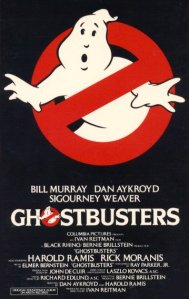 Director: Ivan Reitman
Writers: Dan Aykroyd & Harold Ramis
Cast: Bill Murray, Dan Aykroyd, Harold Ramis, Ernie Hudson, Sigourney Weaver, Rick Moranis, Annie Potts, William Atherton, David Margulies, Slavitza Jovan
Plot: A librarian in the New York is terrified by an apparition that levitates books and spits cards into the air. A team of university parapsychologists are called in to investigate the phenomenon: Dr. Peter Venkman (Bill Murray), Dr. Ray Stantz (Dan Aykroyd) and Dr. Egon Spengler (Harold Ramis). They find a fully-materialized ghost in the stacks, and when it attacks, they flee. Returning to the university, they find that they’ve being evicted for sloppy and inconsistent results, not to mention Venkman’s immature behavior. But Venkman has an idea: Ray and Egon are on the verge of developing a system to capture a ghost. Venkman convinces Ray to mortgage his family home to fund their new operation: the Ghostbusters.
The team buys an abandoned firehouse and sets up shop, but are initially low on clients. They finally get a break when contacted by a violinist named Dana Barrett (Sigourney Weaver). When Dana opens her refrigerator, she sees a bizarre temple with a hellhound that growls a name: “Zuul.” Although she is skeptical of the Ghostbusters’s credentials, she doesn’t know where else to turn, and she winds up bringing Venkman to investigate her apartment. Although he finds no evidence of ghosts, he makes a pass at Dana and vows to solve her problem.
They finally get a paying job when a swank hotel summons them to investigate a disturbance on the 12th floor. Using Egon’s new inventions – a proton pack to use as a weapon against the creatures and a trap to contain them – the three of them locate and capture their first ghost, a little green spudball that manages to slime Venkman before they take him down. Egon does give them one bit of safety advice while working: don’t cross the streams from your proton pack, as “it would be bad.”
Suddenly, the New York area is awash with reports of spectral activity and the Ghostbusters are swamped with work, rushing from one bust to another and becoming media darlings in the progress. They get so busy they hire more help, Winston Zeddmore (Ernie Hudson). As they train him on the equipment, they get a visit from Environmental Protection Agency representative Walter Peck (William Atherton). Venkman refues to show him their storage facility, and Peck promises to come back with court order. Egon, meanwhile, is growing concerned that the amount of spectral activity in the city is growing to dangerous proportions.
Venkman goes back to Dana, telling her he’s found the name Zuul in his research: Zuul was a minion of a dark Sumerian apparition called Gozer. He convinces her to go to dinner with him so they can “discuss the case.” That night, a gargoyle on the roof of her building cracks open, revealing a living hellhound underneath. The beast attacks and pulls Dana into a glowing doorway. A second beast attacks and possesses Dana’s neighbor, the nebbishy Louis Tully (Rick Moranis). When Venkman arrives to pick Dana up, she is clearly possessed, asking him if he “the Keymaster.” She introduces herself as “Zuul, the Gatekeeper,” preparing for the coming of “Gozer the Destructor.” Louis, now calling himself Vinz Clortho, the Keymaster, bumbles through the city seeking the Gatekeeper. The police pick him up and bring him to the Ghostbusters’s firehouse, where Egon examines him.
The next morning Peck returns with the police, an electrical worker, and a court order giving him access to the basement. Although Egon and Venkman implore the electrical worker to leave their machines alone, Peck forces him to turn the containment facility off. The machines blow up, spilling all of the captured ghosts back out into the city, and Louis escapes in the chaos. Peck has the Ghostbusters arrested and brought to jail. While in their cell, Ray reveals that he’s been studying the blueprints of Dana and Louis’s apartment building and believes it was designed to act as an antenna of sorts, drawing ghosts to that spot. It was designed by a Gozer-worshipper who wanted to use it to cause the end of the world. The Keymaster returns to the apartment building, where he and the Gatekeeper ascend to the roof.
The Mayor (David Margulies) has the Ghostbusters brought to his office, where Peck accuses them of using hallucinogens and light shows to take advantage of people. Venkman convinces the mayor to let them out, giving them a police escort and national guard backup all the way to the apartment building, where the roof has transformed into Gozer’s temple. As the Ghostbusters reach the roof an enormous doorway opens, spilling light into the city and transforming Dana and Louis back into the Hellhounds. Gozer appears in the form of a woman (Slavitza Jovan). Ray tries to make contact, but when he makes the mistake of telling her they aren’t gods, she blasts them, nearly hurling them from the roof. (This results in one of the greatest lines, not only in movie history, but in western civilization. Don’t even pretend you don’t know what I’m talking about.)
The Ghosbusters go on the offensive, but Gozer easily evades them and vanishes. Her disembodied voice tells them to choose the form of their destroyer. Although Venkman warns them to empty their minds, Ray is unable to draw a blank. Gozer plucks a form from his mind and the city is suddenly attacked by the enormous form of the Stay-Puft Marshmallow Man. Egon concludes the only way to reverse the portal through which Gozer came to New York is to cross the streams of the proton packs. The plan works, Gozer’s power is eliminated, and the boys, Dana, and Louis miraculously survive. The city proclaims them to be heroes. Which is great, even when you’ve got 22 stories worth of marshmallow to clean up.
Thoughts: The eighties, by my way of thinking, produced three truly great film franchises. George Lucas and Steven Spielberg gave us Indiana Jones. Robert Zemekeis and Bob Gale gave us Back to the Future. And Ivan Reitman and the boys gave us Ghostbusters. Here we are, nearly 30 years later, and the love of this franchise remains undiminished: a sequel and a beloved cartoon series spun off, we’re still seeing video games and comic books, and despite the fact that they haven’t seen the inside of a movie theater since 1989, it’s still one of the most popular Halloween costume choices a person can make. Dressing as a Ghostbuster brings the same cache and recognizability you get if you’re the Boris Karloff Frankenstein or Bela Lugosi Dracula. If you don’t love the Ghostbusters, you are objectively wrong.
To me, this is the quintessential A-Type of horror/comedy. Every beat of the plot is straight out of a horror movie – the opening scenes where the monsters are first identified, the building tension as they grow stronger and stronger, the situation worsening due to the stupid actions of an interloper, and finally a grand climax with the fate of the world at stake. The comedy isn’t slapstick, is rarely broad, and is entirely character-based. Ghostbusters is funny because Bill Murray, Dan Aykroid and Harold Ramis are funny, funny guys.
From the Marx Brothers to the Stooges, these guys have picked up on the comedic power of three by developing a trio of unique, highly entertaining characters. Venkman is all libido, driven by lust and impulse with little regards to the future, the idof the group. Egon is the ego, driven by logic and reason to the detriment of those same baser urges (he barely realizes the way Annie Potts’s Janine throws herself at him throughout the movie). Even in Egon’s rare moments of humanity, such as when he embraces a frightened Janine, he breaks away quickly, clearly uncomfortable showing even that minor hint of feeling.
You’d think this would make Ray the superego, but he’s hardly a balance between the other two. Although his character isn’t as pronounced as it would be in the sequel or the cartoon series, Ray is a sort of wide-eyed innocent, technically very knowledgeable and every bit Egon’s equal, but with a naivety and a love of simple things (like sliding down the fireman’s pole) that serves him well. Of course, this comes back to bite them in the ass when Ray is unable to empty his mind and accidentally chooses the Stay-Puft Man as the form of the destroyer, sent to annihilate New York City. It’s a great moment, in fact, as Mr. Stay-Puft marches down the street, the huge smile on his fluffy face, as he steps on and crushes everything and everyone. Way to go, Ray.
Ray is a child’s id, Venkman an adult’s. If there is a superego in the group (and even this is stretching the metaphor) it would be the mid-film addition of Ernie Hudson’s Winston – the everyman, the audience’s viewpoint character. Winston is the blue-collar guy in the group. He’s the one you can throw back a beer with, the one who is there so Egon can explain the technical stuff, but also to cut through some of Ray and Venkman’s crap. He completes the group in a very unexpected way.
All four of the Ghostbusters serve vital functions, both in comedy and in terms of relatability. We all want to be Venkman, most of us are more like Ray or Winston, but for my money the real underrated comedy gem of the team is Harold Ramis’s Egon. He has a sort of clinical distance, a way of looking at the world as though he isn’t really a part of it, that makes the movie. I was in elementary school when this movie came out, and I remember all the kids talking about Slimer, about the Stay-Puft Marshmallow Man, about Gozer slithering around in her skintight suit that looked like it was made of bathtub bubbles. But if I’m ranking the great moments in this movie, I look at the bit in the hotel when Egon, waving his PKE meter, casually scans a hotel guest, then gives him a little poke in the arm and walks away, clearly disappointed that he’s just an ordinary man instead of a walking corpse. The classic Twinkie metaphor is a close second, but that’s more due to Bill Murray’s brilliant delivery: “What about the Twinkie?”
The film also passes the true test of a memorable comedy: quotability. Aside from the aforementioned Twinkie line, we get such classics as “There is no Dana, only Zuul,” and “Yes it’s true, this man has no dick.” And If not for the Ghostbusters, how would we ever know the correct response if someone asks you if you’re a god? (Hint: “Yes.”)
There were a lot of great movies made in this time period, a lot of great horror films and a lot of great comedies. But here we are, all these years later, and people are still hoping for a third film in the series. Is it the tone of the film? The cast? The way that kids and adults alike can lock on to these characters and this story and enjoy it on totally different levels? I think it’s a combination of all these things, frankly. Whatever the reason, Ghostbusters has permanently chiseled a place in my heart. It’s a fantastic comedy, it’s an awesome monster movie, and it is simply put, one of my favorite films of all time.
Lunatics and Laughter Day 5: An American Werewolf in London (1981)
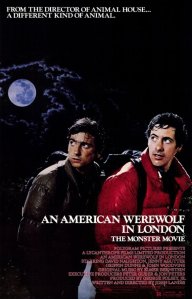 Director: John Landis
Writer: John Landis
Cast: David Naughton, Griffin Dunne, Jenny Agutter, Anne-Marie Davies, John Woodvine, Frank Oz
Plot: American college students David Kessler (David Naughton) and Jack Goodman (Griffin Dunne) are backpacking across Europe, beginning in northern England with plans to work their way south to Italy. The plans are shattered, though, when they stop at a small-town pub called the Slaughtered Lamb in the town of East Proctor. The locals distrust them, and Jack distrusts the five-pointed star painted on the wall. They leave, disturbing the barmaid and prompting warnings to stay on the road and beware the moon. The Americans are attacked by a huge wolf, which kills Jack and bites David before the villagers arrive and shoot it down. As he passes out, David sees that the beast has turned into a man.
He wakes up in a hospital in London three weeks later, where the police take his statement, but believe he was attacked by a lunatic rather than an animal. One of the Nurses, Alex Price (Jenny Agutter) takes a personal interest in him, convincing him to eat even when he isn’t hungry, keeping him company at night. He begins having dreams of running through the woods, naked, slaughtering and eating animals, then later seeing himself in a hospital bed, threatening Alex. After a particularly bad dream, Jack appears in his room, chatting jovially with his friend despite the fact that he’s a mutilated corpse. As David struggles to figure out if he’s dreaming, Jack starts quipping about his own funeral, putting him at ease before he can drop the bomb on his buddy. They were attacked by a werewolf, and since he was killed by a supernatural being Jack is cursed to walk the earth until the werewolf’s bloodline is severed. David, bitten by the wolf, is now part of that line, and Jack begs him to kill himself so they can both find peace. Jenny comes into his room, thinking him waking up from another nightmare, and he kisses her and declares himself a werewolf. When David is discharged, Jenny invites him to stay with her, and their relationship progresses quickly. Despite his newfound happiness, Jack’s corpse continues to haunt David, again begging him to kill himself before tomorrow’s full moon.
David’s doctor, Dr. Hirsch (John Woodvine) drives to the town where David was attacked, trying to figure out why David’s version of events differs so greatly from the official report. He finds himself blocked by the same villagers who turned out David and Jack, but this time, one is willing to talk. He warns Hirsch that David is in danger, and will “change” with the full moon. That night, as Jenny works a late shift at the hospital, the predictions come true – David undergoes a terrifying change from man to monster. He rushes into the night and attacks people, as the previous werewolf attacked him. Hirsch returns to London and compares notes with Jenny. Convinced that something is wrong in East Proctor – and wrong with David by extension – he calls her apartment. When David doesn’t answer, he calls the police.
The next day, David wakes up in the zoo, naked, in a wolf pen. With some quick thinking, he covers up and gets away. Hirsch, meanwhile, finds the morning paper full of stories about a brutal series of murders where the victims were half-eaten. When David returns to Alex’s apartment, particularly excitable and enthusiastic, she plans to take him back to the hospital. Along the way, the cab driver tells them about the murders, and David flees, planning to turn himself into the police, but the officer dismisses him. He runs away and Alex, Hirsch and the police who investigated his attack begin searching for him. David calls his family in America, hurriedly telling his sister he loves her before attempting to slit his wrists. Finding himself unable to do so, Jack’s corpse appears again, leading David into an adult ovie theater. The corpse, now more decrepit than ever, introduces David to the people he killed the night before, now trapped as a living dead just like Jack. He’s still in the theater when night falls again, and the killing begins again. The wolf escapes into the London streets, going on a bloody rampage, killing some and causing traffic crashes that kill many more. The police corner it in an alley and Alex rushes to the scene, approaching it and trying to draw the real David out. It lunges at her and the police open fire. The beast turns back into David as it dies, and Alex weeps.
Thoughts: Reportedly, director John Landis wrote the first draft of this script in 1969 and fought for over a decade to get it released, as studios thought it was too funny to market as a comedy and too scary to market as a horror film. You’ll excuse me if I find that just precious – as the whole point of my project is that the two both can, and have worked hand in hand for decades. On the other hand, the fact that I’ve located so few great horror/comedies before 1980 to include in this project seems to indicate that it wasn’t always the relatively easy sell it is today, and I have to suspect the success of An American Werewolf in London is one of the things that helped turn the tide and convince filmmakers that the conflicting styles could, and do, work together.
Landis is clearly a fan of the old Lon Chaney Jr. Wolfman pictures, even throwing out several references to them throughout film. He goes much farther than Universal could in the 40s, though, showing extremes of violence that wouldn’t have been allowed at the time. His special effects are, as to be expected, considerably more advanced as well. The transformation scenes are very good – simply done, but effective. Not to harp on it, but there’s no way this movie would be made today without giving in to the temptation to do the entire transformation via CGI (see the 2010 remake of The Wolfman if you don’t believe me), and that would really kill one of the most memorable sequences in this film. Naughton’s performance during the transformation is really excellent – even before any of the special effects show up he’s putting on a terrific, very convincing show of agony that makes you receptive when the limbs and face start to transform and the hair begins to sprout.
But the truly innovative thing about the movie, to me, is the tone of the film. This takes us back to a Type A picture, and an extreme Type A at that, far more horror than comedy. Landis basically wrote a monster movie, a modernized retelling of the Lon Chaney Jr. picture, and laced it with just enough humor and off-the-cuff commentary to market it partially as a comedy. Most of the humor actually comes through Jack – a snarky type even when he’s alive, but he becomes the master of the deadpan quip after he dies. David gets a little bit of physical comedy later, once he transforms for the first time. The sequence where he tries to sneak out of the zoo naked, stealing bits and pieces of cover-up along the way, feels like it could have fallen out of an old Marx Brothers or Hope and Crosby routine.
Landis is great at pulling an emotional reversal as well. When David calls home and tells his sister he loves her, there’s a horrible sense of finality to it. It’s a very genuine moment, where you understand you’re listening to a man who’s planning to die, trying to get everything straight before it happens. Considering that David was dancing around in a red fur-trimmed coat just minutes before, the viewer is left completely unprepared. The pace of the film as a whole is surprising, in fact. There’s a very long build-up to David’s first transformation, and once he realizes he’s responsible for the murders you blink and realize there are only about 20 minutes left in the film. It feels like there should be more, like everything has happened much too fast. When the end finally comes, it’s over in the blink of an eye. BAM-David is shot! Alex cries! Begin credits! There’s no denouement to cling to, no moment to allow your emotions to work themselves out before you feel a bit of a tear turn up for the poor American who became something he never wanted to be, did terrible things he never wanted to do, and died in a way he never would have wanted to die. It was a departure for Animal House director Landis and it’s a bit of a departure for this project, but it’s a good one.
Lunatics and Laughter Day 4: Attack of the Killer Tomatoes (1978)
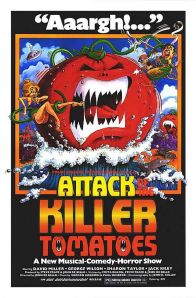 Director: John DeBello
Writer: Costa Dillon, John DeBello, Steve Peace, Rick Rockwell
Cast: David Miller, George Wilson, Sharon Taylor, Steve Peace, Ernie Meyers, Eric Christmas, Ron Shapiro, Al Sklar, Jerrold Anderson, Don Birch
Plot: A series of people begin dying in assorted tomato-related incidents: a man keels over drinking a glass of tomato juice, a woman is beaten to death by a tomato in the kitchen, a boy is gobbled up by a tomato… and the authorities scramble into action to solve the crisis. Presidential Press Secretary Jim Richardson (George Wilson) is sent to calm an increasingly worried public, but when he fails, the task of halting the tomato menace is given to top agent Mason Dixon (David Miller). Miller and his team of “experts” begin their investigation even as the attacks continue and the government feels more and more pressure to take action. Meanwhile, gossip columnist Lois Fairchild (Sharon Taylor) is given the task of reporting on the tomato menace, mostly because everybody else is busy.
Dixon and his team pick up their final member, Lt. Wilbur Finletter (Steve Peace), and the members are sent out on individual missions. Richardson is sent to meet Ted Swann(Al Sklar), head of the “Mind Makers” agency, about ways to convince people that tomatoes are safe. His sales pitch (including a spontaneous and incongruous musical number) fail to do the job. Things only get worse when Dixon encounters a scientist studying a tomato the size of a basketball. The real horror, however, comes in the revelation that this is merely a cherry tomato – the full-sized ones have grown enormous. Mere moments later, one of Dixon’s team is murdered by a tomato the size of a man. Dixon continues to seek a way to combat the menace, but it grows all the more intense, with attacks across the country and people panicking at the slightest reference to the deadly fruit.
Fairchild, stymied by her lack of progress in the case, begins to trail Dixon’s team, finally winding up in Finletter’s hotel room in an attempt to charm him with her feminine wiles. Instead, he mistakes her for an enemy spy and drives her out, screaming. Dixon, meanwhile, is fired upon by a hidden gunman – someone is trying to stop his investigation. The would-be assassin comes after Finletter next, but loses him across a railroad track. The army forces amass as the tomatoes make a brutal assault, destroying large portions of the country, somehow “burning, pillaging, and raping” along the way. (The movie doesn’t explain it and I don’t want to ask.) Dixon and Finletter get caught in a high-speed chase with the assassin, which turns into a slow-speed race as both cars malfunction. Dixon is captured, only to discover the killer is Richardson. He plans to use the tomatoes to overthrow the government and seize power in the chaos. Finletter saves Dixon and kills Richardson, but does so right before Richardson is going to confess the secret of controlling the tomatoes. Dixon realizes that the tomatoes have failed, twice, while the hit song “Puberty Love” has been playing on the radio. He has Finletter bring all the people left in the city to a football stadium, where the tomatoes predictably come to attack. They are rendered helpless, however, when “Puberty Love” blasts from the speakers. As the tomatoes shrink back to normal size, the humans press the attack, smashing and squashing them into pulp.
Thoughts: From the opening crawl, this movie takes its refuge in audacity. John DeBello decides to start the film by reminding people of how silly the concept of Hitchcock’s The Birds seemed in 1963, and that a real-life bird attack in 1975 made people stop laughing. I don’t know if there’s any truth to that at all, but you’ve got to admire the guts of the man who made this movie starting things off by comparing tomatoes to seagulls… or for that matter, himself to Hitchcock.
But that’s actually part of the movie’s bizarre charm. Starting with the crawl and going into an almost disturbingly-catchy opening theme song over credits that include several jokes (including a few “advertisements” and a blatant lie about the story’s origin), there is never any chance that this is a movie that takes itself too seriously. It can’t. And it knows it can’t. So it starts with the ridiculous. It’s another Type B horror/comedy, and a far broader one than Young Frankenstein, but it still stays close enough to the concept of legitimate storytelling to remain entertaining instead of just being a litany of joke after joke after joke.
The “killer tomato concept, in and of itself, comes across as a parody of 1950s sci-fi films, so many of which featured ordinary creatures – ants, lizards, and even the occasional plant – mutating into killing machines. As few of those films were self-aware enough to roll with the joke, though, Attack does it for them. The horror nods don’t stop there, though. The opening sequence feels like it was taken from a George Romero zombie movie, featuring random attacks striking random people. The scene where the girl swimmers are assaulted by tomatoes from beneath is a clear reference to Jaws (even down to a musical sting that mimics the John Williams theme without treading quite close enough to feel like legal action should be considered).
Now I’m not going to lie to you and say this is a good movie. The acting is miserable, the effects are weak, and at no point are you convinced that the tomatoes are actually “attacking” (a better term to use is “being lobbed gently at the actors from immediately off-camera”). Some of the humor does get a little too broad, as well. Taylor’s character seems to be named “Lois” purely for the sake of slipping in a Superman joke that doesn’t really go anywhere or add anything. But despite these relatively mild gripes, there’s still something oddly, inexplicably charming about this movie.
Part of it, I think, is that I never knew exactly how zany it is. I’ve heard of the movie for years, even watched the cartoon spin-off in the 90s (it didn’t last long, don’t be surprised if you never heard of it), but I guess I always had it in my head that it was a more tongue-in-cheek sort of film. Instead, it’s a straight-up spoof movie, and it hit me at a time when I wasn’t expecting one and, at the same time, was particularly turned off of them after seeing such a flurry of poor ones in recent years. In contrast, a lot of these jokes actually do hit. Sam Smith’s terrible (yet astonishingly effective) disguise skills never failed to elicit at least a chuck from me, and an early gag in which a Japanese scientist – all of his dialogue poorly dubbed for no real reason – accidentally knocks a very unfortunate picture into an aquarium pulled one of those simultaneous gasps and laughs. It was that moment where you start to laugh because it’s funny, then immediately try to stop yourself because you know it shouldn’t be. It’s not easy to do that really well, and if you fail to land a joke like that it’ll kill you. This doesn’t.
Some of the writing is also really clever. The bit where Dixon, Finletter, Fairchild and her editor all argue on the phone is cut perfectly, at one point making you question who was talking to who. The dialogue itself isn’t actually funny, but when cut together in such a way that you wonder if the speakers have somehow gotten their lines crossed, it makes you laugh.
This movie is, of course, a cult classic at best, but that’s fair. A lot of those movies that have a small but dedicated audience fall into that category, and even more of them blend together the horror and comedy tropes that mash up so very, very well. This is a movie you start to watch expecting it to be so bad it’s good. The fact that there are a few moments where it’s actually, genuinely good is a nice added bonus.
Lunatics and Laughter Day 3: Young Frankenstein (1974)
 Director: Mel Brooks
Writers: Gene Wilder & Mel Brooks
Cast: Gene Wilder, Peter Boyle, Marty Feldman, Cloris Leachman, Teri Garr, Kenneth Mars, Madeline Khan, Richard Haydn, Gene Hackman, Anne Beesley
Plot: Dr. Frederick Frankenstein (pronounced “Fronkensteen,” Gene Wilder), grandson of the infamous Victor Frankenstein, leaves his inconsistently affectionate fiancé Elizabeth (Madeline Khan), for Transylvania. He is met by Igor (“I-gor,” Marty Feldman), grandson of his grandfather’s assistant, and Inga (Teri Garr), his temporary lab assistant, who quickly displays more affection than the fiancé he left behind. Frankenstein’s castle is kept by Frau Blucher (Cloris Leachman), who Frederick questions about his grandfather’s “private” library. That night, Frederick is awakened from a nightmare by Inga, and, after a classic spinning bookcase gag, the two of them locate a secret passageway. At the bottom of a cobweb-covered staircase, they find Igor and the elder Frankenstein’s lab. Frederick reads his grandfather’s notes and finds the secret of animating lifeless matter, something he always believed impossible.
Igor and Frederick steal the corpse of an enormous, freshly-executed man to repeat Victor’s experiment. Igor goes on his own to steal a suitable brain for the beast, but as happened to his grandfather, fumbles with it and is forced to take an abnormal brain instead. In town, the people fear Frankenstein’s grandson, certain he is repeating his grandfather’s crimes (which, of course, he is). They recruit Inspector Kemp (Kenneth Mars) to discover what Frederick is doing.
That night the Monster (Peter Boyle) comes to life. Although he seems gentle at first, when Igor strikes a match, he goes berserk and nearly kills Frederick. Igor confesses that he took a brain from “Abby Normal” just as Kemp arrives. Frederick sends him off, but while he’s preoccupied Frau Blucher finds the monster and releases it. The creature breaks free from the castle, and Frederick vows to find it before it can hurt anyone. They set a trap for it the next evening, luring it with a violin and sedating it. Frederick insists upon trying to convince the creature it is loved. As he speaks to the beast, he not only takes it under his wing, but accepts his own destiny, declaring, “MY NAME IS FRANKENSTEIN!”
He presents the creature to the town, charming them with a song and dance routine before a light blows and it turns on the crowd and the police haul it away. As Frederick and Inga find comfort in each other’s arms, they receive a telegram that Elizabeth will be coming to the castle that night. After Elizabeth again rebuffs Frederick’s advances for the night, the creature – having escaped — returns to the castle. She passes out and he takes her with him to a hiding place in the woods, where she soon succumbs to its own animal desires. After a mere six times, though, the violin from the castle summons him back. Frederick decides the only way to protect the creature is to use his own brain to stabilize it. Kemp leads an angry mob, complete with torches and pitchforks, into the castle, and are about to make off with Frederick’s body, when the stable creature commands them to put him down. He gives a stirring speech and Kemp realizes the error of his ways. In the end, Frederick and Inga are married, whilst Elizabeth and the creature go off to enjoy domestic bliss of their own.
Thoughts: Coming off the magnificent western/comedy Blazing Saddles, it’s not surprising that Mel Brooks would turn his attention to the horror/comedy genre. (He’d later tackle the epic in History of the World Part I, science fiction in Spaceballs and high adventure with Robin Hood: Men in Tights. He’d return to horror with Dracula: Dead and Loving it, but the less said about that one, the better.) Working off an idea by Gene Wilder, these two took one of the most enduring classics of horror and turned it into one of the best horror/comedies ever.
Young Frankenstein works as a kinda-sequel to the original Frankenstein, building on the mythology of the original Universal films even though there was no official connection. (Young Frankenstein was produced by 20th Century Fox.) It doesn’t really contradict any of the older films, at least no more than some of the official sequels did, but it takes the franchise into an entirely different direction. This is the first film in my little experiment that I’d classify as a “Type B” horror/comedy – more comedy, but using the tropes of horror and spoofing them. The difference is in the plot, really – what puts this in the second category is that the story couldn’t exist without the comedy tropes. Even Abbott and Costello’s antics with the monsters followed a fairly straightforward scary movie plot for the 1940s, whereas certain elements of this film could not be removed or altered without drastic changes being made to the story structure. You could maybe replace the musical number towards the end with something more King Kong-eque, but that would simply feel derivative. And it’d be a lot harder to play up the creature’s abduction and romancing of Elizabeth without the comedy elements in any way that doesn’t make it tread uncomfortably close to plain rape.
The other thing, and the more all-encompassing thing, that makes this a Type B is the characterization. In a Type A universe, we’ve got a frightening situation populated by some funny characters. Bela Lugosi wasn’t a quippy Dracula, and Bob Hope’s cracks about the ghosts were only funny in the context of a world where nobody would take such a thing seriously. Not so for Type B, where all characters – and everything else – can become fodder for humor. In Young Frankenstein, as in most Mel Brooks comedies, anybody can play straight man to anybody else at any moment. Everyone can crack a joke or make a comment that’s hysterical – to the audience. In-universe, however, nobody recognizes the humor.
The only exception would be Marty Feldman’s Igor, who leans heavily on the fourth wall, winking at the audience, and throwing out some meta-puns that make him seem both wackier than and more savvy than the rest of the characters. His comedy is easily the broadest of the troupe Brooks and Wilder assembled, and he’s probably the funniest as well. His timing is flawless, his sense of propriety non-existent, and his ability to key into other comedy from other eras makes his performance as funny now as 40 years ago.
What elevates this above most other Type B horror/comedies (coughScaryMoviecough) is the way Brooks and Wilder are still capable of crafting real characters instead of caricatures, telling a real story instead of just creating their own Frankenstein-patchwork of other movies. Even this film, which literally could not exist without Mary Shelley’s Frankenstein as its inspiration, feels fresh and original.
Just as important, Brooks and Wilder don’t simply repeat moments, but build upon them. The crummy spoofs of the 21st century are frequently completely devoid of actual jokes, instead just referencing a better movie under the assumption that the audience will understand the reference and laugh at the recognition. This is a stupid, asinine way to make a movie that far too many of my 11th grade students mistake for humor. In a Brooks comedy, though, we touch on the familiar moments and make them new. Igor stealing the brain, for example, begins with a glance at the camera, because he knows that we know what’s coming. Then, when the brain of a “scientist and saint” is accidentally destroyed, he goes for the abnormal brain immediately, despite the fact that the next brain over is clearly labeled “visionary.” The camera just pans past the other label, though, and a viewer may watch the movie two or three times before they even notice it. Modern films are incapable of this sort of subtle, Easter Egg humor – a film by Jason Freidberg and Aaron Seltzer (perpetrators of such crimes against comedy as Meet the Spartans and Vampires Suck) would be sure to hover over that label, make sure everybody sees it, and drain every iota of comedic potential from it before moving on to what everybody knows they’re going to do anyway.
Modern spoof movies suck, is the point I’m trying to make.
Anyway, the film is built on small moments. Kenneth Mars’s assorted shtick with his artificial arm, the disastrous game of darts, and the bit where a choking Frederick has to play charades to make his incompetent accomplices understand he wants them to sedate the monster that is actively murdering him are the sorts of thing that make for a great spoof. None of these are repeat jokes, they’re built on the characters and story as presented instead of spending all their time making allusions to everything else. In fact, except for the full-film allusion to the original, the only references to anything else are when the town elders imply they’ve dealt with monsters five times in the past (referring, of course, to the line of Frankenstein pictures made by Universal) and Madeline Kahn’s hairstyle after she becomes the creature’s “bride.” And as those are both clearly references to the Frankenstein lore as a whole, if not the first movie specifically, we accept them.
When the movie references the original directly, it often does so in order to subvert it. When the creature encounters a little girl playing with flowers, we’re prepared for the worst, based on what happened to the little girl in the Boris Karloff original. Instead, we get a hysterical seesaw gag which completely takes us by surprise and is more than funny enough for us to forgive the fact that it really doesn’t have anything to do with the rest of the story. Gene Hackman’s cameo as the blind man serves a similar purpose – not actually progressing the plot, but showing us the character of the beast as it attempts to make friends and is thwarted, not because he’s a monster, but because his potential companions aren’t entirely capable.
When I asked for help assembling the movies for Lunatics and Laughter, one of the first suggestions I got was Scary Movie. And while I considered it, I decided not to do it, at least for the first phase. It may make the expanded edition, but only because of its influence on movie as a whole, not because of the quality. As you’ll see as we continue our march to Halloween, the vast majority of the movies I’ve chosen for this project are A-Type horror comedies, because most of the B-Types, frankly, are terrible. This is hands-down the best, the finest, the funniest horror spoof I’ve ever seen, and it’s frankly ruined me for most of the other ones. And for that, Mel Brooks and Gene Wilder most assuredly have earned my thanks.
Lunatics and Laughter Day 2: Abbott and Costello Meet Frankenstein (1948)
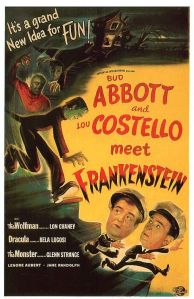 Director: Charles Barton
Writers: Robert Lees, Frederic I. Rinaldo & John Grant
Cast: Bud Abbott, Lou Costello, Lon Chaney Jr., Bela Lugosi, Glenn Strange, Lenore Aubert, Jane Randolph, Frank Ferguson, Charles Bradstreet
Plot: Chick and Wilbur (Abbott and Costello, respectively, although why they even bothered with giving their characters names at this point is beyond me) are employees of a delivery company. They get a nervous phone call from Larry Talbot (Lon Chaney Jr.) in London, asking about a pair of crates being sent to a house of horrors. He tells them that he’s flying to Florida the next day, and they are under no circumstances to deliver the crates until he arrives. The full moon rises in London and Talbot undergoes a startling transformation, becoming a Wolfman. Confused by the growling on the phone, Wilbur hangs up. Moments later, Mr. McDougal (Frank Ferguson) arrives to pick up the crates, which he claims contain the remains of the true Count Dracula and Frankenstein Monster. He tells this to Sandra (Lenore Aubert), Wilbur’s girlfriend, who Chick thinks is far too alluring to be with his bumbling friend.
Despite the call from Talbot, McDougal has the proper paperwork, so Chick and Wilbur deliver the crates To McDougal’s House of Horrors. Wilbur is on-edge, surrounded by the creepy contents, but Chick is convinced Dracula and the Monster are just characters from stories. As he leaves Wilbur alone, Dracula (Bela Lugosi, reprising his role for the first time since 1931) rises from his coffin, terrorizes him, and mesmerizes him. With Wilbur entranced, Dracula awakens the Frankenstein Monster (Glenn Strange). McDougal and Chick arrive and argue over where the exhibits are while Wilbur, hysterical, tries to explain what happened, but McDougal has them arrested.
Dracula flies to a remote castle where waits Dr. Stevens (Charles Bradstreet) and his assistant… Wilbur’s girlfriend, Sandra. Dracula wants to avoid Frankenstein’s mistake and give the monster a new brain, one so simple and naïve that it will never question his master. Sandra, of course, has just the brain in mind.
Talbot finds Wilbur and Chick, just out of jail, and confirms Wilbur’s story. He has been chasing Dracula, but he can’t go to the police for fear of revealing his own secret. As the moon is about to rise, he gives Wilbur the key to his hotel room and begs him to lock him up overnight, not letting him out no matter what he hears inside. Wilbur’s compliance lasts almost 45 whole seconds, before he goes into Talbot’s room to bring him a bag he left behind. In another comedy sequence, Wilbur narrowly avoids being torn to shreds by a Wolfman he never sees.
McDougal, furious over Wilbur and Chick’s release from jail, meets insurance investigator Joan Raymond (Jane Randolph), who plans to use her feminine wiles to trick Wilbur into revealing the location of the missing exhibits. She narrowly avoids Sandra, who came by to arrange a meeting with Wilbur for that evening’s masquerade ball. Joan convinces him to take her to the ball as well, and while Wilbur revels in his two dates, Chick tries to figure out what his dumpy friend has that he doesn’t. (As Sandra tells him, “A brain.”) The two go to Talbot’s room, where they find it’s been torn apart. Talbot wakes and tells them about his curse – he was bitten by a werewolf, and transforms whenever the moon was full. As Wilbur saw the monsters, he pleads with him to help him. They don’t believe him, and continue their preparations for the ball.
Chick, Wilbur and Joan pick up Sandra for the ball (Wilbur allowing each girl to believe the other is Chick’s date). Sandra finds Joan’s ID card for the insurance agency, while Joan finds Sandra’s copy of Frankenstein’s book on life and death. Each suspicious of the other, they return and meet Sandra’s employer, Dr. Lejos, who Wilbur somehow fails to recognize as Dracula wearing a robe instead of his cape. Lejos insists that Dr. Stevens join them for the party, but Sandra suddenly claims she has a headache and can’t go. She brings Dracula aside and says that Joan and Wilbur’s snooping and Stevens’s inconveniently inquisitive nature are making the operation too dangerous. Angry, he hypnotizes her and bites her, and they go to the ball.
At the ball, Chick and Wilbur encounter a fearful Talbot, who is upset by Chick’s wolf-mask. Sandra, now a vampire, tries to bite Wilbur, but he’s saved by Chick and Talbot, seeking the now-missing Joan. As they search, the full moon appears and Talbot transforms. He attacks McDougal, who blames Chick when he sees the wolf-mask. The party goes mad and people flee, with Chick and Wilbur finding a hypnotized Joan with Dracula. He mesmerizes the boys and takes Wilbur and the girls away. Finally convinced, Chick finds Talbot and they go to Dracula’s mansion, where Wilbur’s brain is being prepared for transplant. Talbot and Chick burst in. Talbot is about to free Wilbur, but once again, he transforms, and Frankenstein’s Monster breaks free. The five of them engage in a mansion-encompassing battle of positively Scooby-Doo-ian proportions, until finally the Wolfman seizes Dracula and they plunge off a cliff. The Monster chases Chick and Wilbur to the dock, where Stevens and Joan set him on fire. As they sit in a boat, Wilbur berating Chick for not believing him, a cigarette hovers in the air, and the unmistakable voice of Vincent Price introduces himself… he’s the Invisible Man.
Thoughts: This film is, inarguably, the greatest horror-comedy ever made. Okay, maybe it’s not inarguable. You can argue it. You’d just be wrong. What’s not arguable, however, is that it is by far my favorite movie out of all the films selected for Lunatics and Laughter, and (with the possible exception of Ghostbusters) the one that I’ve watched the most times. It isn’t Halloween unless I see Bud and Lou go toe-to-toe with the greatest Universal Monsters.
That, in fact, is what makes this such a fantastic movie, friends. Universal Studios took their two greatest comedic stars at the height of their popularity and mashed them into a movie with three of their most popular monster franchises, even getting the classic Bela Lugosi and Lon Chaney Jr. to reprise their roles as Dracula and the Wolfman, respectively. (Only Boris Karloff as Frankenstein’s monster is missing from the classic trinity, and he would get his chance to dance with the boys later in Abbott and Costello Meet the Killer, Boris Karloff and again in Abbott and Costello Meet Dr. Jekyll and Mr. Hyde).
It’s such simple alchemy – director Charles Barton got five amazing performers and allowed them to do what they do best for 83 incredible minutes. Abbott and Costello pull off the same sort of brilliant wordplay and slapstick that made them Hollywood legends, while Lugosi, Chaney and Strange (playing the Monster for the third time since Karloff’s retirement) give their performances all the force and horror they had in their respective series. The film doesn’t bother with little things like continuity either – there’s no effort to explain how Talbot knew Dracula or the monster, how Dracula found the creature’s remains, or even how any of the monsters were alive, as most of them had a tendency to die at the ends of all of their films. The sequels usually had a halfhearted resurrection scene, but Barton sees no need to even bother with that. The audience doesn’t care about any of these things. They know who Bud and Lou are, who Dracula and the Wolfman and the Monster are, and that’s all they need.
And damned if they weren’t right.
Like I’ve said, comedy and horror are flip sides of the same coin, and I’ve never seen a movie that demonstrates it as perfectly as this one. Our five lead characters (because that’s who Bud and Lou are, no matter what names they were using in the movie, they played the same two characters they always did) come from totally different styles of film: slapstick comedy and tales of pure terror. But when we put them together there is no clash. Everybody is themselves, everyone is entirely in-character, and it all fits together seamlessly. Even the scenes with Lugosi popping in and out of his coffin, giving Costello the stimuli for one of his legendary freak-outs, works for a Dracula who simply enjoys toying with his eventual prey. He even pulls the same sort of hypnosis and gets the same light-across-the-eyes treatment as he did in the original 1931 version of Dracula.
The plot, meanwhile, is straight out of the horror movie handbook. Dracula’s scheme to give the monster a simple brain keys into Costello’s movie persona perfectly. At the same time, it’s still the kind of devilish plan that many a horror movie villain has concocted over the years. Hell, let’s be honest – it’s a more logical plan than thousands of the others movie monster baddies have conjured up over the years. Talbot’s logic – “the police won’t believe me unless I tell them I’m a wolfman” – is kind of sketchy. It’s more likely they’ll just think him even crazier. But it’s still the same sort of logic that dominated this sort of movie back in the 40s and 50s, and therefore is easy to forgive. Similarly, the special effects are of the highest quality available at the time. Talbot’s werewolf transformation looks as good as it ever did in his own films. And while it may be pretty obvious that the Monster burning on the dock at the end is a mannequin being pushed along with sticks, in 1948, how else were you gonna get that shot?
Truly, the only moment that strains credibility, even for the time, is when Talbot and Chick plan their rescue mission. Talbot tells Chick they should hide and wait, since it is now morning and Dracula will be helpless until nightfall. Um… wouldn’t that make this the perfect time to attack? Come on, dude. (Honorable mention, though, goes to the fact that Talbot makes his transformation four nights in a row. Isn’t three usually the limit for a full moon?)
Bud and Lou, a classic vaudevillian comedy team whose act translated to film and television far better than most of their contemporaries, pull off a lot of the same shtick they usually do. They engage in verbal battles, with Bud tossing out unnecessarily complicated words so Lou can amusingly misunderstand them. Bud leaves Lou alone at inconvenient moments so he can be the sole witness to creepy happenings and have entertaining panic attacks. And once or twice, Lou is allowed to get the better of his buddy in a battle of the logical fallacies. In short, they take their standard routine and inject it into a horror movie. But not for one second does it feel forced, do any of the comedic interludes feel like a distraction, or does any of it feel like padding. They’re just there to have fun, as they always do. (Reportedly one scene – where Wilbur sits on the Monster’s without realizing it – took an absurdly long time to film because Glenn Strange simply couldn’t stop laughing at Costello’s antics in his lap.)
Even the old comedy trope – the panicky one sees the madness, the straight man conveniently misses everything until the last minute – feels fresh and original here. And no, it wasn’t, not even in 1948. When Chick pulls out the wolf-mask, you just know there’s going to be a moment when Wilbur encounters the real Wolfman and thinks it’s his buddy in disguise. You’re waiting for it. You would feel disappointed if it didn’t happen. But Abbott and Costello never disappointed on that front.
The finale is simply great. From the moment Talbot and Chick arrive at the mansion until Vincent Price makes his uncredited cameo, we go through one chase after another, with doors and props being smashed at every turn, our heroes bumbling into the monsters at the worse possible moments, often saved through circumstance, luck, or the good ol’ Rule of Funny. If you are physically capable of watching this movie without laughing, you need intense psychoanalysis. And if you didn’t love the Universal monsters before, this will do the trick.
Lunatics and Laughter Day 1: The Ghost Breakers (1940)
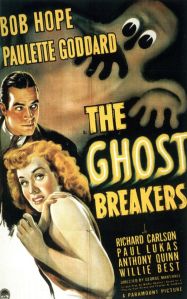 Director: George Marshall
Writers: Walter DeLeon, based on the play The Ghost Breaker by Paul Dickey & Charles W. Goddard
Cast: Bob Hope, Paulette Goddard, Richard Carlson, Paul Lukas, Willie Best, Pedro de Cordoba, Virginia Brissac, Noble Johnson, Anthony Quinn
Plot: On a rainy evening in New York City, Mary Carter (Paulette Goddard) packs to visit her great-great grandfather’s “haunted” island off the coast of Cuba, which she has inherited . Although the Cuban representative Havez (Pedro de Cordoba) tries to dissuade her from visiting, Mary is skeptical of the claims of ghosts on what he calls “Black Island.” Elsewhere in the hotel we meet radio “ghostbreaker” Lawrence Lawrence (Bob Hope), who reveals secrets, uncovers skeletons in the closet, and blows the lid off, as he puts it later, “family ghosts.” Larry is planning to leave for fishing vacation after that evening’s broadcast with his valet, Alex (a somewhat insensitive racial stereotype, by modern standards, played by Willie Best). When Mr. Parada (Paul Lukas) arrives to transfer the castle to Mary, he offers her a princely sum of $50,000 for the land. Before she decides on the deal, she receives a mysterious phone call from a man named Ramon (Anthony Quinn) warning her not to sell. The combination of the call and the offer simply makes her more determined to visit her grandfather’s estate. Left alone, she listens to Larry’s radio broadcast where he dishes on a mob operation.
When Larry returns, there are a series of shootings in the hallways and Larry believes he kills Ramon. Mary helps him hide as the police search the building, but he winds up in her trunk and is mistakenly sent to her cruise ship. Mary and Alex locate the trunk, but are unable to free Larry before he’s loaded onto the ship. In her room, Mary receives a letter warning her that death awaits her on the island. Alex helps Larry out and shows him a newspaper report about the shooting (remember evening editions? Neither do I) where he points out that Ramon was shot by a different caliber bullet– Larry couldn’t have killed him. Larry realizes someone is trying to intimidate Mary into avoiding the castle. As they discuss the situation on the deck, someone pushes a heavy potted plant over a railing, nearly killing the couple. They flee back to her stateroom, where the strain of the evening starts to show on Mary. When Alex arrives and says they can ride back to New York on a speedboat if they hurry, he refuses to leave, determined to help Mary. Before leaving the ship, Parada warns Larry about the castle, while Mary runs into an old acquaintance, Geoff Montgomery (Richard Carlson) who is skeptical of Parada and tries to warn her from dealing with him. Larry is excited when Parada tells him about a voodoo priestess on the island, one who allegedly has the power to create mindless zombies. (“You mean like Democrats?” Larry quips.)
That evening Geoff begins to romance Mary, who asks him to accompany her to Black Island. He refuses, fearful of the zombies. Mary is shocked when she believes she sees a ghost – Ramon, the murdered man. He introduces himself as Ramon’s twin brother, Francisco Mederos, who angrily demands information about his brother’s death. Larry and Alex, meanwhile, have taken a rowboat out to Black Island, where they encounter “Mother Zombie” (Virginia Brissac) and one of her zombies (Noble Johnson). They enter the house, where they hear noises that indicate someone else is there and find a strange painting that is the perfect image of Mary – her great-great-grandmother Maria. The two split up, and Alex observes a ghostly figure emerging from a trunk. Larry chases but only finds a skeleton. At the shore, Mother Zombie watches as Mary suddenly swims onto the beach carrying a waterproof bag with a dry robe. Inside, Larry and Alex hear Mary calling for them, but believe it’s a trick. She, meanwhile, hears voices telling her to run away before it’s too late – but runs right into the clutches of the Zombie. She flees, observed by the hidden Parada, who himself is captured by an unseen figure. Larry and Alex are attacked by the Zombie, hiding in a suit of armor, but before the creature can deliver a death-blow, they see the image of Maria Sebastian walk down the stairs. As it is distracted, Larry and Alex lock it in a closet and run to Maria – really Mary wearing her great-grandmother’s clothes after her own were ripped fleeing from the zombie. Mary notices the painting of Maria is pointing towards the crypt, and she and Larry investigate. In the crypt, Larry and Mary find Parada stabbed, stuffed in one of the caskets, bleeding to death. As he dies, he directs them to the organ in the crypt. Mary solves the puzzle, using the organ to open a hidden door that leads to an old mine beneath the castle. Francisco and Geoff both appear with guns, and Geoff shoots the gun from Francisco’s hand backing the other three against the wall. Geoff reveals that he was behind the threats and the offer to buy the castle, determined to gain ownership of an enormous vein of silver beneath the island. He’s about to shoot them, but the ceiling above collapses and clobbers him. A puzzled Alex looks down and says, “Boss, did I press the wrong button?”
Thoughts: At the top of his game, Bob Hope was one of the funniest human beings ever placed on the planet. He had a sly, sharp wit that was just this side of being truly subversive, and was just as likely to deliver a merciless zinger as he was to take a shot across his own rather prodigious nose. It’s not surprising, given the immensity of his library, that we start our march through the creepy comedy catalogue with him.
From the beginning, this film demonstrates how far afield certain comedies go. If you strip the movie down to its bare plot, it’s actually pretty dramatic – a reporter Is falsely accused of murder, flees from justice, and winds up in a haunted house. It could very easily be the set-up for a more traditional horror movie. The comedy comes not from anything in the situation or setting, but from the wonderfully funny performances by Hope and Best. Horror/comedies tend fall one way or another – either a dark story with funny characters (let’s call this “Type A” for the sake of discussion) or a pure comedy that plays with the tropes of a horror for its humor(“Type B”). While both sorts of film have strong examples (and we’ll discuss films from both categories before this little experiment is over), I find that the Type A movie is typically much more satisfying. (Virtually any “spoof” movie is in the Type B category, and as so many terrible spoofs have been made since Scary Movie jumpstarted that particular subgenre in 2000, I may be a bit unfairly biased against Type B. But at least I can admit it.)
The story is creepy, and the house is covered with cobwebs and dust, straight out of the pages of Better Haunted Homes and Gardens. The moment when the armored zombie slowly raises its mace over the head of the oblivious Larry is genuinely tense, and you’re afraid for him until Alex saves the day. No matter how tough the situation gets, though, Hope’s one-liners and Best’s witty retorts keep the mood light at all times. The best sequence, when Larry and Alex explore the mansion, is full of stuff like this – a distant sneeze prompts Hope to observe “The ghost has a cold,” for instance, and when the two commit the Scary Movie Cardinal Sin of splitting up, Larry tells Alex that, if he sees a couple of fellows running, let the first one go, because “That’ll be me.” Perhaps the greatest thing is how close to the vest the film plays the notion of the supernatural. These days, anyone trying to make a movie of this nature would feel the need to have Mary plagued by odd noises and startling images in the mirror practically from the beginning. Here, there’s nothing close to a confirmation the ghosts are real until Alex sees one in the trunk, almost exactly one hour into the film’s running time. (Okay, admittedly, we see the Zombie before that, but voodoo zombies aren’t the same thing we think of today, and even in this film can just as easily be explained as someone who is heavily drugged rather than someone under any some sort of legitimate magical curse.)
As a Type A, the film allows for more of a slow burn than many movies do today get to the genuinely frightening elements. It takes almost a half hour of the film’s short 85 minute running time to even get on the ship to Cuba, and the closest thing we’ve gotten to horror at this point are the brief allusions to ghosts in Mary’s castle, which she hasn’t even left for yet. The comedy, oddly, is also light, built primarily out of Hope’s quipping and his physical acting ability – the scene where Alex helps him out of Mary’s trunk, for example, is hysterical.
In fact, a lot of the movie is packed with red herrings and somewhat questionable moments that, in retrospect, are simple plot devices with no other value but to complicate the situation. The entire subplot regarding the mobster angry at Larry and Francisco seeking justice for his brother’s murder, in the end, amount to almost nothing. You could lift those characters out of the film entirely, come up with another explanation for getting Larry and Mary together (Larry was planning on a vacation, for Heaven’s sake, it would have been far more expedient simply to have him meet Mary on the cruise ship and get involved in her case when the potted plant is pushed towards her) and you’d still have essentially the same movie. Despite that, though, the movie doesn’t feel padded, and whips forward at a nice clip to the very entertaining finale.
As a rule, I try to not let cultural differences hurt my enjoyment of a movie too much. The 1940s were simply a different time, and I don’t really feel it’s fair to judge a film from that earlier period with the same standards as a contemporary film. That said, the portrayal of Alex frequently borders on the offensive. Although Willie Best gives a solid comedic performance, it’s based on the sort of minstrel show stereotype that, today, would get a film picketed from the moment it’s released. Alex is a clever character – frequently more logical and sensible than Larry, in fact – but it can be a bit hard to accept his cadence and intonation in the 21st century. Perhaps the worst moment is when a frightened Alex hides in a dust-filled clock, emerging covered with white powder and explaining that, when he gets scared, his “Al-bee-no blood shows through.” To his credit, though, Best also gets one of the film’s flat-out funniest moments, when Alex, at the end of his rope, knocks on the door to the closet where he trapped the zombie just to make sure it’s still there, then starts patiently pacing back and forth in front of one of the few things he can control.
To use the film’s age to its benefit, there is a degree of quaintness that makes it even more charming. The ease with which Larry is placed on the boat to Cuba is funny (the idea that anyone in 2012 could make it onto a ship that easily, let alone one to Cuba, is laughable). Hope’s Larry Lawrence is his typical charming screwball, particularly when he sees how shaken up Mary is by the whole affair and turns on some music, putting on a persona and dancing with her to cheer her up. The word today would be “adorkable” – he gladly plays the buffoon, but it’s purely for her benefit. Mary later calls him chivalrous, and when the obvious attraction between the two (who have only known each other for a few murder-obsessed hours) surfaces, there’s no trouble believing it.
Although the movie isn’t without its faults, it’s still a fun excursion with Bob Hope and well worth watching if you want lighter fare in the run-up to Halloween. The creepy moments are genuinely so, and the funny moments are as full of Hope’s timeless charm as any film he ever made.
Lunatics and Laughter: An Introduction
The time is almost here, friends. Like I did last year, I’ve assembled a slate of movies, I’ve begun watching them, and I’ve been composing my thoughts about significant films in a single field. But where last year I looked at pure horror films, this year I’m spending the rest of the month with horror’s goofy cousin, the horror/comedy.
I’ve loved the horror/comedy far longer than I loved straight horror movies. While I was a bit too nervous, as a child, to dig into the really dark stuff, I was eager to see the adventures of the Ghostbusters, the Teen Wolf movies, or virtually any movie or cartoon show that utilized any variation of the Universal Monsters. By my formative years in the 1980s, the more classic icons of horror had already lost much of their bite (excuse the pun) and had become icons of a “safe” scare. Dracula, the Wolfman, the Frankenstein monster were all creatures that children new instinctively were supposed to be scary, but instead of being actually frightened, we flocked to them as fun creatures. Whether Dracula was chasing Abbott and Costello or the Wolfman was being chased by Scooby Doo, part of us secretly was rooting for these beasts that gave chills to our parents and grandparents.
As I posited in the introduction to the first Reel to Reel project (then under its original title, Story Structure), I think most human fear is connected to the unknown or the unfamiliar. When movie audiences first saw the Universal monsters, back in those formative days of cinema, they were something brand-new, unearthly, and frightening. But after 80 years of people wearing masks sculpted like Boris Karloff, there’s no longer anything unfamiliar about the classic monsters. The horror icons of the 80s have begun to suffer from a similar problem — who’s left in western civilization that doesn’t recognize Freddy Krueger or Jason Voorhees? Familiarity has cost these creatures their ability to make us fear them.
When this happens, there are basically two approaches you can take. You can try to strip that familiarity away and make them fresh again (done mostly successfully by Rob Zombie in his Halloween remake, far less so in its sequel), which is brilliant if it works well. The other approach is to embrace that familiarity and turn the monster into a jester. This is surprisingly easy to do – both horror and comedy are predicated on a buildup and release of tension. The biggest change is that the storytellers must now release that tension with a punchline rather than a slashed throat.
So from now until Halloween, we’re going to take a look at one movie a day (hopefully, assuming nothing happens that makes me fall behind) that uses these classic elements of the scary movie and, instead, makes us laugh. Come back tomorrow for Day One of Reel to Reel: Lunatics and Laughter, in which we meet up with one of the greatest American icons of comedy, Bob Hope, as he deals with the darkness in the 1940 classic The Ghost Breakers.
And don’t forget, Reel to Reel: Mutants, Monsters and Madmen is now available as an eBook! You can pick it up for just $2.99!
Amazon.com (for your Kindle or Kindle app)
Smashwords.com (for every other eBook reader)
Mutants, Monsters, and Madmen: the eBook now available!
 Last year, you guys may remember that I spent the entire month of October watching and talking about assorted scary movies, chronologically tracing the evolution of horror films from the 1920s up until the present day. I really enjoyed that little project and I think a lot of you did too. And now, as Halloween approaches again, I’m ready to launch the next stage of that project, my new eBook Reel to Reel: Mutants, Monsters and Madmen.
This eBook collects the 35 essays I wrote last year, plus five brand-new ones written just for this collection. Over the course of this book, I look at how the things that scare us have grown and evolved over the last century, dishing on some of the greatest, most influential and most memorable scary movies ever made. This eBook, available now for a mere $2.99, is hopefully going to be the first in a series, in which I’ll tackle different cinematic topics the same way.
If you read the essays last year, check this one out and enjoy the new ones. If you haven’t read any of them, dive in now for the first time. And tell all of your horror movie-loving friends about it as well! After all, the reason I decided to write this book in the first place is because I wanted to read a book like this one, but I just couldn’t find one. The market is out there, friends. Help us find each other.
(And lest I forget, thanks to Heather Petit Keller for the cover design!)
You can get the book now in the following online stores:
Amazon.com (for your Kindle or Kindle app)
Smashwords.com (for every other eBook reader)
And in case you’re wondering, the movies covered in this book include:
*The Golem (1920)
*Nosferatu (1922)
*The Phantom of the Opera (1925)
*Dracula (1931)
*Frankenstein (1931)
*The Mummy (1932)
*Freaks (1932)
*Cat People (1942)
*The Fly (1958)
*Peeping Tom (1960)
*Psycho (1960)
*Edgar Allen Poe’s Tales of Terror (1962-New in this edition!)
*Whatever Happened to Baby Jane? (1962)
*The Haunting (1963)
*The Birds (1963-New in this edition!)
*Wait Until Dark (1967)
*Night of the Living Dead (1968)
*Last House on the Left (1972)
*The Exorcist (1973)
*The Texas Chainsaw Massacre (1974)
*Jaws (1975)
*Carrie (1976)
*Suspiria (1977)
*Halloween (1978)
*Alien (1979)
*The Shining (1980)
*Friday the 13th (1980)
*The Evil Dead (1981)
*Poltergeist (1982)
*The Thing (1982)
*A Nightmare on Elm Street (1984)
*Return of the Living Dead (1985)
*Hellraiser (1987-New to this edition!)
*Child’s Play (1988-New to this edition!)
*Misery (1990)
*Scream (1996)
*Ringu (1998)
*The Blair Witch Project (1999)
*Saw (2004)
*The Cabin in the Woods (2012-New to this edition!)
Mutants, Monsters, and Madmen Day 35: Saw (2004)
 Director: James Wan
Writers: James Wan & Leigh Whannell
Cast: Cary Elwes, Leigh Wannell, Danny Glover, Monica Potter, Michael Emerson, Ken Leung, Shawnee Smith, Dina Meyer, Makenzie Vega, Tobin Bell
Plot: A man named Adam (Leigh Wannell) wakes up in a tub of water in a darkened room. Draining the tub, he begins calling for help, only to find that he’s trapped in an ancient, grimy bathroom with Dr. Lawrence Gordon (Cary Elwes). Both men are chained to pipes in the filthy room, neither with any memory of how they came to be there. In the middle of the room, lying in a pool of blood, is a dead body clutching a gun and a tape recorder. In his pocket, Adam finds a microcassette with “Play Me” written on it. Gordon checks his own pocket and finds not only a tape, but a single bullet and a key. Adam snatches the tape recorder from the body and plays his tape, which contains a taunting message. Gordon’s tape, however, tells him that his goal in the “game” is Adam’s death, that the dead man killed himself because there was so much poison in his blood, that there are “ways to win” hidden all around him, and that if Adam is still alive by six o’clock, Gordon’s wife and daughter will die.
Inside a toilet tank, Adam finds a pair of rusty hacksaws and tosses the black bag that contained them into the tub, out of Gordon’s vision. Adam’s saw breaks and he hurls it in anger, cracking a mirror. Gordon realizes the saws won’t cut the heavy chains, but will cut through their feet. He realizes they’ve been captured by the mysterious “Jigsaw” killer, a man who has been kidnapping people and placing them in horrible deathtraps.
In flashback, we see detectives David Tapp (Danny Glover) and Steven Sing (Ken Leung) uncovering a previous Jigsaw trap. The police find a series of other victims and the traps in which they died, although Jigsaw himself hasn’t killed anybody; he instead places victims in situations where there will cause their own deaths in an effort to survive. At one crime scene, Detective Kerry (Dina Meyer) finds a penlight with Gordon’s prints on it. At the hospital, Gordon speaks to students about the condition of a cancer patient (Tobin Bell), and is interrupted by orderly Zep Hindle (Michael Emerson), who feels Gordon doesn’t care for his patients as people. Tapp and Sing bring Gordon in for questioning over the penlight, and Gordon admits he was with someone else when he the crime was committed. When his alibi holds up, Sing has Gordon listen to the testimony of a woman named Amanda (Shawnee Smith), one of the few people to survive a Jigsaw trap, as she tells how she had to dig a key out of someone else to free herself from a reverse bear-trap. When she frees herself, a puppet riding a tricycle congratulates her for staying alive. In the police station, a broken Amanda – a drug addict — admits that Jigsaw “helped” her by making her value her life.
Returning to the present, Adam realizes the mirror he broke is two-way and smashes the rest of it, revealing a hidden camera. Gordon begins to search the room for an “X,” as implied by the tape, and remembers the last thing he said to his daughter Diana (Makenzie Vega). Diana believed there was a man in her bedroom, and Gordon reassured her that he was safe and that he wasn’t going to leave her and his wife Alison (Monica Potter). Despite his reassurance, Diana goes to sleep listening to her parents argue in the other room. Gordon tosses Adam his wallet to show him a picture of his wife and daughter, but Adam instead finds a picture of Alison and Diana tied up with a message written on it: “X marks the spot. Sometimes you see more with your eyes shut.” Adam hides the picture from Gordon. In flashback, again, we see that Diana and Alison were trapped in the house right after Gordon left. Their captor is the orderly, Zep. Through the window, Tapp is observing the house from across the street in a room full of surveillance equipment, photos, and news clippings about Jigsaw: he has become obsessed, and believes Gordon is the killer. We see how he and Sing tracked down Jigsaw to a warehouse, where they find one of his victims trapped and gagged. Rather than free him, Tapp decides to allow him to remain trapped as Jigsaw arrives so he can observe what happens. The hooded Jigsaw tells his victim that he’s going to be a “test subject,” and Tapp and Sing jump out with their guns. Jigsaw steps on a button and a drill begins that will kill the latest victim. While Sing rescues the victim, Jigsaw slashes Tapp’s throat and flees. Sing stumbles into a trap, triggering a rifle that blows his own head off, and Jigsaw staggers away. In the present, Tapp (his neck scarred and voice damaged) is determined to get Jigsaw.
Back in the present, Zep watches the video feed of Adam and Gordon in the bathroom. Adam, reading the message on the photo, suggests Gordon turn off the lights. In the dark, they find an X on the wall behind Gordon in glow-in-the-dark paint. He breaks through the wall and finds a locked box. Using the key from his pocket, Gordon opens the box to reveal a cell phone, cigarettes, lighter, and a note. The note tells Gordon the cigarettes are harmless, and that he doesn’t need a gun to kill Adam. The phone turns out to be useless – it’s rigged to only receive calls. Gordon remembers the night before, returning to his car and feeling he was being followed before being attacked by someone wearing a pig mask. Gordon questions how Adam knew to turn off the lights, and Adam shows him the picture, apologizing for hiding it. In view of the cameras, Gordon dips the cigarette into the poison blood, then shuts off the lights again and whispers something to Adam. Zep’s monitor goes dark and he can’t see what’s happening, and when the lights go back on, Gordon tosses Adam a clean cigarette and the lighter. Adam, unconvincingly, pretends to die after taking a few puffs, and Gordon demands Jigsaw release him, but a jolt of electricity in Adam’s chain quickly reveals him to be alive… and appears to have jogged his memory. Adam, a photographer, was abducted while in his darkroom developing pictures… of Dr. Lawrence Gordon.
The phone rings and Gordon hears the voices of his wife and daughter. Alison warns him to not believe Adam’s lies: he knew everything about Gordon before they were abducted. Gordon calls Adam a liar, but Adam reveals that he knows Gordon wasn’t with sick patients the night before, as he claimed. Adam was in the parking lot, taking pictures of him, and pulls out the bag his handsaws were in. It’s full of photos of Gordon, taken by Adam, who is hired to track rich men who cheat on their wives. Gordon denies the charge and asks Adam who paid him, and he describes Detective Tapp. Looking at Adam’s photos, he recognizes Zep in the window of his house just as the clock reaches six o’clock.
Back at Gordon’s, Alison frees herself just as Zep arrives. She pretends to still be bound and he makes her call Gordon to tell him he failed. As she says it, though, she attacks Zep. The gun goes off in the fight, and Tapp comes running from across the street. All Gordon can hear on the phone are gunshots and screams. His chain electrifies, shocking him unconscious, while Tapp chases Zep to a warehouse.
Gordon wakes and, screaming, uses his shirt to tie off his leg and begins to saw through his ankle. Tapp catches up to Zep, but Zep manages to shoot him. Gordon, now free from his chain, takes the bullet he was given and crawls to the gun in the dead body’s hand. He shoots Adam in the shoulder as Zep walks in. Adam, still alive, knocks down Zep and beats him with the toilet lid, killing him, and Gordon – weakened and delirious — promises to go for help. He crawls away and Adam searches Zep for a key. Instead, he finds another tape. Playing it reveals the truth: Zep was just another pawn in the game, forced by Jigsaw to terrorize Gordon’s family in exchange for the antidote to a poison he was given. As Adam listens, the body in the center of the room stands up. He is John Kramer, Gordon’s cancer patient… he is Jigsaw, and he’s been alive the whole time. He tells Adam the key to his chain is in the bathtub, but it drained away when Adam woke up in the very beginning. John explains why he plays his games… as he is dying, he wants to make others grateful to be alive. He turns off the lights, tells Adam the game is over, and closes the door.
Thoughts: This series is a magnificent example of what TVTropes.org calls “sequel decay.” After the original Saw was a hit for Lionsgate films, they decided to churn out a new installment every Halloween, and by 2010 they were on part seven. The law of diminishing returns set in, though, and seven was (so far at least) the last movie. Which is good, because the sequels spiraled out of control in efforts to add layers of complexity that really just made the entire franchise a garbled mess. And the real shame in that is that it makes people forget that the first film, the 2004 Saw, is actually really good.
The thing that made Saw great is that layer of complexity that future installments screwed up so badly. We begin with what is, in essence, a locked room mystery. We have two men who have to dig through the layers of their own past to discover their connection to each other and to their mad tormentor. Each clue they uncover makes the mystery that much more engaging, finally leading up to a truly memorable final scene. While later movies turned Jigsaw’s traps into a horrific haunted house/maze, forcing the victims to run a gauntlet, this first game basically takes place all in one room.
In fact, the movie really contains two separate mysteries. In the flashback sequences, we see Gordon and Tapp trying to solve the mystery of who Jigsaw is and why he’s placing his victims in these elaborate traps. As a pure mystery it works very well, with lots of different suspects, red herrings, and moments of misdirection to distract us from the real killer and his real motivation. The seeming revelation of Zep is an even better piece of misdirection — once you believe he’s Jigsaw, you stop trying to piece together the rest of the clues even as they’re being spooled out in front of you. The other mystery is more of a puzzle game, a room full of clues and tools that have to be used in exactly the right order to “win” Jigsaw’s challenge. This layer of the film almost feels like a video game, like Myst or one of its many imitators, and it wouldn’t be hard to imagine the filmmakers were familiar with that new kind of storytelling when they wrote the script. To me, this is the fun part of the movie. Every clue, every weapon, every hint about what’s happening are all right there in the room with Adam and Gordon from the very beginning – it’s just a matter of finding them and figuring them out. This is probably the longest plot synopsis I’ve written in this entire experiment, and that’s purely because it has to be – you need to get each little tidbit in place or the next thing doesn’t make any sense.
Those two layers combine to make Saw enormously different from other horror movies of the time. It’s smart, well-written, and well-structured as both a mystery and a puzzle, that meld together. Furthermore, there’s a great deal of terror inherent in the fact that Jigsaw (in an extremely twisted way) kinda has a point – most people do take their lives for granted. Of course, by placing his victims in ironic traps, often structured to have some sort of parallel to whatever their particular vice is, writers James Wan and Leigh Wannell have returned to the classic horror movie trope of the Killer-as-Morality Police. This takes it to the extreme, even more so than when Jason was chopping up teenagers for having sex and smoking pot, but the idea is similar.
On another level, there’s a fear that comes in when the viewer is forced to question what he or she would do in these circumstances. Jigsaw doesn’t even have the trace elements of the supernatural we got from the nigh-indestructible Michael Meyers – he’s very human, he’s in fact dying (and does die in the third film), and all of the assorted traps and games he plays feel like they have a very strong basis in reality. I’m no engineer, I’m not going to pretend I could rig up a trap like Jigsaw’s even if I wanted to, but do I believe that somebody could? Hell yes, I do. And if it’s possible, even if you’ve never pissed off anybody as much as Dr. Gordon pissed off John Kramer, you are forced to look at each trap and wonder what you would do in that situation, if you could mutilate yourself (or someone else) in order to stay alive, if you could rank who lives and dies in any way that would allow you to live with yourself afterwards. Horrible thoughts, terrible thoughts, which make for absolutely spine-curling horror.
Another thing that really makes Saw different from so many other horror films is the victim pool. Yes, most of them are people John feels have taken their lives for granted, but that’s really the only qualification. The likes of Jason, Freddy, and Michael aren’t above killing anybody, but their favored prey is teenagers, still in those early days of sin when the potential is endless. Jigsaw will take a young adult or an old man or anybody in-between… if they don’t value their lives (in his opinion) they’re ripe for one of his games. So you’ve never been to Crystal Lake or Elm Street, so you’re not a 16-year-old pothead, big deal. Jigsaw doesn’t care. If you’ve been wasting your life, the time has come to fight for it, and in the most horrific ways possible.
Finally, there was the surprise factor. Like I said, nobody was making movies like this at the time, where you’re left questioning so many things about your protagonists. Gordon, for example, denies that he was cheating on his wife, and Cary Elwes is a good enough actor that you believe him, but that does beg the question of what actually was going on. What was causing his marital troubles, and why he was in the hotel room in the first place? If it’s just a case of him contemplating infidelity, that’s kind of anticlimactic, but if it’s anything more than that, we’ll never really know what was going on. And the finale is simply masterful. I’ve watched hundreds of horror movies, a lot of them just since deciding to do this project, and there are very few moments that stand out as being as all together shocking to me as when the dead body in the middle of the room sits up and casually reveals himself to be the mastermind of the whole scheme. I don’t mind admitting I never saw it coming, and that’s what made it great.
As is so sadly, so often the case, however, the inevitable Saw imitators took the wrong lesson from the film. Instead of constructing a morality play combined with a murder mystery, they looked at how the film ticked up the gore level and ran with that. All of a sudden we were inundated with movies like Hostel and Turistas, which were less concerned with story than with turning out scenes of agony and mutilation as graphic and medically realistic as possible. You can pretty much draw a direct line between Saw and the infamous Human Centipede, a film with little redeeming value to it. This film (and if you’re at all squeamish I suggest you skip down to the next paragraph right now) is about a mad doctor who abducts people and connects them mouth-to-anus in an effort to create some sort of horrible mass organism. Any layer of mystery or social commentary is gone, left only with making things as horrible and disturbing as possible. And that’s the tragedy of a lot of modern horror, you’ve got filmmakers who mistake making the audience uncomfortable for actual fear. As much as I liked this first Saw, I’m really glad to see that the franchise tapered off, just out of the hopes that movies like the horrible, horrible imitators are reaching the end of their cycle, and that the annals of horror cinema are again ready – as they always have been in the past – for something new.
But what could that next thing be? There are few candidates at the moment, but that’s usually how it goes. This first phase of Mutants, Monsters, and Madmen is over (and thanks for playing along), but that doesn’t mean we’re done yet. Come back tomorrow and we’ll take a look at where horror movies are going, what I’m going to be doing next in this little project, and how you can help me to shape it.
Mutants, Monsters, and Madmen Day 34: The Blair Witch Project (1999)
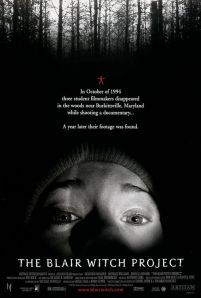 Directors: Daniel Myrick, Eduardo Sanchez
Writer: Daniel Myrick, Eduardo Sanchez
Cast: Heather Donahue, Joshua Leonard, Michael C. Williams
Plot: The movie opens up with a title card informing the viewer that three film students disappeared in the woods near Burkittsville, Maryland in 1994, and that what we’re about to watch is their footage, which was found a year later. Heather Donahue, Michael Williams and Joshua Leonard (using their real names) pack up their equipment and begin walking around town, asking locals questions about the mysterious legend of the Blair Witch. The locals of Burkittsville – formerly known as Blair — weave a story about a lunatic in the 1940s who kidnapped and murdered seven children, claiming to be compelled by the spirit of an 18th-century witch named Elly Kedward, who was hanged by the people of Blair. The three of them go into the woods to seek out Coffin Rock, supposedly a spot where five men were bound together and murdered over a century earlier. They make camp, and in the morning Josh reports waking up in the night and hearing some cackling sounds from the woods. Friction begins to grow between Mike and Heather – Mike insisting she keeps getting them lost – and Josh tries to play peacemaker. As they wander, they find stones and branches arranged in strange structures that seem to echo something told to them in town by a woman they dismissed as a lunatic. They hear more sounds in the night, and wake up to a rainfall and an angry Mike, who believes locals have followed them into the woods to toy with them. They try to walk back back to where they left their car, but are unable to find it before nightfall and finally make camp. That night, they hear more of the strange sounds outside the tent, and in the morning they find three piles of rocks that weren’t there before. Before they leave, Heather realizes she can’t find the map, and the three of them all begin suspecting each other of taking it. After some time, Mike laughs and confesses he threw the map into the creek, and Heather and Josh attack him in a rage.
Later, calmer, they find figures made from sticks dangling from the trees, and eventually, they decide to make camp and not light a fire, terrified that someone is tracking them through the woods. In the night, there are more strange sounds and the tent begins to quake, driving them out. When they return, their belongings have been rifled through, and Josh’s recording equipment has been damaged. The next day, despite keeping a southern course for 15 hours, the find themselves back at a log crossing a creek they’d already passed, and their frustration and desperation increases. The next morning, Heather and Mike cannot find Josh, and eventually are forced to go on without him. That night they think they hear him in the woods, and in the morning Heather finds a bundle of twigs wrapped in the bloody tatters of Josh’s shirt. She freaks out, but hides her discovery from Mike. That night, alone, she records herself apologizing to her parents and those of her crew, and takes the blame for everything that has happened, certain she and Mike will die in the woods. They hear Josh again and follow his cries to a house in the middle of the woods. As they search, Mike thinks he hears Josh downstairs and runs there with a camera, finding odd writing on the walls. As he walks, there’s a thumping sound and the camera falls. The footage begins again, Heather screaming, until we see Mike standing with his face against the wall. There is another scream. The camera falls to the floor. And the screen goes black.
Thoughts: The filming of The Blair Witch Project has become something of a moviemaking legend. With a mere $20,000, Myrick and Sanchez took three unknown actors into the woods and made a movie that was largely improvised, giving them notes about what to feel or how to behave rather than being strict about the lines they spoke, and often not even telling the actors what they were going to do to scare them, trying to capture a realistic feeling to their reactions. The resulting film made nearly $250 million, making it by far one of the most profitable movies of all time. The film is also notable for being one of the first – if not the first – movie marketed heavily on the Internet. A web page was established that went viral on the conceit that the film was real, with lots of articles, videos and photographs presented to support the film’s premise.
You can really track the legacy of this movie in two ways, neither of them having anything to do with the weak sequel Book of Shadows: Blair Witch 2. Although the film did not create the “found footage” genre – the idea that you’re watching a movie constructed of footage filmed by the characters themselves – it sure as hell made it popular. As is always the case, some of the movies that have used this concept in the years since have been critical successes, some have been commercial successes, and some have been outright flops. But unlike most other films that spawn a rash of imitators, only Blair Witch can lay claim to creating a subgenre that is immediately repulsive to anybody who gets seasick easily.
The second – and, to my way of thinking, more important – legacy of this movie the way it change how movies are marketed. In 1999, the Internet was still relatively new to most people, and nobody quite understood yet the power it would one day have. The Blair Witch website, combined with a few other tie-ins like a Sci-Fi Channel special and a comic book from Oni Press, turned a movie made on a microscopic budget into an international sensation. Now, it would be insane to make a movie that doesn’t have a website, it would be ludicrous to not create viral content that fans can find, enjoy, and share with other people in the hopes of generating new fans. If you were on Facebook earlier today, watching the trailers for The Muppets, try to wrap your brain around the fact that such a presentation has its origin in The Blair Witch Project.
In terms of what actually makes it scary, I don’t think it’s the supernatural elements that do the trick. Yeah, the piles of rocks, the little twig-construction stick figures and the other weird things they find in the woods all help contribute to a culture of fear that exists in the film. What makes it work, though, is the way the characters slowly break down. When the movie begins they’re lively and enthusiastic about making their movie. As the film progresses, they get antsy, they get belligerent, and they begin to turn on each other. The suspicion that infects them, the way their little society completely falls apart after a while is pretty scary by itself, because that could happen to anybody. Strip away the witch, take away the manufactured scares, and look at it just as a story about people crumbling just because they’re lost and scared. And it works. Heather’s breakdown near the end has joined the ranks of iconic horror movie scenes for very good reason.
The Blair Witch Project gets a lot of crap today. Like many things which reach enormous popularity very quickly, there was a backlash afterwards by those who feel like it’s uncool to like anything mainstream, and a bit more by those who didn’t care for the style of filmmaking. (Out of the two, the second is by far the more legitimate complaint.) People complain that they feel like they’re watching somebody’s home movies – which, of course, is part of the point. My favorite argument, though, is those who were angry that we never see the witch. My response to this is simple: what could they possibly have shown you that would be scary enough to match what you built up in your own mind?
And of course, there are also many people who react because the whole “found footage” thing has been overdone. Again, this is legitimate – the third Paranormal Activity movie using the same concept just hit theaters as I write this, and frankly I haven’t found them to be remotely frightening – but I think it’s unfair to put the blame for that on Blair Witch. It’s not the fault of this movie that others copied it badly, and as far as this one goes, I think it does what it does very well. I watch this today and get the creeps just as easily as I did back in college. And to me, that’s what makes a movie memorable.
Tomorrow the first stage of Mutants, Monsters, and Madmen (yes, first stage) reaches its conclusion with the most recent film to change the way horror movies are made… so far. We’re going to take a look at Saw.
 Reel to Reel