Category Archives: Comedy
I’ve Never Seen: Goon (2011)
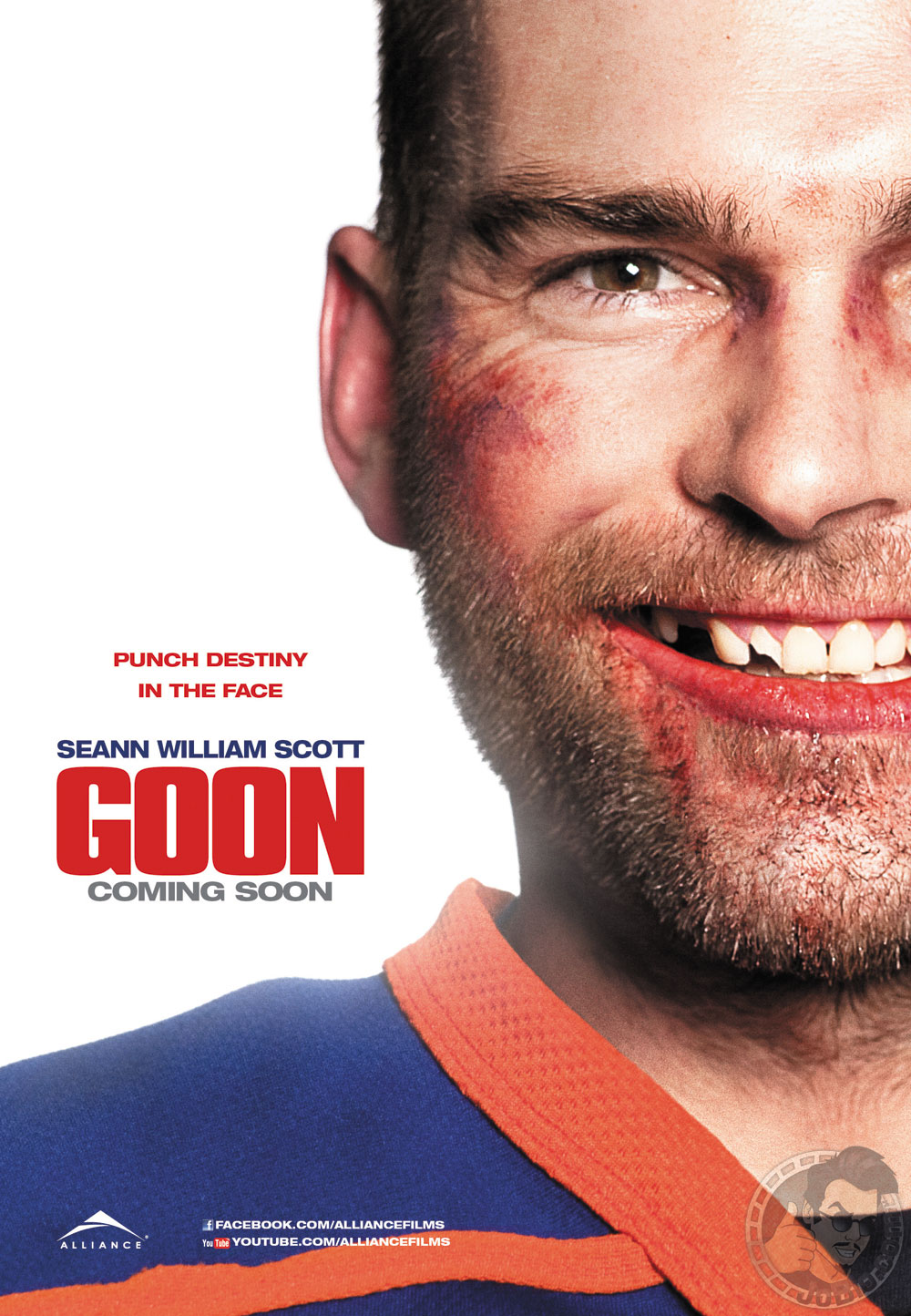 Director: Michael Dowse
Writers: Jay Baruchel, Evan Goldberg, based on the book by Adam Frattasio & Doug Smith
Cast: Seann William Scott, Jay Baruchel, Alison Pill, Liev Schreiber, Eugene Levy, Marc-Andre Grondin, Kim Coates, Nicholas Campbell
Plot: When Doug Glatt (Sean William Scott) trashes a minor league hockey player at a game, he’s called up to use his fighting skills as a player.
Thoughts: To kick off my “Movies I Haven’t Seen” reviews, I asked folks on Facebook to make random recommendations, and Goon walked off with the most support. From this, I can only assume the people on the internet hate me and want me to get brain cancer.
The story begins with Doug Glatt (Seann William Scott), a bouncer who gets offered a spot on a minor league hockey team when he beats the crap out of one of their players during a game, despite the fact that he has no discernable talent for hockey and, in fact, does not even appear to know how to ice skate. Overcoming these obstacles, he quickly gets moved up to a farm team for the majors.
Aside from having a script where the writer assumes dropping an F-bomb every 14 seconds is an acceptable substitute for characterization, this is where the first major problem with the movie appears. Doug goes to the farm team about 12 minutes into the movie – I know, I looked at the counter and couldn’t believe I’d only been subjected to 12 minutes of this so far. I imagine it’s not unlike Sisyphus reaching the top of his hill and then slipping and watching his stone roll to the bottom. But I digress (because it’s a way to avoid talking about this movie any further). In these twelve minutes, the director and screenwriter do absolutely nothing to make us believe that Doug has any business being in the major leagues. Sure, we see him hit a few people. So what? I’m by no means a hockey expert, but I’ve seen plenty enough of it to know that pretty much any other skill is going to have to be secondary to the ability to properly stand up in a pair of ice skates. The fact that he lasted more than 12 seconds, let alone minutes, it pretty ridiculous.
This turns out to be a repeat offense. After spending another 12 minutes on a team where everybody evidently hates each other, Doug meets a girl named Eva (Alison Pill), who he falls for in even less time. She, at least, turns out to be somewhat believable as a character, as she winds up having a secret that makes her seem as unlikable as everybody else in the movie. Then again, the fact that Doug goes along with this makes him less likable in the process.
That’s the real problem here, I just don’t buy any of this movie. The characters are all walking stereotypes, with no hint of depth or nuance at all. We’ve got the alcoholic with marital problems, the homophobe, the closeted gay man, and a bunch of people who exist only to be brutally violent and despise one another. Perhaps this is a casting choice. After all, Seann William Scott is usually the perpetually smarmy jerkass in movies. Since here he’s supposed to be the naïve, sweet guy who only gets brutal when he’s angry, perhaps the idea was to surround him by absolutely miserable examples of the human condition to get us to accept him in that role.
The amazing thing is that this is, evidently, based on a true story, which means at some point the core nugget of truth probably happened in some form. So how did something that happened in real life transmogrify into something that’s utterly unbelievable?
A little more than halfway through, the movie takes a turn for the more downbeat (up until this point it was supposed to be funny). Doug’s temper gets the better of him on the ice, his parents don’t approve of what he’s doing with his life, Eva continues to be an absolutely miserable person, and washed-up veteran Ross Rhea (Liev Schreiber) warns Doug that he’s going to wind up just like him if he keeps going in that direction. Rather than bring him down to a low point from which he can build to redemption, though, the movie just gets more and more miserable, as Doug takes a truly brutal beating, which he then celebrates. The celebration scene, where the entire team is drunk and/or hopped up on prescription painkillers, is one of the most pathetic things ever put on screen.
If there’s anything I can say to this movie’s credit, it’s that it manages to avoid the major sports movie cliché of having everything come down to Who Wins the Big Game in the End. Oh, don’t misunderstand, there still is a big game, it’s just that the game itself is largely secondary to what happens between Doug and Rhea, a battle of goons that, like most of this movie, is ultimately pointless.
I know this movie has a fan base. What I can’t figure out is why.
The first Reel to Reel study, Mutants, Monsters and Madmen, is now available as a $2.99 eBook in the Amazon Kindle store and Smashwords.com bookstore. And you can find links to all of my novels, collections, and short stories, in their assorted print, eBook and audio forms, at the Now Available page!
At the Movies Episode 40: The LEGO Movie
 I’ve got to be honest, gang — my movie watching this month has slowed to a crawl. Blame the Olympics. I’m a huge Olympic geek, so when those are going on, I watch almost nothing else.
I did, however, manage to take in The LEGO Movie last night, and I did a mini podcast to review it. Check it out!
Scrooge Month Day 20: David Ruprecht in MISTER SCROOGE TO SEE YOU (2013)
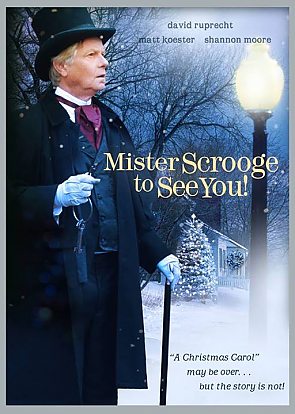 Director: Steven F. Zambo
Writer: Steven F. Zambo
Cast: David Ruprecht, Matt Koester, Shannon Moore, Curt Backlund, William Beglinger, Nancy Ferdyn, Tyler L. Johnson, Jeff Johnstone, Daniel Koester, Torry Martin, Arlensiu Novelli, Rick Richter, Karen Spiegelberg, Chris Taylor, Ken T. Williams
Notes: I thought it would be fun to end Scrooge Month with a different tale of the character. In Mister Scrooge to See You!, David Ruprecht plays the former miser one year after his redemption at the hands of the ghosts. This time out, Jacob Marley (Rick Richter) sends him on a mission of his own, casting him into the distant future to save the embittered soul of Timothy Cratchit VI (Matt Koester), who has lost the very Christmas spirit his ancestor helped restore to Scrooge
Thoughts: This is by no means the first time someone has attempted a sequel to A Christmas Carol. There have been versions that show Tiny Tim as an adult, Marley getting redeemed himself, and all manner of stories featuring the older versions of these characters. This one is a cute enough film, if obviously made on a low budget. The greenscreen effect use to insert Marley into the shots is crude, the footage looks cheap (although that’s probably an ironic effect of using digital video rather than actual film), and the performances are straight from an amateur production of… well… A Christmas Carol.
Of the cast, David Ruprecht’s Scrooge is the best performance. In one scene he pulls off a fake-out on Bob Cratchit before making him a full partner in the firm of “Scrooge and Cratchit,” and he’s pretty convincing both as the nasty miser he used to be and as the cheerful soul he’s become. Ken T. Williams’s Bob Cratchit isn’t bad either – still a bit downtrodden, but a man who has happiness in his heart. It really shows in that same scene, when he gives Scrooge a gift of the original Tiny Tim’s no-longer-needed crutch.
In the present day, Tim VI’s life has matched that of Scrooge in several neat ways. Now a wealthy developer, he comes back to his hometown to buy up the property. There he runs into his own girl that got away, coincidentally named Belle (Shannon Moore), who is running her little diner into the ground by giving free meals to homeless citizens who drive off other customers. What’s more, Tim’s company now owns the mortgage on Belle’s diner and he’s there to shut her down if she can’t meet her back payments by Christmas. (Does anyone else find it odd that the companies in these movies always set a Christmas deadline? I’m not a businessman, but isn’t the first of the month more traditional for this sort of thing?)
Belle (Belle Dickenson – aaaah? Get it?) is in trouble, but Tim’s soul is in far worse shape. He’s greedy, nasty, and frequently spouts slightly-altered versions of Scrooge’s classic pre-redemption lines. He comes across here even more actively malevolent than Scrooge usually does in the traditional versions of the story.
Scrooge is mysteriously transported to the present day, where he meets up with Belle and learns how Tim is planning to shut down her company. Unfortunately for Tim, Scrooge still has the paperwork marking him as a partner in Scrooge and Cratchit Financial, and uses it to block Tim. He begins to turn the company around, driving Tim crazy while making everybody else in town merry as can be. Once we hit this mark, where Scrooge starts driving Tim insane, the film actually gets entertaining. There are some great comedy beats where he’s integrating himself into modern society, and a few fine mirrors of his own time while Tim gripes and complains about all Scrooge’s efforts to bring Christmas down upon him.
The movie ends with a surprising twist – surprising in the sense of “utterly ridiculous and impossible to believe.” On the other hand, it does prevent the movie from having the same ending as 90 percent of these movies do, so I’ve got to appreciate it for that if nothing else.
The story actually isn’t bad – it’s at least as good as the endless carbon copy made-for-TV movies that turn up on the Hallmark Channel this time of year. It would be nice to see what would happen if someone with a budget got their hands on this script. This is pleasant as a diversion, but a talented filmmaker could probably make something really memorable out of it.
The first Reel to Reel study, Mutants, Monsters and Madmen, is now available as a $2.99 eBook in the Amazon Kindle store and Smashwords.com bookstore. And you can find links to all of my novels, collections, and short stories, in their assorted print, eBook and audio forms, at the Now Available page!
Scrooge Month Day 18: Robert Wagner in A DENNIS THE MENACE CHRISTMAS (2007)
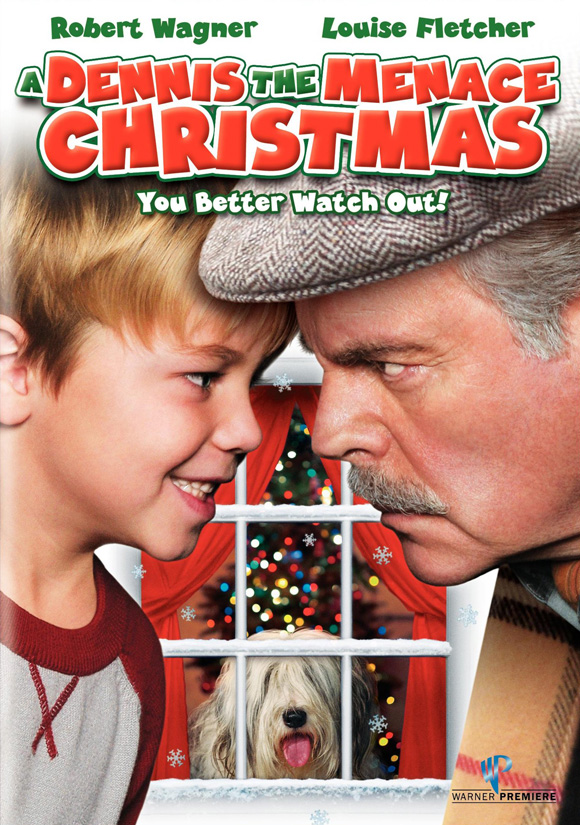 Director: Ron Oliver
Writer: Kathleen Laccinole
Cast: Maxwell Perry Cotton, Robert Wagner, Louise Fletcher, George Newburn, Kim Schraner, Isaac Durnford, Jake Beale, China Anne McClain, Heidi Hayes, Godfrey, Richard Notkin, Jack Noseworthy, Michael Lerner, Walter Massey, Elliott Larson
Notes: Dennis the Menace is one of those properties Hollywood periodically takes down from the shelf, dusts off, and tries again. This is technically a sequel to the 1993 Dennis the Menace film starring Walter Matthau as Mr. Wilson, although none of the original cast is in it as they’re all either dead or way too old to play the parts again. In this version, an encounter with Dennis (Maxwell Perry Cotton) has crushed any Christmas Spirit Mr. Wilson (Robert Wagner) has left. The Christmas Carol stuff doesn’t come in at all until the third act of the movie, where rather than multiple ghosts we get Bob the Angel (Godfrey), who handles the chores for everybody. In fact, for much of the film Bob’s presence makes it feels a little more like an It’s a Wondeful Life pastiche than a take on Dickens.
Thoughts: In case you’ve never read the comic strip or seen the previous movies, here’s Dennis the Menace in a nutshell: he’s a little boy who’s basically good-hearted, but has a propensity towards mischief and disaster. This causes no end of torment for his next door neighbor, retired mailman Mr. Wilson, who Dennis regards as his best friend. This is not a mutual feeling on Mr. Wilson’s part.
This time out the movie begins with the school’s Thanksgiving pageant, where Dennis’s parents Henry and Alice Mitchell (George Newburn and Kim Schraner) are a bit nervous he may wreck the whole thing. George Wilson and his wife Martha (Louise Fletcher) are also in attendance, and Mr. Wilson is even more terrified than the Mitchells that things are going to go haywire. Backstage, pushy stage parent David Bratcher (Jack Noseworthy) instructs his son Jack (Jake Beale) to do whatever it takes to get front and center for the show. Mr. Wilson’s concerns turn out to be correct and disaster strikes. As it turns out, David is an old rival of Henry’s and also the school’s insurance provider, and he points out the “Dennis Clause” in their policy, absolving his company from paying for any destruction caused by Dennis Mitchell. Geez, and Mr. Wilson is the Scrooge in this story? This guy really needs a comeuppance.
As Christmas approaches, Jack harasses Dennis and his friends outside a toy store. Dennis challenges Jack to a bicycle race to get him off his back, but he’ll need a new bike from Santa Claus to pull it off. Back at the Wilson’s house, Mr. Wilson refuses his wife’s pleas to decorate for Christmas. She – along with everyone in town – wishes for a little snow for Christmas, which we’re reminded multiple times hasn’t happened in 30 years, virtually guaranteeing a blizzard by the end of the movie.
Alice gets a part-time job wrapping presents at a department store, and Mrs. Wilson agrees to watch Dennis. When Mr. Wilson falls asleep, though, Dennis gets his hands on a stamp collection worth $10,000, which causes some real trouble for the Mitchells thanks to the aforementioned “Dennis Clause.” I have to admit, I put the blame on Wilson here – if you’ve got a trouble-prone 6-year-old and something worth $10,000 in the same house, you don’t take a nap.
Things get worse and worse, with one disaster after another happening until, on Christmas Eve, Mr. Wilson tells Dennis to go away and never come back and – just to twist the knife a little – says there’s no such thing as Santa Claus. This is the last straw, and he’s visited by Bob the Angel, who has actually been wandering around for most of the movie getting involved in Dennis’s various capers for no apparent reason.
Finally, 59 minutes into the 87-minute movie, Bob starts the Christmas Spiriting. He takes Mr. Wilson back to his childhood, where he’s reminded of his neighbor, Mr. Newman (Walter Massey). Little George (Elliott Larson) turns out to be as dangerous to Mr. Newman’s collection of model ships as Dennis was to Mr. Wilson’s stamps. In the present, he’s shown Henry and Alice tallying up how much money they owe Mr. Wilson for his assorted escapades and they realize they can’t afford to give Dennis much of a Christmas. In fact, they may have to move to a smaller house. Upstairs, Dennis rejects Christmas as “stupid.” When Mr. Wilson hears him saying “the s-word,” he breaks. He’s then tossed to a future where a boy shows up at the Mitchell house, trying to impart some Christmas spirit, but he’s rejected. Dennis – now an old man played by Richard Notkin — spent his whole life trying to get back the house he cost his parents, but never had time for any family or friends. He lives there, pathetic and alone. You can argue, pretty convincingly, that his is a fate worse than Tiny Tim.
When Dennis and the Mitchells wake up in the morning, there’s a new bike there courtesy of “Santa Claus,” and Mr. Wilson shows up to forgive the Mitchells’ debt to him and make up with Dennis. Mrs. Wilson wakes up to a fully-decorated house, because it was the one sin of Mr. Wilson’s that hadn’t been addressed yet. As for the bike race – Dennis actually loses. As it turns out, though, he throws the race – hearing Jack’s father shouting about losers, Dennis realizes Jack needs the win more than he does. The boys make friends, and predictably, the snow starts to fall.
The movie takes an interminably long time to get around to the Scrooge-ish stuff, and it goes through the whole thing (past, present, and future) in less than 15 minutes. It makes sense, I suppose. This isn’t a case like Disney or the Muppets, where the characters are going concerns that are simply being dropped into the classic story. This time around, the focus is more on trying to jumpstart a franchise, with a little Dickens thrown into the mix. Judged purely as a Dennis the Menace movie, therefore, it’s not too bad. The characters are simple enough, and Robert Wagner’s grumpy turn as Mr. Wilson balances things nicely to keep it from getting too saccharine. They take things a bit too far into the cartoony though, with Wagner’s face literally turning red and whistling as smoke hisses from some unseen edifice after Dennis ruins his stamps.
It’s also the kind of story that has virtually no suspense. The conflicts are all laid out in a cookie-cutter fashion and the film marches on directly towards the most obvious solution. You know it’s going to snow simply because it’s been 30 years since it happened. You know Mr. Wilson will forgive Dennis because he does that in every movie. You know Dennis is going to get his bike, and you know there’s a 99 percent chance Mr. Wilson is the one who’ll buy it for him. I know they’re not trying to make groundbreaking cinema here, but does that mean the movie has to feel so cut-and-paste? The only thing that comes as a surprise is when Dennis loses the race, and then there’s an added segment of heartwarming just to make up for it.
I give the film a little credit for self-awareness. At one point, Mr. Wilson turns on Bob saying, “I get it. I’m Scrooge, I need to learn my lesson.” That actually shows the power of Dickens, really. Even when a character is fully aware that he’s getting the Christmas Carol treatment, it still works.
The weird thing is, I probably wouldn’t have cared for this movie too much if I’d watched it by itself. As part 18 of a Scrooge-a-thon, though, it’s actually kind of a refreshing change of pace. So I guess what I’m saying is, if you really want to enjoy A Dennis the Menace Christmas, the best way to do that is to watch 17 other versions of A Christmas Carol first.
The first Reel to Reel study, Mutants, Monsters and Madmen, is now available as a $2.99 eBook in the Amazon Kindle store and Smashwords.com bookstore. And you can find links to all of my novels, collections, and short stories, in their assorted print, eBook and audio forms, at the Now Available page!
Scrooge Month Day 17: Daffy Duck in BAH HUMDUCK! A LOONEY TUNES CHRISTMAS (2006)
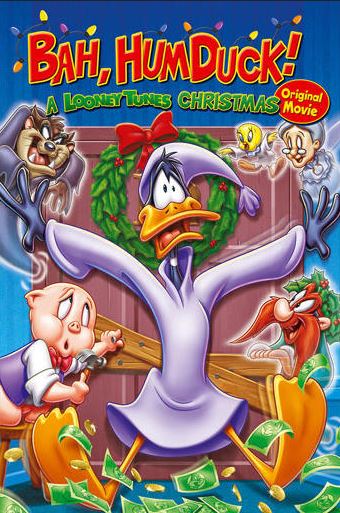 Director: Charles Visser
Writer: Ray DeLaurentis, based on A Christmas Carol by Charles Dickens
Cast: Joe Alaskey, Bob Bergen, Billy West, June Foray, Maurice LaMarche, Jim Cummings, Tara Strong
Notes: This is actually the second time the Looney Tunes characters have tackled Dickens, the first being in the 1979 short, Bugs Bunny’s Christmas Carol. I would have included that in this little experiment, because at only eight minutes it would have been the easiest article ever, but it doesn’t appear to be available on DVD at the moment. Warner Bros should get on that. Anyway, in this version we see Daffy Duck (voice of Joe Alaskey) cast as the owner of the Lucky Duck Superstore in the Scrooge role. Although the Looney Tunes characters basically play themselves, they fill in the assorted Christmas Carol roles appropriately. Porky Pig (Bob Bergen) is Daffy’s assistant manager and the stand-in for Bob Cratchit. Bugs Bunny (Billy West) kind of takes nephew Fred’s place, although the role is somewhat expanded. Sylvester “the Investor” (Alaskey) is our Jacob Marley substitute, Porky’s daughter Priscilla (Tara Strong) fills in for Tiny Tim, and the ghosts are filled up by a tag-team of Granny (the legendary June Foray) and Tweety (Begen) for the past, Yosemite Sam (Maurice LaMarche) for the present, and the Tasmanian Devil (Jim Cummings) for Christmas Future.
Thoughts: The Looney Tunes characters, traditionally, have not proven to be quite as versatile as the Disney crew. While Mickey and Company can star in more traditional versions of Dickens, The Prince and the Pauper, The Three Musketeers and the like, it’s much harder for the Looney Tunes to do so. They shouldn’t be embarrassed by this – it’s because they’re just plain funnier, and therefore it’s harder to wedge them into a drama. That said, Ray LeLaurentis managed to match them to the Dickensian roles in this film pretty neatly.
Daffy, as the head of a superstore, hates Christmas and families, mostly because he never had either of his own. Early on we see him being terrible to assorted Looney Tunes characters in assorted ways, most cleanly when he dismisses Assistant Manager Porky’s wish to spend Christmas with his family. Daffy may not be the most Scrooge-like of the Looney Tunes characters, being more of a grump than a skinflint, but he’s their biggest star that could fit the role. As such, the film doesn’t paint him as a spendthrift the way Scrooge usually is, but just somebody with a nasty disposition who decides to target Christmas with his ire.
“Sylvester the Investor” is a former CEO and idol of Daffy’s, not specifically his old partner, and he’s the character that really made the continuity geek that lives in my brain full-time struggle. There are two ways the Looney Tunes are usually portrayed: either as “themselves,” living an ostensibly normal life while going through wacky adventures; or as actors in crazy cartoons playing crazy roles. This movie seems to exist in some sort of weird in-between place. Daffy is himself, Porky, Elmer Fudd, Marvin the Martian and many of the others are his employees. But Sylvester and the ghosts come across more like the “actor” versions of the characters. There is, of course, the possibility that I’m simply expending way too much energy trying to rationalize the structure of a Looney Tunes movie.
After Marley’s visit, Daffy continues to torment his employees, even announcing that the store will be open from 5 a.m. to midnight on Christmas Day, making this 2006 movie seem sadly prophetic. He and Bugs wind up trapped in the store overnight, though, giving us the biggest Looney Tunes star at vital points of the tale. Granny and Tweety pop in as the Ghosts of Christmas Past and take Daffy back to the Lucky Duck Orphanage where he grew up. Lucky Duck, as it seems, didn’t live up to its name for Daffy. We’re shown a Christmas where he is literally the only child at the orphanage who does not get adopted. The scene is so pathetic that even the ghosts cry for him, until they snap out of it and Tweety lays a verbal smack-down on him and Granny tells him his own lousy childhood doesn’t give him the right to ruin everybody else’s Christmas.
Yosemite Sam, who played Scrooge in Bugs Bunny’s Christmas Carol, here dons the robes of the Ghost of Christmas Present. He whips Daffy around to show him how sad his various employees are, ending it with Porky telling adorable little Priscilla he can’t be with her on Christmas. When she asks him why Daffy’s so mean, Porky tells her it’s probably because he doesn’t have a family to spend it with. She wishes on a star that Porky could spend Christmas with her instead of going to work, and Sam smacks Daffy upside the head. Seriously, Daff, when Yosemite Sam is calling you out for being a jerk, you know you’ve gone too far.
Daffy finds Bugs decorating the store for Christmas and begs him to hide him from the final ghost, giving Bugs the chance to reenact a classic sequence of brutally bad hiding places from one of his old cartoons. None of it will protect him from the Tasmanian Devil as Christmas Future, though. Although Priscilla isn’t sick like Tiny Tim, Daffy sees a future where he’s dead and the store is closed thanks to his stupid effort to leave it to himself in his will. Now all of the employees are out of work just in time for Christmas. Just to drive the nail in, Priscilla promises to visit Daffy’s grave every Christmas. Taz weeps openly and Daffy asks for a second chance.
Well c’mon, it wouldn’t be much of a story if he didn’t get one, would it?
Back home, Daffy finds a frozen Fudd who informs him it’s still Christmas, and Daffy declares there’s work to do. When the employees return to the store in the morning, Daffy starts handing out gifts: a rocket for Marvin so he can go home for the holidays, a chef for the perpetually starving Wile E. Coyote, and raises and vacations all around. His 20-second interaction with Speedy Gonzales makes the whole film worthwhile.
As Daffy looks around he almost relapses, realizing how much the raises and vacations are going to cost him, but Priscilla’s grateful words to “Uncle Daffy” cut him off. She also gets the last word – not “God bless us, everyone,” but swiping her Dad’s usual proclamation of “That’s all, folks!”
The cartoon – at a brisk 45 minutes – doesn’t spend a lot of time on the details of Dickens. Instead, it uses the classic framework to tell a story with more original characters and a lot of old-school Looney Tunes slapstick. These are timeless characters that still make me laugh when they’re done right, and for the most part, this special pulls it off. I’ve actually enjoyed the new Looney Tunes Show the Cartoon Network airs, but this slightly more traditional version of the characters is always going to be where my heart lies.
The first Reel to Reel study, Mutants, Monsters and Madmen, is now available as a $2.99 eBook in the Amazon Kindle store and Smashwords.com bookstore. And you can find links to all of my novels, collections, and short stories, in their assorted print, eBook and audio forms, at the Now Available page!
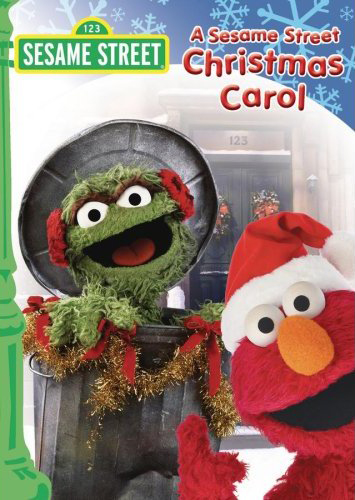
Scrooge Month Day 16: Oscar the Grouch in A SESAME STREET CHRISTMAS CAROL (2006)
 Directors: Victor DiNapoli, Ken Giego, Emily Squires, Jon Stone
Writers: Rickey Boyd, Jon Stone, Joseph A. Bailey, Christine Ferraro, Tony Geiss
Cast: Caroll Spinney, Kristin Chenoweth, Joey Mazzarino, Matt Vogel, Jim Martin, Tim Curry, Rickey Boyd, Kevin Clash, Jim Henson, Frank Oz, Pam Arciero, Fran Brill, Alice Dinnean, Eric Jacobson, Peter Linz, Noel MacNeal, Jerry Nelson, Carmen Osbahr, Martin P. Robinson, David Rudman, John Tartaglia, Steve Whitmire, Bryant Young, Carlo Alban, Alison Bartlett, Desiree Casado, Emilio Delgado, Will Lee, Loretta Long, Sonia Manzano, Bob McGrath, Roscoe Orman, Imani Patterson, David Langston Smyrl, Brian Gore
Notes: This is, of course, not the first time the Muppet characters have tackled A Christmas Carol, but sadly the Muppet Show Muppets and the Sesame Street Muppets are so far removed from one another these days that it almost doesn’t even matter. At any rate, this (much toned down) version of the Dickens story casts Oscar the Grouch as the most natural Scrooge since McDuck. New characters – all computer animated rather than traditional puppets – appear as the three ghosts. My favorite bit of this, though, is that the special uses footage from classic Sesame Street Christmas shows, thus allowing us to see performances from the likes of the late Jim Henson and Will Lee and the mostly-retired Frank Oz, all right alongside the modern cast of the show.
Thoughts: Tim Curry starts us off in his usual role as The Best Narrator In the World Assuming You Can’t Afford Morgan Freeman, and introduces us to an Oscar the Grouch (Caroll Spinney) who’s looking forward to sleeping through Christmas entirely. His plan is wrecked, though, when a messenger named Joe Marley (Joey Mazzarino) shows up with news. Marley is there to deliver Oscar the first of three Ghost-O-Grams, beginning with a vintage 1843 baked beans can. (1843, in case you didn’t know, is the year A Christmas Carol was first published. Cute.)
It hardly seems necessary to critique Caroll Spinney as Oscar the Grouch – he’s played the character for over four decades and he’s made him one of the most enduring childhood icons in the history of the world. Let’s instead just agree that Oscar as Scrooge is such an obvious idea that one wonders why they didn’t try it before and move on, shall we?
Rickey Boyd provides the voice for the first “ghost” – Rhubarb, the Grouch of Christmas Past. Rhubarb and Oscar agree to watch the old films of previous Christmases, even as they agree not to enjoy them, and we see the “Gift of the Magi” segment from 1978’s Christmas Eve on Sesame Street, which I wrote about last year. It’s a clever use of the old footage, something very few other versions of A Christmas Carol could even imagine, but it does raise an important question: what’s the point of all this? There hasn’t been any talk of “redeeming” Oscar the way Scrooge usually needs to be redeemed, and even if there was, this clip doesn’t even include him. Why is Rhubarb being sent to show Oscar heartwarming clips? Even Oscar asks this question, and Rhubarb doesn’t have an answer.
But you know what? It’s Jim Henson, Frank Oz and Will Lee, all together. I’m not about to complain about that.
In the next segment, we have an old musical number with Big Bird (Spinney again) singing about how he misses his best friend, Mr. Snuffleupagus, who’s away for Christmas. It’s a cute song, one I don’t really remember, which probably suggests this clip came some time after I grew out of the prime Sesame Street demographic. There’s not really anything to hint as to just when it was made. Once it was over, we cut back to Rhubarb and Oscar, laughing about how bad the clips are. Call me a racist, but this is the kind of typical Grouch behavior that has caused people to have certain opinions about them for decades.
Marley returns with the next Ghost-O-Gram. This time Oscar gets a jack-in-the-box that releases Christmas Carol (Kristin Chenoweth), a woman in a Christmas tree outfit, who decides to dress up Oscar’s trash can with a little holiday makeover. It gets worse for Oscar when she pops a Santa Claus hat and beard on him. Carol presents a contemporary segment featuring Sesame Street’s current cash cow, Elmo (Kevin Clash), on a visit to Santa’s workshop. Santa sings Elmo a song which can be summarized as, “Boy, it’s nice that you’re not a selfish jerk,” and we then spin off into another clip. This time, Elmo has somehow caused it to be Christmas every day, because he’s never seen a Christmas special before, and he sings a song explaining that Christmas is only special because it’s once a year. Oscar sarcastically quips, “Christmas every day is a bad idea,” as if he didn’t know that already. For once, Oscar, I’m with you.
Then, to ensure that Sesame Workshop maintained its educational grant, we get a couple of Muppet-free segments about Hanukkah and Kwanzaa.
The last Ghost-O-Gram introduces us to a flying robot named i-SAM (Kevin Clash), who is there to show Oscar Christmas Future. Instead of a Sesame Street clip, though, we get an animated segment in which we “tour” a future where homes decorate themselves, giant holiday dinners are reduced to pills, and families are whisked around in oversized Christmas tree ornaments. It’s a silly, charming little cartoon that fulfills the “Future” requirement in a decidedly non-frightening way. Oscar suddenly wakes up and sees it’s Christmas morning, and he’s being visited by Joe Marley again – only this time he claims to be “Little Joey Dickens from Brooklyn,” who tells Oscar all he had was a bad dream. He gives Oscar a present, though – a sticky ball of used wrapping paper – and all seems well. Especially since tomorrow is the best time of the year for a Grouch – the longest possible time until it’s Christmas again.
I don’t usually like stories that end with the “it was all a dream” conceit, but in a way it’s the only thing that makes sense here. There’s no real reason for Oscar to be visited by these ghosts, nothing changes, nothing actually happens in this film. It’s just an excuse to use a classic framing device to show old clips of the show. It’s not the worst premise in the world, but it feels like there could have been more than a little lip service given to Dickens in the framework. It’s cute, and it’s perfectly acceptable as a Sesame Street special, but remembering just how special some of those specials have been, it seems it could have been better.
The first Reel to Reel study, Mutants, Monsters and Madmen, is now available as a $2.99 eBook in the Amazon Kindle store and Smashwords.com bookstore. And you can find links to all of my novels, collections, and short stories, in their assorted print, eBook and audio forms, at the Now Available page!
Scrooge Month Day 11: Carface Carruthers in AN ALL DOGS CHRISTMAS CAROL (1998)
 Director: Paul Sabella, Gary Selvaggio
Writer: Jymn Magon, based on A Christmas Carol by Charles Dickens
Cast: Ernest Borgnine, Dom DeLuise, Sheena Easton, Taylor Emerson, Bebe Neuwirth, Charles Nelson Reilly, Steven Weber, Dee Bradley Baker, Ashley Tisdale
Notes: This TV movie was the third and (so far) final film in the All Dogs Go to Heaven series, and also followed the popular TV show based on the films. In this version the evil dog Carface (Ernest Borgnine) harasses other dogs for bones and money and the like just before Christmas, prompting Charlie (Steven Weber) to re-enact A Christmas Carol in an attempt to set him straight: Itchy (Dom DeLuise) becomes Christmas Past, Sasha (Sheena Easton) Christmas Present, and Charlie Himself becomes Christmas Yet to Come. I’ll be honest, I’ve never seen an All Dogs Go to Heaven movie or TV show before, so other than the fact that it’s about dead dogs, I really don’t know what to expect. The only reason I even own this film is because it was included in a pack of animated Christmas movies on DVD I got a while back, so reviewing it will be an experience.
Thoughts: The film has a cute enough framing sequence – puppy angels (try not to let the obvious implications of that be depressing) ask the angel Annabella (Bebe Neuwirth) for a story, and she tells about how her favorite dogs once stopped her evil cousin Belladonna (Neuwirth again) from ruining Christmas. As the film shifts from Heaven down to a San Francisco decorated for the holidays, it’s clear from the production values that this was created on a TV budget. I try not to hold that against the movie – after all, so was the Flintstones special four years earlier – but the animation is really stiff compared to many of the other animated versions of A Christmas Carol we’ve watched. I also have to deduct points for an obvious “Santa Paws” joke in the first five minutes.
Despite the notes at the beginning, the film takes a long time to get to the actual Christmas Carol content, going through this long opening slog in which Belladonna plans to hypnotize every dog in the city with a giant dog whistle or… or something like that. I’ve got to admit, my attention started to wander, because this most definitely is not a movie for me. Eventually, Annabella gives Charlie a magic amulet that allows him to pull the Dickens bit on Carface, with Charlie sort of taking on the Marley role to introduce the segment. It’s here that the Carface character finally gets some (and by some I mean “any”) depth. The trip to Christmas Past shows Carface as a puppy, loved by a child but put out into the cold and rain one Christmas. It’s about as sad a sight as I’ve ever seen in animation, actually, a pit bull with a beanie propeller walking away from a kid who used to love him.
Christmas Present grinds the movie to a halt with a lame villains song about how the big bad and the minion have differing feelings about Christmas. The whole time I listened to it, I kept thinking that Bebe Neuwirth deserved better. Anyway, eventually Sasha gets around to showing Carface little Timmy, a puppy with a lame leg who was among the dogs he robbed earlier in the movie. (I suspect Timmy was NOT a regular on the TV show.) As it turns out, the money Carface stole was earmarked for a life-saving operation for Timmy, and although the puppy shows heart, he doesn’t have any sort of physical prowess. This is the first version of the story where we get an actual direct link between “Scrooge” and Tim’s death – most of the time it’s just implied that the Cratchits couldn’t afford decent medical care because of Bob’s low wages. Here there’s no denying it’s entirely Carface’s fault.
Then a boring reprise of the boring song that started Christmas Present. Ernest Borgnine – you were great, but if Bebe Neuwirth can’t make the song fly, you don’t really have a chance.
In Christmas Future, we skip the usual preliminaries where Scrooge doesn’t know who they’re talking about and go straight to Carface’s cronies talking about how glad they are to be rid of him. It’s a surprisingly edgy way to approach the subject. Then Charlie kicks off a musical number that parodies – of all things – The Mask to show Carface he’s going down to Hell if he doesn’t change his ways. Which, now that I think about it completely contradicts the title of the franchise. Actually, if all dogs go to Heaven, what incentive do dogs have to behave? They’re going to Heaven anyway, right? Either the title is lying or there’s a huge cosmic loophole here. I’m really giving it far more thought that it deserves, but it’s that or give my complete attention to this lousy musical number, so I’m going to stick with the pontificating for a bit. Christmas Future ends with Carface realizing he was a heel for helping her in her evil scheme and setting out to stop her. Which he does, of course, because kids’ movie. And at the end he gives back everything he stole and Timmy lives and I check my blood sugar levels because I’m afraid they’ve gotten dangerously high.
I like good all-ages movies, ask anybody, but I think the mistake a lot of people make is that by assuming you’re making something for a children’s market means that it’s okay to make something that fails as entertainment for everybody else. To put it another way: when a Christmas-loving musical theatre nerd like myself wants to start fast-forwarding through every song in your movie, you have done something wrong.
There are numerous shows and movie throughout history that prove this simply doesn’t have to be the case: the Looney Tunes, the Flintstones, the Muppets, Animaniacs, Phineas and Ferb and the entire Pixar library come to mind. That makes me considerably less forgiving of a film like this one, where the jokes are stale, the songs are weak, and the animation stodgy, because the creators just assumed nobody over the age of 8 was going to watch it. The thing is, it’s the franchises that do have that crossover appeal that turn out to be long-lasting and classic. I still look forward to the Muppet and Disney specials every year. I don’t remember the last time I heard anyone mention All Dogs Go to Heaven.
I do give the film credit in one instance – although we’ve thrice seen films about characters performing A Christmas Carol, this is the first one we’ve gotten where the characters deliberately invoke Dickens in order to effect change in someone who needs to learn a lesson. I’ve read a few stories based around that trope in books and comics (my personal favorite is Teen Titans #13 from 1967, “TT’s Swingin’ Christmas Carol” for you cool cats in the know), but for such an obvious idea, precious few movie adaptations have activated it.
My unfamiliarity with the property kind of kills my enjoyment of it. This movie builds on character relationships established in two prior movies and a whole TV series, and as I haven’t seen any of them, I feel like I’m left out of the joke. I get why this was the finale, though – it essentially ends with the redemption of (I assume) the primary villain of the TV show, which isn’t exactly something you can do during the run of the series without altering the dynamic dramatically, and an after-school kids’ show circa 1998 wasn’t about to take that sort of chance while it was still on the air. As it is, all I can really say is that the film is at best serviceable and inoffensive, but unless you’re already a fan of the franchise, it’s just not going to do it for you.
The first Reel to Reel study, Mutants, Monsters and Madmen, is now available as a $2.99 eBook in the Amazon Kindle store and Smashwords.com bookstore. And you can find links to all of my novels, collections, and short stories, in their assorted print, eBook and audio forms, at the Now Available page!
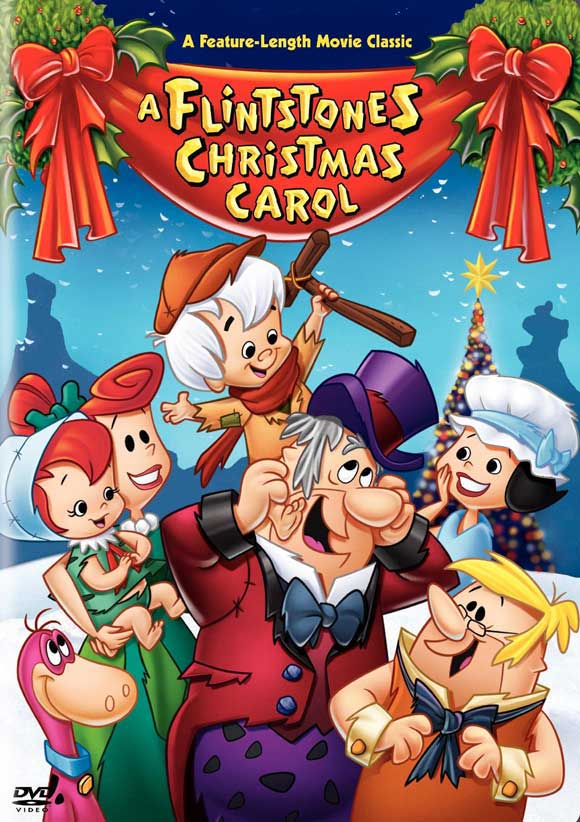
Scrooge Month Day 10: Fred Flintstone in A FLINTSTONES CHRISTMAS CAROL (1994)
 Director: Joanna Romersa
Writer: Glenn Leopold, based on A Christmas Carol by Charles Dickens
Cast: Henry Corden, Jean Vander Pyl, Frank Welker, B.J. Ward, Russi Taylor, Don Messick, John Stephenson, Marsha Clark, Will Ryan, Brian Cummings, John Rhys-Davies, Joan Gerber, Maurice LaMarche, Rene Levant
Notes: This TV movie has become a staple of the Cartoon Network family of TV channels in recent years. Like Mr. Magoo’s Christmas Carol, this film also uses the conceit of the familiar characters putting on a theatrical production of the classic novel by “Charles Brickens”(voiced by John Rhys-Davies). The Flintstones do much more with that concept than Magoo did, though. There are a few Flintstones-centric subplots that run through the story – Fred (Henry Corden) is so caught up with playing Scrooge that he’s ignoring his friends and family at Christmas and allowing his ego to overwhelm him. Wilma (Jean Vander Pyl) is the stage manager of the play, which leaves her hands full to begin with, but things get even worse as different members of the cast come down the with 24-hour “Bedrock Bug” and are unable to perform. Adaptations of A Christmas Carol featuring classic characters seem to be cursed – like Clarence Nash saying goodbye to Donald Duck in Mickey’s Christmas Carol, this was the final time Vander Pyl, Wilma’s original voice, played the character before her passing. Besides Fred as Ebonezer Scrooge (get it?), the Christmas Carol cast includes Barney Rubble (Frank Welker) as Bob Cragit, Betty (B.J. Ward) as Mrs. Cragit, Bamm-Bamm (Don Messick) as Tiny Tim, and Fred’s boss Mr. Slate (John Stephenson) as Jacob Marbley. Wilma gets called upon to play several parts as the actors drop out, including Belle and Christmas Past. The other Ghosts and the rest of the significant roles are filled by obscure or new Flintstones characters.
Thoughts: This film came out at a weird time in Flintstones history. It was the same year as the weak live-action Flintstones movie, and a year after two made-for-TV Flintstones movies which featured Pebbles and Bamm-Bamm as adults getting married, then having babies (twins). For them to step back to the classic era of the cartoon the next year was an interesting choice, but seeing as how they’ve done very little (by which I mean nothing) with the older versions of the characters in the two decades since, I imagine this film was their quiet concession that the characters work best frozen in the eternal forms they enjoyed in the classic TV series.
This is all to say: it’s a pretty good movie.
The Christmas Carol segments are relatively faithful to the book. The characters are true to themselves and they each fill the expected, suitable niche in the story. After watching nine different Christmas Carols though – eight of which are more or less straight-up retellings of the novel – it’s a nice change of pace to see this rendition. With the wraparound story, we don’t actually start the retelling of A Christmas Carol until a full 16 minutes into this 69-minute film. Once we actually get there, it’s nice to see some real “acting,” such as it is. Fred as Scrooge, for example. While it’s true he’s often a loud, obnoxious blowhard in the classic cartoons, he’s almost never pictured as being particularly stingy or cruel. In fact, the character’s biggest fault is that he goes to outrageous extremes in an attempt to provide a life far beyond his reach for his wife and daughter, hardly the actions of a traditional Scrooge. To compensate for the fact that Fred-as-Scrooge isn’t as obvious a comparison as, say, Scrooge McDuck, the movie takes its time to show you how being the star of the play has inflated his ego. Now they’re playing off an established character trait to turn his friends and family against him, making him a better fit for the part. The Fred-centric subplot runs throughout the film, whenever a scene of the “play” ends. He comes offstage bragging about the applause he’s gotten, frustrating Barney and Wilma to no end. It gets even worse when intermission hits and he realizes he left the presents he bought for Wilma and Pebbles at the store, then races out of the theatre to try to fetch them. He winds up having to break into the store, only to get busted by the police. Lucky for him, it’s his buddy Philo Quartz (Rene Lavert), who’s playing Christmas Future and needs to get him back to the theatre in time.
During Christmas Past, the actresses playing both the Ghost and Belle get sick and have to drop out, leaving Wilma to play the roles. Although we get the usual scenes of Scrooge in school, partying with Fezziwig (Barney again) and ultimately losing Belle, there’s an added subtext here. Wilma is legitimately pissed, and Fred – still focusing on his starring turn – can’t understand why.
Christmas Present is the only scene where the Bedrock Bug doesn’t cause havoc. Brian Cummings voices “Ernie,” the ghost who shows him the party at nephew Ned’s and the tender scene at the Cragit home. I know I made the same crack about the Flintstones celebrating Christmas in a time before Christ last year, but this time it’s really glaring. Barney delivers the old line about Tiny Tim hoping people remember “who made lame beggars walk and blind men see.” It’s a beautiful line, of course, one of Dickens’s best, and a vital reminder of the true reason for the Christmas season. But still, Barney, how can people remember a man who hasn’t been born yet?
Ah well. Sacrifices must be made in the name of great cinema.
Christmas Yet to Come is traditionally hooded and silent, and shows Scrooge the traditional scenes. The big curve ball here doesn’t come until the play is actually over, when Fred goes to congratulate Philo on his performance only to find that Philo got struck down with the Bedrock Bug, and Christmas Future was played by none other than his old pal Dino, putting in the greatest canine performance since Rin-Tin-Tin.
In the end, Pebbles (voiced by Russi Taylor) steals Bamm-Bamm’s “God bless us, everyone” line when he gets stage fright. The play over, though, everybody quickly turns on Fred. Fred apologizes to Wilma and the others for real, and they eventually, begrudgingly forgive him. This is the only spot where the movie falls flat. Although we see Scrooge going through his traditional redemption cycle, there’s never anything that indicates any sort of redemption for Fred. It’s as if Scrooge’s life lessons somehow apply to Fred as well, and work their magic on him. Even if we’re to assume that’s the case, why is the lesson only hitting him now, on the night of the performance, instead of the weeks of rehearsal leading up to the production? It doesn’t make a whole lot of sense.
Speaking of the production, let’s hear it for the Bedrock Community Players, can we? Their stage values are absolutely phenomenal. Somehow they have a full-size reproduction of the city on their stage, along with living dinosaurs and real snow, to say nothing of how they somehow make Fred and the Ghosts turn transparent in full view of the audience. I don’t mind tell you, friends, I’ve done my share of community theatre, and there have been times when we have it rough enough just trying to get the fog machine to work. If we could make our actors intangible, people would be abandoning New Orleans to see our performances in droves.
This is not, by any stretch, one of the all-time great productions of A Christmas Carol, but if you’re a fan of the Flintstones – which I am – it’s a fun little departure from the norm and worth watching each Christmas season.
The first Reel to Reel study, Mutants, Monsters and Madmen, is now available as a $2.99 eBook in the Amazon Kindle store and Smashwords.com bookstore. And you can find links to all of my novels, collections, and short stories, in their assorted print, eBook and audio forms, at the Now Available page!
Scrooge Month Day 9: Michael Caine in THE MUPPET CHRISTMAS CAROL (1993)
 Director: Brian Henson
Writer: Jerry Juhl, based on A Christmas Carol by Charles Dickens
Cast: Michael Caine, Dave Goelz, Steve Whitmire, Jerry Nelson, Frank Oz, David Rudman, Don Austen, Jessica Fox, Robert Tygner, Steven Mackintosh, Meredith Braun, Robin Weaver
Notes: The early 90s were a rough time for the Jim Henson Studio. After Jim died in 1990, there was a serious doubt in the minds of many that the Muppets could go on. But before his death, Jim had begun working out a deal with the Disney studio to produce more Muppet films, with one of them being an adaptation of A Christmas Carol. After Jim died, his characters were passed on to other performers. This was the first theatrical production for the Muppets after Jim’s passing, and the film is dedicated to him and Muppeteer Richard Hunt, who died in 1991. Although a musical and mostly comedic, this is a pretty faithful adaptation of the original novel, with Michael Caine playing Scrooge, new Muppets created for the three ghosts, and classic Muppets filling most of the other roles. Statler and Waldorf played Jacob and Robert Marley (rimshot), Fozzie Bear became Scrooge’s old boss Fozziwig, Sam the Eagle was Scrooge’s headmaster in school. Most notably, we got Kermit the Frog and Miss Piggy as Bob and Emily Cratchit and Kermit’s nephew Robin as Tiny Tim. The film’s stroke of genius, something that gives it an added dimension of fun, is casting the Great Gonzo as Charles Dickens himself, and allowing him to act as narrator, with additional commentary by his oft-time sidekick, Rizzo the Rat.
Thoughts: Not to put too fine a point on it, but this may well be my favorite version of A Christmas Carol. Yeah, there are probably better films, but something about this one works for me. Maybe it’s the amazing music by Paul Williams (who also wrote the songs for the original Muppet Movie). Maybe it’s the silly charm that I still feel when I see humans and Muppets walking around a set together as if there was nothing unusual about that at all. Maybe it’s because this is the movie that, in many people’s hearts, proved that the Muppets could survive after Jim Henson was gone. Whatever the reason, I love The Muppet Christmas Carol like I do few other Christmas movies.
Michael Caine is, of course, an acting legend. He’s done amazing work in dozens of fine films, such as Jaws: The Revenge, which made him the logical choice for Scrooge. His Scrooge starts out as bitter as any, but he has a quality of containment about him. He’s mean and angry, but even in the first scene you get the sense that his greatest degree of hatred is turned inward. He seems like a man ready to explode, and few people present that quality as clearly as a man who is keeping everything inside. When the film ends, when he lets his emotion finally free, it’s not anger but happiness that explodes into the old town. For all his lively parading through the streets, though, nothing serves to illustrate his reformation as well as the quiet moment where he approaches the charity collectors (here played by Dr. Bunsen Honeydew and his assistant Beaker) to give them a generous donation. Bunsen is speechless, but Beaker (always speechless) finds a way to express his gratitude: giving Scrooge the scarf from around his neck. The surprised look on Caine’s face makes you believe it’s truly the first Christmas present he’s ever been given.
This wasn’t Steve Whitmire’s first time playing Kermit the Frog, but it was here that he really had to prove himself. The simple kindness and sincerity of America’s favorite amphibian was perfect for Bob Cratchit… but it wouldn’t necessarily have been all that funny in and of itself. The solution was to surround him with Muppet rats who alternately support him and sell him out when Scrooge bellows. It’s a funny juxtaposition, and when he’s paired off with Miss Piggy (Frank Oz) for the scene in the Cratchit home, her overbearing personality plays off of him in much the same way. Whitmire has had the Kermit job ever since. He acquitted himself well.
At one point, the plan was to use existing Muppets to play the three ghosts, but the filmmakers decided it would detract from the seriousness of the story. Instead, we got three all-new Muppet creations. Christmas Past is a softly floating, ethereal puppet that looks like a bizarre combination of elf and child, glowing and floating. In fact, the performance was filmed in a tank of water to give it the sort of weightless effect they wanted, then greenscreened onto the film. For such a simple effect it’s remarkably effective, giving the ghost an ethereal quality that truly makes it look like it belongs to a different world than our own (or even an alternate version of our own where Muppets coexist with humans). Jessica Fox’s Ghost takes Scrooge on the traditional trip through his past – the joy as he left school and went to Fozziwig’s Christmas party, the heartbreak of losing Belle (Meredith Braun) when she realized he loved his money more than her. The song they sing together is devastating – she sings “The Love is Gone” with fresh sadness, while behind her Michael Caine joins in. Near the end she turns back and, just for a second, you think she’s going to acknowledge the older Scrooge… but she doesn’t. She can’t hear or see him, of course, but the audience sees the agony in his face – the pain of a man forced to relive the greatest mistake of his life.
Christmas Present is presented in a form much in keeping with other versions. He’s huge, of course, but cloaked in the traditional green robe with a holly wreath and a long red mane of hair. There’s a nice tick they give the character, though – being the Ghost of Christmas Present, he has a difficult time focusing on the future or remembering the past, and frequently repeats himself. Throughout his segment, as he and Scrooge get closer and closer to the end of Christmas Day, the Muppet grows visibly older. At the end, he’s practically ancient, and vanishes with the wind. It’s a brilliant effect that gives a nice subtext to the movie. We’ve already seen that the Past is forever, and Present reminds us the now is transient. But what’s coming next, the future… that can still be changed.
Caine sells the present scenes very well. When he realizes he’s the butt of the joke at Fred’s family party, there’s genuine pain on his face. The scene at the Cratchit family house invites a few uncomfortable questions about a world where frogs and pigs are genetically compatible, and are exclusively male and female, respectively. You forget those things when Tiny Tim launches into his song, “Bless Us All.” This part improves on many versions of the story. So often, you just see Scrooge look upon Tim and start to feel bad for him… his transformation is brought on more from pity than anything else. But here, as Tim sings his song you get an impression of just how good and pure a soul he is, and when he starts to cough Scrooge’s change of heart is no longer that of a man who simply feels bad for a sick child, but a man grieving for a world that will be deprived of such light.
The Ghost of Christmas Yet to Come, even in Muppet form, is a sight to behold. Although not quite the skeletal figure he sometimes is, he’s got your standard robe and large, oversized hands that make it look like Michael Caine is being escorted by something wholly inhuman and terrible. This segment goes pretty quickly, rushing from one scene of terror to another before they get to Scrooge’s tombstone. Once again, Caine proves himself, begging for his chance to change in a way that makes you believe in him, believe it’s possible to change, maybe even regain a little of your overall faith in the human race.
Surrounding the whole film is Gonzo as Charles Dickens. His antics with Rizzo provide added energy and comedy in scenes that traditionally aren’t that funny – when Scrooge holes himself up in his mansion before encountering the Marleys, for example. Gonzo is smart enough to know when to keep quiet, though, and in fact the characters make a show of running off and hiding just before Christmas Yet to Come pops in, then make a grand return for the finale. Using him as a narrator also allows this film to layer in much of Dickens’s beautiful prose that rarely makes it to screen, as it’s not dialogue. For that reason alone, that helps this stand as one of the most surprisingly faithful adaptations of the book I’ve ever seen.
I mentioned Paul Williams’s music before, but it’s certainly worthy of its own paragraph. The opening song, “Scrooge,” is somehow gloomy and peppy at the same time – a snappy number about a miserable man. It perfectly encapsulates the character, even giving a hint that there may be goodness within him somewhere (although the Muppets quickly dismiss that notion). Kermit and Robin later sing “One More Sleep ‘Til Christmas,” a lovely, happy song that’s worth singing every Christmas Eve. But the crowning gem is Christmas Present’s number, “It Feels Like Christmas.” There’s something undeniably joyous about the song, something that clutches the heart and the ear so tightly that it bubbles out of me at random moments in the middle of July.
Fair warning, though – the theatrical release of the film and some of the subsequent DVD and Blu-Ray editions left out the duet between Scrooge and Belle, “When Love is Gone.” Disney thought it slowed down the film too much, but when left out it kills the emotional impact of the scene, and furthermore hurts the finale, which contains a counterpoint mixed with “It Feels Like Christmas.” My DVD, fortunately, includes it, and I’d never upgrade to a Blu-Ray that leaves it out.
If you haven’t seen this version of A Christmas Carol before I can only presume that you hate the Muppets, hate Christmas, or hate joy itself. Again, I do not deny that there may be objectively superior adaptations of the book, but I very much doubt anything will ever take its place as my favorite.
The first Reel to Reel study, Mutants, Monsters and Madmen, is now available as a $2.99 eBook in the Amazon Kindle store and Smashwords.com bookstore. And you can find links to all of my novels, collections, and short stories, in their assorted print, eBook and audio forms, at the Now Available page!
Scrooge Month Day 8: Bill Murray in SCROOGED (1988)
 Director: Richard Donner
Writers: Mitch Glazer & Michael O’Donoghue, suggested by A Christmas Carol by Charles Dickens
Cast: Bill Murray, Karen Allen, John Forsythe, John Glover, Bobcat Goldthwait, David Johansen, Carol Kane, John Murray, Robert Mitchum, Alfre Woodard, Jamie Farr, Robert Goulet, Buddy Hackett, John Houseman, Lee Majors, Brian Doyle-Murray, Mary Lou Retton, Michael J. Pollard, Wendie Malick, Nicholas Phillips
Notes: This is one of the biggest departures from Dickens we’ve seen yet (and the biggest, I suspect, that we will see in this project, although other movies stray even further from the formula). Bill Murray plays Frank Cross, a disgruntled television network president who is planning a live production of Scrooge on Christmas Eve, loaded with stars like Buddy Hackett as Ebenezer Scrooge and Mary Lou Retton as Tiny Tim. But Frank has lived a rather Scrooge-like life himself, and the Ghosts of Past (Carol Kane), present (David Johansen) and Future are at work once more. We also get Bobcat Goldthwait splitting the Bob Cratchit role with Alfre Woodard (whose young son Calvin, unable to speak for some reason, is our Tiny Tim stand-in), Murray’s younger brother John playing a Fred-like part in the story, and Karen Allen filling in for Scrooge’s lost love Belle in a greatly expanded part than the character has had in any other version of the tale. John Forsythe plays Frank’s late boss, taking the Jacob Marley part.
Thoughts: This weird version of Dickens kicks off with Lee Majors leading an expedition into the North Pole to save Santa from a bunch of terrorists, which he accomplishes by arming the crap out of Santa, Mrs. Claus and all the Elves, all cast against a setting that could have fallen from Tim Burton’s brain. (It doesn’t hurt that we get a Danny Elfman score). It turns out to be one of several horrendous specials planned for the IBC network this year, all being shown to Frank Cross (Bill Murray). As we get to know Frank, we see quickly he’s not exactly Scrooge. Sure, he’s self-centered and greedy and completely lost touch with everything that matters in life – he’s so callous that when a woman has a heart attack and dies after seeing his Scrooge promo he considers it nothing but world-class publicity — but he’s still played by Bill Murray. Such a character cannot be without a sense of humor, and after yesterday’s bitingly joyless performance by George C. Scott, this is already a drastic improvement.
Forsythe’s Lew Hayward is the most gruesome apparition I’ve seen all month. Although he’s talkative and chipper, he looks like a zombie – and not a fresh one either. He’s dried up, desiccated, with rats crawling from a hole in his skull caused by the still-embedded golf ball that killed him. He fills his role neatly, but the sarcastic way Bill Murray deals with him deflates the character right up until Lew gets pissed and dangles him out the window to prove his point. It’s a shame that Murray didn’t have time to call his friends – he knows some people with ghost experience, after all.
Yet another thing that sets Frank Cross’s story apart from Ebenezer Scrooge is that he’s given a chance to return to his life after each ghostly encounter. His meeting with Lew Hayward puts him in touch with Claire Phillips – played to charming perfection by Karen Allen. Claire, it seems, is the one that got away, the love of Frank’s life, the girl who he left behind when he got big. Unlike Scrooge, Frank has a second chance – Claire is still single and she’s clearly happy to see him again. Of course, it wouldn’t be much of a movie if he didn’t come close to screwing it up all over again.
David Johansen is our Ghost of Christmas Past – here depicted as a rough New York cab driver whose taxi takes Frank back in time to relive childhood Christmases where his father (Brian Doyle-Murray) gave him meat and less distant years when things with Claire were pretty good… until they went bad. Johansen is a nice character – funny and sarcastic at the same time, even with his harsh edge. Despite that, though, despite heaping verbal (and even a little physical) abuse on Frank, you never lose your faith that his ultimate goal is for Frank’s ultimate good.
In Carol Kane, we get a Christmas Present that looks like a tooth fairy and has the clear-headedness of a toddler. She also has no problem with smacking Frank around when he needs it, which he frequently does. Her visits with Frank’s brother and Alfre Woodard’s family do more than the traditional Christmas Present visits, where Scrooge usually sees what he’s missing out on and begins to feel empathy for Tiny Tim. Here we also see how good everyone else is in comparison to him—Woodard goes behind Frank’s back and sends his brother a VCR for Christmas rather than the proscribed towel he’s handing out to everyone else. This is also where the movie takes a sharp turn into melancholy when we encounter a homeless man (Michael J. Pollard) Frank had earlier met at Claire’s soup kitchen, now frozen to death. It’s a perhaps the saddest moment in the film, and it gives Frank just the right blow to turn the chink forming in his armor into a full-on crack. It’s just such a sad, hopeless, pathetic sight you can’t help but be affected, and Murray’s enraged screaming at Pollard’s frozen corpse is the clearest indication yet he has a conscience in there somewhere. He may be yelling at Herman for being stupid, but he really hates himself for not doing anything to save the man when he had the chance.
The puppet they use for Christmas Future here is the scariest damn version of the character yet, making his first appearance on a wall of television monitors and reaching out of it for Murray just before Bobcat Goldthwait bursts in with his shotgun. (More on that shortly.) The future he shows Frank is even bleaker than Scrooge’s usual future. Claire isn’t just alone, she’s embraced Frank’s gospel of greed. The non-talking Calvin (Nicholas Phillips) isn’t dead, but he’s been committed to a sanitarium. Brother James comes off the best in the future – he and his wife (Wendie Malick) are the only two people who show up to watch Frank’s cremation, except for Frank himself… and he, naturally, winds up in the coffin.
Although Bobcat Goldthwait’s Eliot Loudermilk is filling the Bob Cratchit archetype, a Cratchit he’s not. He has good intentions, but after Frank fires him in the opening scenes of the movie, he goes nuts. He shows up later toting a shotgun, planning to get his revenge. Fortunately for him, Frank has been redeemed by that point and not only gives him his job back, but recruits him as his sidekick in the glorious finale, in which he takes over the studio at gunpoint and shows off his newly-discovered Christmas spirit to the world.
The finale, in fact, is why I love this movie so much. Not to say the rest of it isn’t entertaining, but if it weren’t for the ending, when Bill Murray stands in front of the cameras and expresses his joyful spirit to the whole world (even winning back Claire) it may not stick with you so clearly. The happiness and sincerity in that final sequence is maybe the most believable such redemption I’ve ever seen a Scrooge undergo. He shouts at the camera, he pleads with the audience for everybody to embrace the feeling that’s overtaking him, and Bill Murray sells every inch of it. And if you don’t laugh when he starts talking to the audience in the movie theater, compelling them to sing along, I don’t know if I want to know you. Scrooged may be the least Dickensian of the films we’ve watched, but it’s easily one of my favorites.
The first Reel to Reel study, Mutants, Monsters and Madmen, is now available as a $2.99 eBook in the Amazon Kindle store and Smashwords.com bookstore. And you can find links to all of my novels, collections, and short stories, in their assorted print, eBook and audio forms, at the Now Available page!
 Reel to Reel