Blog Archives
The Christmas Special Day 9: Emmet Otter’s Jug-Band Christmas (1977)
 Director: Jim Henson
Writer: Jerry Juhl, based on the book by Russell & Lillian Hoban
Cast: Jerry Nelson, Frank Oz, Marilyn Sokol, Dave Goelz, Richard Hunt, Eren Ozker, Jim Henson
Plot: With three days to Christmas,Alice Otter (Marilyn Sokol) is having trouble getting together the money to give her son Emmet (Jerry Nelson) a happy holiday. Emmet sets his heart on a $40 guitar in a music store window, but their shopping afternoon is disrupted by the appearance of a group of rough animals calling themselves the Riverbottom Boys. As the Otters return home, Alice tries to discourage Emmet from getting too hopeful about Christmas, but the boy continues to dream about the days when his father was alive and money went farther. Alice is practically down to using her washtub as their only means of support, while Emmet uses his father’s tools to do odd jobs. Both Alice and Emmet learn the town’s upcoming Talent Competition has a grand prize of $50. Emmet’s friends form a jug band and ask him to borrow his mother’s washtub to make a bass, but Emmet refuses, knowing you can’t make a washtub base without putting a hole in the washtub. Alice is reluctant to enter either, knowing her only way of having a dress for the competition would be to hock her late husband’s tools. Later, as Emmet and Alice play on the frozen lake, they share memories of Pa Otter, and each becomes convinced that he would have made the sacrifice for the other’s sake. Alice wants to buy her son the guitar he admired, while Emmet wants to use his share of the prize money to put a down payment on a piano to replace the one she sold some time ago. Emmet makes his washtub bass, while Alice sells the tools and buys fabric for a dress.
As Emmet’s band practices, the Riverbottom Boys mock their efforts to win the talent contest. Their nerves are shaken even worse when they arrive at the contest to find the opening act is performing the same song they’ve rehearsed. They rush off to learn a new song, but the stage manager forces them back into the theater, afraid they’ll miss their cue. Alice performs “Our World” to a thunderous round of applause, and Emmet’s Jug Band follows up with “Brothers.” The competition is supposed to be over, but the Riverbottom Boys come on and perform a harsh, angry rock number, “Riverbottom Nightmare Band.” The Nightmare Band wins the competition, and the Otters are despondent. Outside they’re told the judges liked both of their acts, but felt like they were missing a little something extra. Alice realizes what their songs were missing was each other. She begins singing and the jug band joins in, resulting in a beautiful combination of the two pieces, “Brothers in Our World.” As they sing, the townspeople come out to listen. Doc Bullfrog, one of the judges, offers them a job performing at his restaurant – free meals included. As they walk home, Alice and the boys sing Pa Otter’s favorite song in his memory.
Thoughts: The great Jim Henson makes his first (but most assuredly not last) appearance in our countdown with this 1977 TV special, adapting a folksy little tale with a hint of O. Henry and a lot of Henson-style sweetness. Although Henson was a veteran puppeteer at this point, and Sesame Street had been on the air for eight years, this special still shows some of the marks of early work and low budgets. The establishing shot is very obviously a model, control rods and seams are often all too visible, and the car the Riverbottom Boys ride through town looks like a wind-up toy. Amazingly all of these things actually contribute to the charm of the special. It gives it a homey, old-fashioned feeling that suits the characters and the world Henson and company created.
The plot has an interesting dash of “Gift of the Magi” in it, but with a clever twist. Rather than trading their own possessions for gifts (which turn out to be useless, thanks to their partner doing the same thing), in this special both Otters trade something important to the other in the hopes of getting the money for a decent present. I’m not quite sure what the message here is… “If you take away your family’s only means of support, make sure you can use it to get them a musical instrument” seems like kind of a bizarre theme for the Christmas season. What makes it work, however, is how the movie uses the focus of the absent Pa Otter – Henson convinces us that both Otters are doing what they believe their late husband/father would do, which is what makes it not only acceptable, but admirable. It helps, I think, that they don’t actually accomplish their goal. Losing the contest makes for a slightly less sugary climax, and the way they get their happy ending anyway feels more natural, more emotionally honest.
Emmet and Alice themselves are sweet, old-fashioned characters. There’s a bit of saccharine to them, but just a bit – enough for the obnoxiously cynical among us to cling to in an attempt to deride this special, unfortunately. For the rest of us, the Otters are simply a hard-luck family in need of a break at Christmas.
The star of this special, I’d argue, isn’t any of the Otters or even Henson, but songwriter Paul Williams. Williams would go on to have a great history with Henson and the Muppets, and the songs he composed for this special (“There Ain’t No Hole in the Washtub,” and “Bar-B-Que,” for instance) have transcended Christmas and become folksy classics. There’s an interesting phenomenon when you rewatch the special, though… having heard the “Our World”/”Brothers” mashup at the end, when you listen to each song performed on its own it feels oddly incomplete. “Brothers” especially sounds like a backing track, with odd pauses and harmonic notes that don’t seem like a proper melody. It’s been far too long since I first saw the special to remember if I would have noticed such a thing upon first viewing, but it stands out to me now. Also amusing, to a Muppet fan like me at least, is “Riverbottom Nightmare Band,” which has some riffs and beats that seem to echo Dr. Teeth and the Electric Mayhem in musical energy, if not in actual tone or message.
A few years ago, Williams wrote a few extra songs to expand the special into a full-length stage play, which ran for two Christmas seasons in Connecticut. Would that I could have seen that one – I’ll bet it was magnificent.
For those of you wondering if the inclusion of this special means you won’t be seeing any other Muppets in the countdown thanks to the “one-per-franchise” rule, the answer is heck no. Using the same logic that allows me to include multiple Rankin and Bass specials, I consider each “family” of Muppets a different franchise. Since this one doesn’t include any of the Muppet Show or Sesame Street Muppets, except Kermit in an intro that is no longer included on the DVD, I hereby declare this a standalone film. You’ll definitely see the Henson company again.
The Christmas Special Day 8: ‘Twas the Night Before Christmas (1974)
 Directors: Jules Bass & Arthur Rankin, Jr.
Writer: Jerome Coopersmith, based on the poem by Clement Clarke Moore
Cast: George Gobel, Joel Grey, Tammy Grimes, Bob McFadden, John McGiver, Alan Swift
Plot: Two months before Christmas, in the little town of Junctionville, NY, both the human and mouse populations found themselves getting their letters from Santa Claus returned unopened. Father Mouse (George Gobel) discovers an anonymous letter in the newspaper calling Santa a myth and a lie, signed “All of us.” Father Mouse’s son, Albert (Tammy Grimes), is revealed as the author of the letter. Albert, a brainy sort, refuses to believe in things he can’t see or touch. Meanwhile, Father Mouse’s human clockmaking partner, Joshua Trundle (Joel Grey) convinces the town to construct a huge clock to play a song in praise of Santa in the hopes of getting back in his good graces. Father shows Albert around town, pointing out children heartbroken by Santa’s rejection, but Albert remarks that grown-ups don’t care about such things. Father tries to show him how wrong he is by taking him to Trundle’s clock.
On the day Trundle’s clock is unveiled, it mysteriously malfunctions, and the town gives in to despair. By Christmas Eve, the Trundle children don’t even want to hang their stockings or decorate the tree. The mice are in similar desperation, and Father stumbles upon a sobbing Albert, who confesses he broke the clock when trying to study the machinery. Albert vows to repair the clock before midnight, finally understanding that he has a lot left to learn. As the town sits up on what they’re certain will be a sad Christmas Eve, the clock strikes midnight and begins chiming Trundle’s Santa song. In the sky, a miniature sleigh and eight tiny reindeer swoop down, and the Trundle and Mouse families watch as St. Nicholas makes his annual visit, right on schedule.
Thoughts: Like the many Rankin and Bass specials based on songs, Jerome Coopersmith had the task of expanding upon a rather thin plot. The original poem, of course, is simply about Santa popping in, getting caught by Dad, and popping back out again. No drama, no antagonist, and the mice that aren’t stirring also aren’t talking. Thank goodness the Rankin and Bass folks were here to fix that. Oddly, the result is an almost completely original story – the poem really only factors into the very beginning and very end narration, with everything in-between existing in a little world of its own.
Albert is an interesting character – someone who refuses to believe in anything abstract or esoteric. At the time, marking such a character as the misguided one in need of a lesson was standard operating procedure. Watching this cartoon today, however, I have to marvel at how different things are. In today’s culture, Albert would far too often be the one dealing out the lesson, ridiculing characters who draw upon faith. I rather prefer this version of the paradigm. The song “Even a Miracle Needs a Hand” is perhaps one of my favorites in all of the Rankin and Bass universe – something sweet and hopeful, but at the same time recognizing the need for good people to step up and work towards their dreams. As messages go, it’s a timeless one that more and more I feel like the modern world is forgetting.
It’s also interesting that this is one of the few Rankin and Bass cartoons – either stop-motion or traditionally-animated – that is presented as a period piece. Most of the Santa-centric cartoons that touch upon the real world – Frosty, for instance, or The Year Without a Santa Claus – all took place in the present day, with only Santa Claus is Comin’ to Town going into the past for the origin. This cartoon, though, seems to take place in a turn of the century sort of community. The story probably would have worked just well if set in 1974, but something about the more old-fashioned setting sets it apart a bit, giving it a slightly different flavor from the rest of the Rankin and Bass catalogue.
If the story has a weakness, it comes in Albert’s redemption. Like so many Rankin and Bass antagonists, we see someone who is more misguided than evil, and in his case, works frantically to fix his mistake. This is all well and good, but Albert’s actual transformation falls short. This half-hour short (25 minutes without commercials) simply doesn’t give us enough time to really watch Albert evolve as a character. Father Mouse’s song and the visit to the clock don’t seem nearly powerful enough to cause the sort of change of heart we see in Albert just in the nick of time. The ending is still very good, but it feels unearned.
 What’s really odd, though, is how off-model Santa and his reindeer are in this film. The Rankin and Bass cartoons have a certain style whether they’re stop motion or cell animation, and even Frosty the Snowman sticks fairly close to style. While the human and mice characters easily look like they could pop into any other R&B production and be perfectly welcome, Santa… Santa. The “right jolly old elf” himself looks more like Alfred E. Neuman wearing a Santa suit than anything else. (Either that or he was a test model for the Hobbits in the Rankin and Bass adaptation of that novel, which came out in 1977.) Then, Santa speaks in a booming, deep (and uncredited) voice. It’s a good Santa voice, again one which would feel at home in any of these films, but feels completely alien to the Santa design in this cartoon.
These things take me out of the cartoon briefly, but only briefly. Despite being based on one of the most famous Christmas verses ever written, it’s actually one of the most original cartoon Rankin and Bass ever produced, and in and of itself, that’s enough to make it one of the better ones from any studio, ever.
The Christmas Special Day 7: The Year Without a Santa Claus (1974)
 Directors: Jules Bass & Arthur Rankin, Jr.
Writer: William J. Keenan, based on the novel by Phyllis McGinley
Cast: Mickey Rooney,Shirley Booth, Dick Shawn, George S. Irving, Bob McFadden, Rhoda Mann, Bradley Bolke, Colin Duffy
Plot: One year Santa Claus (Mickey Rooney) comes down with a terrible cold. His elfin doctor tells him people don’t care about Christmas anymore anyway, and the sad Santa cancels Christmas this year. With everyone distraught, Mrs. Santa Claus (Shirley Booth) sends elves Jingle and Jangle (Bob McFadden and Bradley Bolke, respectively) — with the reindeer Vixen — south to try to find some leftover Christmas spirit from the year before to convince Santa to get back on his feet. When Santa finds out they’ve left, he gets out of bed to try to fetch them, fearing they’ll run afoul of “the Miser Brothers.”
The elves, as it turn out, are heading right between the kingdoms of the warring Snow Miser (Dick Shawn) and Heat Miser (George S. Irving). Vixen barely escapes the Misers, and the trio land in nearby Southtown, U.S.A. They begin their search for Christmas spirit, but run into one person after another who doesn’t care… even children ambivalent about Santa Claus skipping his annual visit. They leave the children when Vixen – disguised as a dog – is taken away by the dogcatcher. One of the children, Ignatius Thistlewhite (Colin Duffy) is later approached by Santa Claus. Ignatius directs Santa to the dog pound and he leaps upon Donner to fly to the rescue. Ignatius and his parents see the flying reindeer, and he realizes his mistake. The elves and Ignatius arrive at town hall at the same time, trying to plead to the mayor for Vixen’s freedom. The mayor doesn’t believe them, and jokingly offers to free Vixen if they can make it snow in Southtown. Meeting up with Mrs. Claus, the elves visit Snow Miser who – after one of the most rousing and memorable musical numbers Rankin and Bass ever produced – they ask to bring snow to Southtown. As it turns out he’d love to do that very thing, but his brother the Heat Miser won’t allow it. When they turn to Heat Miser, he agrees to allow snow in the south, but only if Snow Miser will cede to him the North Pole for a day. Realizing the brothers will never come to terms, Mrs. Claus goes over their heads to their mother… the notoriously reclusive Mother Nature herself (Rhoda Mann). Mother forces them to cooperate.
Unbeknownst to them, Santa has taken Vixen – sick from the heat – back home to the North Pole. Santa, still feeling ill himself, sits down for a nap, unaware snow is falling in Southtown. Mrs. Claus returns with newspapers proclaiming an official holiday in celebration of Santa Claus. All over the world, children come together to visit the North Pole and give gifts to Santa for a change. On Christmas Eve however, Santa receives a letter from a child who proclaims she’ll have a blue Christmas without him. Santa, touched despite the blatant plagiarism from an Elvis Presley hit, demands his sleigh be prepared for his traditional Christmas rounds. He makes a special journey to Southtown, appearing in public (I told you guys he constantly breaks that rule in the Rankin-Bass universe) to thank the children who taught him his lesson. He leaves to perform his duty, taking off from the newly-renamed Santa Claus Lane.
Thoughts: I was almost reluctant to include this one, based on my “one-per-franchise” rule. This film is considered by some to be a sequel to Santa Claus is Comin’ to Town, mostly due to the fact that Mickey Rooney returns as Santa Claus. But then I decided screw it – it would be easy to link together most of the Rankin-Bass specials and just as easy to declare that each one exists in a totally separate reality from all the others, so I’m just going to do the ones I want to. It’s my project, after all.
If I did want to think of it as a sequel (which I don’t), this is the Superman II of the franchise. The origin stuff is out of the way, so we can tell a solid, self-contained story without worrying about wasting time placing the pieces on the board. The cast is expanded and the threat is considerably greater than in the first film. Also like Superman II, this film features the hero deciding to eschew his responsibilities and struggle with questions of his own relevance, only to learn a harsh lesson about just how needed he truly is. In both films, our hero is rendered ill, wounded, and is eventually prodded forward by the urging of an outside party (Santa’s letter to the little girl, Superman given a plea by the President of the United States). Even the villains in each film take the opportunity to screw each other, setting up circumstances that directly lead to the solution to the threat. This movie, it should be noted, has 100 percent fewer Super Roofie Kisses than Superman II, so the metaphor isn’t a perfect one.
I honestly like this much more than Santa Claus is Comin’ to Town, mostly because – although it suffers from an unforgivable lack of Topper the Penguin (something else it has in common with Superman II) — it more than makes up for it with the introduction of the Miser Brothers. These are characters that have really become cultural hallmarks, at least for my generation. Their respective Heat Miser and Snow Miser songs have been covered by pop groups and rock bands, and even the most ardent Scrooge will find themselves singing along if that particular tune starts piping in through the mall sound system. Of all the characters created by the Rankin-Bass people from whole cloth (as opposed to being based on a preexisting tune or legend), these are the two that have most fully acclimated into American pop culture. They are the perfect example of a Rankin and Bass creep-to-be-redeemed. They aren’t evil, they’re just childish, and the ire they’ve directed at one another for such a long time has contributed directly to the lack of Christmas spirit in the world around them. It’s not a question of turning them away from being bad, it’s just a case of making them realize it will be better for everyone if they would simply cooperate with one another, a lesson similar to that learned by General Zod and Lex Luthor, and I swear to Krampus himself that’s the last Superman II reference. Today.
On a more personal note, the notion of snow in the south being the hallmark of real magic is something else that helps this special resonate with me. I’m from Louisiana, friends. White Christmases aren’t exactly common here. Neither are white New Years, white Valentine’s Days, or white Mardi Gras. It doesn’t snow down here much, is the point I’m making. So the idea of a little snow hitting specifically on Christmas really does carry magic in the south that those of you in colder climes may not realize. I offer the following evidence: a few years ago, against all odds, it actually got cold enough to snow in New Orleans on Christmas Day. It wasn’t much snow, just a dusting really, and my Yankee now-fiancé Erin just laughed when she saw how excited we were… but on that day, people flooded the streets. Everybody in the neighborhood was outside, kids who hadn’t taken their eyes off their X-Boxes in years were playing in the sun, throwing snowballs at each other and embracing the sudden burst of joy that was falling down as surely as the ice. My sister, who was 23 at the time, actually pulled the doorknob out of the door in her rush to get outside. It doesn’t happen here, friends. So I know how the folks of Southtown feel.
Like A Charlie Brown Christmas, this special proves that the fear of waning Christmas spirit isn’t a new problem at all. It’s actually kind of encouraging to realize people were afraid of these same problems forty and fifty years ago – if we’ve made it this far, maybe it’s just one of those things that never really goes away. But that’s okay, because there are people like Mrs. Claus, people of goodwill like you and me (admit it, you love Christmas, you wouldn’t have made it this far if you didn’t), and through our own small efforts and acts of kindness and acts of will, we’ll help the holiday persevere.
The Christmas Special Day 6: Santa Claus is Comin’ to Town (1970)
 Directors: Jules Rankin & Arthur Bass
Writer: Romeo Muller
Cast: Fred Astaire, Mickey Rooney, Keenan Wynn, Paul Frees, Joan Gardner, Robie Lester, the Westminster Children’s Choir
Plot: Friendly mailman S.D. Kluger (Fred Astaire) has once again rounded up a cart full of letters about Santa Claus. To answer all the questions at once, he decides to share with us the story of Santa’s life. Years ago, in a vaguely Eastern European land called Sombertown, a baby is found. He’s brought to the town’s mayor, the Burgermeister Meisterburger (Paul Frees), who immediately sends the baby to the local orphanage. On the way, though, the Winter Warlock (Keenan Wynn) sends up a terrific snowstorm that snatches the child away. The forest animals find him and hide him from the Warlock, taking him to a safe place – the home of an elf family named Kringle. The elves name him Kris, raising him as their own. As he grows up he learns all of their skills, including making toys. Sadly, the elves have mountains of toys that go undelivered thanks to the Burgermeister, even though they were once the royal toymakers to the king. Kris eventually grows into a strapping young man with the voice of Mickey Rooney. He vows to set out and begin delivering the toys, with an official red-and-white Kringle suit and a penguin named Topper. In Sombertown, though, the Burgermeister has outlawed toys entirely. Ignoring the decree, Kris hands out toys to children, and a schoolteacher named Jessica chastises him for breaking the law. The Burgermeister declares Kris a rebel and orders him arrested, but Kris distracts him with a yo-yo and escapes. Kris and Topper turn up in the lands of the Winter Warlock and are captured. Before he can destroy them, Kris gives him a wooden train, and Winter’s frozen heart melts away, restoring his humanity. Winter offers to use his magic to help Kris in exchange for toys once in a while, and he demonstrates his power by showing him a vision of Jessica, who is wandering the woods looking for him. She’s got a handful of letters from the children asking for toys to replace the ones the Burgermeister destroyed, and Kris begins using the Warlock’s tricks to watch over them, to be sure they’re being good, for goodness sake.
The next night Kris returns to Sombertown with a sleigh full of toys and a list of the good children (which, naturally, he checks twice), and the next morning the Burgermeister is again outraged at the proliferation of toys. He orders the doors and windows locked all over town, but Jessica and the animals continue to deliver letters to Kris. Refusing to disappoint a child with a special request, Topper suggests Kris try entering homes through the chimney, a task which quickly becomes standard operating procedure. The Burgermeister turns over all the houses looking for toys, so Kris starts hiding them in stockings hung to dry by the fireplace. The Burgermeister finally uses Jessica to track down the Kringles’ home, and Kris, the Kringles, and Winter are all captured and arrested. Jessica tries to break Winter out of prison, but the only remnants of his power are some magic kernels of corn. She feeds them to eight of Kris’s reindeer friends, who gain the ability to fly. They sweep into the prison and break out the inmates, taking them away. With the Kringle home destroyed by the Burgermeister, Kris and his family are now outlaws. Kris grows a beard to help disguise himself (doesn’t bother to change his bright red clothes, but, y’know, a beard… that should do the trick) and decides to use an alias. The eldest Kringle shows him a medal with his birth name on it: Claus. Taking back his real name, he asks Jessica to share it and the two are married in the woods on Christmas Eve while the Kringles decorate the pine trees and place their wedding gifts beneath the boughs. With his last burst of magic, Winter fills the trees with brilliant lights.
Kris and the Kringles march further north and build a home, where they continue to make toys for years. Eventually, the Meisterburgers die out, and Kris is able to make his journeys more freely. The letters from the children grow more and more frequent, though, and he decides to restrict his deliveries to one night a year, the holiest night, Christmas Eve.
Thoughts: Although, as we’ve seen, Rankin and Bass made a cottage industry out of turning Christmas songs into Christmas specials, this may be their crowning achievement of adaptation. The song “Santa Claus is Comin’ to Town” has even less of a plot than Rudolph or Frosty’s titular claims to fame. It’s basically a reminder to kids not to act like jerks because Santa won’t give them any loot on Christmas morning, and as this is a one-hour special, they’re going to need a lot more to go on. Romeo Muller, who has earned a permanent spot in Christmas Heaven for writing so many of these, does an absolutely heroic job weaving the tale of Santa’s life. This is without a doubt the longest synopsis I’ve written yet in the Christmas project, and that’s due entirely to the complexity of the story and the number of important touchstones along the way.
Muller manages to work in most of the major points of the Santa legend – the elves, the toymaking, the reason Christmas Eve is so sacred to him. For the most part, he does it very organically, almost seamlessly. The only thing that breaks the spell, that reminds you that he’s going through a checklist of Santa Facts, is that every so often Fred Astaire and the children break in with some narration to point out that you just learned something important: “So that’s why he makes such wonderful toys!” Yeah kid, we got that. No need to call attention to it. Muller also gives Santa a Mrs. Claus, elves, flying reindeer and the charming voyeuristic powers that probably weren’t nearly as creepy in the pre-Internet days.
There are a few interesting trends in here that would later reach out and lay branches in future Rankin and Bass productions. We’ve got multiple antagonists, at least at first, in the Warlock and the Burgermeister. The Warlock’s menace ends quickly, though, and he reforms, becoming a friend to our heroes. We’d see this later in other cartoons, including Jack Frost in Frosty’s Winter Wonderland and, to a lesser degree, the Miser Brothers in Year Without a Santa Claus. It’s a good way to work in themes of redemption into these cartoons without actually making an icon like Santa or Rudolph a jerk at any point in their respective careers. Not every villain can be redeemed, of course, but the way we see the Burgermeister waste away in self-imposed loneliness and misery says a lot for the power of having a winning personality.
The story is a tad anticlimactic – the Burgermeister never really gets his comeuppance, he just loses his prisoner, and it’s implied that he dies a pathetic wretch. But Fred Astaire comes in at the end of the special and delivers a speech of pure sincerity to rival “Yes Virginia.” It’s a beautiful moment and it leads right into the musical finale.
This isn’t my favorite of the Rankin and Bass specials, and none of the elements created for this show specifically have ever really caught on with the public at large the way some of the other Rankin and Bass creations have. (Not even Topper. What’s up with that? Topper is awesome.) But on the whole, it’s a fine origin for Santa Claus, one that is perfectly satisfying for any child who wants to know all of the things kids tend to ask about Santa. Even after all these years, it’s still a joy to watch.
The Christmas Special Day 5: Frosty the Snowman (1969)
 Directors: Jules Bass, Arthur Rankin Jr.
Writer: Romeo Muller
Cast: Jimmy Durante, Billy DeWolfe, Jackie Vernon, Paul Frees, June Foray
Plot: Children’s entertainer Professor Hinkle (Billy DeWolfe) is perhaps the world’s worst performer, with tricks that won’t work and a rabbit named Hocus Pocus who won’t cooperate. After a failed show at an elementary school, the children race outside to build a snowman, whom they christen Frosty (Jackie Vernon). Hocus and Hinkle rush outside, where Hinkle throws his hat at the rabbit. It’s retrieved by one of the children, Karen (June Foray, again, proving that if there is a goddess of voice animation it’s her), who places it on Frosty’s head. The snowman snaps to life and bids everyone a happy birthday, but Hinkle snatches his hat back and leaves. Hocus steals the hat again and returns it to the children, who use it to bring Frosty to life again. He plays and dances with the children until he notices the temperature is rising, and he’s beginning to melt. Karen and the children promise to send him to the one place he’ll never melt: the North Pole. They parade through town to the train station to send him off (startling a traffic cop along the way) but are stumped when they realize they can’t possibly afford the ticket. At Hocus’s suggestion, Frosty and Karen hop into a refrigerated boxcar on a north-bound train. Hinkle, who realizes the hat has genuine magic power, hops on the same train, determined to steal it back.
When Frosty realizes the frozen car is making Karen sick, he and Hocus get off with her at the next stop. Hinkle jumps from the train so as not to lose them, crashing in the process. Karen is still in danger of freezing, so Hocus tries to rouse the local forest animals to build her a fire. Although Karen is safe for the moment, Frosty knows they need to find help soon, and Hocus suggests Santa Claus, who is scheduled to make his Christmas Eve rounds in mere hours. To keep her warm in the meantime, Frosty finds a greenhouse, but Hinkle manages to trap them both inside. When Santa arrives, Hocus brings him to the greenhouse, where Karen is safe, but in tears: Frosty has been reduced to a puddle with a corncob pipe and an old silk hat. Santa tells her that Frosty is made of magical Christmas snow, which can never go away forever. He uses his magic to rebuild Frosty, but before he places the hat upon his head, Hinkle shows up to demand its return. When Santa warns him he’ll never give him another Christmas present again if he hurts Frosty, Hinkle backs down and is sent away to write a massive apology. Santa places the hat back on Frosty’s head, restoring him to life. He takes Karen home and promises her that Frosty will return every year with the Christmas snow.
Thoughts: Frosty the Snowman gives us yet another case of Rankin and Bass magic, but this time, we’re going for traditional animation. This studio is much better known for their stop motion work, but they did several specials in this format, and later applied it to their version of Tolkien’s Lord of the Rings and 80s TV shows like Thundercats.
Like Rudolph and Little Drummer Boy, this film takes a classic song and gives us an expanded storyline to fill out its half-hour running time. The song even shares DNA with Rudolph – Gene Autry commissioned the piece from Walter Rollins as a follow-up to his earlier Christmas hit. And a hit it was, but like Rudolph, it needs some work to succeed as a narrative. The original song, let’s be honest here, doesn’t exactly have a riveting plot: Snowman gets magic hat, snowman comes to life, snowman starts to melt, snowman leaves. Hard to get a full-length special, and what’s more, there’s no antagonist.
That, in fact, is what really makes this special: Professor Hinkle. He’s a really entertaining bad guy, very different from the usual Rankin/Bass assortment of monsters, evil wizards, and misers. Hinkle is kind of a pathetic figure, but in a funny way. He’s utterly failed at life, he’s a disaster as a magician, but he seems to have more greed than genuine evil in him (despite his own protests to the contrary). Even as he’s trailing Frosty and Karen he has to keep reminding himself to “think nasty… think nasty…”
Looking back on this as an adult, you start to realize that Hocus Pocus, the rabbit, is actually a pretty lousy influence on the children. His refusal to work with his partner in the first place is what costs Professor Hinkle his hat. Hocus steals the hat later (for a good cause, perhaps, but it’s still theft). He convinces an underage girl to illegally board a train with a man she’s known for all of seventeen minutes, without so much as a phone call home to tell her parents not to worry. Yes, he technically helps to save her life multiple times, but seeing as how she would never have been in danger if not for him, it’s hard to give him too much credit for that.
Christmas is almost an afterthought in this special. It’s not really mentioned at all in the original song, and you’ve only got a quarter of the special left when it’s even mentioned that this is all taking place on Christmas Eve. (What school is in session on Christmas Eve? Did they used to do it that way?) It works out for Karen, of course, because otherwise Santa Claus wouldn’t be around to save her and…
Wait a minute, this all happened on Christmas Eve? What did they even need the train ticket for? Why didn’t Frosty just wait around for Santa in town in the first place? They could have saved themselves all kinds of trouble! And don’t tell me it’s because Santa wouldn’t show up while the kids were awake, because this is a Rankin and Bass special and he breaks that rule all the time. He even breaks this rule in this very cartoon, because if he was waiting for all of the animals to be asleep before he shows up Hocus couldn’t even have flagged him down in the first place! Good grief, Romeo Muller, were you even trying?
Yet, this is a classic.
You see, out of all the great characters in the Rankin and Bass catalogue, there may be none as ridiculously endearing as Frosty. His sweetness, his heart that remains warm despite being encased in snow, the fact that he even apologizes to Hocus for some truly ridiculous suggestions for getting help… well, he’s a better snowman than I. This cartoon is the reason I can’t put on a top hat without getting the urge to wish everyone a happy birthday. It’s ludicrous! It’s incomprehensible!
And it’s a valued part of our collective childhood, and I wouldn’t change a minute of it.
Frosty returned twice more in the annals of Rankin and Bass – in 1976’s Frosty’s Winter Wonderland he’s given a snowwife, Crystal. In 1979, the Frosty family teamed up with Rudolph for the stop-motion feature length film Rudolph and Frosty’s Christmas in July. Both of these are worthy sequels. Less so is 1992’s Frosty Returns, a terrible, painfully preachy cartoon produced by CBS and unforgivably directed by Bill Melendez (of A Charlie Brown Christmas), and in 2005 there was the CGI Legend of Frosty the Snowman, which is more faithful to the original, but still merely okay. As usual with these characters, Rankin and Bass did it best. All others need not apply.
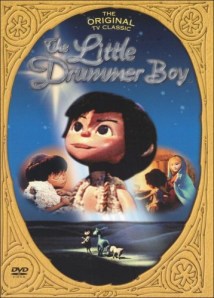
The Christmas Special Day 4: The Little Drummer Boy (1968)
 Directors: Jules Bass & Arthur Rankin Jr.
Writer: Romeo Muller
Cast: Jose Ferrer, Paul Frees, June Foray, Ted Eccles, Greer Garson, music by the Vienna Boys Choir
Plot: Aaron, an orphaned drummer boy (Ted Eccles), has grown up with a disdain for all humanity after his family was killed by bandits. His hatred grows even more intense when he and his few animal friends are abducted by a travelling salesman, Ben Haramed (Jose Ferrer). Ben Haramed paints Aaron’s face and forces him to perform at the marketplace for donations. He grows angry and lashes out at the people around him, and Ben Haramed’s troupe is driven from town. As they cross the desert, they encounter a group of three kings (all voiced by the great Paul Frees, who also voices Aaron’s father) who are breaking camp on a long journey to follow a star in the heavens. One of their camels has collapsed under the weight of his pack, and Ben Haramed sells them Aaron’s camel Joshua to replace it. Enraged, Aaron takes his remaining animals and sets out to find his missing friend.
He follows the same star as the Magi, finally arriving at the town of Bethlehem. Dozens of shepherds arrive as well, all following the same star. He tracks them to a stable, where they are bowing before a manger. Aaron and his animals rush to their missing friend, but his sheep Baba is struck by a Roman chariot in the streets. Aaron takes the dying sheep to the Magi, where he finds them presenting a baby in the manger with their gifts of gold, frankincense and myrrh. When one of the Magi tells him he cannot save Baba, he suggests Aaron take Baba to the newborn king in the manger. With no gift to present the baby, Aaron begins to play his drum. As he finishes, Baba comes back to him, miraculously healed. Aaron’s angry heart melts, as the star shines brilliantly over the little town of Bethlehem.
Thoughts: I don’t typically get religious in my writing, but it would be somewhat negligent to do a project like this one, examining the all-time great Christmas specials, without touching upon a few of them that actually deal with the true meaning of Christmas. Take this 1968 special by our friends at Rankin and Bass (oh, we’re just getting started with them, folks), which dramatizes the old favorite of the Little Drummer Boy.
Rankin and Bass took the classic song and greatly expanded upon it, giving the little drummer boy a backstory, a reason for being in Bethlehem, and a name. For the most part, the additions to the song work very well. The add-ons make Aaron a very different kind of character than the cipher who arrives in the song to humbly play his drum for Jesus. Instead, we’re introduced to a child who has shut himself off from the world, keeping his affection only for his animals. Aaron turns to Jesus to save his friend, but viewed through a spiritual prism, it’s clear that Aaron himself is the one who truly needs salvation. In a very real way, this special makes the Little Drummer Boy the first soul to be saved by the Son of God. It’s a very clever angle to take, rooting the story very strongly with the Bible tales and making Aaron a far more significant character than he was described as previously. It doesn’t change anybody’s religion, of course, but taken from a narrative standpoint, writer Romeo Muller came up with a really good way to make this cartoon matter in a way the original song really didn’t.
The music here is strong, if not quite as iconic as many of the other Rankin and Bass specials. The original “Little Drummer Boy” is the only one that really stays with you after the show is over, and that’s mostly because it’s a piece that virtually everybody who watches this will know already.
More so than some of the other films we’ve looked at (or will look at) this short does express some of the limitations of early stop motion animation, especially in terms of precision. As Aaron plays his drum, the beat doesn’t match the movement of his hands. When we get to the line where “the ox and lamb kept time,” the camera pans across them nodding rhythmically, but not in the same rhythm as the song. You feel a little bad for chuckling at this, as it is supposed to be a wonderfully somber moment, but fortunately the emotion of Baba’s rejuvenation sweeps in as the song ends to save the day.
This isn’t the greatest religious-themed Christmas special, but it’s one of the earliest greats. Other films would later tread over some of the same ground, and one imagines director Don Bluth was drawing on this ten years later when he created his last short for Disney before striking out on his own, The Small One. Were this a project about Christmas films in general and not just television specials, you can rest assured, Small One would have a place of honor. As far as the TV spots goes, if you’re looking for one that actually features the nativity, this is as good as it gets.
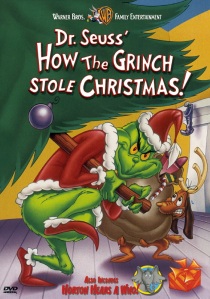
The Christmas Special Day 3: How the Grinch Stole Christmas (1966)
 Director: Chuck Jones
Writers: Irv Spector & Bob Ogle, based on the book by Dr. Seuss
Cast: Boris Karloff, June Foray
Plot: In the town of Whoville, Christmas is a season beloved by all. The Whos in Whoville gather together to cut down the town tree, decorate the community, and celebrate the season. But not everybody is happy with the season. North of Whoville, in a mountain cave, lives a green creature called the Grinch (Boris Karloff, doing double-duty as the narrator) who hates Christmas with all of his two-sizes-too-small heart. As he watches their celebration begin, he vows to destroy Christmas for everyone. Stitching together a Santa Claus suit and putting “antlers” on his dog Max, the Grinch sweeps into town and begins breaking into houses, stealing every present, every decoration, every morsel of food, even the roast beast. As he goes to work in one house, however, he’s interrupted by little Cindy Lou Who (June Foray).Cindy Lou mistakes him for Santa and asks him why he’s taking their Christmas tree. He tells her he’s bringing the tree to his workshop to repair a broken light, then ushers her off to bed and finishes his insidious task.
The Grinch and Max take their loot to the top of a mountain, where he plans to spy on the Whos as they wake up and find their Christmas ruined. To his shock, though, the Whos come from their houses, join hands, and begin to sing despite their lack of gifts, of trees, of boxes and bags. That’s when it dawns on him… that perhaps Christmas has a deeper meaning than those things one can buy from a store. As his heart fills for the first time in years, his sleigh of toys begins to tip over the side of the mountain. His newfound Christmas spirit gives him the strength to rescue the sleigh and he races back to Whoville to return everything he stole. The Whos welcome him with open arms and even allow him to carve the roast beast.
Thoughts: Like most movies (even short films) that are based on children’s books, when the time came to animate How the Grinch Stole Christmas there was a need to beef up the story considerably in order to make it fill the allotted running time. Fortunately, this is a case where just enough was added to make the story a real classic (as opposed to the 2001 feature film where just enough was added to make the whole thing feel like a waste of time).
Out of all the specials I’m going to talk about this month, this may be the most singularly perfect case of voice casting we’ll see. Boris Karloff, as both the narrator and the Grinch himself, delivers a legitimately flawless performance. The Narrator has the sort of homespun quality you want – it’s like having a grandfather or a gruff uncle calling you around the fireplace to tell you a story. Then he shifts into the Grinch persona, adopting a nasty edge to his timbre that sends him from being your grandfather to that creepy old man down the street you’re really afraid of but feel compelled to pester at Halloween. Complimenting Karloff in the small but vital role of Cindy Lou Who is the legendary June Foray, one of the two greatest voice artists of all time (the other being Mel Blanc, and if you want to rank anybody else above those two you are wrong). Foray gives Cindy Lou a tender innocence that could easily be obnoxious and saccharine, but she imbues it with such sincerity that she’s impossible to dislike. Cindy Lou is the child every parent wishes they could present to Santa Claus down at the mall.
Then there’s the direction. Chuck Jones, perhaps the greatest animator in American history, takes the performances of these voice artists and crafts a beautifully rendered, visually amazing world that perfectly captures the wonderful lunacy of Dr. Seuss’s best work, while still maintaining his own inimitable comedic style. In the antics of the Grinch and his dog Max, you can see the finest moments of Wile E. Coyote and the Road Runner or of Tom and Jerry, both of whom experienced their best years when directed by Jones.
The Grinch slinks along like a snake in this cartoon, he casually licks his fingers to unscrew a light bulb, and in one of the greatest moments in the special, his face grows into this insidious, far-too-wide grin when he concocts his terrible scheme. This sort of thing is all Jones, all part of his amazing animated style. The action sequences, when he’s racing up and down the mountain in his sled, or where he desperately tries to save the presents at the end… again, Jones is the star here, showing off the potential of animation to tell a story of this nature in a thrilling fashion.
Rounding out a perfect crew was Thurl Ravenscroft, best known as the voice of cereal mascot Tony the Tiger, singing “You’re a Mean One, Mr. Grinch.” The song is great in and of itself, but planting it in Ravenscroft’s deep baritone gives it a feeling that no other Christmas song can boast. That song, that performance, is just as famous as any other part of this cartoon, and it’s well-deserved.
This film also passes a rather unique test when it comes to Christmas specials. There are honestly far too few truly original stories out there. We live in a world where half the Christmas stories told are just retreads of A Christmas Carol or It’s a Wonderful Life. This film is its own story, though, not a parody, which makes it impressive enough. But eventually, it reached the stage where it is the source of parody – plenty of movies and TV shows have spoofed the Grinch over the years. That places it in the upper echelon of Christmas stories, the strata of tale that writers who can’t come up with their own story choose instead to build upon. If that isn’t the sign of a cultural landmark, I don’t know what is.
The Christmas Special Day 2: A Charlie Brown Christmas (1965)
 Director: Bill Melendez
Writer: Charles M. Schulz
Cast: Peter Robbins, Christopher Shea, Kathy Steinberg, Tracy Stratford, Chris Doran, Geoffrey Ornstein, Karen Mendelson, Sally Dryer, Ann Altieri, Bill Melendez
Plot: It’s nearly Christmas, but Charlie Brown (Peter Robbins) can’t seem to find it within himself to enjoy the season. Nobody is sending him any Christmas cards, his little sister Sally (Kathy Steinberg) is more concerned with getting presents than any spirit of generosity, and even his dog Snoopy (Bill Melendez) is giving himself over to a Christmas decorating contest. His “psychiatrist,” Lucy (Tracy Stratford), suggests that he take a hand in directing the children’s Christmas play. She also confides that she feels the holiday blahs as well, never getting the gift she really wants: real estate. Charlie Brown arrives at the theater to find a disjointed group of performers who lack any real holiday spirit, and his best efforts to turn things around avail him nothing. Lucy finally suggests that he find a big, shiny aluminum Christmas tree to help with the celebration, and he sets out with her brother Linus (Christopher Shea) to search. Instead of one of the garish plastic and metal monstrosities that Lucy wants, though, Charlie Brown finds a little sprig of a tree that looks like it needs love. Lucy and the others mock the tree and Charlie Brown, depressed, asks if there’s anyone who can tell him what Christmas is all about.
Linus, of course, can. In one of the most memorable moments in animation history, Linus Van Pelt recites the Christmas story from the Bible, reminding his friends that the season is not about plays or trees or decorations, but about something much, much deeper. Encouraged, Charlie Brown tries to decorate his little tree, but with one ornament it collapses. He slinks away, heartbroken, and Linus leads the rest of the children in fixing the tree and making it beautiful. Charlie Brown returns to see what they’ve done, and his friends wish him a Merry Christmas.
Thoughts: Is there any special as beloved, and as deservedly so, as A Charlie Brown Christmas? I’ve always thought that Peanuts in general, the classic comic strip by Charles M. Schulz, represents the pinnacle of human philosophy in the 20th century. There is no other work of art that so succinctly and completely captures the human spirit as Schulz’s squiggle children and their outlandish dog. And this, the first of what would become a mini-empire of animated classics, is perhaps the greatest of them all.
The special, as the story goes, was difficult to get made. Schulz and Melendez had collaborated on some short animated pieces for commercials and a TV documentary about the comic strip, and crafted the story in just a few days after Melendez committed the pair to producing it. They insisted on using real child actors to voice the children, which was unheard of at the time and especially problematic in that some of the cast was too young to read and needed their lines cued by Melendez (whose heavy Mexican accent can actually be heard in a few of the lines where the children parroted his voice too closely). The CBS network objected to Vince Guaraldi’s jazz soundtrack, to the inclusion of the Biblical passage, to the lack of a laugh track on the cartoon, but Schulz and Melendez stood their ground. I would imagine by the time the Emmy and Peabody awards started rolling in, CBS would have realized their mistake.
It is this film’s lack of perfection, I think, that makes it perfect. The animation isn’t polished, the voice actors are clearly amateurs, the editing can be choppy at times. But at the same time, the entire point of the story is that Christmas is supposed to be about something more than glitz and glamour, that the heart of the season is what really matters, and that there’s no reason to be ashamed of loving something, flaws and all. How hollow would that message ring in some of the computer animated films of today, the ones where all the characters look like polished plastic and none of them seem to have any souls? (Yes, I know that there’s currently a CGI Peanuts feature film in the works. I’m trying not to think about it.)
The imperfection of the plotting leads to some of this cartoon’s best character moments. This is one of the shortest synopses I’ve written for a Reel to Reel study since the early days of the first project, and the reason for that is that the actual plot is wonderfully short. Nearly half the cartoon is taken up by tangents that have nothing to do with the story – an ice-skating sequence, Linus showing up the rest of the kids pelting snowballs at a tin can, Lucy flirting with Schroeder on his piano. All of these bits are superfluous as far as the story goes, but go a long way towards demonstrating who these characters are and why they should matter to us.
It doesn’t matter if the lips don’t sync with the words, that the mouths disappear when characters stop talking, that there’s no physical universe in which Charlie Brown’s face in profile and Charlie Brown’s face head-on could possible occupy the same head. If you’re focusing on stuff like that, my friends, you have completely missed the point of this film.
In addition to being an excellent cartoon about the true meaning of Christmas, this special goes a long way towards making Peanuts the cultural icon it is are today. This cartoon was made 15 years into the comic strip’s legendary 50-year run, and while 15 years seems like a long time, in those early years the comic strip and its characters were very much in flux. Lucy was introduced as a baby then aged to being the elder of the group. Sally and Linus were both born during the course of the strip. Snoopy began as a relatively normal dog, but his imagination and behavior grew more and more outlandish. By the time this cartoon was made, the characters had finally settled into the personalities and roles that would define them for the rest of the century. To many of us, Lucy will always be the fussbudget in the psychiatrist booth, Snoopy will always be the dog capable of winning a decorating contest, and Linus will be the child wise beyond his years, the one who puts everything into perspective. (At least until Halloween.)
For all the generations that have been born since this cartoon premiered, how many of us first formed our opinions of these characters by watching A Charlie Brown Christmas? It’s not just a great Christmas special, this is an important piece of Americana. It’s part of our cultural heritage. And on our best days, as it always was with Charles Schulz’s comics, it is who we really are.
For all the dozens of Peanuts cartoons that followed, it was almost 30 years before they tried another Christmas tale – this time with 1992’s It’s Christmastime Again, Charlie Brown. This would be followed again by Charlie Brown’s Christmas Tales in 2002 and the ambitious hour-long special I Want a Dog For Christmas, Charlie Brown in 2003. While these cartoons, like all Peanuts specials, have their moments of sweetness, nothing has ever approached the pure, sincere beauty of the original, and I daresay nothing ever will.
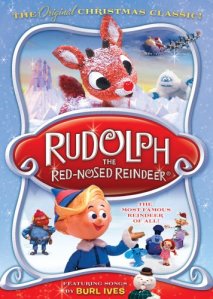
The Christmas Special Day 1: Rudolph the Red-Nosed Reindeer (1964)
 Director: Larry Roemer
Writers: Robert May, Romeo Muller
Cast: Burl Ives, Billie Mae Richards, Paul Soles, Larry D. Mann, Stan Francis, Paul Kligman, Janis Orenstein, Alfie Scopp
Plot: On a cold winter’s day Sam the Snowman (Burl Ives) invites us to listen to the story of the most tumultuous Christmas of all time. The reindeer Donner (Paul Kligman) is shocked when his wife gives birth to a fawn with a glowing red nose. Naming the child Rudolph (Billie Mae Richards), Donner attempts to hide the strange nose from the rest of the reindeer, afraid the boy will never be accepted enough to join Santa’s sleigh team. Rudolph joins in the reindeer games, and his attempt to impress a doe named Clarice (Janis Orenstein) goes off brilliantly… until, in his joy, he exposes his nose. The rest of the reindeer mock him and drive him away, but Clarice follows, trying to convince him his nose is something to be proud of.
In Santa’s workshop, meanwhile, an elf named Hermey (Paul Soles) is feeling trapped in his toymaking tasks… he really wants to be a dentist. He encounters Rudolph, who has just been warned off by Clarice’s father, and the two outcasts strike up a friendship, deciding to become “independent together.” They set off from the North Pole, hoping to find a place where they fit in, but find themselves tracked by the Abominable Snowman. They get stuck in ice, but are rescued by a prospector named Yukon Cornelius (Larry D. Mann), who is determined to mine for silver and gold in the great white north. The three of them are attacked by Abominable, and Yukon breaks them off onto an ice floe to escape. Eventually they arrive at the Island of Misfit Toys, a land populated entirely by playthings that are flawed in some way: a Jack-in-the-Box named Charlie, a train with square wheels, a water pistol that only shoots jelly, and other such manufacturer’s defects. They’re taken to the island’s king, Moonracer (Stan Francis, who also voices Santa), who offers to give them shelter for a night if Rudolph agrees to ask Santa to deliver the misfit toys to children so they can finally be happy. That night, however, Rudolph realizes the Abominable Snowman is tracking them via his nose, so he leaves his friends behind.
As time passes, Rudolph grows up and returns to the North Pole two days before Christmas Eve, where he finds that his parents and Clarice are missing, having spent months searching for him. Before he can set out to look for them, an incredible snowstorm strikes. Rudolph manages to find the missing reindeer in a cave, trapped by the Abominable Snowman. He saves them as Hermey and Yukon arrive. Hermey extracts the Snowman’s teeth, but he traps them all before Yukon plunges off a cliff with the monster and is lost. The misfits return to the North Pole, where Santa agrees to deliver the Misfit Toys and Hermey is given permission to set up his dentist’s practice. As apologies are made, Yukon Cornelius appears with the bound and reformed snowman, now called “Bumble,” who cheerfully joins in the celebration by placing the star atop the Christmas tree. All may still be lost, though, because the storm isn’t letting up… until Santa realizes Rudolph’s brilliant nose is just the thing to guide his sleigh.
Thoughts: As far as beloved symbols of the holiday season go, Rudolph didn’t get the most auspicious start… and I’m not talking about the whole “Reindeer Games” thing. Rudolph began life not because someone had a vision, not because of an abiding thirst to add something to the Christmas pantheon, but because a department store wanted to save money. Montgomery Ward had been giving away coloring books to children for a few years and decided it would be cheaper if they made their own instead of just buying them from others, so in 1939 the company assigned copyrighter Robert May to come up with a story. The resulting poem, about an outcast reindeer with a red nose, became a hit. In 1944 Max Fleisher’s studio made an animated short starring the character, in 1949 songwriter Johnny Marks adapted the poem into a song made legendary by Gene Autry, and throughout the 1950s and 60s he starred in an annual comic book special published by DC. But the most enduring (and, I’d argue, most endearing) version of the character is this one, the one who raced onto NBC and 1964 and brought with him not only the hope for the Christmas season, but also the beginning of a golden age of animated specials by Rankin/Bass Productions.
Rudolph’s tale has a good, positive message even in the original poem: it’s a story about accepting who you are and finding your utmost potential. But the added dimension this special gives to a relatively simple story is a big part of what makes it so memorable. When Hermey first shows up, wanting to practice dentistry, it feels like a throwaway joke at first. And it’s a funny joke, don’t misunderstand. The notion of an elf tossing away his heritage to do something so decidedly un-elflike is silly on the face of it. But Hermey’s character arc parallel’s Rudolph’s in a very interesting way. Rudolph is separated from the other reindeer by something physical that he can’t change; Hermey is separated from the other elves by something spiritual that he wants to change. The friendship the two of them strike up is undeniably heartwarming.
Although the rest of the cast hasn’t become as famous as Rudolph himself, Hermey, Yukon Cornelius and Bumble have most definitely ascended to the level of B-list players on the Christmas scene. Yukon is goofy enough to be fun in any context, and in most company you need only say “I want to be a dentist!” in Hermey’s intonation to get across the point that you feel like a square peg being forced into a round hole. But Bumble is my favorite of the trio. Although Rankin/Bass are best known for their Christmas specials (and for their later 80s animation), they did occasionally swerve into other seasons. Bumble was their first great monster, and the sensibility that went into his design would turn up three years later, when they produced the feature film Mad Monster Party, including versions of all the great Universal monsters.
The Misfit Toys, likewise, have become classics, but I’ve always felt like the writers were stretching just a bit with this section. Some of the “defects” seem almost too silly to accept (the Charlie-in-the-Box, for example… doesn’t it occur to anybody he could just change his name?). Still, the charm of the characters is enough to deflate these more practical notions, and the idea that a toy needs the love of a child to be complete is the sort of beautiful thing that Jim Henson and the boys at Pixar would pick up on in years to come. I’m not saying that Toy Story never would have happened if it weren’t for Rudolph, but I guarantee you the people who made that movie were fans of this one.
Although the original Johnny Marks song is the hallmark of the special’s musical numbers, it would be practically criminal to ignore the rest of the music he composed to accompany it. “We’re a Couple of Misfits,” the song Rudolph and Hermey each sing solo before coming together for a brilliant duet, is almost an anthem for outcasts, and deservedly so. It’s quick, it’s catchy, and it’s infinitely adaptable. Burl Ives is at his all-time best turning out “Silver and Gold” and “Holly Jolly Christmas,” both songs that have become perennials in their own right – and with all due respect to Gene Autry, it’s the Ives version of “Rudolph the Red-Nosed Reindeer” I hear whenever the music begins playing in my head (usually a few days before Thanksgiving, at which point I attempt to force it back until the turkey and stuffing are digested… or at least eaten).
Having Rudolph grow up during the course of this cartoon was an interesting choice. This was, if you’ll recall, Rankin/Bass’s first big Christmas hit, and they probably didn’t expect it to become the trademark of their brand. They’d bring Rudolph back for other specials over the years, when he would save the New Year and, along with Frosty, the Fourth of July, but whenever he turned up after this, he was the young Rudolph again. And that’s as it should be. That is, after all, the way he went down in history.
The Christmas Special: An Introduction
Once again, my friends, the Christmas season is underway, and that means it’s time to immerse ourselves in the sort of cheerful yuletide content that we all love. There are Christmas books, Christmas movies, Christmas music, Christmas food (oh… oh dear Heaven the Christmas food…) but there’s one entertainment medium that, as far as I’m concerned, Christmas dominates like no other.
The television Christmas special.
Let’s think about it here. Think for a moment about what a TV special is – a short film made for the small screen. It’s not long enough to block out the two hours for a legitimate TV movie. It’s not necessarily part of a regular TV series, although it may be a spin-off, reunion show, or a backdoor pilot for one. Sometimes the characters are familiar, sometimes they’re one-off visitors, sometimes they’re telling a timeless story and sometimes they’re giving us something new.
And I don’t know about you guys, but the vast majority of the great television specials that linger in my mind are Christmas specials
Oh sure, there are a few Halloween greats, the odd Thanksgiving or Valentine’s Day yarn, but let’s be honest here. During those golden days when the word “SPECIAL” would spin out at us from our TV screens to announce the next thirty to sixty minutes of CBS would not be our regular programming, we were hoping to see Rudolph, or Frosty, or Charlie Brown putting up his sad little Christmas tree.
So this year, I’m giving my month of December to a discussion of 25 of the most memorable Christmas specials, at least as far as I’m concerned. Interestingly, this project has proven to have the opposite problem of this Halloween’s comedy/horror project, in which I simply couldn’t find very many old movies to discuss. This time around, the closer we get to the present day, the harder it is to find a truly great special. I managed to scrape up a few, but we’re still going to spend most of the month without getting past the 80s. I also tried to restrict myself to just one special per franchise, although there are countless Muppet, Sesame Street and Peanuts films I could have gone with. And I also refused to go with any of the endless reiterations of Charles Dickens’s A Christmas Carol, not because I don’t like them, but because there are so damn many of them I rather think it would be fun to do a Reel to Reel project someday looking exclusively at those films.
So come back tomorrow and we’re going to begin, appropriately enough, with the first great special from the good people at Rankin/Bass productions. We’re traveling back to 1964 to spend some time with Rudolph the Red-Nosed Reindeer.
 Reel to Reel