Blog Archives
The Christmas Special Day 20: Christmas at Pee-Wee’s Playhouse (1988)
 Directors: Wayne Orr, Paul Reubens
Writer: John Paragon, Paul Reubens
Cast: Paul Reubens, Annette Funicello, Frankie Avalon, Grace Jones, k.d. lang, Dinah Shore, Little Richard, Cher, Magic Johnson, Zsa Zsa Gabor, Whoopi Goldberg, Oprah Winfrey, Joan Rivers, Charo, Kevin Carlson, Laurence Fishburne, Aaron Fletcher, Darin Grimes, Rick Heitzman, Suzanne Kent, William Marsha, George McGrath, S. Epatha Merkerson, Alison Mork, John Paragon, Lynne Marie Stewart, Vic Trevino, Wayne White & the Del Rubio Triplets
Plot: As Pee-Wee Herman (Paul Reubens) makes out his list for Santa Claus, he gets a visit from his friend Miss Yvonne (Lynne Marie Stewart), who has strategically placed mistletoe into her hairdo to get kisses from everyone. She’s brought Pee-Wee his Christmas present: her own homemade fruitcake. Less than enthused, Pee-Wee gives her a bottle of homemade perfume that smells just like him. As he continues his preparations, he gets a call from Whoopi Goldberg, asking to be on his Christmas special, but he’s booked solid for the next two years. When he’s reminded that he forgot to get decorations for the Christmas party, he wishes he hadn’t been so selfish, getting the attention of Jambi the Genie (John Paragon). Pee-Wee uses Christmas to con an extra wish out of Jambi (he usually only gets one a day) and has the Playhouse quickly decorated, planning to use his other wish for “something special” later. Mail Lady Reba (S. Epatha Merkerson) arrives and Pee-Wee gives her a set of press-on toenails and an enormous letter to Santa. She gives him another fruitcake, and a huge box containing singer Grace Jones, who was supposed to be shipped to the White House. She sings her own rendition of “Little Drummer Boy” before she’s reboxed and sent off to Washington (where I’m sure President Reagan was highly appreciative). Frankie Avalon and Annette Funicello stop by to make Christmas Cards, and Cher drops in to get today’s Secret Word. (It’s “Year.” So whenever anyone says “Year,” you scream real loud. You know where this is going.)
The King of Cartoons (William Marshall) drops in with a gift for Pee-Wee (two fruitcakes), and Annette starts the cartoon, preceded by a Christmas message from Joan Rivers on the set of Hollywood Squares. The excitement is heightened when a snowfall sends Pee-Wee out to play (after telling Frankie and Annette they can’t join him until they finish making their cards). As he plays, his friend Cowboy Curtis (Laurence Fishburne) stops by, and the two of them listen while the Del Rubio Triplets perform “Winter Wonderland.” Little Richard joins the gang as they go ice skating, but he’s not that good on skates, and has to watch as Pee-Wee demonstrates his own prowess, courtesy of his stunt double, Hans. Everyone goes in for hot chocolate to warm up and listen to a song by special guest k.d. lang, backed up by the Puppet Band. As night falls, Pee-Wee hangs up his giant Christmas stocking(s) amidst those of his friends, then tosses Frankie and Annette bread and water to sustain them as they toil away on the cards. Pee-Wee gets more visitors, more well-wishers, and more fruitcake… even, courtesy of Charo, one in Spanish. Pee-Wee’s friend Mrs. Rene (Susanne Kent) stops in to teach him about Hanukkah and gives him eight days of fruitcakes. Finally, Frankie and Annette finish making the 1000 cards, and are allowed to join the party. Randy, Pee-Wee’s Marionette buddy, seems to have forgotten the true meaning of Christmas, so the Magic Screen shows him a video of a Nativity Play and tells him the story of the first Christmas. “Touched,” Randy gives Pee-Wee a fruitcake. Finally, Pee-Wee leads them to a new wing of the Playhouse where he has a couple of construction workers building walls using the fruitcakes for bricks. As the gang begins caroling, Pee-Wee hears sleigh bells – Santa Claus has arrived! Santa (Aaron Fletcher) pops in and tells Pee-Wee his list was so big that he didn’t have any presents for the other children. Pee-Wee’s friends, with the help of his flashback to Randy, convince him to sacrifice his presents so the other children can have Christmas, and Santa rewards him by inviting him to join him on his sleigh to deliver the presents. Before he goes, Jambi reminds Pee-Wee of his special wish, which he uses to wish for Peace on Earth, a Merry Christmas, and a Happy New Year.
And everybody screams real loud.
Thoughts: If you were around in the late 80s, and were just at the right age, you might remember Pee-Wee’s Playhouse as something of a phenomenon. It was an odd sort of show. To kids, it was a bizarre, surreal blend of puppetry, animation and sketch comedy that tapped into a primal source of humor for us all, a sort of subversive answer to Sesame Street that seemed to want to use the same tricks, but instead of teaching us to spell and count, taught us to scream real loud. To adults, it was a weird production that was half parody and half celebration of the sort of kid-centered variety show that existed in the 50s and 60s, but was largely extinct by that point. To everybody, it was something that would prove impossible to forget even after Paul Reubens was forced to retire the character in disgrace. (We won’t go there, this is a family countdown.)
As an adult, it’s hard not to look at this and immediately understand that Pee-Wee creator (and performer) Paul Reubens was in this more to entertain himself and the older audience, and any kids who really got into it were just a little extra credit. If you doubt that, look at the guest list for this special. Find one seven-year-old circa 1988 who either knew or cared who Dinah Shore, Charo, or the Del Rubio Triplets were. Come on. I’ll wait. Most of the older guests seem to be wallowing in their own irony – particularly Frankie and Annette, who were riding an irony-fused wave of nostalgia popularity at the time. Only k.d. lang really seems to get into it, performing a wild and ridiculous rendition of “Jingle Bell Rock” that clearly demonstrates that she realizes how crazy what she’s doing is and has decided to just roll with it.
Pee-Wee himself, as a character, is hardly the role model of a Charlie Brown or a Rudolph… or even a Fat Albert. He’s kind of rude at times, openly disdainful of the gifts his friends give him, engages in a weirdly antagonistic back-and-forth with the viewers, and comes across as rather self-centered even at his best. It’s actually part of the reason kids liked him so much, I think – he was a more cynical character and, as a result, a slightly more honest one.
Even the bits that you usually get in a children’s show have a weird sort of twist. The scene where Frankie and Annette make Christmas Cards, for example, is the kind of quasi-education craft segment you’d get in any kids’ show… so why does Pee-Wee look at the former supercouple as if they’ve fallen from another planet? (Because that’s what most kids would do when some grown-up starts rambling about trying to make Christmas Cards with a potato, that’s why.) Perhaps the best “tip,” though, comes when Pee-Wee plays in the snow, and tells the kids at home that they can substitute 20 pounds of coconut shavings if they don’t have any snow at home. You’ve got to wonder how many kids tried to convince their parents to let them give that one a try.
Although this is billed as its own standalone special, even more than many of the others we’ve watched, it feels very much like a longer episode of the TV show. Reubens and his guests engage in most of the once-an-episode bits that we’re all used to from the weekly series, like his journey through the magic screen or his daily wish from Jambi the Genie. As was true for most episodes of the TV show, the plot is loose at best, with Reubens and company instead pinwheeling from one segment to another with no real logic or connectivity beyond the need to discuss Christmas and keep up the running gag about Pee-Wee getting fruitcake after fruitcake instead of real gifts.
It’s entertaining, at least, but perhaps not as much as a lot of the other Christmas specials we’ve watched this month. It has its charm, but Pee-Wee doesn’t really age as well as a lot of the other characters who’ve come together to make our Yuletide merry. Ah well. Perhaps the next cast of misfits will do better.
The Christmas Special Day 18: A Garfield Christmas Special (1987)
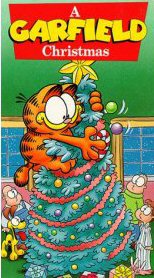 Directors: Phil Roman & George Singer
Writer: Jim Davis
Cast: Lorenzo Music, Thom Huge, Gregg Berger, Pat Carroll, Pat Harrington Jr., David Lander, Julie Payne
Plot: Garfield the Cat (Lorenzo Music) wakes up on Christmas morning to find his owner Jon (Thom Huge) has arranged an incredible gift – a chair that will read his mind and produce any gift he can imagine. Garfield produces dozens of presents before he realizes it’s all a dream. Jon wakes him up in the real world, on Christmas Eve, planning to pack up and go to his parents’ farm for Christmas. On the farm Jon, Garfield and Odie (Gregg Berger) get caught up in the preparations, while his mom (Julie Payne) and Grandma (Pat Carroll) clash in the kitchen. After dinner, Jon’s father (Pat Harrington Jr.) can’t get the star on top of the tree, and Garfield is sent in to do the job. After a few heart-rending moments, he pops out of the branches, places the star, and falls back down, taking the half of the decorations with him. Despite the chaos, when Dad plugs the tree in, it’s perfect. Jon’s parents have his brother Doc Boy (David Lander) sit down at the piano to lead a singalong, but Grandma quickly takes over. After, as she relaxes with Garfield in her lap, she relates how her late husband always made Christmas magical for her and the kids.
After Dad’s rousing recitation of Binky: The Clown Who Saved Christmas, the family goes to bed. Garfield watches Odie sneak off to the barn, where the dog struggles to put together some bizarre contraption. Garfield helps without Odie’s knowledge, then stumbles onto a bundle of old letters. Inside, Jon and Doc Boy try to rouse their parents to open presents – at 1:30 a.m. Dad forces them to go back to bed until morning – real morning – when Garfield presents Grandma with the letters he found. She’s stunned to realize Garfield found the love letters her husband sent her years ago, letters she thought were lost forever. Odie then pops in with his own gift – the contraption from the barn, a backscratcher for Garfield. Touched, Garfield comments on the true meaning of Christmas… love… before he tells us all to get out.
Thoughts: It’s easy to forget, considering how bland it’s grown in recent years, but Garfield actually used to be pretty funny. Both the comic strip and the 80s/90s cartoon had some really good years, and this 1987 special is one of the earlier efforts with the newspaper star.
Garfield’s cynicism is a trademark of the character, of course, but for a children’s Christmas special in 1987 to open up with a main character proclaiming the virtues of greed and avarice was a rather surprising way to kick things off. His complete lack of excitement and enthusiasm is what makes the character so funny, in fact. While Jon bubbles over with excitement about Christmas, Garfield bemoans days of work, chores, “electrical contracting,” and other such activities that draw him away from his cozy bed. Looking back as an adult, it’s a lot easier to sympathize with Garfield than Jon’s family. Even if you forget everything else that goes along with Christmas, life on a farm… it’s not easy.
Grandma Arbuckle (who made a return appearance, triumphantly, in Garfield’s Thanksgiving special a few years later) is another comedic gem, throwing out such bizarre observations as “in my day all we had were wood-burning cats.” That sort of weird, surreal comment is just the thing to elevate this beyond being just a wacky kids’ show and into something with a little bit of an absurdist quality that adults can enjoy too. As the show progresses, though, we start to get the sense that her lunacy is a bit of a front, a shield she puts up to hide a bit of loneliness that’s come upon her in her age.
Lorenzo Music was truly fantastic in the Garfield role, bringing in a amusing, dry quality that sells every line. Even Frank Welker, who does the character in the modern version of the cartoon, doesn’t really hold a candle to Music, who passed away in 2001. Pat Carroll’s Grandma is another great find, straddling the line between sweet little old lady and aging hellfire. Fans who like to play “who’s that voice?” get a nice puzzle as well – Jon’s brother Doc Boy is voiced by David Lander, alias Squiggy of Laverne and Shirley fame.
The story of this special is pretty loose. Although I don’t think most of it is based on any specific comic strips, it definitely has the feel of being plucked from assorted holiday-themed strips that don’t necessarily have anything to do with one another, then stitched together into something resembling a plot. The later Peanuts specials have often been fraught with this problem, but this is one of the few times Garfield fell victim to it.
With the loose feeling, the special doesn’t really latch on to the real Christmas spirit until the end. Suitably, the cartoon maintains Garfield’s rather pessimistic air until the moment Garfield realizes Odie is trying to make him a gift. After that, it quickly swings into the realm of the sweet – Garfield helps Odie and improbably finds the one thing that would mean more to Grandma than anything else. It’s quite a coincidence, but it’s not hard to accept in a cartoon of this sort.
This is one of my favorite of the various Garfield specials, and it set things up very nicely for his weekly cartoon series the next year. That one became a staple for me for many years, and even now, I’d rather watch some of those old episodes than most other cartoons on the air today. The modern Garfield Show doesn’t really hold a candle to the old one (despite having much of the same cast and writing staff), but I still like to go to this one every Christmas season.
The Christmas Special Day 15: The Life and Adventures of Santa Claus (1985)
 Director: Jules Bass, Arthur Rankin Jr.
Writer: Jules Bass, based on the novel by L. Frank Baum
Cast: Earl Hammond, Earle Hyman, Larry Kenney, Lynne Lipton, Bob McFadden, Lesley Miller, Peter Newman, Joey Grasso, J.D. Roth, Alfred Drake
Plot: In the forest of Burzee, the Great Ak (Alfred Drake) summons a council of the immortals. As dozens of fairies, nooks, and other fantastic creatures come together, the Great Ak tells them the mortal named Santa Claus is about to be visited by the Spirit of Death. This mortal, Ak says, has earned possession of the world’s one and only Mantle of Immortality. To convince them, the Great Ak tells them his story, the tale of the life and adventures of Santa Claus.
Sixty years prior, the Great Ak found a mortal baby abandoned in the snow. He gives the child to a lioness to rear, but the fairy Necile (Lesley Miller) is curious about what a “child” is. She observes the lioness and decides she wants to care for the baby herself. She begs the Great Ak permission, which he grants, assigning the lioness to remain with the baby as its protector. Necile names the baby Claus, “little one” in her language. Claus doesn’t remain little for long, though. In the view of the immortals, he begins to grow up in the blink of an eye, and young Claus (voiced by J.D. Roth) begins his education in the ways of the forest. Ak decides Claus should see his own people, and takes him on a magical tour of the world of Man, where Claus sees terrible misery, violence, and suffering. He also begins to understand that he is mortal, unlike Necile and his friends, and one day he will die and become just a memory to his loved ones. Claus decides to live in the world of mortals, hoping to make it better, and he takes his lioness protector and teacher Tingler (Bob McFadden) with him. As he grows older, he begins to visit the nearby settlements of mankind, taking particular care in being a friend to the children. (His voice also changes, just like real life! Adult Claus is voiced by Earl Hammond.)
One winter night, as Claus carves a cat out of wood, he finds a child outside his home, nearly frozen. He brings the boy inside to warm up, and the child quickly takes a liking to Claus’s cat, Blinky. As the child sleeps, he finishes carving the cat, paints it, and gives it to the boy when he wakes up. When the other children in town learn of the wooden cat, they all want one of their own. He starts making cats, then other animals and dolls for the children… he has invented the toy. He brings his friends the Nooks to his home to help make toys in bulk, but soon receives a threat from a beast called King Awgwa (Earle Hyman), lord of the dark creatures who convince children to misbehave. King Awgwa abducts Claus, but the immortals easily rescue him. The Awgwa realize they cannot capture him easily, but they can prevent him from delivering his toys. They attack him the next day as he travels, stealing all the toys he’s made and taking them to their caves. The attacks continue, over and over. Finally, the Great Ak, Master Woodsman of the World, takes out his Silver Axe and leads the fairies and nooks into battle with the Awgwa and a mighty dragon. The Great Ak and his forces defeat the Awgwa, and Claus is free to deliver toys again. His sled is now so heavy with toys he can’t pull it, and his friend Peter Nook (Peter Newman) offers to allow Claus to use some of his reindeer to pull the sleigh, provided he can return them to their forest home by daybreak. The reindeer are impossibly fast, eventually finding the ability to fly through the air. Claus begins making regular trips to deliver toys, and is soon beloved by children everywhere, who call him “Santa Claus.” He returns home too late, though, and Peter is angry. Claus asks him to allow him to use the reindeer again, and Peter finally agrees, but only for one night a year… Christmas Eve. With just ten days, Claus won’t have enough toys to make the trip and will have to skip an entire year, unless he can find the toys stolen by the Awgwa. He goes to bed on Christmas Eve, convinced he’ll lose a year, but Peter Nook arrives with the reindeer and the sleigh full of recovered toys.
Years later, Santa Claus has won the love of all the world, and now stands on the brink of death. He decorates a tree with small toys as a symbol of his good work, and Tingler vows to decorate the tree every year. In the forest of Burzee, the Great Ak petitions the rest of the immortals to give Claus the Mantle of Immortality. In all the world there is only one, and can only be given to one mortal. Touched by his story, the immortals agree to present it to Claus. Just before he dies, Necile delivers the golden shroud to her son. Revitalized, he thanks Ak, pledging to prove himself worthy of the mantle for all time to come.
Thoughts: It had to happen sooner or later, my friends. This, I’m sorry to say, is the last Rankin and Bass special in our Reel to Reel countdown. It’s not one of the best-known specials either, but it’s one of my favorites. Based on the novel by The Wizard of Oz creator L. Frank Baum, this is a version of Santa Claus’s origin that doesn’t quite jive with any of the others we’ve seen, doesn’t fit in with the rest of the Rankin and Bass “universe,” but stands on its own as a lovely fairy tale version of this holiday icon’s story.
The Baum touch is one of my favorite things about this special, I admit. I am an unabashed fan of all things Oz and I love to see different takes on the Oz mythos. While Baum never directly linked this book to his Oz novels, there are enough of his magical creatures common to the different books for me to accept this as a part of the Oz Universe. Which I know is something only a nerd of my particular stripe cares about, but as I can say that for roughly 87 percent of the observations I’ve made this month, I feel perfectly justified in doing so again.
Children may find parts of this special a bit odd. Although it was made in 1985, it’s a faithful adaptation of a novel written in 1902, before many of the elements now considered part of Santa Claus lore became standard. He’s still a plump, jolly man who enters through the chimney, who rides in a sleigh pulled by reindeer. But kids will ask why his toy shop is in the Laughing Valley instead of the North Pole, why his toys are made by nooks instead of elves. My nerd response will be to tell them this is the Santa Claus of Earth-2. Of course, then you’ll have to explain that, so maybe you’d better just find a way to explain it that suits your own children.
Most of the Rankin and Bass specials are more or less timeless. If there’s anything that links them to their era it is a tendency to model their narrators after the stars who voice them (Fred Astaire in Santa Claus is Comin’ to Town and Andy Griffith in Frosty’s Winter Wonderland being prime examples). This one is a little different, with the nook (or fairy or gnome – I’m not sure) named Tingler being clearly inspired by Chico Marx, of call people. Which would have made a lot more sense in an early Rankin and Bass special – this was made in 1985. It’s an odd choice, one that most kids watching this won’t even notice, but older viewers will see it quickly.
This special doesn’t have as much music as most Rankin and Bass specials either. The “Big Surprise” number the children sing to Claus is the centerpiece, coming almost exactly halfway through the film and helping Claus realize exactly what his mission will be. It works pretty well as far as providing the character with motivation, but it isn’t as great a musical number as we’d like from Rankin and Bass. The special also isn’t as funny as we’ve come to expect from Rankin and Bass. Except for the Biblical specials, most of their cartoons at least had an element of comedy to them. This has almost nothing. Claus is motivated by seeing true darkness in the world, and although the battle sequences aren’t gory or bloody, they’re fairly intense for a film of this nature. The violence is real, not played in a cartoonish nature.
These elements are all perfectly good, though. This isn’t another cookie-cutter Santa movie like so many of them are. (To fully understand what I’m talking about, just turn it on the Hallmark Channel or Lifetime whenever you’re reading this. If it’s still December, there’s a 90 percent chance they’re showing a Christmas movie starring washed-up stars that is virtually indistinguishable from all of the other Christmas movies starring washed-up stars they show this time of year.) If you’re looking for something a little different – something that still has the charm and joy that comes with the names of Rankin and Bass but that is totally unique from every other version of the Santa Claus myth you’ve seen this year, this is the special for you.
NOTE: This story was remade as a traditionally animated direct-to-video movie in 2000 starring Robby Benson of Disney’s Beauty and the Beast. Don’t get the two confused. While the Benson version is… okay… the Rankin and Bass version is great.
The Christmas Special Day 14: A Chipmunk Christmas (1981)
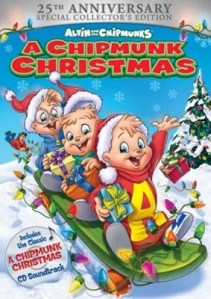 Director: Phil Monroe
Writers: Janice Karman, Ross Bagdasarian Jr., Hal Mason
Cast: Ross Bagdasarian Jr., Janice Karman, June Foray, Frank Welker, Charles Berendt, R.J. Williams
Plot: Five days before Christmas, the Chipmunks rouse David Seville (Ross Bagdasarian Jr., taking over the roles of Dave, Alvin and Simon from his late father, with Janice Karman playing Theodore) from a sound sleep and start to rush him out the door. As the boys go to the stores, Alvin overhears a little girl admiring a golden harmonica like Alvin’s, wishing she could get it for her sick brother Tommy (R.J. Williams). Tommy’s mother, however, seems skeptical Tommy will live to see the holiday. As the Chipmunks head into the recording studio, Alvin’s spirit has been diminished, and he heads out on an unscheduled break just minutes after recording begins. He finds Tommy at home and visits the sick boy, giving him with his harmonica and telling him he won it in a contest. Alvin rushes back to the studio and joins in the singing, his spirits restored. The Chipmunks are later booked to do a Christmas Eve concert at Carnegie Hall – a huge break – but they want Alvin to do a harmonica solo. Alvin can’t tell Dave (who gave him the harmonica) he gave it up, so he and his brothers try to buy a new one. He dresses up as Santa and charges kids for a picture, which Dave breaks up, admonishing his sons for trying to use Christmas to make money. When his brothers bumble out that Alvin needs money to buy something for himself, a disappointed Dave sends him to his room. That night, Alvin dreams of visiting mad inventor Clyde Crashcup (Charles Berendt), asking him for a loan, but the addle-brained Crashcup proves little help. Dave’s disappointment only grows when he walks past the dreaming Alvin, hearing the boy cry out for money in his sleep.
With two hours to go before the Christmas Eve concert, Alvin sets out to try to buy a new harmonica. While he’s gone Dave gets a phone call from Tommy’s mother, telling him the harmonica did wonders for the sick child. At the mall, Alvin stares at the harmonica he still can’t afford, when a kind old lady (June Foray) comes from nowhere and buys it for him. To thank her, he begins playing “Silent Night,” and a crowd forms to listen, including Dave, Simon and Theodore. Dave apologizes for misjudging Alvin, and the Sevilles head to Carnegie Hall for the concert. As he finishes his harmonica solo, Alvin runs into Tommy, out of bed and well. Alvin pulls him on stage to play an encore with the Chipmunks. Their song even reaches Santa Claus (Frank Welker), passing overhead on his rounds. He returns home to Mrs. Claus, telling her she should get out on Christmas some time and see what it’s like. As he drifts to sleep Mrs. Claus – a familiar, kindly old woman – looks at the audience and hushes us… why tell Santa, after all?
Thoughts: The Chipmunks, those animated anthropomorphs who rocketed to novelty album fame with “The Chipmunk Song,” had been off TV screens for some time in 1981. Although I didn’t know it at the time, this special was the start of a comeback, leading into a new Saturday morning cartoon that would be the version of the Chipmunks throughout my formative years. And it’s fitting, as their first hit was a Christmas song, that Christmas would factor into their comeback as well.
This special was something of an all-star piece, with the already-great June Foray stepping in as Mrs. Claus and the soon-to-be great Frank Welker as her husband. Even better, Chuck Jones pitched in on animation and character design for the special, and having watched it so relatively soon after How the Grinch Stole Christmas, it’s not hard to see some of his trademark gestures and designs, even if the flow of the animation isn’t really his. Some of the visual gags are distinctly Jonesian, though, such as Alvin as a miniature Santa being hoisted and lowered onto kids’ laps via a pulley… there’s a Wile E. Coyote flavor to it. (There’s also a great nod to Jones and Foray’s previous Christmas collaboration, as Alvin encounters a little girl named Cindy Lou.) The Clyde Crashcup sequence is a double whammy, bringing back a great (and mostly forgotten) cartoon star of the past, as well as presenting a sequence of confusion and misunderstanding that echoes a Dr. Seuss poem – or even one of Jones’s few feature films, the great The Phantom Tollbooth.
Although the Chipmunks would return during the run of their TV show with takes on A Christmas Carol and It’s a Wonderful Life, this special was all-new, and a really refreshing change. So many Christmas specials hinge on a character lacking Christmas spirit and finding it at the last minute. This time we see Alvin – often presented as the self-centered one in the group – show true Christmas spirit at the very beginning, and still winding up in a jam. The arc of the story is utterly unlike any other Christmas film I’m aware of. There’s not even really a lesson to be learned – Alvin knows and does the right thing right away, without having to go through trials or face the intervention of some wise mentor. If there’s anything he does wrong it’s not confessing to Dave that he gave up the harmonica, and given the circumstances, I think most people would have done the same thing. It’s a really refreshing change of pace, and makes for a unique special, unlike any of the others we’ve watched so far.
I have to confess, friends, I think the Chipmunks have hit something of a low point. I’m not at all a fan of the current movie series, where I think some of the silly charm of the original has been traded in for gross-out humor and tendrils of raunch that just don’t fit the spirit of Ross Bagdasarian’s characters. But that doesn’t mean I don’t still love Alvin and the boys, and especially at Christmas, I like looking back at these old cartoons and remembering when they were… y’know… good.
The Christmas Special Day 11: A Flintstones Christmas (1977)
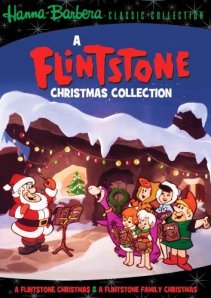 Director: Charles A. Nichols
Writers: Duane Poole & Dick Robbins
Cast: Henry Corden, Jean Vander Pyl, Mel Blanc, Gay Hartwig, Lucille Bills, Virginia Gregg, Hal Smith, John Stephenson
Plot: It’s Christmas Eve in Bedrock and the Flintstones and Rubbles are finishing up their preparations. Wilma (Jean Vander Pyl) and Betty (Gay Hartwig) try to persuade Fred (Henry Corden, taking over the role seamlessly from the late Alan Reed) to play Santa at the orphanage’s Christmas party that night, but Fred refuses and heads to work. When he arrives his boss, Mr. Slate (John Stephenson) informs him that his wife wants Fred to play Santa for the same party. This time, to protect his job, Fred agrees. At home, Fred and Barney (Mel Blanc) prepare for the party, but hear a thumping from the roof. They find Santa Claus (great voice actor Hal Smith, who played Santa in no less than five different cartoon series over the years) in the snow. Although Fred is skeptical at first, Barney finds the sleigh and reindeer, proving they’ve got the real Santa in the Flintstone house. Santa sprained his ankle on Fred’s roof, and Barney suggests Fred as a substitute while he heals. Santa gives them a dose of magic and sends them on their way.
Things go relatively smoothly for Fred and Barney’s first few deliveries, but some turbulence knocks the sack of presents out of the sleigh. Barney calls Santa on the sleigh’s CB radio (it was the 70s, people), and Santa tells them to go back to the North Pole for another load. As they wait for the sleigh to be reloaded, Fred and Barney take a tour of Santa’s high-tech operation and pitch in making some toys. They get back in the air and speed up their deliveries, realizing Fred is still scheduled to play Santa for the orphans. Back in Bedrock, the children are starting to get upset – almost as upset as Mr. Slate. Fortunately, Fred and Barney finally arrive, spilling in through the chimney with such a spectacular entrance Mr. Slate forgives their tardiness… until Fred realizes they’ve given out all the presents already. With a little of Santa’s Christmas magic, Fred produces more, and the children are overjoyed. As they open their gifts, the boys return home to send Santa on his way. Wilma and Betty return home, angry at their husbands for rushing out of the party, and Santa ducks out before they see him. Although the girls don’t believe Fred and Barney’s story about filling in for Santa, they forgive them and begin trading gifts. Fred is horrified to realize, in all the commotion, he didn’t get Wilma a present, but Santa saves the day one last time, slipping one down the chimney. Pebbles and Bamm-Bamm spot Santa flying away, and their fathers join them at the window, waving goodbye, while the girls just chuckle at the four kids looking up at the skies over Bedrock.
Thoughts: Like Fat Albert, this 1977 special takes characters from a popular cartoon show and gives them a Christmas adventure, although unlike Fat Albert, by 1977 the original run of The Flintstones had been over for several years. Fortunately, with animation, it’s easier to do a reunion special without worrying about actors getting older or passing away or refusing to reprise their role – in almost every case, a new voice artist is always a possibility. This special managed to get most of the original voices back, but one wonders if Mel Blanc felt a little confused that he was remaking a cartoon he’d done 13 years prior.
A Flintstones Christmas borrows much of its plot from the 1964 episode of the TV show, “Christmas Flintstone” (brilliantly clever with titles, these Hanna-Barbera folks), specifically the story of Fred filling in for Santa Claus after he injures himself. This special adds in more and different music and ages the children – Pebbles and Bamm-Bamm are elementary school age, whereas they were still babies in the original. They also trade out B-plots – in the original, Fred was working as a department store Santa for extra money, whereas here he’s dealing with Mr. Slate and playing Santa for orphans. The B-plot is used to give urgency to the A-plot as well, while in the original Fred was pretty much done with his gig when he stumbles into the real Santa and is called upon to fill in. Still, if one were to sit down for a marathon of the assorted Flintstones Christmas specials and episodes throughout the years (something a guy like me is honestly very likely to do), you’d be a bit shocked when you essentially saw the same show twice.
Having dealt with that particular elephant in the room (I’m going to ignore the one about characters celebrating Christmas before the birth of Christ), let’s talk about the story for what it is. The notion of Fred filling in for Santa is a wonderfully natural one – the heart of the character is that of a sort of good-natured lummox. For all the times throughout the years where Fred gets short-tempered or angry, at the core of the character is a deep, abiding love for his wife and friends, the sort of thing that lends itself perfectly to playing Santa. The actual mechanism for getting him into the suit was pretty clever for the time, although it seems that Disney picked at this cartoon when they made Tim Allen’s more morbid The Santa Clause.
Although there was music in the original version of this, this version has much more of it, almost making it into a full-blown musical as both Fred and Barney break into song about how much they love Christmas at assorted points in the show. While none of the music has broken out and become of particular note, it’s perfectly passable and a nice addition to the cartoon. The animation style is really indicative of the sort of thing we got from Hanna-Barbera, up to and including a nice little Rube Goldberg-style montage sequence in Santa’s workshop, where Fred and Barney spill out onto the conveyer belts and get temporarily caught up in the mechanisms of the toymaking machines. We saw this sort of thing a lot in the old Hanna-Barbera cartons, second only to the “hall of doors” chase scenes they did so often, particularly in Scooby Doo.
In terms of sheer volume, the good folks at Hanna-Barbera may have been second only to Rankin and Bass for producing great Christmas cartoons. However, there aren’t a lot of ‘em I could use for this project, as so many of them are feature film length, regular episodes of assorted TV shows or, saddest of all, not available on DVD. Maybe next year. But for now we’re not quite done with the Hanna-Barbera characters… not yet.
The Christmas Special Day 10: The Fat Albert Christmas Special (1977)

Note: Revelations about Bill Cosby himself have obviously tainted perceptions of much of his work, this special included. However, I have chosen to keep this article in its entirety as a sort of archival piece. Regardless of who Cosby himself turned out to be, I stand by my thoughts on the work itself as being valid.
Director: Hal Sutherland
Writer: Bill Danch & Jim Ryan
Cast: Bill Cosby, Jan Crawford, Gerald Edward, Eric Suter, Marshall Franklin, Eric Greene, Kim Hamiton, Julius Harris, Ty Henderson
Plot: Fat Albert (Bill Cosby, who did about 75 percent of the voices) and his gang are preparing for their Christmas pageant, when old “Tightwad” Tyrone – owner of the junkyard where they’ve built their clubhouse – shows up and declares he’s tearing down the clubhouse. While the gang tries to think of a way out of their predicament, they’re approached by a boy named Marshall (Marshall Franklin). His father is out of a job and their car broke down right outside. To make matters worse, his mother is about to have a baby. Fat Albert invites them in to warm up, and sends Bill to help Marshall’s father find a hospital. Fat Albert chases down Tyrone to try to convince him to leave the clubhouse alone, fearing it’ll be torn down with Mrs. Franklin inside. Tyrone agrees to leave the clubhouse standing if Fat Albert plays Santa Claus outside of his secondhand store to try to draw in customers. Bill and Mr. Franklin return, unable to get help at the local hospital without insurance. Mrs. Franklin stands up to go to the distant city charity hospital, but can’t go any farther. Bill and his brother, Russell, rush off to find help.
The rest of the gang finds Fat Albert outside Tyrone’s store and begin snatching his free samples, and an angry Tyrone fires Albert and promises to demolish the clubhouse. Old Mudfoot Brown arrives and snaps at Tyrone that he’s become a miserable old man since his wife died. Embarrassed, Tyrone asks how he can redeem himself, but Mudfoot simply tells him he wouldn’t know how to do a good deed. At the clubhouse, Marshall overhears his father say he’s afraid he can’t even afford to feed his first child, let alone the second, and Marshall decides to run away. When the gang returns with the promise of a doctor, they realize Marshall is missing and set out to look for him just as Mrs. Franklin begins to deliver. They find Marshall down at the docks, and the boy is trapped on an ice floe when he tries to flee. Fat Albert and the others manage to save him, but he slips away again. When they return to the clubhouse the baby has arrived. Mr. Franklin asks where Marshall is, but before Fat Albert can answer, Mr. Tyrone arrives – with Marshall. Hearing the Franklins’ story, he offers Mr. Franklin a job and says he can no longer tear down the clubhouse, since it’s a “landmark.” The gang and Tyrone give the Franklins a merry Christmas, and Tyrone looks to the sky to ask his wife how he’s doing now.
Thoughts: By 1977, we had reached the point where a Christmas episode of a popular cartoon wasn’t enough. We needed a full-blown Christmas special, and Bill Cosby and company delivered here. Although Tyrone definitely has a dash of Scrooge about him, the story isn’t just another Dickens rehash. If anything, the plot is more intent on echoing the nativity story, with a pregnant woman who has nowhere to go.
The plot is nicely layered, with the story of the Franklin family colliding with the Cosby Kids’ problem with Mr. Franklin. Not too many children’s cartoons today would have the wherewithal to take two entirely unrelated problems and intertwine them this way. The kids’ problem, furthermore, makes the Franklins’ dilemma even more dire. Sure, Mrs. Franklin is safe from the cold, but the viewer legitimately wonders if Mr. Tyrone will get over his anger long enough to realize there’s a pregnant woman inside the clubhouse, or if that would even matter to him before he demolishes it. Marshall has a pretty standard waif reaction to the situation – he’s causing a problem for his parents, so he decides to run away. Rather than one huge, overriding issue like a lot of these cartoons deal with, The Fat Albert Christmas Special deals with a lot of little things, and is the better for it.
Mr. Tyrone is an interesting villain. Like I said, he has elements of Scrooge, but not all of his actions make as much logical sense as Ebenezer’s. Evidently, the presence of a clubhouse somehow decreases the value of a junkyard. I know. I don’t get it either.
Like many of the half-hour Christmas specials, especially the ones that have a real villain, the climax seems to come a little too easily. It’s a bit more forgivable in this case, though… I’m not really sure where else they could have taken Mr. Tyrone’s story without dovetailing into a straight-up Dickens parody. As it is, Mudfoot plays the role of Jacob Marley and all three ghosts, delivering in 30 seconds the sort of realization that takes most films 90 minutes to do. I think it actually helps that we don’t see a traditional “moment of redemption” here. Tyrone’s change of heart happens largely off-camera, helping to drive in the idea that he isn’t really a bad man, just one who’s sad and angry, and who tries to make amends when he’s called on being sad and angry.
It’s hard to believe this cartoon is as old as I am. The story ages very well, the ideas are timeless and the backdrop is sadly relevant to modern times. Really, the only point that’s not completely current is the notion of kids playing in a clubhouse they made themselves, rather than sitting around with X-Box controllers. One can only hope, were the Franklins to break down today, they could still find a Fat Albert to bring them a little hope.
The Christmas Special Day 8: ‘Twas the Night Before Christmas (1974)
 Directors: Jules Bass & Arthur Rankin, Jr.
Writer: Jerome Coopersmith, based on the poem by Clement Clarke Moore
Cast: George Gobel, Joel Grey, Tammy Grimes, Bob McFadden, John McGiver, Alan Swift
Plot: Two months before Christmas, in the little town of Junctionville, NY, both the human and mouse populations found themselves getting their letters from Santa Claus returned unopened. Father Mouse (George Gobel) discovers an anonymous letter in the newspaper calling Santa a myth and a lie, signed “All of us.” Father Mouse’s son, Albert (Tammy Grimes), is revealed as the author of the letter. Albert, a brainy sort, refuses to believe in things he can’t see or touch. Meanwhile, Father Mouse’s human clockmaking partner, Joshua Trundle (Joel Grey) convinces the town to construct a huge clock to play a song in praise of Santa in the hopes of getting back in his good graces. Father shows Albert around town, pointing out children heartbroken by Santa’s rejection, but Albert remarks that grown-ups don’t care about such things. Father tries to show him how wrong he is by taking him to Trundle’s clock.
On the day Trundle’s clock is unveiled, it mysteriously malfunctions, and the town gives in to despair. By Christmas Eve, the Trundle children don’t even want to hang their stockings or decorate the tree. The mice are in similar desperation, and Father stumbles upon a sobbing Albert, who confesses he broke the clock when trying to study the machinery. Albert vows to repair the clock before midnight, finally understanding that he has a lot left to learn. As the town sits up on what they’re certain will be a sad Christmas Eve, the clock strikes midnight and begins chiming Trundle’s Santa song. In the sky, a miniature sleigh and eight tiny reindeer swoop down, and the Trundle and Mouse families watch as St. Nicholas makes his annual visit, right on schedule.
Thoughts: Like the many Rankin and Bass specials based on songs, Jerome Coopersmith had the task of expanding upon a rather thin plot. The original poem, of course, is simply about Santa popping in, getting caught by Dad, and popping back out again. No drama, no antagonist, and the mice that aren’t stirring also aren’t talking. Thank goodness the Rankin and Bass folks were here to fix that. Oddly, the result is an almost completely original story – the poem really only factors into the very beginning and very end narration, with everything in-between existing in a little world of its own.
Albert is an interesting character – someone who refuses to believe in anything abstract or esoteric. At the time, marking such a character as the misguided one in need of a lesson was standard operating procedure. Watching this cartoon today, however, I have to marvel at how different things are. In today’s culture, Albert would far too often be the one dealing out the lesson, ridiculing characters who draw upon faith. I rather prefer this version of the paradigm. The song “Even a Miracle Needs a Hand” is perhaps one of my favorites in all of the Rankin and Bass universe – something sweet and hopeful, but at the same time recognizing the need for good people to step up and work towards their dreams. As messages go, it’s a timeless one that more and more I feel like the modern world is forgetting.
It’s also interesting that this is one of the few Rankin and Bass cartoons – either stop-motion or traditionally-animated – that is presented as a period piece. Most of the Santa-centric cartoons that touch upon the real world – Frosty, for instance, or The Year Without a Santa Claus – all took place in the present day, with only Santa Claus is Comin’ to Town going into the past for the origin. This cartoon, though, seems to take place in a turn of the century sort of community. The story probably would have worked just well if set in 1974, but something about the more old-fashioned setting sets it apart a bit, giving it a slightly different flavor from the rest of the Rankin and Bass catalogue.
If the story has a weakness, it comes in Albert’s redemption. Like so many Rankin and Bass antagonists, we see someone who is more misguided than evil, and in his case, works frantically to fix his mistake. This is all well and good, but Albert’s actual transformation falls short. This half-hour short (25 minutes without commercials) simply doesn’t give us enough time to really watch Albert evolve as a character. Father Mouse’s song and the visit to the clock don’t seem nearly powerful enough to cause the sort of change of heart we see in Albert just in the nick of time. The ending is still very good, but it feels unearned.
 What’s really odd, though, is how off-model Santa and his reindeer are in this film. The Rankin and Bass cartoons have a certain style whether they’re stop motion or cell animation, and even Frosty the Snowman sticks fairly close to style. While the human and mice characters easily look like they could pop into any other R&B production and be perfectly welcome, Santa… Santa. The “right jolly old elf” himself looks more like Alfred E. Neuman wearing a Santa suit than anything else. (Either that or he was a test model for the Hobbits in the Rankin and Bass adaptation of that novel, which came out in 1977.) Then, Santa speaks in a booming, deep (and uncredited) voice. It’s a good Santa voice, again one which would feel at home in any of these films, but feels completely alien to the Santa design in this cartoon.
These things take me out of the cartoon briefly, but only briefly. Despite being based on one of the most famous Christmas verses ever written, it’s actually one of the most original cartoon Rankin and Bass ever produced, and in and of itself, that’s enough to make it one of the better ones from any studio, ever.
The Christmas Special Day 7: The Year Without a Santa Claus (1974)
 Directors: Jules Bass & Arthur Rankin, Jr.
Writer: William J. Keenan, based on the novel by Phyllis McGinley
Cast: Mickey Rooney,Shirley Booth, Dick Shawn, George S. Irving, Bob McFadden, Rhoda Mann, Bradley Bolke, Colin Duffy
Plot: One year Santa Claus (Mickey Rooney) comes down with a terrible cold. His elfin doctor tells him people don’t care about Christmas anymore anyway, and the sad Santa cancels Christmas this year. With everyone distraught, Mrs. Santa Claus (Shirley Booth) sends elves Jingle and Jangle (Bob McFadden and Bradley Bolke, respectively) — with the reindeer Vixen — south to try to find some leftover Christmas spirit from the year before to convince Santa to get back on his feet. When Santa finds out they’ve left, he gets out of bed to try to fetch them, fearing they’ll run afoul of “the Miser Brothers.”
The elves, as it turn out, are heading right between the kingdoms of the warring Snow Miser (Dick Shawn) and Heat Miser (George S. Irving). Vixen barely escapes the Misers, and the trio land in nearby Southtown, U.S.A. They begin their search for Christmas spirit, but run into one person after another who doesn’t care… even children ambivalent about Santa Claus skipping his annual visit. They leave the children when Vixen – disguised as a dog – is taken away by the dogcatcher. One of the children, Ignatius Thistlewhite (Colin Duffy) is later approached by Santa Claus. Ignatius directs Santa to the dog pound and he leaps upon Donner to fly to the rescue. Ignatius and his parents see the flying reindeer, and he realizes his mistake. The elves and Ignatius arrive at town hall at the same time, trying to plead to the mayor for Vixen’s freedom. The mayor doesn’t believe them, and jokingly offers to free Vixen if they can make it snow in Southtown. Meeting up with Mrs. Claus, the elves visit Snow Miser who – after one of the most rousing and memorable musical numbers Rankin and Bass ever produced – they ask to bring snow to Southtown. As it turns out he’d love to do that very thing, but his brother the Heat Miser won’t allow it. When they turn to Heat Miser, he agrees to allow snow in the south, but only if Snow Miser will cede to him the North Pole for a day. Realizing the brothers will never come to terms, Mrs. Claus goes over their heads to their mother… the notoriously reclusive Mother Nature herself (Rhoda Mann). Mother forces them to cooperate.
Unbeknownst to them, Santa has taken Vixen – sick from the heat – back home to the North Pole. Santa, still feeling ill himself, sits down for a nap, unaware snow is falling in Southtown. Mrs. Claus returns with newspapers proclaiming an official holiday in celebration of Santa Claus. All over the world, children come together to visit the North Pole and give gifts to Santa for a change. On Christmas Eve however, Santa receives a letter from a child who proclaims she’ll have a blue Christmas without him. Santa, touched despite the blatant plagiarism from an Elvis Presley hit, demands his sleigh be prepared for his traditional Christmas rounds. He makes a special journey to Southtown, appearing in public (I told you guys he constantly breaks that rule in the Rankin-Bass universe) to thank the children who taught him his lesson. He leaves to perform his duty, taking off from the newly-renamed Santa Claus Lane.
Thoughts: I was almost reluctant to include this one, based on my “one-per-franchise” rule. This film is considered by some to be a sequel to Santa Claus is Comin’ to Town, mostly due to the fact that Mickey Rooney returns as Santa Claus. But then I decided screw it – it would be easy to link together most of the Rankin-Bass specials and just as easy to declare that each one exists in a totally separate reality from all the others, so I’m just going to do the ones I want to. It’s my project, after all.
If I did want to think of it as a sequel (which I don’t), this is the Superman II of the franchise. The origin stuff is out of the way, so we can tell a solid, self-contained story without worrying about wasting time placing the pieces on the board. The cast is expanded and the threat is considerably greater than in the first film. Also like Superman II, this film features the hero deciding to eschew his responsibilities and struggle with questions of his own relevance, only to learn a harsh lesson about just how needed he truly is. In both films, our hero is rendered ill, wounded, and is eventually prodded forward by the urging of an outside party (Santa’s letter to the little girl, Superman given a plea by the President of the United States). Even the villains in each film take the opportunity to screw each other, setting up circumstances that directly lead to the solution to the threat. This movie, it should be noted, has 100 percent fewer Super Roofie Kisses than Superman II, so the metaphor isn’t a perfect one.
I honestly like this much more than Santa Claus is Comin’ to Town, mostly because – although it suffers from an unforgivable lack of Topper the Penguin (something else it has in common with Superman II) — it more than makes up for it with the introduction of the Miser Brothers. These are characters that have really become cultural hallmarks, at least for my generation. Their respective Heat Miser and Snow Miser songs have been covered by pop groups and rock bands, and even the most ardent Scrooge will find themselves singing along if that particular tune starts piping in through the mall sound system. Of all the characters created by the Rankin-Bass people from whole cloth (as opposed to being based on a preexisting tune or legend), these are the two that have most fully acclimated into American pop culture. They are the perfect example of a Rankin and Bass creep-to-be-redeemed. They aren’t evil, they’re just childish, and the ire they’ve directed at one another for such a long time has contributed directly to the lack of Christmas spirit in the world around them. It’s not a question of turning them away from being bad, it’s just a case of making them realize it will be better for everyone if they would simply cooperate with one another, a lesson similar to that learned by General Zod and Lex Luthor, and I swear to Krampus himself that’s the last Superman II reference. Today.
On a more personal note, the notion of snow in the south being the hallmark of real magic is something else that helps this special resonate with me. I’m from Louisiana, friends. White Christmases aren’t exactly common here. Neither are white New Years, white Valentine’s Days, or white Mardi Gras. It doesn’t snow down here much, is the point I’m making. So the idea of a little snow hitting specifically on Christmas really does carry magic in the south that those of you in colder climes may not realize. I offer the following evidence: a few years ago, against all odds, it actually got cold enough to snow in New Orleans on Christmas Day. It wasn’t much snow, just a dusting really, and my Yankee now-fiancé Erin just laughed when she saw how excited we were… but on that day, people flooded the streets. Everybody in the neighborhood was outside, kids who hadn’t taken their eyes off their X-Boxes in years were playing in the sun, throwing snowballs at each other and embracing the sudden burst of joy that was falling down as surely as the ice. My sister, who was 23 at the time, actually pulled the doorknob out of the door in her rush to get outside. It doesn’t happen here, friends. So I know how the folks of Southtown feel.
Like A Charlie Brown Christmas, this special proves that the fear of waning Christmas spirit isn’t a new problem at all. It’s actually kind of encouraging to realize people were afraid of these same problems forty and fifty years ago – if we’ve made it this far, maybe it’s just one of those things that never really goes away. But that’s okay, because there are people like Mrs. Claus, people of goodwill like you and me (admit it, you love Christmas, you wouldn’t have made it this far if you didn’t), and through our own small efforts and acts of kindness and acts of will, we’ll help the holiday persevere.
The Christmas Special Day 6: Santa Claus is Comin’ to Town (1970)
 Directors: Jules Rankin & Arthur Bass
Writer: Romeo Muller
Cast: Fred Astaire, Mickey Rooney, Keenan Wynn, Paul Frees, Joan Gardner, Robie Lester, the Westminster Children’s Choir
Plot: Friendly mailman S.D. Kluger (Fred Astaire) has once again rounded up a cart full of letters about Santa Claus. To answer all the questions at once, he decides to share with us the story of Santa’s life. Years ago, in a vaguely Eastern European land called Sombertown, a baby is found. He’s brought to the town’s mayor, the Burgermeister Meisterburger (Paul Frees), who immediately sends the baby to the local orphanage. On the way, though, the Winter Warlock (Keenan Wynn) sends up a terrific snowstorm that snatches the child away. The forest animals find him and hide him from the Warlock, taking him to a safe place – the home of an elf family named Kringle. The elves name him Kris, raising him as their own. As he grows up he learns all of their skills, including making toys. Sadly, the elves have mountains of toys that go undelivered thanks to the Burgermeister, even though they were once the royal toymakers to the king. Kris eventually grows into a strapping young man with the voice of Mickey Rooney. He vows to set out and begin delivering the toys, with an official red-and-white Kringle suit and a penguin named Topper. In Sombertown, though, the Burgermeister has outlawed toys entirely. Ignoring the decree, Kris hands out toys to children, and a schoolteacher named Jessica chastises him for breaking the law. The Burgermeister declares Kris a rebel and orders him arrested, but Kris distracts him with a yo-yo and escapes. Kris and Topper turn up in the lands of the Winter Warlock and are captured. Before he can destroy them, Kris gives him a wooden train, and Winter’s frozen heart melts away, restoring his humanity. Winter offers to use his magic to help Kris in exchange for toys once in a while, and he demonstrates his power by showing him a vision of Jessica, who is wandering the woods looking for him. She’s got a handful of letters from the children asking for toys to replace the ones the Burgermeister destroyed, and Kris begins using the Warlock’s tricks to watch over them, to be sure they’re being good, for goodness sake.
The next night Kris returns to Sombertown with a sleigh full of toys and a list of the good children (which, naturally, he checks twice), and the next morning the Burgermeister is again outraged at the proliferation of toys. He orders the doors and windows locked all over town, but Jessica and the animals continue to deliver letters to Kris. Refusing to disappoint a child with a special request, Topper suggests Kris try entering homes through the chimney, a task which quickly becomes standard operating procedure. The Burgermeister turns over all the houses looking for toys, so Kris starts hiding them in stockings hung to dry by the fireplace. The Burgermeister finally uses Jessica to track down the Kringles’ home, and Kris, the Kringles, and Winter are all captured and arrested. Jessica tries to break Winter out of prison, but the only remnants of his power are some magic kernels of corn. She feeds them to eight of Kris’s reindeer friends, who gain the ability to fly. They sweep into the prison and break out the inmates, taking them away. With the Kringle home destroyed by the Burgermeister, Kris and his family are now outlaws. Kris grows a beard to help disguise himself (doesn’t bother to change his bright red clothes, but, y’know, a beard… that should do the trick) and decides to use an alias. The eldest Kringle shows him a medal with his birth name on it: Claus. Taking back his real name, he asks Jessica to share it and the two are married in the woods on Christmas Eve while the Kringles decorate the pine trees and place their wedding gifts beneath the boughs. With his last burst of magic, Winter fills the trees with brilliant lights.
Kris and the Kringles march further north and build a home, where they continue to make toys for years. Eventually, the Meisterburgers die out, and Kris is able to make his journeys more freely. The letters from the children grow more and more frequent, though, and he decides to restrict his deliveries to one night a year, the holiest night, Christmas Eve.
Thoughts: Although, as we’ve seen, Rankin and Bass made a cottage industry out of turning Christmas songs into Christmas specials, this may be their crowning achievement of adaptation. The song “Santa Claus is Comin’ to Town” has even less of a plot than Rudolph or Frosty’s titular claims to fame. It’s basically a reminder to kids not to act like jerks because Santa won’t give them any loot on Christmas morning, and as this is a one-hour special, they’re going to need a lot more to go on. Romeo Muller, who has earned a permanent spot in Christmas Heaven for writing so many of these, does an absolutely heroic job weaving the tale of Santa’s life. This is without a doubt the longest synopsis I’ve written yet in the Christmas project, and that’s due entirely to the complexity of the story and the number of important touchstones along the way.
Muller manages to work in most of the major points of the Santa legend – the elves, the toymaking, the reason Christmas Eve is so sacred to him. For the most part, he does it very organically, almost seamlessly. The only thing that breaks the spell, that reminds you that he’s going through a checklist of Santa Facts, is that every so often Fred Astaire and the children break in with some narration to point out that you just learned something important: “So that’s why he makes such wonderful toys!” Yeah kid, we got that. No need to call attention to it. Muller also gives Santa a Mrs. Claus, elves, flying reindeer and the charming voyeuristic powers that probably weren’t nearly as creepy in the pre-Internet days.
There are a few interesting trends in here that would later reach out and lay branches in future Rankin and Bass productions. We’ve got multiple antagonists, at least at first, in the Warlock and the Burgermeister. The Warlock’s menace ends quickly, though, and he reforms, becoming a friend to our heroes. We’d see this later in other cartoons, including Jack Frost in Frosty’s Winter Wonderland and, to a lesser degree, the Miser Brothers in Year Without a Santa Claus. It’s a good way to work in themes of redemption into these cartoons without actually making an icon like Santa or Rudolph a jerk at any point in their respective careers. Not every villain can be redeemed, of course, but the way we see the Burgermeister waste away in self-imposed loneliness and misery says a lot for the power of having a winning personality.
The story is a tad anticlimactic – the Burgermeister never really gets his comeuppance, he just loses his prisoner, and it’s implied that he dies a pathetic wretch. But Fred Astaire comes in at the end of the special and delivers a speech of pure sincerity to rival “Yes Virginia.” It’s a beautiful moment and it leads right into the musical finale.
This isn’t my favorite of the Rankin and Bass specials, and none of the elements created for this show specifically have ever really caught on with the public at large the way some of the other Rankin and Bass creations have. (Not even Topper. What’s up with that? Topper is awesome.) But on the whole, it’s a fine origin for Santa Claus, one that is perfectly satisfying for any child who wants to know all of the things kids tend to ask about Santa. Even after all these years, it’s still a joy to watch.
The Christmas Special Day 5: Frosty the Snowman (1969)
 Directors: Jules Bass, Arthur Rankin Jr.
Writer: Romeo Muller
Cast: Jimmy Durante, Billy DeWolfe, Jackie Vernon, Paul Frees, June Foray
Plot: Children’s entertainer Professor Hinkle (Billy DeWolfe) is perhaps the world’s worst performer, with tricks that won’t work and a rabbit named Hocus Pocus who won’t cooperate. After a failed show at an elementary school, the children race outside to build a snowman, whom they christen Frosty (Jackie Vernon). Hocus and Hinkle rush outside, where Hinkle throws his hat at the rabbit. It’s retrieved by one of the children, Karen (June Foray, again, proving that if there is a goddess of voice animation it’s her), who places it on Frosty’s head. The snowman snaps to life and bids everyone a happy birthday, but Hinkle snatches his hat back and leaves. Hocus steals the hat again and returns it to the children, who use it to bring Frosty to life again. He plays and dances with the children until he notices the temperature is rising, and he’s beginning to melt. Karen and the children promise to send him to the one place he’ll never melt: the North Pole. They parade through town to the train station to send him off (startling a traffic cop along the way) but are stumped when they realize they can’t possibly afford the ticket. At Hocus’s suggestion, Frosty and Karen hop into a refrigerated boxcar on a north-bound train. Hinkle, who realizes the hat has genuine magic power, hops on the same train, determined to steal it back.
When Frosty realizes the frozen car is making Karen sick, he and Hocus get off with her at the next stop. Hinkle jumps from the train so as not to lose them, crashing in the process. Karen is still in danger of freezing, so Hocus tries to rouse the local forest animals to build her a fire. Although Karen is safe for the moment, Frosty knows they need to find help soon, and Hocus suggests Santa Claus, who is scheduled to make his Christmas Eve rounds in mere hours. To keep her warm in the meantime, Frosty finds a greenhouse, but Hinkle manages to trap them both inside. When Santa arrives, Hocus brings him to the greenhouse, where Karen is safe, but in tears: Frosty has been reduced to a puddle with a corncob pipe and an old silk hat. Santa tells her that Frosty is made of magical Christmas snow, which can never go away forever. He uses his magic to rebuild Frosty, but before he places the hat upon his head, Hinkle shows up to demand its return. When Santa warns him he’ll never give him another Christmas present again if he hurts Frosty, Hinkle backs down and is sent away to write a massive apology. Santa places the hat back on Frosty’s head, restoring him to life. He takes Karen home and promises her that Frosty will return every year with the Christmas snow.
Thoughts: Frosty the Snowman gives us yet another case of Rankin and Bass magic, but this time, we’re going for traditional animation. This studio is much better known for their stop motion work, but they did several specials in this format, and later applied it to their version of Tolkien’s Lord of the Rings and 80s TV shows like Thundercats.
Like Rudolph and Little Drummer Boy, this film takes a classic song and gives us an expanded storyline to fill out its half-hour running time. The song even shares DNA with Rudolph – Gene Autry commissioned the piece from Walter Rollins as a follow-up to his earlier Christmas hit. And a hit it was, but like Rudolph, it needs some work to succeed as a narrative. The original song, let’s be honest here, doesn’t exactly have a riveting plot: Snowman gets magic hat, snowman comes to life, snowman starts to melt, snowman leaves. Hard to get a full-length special, and what’s more, there’s no antagonist.
That, in fact, is what really makes this special: Professor Hinkle. He’s a really entertaining bad guy, very different from the usual Rankin/Bass assortment of monsters, evil wizards, and misers. Hinkle is kind of a pathetic figure, but in a funny way. He’s utterly failed at life, he’s a disaster as a magician, but he seems to have more greed than genuine evil in him (despite his own protests to the contrary). Even as he’s trailing Frosty and Karen he has to keep reminding himself to “think nasty… think nasty…”
Looking back on this as an adult, you start to realize that Hocus Pocus, the rabbit, is actually a pretty lousy influence on the children. His refusal to work with his partner in the first place is what costs Professor Hinkle his hat. Hocus steals the hat later (for a good cause, perhaps, but it’s still theft). He convinces an underage girl to illegally board a train with a man she’s known for all of seventeen minutes, without so much as a phone call home to tell her parents not to worry. Yes, he technically helps to save her life multiple times, but seeing as how she would never have been in danger if not for him, it’s hard to give him too much credit for that.
Christmas is almost an afterthought in this special. It’s not really mentioned at all in the original song, and you’ve only got a quarter of the special left when it’s even mentioned that this is all taking place on Christmas Eve. (What school is in session on Christmas Eve? Did they used to do it that way?) It works out for Karen, of course, because otherwise Santa Claus wouldn’t be around to save her and…
Wait a minute, this all happened on Christmas Eve? What did they even need the train ticket for? Why didn’t Frosty just wait around for Santa in town in the first place? They could have saved themselves all kinds of trouble! And don’t tell me it’s because Santa wouldn’t show up while the kids were awake, because this is a Rankin and Bass special and he breaks that rule all the time. He even breaks this rule in this very cartoon, because if he was waiting for all of the animals to be asleep before he shows up Hocus couldn’t even have flagged him down in the first place! Good grief, Romeo Muller, were you even trying?
Yet, this is a classic.
You see, out of all the great characters in the Rankin and Bass catalogue, there may be none as ridiculously endearing as Frosty. His sweetness, his heart that remains warm despite being encased in snow, the fact that he even apologizes to Hocus for some truly ridiculous suggestions for getting help… well, he’s a better snowman than I. This cartoon is the reason I can’t put on a top hat without getting the urge to wish everyone a happy birthday. It’s ludicrous! It’s incomprehensible!
And it’s a valued part of our collective childhood, and I wouldn’t change a minute of it.
Frosty returned twice more in the annals of Rankin and Bass – in 1976’s Frosty’s Winter Wonderland he’s given a snowwife, Crystal. In 1979, the Frosty family teamed up with Rudolph for the stop-motion feature length film Rudolph and Frosty’s Christmas in July. Both of these are worthy sequels. Less so is 1992’s Frosty Returns, a terrible, painfully preachy cartoon produced by CBS and unforgivably directed by Bill Melendez (of A Charlie Brown Christmas), and in 2005 there was the CGI Legend of Frosty the Snowman, which is more faithful to the original, but still merely okay. As usual with these characters, Rankin and Bass did it best. All others need not apply.
 Reel to Reel