Category Archives: Musical
Dorothy Gale Week Day 4: Diana Ross in The Wiz (1978)
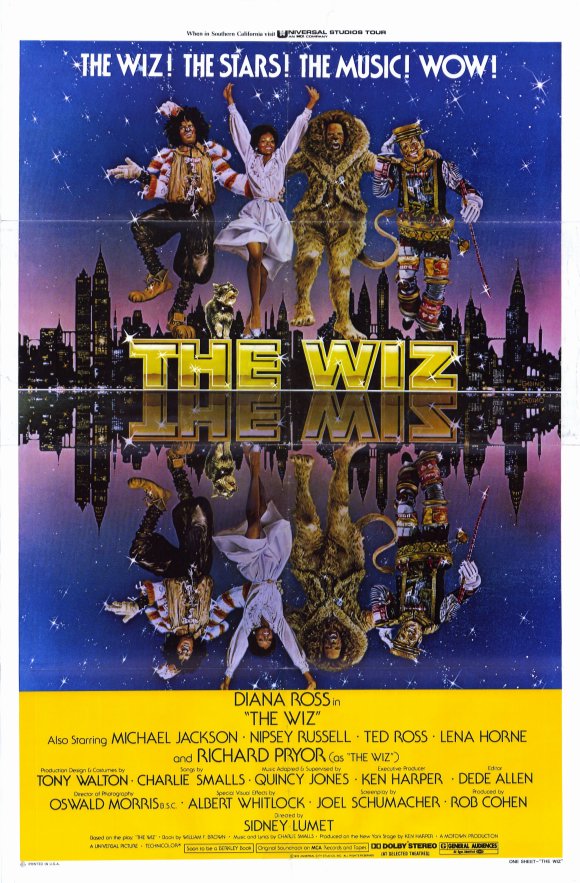 Director: Sidney Lumet
Writer: Joel Schumacher, based on the play by Charlie Smalls and William F. Brown, based on the novel by L. Frank Baum
Cast: Diana Ross, Michael Jackson, Nipsey Russell, Ted Ross, Mabel King, Theresa Merritt, Thelma Carpenter, Lena Horne, Richard Pryor, Stanley Greene
Plot: In modern-day Harlem, a family gathers for Thanksgiving dinner. Dorothy (Diana Ross) is a schoolteacher, living with her Aunt Em (Theresa Merritt) and Uncle Henry (Stanley Greene), who wishes for her to break free and find a life of her own. Her dog Toto rushes out into a snowstorm after dinner, and Dorothy races after him. A cyclone appears in the snow, grabbing them both and pulling them into the air, where we see the cyclone being manipulated by a woman in the stars (Lena Horne). She drops Dorothy into a pit of sand near a graphitti-covered wall, and the people painted onto the wall come to life. Although initially frightened, the people from the walls begin celebrating her for killing the Wicked Witch of the East, knocking down a sign on her during her descent. The people, the Munchkins, were trapped in the wall by the Witch’s magic, and now are free. Miss One (Thelma Carpenter), the Good Witch of the North, thanks Dorothy and gives her the Wicked Witch’s Silver Shoes. Miss One doesn’t have the power to send Dorothy home to New York herself, and she knows the Wicked Witch of the West will be uninclined to help. Even Glinda, the Good Witch of the South, will likely be unavailable. Instead, she suggests Dorothy follow the Yellow Brick Road to talk to the Wiz.
As Dorothy walks through the strange city, unable to find the Road, she finds a Scarecrow (Michael Jackson) being tormented by a group of crows. She shoos the birds away and frees the Scarecrow. When he realizes the crows had tricked him into captivity, he reveals to Dorothy his head is stuffed with garbage instead of a brain. She suggests he come with her to see the Wiz for help. The Scarecrow finds the rubble of yellow bricks and they finally trace them to the Road. As they walk through the remains of an amusement park they find a trapped mechanical man beneath some rubble (Nipsey Russell). The Tin Man says it’s okay – he lacks a heart, and cannot feel. They help him to his feet and he joins them. As they pass the library, the Tin Man notices a statue of a lion is watching them. Inside the statue they find a real Lion (Ted Ross), who boasts to them but is soon revealed as a coward. He joins them as well.
Following encounters with creatures in the subway and a group of “Poppies” that try to tempt the friends away from the path, they arrive at the Emerald City, where the Great and Power Oz summons “the one with the silver slippers” to his chambers. Oz, appearing as a giant mechanical head, hears their requests and bargains with them: he’ll aid them if they can destroy Evillene, the Wicked Witch of the West (Mabel King). They find Evillene in a sweatshop beneath the city, where her Winkie captives are toiling away, when she hears of Dorothy’s quest. She sends out her motorcycle gang, the Flying Monkeys, to capture the girl. Although they are captured easily, Evillene finds she cannot take the Silver Slippers from Dorothy against her will, and instead begins torturing her friends, cutting the Scarecrow in half, flattening the Tin Man, and dangling the Lion from his tail as he shouts to Dorothy not to give up the shoes. When the Witch is about to throw Toto into a flaming cauldron, the Scarecrow tells Dorothy to pull the fire alarm, setting off the sprinklers. Toto is saved, and the water melts Evillene to nothing. The Winkies, free from the Witch’s enchantment, release Dorothy and her friends and celebrate. When they return to the Emerald City, they find the Wiz (Richard Pryor) has closed up shop, and is a phony, powerless little man sleeping on a cot. He reveals he’s just an ordinary man from Atlantic City, and only sent Dorothy to destroy Evillene because he feared her. As her friends lament, Dorothy points out to each of them how they’ve already proven they have everything they need. It seems that Dorothy will be trapped, though, when the woman in the stars appears. She is Glinda, the Good Witch of the South, and reveals to Dorothy that her silver shoes have the power to send her home, now that she truly knows herself. The Wiz asks Dorothy if she can help him, and she tells him that he, like the rest of them, can only be helped by letting people see who he really is. She says goodbye to her friends and she and Toto finally return home.
Thoughts: I can’t believe my first official Reel to Reel encounter with the dreaded Joel Schumacher comes in the form of this Broadway adaptation. There’s just something terribly twisted about that. Anyway, Schumacher’s script takes some liberties not only with the Oz formula, but even with the original play, which skewed closer to L. Frank Baum’s book. The play kept Dorothy on a farm, it’s the movie that moved her to a school in Harlem and put in the metaphor of Oz as a fantastic version of New York City. Fortunately, the changes actually work to create something that feels very different than other versions of Oz, yet still undeniably taps into the soul of what Baum created.
What I like about this version of the story is that is really shows the diversity of the basic Oz concept. The writers of the play and creators of the film took the skeleton of Baum’s story and created something different and unique. The appearance of the Munchkins, for example, is initially terrifying, even for someone who knows the story and surmises that they don’t actually mean her any harm. Resetting Oz in a dark fairy tale version of New York is an effective change as well, giving it a feeling of urban magic that sets it apart from the very rural feel of most traditional interpretations of the story.
On the other hand, there are some aspects in which this version skews closer to Baum than most other film versions… Dorothy wears Silver Shoes instead of Ruby Slippers, and doesn’t (technically) encounter Glinda until the end of the story, keeping the Witch of the North in her proper role at the beginning, whereas the MGM film and most other versions just have Glinda fill both of those parts. On the other hand, the implication that Glinda manipulated events just to bring Dorothy to Oz is a new idea to this version. It would be easy to see it as somewhat cruel, but I think it feels more like the actions of a fairy godmother, putting the pieces in just the right place to do her charge some good. Baum didn’t really have a particular moral lesson for Dorothy, the MGM film added a considerable weight to the idea that “there’s no place like home.” With this film, the message seems to be exactly the opposite – there’s a big world out there and it takes courage to find it.
Diana Ross works very well in this incarnation of Dorothy. At the beginning of the movie she comes across as very timid, even frightened of the smallest things. She slowly changes as the movie goes on, first needing to find a well of courage when she saves the Scarecrow, and expressing joy in the antics of the Tin Man. By the time they reach the Emerald City (which the Wiz then changes to Ruby, then to Gold on whim), she’s becoming more fully-formed. At first, he won’t allow her friends to see him, but Dorothy refuses to speak to him without the others. Ross still has some timidity in her voice here, but it’s paired with determination in a way that shows how far she’s grown as a character already.
The small tweaks to Dorothy’s friends all feel very natural and in keeping with the concept that they all really had what they wanted all along. Michael Jackson’s Scarecrow, for instance, is never particularly foolish, and we accentuate this point by having him periodically pull a scrap of “garbage” from his head with some sort of wise fortune cookie-style quotation on it. Nipsey Russell’s Tin Man, from the beginning, has a lively energy that simply doesn’t fit the conceit that he has no feelings. He seems thrilled from the beginning to have friends and a purpose again. The Lion is the only one who really displays his fault – cowardice – and in fact has a fine moment after the encounter with the Poppies where he laments his weakness. Dorothy, as usual, helps him back from the edge (literally), and from then on when they approach danger, he may tremble, but he pulls himself together in the end.
The music in this version takes a few different paths. “Ease on Down the Road,” probably the most famous number, is vibrant, energetic, and fun. Evillene’s “Don’t Nobody Bring Me No Bad News” has a similar energy, but a much more sinister flavor. Other songs, like the Scarecrow’s “You Can’t Win,” are considerably darker, and still more project homely feelings, or soulful rhythms. A lot of them are particularly quiet and emotional – Dorothy’s “Believe in Yourself” in particular clearly is meant to reach right to the heartstrings. It makes for an eclectic mix that fits nicely with the wild, unique vision of Oz presented in this movie. Some of them do tend to go on a little too long, with endless refrains and dance numbers that probably work better on stage than in the filmed version, but there’s nothing that ever really gets tedious… just a few moments where I wanted them to get on with it.
This is the first time I’ve ever seen this version of the story, and I’m rather sorry it took so long. While not really like the classic versions, it has a spirit and vibe of its own that’s very entertaining and very satisfying. As far as efforts to “reimagine” Oz have gone, this is one of the better ones.
The first Reel to Reel study, Mutants, Monsters and Madmen, is now available as a $2.99 eBook in the Amazon Kindle store and Smashwords.com bookstore. And you can find links to all of my novels, collections, and short stories, in their assorted print, eBook and audio forms, at the Now Available page!
Dorothy Gale Week Day 3: Liza Minnelli in Journey Back to Oz (1974)
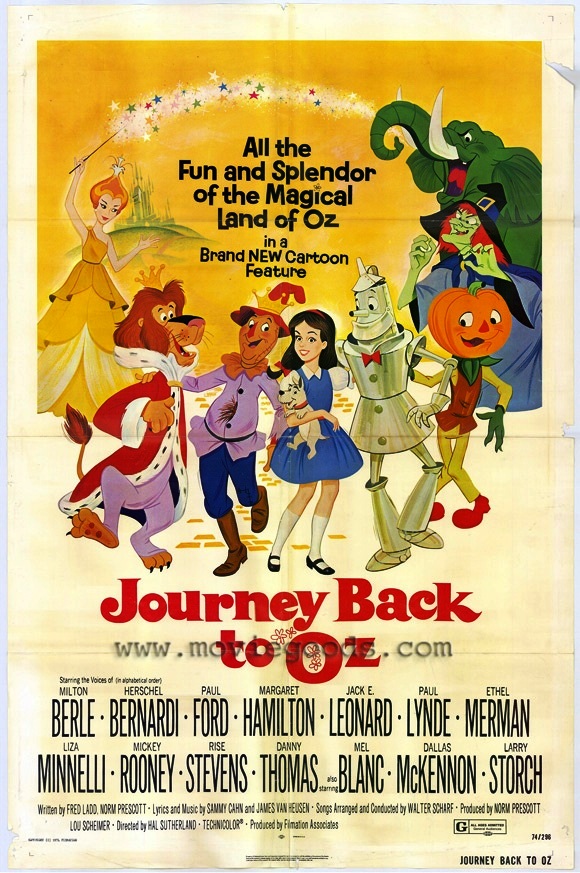 Director: Hal Sutherland
Writer: Fred Land & Norman Prescott
Cast: Liza Minnelli, Milton Berle, Margaret Hamilton, Paul Ford, Paul Lynde, Ethel Merman, Mickey Rooney, Danny Thomas, Mel Blanc, Dal McKennon, Larry Storch, Risë Stevens, Jack E. Leonard, Herschel Bernardi
Plot: In this animated kind-of sequel to the 1939 MGM film, a storm is brewing in Kansas again, and Henry (Paul Ford) is getting worried. His niece Dorothy (Liza Minnelli) feels a-tingle, remembering how a similar storm once swept her away to the land of Oz, but her Aunt Em (Margaret Hamilton) swears to her that Oz is simply a figment of her imagination. As she sings to Toto about wishing to return, a cyclone snaps the two of them up and pulls them into the air. When Dorothy comes to her senses, she realizes she’s landed by the Yellow Brick Road in Oz, and rushes off to find her old friends in the Emerald City. Setting off, Dorothy encounters a creature with a pumpkin for a head (Paul Lynde). Pumpkinhead is fleeing from an evil witch named Mombi (Ethel Merman), who created him to help her conjure some powerful, terrible work of magic. Dorothy tells Pumpkinhead to come with her to the Emerald City, where her friend the Scarecrow will help him.
Dorothy finds Mombi’s hut, where a crow (Mel Blanc) invites her to peek at the cauldron simmering on the fire. Mombi traps her and reveals her brew will create an army of green elephants to conquer Oz and destroy the Scarecrow. When Mombi leaves to get firewood, Pumpkinhead sneaks in and rescues Dorothy. As they escape, they encounter a carousel horse called Woodenhead (Herschel Bernardi), stuck upside-down in the ground. They free him and he joins their party.
Arriving at the Emerald City, they warn the Scarecrow (Mickey Rooney about Mombi’s attack just as the Witch and her Green Elephants arrive. Dorothy and her friends climb on Woodenhead’s back, but Toto and the Scarecrow are captured in the escape. Dorothy, Pumpkinhead and Woodenhead set out for Tinland, to enlist the aid of her old friend the Tin Man (Danny Thomas). At first he’s eager to help, but loses heart when told of the army of elephants. The Cowardly Lion (Milton Berle) initially puts on a show of bravado, but quickly reverts back to quaking when told of the elephants. Glinda, the Good Witch (Risë Stevens) who has been watching the proceedings with her… “Glinda-Bird”… arrives to offer her aid, and gives Dorothy a package which she warns her not to open until she arrives at the Emerald City.
Mombi sends a group of enchanted trees after the friends, but Glinda – watching through the Glinda-Bird – gives Pumpkinhead a magic axe that turns them into… well… hippies. Saved, they return to an Emerald City that has rapidly fallen into decay. They are attacked by an elephant, but Dorothy opens Glinda’s box and a swarm of magic mice pop out and chase it away, freeing them to assault the palace. The mice make it to Mombi’s chambers and chase her the gardens, where she disguises herself as a rose bush. The mice have sent the elephants on a stampede, though, and she is trampled flat. Toto, recognizing Mombi’s true form, leads Dorothy to the flattened rose, who blames Dorothy for her fate just as she dies. As she withers, the elephants fade and the Emerald City is restored to its former glory. The celebration is short-lived, though, as Pumpkinhead has fallen along with the rest of Mombi’s creations. Glinda tells Dorothy her magic cannot restore him, and Dorothy weeps for her fallen friend. As she cries, her tears touch Pumpkinhead’s face, and the magic of her love restores him to life. The Scarecrow awards his friends, making Woodenhead his own royal steed and knighting Pumpkinhead, then offers Dorothy anything she desires. She asks, as always, simply to return home. The Scarecrow find a loophole in the Oz Constitution that will only allow Dorothy to return home the way she came, and Glinda creates a cyclone to carry her back.
Thoughts: In the 1970s theatrical animation could be divided pretty squarely into two categories: Disney, and everything else. This Filmation effort falls into the latter category: limited animation, competent but unimpressive voice acting and weak music. The idea of doing an Oz sequel was all well and good, but Filmation went with stunt casting (Judy Garland’s daughter voicing Dorothy, original Wicked Witch Margaret Hamilton doing a cameo as Aunt Em, plus several celebrities of the time) and an uncredited rewrite of Baum’s second Oz book, The Marvelous Land of Oz. This movie plucks some of the characters from that book – Mombi and Pumpkinhead – turns the Sawhorse into a Merry-Go-Round horse, then turns the plot into something that’s trying hard to be The Wizard of Oz all over again. Instead of that other story, in which a young boy named Tip and his friends wind up stumbling on a plot to conquer Oz by an army of angry women, this movie has Dorothy once again marching to the Emerald City, once again picking up unusual friends along the way, once again being plagued by a Wicked Witch out for revenge. It’s incomprehensible to me why, with 14 Oz books to choose from by Baum alone, filmmakers never seem to look past the first three for inspiration, and often try to shoehorn elements from the latter two into the mold of the first one all over again. It’s equally baffling why they would create new elements when the originals (such as General Jinjur’s all-girl army, which the elephants are standing in for) work so much better. And for Heaven’s sake, why elephants? Okay, they’re big, they’re powerful, but the way the Tin Man and Cowardly Lion react to them you’d think elephants are their natural predators or something. Even mammoths might make sense, but the Tin Man going into a panic over green elephants simply doesn’t make any sense.
The performances, as I said, are merely adequate. Liza Minnelli is clearly cast simply for the gimmick of having her take up her mother’s role, as she brings nothing to the part. She’s not terrible, but there are most certainly more talented voice performers who could have done more, granted the character the sweetness and innocence she demands. As it is, the only thing that really can be said about Dorothy in this film is that she “kinda sounds a little like Judy Garland.” The animation is weak as well – Filmation does a far better job with the non-human characters than Dorothy. She’s surrounded by characters like the Tin Man and Pumpkinhead, which at least look amusing, but Dorothy herself is a stiff, unemotive creature that only really has one expression. This isn’t one of those times where I’m willing to chalk it up to the limited resources of the time, either. If Disney could make magical, powerful characters in the 1930s, the only excuse for the poor animation of the 70s is pencil-pushers cutting corners, and that I refuse to forgive.
Some of the other characters are better, at least. Milton Berle as the Cowardly Lion and Mickey Rooney as the Scarecrow fit the parts nicely. Danny Thomas’s Tin Man is less impressive, and Paul Lynde… well, he’s pretty much Paul Lynde talking out of a Jack O’Lantern. Ethel Merman’s Mombi isn’t bad at all, but she’s playing a typical, stereotypical witch, not particularly doing anything innovative. But my biggest problem with them is more along the lines of characterization than animation. The notion that the Tin Man or Lion would ever refuse to help Dorothy is preposterous. Hell, the entire point of the Lion’s story arc in the first book (or movie) is that he will always overcome his fear to help his friends! You mean to tell me you wave a little thing like an army of magic green elephants in his face and the king of beasts will lose his ability to fight? Absolutely not, my friends. I cannot accept this. The scenes with the Tin Man and Lion ultimately have no impact on the plot anyway, they’re included simply so that the recognizable characters could put in an appearance. It would have been just as effective and far less insulting, from a story standpoint, if the movie skipped from the escape from the Emerald City to the point where Glinda pops up. (It would actually be better, in fact, because if Glinda was watching the whole time, why the hell did she wait so long before taking action?)
Speaking of Glinda, here we see one of those oft-used fantasy tropes that usually irritates me: the “don’t open it until the proper time” gimmick. Writers often use this to create some false suspense, but at least they usually make some effort to explain why the giver of the gift won’t say what it is: magic, arbitrary rules of the game, “you wouldn’t have believed me,” something. None of those are brought into play here, though, there was no reason for Glinda to make a secret out of the box’s contents. It’s just there so we can have a brief moment in the forest where Woodenhead suggests opening the box to escape the trees and Dorothy can tell him no, reminding us that she’s a good little girl who does as Glinda tells her.
The songs, like the voice acting, are merely adequate. Each character gets at least one, Dorothy gets several, none of them are particularly memorable. This was par for the course for films of this nature, sadly, and that’s even sadder when you compare it to the incomparable music from the 1939 film.
When I learned of the existence of this movie, I was initially very excited – as I always am when I find out about a version of Oz I haven’t encountered before. Sadly, the whole thing fell very flat for me. It was at least more recognizable than the 1925 Wizard of Oz, but in truth, that’s mostly because it was built on the back of the Judy Garland film. That’s not to say you can’t tell a good Oz story that way – many people have – but this didn’t hold up for me. Still, I can see a lot of similarities to the cartoons I grew up watching, the ones that hold a special place in my heart even today. On the other hand, I can also recognize that a large number of those cartoons I loved as a kid are terribly weak when looked back upon with a discerning eye. I suspect that if I had watched this movie as a child, I’d probably upon it with rose-colored glasses. As it is, I’m just left sliding the disc back into its NetFlix sleeve and feeling a little disappointed for the second time in this week’s experiment.
The first Reel to Reel study, Mutants, Monsters and Madmen, is now available as a $2.99 eBook in the Amazon Kindle store and Smashwords.com bookstore. And you can find links to all of my novels, collections, and short stories, in their assorted print, eBook and audio forms, at the Now Available page!
Dorothy Gale Week Day 2: Judy Garland in The Wizard of Oz (1939)
 Director: Victor Fleming
Writer: Noel Langley, Florence Ryerson, Edgar Allan Woolf, based on the novel by L. Frank Baum
Cast: Judy Garland, Frank Morgan, Ray Bolger, Bert Lahr, Jack Haley, Billie Burke, Margaret Hamilton, Charley Grapewin, Clara Blandick
Plot: On a farm in Kansas, Dorothy Gale (Judy Garland) has to defend her dog, Toto, from the angry reproach of her neighbor, Mrs. Gulch (Margaret Hamilton). Because Toto has bitten Gulch, she’s within her rights to take the dog and have it destroyed. Dorothy and Toto run away, encountering a carnival performer called Professor Marvel (Frank Morgan), who convinces her to return home to her upset Uncle Henry and Aunt Em (Charley Grapewin & Clara Blandwick). When she returns, a tornado has sprung up and her family is hiding in the storm cellar. Dorothy and Toto rush into the farmhouse, which the tornado plucks from the ground and hurls through the air.
Dorothy crashes in a brilliantly colorful land called Oz, where she finds herself the darling of a group of small people called Munchkins. She is met by a good witch named Glinda (Billie Burke), who explains that Dorothy’s house crushed the tyrannical Wicked Witch of the East. Her sister, the Wicked Witch of the West (Hamilton again) arrives for vengeance, but finds she cannot harm Dorothy directly, as Glinda has given her the dead witch’s powerfully magic Ruby Slippers.
Glinda sets Dorothy on a path to the fabled Emerald City, where the Wizard of Oz may be able to help her get home. Along the way she is joined by three others, each who need help from the Wizard: a living Scarecrow (Ray Bolger) was made without a brain, a Tin Woodsman (Jack Haley) who was crafted without a heart, and a Lion (Bert Lahr) who is sadly a coward. The three of them encounter the witch several times, narrowly escaping her traps before finally arriving in the Emerald City. When they go into the Wizard’s chambers, they encounter an enormous floating head that tells them he can grant their wishes, but will only do so if they can bring him the broomstick of the Wicked Witch of the West.
Dorothy and her friends travel to the Witch’s palace, where she is captured by the Witch’s flying monkeys. The other three disguise themselves as guards and rescue her, but encounter the witch upon escape. In desperation, Dorothy hurls a bucket of water at the witch, who immediately melts away, destroyed by her one weakness. Returning to the Emerald City, the Wizard tells them he needs time to think about their requests. As the friends despair, Toto discovers a little man (Morgan again) hiding behind a curtain, operating a machine that projects the image of the head. The Great and Powerful Wizard of Oz, it seems, is a humbug – a simple performer from the United States who accidentally drifted into Oz years ago in a hot air balloon.
Recognizing that the Scarecrow, Tin Woodsman and Lion already possess those very things they most desire, he gives each of them a small token: a diploma to signify the Scarecrow’s wisdom, a testimonial in the shape of a heart for the Tin Woodsman, and a medal to proclaim the courage of the Lion. For Dorothy, though, the only thing he can do is repair his balloon and take her home himself. Before they’re about to leave, though, Toto leaps from the basket. Dorothy rushes after him, and the balloon drifts away with the Wizard alone. Dorothy fears she’ll be trapped in Oz forever, but Glinda appears again and reveals that the Ruby Slippers she wears have the power to transport her: she need only click her heels together three times and recite “There’s no place like home.” When Dorothy does this, the world swims around her and she wakes up back in Kansas, surrounded by her Aunt and Uncle, three farmhands who bear a striking resemblance to her friends in Oz, and Professor Marvel, who has come to check on her. Although they all believe she dreamed her adventure in Oz, Dorothy doesn’t care – she is content to simply be home.
Thoughts: After yesterday’s somewhat disturbing look at a silent Oz, spending time with the MGM classic is just what I needed. This is the movie we all know and love, the apex of the musical fantasy, the film that virtually everybody in the world has seen as a child, hidden from the flying monkeys, sang along with the Munchkins, and then later pretended they didn’t like a few years later while going through a hipster phase. It is, in fact, a masterpiece.
Although the film seemed like it was going to be a disaster for much of the production, with prospective directors and screenwriters playing musical chairs before we finally landed on the people who got the credit, the final result is something that was spectacular to look at in 1939 and is still lovely today. The transition from the sepia tone of Kansas to the brilliant color of Oz is beautiful both artistically and technically. The shift demonstrates a transition from a sad, humdrum world into a place of incredible wonders, and when you consider most people in 1939 would never have seen much color before, it’s easy to see it as a game-changer. The color in this film mattered as a storytelling choice, it sold the idea that color can influence the telling of the tale. This was Al Jolson in The Jazz Singer all over again, looking at the camera and proclaiming “you ain’t seen nothin’ yet.” This (if I may briefly tangent) is why I still don’t care for 3-D movies – no matter how pretty any of them may be, I’ve yet to see a movie become more effective as a story because it is in 3-D, the way this film could never have been filmed in black and white.
Judy Garland has become the gold standard for Dorothy Gale. Not only is the actress most identified with the role, but a vast majority of the artistic representations since then have used her likeness and costume as the basis, even though later Oz books specified her as blonde and depicted her in different clothes than the blue checkered dress. In truth, at 16 when the movie was filmed, Garland was really too old to fit the part as written (at one point, then 10-year-old Shirley Temple was a frontrunner for the role). Yet her youthful charm, innocence, and amazing voice sold her like few actresses have ever sold a part. You cannot use the name Dorothy without summoning up a vision of Judy Garland, and that’s all to the good.
Despite the various cast changes, it’s now virtually impossible to imagine anyone filling in the other principle roles than the actors we had. Ray Bolger flawlessly plays the wise man who doesn’t understand his own worth, Jack Haley has tenderness without seeming weak, and Bert Lahr is a living cartoon, silly and heartwarming all at once. Morgan and Hamilton, similarly, have become the benchmark for their parts as the Wizard and Witch. Hamilton in particular deserves special credit, I think, taking a character who had little personality in the original novel and creating one of the most enduring villains in cinematic history.
The film leaves out certain sequences from the book, and changes too many things for it to really succeed as an adaptation, but the alterations are forgivable in the context of the film MGM was trying to make. Sequences like the China town (brought back by Disney in this year’s Oz the Great and Powerful) would have been difficult to make convincing with the special effects of the time. Other scenes featured Dorothy’s friends getting rather violent in defense of the little girl – could you imagine seeing Ray Bolger standing atop a pile of crows after snapping their necks or Jack Haley swinging his axe to behead a pack of ravenous wolves? The original story left a lot of blood on the page that never made it to the movie screen, and that’s honestly okay.
This is one of those films that’s so well-known, so well-loved, it’s hard to imagine anything I could say that hasn’t been said already. As an Oz fan, I’m still waiting for a truly faithful adaptation of the L. Frank Baum novel, but as a fan of musical cinema, this is one of the greatest movies ever made.
The first Reel to Reel study, Mutants, Monsters and Madmen, is now available as a $2.99 eBook in the Amazon Kindle store and Smashwords.com bookstore. And you can find links to all of my novels, collections, and short stories, in their assorted print, eBook and audio forms, at the Now Available page!
2 in 1 Showcase At the Movies Episode 34: Double Feature! Django Unchained/Les Miserables
 In addition to the many, many other projects on my plate, friends, I also co-host a weekly podcast about comic books and pop culture. We also have periodic “at the movies” mini-episodes, where myself and my co-hosts talk about a recent film we’ve seen. In this episode, my fiance Erin and I discuss a double feature of Tarantino’s Django Unchained and the musical Les Miserables.
2 in 1 Showcase at the Movies Episode 34: Double Feature! Django Unchained/Les Miserables
The Christmas Special Day 20: Christmas at Pee-Wee’s Playhouse (1988)
 Directors: Wayne Orr, Paul Reubens
Writer: John Paragon, Paul Reubens
Cast: Paul Reubens, Annette Funicello, Frankie Avalon, Grace Jones, k.d. lang, Dinah Shore, Little Richard, Cher, Magic Johnson, Zsa Zsa Gabor, Whoopi Goldberg, Oprah Winfrey, Joan Rivers, Charo, Kevin Carlson, Laurence Fishburne, Aaron Fletcher, Darin Grimes, Rick Heitzman, Suzanne Kent, William Marsha, George McGrath, S. Epatha Merkerson, Alison Mork, John Paragon, Lynne Marie Stewart, Vic Trevino, Wayne White & the Del Rubio Triplets
Plot: As Pee-Wee Herman (Paul Reubens) makes out his list for Santa Claus, he gets a visit from his friend Miss Yvonne (Lynne Marie Stewart), who has strategically placed mistletoe into her hairdo to get kisses from everyone. She’s brought Pee-Wee his Christmas present: her own homemade fruitcake. Less than enthused, Pee-Wee gives her a bottle of homemade perfume that smells just like him. As he continues his preparations, he gets a call from Whoopi Goldberg, asking to be on his Christmas special, but he’s booked solid for the next two years. When he’s reminded that he forgot to get decorations for the Christmas party, he wishes he hadn’t been so selfish, getting the attention of Jambi the Genie (John Paragon). Pee-Wee uses Christmas to con an extra wish out of Jambi (he usually only gets one a day) and has the Playhouse quickly decorated, planning to use his other wish for “something special” later. Mail Lady Reba (S. Epatha Merkerson) arrives and Pee-Wee gives her a set of press-on toenails and an enormous letter to Santa. She gives him another fruitcake, and a huge box containing singer Grace Jones, who was supposed to be shipped to the White House. She sings her own rendition of “Little Drummer Boy” before she’s reboxed and sent off to Washington (where I’m sure President Reagan was highly appreciative). Frankie Avalon and Annette Funicello stop by to make Christmas Cards, and Cher drops in to get today’s Secret Word. (It’s “Year.” So whenever anyone says “Year,” you scream real loud. You know where this is going.)
The King of Cartoons (William Marshall) drops in with a gift for Pee-Wee (two fruitcakes), and Annette starts the cartoon, preceded by a Christmas message from Joan Rivers on the set of Hollywood Squares. The excitement is heightened when a snowfall sends Pee-Wee out to play (after telling Frankie and Annette they can’t join him until they finish making their cards). As he plays, his friend Cowboy Curtis (Laurence Fishburne) stops by, and the two of them listen while the Del Rubio Triplets perform “Winter Wonderland.” Little Richard joins the gang as they go ice skating, but he’s not that good on skates, and has to watch as Pee-Wee demonstrates his own prowess, courtesy of his stunt double, Hans. Everyone goes in for hot chocolate to warm up and listen to a song by special guest k.d. lang, backed up by the Puppet Band. As night falls, Pee-Wee hangs up his giant Christmas stocking(s) amidst those of his friends, then tosses Frankie and Annette bread and water to sustain them as they toil away on the cards. Pee-Wee gets more visitors, more well-wishers, and more fruitcake… even, courtesy of Charo, one in Spanish. Pee-Wee’s friend Mrs. Rene (Susanne Kent) stops in to teach him about Hanukkah and gives him eight days of fruitcakes. Finally, Frankie and Annette finish making the 1000 cards, and are allowed to join the party. Randy, Pee-Wee’s Marionette buddy, seems to have forgotten the true meaning of Christmas, so the Magic Screen shows him a video of a Nativity Play and tells him the story of the first Christmas. “Touched,” Randy gives Pee-Wee a fruitcake. Finally, Pee-Wee leads them to a new wing of the Playhouse where he has a couple of construction workers building walls using the fruitcakes for bricks. As the gang begins caroling, Pee-Wee hears sleigh bells – Santa Claus has arrived! Santa (Aaron Fletcher) pops in and tells Pee-Wee his list was so big that he didn’t have any presents for the other children. Pee-Wee’s friends, with the help of his flashback to Randy, convince him to sacrifice his presents so the other children can have Christmas, and Santa rewards him by inviting him to join him on his sleigh to deliver the presents. Before he goes, Jambi reminds Pee-Wee of his special wish, which he uses to wish for Peace on Earth, a Merry Christmas, and a Happy New Year.
And everybody screams real loud.
Thoughts: If you were around in the late 80s, and were just at the right age, you might remember Pee-Wee’s Playhouse as something of a phenomenon. It was an odd sort of show. To kids, it was a bizarre, surreal blend of puppetry, animation and sketch comedy that tapped into a primal source of humor for us all, a sort of subversive answer to Sesame Street that seemed to want to use the same tricks, but instead of teaching us to spell and count, taught us to scream real loud. To adults, it was a weird production that was half parody and half celebration of the sort of kid-centered variety show that existed in the 50s and 60s, but was largely extinct by that point. To everybody, it was something that would prove impossible to forget even after Paul Reubens was forced to retire the character in disgrace. (We won’t go there, this is a family countdown.)
As an adult, it’s hard not to look at this and immediately understand that Pee-Wee creator (and performer) Paul Reubens was in this more to entertain himself and the older audience, and any kids who really got into it were just a little extra credit. If you doubt that, look at the guest list for this special. Find one seven-year-old circa 1988 who either knew or cared who Dinah Shore, Charo, or the Del Rubio Triplets were. Come on. I’ll wait. Most of the older guests seem to be wallowing in their own irony – particularly Frankie and Annette, who were riding an irony-fused wave of nostalgia popularity at the time. Only k.d. lang really seems to get into it, performing a wild and ridiculous rendition of “Jingle Bell Rock” that clearly demonstrates that she realizes how crazy what she’s doing is and has decided to just roll with it.
Pee-Wee himself, as a character, is hardly the role model of a Charlie Brown or a Rudolph… or even a Fat Albert. He’s kind of rude at times, openly disdainful of the gifts his friends give him, engages in a weirdly antagonistic back-and-forth with the viewers, and comes across as rather self-centered even at his best. It’s actually part of the reason kids liked him so much, I think – he was a more cynical character and, as a result, a slightly more honest one.
Even the bits that you usually get in a children’s show have a weird sort of twist. The scene where Frankie and Annette make Christmas Cards, for example, is the kind of quasi-education craft segment you’d get in any kids’ show… so why does Pee-Wee look at the former supercouple as if they’ve fallen from another planet? (Because that’s what most kids would do when some grown-up starts rambling about trying to make Christmas Cards with a potato, that’s why.) Perhaps the best “tip,” though, comes when Pee-Wee plays in the snow, and tells the kids at home that they can substitute 20 pounds of coconut shavings if they don’t have any snow at home. You’ve got to wonder how many kids tried to convince their parents to let them give that one a try.
Although this is billed as its own standalone special, even more than many of the others we’ve watched, it feels very much like a longer episode of the TV show. Reubens and his guests engage in most of the once-an-episode bits that we’re all used to from the weekly series, like his journey through the magic screen or his daily wish from Jambi the Genie. As was true for most episodes of the TV show, the plot is loose at best, with Reubens and company instead pinwheeling from one segment to another with no real logic or connectivity beyond the need to discuss Christmas and keep up the running gag about Pee-Wee getting fruitcake after fruitcake instead of real gifts.
It’s entertaining, at least, but perhaps not as much as a lot of the other Christmas specials we’ve watched this month. It has its charm, but Pee-Wee doesn’t really age as well as a lot of the other characters who’ve come together to make our Yuletide merry. Ah well. Perhaps the next cast of misfits will do better.
The Christmas Special Day 19: A Muppet Family Christmas (1987)
 Directors: Peter Harris & Eric Till
Writer: Jerry Juhl
Cast: Jim Henson, Frank Oz, Dave Goelz, Richard Hunt, Kathryn Mullen, Jerry Nelson, Karen Prell, Steve Whitmire, David Rudman, Caroll Spinney, Gerard Parkes
Plot: Kermit the Frog (Jim Henson) and many of the Muppets are off to spend Christmas at Fozzie Bear’s mother’s house (Fozzie and Ma Bear performed by Frank Oz and Jerry Nelson, respectively). They arrive to find that Ma is about to leave, having planned on taking a vacation to Florida for the holidays. Doc (Gerard Parkes) and his dog Sprocket (Steve Whitmire) are renting the house for a quiet holiday. When the Muppets arrive Ma decides to call off her vacation, and Doc finds himself surrounded by strange creatures. (Perplexed, he asks Sprocket if the Muppets are like the “Fraggles” his dog often reports encountering back home.) As everyone settles in, Kermit gets a call from Miss Piggy (Oz again), who is finishing up a photo shoot and plans to join them later. A Turkey (Whitmire again) arrives at the door, having been invited by the Swedish Chef (Henson), and the poultry-loving Gonzo (Dave Goelz) tries to convince him that a turkey at Christmas is more likely to be the main course than a guest. As more Muppets arrive, the farmhouse begins to descend into chaos: the Turkey tells Chef that Sprocket is the turkey, Fozzie Bear attempts to start up a new comedy routine with a Snowman (Richard Hunt), and the Turkey starts to hit on Gonzo’s girlfriend, Camilla. Scooter (Hunt) cheers everyone up with some home movies of the gang as babies, and just before Gonzo and the turkey come to blows, a group of carolers arrive: the Muppets’ friends from Sesame Street. They come in, Bert and Ernie (Oz and Henson) engage Doc in small talk about the letter B, and Christmas Eve.
Chef gets the Turkey into the kitchen and begins sizing him up for the pan, but the Turkey deflects his attention by pointing out the most delectable dish of all: Big Bird (Caroll Spinney). The news reports a terrible storm approaching, and Kermit begins to worry about Miss Piggy, who still hasn’t arrived. The different groups begin bonding, with Janice (Hunt) and Cookie Monster (Oz) “sharing” a plate of treats, drawing Animal (Oz)’s admiration, Oscar the Grouch (Spinney) offering to share his trash can with Rizzo the Rat (Whitmire), and Bert and Ernie leading the Sesame Street gang in a performance of “Twas the Night Before Christmas.” Kermit gets a call from Piggy and tries to convince her to stay off the road during the storm. The pigheaded (rimshot) Muppet doesn’t listen, though, and tries to hail a taxi. The Chef summons Big Bird into the kitchen, planning to prepare him for dinner, but is touched when Big Bird – feeling sorry for him spending Christmas so far away from his home in Sweden – gives him a present of chocolate covered birdseed. When Doc sees Kermit staring out into the snow again, he offers to head out and look for Piggy. As Kermit waits, his nephew Robin (Nelson) summons him to the cellar, where he’s found what he believes to be a Fraggle hole. The two frogs wind up in the subterranean world of Fraggle Rock, where the Fraggles are in the midst of their own midwinter celebration, in which Mokey (Kathryn Mullen) is giving Boober (Goelz) a yellow pebble – which has been a present from Fraggle to Fraggle 37 times. Boober gives the pebble to Robin. As the Frogs return to the farmhouse, Doc arrives on a dogsled wearing a Mountie uniform – all things Miss Piggy just happened to have for him when he found her in the snow. After all, Miss Piggy knows how to make an entrance.
With everyone finally safe and warm in the farmhouse (which is now so tight on space Gonzo and Animal have to sleep on hangers on the wall), Ma Bear officially welcomes everyone to her home and Rowlf the Dog leads the extended Muppet family in their annual Carol Sing. The music summons the Fraggles into the farmhouse, and they join in. Gifts are exchanged – Kermit gives Piggy a mink, and Robin passes the Fraggle Pebble on to Grover – and in the kitchen, Jim Henson himself watches on and smiles… then recruits Sprocket to help him wash the dishes.
Thoughts: We finally get to Jim Henson’s most famous family of characters, the Muppet Show Muppets, making the Henson company’s final entry in our countdown. This special hits on several levels. First of all, it’s full of fantastic Christmas music – in and of itself, that’s enough to make it worth watching. We get a lot of traditionals in the Carol Sing at the end, as well as plenty of other songs throughout. There’s also a song plucked from Fraggle Rock – the joyful “Pass it on” – and the show caps off with a slightly modified version of “Together at Christmas” from The Christmas Toy.
It’s also impressive just how many different stories the special manages to juggle. Kermit and Piggy’s story is ostensibly the A-plot, but it doesn’t really have much more screen time than the Chef’s attempts at dinner, Gonzo’s rivalry with the turkey, Fozzie’s new act, Ma’s effort to find room for everybody, or the introduction of the Fraggles to the rest of the family. All of these things could command a larger chunk if they eliminated the other stories, but it would be a real loss to do so.
It’s also worth noting that most of the stories are pretty original – no retreads of Dickens or Capra or O’Henry, even though Henson has turned to that well before. It’s interesting to note, though, that of the four specials we’ve watched from the Henson company, all four have dealt with gift-giving and self-sacrifice on a fairly significant level. Food for thought.
But the thing that makes this legendary for fans of the Henson company is because this is the only time the casts of all three major Henson families came together on-screen. We saw the Muppet Show and Sesame Street characters interact on several occasions in the past, but throwing in the Fraggles (at the height of their popularity when this special was made) makes it… well, extra-special. There’s even a small bit with the Muppet Babies, when Scooter shows the home movies, allowing us to see them as puppets for only the second time. (Their debut was in the feature film The Muppets Take Manhattan – for their own show, they were animated.) Unfortunately, due to rights issues with the music used in that scene, most of it was cut from the special’s DVD release. There are actually several scenes removed or abbreviated for this reason, so a complete version has never made it to DVD. Even worse, because of the fracturing of the Jim Henson company, in which the Muppet Show characters were sold to Disney and the Sesame Street characters given to the Children’s Television Workshop (now Sesame Workshop), the three families are now all owned by three different companies. Because of this, the DVD has been out of print for years, and can only be obtained used. Good luck – I managed to snag it when it was new and I’ve been watching the same disc for ten years, and it’s now extremely hard to come by. (Although you can find the whole thing on YouTube, and it’s worth it.)
Jim Henson was one of those creators that comes along once in a generation. While he wasn’t the sole force behind the creation of the Muppets, and probably gets too much credit for Sesame Street in some circles, the fact that he was the epicenter of so many different creative movements in his too-short time on this planet is nothing short of astonishing. The fact that so many people continue to use his creations to tell new and wonderful stories 20 years after his death is astonishing. He made something magical and lasting, and this special is one of the few places you can see the scope of his talent all at once, all together, as it should be. That, in and of itself, is a Christmas miracle of a kind.
The Christmas Special Day 18: A Garfield Christmas Special (1987)
 Directors: Phil Roman & George Singer
Writer: Jim Davis
Cast: Lorenzo Music, Thom Huge, Gregg Berger, Pat Carroll, Pat Harrington Jr., David Lander, Julie Payne
Plot: Garfield the Cat (Lorenzo Music) wakes up on Christmas morning to find his owner Jon (Thom Huge) has arranged an incredible gift – a chair that will read his mind and produce any gift he can imagine. Garfield produces dozens of presents before he realizes it’s all a dream. Jon wakes him up in the real world, on Christmas Eve, planning to pack up and go to his parents’ farm for Christmas. On the farm Jon, Garfield and Odie (Gregg Berger) get caught up in the preparations, while his mom (Julie Payne) and Grandma (Pat Carroll) clash in the kitchen. After dinner, Jon’s father (Pat Harrington Jr.) can’t get the star on top of the tree, and Garfield is sent in to do the job. After a few heart-rending moments, he pops out of the branches, places the star, and falls back down, taking the half of the decorations with him. Despite the chaos, when Dad plugs the tree in, it’s perfect. Jon’s parents have his brother Doc Boy (David Lander) sit down at the piano to lead a singalong, but Grandma quickly takes over. After, as she relaxes with Garfield in her lap, she relates how her late husband always made Christmas magical for her and the kids.
After Dad’s rousing recitation of Binky: The Clown Who Saved Christmas, the family goes to bed. Garfield watches Odie sneak off to the barn, where the dog struggles to put together some bizarre contraption. Garfield helps without Odie’s knowledge, then stumbles onto a bundle of old letters. Inside, Jon and Doc Boy try to rouse their parents to open presents – at 1:30 a.m. Dad forces them to go back to bed until morning – real morning – when Garfield presents Grandma with the letters he found. She’s stunned to realize Garfield found the love letters her husband sent her years ago, letters she thought were lost forever. Odie then pops in with his own gift – the contraption from the barn, a backscratcher for Garfield. Touched, Garfield comments on the true meaning of Christmas… love… before he tells us all to get out.
Thoughts: It’s easy to forget, considering how bland it’s grown in recent years, but Garfield actually used to be pretty funny. Both the comic strip and the 80s/90s cartoon had some really good years, and this 1987 special is one of the earlier efforts with the newspaper star.
Garfield’s cynicism is a trademark of the character, of course, but for a children’s Christmas special in 1987 to open up with a main character proclaiming the virtues of greed and avarice was a rather surprising way to kick things off. His complete lack of excitement and enthusiasm is what makes the character so funny, in fact. While Jon bubbles over with excitement about Christmas, Garfield bemoans days of work, chores, “electrical contracting,” and other such activities that draw him away from his cozy bed. Looking back as an adult, it’s a lot easier to sympathize with Garfield than Jon’s family. Even if you forget everything else that goes along with Christmas, life on a farm… it’s not easy.
Grandma Arbuckle (who made a return appearance, triumphantly, in Garfield’s Thanksgiving special a few years later) is another comedic gem, throwing out such bizarre observations as “in my day all we had were wood-burning cats.” That sort of weird, surreal comment is just the thing to elevate this beyond being just a wacky kids’ show and into something with a little bit of an absurdist quality that adults can enjoy too. As the show progresses, though, we start to get the sense that her lunacy is a bit of a front, a shield she puts up to hide a bit of loneliness that’s come upon her in her age.
Lorenzo Music was truly fantastic in the Garfield role, bringing in a amusing, dry quality that sells every line. Even Frank Welker, who does the character in the modern version of the cartoon, doesn’t really hold a candle to Music, who passed away in 2001. Pat Carroll’s Grandma is another great find, straddling the line between sweet little old lady and aging hellfire. Fans who like to play “who’s that voice?” get a nice puzzle as well – Jon’s brother Doc Boy is voiced by David Lander, alias Squiggy of Laverne and Shirley fame.
The story of this special is pretty loose. Although I don’t think most of it is based on any specific comic strips, it definitely has the feel of being plucked from assorted holiday-themed strips that don’t necessarily have anything to do with one another, then stitched together into something resembling a plot. The later Peanuts specials have often been fraught with this problem, but this is one of the few times Garfield fell victim to it.
With the loose feeling, the special doesn’t really latch on to the real Christmas spirit until the end. Suitably, the cartoon maintains Garfield’s rather pessimistic air until the moment Garfield realizes Odie is trying to make him a gift. After that, it quickly swings into the realm of the sweet – Garfield helps Odie and improbably finds the one thing that would mean more to Grandma than anything else. It’s quite a coincidence, but it’s not hard to accept in a cartoon of this sort.
This is one of my favorite of the various Garfield specials, and it set things up very nicely for his weekly cartoon series the next year. That one became a staple for me for many years, and even now, I’d rather watch some of those old episodes than most other cartoons on the air today. The modern Garfield Show doesn’t really hold a candle to the old one (despite having much of the same cast and writing staff), but I still like to go to this one every Christmas season.
The Christmas Special Day 17: A Claymation Christmas Celebration (1987)
 Director: Will Vinton
Writer: Ralph Liddle
Cast: Tim Conner, Johnny Counterfit, Greg Black, Ron Tinsley, Patric Miller (Musical Director)
Plot: Unlike most of the Christmas specials we’ve covered this month, A Claymation Christmas Celebration doesn’t exactly have a “plot.” This film instead features a pair of dinosaurs named Herb (Tim Conner) and Rex (Johnny Counterfit) as they host a revue of classic Christmas songs starring Will Vinton’s animated characters, including the California Raisins. In London, Herb and Rex try to give us some background into the first song, but are interrupted as a set of dogs come by singing “Here We Come A-Waffleing.” As Rex tries to correct them, he realizes he has no idea what “Wassailing” actually is, and sends us into “We Three Kings.” Herb then tells us that bell-ringing ceremonies have their roots in attempts to ward off evil, which takes us into “Carol of the Bells.” As the dinosaurs go into their next, a group of geese begin to sing “Here We Come A-Waddling,” Rex throws us to “O Christmas Tree.” When we return, the dinosaurs are looking up “Wassail,” tossing us into an ice ballet for “Angels We Have Heard on High.” A cart of hungry, hedonistic pigs gives their version of “Here We Come A-Wallowing,” tempting Herb away as Rex tries to introduce “Joy to the World.” The various wassailers begin arguing as the dinosaurs send us to the real stars of the special, the California Raisins performing “Rudolph the Red-Nosed Reindeer.” Finally, a load of cider-guzzling elves arrive and explain the meaning of “Wassailing” – going around the neighborhood, singing carols, and sharing treats and drinks. The dinosaurs and the rest of the cast join in to sing the proper version of the song, dovetailing into “We Wish You a Merry Christmas” as they all say farewell.
Thoughts: This special is such a product of its time. In the 80s, the California Raisins turned up for a series of ads, were rock stars for a while, provided parents with the cheapest Halloween costume imaginable, and then faded from the public consciousness. It’s a shame too, because I really do love Will Vinton’s work. This special shows off his considerable talents as an animator, not just with the clay figures of the Raisins and other characters, but on other forms of animation as well. During “We Three Kings,” for example, as the Magi sing, we drift into different styles of animation that look like oil paintings. Later, in “Joy to the World,” the style mimics the look of stained glass, while still having a very lively, evocative feel to it. It’s the most unique visual in the entire special, and a wonderful showcase of the potential inherent in this kind of animation.
“O Christmas Tree” is another display piece for Vinton’s skill, beginning in a simple setting with a pair of children decorating their tree. The camera zooms in on an ornament on their tree, taking us to a scene in a candyland, then repeats the process. We go through Santa’s workshop, then into Santa and Mrs. Claus’s own home. Each scene has a similar composition, but a distinctly unique decorating style that shows off the different sorts of stories Claymation can be used to depict.
Vinton also has real skill at comedic animation. In “Carol of the Bells,” we see several different bells (each with distinct faces that reveal a lot of personality) engage in a head-bonging chorus that would have made Jim Henson himself proud. The scene also has a good punchline, delivering the final note in a Chuck Jones fashion. The ice ballet has a bit of Disney’s Fantasia and a bit of Disney’s Donald Duck (the cartoon where he engages in an ice battle with his nephews comes distinctly to mind). Vinton is a smart writer as well, dropping in nice little literary Easter Eggs like making Quasimodo the director of the Bell Choir.
The music is also phenomenal in this special. This is one of my all-time favorite renditions of “We Three Kings,” in which the Magi sing a quiet, respectful, traditional version, which then spins into a peppy, jazzy chorus provided by the camels. “Joy to the World” has a sort of bluesy feel, while the California Raisins cover of “Rudolph” is right up there with Burl Ives as one of the best versions of the song.
Sadly, Vinton’s studio has been gone for some time now, and with CGI ruling the animation roost there aren’t too many people left doing this sort of thing. Even the final few stalwarts of stop-motion – Aardman, Henry Selick, Tim Burton – don’t do the sort of wild, experimental stuff Vinton tried to bring to the table. We don’t see the likes of this anymore, and that’s a real shame. As of this writing, the DVD (which also includes Vinton’s Halloween and Easter specials) is still available from Amazon. It’s definitely worth getting.
The Christmas Special Day 16: The Christmas Toy (1986)
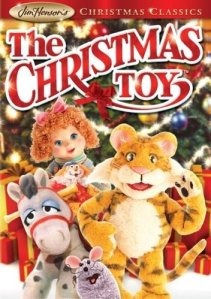 Director: Eric Till
Writer: Laura Phillips
Cast: Dave Goelz, Steve Whitmire, Kathryn Mullen, Jerry Nelson, Richard Hunt, Camille Bonora, Brian Henson, Marsha Moreau, Zachary Bennett, Jim Henson
Plot: Rugby the Tiger (Dave Goelz) and the rest of the toys in Jesse and Jamie’s playroom (Zachary Bennett and Marsha Moreau, respectively) have an active existence, coming to life and playing whenever their children leave the room. They have to be careful to be in the same spot where the humans left them, though, for if they’re found out of place, they’re frozen forever. When the toys learn it’s Christmas Eve, Rugby is astonished. He remembers last Christmas, when Jamie found him in his brilliant box beneath the tree and he became the center of her world… he never imagined it would happen again. The old teddy bear Balthazar (Jerry Nelson) tells the toys to be ready to welcome the new toys into their midst, pointing out how the doll named Apple (Kathryn Mullen) was upset when Rugby stole her spotlight the year before. As Bathlazar tries to talk to Rugby about what’s about to happen, the catnip mouse named Mew (Steve Whitmire) tells them Rugby has left the playroom to get back under the Christmas Tree, where he believes he belongs. A clown doll named Ditz (Goelz again) steps out of the room to call Rugby back, but he’s found by the children’s mother, who tosses him back into the playroom. Ditz is now “frozen” – unable to move, unable to speak… essentially dead. The rest of the toys sadly bring him to a sort of graveyard in the closet for other frozen toys. As the rest of the toys grieve, Mew sneaks out alone to try to save Rugby.
Mew finds Rugby trapped in the linen closet, locked in after he got mixed up with some clothes. When he tells Mew how spectacular Christmas is (for Rugby, that is), Mew decides to help him back under the tree, showing him the real cat’s trick for opening the door. Back in the playroom Apple assembles a rescue party to go after Rugby and Mew. Rugby makes it to the Christmas tree, where a lovely box for Jamie is waiting to be opened. Mew gets the ribbon off just as Apple and the others find them. She implores him to leave the box alone, but Rugby ignores her. When he opens the box, instead of it being empty, he finds a new doll, a beautiful warrior woman who proclaims herself to be “Meteora, queen of the asteroids (Camille Bonora)!” Meteora rushes off and Rugby tries to seal himself inside her box, but Apple re-tells him the story of last Christmas from her own perspective, when Rugby took her place as Jamie’s favorite toy. As Rugby finally realizes the truth, he still tries to get in the box, and Apple and Mew remind him that he’ll be frozen if the humans find him. Meteora knocks over a chess set, and the noise summons Jamie and Jesse’s father. Before he sees the toys, Mew lets out a very convincing “meow.” Believing it’s just the cat, father goes back to bed. The other toys convince Meteora to return to her box by singing her praises and telling her how she’ll be recognized as a star come Christmas morning. Once she’s wrapped again, they head back towards the playroom. Just as most of them make it back, though, Mew slips from Rugby’s tail and is caught in the hall as the children’s mother opens the door. Rugby rushes to try to save him, but he gets trapped in the linen closet again when mother finds Mew and takes him downstairs to the cat. Heartbroken, Rugby retrieves his friend’s frozen body and tearfully sings him a song to tell him he loves him. Miraculously, Mew begins twitching, and wakes up. In the playroom, the rest of the toys take up the song as the frozen toys in the closet pick themselves up and stumble back to life. The next morning, Jamie and Jesse bring their new toys to the playroom (while the cat, Luigi, drops off a new mouse), and the rest of the toys welcome them. Rugby feels a moment of sorrow while Jamie tells Meteora she loves her, but spirits are lifted all around as she says the same to Apple, and to Rugby himself.
Thoughts: Once more to the Jim Henson company, friends, and to one of my favorite lesser-known Henson productions. The Christmas Toy, from 1986, was one of these specials that led into a (sadly short-lived) TV series, The Secret Life of Toys, about toys that come to life and play whenever their humans leave the room. Nine years later, of course, Pixar Animation would take the basic plot of this special and turn it into a billion-dollar franchise for Disney. And I’m not just talking about the “toys coming to life” part – let’s be fair here, everyone who has ever been a child has imagined that their toys come to life and have adventures of their own when they aren’t around. Of course, there’s also the notion of the comfortable favorite toy suddenly having his prominence threatened by the introduction of a cool new space toy… who doesn’t realize she IS a toy and thinks she’s really in… outer… space… Okay, look, I love Pixar as much as anybody, but if Jim Henson’s ghost had started haunting the crap out of their studio after the first Toy Story came out, he would have been entirely within his rights.
I remember watching this special as a child (I would have been nine the year it came out, so it’s likely I was part of the audience for the premiere) and loving it immediately, even wearing out a VHS copy taped from ABC. Looking back at it as an adult, it’s impressive to me how dark Henson and company were willing to get with these characters. Rugby, at the beginning of the special, is terribly arrogant and unlikable. When he starts singing that he was “the greatest Christmas toy of all,” you kind of hope he does get frozen.
Then there’s the “frozen” concept itself – for a small child, this could be terrifying. Think about it here… you’re little, you’re just starting to gain a comprehension about what death actually is and what it actually means… and then you watch a Muppet special where the lovable mouse drops dead because somebody looks at it. I don’t actually remember the spin-off TV show very well, but I’m pretty sure they dropped this particular aspect when it went to series, and that’s probably a good thing. It definitely adds a note of suspense and danger to the story, but it may have been too difficult to deal with on a weekly basis. (If you really want to be a stickler for continuity, you can probably argue that whatever Rugby did to bring Mew back at the end of this special broke that spell forever, but if you’re thinking that hard about it you’re probably thinking too much about this. Yes, I am speaking from experience.)
Like any good Christmas special, of course, the unlikable character finds redemption in the end. And like any good Jim Henson production, that redemption comes with the help of his friends. The relationship between Rugby and Mew is wonderfully constructed. They’re not buddy-buddy like Kermit and Fozzie or Bert and Ernie. Instead, at the beginning, Mew hangs out with Rugby mainly because all of the toys reject him (he’s “just a cat toy”), but Rugby gives him slightly more attention than the others. It’s not even good attention – Rugby mocks and degrades him more than anyone, but Mew latches on to him anyway. When Mew saves him, twice, we see Rugby’s attitude shift, becoming more accepting not only of Mew, but of Meteora as well. And all of it is part of his true education – the growing knowledge that he isn’t the center of the universe after all, but merely an important part of it for one child. Once again, Henson is teaching children a lesson: “It ain’t all about you, kid.”
The music is okay here, but the final number is fantastic. “Together at Christmas,” Rugby’s song to Mew, briefly became something of a Henson anthem, and we in fact will hear it once more a few days from now, when we pay our fourth and final visit to the Henson workshop, and look in on his most famous creations.
Speaking of those creations, like Emmet Otter’s Jug-Band Christmas, this film sadly isn’t available uncut. Both Emmet and the Toys are still owned by the Jim Henson Company, but a few years back they sold the Muppet Show characters to Disney, which means they had to trim the introduction for both of these films, starring Kermit the Frog, to put on DVD. (Sesame Workshop got special permission from Disney to use Kermit in some of the DVDs of their older shows. I don’t know if Henson even asked…) The special is lovely in its own right, but the beginning is terribly abrupt, you feel like you’ve turned it on after it already began, and that’s why. The DVD itself is horribly barebones, not even taking you to a menu before starting the film. If they ever decide to dress this up and do a better home video release, I hope they come to some sort of agreement to give us Kermit’s welcome back again.
The Christmas Special Day 14: A Chipmunk Christmas (1981)
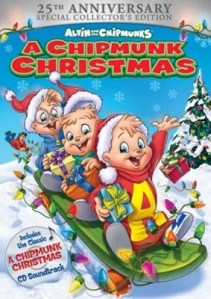 Director: Phil Monroe
Writers: Janice Karman, Ross Bagdasarian Jr., Hal Mason
Cast: Ross Bagdasarian Jr., Janice Karman, June Foray, Frank Welker, Charles Berendt, R.J. Williams
Plot: Five days before Christmas, the Chipmunks rouse David Seville (Ross Bagdasarian Jr., taking over the roles of Dave, Alvin and Simon from his late father, with Janice Karman playing Theodore) from a sound sleep and start to rush him out the door. As the boys go to the stores, Alvin overhears a little girl admiring a golden harmonica like Alvin’s, wishing she could get it for her sick brother Tommy (R.J. Williams). Tommy’s mother, however, seems skeptical Tommy will live to see the holiday. As the Chipmunks head into the recording studio, Alvin’s spirit has been diminished, and he heads out on an unscheduled break just minutes after recording begins. He finds Tommy at home and visits the sick boy, giving him with his harmonica and telling him he won it in a contest. Alvin rushes back to the studio and joins in the singing, his spirits restored. The Chipmunks are later booked to do a Christmas Eve concert at Carnegie Hall – a huge break – but they want Alvin to do a harmonica solo. Alvin can’t tell Dave (who gave him the harmonica) he gave it up, so he and his brothers try to buy a new one. He dresses up as Santa and charges kids for a picture, which Dave breaks up, admonishing his sons for trying to use Christmas to make money. When his brothers bumble out that Alvin needs money to buy something for himself, a disappointed Dave sends him to his room. That night, Alvin dreams of visiting mad inventor Clyde Crashcup (Charles Berendt), asking him for a loan, but the addle-brained Crashcup proves little help. Dave’s disappointment only grows when he walks past the dreaming Alvin, hearing the boy cry out for money in his sleep.
With two hours to go before the Christmas Eve concert, Alvin sets out to try to buy a new harmonica. While he’s gone Dave gets a phone call from Tommy’s mother, telling him the harmonica did wonders for the sick child. At the mall, Alvin stares at the harmonica he still can’t afford, when a kind old lady (June Foray) comes from nowhere and buys it for him. To thank her, he begins playing “Silent Night,” and a crowd forms to listen, including Dave, Simon and Theodore. Dave apologizes for misjudging Alvin, and the Sevilles head to Carnegie Hall for the concert. As he finishes his harmonica solo, Alvin runs into Tommy, out of bed and well. Alvin pulls him on stage to play an encore with the Chipmunks. Their song even reaches Santa Claus (Frank Welker), passing overhead on his rounds. He returns home to Mrs. Claus, telling her she should get out on Christmas some time and see what it’s like. As he drifts to sleep Mrs. Claus – a familiar, kindly old woman – looks at the audience and hushes us… why tell Santa, after all?
Thoughts: The Chipmunks, those animated anthropomorphs who rocketed to novelty album fame with “The Chipmunk Song,” had been off TV screens for some time in 1981. Although I didn’t know it at the time, this special was the start of a comeback, leading into a new Saturday morning cartoon that would be the version of the Chipmunks throughout my formative years. And it’s fitting, as their first hit was a Christmas song, that Christmas would factor into their comeback as well.
This special was something of an all-star piece, with the already-great June Foray stepping in as Mrs. Claus and the soon-to-be great Frank Welker as her husband. Even better, Chuck Jones pitched in on animation and character design for the special, and having watched it so relatively soon after How the Grinch Stole Christmas, it’s not hard to see some of his trademark gestures and designs, even if the flow of the animation isn’t really his. Some of the visual gags are distinctly Jonesian, though, such as Alvin as a miniature Santa being hoisted and lowered onto kids’ laps via a pulley… there’s a Wile E. Coyote flavor to it. (There’s also a great nod to Jones and Foray’s previous Christmas collaboration, as Alvin encounters a little girl named Cindy Lou.) The Clyde Crashcup sequence is a double whammy, bringing back a great (and mostly forgotten) cartoon star of the past, as well as presenting a sequence of confusion and misunderstanding that echoes a Dr. Seuss poem – or even one of Jones’s few feature films, the great The Phantom Tollbooth.
Although the Chipmunks would return during the run of their TV show with takes on A Christmas Carol and It’s a Wonderful Life, this special was all-new, and a really refreshing change. So many Christmas specials hinge on a character lacking Christmas spirit and finding it at the last minute. This time we see Alvin – often presented as the self-centered one in the group – show true Christmas spirit at the very beginning, and still winding up in a jam. The arc of the story is utterly unlike any other Christmas film I’m aware of. There’s not even really a lesson to be learned – Alvin knows and does the right thing right away, without having to go through trials or face the intervention of some wise mentor. If there’s anything he does wrong it’s not confessing to Dave that he gave up the harmonica, and given the circumstances, I think most people would have done the same thing. It’s a really refreshing change of pace, and makes for a unique special, unlike any of the others we’ve watched so far.
I have to confess, friends, I think the Chipmunks have hit something of a low point. I’m not at all a fan of the current movie series, where I think some of the silly charm of the original has been traded in for gross-out humor and tendrils of raunch that just don’t fit the spirit of Ross Bagdasarian’s characters. But that doesn’t mean I don’t still love Alvin and the boys, and especially at Christmas, I like looking back at these old cartoons and remembering when they were… y’know… good.
 Reel to Reel