Blog Archives
Lunatics and Laughter Day 5: An American Werewolf in London (1981)
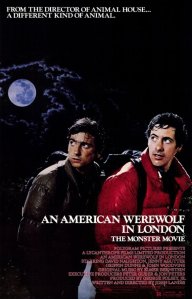 Director: John Landis
Writer: John Landis
Cast: David Naughton, Griffin Dunne, Jenny Agutter, Anne-Marie Davies, John Woodvine, Frank Oz
Plot: American college students David Kessler (David Naughton) and Jack Goodman (Griffin Dunne) are backpacking across Europe, beginning in northern England with plans to work their way south to Italy. The plans are shattered, though, when they stop at a small-town pub called the Slaughtered Lamb in the town of East Proctor. The locals distrust them, and Jack distrusts the five-pointed star painted on the wall. They leave, disturbing the barmaid and prompting warnings to stay on the road and beware the moon. The Americans are attacked by a huge wolf, which kills Jack and bites David before the villagers arrive and shoot it down. As he passes out, David sees that the beast has turned into a man.
He wakes up in a hospital in London three weeks later, where the police take his statement, but believe he was attacked by a lunatic rather than an animal. One of the Nurses, Alex Price (Jenny Agutter) takes a personal interest in him, convincing him to eat even when he isn’t hungry, keeping him company at night. He begins having dreams of running through the woods, naked, slaughtering and eating animals, then later seeing himself in a hospital bed, threatening Alex. After a particularly bad dream, Jack appears in his room, chatting jovially with his friend despite the fact that he’s a mutilated corpse. As David struggles to figure out if he’s dreaming, Jack starts quipping about his own funeral, putting him at ease before he can drop the bomb on his buddy. They were attacked by a werewolf, and since he was killed by a supernatural being Jack is cursed to walk the earth until the werewolf’s bloodline is severed. David, bitten by the wolf, is now part of that line, and Jack begs him to kill himself so they can both find peace. Jenny comes into his room, thinking him waking up from another nightmare, and he kisses her and declares himself a werewolf. When David is discharged, Jenny invites him to stay with her, and their relationship progresses quickly. Despite his newfound happiness, Jack’s corpse continues to haunt David, again begging him to kill himself before tomorrow’s full moon.
David’s doctor, Dr. Hirsch (John Woodvine) drives to the town where David was attacked, trying to figure out why David’s version of events differs so greatly from the official report. He finds himself blocked by the same villagers who turned out David and Jack, but this time, one is willing to talk. He warns Hirsch that David is in danger, and will “change” with the full moon. That night, as Jenny works a late shift at the hospital, the predictions come true – David undergoes a terrifying change from man to monster. He rushes into the night and attacks people, as the previous werewolf attacked him. Hirsch returns to London and compares notes with Jenny. Convinced that something is wrong in East Proctor – and wrong with David by extension – he calls her apartment. When David doesn’t answer, he calls the police.
The next day, David wakes up in the zoo, naked, in a wolf pen. With some quick thinking, he covers up and gets away. Hirsch, meanwhile, finds the morning paper full of stories about a brutal series of murders where the victims were half-eaten. When David returns to Alex’s apartment, particularly excitable and enthusiastic, she plans to take him back to the hospital. Along the way, the cab driver tells them about the murders, and David flees, planning to turn himself into the police, but the officer dismisses him. He runs away and Alex, Hirsch and the police who investigated his attack begin searching for him. David calls his family in America, hurriedly telling his sister he loves her before attempting to slit his wrists. Finding himself unable to do so, Jack’s corpse appears again, leading David into an adult ovie theater. The corpse, now more decrepit than ever, introduces David to the people he killed the night before, now trapped as a living dead just like Jack. He’s still in the theater when night falls again, and the killing begins again. The wolf escapes into the London streets, going on a bloody rampage, killing some and causing traffic crashes that kill many more. The police corner it in an alley and Alex rushes to the scene, approaching it and trying to draw the real David out. It lunges at her and the police open fire. The beast turns back into David as it dies, and Alex weeps.
Thoughts: Reportedly, director John Landis wrote the first draft of this script in 1969 and fought for over a decade to get it released, as studios thought it was too funny to market as a comedy and too scary to market as a horror film. You’ll excuse me if I find that just precious – as the whole point of my project is that the two both can, and have worked hand in hand for decades. On the other hand, the fact that I’ve located so few great horror/comedies before 1980 to include in this project seems to indicate that it wasn’t always the relatively easy sell it is today, and I have to suspect the success of An American Werewolf in London is one of the things that helped turn the tide and convince filmmakers that the conflicting styles could, and do, work together.
Landis is clearly a fan of the old Lon Chaney Jr. Wolfman pictures, even throwing out several references to them throughout film. He goes much farther than Universal could in the 40s, though, showing extremes of violence that wouldn’t have been allowed at the time. His special effects are, as to be expected, considerably more advanced as well. The transformation scenes are very good – simply done, but effective. Not to harp on it, but there’s no way this movie would be made today without giving in to the temptation to do the entire transformation via CGI (see the 2010 remake of The Wolfman if you don’t believe me), and that would really kill one of the most memorable sequences in this film. Naughton’s performance during the transformation is really excellent – even before any of the special effects show up he’s putting on a terrific, very convincing show of agony that makes you receptive when the limbs and face start to transform and the hair begins to sprout.
But the truly innovative thing about the movie, to me, is the tone of the film. This takes us back to a Type A picture, and an extreme Type A at that, far more horror than comedy. Landis basically wrote a monster movie, a modernized retelling of the Lon Chaney Jr. picture, and laced it with just enough humor and off-the-cuff commentary to market it partially as a comedy. Most of the humor actually comes through Jack – a snarky type even when he’s alive, but he becomes the master of the deadpan quip after he dies. David gets a little bit of physical comedy later, once he transforms for the first time. The sequence where he tries to sneak out of the zoo naked, stealing bits and pieces of cover-up along the way, feels like it could have fallen out of an old Marx Brothers or Hope and Crosby routine.
Landis is great at pulling an emotional reversal as well. When David calls home and tells his sister he loves her, there’s a horrible sense of finality to it. It’s a very genuine moment, where you understand you’re listening to a man who’s planning to die, trying to get everything straight before it happens. Considering that David was dancing around in a red fur-trimmed coat just minutes before, the viewer is left completely unprepared. The pace of the film as a whole is surprising, in fact. There’s a very long build-up to David’s first transformation, and once he realizes he’s responsible for the murders you blink and realize there are only about 20 minutes left in the film. It feels like there should be more, like everything has happened much too fast. When the end finally comes, it’s over in the blink of an eye. BAM-David is shot! Alex cries! Begin credits! There’s no denouement to cling to, no moment to allow your emotions to work themselves out before you feel a bit of a tear turn up for the poor American who became something he never wanted to be, did terrible things he never wanted to do, and died in a way he never would have wanted to die. It was a departure for Animal House director Landis and it’s a bit of a departure for this project, but it’s a good one.
Lunatics and Laughter Day 4: Attack of the Killer Tomatoes (1978)
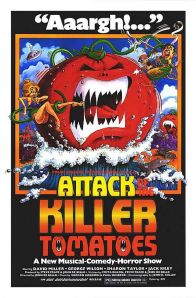 Director: John DeBello
Writer: Costa Dillon, John DeBello, Steve Peace, Rick Rockwell
Cast: David Miller, George Wilson, Sharon Taylor, Steve Peace, Ernie Meyers, Eric Christmas, Ron Shapiro, Al Sklar, Jerrold Anderson, Don Birch
Plot: A series of people begin dying in assorted tomato-related incidents: a man keels over drinking a glass of tomato juice, a woman is beaten to death by a tomato in the kitchen, a boy is gobbled up by a tomato… and the authorities scramble into action to solve the crisis. Presidential Press Secretary Jim Richardson (George Wilson) is sent to calm an increasingly worried public, but when he fails, the task of halting the tomato menace is given to top agent Mason Dixon (David Miller). Miller and his team of “experts” begin their investigation even as the attacks continue and the government feels more and more pressure to take action. Meanwhile, gossip columnist Lois Fairchild (Sharon Taylor) is given the task of reporting on the tomato menace, mostly because everybody else is busy.
Dixon and his team pick up their final member, Lt. Wilbur Finletter (Steve Peace), and the members are sent out on individual missions. Richardson is sent to meet Ted Swann(Al Sklar), head of the “Mind Makers” agency, about ways to convince people that tomatoes are safe. His sales pitch (including a spontaneous and incongruous musical number) fail to do the job. Things only get worse when Dixon encounters a scientist studying a tomato the size of a basketball. The real horror, however, comes in the revelation that this is merely a cherry tomato – the full-sized ones have grown enormous. Mere moments later, one of Dixon’s team is murdered by a tomato the size of a man. Dixon continues to seek a way to combat the menace, but it grows all the more intense, with attacks across the country and people panicking at the slightest reference to the deadly fruit.
Fairchild, stymied by her lack of progress in the case, begins to trail Dixon’s team, finally winding up in Finletter’s hotel room in an attempt to charm him with her feminine wiles. Instead, he mistakes her for an enemy spy and drives her out, screaming. Dixon, meanwhile, is fired upon by a hidden gunman – someone is trying to stop his investigation. The would-be assassin comes after Finletter next, but loses him across a railroad track. The army forces amass as the tomatoes make a brutal assault, destroying large portions of the country, somehow “burning, pillaging, and raping” along the way. (The movie doesn’t explain it and I don’t want to ask.) Dixon and Finletter get caught in a high-speed chase with the assassin, which turns into a slow-speed race as both cars malfunction. Dixon is captured, only to discover the killer is Richardson. He plans to use the tomatoes to overthrow the government and seize power in the chaos. Finletter saves Dixon and kills Richardson, but does so right before Richardson is going to confess the secret of controlling the tomatoes. Dixon realizes that the tomatoes have failed, twice, while the hit song “Puberty Love” has been playing on the radio. He has Finletter bring all the people left in the city to a football stadium, where the tomatoes predictably come to attack. They are rendered helpless, however, when “Puberty Love” blasts from the speakers. As the tomatoes shrink back to normal size, the humans press the attack, smashing and squashing them into pulp.
Thoughts: From the opening crawl, this movie takes its refuge in audacity. John DeBello decides to start the film by reminding people of how silly the concept of Hitchcock’s The Birds seemed in 1963, and that a real-life bird attack in 1975 made people stop laughing. I don’t know if there’s any truth to that at all, but you’ve got to admire the guts of the man who made this movie starting things off by comparing tomatoes to seagulls… or for that matter, himself to Hitchcock.
But that’s actually part of the movie’s bizarre charm. Starting with the crawl and going into an almost disturbingly-catchy opening theme song over credits that include several jokes (including a few “advertisements” and a blatant lie about the story’s origin), there is never any chance that this is a movie that takes itself too seriously. It can’t. And it knows it can’t. So it starts with the ridiculous. It’s another Type B horror/comedy, and a far broader one than Young Frankenstein, but it still stays close enough to the concept of legitimate storytelling to remain entertaining instead of just being a litany of joke after joke after joke.
The “killer tomato concept, in and of itself, comes across as a parody of 1950s sci-fi films, so many of which featured ordinary creatures – ants, lizards, and even the occasional plant – mutating into killing machines. As few of those films were self-aware enough to roll with the joke, though, Attack does it for them. The horror nods don’t stop there, though. The opening sequence feels like it was taken from a George Romero zombie movie, featuring random attacks striking random people. The scene where the girl swimmers are assaulted by tomatoes from beneath is a clear reference to Jaws (even down to a musical sting that mimics the John Williams theme without treading quite close enough to feel like legal action should be considered).
Now I’m not going to lie to you and say this is a good movie. The acting is miserable, the effects are weak, and at no point are you convinced that the tomatoes are actually “attacking” (a better term to use is “being lobbed gently at the actors from immediately off-camera”). Some of the humor does get a little too broad, as well. Taylor’s character seems to be named “Lois” purely for the sake of slipping in a Superman joke that doesn’t really go anywhere or add anything. But despite these relatively mild gripes, there’s still something oddly, inexplicably charming about this movie.
Part of it, I think, is that I never knew exactly how zany it is. I’ve heard of the movie for years, even watched the cartoon spin-off in the 90s (it didn’t last long, don’t be surprised if you never heard of it), but I guess I always had it in my head that it was a more tongue-in-cheek sort of film. Instead, it’s a straight-up spoof movie, and it hit me at a time when I wasn’t expecting one and, at the same time, was particularly turned off of them after seeing such a flurry of poor ones in recent years. In contrast, a lot of these jokes actually do hit. Sam Smith’s terrible (yet astonishingly effective) disguise skills never failed to elicit at least a chuck from me, and an early gag in which a Japanese scientist – all of his dialogue poorly dubbed for no real reason – accidentally knocks a very unfortunate picture into an aquarium pulled one of those simultaneous gasps and laughs. It was that moment where you start to laugh because it’s funny, then immediately try to stop yourself because you know it shouldn’t be. It’s not easy to do that really well, and if you fail to land a joke like that it’ll kill you. This doesn’t.
Some of the writing is also really clever. The bit where Dixon, Finletter, Fairchild and her editor all argue on the phone is cut perfectly, at one point making you question who was talking to who. The dialogue itself isn’t actually funny, but when cut together in such a way that you wonder if the speakers have somehow gotten their lines crossed, it makes you laugh.
This movie is, of course, a cult classic at best, but that’s fair. A lot of those movies that have a small but dedicated audience fall into that category, and even more of them blend together the horror and comedy tropes that mash up so very, very well. This is a movie you start to watch expecting it to be so bad it’s good. The fact that there are a few moments where it’s actually, genuinely good is a nice added bonus.
Lunatics and Laughter Day 3: Young Frankenstein (1974)
 Director: Mel Brooks
Writers: Gene Wilder & Mel Brooks
Cast: Gene Wilder, Peter Boyle, Marty Feldman, Cloris Leachman, Teri Garr, Kenneth Mars, Madeline Khan, Richard Haydn, Gene Hackman, Anne Beesley
Plot: Dr. Frederick Frankenstein (pronounced “Fronkensteen,” Gene Wilder), grandson of the infamous Victor Frankenstein, leaves his inconsistently affectionate fiancé Elizabeth (Madeline Khan), for Transylvania. He is met by Igor (“I-gor,” Marty Feldman), grandson of his grandfather’s assistant, and Inga (Teri Garr), his temporary lab assistant, who quickly displays more affection than the fiancé he left behind. Frankenstein’s castle is kept by Frau Blucher (Cloris Leachman), who Frederick questions about his grandfather’s “private” library. That night, Frederick is awakened from a nightmare by Inga, and, after a classic spinning bookcase gag, the two of them locate a secret passageway. At the bottom of a cobweb-covered staircase, they find Igor and the elder Frankenstein’s lab. Frederick reads his grandfather’s notes and finds the secret of animating lifeless matter, something he always believed impossible.
Igor and Frederick steal the corpse of an enormous, freshly-executed man to repeat Victor’s experiment. Igor goes on his own to steal a suitable brain for the beast, but as happened to his grandfather, fumbles with it and is forced to take an abnormal brain instead. In town, the people fear Frankenstein’s grandson, certain he is repeating his grandfather’s crimes (which, of course, he is). They recruit Inspector Kemp (Kenneth Mars) to discover what Frederick is doing.
That night the Monster (Peter Boyle) comes to life. Although he seems gentle at first, when Igor strikes a match, he goes berserk and nearly kills Frederick. Igor confesses that he took a brain from “Abby Normal” just as Kemp arrives. Frederick sends him off, but while he’s preoccupied Frau Blucher finds the monster and releases it. The creature breaks free from the castle, and Frederick vows to find it before it can hurt anyone. They set a trap for it the next evening, luring it with a violin and sedating it. Frederick insists upon trying to convince the creature it is loved. As he speaks to the beast, he not only takes it under his wing, but accepts his own destiny, declaring, “MY NAME IS FRANKENSTEIN!”
He presents the creature to the town, charming them with a song and dance routine before a light blows and it turns on the crowd and the police haul it away. As Frederick and Inga find comfort in each other’s arms, they receive a telegram that Elizabeth will be coming to the castle that night. After Elizabeth again rebuffs Frederick’s advances for the night, the creature – having escaped — returns to the castle. She passes out and he takes her with him to a hiding place in the woods, where she soon succumbs to its own animal desires. After a mere six times, though, the violin from the castle summons him back. Frederick decides the only way to protect the creature is to use his own brain to stabilize it. Kemp leads an angry mob, complete with torches and pitchforks, into the castle, and are about to make off with Frederick’s body, when the stable creature commands them to put him down. He gives a stirring speech and Kemp realizes the error of his ways. In the end, Frederick and Inga are married, whilst Elizabeth and the creature go off to enjoy domestic bliss of their own.
Thoughts: Coming off the magnificent western/comedy Blazing Saddles, it’s not surprising that Mel Brooks would turn his attention to the horror/comedy genre. (He’d later tackle the epic in History of the World Part I, science fiction in Spaceballs and high adventure with Robin Hood: Men in Tights. He’d return to horror with Dracula: Dead and Loving it, but the less said about that one, the better.) Working off an idea by Gene Wilder, these two took one of the most enduring classics of horror and turned it into one of the best horror/comedies ever.
Young Frankenstein works as a kinda-sequel to the original Frankenstein, building on the mythology of the original Universal films even though there was no official connection. (Young Frankenstein was produced by 20th Century Fox.) It doesn’t really contradict any of the older films, at least no more than some of the official sequels did, but it takes the franchise into an entirely different direction. This is the first film in my little experiment that I’d classify as a “Type B” horror/comedy – more comedy, but using the tropes of horror and spoofing them. The difference is in the plot, really – what puts this in the second category is that the story couldn’t exist without the comedy tropes. Even Abbott and Costello’s antics with the monsters followed a fairly straightforward scary movie plot for the 1940s, whereas certain elements of this film could not be removed or altered without drastic changes being made to the story structure. You could maybe replace the musical number towards the end with something more King Kong-eque, but that would simply feel derivative. And it’d be a lot harder to play up the creature’s abduction and romancing of Elizabeth without the comedy elements in any way that doesn’t make it tread uncomfortably close to plain rape.
The other thing, and the more all-encompassing thing, that makes this a Type B is the characterization. In a Type A universe, we’ve got a frightening situation populated by some funny characters. Bela Lugosi wasn’t a quippy Dracula, and Bob Hope’s cracks about the ghosts were only funny in the context of a world where nobody would take such a thing seriously. Not so for Type B, where all characters – and everything else – can become fodder for humor. In Young Frankenstein, as in most Mel Brooks comedies, anybody can play straight man to anybody else at any moment. Everyone can crack a joke or make a comment that’s hysterical – to the audience. In-universe, however, nobody recognizes the humor.
The only exception would be Marty Feldman’s Igor, who leans heavily on the fourth wall, winking at the audience, and throwing out some meta-puns that make him seem both wackier than and more savvy than the rest of the characters. His comedy is easily the broadest of the troupe Brooks and Wilder assembled, and he’s probably the funniest as well. His timing is flawless, his sense of propriety non-existent, and his ability to key into other comedy from other eras makes his performance as funny now as 40 years ago.
What elevates this above most other Type B horror/comedies (coughScaryMoviecough) is the way Brooks and Wilder are still capable of crafting real characters instead of caricatures, telling a real story instead of just creating their own Frankenstein-patchwork of other movies. Even this film, which literally could not exist without Mary Shelley’s Frankenstein as its inspiration, feels fresh and original.
Just as important, Brooks and Wilder don’t simply repeat moments, but build upon them. The crummy spoofs of the 21st century are frequently completely devoid of actual jokes, instead just referencing a better movie under the assumption that the audience will understand the reference and laugh at the recognition. This is a stupid, asinine way to make a movie that far too many of my 11th grade students mistake for humor. In a Brooks comedy, though, we touch on the familiar moments and make them new. Igor stealing the brain, for example, begins with a glance at the camera, because he knows that we know what’s coming. Then, when the brain of a “scientist and saint” is accidentally destroyed, he goes for the abnormal brain immediately, despite the fact that the next brain over is clearly labeled “visionary.” The camera just pans past the other label, though, and a viewer may watch the movie two or three times before they even notice it. Modern films are incapable of this sort of subtle, Easter Egg humor – a film by Jason Freidberg and Aaron Seltzer (perpetrators of such crimes against comedy as Meet the Spartans and Vampires Suck) would be sure to hover over that label, make sure everybody sees it, and drain every iota of comedic potential from it before moving on to what everybody knows they’re going to do anyway.
Modern spoof movies suck, is the point I’m trying to make.
Anyway, the film is built on small moments. Kenneth Mars’s assorted shtick with his artificial arm, the disastrous game of darts, and the bit where a choking Frederick has to play charades to make his incompetent accomplices understand he wants them to sedate the monster that is actively murdering him are the sorts of thing that make for a great spoof. None of these are repeat jokes, they’re built on the characters and story as presented instead of spending all their time making allusions to everything else. In fact, except for the full-film allusion to the original, the only references to anything else are when the town elders imply they’ve dealt with monsters five times in the past (referring, of course, to the line of Frankenstein pictures made by Universal) and Madeline Kahn’s hairstyle after she becomes the creature’s “bride.” And as those are both clearly references to the Frankenstein lore as a whole, if not the first movie specifically, we accept them.
When the movie references the original directly, it often does so in order to subvert it. When the creature encounters a little girl playing with flowers, we’re prepared for the worst, based on what happened to the little girl in the Boris Karloff original. Instead, we get a hysterical seesaw gag which completely takes us by surprise and is more than funny enough for us to forgive the fact that it really doesn’t have anything to do with the rest of the story. Gene Hackman’s cameo as the blind man serves a similar purpose – not actually progressing the plot, but showing us the character of the beast as it attempts to make friends and is thwarted, not because he’s a monster, but because his potential companions aren’t entirely capable.
When I asked for help assembling the movies for Lunatics and Laughter, one of the first suggestions I got was Scary Movie. And while I considered it, I decided not to do it, at least for the first phase. It may make the expanded edition, but only because of its influence on movie as a whole, not because of the quality. As you’ll see as we continue our march to Halloween, the vast majority of the movies I’ve chosen for this project are A-Type horror comedies, because most of the B-Types, frankly, are terrible. This is hands-down the best, the finest, the funniest horror spoof I’ve ever seen, and it’s frankly ruined me for most of the other ones. And for that, Mel Brooks and Gene Wilder most assuredly have earned my thanks.
Lunatics and Laughter Day 2: Abbott and Costello Meet Frankenstein (1948)
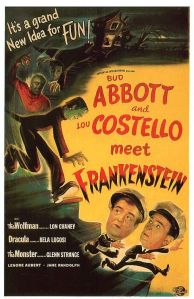 Director: Charles Barton
Writers: Robert Lees, Frederic I. Rinaldo & John Grant
Cast: Bud Abbott, Lou Costello, Lon Chaney Jr., Bela Lugosi, Glenn Strange, Lenore Aubert, Jane Randolph, Frank Ferguson, Charles Bradstreet
Plot: Chick and Wilbur (Abbott and Costello, respectively, although why they even bothered with giving their characters names at this point is beyond me) are employees of a delivery company. They get a nervous phone call from Larry Talbot (Lon Chaney Jr.) in London, asking about a pair of crates being sent to a house of horrors. He tells them that he’s flying to Florida the next day, and they are under no circumstances to deliver the crates until he arrives. The full moon rises in London and Talbot undergoes a startling transformation, becoming a Wolfman. Confused by the growling on the phone, Wilbur hangs up. Moments later, Mr. McDougal (Frank Ferguson) arrives to pick up the crates, which he claims contain the remains of the true Count Dracula and Frankenstein Monster. He tells this to Sandra (Lenore Aubert), Wilbur’s girlfriend, who Chick thinks is far too alluring to be with his bumbling friend.
Despite the call from Talbot, McDougal has the proper paperwork, so Chick and Wilbur deliver the crates To McDougal’s House of Horrors. Wilbur is on-edge, surrounded by the creepy contents, but Chick is convinced Dracula and the Monster are just characters from stories. As he leaves Wilbur alone, Dracula (Bela Lugosi, reprising his role for the first time since 1931) rises from his coffin, terrorizes him, and mesmerizes him. With Wilbur entranced, Dracula awakens the Frankenstein Monster (Glenn Strange). McDougal and Chick arrive and argue over where the exhibits are while Wilbur, hysterical, tries to explain what happened, but McDougal has them arrested.
Dracula flies to a remote castle where waits Dr. Stevens (Charles Bradstreet) and his assistant… Wilbur’s girlfriend, Sandra. Dracula wants to avoid Frankenstein’s mistake and give the monster a new brain, one so simple and naïve that it will never question his master. Sandra, of course, has just the brain in mind.
Talbot finds Wilbur and Chick, just out of jail, and confirms Wilbur’s story. He has been chasing Dracula, but he can’t go to the police for fear of revealing his own secret. As the moon is about to rise, he gives Wilbur the key to his hotel room and begs him to lock him up overnight, not letting him out no matter what he hears inside. Wilbur’s compliance lasts almost 45 whole seconds, before he goes into Talbot’s room to bring him a bag he left behind. In another comedy sequence, Wilbur narrowly avoids being torn to shreds by a Wolfman he never sees.
McDougal, furious over Wilbur and Chick’s release from jail, meets insurance investigator Joan Raymond (Jane Randolph), who plans to use her feminine wiles to trick Wilbur into revealing the location of the missing exhibits. She narrowly avoids Sandra, who came by to arrange a meeting with Wilbur for that evening’s masquerade ball. Joan convinces him to take her to the ball as well, and while Wilbur revels in his two dates, Chick tries to figure out what his dumpy friend has that he doesn’t. (As Sandra tells him, “A brain.”) The two go to Talbot’s room, where they find it’s been torn apart. Talbot wakes and tells them about his curse – he was bitten by a werewolf, and transforms whenever the moon was full. As Wilbur saw the monsters, he pleads with him to help him. They don’t believe him, and continue their preparations for the ball.
Chick, Wilbur and Joan pick up Sandra for the ball (Wilbur allowing each girl to believe the other is Chick’s date). Sandra finds Joan’s ID card for the insurance agency, while Joan finds Sandra’s copy of Frankenstein’s book on life and death. Each suspicious of the other, they return and meet Sandra’s employer, Dr. Lejos, who Wilbur somehow fails to recognize as Dracula wearing a robe instead of his cape. Lejos insists that Dr. Stevens join them for the party, but Sandra suddenly claims she has a headache and can’t go. She brings Dracula aside and says that Joan and Wilbur’s snooping and Stevens’s inconveniently inquisitive nature are making the operation too dangerous. Angry, he hypnotizes her and bites her, and they go to the ball.
At the ball, Chick and Wilbur encounter a fearful Talbot, who is upset by Chick’s wolf-mask. Sandra, now a vampire, tries to bite Wilbur, but he’s saved by Chick and Talbot, seeking the now-missing Joan. As they search, the full moon appears and Talbot transforms. He attacks McDougal, who blames Chick when he sees the wolf-mask. The party goes mad and people flee, with Chick and Wilbur finding a hypnotized Joan with Dracula. He mesmerizes the boys and takes Wilbur and the girls away. Finally convinced, Chick finds Talbot and they go to Dracula’s mansion, where Wilbur’s brain is being prepared for transplant. Talbot and Chick burst in. Talbot is about to free Wilbur, but once again, he transforms, and Frankenstein’s Monster breaks free. The five of them engage in a mansion-encompassing battle of positively Scooby-Doo-ian proportions, until finally the Wolfman seizes Dracula and they plunge off a cliff. The Monster chases Chick and Wilbur to the dock, where Stevens and Joan set him on fire. As they sit in a boat, Wilbur berating Chick for not believing him, a cigarette hovers in the air, and the unmistakable voice of Vincent Price introduces himself… he’s the Invisible Man.
Thoughts: This film is, inarguably, the greatest horror-comedy ever made. Okay, maybe it’s not inarguable. You can argue it. You’d just be wrong. What’s not arguable, however, is that it is by far my favorite movie out of all the films selected for Lunatics and Laughter, and (with the possible exception of Ghostbusters) the one that I’ve watched the most times. It isn’t Halloween unless I see Bud and Lou go toe-to-toe with the greatest Universal Monsters.
That, in fact, is what makes this such a fantastic movie, friends. Universal Studios took their two greatest comedic stars at the height of their popularity and mashed them into a movie with three of their most popular monster franchises, even getting the classic Bela Lugosi and Lon Chaney Jr. to reprise their roles as Dracula and the Wolfman, respectively. (Only Boris Karloff as Frankenstein’s monster is missing from the classic trinity, and he would get his chance to dance with the boys later in Abbott and Costello Meet the Killer, Boris Karloff and again in Abbott and Costello Meet Dr. Jekyll and Mr. Hyde).
It’s such simple alchemy – director Charles Barton got five amazing performers and allowed them to do what they do best for 83 incredible minutes. Abbott and Costello pull off the same sort of brilliant wordplay and slapstick that made them Hollywood legends, while Lugosi, Chaney and Strange (playing the Monster for the third time since Karloff’s retirement) give their performances all the force and horror they had in their respective series. The film doesn’t bother with little things like continuity either – there’s no effort to explain how Talbot knew Dracula or the monster, how Dracula found the creature’s remains, or even how any of the monsters were alive, as most of them had a tendency to die at the ends of all of their films. The sequels usually had a halfhearted resurrection scene, but Barton sees no need to even bother with that. The audience doesn’t care about any of these things. They know who Bud and Lou are, who Dracula and the Wolfman and the Monster are, and that’s all they need.
And damned if they weren’t right.
Like I’ve said, comedy and horror are flip sides of the same coin, and I’ve never seen a movie that demonstrates it as perfectly as this one. Our five lead characters (because that’s who Bud and Lou are, no matter what names they were using in the movie, they played the same two characters they always did) come from totally different styles of film: slapstick comedy and tales of pure terror. But when we put them together there is no clash. Everybody is themselves, everyone is entirely in-character, and it all fits together seamlessly. Even the scenes with Lugosi popping in and out of his coffin, giving Costello the stimuli for one of his legendary freak-outs, works for a Dracula who simply enjoys toying with his eventual prey. He even pulls the same sort of hypnosis and gets the same light-across-the-eyes treatment as he did in the original 1931 version of Dracula.
The plot, meanwhile, is straight out of the horror movie handbook. Dracula’s scheme to give the monster a simple brain keys into Costello’s movie persona perfectly. At the same time, it’s still the kind of devilish plan that many a horror movie villain has concocted over the years. Hell, let’s be honest – it’s a more logical plan than thousands of the others movie monster baddies have conjured up over the years. Talbot’s logic – “the police won’t believe me unless I tell them I’m a wolfman” – is kind of sketchy. It’s more likely they’ll just think him even crazier. But it’s still the same sort of logic that dominated this sort of movie back in the 40s and 50s, and therefore is easy to forgive. Similarly, the special effects are of the highest quality available at the time. Talbot’s werewolf transformation looks as good as it ever did in his own films. And while it may be pretty obvious that the Monster burning on the dock at the end is a mannequin being pushed along with sticks, in 1948, how else were you gonna get that shot?
Truly, the only moment that strains credibility, even for the time, is when Talbot and Chick plan their rescue mission. Talbot tells Chick they should hide and wait, since it is now morning and Dracula will be helpless until nightfall. Um… wouldn’t that make this the perfect time to attack? Come on, dude. (Honorable mention, though, goes to the fact that Talbot makes his transformation four nights in a row. Isn’t three usually the limit for a full moon?)
Bud and Lou, a classic vaudevillian comedy team whose act translated to film and television far better than most of their contemporaries, pull off a lot of the same shtick they usually do. They engage in verbal battles, with Bud tossing out unnecessarily complicated words so Lou can amusingly misunderstand them. Bud leaves Lou alone at inconvenient moments so he can be the sole witness to creepy happenings and have entertaining panic attacks. And once or twice, Lou is allowed to get the better of his buddy in a battle of the logical fallacies. In short, they take their standard routine and inject it into a horror movie. But not for one second does it feel forced, do any of the comedic interludes feel like a distraction, or does any of it feel like padding. They’re just there to have fun, as they always do. (Reportedly one scene – where Wilbur sits on the Monster’s without realizing it – took an absurdly long time to film because Glenn Strange simply couldn’t stop laughing at Costello’s antics in his lap.)
Even the old comedy trope – the panicky one sees the madness, the straight man conveniently misses everything until the last minute – feels fresh and original here. And no, it wasn’t, not even in 1948. When Chick pulls out the wolf-mask, you just know there’s going to be a moment when Wilbur encounters the real Wolfman and thinks it’s his buddy in disguise. You’re waiting for it. You would feel disappointed if it didn’t happen. But Abbott and Costello never disappointed on that front.
The finale is simply great. From the moment Talbot and Chick arrive at the mansion until Vincent Price makes his uncredited cameo, we go through one chase after another, with doors and props being smashed at every turn, our heroes bumbling into the monsters at the worse possible moments, often saved through circumstance, luck, or the good ol’ Rule of Funny. If you are physically capable of watching this movie without laughing, you need intense psychoanalysis. And if you didn’t love the Universal monsters before, this will do the trick.
Mutants, Monsters, and Madmen Day 30: Return of the Living Dead (1985)
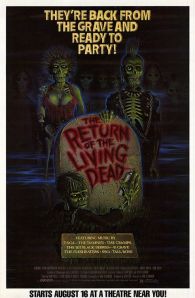 Director: Dan O’Bannon
Writers: John Russo, Rudy Ricci, Russell Streiner, Dan O’Bannon
Cast: Clu Gulager, James Karen, Don Calfa, Thom Matthews, Beverly Randolph, Linnea Quigley, Miguel Nunez, Allan Trautman
Plot: At the Uneeda Medical Supply company, manager Frank (James Karen) shows around trainee Freddy (Thom Matthews), and asks him if he’s ever seen Night of the Living Dead. Showing off, Frank tells Freddy the film was based on reality. A strange chemical called Trioxin animated corpses in Pittsburgh, but the truth was suppressed… and the bodies are being stored right there in barrels of the chemical. Frank shows the barrels to Freddy, but accidentally causes a leak of the gas, dousing both men and reanimating the dead bodies – even the parts of dead bodies – kept in storage at Uneeda. Freddy’s friends – a group of punk teenagers who look like the 80s threw up leather and piercings all over them – decide to kill time in a nearby cemetery while waiting to pick him up from work. As they proceed to party in the graveyard, Frank and Freddy wake up from their encounter with the Trioxin gas feeling sick. One of the barrels has broken open and is empty, and Frank assumes the body melted. They soon find the rest of the corpses (human and otherwise) throughout the warehouse animated and hungry.
Back in the graveyard one of the teens, Trash (Linnea Quigley) begins to fantasize about the more horrific ways to die, leading to one of the most bizarre and gratuitous striptease sequences in horror movie history. Frank and Freddy summon their boss, Burt (Clu Gulagar), about the cadaver screaming and banging on the walls of cold storage. Remembering Night of the Living Dead, Burt tries to kill the cadaver by driving an axe into its brain, then cutting off its head, but it doesn’t kill the monster. They reach a horrible revelation: the movies lied to them. Burt decides to bring the cadavers to his pal Ernie (Don Calfa) at the crematorium, hoping to destroy them that way. It works, but the smoke that spills out of the oven seeds the clouds above, and it begins to rain on the graveyard. The water filters down through the soil, into the coffins, and the dead begin to claw their way to the surface.
Frank and Freddy are getting sicker and sicker, and Ernie calls an ambulance. Meanwhile Freddy’s girlfriend, Tina (Beverly Randolph), has made it to Uneeda, where she finds the place seemingly deserted. As she searches for Freddy, she encounters the zombie that escaped from the first barrel, a slender figure that has become known as Tarman (Allan Trautman). The rest of the teens arrive just in time to save her, but Tarman gets his first snack of brains in the process. The paramedics arrive to treat Freddy and Frank, but are unable to find a pulse or blood pressure in either one of them, and their bodies are room temperature. The teens are attacked in the cemetery, and three of them (Tina included) make it to the mortuary, while two more get back to Uneeda. As the paramedics return to their ambulance, they hear screams and try to call for back-up, only to be attacked and devoured by the swarming dead. The survivors in the mortuary board up the place to hold out the zombies, and Freddy begins experiencing pain as his body goes into rigor mortis. One of the zombies manages to make it into the mortuary and Ernie straps it down, questioning it. It tells the survivors they want to eat brains because it relieves the pain of being dead. Burt locks Freddy and Frank in the mortuary chapel with Tina, who insists on staying with Freddy. Burt, Ernie, and Spider (Miguel Nunez) begin to seek an escape, while in the chapel, Freddy attacks Tina, hungry for brains. Spider and Burt make a run for the police car, fighting the zombies on the way. They drive the car to the door to collect Tina and Ernie, can’t get through the mob and drive away for help, but a swarm of zombies traps them at the Uneeda warehouse. Not wanting to become like the rest of the zombies, Frank turns on the crematorium, says a prayer for forgiveness, and climbs into the oven. Burt calls the army hotline on the Trioxin barrel and reports what has happened, and the army activates its contingency plan. Ernie and Tina hide from Freddy while the survivors at Uneeda protect themselves from Tarman, and just as everyone makes a final stand, the army drops a bomb on the whole damn city of Louisville, Kentucky, wiping it – and the zombies – off the map. But as the zombies burn, the smoke rises… and the rain starts to fall.
Thoughts: This movie has perhaps the strangest pedigree of any film on this list. George Romero – writer and director of Night of the Living Dead – got into a disagreement with co-producer John Russo about the direction of the franchise. Russo walked away with the right to use the “Living Dead” name for his own franchise, and this was the result: a world where Night of the Living Dead was a movie, but was based on its own reality. It’s a weird premise, to be sure, and I was at first reluctant to include this movie in my little horror movie project, mainly because I think it may be more deserving of a place in the eventual horror/comedy project I intend to present in the future. But I decided use it for two reasons: first, like Night of the Living Dead, this movie helped influence the way zombies are portrayed in popular culture even today, and second, I’m not really convinced that all of the comedy in this movie was intentional.
The zombies (with the exception of Tarman) are all kind of silly, particularly the first, fresh cadaver, where the actor seemed to just be stripped, shaved, and painted yellow. And a lot of the violence seems to be played for laughs. Trash’s legendary tombstone striptease isn’t really scary or sexy, just weird. On the other hand, the parts that probably were intentionally funny (such as the hungry zombie calling for “more paramedics” on the ambulance scanner) are legitimately funny. Even the 80s-style montage (in this one the characters are barricading themselves in the mortuary instead of training to win the big ski tournament) is funny enough, juxtaposed against a goofy rock ballad about the Living Dead.
The characters in this movie really are jokes, especially the teenagers. They’re all caricatures, and the way one of them (I don’t even remember the characters’ name, making it impossible to look up the actor, that’s how generic they are) gives a speech about how his leather and chains is a “way of life” and not a costume is groan-inducing, and the way they resist calling the cops (because they’ll “kick our ass”) even as one of their buddies is having his brain eaten takes them from the realm of stereotype to the land of the remarkably stupid. It’s really no loss when any of them gets turned into a zombie hors d’oeuvre. As for naming the two old chums “Burt” and “Ernie”… really, O’Bannon? Sesame Street was pushing 20 years old at the time you wrote this script, you can’t tell me that wasn’t intentional.
There seems to have been an ill-fated attempt at poignancy with “Trash,” who proclaims early in the film that she believes the worst way to die would be to be eaten to death by old men, but seeing as how she says that immediately before she begins taking off her clothes for no apparent reason, it’s doubtful most audience members remember that bit. Frank’s suicide is a little more satisfying from an audience standpoint – it’s the one point in the movie where someone shows anything like a little human regret – and the moment where he dies is a good capper to what little of a character arc there is.
The zombies in this movie are different from Romero zombies in many ways. First off, they’re more intelligent, with the ability to speak and reason (although later Romero films did start to show zombies exhibiting a few higher-order skills). Second, they can’t be killed by a simple bullet to the brain, and in fact, dismemberment does no good as each individual chunk of the zombie continues to move of its own accord. Finally, and most importantly to popular culture, this is the movie that gave us zombies obsessed with braaaaaaaains. A Romero zombie (and those of most of his imitators) is perfectly happy with any chunk of living flesh, and it’s these zombies that we still see in most movies and TV shows. If you’re a fan of The Walking Dead, you’re watching a Romero zombie. But whenever you see a zombie that wants specifically to chomp on a brain, you can thank John Russo and Dan O’Bannon.
From the perspective of a horror movie fan, there’s nothing in this movie as scary or visually cool as Tarman. The first zombie, one whose flesh has mostly melted into slime from years of Trioxin storage, is a grotesque, slimy creature that could give anybody nightmares. Allan Trautman, who played the character, is rather underappreciated in the strata of horror icons. His slim frame and marvelous physical performance created the best monster from this movie, and one of the most memorable single zombies of all time. While the other zombies aren’t nearly as recognizable or as entertaining, there are a couple of cool scenes. The moment where the rainwater filters down through the ground into the coffins and the dead claw their way out to the surface, for example, looks really great, and the zombie Ernie interrogates is a nice piece of puppeteering, even if the movement of its mouth doesn’t remotely match the words she’s saying.
The end of the movie is almost as literal a deus ex machina as one could hope for. There’s a short bit earlier where someone from the army shows a bit of concern about the barrels (which have been missing for sixteen years thanks to some sort of paperwork screw-up), but it seems tacked on to justify a conclusion that otherwise would come totally from out of the blue. While I give the filmmakers credit for going for the nuclear option (pun intended), it makes everything else in the movie feel somewhat hollow.
While Return of the Living Dead is by no means the only movie to use the “we swear it’s a true story” gag, it’s by far the least convincing. And although there’s fun to be had in watching the movie, it’s horror movie fun at its cheesiest. It’s hard to imagine this film being sincerely frightening to any adult, but there’s still room for enjoyment in watching it. Just don’t go into it looking for a scare.
Stephen King makes one more appearance tomorrow, with one of his most down-to-earth tales of horror… and, I admit, one of my personal favorites: Misery.
Mutants, Monsters, and Madmen Day 29: A Nightmare on Elm Street (1984)
 Director: Wes Craven
Writer: Wes Craven
Cast: Robert Englund, Heather Langenkamp, Johnny Depp, Nick Corri, Amanda Wyss, Ronee Blakley, John Saxon
Plot: Tina Gray (Amanda Wyss) is being plagued by a dream in which some maniac with knives on his fingers is stalking her through a boiler room. The next day, she discovers that her friend Nancy (Heather Langencamp) has been suffering from similar dreams. Nancy and her boyfriend Glenn (Johnny Depp) come over that night to make her feel better while she’s home alone, but Tina’s boyfriend Rod (Nick Corri) crashes the party and coaxes Tina into her mother’s bed. Tina falls asleep and is again attacked by the man with the knives in her dream. This time, as she fights him in the dream-world, in the real world her body is tossed about the room, cut and broken, and she dies. Rod, the only witness, flees in terror, but is arrested the next day and charged with her murder. Nancy falls asleep in school the next day, and has a vision of Tina’s blood-covered corpse being dragged around the school in a bodybag. Nancy finds herself in a boiler room, pursued by the man with the knives, who introduces himself as Freddy (Robert Englund). In terror, she puts her arm against a hot pipe, the pain jolting her awake. Freddy attacks her again when she falls asleep in the bathtub, but she again manages to wake up in time. After a third dream-encounter, Nancy and Glenn rush to the police station to visit Rob, but at that same moment he has fallen asleep. Freddy hangs him in his jail cell.
Nancy tells her parents (John Saxon and Ronee Blakley) about the dreams, and they bring her to a doctor who observes her while she sleeps. She has a violent reaction to the dreams, cuts appear on her arms, and a white streak appears in her hair. In her bed, she finds the battered hat Freddy wears in the dreams. She confronts her mother with the hat and the name written in it, Fred Kruger, and Marge breaks down and tells Nancy the truth: Krueger was a child murderer in the neighborhood that escaped justice on a technicality. Marge and the other parents of Elm Street tracked him to his hideout in a boiler room and lit the place on fire, letting him burn to death. Now he’s back, seeking revenge on the children of the parents who murdered him. Marge, heavily drunk, locks Nancy in her house, and she is trapped across the street as Glenn falls asleep and is killed, sucked into his bed by Freddy, and then expelled back into the room as a geyser of blood. Setting up traps around the house, she finally allows herself to fall asleep. She manages to bring Freddy into the real world, where she leads him through her gauntlet of traps and eventually trapping him in the basement – on fire. As her father arrives, Krueger escapes the basement and kills Marge, drawing her blackened, burned corpse into the bed. Her father leaves her alone, and Nancy confronts him one more time. This time, though, she refuses to give in to her fear, breaking his power, and he vanishes. In the morning, we see Nancy and Marge step out into the sunlight as Glenn, Rod, and Tina drive up. Nancy gets into the car, but the top (with Freddy’s distinctive red and green stripe pattern) closes and drives them away.
Thoughts: If you’ll recall, I was less than impressed with Wes Craven’s first entry in this experiment, Last House on the Left. Twelve years later, he more than redeemed himself with this horror classic. Freddy Krueger was a game changer for slasher movies. For the most part, previous films about some madman stalking people were grounded in reality. Michael Myers, Jason Voorhees, Leatherface and the sort were all human, if a bit hard to kill. It was Freddy that brought slashers into the supernatural, and a large number of the imitators that have come since then have embraced the supernatural elements wholeheartedly. Even some of those psycho killers that preceded Freddy made the switch to supernatural after a few movies, some successfully (Jason Voorhees became a Superzombie in Friday the 13th Part 6 and never looked back), and some not (there have been a few attempts to make Michael Meyers possessed by a demon or some other rot, all of which wound up simply undermining the character).
The modern slasher is often pictured as some maniac killer who dies and returns to a semblance of life in some hate-fueled quest for blood, and this is where that comes from. Even Tim Seeley’s excellent comic book series Hack/Slash uses this as its core – this series focuses on a “Survivor Girl” who gets pissed and decides to start hunting supernatural slashers, many of them creepy enough to stand right next to Freddy or Jason, and on one memorable occasion even encountering the maniacal Chucky from the Child’s Play series. Without this vision from Wes Craven, it wouldn’t have happened.
Also like many other films on this list, we get a great argument for the use of practical effects over CGI. The 2010 remake of this movie tried some of the same gags using computers, and they just weren’t as effective. When Freddy leans through the wall at Nancy, Wes Craven simply had Robert Englund pushing against a rubber membrane to terrifying effect. The remake went CGI, and it looked terrible. The fountain of blood in Johnny Depp’s death scene? Again, something that just wouldn’t look as good with computerized blood as good old-fashioned red corn syrup (or whatever they used).
It’s not just the quality of the effects, though, it’s how creative Craven is at conjuring up images that seem like something that would come straight out of a dream, like the centipede that comes from Tina’s mouth or the stairs melting away beneath Nancy’s feet. Even now, the image of Tina’s bodybag being dragged around the school by some unseen force is among the creepier images I’ve seen in a movie. It’s this kind of imagination that makes the movie work, that and the fact that Craven taps into one of the most primal fears a person could have. Regardless of age, sex, religion, or culture, everybody sleeps, and everybody dreams. That moment when you’re asleep, you’re the most vulnerable, but we survive by knowing that nothing that happens in a dream can actually hurt us. For Nancy and the others, Craven takes away that last bit of security, creating some genuine terror for the characters. Nancy is now living in a world where she has to sleep or go insane, but the moment she falls asleep she knows she can be attacked by a madman.
Nightmare helps to reinforce a great number of horror tropes. The first victim, Tina, dies immediately after having sex: we have slasher-as-morality police. Nancy’s parents don’t believe her at first: the clueless authority figures. Then, it turns out Nancy’s mother knew the truth all along, while her father still resists the truth: the useless authority figures. And then there’s Nancy herself, one of my favorite horror movie Survivor Girls. Sure, Laurie Strode is the prototype, but for my money Nancy Thompson is the character all girls who want to survivor horror movies should aspire to be. Laurie shows guts, but she’s largely reactive. Nancy investigates, hunts the killer, even going so far as to lay traps for him, and when she returns to the series in A Nightmare on Elm Street Part 3: Dream Warriors (the best of the film’s many sequels), she has evolved considerably. She uses her trauma to help other people, and makes the transformation from Hero to Mentor figure, something which very few horror movie characters ever get a chance to do. Even though Nancy dies in that film, she dies with a purpose, escaping that much-hated “survivor dies in the first five minutes of the sequel” plague that hit so many of her peers.
If I may tangent a moment here – the scene of Nancy booby-trapping the house evokes the similar scene Craven used in Last House on the Left. Exactly why Craven saw fit to use such a similar sequence in two different movies, I don’t know, but it works much better here. In Last House it felt silly, reminding me of nothing so much as Home Alone. Here, possibly because Nancy has already proven herself as a true survivor, it works.
Freddy himself breaks the mold of the monolithic, quiet slayers we saw in Leatherface, Michael Meyers, and Jason Voorhees (once he took over his franchise from Mommy). Freddy is a smaller figure, slender, and wiley. He isn’t quite the chatterbox he would become in the sequels, but he’s already taken to taunting his victims – both verbally and physically – as part of his game. And it is a game to him, make no mistake. Michael and Jason are driven to kill by their respective madness. In a way, Freddy is scarier. He kills because it’s fun. Robert Englund raised this character from a one-note killer to a horror legend, the kind of character that took over the franchise and that audiences actually started to root for after awhile. That’s a testament to his skill as an actor and the charm of the character, but whenever someone starts to cheer for Freddy, I feel somewhat compelled to point out that the guy wound up in this predicament in the first place because of that whole “molest and murder small children” thing he had going on there.
I am not, to be honest, a big fan of the ending of the movie. The ambiguity of Nancy’s final confrontation with Freddy doesn’t quite work. We’ve seen other films in this project with ambiguous endings that worked very well – Ash’s final scream in The Evil Dead, or Joan Crawford’s lingering mortality in Whatever Happened to Baby Jane? But here we get the feeling that Wes Craven (who didn’t have sequels in mind when he wrote this script) wanted to make it more definitive, and give the film more of a down ending, while the studio (New Line Cinema, which until this point had only been a distribution company and was actually producing its first film) wanted things a bit more open-ended. As a result, we have something that leaves the movie feeling unfinished, and as the second film in the series (in my opinion the worst film in the series) doesn’t touch upon Nancy or her fate at all, except to find one of her old diaries, the audience was left wondering until Craven returned to help write the story for Part 3. And that, frankly, isn’t very satisfying.
Although he made many more horror movies, it’ll be another 12 years before we see Wes Craven turn up in this project again. As for now, the 80s seemed to be the era of things returning from the dead. Aside from Freddy and Jason, the zombie film really seemed to hit its stride in this era, and one of the more memorable of the entries in that group comes up next. Join us tomorrow for Return of the Living Dead.
Mutants, Monsters, and Madmen Day 28: The Thing (1982)
 Director: John Carpenter
Writer: Bill Lancaster, based on the story “Who Goes There?” by John W. Campbell
Cast: Kurt Russell, Donald Moffat, Wilfred Brimley, T.K. Carter, David Clennon, Keith David, Richard Dysart, Charles Hallahan, Joel Polis
Plot: An American antarctic research station is rocked when a Malamute dog rushes onto the base being pursued by a Norwegian helicopter, whose pilot is throwing explosives at the dog. The helicopter lands, but one of the two men on board fumbles with an explosive, blowing up himself and the helicopter. The remaining Norwegian opens fire on the dog, injuring one of the Americans, and is finally brought down with a bullet to the head fired by the base commander, Garry (Donald Moffat). Base pilot R.J. MacReady (Kurt Russell) and doctor Dr. Copper (Richard Dysart) decide to take their own helicopter to the Norwegian base to investigate what happened, while the rest of the Americans adopt the abandoned Malamute. Arriving at the Norwegian base, they find it devastated – burned, holes blown in the sides, an axe embedded in the wall and more. They also find a strange organism frozen in ice and another strange, semi-humanoid body burned to a husk. They bring the burned body back to their own base so Dr. Blair (Wilfred Brimley) can perform an autopsy, but all it shows is that its internal organs appear to be normal. As the Malamute begins to get underfoot, Clark (Richard Masur) puts it in with the other dogs. The Malamute suddenly transforms, its body splitting open and strange appendages attacking the other dogs. As Clark comes to investigate the barking, the dogs flee, and he sees the tendrils of the Thing. Seeing the creature, MacReady hits the base’s fire alarm and tells somebody to come with a flamethrower. He tries shooting the beast as it assimilates the other dogs, but part of it ultimately escapes by breaking into the ceiling. The flamethrower arrives and Childs (Keith David) burns what’s left of the monster.
Blair examines the body and declares it’s some sort of creature with the ability to absorb and imitate other life forms… and what’s worse, the Malamute was free to roam the base for a full night before it was kenneled. A film retrieved from the Norwegian camp shows a spot where they blasted a hole in the ice, and MacReady takes off to investigate. In the hole the Norwegians blasted, they find what appears to be an alien spacecraft, which could have been buried for over 100,000 years. Blair runs some computer projections on the creature’s reproduction rate and, calculating that it could take over the entire world in three years if it reaches civilization, kills the remaining dogs and sabotages the base radio and helicopter. The creature assimilates its first human, and the rest of the crew kills him, rounds up all the bodies, and torches them. While they try to clean up, they find Blair with a gun and an axe, holding off the rest of the crew. Once he runs out of bullets, they manage to overpower and sequester him, but he warns MacReady – watch Clark. Copper proposes testing each person’s blood to prove if they’re really human, but finds that the Thing (whoever It is) has destroyed the supply of untainted blood needed for the test. The men begin hurling accusations at each other, each suspecting the others of being the Monster in disguise. MacReady logically argues that they can’t all the disguised creature, and sequesters Garry, Clark and Copper, the most likely suspects, while Norris (Charles Hallahan) prepares to test them. With a storm approaching, a fuse is blown, Fuchs (Joel Polis) disappears and MacReady separates the crew into groups to search. They find Fuchs’ body, burnt, in the snow, and Nauls (T.K. Carter) finds some of MacReady’s clothes, shredded. He returns with dynamite and the crew debates his fate. In the middle of the standoff, Norris explodes into a creature, killing Copper. MacReady torches the Thing, but the question of who among them may be infected still hangs in the air. He orders the men to submit to a test, but kills Clark when he tries to attack. MacReady’s test is to draw blood from each person – including the dead – and burn it, having learned from Norris’s Thing that each piece of the creature will react. The test begins to exonerate people, including the dead Clark, but when he tests Palmer (David Clennon)’s blood, Palmer transforms into a Thing. MacReady torches It and blows up the body in the snow. The four remaining men – MacReady, Nauls, Childs and Garry, all test clean, and plan to go test Blair, but his shed is empty. They find a tunnel beneath, where Blair has been trying to reconstruct the alien ship. Realizing they can’t risk the creature surviving or even freezing again, MacReady declares they have to blow up the base, even at the cost of their own lives. After a final explosive confrontation, only MacReady and Childs remain. Sitting by the fire, waiting to freeze to death, they decide to wait… and see what happens.
Thoughts: Although a great number of the movies on my list have been remade at some point or another, this is the only time I’m going to discuss the remake of a movie in lieu of its original. John Carpenter’s film is far more faithful to John W. Campbell’s original novella “Who Goes There?” than the less-remembered 1951 Christian Nyby movie The Thing From Another World (which, you may remember, was the movie the kids were watching in Carpenter’s previous entry on this list, Halloween). I picked the remake for several reasons: it’s a better movie, first of all. It’s far more memorable than the original. And pretty much every cultural reference made to this story today is based not on the 1951 film, but on this 1982 outing. Simply put, people remember Carpenter’s film. They don’t really remember Nyby’s. Carpenter himself hasn’t turned out many impressive films in the last few years, but this and Halloween give him two very well-deserved spots on this list.
This is different from a typical horror movie in several ways, beginning with the setting. The Antarctic location is different enough in its own right (let’s not forget many of the films we’ve looked at lately have been set in the woods or suburbia), and the constant snow makes it look very different than any other film, even the similarly snowbound The Shining.
This is another one of the few entries in this experiment that crosses the line between science fiction and horror, but this is even easier to place in the horror camp than Alien was. Whereas that film is sci-fi through and through, its only the extraterrestrial nature of the monster that puts this movie in the science fiction category. Had it been supernatural instead – a change that could have theoretically been made without substantially altering the plot – the movie would be a pure horror romp. As it is, it fits in the horror category without any trouble.
Like the best horror, John Carpenter uses fear itself as the core of the movie. The fear actually doesn’t come from the unknown this time, though, but from the perversion of what is known. Before anybody realizes the true nature of the monster that threatens them, it’s already begun to infect the population of the camp. Suddenly any living creature – any of the dogs, any of your fellow researchers – may in fact be a monster in disguise (and this time in a far more literal sense than old Norman Bates was). That fear that something you know and trust can be perverted and turn on you is chilling under any circumstances… and even more so in a setting like this one, an Antarctic base where there’s no way to contact the outside world and no hope of rescue.
Of course, let’s not discount the effectiveness of a great makeup and puppeteering department either. The first inkling that we’re dealing with something inhuman is the corpse at the Norwegian base – a horrible thing that looks like two separate human bodies were somehow melting together. When we see the dog-creature actually alive, actually moving, it gets far worse. Sometimes, hiding the beast works better. In this movie, where the monster can perfectly imitate any lifeform, there’s not really a “true form” to reveal, so showing it in mid-transformation gives us a jolt of horror that carries us through when we start to wonder what – or who – has been subject to that very process. The Thing that bursts out of Norris is especially grotesque and powerful – it’s an ugly beast that has a very realistic way of moving (considering that its primary means of locomotion is an absurdly long tongue, anyway). But nothing is as mind-bendingly horrible as the creature’s final form, where it attacks MacReady as a sort of horrible biomass in which we can see the trace elements of the different people and beasts it assimilated over the course of the movie. These are the kinds of effects that you know – you know – most filmmakers today would try to create with CGI, and which wouldn’t be one iota as effective.
The new version of The Thing, released just a couple of weeks ago, I find somewhat odd. It’s not a remake of the remake, but supposedly a prequel that shows what happened at the Norwegian base, using all of the visuals Carpenter created in this movie as its blueprint. It’s not a bad idea, and I’d certainly rather see that than watch them try to remake this one, but why call it The Thing again? That’s just going to lead to confusion, my friends. This is why subtitles were invented. On the plus side, from my understanding the creators of the new movie are insistent on using practical effects – makeup and puppets – instead of relying on CGI, and for that at least, they’ve earned my respect. And quite possibly the price of my admission ticket.
Brr. I think we need to warm up tomorrow, don’t you? We’re going to leave behind the frozen waste of Antarctica for the warmth of hearth and home and a scorching boiler room… in a nice, quiet community where dreams are growing disturbed. We’re going to have a bit of a Nightmare on Elm Street.
Mutants, Monsters, and Madmen Day 26: The Evil Dead (1981)
 Director: Sam Raimi
Writer: Sam Raimi
Cast: Bruce Campbell, Ellen Sandweiss, Betsy Baker, Hal Delrich, Sarah York
Plot: Five college students head out to a cabin in the woods, looking for a short getaway. From the very beginning, though, the trip seems to be in trouble. The bridge they have to take is crumbling and their car almost gets stuck. The cabin isn’t in any better shape than the bridge itself. And something, some presence in the woods seems to be watching them for some malevolent purpose. Cheryl (Ellen Sandweiss), while sketching an old clock, finds her hand seemingly possessed, and draws a crude image of a book with a face on it, then sees a trapdoor rattling in the corner. She dismisses her experience and returns to her friends, where her brother Ash (Bruce Campbell) lightens the mood with a stumbling toast that’s interrupted when the trapdoor is thrown open. Ash and Scott (Hal Delrich) investigate the cellar, finding some horrific artifacts, including an ancient book wrapped in human skin and inked in blood, The Book of the Dead, and a tape recorder. When they play back the recording, they hear a message from the cabin’s previous occupant – an archeologist who was studying the Book of the Dead and the demons it can summon. The voice on the tape recites an old chant and a horrible light glows from beneath the ground. Horrified, Cheryl storms off. Ash is left alone with his girlfriend, Linda, and gives her a necklace with a magnifying glass pendant. Cheryl, believing she’s being watched, walks out alone into the woods (a stupid move that girls in horror movies had been doing for years and would keep doing for years to come), only to be attacked by a demon in the trees. (Literally, in the trees.) She demands Ash drive her back into town, but the bridge they used on the way in has been destroyed. Returning to the cabin, Cheryl suddenly transforms into a “Deadite” – possessed by a demon, possessing strange power. She attacks, stabbing Linda with a pencil and throwing Ash into a shelf before Scott manages to lock her in the cellar. Shelly (Sarah York) is next, transforming and attacking Scott, and he kills her to save himself.
Scott wants to leave the injured Linda behind and look for a way back to town, but Ash refuses, so he wanders off alone. Linda’s injury spreads, transforming her into another Deadite, and Scott reappears, horribly wounded by something in the woods. While the possessed girls taunt them, Scott tells Ash there’s a trail in the woods. The girls suddenly become themselves again, but when Ash goes to free Cheryl, she breaks through the floor and tries to strangle him. He escapes and drags the again-possessed Linda outside, and returns to find that Scott has died. The girls attack and Ash kills Linda. Remembering that Shelly didn’t stop until her body was completely dismembered, Ash chains up Linda and is about to cut her up with a chainsaw when he sees her pendant. Grief-stricken, he carries her outside to bury her intact, but she reanimates and attacks him again; he finally beheads her. Returning to the cabin, he finds that Cheryl has escaped and arms himself with a shotgun. As he barricades himself in, Scott reanimates and Ash loses the gun. He gets free of Scott as Cheryl breaks in, and the two Deadites try to hold him down and kill him. Ash manages to use Linda’s necklace (which somehow, miraculously appeared at the right time) to grab the Book of the Dead and hurl it into the fireplace. The two Deadites deteriorate before his eyes, collapsing into piles of gore. As the sun rises Ash – broken, battered, and covered in blood – stands up, alive and victorious. But as he steps into the light, something else approaches… and attacks.
Thoughts: To be perfectly, frank, this isn’t a masterpiece of a movie. Sam Raimi is still very raw as a director at this point, with ineffective angles and stiff performances from his actors. But the film is significant nonetheless in that we can see the germ of greatness in here. Raimi, who has gone on to do a great many very good movies, was cutting his teeth at this point, and was learning the basics of telling a story. Campbell was not yet the tongue-in-cheek master of camp that he would later become.
Some scenes, in fact, are downright awkward. The scene where Ash pretends to be asleep to give Linda the necklace, for example, includes a weird game where the camera keeps doing close-ups of Campbell and Baker’s eyes while she tries to decide if she’s going to take the box and keeps feigning sleep, while watching her at the same time. It’s supposed to be sweet, but even for the audience, it’s kind of uncomfortable. And while that feeling fits in with the rest of the film very well, in this scene it somewhat undermines the intent. Ash himself has a long way to go before he becomes the badass we know from Army of Darkness. When Shelly attacks, he’s actually paralyzed with fear, leaving Scott to take care of dismembering her himself.
But one thing that was effective right away was the mood. Raimi managed to put together scenes that combined shadow, nice tricks of the camera, and haunting music to make you feel that the characters’ fear was justified, even if it wasn’t presented in a flawless manner. There are several moments where the viewer is placed in the eyes of the Evil itself, as it zooms in on the characters, watches them from the woods, and otherwise stalks them.
By the time we reached the sequel, 1987’s Evil Dead II, both Raimi and Campbell had improved dramatically. In fact, the sequel is little more than a more successful remake of the original – it tells the same story, but injects it with superior storytelling, a healthy dose of black comedy, and a much stranger ending, making it a true classic of the horror/comedy mashup genre. (If and when I do the follow-up to this project about horror/comedies, you can bet Evil Dead II will occupy a place of honor.)
That’s not to say that none of the scenes work, though. The scene of Cheryl’s “possession” (which, let’s be honest, is a nice way to say she’s “raped by a bunch of freaking trees”) is horrible in all the ways the filmmaker wants. Considering that so much of it is dependent on our ability to believe that the branches and sprigs that are wrapping themselves around her body are acting of their own accord and not being manipulated right off-camera by a guy in a sweaty t-shirt, it looks very convincing and pretty horrifying. In fact, the makeup and gore effects on the whole are very well-done. There’s also some impressive stop-motion animation at the end, as the book burns and the two Deadites decay.
Speaking of them, the Deadite makeup is instantly frightening, and the scene where she stabs Linda with the pencil is convincing as all hell. And man, man is there a lot of blood in this movie. Every wound, every cut, every scrape absolutely gushes, and it all looks real enough for me. It multiplies when Ash hides in the cellar – pipes drip with blood, electrical outlets, blood flows into a lightbulb, drips down the lens of a movie projector… Raimi must have spent half his budget on corn syrup and food coloring. This does, however, lead to some amusing continuity errors. At one point, Ash bashes the possessed Cheryl’s hand in the door and it explodes with blood – in the next shot he slams the door shut and the door and frame are totally clean. Similarly, the pattern of gore on Ash’s increasingly dirty face and clothes changes noticeably from shot to shot. It’s a small thing, but when you notice it, it takes you out of the film.
The ending of the film is particularly – if justifiably – bleak. Ash, who has managed to survive all the horror around him – is attacked once more as we cut to black. Raimi’s philosophy for the movie, he says, was “everything dies,” and if he had stopped here, that would have come across very well. Of course, in the sequels we learn that not only does Ash live, he rules. But that’s neither here nor there. If nothing else, we owe this film and Sam Raimi an unending debt of gratitude for giving the world the awesomeness that is Bruce Campbell. And even though you know the forthcoming remake has both Raimi and Campbell’s stamp of approval, there’s just no way it capture the thrill of watching Ashley Williams become one of the great cult movie heroes.
After spending a couple of days in the woods, let’s get back to civilization… a nice little house in the suburbs. In a film called Poltergeist.
Mutants, Monsters, and Madmen Day 23: Alien (1979)
 Director: Ridley Scott
Writer: Dan O’Bannon, Ronald Shusett
Cast: Sigourney Weaver, Tom Skerritt, Veronica Cartwright, Harry Dean Stanton, John Hurt, Ian Holm, Yaphet Kotto
Plot: In the far future, the mining ship Nostromo is making a run to Earth, hauling a refinery and 20 million tons of ore for a Corporation. The ship’s computer awakens the crew from its cryogenic sleep, and they expect they’re approaching hope. Captain Dallas (Tom Skeritt) informs the crew they’re only halfway to Earth, but the ship has intercepted a strange transmission that may be of intelligent origin. The ship is damaged upon landing on the planetoid, and Dallas, Kane (John Hurt) and Lambert (Veronica Cartwright) go off to search for the source of the transmission while Ripley (Sigourney Weaver), Ash (Ian Holm), and engineers Brett (Harry Dean Stanton) and Parker (Yaphet Kotto) remain behind to monitor them and make repairs to the ship. Kane’s team discovers an alien ship in ruins. The body of the creature inside the alien craft is enormous, and was apparently destroyed from the inside-out. Kane discovers an alien egg, which bursts open, allowing a tiny creature to affix itself to his face. Dallas and Lambert return him to the ship, but Ripley initially refuses to allow him to enter the ship, citing quarantine regulations. Ash defies her and allows them inside, where he tries to examine the creature. Dallas and Ash try to cut the creature off, only to discover it has acidic blood. The creature dies and Kane wakes up, seemingly in good health. As the crew sits down to dinner, though, he begins going through horrible convulsions. He falls over on the table and his chest explodes, setting free a tiny creature that escapes into the ship.
Hunting for the beast, Brett and Dallas are killed in short order. Ripley investigates the ship’s computer, only to discover that Ash is acting under special orders of the Corporation that sent them into space in the first place. They were deliberately sent to the derelict to find an alien organism and return it for study, and the crew is considered expendable. Ash attacks Ripley, displaying extraordinary strength and leaking a strange white fluid when wounded instead of blood – he is an android. Parker and Lambert save Ripley and destroy the mechanical man. Parker and Lambert go off to retrieve coolant while Ripley preps the escape shuttle, planning to blow up the ship. The alien kills Parker and Lambert and Ripley rushes to activate the ship’s self-destruct mechanism herself. She manages to fight her way to the shuttle and escape the Nostromo before it is destroyed, unaware the alien has boarded the escape craft with her. She comes across the creature sleeping, puts on an atmosphere suit and opens the hatch, blasting the creature into space. As the film ends she records a message to anyone who finds the ship and climbs into suspended animation, hoping she is found sooner rather than later.
Thoughts: I’ve largely avoided science fiction movies in this list, mainly because I hope this “story structure” experiment will be something I can do again and again, and science fiction most certainly deserves its own category (if not several). However, out of all the movies that straddle the fence between science fiction and horror, there are a few that keep to the horror side so firmly that to not include them in this project would be a disgrace. Hence, Ridley Scott’s Alien.
In essence, Alien is a haunted house movie in outer space. It meets the tropes of that genre very nicely – you’ve got a small cast in a confined area from which they cannot easily escape or summon outside help. (How many good Haunted House movies take place in a remote location, during a power outage, or in some sort of horrible weather? There’s always a reason the people trapped in the house can’t just leave, otherwise they look like idiots.) As they run around the “house” (or in this case, spaceship) they make their way through enormous labyrinthine hallways, find evidence of a creature that is beyond human that appears with greater, more violent, and more alarming frequency, and are picked off a few at a time until a single or small group of survivors finally manages to escape. You see parts of the monster, or shadows of its inhuman shape, long before you see the creature in all its glory, building the tension and the fear as you go along. This is why Alien had to go in this list – not only does it fit every Haunted House trope other than the ghost itself, but it does so brilliantly.
Aside from Ridley Scott getting great performances from his actors, much of the credit for this film’s success has to go to creature creator H.R. Giger. Giger’s artwork helped inspire screenwriter Dan O’Bannon, and thus he really was the logical choice to design not only the alien creature itself, but also the environments found on the alien spacecraft. There are scenes, admittedly, where you can tell you’re looking at a matte painting, but it’s an H.R. Giger matte painting, and that automatically makes it 99 percent more awesome than any other matte painting you’ve ever seen, including the one you helped color on your 11th grade production of Oklahoma.
Even certain things that could have looked terrible under other circumstances really work in this film. When Dallas is attacked in the air vent, the beast thrusts its arms at him. If you do a freeze-frame on the image, it’s kind of goofy… the creature throws out jazz hands like it wants to give Tom Skeritt a big, motherly hug. When you only get a glimpse of it, though, it’s scary as hell. And like all good scary movies, you get caught up in it enough that you forget some of the logical holes, like why the ship’s self-destruct mechanism is so damn far away from the escape shuttle. (Seriously, The Corporation? Talk about a design flaw.) Or the fact that we can hear the big ol’ Nostromo explosion in the vacuum of outer space, which is impossible… and this from the film that uses that little nugget of science in its own tagline: “In space, no one can hear you scream.”
The English teacher in me also has to give O’Bannon credit for abandoning the film’s original title, Star Beast. This was 1979, both Star Wars and Star Trek were heavily on the public consciousness and going with the “Star” title probably would have made the film successful. But Alien is just flat-out a superior title. It works both as a noun – describing the creature that hunts the crew of the Nostromo – and as an adjective, describing the fact that the thing they’ve found is utterly unlike anything we’ve ever seen in the universe. It’s a nice bit of wordplay that I think helps the movie just a tad.
When the time came, inevitably, to make a sequel to this film, the filmmakers realized it would be nearly impossible to replicate the terror of the original. After all, much of what makes Alien so scary is the fact that you don’t really see the adult creature in full until the near end of the film, allowing the deadly power of the human imagination to do its work. By the time Aliens went into production, the creature was already pretty much public knowledge, so James Cameron took the film in another direction: instead of making an awesome sci-fi/horror movie, Aliens was an awesome sci-fi/action movie. This, of course, was followed by Alien3, a film that was a hybrid of science fiction and “a movie so poorly conceived and directed I got disgusted with the whole franchise and, to this day, haven’t seen the fourth one.” There are also, of course, the two Alien Vs. Predator movies, of which there isn’t much to say. I am looking forward to Ridley Scott’s upcoming film Prometheus, though, which is apparently going to be connected to Alien, although how tightly or in what way is something he’s still playing very close to the vest.
Tomorrow we return to Earth, Stephen King, and the more traditional haunted house idea with Stanley Kubrick’s The Shining.
Mutants, Monsters, and Madmen Day 19: Jaws (1975)
 Director: Steven Spielberg
Writer: Peter Benchly & Carl Gottlieb, based on the novel by Benchly
Cast: Roy Scheider, Robert Shaw, Richard Dreyfuss, Lorraine Gray, Murray Hamilton
Plot: On Amity Island, tourists come to spend relaxing summer months. There’s nothing relaxing this year, though. A young woman is drawn underwater and killed by some unseen creature, and police chief Martin Brody (Roy Scheider) finds her mutilated remains a few days later. The coroner labels her death as the result of a shark attack, prompting Brody to order the beaches closed. The town Mayor (Murray Hamilton) overrules him, worried that shutting down the beaches will ruin the summer tourist season, the town’s main source of income for the year. Predictably, there’s another attack – this time a child, and in the middle of a busy afternoon on the water. The child’s parents offer a $3000 reward for the shark, and the town goes wild. As a debate rages about closing the beaches, a professional shark hunter named Quint (Robert Shaw) offers to kill the beast, but will only do so for $10,000.
Brody calls in a marine biologist named Matt Hooper (Richard Dreyfuss) to help, even as would-be hunters from all around converge on the island to try to find the shark. Hooper can tell from examining the first victim that not only was it most definitely a shark, but the one that’s much bigger than any ordinary shark. The mayor still refuses to close the beaches on the Fourth of July, and on the big day the beaches are more crowded than ever. Brody and Hooper assemble a small army to patrol the waters, but the beast strikes again. The Mayor finally agrees to hire Quint to kill it, and Brody and Hooper join the old salt on the water. As the men share a drink, the creature strikes the boat, cracking the hull. The shark starts to pull the boat out to sea, flooding it in the process. Quint heads for the shallow water, hoping to suffocate the beast, but he burns out the boat’s flooded engine and it dies. Hooper enters a shark cage and gets into the water, hoping to shoot the shark in the mouth with a poisoned harpoon, but fails. The shark breaks the cage apart, coming after Hooper before surfacing and going for the boat. As the ship begins to sink under its weight, Quint is eaten. Brody manages to cram Hooper’s space scuba tank into the monster’s mouth, then shoots the tank, causing an explosion that kills the beast. With the shark dead, Hooper surfaces and the survivors begin to piece together a crude raft to paddle back to shore.
Thoughts: Some people will argue that this isn’t a horror film. I say they should tell that to anyone who was afraid to go to the beach in 1975. Although the film is only rated PG, this in the years before there was a PG-13, Spielberg managed to get in some pretty gruesome imagery, such as when the shark’s first victim is found. You don’t really see how mutilated her body actually is, because what’s left of it is swarming with crabs. Other films would use flies or maggots, but somehow this is just as disturbing, if not more. Spielberg also gives us a nice chill using the “less is more” philosophy. The truth is, we see very little of the shark because the mechanical beast built for the movie really wasn’t all that convincing. But because Spielberg had a crappy shark-bot, he avoids actually letting you see it for as long as possible, scaring you way more than he could have if he’d actually shown you a convincing shark. Like Hitchcock in Psycho, Spielberg avoids showing you the evil and allows your brain to fill in the blanks.
Atmosphere, of course, is all-important in these movies, and Spielberg achieves that perfectly with the help of his frequent collaborator, John Williams. Williams has scored (I believe) all but one of Spielberg’s directorial efforts, and he’s turned out some of the most memorable movie music of all time, starting here. The Jaws theme is still emblematic of fear, and the rest of the score lets you feel the danger all around you.
The film works on the level of the “townies versus the outsider” mindset as well. Brody is the outsider – he’s been sheriff and lived on the island for less than a year. When he wants to shut down the beach, not only does the mayor strongarm him out of it, but he gets the coroner to change his diagnosis from “shark attack” to “boating accident.” I’m no doctor, but I can’t imagine that any competent one couldn’t tell the difference between a body that’s been hacked up by a propeller and one that’s been chewed, if for no other reason than the pattern of damage to the bone would be different.
In some ways, you almost watch two different movies when you watch Jaws. For the first 70 minutes or so, you’re in the town, experiencing the fear of the townies as the truth about the shark becomes evident. The last 50 minutes is all about the three men at sea, hunting the creature, and taking on a somewhat different tone. There’s still fear, but it’s more immediate. In the first half of the movie, as long as you’re on the land you know you’re safe. Once they set out to sea, the danger is most definitely all around. It gets even worse in the climactic scene, when the engine kills and our heroes are stranded with no means of escape. There’s something terrifying about that, and that’s what makes this movie work so damn well. I don’t even care if the Mythbusters proved that the exploding scuba tank wouldn’t really work, that doesn’t make the finale of this movie any less exciting.
And let’s be fair here – this is one of the most eminently quotable scary movies of all time. Little quips like Brody’s “That’s some bad hat, Harry” or Hooper’s “They’re all gonna die” have pervaded the common lexicon. Quint’s speech about killing the beast or the injury-comparing scene have been quoted, copied, and parodied so often that younger people familiar with the tropes may not even be aware of where they originated. And who can forget, “We’re gonna need a bigger boat”?
Jaws changed not only horror movies, but the movie business itself. It was the first film to use “wide release” as part of its campaign, opening everywhere instead of rolling out in a few cities at a time, which is now the common practice. It was also a gargantuan success financially, inventing the blockbuster motion picture and starting the practice of films distributing their major releases during the summer months. It was the first film to advertise heavily on television as well. Pretty much everything standard about the film industry today is true because of Jaws.
More specifically in terms of horror, the film spawned the inevitable rash of imitators: Piranha to Deep Blue Sea to this summer’s Shark Night. On land, we’ve had animal horror films like Anaconda and Lake Placid, and more and more of these imitators are drifting away from any real attempt to scare the audience in favor of going for shock and laughter. Cinematically, Jaws has two thriving descendants today: the way you see any movie, regardless of genre, and the made-for-TV monster goofs SyFy shows on Saturday nights.
In the mid-70s, a name that would become synonymous with fear first made its mark, and tomorrow we’ll look at the first movie made from his first published novel: Stephen King’s Carrie.
 Reel to Reel