Blog Archives
The Christmas Special Day 19: A Muppet Family Christmas (1987)
 Directors: Peter Harris & Eric Till
Writer: Jerry Juhl
Cast: Jim Henson, Frank Oz, Dave Goelz, Richard Hunt, Kathryn Mullen, Jerry Nelson, Karen Prell, Steve Whitmire, David Rudman, Caroll Spinney, Gerard Parkes
Plot: Kermit the Frog (Jim Henson) and many of the Muppets are off to spend Christmas at Fozzie Bear’s mother’s house (Fozzie and Ma Bear performed by Frank Oz and Jerry Nelson, respectively). They arrive to find that Ma is about to leave, having planned on taking a vacation to Florida for the holidays. Doc (Gerard Parkes) and his dog Sprocket (Steve Whitmire) are renting the house for a quiet holiday. When the Muppets arrive Ma decides to call off her vacation, and Doc finds himself surrounded by strange creatures. (Perplexed, he asks Sprocket if the Muppets are like the “Fraggles” his dog often reports encountering back home.) As everyone settles in, Kermit gets a call from Miss Piggy (Oz again), who is finishing up a photo shoot and plans to join them later. A Turkey (Whitmire again) arrives at the door, having been invited by the Swedish Chef (Henson), and the poultry-loving Gonzo (Dave Goelz) tries to convince him that a turkey at Christmas is more likely to be the main course than a guest. As more Muppets arrive, the farmhouse begins to descend into chaos: the Turkey tells Chef that Sprocket is the turkey, Fozzie Bear attempts to start up a new comedy routine with a Snowman (Richard Hunt), and the Turkey starts to hit on Gonzo’s girlfriend, Camilla. Scooter (Hunt) cheers everyone up with some home movies of the gang as babies, and just before Gonzo and the turkey come to blows, a group of carolers arrive: the Muppets’ friends from Sesame Street. They come in, Bert and Ernie (Oz and Henson) engage Doc in small talk about the letter B, and Christmas Eve.
Chef gets the Turkey into the kitchen and begins sizing him up for the pan, but the Turkey deflects his attention by pointing out the most delectable dish of all: Big Bird (Caroll Spinney). The news reports a terrible storm approaching, and Kermit begins to worry about Miss Piggy, who still hasn’t arrived. The different groups begin bonding, with Janice (Hunt) and Cookie Monster (Oz) “sharing” a plate of treats, drawing Animal (Oz)’s admiration, Oscar the Grouch (Spinney) offering to share his trash can with Rizzo the Rat (Whitmire), and Bert and Ernie leading the Sesame Street gang in a performance of “Twas the Night Before Christmas.” Kermit gets a call from Piggy and tries to convince her to stay off the road during the storm. The pigheaded (rimshot) Muppet doesn’t listen, though, and tries to hail a taxi. The Chef summons Big Bird into the kitchen, planning to prepare him for dinner, but is touched when Big Bird – feeling sorry for him spending Christmas so far away from his home in Sweden – gives him a present of chocolate covered birdseed. When Doc sees Kermit staring out into the snow again, he offers to head out and look for Piggy. As Kermit waits, his nephew Robin (Nelson) summons him to the cellar, where he’s found what he believes to be a Fraggle hole. The two frogs wind up in the subterranean world of Fraggle Rock, where the Fraggles are in the midst of their own midwinter celebration, in which Mokey (Kathryn Mullen) is giving Boober (Goelz) a yellow pebble – which has been a present from Fraggle to Fraggle 37 times. Boober gives the pebble to Robin. As the Frogs return to the farmhouse, Doc arrives on a dogsled wearing a Mountie uniform – all things Miss Piggy just happened to have for him when he found her in the snow. After all, Miss Piggy knows how to make an entrance.
With everyone finally safe and warm in the farmhouse (which is now so tight on space Gonzo and Animal have to sleep on hangers on the wall), Ma Bear officially welcomes everyone to her home and Rowlf the Dog leads the extended Muppet family in their annual Carol Sing. The music summons the Fraggles into the farmhouse, and they join in. Gifts are exchanged – Kermit gives Piggy a mink, and Robin passes the Fraggle Pebble on to Grover – and in the kitchen, Jim Henson himself watches on and smiles… then recruits Sprocket to help him wash the dishes.
Thoughts: We finally get to Jim Henson’s most famous family of characters, the Muppet Show Muppets, making the Henson company’s final entry in our countdown. This special hits on several levels. First of all, it’s full of fantastic Christmas music – in and of itself, that’s enough to make it worth watching. We get a lot of traditionals in the Carol Sing at the end, as well as plenty of other songs throughout. There’s also a song plucked from Fraggle Rock – the joyful “Pass it on” – and the show caps off with a slightly modified version of “Together at Christmas” from The Christmas Toy.
It’s also impressive just how many different stories the special manages to juggle. Kermit and Piggy’s story is ostensibly the A-plot, but it doesn’t really have much more screen time than the Chef’s attempts at dinner, Gonzo’s rivalry with the turkey, Fozzie’s new act, Ma’s effort to find room for everybody, or the introduction of the Fraggles to the rest of the family. All of these things could command a larger chunk if they eliminated the other stories, but it would be a real loss to do so.
It’s also worth noting that most of the stories are pretty original – no retreads of Dickens or Capra or O’Henry, even though Henson has turned to that well before. It’s interesting to note, though, that of the four specials we’ve watched from the Henson company, all four have dealt with gift-giving and self-sacrifice on a fairly significant level. Food for thought.
But the thing that makes this legendary for fans of the Henson company is because this is the only time the casts of all three major Henson families came together on-screen. We saw the Muppet Show and Sesame Street characters interact on several occasions in the past, but throwing in the Fraggles (at the height of their popularity when this special was made) makes it… well, extra-special. There’s even a small bit with the Muppet Babies, when Scooter shows the home movies, allowing us to see them as puppets for only the second time. (Their debut was in the feature film The Muppets Take Manhattan – for their own show, they were animated.) Unfortunately, due to rights issues with the music used in that scene, most of it was cut from the special’s DVD release. There are actually several scenes removed or abbreviated for this reason, so a complete version has never made it to DVD. Even worse, because of the fracturing of the Jim Henson company, in which the Muppet Show characters were sold to Disney and the Sesame Street characters given to the Children’s Television Workshop (now Sesame Workshop), the three families are now all owned by three different companies. Because of this, the DVD has been out of print for years, and can only be obtained used. Good luck – I managed to snag it when it was new and I’ve been watching the same disc for ten years, and it’s now extremely hard to come by. (Although you can find the whole thing on YouTube, and it’s worth it.)
Jim Henson was one of those creators that comes along once in a generation. While he wasn’t the sole force behind the creation of the Muppets, and probably gets too much credit for Sesame Street in some circles, the fact that he was the epicenter of so many different creative movements in his too-short time on this planet is nothing short of astonishing. The fact that so many people continue to use his creations to tell new and wonderful stories 20 years after his death is astonishing. He made something magical and lasting, and this special is one of the few places you can see the scope of his talent all at once, all together, as it should be. That, in and of itself, is a Christmas miracle of a kind.
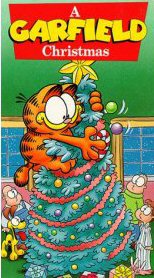
The Christmas Special Day 18: A Garfield Christmas Special (1987)
 Directors: Phil Roman & George Singer
Writer: Jim Davis
Cast: Lorenzo Music, Thom Huge, Gregg Berger, Pat Carroll, Pat Harrington Jr., David Lander, Julie Payne
Plot: Garfield the Cat (Lorenzo Music) wakes up on Christmas morning to find his owner Jon (Thom Huge) has arranged an incredible gift – a chair that will read his mind and produce any gift he can imagine. Garfield produces dozens of presents before he realizes it’s all a dream. Jon wakes him up in the real world, on Christmas Eve, planning to pack up and go to his parents’ farm for Christmas. On the farm Jon, Garfield and Odie (Gregg Berger) get caught up in the preparations, while his mom (Julie Payne) and Grandma (Pat Carroll) clash in the kitchen. After dinner, Jon’s father (Pat Harrington Jr.) can’t get the star on top of the tree, and Garfield is sent in to do the job. After a few heart-rending moments, he pops out of the branches, places the star, and falls back down, taking the half of the decorations with him. Despite the chaos, when Dad plugs the tree in, it’s perfect. Jon’s parents have his brother Doc Boy (David Lander) sit down at the piano to lead a singalong, but Grandma quickly takes over. After, as she relaxes with Garfield in her lap, she relates how her late husband always made Christmas magical for her and the kids.
After Dad’s rousing recitation of Binky: The Clown Who Saved Christmas, the family goes to bed. Garfield watches Odie sneak off to the barn, where the dog struggles to put together some bizarre contraption. Garfield helps without Odie’s knowledge, then stumbles onto a bundle of old letters. Inside, Jon and Doc Boy try to rouse their parents to open presents – at 1:30 a.m. Dad forces them to go back to bed until morning – real morning – when Garfield presents Grandma with the letters he found. She’s stunned to realize Garfield found the love letters her husband sent her years ago, letters she thought were lost forever. Odie then pops in with his own gift – the contraption from the barn, a backscratcher for Garfield. Touched, Garfield comments on the true meaning of Christmas… love… before he tells us all to get out.
Thoughts: It’s easy to forget, considering how bland it’s grown in recent years, but Garfield actually used to be pretty funny. Both the comic strip and the 80s/90s cartoon had some really good years, and this 1987 special is one of the earlier efforts with the newspaper star.
Garfield’s cynicism is a trademark of the character, of course, but for a children’s Christmas special in 1987 to open up with a main character proclaiming the virtues of greed and avarice was a rather surprising way to kick things off. His complete lack of excitement and enthusiasm is what makes the character so funny, in fact. While Jon bubbles over with excitement about Christmas, Garfield bemoans days of work, chores, “electrical contracting,” and other such activities that draw him away from his cozy bed. Looking back as an adult, it’s a lot easier to sympathize with Garfield than Jon’s family. Even if you forget everything else that goes along with Christmas, life on a farm… it’s not easy.
Grandma Arbuckle (who made a return appearance, triumphantly, in Garfield’s Thanksgiving special a few years later) is another comedic gem, throwing out such bizarre observations as “in my day all we had were wood-burning cats.” That sort of weird, surreal comment is just the thing to elevate this beyond being just a wacky kids’ show and into something with a little bit of an absurdist quality that adults can enjoy too. As the show progresses, though, we start to get the sense that her lunacy is a bit of a front, a shield she puts up to hide a bit of loneliness that’s come upon her in her age.
Lorenzo Music was truly fantastic in the Garfield role, bringing in a amusing, dry quality that sells every line. Even Frank Welker, who does the character in the modern version of the cartoon, doesn’t really hold a candle to Music, who passed away in 2001. Pat Carroll’s Grandma is another great find, straddling the line between sweet little old lady and aging hellfire. Fans who like to play “who’s that voice?” get a nice puzzle as well – Jon’s brother Doc Boy is voiced by David Lander, alias Squiggy of Laverne and Shirley fame.
The story of this special is pretty loose. Although I don’t think most of it is based on any specific comic strips, it definitely has the feel of being plucked from assorted holiday-themed strips that don’t necessarily have anything to do with one another, then stitched together into something resembling a plot. The later Peanuts specials have often been fraught with this problem, but this is one of the few times Garfield fell victim to it.
With the loose feeling, the special doesn’t really latch on to the real Christmas spirit until the end. Suitably, the cartoon maintains Garfield’s rather pessimistic air until the moment Garfield realizes Odie is trying to make him a gift. After that, it quickly swings into the realm of the sweet – Garfield helps Odie and improbably finds the one thing that would mean more to Grandma than anything else. It’s quite a coincidence, but it’s not hard to accept in a cartoon of this sort.
This is one of my favorite of the various Garfield specials, and it set things up very nicely for his weekly cartoon series the next year. That one became a staple for me for many years, and even now, I’d rather watch some of those old episodes than most other cartoons on the air today. The modern Garfield Show doesn’t really hold a candle to the old one (despite having much of the same cast and writing staff), but I still like to go to this one every Christmas season.
The Christmas Special Day 17: A Claymation Christmas Celebration (1987)
 Director: Will Vinton
Writer: Ralph Liddle
Cast: Tim Conner, Johnny Counterfit, Greg Black, Ron Tinsley, Patric Miller (Musical Director)
Plot: Unlike most of the Christmas specials we’ve covered this month, A Claymation Christmas Celebration doesn’t exactly have a “plot.” This film instead features a pair of dinosaurs named Herb (Tim Conner) and Rex (Johnny Counterfit) as they host a revue of classic Christmas songs starring Will Vinton’s animated characters, including the California Raisins. In London, Herb and Rex try to give us some background into the first song, but are interrupted as a set of dogs come by singing “Here We Come A-Waffleing.” As Rex tries to correct them, he realizes he has no idea what “Wassailing” actually is, and sends us into “We Three Kings.” Herb then tells us that bell-ringing ceremonies have their roots in attempts to ward off evil, which takes us into “Carol of the Bells.” As the dinosaurs go into their next, a group of geese begin to sing “Here We Come A-Waddling,” Rex throws us to “O Christmas Tree.” When we return, the dinosaurs are looking up “Wassail,” tossing us into an ice ballet for “Angels We Have Heard on High.” A cart of hungry, hedonistic pigs gives their version of “Here We Come A-Wallowing,” tempting Herb away as Rex tries to introduce “Joy to the World.” The various wassailers begin arguing as the dinosaurs send us to the real stars of the special, the California Raisins performing “Rudolph the Red-Nosed Reindeer.” Finally, a load of cider-guzzling elves arrive and explain the meaning of “Wassailing” – going around the neighborhood, singing carols, and sharing treats and drinks. The dinosaurs and the rest of the cast join in to sing the proper version of the song, dovetailing into “We Wish You a Merry Christmas” as they all say farewell.
Thoughts: This special is such a product of its time. In the 80s, the California Raisins turned up for a series of ads, were rock stars for a while, provided parents with the cheapest Halloween costume imaginable, and then faded from the public consciousness. It’s a shame too, because I really do love Will Vinton’s work. This special shows off his considerable talents as an animator, not just with the clay figures of the Raisins and other characters, but on other forms of animation as well. During “We Three Kings,” for example, as the Magi sing, we drift into different styles of animation that look like oil paintings. Later, in “Joy to the World,” the style mimics the look of stained glass, while still having a very lively, evocative feel to it. It’s the most unique visual in the entire special, and a wonderful showcase of the potential inherent in this kind of animation.
“O Christmas Tree” is another display piece for Vinton’s skill, beginning in a simple setting with a pair of children decorating their tree. The camera zooms in on an ornament on their tree, taking us to a scene in a candyland, then repeats the process. We go through Santa’s workshop, then into Santa and Mrs. Claus’s own home. Each scene has a similar composition, but a distinctly unique decorating style that shows off the different sorts of stories Claymation can be used to depict.
Vinton also has real skill at comedic animation. In “Carol of the Bells,” we see several different bells (each with distinct faces that reveal a lot of personality) engage in a head-bonging chorus that would have made Jim Henson himself proud. The scene also has a good punchline, delivering the final note in a Chuck Jones fashion. The ice ballet has a bit of Disney’s Fantasia and a bit of Disney’s Donald Duck (the cartoon where he engages in an ice battle with his nephews comes distinctly to mind). Vinton is a smart writer as well, dropping in nice little literary Easter Eggs like making Quasimodo the director of the Bell Choir.
The music is also phenomenal in this special. This is one of my all-time favorite renditions of “We Three Kings,” in which the Magi sing a quiet, respectful, traditional version, which then spins into a peppy, jazzy chorus provided by the camels. “Joy to the World” has a sort of bluesy feel, while the California Raisins cover of “Rudolph” is right up there with Burl Ives as one of the best versions of the song.
Sadly, Vinton’s studio has been gone for some time now, and with CGI ruling the animation roost there aren’t too many people left doing this sort of thing. Even the final few stalwarts of stop-motion – Aardman, Henry Selick, Tim Burton – don’t do the sort of wild, experimental stuff Vinton tried to bring to the table. We don’t see the likes of this anymore, and that’s a real shame. As of this writing, the DVD (which also includes Vinton’s Halloween and Easter specials) is still available from Amazon. It’s definitely worth getting.
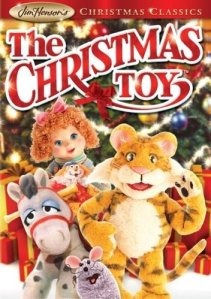
The Christmas Special Day 16: The Christmas Toy (1986)
 Director: Eric Till
Writer: Laura Phillips
Cast: Dave Goelz, Steve Whitmire, Kathryn Mullen, Jerry Nelson, Richard Hunt, Camille Bonora, Brian Henson, Marsha Moreau, Zachary Bennett, Jim Henson
Plot: Rugby the Tiger (Dave Goelz) and the rest of the toys in Jesse and Jamie’s playroom (Zachary Bennett and Marsha Moreau, respectively) have an active existence, coming to life and playing whenever their children leave the room. They have to be careful to be in the same spot where the humans left them, though, for if they’re found out of place, they’re frozen forever. When the toys learn it’s Christmas Eve, Rugby is astonished. He remembers last Christmas, when Jamie found him in his brilliant box beneath the tree and he became the center of her world… he never imagined it would happen again. The old teddy bear Balthazar (Jerry Nelson) tells the toys to be ready to welcome the new toys into their midst, pointing out how the doll named Apple (Kathryn Mullen) was upset when Rugby stole her spotlight the year before. As Bathlazar tries to talk to Rugby about what’s about to happen, the catnip mouse named Mew (Steve Whitmire) tells them Rugby has left the playroom to get back under the Christmas Tree, where he believes he belongs. A clown doll named Ditz (Goelz again) steps out of the room to call Rugby back, but he’s found by the children’s mother, who tosses him back into the playroom. Ditz is now “frozen” – unable to move, unable to speak… essentially dead. The rest of the toys sadly bring him to a sort of graveyard in the closet for other frozen toys. As the rest of the toys grieve, Mew sneaks out alone to try to save Rugby.
Mew finds Rugby trapped in the linen closet, locked in after he got mixed up with some clothes. When he tells Mew how spectacular Christmas is (for Rugby, that is), Mew decides to help him back under the tree, showing him the real cat’s trick for opening the door. Back in the playroom Apple assembles a rescue party to go after Rugby and Mew. Rugby makes it to the Christmas tree, where a lovely box for Jamie is waiting to be opened. Mew gets the ribbon off just as Apple and the others find them. She implores him to leave the box alone, but Rugby ignores her. When he opens the box, instead of it being empty, he finds a new doll, a beautiful warrior woman who proclaims herself to be “Meteora, queen of the asteroids (Camille Bonora)!” Meteora rushes off and Rugby tries to seal himself inside her box, but Apple re-tells him the story of last Christmas from her own perspective, when Rugby took her place as Jamie’s favorite toy. As Rugby finally realizes the truth, he still tries to get in the box, and Apple and Mew remind him that he’ll be frozen if the humans find him. Meteora knocks over a chess set, and the noise summons Jamie and Jesse’s father. Before he sees the toys, Mew lets out a very convincing “meow.” Believing it’s just the cat, father goes back to bed. The other toys convince Meteora to return to her box by singing her praises and telling her how she’ll be recognized as a star come Christmas morning. Once she’s wrapped again, they head back towards the playroom. Just as most of them make it back, though, Mew slips from Rugby’s tail and is caught in the hall as the children’s mother opens the door. Rugby rushes to try to save him, but he gets trapped in the linen closet again when mother finds Mew and takes him downstairs to the cat. Heartbroken, Rugby retrieves his friend’s frozen body and tearfully sings him a song to tell him he loves him. Miraculously, Mew begins twitching, and wakes up. In the playroom, the rest of the toys take up the song as the frozen toys in the closet pick themselves up and stumble back to life. The next morning, Jamie and Jesse bring their new toys to the playroom (while the cat, Luigi, drops off a new mouse), and the rest of the toys welcome them. Rugby feels a moment of sorrow while Jamie tells Meteora she loves her, but spirits are lifted all around as she says the same to Apple, and to Rugby himself.
Thoughts: Once more to the Jim Henson company, friends, and to one of my favorite lesser-known Henson productions. The Christmas Toy, from 1986, was one of these specials that led into a (sadly short-lived) TV series, The Secret Life of Toys, about toys that come to life and play whenever their humans leave the room. Nine years later, of course, Pixar Animation would take the basic plot of this special and turn it into a billion-dollar franchise for Disney. And I’m not just talking about the “toys coming to life” part – let’s be fair here, everyone who has ever been a child has imagined that their toys come to life and have adventures of their own when they aren’t around. Of course, there’s also the notion of the comfortable favorite toy suddenly having his prominence threatened by the introduction of a cool new space toy… who doesn’t realize she IS a toy and thinks she’s really in… outer… space… Okay, look, I love Pixar as much as anybody, but if Jim Henson’s ghost had started haunting the crap out of their studio after the first Toy Story came out, he would have been entirely within his rights.
I remember watching this special as a child (I would have been nine the year it came out, so it’s likely I was part of the audience for the premiere) and loving it immediately, even wearing out a VHS copy taped from ABC. Looking back at it as an adult, it’s impressive to me how dark Henson and company were willing to get with these characters. Rugby, at the beginning of the special, is terribly arrogant and unlikable. When he starts singing that he was “the greatest Christmas toy of all,” you kind of hope he does get frozen.
Then there’s the “frozen” concept itself – for a small child, this could be terrifying. Think about it here… you’re little, you’re just starting to gain a comprehension about what death actually is and what it actually means… and then you watch a Muppet special where the lovable mouse drops dead because somebody looks at it. I don’t actually remember the spin-off TV show very well, but I’m pretty sure they dropped this particular aspect when it went to series, and that’s probably a good thing. It definitely adds a note of suspense and danger to the story, but it may have been too difficult to deal with on a weekly basis. (If you really want to be a stickler for continuity, you can probably argue that whatever Rugby did to bring Mew back at the end of this special broke that spell forever, but if you’re thinking that hard about it you’re probably thinking too much about this. Yes, I am speaking from experience.)
Like any good Christmas special, of course, the unlikable character finds redemption in the end. And like any good Jim Henson production, that redemption comes with the help of his friends. The relationship between Rugby and Mew is wonderfully constructed. They’re not buddy-buddy like Kermit and Fozzie or Bert and Ernie. Instead, at the beginning, Mew hangs out with Rugby mainly because all of the toys reject him (he’s “just a cat toy”), but Rugby gives him slightly more attention than the others. It’s not even good attention – Rugby mocks and degrades him more than anyone, but Mew latches on to him anyway. When Mew saves him, twice, we see Rugby’s attitude shift, becoming more accepting not only of Mew, but of Meteora as well. And all of it is part of his true education – the growing knowledge that he isn’t the center of the universe after all, but merely an important part of it for one child. Once again, Henson is teaching children a lesson: “It ain’t all about you, kid.”
The music is okay here, but the final number is fantastic. “Together at Christmas,” Rugby’s song to Mew, briefly became something of a Henson anthem, and we in fact will hear it once more a few days from now, when we pay our fourth and final visit to the Henson workshop, and look in on his most famous creations.
Speaking of those creations, like Emmet Otter’s Jug-Band Christmas, this film sadly isn’t available uncut. Both Emmet and the Toys are still owned by the Jim Henson Company, but a few years back they sold the Muppet Show characters to Disney, which means they had to trim the introduction for both of these films, starring Kermit the Frog, to put on DVD. (Sesame Workshop got special permission from Disney to use Kermit in some of the DVDs of their older shows. I don’t know if Henson even asked…) The special is lovely in its own right, but the beginning is terribly abrupt, you feel like you’ve turned it on after it already began, and that’s why. The DVD itself is horribly barebones, not even taking you to a menu before starting the film. If they ever decide to dress this up and do a better home video release, I hope they come to some sort of agreement to give us Kermit’s welcome back again.
The Christmas Special Day 15: The Life and Adventures of Santa Claus (1985)
 Director: Jules Bass, Arthur Rankin Jr.
Writer: Jules Bass, based on the novel by L. Frank Baum
Cast: Earl Hammond, Earle Hyman, Larry Kenney, Lynne Lipton, Bob McFadden, Lesley Miller, Peter Newman, Joey Grasso, J.D. Roth, Alfred Drake
Plot: In the forest of Burzee, the Great Ak (Alfred Drake) summons a council of the immortals. As dozens of fairies, nooks, and other fantastic creatures come together, the Great Ak tells them the mortal named Santa Claus is about to be visited by the Spirit of Death. This mortal, Ak says, has earned possession of the world’s one and only Mantle of Immortality. To convince them, the Great Ak tells them his story, the tale of the life and adventures of Santa Claus.
Sixty years prior, the Great Ak found a mortal baby abandoned in the snow. He gives the child to a lioness to rear, but the fairy Necile (Lesley Miller) is curious about what a “child” is. She observes the lioness and decides she wants to care for the baby herself. She begs the Great Ak permission, which he grants, assigning the lioness to remain with the baby as its protector. Necile names the baby Claus, “little one” in her language. Claus doesn’t remain little for long, though. In the view of the immortals, he begins to grow up in the blink of an eye, and young Claus (voiced by J.D. Roth) begins his education in the ways of the forest. Ak decides Claus should see his own people, and takes him on a magical tour of the world of Man, where Claus sees terrible misery, violence, and suffering. He also begins to understand that he is mortal, unlike Necile and his friends, and one day he will die and become just a memory to his loved ones. Claus decides to live in the world of mortals, hoping to make it better, and he takes his lioness protector and teacher Tingler (Bob McFadden) with him. As he grows older, he begins to visit the nearby settlements of mankind, taking particular care in being a friend to the children. (His voice also changes, just like real life! Adult Claus is voiced by Earl Hammond.)
One winter night, as Claus carves a cat out of wood, he finds a child outside his home, nearly frozen. He brings the boy inside to warm up, and the child quickly takes a liking to Claus’s cat, Blinky. As the child sleeps, he finishes carving the cat, paints it, and gives it to the boy when he wakes up. When the other children in town learn of the wooden cat, they all want one of their own. He starts making cats, then other animals and dolls for the children… he has invented the toy. He brings his friends the Nooks to his home to help make toys in bulk, but soon receives a threat from a beast called King Awgwa (Earle Hyman), lord of the dark creatures who convince children to misbehave. King Awgwa abducts Claus, but the immortals easily rescue him. The Awgwa realize they cannot capture him easily, but they can prevent him from delivering his toys. They attack him the next day as he travels, stealing all the toys he’s made and taking them to their caves. The attacks continue, over and over. Finally, the Great Ak, Master Woodsman of the World, takes out his Silver Axe and leads the fairies and nooks into battle with the Awgwa and a mighty dragon. The Great Ak and his forces defeat the Awgwa, and Claus is free to deliver toys again. His sled is now so heavy with toys he can’t pull it, and his friend Peter Nook (Peter Newman) offers to allow Claus to use some of his reindeer to pull the sleigh, provided he can return them to their forest home by daybreak. The reindeer are impossibly fast, eventually finding the ability to fly through the air. Claus begins making regular trips to deliver toys, and is soon beloved by children everywhere, who call him “Santa Claus.” He returns home too late, though, and Peter is angry. Claus asks him to allow him to use the reindeer again, and Peter finally agrees, but only for one night a year… Christmas Eve. With just ten days, Claus won’t have enough toys to make the trip and will have to skip an entire year, unless he can find the toys stolen by the Awgwa. He goes to bed on Christmas Eve, convinced he’ll lose a year, but Peter Nook arrives with the reindeer and the sleigh full of recovered toys.
Years later, Santa Claus has won the love of all the world, and now stands on the brink of death. He decorates a tree with small toys as a symbol of his good work, and Tingler vows to decorate the tree every year. In the forest of Burzee, the Great Ak petitions the rest of the immortals to give Claus the Mantle of Immortality. In all the world there is only one, and can only be given to one mortal. Touched by his story, the immortals agree to present it to Claus. Just before he dies, Necile delivers the golden shroud to her son. Revitalized, he thanks Ak, pledging to prove himself worthy of the mantle for all time to come.
Thoughts: It had to happen sooner or later, my friends. This, I’m sorry to say, is the last Rankin and Bass special in our Reel to Reel countdown. It’s not one of the best-known specials either, but it’s one of my favorites. Based on the novel by The Wizard of Oz creator L. Frank Baum, this is a version of Santa Claus’s origin that doesn’t quite jive with any of the others we’ve seen, doesn’t fit in with the rest of the Rankin and Bass “universe,” but stands on its own as a lovely fairy tale version of this holiday icon’s story.
The Baum touch is one of my favorite things about this special, I admit. I am an unabashed fan of all things Oz and I love to see different takes on the Oz mythos. While Baum never directly linked this book to his Oz novels, there are enough of his magical creatures common to the different books for me to accept this as a part of the Oz Universe. Which I know is something only a nerd of my particular stripe cares about, but as I can say that for roughly 87 percent of the observations I’ve made this month, I feel perfectly justified in doing so again.
Children may find parts of this special a bit odd. Although it was made in 1985, it’s a faithful adaptation of a novel written in 1902, before many of the elements now considered part of Santa Claus lore became standard. He’s still a plump, jolly man who enters through the chimney, who rides in a sleigh pulled by reindeer. But kids will ask why his toy shop is in the Laughing Valley instead of the North Pole, why his toys are made by nooks instead of elves. My nerd response will be to tell them this is the Santa Claus of Earth-2. Of course, then you’ll have to explain that, so maybe you’d better just find a way to explain it that suits your own children.
Most of the Rankin and Bass specials are more or less timeless. If there’s anything that links them to their era it is a tendency to model their narrators after the stars who voice them (Fred Astaire in Santa Claus is Comin’ to Town and Andy Griffith in Frosty’s Winter Wonderland being prime examples). This one is a little different, with the nook (or fairy or gnome – I’m not sure) named Tingler being clearly inspired by Chico Marx, of call people. Which would have made a lot more sense in an early Rankin and Bass special – this was made in 1985. It’s an odd choice, one that most kids watching this won’t even notice, but older viewers will see it quickly.
This special doesn’t have as much music as most Rankin and Bass specials either. The “Big Surprise” number the children sing to Claus is the centerpiece, coming almost exactly halfway through the film and helping Claus realize exactly what his mission will be. It works pretty well as far as providing the character with motivation, but it isn’t as great a musical number as we’d like from Rankin and Bass. The special also isn’t as funny as we’ve come to expect from Rankin and Bass. Except for the Biblical specials, most of their cartoons at least had an element of comedy to them. This has almost nothing. Claus is motivated by seeing true darkness in the world, and although the battle sequences aren’t gory or bloody, they’re fairly intense for a film of this nature. The violence is real, not played in a cartoonish nature.
These elements are all perfectly good, though. This isn’t another cookie-cutter Santa movie like so many of them are. (To fully understand what I’m talking about, just turn it on the Hallmark Channel or Lifetime whenever you’re reading this. If it’s still December, there’s a 90 percent chance they’re showing a Christmas movie starring washed-up stars that is virtually indistinguishable from all of the other Christmas movies starring washed-up stars they show this time of year.) If you’re looking for something a little different – something that still has the charm and joy that comes with the names of Rankin and Bass but that is totally unique from every other version of the Santa Claus myth you’ve seen this year, this is the special for you.
NOTE: This story was remade as a traditionally animated direct-to-video movie in 2000 starring Robby Benson of Disney’s Beauty and the Beast. Don’t get the two confused. While the Benson version is… okay… the Rankin and Bass version is great.
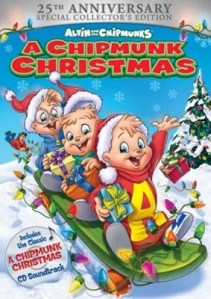
The Christmas Special Day 14: A Chipmunk Christmas (1981)
 Director: Phil Monroe
Writers: Janice Karman, Ross Bagdasarian Jr., Hal Mason
Cast: Ross Bagdasarian Jr., Janice Karman, June Foray, Frank Welker, Charles Berendt, R.J. Williams
Plot: Five days before Christmas, the Chipmunks rouse David Seville (Ross Bagdasarian Jr., taking over the roles of Dave, Alvin and Simon from his late father, with Janice Karman playing Theodore) from a sound sleep and start to rush him out the door. As the boys go to the stores, Alvin overhears a little girl admiring a golden harmonica like Alvin’s, wishing she could get it for her sick brother Tommy (R.J. Williams). Tommy’s mother, however, seems skeptical Tommy will live to see the holiday. As the Chipmunks head into the recording studio, Alvin’s spirit has been diminished, and he heads out on an unscheduled break just minutes after recording begins. He finds Tommy at home and visits the sick boy, giving him with his harmonica and telling him he won it in a contest. Alvin rushes back to the studio and joins in the singing, his spirits restored. The Chipmunks are later booked to do a Christmas Eve concert at Carnegie Hall – a huge break – but they want Alvin to do a harmonica solo. Alvin can’t tell Dave (who gave him the harmonica) he gave it up, so he and his brothers try to buy a new one. He dresses up as Santa and charges kids for a picture, which Dave breaks up, admonishing his sons for trying to use Christmas to make money. When his brothers bumble out that Alvin needs money to buy something for himself, a disappointed Dave sends him to his room. That night, Alvin dreams of visiting mad inventor Clyde Crashcup (Charles Berendt), asking him for a loan, but the addle-brained Crashcup proves little help. Dave’s disappointment only grows when he walks past the dreaming Alvin, hearing the boy cry out for money in his sleep.
With two hours to go before the Christmas Eve concert, Alvin sets out to try to buy a new harmonica. While he’s gone Dave gets a phone call from Tommy’s mother, telling him the harmonica did wonders for the sick child. At the mall, Alvin stares at the harmonica he still can’t afford, when a kind old lady (June Foray) comes from nowhere and buys it for him. To thank her, he begins playing “Silent Night,” and a crowd forms to listen, including Dave, Simon and Theodore. Dave apologizes for misjudging Alvin, and the Sevilles head to Carnegie Hall for the concert. As he finishes his harmonica solo, Alvin runs into Tommy, out of bed and well. Alvin pulls him on stage to play an encore with the Chipmunks. Their song even reaches Santa Claus (Frank Welker), passing overhead on his rounds. He returns home to Mrs. Claus, telling her she should get out on Christmas some time and see what it’s like. As he drifts to sleep Mrs. Claus – a familiar, kindly old woman – looks at the audience and hushes us… why tell Santa, after all?
Thoughts: The Chipmunks, those animated anthropomorphs who rocketed to novelty album fame with “The Chipmunk Song,” had been off TV screens for some time in 1981. Although I didn’t know it at the time, this special was the start of a comeback, leading into a new Saturday morning cartoon that would be the version of the Chipmunks throughout my formative years. And it’s fitting, as their first hit was a Christmas song, that Christmas would factor into their comeback as well.
This special was something of an all-star piece, with the already-great June Foray stepping in as Mrs. Claus and the soon-to-be great Frank Welker as her husband. Even better, Chuck Jones pitched in on animation and character design for the special, and having watched it so relatively soon after How the Grinch Stole Christmas, it’s not hard to see some of his trademark gestures and designs, even if the flow of the animation isn’t really his. Some of the visual gags are distinctly Jonesian, though, such as Alvin as a miniature Santa being hoisted and lowered onto kids’ laps via a pulley… there’s a Wile E. Coyote flavor to it. (There’s also a great nod to Jones and Foray’s previous Christmas collaboration, as Alvin encounters a little girl named Cindy Lou.) The Clyde Crashcup sequence is a double whammy, bringing back a great (and mostly forgotten) cartoon star of the past, as well as presenting a sequence of confusion and misunderstanding that echoes a Dr. Seuss poem – or even one of Jones’s few feature films, the great The Phantom Tollbooth.
Although the Chipmunks would return during the run of their TV show with takes on A Christmas Carol and It’s a Wonderful Life, this special was all-new, and a really refreshing change. So many Christmas specials hinge on a character lacking Christmas spirit and finding it at the last minute. This time we see Alvin – often presented as the self-centered one in the group – show true Christmas spirit at the very beginning, and still winding up in a jam. The arc of the story is utterly unlike any other Christmas film I’m aware of. There’s not even really a lesson to be learned – Alvin knows and does the right thing right away, without having to go through trials or face the intervention of some wise mentor. If there’s anything he does wrong it’s not confessing to Dave that he gave up the harmonica, and given the circumstances, I think most people would have done the same thing. It’s a really refreshing change of pace, and makes for a unique special, unlike any of the others we’ve watched so far.
I have to confess, friends, I think the Chipmunks have hit something of a low point. I’m not at all a fan of the current movie series, where I think some of the silly charm of the original has been traded in for gross-out humor and tendrils of raunch that just don’t fit the spirit of Ross Bagdasarian’s characters. But that doesn’t mean I don’t still love Alvin and the boys, and especially at Christmas, I like looking back at these old cartoons and remembering when they were… y’know… good.
The Christmas Special Day 13: Christmas Eve on Sesame Street (1978)
 Director: Jon Stone
Writer: Jon Stone, Joseph A. Bailey
Cast: Caroll Spinney, Jim Henson, Frank Oz, Jerry Nelson, Richard Hunt, Linda Bove, Northern Calloway, Debbie Chen, Will Lee, Loretta Long, Sonia Manzano, Bob McGrath, Roscoe Orman, Alaina Reed
Plot: On Christmas Eve the gang on Sesame Street takes a trip to the local ice skating rink. While everyone else is having a good time, Oscar the Grouch (Carroll Spinney) decides to poke fun at the naive Big Bird (Spinney again), asking him how Santa Claus can possibly fit through the tiny chimneys the buildings on Sesame Street have. Dismayed at the thought that Santa may not be able to get in, Big Bird and his friend Patty (Debbie Chen) set out to solve the mystery. They turn to Kermit the Frog (Jim Henson, and if you didn’t know that stop reading my article right now, you heathen), who suggests turning to the Santa Claus experts – the children – to find the answer.
Meanwhile, Bert (Frank Oz) is stuck for a Christmas present for his best friend Ernie (Henson again, I mean it, stop reading if you didn’t know that already because I don’t want you here). When he comes across Ernie’s Rubber Duckie, he gets an idea. Ernie, facing a similar dilemma, stumbles across one of Bert’s prize paperclips and decides to get him a cigar box to keep his paperclip collection safe. Going to Mr. Hooper’s store, Ernie finds he doesn’t have enough money for the box, and offers Mr. Hooper (Will Lee) his Rubber Duckie as a trade. As Ernie leaves, Bert enters with a similar offer: he wants to trade his paperclip collection for a soap dish where Ernie can keep Rubber Duckie. Mr. Hooper takes both deals, even though Bert and Ernie are both clearly distraught over surrendering their prized possessions.
When Kermit’s investigation proves fruitless, Big Bird and Patty recruit Mr. Snuffleupagus (Jerry Nelson) to try to test out a method for squeezing into a chimney. Snuffy, unfortunately, gets stuck. Outside, as Bob (Bob McGrath) and Mr. Hooper exchange holiday pleasantries, Oscar groans and launches into his own seasonal anthem: “I Hate Christmas.”
Bert and Ernie exchange gifts, and both are stunned to realize they’ve been given a gift intended specifically to compliment the very item they have sacrificed. Neither wants to confess to the other that his gift is now useless, and before either of them have to, there’s a knock at the door. Mr. Hooper is there with gifts for the boys – Ernie’s Rubber Duckie and Bert’s paperclips. Bert and Ernie are overjoyed at having their treasures back, but sadly say they haven’t a gift to give Mr. Hooper. The kind old man smiles and tells them they’ve already given him the best gift ever: the chance to see everyone get what they want for Christmas.
When the snow begins to fall that evening, Big Bird sends Patty home. As she leaves she tells him not to worry, she’s certain Santa will come, even if they don’t know how he’ll do it. Left alone, Big Bird decides to go to the roof and wait for him. Patty later turns up at Gordon and Susan’s apartment (Roscoe Orman and Loretta Long, respectively) to tell them she went back to Big Bird’s nest and he’s gone. Everyone on Sesame Street begins searching for him, while on the roof Big Bird watches them, wondering what all the fuss is about. With the temperature dropping and everyone worrying Maria (Sonia Manzano) confronts Oscar over upsetting Big Bird in the first place. Guilty, Oscar sets out to find him. On the roof, away from his safe, warm nest, Big Bird falls asleep, unaware of the figure that has joined him there. When he wakes up he sees nothing, not even footprints, and decides to go downstairs and warm up. He meets Gordon and Patty on the stairs, and Gordon refuses to let him go back outside. In Gordon and Susan’s apartment, he finds a beautiful Christmas tree and stockings loaded with presents for everyone – Santa must have passed while he slept. Gordon explains to Big Bird that it isn’t important to explain a miracle; the important thing is that they’re all together again. Oscar turns up and tells Big Bird he’s glad he’s back… but the Grouch can’t resist one last dig. “How do you think the Easter Bunny can hide all those eggs in one night?”
Thoughts: Jim Henson and company return, although this time he’s joined by some of the other great “J”s of his era – Jon Stone, the writer responsible for so many of the greatest Sesame Street moments of your youth; Jerry Nelson, who gave us the Count and Mr. Snuffleupagus (a word which, somehow, is not in my spellcheck); producer Joan Ganz Cooney, the woman who conceived of using entertaining television to educate children in what would become the Sesame Street style. Henson and his Muppets were integral to the success of this show, but he sure didn’t do it alone. Regardless, as fantastic as each of those creators are, the true magic of Christmas Eve on Sesame Street isn’t brought to you by the letter J, but rather by C and S: Carroll Spinney, the Muppeteer responsible for both Big Bird and Oscar the Grouch.
Unlike the regular daily episodes of the show, this prime time special didn’t have any of the cutaway educational segments, didn’t include lessons on counting or spelling… instead, the Children’s Television Workshop used the opportunity to teach a moral lesson or three. And like they did in all their finest moments, they did so without preaching, presenting the lesson in a way that would be easy for children to accept, understand, and internalize.
The A-plot of this special belongs to Oscar and Big Bird in a way that shows off their relationship for what it is: an older sibling (Oscar) who enjoys picking on the younger (Big Bird), but still feels responsible and tries to set things right when confronted with the consequences of his actions. Anyone who has a brother or sister can probably relate – it’s crafted in a very realistic, natural and believable way. Spinney plays their relationship with Oscar’s edge and Big Bird’s unrelenting sweetness clashing at every turn, allowing the kids to worry along with Big Bird until the obvious conclusion is reached at the end. Spinney is a master performer, and I only wish I could have been there to watch him rushing back and forth between the two characters as the camera cut away. Dude must have been exhausted.
The story reveals a depth of character I don’t think is obvious when you’re a child watching these specials. It’s telling to me that only Maria, out of all the adults on Sesame Street, is able to convince Oscar to go out and look for Big Bird and fix what he did wrong. That’s not an accident – Maria and Oscar have a surprisingly complex relationship, in which Maria plays both mother and big sister to the Muppets. It’s one of the few moments in Sesame Street history where I remember seeing one of the human characters get genuinely, justifiably angry, and Sonia Manzano pulls it off wonderfully. Oscar comes across as the problem child who reacts to a stern but loving hand when gentleness fails. (I also maintain that Oscar – at least in my formative years of watching Sesame Street – was written to harbor a forever-unspoken crush on Maria, but that’s neither here nor there.)
The B-plot, featuring Bert, Ernie, and Mr. Hooper, is surprisingly only the second story in our countdown to play with the “Gift of the Magi,” although this is a much more straightforward retelling than Emmet Otter’s Jug-Band Christmas. Bert and Ernie fill the roles nicely, with writer Jon Stone playing on their legendary friendship and slightly childlike outlook to create a story where you can naturally accept them sacrificing for one another. Seeing Mr. Hooper step in to save the day is a lovely moment, and one that still touches the heart all these years after actor Will Lee’s death. (A rare non-Christmas tangent: if you’ve never seen the Sesame Street episode where Big Bird learns that Mr. Hooper has died, watch it on YouTube. And if it doesn’t make you cry, stop reading my blog forever and go back to your day job strangling baby owls and selling their feathers to stuff pillows for Neo-Nazis.) Although this story was once copied almost as often as A Christmas Carol, it’s fallen a bit by the wayside in recent years. That may be a good thing. A child seeing this special now wouldn’t necessarily see the ending coming, and the message of the piece will more likely remain intact.
One thing I didn’t mention much in my synopsis of the episode are the musical numbers peppered throughout. In truth, most of these do little (or nothing) to advance the plot, so they didn’t really belong there, but that doesn’t mean they aren’t memorable in and of themselves. Bob McGrath and Linda Bove (playing Bob and Linda, respectively) lead the children of the cast in the haunting “Keep Christmas With You (All Through the Year),” and the whole cast joins in for “True Blue Miracle,” another one of those songs that has transcended the special that birthed it and become something you may well hear on the radio or in a shopping mall. It’s nice to have some traditional music in there as well – Bert and Ernie’s duet of “Have Yourself a Merry Little Christmas” is lovely. Hardcore Muppet fans can probably hear just a bit of Frank and Jim’s friendship in the performance as well. And Oscar’s “I Hate Christmas” is just a joy whether you’re a true believer or an eternal humbug.
There are other moments that don’t actually contribute to either of the two main plots. Grover has a few scenes where he interviews children about Santa’s efforts to enter the chimney, similar to scenes in the regular episodes of the TV show. There’s a running gag about Cookie Monster trying to write a letter to Santa and eating his assorted writing implements as well. It’s a good bit, but there may be no moment of sheer comedy in the special as great as when he realizes the traditional Santa Claus exchange: when he leaves you a present, Gordon tells him, you should leave him a plate of cookies.
But as far as those moments that don’t go with the plot are concerned, the champion is the very first scene in the ice skating rink. As wonderful as the rest of the episode is, this opening scene is still bizarre, with ice skaters wearing full-size costumes of the Muppets skating on the ice. Seeing a six-foot Bert and Ernie or an adult-sized Count is just bizarre. And yes, I know they’ve been doing essentially the same thing with the Sesame Street Live shows for decades. I think it’s weird there, too.
This special won two Emmy awards, ironically beating out A Special Sesame Street Christmas, which aired in prime time on CBS. Both of these shows are now available on DVD, and a quick comparison makes it clear why Christmas Eve walked home with the awards. Out of the two, this special is far more special than Special.
The Christmas Special Day 12: Nestor, the Long-Eared Christmas Donkey (1977)
 Directors: Jules Bass & Arthur Rankin Jr.
Writer: Romeo Muller
Cast: Roger Miller, Brenda Vaccaro, Paul Frees, Don Messnick, Linda Gary, Iris Rainer, Shelly Hines, Eric Stern
Plot: As Santa and his reindeer fly out for their Christmas Eve rounds, Santa’s donkey Speiltoe (Roger Miller) prepares for his annual rest, after a long year of pulling work carts and plows. As he observes Santa’s nativity scene, he sadly tells us the donkey doesn’t at all resemble the original, his ancestor. Breaking into song, Speiltoe begins telling us the tale of Nestor, the long-eared Christmas donkey.
Many years ago, a young donkey named Nestor (Shelly Hines) is mocked and dismissed due to his enormously long ears. On the winter solstice, the animals in the barn celebrate with gifts and goodwill, even to Nestor, who is given a pair of stockings to cover his ears. The joyful evening is ruined when a Roman soldier comes into the barn to buy donkeys for the emperor. They snag all of the donkeys except Nestor’s mother (Linda Gary), but when Nestor’s ears are uncovered they throw him into the snow and make off with the donkeys without paying. His mother breaks free and rushes into the winter night, finding her son buried in a snowbank. She covers Nestor with her own body, and perishes in the storm.
Nestor survives the winter, and as spring comes he meets a cherub named Tilly (Brenda Vaccaro), who informs him that his ears will allow him to do wondrous things some day. He is skeptical, but agrees to join Tilly on her way to Bethlehem. Eventually, Tilly has to leave him and he’s taken in by a merchant. A couple named Joseph and Mary try to bargain for him, but when the merchant realizes Mary is great with child, he gives them the donkey for nothing. Nestor, who had been sad and bone-weary, suddenly finds the strength to carry the young woman. When a sandstorm strikes, Tilly’s words ring through Nestor’s memory, and he hears his mother’s voice telling him to follow the singing of angels in the sky. He wraps his ears around Mary and leads them through the sandstorm, coming finally to Bethlehem. He finds a manger for them, and Mary bears a child. Nestor leaves them in safety, finding his way back home, where his friends celebrate him and his magnificent ears.
Thoughts: It’s back to Rankin and Bass land again, friends, for another tale of Biblical times… kind of. It’s also a return to a Gene Autry song as the inspiration, he who gave us both Rudolph and Frosty, and Nestor is the sort of character that would fit in nicely with the other two and their jolly band of misfits… although his story goes to dark places the others didn’t dream of. The threats Rudolph and Frosty face are more of the comical sort – a giant, bumbling snowman, an inept magician. Nestor’s threats are the Roman legion and nature itself. It comes upon us quickly as well, taking a shift from joy to sorrow faster than a Joss Whedon movie. Even as I was typing this paragraph, while watching the special over again, I was halfway through a sentence when I remembered what was going to happen to Nestor’s mother, and it was only through sheer force of will I managed to avoid turning it into an incoherent rant against the legionnaires and the Roman emperor and Rankin and Bass and Godfather’s Pizza. Because I was upset.
The plot itself is an odd one, bringing together elements of the Nativity story and mingling it with a character who, in many ways, apes Rudolph’s story a little too closely. Once again, we see an outcast born with some sort of deformity, driven away from home, forced into a situation where the deformity becomes his greatest advantage, and finally celebrated as special rather than dismissed as a freak. It’s certainly a positive message, but it gets repetitive after a while. If not for the last bit, these two could be X-Men. The story plays fast and loose with the Bible, of course, but not in a way that seems wrong or exploitive. Pretty much every account depicts Mary being carried on a donkey, and expanding that donkey’s story is a perfectly acceptable storytelling avenue.
Of all the Rankin and Bass specials I’ve covered, this one is probably the weakest from a musical standpoint. Roger Miller makes for a fine narrator and his voice is perfectly suited for the songs that accompany the special. The problem is that none of the songs are particularly catchy or memorable. After Rudolph and Frosty’s respective specials, you’re left singing their anthems. Nestor, not so much. If anything, it makes me want to sift through my iPod to find “Dominic the Christmas Donkey,” which I’m realizing now I haven’t actually heard yet this Christmas season, and I’d better rectify that.
My favorite bit in the special, however, comes at the end, when Santa and his reindeer return to the North Pole and join Speiltoe in celebrating the legendary Nestor. Again, the song itself is no great shakes, but the Rankin and Bass guys fill the scene with their all-stars. In the Biblical flashback scene we see the Magi and several other characters from Little Drummer Boy. When we come back to the present we see Santa, Mrs. Claus, Jingle and Jangle from Year Without a Santa Claus, and even Rudolph himself (who makes a rare appearance outside of one of his own specials). Again, this is the nerd in me, but it reminds me of when every Marvel superhero turned up for Reed and Sue Richards’ wedding in Fantastic Four, when all of the Tenth Doctor’s companions showed up together in Doctor Who, when Urkel did that guest appearance on Full House. There are certain characters you know all belong in the same family, even though you don’t usually see them together, and there’s an inexplicable sort of satisfaction that comes when you finally get them all in the same place. This is by no means a bad special, but it probably tells you something that the most memorable part is when all of the characters whose names are not in the title get together at the end.
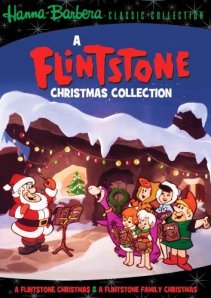
The Christmas Special Day 11: A Flintstones Christmas (1977)
 Director: Charles A. Nichols
Writers: Duane Poole & Dick Robbins
Cast: Henry Corden, Jean Vander Pyl, Mel Blanc, Gay Hartwig, Lucille Bills, Virginia Gregg, Hal Smith, John Stephenson
Plot: It’s Christmas Eve in Bedrock and the Flintstones and Rubbles are finishing up their preparations. Wilma (Jean Vander Pyl) and Betty (Gay Hartwig) try to persuade Fred (Henry Corden, taking over the role seamlessly from the late Alan Reed) to play Santa at the orphanage’s Christmas party that night, but Fred refuses and heads to work. When he arrives his boss, Mr. Slate (John Stephenson) informs him that his wife wants Fred to play Santa for the same party. This time, to protect his job, Fred agrees. At home, Fred and Barney (Mel Blanc) prepare for the party, but hear a thumping from the roof. They find Santa Claus (great voice actor Hal Smith, who played Santa in no less than five different cartoon series over the years) in the snow. Although Fred is skeptical at first, Barney finds the sleigh and reindeer, proving they’ve got the real Santa in the Flintstone house. Santa sprained his ankle on Fred’s roof, and Barney suggests Fred as a substitute while he heals. Santa gives them a dose of magic and sends them on their way.
Things go relatively smoothly for Fred and Barney’s first few deliveries, but some turbulence knocks the sack of presents out of the sleigh. Barney calls Santa on the sleigh’s CB radio (it was the 70s, people), and Santa tells them to go back to the North Pole for another load. As they wait for the sleigh to be reloaded, Fred and Barney take a tour of Santa’s high-tech operation and pitch in making some toys. They get back in the air and speed up their deliveries, realizing Fred is still scheduled to play Santa for the orphans. Back in Bedrock, the children are starting to get upset – almost as upset as Mr. Slate. Fortunately, Fred and Barney finally arrive, spilling in through the chimney with such a spectacular entrance Mr. Slate forgives their tardiness… until Fred realizes they’ve given out all the presents already. With a little of Santa’s Christmas magic, Fred produces more, and the children are overjoyed. As they open their gifts, the boys return home to send Santa on his way. Wilma and Betty return home, angry at their husbands for rushing out of the party, and Santa ducks out before they see him. Although the girls don’t believe Fred and Barney’s story about filling in for Santa, they forgive them and begin trading gifts. Fred is horrified to realize, in all the commotion, he didn’t get Wilma a present, but Santa saves the day one last time, slipping one down the chimney. Pebbles and Bamm-Bamm spot Santa flying away, and their fathers join them at the window, waving goodbye, while the girls just chuckle at the four kids looking up at the skies over Bedrock.
Thoughts: Like Fat Albert, this 1977 special takes characters from a popular cartoon show and gives them a Christmas adventure, although unlike Fat Albert, by 1977 the original run of The Flintstones had been over for several years. Fortunately, with animation, it’s easier to do a reunion special without worrying about actors getting older or passing away or refusing to reprise their role – in almost every case, a new voice artist is always a possibility. This special managed to get most of the original voices back, but one wonders if Mel Blanc felt a little confused that he was remaking a cartoon he’d done 13 years prior.
A Flintstones Christmas borrows much of its plot from the 1964 episode of the TV show, “Christmas Flintstone” (brilliantly clever with titles, these Hanna-Barbera folks), specifically the story of Fred filling in for Santa Claus after he injures himself. This special adds in more and different music and ages the children – Pebbles and Bamm-Bamm are elementary school age, whereas they were still babies in the original. They also trade out B-plots – in the original, Fred was working as a department store Santa for extra money, whereas here he’s dealing with Mr. Slate and playing Santa for orphans. The B-plot is used to give urgency to the A-plot as well, while in the original Fred was pretty much done with his gig when he stumbles into the real Santa and is called upon to fill in. Still, if one were to sit down for a marathon of the assorted Flintstones Christmas specials and episodes throughout the years (something a guy like me is honestly very likely to do), you’d be a bit shocked when you essentially saw the same show twice.
Having dealt with that particular elephant in the room (I’m going to ignore the one about characters celebrating Christmas before the birth of Christ), let’s talk about the story for what it is. The notion of Fred filling in for Santa is a wonderfully natural one – the heart of the character is that of a sort of good-natured lummox. For all the times throughout the years where Fred gets short-tempered or angry, at the core of the character is a deep, abiding love for his wife and friends, the sort of thing that lends itself perfectly to playing Santa. The actual mechanism for getting him into the suit was pretty clever for the time, although it seems that Disney picked at this cartoon when they made Tim Allen’s more morbid The Santa Clause.
Although there was music in the original version of this, this version has much more of it, almost making it into a full-blown musical as both Fred and Barney break into song about how much they love Christmas at assorted points in the show. While none of the music has broken out and become of particular note, it’s perfectly passable and a nice addition to the cartoon. The animation style is really indicative of the sort of thing we got from Hanna-Barbera, up to and including a nice little Rube Goldberg-style montage sequence in Santa’s workshop, where Fred and Barney spill out onto the conveyer belts and get temporarily caught up in the mechanisms of the toymaking machines. We saw this sort of thing a lot in the old Hanna-Barbera cartons, second only to the “hall of doors” chase scenes they did so often, particularly in Scooby Doo.
In terms of sheer volume, the good folks at Hanna-Barbera may have been second only to Rankin and Bass for producing great Christmas cartoons. However, there aren’t a lot of ‘em I could use for this project, as so many of them are feature film length, regular episodes of assorted TV shows or, saddest of all, not available on DVD. Maybe next year. But for now we’re not quite done with the Hanna-Barbera characters… not yet.
The Christmas Special Day 10: The Fat Albert Christmas Special (1977)

Note: Revelations about Bill Cosby himself have obviously tainted perceptions of much of his work, this special included. However, I have chosen to keep this article in its entirety as a sort of archival piece. Regardless of who Cosby himself turned out to be, I stand by my thoughts on the work itself as being valid.
Director: Hal Sutherland
Writer: Bill Danch & Jim Ryan
Cast: Bill Cosby, Jan Crawford, Gerald Edward, Eric Suter, Marshall Franklin, Eric Greene, Kim Hamiton, Julius Harris, Ty Henderson
Plot: Fat Albert (Bill Cosby, who did about 75 percent of the voices) and his gang are preparing for their Christmas pageant, when old “Tightwad” Tyrone – owner of the junkyard where they’ve built their clubhouse – shows up and declares he’s tearing down the clubhouse. While the gang tries to think of a way out of their predicament, they’re approached by a boy named Marshall (Marshall Franklin). His father is out of a job and their car broke down right outside. To make matters worse, his mother is about to have a baby. Fat Albert invites them in to warm up, and sends Bill to help Marshall’s father find a hospital. Fat Albert chases down Tyrone to try to convince him to leave the clubhouse alone, fearing it’ll be torn down with Mrs. Franklin inside. Tyrone agrees to leave the clubhouse standing if Fat Albert plays Santa Claus outside of his secondhand store to try to draw in customers. Bill and Mr. Franklin return, unable to get help at the local hospital without insurance. Mrs. Franklin stands up to go to the distant city charity hospital, but can’t go any farther. Bill and his brother, Russell, rush off to find help.
The rest of the gang finds Fat Albert outside Tyrone’s store and begin snatching his free samples, and an angry Tyrone fires Albert and promises to demolish the clubhouse. Old Mudfoot Brown arrives and snaps at Tyrone that he’s become a miserable old man since his wife died. Embarrassed, Tyrone asks how he can redeem himself, but Mudfoot simply tells him he wouldn’t know how to do a good deed. At the clubhouse, Marshall overhears his father say he’s afraid he can’t even afford to feed his first child, let alone the second, and Marshall decides to run away. When the gang returns with the promise of a doctor, they realize Marshall is missing and set out to look for him just as Mrs. Franklin begins to deliver. They find Marshall down at the docks, and the boy is trapped on an ice floe when he tries to flee. Fat Albert and the others manage to save him, but he slips away again. When they return to the clubhouse the baby has arrived. Mr. Franklin asks where Marshall is, but before Fat Albert can answer, Mr. Tyrone arrives – with Marshall. Hearing the Franklins’ story, he offers Mr. Franklin a job and says he can no longer tear down the clubhouse, since it’s a “landmark.” The gang and Tyrone give the Franklins a merry Christmas, and Tyrone looks to the sky to ask his wife how he’s doing now.
Thoughts: By 1977, we had reached the point where a Christmas episode of a popular cartoon wasn’t enough. We needed a full-blown Christmas special, and Bill Cosby and company delivered here. Although Tyrone definitely has a dash of Scrooge about him, the story isn’t just another Dickens rehash. If anything, the plot is more intent on echoing the nativity story, with a pregnant woman who has nowhere to go.
The plot is nicely layered, with the story of the Franklin family colliding with the Cosby Kids’ problem with Mr. Franklin. Not too many children’s cartoons today would have the wherewithal to take two entirely unrelated problems and intertwine them this way. The kids’ problem, furthermore, makes the Franklins’ dilemma even more dire. Sure, Mrs. Franklin is safe from the cold, but the viewer legitimately wonders if Mr. Tyrone will get over his anger long enough to realize there’s a pregnant woman inside the clubhouse, or if that would even matter to him before he demolishes it. Marshall has a pretty standard waif reaction to the situation – he’s causing a problem for his parents, so he decides to run away. Rather than one huge, overriding issue like a lot of these cartoons deal with, The Fat Albert Christmas Special deals with a lot of little things, and is the better for it.
Mr. Tyrone is an interesting villain. Like I said, he has elements of Scrooge, but not all of his actions make as much logical sense as Ebenezer’s. Evidently, the presence of a clubhouse somehow decreases the value of a junkyard. I know. I don’t get it either.
Like many of the half-hour Christmas specials, especially the ones that have a real villain, the climax seems to come a little too easily. It’s a bit more forgivable in this case, though… I’m not really sure where else they could have taken Mr. Tyrone’s story without dovetailing into a straight-up Dickens parody. As it is, Mudfoot plays the role of Jacob Marley and all three ghosts, delivering in 30 seconds the sort of realization that takes most films 90 minutes to do. I think it actually helps that we don’t see a traditional “moment of redemption” here. Tyrone’s change of heart happens largely off-camera, helping to drive in the idea that he isn’t really a bad man, just one who’s sad and angry, and who tries to make amends when he’s called on being sad and angry.
It’s hard to believe this cartoon is as old as I am. The story ages very well, the ideas are timeless and the backdrop is sadly relevant to modern times. Really, the only point that’s not completely current is the notion of kids playing in a clubhouse they made themselves, rather than sitting around with X-Box controllers. One can only hope, were the Franklins to break down today, they could still find a Fat Albert to bring them a little hope.
 Reel to Reel