Blog Archives
Showcase At the Movies Superhero Double Feature
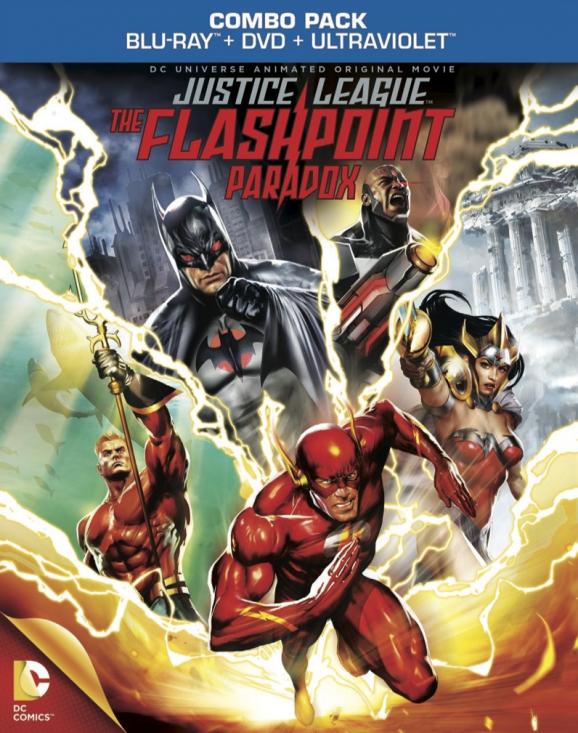
 This week’s episode of my podcast, the All New Showcase, features myself and my cohort Kenny giving our opinions on a pair of new superhero movies. We took in The Wolverine and the new animated feature Justice League: The Flashpoint Paradox. To hear our thoughts on those, as well as a comic book and TV pick, click on the link!
Get ready for the Man of Steel…
 It is absolutely no surprise or secret that the movie I’m the most excited for this year is finally hitting theaters this Friday. Lifelong comic book fan, and more importantly, Superman fan that I am, Man of Steel couldn’t possibly get here soon enough to suit me. I’m on a mini-vacation with my fiance, Erin, right now, but once I’m home with my DVD shelf I fully intend to immerse myself in the Superman films of the past. Chances are you’re aware of the four Christopher Reeve movies, the one Brandon Routh movie… you no doubt know about the Fleischer Studios shorts of the early 40s, the assorted TV shows starring George Reeves, Dean Cain, and Tom Welling. You may even know about the Helen Slater Supergirl movie, and you no doubt watched the 90s Superman: The Animated Series starring Tim Daly.
Today, I’m going to give you a quick rundown of a few Superman movies you may not know about. In 2007, Warner Brothers and DC Comics began a series of animated movies based on their superhero comics, beginning with a Superman film. Many of these are available via Netflix steaming, and all of them are being flooded back into stores this week, with the big Man of Steel push. Here are those DCU Animated Superman movies you may not have seen…
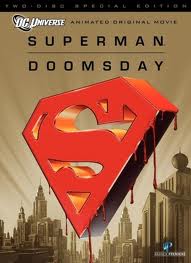 Superman/Doomsday (2007). The first film in the series was based on the early 90s Death of Superman storyline from the comic books, although it is a very trimmed-down version. In this version, Metropolis is attacked by a rampaging beast that comes to be known as Doomsday, a mindless killing machine that threatens to destroy his city. Superman faces down the beast, seemingly at the cost of his own life, but both friend and foe alike are unwilling to accept that his death is that simple. The film wasn’t bad — Adam Baldwin made for a good Superman and James Marsters was a great Lex Luthor. Anne Heche’s Lois Lane was weak, though, and I think they trimmed a bit too much to allow the story to fit in the extremely abbreviated running time of the animated series. Still, this was the DC Animated Universe’s first shot, and the series got better very quickly.
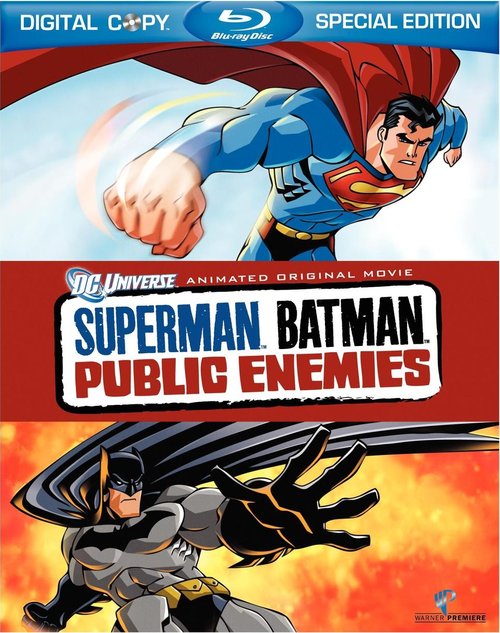 Superman/Batman: Public Enemies (2009). This movie reunited the TV voices of Superman and Batman, Tim Daly and Kevin Conroy, for the first of two films based on a comic book series by Jeph Loeb. In Public Enemies Lex Luthor (also voiced by his TV actor, Clancy Brown), has been elected president of the United States, and uses that influence to draw together a group of heroes under the government payroll. Luthor uses the threat of an impending strike of a massive meteor of Kryptonite to turn the public against Superman and he and Batman go on the run, fighting their fellow heroes in an attempt to clear their names and reveal Luthor as the villain he is. This is a really great flick, one that plays not just with Superman, but with the larger DC Universe, with lots of heroes and villains that casual fans may be introduced to for the first time.
 Superman/Batman: Apocalypse (2010). The sequel to Public Enemies again reunites Daly and Conroy. The shower of Kryptonite meteors in the first movie brought with it a large chunk with some mysterious technology inside. Batman investigates the chunk to discover a girl in suspended animation — Kara Zor-El (Summer Glau), daughter of Superman’s uncle, and the first blood family he has seen since coming to Earth as an infant. The heroes take Kara to Wonder Woman (Susan Eisenberg) to teach her how to use her powers and help her adapt to life on Earth, but she soon becomes embroiled in a battle between the heroes and the powerful villain Darkseid (Andre Braugher). I rather like this movie even more than Public Enemies, adding Supergirl to the mix and bringing in the most dangerous foe Superman has ever faced.
 All-Star Superman (2011). Based on a graphic novel by Grant Morrison and Frank Quitely, in All-Star, Superman (James Denton) receives a fatal overdose of solar radiation while thwarting one of Lex Luthor’s (Anthony LaPaglia) schemes. The radiation is killing him slowly, and giving him additional powers in the process. With his time limited, Superman embarks on a quest to make permanent, lasting changes to the world, leaving it better before his death. This film is based on one of the greatest Superman comics of all time and, sadly, came out just days after the death of its screenwriter, Justice League Unlimited showrunner Dwayne McDuffie. If you can only watch one of the movies on this list, or if you don’t understand what makes Superman a brilliant and compelling character, this is the movie to watch.
 Superman Vs. the Elite (2012). George Newburn, who voiced Superman on the Justice League cartoons, returns to the character in this film based on a comic book by Joe Kelly. Manchester Black (Robin Atkin Downes) is a new superhero, one whose team the Elite initially appears like a welcome addition in the war on crime. Superman soon realizes, however, that Manchester and the Elite have much more violent and permanent solutions to villainy than he is comfortable with. As the people of Earth start to gravitate towards the Elite and question whether Superman is outdated, the man of steel is forced to confront questions of his own relevance. Like All-Star, this is a brilliant story made into a very good movie. This film is the answer to everyone who ever says that Superman is “too old fashioned,” “too good,” or just plain “boring.” This is a story that explains the importance of Superman, and why he has to be who he is… because the alternative is chilling.
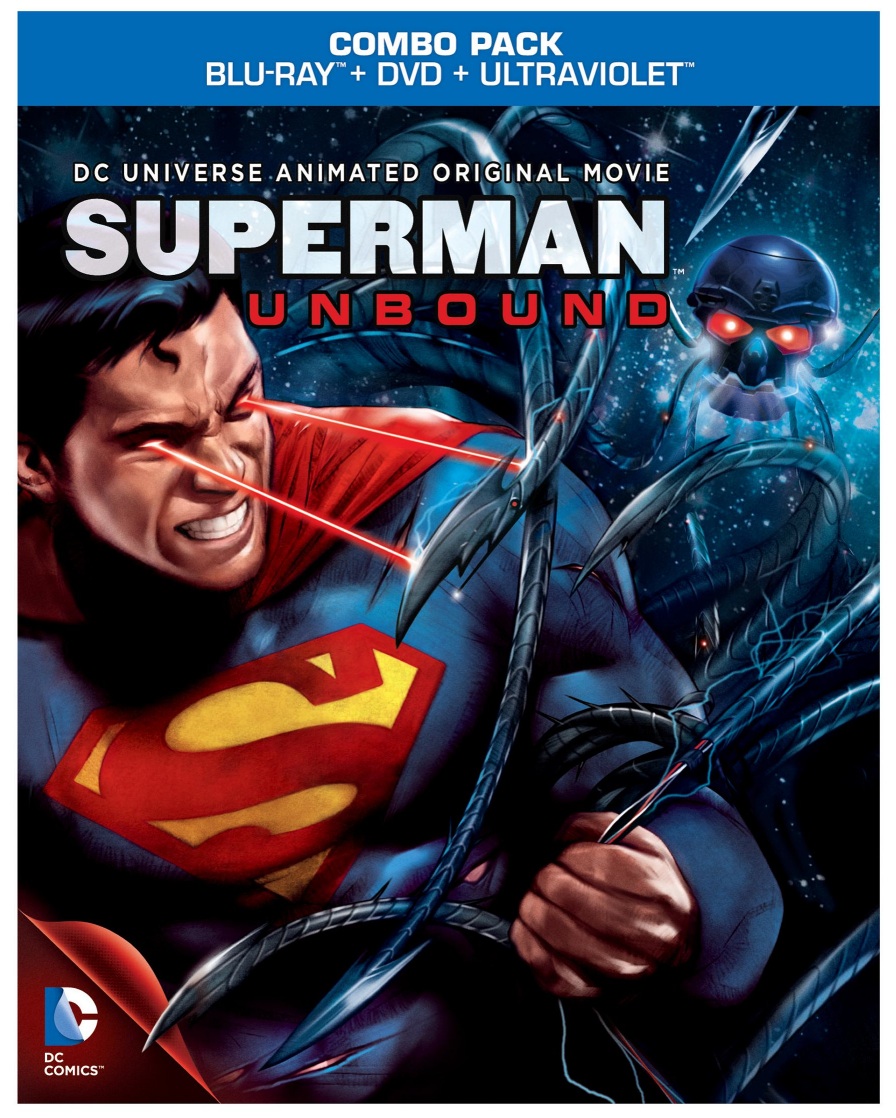 Superman Unbound (2013). The most recent film on this list came out just last month. based on a graphic novel by Geoff Johns and Gary Frank, Matt Bomer takes on the role of Superman in this film. Brainiac, a highly-intelligent alien that menaced Krypton in the past, has come to Earth, terrifying Supergirl (Molly Quinn), who remembers the villain from Krypton. Brainiac travels through the universe, miniaturizing and stealing cities from different planets before destroying them, and Metropolis is his next target. The graphic novel this movie is based on is great, the movie is just okay. Like some of the earlier films on the list, it suffers a little from having to strip away a bit too much from the original story to fit in the short animated running time. For the Superman fan, though, it’s still worth watching.
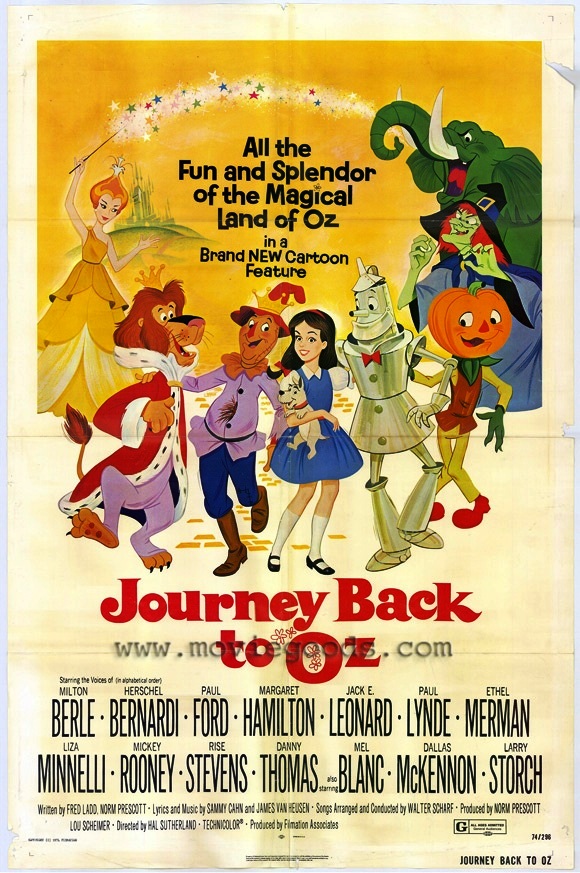
Dorothy Gale Week Day 3: Liza Minnelli in Journey Back to Oz (1974)
 Director: Hal Sutherland
Writer: Fred Land & Norman Prescott
Cast: Liza Minnelli, Milton Berle, Margaret Hamilton, Paul Ford, Paul Lynde, Ethel Merman, Mickey Rooney, Danny Thomas, Mel Blanc, Dal McKennon, Larry Storch, Risë Stevens, Jack E. Leonard, Herschel Bernardi
Plot: In this animated kind-of sequel to the 1939 MGM film, a storm is brewing in Kansas again, and Henry (Paul Ford) is getting worried. His niece Dorothy (Liza Minnelli) feels a-tingle, remembering how a similar storm once swept her away to the land of Oz, but her Aunt Em (Margaret Hamilton) swears to her that Oz is simply a figment of her imagination. As she sings to Toto about wishing to return, a cyclone snaps the two of them up and pulls them into the air. When Dorothy comes to her senses, she realizes she’s landed by the Yellow Brick Road in Oz, and rushes off to find her old friends in the Emerald City. Setting off, Dorothy encounters a creature with a pumpkin for a head (Paul Lynde). Pumpkinhead is fleeing from an evil witch named Mombi (Ethel Merman), who created him to help her conjure some powerful, terrible work of magic. Dorothy tells Pumpkinhead to come with her to the Emerald City, where her friend the Scarecrow will help him.
Dorothy finds Mombi’s hut, where a crow (Mel Blanc) invites her to peek at the cauldron simmering on the fire. Mombi traps her and reveals her brew will create an army of green elephants to conquer Oz and destroy the Scarecrow. When Mombi leaves to get firewood, Pumpkinhead sneaks in and rescues Dorothy. As they escape, they encounter a carousel horse called Woodenhead (Herschel Bernardi), stuck upside-down in the ground. They free him and he joins their party.
Arriving at the Emerald City, they warn the Scarecrow (Mickey Rooney about Mombi’s attack just as the Witch and her Green Elephants arrive. Dorothy and her friends climb on Woodenhead’s back, but Toto and the Scarecrow are captured in the escape. Dorothy, Pumpkinhead and Woodenhead set out for Tinland, to enlist the aid of her old friend the Tin Man (Danny Thomas). At first he’s eager to help, but loses heart when told of the army of elephants. The Cowardly Lion (Milton Berle) initially puts on a show of bravado, but quickly reverts back to quaking when told of the elephants. Glinda, the Good Witch (Risë Stevens) who has been watching the proceedings with her… “Glinda-Bird”… arrives to offer her aid, and gives Dorothy a package which she warns her not to open until she arrives at the Emerald City.
Mombi sends a group of enchanted trees after the friends, but Glinda – watching through the Glinda-Bird – gives Pumpkinhead a magic axe that turns them into… well… hippies. Saved, they return to an Emerald City that has rapidly fallen into decay. They are attacked by an elephant, but Dorothy opens Glinda’s box and a swarm of magic mice pop out and chase it away, freeing them to assault the palace. The mice make it to Mombi’s chambers and chase her the gardens, where she disguises herself as a rose bush. The mice have sent the elephants on a stampede, though, and she is trampled flat. Toto, recognizing Mombi’s true form, leads Dorothy to the flattened rose, who blames Dorothy for her fate just as she dies. As she withers, the elephants fade and the Emerald City is restored to its former glory. The celebration is short-lived, though, as Pumpkinhead has fallen along with the rest of Mombi’s creations. Glinda tells Dorothy her magic cannot restore him, and Dorothy weeps for her fallen friend. As she cries, her tears touch Pumpkinhead’s face, and the magic of her love restores him to life. The Scarecrow awards his friends, making Woodenhead his own royal steed and knighting Pumpkinhead, then offers Dorothy anything she desires. She asks, as always, simply to return home. The Scarecrow find a loophole in the Oz Constitution that will only allow Dorothy to return home the way she came, and Glinda creates a cyclone to carry her back.
Thoughts: In the 1970s theatrical animation could be divided pretty squarely into two categories: Disney, and everything else. This Filmation effort falls into the latter category: limited animation, competent but unimpressive voice acting and weak music. The idea of doing an Oz sequel was all well and good, but Filmation went with stunt casting (Judy Garland’s daughter voicing Dorothy, original Wicked Witch Margaret Hamilton doing a cameo as Aunt Em, plus several celebrities of the time) and an uncredited rewrite of Baum’s second Oz book, The Marvelous Land of Oz. This movie plucks some of the characters from that book – Mombi and Pumpkinhead – turns the Sawhorse into a Merry-Go-Round horse, then turns the plot into something that’s trying hard to be The Wizard of Oz all over again. Instead of that other story, in which a young boy named Tip and his friends wind up stumbling on a plot to conquer Oz by an army of angry women, this movie has Dorothy once again marching to the Emerald City, once again picking up unusual friends along the way, once again being plagued by a Wicked Witch out for revenge. It’s incomprehensible to me why, with 14 Oz books to choose from by Baum alone, filmmakers never seem to look past the first three for inspiration, and often try to shoehorn elements from the latter two into the mold of the first one all over again. It’s equally baffling why they would create new elements when the originals (such as General Jinjur’s all-girl army, which the elephants are standing in for) work so much better. And for Heaven’s sake, why elephants? Okay, they’re big, they’re powerful, but the way the Tin Man and Cowardly Lion react to them you’d think elephants are their natural predators or something. Even mammoths might make sense, but the Tin Man going into a panic over green elephants simply doesn’t make any sense.
The performances, as I said, are merely adequate. Liza Minnelli is clearly cast simply for the gimmick of having her take up her mother’s role, as she brings nothing to the part. She’s not terrible, but there are most certainly more talented voice performers who could have done more, granted the character the sweetness and innocence she demands. As it is, the only thing that really can be said about Dorothy in this film is that she “kinda sounds a little like Judy Garland.” The animation is weak as well – Filmation does a far better job with the non-human characters than Dorothy. She’s surrounded by characters like the Tin Man and Pumpkinhead, which at least look amusing, but Dorothy herself is a stiff, unemotive creature that only really has one expression. This isn’t one of those times where I’m willing to chalk it up to the limited resources of the time, either. If Disney could make magical, powerful characters in the 1930s, the only excuse for the poor animation of the 70s is pencil-pushers cutting corners, and that I refuse to forgive.
Some of the other characters are better, at least. Milton Berle as the Cowardly Lion and Mickey Rooney as the Scarecrow fit the parts nicely. Danny Thomas’s Tin Man is less impressive, and Paul Lynde… well, he’s pretty much Paul Lynde talking out of a Jack O’Lantern. Ethel Merman’s Mombi isn’t bad at all, but she’s playing a typical, stereotypical witch, not particularly doing anything innovative. But my biggest problem with them is more along the lines of characterization than animation. The notion that the Tin Man or Lion would ever refuse to help Dorothy is preposterous. Hell, the entire point of the Lion’s story arc in the first book (or movie) is that he will always overcome his fear to help his friends! You mean to tell me you wave a little thing like an army of magic green elephants in his face and the king of beasts will lose his ability to fight? Absolutely not, my friends. I cannot accept this. The scenes with the Tin Man and Lion ultimately have no impact on the plot anyway, they’re included simply so that the recognizable characters could put in an appearance. It would have been just as effective and far less insulting, from a story standpoint, if the movie skipped from the escape from the Emerald City to the point where Glinda pops up. (It would actually be better, in fact, because if Glinda was watching the whole time, why the hell did she wait so long before taking action?)
Speaking of Glinda, here we see one of those oft-used fantasy tropes that usually irritates me: the “don’t open it until the proper time” gimmick. Writers often use this to create some false suspense, but at least they usually make some effort to explain why the giver of the gift won’t say what it is: magic, arbitrary rules of the game, “you wouldn’t have believed me,” something. None of those are brought into play here, though, there was no reason for Glinda to make a secret out of the box’s contents. It’s just there so we can have a brief moment in the forest where Woodenhead suggests opening the box to escape the trees and Dorothy can tell him no, reminding us that she’s a good little girl who does as Glinda tells her.
The songs, like the voice acting, are merely adequate. Each character gets at least one, Dorothy gets several, none of them are particularly memorable. This was par for the course for films of this nature, sadly, and that’s even sadder when you compare it to the incomparable music from the 1939 film.
When I learned of the existence of this movie, I was initially very excited – as I always am when I find out about a version of Oz I haven’t encountered before. Sadly, the whole thing fell very flat for me. It was at least more recognizable than the 1925 Wizard of Oz, but in truth, that’s mostly because it was built on the back of the Judy Garland film. That’s not to say you can’t tell a good Oz story that way – many people have – but this didn’t hold up for me. Still, I can see a lot of similarities to the cartoons I grew up watching, the ones that hold a special place in my heart even today. On the other hand, I can also recognize that a large number of those cartoons I loved as a kid are terribly weak when looked back upon with a discerning eye. I suspect that if I had watched this movie as a child, I’d probably upon it with rose-colored glasses. As it is, I’m just left sliding the disc back into its NetFlix sleeve and feeling a little disappointed for the second time in this week’s experiment.
The first Reel to Reel study, Mutants, Monsters and Madmen, is now available as a $2.99 eBook in the Amazon Kindle store and Smashwords.com bookstore. And you can find links to all of my novels, collections, and short stories, in their assorted print, eBook and audio forms, at the Now Available page!
Batman Week Day 4: Kevin Conroy in Batman: Mask of the Phantasm (1993)
 Directors: Eric Radomski & Bruce Timm
Writer: Alan Burnett, Paul Dini, Martin Pasko & Michael Reaves
Cast: Kevin Conroy, Dana Delany, Hart Bochner, Stacy Keach, Abe Vigoda, Dick Miller, John P. Ryan, Efrem Zimbalist Jr., Bob Hastings, Robert Costanzo, Mark Hamill
Plot: As Batman (Kevin Conroy) chases after a gang of mobsters in Gotham City, one of them manages to escape, only to encounter a chilling robed figure with a bladed scythe for a hand. This masked shape, far more brutal than Batman himself, sends gangster Chuckie Sol’s (Dick Miller) car over the edge of a parking garage and into a nearby building. Batman arrives in time to see the traces of this “Phantasm”’s wrath, but is unable to capture him.
At a party at Wayne Manor Bruce encounters Councilman Arthur Reeves (Hart Bochner), whose anti-Batman crusade has been making papers. Reeves reminds Bruce of Andrea Beaumont (Dana Delany), one of those classic girls who got away. Bruce remembers meeting Andrea at a cemetery years ago, before he adopted his Batman persona but after he made his pledge to his murdered parents to seek justice. Andrea is visiting her mother’s grave and Bruce his parents. The two quickly feel a connection, and within days Bruce’s butler Alfred (Efrem Zimbalist Jr.) is walking in on them in a deep kiss.
Back in the present, gangster Buzz Bronski (John P. Ryan) arrives to pay his “respects” to the late Chuckie Sol, but is attacked by the Phantasm, who implies a previous relationship with the criminal. The Phantasm forces Bronski into an open grave and topples an angel statue, killing him. Reeves blames the second gangland killing on Batman, but Commissioner James Gordon (Bob Hastings) defends the Dark Knight. As Batman investigates the murder scene at the cemetery, he sees Andrea Beaumont, who has returned to town. Batman watches as she meets Reeves for dinner, and again begins to reminisce.
Soon after he and Andrea begin dating, Bruce takes her on a visit to an exhibition of the future, full of amazing technology and a particularly impressive car. Andrea invites Bruce to meet her father Carl (Stacy Keach), and while Bruce agrees, he confesses to Alfred that he’s concerned about deviating from his plans to become a crimefighter. Alfred, however, is fully supportive of the relationship. When Bruce meets Carl, he also meets Reeves for the first time – at this point, just a “hot young turk” in Beaumont’s legal department. Carl is very welcoming to Bruce, who finds himself unnerved when their meeting is interrupted by a surprise visit from the intimidating Salvadore Valestra (Abe Vigoda). As they leave Beaumont, Bruce sees a group of motorcycle punks attacking a vendor and rushes in to fight them. Although formidable, one of the crooks gets in a hard blow to Bruce and escapes. Andrea is worried, but Bruce brushes her off. He finds himself torn between his promise to his dead parents and his relationship with Andrea, certain he can’t have both. He goes to his parents’ grave, begging their permission to abandon his quest for justice and allow himself to be happy, but is interrupted by Andrea, who suggests that maybe she was sent by his parents because he already has their blessing.
In the present, Valestra speaks to Reeves, who assures him that it’s Batman killing the crimelords. Valestra, now old and infirm, is beginning to fear for his life. Batman, meanwhile, finds Sol and Bronski were connected through a series of dummy corporations along with a third partner: Valestra. Alfred tries to persuade him to see Andrea again after he’s done with Valestra, but Batman refuses. He painfully recalls his awkward proposal to Andrea years ago. Even as she accepts, though, a swarm of bats escapes the caves beneath Wayne Manor and swallows the couple. Shaking it off, they go to Carl’s house to announce the good news, but the house is full of business associates. Andrea convinces Bruce to wait. The next day, as he explores the bat-caves beneath his house, Bruce receives a message from Andrea saying she’s leaving town with her father, and that he should forget about her. Along with the note is her engagement ring. Broken-hearted, he continues with his pledge to his parents.
In the present, Valestra visits the now run-down and decrepit “future” exhibition where Bruce once romanced Andrea. It’s not abandoned, though – here Valestra encounters the Joker (Mark Hamill), who he begs for protection from Batman. Batman approaches Andrea with a photograph of the targeted gangsters and Carl Beaumont, asking where Carl is now. Andrea claims she doesn’t know, and angrily tells Batman, “the way I see it, the only one in this room controlled by his parents is you.” As Batman leaves, she weeps.
The Phantasm goes to Valestra’s home, but he’s already been murdered by the Joker, who has rigged the corpse up with a video camera and a bomb. Although he’s surprised it isn’t Batman, the Joker blows the bomb anyway, and the Phantasm just barely escapes, but is soon pursued by Batman. The police arrive, but don’t see the Phantasm at all, and believe Batman bombed the house. He barely escapes, losing his mask in the process, but Andrea races in and rescues him. She confesses what really happened the night of their engagement: she returned home to find her father with the criminals in the picture, who threatened her if her father didn’t give them money he’d been embezzling. They give him 24 hours to get the money, but he can’t free it in time. Carl forces Andrea to pack a bag and flee Gotham, breaking her engagement to save her life, and he angrily swears to free her from the criminals “whatever it takes.” Andrea tells Bruce she believes the Phantasm is her father, come back to Gotham to set them both free from his past. She tries to leave but he stops her, and Alfred – again – walks in on the two of them as they kiss. The next morning she leaves just before Bruce has an epiphany. There’s a fourth, unidentified criminal in the old photograph… a swipe with a red pencil makes him realize it’s the Joker, in those long-ago days before his skin was bleached and his mind shattered.
The Joker approaches Reeves, accusing him of using Beaumont’s ill-gotten money for his own gains. The Joker denies that Batman is the killer and doses Reeves with a chemical that sends him to the hospital, giggling uncontrollably. As he lies in his hospital bed, Reeves is visited by Batman. Reeves confesses helping Beaumont escape Gotham years ago, but hasn’t heard from him since he asked for money for his first campaign. When Beaumont denied him, Reeves sold his location to the mob. Batman goes to Andrea’s apartment for clues and he finds a locket he gave her years ago. The Joker attack him with a drone, and reveals his hideout in the abandoned exhibition.
At the exhibition, Andrea remembers the last time she saw her father – after the mob murdered him. Putting on the Phantasm’s costume, she attacks the Joker, who has already seen through her masquerade. He nearly kills her, but Batman saves her, at the same time refusing to let her murder anybody else. He asks her what vengeance will solve, a question whose irony she points out before disappearing in a puff of smoke. Batman pursues the Joker through the exhibits, which he has wired to explode. Eventually, Andrea captures him. Although Batman begs her to flee from the explosives, she and the Joker both disappear in the smoke as the exhibition begins to explode all around them. Batman falls into a storm drain and is swept away. Back in the cave, Alfred tells him his greatest fear is that Bruce will someday fall into the vengeance-craving Pit that consumed Andrea. As he mourns, he sees a glint in the darkness of the cave: Andrea’s locket. We glimpse her on a ship out of town, approached by a man. When he asks her if she wants to be alone, she simply answers, “I am.”
Thoughts: Like the 1966 Batman: The Movie, this 1993 offering is a theatrical spinoff of a television show. Batman: The Animated Series launched in 1992, and quickly proved that animation was a perfect medium for the Dark Knight. Paul Dini and Bruce Timm crafted a version of Batman that was sleek, powerful, and respectful to the comic books. It was much harsher and more violent than other cartoons of the time, and the designs were bold and striking, mixing in a 40s-era design aesthetic (particularly in the buildings, vehicles and fashion) with a modern storytelling style. This film takes everything that made the TV show great and amplified it, giving us what was (at the time) the greatest version of Batman ever put on the big screen. The climactic fight scene, where Batman and the Joker fight it out in the miniature city, has a sort of reverse King Kong feel to it. It’s the sort of thing you’d see in a goofy Silver Age comic – Batman swatting tiny planes out of the air while the Joker uses the tip of a skyscraper to bash his foe’s head – but it’s played perfectly straight and deadly seriously.
You’ll forgive me if I talk a bit about the TV show along with the movie, but everything that made the one great also applies to the other. Kevin Conroy’s Batman voice was so perfectly iconic that he remains the most popular performer for the character in animation or video games over 20 years later. He does with his voice what Christopher Reeve did with Superman – shifting flawlessly from a powerful, heroic presence to an entirely different character when he’s not uniform. Conroy’s Bruce Wayne isn’t the faux geek that Reeve’s Clark Kent was, of course, but he has a different tenor, a different attitude, and a different feel that you can accept transforming into Batman, but at the same time, could be forgiven for failing to make the connection if you didn’t know better.
The rest of the cast from the TV show is similarly magnificent. Efrem Zimbalist Jr.’s Alfred is the perfect mixture of supportive and sarcastic, with a quiet wit that speaks to the character perfectly. Bob Hastings as Commissioner Jim Gordon is, likewise, a definitive version of the character. And Mark Hamill as the Joker… He’ll always be remembered for playing Luke Skywalker in the Star Wars films, of course, but to so many Bat-fans, he’ll be one of the greatest Jokers ever. He’s more menacing than Nicholson, crazier than Romero, and if he wasn’t in a franchise that had to be sanitized for children, he could easily play a Joker that would give you nightmares. Like Conroy, he was the voice of the character for decades, and everyone was sad when he formally announced his retirement from the character a few years ago.
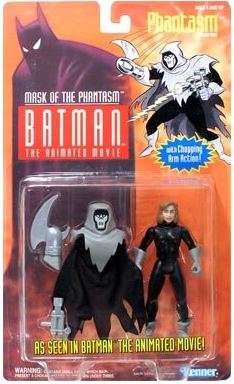
Seriously, who the hell thought this packaging was a good idea?
The one major addition to the cast who wasn’t in the show was Dana Delany as Andrea Beaumont. The voice she puts on here is sweet and kind, with less of an edge than she would use a few years later as Lois Lane in Superman: The Animated Series. Her character works perfectly for the story, though, despite the toy licensees’ attempts to sabotage it. The film works really hard to keep the Phantasm’s identity secret. The design of the character is male, and Stacy Keach provides the voice when he’s in his mask, making it seem as though Carl Beaumont is the one seeking revenge for anyone who can recognize the voice through the modulation. Therefore, when Andrea is revealed as the Phantasm it’s a legitimate shock, a great kick in the gut… unless you happened to go to Toys ‘R Us earlier that day and saw the Phantasm action figure with an unmasked Andrea Beaumont in plain view.
One thing you’ve got to give Superman over Batman – he’s had a much more stable love life. Oh sure, there have been dalliances with Lana Lang, Wonder Woman, that mermaid that one time, but pretty much every movie version has always come back to Lois Lane. This is the fourth Batman movie I’ve watched for this project, and there’s been a different woman in each one (and there’ll be still a fifth tomorrow). I suppose part of it is the attempt to make Batman seem like the perpetual loner, although that image is quickly dispelled by the plethora of Robins, Batgirls, Outsiders and Justice Leagues he typically surrounds himself with. On the other hand, that makes a story like this one work much better than it would with Superman or Spider-Man or any hero who has a more traditionally stable love life on screen. No one would really take Andrea seriously, start to picture her as the girl Bruce belongs with, if they were accustomed to seeing him with somebody else full-time. This way, we get to fall in love with her a little bit along with Bruce, making the ending of the film all the more tragic and powerful.
The TV show and movie both take certain elements from the Tim Burton version of Batman from 1989, including the designs for the Batmobile and Batwing and, most notably, music inspired by the Danny Elfman score. But while the popularity of the Burton films may have helped get this version produced in the first place, Dini and Timm quickly took the franchise in different directions, making it more serious most of the time. This is a far deeper, more psychologically intriguing and –frankly –more realistic portrayal of Batman than any of the previous ones. This is a Batman that can actually get hurt physically as well as emotionally. He gets tired, he gets cut, he bleeds. And while Michael Keaton’s Batman did have a degree of brooding about him, Kevin Conroy’s is a rich, multi-layered character that actually struggles with his choices in a way that no film version of Batman had ever done.
For the most part, our culture still marginalizes animation as a tool only suitable for children’s stories. Although there has been some improvement on that front, in 1993 it was even worse than it is today, so there was no small amount of surprise at this film’s heavy violence and implied sex. (It was still a PG-rated movie, but much harsher than even this same production team would have dared to put on television at the time.) But then, as now, I loved this movie completely. There is room, as I’ve said many times, for a lot of different versions of the Batman in popular culture, but that doesn’t mean that individual fans might not feel loyalty to certain interpretations of the hero. As good as the stuff that was coming (which we’ll discuss tomorrow) turned out to be, to me, this is still the truest version of Batman ever put to screen. And I don’t just mean by 1993, I mean in the two decades since then as well.
The first Reel to Reel study, Mutants, Monsters and Madmen, is now available as a $2.99 eBook in the Amazon Kindle store and Smashwords.com bookstore. And you can find links to all of my novels, collections, and short stories, in their assorted print, eBook and audio forms, at the Now Available page!
Gut Reaction: Paranorman (2012)
 Directors: Chris Butler & Sam Fell
Writer: Chris Butler
Cast: Kodi Smit-McPhee, Tucker Albrizzi, Anna Kendrick, Casey Affleck, Christopher Mintz-Plasse, Leslie Mann, Jeff Garlin, Elaine Stritch, Bernard Hill, Tempest Bledsoe, Alex Borstein, John Goodman, Hannah Noyes, Jodelle Ferland
Plot: Norman Babcock (Kodi Smit-McPhee) was born with a terrible gift – the ability to see and communicate with ghosts. The problem is, nobody believes him, except for his mysterious Uncle Prendergast (John Goodman), who has the same power. Prendergast warns Norman that a witch’s curse is about to overwhelm his small town unless he can stop it… but the spirits of the undead may not even be the worst danger – first Norman has to navigate a sea of school bullies, unbelieving townspeople, and parents who think something is wrong with him.
As always, this Reel to Reel is not simply a review, but a study of the themes and tropes of the movie. So fair warning: SPOILERS LIE AHEAD.
Thoughts: Last fall we got hit by not one, but three stop-motion films that seemed to be grasping for the young Halloween-lover’s moviegoing dollars: this, Hotel Transylvania and Frankenweenie. I wanted to see all three, so naturally, circumstances conspired to keep me from seeing any of them. Now that they’re rolling out on DVD, I’m making up for lost time.
From the basic description, it’s impossible not to see Paranorman as taking some of its lead from The Sixth Sense – both films are about young boys with the ability to talk to the dead and the earlier film is far too large a cultural milestone to imagine writer Chris Butler could have been unaware of it. It’s even less likely when you realize just how culturally aware this movie is – it’s full of tiny little jokes, tidbits and Easter Eggs that link us to the great horror movies of the past — gags about zombie movies, Norman’s friend Neil showing up in a hockey mask, and Norman’s phone having John Carpenter’s Halloween theme as his ringtone being some of the most prominent examples.
That said, this isn’t a problem for the movie at all. In fact, you could almost look at Paranorman as a sort of thematic sequel to M. Night Shyamalan’s breakthrough film. At the end of that movie, Haley Joel Osment’s Cole Sear character had started to make peace with his ability to talk to the dead and was attempting to use his ability to help spirits in need. Norman Babcock is at that point when this movie begins, but an unbelieving family and the fact that the town is aware of – but doesn’t believe in – his power helps make him a real outcast, perfectly positioning him to be the hero when the zombies hit the fan.
Chris Butler and Sam Fell are clearly drawing from the Tim Burton/Henry Sellick school of filmmaking. Although parents frequently forget, a lot of kids love the creepy and the macabre. It’s why Roald Dahl is still popular, why the Universal Monsters will never die, and why The Nightmare Before Christmas is still the most popular thing Tim Burton’s name has ever been associated with. Kids, however, don’t really want to be legitimately scared the way adults sometimes do. Kids want the trappings of horror around them, because it makes them feel older, like they can take it. Plus, that line between terror and laughter is really very slim. (I may have mentioned it before.)
The interesting thing about Paranorman is that it treads the line between an all-ages movie and an adult film very carefully, but not only in terms of the horror content. When Mitch (Casey Affleck) drop-kicks a zombie’s head, that’s a little gross… but part of my brain was still processing the moment a few minutes before when he was joking about his little brother Neil (Tucker Albrizzi) freeze-framing their mother’s aerobics DVDs, with a screenshot that leaves no room for interpretation as to what he’s looking for.
Like the horror, the comedy in this movie draws heavily from classic sources. Zombie hands chasing after people feel like they could have been dragged out of a Three Stooges short or an episode of The Addams Family. The mob violence calls to mind Frankenstein in the campier moments of the franchise, and the script even drops in a shout-out to Scooby-Doo. The action, on the other hand, evokes some of the great kids’ adventures movies of the 80s. We used to get movies like Explorers, like Monster Squad, like the greatest kids’ adventure of all time, Goonies, in which the young have to come together to fight the bad guy or save the day. I grew up in this mythical fairyland – it was called the 80s. Halfway through the movie, Paranorman takes a turn in this direction, when Norman and Neil are joined by their older siblings and the school bully, none of whom can afford to remain skeptical anymore, what with the actual hordes of the undead coming after them.
The way those characters come together, though, is pretty realistic. Norman’s sister Courtney (Anna Kendrick) turns against him, even after they’ve all fought the monsters and know for a fact he isn’t just crazy. Alvin the Bully (Christopher Mintz-Plasse) is still a jerk. Neil’s brother Mitch (Casey Affleck) is still a bonehead. In a lot of movies, these lesser antagonistic characters turn on a dime and join the heroes in the face of a greater threat (such as in the legendary Shakespearean drama Ernest Goes to Camp.) Things don’t go nearly so well for Norman, who really has only one stalwart in his corner, and when the story begins, it’s Norman who tries to reject Neil. The characters do come around eventually, of course, because that’s the sort of story this is, but it doesn’t come easily. They need real convincing, an idea that becomes more important at the climax when Norman confronts the witch and tries to talk her down from the monster she’s become to the little girl she once was.
The big moment for the film, the one where we really start to understand we’re in a complex world where nothing is black and white, is when Norman gets a pensieve-style glimpse into the sentencing of the witch Agatha Prendergast (Jodelle Ferland), who started all this in the first place when she cursed the people who condemned her. At this point, after an hour of running from the monsters, everything becomes clear. Agatha was a child when she was condemned – we’re not seeing a spell cast by a bloodthirsty witch, we’re seeing a tantrum being thrown by a scared, powerful child. Then the next domino falls – the zombies beg Norman to complete the ritual to put Agatha asleep again for another year… they aren’t out for blood, they just want the curse to end.
In truth, it takes a bullied, misunderstood child to comprehend what a bullied misunderstood child actually needs, and that’s as true in this movie as it is in real life.
Although rated PG, I would be hesitant to show this movie to some kids. The mass numbers of double entendre aside, a lot of the monsters and violence – although played for laughs – are perhaps a little too realistic for the littlest of them. If you’ve got a kid under 10, I’d recommend watching the movie yourself first to decide if you think your kid can handle it. If you’re older, though – if you’re from that demographic that loves Nightmare Before Christmas, Beetlejuice, The Munsters, this really is an excellent movie.
Don’t forget the first Reel to Reel movie study, Mutants, Monsters and Madmen, is now available as a $2.99 eBook in the Amazon Kindle store and Smashwords.com bookstore. And you can find links to all of my novels, collections, and short stories, in their assorted print, eBook and audio forms, at the Now Available page!
The Christmas Special Day 25: Prep and Landing (2009)
 Directors: Stevie Wermers & Kevin Deters
Writers: Kevin Deters, Stevie Wermers & Chris Williams
Cast: Dave Foley, Sarah Chalke, Mason Vale Cotton, David DeLuise, Derek Richardson, William Morgan Sheppard, Nathan Greno
Plot: Before “The Big Guy” (William Morgan Sheppard) can make his rounds, it’s up to the Prep and Landing Elves to scout ahead and make sure your house is ready: children nestled in their beds, no creatures stirring, and so forth. For over 200 years Wayne (Dave Foley) has been a Prep and Landing elf, but this year he’s certain he’ll get promoted to Head of the Naughty List. He’s shattered when North Pole Christmas Eve Command Center Coordinator Magee (Sarah Chalke) tells him he’s been passed over in favor of his partner, an elf he helped to train. As if that wasn’t bad enough, he’s being given a new rookie, Lanny (Derek Richardson), an idealistic young elf who thinks he’s landed the “most tinsel” job in the world. Broken, on Christmas Eve Wayne starts to sleepwalk through his job, bumbling and eventually getting caught by a little boy named Timmy (Mason Vale Cotton). Lanny manages to put Timmy back to sleep, but a massive snowstorm is raging, and as Wayne has slacked off his work, Magee is left with no choice but to declare a “Figgy Pudding” situation — they’re going to have to skip Timmy’s house. Realizing the depths of his mistake, Wayne snaps Lanny into action, calling the boss back and transforming an inflatable snowglobe into a beacon to guide him in for a landing. Christmas is saved, but Wayne’s career may be over. The next day, the Big Guy calls him into his office. Wayne is ready to accept his punishment, asking only that the boss assign Lanny a good partner to replace him. But to his surprise, the Big Guy tells him he understands… everyone winds up on the naughty list once in a while, but he gave him Lanny precisely because he’s so god at his job. When Wayne leaves the office, he tells the waiting Lanny he was offered a promotion, to head of the Nice List, but he turned it down. He’s decided he’s more of a Prep and Landing guy.
Thoughts: One special is not enough to declare it a new Golden Age of Christmas Specials, but if Disney keeps turning out things like this – and starts inspiring other studios to do the same, we’ll have plenty to choose from very soon.
Disney really pulled out all the stops for this, with animation as crisp and energetic as anything they would put on the big screen, characters just as well-developed and entertaining, and even a musical score by Michael Giacchino. If they had showed this before The Princess and the Frog, not a single moviegoer would have been disappointed.
Prep and Landing is one of those cartoons that genuinely does everything right, starting with the characters and cast. Wayne and Lanny make for a fine odd couple, with Dave Foley bringing in the sort of exasperated worker attitude that worked for him on Newsradio and Derek Richardson matching it with an enthusiasm that would be obnoxious if it weren’t so sincere. Sarah Chalke’s Magee has a sort of frantic, manic energy that perfectly suits the character of the woman who’s doing the real legwork of running the north pole operation, and her interaction with her voiceless assistant, Tiny, make for a constant string of sight gags that still make me laugh after watching this a half-dozen times. I didn’t mention Santa’s reindeer Dasher and Dancer (Nathan Greno and David DeLuise) during the synopsis because they really don’t add anything to the plot. However, they bring out some fantastic comedic moments, adding to the conceit that Santa’s operation is treated like a cross between NASA and a military enterprise. The two of them put on the persona of hardcore, Top Gun-style pilots, while Magee runs things like she’s in charge of Mission Control and we’re about launch for outer space.
The characters, of course, play these things all perfectly straight. There’s no winking at the camera, no tongue-in-cheek moments where you get the impression the characters know they’re in a Christmas special. Instead, every beat of the story comes across like we’re watching a vital, life-and-death situation, even as Wayne’s depression sends him into mocking the Big Guy and his partner and Christmas in general (even shutting off a TV presentation of Mickey’s Christmas Carol – a nice touch).
It’s also nice to see the Elves elevated into stars for once. Most Christmas specials focus on Santa or one of his ancillary associates – Rudolph, Frosty, even Mrs. Claus. Until now, any special or movie that has shown the Elves in any large part has kept them in supporting roles. The only exception I can think of is the 2003 film Elf, and even that is less about the Elves themselves and instead focuses on a goober who happens to think he’s an elf… not exactly the same thing. This is the first series I can think of that takes real Elves and shows us what they can really do, making them our heroes. It’s telling that “the Big Guy” is rarely mentioned by name, that his face never actually appears on-screen. Sure, we all know it’s Santa, but by keeping our distance from him it’s easier to look at Wayne and Lanny as our stars instead of worrying about what the boss is up to on this particular Christmas Eve.
This special has become the start of a lucrative franchise for the Disney folks. After winning a boatload of awards, they came back in 2010 with a seven-minute short (Operation Secret Santa) and, in 2011, another half-hour (Naughty Vs. Nice). Both of these have expanded the world of Prep and Landing, introducing more characters, more parts of the overall operation, and more worlds to explore with our favorite Elves. The characters even appeared in an eight-page Marvel Comic (Disney being Marvel’s parent company), in which Wayne and Lanny prep the Avengers’s headquarters for Santa’s arrival. Point is, these guys are becoming legitimate stars in their own right.
Unfortunately, last I heard a third full-length special was put on hold after Naughty Vs. Nice didn’t quite grab the ratings bonanza the first film did. But with both specials being shown all over ABC and ABC Family, and the DVD and Blu-Ray now available, there’s always hope. I love Wayne and Lanny, I love Magee and Tiny, I love the whole world of these gutsy little Elves, and I want to go back there again.
The Christmas Special Day 24: Shrek the Halls (2007)
 Director: Gary Trousdale
Writers: Gary Trousdale, Sean Bishop, Theresa Cullen, Bill Riling
Cast: Mike Myers, Eddie Murphy, Cameron Diaz, Antonio Banderas, Cody Cameron, Susan Fitzer, Christopher Knights, Gary Trousdale, Conrad Vernon, Aron Warner, Marissa Jaret Winokur
Plot: With only 159 days left until Christmas, Donkey (Eddie Murphy) begins pestering his friend Shrek (Mike Myers) to begin the preparations. Over the next few months, Donkey gets more and more insistent and Shrek more and more resistant, until it’s finally December 23 and he realizes for the first time his wife, Princess Fiona (Cameron Diaz), and their triplets are looking forward to their first Christmas as a family. Not wanting to let her down, Shrek sets out for town to figure out how to “make a Christmas.” He winds up with a copy of a self-help book, Christmas For Village Idiots, that promises to help him one step at a time make the holiday Fiona deserves.
The next day, Christmas Eve, Fiona wakes up to find Shrek decorating their house for Christmas. Although she’s happily surprised, Donkey shows up to drop off a Christmas card and criticizes the decorating job. Fiona and the babies pitch in, and by dark Shrek is ready to sit down and tell his kids the Christmas story, but he’s interrupted when Donkey bursts in along with all of their friends. Puss in Boots (Antonio Banderas) entertains the kids while the others race around putting up more and more decorations, ruin supper and – in the case of the Gingerbread Man (Conrad Vernon) – make a pass at the angel-shaped Christmas Cookies. Although Shrek tries to hide from the chaos, Fiona lures him back, but things just get worse. He tries to get himself back into the spirit by telling his kids his Christmas story, but Donkey again steals the spotlight with an insane poem about a Christmas parade. Puss in Boots gets into the act with his tale of “Santa Claws,” and the Gingerbread Man jumps in with a story that’s really more appropriate for Halloween. A fight ensues and Shrek, while trying to hide his book, accidentally starts a chaotic chain reaction that ruins the party and sets both himself and the Christmas tree on fire. Boiling with rage, he throws Donkey and the rest out of his house. Fiona is upset that he threw out their friends, and sets out to find them while Shrek complains about how they ruined “his” Christmas. He catches up to them and tries a halfhearted apology, finally admitting that ogres don’t celebrate Christmas, and he has no idea what he’s doing. Everyone apologizes to each other and the odd little family returns to Shrek’s home to settle in for the night. Before lights out, Shrek tries once more to tell his Christmas story: a tale of a Santa Claus making his visit to an ogre home. As he finishes, they hear laughter in the air and rush outside to see Santa Claus flying across the moon.
Thoughts: My thoughts about Dreamworks Pictures Shrek franchise are fairly simple: I thought the first one was entertaining. As for the rest, my grandma always said if you can’t say something nice, don’t say anything at all. But even the worst franchise can sometimes turn out a charming Christmas story, so when Shrek the Halls made its network TV debut, I gave it a chance, and I rather liked it.
In truth, it suffers from many of the problems that plague Dreamworks Animation in general – too many topical jokes and current songs that hurt the special’s ability to become a real timeless classic. There’s a reason Rankin and Bass didn’t throw the Beatles into their specials… well, they also probably couldn’t afford them, but you see my point. In truth, this and oversaturation is one of the reasons Dreamworks will never quite reach the heights of a Pixar or Disney Animation Studio – they’re so focused on making a franchise that’s current and modern and now that the next generation of children will find themselves tuning out to the constant reminders of the world their parents grew up in. To put it another way, my two-year-old niece loves every Toy Story movie (and, in fact, everything Pixar has produced). I find it really hard to believe that she’ll latch on to Shrek or Kung-Fu Panda in the same way, even once she gets a little older and enters into the sphere of the intended demographic. They also rush out sequels, cranking out cookie-cutter cartoons that rarely, if ever, match the original, rather than allowing the story to dictate the future of the characters. Finally, there’s an emphasis on gross-out humor (such as the Gingerbread Man throwing up a chocolate kiss and the Donkey eating it) that shuts out older viewers… something else Pixar doesn’t feel the need to succumb to.
But don’t get the impression that I didn’t like this cartoon – I did. The animation itself is top-notch, and a lot of the characters and design are very imaginative… the giant Waffle Santa Claus, for instance. Puss in Boots is a great character, especially if you’re a cat owner and recognize how easily he slips from the persona of the suave Latin lover into a typical feline, which leaves him embarrassed.
Like any good Christmas special, the true test comes in when the hero learns his lesson at the end. Shrek has an interesting character arc here – he goes from being a complete Scrooge to suddenly wanting desperately to create a good Christmas for his family. From there he bumbles, he misunderstands the meaning of Christmas, he learns it, and then gets it all right. This time around, rather than giving a religious message or a message about the virtue in giving and sacrifice (all of which are well and good, by the way), the message is one of family. You may fight and struggle and drive each other crazy, but there’s a reason you stick around people besides blood. It’s a nice message about love and the truth about what a real family is, and it’s one even the children will no doubt be able to grasp.
Throughout most of the 90s and early 2000s, there was a dearth of new televised Christmas specials, which is why this particular Reel to Reel project has been so heavily weighted with films from the 60s through the 80s. (In a way, it’s the exact opposite of the problem I had with Lunatics and Laughter.) But in recent years, Dreamworks and Disney both have stepped up and started to change that. Have a wonderful Christmas Eve, my friends, and come back tomorrow for the finale of The Christmas Special with my favorite TV Christmas Special to premiere since I was a child.
The Christmas Special Day 23: A Scooby-Doo! Christmas (2004)
 Director: Scott Jeralds
Writer: Jonathan Collier & James Krieg
Cast: Mindy Cohn, Grey DeLisle, Casey Kasem, Kathy Kinney, Frank Welker
Plot: A group of kids find an enormous snowman in the woods. When they try to take its nose, it comes to life, removes its head, and hurls it at them, making them run away in a panic. Nearby, the gang in the Mystery Machine is on their way to Mill’s Corner to spend Christmas at a condo owned by Daphne’s (Grey DeLisle) uncle. The bridge to the condo is out, forcing them to detour through the town of Winterhollow, where they meet the kids fleeing from the Headless Snowman, who also startles Shaggy (Casey Kasem) and Scooby-Doo (Frank Welker). When they walk into the local diner, a man called Old Jeb is raving about the Headless Snowman who has been terrorizing the town for years. Sheriff Perkins (Kathy Kinney) calms him down and tells the gang there’s no way to get to Mill’s Corner that night with the bridge out. The gang checks into an inn, which is full to bursting with people who have had their homes damaged by the Snowman. The innkeeper, Asa, tells them the town doesn’t celebrate Christmas anymore due to the snowman… some of the children have never even seen a Christmas tree.
Everyone is summoned outside when a loud noise signals an attack by the snowman. There they find a boy named Tommy telling the Sheriff the snowman startled him and smashed his chimney, ripping open a wall in his house. Fred (Welker again) tries to comfort the boy, promising they’ll try to save Christmas. As the gang searches, the Snowman chases them all into a tiny shed, when they send plunging down the side of the mountain and hurtling through the air before smashing to safety. Asa calls a professor from Mill’s Corner to help, and Velma (Mindy Cohn) takes note that Asa’s business seems to benefit greatly from the snowman. Professor Higginson tells them the story an old prospector called Blackjack Brody who froze to death hiding gold bricks he stole from a local man, and that his ghost is sending the snowman to destroy the older homes in Winterhollow searching for his gold. Velma brings the gang to Jeb’s house, expecting the ghost to come there next. They hide when the Snowman appears and starts tearing apart the walls. A sneeze alerts him to our heroes and chase resumes via the classic horror movie technique of the musical montage. Eventually, Scooby and Shaggy lure it away and Sheriff Perkins arrives, claiming to have followed a set of mysterious footprints. Fred, Daphne and Velma go off to set a trap for the monster, but it attacks Scooby and Shaggy instead. They lead it into a series of heat lamps the others set up, melting the snow and revealing a robotic core being piloted by Professor Higginson. Velma reveals that Higginson is a descendant of the man Blackjack Brody stole his gold from in the first place, and he’s been searching for the gold he believes is rightfully his. Remembering how heavy the bricks in the smashed chimneys were, Velma finds the truth – Brody painted the gold and it was used to build the houses in the town. Tommy gives the shivering Higginson his scarf to warm him up, and he realizes the error of his ways. As the gold is rightfully his, he donates it to the town to help them rebuild. The gang sets up a Christmas tree – Winterhollow’s first in years – and everyone gathers around to watch it glow.
Thoughts: This is pretty atypical for a Christmas special, but a perfectly normal episode of Scooby-Doo. The formula is time-honored and well-worn for these characters. Like virtually every episode of the assorted cartoons, a “monster” shows up terrorizing people for reasons that are dubious, but usually somehow financially motivated. The gang investigates three or four suspects, all but one of which are red herrings. They catch the monster, Velma unmasks him and explains how she knew it was really him. Lather, rinse, repeat. I’m told some of the more recent Scooby-Doo cartoons actually try to mix it up by having real monsters, but I haven’t seen any of those… in fact, with a 2004 air date, this is the most recent visit with the original Scooby Gang I’ve ever seen. I do, however, have to give the makers of this cartoon credit for managing to tell a story with a Christmas feel without restoring to many (if any) of the typical Christmas tropes. Don’t misunderstand – I love those tropes, those tropes are great. But I’ve been watching these specials for weeks now, and one can’t help but appreciate the change of pace.
The atypical part comes in at the very end, when Higginson repents instead of being carted off shouting that he would have gotten away with it if it weren’t for those rotten kids. It’s a Christmas special, so I can accept the villain who repents at the end – that’s what Christmas is all about, after all. But the way the people of the town are so willing to forgive is nothing short of supernatural. This is the man who has terrorized their town, destroyed their homes, and stolen Christmas itself from an entire generation of children, and they’re ready to forgive him even before he offers to use the gold to help them fix their houses. Ladies and gentlemen, either Winterhollow is the most forgiving town on this or any other planet, or the good Professor had some sort of mind-control apparatus that the gang somehow missed while they were hopped up on Scooby Snacks.
Come to think of it, it’s not like he even really needs the gold. The man has the money to either purchase or develop and build a robotic upside-down top that has the ability to animate and control snow, which it somehow endows with superhuman strength sufficient to rip apart a brick… freaking… wall. If you can do that, what do you need hundred-year-old gold for? Market it! The possibilities for a Vegas stage show alone are staggering!
It’s not the strongest mystery, but then again, Scooby-Doo ain’t exactly Sherlock Holmes. I pegged the professor as our culprit even before he arrived for one simple reason: he told Asa he was coming into town from Mill’s Crossing – the same town the gang was unable to reach because the bridge was out. When he walked through the door I nodded to myself and said, “Yep, he was there all the time.” Startlingly, though, when Velma is doing her Reveal Sequence, this nugget of information is never mentioned. Deleted scene? Serendipitous screw-up? Who knows? I’m just going to take it as further evidence that I’m smarter than most cartoon characters, with the obvious exceptions of Simon from the Chipmunks, Brainy Smurf, and Snarf.
This is a relatively recent cartoon, particularly when you look at the rich history Scooby and the gang enjoy, but they still manage to work in most of the classic bits. My favorite scene is, indeed, the musical montage, when the gang tries to outwit the monster. They even usually succeed, at least for a few seconds. Scooby and Shaggy douse him in syrup and almost have one monster sno-cone, the others start singing Christmas carols and he temporarily forgets he’s a demonic hellbeast and offers them hot chocolate… This may not be a laugh-a-minute show like some of the other Hanna-Barbera cartoons, but when it’s on, it truly has some of the funniest tropes in the cartoon kingdom.
Like I said back when we discussed A Flintstones Christmas, it’s a shame I couldn’t work in more Hanna-Barbera into this countdown. There are dozens of cartoons spread out amongst their various franchises that just fill you with the Christmas spirit. Unfortunately, almost all of them fall into one of the three categories that I disqualified from this project: they were run as part of the regular series, they’re too long and therefore count as a TV movie rather than a TV special, or they’re a take on Dickens’s A Christmas Carol – such as one of my favorite Yuletide adventures with the Scooby gang, “A Nutcracker Scoob.” But fear not, friends. Reel to Reel is a long-term project. There’s always next year.
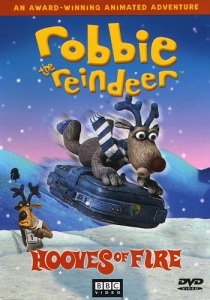
The Christmas Special Day 22: Hooves of Fire (1999)
 Director: Richard Goleszowski
Writers: Andy Riley, Kevin Cecil, Richard Curtis
Cast: UK VERSION-Robbie Williams, Ardal O’Hanlon, Paul Whitehouse, Jane Horrocks, Steve Coogan, Caroline Quentin, Jean Alexander, Ricky Tomlinson, Rhys Ifans, Harry Enfield; US Version-Ben Stiller, Britney Spears, James Woods, Brad Garrett, Hugh Grant, Leah Remini, James Belushi, Jerry Stiller, Rob Paulsen
Plot: The red-nosed Robbie the Reindeer (Ardal O’Hanlon/Ben Stiller) has long dreamed of winning a spot as the navigator on Santa’s sleigh team, and it looks like he’s finally being given a chance. He reports to the sleigh team, run by a taskmaster-like Blitzen (Steve Coogan/Hugh Grant). As Donner (Jane Horrocks/Britney Spears) shows him to his room, Blitzen begins plotting… he’s been jealous of Robbie’s father ever since the day that (unnamed) most famous reindeer of all saved Christmas, and now he can take revenge on that reindeer’s son. Donner quickly develops a crush on Robbie, but he’s oblivious, only having eyes for Vixen (Caroline Quentin/Leah Remini). Robbie meets Santa Claus (Ricky Tomlinson/James Belushi) for the first time at a party the boss is throwing for the elves, where Santa gushes over Robbie’s father and Vixen rebuffs his advances. Santa has a surprise for the party as well: he unveils the Sleigh Mark II, a new high-tech vehicle full of bells, whistles, and a computer navigation system. Robbie suddenly realizes that, to keep his spot on the sleigh team, he has to be physically fit… which will be hard, as Blitzen has been sabotaging his fitness training. Disheartened, Robbie wanders out into the snow to walk south. He winds up frozen solid and would be lost if he wasn’t found and thawed out by a group of elves. He joins them working in their toy factory, but a series of mishaps bumps him lower and lower on the totem pole until he’s stuck using his antlers for a forklift – which is where he is when Donner finds him. She tells him he’s still got a chance to make the sleigh team, if he can compete in and win the upcoming Reindeer Games. She also convinces him Blitzen has been his enemy all along, and they turn to a legendary reindeer named Old Jingle (Harry Enfield/Jerry Stiller) for help.
They find Old Jingle in his house, precariously perched at the top of Pointy Mountain, and Robbie asks him to help him train. On the day of the games, Robbie suddenly becomes a crowd favorite by saving a baby from a fall. Vixen tries to use Robbie’s crush on her to force him out of the games, but he’s fallen for Donner instead. He leaves the stadium, however, when he learns that Jingle has been trapped under his house. He rushes off and saves the old reindeer, but misses the start of the race, and Blitzen gets an enormous lead. Amazingly, Robbie makes up ground quickly, and one of Blitzen’s cronies has him stumble into a steeple. Robbie uses his special “Nose Jump” to vault to the finish line, but the photo finish reveals Blitzen to be the winner. Donner kisses him, and in his glee Robbie rushes off and performs in every event, breaking all the records, albeit unofficially. As Robbie’s dad sends a congratulatory blimp over the stadium, Blitzen is carted off for drug testing and Santa gives Robbie the keys to the sleigh for the night. He takes Donner out for a romantic evening on the moon, where together they watch the Earth come up.
Thoughts: It’s always nice to see a tweak to a Christmas classic, and this BBC special from 1999 definitely qualifies. While they’re always careful to avoid mentioning Robbie’s famous father by name, there can be no doubt who he is or what made him so famous.
Hooves of Fire picks up on Rudolph, creating a bizarre semi-sequel by way of sports story. Robbie’s tale echoes his father’s in certain ways – picking up on the Reindeer Games, for example. His journey is not just a copy of his father’s however. Although his own nose does some weird things, it never becomes the center of the storyline the way Rudolph’s does. Robbie is made an outcast not because he’s different, but because Blitzen holds an old grudge against his family. Even when Robbie pulls out his nose’s special abilities at the end, they don’t directly contribute to his success. Remember, he loses the games. He wins in the end because he’s made everyone love him for reasons that don’t have anything to do with his nose. Also because Blitzen is a jerk who, evidently, was ‘roided up.
The plot with the Reindeer Games is a mirror of cheesy 80s sports movies… particularly, and appropriately, films like Ski School. We have the jerk jock and the Yoda-style mentor there to help win the day, the goofy protagonist who focuses on the sexpot without realizing the cute girl next door type is in love with him. The writers load up the tropes, and it’s usually for the purposes of ridicule. That’s kind of the weird thing about the comedy, actually – half of it is straight-up parody of Christmas movies, of sports movies, of romantic comedies and so forth. In the other half, though, the BBC gives the show a really sharp, unmistakably British sense of humor, full of cutway gags and non sequiturs that feel almost Monty Python-esque in their scope.
The stop motion used here feels a step beyond Will Vinton, closer to the sort of thing Aardman Animation puts out on their best days. Something about the character design is really bizarre, but in a funny way. The reindeer, for example, are actually weird 2-D designs, with eyes and a mouth that all go on the same side of the head like a character in Peanuts. The designers keep that feel when they plump the characters out for their animated forms, resulting in a set of reindeer heads that obviously don’t work in the real world, but work perfectly in the quirky version of the North Pole director Richard Goleszowski puts forth. The costuming is cute as well: Jingle walks around with briefs on over his clothing, the elves have several diverse designs that range from the traditional to the mini-biker. The steeples in the steeplechase are actual steeples, looking like they were ripped right off the houses.
And Mrs. Claus had a beard. What else is there to say?
If there’s any major complaint, it’s that for some reason they re-dubbed all of the voices with American actors for the stateside presentation of the film. (Except for Blitzen. In his case, they replaced British actor Steve Coogan with… more widely-known-in-the-US British actor Hugh Grant.) I can only assume this was some sort of effort at marketability. In the 13 years since this film was first made, of course, British pop culture has become much more popular here in the US of A – I imagine if this cartoon was released for the first time today, they probably wouldn’t have bothered with the American voices.
Robbie has returned in two other cartoons – Legends of the Lost Tribe in 2002, and 2007’s Close Encounters of the Herd Kind, the latter of which I was actually unaware of until I did the research for this article. I’ve got an older DVD, with the first two cartoons on it, but now I’ve got a quest. I’ve got to see the 2007 film, because Robbie rocks.
The Christmas Special Day 21: A Wish For Wings That Work (1991)
 Director: Skip Jones
Writer: Berkeley Breathed
Cast: Michael Bell, John Byner, Joe Alaskey, Tress MacNeille, Andrew Hill Newman, Robin Williams, Alexaundria Simmons, Frank Welker
Plot: As Christmas approaches Opus the Penguin (Michael Bell) has one wish: a new pair of wings, because the ones he’s been saddled with don’t allow him to fly. Opus and his friend Bill the Cat (John Byner) have found themselves the subject of torment by a group of ducks (Joe Alaskey) who mock Opus for being flightless, to the point where Opus is going to a support group led by a young child named Ronald-Anne (Alexaundria Simmons). The other birds in the group rave, particularly a Kiwi (an uncredited cameo by Robin Williams) whose wife has left him for an albatross. After an effort at becoming an airborne vigilante fails spectacularly, Opus turns to Santa for help.
On Christmas Eve, though, Santa Claus (Frank Welker) suffers a mishap and falls from the sky. Opus, meanwhile, sleeps fitfully, having dreams of being a pilot. Even in his dream, though, the plane falls from the sky, because penguins can’t fly. He wakes up and finds himself accosted by the ducks, who are in a panic. They take Opus to the lake, where Santa is perched on his sleigh, stranded in the middle. The ducks are scared of the icy water, and it’s up to Opus the Penguin to glide out and save Santa Claus. Grasping the reigns in his beak, he tows Santa back to dry land. Having lost his hat in the rescue, Santa gives Opus his own hat, and makes him see that his courage is a gift that more than makes up for flightless wings. Opus’s joy is short-lived, however, when he realizes he isn’t getting his Christmas wish. On Christmas morning, he steps outside to see that the three ducks have returned, with dozens more. They grab him and pull him outside, taking him with them into the air. Bill, who we discover suggested going to Opus for help in the first place, begins running behind, and the support group disdains him from the sidewalk. But Opus doesn’t care. For one day, Opus the Penguin can fly.
Thoughts: I’m not sure how popular it is today, but in the 80s I remember Berkeley Breathed’s comic strip Bloom Countyas being one of the more clever, slightly subversive features in the newspaper (definitely the ones carried by the New Orleans Times-Picayune). It was sharper and a bit more pointed than a lot of other strips (coughFAMILYCIRCUScough) without ever reaching the preachiness of a Doonsbury and getting bogged down in its own self-importance. The strip has been rebooted a few times over the years – under the names Outlands and Opus – and the so-called penguin Opus has not always been the star, but to me, he’s the icon.
While animated in a soft, lovely style that is perfectly acceptable for children, early in the special we see signs that this is an elevated cartoon, something that will go over the heads of the playground set, and possibly bore them. Opus blames the “accident of birth” that left him as a flightless bird on Congress rather than his mother, and suggests that Bill move into a recycling bin rather than a garbage can. These are the sort of things that adults will see as satire and kids will see as gibberish. Other not-so-subtle bits include the Kiwi who is outraged that his wife left him for a better endowed bird, a war toy store called “Stormin’ Norman’s” and a cross-dressing cockaroach. Although it does a better job of disguising itself than Christmas at Pee-Wee’s Playhouse, it’s not a show for children.
The trouble is, this was 1991. The Simpsons was still new, South Park wasn’t a glimmer on the horizon, and cartoons were still for kids, as far as anyone was concerned. The prime audience for this special likely dismissed it without even tuning in, and the kids who turned in looking for an alternative to their 900th screening of Rudolph gave up and turned back before Yukon Cornelius even showed up. The sequence where Opus dreams of being a pilot – helped along by footage from an old war movie – is quietly amusing in a way that isn’t instantly memorable, but brings a smile to your face when you come back and watch the special again the next year.
And it’s a shame, because the special has a sweet little message that you don’t really see anywhere else. Like Rudolph or Nestor, we’ve got a story about a main character who suffers from some physical characteristic that he sees as a disadvantage. Like Rudolph and Nestor, in the end it is precisely his abnormality that allows him to save the day. Unlike Rudolph and Nestor, though, this realization isn’t enough for Opus. While the message of Rudolph’s story is a good one (be proud of who you are), Opus’s message is considerably more realistic. Discovering you can do something useful is not, in and of itself, enough to make a person forget a lifelong dream. It’s pretty unlikely that Opus had never taken an ice-cold swim before, too, so it’s not like he even discovered something new like Rudolph and Nestor did. Rudolph’s nose helped him achieve his dream. Opus was told his gift made his dream unnecessary, which any child could tell you is a load of penguin guano. (I know penguins don’t really produce guano, please don’t send me e-mails about this.)
Still, for all the cynicism, the special ends on a very positive note. While we weren’t looking the bullies, the ducks, experience their own change of heart and help our little hero have his dream after all. Most of us will never be that lucky, of course, but it’s a more realistic conclusion to this particular hero’s journey than most of the others we’ve watched. Of course, this is a cartoon with a cross-dressing cockroach, so “realistic” is something of a relative term.
Although I would have been 14 when this special premiered, I don’t remember watching it at the time. At some point, I became aware of it, then a few years ago I found it on DVD and watched it for the first time. There’s something quiet, sweet, and lovely about this special, and if you can find it, it’s well worth rotating the 22 minutes into your Christmas cartoon marathon.
 Reel to Reel