Author Archives: blakemp
Dorothy Gale Week Day 3: Liza Minnelli in Journey Back to Oz (1974)
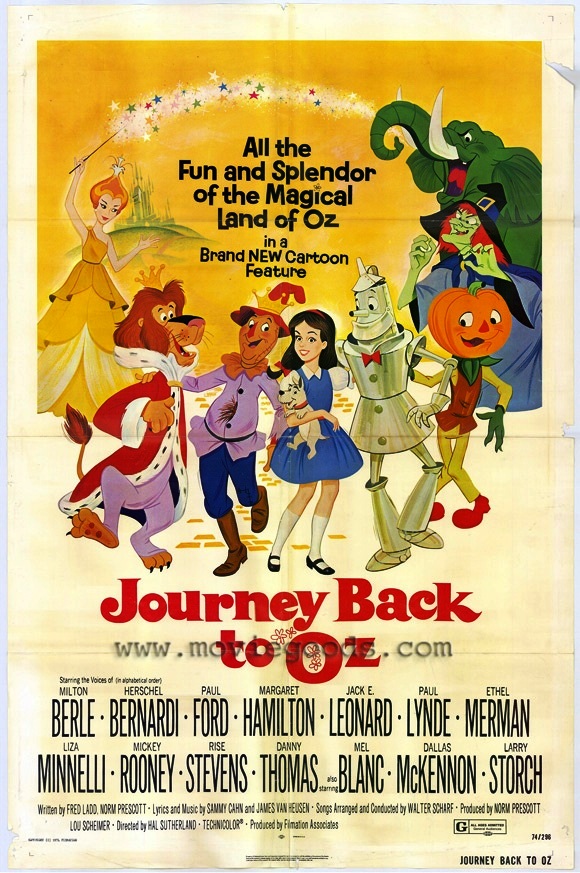 Director: Hal Sutherland
Writer: Fred Land & Norman Prescott
Cast: Liza Minnelli, Milton Berle, Margaret Hamilton, Paul Ford, Paul Lynde, Ethel Merman, Mickey Rooney, Danny Thomas, Mel Blanc, Dal McKennon, Larry Storch, Risë Stevens, Jack E. Leonard, Herschel Bernardi
Plot: In this animated kind-of sequel to the 1939 MGM film, a storm is brewing in Kansas again, and Henry (Paul Ford) is getting worried. His niece Dorothy (Liza Minnelli) feels a-tingle, remembering how a similar storm once swept her away to the land of Oz, but her Aunt Em (Margaret Hamilton) swears to her that Oz is simply a figment of her imagination. As she sings to Toto about wishing to return, a cyclone snaps the two of them up and pulls them into the air. When Dorothy comes to her senses, she realizes she’s landed by the Yellow Brick Road in Oz, and rushes off to find her old friends in the Emerald City. Setting off, Dorothy encounters a creature with a pumpkin for a head (Paul Lynde). Pumpkinhead is fleeing from an evil witch named Mombi (Ethel Merman), who created him to help her conjure some powerful, terrible work of magic. Dorothy tells Pumpkinhead to come with her to the Emerald City, where her friend the Scarecrow will help him.
Dorothy finds Mombi’s hut, where a crow (Mel Blanc) invites her to peek at the cauldron simmering on the fire. Mombi traps her and reveals her brew will create an army of green elephants to conquer Oz and destroy the Scarecrow. When Mombi leaves to get firewood, Pumpkinhead sneaks in and rescues Dorothy. As they escape, they encounter a carousel horse called Woodenhead (Herschel Bernardi), stuck upside-down in the ground. They free him and he joins their party.
Arriving at the Emerald City, they warn the Scarecrow (Mickey Rooney about Mombi’s attack just as the Witch and her Green Elephants arrive. Dorothy and her friends climb on Woodenhead’s back, but Toto and the Scarecrow are captured in the escape. Dorothy, Pumpkinhead and Woodenhead set out for Tinland, to enlist the aid of her old friend the Tin Man (Danny Thomas). At first he’s eager to help, but loses heart when told of the army of elephants. The Cowardly Lion (Milton Berle) initially puts on a show of bravado, but quickly reverts back to quaking when told of the elephants. Glinda, the Good Witch (Risë Stevens) who has been watching the proceedings with her… “Glinda-Bird”… arrives to offer her aid, and gives Dorothy a package which she warns her not to open until she arrives at the Emerald City.
Mombi sends a group of enchanted trees after the friends, but Glinda – watching through the Glinda-Bird – gives Pumpkinhead a magic axe that turns them into… well… hippies. Saved, they return to an Emerald City that has rapidly fallen into decay. They are attacked by an elephant, but Dorothy opens Glinda’s box and a swarm of magic mice pop out and chase it away, freeing them to assault the palace. The mice make it to Mombi’s chambers and chase her the gardens, where she disguises herself as a rose bush. The mice have sent the elephants on a stampede, though, and she is trampled flat. Toto, recognizing Mombi’s true form, leads Dorothy to the flattened rose, who blames Dorothy for her fate just as she dies. As she withers, the elephants fade and the Emerald City is restored to its former glory. The celebration is short-lived, though, as Pumpkinhead has fallen along with the rest of Mombi’s creations. Glinda tells Dorothy her magic cannot restore him, and Dorothy weeps for her fallen friend. As she cries, her tears touch Pumpkinhead’s face, and the magic of her love restores him to life. The Scarecrow awards his friends, making Woodenhead his own royal steed and knighting Pumpkinhead, then offers Dorothy anything she desires. She asks, as always, simply to return home. The Scarecrow find a loophole in the Oz Constitution that will only allow Dorothy to return home the way she came, and Glinda creates a cyclone to carry her back.
Thoughts: In the 1970s theatrical animation could be divided pretty squarely into two categories: Disney, and everything else. This Filmation effort falls into the latter category: limited animation, competent but unimpressive voice acting and weak music. The idea of doing an Oz sequel was all well and good, but Filmation went with stunt casting (Judy Garland’s daughter voicing Dorothy, original Wicked Witch Margaret Hamilton doing a cameo as Aunt Em, plus several celebrities of the time) and an uncredited rewrite of Baum’s second Oz book, The Marvelous Land of Oz. This movie plucks some of the characters from that book – Mombi and Pumpkinhead – turns the Sawhorse into a Merry-Go-Round horse, then turns the plot into something that’s trying hard to be The Wizard of Oz all over again. Instead of that other story, in which a young boy named Tip and his friends wind up stumbling on a plot to conquer Oz by an army of angry women, this movie has Dorothy once again marching to the Emerald City, once again picking up unusual friends along the way, once again being plagued by a Wicked Witch out for revenge. It’s incomprehensible to me why, with 14 Oz books to choose from by Baum alone, filmmakers never seem to look past the first three for inspiration, and often try to shoehorn elements from the latter two into the mold of the first one all over again. It’s equally baffling why they would create new elements when the originals (such as General Jinjur’s all-girl army, which the elephants are standing in for) work so much better. And for Heaven’s sake, why elephants? Okay, they’re big, they’re powerful, but the way the Tin Man and Cowardly Lion react to them you’d think elephants are their natural predators or something. Even mammoths might make sense, but the Tin Man going into a panic over green elephants simply doesn’t make any sense.
The performances, as I said, are merely adequate. Liza Minnelli is clearly cast simply for the gimmick of having her take up her mother’s role, as she brings nothing to the part. She’s not terrible, but there are most certainly more talented voice performers who could have done more, granted the character the sweetness and innocence she demands. As it is, the only thing that really can be said about Dorothy in this film is that she “kinda sounds a little like Judy Garland.” The animation is weak as well – Filmation does a far better job with the non-human characters than Dorothy. She’s surrounded by characters like the Tin Man and Pumpkinhead, which at least look amusing, but Dorothy herself is a stiff, unemotive creature that only really has one expression. This isn’t one of those times where I’m willing to chalk it up to the limited resources of the time, either. If Disney could make magical, powerful characters in the 1930s, the only excuse for the poor animation of the 70s is pencil-pushers cutting corners, and that I refuse to forgive.
Some of the other characters are better, at least. Milton Berle as the Cowardly Lion and Mickey Rooney as the Scarecrow fit the parts nicely. Danny Thomas’s Tin Man is less impressive, and Paul Lynde… well, he’s pretty much Paul Lynde talking out of a Jack O’Lantern. Ethel Merman’s Mombi isn’t bad at all, but she’s playing a typical, stereotypical witch, not particularly doing anything innovative. But my biggest problem with them is more along the lines of characterization than animation. The notion that the Tin Man or Lion would ever refuse to help Dorothy is preposterous. Hell, the entire point of the Lion’s story arc in the first book (or movie) is that he will always overcome his fear to help his friends! You mean to tell me you wave a little thing like an army of magic green elephants in his face and the king of beasts will lose his ability to fight? Absolutely not, my friends. I cannot accept this. The scenes with the Tin Man and Lion ultimately have no impact on the plot anyway, they’re included simply so that the recognizable characters could put in an appearance. It would have been just as effective and far less insulting, from a story standpoint, if the movie skipped from the escape from the Emerald City to the point where Glinda pops up. (It would actually be better, in fact, because if Glinda was watching the whole time, why the hell did she wait so long before taking action?)
Speaking of Glinda, here we see one of those oft-used fantasy tropes that usually irritates me: the “don’t open it until the proper time” gimmick. Writers often use this to create some false suspense, but at least they usually make some effort to explain why the giver of the gift won’t say what it is: magic, arbitrary rules of the game, “you wouldn’t have believed me,” something. None of those are brought into play here, though, there was no reason for Glinda to make a secret out of the box’s contents. It’s just there so we can have a brief moment in the forest where Woodenhead suggests opening the box to escape the trees and Dorothy can tell him no, reminding us that she’s a good little girl who does as Glinda tells her.
The songs, like the voice acting, are merely adequate. Each character gets at least one, Dorothy gets several, none of them are particularly memorable. This was par for the course for films of this nature, sadly, and that’s even sadder when you compare it to the incomparable music from the 1939 film.
When I learned of the existence of this movie, I was initially very excited – as I always am when I find out about a version of Oz I haven’t encountered before. Sadly, the whole thing fell very flat for me. It was at least more recognizable than the 1925 Wizard of Oz, but in truth, that’s mostly because it was built on the back of the Judy Garland film. That’s not to say you can’t tell a good Oz story that way – many people have – but this didn’t hold up for me. Still, I can see a lot of similarities to the cartoons I grew up watching, the ones that hold a special place in my heart even today. On the other hand, I can also recognize that a large number of those cartoons I loved as a kid are terribly weak when looked back upon with a discerning eye. I suspect that if I had watched this movie as a child, I’d probably upon it with rose-colored glasses. As it is, I’m just left sliding the disc back into its NetFlix sleeve and feeling a little disappointed for the second time in this week’s experiment.
The first Reel to Reel study, Mutants, Monsters and Madmen, is now available as a $2.99 eBook in the Amazon Kindle store and Smashwords.com bookstore. And you can find links to all of my novels, collections, and short stories, in their assorted print, eBook and audio forms, at the Now Available page!
Dorothy Gale Week Day 2: Judy Garland in The Wizard of Oz (1939)
 Director: Victor Fleming
Writer: Noel Langley, Florence Ryerson, Edgar Allan Woolf, based on the novel by L. Frank Baum
Cast: Judy Garland, Frank Morgan, Ray Bolger, Bert Lahr, Jack Haley, Billie Burke, Margaret Hamilton, Charley Grapewin, Clara Blandick
Plot: On a farm in Kansas, Dorothy Gale (Judy Garland) has to defend her dog, Toto, from the angry reproach of her neighbor, Mrs. Gulch (Margaret Hamilton). Because Toto has bitten Gulch, she’s within her rights to take the dog and have it destroyed. Dorothy and Toto run away, encountering a carnival performer called Professor Marvel (Frank Morgan), who convinces her to return home to her upset Uncle Henry and Aunt Em (Charley Grapewin & Clara Blandwick). When she returns, a tornado has sprung up and her family is hiding in the storm cellar. Dorothy and Toto rush into the farmhouse, which the tornado plucks from the ground and hurls through the air.
Dorothy crashes in a brilliantly colorful land called Oz, where she finds herself the darling of a group of small people called Munchkins. She is met by a good witch named Glinda (Billie Burke), who explains that Dorothy’s house crushed the tyrannical Wicked Witch of the East. Her sister, the Wicked Witch of the West (Hamilton again) arrives for vengeance, but finds she cannot harm Dorothy directly, as Glinda has given her the dead witch’s powerfully magic Ruby Slippers.
Glinda sets Dorothy on a path to the fabled Emerald City, where the Wizard of Oz may be able to help her get home. Along the way she is joined by three others, each who need help from the Wizard: a living Scarecrow (Ray Bolger) was made without a brain, a Tin Woodsman (Jack Haley) who was crafted without a heart, and a Lion (Bert Lahr) who is sadly a coward. The three of them encounter the witch several times, narrowly escaping her traps before finally arriving in the Emerald City. When they go into the Wizard’s chambers, they encounter an enormous floating head that tells them he can grant their wishes, but will only do so if they can bring him the broomstick of the Wicked Witch of the West.
Dorothy and her friends travel to the Witch’s palace, where she is captured by the Witch’s flying monkeys. The other three disguise themselves as guards and rescue her, but encounter the witch upon escape. In desperation, Dorothy hurls a bucket of water at the witch, who immediately melts away, destroyed by her one weakness. Returning to the Emerald City, the Wizard tells them he needs time to think about their requests. As the friends despair, Toto discovers a little man (Morgan again) hiding behind a curtain, operating a machine that projects the image of the head. The Great and Powerful Wizard of Oz, it seems, is a humbug – a simple performer from the United States who accidentally drifted into Oz years ago in a hot air balloon.
Recognizing that the Scarecrow, Tin Woodsman and Lion already possess those very things they most desire, he gives each of them a small token: a diploma to signify the Scarecrow’s wisdom, a testimonial in the shape of a heart for the Tin Woodsman, and a medal to proclaim the courage of the Lion. For Dorothy, though, the only thing he can do is repair his balloon and take her home himself. Before they’re about to leave, though, Toto leaps from the basket. Dorothy rushes after him, and the balloon drifts away with the Wizard alone. Dorothy fears she’ll be trapped in Oz forever, but Glinda appears again and reveals that the Ruby Slippers she wears have the power to transport her: she need only click her heels together three times and recite “There’s no place like home.” When Dorothy does this, the world swims around her and she wakes up back in Kansas, surrounded by her Aunt and Uncle, three farmhands who bear a striking resemblance to her friends in Oz, and Professor Marvel, who has come to check on her. Although they all believe she dreamed her adventure in Oz, Dorothy doesn’t care – she is content to simply be home.
Thoughts: After yesterday’s somewhat disturbing look at a silent Oz, spending time with the MGM classic is just what I needed. This is the movie we all know and love, the apex of the musical fantasy, the film that virtually everybody in the world has seen as a child, hidden from the flying monkeys, sang along with the Munchkins, and then later pretended they didn’t like a few years later while going through a hipster phase. It is, in fact, a masterpiece.
Although the film seemed like it was going to be a disaster for much of the production, with prospective directors and screenwriters playing musical chairs before we finally landed on the people who got the credit, the final result is something that was spectacular to look at in 1939 and is still lovely today. The transition from the sepia tone of Kansas to the brilliant color of Oz is beautiful both artistically and technically. The shift demonstrates a transition from a sad, humdrum world into a place of incredible wonders, and when you consider most people in 1939 would never have seen much color before, it’s easy to see it as a game-changer. The color in this film mattered as a storytelling choice, it sold the idea that color can influence the telling of the tale. This was Al Jolson in The Jazz Singer all over again, looking at the camera and proclaiming “you ain’t seen nothin’ yet.” This (if I may briefly tangent) is why I still don’t care for 3-D movies – no matter how pretty any of them may be, I’ve yet to see a movie become more effective as a story because it is in 3-D, the way this film could never have been filmed in black and white.
Judy Garland has become the gold standard for Dorothy Gale. Not only is the actress most identified with the role, but a vast majority of the artistic representations since then have used her likeness and costume as the basis, even though later Oz books specified her as blonde and depicted her in different clothes than the blue checkered dress. In truth, at 16 when the movie was filmed, Garland was really too old to fit the part as written (at one point, then 10-year-old Shirley Temple was a frontrunner for the role). Yet her youthful charm, innocence, and amazing voice sold her like few actresses have ever sold a part. You cannot use the name Dorothy without summoning up a vision of Judy Garland, and that’s all to the good.
Despite the various cast changes, it’s now virtually impossible to imagine anyone filling in the other principle roles than the actors we had. Ray Bolger flawlessly plays the wise man who doesn’t understand his own worth, Jack Haley has tenderness without seeming weak, and Bert Lahr is a living cartoon, silly and heartwarming all at once. Morgan and Hamilton, similarly, have become the benchmark for their parts as the Wizard and Witch. Hamilton in particular deserves special credit, I think, taking a character who had little personality in the original novel and creating one of the most enduring villains in cinematic history.
The film leaves out certain sequences from the book, and changes too many things for it to really succeed as an adaptation, but the alterations are forgivable in the context of the film MGM was trying to make. Sequences like the China town (brought back by Disney in this year’s Oz the Great and Powerful) would have been difficult to make convincing with the special effects of the time. Other scenes featured Dorothy’s friends getting rather violent in defense of the little girl – could you imagine seeing Ray Bolger standing atop a pile of crows after snapping their necks or Jack Haley swinging his axe to behead a pack of ravenous wolves? The original story left a lot of blood on the page that never made it to the movie screen, and that’s honestly okay.
This is one of those films that’s so well-known, so well-loved, it’s hard to imagine anything I could say that hasn’t been said already. As an Oz fan, I’m still waiting for a truly faithful adaptation of the L. Frank Baum novel, but as a fan of musical cinema, this is one of the greatest movies ever made.
The first Reel to Reel study, Mutants, Monsters and Madmen, is now available as a $2.99 eBook in the Amazon Kindle store and Smashwords.com bookstore. And you can find links to all of my novels, collections, and short stories, in their assorted print, eBook and audio forms, at the Now Available page!
2 in 1 Showcase Episode 287: Summer Movie Preview 2013
 Twice a year, on the Showcase podcast, I sit back with whichever of my co-hosts are available and talk about the new movies coming out in the next several months. It’s time for this year’s Showcase Summer Movie Preview!
Dorothy Gale Week Day 1: Dorothy Dwan in The Wizard of Oz (1925)
 Director: Larry Semon
Writer: Frank Joslyn Baum, Leon Lee & Larry Semon, adapted from the novel by L. Frank Baum
Cast: Dorothy Dwan, Mary Carr, Virginia Pearson, Bryant Washburn, Josef Swickard, Charles Murray, Oliver Hardy, Frank Alexander, Otto Lederer, Frederick Ko Vert, Larry Semon, G. Howe Black
Plot: A toymaker (Larry Semon) crafts a set of dolls for his granddaughter, recreating the characters from L. Frank Baum’s The Wonderful Wizard of Oz, then sits her down and to read the book with her. Or rather, he reads some alternate universe version of the book that only exists in this movie, because despite the fact that Baum’s own son got a screenwriting credit, it is almost unrecognizable from the book. My friends, I have written about 80 or so different movies since I first started this project, but this may be the craziest thing I’ve ever watched. Normally I don’t blame you if you skim over my somewhat detailed synopses, but this time I implore you… read on.
In this version, the people of Oz have managed to achieve a tense, suspicious peace many years after their baby princess was kidnapped and lost. In the place of the royal family is the treacherous Prime Minister Kruel (Josef Swickard). His actions (which are completely undefined) are beginning to bring the people of Oz to rally around Prince Kynd (Bryant Washburn), who demands the return of the rightful queen. Kruel turns to his advisor, Ambassador Wikked (Otto Lederer), who suggests they take their case to the Wizard (Charles Murray) and ask him to use his power to distract the people while Kruel schemes. Nobody knows the Wizard is merely a huckster – a man with impressive tricks, but no real magic.
Upset by the story, the toymaker’s granddaughter urges him to read the part about Dorothy and her friends, and he complies. In Kansas, we meet a rose-adorned girl named Dorothy (Dorothy Dwan) and her loving Aunt Em (Mary Carr). Her Uncle Henry (Frank Alexander) is less enamored of her, and grows angry at her for wasting time on the farm, where a farmhand (Oliver Hardy) defends the women as Henry berates them. Semon and G. Howe Black also appear as buffoonish farmhands, also victims of Henry’s temper. Semon and Hardy (both nameless) fight over Dorothy’s affections, and Henry gets angry at them all. Dorothy turns to Em, upset at Henry’s cruelty, and Em confesses that he isn’t really her uncle. She tells Dorothy the story of how, many years ago, baby Dorothy was delivered to their doorstep in a basket, and if you don’t know where this is going then congratulations on making it this far in life without ever having watched a movie before. Anyway, Dorothy arrived with a letter to be opened by her on her 18th birthday and not a moment before.
Back in Oz, things are getting even more tense, as Kynd warns Kruel that coronation day is approaching. He has until the new moon to produce Oz’s rightful queen, or Kynd will throw him into the dungeon. Kruel knows there are papers in a faraway place called Kansas that will save his regime, and sends Wikked on a journey to find them. The granddaughter, showing the sort of patience that would no doubt lead her to blow up her high school science lab in later years, forces her grandmother to jump back ahead in the story to Dorothy, who now is celebrating her 18th birthday. She goes to Henry, reminding him that today is the day he gives her the papers that came with her upon her birth. Before he can do so, Wikked arrives, flying in a biplane and landing on Henry’s farm. He demands the letter that came with Dorothy, offering to bribe Henry to prevent Dorothy from knowing the contents of the letter, but Henry grows angry and shoos them away. Wikked turns to the farmhands, who are fighting over Dorothy’s hand, and tells Hardy that she will never marry him if she reads her papers. Henry is about to give the papers to Dorothy, but Wikked and his thugs capture them at gunpoint. Henry manages to hide the letter, and Wikked has Dorothy tied to a watertower, threatening to burn the rope and let her fall if he doesn’t get the papers. Semon manages to catch her, because physics don’t apply in silent movies, and gives her the letter, which he found. Wikked tries to attack again, but apparently even God wants them to just get the hell to Oz, because all of a sudden a storm comes out of nowhere, lightning striking the bad guys (and knocking off Semon’s hat and bow tie) and wind forcing everyone else inside. Dorothy, Henry and the farmhands, in the house, are caught by the wind and blown away.
The five of them and Wikked crash outside the land of Oz. Semon hands Dorothy the letter, which indicates that her true name is Dorothea, rightful ruler of Oz, and destined to take the throne upon her 18th birthday. Kynd, Kruel, and the Wizard come out to greet them, although only Kynd is happy. Kruel orders the wizard to do something to the farmhands while he deals with Dorothy and Henry, but the Wizard is powerless. The farmhands each disguise themselves so that they and the Wizard won’t get in trouble – Semon putting on the clothes of a Scarecrow, Hardy a suit made of tin. Kruel captures them all and Hardy and Semon each accuse the other of kidnapping Dorothy in the first place. Black (the remaining farmhand) and Semon are sent into a dungeon where they are immediately mistreated by people dressed like pirates. I think this movie is going to give me a nosebleed.
With Dorothy’s true status revealed, Wikked advises Kruel to marry the new Queen to maintain his power. Hardy is made a “knight of the garter,” which somehow makes him immune to metal, and Henry is made Prince of Whales, which is not a typo. Back in the dungeon, the Wizard approaches Black and has him don a lion costume so he can frighten his captors and WHY THE HELL IS THE WIZARD TRYING TO HELP THE FARMHANDS THIS DOESN’T MAKE ANY SENSE AND he and Semon manage to escape. Semon plans to help save Dorothy from being the victim of a frame-up (FRAME UP? WHAT IS SHE BEING FRAMED FOR?) and sneaks out of the dungeon, but winds up being chased back down by Hardy, where he and Black encounter real lions. But Semon isn’t worried because lions like “dark meat” and Black is actually black and I think I need to sit down.
Kruel and Dorothy are about to get married (I think) when Kynd shows up and engages him in a swordfight and the Wizard helps Semon escape the dungeon. Together they defeat Kruel, who confesses to kidnapping Dorothy in the first place, claiming he whisked her away to save her from a “hostile faction.” Dorothy turns to Kynd, who she has apparently fallen in love with because of his mustache, and Black and Semon fly away in Wikked’s biplane.
Thoughts: This is truly a bizarre movie, unlike any other version of Oz I’ve seen put to screen. The long, frankly tedious focus on the bumbling farmhands at the beginning makes it clear that the film was really intended as a starring vehicle for actor/director/co-writer Larry Semon (he in fact is the only actor credited on the only original movie poster I could find). As a historical footnote, the film is more notable for featuring a young Oliver Hardy, who would go on to be one-half of one of the greatest comedy teams of all time, whereas Semon would go on to die of pneumonia at the age of 39. This is especially notable as, even when he’s not wearing his old man makeup, he looks like he’s about 64 years old in this movie.
The story here is something of a chore to get through. I can handle a story that adds new things to the Oz mythology, but the almost unforgivable thing here is the way Semon and his co-writers spend a ridiculously long time showing the various farmhands going through comedic antics back in Kansas, this after the granddaughter has specifically asked to hear about Dorothy and the Scarecrow, the Tin Woodsman, and so forth. I’m also very uncomfortable with re-casting Uncle Henry as this cruel, heartless man who practically tortures Dorothy and Em, regardless of the question of Dorothy’s true parentage. Even worse, though, it’s internally inconsistent, as the cold-hearted Henry suddenly becomes Dorothy’s stalwart defender when Wikked shows up to take back her birth papers.
I admit that I’m not exactly privy to the demands of a 1925 filmgoing audience, but I can’t imagine anybody who loved the novel (which was 25 years old at this point, enough for parents and their children alike to have grown up with the book) watched this and came away satisfied. So much of it simply makes no sense. How did Kruel come to power? What the hell is Prince Kynd actually the prince of? What were Kruel and Wikked doing that turned the people of Oz against them? And didn’t anybody find their names at all suspicious? Why do the farmhands disguise themselves? What the hell does it matter to them if the Wizard gets in trouble for faking his powers all these years? They have literally just met the man, and he’s working with the guy who wants to destroy them. Typing this paragraph is giving me a headache.
Considering the complete mess made of the story here, perhaps the thing that disturbs me about this movie the most is the way it completely strips away all of the magic of Oz. Not only is the Wizard a humbug, but there’s no magic anywhere – the scarecrow and tin man are just disguises, and the route between Oz and Kansas is easily accessible by a 1920s-era crop duster. The closest thing to magic is the storm that hurls them to Oz, and I’m still willing to chalk that up to the intervention of a deity that can’t believe they were 44 minutes into an adaptation of The Wizard of Oz and Dorothy hadn’t left Kansas.
The characters, meanwhile, are paper-thin. Dorothy Dwan (Semon’s wife) as Dorothy is less of a character and more of a living doll for the men to fight over. Her affections bounce between men from moment to moment with no reason or logic, and we’re never given a satisfactory reason why she should fall in love with Kynd in the end. The rest of the characters are similarly ill-developed, acting without any real motivation. Howe’s “Cowardly Lion” farmhand is the sort of racial stereotype you expect in a movie from this time period, which I usually try to tolerate for the sake of context, but the line about lions liking “dark meat” just sent me over the edge. In the end, the whole thing seems to exist solely to showcase Larry Semon’s slapstick abilities. That’s fair, I suppose – a lot of the comedies in the era of silent movies were little more than the star comedian performing their antics in front of a camera. But I have to ask – is an adaptation of The Wizard of Oz really the right place for that kind of one-man show?
The good news is that this movie is largely a footnote in Oz lore. Very few people watch it anymore, which is as it should be, and it’s not remembered very well. The bad news is that the one thing from this movie that did make it into the greater Oz Mythology is probably one of my least-favorite parts: the conceit that Dorothy’s friends in Oz are based on the people she knew back home. In and of itself, that’s not really a bad idea. It’s cute, it’s fanciful, and it has worked its way into many other fantasy films over the years. The problem, though, is that the way it was used in the 1939 film birthed the notion that Dorothy dreamed her entire Oz adventure. This is something Baum never intended, but something a lot of people think is Oz canon… and the whole thing rather cheapens Oz to me, almost as much as the stripped-down Oz we got in this movie.
I need to cleanse my palette, friends. I need a good movie to cleanse my mind. Fortunately, the next one on this list is the classic to end all classics. Tomorrow it’s time for Judy Garland in MGM’s 1939 film The Wizard of Oz.
The first Reel to Reel study, Mutants, Monsters and Madmen, is now available as a $2.99 eBook in the Amazon Kindle store and Smashwords.com bookstore. And you can find links to all of my novels, collections, and short stories, in their assorted print, eBook and audio forms, at the Now Available page!
Next week is DOROTHY GALE WEEK!
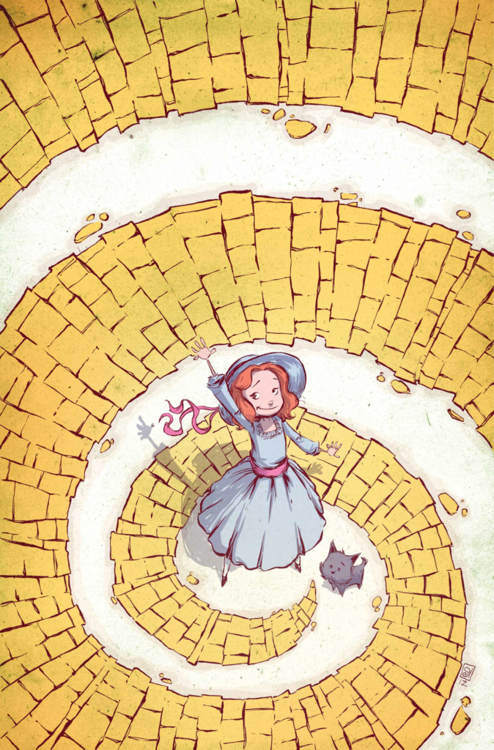
From Marvel’s “The Road to Oz” comic book, artwork by Skottie Young.
It’s time for our second monthly “Icons Week” here at Reel to Reel, friends, and starting Monday we’re going to be focusing on that lovely little girl from Kansas who took us all on a journey over the rainbow. I think I’ve written enough here by now about how much I love The Wizard of Oz and its various interpretations, and this week I’m going to bring you five different looks at the story, including three variants of Dorothy’s original journey and two films that depict future adventures in the land of Oz. Here are the movies and actresses we’ll talk about next week:
- Dorothy Dwan in The Wizard of Oz (1925)
- Judy Garland in The Wizard of Oz (1939)
- Liza Minnelli in Journey Back to Oz (1974)
- Diana Ross in The Wiz (1978)
- Fairuza Balk in Return to Oz (1985)
Five films, five very different interpretations of the Land of Oz that I’m really looking forward to sharing with you guys. But as we did with Batman, we really need to have a sort of baseline, a way to understand who this character is, so that we can understand what these different versions bring to the table. So in case you don’t know, let’s talk about…
The Character
Dorothy Gale is a little girl from the farmland of Kansas, where she lives with her Uncle Henry and Aunt Em. One day, a tornado rips Dorothy’s house from the ground with her in it, tossing her through the air, crashing her into the magical Land of Oz, and crushing the evil Wicked Witch of the East in the process. Dorothy’s only hope to return home is to visit the Wonderful Wizard of Oz, taking a long trip down a road of Yellow Brick, and encountering new friends and incredible dangers along the way.
There are the basics, friends, that’s who Dorothy is at her core, and that’s who we’ll be talking about in just a few days time. So have a good weekend, spread the word, and I’ll see you back here Monday to discuss the 1925 silent version of this classic tale.
It Means Hope
As you may know, I’m something of a Superman fan. This week, in my comic book column over at CXPulp.com, I talk a lot about the new trailer for Man of Steel that hit the internet this week. So watch the trailer, then click here to read my thoughts.
Trilogy Trouble
I am, as you may know, an English teacher. As such, I’ve got a particular sensitivity towards using words correctly. The wonderful thing about words, you see, is that by using them properly you can be much more specific in your meaning… more descriptive, more precise and, therefore, more effective in making the intent of your words clear. If I wanted to say, in one word, that something has been broken into ten pieces, I should be able to use the word “decimate,” because that was its original meaning. But too many people used it as a synonym for “destroy,” and now that secondary – and far less specific – meaning is also considered correct. And it irritates me. And it’s the same vein of irritation that strikes me when I hear people throw around the word “trilogy” willy-nilly.
 Strictly speaking, a “trilogy” can refer to any series of three, but I think using it that way cheapens its usage. The word “trilogy” should be reserved to refer to something a little different than just “three.” These days, it seems to be popular to group movies into trilogies, perhaps because it’s so attractive package them together in a DVD box set. You can go out and buy the Lord of the Rings trilogy, the Dark Knight trilogy, the Back to the Future trilogy, each with three films in a series, each of which fits the definition to varying degrees. But are they true trilogies? How about the X-Men trilogy? There have been two movies released since they started calling it that, although one could argue that they aren’t part of the original series, but rather spin-offs… but next year’s X-Men: First Class seems poised to tie everything together. Can you still make that arguement? There are three films with Evil Dead in the title, but when people talk about an Evil Dead trilogy they mean Evil Dead, Evil Dead 2 and Army of Darkness. And then there’s my personal favorite, the Star Trek Trilogy. In a series with either six, ten, or eleven movies (depending on how you count), the boxed set with “trilogy” on the cover collects numbers two through four, because technically, those are the only ones that take place (chronologically) one after another.
Let me break this down, guys.
The True Trilogy.
 In my personal, extremely picky (I know) vernacular, a true trilogy is one story told in three parts. The Lord of the Rings, for example, is a true trilogy. (Yes, I know Professor Tolkien never actually wanted to split the book into three volumes, that it was done on the insistence of a publisher who didn’t think people would want to purchase a novel the length of a phone book. For the purposes of this semantic discussion, that’s not actually important.) For me to consider it a true trilogy, it needs to be planned as such… maybe not necessarily conceived in three parts, but once finished, part three should end with the ending the author was working towards all along. True trilogies, by my definition, are really quite rare.
It’s not uncommon for someone to claim a story was intended as a trilogy even when it wasn’t. These usually don’t hold up to close scrutiny – the original Star Wars trilogy, for example… as much as I love the first three movies, if you watch them together it seems terribly unlikely that George Lucas had decided that Leia and Luke were brother and sister when he wrote the first screenplay, and even the question of Luke’s parentage isn’t a slam-dunk in that first film. Try to handwave it as being a “certain point of view” all you want, Obi-Wan – either you lied to Luke in Episode IV or Lucas hadn’t decided yet that Vader was Anakin Skywalker. The third Scream film also tries to claim trilogy status as well – Jamie Kennedy’s character appears in a post-mortem video that lays out the “trilogy rules” – but it’s written by a different writer than the first two films and the story it tells makes the second film (which was considerably better than the third) largely irrelevant, from a narrative standpoint. True trilogies are hard to find, but easy to confirm.
Far more common is…
The Retroactive Trilogy.
 A Retroactive Trilogy is what you get when a storyteller doesn’t have any solid or specific plans for a sequel, but once the first movie turns out to be a success, comes up with two more films that more or less go together. The original Star Wars, most likely, fits into this category much better than the “true trilogy” category. There are differing reports as to how much of Return of the Jedi was mapped out when Empire Strikes Back was written, it seems that at least some sort of framework was planned… as Luke is leaving Dagobah and Obi-Wan calls him “our last hope,” Yoda replies, “No… there is another.” Did they know the “other” was Leia when they wrote that line? I dunno. But they were at least thinking.
The problem with these Retroactive Trilogies is that sometimes the writers simply try too hard. They build everything up in part two to some gargantuan cliffhanger, but along the way they’re throwing so many things at the audience that the story starts to get lost and garbled. Then, when part three comes along, they’ve gotten so jumbled up that they just can’t untie the knot before the end. I don’t have the hatred for the Matrix sequels that some people do, but I can’t deny they fell victim to this problem. Even worse, I’d argue, were the second and third Pirates of the Caribbean films. Not coincidentally, I liked the fourth Pirates film much better than two or three, mostly because the plot had almost nothing to do with the previous three films, simply throwing Jack Sparrow and Captain Barbossa into another standalone adventure.
 One of the best Retroactive Trilogies I’ve ever seen is the Back to the Future series, with second and third installments that are entertaining in their own right, extend the world built in the first, tie back to the beginning in a logical way, and each have their own clear identity. But they’re still, to be clear, a retroactive trilogy. Yes, I know, we’ve all seen that “To Be Continued” logo at the end of Part I a million times… which is why most people forget that it wasn’t actually in the theatrical cut, but added to the VHS release after the first movie was a hit and the studio decided to go on and make some sequels.
The Trilogy in Name Only.
This is the one that really irritates me. When the trailers for Oz the Great and Powerful came out, they identified Sam Raimi as the “director of the Spider-Man trilogy.” Which made me bristle. The three Raimi-helmed Spider-Man movies are in no way a trilogy… not planned as such, not conceived as such, not executed as such. Aside from the lead characters, the only arc that even remotely welds them together is that of Harry Osborne, whose significance in Spider-Man 2 was negligible. Furthermore, Raimi never intended to stop at three. There were plans, at one point, to go to six films, but after Spider-Man 3 left audiences disappointed and Tobey Maguire hurt his back, everyone decided to walk away from the franchise and let someone else take a crack at it. (Incidentally, there are reports that the current Amazing Spider-Man film is intended to launch a trilogy. Whether there’s actually a three-part story planned or whether it’s just marketing using that word because they think it sounds sophisticated remains to be seen.)
 A Trilogy in Name Only is what you get when a series happens to end after the third installment. Blade, for example. Ocean’s Eleven. The original Robocop franchise. None of these were planned as three-volume stories. These just happened to stop after three movies for various reasons – failure of the third installment, age or lack of interest in the principal actors, whatever. Despite that, these films frequently get packaged and marketed as “trilogies.” Even the Godfather franchise falls under this category.
Sometimes, though, fourth films get made after a series seems over, taking away even its faux “trilogy” status. Toy Story is currently in this category, but every time you turn around it seems someone is starting a rumor about Pixar working on a Toy Story 4. (Seeing as how the third Toy Story had perhaps the greatest ending of any animated film in history, I really think that would be a huge mistake, but that’s an argument for another time.) You can find DVD sets of the TransFormers films marketed as a “trilogy” even as the fourth film is under production, and I distinctly remember the Saw movies marketed as a “trilogy” even back when they were actively cranking out a new movie every darn year.
What’s more, we’ve entered the age of the drastically-delayed sequel, which is taking older films that used to fall into this category and turn them into longer franchises: Die Hard, Indiana Jones… these used to be called trilogies, then fourth films came out. The same thing will happen to Jurassic Park next year.
Remakes or spin-offs incidentally, do not take a film out of this category. They’re working on a Robocop remake, but they’ll still market the original as a trilogy. They marked The Mummy franchise as a trilogy because they can easily (and rightfully) ignore the Scorpion King films.
 Evil Dead is an interesting case, as the new film is being presented as a remake, while at the same time the creators are publicly talking about continuing the original series (with an Army of Darkness 2) and eventually making a film that would bring the two incarnations of the franchise into a collision course. After AoD2 and a new Evil Dead 2, they’re considering a film that would feature Bruce Campbell’s Ash meeting Jane Levy’s Mia in a film that – I feel comfortable saying – would finally force the American Film Institute to stop placing Citizen Kane at the top of its “100 Greatest Films of All Time” list. At any rate, doing this would make for seven films total… two Ash Evil Dead movies, two Army of Darkness movies (also starring Ash), two Mia Evil Dead movies, then whatever they would call the final film.
None of this is to make any particular claims about the qualities of any film in any given category. There have been bad “true” trilogies and terrible “retroactive” trilogies. Sometimes a trilogy in name only can have three fantastic movies (and by “sometimes” I mean “mostly in the case of the Toy Story films”). This isn’t about judging any film as superior to any other. This is all about a plea from me to use words the way they are intended. If it ain’t a trilogy, don’t call it one.
The first Reel to Reel study, Mutants, Monsters and Madmen, is now available as a $2.99 eBook in the Amazon Kindle store and Smashwords.com bookstore. And you can find links to all of my novels, collections, and short stories, in their assorted print, eBook and audio forms, at the Now Available page!
2 in 1 Showcase Episode 286: A Weekend at the Movies
I don’t always post my pop culture podcast here at Reel to Reel, but when I do, you can bet it’s because there’s a lot of movie talk. In this week’s episode, my fiance Erin gives her opinion of the new 3D re-release of Jurassic Park, then I talk about the remake of Evil Dead and the DVD release of the horror/comedy John Dies at the End. If you enjoy my movie punditry, give it a listen!
And if you, like me, have a lot of overlapping fandoms in your personal geek wheelhouse, the rest of the episode concerns such subjects as the newest episode of Doctor Who, the upcoming Marvel’s Agents of S.H.I.E.L.D. TV show, and the passing of comic book greats Carmine Infantino and George Gladir.
2 in 1 Showcase Episode 286: A Weekend at the Movies
Gut Reactions: Ruby Sparks (2012)
 Directors: Jonathan Dayton & Valerie Faris
Writer: Zoe Kazan
Cast: Paul Dano, Zoe Kazan, Chris Messina, Annette Bening, Antonio Banderas, Aasif Mandvi, Steve Coogan, Toni Trucks, Deborah Ann Woll, Elliott Gould, Alia Shawkat
Plot: After an early success, writer Calvin Weir-Fields (Paul Dano) has been stuck with writer’s block for years and has found failure after failure in his relationships with women. Upon the advice of his therapist (Elliott Gould), he begins writing about a girl he sees in a dream. After a few dreams, the girl, Ruby (Zoe Kazan) appears in his home, miraculously brought to life. The two begin a romance that starts to crack when it becomes apparent that Ruby wants more of a life than the sequestered world Calvin has created for her, and in the end, Calvin finds himself in a struggle between love with the girl of his dream and trying to control that which he made.
Thoughts: Every so often those Netflix recommendations get it right. I’d never heard of this film, but when I read the description I figured I’d give it a try. I had no idea just how deeply it would hit me.
Admittedly, I may have a bit of an occupational bias when it comes to this movie. I may not be quite the success as a writer that Calvin Weir-Fields is (of course, as he reminds us during the film, he’s “no J.D. Salinger”), but I think any person who really pursues creative arts will be able to relate to this movie. The story hits upon a time in Calvin’s life when he’s struggling between crushing creative blockage and unbearable loneliness, something that’s all too real. And in fact, I can’t imagine there’s any writer out there who didn’t – at his weakest point – fantasize about doing exactly what he does in this movie. The idea of creating the perfect person, the perfect companion out of your imagination is tantalizing, powerful, and engaging.
SPOILERS AFTER THIS LINE. ———————————————————————————————-
Of course, this is just a fantasy, and like most fantasies it doesn’t really maintain if you hold it up to the light of reality. We all may have imagined being able to create the perfect girl, but a little critical thinking will reveal a thousand reasons this would be a bad idea. Zoe Kazan (who both played Ruby and wrote the screenplay) takes this idea and dissects it beautifully. Early on Calvin’s brother Harry (Chris Messina) points out the difference between this perfect, idealized girl and the realities of a functional adult relationship. When Ruby turns out to be more real and less idealized than Calvin thought, he begins to use his writing to manipulate her, which again backfires. His first effort makes her frighteningly clingy and needy, the next turns her into a bounding child. Even attempting to erase his mistakes bounces back on him, as he instead leaves her an emotional wreck.
The climax of the movie, I admit, is somewhat painful to watch. Frustrated and angry, Calvin reveals the truth of Ruby’s existence to her and “writes” her into performing a series of degrading, humiliating tasks (barking like a dog, for instance) to demonstrate his power over her. I cringed at each moment, watching him take someone he loved and turn her into a puppet. Each time he finished a sentence I found myself asking how he could do it, how he could possibly treat someone he loved in such a fashion, how anyone could be so frustrated that he’d do something that so utterly stains his own soul? Like the most painful things we see, though, it’s at its most horrible when we question what we would do in that same predicament. I don’t think I’d have it in me to do what Calvin does at the end, but it’s very easy to say that, knowing I’ll never have to face such a situation. In the heat of the moment, who can say what any of us are truly capable of? And if we ever did cross that line, would we ever be deserving of forgiveness, or capable of forgiving ourselves?
Although billed as a comedy, Ruby Sparks is definitely not cut from the standard romcom cloth that churns out so many practically identical movies a year. It’s not even the same as other “romantic dramadies.” For example, I recently watched Seeking a Friend For the End of the World, another romance from last year that treads the line between comedy and drama, including a dose of speculative fiction for the sake of the plot. In that one, Steve Carrell and Keira Knightley set out to find his lost high school sweetheart amidst the collapse of society that comes after final efforts to prevent an extinction-level asteroid from colliding with Earth fail. (Yes, this too is ostensibly a comedy.) While that movie wasn’t bad, in the end I found it sadly predictable. Ruby Sparks, on the other hand, isn’t predictable at all. Once Kazan deals with some of the more necessary tropes (showing how people react to this mysterious girl who’s appeared in Calvin’s life, a little interaction with his wacky family), the film is left in a sort of free roaming state where it could go absolutely anywhere. I never felt like I knew how the movie was going to end, which is probably the most exciting feeling I can imagine having during a movie. That open-endedness, that powerful, driving uncertainty finally brings us to an ending that’s ultimately sweet and hopeful, and a final line that couldn’t fit any better.
Again, this is a movie that struck me on a very personal level, which makes it difficult to say if I would recommend it to just anybody – I can’t honestly tell you if you would have the same visceral reaction that I did. But I can tell you that it’s well-written, well-acted, very emotional, and different from all the other cookie cutter movie romances in ways that satisfied me greatly.
The first Reel to Reel study, Mutants, Monsters and Madmen, is now available as a $2.99 eBook in the Amazon Kindle store and Smashwords.com bookstore. And you can find links to all of my novels, collections, and short stories, in their assorted print, eBook and audio forms, at the Now Available page!
How many Oz movies are there, anyway?
 After I posted my April Icons announcement (Dorothy Gale week) along with my March viewing list, a few people expressed surprise to me that there are so many movies based on L. Frank Baum’s Oz books. Ozophile that I am, I’m always on the lookout for new films and new entries into the land of Oz, but I forget at times that most people are only familiar with the 1939 MGM film starring Judy Garland (which will be a part of the Dorothy Gale Icons week, don’t worry). So that in mind, I’ve put together a list of Oz films, culled from a glance at IMDB.com. This may not be comprehensive, but even if I missed a bunch of movies, this should give you an idea that the world of Oz is so much bigger than many people think.
1. The Wonderful Wizard of Oz (1910)
2. The Land of Oz (1910)
3. The Patchwork Girl of Oz (1914)
4. The New Wizard of Oz (1914, uses elements of Baum’s novel The Scarecrow of Oz)
5. The Wizard of Oz (1925)
6. The Land of Oz (1932)
7. The Wizard of Oz (1933 short)
8. Oz University (1936)
9. The Wizard of Oz (1938 Short)
10. The Wizard of Oz (1939 — This is the classic version that everyone knows… the FIFTH attempt at adapting the first Oz novel, and the last time anyone would try to do it directly for a long time…)
11. The Land of Oz (1960 episode of series Shirley Temple’s Storybook)
12. Return to Oz (1964 TV movie)
13. The Wizard of Mars (1965, based on The Wonderful Wizard of Oz and Glinda of Oz)
14. Oz: The Tin Woodman’s Dream (1967)
15. The Wonderful Land of Oz (1969)
16. Favorite Children’s Books: The Wizard of Oz (1970)
17. Journey Back to Oz (1974)
18. 20th Century Oz (1976)
19. The Wiz (1978)
20. Thanksgiving in the Land of Oz (1980)
21. The Marvelous Land of Oz (1981)
22. The Wizard of Malta (1981)
23. The Adventures of a Man in Search of a Heart (1984 — Film about the Tin Woodman)
24. The Whimsical World of Oz (1985 — Documentary)
25. Return to Oz (1985 — Disney mashup of the novels The Land of Oz and Ozma of Oz)
26. The Life and Adventures of Santa Claus (1985 — Not strictly an Oz movie, but a Rankin/Bass film based on the novel by Baum with certain fairy characters and locations that would recur in the Oz books)
27. The Emerald City of Oz (1987)
28. The Marvelous Land of Oz (1987)
29. Ozma of Oz (1987)
30. Dorothy Meets Ozma of Oz (1987)
31. Toto’s Rescue (1989)
32. Trouble in Oz (1989)
33. The Wonderful Galaxy of Oz (1990 — Japanese sci-fi anime)
34. The Hollywood Road to Oz (1990 — Documentary)
35. The Dreamer of Oz (1990 — Biopic of L. Frank Baum starring John Ritter)
36. Dorothy and the Wizard in Oz (1993)
37. We’re Off to See the Munchkins (1993 — Documentary)
38. The Magic Book of Oz (1994)
39. Christmas in Oz (1996)
40. The Nome Prince and the Magic Belt (1996 — Uses parts of five different Oz novels)
41. Toto Lost in New York (1996)
42. The Return of Mombi (1997)
43. Underground Advnture (1997, based on Dorothy and the Wizard in Oz)
44. The Wicked Witch Project (1999)
45. Twister: A Musical Catastrophe (2000)
46. Lion of Oz (2000, based on the novel by Baum’s great-grandson, Roger S. Baum)
47. The Life and Adventures of Santa Claus (2000 — Remake of 1985 Rankin/Bass film)
48. The Muppets’ Wizard of Oz (2005)
49. Apocalypse Oz (2006)
50. Tin Man (2007 Miniseries)
51. The Patchwork Girl of Oz (2009)
52. The Tin Woodman of Oz (2009),
53. Heartless: The Story of the Tinman (2010)
54. The Witches of Oz (2011 Miniseries)
55. Tom and Jerry and the Wizard of Oz (2011 — Remakes MGM film with Tom and Jerry having a parallel adventure to that of Dorothy, surprisingly good)
56. Dorothy and the Witches of Oz (2012 sequel to 2011 miniseries)
57. Oz the Great and Powerful (2013)
And upcoming…
L. Frank Baum’s The Wonderful Wizard of Oz (2013, an attempt at a more faithful adaptation of the novel than most others)
Legends of Oz: Dorothy’s Return (CGI musical based on Roger Baum’s novel Dorothy of Oz)
Oz the Great and Powerful 2
Again, this is by no means a comprehensive list. I left off foreign language versions (of which there are many), video games and TV series (although I kept miniseries and made-for-TV movies), and film releases of “live” shows like The Wizard of Oz in Concert and The Wizard of Oz on Ice. I also stopped counting straight-up adaptations of the first Oz novel after we reached the Judy Garland film, but they came back after a while. Other versions were made in 1950, 1967, 1975, two in 1976, and 1982. Plus, this list was created just by looking at L. Frank Baum’s IMDB page, it doesn’t list most of the Oz films, adaptations, or “reimaginings” in which he received no credit on the website.
And we could still be here watching these for weeks.
So again, while I don’t expect anybody to rush out and become the sponge for Oz that I am, it’s nice to call attention to the fact that for those who want more, there’s almost always more available.
 Reel to Reel