Blog Archives
Lunatics and Laughter Day 2: Abbott and Costello Meet Frankenstein (1948)
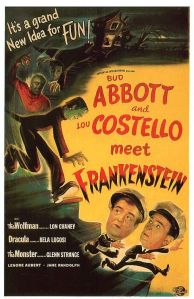 Director: Charles Barton
Writers: Robert Lees, Frederic I. Rinaldo & John Grant
Cast: Bud Abbott, Lou Costello, Lon Chaney Jr., Bela Lugosi, Glenn Strange, Lenore Aubert, Jane Randolph, Frank Ferguson, Charles Bradstreet
Plot: Chick and Wilbur (Abbott and Costello, respectively, although why they even bothered with giving their characters names at this point is beyond me) are employees of a delivery company. They get a nervous phone call from Larry Talbot (Lon Chaney Jr.) in London, asking about a pair of crates being sent to a house of horrors. He tells them that he’s flying to Florida the next day, and they are under no circumstances to deliver the crates until he arrives. The full moon rises in London and Talbot undergoes a startling transformation, becoming a Wolfman. Confused by the growling on the phone, Wilbur hangs up. Moments later, Mr. McDougal (Frank Ferguson) arrives to pick up the crates, which he claims contain the remains of the true Count Dracula and Frankenstein Monster. He tells this to Sandra (Lenore Aubert), Wilbur’s girlfriend, who Chick thinks is far too alluring to be with his bumbling friend.
Despite the call from Talbot, McDougal has the proper paperwork, so Chick and Wilbur deliver the crates To McDougal’s House of Horrors. Wilbur is on-edge, surrounded by the creepy contents, but Chick is convinced Dracula and the Monster are just characters from stories. As he leaves Wilbur alone, Dracula (Bela Lugosi, reprising his role for the first time since 1931) rises from his coffin, terrorizes him, and mesmerizes him. With Wilbur entranced, Dracula awakens the Frankenstein Monster (Glenn Strange). McDougal and Chick arrive and argue over where the exhibits are while Wilbur, hysterical, tries to explain what happened, but McDougal has them arrested.
Dracula flies to a remote castle where waits Dr. Stevens (Charles Bradstreet) and his assistant… Wilbur’s girlfriend, Sandra. Dracula wants to avoid Frankenstein’s mistake and give the monster a new brain, one so simple and naïve that it will never question his master. Sandra, of course, has just the brain in mind.
Talbot finds Wilbur and Chick, just out of jail, and confirms Wilbur’s story. He has been chasing Dracula, but he can’t go to the police for fear of revealing his own secret. As the moon is about to rise, he gives Wilbur the key to his hotel room and begs him to lock him up overnight, not letting him out no matter what he hears inside. Wilbur’s compliance lasts almost 45 whole seconds, before he goes into Talbot’s room to bring him a bag he left behind. In another comedy sequence, Wilbur narrowly avoids being torn to shreds by a Wolfman he never sees.
McDougal, furious over Wilbur and Chick’s release from jail, meets insurance investigator Joan Raymond (Jane Randolph), who plans to use her feminine wiles to trick Wilbur into revealing the location of the missing exhibits. She narrowly avoids Sandra, who came by to arrange a meeting with Wilbur for that evening’s masquerade ball. Joan convinces him to take her to the ball as well, and while Wilbur revels in his two dates, Chick tries to figure out what his dumpy friend has that he doesn’t. (As Sandra tells him, “A brain.”) The two go to Talbot’s room, where they find it’s been torn apart. Talbot wakes and tells them about his curse – he was bitten by a werewolf, and transforms whenever the moon was full. As Wilbur saw the monsters, he pleads with him to help him. They don’t believe him, and continue their preparations for the ball.
Chick, Wilbur and Joan pick up Sandra for the ball (Wilbur allowing each girl to believe the other is Chick’s date). Sandra finds Joan’s ID card for the insurance agency, while Joan finds Sandra’s copy of Frankenstein’s book on life and death. Each suspicious of the other, they return and meet Sandra’s employer, Dr. Lejos, who Wilbur somehow fails to recognize as Dracula wearing a robe instead of his cape. Lejos insists that Dr. Stevens join them for the party, but Sandra suddenly claims she has a headache and can’t go. She brings Dracula aside and says that Joan and Wilbur’s snooping and Stevens’s inconveniently inquisitive nature are making the operation too dangerous. Angry, he hypnotizes her and bites her, and they go to the ball.
At the ball, Chick and Wilbur encounter a fearful Talbot, who is upset by Chick’s wolf-mask. Sandra, now a vampire, tries to bite Wilbur, but he’s saved by Chick and Talbot, seeking the now-missing Joan. As they search, the full moon appears and Talbot transforms. He attacks McDougal, who blames Chick when he sees the wolf-mask. The party goes mad and people flee, with Chick and Wilbur finding a hypnotized Joan with Dracula. He mesmerizes the boys and takes Wilbur and the girls away. Finally convinced, Chick finds Talbot and they go to Dracula’s mansion, where Wilbur’s brain is being prepared for transplant. Talbot and Chick burst in. Talbot is about to free Wilbur, but once again, he transforms, and Frankenstein’s Monster breaks free. The five of them engage in a mansion-encompassing battle of positively Scooby-Doo-ian proportions, until finally the Wolfman seizes Dracula and they plunge off a cliff. The Monster chases Chick and Wilbur to the dock, where Stevens and Joan set him on fire. As they sit in a boat, Wilbur berating Chick for not believing him, a cigarette hovers in the air, and the unmistakable voice of Vincent Price introduces himself… he’s the Invisible Man.
Thoughts: This film is, inarguably, the greatest horror-comedy ever made. Okay, maybe it’s not inarguable. You can argue it. You’d just be wrong. What’s not arguable, however, is that it is by far my favorite movie out of all the films selected for Lunatics and Laughter, and (with the possible exception of Ghostbusters) the one that I’ve watched the most times. It isn’t Halloween unless I see Bud and Lou go toe-to-toe with the greatest Universal Monsters.
That, in fact, is what makes this such a fantastic movie, friends. Universal Studios took their two greatest comedic stars at the height of their popularity and mashed them into a movie with three of their most popular monster franchises, even getting the classic Bela Lugosi and Lon Chaney Jr. to reprise their roles as Dracula and the Wolfman, respectively. (Only Boris Karloff as Frankenstein’s monster is missing from the classic trinity, and he would get his chance to dance with the boys later in Abbott and Costello Meet the Killer, Boris Karloff and again in Abbott and Costello Meet Dr. Jekyll and Mr. Hyde).
It’s such simple alchemy – director Charles Barton got five amazing performers and allowed them to do what they do best for 83 incredible minutes. Abbott and Costello pull off the same sort of brilliant wordplay and slapstick that made them Hollywood legends, while Lugosi, Chaney and Strange (playing the Monster for the third time since Karloff’s retirement) give their performances all the force and horror they had in their respective series. The film doesn’t bother with little things like continuity either – there’s no effort to explain how Talbot knew Dracula or the monster, how Dracula found the creature’s remains, or even how any of the monsters were alive, as most of them had a tendency to die at the ends of all of their films. The sequels usually had a halfhearted resurrection scene, but Barton sees no need to even bother with that. The audience doesn’t care about any of these things. They know who Bud and Lou are, who Dracula and the Wolfman and the Monster are, and that’s all they need.
And damned if they weren’t right.
Like I’ve said, comedy and horror are flip sides of the same coin, and I’ve never seen a movie that demonstrates it as perfectly as this one. Our five lead characters (because that’s who Bud and Lou are, no matter what names they were using in the movie, they played the same two characters they always did) come from totally different styles of film: slapstick comedy and tales of pure terror. But when we put them together there is no clash. Everybody is themselves, everyone is entirely in-character, and it all fits together seamlessly. Even the scenes with Lugosi popping in and out of his coffin, giving Costello the stimuli for one of his legendary freak-outs, works for a Dracula who simply enjoys toying with his eventual prey. He even pulls the same sort of hypnosis and gets the same light-across-the-eyes treatment as he did in the original 1931 version of Dracula.
The plot, meanwhile, is straight out of the horror movie handbook. Dracula’s scheme to give the monster a simple brain keys into Costello’s movie persona perfectly. At the same time, it’s still the kind of devilish plan that many a horror movie villain has concocted over the years. Hell, let’s be honest – it’s a more logical plan than thousands of the others movie monster baddies have conjured up over the years. Talbot’s logic – “the police won’t believe me unless I tell them I’m a wolfman” – is kind of sketchy. It’s more likely they’ll just think him even crazier. But it’s still the same sort of logic that dominated this sort of movie back in the 40s and 50s, and therefore is easy to forgive. Similarly, the special effects are of the highest quality available at the time. Talbot’s werewolf transformation looks as good as it ever did in his own films. And while it may be pretty obvious that the Monster burning on the dock at the end is a mannequin being pushed along with sticks, in 1948, how else were you gonna get that shot?
Truly, the only moment that strains credibility, even for the time, is when Talbot and Chick plan their rescue mission. Talbot tells Chick they should hide and wait, since it is now morning and Dracula will be helpless until nightfall. Um… wouldn’t that make this the perfect time to attack? Come on, dude. (Honorable mention, though, goes to the fact that Talbot makes his transformation four nights in a row. Isn’t three usually the limit for a full moon?)
Bud and Lou, a classic vaudevillian comedy team whose act translated to film and television far better than most of their contemporaries, pull off a lot of the same shtick they usually do. They engage in verbal battles, with Bud tossing out unnecessarily complicated words so Lou can amusingly misunderstand them. Bud leaves Lou alone at inconvenient moments so he can be the sole witness to creepy happenings and have entertaining panic attacks. And once or twice, Lou is allowed to get the better of his buddy in a battle of the logical fallacies. In short, they take their standard routine and inject it into a horror movie. But not for one second does it feel forced, do any of the comedic interludes feel like a distraction, or does any of it feel like padding. They’re just there to have fun, as they always do. (Reportedly one scene – where Wilbur sits on the Monster’s without realizing it – took an absurdly long time to film because Glenn Strange simply couldn’t stop laughing at Costello’s antics in his lap.)
Even the old comedy trope – the panicky one sees the madness, the straight man conveniently misses everything until the last minute – feels fresh and original here. And no, it wasn’t, not even in 1948. When Chick pulls out the wolf-mask, you just know there’s going to be a moment when Wilbur encounters the real Wolfman and thinks it’s his buddy in disguise. You’re waiting for it. You would feel disappointed if it didn’t happen. But Abbott and Costello never disappointed on that front.
The finale is simply great. From the moment Talbot and Chick arrive at the mansion until Vincent Price makes his uncredited cameo, we go through one chase after another, with doors and props being smashed at every turn, our heroes bumbling into the monsters at the worse possible moments, often saved through circumstance, luck, or the good ol’ Rule of Funny. If you are physically capable of watching this movie without laughing, you need intense psychoanalysis. And if you didn’t love the Universal monsters before, this will do the trick.
Mutants, Monsters, and Madmen Day 4: Dracula (1931)
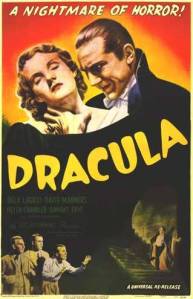 Director: Tod Browning
Writer: Hamilton Dean & John L. Balderston, based on the play by Garrett Fort, based in turn on the novel by Bram Stoker
Cast: Bela Lugosi, Helen Chandler, David Manners, Dwight Frye, Edward Van Solan & Francis Dade
Plot: The mysterious Count Dracula and his unwitting slave, Renfield, travel to England. When the ship is arrived, the entire crew and passenger manifest is dead, save for Renfield, who has gone mad. Dracula takes up residence in an abbey near Renfield’s sanitarium, and mysterious sightings and deaths occur, spurring the noted professor Van Helsing to confront the Count, and expose him for what he truly is – a vampire.
Thoughts: I’ve been waiting for this one. The Bela Lugosi version of Dracula, more than any other film or piece of pop culture, is what has helped to inform our current perception of the vampire. (Because the things in Twilight are not vampires, damn you Stephenie Meyer.) A lot of people don’t even realize how many of our current tropes come from this film or its sequels or imitators – the explicit connection of the vampire to bats, for example (where in the past – and even in this film – vampires could transform into bats, wolves, mist, and other things), or their aversion to sunlight. As important as those things are to current vampire lore, they didn’t come from the classic lore. (Which raises the question – if the Universal pictures depiction of the vampire hadn’t made him allergic to sunlight, would Meyer still have felt the urge to make Edward Cullen sparkle as an aversion to that trope? Hmm. Okay, I think I need to stop talking about Twilight now.)
Lugosi pops in with his tuxedo, his cape, his pendant, and those convenient beams of light that always seem to fall across his eyes and he absolutely owns the room, mesmerizing whoever’s on screen with him and whoever happens to be watching him. He may not be overtly sexual in the way that writers have tried to make vampires since the rise of Anne Rice, but he’s clearly seductive in a way that defies explanation. Even without the supernatural powers of the vampire, Lugosi’s presence would command anybody.
Other classic horror character tropes appear to be in their infancy here as well. Renfield, once Dracula has possessed him, is extremely effective. Dwight Frye has a madness in his eyes that spreads throughout his entire face. As he smiles and peers up the staircase of the ship at the camera, you find yourself absolutely chilled to the bone – he’s a madman, and he’s coming after you next. The Renfields of this world may come second to the Igors as the horror movie second bananas, but when played right, I’d be more scared of a Renfield any day. The atmosphere of the film is powerful as well – the scenery is fantastic, and the scenery is the stuff of every classic haunted house.
As masterful as Lugosi and Frye’s performances are, however, some of the other elements of this 80-year-old film just don’t hold up as well. Granted, you’ve got to make allowances for the special effects limitations of the time, but the scene towards the beginning where Renfield leans out of his carriage to see a bat flying in front just yanks a modern audience out entirely – it looks as though someone is dangling a rubber bat from a fishing pole, which probably isn’t that far from the truth.
You can’t blame age on stale performances, though, and Lugosi and Frye are really the only memorable actors in the film. The women are mannequins, and Edward Van Solan’s Van Helsing is forgettable at best. David Manners as Jonathan Harker is just plain bland, vanilla, and utterly unexciting.
The climax of the film, however, is what really hurts it. After so much tension and so much buildup, the ending just doesn’t excite. Van Helsing simply marches into Dracula’s lair and stakes him – off-camera at that. Again, I’m trying to make allowances for the time period. There wasn’t going to be any gory close-ups or a fountain of blood (like in the painfully weak Mel Brooks comedy, Dracula: Dead and Loving It), but at the same time, I can’t help thinking there could have been more. In truth, I think it speaks to how the still-evolving language of film hadn’t really been solidified yet. The film is based on the stage play based (legally, unlike Nosferatu) on Bram Stoker’s novel, and in 1931 they were still filming movies as if they were stage plays. I actually worked backstage on a production of this play several years ago, and I know how effective the final scene can be when done properly, but film is an entirely different medium with different demands.
The same goes for the novel – in the book, a great deal of the tension and fear is internal. It’s a lot harder to do that in a movie. You need to give the audience something to look at, something to see and fear. This is one of the reasons I’m not a purist when it comes to film adaptations. Sometimes, what works great on the printed page just doesn’t work on film. This is a case where the screenwriters should have found a more dramatic way to stage that final moment between Van Helsing and Dracula, some way to get the audience more engaged, than just waltzing in and driving in the stake.
I look back at these comments and I start to feel a little worried about myself. This film is a classic of the genre, isn’t it? I sure as hell haven’t endured for 80 years, do I really have the right dismiss something that millions have found frightening? Worst of all, what if I’m falling victim to the same mindset that I so often accuse my high school English students of having? What if I’m unable to divorce myself from my modern mindset and appreciate the film for what it was when it was created?
A terrifying thought.
But then I look at the next film on my list, a film released in the same year as Dracula, and one that I do consider a masterpiece of cinema. And I think, “Maybe Dracula simply doesn’t hold up the way Frankenstein does.”
Mutants, Monsters, and Madmen Day 2: Nosferatu (1922)
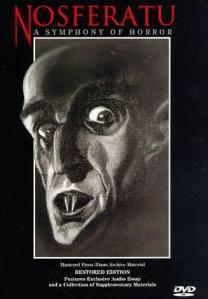 Director: F.W. Murnau
Writer: Henrik Galeen
Cast: Max Schreck, Gustav Van Wangenheim, Greta Schröder, Alexander Granach, Georg H. Schnell
Plot: A wizened old man seeks a new home and becomes obsessed with the wife of his real estate agent. As it turns out, the mysterious Count Orlok has a much darker agenda than finding a castle to call his own. This unauthorized adaptation of Bram Stoker’s Dracula is rightly considered a classic.
Thoughts: You don’t often see a movie that resulted in the bankruptcy of a studio considered one of the greats (except, of course, Cutthroat Island), but here ya go. The estate of Bram Stoker refused to allow permission for F.W. Murnau to adapt Dracula in a movie, but showing the kind of spunk and sass that have made the Germans so beloved throughout history, Murnau just changed the names, abandoned some subplots, and made it anyway. Stoker’s estate sued, Prana Film went out of business, and an attempt was made to destroy all copies of the movie. Fortunately for us, that attempt failed, and the movie is now in public domain.
This film, a silent movie of course, is incredibly successful at creeping you the hell out, and a lot of the credit for that has to go to Max Schreck as Count Orlok. Although he doesn’t really fit into what we not think of as a classical interpretation of Dracula (although the “classic” Dracula is really Bela Lugosi’s interpretation), he’s become an archetypical monster in his own right. Orlok’s body is incredibly slender, almost unnaturally so – his limbs, his torso, his head all look like they’ve been stretched out. The extremities, on the other hand, are all pointed and sharp – his fingers, his nose, his chin, his ears. Add that to his sunken eyes and you can see monsters from throughout the 20th century. The long body stirs up images of H.R. Giger’s Alien, the pseudo-zombies from the 2007 I Am Legend, any manner of creeps and crawlies, all the way up to the new Slender Man urban legend. In the introduction to this little project, I talked about the unknown being one of the pervading human fears. I didn’t mention one that may be even a little stronger – the manipulation of what is known. Orlok’s body is supposed to be human, but the little tweaks and alterations that define the character make him something even worse than what we don’t know: it makes him into what we should know, but don’t.
Think of it this way. We turn on the news, we hear terrible stories about things done to children by some nutjob or psychopath. I don’t feel the need to elaborate here, you guys know as well as I do what some human-shaped monsters are capable of. We hear these stories, and we think it’s terrible. But how much worse is it if the monster isn’t some random stranger, but someone the victim knows, someone they thought was a friend, maybe even a member of their own family?
It’s an extreme example, but the same principle that makes Orlok so creepy. Fortunately, trapped as he is on the movie screen, it’s a hell of a lot safer than the psycho on the news.
Anyway, on to a bit lighter fare. I haven’t included many silent films in this project (just one more after this one), but this movie really illustrates the need for a good print of these films. Nosferatu, of course, is in public domain now, which allows anybody to do whatever they want with it. In some ways, that’s a good thing – look at the 2000 film Shadow of the Vampire, about the making of Nosferatu, in which Willem DaFoe plays Max Schreck as a real vampire. It’s a great piece of work that couldn’t have been made were it not for public domain laws. (Which is funny, when you think about how Nosferatu was made in the first place, but there ya go.) The problem is, this allows people to put out really bad versions of the film. This was one case where I didn’t think I would need to turn to NetFlix for my hit, as I already happened to have a DVD set of many, many vampire films, Nosferatu included. As I started the movie, I realized that this version had actually changed all the title cards, replacing the names of Orlok and company with the original names from the Dracula novel. I realize, logically, that this shouldn’t have impacted my enjoyment of the movie, but I had a gut-level reaction that rejected the entire thing as wrong and bad and evil!
I turn into a purist at incredibly strange times.
So I did turn to NetFlix, where I found Nosferatu: The Original Version, which did in fact have all the classic names right where they belonged. This was much more acceptable… but in a few minutes, I found a flaw with this version as well. The music. Dear lord, the music. Old silent films we watch today don’t have any soundtrack except the one tagged on by whoever releases the DVD, and whoever put out the “original Version” of Nosferatu included one god awful super-synthesized soundtrack that went from happy, chirpy music at the beginning to a better (but weak) score towards the end. You’ve got to have the right music for these silent movies to make them come across properly. NetFlix also has a listing for Nosferatu: The Gothic Industrial Mix which, frankly, is a prospect I find horrifying.
While I can appreciate the artistry of these old silent films, I do have to admit, it’s hard to connect with them. I’m used to a completely different kind of filmmaking, and although there’s a definite style to telling a story I this way, it’s not my style. Only one more film from the silent era, and then we’ll move on to the talkies. Come back tomorrow for 1925’s Phantom of the Opera.
 Reel to Reel