Category Archives: Projects
Mutants, Monsters, and Madmen Day 3: The Phantom of the Opera (1925)
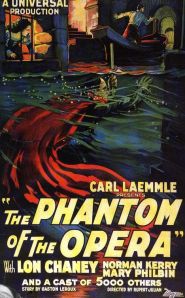 Director: Rupert Julian
Writer: Walter Anthony & Elliot J. Clawson
Cast: Lon Chaney, Mary Philbin & Norman Kerry
Plot: As new owners take possession of an Opera House, they begin to hear tales of a Ghost that inhabits its walls. The Phantom, as he calls himself, begins leaving threatening notes, telling them to place Christine Daae in the lead role of their performance of Faust. When they fail to comply, a curse is brought upon the house, the Phantom abducts Christine, and a chase for her life and the survival of the opera house ensues.
Thoughts: This is the last of the silent films I’ll be watching for this little experiment, but I think it’s easily my favorite. To begin with, it’s just extremely well made. The sets are elaborate and well-constructed, the performances aren’t quite as over-the-top melodramatic as many silent era performances tended to be, and the work of the immortal Lon Chaneyas the Phantom is truly extraordinary. It’s said he did his makeup himself, and that it was hidden from the audiences until the premiere of the film. Contrast that to the movie trailers we get these days, that give away the entire damn movie in 90 seconds. Chaney, friends, was a true showman.
But I think something else that helps this film appeal to me is that it feels more modern in the telling than the other movies I’ve watched. It’s still silent, of course, but I’m starting to see a lot of the language of modern storytelling begin to appear. This film is not merely a filmed stage play, the way so many early films are. There are different angles, different cuts, different ways of telling the story we didn’t see before. It’s not as drastic as the cinematic evolution we’d later get in Citizen Kane, of course, but it’s definitely there. There’s a scene, for instance, where Christine (Mary Philbin) and her lover (Norman Kerry) fall down in the midst of an angry mob. Instead of watching them overwhelmed, the camera stays with them while the mob runs around it. It’s not an unusual shot at all by modern standards, but by the standards of the time it was a really clever trick.
In terms of horror, we’re seeing the monster beginning to evolve as well. The Golem was literally a lifeless beast, propelled by the whims of its creator. Count Orlock in Nosferatuwas evil for evil’s sake – which can be terrifying, but lacks some depth. Erik, the Phantom, progresses cinematic monsters to the next level by giving him an actual motivation: love. Granted, it’s a sick, twisted kind of love, but let’s be honest here, so are half the relationships you see on screen these days. (It is arguable, for example, that Erik is any worse for Christine than Edward is for Bella in the Twilight franchise.) Erik is a madman, of course, and a multiple murderer, but by giving him that warped love for Christine as his motivation, we’re given for the first time a monster that we can really understand.
Aside from his motivation, the Phantom’s methods also start to hint at the evolution of monsters in modern cinema. We see him employ a lot of the techniques that become familiar in later years – not just the secret passages and the skulking in the shadows, but the methods of abduction, of leaving the bodies of his victims in rather theatrical poses to best terrify the survivors, and the use of deathtraps. I really liked the deathtraps, in fact – rooms of mirrors, hotboxes, tricking Christine into starting a flood that threatens the life of her lover… these are the trademarks of later monsters and mad scientists, everybody from the Joker to Jigsaw, and it all seems to begin right here.
Once again, though, I’m forced to deal with what seems to be a piecemeal print of the movie courtesty of Netflix. The film is dark, moody, atmospheric – all kinds of great adjectives you want applied to a horror movie. Then, out of the blue, a scene in the middle of the film is in full color. It doesn’t quite look as oversaturized as most colorized movies, so I’m forced to wonder if the scene in question is actually taken from another film and wedged in here – but all of a sudden we see the monster waltz into a ballroom scene wearing a bright crimson costume with a skull mask. The lighting is bright, the scene could be in broad daylight, and the effect is ruined. The only thing that makes me less than 100 percent certain the scene is plucked from another film is that Chaney arrives in the next scene – once we’re back in the proper black and white milieu – wearing exactly the same mask.
The ending is the biggest deviation from the original novel, and it seems we’re given here an early example of focus groups altering a film. The original ending filmed, like in the novel, featured the Phantom dying of a broken heart when Christine leaves him. Test audiences apparently felt it wasn’t dramatic enough, so a new ending was shot featuring the Phantom fleeing from an angry mob that finally manages to overwhelm him, beat him, and throw his body into the river. You’re even left with a nice shot of bubbles rising to the surface, leaving the lingering question of whether the Phantom died from the beating or drowned once they had him down.
More so than the other two silent films, in this one I’m really starting to see what we recognize as a horror film today. And I’m really enjoying that.
Mutants, Monsters, and Madmen Day 2: Nosferatu (1922)
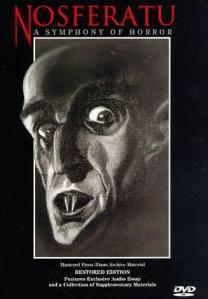 Director: F.W. Murnau
Writer: Henrik Galeen
Cast: Max Schreck, Gustav Van Wangenheim, Greta Schröder, Alexander Granach, Georg H. Schnell
Plot: A wizened old man seeks a new home and becomes obsessed with the wife of his real estate agent. As it turns out, the mysterious Count Orlok has a much darker agenda than finding a castle to call his own. This unauthorized adaptation of Bram Stoker’s Dracula is rightly considered a classic.
Thoughts: You don’t often see a movie that resulted in the bankruptcy of a studio considered one of the greats (except, of course, Cutthroat Island), but here ya go. The estate of Bram Stoker refused to allow permission for F.W. Murnau to adapt Dracula in a movie, but showing the kind of spunk and sass that have made the Germans so beloved throughout history, Murnau just changed the names, abandoned some subplots, and made it anyway. Stoker’s estate sued, Prana Film went out of business, and an attempt was made to destroy all copies of the movie. Fortunately for us, that attempt failed, and the movie is now in public domain.
This film, a silent movie of course, is incredibly successful at creeping you the hell out, and a lot of the credit for that has to go to Max Schreck as Count Orlok. Although he doesn’t really fit into what we not think of as a classical interpretation of Dracula (although the “classic” Dracula is really Bela Lugosi’s interpretation), he’s become an archetypical monster in his own right. Orlok’s body is incredibly slender, almost unnaturally so – his limbs, his torso, his head all look like they’ve been stretched out. The extremities, on the other hand, are all pointed and sharp – his fingers, his nose, his chin, his ears. Add that to his sunken eyes and you can see monsters from throughout the 20th century. The long body stirs up images of H.R. Giger’s Alien, the pseudo-zombies from the 2007 I Am Legend, any manner of creeps and crawlies, all the way up to the new Slender Man urban legend. In the introduction to this little project, I talked about the unknown being one of the pervading human fears. I didn’t mention one that may be even a little stronger – the manipulation of what is known. Orlok’s body is supposed to be human, but the little tweaks and alterations that define the character make him something even worse than what we don’t know: it makes him into what we should know, but don’t.
Think of it this way. We turn on the news, we hear terrible stories about things done to children by some nutjob or psychopath. I don’t feel the need to elaborate here, you guys know as well as I do what some human-shaped monsters are capable of. We hear these stories, and we think it’s terrible. But how much worse is it if the monster isn’t some random stranger, but someone the victim knows, someone they thought was a friend, maybe even a member of their own family?
It’s an extreme example, but the same principle that makes Orlok so creepy. Fortunately, trapped as he is on the movie screen, it’s a hell of a lot safer than the psycho on the news.
Anyway, on to a bit lighter fare. I haven’t included many silent films in this project (just one more after this one), but this movie really illustrates the need for a good print of these films. Nosferatu, of course, is in public domain now, which allows anybody to do whatever they want with it. In some ways, that’s a good thing – look at the 2000 film Shadow of the Vampire, about the making of Nosferatu, in which Willem DaFoe plays Max Schreck as a real vampire. It’s a great piece of work that couldn’t have been made were it not for public domain laws. (Which is funny, when you think about how Nosferatu was made in the first place, but there ya go.) The problem is, this allows people to put out really bad versions of the film. This was one case where I didn’t think I would need to turn to NetFlix for my hit, as I already happened to have a DVD set of many, many vampire films, Nosferatu included. As I started the movie, I realized that this version had actually changed all the title cards, replacing the names of Orlok and company with the original names from the Dracula novel. I realize, logically, that this shouldn’t have impacted my enjoyment of the movie, but I had a gut-level reaction that rejected the entire thing as wrong and bad and evil!
I turn into a purist at incredibly strange times.
So I did turn to NetFlix, where I found Nosferatu: The Original Version, which did in fact have all the classic names right where they belonged. This was much more acceptable… but in a few minutes, I found a flaw with this version as well. The music. Dear lord, the music. Old silent films we watch today don’t have any soundtrack except the one tagged on by whoever releases the DVD, and whoever put out the “original Version” of Nosferatu included one god awful super-synthesized soundtrack that went from happy, chirpy music at the beginning to a better (but weak) score towards the end. You’ve got to have the right music for these silent movies to make them come across properly. NetFlix also has a listing for Nosferatu: The Gothic Industrial Mix which, frankly, is a prospect I find horrifying.
While I can appreciate the artistry of these old silent films, I do have to admit, it’s hard to connect with them. I’m used to a completely different kind of filmmaking, and although there’s a definite style to telling a story I this way, it’s not my style. Only one more film from the silent era, and then we’ll move on to the talkies. Come back tomorrow for 1925’s Phantom of the Opera.
Mutants, Monsters, and Madmen Day 1: The Golem-How He Came Into the World (1920)
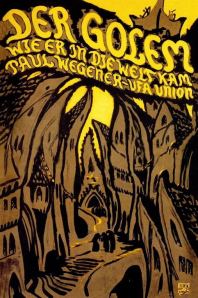 Directors: Carl Boese & Paul Wegener
Writer: Henrik Galeen & Paul Wegener
Cast: Paul Wegener, Albert Steinrück, Lyda Salmonova, Ernst Deutsch, Hans Stürm, Max Kronert & Otto Gebühr
Plot: In 16th century Prague, the Jewish people are being oppressed by a vindictive emperor who blames them for the death of Christ and accuses them of engaging in black magic. To protect his people Rabbi Löw (Albert Steinrück) creates a Golem (Paul Wegener), a powerful creature made from clay. Löw summons the demon Azaroth for the magic word needed to bring the Golem to life, and brings him to the Emperor’s court. During a display of magic the people of the court break the one rule they’re told to obey – don’t talk or laugh – proving that people in horror movies have been unable to follow simple directions since the beginning of the medium. The Golem goes on a tear and the Emperor agrees to pardon the Jews if Löw saves them. All is well, until Löw bothers to read the next page in his magic book, where he learns that Azaroth is going to come back and turn the Golem against him. No problem, though, he simply removes the amulet with the word of life from the Golem’s chest. It looks like things are fine, until Löw’s assistant gets jealous that the girl he desires is running around with someone else. He brings the Golem back to life, and he goes on a tear that threatens the entire city, forcing Löw to step forward and fight his creation once more. In the end, the Golem escapes Löw, but is defeated when he befriends a little girl, who simply plucks the amulet from his chest.
Thoughts: I didn’t know it when I chose this film to begin my experiment, but this silent German classic is actually the third film in a trilogy. The original The Golem was released in 1914, and its sequel, The Golem and the Dancing Girl, came out in 1917. This concluding chapter is the prequel to the other two, though, and is the one that is best-remembered today, and for good reason. First of all, it’s the only film in the trilogy that survives intact. More importantly, even at this incredibly early juncture, it’s easy to see in this movie a lot of the horror movie tropes that are so familiar today.
Beginning with Rabbi Löw himself, the character visually evokes both the archetypical pointy hat-wearing wizard, and the lab coated mad scientist of the likes of Victor Frankenstein. In fact, even though this film predates the most famous version of Frankenstein by eleven years, it displays a lot of the themes and ideas that we most clearly recognize as part of that franchise: the Golem himself is the creation of man, a giant creature of incredible strength that is turned to dark purposes against his will. Even his interaction with the children at the end seems to feed the later scenes of the Frankenstein monster playing with the famous little blind girl.
This film is considerably darker than Frankenstein, though. While Vic’s monster is usually portrayed as the misunderstood beast, a gentle giant of sorts, the Golem is no benign creature. He’s angry and surly from the first, and seems to revel in the destruction he causes. In fact, in the scene where he carries Miriam (Lyda Salmonova) down from the tower where he kills her lover, there’s a truly disturbing hunger in his eyes. When he lays her down on a table and runs his hands over her body, there’s a second there where the clay beast actually raping the young woman seems like a distinct possibility. Then there’s the demon-summoning scene itself. When the creature’s head first appears, it’s a jump-out-of-your-seat moment. It snaps into frame, this ugly face with bulging eyes that seems to be looking down at Löw with terrible glee. Once the shock passes and the camera zooms in at the head, you start to appreciate it for the prop that it actually is, but by then you’re already invested in it as a creature of darkness. Smoke billows out of its mouth, and you question just what the hell kind of Rabbi Löw actually is, if he’s willing to deal with a beast of this nature. Today, you know the head would be CGI and the smoke would probably billow with the shapes of Hell itself, and you know that it wouldn’t be a tenth as effective as it is in this simple scene.
This isn’t the first horror movie ever, of course, although it seems to be credited as being the first ever horror franchise, and I think that’s fair enough. It also gives me a chance, very early in the process, to make an important point: although I’m looking at film in this project, it would be a terrible mistake to pretend any art form exists in a vacuum. Movies can be influenced by novels, can influence comic books, can later be influenced by comic books, can feed influence back into novels. The film is based on actual Hebrew legend, but the filmmaker presents the legend in a way that’s very evocative of Mary Shelley’s Frankenstein, first published in 1818. The actual framework, though, as is the case with so much supernatural horror, comes from a religious stance. Regardless of your own personal religious faith (or lack thereof), it would be foolish not to recognize religion as part of culture, and as those things we find scary come directly from our culture, religion plays a vital role in deciding that. If anything, that’s only going to become more obvious as this little adventure continues.
Come back tomorrow and we’ll look at what may be the first vampire film of all time, the 1922 classic Nosferatu.
Mutants, Monsters, and Madmen: An Introduction
Fear is subjective. We need to agree on that right now or there’s really no point in continuing. What scares you and what scares me are likely to be very different things. And that’s normal, because those things we are afraid of, like those things we desire, are based on our collective life experiences. But there are some fears which are almost universal. The unknown, for example – something unfamiliar, something outside of our realm of experience can be full of great potential, but also great peril. A fear of the dark is largely an extension of our fear of the unknown – anything could be lurking in the shadows, and anything that spends so much time on the lurking part probably isn’t doing it because it wants to give you a big, warm hug and a kiss on the cheek.
And of course, we fear the monsters of this world, both literal and figurative, real and imaginary. And sometimes, we even fear with reason.
Despite that, though, we like to be scared. For thousands of years, we’ve gathered around camp fires to hear the stories of the Things in the woods around us, the vampires and werewolves and cannibals and madmen that creep about in the dark. For the past hundred years or so, we’ve gathered around a different fire: the bulb of a movie projector, allowing modern storytellers to terrorize us in new and different ways. We scream and we jump, we feel that jolt of adrenalin that comes with such fear and we laugh with relief when that fear passes.
We love scary movies for the same reason we love thrill rides and roller coasters – we get that rush of fear that can be so intoxicating without putting ourselves at any genuine risk. It’s remarkable what we, as a species, have devised to scare the crap out of ourselves.
But if what’s scary changes from person to person, how much does what is considered scary change over time? Look at the early icons of horror cinema, the Universal monsters. Dracula, Wolfman, and the Frankenstein monster were envisioned as chilling figures, but by 21st century standards they’re so tame they’ve become beloved by the smallest children. When I was growing up in the 80s, the Big Bads were Freddy Krueger and Jason Voorhees, and my parents steadfastly refused to let me see their movies. In retrospect they were right. I was a nervous child and I grew into a nervous adult, and I can only imagine the image of Kevin Bacon being impaled from beneath would have necessitated an entire ring of incredibly hot stage lights shining under my bed at all times, an effect which really should be reserved for the likes of Charlie Sheen. Today, though, watching those films doesn’t phase me in the slightest, nor do Freddy and Jason haunt the dreams of children today who are of the age I was then. And it’s not because they’re unaware of the monsters – kids these days are more aware than ever. It’s because, like Dracula and Doc Frankenstein’s bouncing baby boy, they no longer find them frightening. The horror icons of the past now walk a line between being macabre clowns and anti-heroes.
And new horror icons roll in, like Jigsaw, while old ones are recycled in sequels, remakes, reboots, relaunches, whatever it’s in vogue to call them today. And so it continues, because horror evolves with culture.
That’s what this little project of mine, Mutants, Monsters, and Madmen, is really about: the evolution of stories and story tropes over time. I want to look at stories of a kind and see how the telling changes over the years, and see if I can’t parse out why, and I’ve decided to start with horror movies as part of the most ambitious Evertime Realms Halloween Party of all time. With the help of my lovely girlfriend Erin (herself a horror fan much longer than I’ve been) and a few other friendly suggestions, I’ve complied a list of 35 of the most significant horror movies ever made. I don’t claim this list necessarily represents the best of all time (although many of these films would deserve a spot on that list as well), or even my personal favorites (some of which were lost when I pruned the original, much longer list down to 35). I do think, though, this represents a good cross-section of horror since the birth of cinema, with each film being a cultural milestone in one way or another. As I write this, on May 31 (yeah, I started that early) I’m planning to start watching these films in the order in which they were released, and discuss my thoughts on the film with you. Why is this movie important? Where did it come from? How did it influence the films that came later? And was it ever really scary?
If nothing else, it makes for a hell of a discussion topic, don’t you think?
At the time I did this project – spring through fall of 2011 – all of these movies were available via NetFlix, either streaming or on disc, so if you’d like to play along, throw ‘em in your queue!
 Reel to Reel