Category Archives: 4-Icons
Dorothy Gale Week Day 5: Fairuza Balk in Return to Oz (1985)
 Director: Walter Murch
Writer: Walter Murch, Gill Dennis, based on the novels The Marvelous Land of Oz and Ozma of Oz by L. Frank Baum
Cast: Fairuza Balk, Nicol Williamson, Jean Marsh, Piper Laurie, Matt Clark, Sean Barrett, Michael Sundin, Tim Rose, Mak Wilson, Denise Bryer, Brian Henson, Lyle Conway, Justin Case, John Alexander, Deep Roy, Emma Ridley, Sophie Ward, Fiona Victory, Pons Maar
Plot: It has been six months since Dorothy Gale (Fairuza Balk) came home following her adventure in Oz. Her Uncle Henry (Matt Clark) is working to rebuild the farm, destroyed by the tornado, and Aunt Em (Piper Laurie) is worried that the little girl is sleepless, stuck imagining the fairy land she “dreamed” about before. Dorothy scolds a chicken named Billina who has been unable to produce eggs, and finds an old key in the chicken coop. The design on the end of it seems to bear an “O-Z” – the symbol of the land of Oz. She shows it to Em as proof of her stories, but it only furthers her resolve to bring Dorothy to the a doctor. She tells Dr. Worley (Nicol Williamson) her stories of Oz, of her friends, of the Ruby Slippers that were lost as she flew home. Worley unveils an electrical device with a “face” that may cure her, and Dorothy sees a reflection of a girl (Emma Ridley) looking at her. The doctor and his nurse (Jean Marsh) prepare Dorothy to stay overnight for treatment. Dorothy is strapped onto a gurney for treatment, but she’s frightened by the device placed on her head. Before the Doctor can turn it on, the power to the hospital is knocked out by a storm. The Nurse goes to check on a screaming patient while the Doctor tries to repair the power, leaving Dorothy alone so the mysterious girl can unstrap her and let her free. Rushing outside, the girls are separated by a flash flood, and Dorothy clings to a floating chicken coop to ride out the storm.
In the morning, Dorothy finds that her hen Billina is in the coop with her, she begins speaking (voice of Denise Bryer). The coop has washed up on the edge of a desert, with lush, green land nearby. Dorothy realizes they must be in Oz, which means the sands beneath them are those of the Deadly Desert, which transforms any living creature that touches it to sand. Dorothy carries Billina to safety, leaping from one stone to another until she reaches the grass, unaware that some of those stones are watching her. The creature watching from the rocks rushes off to inform his king that she has returned to Oz, and has a chicken with her.
Dorothy and Billina find the old farmhouse where it crashed in Munchkinland, but realize the Munchkin City is gone, and the Munchkins with it. The Yellow Brick Road has been reduced to rubble, and she races along it until she comes to the destroyed remains of the Emerald City. The people have been turned to stone, including the Tin Woodsman and Cowardly Lion. They are attacked by creatures with wheels for hands and feet, who chase them into a hidden chamber. The lead Wheeler (Pans Maar) tells them they’ll destroy them, for the Nome King doesn’t allow chickens in Oz. Turning around, Dorothy finds a clockwork man with a plate that proclaims him “The Royal Army of Oz.” Winding him up with the key she found in Kansas, he activates and introduces himself at Tik-Tok (Sean Barrett). Upon the orders of the Scarecrow, he was locked in the chamber to wait for Dorothy’s return after the people began to turn to stone. Tik-Tok defeats the Wheelers and interrogates the leader, who tells them the Nome King is responsible for Oz’s devastation, and that only Princess Mombi can tell them where the Scarecrow is. In Mombi’s palace, they find a beautiful woman with a room full of interchangeable heads. She imprisons Dorothy in the attic, planning to come back for her when her own head is a bit older.
In the attic, Dorothy finds a pumpkin-headed man named Jack (Brian Henson), who tells her he was built by Mombi’s former servant to scare the witch. Instead of destroying him, Mombi tested a “Powder of Life” on him, then locked up the remaining powder with her original head. Jack believes his “mother” was enchanted by Mombi and hidden away. Dorothy and Jack sneaks out to steal the powder, but Mombi is alerted when her original head (Jean Marsh again) wakes up and shouts for help. The others have constructed a flying contraption from couches, leaves, and the mounted head of a Gump (Lyle Conway), which they bring to life with the powder and escape. They fly until the Gump comes apart and crashes on the mountain of the Nome King (Williamson), where the Scarecrow (Justin Case) is imprisoned.
The Nome King (happy that Billina has seemingly disappeared, although she is merely resting inside Jack’s hollow head) has transformed the Scarecrow into an amusing ornament for his vast collection, and claims his conquest of Oz was simply taking back what belonged to him – the gems from the Emerald City were all mined from his underground kingdom, after all. As she weeps for her missing friend, the Nome King seems genuinely touched by her tears, and offers her an opportunity to win him back – if she or her friends can guess which ornament he is, he will be set free. The Gump goes first, but fails in his effort and is transformed into an ornament himself – a condition of the contest the Nome King failed to mention before. Jack goes next, then Tik-Tok, and each are transformed. The Nome King offers to send Dorothy back home using the Ruby Slippers, which he found after she lost them, but she insists on trying to save her friends. She manages to rescue the Scarecrow, who was turned into an emerald, and realizes the people from Oz are all green ornaments. They quickly rescue the Gump, and the Nome King grows angry, sending an earthquake through the mountain. They find and transform Jack as the Nome King attacks them, enraged, tired of the games. He grabs Jack, lifting him to his mouth, but he’s stopped by a sudden clucking sound. Inside Jack’s head, Billina lays an egg, which rolls into the Nome King’s mouth. As he shrieks, he begins to crumble away, revealing that eggs are poison to Nomes. The mountain collapses, and Dorothy takes the Ruby Slippers from the Nome King’s body, using the magic to bring them back to the Emerald City, bring the people back to life, and return Oz to its former glory. With them is a green medal that was somehow stuck to the Gump. Dorothy guesses the truth, and transforms the medal back into the missing Tik-Tok.
The people of Oz ask Dorothy to stay and be their queen, but she wishes to return to Kansas. As she debates what to do, the women whose heads Mombi took tell the truth about her serving-girl: she is Ozma, queen and rightful ruler of Oz. (Also Jack’s “mother” and the girl who helped Dorothy escape the hospital), lost after the Wizard came. Freed from Mombi’s magic, Ozma is restored to the throne and promises to send Dorothy home, on the condition that she signal her should she ever wish to return to Oz again.
Thoughts: This film is an old favorite of mine, probably my first experience with Oz beyond the MGM Musical. It may, in fact, be what first stirred me on to read the further Oz books, when I heard it was essentially a combination of the second and third novels in the series, The Marvelous Land of Oz and Return to Oz. (Honestly, I don’t remember if I read the books before I saw the movie or vice-versa. I would have been 8 years old when this movie was released, and certainly old enough to have discovered the Oz shelf at the St. Charles Parish Public Library where I would be utterly lost for the next few years – a sojourn for which I am eternally grateful.) The writers took the characters and plots of both books and blended them together in a very satisfying way, creating a story that evokes parts of each of them, but manages to feel complete in and of itself. I won’t go into what parts came from which book (read them yourself – they’re in the public domain and free on the internet), but I can say that if I hadn’t read them myself, I wouldn’t have guessed the movie is a mash-up.
Fairuza Balk is the most age-appropriate Dorothy we’ve had yet (she was 11 at the time the film was released), and puts out a decent performance. She’s a young actor, obviously still learning, and you frequently hear the stilted delivery of a child actor trying to remember her lines. But there’s a nice bit of emotion and determination in her voice, even during those abrupt and unnecessary pauses. She feels like a Dorothy who’s already been through a lot and has to reconcile the world she experienced with the ordinary one in which she was raised. It’s a nuanced idea, one that Baum never dealt with much in the books (except perhaps in The Emerald City of Oz), and rather daring for Disney to attempt in the 80s.
Except for Dorothy and Mombi, most of the cast is realized through the use of Jim Henson’s Creature Shop, doing a job that these days would probably be mostly CGI. I find the practical puppetry of Tik-Tok and Jack Pumpkinhead far more impressive than most computer animated creations, however, and they add a sense of realism to this fantastic setting. The character designs also skew very close to the illustrations in the original Oz books — even the three characters from the original Wizard of Oz are made up to look like their book versions rather than Jack Haley, Ray Bolger or Bert Lahr. Of all the versions of Oz I’ve looked at this week, this is the one that feels most like the fantasy epic it is at its heart, and I attribute a lot of that to the designs of the characters and sets used here. There’s also some well-done stop motion animation for the Nomes, which are more like living rocks here than the dumpy creatures of the novel. The animation, done by Claymation creator Will Vinton, looks very impressive, and I can try to reconcile the changes to the characters with an attempt to make them more menacing – although the Nome King in Baum’s novels is one of the few truly credible threats to the power of Ozma and Glinda, his appearance is by no means something that will inspire fright.
Return to Oz was thought of by many people as an attempt to do a sequel to the Judy Garland movie, but this film has only a few nods to the MGM musical – the use of Ruby Slippers being the most obvious. The sequence in Kansas at the beginning, like in the MGM movie, introduces actors that would reoccur in Oz and elements that would reflect back on Dorothy’s second adventure (the pumpkin, the lunchpail, and the mechanical man most obviously). Fortunately, the end of the movie makes it pretty clear this time, it’s not just a dream, which Baum never intended in the first place.
As far as deviating from Baum’s intentions, the villains are farther off than anything else. Mombi has little in common with her counterpart from the books, borrowing her most distinctive aspects from Langwidere, the head-swappin’ princess from Ozma of Oz. The Nome King himself, though, is the biggest departure, showing a sense of compassion that doesn’t bespeak the character from the book at all, although the temper he displays at the end feels appropriate. His appearance is also very different from the pudgy, deceptively silly character he is in the books. In this version, he begins as a creature made of solid rock, and slowly becomes more human with each person added to his collection of ornaments. Once Dorothy starts setting her friends free he grows more and more inhuman again, finally crumbling to skeletal rock after Billina’s egg poisons him. It’s an interesting idea that would probably work with some villains, but doesn’t really fit the Nome King of L. Frank Baum’s novels all that well.
Despite that, this movie feels more like Baum’s Oz than any Oz movie I’ve ever seen – not perfect, mind you (the Emerald City’s sudden proximity to the very edge of Oz still strikes me as being somewhat ridiculous in the context of any version of the first story), but closer than anything else. We’ve still yet to have a truly faithful big-screen adaptation of The Wonderful Wizard of Oz, let alone the rest of the books in the series, but if we ever get them, the look and flavor of this movie wouldn’t be a bad template to use at all.
Now I know I promised you five films for each week of this project, but I feel a little bad, as the most recent significant version of Dorothy Gale I can find in cinema is nearly 30 years old. Hollywood really needs to pick up the pace. But in order to have something a little more recent, just for perspective, come back tomorrow for a Dorothy Gale Week bonus! This time we’re going to the small screen to see how Zooey Deschanel depicted Dorothy Gale (or “D.G.”) in the 2007 Sci-Fi Channel miniseries Tin Man.
The first Reel to Reel study, Mutants, Monsters and Madmen, is now available as a $2.99 eBook in the Amazon Kindle store and Smashwords.com bookstore. And you can find links to all of my novels, collections, and short stories, in their assorted print, eBook and audio forms, at the Now Available page!
Dorothy Gale Week Day 4: Diana Ross in The Wiz (1978)
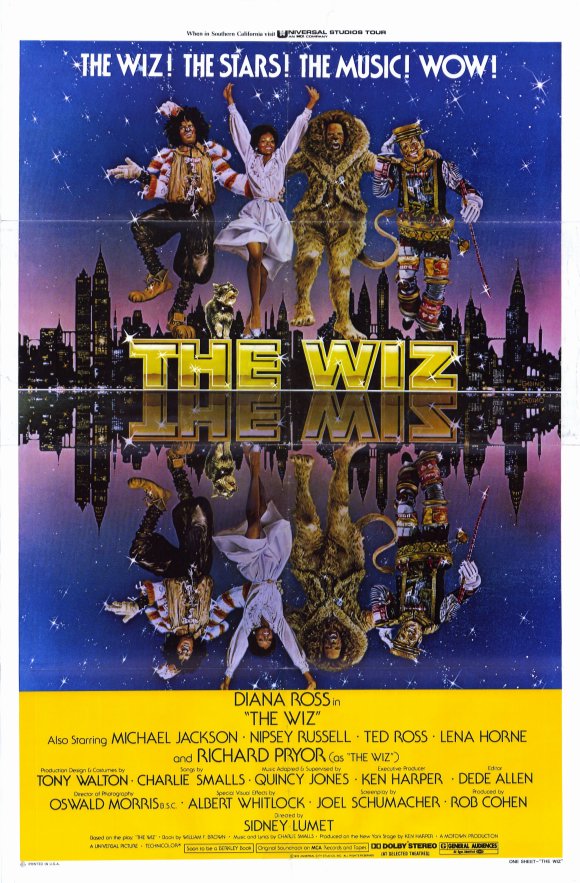 Director: Sidney Lumet
Writer: Joel Schumacher, based on the play by Charlie Smalls and William F. Brown, based on the novel by L. Frank Baum
Cast: Diana Ross, Michael Jackson, Nipsey Russell, Ted Ross, Mabel King, Theresa Merritt, Thelma Carpenter, Lena Horne, Richard Pryor, Stanley Greene
Plot: In modern-day Harlem, a family gathers for Thanksgiving dinner. Dorothy (Diana Ross) is a schoolteacher, living with her Aunt Em (Theresa Merritt) and Uncle Henry (Stanley Greene), who wishes for her to break free and find a life of her own. Her dog Toto rushes out into a snowstorm after dinner, and Dorothy races after him. A cyclone appears in the snow, grabbing them both and pulling them into the air, where we see the cyclone being manipulated by a woman in the stars (Lena Horne). She drops Dorothy into a pit of sand near a graphitti-covered wall, and the people painted onto the wall come to life. Although initially frightened, the people from the walls begin celebrating her for killing the Wicked Witch of the East, knocking down a sign on her during her descent. The people, the Munchkins, were trapped in the wall by the Witch’s magic, and now are free. Miss One (Thelma Carpenter), the Good Witch of the North, thanks Dorothy and gives her the Wicked Witch’s Silver Shoes. Miss One doesn’t have the power to send Dorothy home to New York herself, and she knows the Wicked Witch of the West will be uninclined to help. Even Glinda, the Good Witch of the South, will likely be unavailable. Instead, she suggests Dorothy follow the Yellow Brick Road to talk to the Wiz.
As Dorothy walks through the strange city, unable to find the Road, she finds a Scarecrow (Michael Jackson) being tormented by a group of crows. She shoos the birds away and frees the Scarecrow. When he realizes the crows had tricked him into captivity, he reveals to Dorothy his head is stuffed with garbage instead of a brain. She suggests he come with her to see the Wiz for help. The Scarecrow finds the rubble of yellow bricks and they finally trace them to the Road. As they walk through the remains of an amusement park they find a trapped mechanical man beneath some rubble (Nipsey Russell). The Tin Man says it’s okay – he lacks a heart, and cannot feel. They help him to his feet and he joins them. As they pass the library, the Tin Man notices a statue of a lion is watching them. Inside the statue they find a real Lion (Ted Ross), who boasts to them but is soon revealed as a coward. He joins them as well.
Following encounters with creatures in the subway and a group of “Poppies” that try to tempt the friends away from the path, they arrive at the Emerald City, where the Great and Power Oz summons “the one with the silver slippers” to his chambers. Oz, appearing as a giant mechanical head, hears their requests and bargains with them: he’ll aid them if they can destroy Evillene, the Wicked Witch of the West (Mabel King). They find Evillene in a sweatshop beneath the city, where her Winkie captives are toiling away, when she hears of Dorothy’s quest. She sends out her motorcycle gang, the Flying Monkeys, to capture the girl. Although they are captured easily, Evillene finds she cannot take the Silver Slippers from Dorothy against her will, and instead begins torturing her friends, cutting the Scarecrow in half, flattening the Tin Man, and dangling the Lion from his tail as he shouts to Dorothy not to give up the shoes. When the Witch is about to throw Toto into a flaming cauldron, the Scarecrow tells Dorothy to pull the fire alarm, setting off the sprinklers. Toto is saved, and the water melts Evillene to nothing. The Winkies, free from the Witch’s enchantment, release Dorothy and her friends and celebrate. When they return to the Emerald City, they find the Wiz (Richard Pryor) has closed up shop, and is a phony, powerless little man sleeping on a cot. He reveals he’s just an ordinary man from Atlantic City, and only sent Dorothy to destroy Evillene because he feared her. As her friends lament, Dorothy points out to each of them how they’ve already proven they have everything they need. It seems that Dorothy will be trapped, though, when the woman in the stars appears. She is Glinda, the Good Witch of the South, and reveals to Dorothy that her silver shoes have the power to send her home, now that she truly knows herself. The Wiz asks Dorothy if she can help him, and she tells him that he, like the rest of them, can only be helped by letting people see who he really is. She says goodbye to her friends and she and Toto finally return home.
Thoughts: I can’t believe my first official Reel to Reel encounter with the dreaded Joel Schumacher comes in the form of this Broadway adaptation. There’s just something terribly twisted about that. Anyway, Schumacher’s script takes some liberties not only with the Oz formula, but even with the original play, which skewed closer to L. Frank Baum’s book. The play kept Dorothy on a farm, it’s the movie that moved her to a school in Harlem and put in the metaphor of Oz as a fantastic version of New York City. Fortunately, the changes actually work to create something that feels very different than other versions of Oz, yet still undeniably taps into the soul of what Baum created.
What I like about this version of the story is that is really shows the diversity of the basic Oz concept. The writers of the play and creators of the film took the skeleton of Baum’s story and created something different and unique. The appearance of the Munchkins, for example, is initially terrifying, even for someone who knows the story and surmises that they don’t actually mean her any harm. Resetting Oz in a dark fairy tale version of New York is an effective change as well, giving it a feeling of urban magic that sets it apart from the very rural feel of most traditional interpretations of the story.
On the other hand, there are some aspects in which this version skews closer to Baum than most other film versions… Dorothy wears Silver Shoes instead of Ruby Slippers, and doesn’t (technically) encounter Glinda until the end of the story, keeping the Witch of the North in her proper role at the beginning, whereas the MGM film and most other versions just have Glinda fill both of those parts. On the other hand, the implication that Glinda manipulated events just to bring Dorothy to Oz is a new idea to this version. It would be easy to see it as somewhat cruel, but I think it feels more like the actions of a fairy godmother, putting the pieces in just the right place to do her charge some good. Baum didn’t really have a particular moral lesson for Dorothy, the MGM film added a considerable weight to the idea that “there’s no place like home.” With this film, the message seems to be exactly the opposite – there’s a big world out there and it takes courage to find it.
Diana Ross works very well in this incarnation of Dorothy. At the beginning of the movie she comes across as very timid, even frightened of the smallest things. She slowly changes as the movie goes on, first needing to find a well of courage when she saves the Scarecrow, and expressing joy in the antics of the Tin Man. By the time they reach the Emerald City (which the Wiz then changes to Ruby, then to Gold on whim), she’s becoming more fully-formed. At first, he won’t allow her friends to see him, but Dorothy refuses to speak to him without the others. Ross still has some timidity in her voice here, but it’s paired with determination in a way that shows how far she’s grown as a character already.
The small tweaks to Dorothy’s friends all feel very natural and in keeping with the concept that they all really had what they wanted all along. Michael Jackson’s Scarecrow, for instance, is never particularly foolish, and we accentuate this point by having him periodically pull a scrap of “garbage” from his head with some sort of wise fortune cookie-style quotation on it. Nipsey Russell’s Tin Man, from the beginning, has a lively energy that simply doesn’t fit the conceit that he has no feelings. He seems thrilled from the beginning to have friends and a purpose again. The Lion is the only one who really displays his fault – cowardice – and in fact has a fine moment after the encounter with the Poppies where he laments his weakness. Dorothy, as usual, helps him back from the edge (literally), and from then on when they approach danger, he may tremble, but he pulls himself together in the end.
The music in this version takes a few different paths. “Ease on Down the Road,” probably the most famous number, is vibrant, energetic, and fun. Evillene’s “Don’t Nobody Bring Me No Bad News” has a similar energy, but a much more sinister flavor. Other songs, like the Scarecrow’s “You Can’t Win,” are considerably darker, and still more project homely feelings, or soulful rhythms. A lot of them are particularly quiet and emotional – Dorothy’s “Believe in Yourself” in particular clearly is meant to reach right to the heartstrings. It makes for an eclectic mix that fits nicely with the wild, unique vision of Oz presented in this movie. Some of them do tend to go on a little too long, with endless refrains and dance numbers that probably work better on stage than in the filmed version, but there’s nothing that ever really gets tedious… just a few moments where I wanted them to get on with it.
This is the first time I’ve ever seen this version of the story, and I’m rather sorry it took so long. While not really like the classic versions, it has a spirit and vibe of its own that’s very entertaining and very satisfying. As far as efforts to “reimagine” Oz have gone, this is one of the better ones.
The first Reel to Reel study, Mutants, Monsters and Madmen, is now available as a $2.99 eBook in the Amazon Kindle store and Smashwords.com bookstore. And you can find links to all of my novels, collections, and short stories, in their assorted print, eBook and audio forms, at the Now Available page!
Dorothy Gale Week Day 3: Liza Minnelli in Journey Back to Oz (1974)
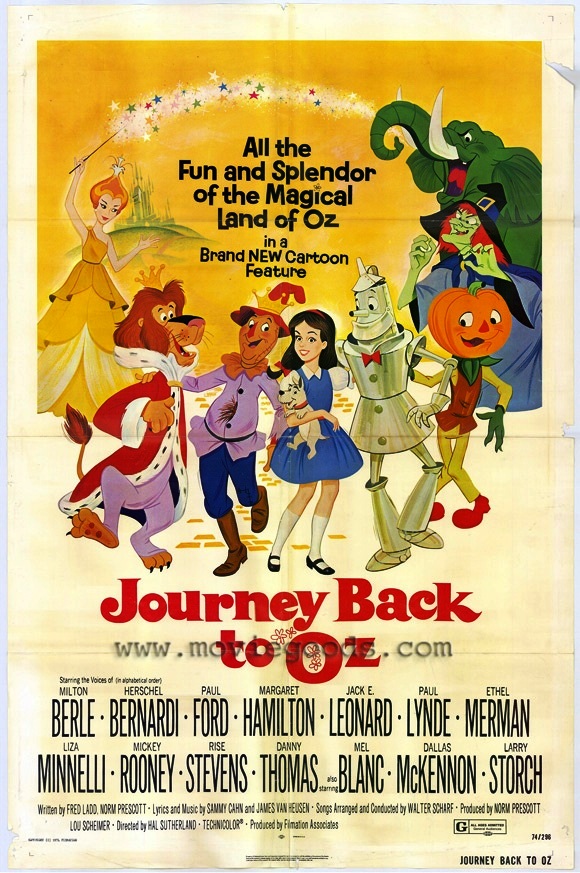 Director: Hal Sutherland
Writer: Fred Land & Norman Prescott
Cast: Liza Minnelli, Milton Berle, Margaret Hamilton, Paul Ford, Paul Lynde, Ethel Merman, Mickey Rooney, Danny Thomas, Mel Blanc, Dal McKennon, Larry Storch, Risë Stevens, Jack E. Leonard, Herschel Bernardi
Plot: In this animated kind-of sequel to the 1939 MGM film, a storm is brewing in Kansas again, and Henry (Paul Ford) is getting worried. His niece Dorothy (Liza Minnelli) feels a-tingle, remembering how a similar storm once swept her away to the land of Oz, but her Aunt Em (Margaret Hamilton) swears to her that Oz is simply a figment of her imagination. As she sings to Toto about wishing to return, a cyclone snaps the two of them up and pulls them into the air. When Dorothy comes to her senses, she realizes she’s landed by the Yellow Brick Road in Oz, and rushes off to find her old friends in the Emerald City. Setting off, Dorothy encounters a creature with a pumpkin for a head (Paul Lynde). Pumpkinhead is fleeing from an evil witch named Mombi (Ethel Merman), who created him to help her conjure some powerful, terrible work of magic. Dorothy tells Pumpkinhead to come with her to the Emerald City, where her friend the Scarecrow will help him.
Dorothy finds Mombi’s hut, where a crow (Mel Blanc) invites her to peek at the cauldron simmering on the fire. Mombi traps her and reveals her brew will create an army of green elephants to conquer Oz and destroy the Scarecrow. When Mombi leaves to get firewood, Pumpkinhead sneaks in and rescues Dorothy. As they escape, they encounter a carousel horse called Woodenhead (Herschel Bernardi), stuck upside-down in the ground. They free him and he joins their party.
Arriving at the Emerald City, they warn the Scarecrow (Mickey Rooney about Mombi’s attack just as the Witch and her Green Elephants arrive. Dorothy and her friends climb on Woodenhead’s back, but Toto and the Scarecrow are captured in the escape. Dorothy, Pumpkinhead and Woodenhead set out for Tinland, to enlist the aid of her old friend the Tin Man (Danny Thomas). At first he’s eager to help, but loses heart when told of the army of elephants. The Cowardly Lion (Milton Berle) initially puts on a show of bravado, but quickly reverts back to quaking when told of the elephants. Glinda, the Good Witch (Risë Stevens) who has been watching the proceedings with her… “Glinda-Bird”… arrives to offer her aid, and gives Dorothy a package which she warns her not to open until she arrives at the Emerald City.
Mombi sends a group of enchanted trees after the friends, but Glinda – watching through the Glinda-Bird – gives Pumpkinhead a magic axe that turns them into… well… hippies. Saved, they return to an Emerald City that has rapidly fallen into decay. They are attacked by an elephant, but Dorothy opens Glinda’s box and a swarm of magic mice pop out and chase it away, freeing them to assault the palace. The mice make it to Mombi’s chambers and chase her the gardens, where she disguises herself as a rose bush. The mice have sent the elephants on a stampede, though, and she is trampled flat. Toto, recognizing Mombi’s true form, leads Dorothy to the flattened rose, who blames Dorothy for her fate just as she dies. As she withers, the elephants fade and the Emerald City is restored to its former glory. The celebration is short-lived, though, as Pumpkinhead has fallen along with the rest of Mombi’s creations. Glinda tells Dorothy her magic cannot restore him, and Dorothy weeps for her fallen friend. As she cries, her tears touch Pumpkinhead’s face, and the magic of her love restores him to life. The Scarecrow awards his friends, making Woodenhead his own royal steed and knighting Pumpkinhead, then offers Dorothy anything she desires. She asks, as always, simply to return home. The Scarecrow find a loophole in the Oz Constitution that will only allow Dorothy to return home the way she came, and Glinda creates a cyclone to carry her back.
Thoughts: In the 1970s theatrical animation could be divided pretty squarely into two categories: Disney, and everything else. This Filmation effort falls into the latter category: limited animation, competent but unimpressive voice acting and weak music. The idea of doing an Oz sequel was all well and good, but Filmation went with stunt casting (Judy Garland’s daughter voicing Dorothy, original Wicked Witch Margaret Hamilton doing a cameo as Aunt Em, plus several celebrities of the time) and an uncredited rewrite of Baum’s second Oz book, The Marvelous Land of Oz. This movie plucks some of the characters from that book – Mombi and Pumpkinhead – turns the Sawhorse into a Merry-Go-Round horse, then turns the plot into something that’s trying hard to be The Wizard of Oz all over again. Instead of that other story, in which a young boy named Tip and his friends wind up stumbling on a plot to conquer Oz by an army of angry women, this movie has Dorothy once again marching to the Emerald City, once again picking up unusual friends along the way, once again being plagued by a Wicked Witch out for revenge. It’s incomprehensible to me why, with 14 Oz books to choose from by Baum alone, filmmakers never seem to look past the first three for inspiration, and often try to shoehorn elements from the latter two into the mold of the first one all over again. It’s equally baffling why they would create new elements when the originals (such as General Jinjur’s all-girl army, which the elephants are standing in for) work so much better. And for Heaven’s sake, why elephants? Okay, they’re big, they’re powerful, but the way the Tin Man and Cowardly Lion react to them you’d think elephants are their natural predators or something. Even mammoths might make sense, but the Tin Man going into a panic over green elephants simply doesn’t make any sense.
The performances, as I said, are merely adequate. Liza Minnelli is clearly cast simply for the gimmick of having her take up her mother’s role, as she brings nothing to the part. She’s not terrible, but there are most certainly more talented voice performers who could have done more, granted the character the sweetness and innocence she demands. As it is, the only thing that really can be said about Dorothy in this film is that she “kinda sounds a little like Judy Garland.” The animation is weak as well – Filmation does a far better job with the non-human characters than Dorothy. She’s surrounded by characters like the Tin Man and Pumpkinhead, which at least look amusing, but Dorothy herself is a stiff, unemotive creature that only really has one expression. This isn’t one of those times where I’m willing to chalk it up to the limited resources of the time, either. If Disney could make magical, powerful characters in the 1930s, the only excuse for the poor animation of the 70s is pencil-pushers cutting corners, and that I refuse to forgive.
Some of the other characters are better, at least. Milton Berle as the Cowardly Lion and Mickey Rooney as the Scarecrow fit the parts nicely. Danny Thomas’s Tin Man is less impressive, and Paul Lynde… well, he’s pretty much Paul Lynde talking out of a Jack O’Lantern. Ethel Merman’s Mombi isn’t bad at all, but she’s playing a typical, stereotypical witch, not particularly doing anything innovative. But my biggest problem with them is more along the lines of characterization than animation. The notion that the Tin Man or Lion would ever refuse to help Dorothy is preposterous. Hell, the entire point of the Lion’s story arc in the first book (or movie) is that he will always overcome his fear to help his friends! You mean to tell me you wave a little thing like an army of magic green elephants in his face and the king of beasts will lose his ability to fight? Absolutely not, my friends. I cannot accept this. The scenes with the Tin Man and Lion ultimately have no impact on the plot anyway, they’re included simply so that the recognizable characters could put in an appearance. It would have been just as effective and far less insulting, from a story standpoint, if the movie skipped from the escape from the Emerald City to the point where Glinda pops up. (It would actually be better, in fact, because if Glinda was watching the whole time, why the hell did she wait so long before taking action?)
Speaking of Glinda, here we see one of those oft-used fantasy tropes that usually irritates me: the “don’t open it until the proper time” gimmick. Writers often use this to create some false suspense, but at least they usually make some effort to explain why the giver of the gift won’t say what it is: magic, arbitrary rules of the game, “you wouldn’t have believed me,” something. None of those are brought into play here, though, there was no reason for Glinda to make a secret out of the box’s contents. It’s just there so we can have a brief moment in the forest where Woodenhead suggests opening the box to escape the trees and Dorothy can tell him no, reminding us that she’s a good little girl who does as Glinda tells her.
The songs, like the voice acting, are merely adequate. Each character gets at least one, Dorothy gets several, none of them are particularly memorable. This was par for the course for films of this nature, sadly, and that’s even sadder when you compare it to the incomparable music from the 1939 film.
When I learned of the existence of this movie, I was initially very excited – as I always am when I find out about a version of Oz I haven’t encountered before. Sadly, the whole thing fell very flat for me. It was at least more recognizable than the 1925 Wizard of Oz, but in truth, that’s mostly because it was built on the back of the Judy Garland film. That’s not to say you can’t tell a good Oz story that way – many people have – but this didn’t hold up for me. Still, I can see a lot of similarities to the cartoons I grew up watching, the ones that hold a special place in my heart even today. On the other hand, I can also recognize that a large number of those cartoons I loved as a kid are terribly weak when looked back upon with a discerning eye. I suspect that if I had watched this movie as a child, I’d probably upon it with rose-colored glasses. As it is, I’m just left sliding the disc back into its NetFlix sleeve and feeling a little disappointed for the second time in this week’s experiment.
The first Reel to Reel study, Mutants, Monsters and Madmen, is now available as a $2.99 eBook in the Amazon Kindle store and Smashwords.com bookstore. And you can find links to all of my novels, collections, and short stories, in their assorted print, eBook and audio forms, at the Now Available page!
Dorothy Gale Week Day 2: Judy Garland in The Wizard of Oz (1939)
 Director: Victor Fleming
Writer: Noel Langley, Florence Ryerson, Edgar Allan Woolf, based on the novel by L. Frank Baum
Cast: Judy Garland, Frank Morgan, Ray Bolger, Bert Lahr, Jack Haley, Billie Burke, Margaret Hamilton, Charley Grapewin, Clara Blandick
Plot: On a farm in Kansas, Dorothy Gale (Judy Garland) has to defend her dog, Toto, from the angry reproach of her neighbor, Mrs. Gulch (Margaret Hamilton). Because Toto has bitten Gulch, she’s within her rights to take the dog and have it destroyed. Dorothy and Toto run away, encountering a carnival performer called Professor Marvel (Frank Morgan), who convinces her to return home to her upset Uncle Henry and Aunt Em (Charley Grapewin & Clara Blandwick). When she returns, a tornado has sprung up and her family is hiding in the storm cellar. Dorothy and Toto rush into the farmhouse, which the tornado plucks from the ground and hurls through the air.
Dorothy crashes in a brilliantly colorful land called Oz, where she finds herself the darling of a group of small people called Munchkins. She is met by a good witch named Glinda (Billie Burke), who explains that Dorothy’s house crushed the tyrannical Wicked Witch of the East. Her sister, the Wicked Witch of the West (Hamilton again) arrives for vengeance, but finds she cannot harm Dorothy directly, as Glinda has given her the dead witch’s powerfully magic Ruby Slippers.
Glinda sets Dorothy on a path to the fabled Emerald City, where the Wizard of Oz may be able to help her get home. Along the way she is joined by three others, each who need help from the Wizard: a living Scarecrow (Ray Bolger) was made without a brain, a Tin Woodsman (Jack Haley) who was crafted without a heart, and a Lion (Bert Lahr) who is sadly a coward. The three of them encounter the witch several times, narrowly escaping her traps before finally arriving in the Emerald City. When they go into the Wizard’s chambers, they encounter an enormous floating head that tells them he can grant their wishes, but will only do so if they can bring him the broomstick of the Wicked Witch of the West.
Dorothy and her friends travel to the Witch’s palace, where she is captured by the Witch’s flying monkeys. The other three disguise themselves as guards and rescue her, but encounter the witch upon escape. In desperation, Dorothy hurls a bucket of water at the witch, who immediately melts away, destroyed by her one weakness. Returning to the Emerald City, the Wizard tells them he needs time to think about their requests. As the friends despair, Toto discovers a little man (Morgan again) hiding behind a curtain, operating a machine that projects the image of the head. The Great and Powerful Wizard of Oz, it seems, is a humbug – a simple performer from the United States who accidentally drifted into Oz years ago in a hot air balloon.
Recognizing that the Scarecrow, Tin Woodsman and Lion already possess those very things they most desire, he gives each of them a small token: a diploma to signify the Scarecrow’s wisdom, a testimonial in the shape of a heart for the Tin Woodsman, and a medal to proclaim the courage of the Lion. For Dorothy, though, the only thing he can do is repair his balloon and take her home himself. Before they’re about to leave, though, Toto leaps from the basket. Dorothy rushes after him, and the balloon drifts away with the Wizard alone. Dorothy fears she’ll be trapped in Oz forever, but Glinda appears again and reveals that the Ruby Slippers she wears have the power to transport her: she need only click her heels together three times and recite “There’s no place like home.” When Dorothy does this, the world swims around her and she wakes up back in Kansas, surrounded by her Aunt and Uncle, three farmhands who bear a striking resemblance to her friends in Oz, and Professor Marvel, who has come to check on her. Although they all believe she dreamed her adventure in Oz, Dorothy doesn’t care – she is content to simply be home.
Thoughts: After yesterday’s somewhat disturbing look at a silent Oz, spending time with the MGM classic is just what I needed. This is the movie we all know and love, the apex of the musical fantasy, the film that virtually everybody in the world has seen as a child, hidden from the flying monkeys, sang along with the Munchkins, and then later pretended they didn’t like a few years later while going through a hipster phase. It is, in fact, a masterpiece.
Although the film seemed like it was going to be a disaster for much of the production, with prospective directors and screenwriters playing musical chairs before we finally landed on the people who got the credit, the final result is something that was spectacular to look at in 1939 and is still lovely today. The transition from the sepia tone of Kansas to the brilliant color of Oz is beautiful both artistically and technically. The shift demonstrates a transition from a sad, humdrum world into a place of incredible wonders, and when you consider most people in 1939 would never have seen much color before, it’s easy to see it as a game-changer. The color in this film mattered as a storytelling choice, it sold the idea that color can influence the telling of the tale. This was Al Jolson in The Jazz Singer all over again, looking at the camera and proclaiming “you ain’t seen nothin’ yet.” This (if I may briefly tangent) is why I still don’t care for 3-D movies – no matter how pretty any of them may be, I’ve yet to see a movie become more effective as a story because it is in 3-D, the way this film could never have been filmed in black and white.
Judy Garland has become the gold standard for Dorothy Gale. Not only is the actress most identified with the role, but a vast majority of the artistic representations since then have used her likeness and costume as the basis, even though later Oz books specified her as blonde and depicted her in different clothes than the blue checkered dress. In truth, at 16 when the movie was filmed, Garland was really too old to fit the part as written (at one point, then 10-year-old Shirley Temple was a frontrunner for the role). Yet her youthful charm, innocence, and amazing voice sold her like few actresses have ever sold a part. You cannot use the name Dorothy without summoning up a vision of Judy Garland, and that’s all to the good.
Despite the various cast changes, it’s now virtually impossible to imagine anyone filling in the other principle roles than the actors we had. Ray Bolger flawlessly plays the wise man who doesn’t understand his own worth, Jack Haley has tenderness without seeming weak, and Bert Lahr is a living cartoon, silly and heartwarming all at once. Morgan and Hamilton, similarly, have become the benchmark for their parts as the Wizard and Witch. Hamilton in particular deserves special credit, I think, taking a character who had little personality in the original novel and creating one of the most enduring villains in cinematic history.
The film leaves out certain sequences from the book, and changes too many things for it to really succeed as an adaptation, but the alterations are forgivable in the context of the film MGM was trying to make. Sequences like the China town (brought back by Disney in this year’s Oz the Great and Powerful) would have been difficult to make convincing with the special effects of the time. Other scenes featured Dorothy’s friends getting rather violent in defense of the little girl – could you imagine seeing Ray Bolger standing atop a pile of crows after snapping their necks or Jack Haley swinging his axe to behead a pack of ravenous wolves? The original story left a lot of blood on the page that never made it to the movie screen, and that’s honestly okay.
This is one of those films that’s so well-known, so well-loved, it’s hard to imagine anything I could say that hasn’t been said already. As an Oz fan, I’m still waiting for a truly faithful adaptation of the L. Frank Baum novel, but as a fan of musical cinema, this is one of the greatest movies ever made.
The first Reel to Reel study, Mutants, Monsters and Madmen, is now available as a $2.99 eBook in the Amazon Kindle store and Smashwords.com bookstore. And you can find links to all of my novels, collections, and short stories, in their assorted print, eBook and audio forms, at the Now Available page!
Dorothy Gale Week Day 1: Dorothy Dwan in The Wizard of Oz (1925)
 Director: Larry Semon
Writer: Frank Joslyn Baum, Leon Lee & Larry Semon, adapted from the novel by L. Frank Baum
Cast: Dorothy Dwan, Mary Carr, Virginia Pearson, Bryant Washburn, Josef Swickard, Charles Murray, Oliver Hardy, Frank Alexander, Otto Lederer, Frederick Ko Vert, Larry Semon, G. Howe Black
Plot: A toymaker (Larry Semon) crafts a set of dolls for his granddaughter, recreating the characters from L. Frank Baum’s The Wonderful Wizard of Oz, then sits her down and to read the book with her. Or rather, he reads some alternate universe version of the book that only exists in this movie, because despite the fact that Baum’s own son got a screenwriting credit, it is almost unrecognizable from the book. My friends, I have written about 80 or so different movies since I first started this project, but this may be the craziest thing I’ve ever watched. Normally I don’t blame you if you skim over my somewhat detailed synopses, but this time I implore you… read on.
In this version, the people of Oz have managed to achieve a tense, suspicious peace many years after their baby princess was kidnapped and lost. In the place of the royal family is the treacherous Prime Minister Kruel (Josef Swickard). His actions (which are completely undefined) are beginning to bring the people of Oz to rally around Prince Kynd (Bryant Washburn), who demands the return of the rightful queen. Kruel turns to his advisor, Ambassador Wikked (Otto Lederer), who suggests they take their case to the Wizard (Charles Murray) and ask him to use his power to distract the people while Kruel schemes. Nobody knows the Wizard is merely a huckster – a man with impressive tricks, but no real magic.
Upset by the story, the toymaker’s granddaughter urges him to read the part about Dorothy and her friends, and he complies. In Kansas, we meet a rose-adorned girl named Dorothy (Dorothy Dwan) and her loving Aunt Em (Mary Carr). Her Uncle Henry (Frank Alexander) is less enamored of her, and grows angry at her for wasting time on the farm, where a farmhand (Oliver Hardy) defends the women as Henry berates them. Semon and G. Howe Black also appear as buffoonish farmhands, also victims of Henry’s temper. Semon and Hardy (both nameless) fight over Dorothy’s affections, and Henry gets angry at them all. Dorothy turns to Em, upset at Henry’s cruelty, and Em confesses that he isn’t really her uncle. She tells Dorothy the story of how, many years ago, baby Dorothy was delivered to their doorstep in a basket, and if you don’t know where this is going then congratulations on making it this far in life without ever having watched a movie before. Anyway, Dorothy arrived with a letter to be opened by her on her 18th birthday and not a moment before.
Back in Oz, things are getting even more tense, as Kynd warns Kruel that coronation day is approaching. He has until the new moon to produce Oz’s rightful queen, or Kynd will throw him into the dungeon. Kruel knows there are papers in a faraway place called Kansas that will save his regime, and sends Wikked on a journey to find them. The granddaughter, showing the sort of patience that would no doubt lead her to blow up her high school science lab in later years, forces her grandmother to jump back ahead in the story to Dorothy, who now is celebrating her 18th birthday. She goes to Henry, reminding him that today is the day he gives her the papers that came with her upon her birth. Before he can do so, Wikked arrives, flying in a biplane and landing on Henry’s farm. He demands the letter that came with Dorothy, offering to bribe Henry to prevent Dorothy from knowing the contents of the letter, but Henry grows angry and shoos them away. Wikked turns to the farmhands, who are fighting over Dorothy’s hand, and tells Hardy that she will never marry him if she reads her papers. Henry is about to give the papers to Dorothy, but Wikked and his thugs capture them at gunpoint. Henry manages to hide the letter, and Wikked has Dorothy tied to a watertower, threatening to burn the rope and let her fall if he doesn’t get the papers. Semon manages to catch her, because physics don’t apply in silent movies, and gives her the letter, which he found. Wikked tries to attack again, but apparently even God wants them to just get the hell to Oz, because all of a sudden a storm comes out of nowhere, lightning striking the bad guys (and knocking off Semon’s hat and bow tie) and wind forcing everyone else inside. Dorothy, Henry and the farmhands, in the house, are caught by the wind and blown away.
The five of them and Wikked crash outside the land of Oz. Semon hands Dorothy the letter, which indicates that her true name is Dorothea, rightful ruler of Oz, and destined to take the throne upon her 18th birthday. Kynd, Kruel, and the Wizard come out to greet them, although only Kynd is happy. Kruel orders the wizard to do something to the farmhands while he deals with Dorothy and Henry, but the Wizard is powerless. The farmhands each disguise themselves so that they and the Wizard won’t get in trouble – Semon putting on the clothes of a Scarecrow, Hardy a suit made of tin. Kruel captures them all and Hardy and Semon each accuse the other of kidnapping Dorothy in the first place. Black (the remaining farmhand) and Semon are sent into a dungeon where they are immediately mistreated by people dressed like pirates. I think this movie is going to give me a nosebleed.
With Dorothy’s true status revealed, Wikked advises Kruel to marry the new Queen to maintain his power. Hardy is made a “knight of the garter,” which somehow makes him immune to metal, and Henry is made Prince of Whales, which is not a typo. Back in the dungeon, the Wizard approaches Black and has him don a lion costume so he can frighten his captors and WHY THE HELL IS THE WIZARD TRYING TO HELP THE FARMHANDS THIS DOESN’T MAKE ANY SENSE AND he and Semon manage to escape. Semon plans to help save Dorothy from being the victim of a frame-up (FRAME UP? WHAT IS SHE BEING FRAMED FOR?) and sneaks out of the dungeon, but winds up being chased back down by Hardy, where he and Black encounter real lions. But Semon isn’t worried because lions like “dark meat” and Black is actually black and I think I need to sit down.
Kruel and Dorothy are about to get married (I think) when Kynd shows up and engages him in a swordfight and the Wizard helps Semon escape the dungeon. Together they defeat Kruel, who confesses to kidnapping Dorothy in the first place, claiming he whisked her away to save her from a “hostile faction.” Dorothy turns to Kynd, who she has apparently fallen in love with because of his mustache, and Black and Semon fly away in Wikked’s biplane.
Thoughts: This is truly a bizarre movie, unlike any other version of Oz I’ve seen put to screen. The long, frankly tedious focus on the bumbling farmhands at the beginning makes it clear that the film was really intended as a starring vehicle for actor/director/co-writer Larry Semon (he in fact is the only actor credited on the only original movie poster I could find). As a historical footnote, the film is more notable for featuring a young Oliver Hardy, who would go on to be one-half of one of the greatest comedy teams of all time, whereas Semon would go on to die of pneumonia at the age of 39. This is especially notable as, even when he’s not wearing his old man makeup, he looks like he’s about 64 years old in this movie.
The story here is something of a chore to get through. I can handle a story that adds new things to the Oz mythology, but the almost unforgivable thing here is the way Semon and his co-writers spend a ridiculously long time showing the various farmhands going through comedic antics back in Kansas, this after the granddaughter has specifically asked to hear about Dorothy and the Scarecrow, the Tin Woodsman, and so forth. I’m also very uncomfortable with re-casting Uncle Henry as this cruel, heartless man who practically tortures Dorothy and Em, regardless of the question of Dorothy’s true parentage. Even worse, though, it’s internally inconsistent, as the cold-hearted Henry suddenly becomes Dorothy’s stalwart defender when Wikked shows up to take back her birth papers.
I admit that I’m not exactly privy to the demands of a 1925 filmgoing audience, but I can’t imagine anybody who loved the novel (which was 25 years old at this point, enough for parents and their children alike to have grown up with the book) watched this and came away satisfied. So much of it simply makes no sense. How did Kruel come to power? What the hell is Prince Kynd actually the prince of? What were Kruel and Wikked doing that turned the people of Oz against them? And didn’t anybody find their names at all suspicious? Why do the farmhands disguise themselves? What the hell does it matter to them if the Wizard gets in trouble for faking his powers all these years? They have literally just met the man, and he’s working with the guy who wants to destroy them. Typing this paragraph is giving me a headache.
Considering the complete mess made of the story here, perhaps the thing that disturbs me about this movie the most is the way it completely strips away all of the magic of Oz. Not only is the Wizard a humbug, but there’s no magic anywhere – the scarecrow and tin man are just disguises, and the route between Oz and Kansas is easily accessible by a 1920s-era crop duster. The closest thing to magic is the storm that hurls them to Oz, and I’m still willing to chalk that up to the intervention of a deity that can’t believe they were 44 minutes into an adaptation of The Wizard of Oz and Dorothy hadn’t left Kansas.
The characters, meanwhile, are paper-thin. Dorothy Dwan (Semon’s wife) as Dorothy is less of a character and more of a living doll for the men to fight over. Her affections bounce between men from moment to moment with no reason or logic, and we’re never given a satisfactory reason why she should fall in love with Kynd in the end. The rest of the characters are similarly ill-developed, acting without any real motivation. Howe’s “Cowardly Lion” farmhand is the sort of racial stereotype you expect in a movie from this time period, which I usually try to tolerate for the sake of context, but the line about lions liking “dark meat” just sent me over the edge. In the end, the whole thing seems to exist solely to showcase Larry Semon’s slapstick abilities. That’s fair, I suppose – a lot of the comedies in the era of silent movies were little more than the star comedian performing their antics in front of a camera. But I have to ask – is an adaptation of The Wizard of Oz really the right place for that kind of one-man show?
The good news is that this movie is largely a footnote in Oz lore. Very few people watch it anymore, which is as it should be, and it’s not remembered very well. The bad news is that the one thing from this movie that did make it into the greater Oz Mythology is probably one of my least-favorite parts: the conceit that Dorothy’s friends in Oz are based on the people she knew back home. In and of itself, that’s not really a bad idea. It’s cute, it’s fanciful, and it has worked its way into many other fantasy films over the years. The problem, though, is that the way it was used in the 1939 film birthed the notion that Dorothy dreamed her entire Oz adventure. This is something Baum never intended, but something a lot of people think is Oz canon… and the whole thing rather cheapens Oz to me, almost as much as the stripped-down Oz we got in this movie.
I need to cleanse my palette, friends. I need a good movie to cleanse my mind. Fortunately, the next one on this list is the classic to end all classics. Tomorrow it’s time for Judy Garland in MGM’s 1939 film The Wizard of Oz.
The first Reel to Reel study, Mutants, Monsters and Madmen, is now available as a $2.99 eBook in the Amazon Kindle store and Smashwords.com bookstore. And you can find links to all of my novels, collections, and short stories, in their assorted print, eBook and audio forms, at the Now Available page!
Next week is DOROTHY GALE WEEK!
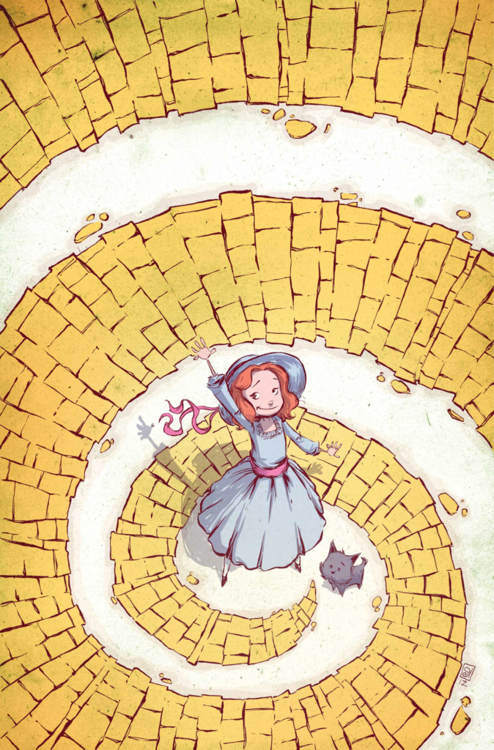
From Marvel’s “The Road to Oz” comic book, artwork by Skottie Young.
It’s time for our second monthly “Icons Week” here at Reel to Reel, friends, and starting Monday we’re going to be focusing on that lovely little girl from Kansas who took us all on a journey over the rainbow. I think I’ve written enough here by now about how much I love The Wizard of Oz and its various interpretations, and this week I’m going to bring you five different looks at the story, including three variants of Dorothy’s original journey and two films that depict future adventures in the land of Oz. Here are the movies and actresses we’ll talk about next week:
- Dorothy Dwan in The Wizard of Oz (1925)
- Judy Garland in The Wizard of Oz (1939)
- Liza Minnelli in Journey Back to Oz (1974)
- Diana Ross in The Wiz (1978)
- Fairuza Balk in Return to Oz (1985)
Five films, five very different interpretations of the Land of Oz that I’m really looking forward to sharing with you guys. But as we did with Batman, we really need to have a sort of baseline, a way to understand who this character is, so that we can understand what these different versions bring to the table. So in case you don’t know, let’s talk about…
The Character
Dorothy Gale is a little girl from the farmland of Kansas, where she lives with her Uncle Henry and Aunt Em. One day, a tornado rips Dorothy’s house from the ground with her in it, tossing her through the air, crashing her into the magical Land of Oz, and crushing the evil Wicked Witch of the East in the process. Dorothy’s only hope to return home is to visit the Wonderful Wizard of Oz, taking a long trip down a road of Yellow Brick, and encountering new friends and incredible dangers along the way.
There are the basics, friends, that’s who Dorothy is at her core, and that’s who we’ll be talking about in just a few days time. So have a good weekend, spread the word, and I’ll see you back here Monday to discuss the 1925 silent version of this classic tale.
Batman Week: Conclusions
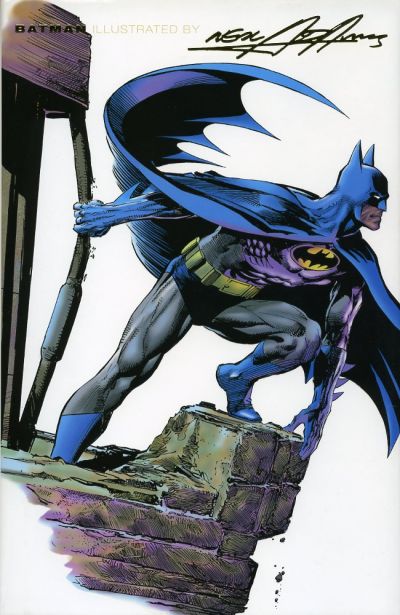 Thanks to everybody who joined in for the first Reel to Reel: Icons week. I thought Batman would be a good choice to launch the project, as he’s about as recognizable a character as there is, and he’s had so many interpretations that it was simple to find a few to talk about. I barely touched on the Val Kilmer or George Clooney versions (because these were terrible), and I didn’t look at the many different versions that have come out in recent years in Warner Premiere’s direct-to-DVD animated films (most of these have been pretty good). I didn’t even talk about the excellent film Batman Beyond: Return of the Joker (although that’s kind of acceptable, as Batman is Terry McGuinness and the aged Bruce Wayne is again played by Kevin Conroy, who most certainly got his due in this project).
What are my conclusions about Batman? Well, basically, I reaffirmed what I felt about the character already. Bruce Wayne, the Batman, is one of the most enduring characters in media because he’s such a simple concept that can be played with number of different ways. You can go silly, like Adam West did, or super-serious like Christian Bale. You can have loads of fun with the concept (see the Batman: The Brave and the Bold TV series), you can take the route of Scott Snyder in his Batman: Death of the Family comic book storyline and go almost to the edge of being straight-up horror, courtesy of the Joker. You can have your Batman, and I can have mine.
Mine is, admittedly, a little rougher. Mine is the dauntless crimefighter, the driven hero of Gotham City, the man who saw something terrible once and has dedicated his life to trying to prevent anyone else from suffering that same fate. Some people see Batman as being as crazy as his enemies, to me, he’s the sanest man in the room. My Batman always, always knows how to get rid of a bomb.
As for the Reel to Reel: Icons project, I very much enjoyed this. As I expected, it was way less intense than trying to rack up an entire month’s worth of articles at a time, and it gave me a chance to get some real content here without taking six or eight months in-between. Don’t get me wrong, I’m not saying that I’ll never do a major Reel to Reel like the first three again, just that stuff like this will make it easier on me in-between the huge things.
That does it for March, guys. Keep your eyes peeled, because there’s more content to come here at ReeltoReelMovies.com, and before the end of April I’ll be back with the next Icons week. From the gritty streets of Gotham City we’re going to the glittering streets of the Emerald City. The next project will be Dorothy Gale Week, with five very different journeys to the land of Oz!
Batman Week Day 5: Christian Bale in The Dark Knight (2008)
 Director: Christopher Nolan
Writers: Jonathan Nolan, Christopher Nolan, David S. Goyer
Cast: Christian Bale, Heath Ledger, Aaron Eckhart, Michael Caine, Maggie Gyllenhaal, Gary Oldman, Morgan Freeman, Monique Gabriela Curnen, Chin Han, Cillian Murphy, Nestor Carbonell, Eric Roberts, Anthony Michael Hall, Colin McFarlane, Michael Jai White, Joshua Harto
Plot: A group of men wearing clown masks break into and rob a bank in Gotham City, each of them killing another according to their mysterious plan. The last of them, a scarred man in makeup called the Joker (Heath Ledger) boards a school bus full of cash and rides away.
Dr. Jonathan Crane (Cillian Murphy), a Scarecrow-masked villain who escaped Batman before, plans an operation in a parking garage, only to be interrupted by several men wearing Batman masks and sporting guns. As a shootout begins, the real Batman (Christian Bale) arrives, taking out criminals and fake Batmen alike. He warns the pretenders to leave the crimefighting to him.
Wayne and his butler, Alfred (Michael Caine) meet in a secret bunker they’ve been using since the destruction of Wayne Manor. They discuss the new District Attorney, Harvey Dent (Aaron Eckhart), who is prosecuting gangster Salvadore Maroni (Eric Roberts). Dent celebrates his progress with his girlfriend — and Bruce Wayne’s ex — Rachel Dawes (Maggie Gyllenhaal), before meeting up with Lt. James Gordon (Gary Oldman), asking him to arrange a meeting with the Batman. That evening, Bruce has dinner with Rachel and Dent. Impressed by the new DA, Bruce offers to hold a fundraiser for him with friends that will fill his coffers for life. Meanwhile, the Joker interrupts a teleconference between a Chinese businessman named Lau (Chin Han) and the rest of the Gotham underworld. The Joker says they need to eliminate Batman – a task he’s happy to perform for a mere half of their bounty.
Batman meets Dent and Gordon, and the three of them make a pact – if Batman can bring them Lau, they’ll use him to bring down the rest. Bruce makes a visit to Wayne executive Lucius Fox (Morgan Freeman), who is secretly supplying him with impressive technology. He sneaks off to Hong Kong, where Lucius plants a sonar-like device that allows Batman to track Lau and bring him to Gotham. Dent, Gordon and Rachel interrogate Lau, making a deal that will allows Gordon and the GCPD make over 500 arrests in the next few days. The mayor (Nestor Carbonell) is upset at Dent for overloading the system until Dent points out that, although many of the top criminals will soon be out of jail, most of the lower-level hoods will be tied up for months, giving them the time needed to clean the streets. Their meeting is interrupted by the body of one of the false Batmen, lynched and painted to look like the Joker, dropped from the roof. The news shows a video of the victim being tortured by the Joker, who demands Batman unmask and turn himself in or the killings will continue.
That night is Dent’s fundraiser, where Bruce gives him a ringing endorsement. Rachel is angry at him, thinking he was mocking Dent, but Bruce swears he meant every word. He sees Dent as the man who can create a Gotham that will no longer need a Batman, at which point he and Rachel can be free to be together. Minutes later, she and Dent are alone, and he proposes to her, but she has no answer. As the party continues, the Joker kills the police commissioner and the judge who indicted Dent’s 500 crooks, then comes after Dent. Bruce knocks Dent out and hides him, then faces the Joker as Batman, just barely saving Rachel. A newspaper at a subsequent crime scene indicates who the Joker’s next target will be: the mayor.
Lucius is approached by a Wayne employee named Reese (Joshua Harto) who is investigating the tech Lucius has funneled towards Bruce. Lucius laughs at the notion of blackmailing a man who spends his evenings beating criminals within an inch of their life. At a memorial service for the slain commissioner, the Joker attacks again. Gordon saves the mayor, but is shot himself. Dent takes away one of the hoods working for the Joker, finding a hint that Rachel is next. Batman brutalizes Maroni, but Maroni refuses to talk, being more afraid of the Joker than the Bat. Dent, meanwhile, has the gunman tied up and starts flipping a coin to determine if he’ll shoot the man or not. Batman arrives, telling Dent he has to remain pure, the symbol of hope Gotham needs. He tells Dent to hold a press conference in the morning, where he’ll give himself up. Before he can do so, though, Dent claims to be the Batman himself and is taken away.
Rachel gives Alfred a letter to pass on to Bruce “when the time is right,” then goes to see Dent in jail, where he’s being transferred to another facility. He gives her his coin, revealing it’s two-headed, and that he always “makes his own luck.” In transit, the Joker attacks. After a spectacular chase and battle sequence, the Joker has Batman on his back and is about to remove his mask, but is taken down from behind by a cop: Jim Gordon, very much alive. When they return to the police station with the Joker, triumphant, the Mayor announces Gordon’s promotion to police commissioner.
The joy is short-lived, however, when Dent goes missing. Batman interrogates the Joker, who tells him Dent is in a warehouse full of explosives, and Rachel is in a second one. Batman rushes to save Rachel, while Gordon goes after Dent. In the chaos, the Joker escapes. Rachel, who has an open phone line to Dent, tells him she will marry him. Batman discovers the Joker lied – he’s gone after Dent, not Rachel. The bombs go off and half of Dent’s face is terribly scarred. In the other warehouse, Rachel is killed. Batman finds Dent’s two-headed coin in the wreckage, one side blackened and charred. He returns it to Dent and goes home, where Alfred hides Rachel’s letter (revealing her intention to marry Dent), allowing him to believe Rachel was going to wait for him.
Reese goes on television with the intention of announcing the secret he’s found: the true identity of the Batman. The Joker calls the TV studio and says he’s changed his mind about Batman’s identity being revealed, so he issues an ultimatum: if Reese is still alive in 60 minutes, he’ll blow up a hospital. The Joker sneaks into Dent’s hospital room, preaching to him a gospel of chaos, and Dent decides to leave things to chance. He’ll flip his coin – clean side, the Joker lives, burned side, he dies. Moments later the Joker walks away, blowing up the hospital behind him. Dent is missing again.
The Joker announces that anyone left in Gotham will be playing by “his rules” by nightfall, and that people using the bridges and tunnels are in for a surprise. As people cram onto ferries to escape, Dent begins going after the criminals and corrupt cops tied in to Rachel’s death, flipping his coin to decide who’ll live and die each time. Lucius discovers Bruce has adapted his sonar device to allow him to use every cell phone in Gotham as a tracker. He’s disturbed at the invasion of privacy and agrees to help Batman find the Joker, but this will end their partnership. Batman tells him to type his name into the device when he’s finished.
The Joker incapacitates two ferries: one full of citizens, one full of criminals being transported by the police, each loaded with bombs. He’s also given each ferry a device he claims will detonate the bomb on the other ferry. If one of the boats hasn’t exploded by midnight, he’ll blow them both up. On the civilian ferry, the passengers vote to blow up the criminals, but nobody can bring themselves to do it. One of the convicts, meanwhile, takes the detonator from the guard and throws it overboard. Lucius tracks the Joker down and Batman chases after him, but another trick forces Batman to fight the police to get to him. Although defeated, the Joker is in high spirits, anticipating a long future of playing his game with the Batman.
Dent has kidnapped Gordon’s wife and children and brought them to the site where Rachel died. As Batman and Gordon confront him, Dent asks why – of the three of them – he was the only one who had to pay the price for their quest to save Gotham. He nearly kills James Jr., but Batman saves him, Dent dying in the process. He and Gordon agree to allow Gotham City to think Batman is responsible for Dent’s rampage, believing the myth of Harvey Dent to be more important to the city than the truth. When Lucius types his name into the sonar device, it self-destructs, proving to him that he had Bruce’s faith all along. Batman goes into hiding, allowing the city to make him the villain so it could have the hero it deserves, with only the Gordons knowing the truth about the Dark Knight.
Thoughts: The nature of this project being what it is, I could only allow myself to pick one of the three films from Christopher Nolan’s “Dark Knight Trilogy.” Rather than the first or last, I decided to go with the best film of the three, perhaps one of the best superhero movies ever made. But again, as I discuss it, expect spoilers for the whole series, because this is really here as an excuse for me to discuss the franchise as a whole.
 This being the Batman Icons project, let’s start with Christian Bale himself. When Bale and Nolan came onto the franchise in 2005’s Batman Begins, they had the unenviable task of making up for the mess the Burton franchise became after the dreaded Joel Schumaker took it over. (I spent the better part of a decade firmly believing that Batman and Robin was not merely the worst of the franchise, but perhaps the worst superhero movie ever made. To this day, I struggle internally to decide whether or not Halle Berry’s Catwoman actually took that top spot away.)
The world Nolan created and Bale inhabited is as close to perfect as a live-action Batman has ever been. They tried to make it as realistic as possible, dropping any element of fantasy the previous versions used and making the technology as plausible as they could. All three of the films in the trilogy have at least one piece of tech that seems to fit firmly in the realm of science fiction, but none of them are as out of the blue as so many of the toys the Burton films conjured up. More importantly, the story and performances have a ring of truth, of authenticity to them that no previous version managed to capture. Although this is a superhero movie, structurally speaking it’s much more like a classic crime drama, a tale of steadfast police trying to take down the scum that have torn their city down. Nolan’s Batman universe has far more in common with The Untouchables than it does with the world of Adam West.
Bale is a pitch-perfect Bruce Wayne, able to put on the flaky playboy image in front of everybody but Alfred and Rachel, and becoming a determined warrior as soon as he’s in a safe place. He’s gotten some flak from people about the gruff voice he puts on as Batman, and yes, it’s somewhat exaggerated, but it’s never bothered me. The comics have often pointed out that Bruce alters his voice when he puts on the mask, and an abrasive tone is just fine. And honestly, if that’s the biggest complaint you can conjure up for Christian Bale’s performance, that still places him light-years ahead of, say, Val Kilmer. (I didn’t discuss Kilmer’s Batman Forever in this project, but in short, he gave us a Batman that’s short and flippant and a Bruce Wayne that was dark and brooding, exactly the opposite of every sane or logical comportment the character has ever had.)
Another reason I had to pick this film instead of the other two is because of the villains – the best two of the franchise and proof that it is, in fact, possible to make a superhero movie with multiple villains that doesn’t fall apart under its own weight. Heath Ledger’s Joker has become truly iconic, and probably would have done so even if he had not died before the film was released. This version of the character is nearly impossible to qualify, especially compared to earlier versions. He uses the veneer of madness that we expect from the Joker, but in his behavior he comes across more like a complete nihilist, a man dedicated to anarchy because of his philosophy rather than because he’s simply crazy. The Nolans and Goyer, crafting the story, picked up on the best parts of the character from the comics, particularly Alan Moore’s notion from Batman: The Killing Joke. Here, they dismiss efforts to give the character a true “origin,” for the Joker says if he has to have a past, he wants it to be multiple choice. As a nod to that, each time the Joker talks about how he got his scars in this movie, he tells a different tale. That lingering question mark, leaving his past open instead of filling in every blank like Burton did, makes him all the more menacing. He’s the most terrifying vision of the character ever brought to screen, perhaps the most terrifying vision ever. Romero was goofy. Nicholson was dangerous, but still amusing. There’s nothing funny about this Joker, he’s a creature of terror.
As perfect as Heath Ledger’s Joker is, though, I think Aaron Eckhart is often overlooked as Harvey Dent. Everybody who went to this movie went in to see Batman and the Joker, but it’s Dent that’s the Shakespearian figure, the tragic hero that falls to the darkness. When we first meet Dent we see someone proud, idealistic, and determined to do good at any cost. Throughout the film his armor is chipped away – first by Rachel’s refusal of his proposal, next by the threat on her life, then a piece at a time until her death and his disfigurement. At that point his plunge over the abyss, his embracing of the Joker’s doctrine of chaos, seems utterly plausible. We weep in this movie for Harvey Dent, we bleed for the hero that Gotham needed, but that lived long enough to become the villain. Eckhart sells every minute of this transformation. Ledger got a posthumous Oscar for playing the Joker (a concession I still maintain was only given to him because he died – I simply can’t believe the turgid Academy of Motion Picture Arts and Sciences would have awarded a “comic book movie” if the actor was still alive), but I think Aaron Eckhart was every bit as deserving of a nomination.
Next, let’s look at Gary Oldman as Commissioner James Gordon, and I apologize if the comic nerd in me becomes even more pronounced here than it usually is. Most of the Batman characters allow for different interpretations, but the version of Gordon dearest to me is that of the one good cop in a sea of corruption, struggling to right the ship. He’s one of the greatest supporting characters in comic books precisely because of this, and he’s the one character that none of the live-action versions ever got right. The 1966 Gordon was inept. The Burton Gordon started out okay, but never impressive, and spiraled down into a clown by the time Schumaker was done with him. Goldman, though, was magnificent throughout three movies. It’s Batman’s series, but Gordon here is a true hero in his own right, and I would have been just as happy watching him as the star. When he was shot in this movie, I didn’t really believe he was dead (although I knew I couldn’t discount it, as Nolan had proven himself willing to toy with the mythology of the franchise). Despite that, when he revealed himself, taking down the Joker, I jumped out of my seat and cheered right there in the movie theater. (My fiancé, Erin, still laughs about that.)
 The third film in this trilogy, The Dark Knight Rises, has caused a bit of a division between fans. Although I don’t want to spent too much time talking about that movie right now there’s one point of contention I want to address, because I believe The Dark Knight sets it up very well. At the end of that film (and c’mon, spoiler warnings if I really need to say it), Bruce fakes his death and passes on the responsibility of protecting Gotham to a good cop, John Blake (Joseph Gordon-Levitt). This upset a lot of comic readers I know who argue that Bruce Wayne would never quit, never retire, because it simply goes against his character. And if we’re talking about the character in the comic books, I agree. But as I’ve been saying all week, Batman is a character that allows for many interpretations, and to me, The Dark Knight justifies the retirement of this incarnation of Batman. Several times in this movie, Batman clearly expresses a desire to quit. He latches on to Harvey Dent because he sees in him a man who can create a Gotham that doesn’t need a Batman. He wants to give it up and be with Rachel, but he doesn’t feel like he’s earned it and refuses to leave Gotham without a hero. Although Rachel is dead in the third film, he manages to find happiness with Selina Kyle (Anne Hathaway) and a hero to take over for him. Even in the first movie, Batman Begins, the groundwork was laid when Bruce indicates to Rachel that they can’t be together as long as Gotham needs Batman, as well as in an early conversation with Alfred where he makes it clear that he needs to be a symbol rather than a human being. If your version of Batman doesn’t allow for that, I can respect that. That’s pretty much how I feel about the 1966 version, after all. But I think it’s perfectly consistent with the world that Nolan created.
But this discussion is supposed to be about The Dark Knight, and I think it is The Dark Knight that is the Batman masterpiece. Warner Bros is already talking about restarting the franchise with a new Batman, as Nolan’s story is done, and I guess I’m okay with that. He’s been rebooted before, after all. But I can’t help but wish they’d wait a little bit longer, let this trilogy completely digest and fade a little bit before moving on to something new, because anything they try to do next will inevitably be compared to Christopher Nolan, Christian Bale, and Heath Ledger. And unless they pull off a feat of storytelling virtually unheard of in filmgoing circles, almost any movie that invites an immediate comparison to The Dark Knight will inevitably be left wanting.
The first Reel to Reel study, Mutants, Monsters and Madmen, is now available as a $2.99 eBook in the Amazon Kindle store and Smashwords.com bookstore. And you can find links to all of my novels, collections, and short stories, in their assorted print, eBook and audio forms, at the Now Available page!
Batman Week Day 4: Kevin Conroy in Batman: Mask of the Phantasm (1993)
 Directors: Eric Radomski & Bruce Timm
Writer: Alan Burnett, Paul Dini, Martin Pasko & Michael Reaves
Cast: Kevin Conroy, Dana Delany, Hart Bochner, Stacy Keach, Abe Vigoda, Dick Miller, John P. Ryan, Efrem Zimbalist Jr., Bob Hastings, Robert Costanzo, Mark Hamill
Plot: As Batman (Kevin Conroy) chases after a gang of mobsters in Gotham City, one of them manages to escape, only to encounter a chilling robed figure with a bladed scythe for a hand. This masked shape, far more brutal than Batman himself, sends gangster Chuckie Sol’s (Dick Miller) car over the edge of a parking garage and into a nearby building. Batman arrives in time to see the traces of this “Phantasm”’s wrath, but is unable to capture him.
At a party at Wayne Manor Bruce encounters Councilman Arthur Reeves (Hart Bochner), whose anti-Batman crusade has been making papers. Reeves reminds Bruce of Andrea Beaumont (Dana Delany), one of those classic girls who got away. Bruce remembers meeting Andrea at a cemetery years ago, before he adopted his Batman persona but after he made his pledge to his murdered parents to seek justice. Andrea is visiting her mother’s grave and Bruce his parents. The two quickly feel a connection, and within days Bruce’s butler Alfred (Efrem Zimbalist Jr.) is walking in on them in a deep kiss.
Back in the present, gangster Buzz Bronski (John P. Ryan) arrives to pay his “respects” to the late Chuckie Sol, but is attacked by the Phantasm, who implies a previous relationship with the criminal. The Phantasm forces Bronski into an open grave and topples an angel statue, killing him. Reeves blames the second gangland killing on Batman, but Commissioner James Gordon (Bob Hastings) defends the Dark Knight. As Batman investigates the murder scene at the cemetery, he sees Andrea Beaumont, who has returned to town. Batman watches as she meets Reeves for dinner, and again begins to reminisce.
Soon after he and Andrea begin dating, Bruce takes her on a visit to an exhibition of the future, full of amazing technology and a particularly impressive car. Andrea invites Bruce to meet her father Carl (Stacy Keach), and while Bruce agrees, he confesses to Alfred that he’s concerned about deviating from his plans to become a crimefighter. Alfred, however, is fully supportive of the relationship. When Bruce meets Carl, he also meets Reeves for the first time – at this point, just a “hot young turk” in Beaumont’s legal department. Carl is very welcoming to Bruce, who finds himself unnerved when their meeting is interrupted by a surprise visit from the intimidating Salvadore Valestra (Abe Vigoda). As they leave Beaumont, Bruce sees a group of motorcycle punks attacking a vendor and rushes in to fight them. Although formidable, one of the crooks gets in a hard blow to Bruce and escapes. Andrea is worried, but Bruce brushes her off. He finds himself torn between his promise to his dead parents and his relationship with Andrea, certain he can’t have both. He goes to his parents’ grave, begging their permission to abandon his quest for justice and allow himself to be happy, but is interrupted by Andrea, who suggests that maybe she was sent by his parents because he already has their blessing.
In the present, Valestra speaks to Reeves, who assures him that it’s Batman killing the crimelords. Valestra, now old and infirm, is beginning to fear for his life. Batman, meanwhile, finds Sol and Bronski were connected through a series of dummy corporations along with a third partner: Valestra. Alfred tries to persuade him to see Andrea again after he’s done with Valestra, but Batman refuses. He painfully recalls his awkward proposal to Andrea years ago. Even as she accepts, though, a swarm of bats escapes the caves beneath Wayne Manor and swallows the couple. Shaking it off, they go to Carl’s house to announce the good news, but the house is full of business associates. Andrea convinces Bruce to wait. The next day, as he explores the bat-caves beneath his house, Bruce receives a message from Andrea saying she’s leaving town with her father, and that he should forget about her. Along with the note is her engagement ring. Broken-hearted, he continues with his pledge to his parents.
In the present, Valestra visits the now run-down and decrepit “future” exhibition where Bruce once romanced Andrea. It’s not abandoned, though – here Valestra encounters the Joker (Mark Hamill), who he begs for protection from Batman. Batman approaches Andrea with a photograph of the targeted gangsters and Carl Beaumont, asking where Carl is now. Andrea claims she doesn’t know, and angrily tells Batman, “the way I see it, the only one in this room controlled by his parents is you.” As Batman leaves, she weeps.
The Phantasm goes to Valestra’s home, but he’s already been murdered by the Joker, who has rigged the corpse up with a video camera and a bomb. Although he’s surprised it isn’t Batman, the Joker blows the bomb anyway, and the Phantasm just barely escapes, but is soon pursued by Batman. The police arrive, but don’t see the Phantasm at all, and believe Batman bombed the house. He barely escapes, losing his mask in the process, but Andrea races in and rescues him. She confesses what really happened the night of their engagement: she returned home to find her father with the criminals in the picture, who threatened her if her father didn’t give them money he’d been embezzling. They give him 24 hours to get the money, but he can’t free it in time. Carl forces Andrea to pack a bag and flee Gotham, breaking her engagement to save her life, and he angrily swears to free her from the criminals “whatever it takes.” Andrea tells Bruce she believes the Phantasm is her father, come back to Gotham to set them both free from his past. She tries to leave but he stops her, and Alfred – again – walks in on the two of them as they kiss. The next morning she leaves just before Bruce has an epiphany. There’s a fourth, unidentified criminal in the old photograph… a swipe with a red pencil makes him realize it’s the Joker, in those long-ago days before his skin was bleached and his mind shattered.
The Joker approaches Reeves, accusing him of using Beaumont’s ill-gotten money for his own gains. The Joker denies that Batman is the killer and doses Reeves with a chemical that sends him to the hospital, giggling uncontrollably. As he lies in his hospital bed, Reeves is visited by Batman. Reeves confesses helping Beaumont escape Gotham years ago, but hasn’t heard from him since he asked for money for his first campaign. When Beaumont denied him, Reeves sold his location to the mob. Batman goes to Andrea’s apartment for clues and he finds a locket he gave her years ago. The Joker attack him with a drone, and reveals his hideout in the abandoned exhibition.
At the exhibition, Andrea remembers the last time she saw her father – after the mob murdered him. Putting on the Phantasm’s costume, she attacks the Joker, who has already seen through her masquerade. He nearly kills her, but Batman saves her, at the same time refusing to let her murder anybody else. He asks her what vengeance will solve, a question whose irony she points out before disappearing in a puff of smoke. Batman pursues the Joker through the exhibits, which he has wired to explode. Eventually, Andrea captures him. Although Batman begs her to flee from the explosives, she and the Joker both disappear in the smoke as the exhibition begins to explode all around them. Batman falls into a storm drain and is swept away. Back in the cave, Alfred tells him his greatest fear is that Bruce will someday fall into the vengeance-craving Pit that consumed Andrea. As he mourns, he sees a glint in the darkness of the cave: Andrea’s locket. We glimpse her on a ship out of town, approached by a man. When he asks her if she wants to be alone, she simply answers, “I am.”
Thoughts: Like the 1966 Batman: The Movie, this 1993 offering is a theatrical spinoff of a television show. Batman: The Animated Series launched in 1992, and quickly proved that animation was a perfect medium for the Dark Knight. Paul Dini and Bruce Timm crafted a version of Batman that was sleek, powerful, and respectful to the comic books. It was much harsher and more violent than other cartoons of the time, and the designs were bold and striking, mixing in a 40s-era design aesthetic (particularly in the buildings, vehicles and fashion) with a modern storytelling style. This film takes everything that made the TV show great and amplified it, giving us what was (at the time) the greatest version of Batman ever put on the big screen. The climactic fight scene, where Batman and the Joker fight it out in the miniature city, has a sort of reverse King Kong feel to it. It’s the sort of thing you’d see in a goofy Silver Age comic – Batman swatting tiny planes out of the air while the Joker uses the tip of a skyscraper to bash his foe’s head – but it’s played perfectly straight and deadly seriously.
You’ll forgive me if I talk a bit about the TV show along with the movie, but everything that made the one great also applies to the other. Kevin Conroy’s Batman voice was so perfectly iconic that he remains the most popular performer for the character in animation or video games over 20 years later. He does with his voice what Christopher Reeve did with Superman – shifting flawlessly from a powerful, heroic presence to an entirely different character when he’s not uniform. Conroy’s Bruce Wayne isn’t the faux geek that Reeve’s Clark Kent was, of course, but he has a different tenor, a different attitude, and a different feel that you can accept transforming into Batman, but at the same time, could be forgiven for failing to make the connection if you didn’t know better.
The rest of the cast from the TV show is similarly magnificent. Efrem Zimbalist Jr.’s Alfred is the perfect mixture of supportive and sarcastic, with a quiet wit that speaks to the character perfectly. Bob Hastings as Commissioner Jim Gordon is, likewise, a definitive version of the character. And Mark Hamill as the Joker… He’ll always be remembered for playing Luke Skywalker in the Star Wars films, of course, but to so many Bat-fans, he’ll be one of the greatest Jokers ever. He’s more menacing than Nicholson, crazier than Romero, and if he wasn’t in a franchise that had to be sanitized for children, he could easily play a Joker that would give you nightmares. Like Conroy, he was the voice of the character for decades, and everyone was sad when he formally announced his retirement from the character a few years ago.
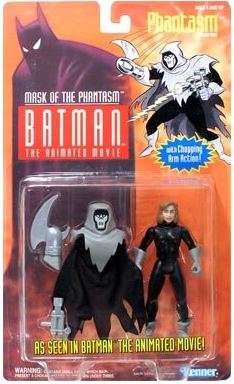
Seriously, who the hell thought this packaging was a good idea?
The one major addition to the cast who wasn’t in the show was Dana Delany as Andrea Beaumont. The voice she puts on here is sweet and kind, with less of an edge than she would use a few years later as Lois Lane in Superman: The Animated Series. Her character works perfectly for the story, though, despite the toy licensees’ attempts to sabotage it. The film works really hard to keep the Phantasm’s identity secret. The design of the character is male, and Stacy Keach provides the voice when he’s in his mask, making it seem as though Carl Beaumont is the one seeking revenge for anyone who can recognize the voice through the modulation. Therefore, when Andrea is revealed as the Phantasm it’s a legitimate shock, a great kick in the gut… unless you happened to go to Toys ‘R Us earlier that day and saw the Phantasm action figure with an unmasked Andrea Beaumont in plain view.
One thing you’ve got to give Superman over Batman – he’s had a much more stable love life. Oh sure, there have been dalliances with Lana Lang, Wonder Woman, that mermaid that one time, but pretty much every movie version has always come back to Lois Lane. This is the fourth Batman movie I’ve watched for this project, and there’s been a different woman in each one (and there’ll be still a fifth tomorrow). I suppose part of it is the attempt to make Batman seem like the perpetual loner, although that image is quickly dispelled by the plethora of Robins, Batgirls, Outsiders and Justice Leagues he typically surrounds himself with. On the other hand, that makes a story like this one work much better than it would with Superman or Spider-Man or any hero who has a more traditionally stable love life on screen. No one would really take Andrea seriously, start to picture her as the girl Bruce belongs with, if they were accustomed to seeing him with somebody else full-time. This way, we get to fall in love with her a little bit along with Bruce, making the ending of the film all the more tragic and powerful.
The TV show and movie both take certain elements from the Tim Burton version of Batman from 1989, including the designs for the Batmobile and Batwing and, most notably, music inspired by the Danny Elfman score. But while the popularity of the Burton films may have helped get this version produced in the first place, Dini and Timm quickly took the franchise in different directions, making it more serious most of the time. This is a far deeper, more psychologically intriguing and –frankly –more realistic portrayal of Batman than any of the previous ones. This is a Batman that can actually get hurt physically as well as emotionally. He gets tired, he gets cut, he bleeds. And while Michael Keaton’s Batman did have a degree of brooding about him, Kevin Conroy’s is a rich, multi-layered character that actually struggles with his choices in a way that no film version of Batman had ever done.
For the most part, our culture still marginalizes animation as a tool only suitable for children’s stories. Although there has been some improvement on that front, in 1993 it was even worse than it is today, so there was no small amount of surprise at this film’s heavy violence and implied sex. (It was still a PG-rated movie, but much harsher than even this same production team would have dared to put on television at the time.) But then, as now, I loved this movie completely. There is room, as I’ve said many times, for a lot of different versions of the Batman in popular culture, but that doesn’t mean that individual fans might not feel loyalty to certain interpretations of the hero. As good as the stuff that was coming (which we’ll discuss tomorrow) turned out to be, to me, this is still the truest version of Batman ever put to screen. And I don’t just mean by 1993, I mean in the two decades since then as well.
The first Reel to Reel study, Mutants, Monsters and Madmen, is now available as a $2.99 eBook in the Amazon Kindle store and Smashwords.com bookstore. And you can find links to all of my novels, collections, and short stories, in their assorted print, eBook and audio forms, at the Now Available page!
Batman Week Day 3: Michael Keaton in Batman (1989)
 Director: Tim Burton
Writer: Sam Hamm & Warren Skaaren
Cast: Jack Nicholson, Michael Keaton, Kim Basinger, Robert Wuhl, Pat Hingle, Billy Dee Williams, Michael Gough, Jack Palance, Jerry Hall, Tracey Walter, William Hootkins
Plot: As a pair of muggers in Gotham City go through their loot, a black-clad figure wearing a bat symbol attacks, incapacitating them both in seconds. When one of the criminals begs for his life, the man in black tells him he wants a favor… he wants him to tell all his friends. When the crook asks who he is, he hisses in reply, “I’m Batman.”
Commissioner James Gordon (Pat Hingle) and District Attorney Harvey Dent (Billy Dee Williams) make a public pledge to take down crimelord Carl Grissom (Jack Palance), an announcement watched on TV by Grissom’s chief lieutenant, Jack Napier (Jack Nicholson). Jack has been having a fling with Grissom’s girlfriend Alicia (Jerry Hall), but is confidant Grissom has no idea what’s going on under his nose. Reporter Alexander Knox (Robert Wuhl) is approached by an award-winning photographer named Vicki Vale (Kim Basinger). As two of the only people in town who believe the Batman exists, they form a partnership to try to dig out the story. They attend a casino night hosted by Gotham’s richest son, Bruce Wayne (Michael Keaton), hoping to get the authorities on record about the Batman. Encountering Bruce, who comes across as somewhat absent-minded, leaving a bizarre impression before he is called away by his butler, Alfred (Michael Gough). While at the party, Gordon is given a tip that Napier is robbing a local chemical company. Bruce, now in a hidden cave beneath the mansion, listens to Gordon’s conversation as picked up by a hidden camera.
At Axis Chemicals, corrupt police Lieutenant Eckhardt (William Hootkins) prepares his men to take down Napier’s gang, giving orders to shoot to kill. Inside, Jack finds the safe empty and realizes they’re being set up. The cops and gangsters begin a shootout, but Gordon arrives and commands the police to take Napier alive. Batman rounds up the criminals and manages to grab Jack, but his chief goon Bob (Tracey Walter) threatens to kill Gordon if he doesn’t let him go. Although Batman tries to save him, Jack tumbles over a rail into a vat of chemicals, his face damaged in the battle.
The next evening, Vicki returns to Wayne Manor for a dinner with Bruce. It goes well, but she can’t help but notice that so much of the image of the playboy doesn’t fit as she begins to get to know him. Jack, meanwhile, has escaped the chemical bath, but not without damage. As he removes the bandages from his face, he smashes the mirror and stumbles away, giggling maniacally. He returns to Grissom’s home, confronting him over the double-cross. He reveals the extent of the damage – his skin bleached, his hair turned green, his mouth frozen in a permanent grin. Calling himself the Joker, Jack guns Grissom down.
Jack (wearing fleshtone makeup) meets with the rest of Gotham’s crimelords, announcing he’s taking over Grissom’s operation. One of them indicates an unwillingness to cooperate, so Jack offers a friendly handshake, roasting him with a supercharged joy buzzer. His power solidified, he instructs Bob to trail Knox and find out what he knows about the Batman. Vicki leaves Wayne Manor the next morning, happy with Bruce and looking forward to seeing him again after he returns from a business trip. As she bids farewell to Alfred, though, he lets it slip that no such trip is forthcoming. She leaves, confused, and trails Bruce to a bad part of town, where she sees him lay a pair of roses on the ground in an alley.
That night, Gotham’s Action News reports on the deaths of two models who died after an extreme reaction to cosmetics leaving them with horrible grins on their faces. A bulletin announces three more similar deaths, when suddenly one of the anchors has an uncontrollable laughing fit and keels over. Suddenly, the Joker cuts into the feed, announcing his “Joker Brand” products – products that, chances are, everybody in town has already bought. Bruce studies Jack’s past, learning he has a background in chemistry, and he and Alfred go on a shopping trip. Gotham begins to struggle as everyone is terrified to use food, cosmetics, or anything that may contain the Joker’s “Smilex” chemical.
Vicki leaves a message for Bruce to tell him she’ll be late meeting him at the museum, but he has no date planned. It’s a trap by the Joker, who has become infatuated with her after seeing one of Bob’s surveillance photos of Knox. The Joker and his goons come in, smashing and defacing the exhibits. He approaches Vicki, proclaiming himself to be the “world’s first fully-functioning homicidal artist.” As proof, he has Bob bring in Alicia, whose face he has horribly scarred, and tells Vicki he wants her to record his “art” in photography. Batman rescues her, but the Joker’s thugs pursue him and nearly take him down. Just as Bob is about to remove his mask, Vicki snaps a picture, distracting them long enough for Batman to fight free. He brings Vicki back to the Batcave, where he tells her he’s cracked the “Joker Products” code – there’s no one single product that’s harmful, but certain combinations of products that are deadly. He gives her his research, instructs her to bring it to the press, and gasses her. When she wakes up, she’s safe at home, and realizes he took the film from her camera with the picture of his upturned mask.
As Gotham returns to normal, Alfred urges Bruce to tell Vicki the truth about his identity. He visits her apartment, intending to do just that, but they’re interrupted by the Joker, who tells her that Alicia tragically “threw herself out of the window.” Bruce reveals himself and threatens the Joker, who casually asks him if he’s ever “danced with the devil in the pale moonlight” before shooting him. He leaves Vicki alone, and she turns to find Bruce gone, a tray from her mantle lying on the floor with a bullet-sized dent.
Knox has researched the alley where Bruce left the roses and discovered his parents were murdered there before Bruce’s eyes when he was just a child. Bruce, meanwhile, is delving back into the case himself. The Joker’s “dance with the devil” taunt has dredged up memories, and he realizes Jack Napier is he nameless thug that murdered his parents. The battle is personal now, and becomes moreso when the Joker seizes Gotham’s airwaves again to announce he’s going to dump $20 million on the crowd for Gotham’s 200th anniversary celebration that night, challenging Batman to a confrontation.
Using the Batmobile via remote control, Batman destroys the Axis Chemical Plant, taking a number of the Joker’s goons with it, but the Joker remains at large, flying above in a helicopter. He retreats to the city, where he’s started a parade full of balloons and floats, hurling money into the crowd before gassing it with Smilex. In his Batwing jet, Batman cuts the gas-filled balloons loose. The Joker shoots the Batwing down with an improbably long-barreled gun, but Batman survives the crash. The Joker snares Vicki and leads her to the bell tower in Gotham City Cathedral where he awaits his helicopter. Batman and the Joker face off at the top of the Cathedral, where Batman vents his rage at Jack Napier for killing his parents. The three of them wind up dangling over the edge of the Cathedral, Joker dangling from a ladder to his helicopter. Batman snares him with a line, attaching him to a gargoyle broken from the cathedral. The added weight is too much, and the Joker plunges to his death. Soon afterwards, the police round up the Joker’s men and announce an alliance with the Batman, complete with a signal – an enormous spotlight that casts the emblem of the bat against the night sky. Vicki meets Alfred in a waiting limo… he apologizes for Bruce. He’s going to be a little late.
Thoughts: When Tim Burton’s Batman came out I was 12 years old, just at the perfect age to be heavily influenced by it. The prospect of Batman on the big screen was thrilling to me, and I was excited as I’d ever been to see a movie in my life. Looking back, my perspective has changed a little. While I never achieved the level of distaste I sometimes have for the Adam West incarnation, looking back on this film nearly 25 years later, I realize that it’s a good Tim Burton movie, but it isn’t really a great rendition of Batman.
You see, Tim Burton is a particularly distinctive filmmaker. He’s got lots of visual tricks, certain pacing techniques and other elements that all combine to make a movie distinctly his. This would be the first time he did a major adaptation of somebody else’s characters, but it sets the stage for his career in the future. Years later when he’d tackle Planet of the Apes, Alice in Wonderland, Charlie and the Chocolate Factory and the like, it would become clear he had his own sub-category of film… adaptations run through a Burton filter. Sometimes it works, sometimes it’s a disaster. This Burton-filtered Batman is a good movie, much darker and more serious than the movies we’ve discussed in this project so far, but still lacks certain elements that keep it from being great as a Batman film.
There is a lot of good here. This is the first film in the project to tackle Batman’s origin, for instance, and it does it in a very good way. Certain superhero origins are so well known that it’s become redundant to go over them yet again, and working it in as exposition rather than taking an hour to cover it works very much to this film’s advantage. It’s also the first time we’ve seen a Batman that isn’t a fully authorized officer of the law. The outlaw status works better for the character, even when he’s allied with the police.
I also really like Michael Keaton’s version of Bruce Wayne. There isn’t a lot of comedy in this movie, but Keaton (who previously worked with Burton in Beetlejuice) supplies most of it when he’s trying to maintain his absent-minded playboy image. There’s a sort of awkward sincerity to him, but he has a distinct competence right beneath the surface that makes it easy to accept him as Batman when the transformation begins. There was, I’m told, quite a controversy around casting Keaton (best known as a comedic actor) in the role, but he balances the humor with the depth of the character very well. The scene where he struggles to explain the truth of his double life to Vicki is just fantastic – very human, very charming, very honest.
Jack Nicholson also puts in a bravura performance as the Joker. He’s got some of the chaos of Cesar Romero, but unlike that earlier incarnation, he actually manages to apply some menace to it. Romero’s Joker was fun, but never scary. Nicholson’s Joker is both. There’s a great moment in the boardroom scene where it really starts to come through… not when he murders the unsuspecting Antoine, but a few seconds later when he orders Bob to trail Knox. Nicholson imitates a speech Palance gave to him just before sending him to his death, and although he’s not planning to have Bob killed, the result is downright disturbing. His cheerful chant that he’s glad Antoine is dead a few seconds later simply compounds it. While not the best Joker of all time (we’ll get to that), Nicholson is a great Joker.
The performances really are excellent. The elements that make it harder for me to accept this as a straight Batman movie and more of a Tim Burton movie come in plot, tone, and atmosphere. For example, the first moment where the “Burtonian” elements overtake the “Batmanian” is when the newly-christened Joker kills Carl Grissom. While not at all out of character for him, Burton uses a rousing carnival tune as the background music for the scene, something that stands in stark contrast to what we’re watching. It’s a very effective moment, something that encapsulates the madness of the character, but it’s also a very Burtonian trick, and the first point where we’re clearly seeing his fingerprints on the mythology.
From there, there are many other such moments that feel Burtonian. The more we see of Gotham City, the more it feels like the sort of world he’s conjured up for films like Edward Scissorhands – not exactly reality, but a strange sort of postcard that depicts a version of some stereotypical world at Halloween. (In Scissorhands it was a Leave it to Beaver-style community, in this it’s a grungy cityscape.) Even the woods outside of Wayne Manor, where the Batmobile drives to reach the Batcave, are distinctive. Something about the bare, sparse trunks of the trees combined with the pounding Danny Elfman score (the #2 superhero theme of all time, after John Williams’s Superman) give an effect that reminds me more of Burton’s The Nightmare Before Christmas than any other film I can think of. The cathedral where the climactic battle takes place appears to be deserted, the wood rotting away and everything is ready to break for the sake of the fight scene. For sheer Burtonian symbolism, though, there’s no bigger moment than when the Batwing sweeps up in front of the full moon, forming a perfect Bat-Signal for absolutely no reason other than the rule of cool, before diving back down at the city.
Burton and the screenwriters introduce another element that happened in a lot of superhero films afterwards and, in fact, continues to this day: the idea that the hero’s origin has to be tied into the villain of the piece. From a purely thematic standpoint I understand it – it makes things much more personal for the characters and gives you a tighter narrative. From a larger perspective, though, I think it’s often a mistake. It requires either an uncomfortable level of coincidence or a ridiculous level of conspiracy that only a few movies have pulled off well.
Then there’s one thing that I’m never comfortable with in any incarnation of this character – a Batman who kills. His bombing of the Axis plant bothers the hell out of me… no matter how scummy the Joker’s goons were, they were still humans, and it’s hard to accept Batman killing them. The end of the film presents a similar problem, where Batman first opens fire upon the Joker with an array of bullets and missiles (all of which miss, but still), and then apparently drops the Joker to his death. Ironically, in the earliest comics Batman had no code against killing, and even used guns to cut down hoods on more than one occasion. The no-killing code has worked its way into most versions of the character, though, to the point where a Batman who kills feels wrong in any context.
I like this movie, I like it a lot actually. It’s just that being years removed from the childhood excitement of actually seeing Batman on the big screen, the various faults and flaws are a lot easier to pick out. None of them are enough to kill the movie for me, but shifting perspectives over the years have made me want something different out of Batman than what Burton gave us. Still, it was leaps and bounds ahead of the Adam West incarnation, and lightyears ahead of what was to come, when Burton stepped back from directing with the third film in the franchise and ushered in the disastrous Joel Schumacher years. Either way, though, the popularity of this movie helped to lead to the first screen version of Batman that I felt – and still feel – was truly, purely, and amazingly true to the character, and it’s that version we’re going to look at next.
The first Reel to Reel study, Mutants, Monsters and Madmen, is now available as a $2.99 eBook in the Amazon Kindle store and Smashwords.com bookstore. And you can find links to all of my novels, collections, and short stories, in their assorted print, eBook and audio forms, at the Now Available page!
 Reel to Reel