Category Archives: 4-Icons
Scrooge Month Day 1: Sir Seymour Hicks in SCROOGE (1935)
 Director: Henry Edwards
Writer: H. Fowler Mear, based on the novel A Christmas Carol by Charles Dickens
Cast: Seymour Hicks, Donald Calthrop, Robert Cochran, Mary Glynne, Garry Marsh, Oscar Asche, Marie Ney, C.V. France, Barbara Everest, Philip Frost
Notes: Look, it would be insane of me to try to recap the plot of A Christmas Carol seventeen times. Even more insane than I usually am. I know the story, you know the story. Scrooge is a greedy jerk. His dead partner, Jacob Marley, pops into his house on Christmas Eve and warns him if he doesn’t change his ways death is gonna suck even worse for him, and tonight three spirits are going to convince him. Christmas Past reminds him he wasn’t always a greedy jerk. Christmas Present shows him his family thinks he’s a joke and his employee, Bob Cratchit, has a kid who’s going to die because they didn’t have Obamacare. Christmas Future shows him that when Scrooge pops off, nobody is going to give a damn. When he gets back to the present he promises to stop being a jerk, and by most accounts, he keeps that promise.
So rather than making you read that every day this month, I’m going to instead use the usual “Plot” section of these articles to note any particular changes or deviations from the norm that specific version of the story features. Fair enough?
Thoughts: This is the oldest version of A Christmas Carol currently gracing my DVD shelf, and as far as it goes, it’s a pretty standard rendition. We open up with Seymour Hicks as Scrooge being grumpy to Bob Cratchit (Donald Calthrop) and his nephew Fred (Robert Cochran), who is trying his hardest to cheer him up. (Spoiler warning: he fails.) The film goes through pretty much all the standard beats, the lines about “picking a man’s pocket every 25th of December” and Scrooge warning Cratchit to get his lazy butt to work early the next day. This was, after all, a film from the early days of the form, before people realized that the Scrooge formula could be easily applied to all sorts of different misers and tell different stories. It was before it got so well known that parodies became inevitable, and before it started to get twisted for the sake of musicals, for political satire, for cheesy romantic comedies, and for virtually every TV show imaginable. (Seriously, folks, among the shows that did their own riffs on Dickens we had Family Ties, Alvin and the Chipmunks, The Jetsons and Smallville, the latter of which wasn’t even a Christmas episode).
What surprises me most about this film, actually, is that the filmmakers actually choose to add some stuff that’s not in the original book or in any other version of the film. After Scrooge leaves his counting-house at the very beginning, he stops off for dinner and our attention is shifted to – of all things – a royal dinner for the Queen of England! It would be a baffling addition to any version of A Christmas Carol but is even stranger in this one, which boasts a running time of a mere 59 minutes. Marley’s ghost doesn’t appear until almost 20 minutes — or one-third –of the way through the film. And even “appear” is a misnomer. We hear Marley’s voice (provided by an uncredited actor), but he never shows up on-camera. We only see Scrooge talking to somebody off-screen as Marley recites the famous “Mankind was my business” speech from the novel.
Christmas Past is credited as actress Marie Ney, but the strange effect around her body and her low voice made me initially think this was one of those versions where that ghost is played by a man. I’m not sure why, but I always picture the character as a woman, despite the fact that Dickens himself described this ghost as being a somewhat amorphic, shifting creature of indeterminate gender. At any rate, this is where the filmmakers compensate for that time spent on the royal ball at the beginning – rushing through Christmas Past, with several of the earlier scenes condensed and shown in a dialogue-free montage that’s supposed to just give us the impression that Scrooge done screwed up somehow.
The film picks up considerably with C.V. France’s powerfully rotund Ghost of Christmas Present. He handles Scrooge with a small measure of well-deserved condescension, shaming him profusely when he catches him laughing along with the joyful antics of the Cratchit family. This too, is rushed through to get us to Christmas future – who appears when there are 20 minutes, or one-third of the film, remaining. Seymour Hicks does his best work in this segment, showing remorse already.
I actually much prefer when an adaptation of Dickens takes this particular beat: the idea that Scrooge has already begun to change before Christmas Yet to Come even appears, and all that apparition really does is seal a bargain that’s already mostly made. Any time we see a Scrooge who faces Yet to Come with smug stubbornness, it makes me want to shout, “Dude, what is it gonna take?” Which of course is a little silly to ask. We already know what it’s going to take: the vision of people selling the blankets stripped from his bed before his corpse was even cold and the fact that nobody bothers to show up when he’s laid in the ground. Dickens really nailed it here – for a man of Scrooge’s station, such an ignoble end is the worst fate imaginable, and if there’s any ice left in his heart after seeing Philip Frost as the pathetic little Tiny Tim, this is going to shatter it.
Hicks is a good, classic Scrooge – ugly and nasty at the beginning, melting into fear as the story progresses. The end is nice – instead of a sudden explosion of joy like some Scrooges have, he actually weeps with happiness before thanking Marley and the Spirits for doing their work. Is it a great version of A Christmas Carol? No. But for the time it’s perfectly serviceable and it tells the story in a compressed time frame without any real glaring omissions. There are better versions of the story you can give your time to, but there’s nothing really wrong with this one.
The first Reel to Reel study, Mutants, Monsters and Madmen, is now available as a $2.99 eBook in the Amazon Kindle store and Smashwords.com bookstore. And you can find links to all of my novels, collections, and short stories, in their assorted print, eBook and audio forms, at the Now Available page!
Next week is EBENEZER SCROOGE… MONTH?
 You may be asking yourself, “Blake, as the humble Reel to Reel host, what’s the stupidest thing you could possibly do this holiday season?” And I would think to myself, “Well… I guess that would be to attempt to watch and review as many different versions of Charles Dickens’s A Christmas Carol as possible.” And you might say, “Well why don’t you do that, then?” And I would reply, “…okay.”
I’m such a sucker.
You see, friends, when I first conceived of the Icons project, I intended to give Scrooge his week in the sun, same as Batman, as Dorothy Gale, as Dracula… you know, the other characters he has so much in common with. But the thing is, as I started to pluck out my five chosen versions of Scrooge, I saw so many others being left on the shelf. Great ones. Mediocre ones. Versions best remembered mostly for their hilarity. And I just could not, in good conscience, allow them to wallow.
So instead, I found myself pulling every version of A Christmas Carol I own from the DVD shelf — minus any TV episodes that covered this ground, because December is still only one month long — and stacking them up, and counting them. And lo and behold, I have 17. (I have seventeen versions of A Christmas Carol. What is wrong with me?) And it just so happens, this year, there are 17 weekdays in December before Christmas. It’s like fate, guys. Kismet. Insanity.
So, strap yourself in, because I’m gonna try to hit you with my reviews of every version of Dickens’s classic tale that I have. Now keep in mind, even this will not come close to being a comprehensive list. This is merely a list based on the versions I already own. A quick glance at Amazon.com confirms that I could easily find enough versions to do this again next Christmas without any duplicates! (Note to readers that I happen to be marrying in June of 2014: I promise not to do this again next Christmas.)
But this year, guys, you’re going to get the full force of my insanity as I slam you with Scrooge after Scrooge after Scrooge. Also characters that aren’t technically Scrooge, but are filling his role in different versions of the story. And also other fictional characters playing Ebenezer Scrooge. And this time, I’m not even gonna tell you who’s on the list. I’ll let you wonder.
So who is Ebenezer Scrooge, anyway? Well…
The Character: Ebenezer Scrooge is a miserly owner of a counting house, ruthlessly squeezing money from his clients and mercilessly foreclosing on those who cannot pay. Although once a good, kind man, life has turned Scrooge cold and cruel. On one fateful Christmas Eve, it will be the task of three spirits to show him the error of his ways before it’s too late.
And if you want some pre-December goodness or suggestions for your own DVD player this holiday season, I invite you to check out last year’s Reel to Reel project, The Christmas Special, in which I gave the R2R treatment to 25 of the greatest Christmas TV specials ever made!
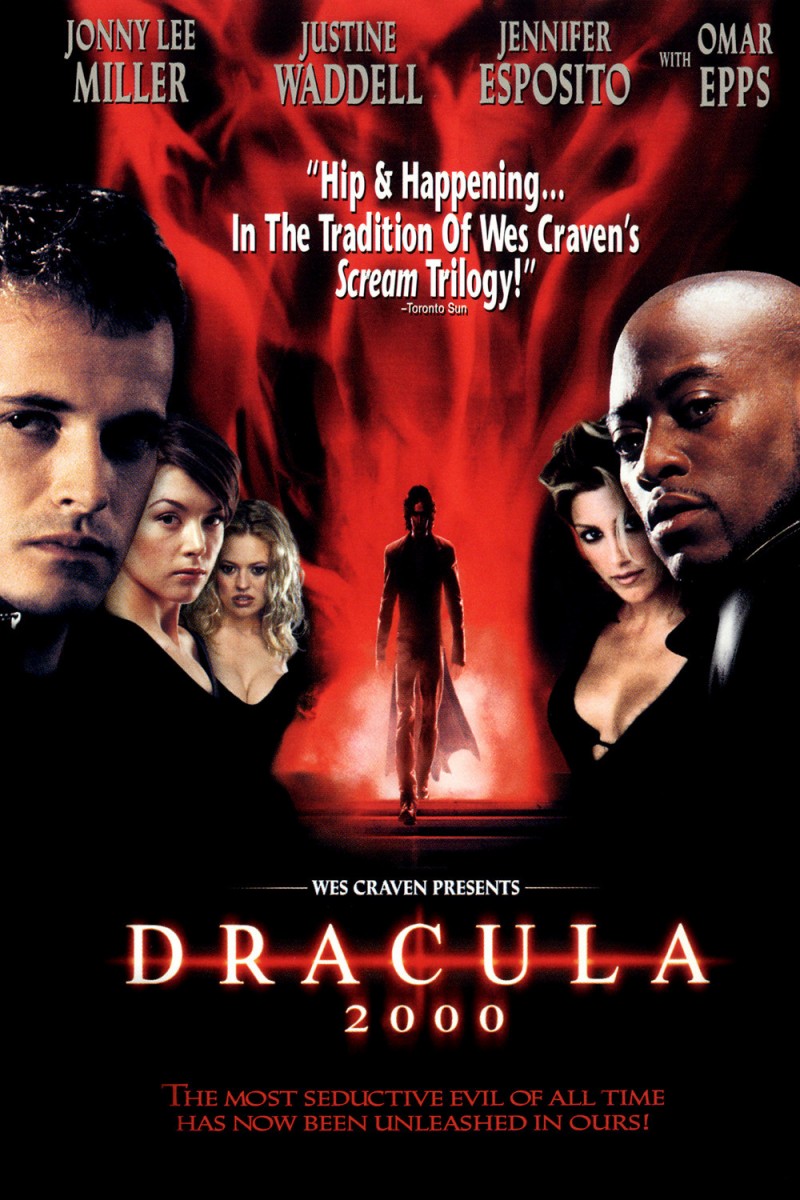
DRACULA WEEK DAY 5: Gerard Butler in Dracula 2000
 Director: Patrick Lussier
Writer: Joel Soisson & Patrick Lussier
Cast: Gerard Butler, Christopher Plummer, Jonny Lee Miller, Justine Waddell, Colleen Fitzpatrick, Jennifer Esposito, Omar Epps, Sean Patrick Thomas, Danny Masterson, Lochlyn Munro, Tig Fong, Jeri Ryan, Shane West, Nathan Fillion
Plot: Matthew Van Helsing (Christopher Plummer) is an antique dealer in London in the year 2000, and constantly attempts to downplay the tales of his grandfather Abraham, who supposedly inspired the vampire hunter character in Bram Stoker’s novel Dracula. His secretary, Solina (Jennifer Esposito), helps her boyfriend, Marcus (Omar Epps) break into Van Helsing’s vault. They set off a series of traps, killing several of the thieves in the process. The survivors steal a silver coffin, which they take with them as they flee to New Orleans. Van Helsing and his apprentice Simon (Jonny Lee Miller) pursue them. On the way over one of the thieves, Nightshade (Danny Masterson) opens the coffin to find a corpse covered in leeches. The corpse rises and attacks him, slaying two thieves to regain a healthy, human form – Dracula (Gerard Butler).
In New Orleans, at Mardi Gras (because in Hollywood, Mardi Gras happens every day of the year in New Orleans) we meet Van Helsing’s daughter Mary (Justine Waddell) and her friend Lucy Westerman (Colleen Fitzpatrick). Mary, who has been having nightmares, finds herself with an unexplained psychic link to Dracula. She turns to Father David, (Nathan Fillion) an old friend who knew her late mother, hoping he can help her uncover the secrets she carried with her, but he knows nothing that can help her. Van Helsing arrives in New Orleans to see news of a plane crash in a nearby bayou, and sees the silver coffin among the wreckage. Reporter Valerie Sharpe (Jeri Ryan) is on the scene of the crash – and soon becomes one of Dracula’s new brides. Simon and Van Helsing find the bodies of Marcus’s crew, only to find they’ve become vampires.
Van Helsing tells Simon that Dracula cannot be permanently destroyed, even by the normal methods of killing a vampire (stakes, silver, sunlight). He has spent his life seeking a way to kill the beast, to no avail. What’s more, he’s not Abraham Van Helsing’s grandson, he is Abraham, having prolonged his life by leeching Dracula’s blood and injecting it into himself. All he knows is that Dracula hates God and Christianity, presumably lining him up for a correspondent’s job at MSNBC. Dracula seeks Mary, but instead encounters Lucy, who he bites. Mary sees a flash of Lucy’s assault just as Simon approaches her with the promise of explaining why her mother took her across the world to escape her father. As she leaves, he’s attacked by Marcus, but slays him.
Van Helsing tracks Dracula to Mary’s house, but is killed. Mary finds him under the bed, and is soon assaulted by Dracula’s three new brides: Solina, Valerie, and Lucy. She learns the telepathic link she has with Dracula is because her father had injected himself with the vampire’s blood. Dracula shows Valerie the truth of his origin – he is Judas Iscariot, betrayer of Jesus Christ, condemned to walk the Earth ever since the night of his great sin. He takes her to Simon, captured by the Brides, and offers him to Mary: drink his blood and join them as a vampire. She tricks him and they fight, slaying the Brides. After a struggle, she wraps a cord around his neck and pushes him from the roof, hanging him, just as Judas was hanged for his sin, as the sun rises. He catches on fire when the sun touches him. Mary, however, remembers that her father said none of the normal ways to kill a vampire work on Dracula, and vows to return to London to watch in case he ever returns.
Thoughts: Produced by Wes Craven, whose name has turned up in previous movie studies a time or three, this is an odd telling of Dracula. Although it acknowledges the classic story, it also borrows elements from it, making Dracula 2000 an attempted hybrid between a sequel to Bram Stoker’s original and a contemporary remake of the same.
Craven’s greatest work – and here I am thinking specifically of A Nightmare on Elm Street and Scream, which the movie poster vehemently reminds us of – fall into the “slasher” category of horror. Dracula, however, is a different kind of beast, and the same things that work for Freddy Krueger or Ghostface don’t necessarily work here. The weaker elements of this movie, in fact, are those that attempt the same sort of jump scares or plot twists that make up the very DNA of a slasher film, but feel a good bit sillier in the context of a vampire movie.
Speaking of silly, I know this is just my personal sensitivity as a lifelong Louisiana boy, but I really would love to get my hands on whoever dressed the extras in this movie and batter them in the face with an oversized set of Mardi Gras beads. People don’t always dress for a party here, nor does everybody in the city show up wearing oversized novelty hats. The fact that this story takes place at Mardi Gras bears absolutely no bearing on the plot, making it just another case of Hollywood thinking it’s like that here all the time. And the “local” news reporter who asks “what’s the deal with these bugs?” It’s Louisiana, jackass. That’s the deal. We gots bugs.
But I digress.
One thing about this movie I do find interesting is the origin story of Dracula. This is one monster that I always feel is actually stronger when he has a religious bent of some sort. Perhaps it comes from the old notion that he can be driven back by a Crucifix, but Dracula as an enemy of God is a concept that makes sense to me and I think works for the character. (It was, in fact, a strength of Bram Stoker’s Dracula.) Casting him as Judas, however, doesn’t quite do the trick. It may seem to fit the requirements, but it also betrays a rather fundamental misunderstanding of Judas as he was presented in the Bible – he never hated Christ. And come on, even if we’re to believe that Dracula didn’t hate Jesus in the beginning, but grew to hate him due to his curse, it’s not like he didn’t have it coming. Plus, the Biblical flashbacks in this film are pretty cheesy, clear soundstage set-ups and not convincing at all.
Gerard Butler – who, by the way, isn’t nearly oily enough in this movie to be recognizable as Gerard Butler – doesn’t have as much to do as Dracula as you would think. He basically is called upon to stand around looking menacing, throw people smaller than him through scenery, and seduce beautiful women. He has a better job than any of us, is what I’m saying. But he plays Dracula as more of a force of nature than a character, with little dialogue and littler personality.
The rest of the cast is largely forgettable – sitcom actors and other b-movie stars or musicians taking a stab at acting. Only Christopher Plummer has any real acting chops, and he’s hamming it up with the rest of them. It’s telling that arguably the supporting performer in this movie with the best post-Dracula career is Nathan Fillion, who appears for all of five minutes.
The design aesthetic is so, so nineties. It’s not enough that our hero have a gun, it has to be a gun with a detachable knife. Hallways must appear endless. Even the Crucifix Simon gives Mary at the end has a hidden blade inside it. Admittedly, there’s a practical purpose for it, but it still feels like overkill.
Overall, it’s hard to really recommend this movie. From a technical standpoint, it’s superior to Blacula, but damn if that movie won’t stay with me more. This film has two direct-to-DVD sequels as well, and while a weird part of me wants to seek out Scream, Blacula, Scream, and all of me wants to continue watching more of Christopher Lee in the Hammer Dracula movies, if this is the end of my road with Wes Craven’s Dracula, I think I’m okay with it.
The first Reel to Reel study, Mutants, Monsters and Madmen, is now available as a $2.99 eBook in the Amazon Kindle store and Smashwords.com bookstore. And you can find links to all of my novels, collections, and short stories, in their assorted print, eBook and audio forms, at the Now Available page!
DRACULA WEEK DAY 4: Gary Oldman in Bram Stoker’s Dracula (1992)
 Director: Francis Ford Coppola
Writer: James V. Hart, based on the novel by Bram Stoker
Cast: Gary Oldman, Winona Ryder, Anthony Hopkins, Keanu Reeves, Richard E. Grant, Cary Elwes, Billy Campbell, Sadie Frost, Tom Waits, Monica Bellucci, Michaela Bercu, Florina Kendrick
Plot: In 1492, the warrior Vlad Dracula (Gary Oldman) returns from battle to find his wife Elisabeta (Winona Ryder) has killed herself after hearing a false report of his death. Enraged, Dracula renounces God and stabs a cross, which begins flowing with blood. He drinks the blood and screams.
Over four hundred years later, solicitor Jonathan Harker (Keanu Reeves) is given an account from his colleague Renfield (Tom Waits), who has gone mad. Harker says goodbye to his fiancé, Mina (Winona Ryder again) and travels to meet his new client, Count Dracula of Transylvania – now a frail-looking old man, but with horrible power. When Dracula sees Harker’s photograph of Mina, he is stricken, believing her to be the reincarnation of his long-dead wife. Harker explores the castle, only to be found and fed upon by Dracula’s three “brides” (Monica Bellucci, Michela Bercu and Florina Kendrick).
Mina’s friend Lucy Westenra (Sadie Frost) is romanced by three separate men: a visiting American, Quincy Morris (Billy Campbell); Dr. Jack Seward (Richard E. Grant); and Lord Arthur Holmwood (Cary Elwes). She ultimately accepts Arthur’s proposal of marriage. Dracula, meanwhile, has boxed up himself and the most important parts of his household and is sailing to England and his new property in Carfax Abby. As they arrive in England, Dracula transforms into a wolf-like monster and seeks out the home of Harker’s fiancé. Mina awakens to see Lucy, mesmerized, leaving her home in the midst of a storm, and finds her being ravaged by the wolf-man. When he sees Mina watching, he flees. In the morning he appears as a young man, and introduces himself to her as “Prince Vlad of Sangre.”
Concerned for Lucy’s ailing health, Seward calls for Dr. Abraham Van Helsing (Anthony Hopkins). He arrives to see Lucy again being drained of blood, this time by Dracula in shadow-form. He gives her a transfusion from Arthur. Elsewhere, Dracula plies Mina with absinthe, wooing her slowly. Harker manages to escape from Dracula’s brides and sends for Mina to join him so they can finally be married. When she bids farewell to her “prince,” he goes into a mad fit and kills Lucy. After her funeral, Van Helsing convinces her three suitors to join him in opening her crypt, only to find it empty. Lucy, now a vampire, enters the tomb with a small child intent on feeding, and the men slay her. Harker joins them and tells them Dracula resides at Carfax Abby, and they plan to destroy him.
Van Helsing and the others go to the Abby and begin destroying the boxes of Transylvanian soil Dracula must sleep in. He, meanwhile, visits Mina, who begs him to grant her his gift of eternal life. As she drinks his blood, Van Helsing and the others burst in and force him back. He transforms into a horde of rats and escapes. He takes a ship to return home, but the others take Mina by train, a much faster voyage. Van Helsing and Mina travel to the castle, while the others try to head off the gypsies transporting Dracula’s casket. The Brides attack Van Helsing, but he manages to track them to their crypt and slay them by the light of day. The hunters catch up to Dracula at the castle. Morris dies in the battle, but not before stabbing Dracula in the heart. The wounded vampire crawls into the chapel where his curse began and dies, Mina by his side. She professes her love to him before cutting off his head, releasing him from his curse. A fresco appears, picturing the human Vlad and Elisabeta rising, at long last, into Heaven.
Thoughts: You’ve got to give Francis Ford Coppola credit – the man doesn’t do half-measures. From the first moments of the film, when we see Gary Oldman marching around in blood-red armor sculpted to suggest bare muscle tissue, we know we’re in for a wild sort of ride. That’s only where it begins, though – Coppola took great pains to give this film a unique look, eschewing camera tricks, even the sort of green screen that was common when the film was made in 1992. Every effect is practical, including the projection of words on the faces of actors, the reflection of enormous eyes onto glass windows, and some frankly humorous model train work. Lightning strikes don’t look remotely realistic, instead giving the impression of someone shining a flashlight through a cut-out flat behind the actors. It’s as if Coppola decided that he was by god going to make sure everything he captured on film was no more complicated than he could have gotten out of a community theater production of the story. And boy, did he succeed.
Despite the inherent goofiness of doing something this way, though, I find that the look of the film is one of the first things I loved about it. This doesn’t look like any of the other Dracula movies I’ve seen… hell, it doesn’t look like any other movie I’ve seen. It has a unique sort of style, not just in the design but in the way all the elements come together, that appeals to me in ways I can’t fully articulate. Let’s just say there’s something really cool about all of it, the same way you realize your dad was kind of cool when you get older and catch yourself making the same kind of jokes that embarrassed the hell out of you when he told them to your friends.
On the plus side, some of the monster effects are really cool. While certain other films downplayed the notion that vampires could change their shape or were limited by the effects of the time, Coppola pulls off a pretty convincing monstrous transformation on the screen, with Oldman metamorphosing from a pale creature to a hairy, wolflike beast. (Yeah, folks, in classic lore vampires could turn into bats or wolves. Also mist. It’s cool.) The design of the human-sized bat is really creepy and worthy of the nastiest supernatural horror flick. The set design is impressive, and the costumes are top-notch.
Gary Oldman… if ever there was an actor who gave himself entirely to the movie, it’s Gary Oldman. He’s given us the finest interpretation of Commissioner James Gordon ever to fit a Batman movie, and he’s also given us the insane, over-the-top lunacy of The Fifth Element. One thing you can count on is that he never phones in his performance. In this film, he revels in the cheesy dialogue and ridiculous character work he’s asked to do. Every chunk of scenery to be chewed, every wild arm flailing or preposterous accent… when Gary Oldman presents it to you, you know he believes it.
Winona Ryder is pretty effective as Mina, pulling off a passable British accent and a convincing amount of young naiveté, as befits the character. Anthony Hopkins brings his usual air of class to Van Helsing, and Cary Elwes continues to prove, as I asserted back during Robin Hood week, that he should have been born in an earlier era, because he has the presence of a grand star of cinema’s Golden Age. Keanu Reeves plays Keanu Reeves.
I’m a little weirded out by the ending, to be perfectly honest. Coppola appears to be trying for some sort of fable about the healing power of love, showing some sort of redemption for Dracula after Mina’s love “sets him free” (by means of brutal decapitation). That’s all well and good, lord knows there aren’t many people that believe in true love as much as I do, but is Dracula really the best place to insert that particular moral? The man is, by every definition of the term, a terrible monster. He chose to turn against God, he brutally murdered countless people over 400 years, but at the end he seems to get a pass just because he got a woman (that he gave the vmpire equivalent of a roofie) to say she loves him. That’s the ending of Beauty and the Beast, except that the Beast was only guilty of kidnapping and a little mild verbal abuse. How does Dracula deserve redemption?
That aside, I enjoy this movie quite a bit. It’s a well-made production with its own look and feel that sets it apart from any other version of the character, and for me, that’s one of the most important things you can look for in a movie.
The first Reel to Reel study, Mutants, Monsters and Madmen, is now available as a $2.99 eBook in the Amazon Kindle store and Smashwords.com bookstore. And you can find links to all of my novels, collections, and short stories, in their assorted print, eBook and audio forms, at the Now Available page!
DRACULA WEEK DAY 3: William Marshall in Blacula (1972)
 Director: William Crain
Writer: Joan Torres & Raymond Koening
Cast: William Marshall, Vonetta McGee, Denise Nicholas, Thalmus Rasulal, Gordon Pinsent, Charles Macaulay, Emily Yancy, Ted Harris, Rick Metzler, Ketty Lester
Plot: In the 18th century African Prince Mamuwalde (William Marshall) seeks out the aid of the regal Count Dracula (Charles Macaulay) in helping him snuff out the slave trade. Dracula refuses, attacking Mamuwalde and cursing him to share in his vampirism before christening him “Blacula” and sealing him in a tomb.
Over 200 years later, long after Dracula’s death at the hands of Van Helsing, his property is purchased by a pair of interior decorators (Ted Harris and Rick Metzler) who find Mamuwalde’s coffin and bring it to Los Angeles. There, as they examine their purchases, the vampire awakens and slays them both. At the funeral for one of the victims, Dr. Gordon Thomas (Thalmus Rasulal) examines the body to find it surprisingly empty of blood, despite his mother’s request he not be embalmed. Mamuwalde encounters Tina Williams (Vonetta McGee), whom he takes to be the reincarnation of his wife, Luva, and attempts to pursue her, but loses her when he’s struck by a taxi cab. The driver (Ketty Lester) makes for a good snack. Gordon is summoned to examine the driver’s body and finds her injuries, like the decorator’s, to be consistent with the legend of the vampire.
Mamuwalde continues to stalk and slaughter the friends of his victims, while Dr. Thomas begins a search for the serial killer. When he opens the grave of one of the victims, he finds the man has transformed into a vampire. After a brief struggle, Gordon stakes him through the heart. Mamuwalde, meanwhile, has found and romanced Tina, who becomes engrossed in his promise of eternal life if he makes her a vampire as well. Gordon shows Lt. Jack Peters (Gordon Pinsent) the transformed cab driver as she attacks, but is destroyed by sunlight. Together, Gordon and Peters begin to hunt the monster, not realizing Tina is now dating the beast until Gordon develops a picture he took only to find Mamuwalde doesn’t have an photographic image.
The cops swarm the city, seeking not only Mamuwalde, but his assorted victims, each of whom is rising and transforming. They track him to a warehouse, where an entire horde of vampires attacks and slays a police officer. They barely escape with their lives and the police issue a city-wide curfew in the hopes of depriving the vampires of potential victims. Tina, however, slips out and seeks Mamuwalde, who transforms her into a vampire. Peters kills her, devastating Mamuwalde. His reason for living gone, the vampire steps outside and allows the sunlight to reduce him to ash.
Thoughts: Perhaps I’m cheating a bit with this film. After all, Dracula himself is a supporting player at best – but in dealing with the pedigree of this character and the various interpretations he’s enjoyed over the decades, it’s hard to ignore William Marshall’s turn in the cape and fangs. This is the first time I’ve delved into the Blaxplotation subgenre here in Reel to Reel and with good reason – a lot of those movies are terribly goofy and many of the others are instantly forgettable. Something about Blacula, however, has withstood the test of time, even if it’s mainly as a curious footnote in the horror genre.
William Marshall’s “Blacula” isn’t exactly a legendary hellbeast. In fact, he works far better as a parody of the vampire than as a monster himself. The shots of him looming in the corners, ready to lunge, are laughter-inducing. This may be an example of cultural dissonance, I suppose. It’s possible that the audience of 1972 could have viewed this and enjoyed it as a legitimate creepy good time. But somehow, the various musical breaks and campy nature of the vampire’s performance make me doubt it was terribly frightening even then. (The cheesy 70s soundtrack doesn’t help the situation.)
Speaking of cultural dissonance, this is one of the few times since I’ve started these reviews that I’ve actually caught myself irritated at an older film that doesn’t accept the tropes of a more recent one. As Gordon and Peters are attacked by the vampires in the warehouse and their redshirt cop buddy starts pumping useless bullets at the bloodsuckers, I found myself asking why they didn’t just start staking them in the heart. It wasn’t until a minute or so later that I remembered the likes of Buffy the Vampire Slayer, From Dusk ‘Till Dawn and the Blade trilogy were still two decades away from making a staking seem like a walk in the park. Back in the 70s, it still took effort to kill a vampire.
The rest of the movie works better than the title character. When each of Mamuwalde’s victims transforms into a vampire they provide a brief but legitimate scare. The cab driver in particular is rather effective, leaping at the camera even as she goes after Pinsent. Her makeup is far more convincing, her performance far more menacing in the few seconds before she’s destroyed by the sunlight. The vampire horde is actually really creepy, feeling slightly zombie-ish, but scarier in that these are creature that still possess intelligence. Unlike zombies, vampires retain their mortal selves in many ways, making the evil that lurks beneath even more pronounced.
Thalamus Rasulal makes for an effective Van Helsing substitute in this modern retelling, accepting the reality of his situation relatively quickly and teaching himself what to do to combat the threat of the vampire. He’s our de facto hero, and helps propel the story where you want it to go. His performance actually helps spur one of the few real innovations in this film – once provided with some solid evidence, the police join in the search rather than turning into stonewall skeptics the way the usually do in genre movies. Not only does Peters easily buy into the notion that there’s a vampire stalking his city, but he manages to get the entire force in on the action. I can’t think of a single horror movie before or since where such a thing happened unless the situation reached the level of a full-on apocalypse.
The final scene of the movie, as Mamuwalde melts in the sunlight, would make a remarkably effective visual stunt if not for the fact that the makeup and worms are applied to a dummy that doesn’t quite seem to fit the proportions of the actor. In a way, that’s not a bad metaphor for this movie as a whole – it has all of the traits you want in a good vampire movie, but doesn’t entirely succeed at convincing you you’re watching an honest effort to scare anybody. I’ve seen worse movies – I’ve even seen worse Dracula movies – but this movie somehow just feels more like a cultural oddity than anything that will leave a lasting impression on me.
The first Reel to Reel study, Mutants, Monsters and Madmen, is now available as a $2.99 eBook in the Amazon Kindle store and Smashwords.com bookstore. And you can find links to all of my novels, collections, and short stories, in their assorted print, eBook and audio forms, at the Now Available page!
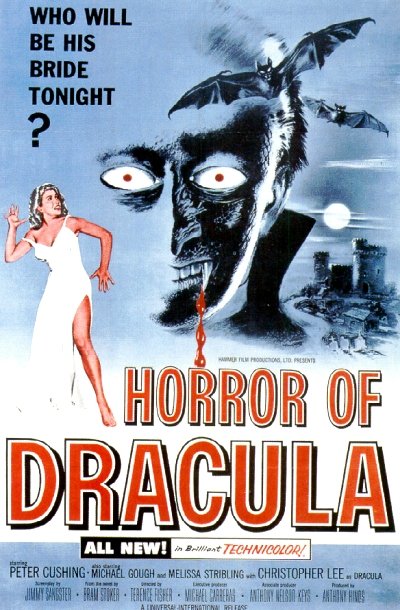
DRACULA WEEK DAY 2: Christopher Lee in Horror of Dracula (1958)
 Director: Terence Fisher
Writer: Jimmy Sangster, based on the novel by Bram Stoker
Cast: Christopher Lee, Peter Cushing, Michael Gough, Melissa Stribling, Carol Marsh, Olga Dickie, John Van Eyssen, Valerie Gaunt, Charles Lloyd Pack, Barbara Archer, Janina Faye
Plot: Librarian Jonathan Harker (John Van Eyssen) is called to Castle Dracula by its mysterious count (Christopher Lee). He encounters a strange woman (Valerie Gaunt) who begs him to help her escape, but she flees as Dracula makes his appearance. Dracula has summoned Harker to index his enormous collection of books, and encourages him to make the castle his home as he works. As Dracula leaves him, Harker pens a journal entry that reveals his true intention – to end the Count’s reign of terror forever. That night, he again encounters the strange woman from before, and she again begs his help, only to bite him on the neck. As she does so Dracula appears, blood on his mouth, and he attacks the woman. Harker grapples with the Count, but is defeated, and Dracula takes the woman away. Harker wakes up in his bedroom the next morning, a pair of fang-marks on his neck, and decides he must exterminate Dracula before sundown. He finds the crypt and drives a stake through the vampire woman’s heart, awakening Dracula just as the sun goes down. Dracula seals Harker in the tomb.
Some time later Dr. Van Helsing (Peter Cushing) stops at a tavern, seeking word of the missing Harker. A tavern girl gives the Doctor a book she found – Harker’s journal. He finds Castle Dracula and the bodies of both the vampire woman and Harker. Van Helsing returns to Harker’s bedridden fiancé, Lucy (Carol Marsh) to tell her of Harker’s death, but her brother Arthur (Michael Gough) and his wife Mina (Melissa Stribling) hide the truth from Lucy, unaware that she is already being visited by Dracula in the night. He is biting her, draining her slowly, preparing her to become his new thrall.
As Lucy is treated for what her doctors believe to be anemia, Van Helsing recognizes the symptoms of a vampire attack. He orders the windows in her room shut at night and the room filled with garlic cloves. At Lucy’s behest, though, her housekeeper (Olga Dickie) opens the windows and removes the garlic. In the morning, Lucy is found dead. Later, the housekeeper’s daughter Tania (Janina Faye) claims to have encountered her dead “Aunt Lucy.” Arthur goes to her tomb that night and finds it empty. Lucy, now a vampire, summons the child to her and they encounter Arthur. Van Helsing saves him and stakes Lucy, sending her to a true rest. Arthur gives Mina a cross to wear, but upon touching it she shouts and collapses, the cross burned into her flesh. She, too, has been touched by the vampire.
That night, Dracula comes for Mina again, draining her so completely Van Helsing has to give her a transfusion of blood from Arthur. Van Helsing finds Dracula’s coffin in the cellar, but the Count takes the moment of distraction to take Mina and flee. They chase him back to Castle Dracula, where Van Helsing exposes him to the light of the sun. Dracula shrivels and turns to dust, his reign of terror ending… until the sequel.
Thoughts: It is utterly unforgivable that I’ve been conducting these movie studies for three consecutive Octobers now, and this is the first time I’ve touched upon the storied Hammer Films catalogue of horror. While Hammer may not have the immediately recognizable icons of Universal (although they in no small way owe their fame to remaking the characters Universal made famous), it’s no less an important chapter in the universe of terror, and I should have delved into it a long time ago.
That said, I picked a great film to begin my Hammer Horror education. Horror of Dracula was Christopher Lee’s first time portraying Count Dracula, and he did a fantastic job in the role. Although largely absent from the middle section of the movie, his presence is compelling and powerful, a real menacing figure worthy of the Dracula name. In the final confrontation with Van Helsing, he momentarily devolves into a mad, snarling beast, and it’s a great moment. You’re terrified of him, you think he’ll rip Peter Cushing’s throat right out. He’s a monster in the best sense of the word.
He’s also the subject of some pretty impressive special effects. When the sunlight kills him at the end, the way he wilts away into nothing is really remarkable for a 1958 film. Hammer truly was on the top of its game.
As Van Helsing, Peter Cushing makes for a great hero. There’s an authoritative sense to him – he’s a man you want to trust in the middle of a terrible ordeal. He carries a gravity and a power that makes the situation seem just as serious as a horror film should seem. Even now, over 50 years later, this really works as a horror classic.
The structure of this film is odd. It’s based on the original Dracula novel, at least in part, but both the plot and the characters presume a great deal of familiarity with the Dracula concept even before the film begins. Harker knows who and what Dracula is and has a plan to destroy him from the very outset, although Dracula seems at least initially fooled by his façade of being a simple librarian. It’s almost as if the film’s heroes had read the novel and decided they wanted to cut off the monster at the pass. Of course, that sort of genre awareness seems to evaporate when Harker reaches Dracula’s crypt and stakes the woman first. Seriously, man? You always kill the boss first, if you’ve got the chance. It’s like this 19th century character from a 1950s movie had never played a video game or something.
Although clearly inspired by Bram Stoker, screenwriter Jimmy Sangster took some unusual and rather inexplicable liberties – changing Harker’s love interest from Mina to Lucy, making the two sisters-in-law, making Arthur Mina’s husband and so on. All in all, the film succeeds in telling a perfectly coherent story, but it’s not exactly the same story as the book. That’s not necessarily a bad thing, mind you, but it is a… thing. That happened. And I find it curious enough to point it out. The film also attempts to distance itself from the novel, accepting the by-then common conceit that the vampire cannot venture out in the daylight (absent from the novel) and dismissing the idea of the vampire changing its shape as “pure fallacy” (this idea was present in the Stoker original). I’m truly not sure what to make of it. The writer really seems to be struggling to buy in to the existing Dracula mythology, while picking and choosing the parts he likes and bringing in other elements pretty much at will. I don’t know how a storyteller reconciles those two impulses, but Sangster at least manages to turn out an entertaining story in the mix.
If nothing else, the movie is plenty of fun and a great film to throw on during your Halloween party… or any other time you’re looking to have a creepy good time.
The first Reel to Reel study, Mutants, Monsters and Madmen, is now available as a $2.99 eBook in the Amazon Kindle store and Smashwords.com bookstore. And you can find links to all of my novels, collections, and short stories, in their assorted print, eBook and audio forms, at the Now Available page!
DRACULA WEEK DAY 1: John Carradine in House of Dracula (1945)
 Director: Erle C. Kenton
Writer: Edward T. Lowe Jr.
Cast: John Carradine, Lon Chaney Jr., Martha O’Driscoll, Lionel Atwill, Onslow Stevens, Jane Adams, Ludwig Stossel, Glenn Strange, Skeleton Knaggs
Plot: Count Dracula (John Carradine) approaches a scientist, Dr. Franz Edelmann (Onslow Stevens), and asks him to discover a cure for his immortal curse. Edelmann and his hunchbacked assistant, Nina (Jane Adams) study Dracula’s blood and discover an unknown parasite. As Edelmann begins his experiments on Dracula a new patient arrives – Lawrence Talbot (Lon Chaney Jr.), who seeks a cure for his own curse. When told the doctor is unavailable, an upset Talbot flees to the police station and demands to be locked up. The police summon Edelmann to examine him, and he arrives just in time to witness the rising full moon and Talbot’s transformation into the Wolfman.
Edelmann believes he can cultivate a mold that will allow him to reshape Talbot’s skull, which will relieve the pressure on his cranium and prevent his transformation. (It doesn’t make a lot of sense in the context of the movie either.) Unwilling to wait for enough mold to be cultivated, Talbot flings himself from a nearby cliff. That night, as Edelmann searches for Talbot, the Wolfman attacks him. Talbot changes back before Edelmann can die, and the doctor discovers he’s hiding in a cave perfectly suited to grow the spores he needs. As they search the cavern, they find something totally unexpected: the Frankenstein monster (Glenn Strange). Because what the hell. They bring the monster to the hospital, hook him up to machines that can bring him back to life, then decide not to do it. This should end well.
Dracula, remembering that his name is in the title of the movie, stops by and sees Edelmann’s assistant Miliza (Martha O’Driscoll) playing the piano. For no discernible reason, he uses his power to mesmerize her. Wary, Edelmann tells Dracula he will require another transfusion to test his theory, and Dracula agrees. Edleman falls asleep during the experiment, though, and Dracula reverses the transfusion, placing his own blood into the doctor’s veins before fleeing. Edelmann follows Dracula to his coffin, which he drags into the sunlight and opens, reducing the vampire to a skeleton and laughing at the fact that there’s still a third of the movie left to go.
The transfusion begins to affect Edelmann, darkening his eyes, causing his reflection to vanish. He is becoming a vampire. This conveniently leads to him having a dream sequence largely made up of clips of earlier Frankenstein movies, which tempts him to resurrect the monster. The good in him forces back the evil, and he decides to use the spores to operate on Nina while he’s still himself. She convinces him to use his time to operate on Talbot instead, and he does so, knowing it will not be until the next full moon that they can be certain he was successful.
Edelmann, meanwhile, begins to succumb to the vampire, killing a villager and fleeing the same crowd of angry townspeople who spent most of the 1930s and 40s waiting for Universal to make another monster movie so they could find work. The police come to Edelmann’s hospital, believing Talbot responsible for the murder. Talbot realizes Edelmann is the real killer, and he pledges to help him stay sane long enough to help Nina, then destroy the evil within him. As the next full moon approaches, Talbot is astonished to find he does not transform: the operation was a success. The Wolfman is no more. As Nina tries to tell Edelmann, she finds him resurrecting the Frankenstein Monster, having given in to the evil within him. He kills Nina and has the monster attack the police. Talbot retrieves a police weapon and guns down Edelmann as the mob arrives for their scheduled appointment. The lab catches on fire, because 1945, and the monster is destroyed as the mob, Talbot and Milizia flee.
Thoughts: By 1945 the Universal Monster franchise had largely evolved into a bizarre mishmash where the monsters – particularly the three heavyweights – appeared in each other’s films indiscriminately and with little to no regard to continuity. Just the year before, in House of Frankenstein, audiences saw Dracula, the Wolfman and Frankenstein’s monster each meet their demise, but here they are without any attempt at an explanation. Today we’d just call it a “reboot” and pretend the earlier movies never happened, but nobody wants to ignore the Universal Classics… nobody in their right mind, anyway.
If there’s one thing this movie proves, it’s that trying to come up with a scientific explanation for what has always been supernatural in-canon is usually a bad idea. The parasites in Dracula’s blood are bad enough, but the explanation for Larry Talbot’s transformation Wolfman is close enough to “it’s all in your head” as to almost be insulting to fans of the character. One can easily believe George Lucas watched this movie just before he whipped up the concept of Midi-Chlorians.
The good news is, no matter how crappy the plot of a movie, it was always a treat to watch Lon Chaney Jr. and Glenn Strange in their legendary forms. Chaney’s Wolfman has always been the saddest and most tragic of the Universal monsters, a creature that wishes for nothing but peace but is utterly unable to find it. When Stan Lee created the Hulk, he always credited inspiration coming from Dr. Jekyll and Mr. Hyde, but I’ve often thought the sad case of Bruce Banner had more in common with Lawrence Talbot. And with that in mind, it’s nice to see him sort of get a happy ending for a change. Sure, by the time he met Abbott and Costello three years later he was the Wolfman again, but so what? Frankenstein wasn’t burned anymore and Dracula had regenerated from a skeleton back into Bela Lugosi somehow. Who cares? It’s the 40’s! Party!
Anyway, on to Dracula himself. John Carradine as the legendary nosferatu has surprisingly little to do in this movie, even though he’s the title character. (In truth, at this point Universal’s naming convention was practically random: grab the name of any monster that appears in the movie and add a few other words. This film could just as easily have been titled Curse of the Wolfman or Return of Frankenstein or Dr. Edelmann’s Wonder Emporium and it would have been equally – if not more – accurate.) To Carradine’s credit, in the time he’s on screen he puts forth a solid performance. There’s a charm and a menace to him, and one can believe a woman would allow herself to be in his presence long enough to be affected by his hypnotic powers, which is convenient, because that’s exactly what the alleged plot calls for.
That said, the Dracula in this film is written in a terrible fashion. He begins the story by seeking a cure for his vampirism (something he never showed any particular interest in before), then starts going right back to his old “hypnotize ‘em and suck their blood” routine as if he wasn’t tired of that crap at all. He falls for Edelmann’s transfusion trick entirely too easily, then sabotages the very experiment he asked for in the first place. I spent half the film watching Carradine and shouting: “WHY ARE YOU DOING THINGS? STOP. THIS MAKES NO SENSE. YOU DON’T EVEN HAVE A HOUSE.”
The real star of this movie is Onslow Stevens as Dr. Edelmann, who starts out as a well-meaning scientist skeptic before becoming a creature of cartoonish evil. The dream sequence he has is nearly laughable, as his “good” and “evil” selves seem to argue over whether or not to resurrect the Frankenstein Monster… as if there could be any doubt that he would. Stevens does a great job with what he’s given, he’s just not given A material.
This is not a very good movie, to be blunt. But even the worst of the Universal Monster pictures had a strange sort of charm to them… the fun of seeing these characters overcame the cheesy effects or the ludicrous storylines. While this should never be anyone’s first choice of a monster movie to watch, if it’s available or if you’re doing a marathon of the classics, it has its place.
The first Reel to Reel study, Mutants, Monsters and Madmen, is now available as a $2.99 eBook in the Amazon Kindle store and Smashwords.com bookstore. And you can find links to all of my novels, collections, and short stories, in their assorted print, eBook and audio forms, at the Now Available page!
Next Week is DRACULA WEEK!
 I’m not gonna lie to you guys, I’ve been crazy busy the last few weeks… schoolwork, wedding planning, podcasts and other writing projects… I’ve barely scratched the surface of my annual bacchanalia of creepy cinema that I use to get myself excited for to Halloween. But with the big day rapidly approaching, I could not in good conscience go without marking the occasion with a Reel to Reel project. So next week, I’m going to dive into five wildly different interpretations of the most legendary vampire of all time, Count Dracula:
- John Carradine: House of Dracula (1945)
- Christopher Lee: Horror of Dracula (1958)
- Charles Macaulay: Blacula (1971)
- Gary Oldman: Bram Stoker’s Dracula (1992)
- Gerard Butler: Dracula 2000 (2000)
Don’t worry, friends, I’m not forgetting THE most legendary incarnation of the big bloodsucker. But longtime readers know that I’ve already given Bela Lugosi the Reel to Reel treatment in the very first project two years ago. (Then again for his appearance in Abbott and Costello Meet Frankenstein, which means I’ve officially written about every film in which Legosi played Dracula.) So rather than writing about him all over again, I’m going to direct you guys back to that original article, then hit you with five different versions next week. Fair?
Read the original Reel to Reel: Mutants, Monsters and Madman article featuring Bela Lugosi in Dracula (1931)
Okay, now that that’s settled, let’s think about just who Dracula really is, shall we?
The Character:
In the shadowed land of Transylvania, the ancient Castle Dracula stands as a monument to its lord, a creature of Evil. Legend has it he rises at night and drinks the blood of the innocent to maintain his own eternal unlife. But more than perhaps any other character in Icons, Dracula has many, many incarnations — everything from a dark elder god to a charming philanderer to a child’s mascot of creepy fun to an unlikely antihero. Next week, we’re going to think about five such Draculas. Come back on Monday, friends!
Robin Hood Week Day 5: Cary Elwes in Robin Hood-Men in Tights (1993)
 Director: Mel Brooks
Writers: J.D. Shapiro, Evan Chandler, Mel Brooks
Cast: Cary Elwes, Richard Lewis, Roger Rees, Amy Yasbeck, Mark Blankfield, Dave Chappelle, Isaac Hayes, Megan Cavanagh, Eric Allan Kramer, Matthew Porretta, Tracey Ullman, Dom DeLuise, Dick Van Patten, Mel Brooks
Plot: With King Richard away in the Crusades, his brother Prince John (Richard Lewis) and the corrupt Sheriff of Rottingham (Roger Rees) have seized power in England. Really… if you guys have been reading these articles all week this should be no surprise by now. In Mel Brooks’s parody of earlier Robin Hood films (most notably the Costner and Flynn versions), we begin in Khalil Prison in Jerusalem, where Robin of Loxley (Cary Elwes) has been taken captive. He meets a Moorish prisoner named Asneeze (Isaac Hayes), imprisoned for jaywalking. Together they free the captives and Asneeze asks Robin to look after his son Ahchoo (Dave Chapelle), an exchange student, when he returns home. Robin agrees and swims from Jerusalem back to England.
Robin finds Ahchoo and rescues him from a band of the Sheriff’s men. They return to Loxley Hall to find it repossessed by the Prince’s accountant, leaving behind only Robin’s old blind servant Blinkin (Mark Bankfield). The Sheriff of Rottingham pursues a boy who killed a deer on the King’s lands, but Robin humiliates him and drives him off. In the palace, Maid Marian (Amy Yasbeck) confides to her servant Broomhilde (Megan Cavanagh) her wish that she could find her one true love: the man with the key to her “heart.” (Also her chastity belt.)
Worried about Robin’s return to England, Prince John turns to his gnarled, witchlike servant, Latrine (Tracey Ullman), who offers to brew a potion to disable Robin. In the forest, Robin meets Little John (Eric Allan Kramer) and Will Scarlett O’Hara (Matthew Porretta), battling over the right to use the bridge over a ludicrously small creek. After besting John and saving his life… sort of… Robin invites the two of them to join his band of Merry Men. Robin barges into one of the Prince’s feasts, charming Marian and antagonizing the Prince and Sheriff before battling free.
Robin’s men stop the wandering Rabbi Tuckman (Mel Brooks), who agrees to join them – along with his stores of Sacramental Wine. As the men “bless” everything in the forest, the Sheriff turns to Don Giovanni (Dom DeLuise), a lord who suggests using an archery contest to trap Robin. Overhearing the plot, Marian and Broomhilde rush to the forest to warn him, arriving just after the show-stopping “Men in Tights” musical number. Robin professes his love to Marian and promises to avoid the contest, a promise he promptly breaks.
The disguised Robin nearly loses to one of Don Giovanni’s men before checking the script for the movie and confirming that he has another shot. With his “Patriot Arrow,” he annihilates the target. He’s captured and almost killed, but Marian promises to marry the Sheriff if he allows Robin to live. Ahchoo saves Robin just before she can say “I do,” and the Prince’s men go to battle with Robin’s. The Sheriff drags Marian away hoping to consummate the marriage, only to be stymied by Marian’s Chastity Belt. Robin and the Sheriff duel, breaking open a medallion from Robin’s father and revealing the key to Marian’s belt. The Sheriff impales himself on Robin’s sword while trying to stab him from behind, and Latrine offers to save him if he’ll marry her. He agrees, and immediately regrets it. Robin and Marian plan a wedding, but are interrupted by the return of King Richard (a cameo by Patrick Stewart), who has his brother arrested and makes Robin a knight. Tuchman finishes the marriage ceremony and Robin and Marian dance away… only to find Robin’s key doesn’t turn in the lock.
Thoughts: Just as the Kevin Costner Robin Hood hit when I was 13 and looking for adventure, this version hit when I was 15 and looking for things to be cynical about. A Mel Brooks comedy was just the thing. And like the Kevin Costner version, I still like this film despite its flaws. Unlike the Costner film, though, I find the flaws in this movie a bit harder to defend.
Brooks is credited with co-writing the screenplay with the two men credited for the story, one of whom never wrote anything else and the other of whom went on to write Battlefield Earth. When you realize just how drastically this film lacks the sharp verbal wit of Brooks’s superior films, the preceding sentence makes a lot more sense. The best Brooks movies (by which I mean Blazing Saddles and Young Frankenstein) were so great because of how sharp and clever the writing and characters were. This movie doesn’t quite rise to that level, relying more on anachronistic dated references like Ahchoo’s pump sneakers and a kid parodying Macaulay Culkin’s character in Home Alone. Anachronisms in Brooks comedies isn’t new, of course, but compare the impromptu musical numbers and wild finale of Blazing Saddles with Blinkin holding a braille Playboy magazine in this movie and tell me they belong in the same conversation. Other nuggets feel like lame Mad magazine gags (Will Scarlett O’Hara – “We’re from Georgia”), or the “Wide load” sign on the back of Loxley Hall as it’s carted away.
The best bits, in fact, are the ones that harken to Errol Flynn’s The Adventures of Robin Hood, a movie a good 75 percent of this audience never saw. Robin and Little John’s battle at the creek is great – the two of them duel over the right to cross a body of water approximately ten inches wide, their fighting staffs breaking in half over and over until they’re left swatting at each others’ fingers. The battle at the feast is set up much like the fights in Flynn’s movie, with added visual gags which work infinitely better than many of the verbal jokes in the film. The archery contest, similarly, is really funny. Brooks is no stranger to breaking the fourth wall, but having every character stop to check the script to make sure Robin was entitled to another shot… I don’t really know why, but I still chuckle at that.
A great Brooks comedy always has great performances, but this is the only one I can think of where the performances actually save the weak material. Cary Elwes is really great here, only a few years after The Princess Bride and playing a broader version of the swashbuckler from that film. While he does his share of mugging for the camera, he does it with charm and wit. His famous dig at Kevin Costner (“Unlike some other Robin Hoods, I can speak with an English accent”) is the one thing everybody remembers from this movie even 20 years later, and he sells it with real panache. Had he been born sixty years earlier, I think Elwes would have gone down as one of the all time great movie heroes. As it is, he has that one great movie, this lesser movie, and Saw. Wow, it’s depressing when you think of it that way.
Amy Yasbeck isn’t a bad Marian. While not a classic beauty, she has a sweetness to her that feels like it’s been amplified for the sake of the comedy, but remains sincere at heart. Richard Lewis and Roger Rees, similarly, work well in this film. While Lewis would never fit in to a straight version of Robin Hood, he’s perfect as this sort of weasely, incompetent Prince John. Roger Rees, probably best known for his recurring role in Cheers, is the perfect smarmy right-hand man. He’s the enforcer, with a little bit of muscle to back up the Prince’s gutless orders. At the same time, though, he’s a bumbler himself, constantly tripping over his words and never exuding any real menace.
This isn’t the best Robin Hood movie, I concede. And it’s certainly not Brooks’s best movie. But if there’s one thing I think we can all agree on, it’s this: at least it’s not Dracula: Dead and Loving It.
The first Reel to Reel study, Mutants, Monsters and Madmen, is now available as a $2.99 eBook in the Amazon Kindle store and Smashwords.com bookstore. And you can find links to all of my novels, collections, and short stories, in their assorted print, eBook and audio forms, at the Now Available page!
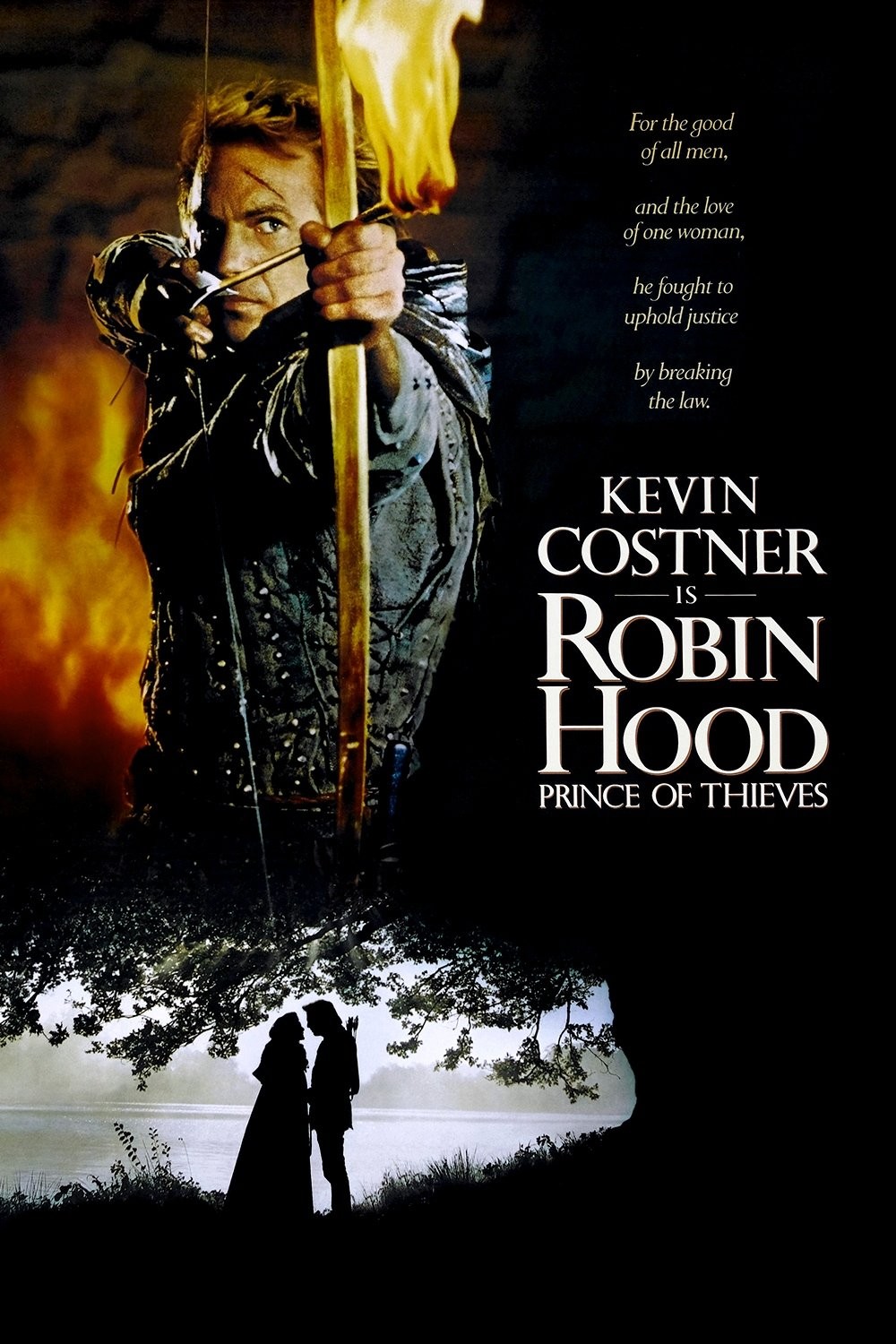
Robin Hood Week Day 4: Kevin Costner in Robin Hood-Prince of Thieves (1991)
 Director: Kevin Reynolds
Writer: Pen Densham & John Watson
Cast: Kevin Costner, Morgan Freeman, Christian Slater, Mary Elizabeth Mastrantonio, Alan Rickman, Nick Brimble, Mike McShane, Michael Wincott, Geraldine McEwan, Harold Innocent, Brian Blessed, Soo Drouet
Plot: Robin of Locksley (Kevin Costner), a nobleman who joined King Richard in the Crusades, has been captured in Jerusalem. He escapes, saving the life of a Moor named Azeem (Morgan Freeman) in the process. Azeem returns to England with Robin, having sworn a life-debt to the Christian. Robin and Azeem return to England to find Nottingham under the thumb of its cruel Sheriff (Alan Rickman). The Sheriff rules with the aid of Sir Guy of Ginsbourne (Michael Wincott), the corrupt Bishop (the ironically-named Harold Innocent), and a witch named Mortianna (Geraldine McEwan), who fears prophecy of her death at the hands of a “painted man.” Robin meets with a childhood friend, Marian (Mary Elizabeth Mastrantonio), whose brother made Robin swear to protect her before dying in the Crusades. Robin’s father is dead and his home destroyed, and he and Azeem flee into Sherwood Forest to evade the Sheriff’s men.
They encounter a band of outlaws led by Little John (Nick Brimble) and Will Scarlet (Christian Slater), who takes an immediate dislike to Robin. Robin takes the lead of the outlaws and begins training them to fight. As time passes, they begin robbing the coaches of noblemen, including that of a hard-drinking but able Friar Tuck (Mike McShane), who joins their party. Marian, realizing that Robin is fighting for the England of her absent cousin, the King, begins to quietly provide him aid.
The Sheriff hires mercenaries to help him find Robin’s woodland hideout, capturing several of his men. He “proposes” marriage to Marian, the King’s cousin, saying he will space the captured outlaws if she accepts. One of the captives, Will Scarlet, deals with the Sheriff to track down Robin. When released into the forest, though, Will tells Robin of the Sheriff’s plans despite his anger with the man. Will reveals that he is Robin’s half-brother, the son of a woman Robin’s father took up with after his mother died. Robin embraces his brother, and together, they begin to plan.
On the day of Marian’s wedding – which will coincide with the execution of the captives – Robin leads a rescue, setting them free. Azeem rallies the peasants to join them in overthrowing the Sheriff, and Nottingham erupts into war. The Sheriff rushes his “wedding” to Marian and takes her away, planning to consummate the marriage. As the Bishop tries to flee, Tuck faces him and loads him with treasure, pushing him from a window to his death. Robin saves Marian and kills the Sheriff, but Mortianna attacks him with a spear. Before she can strike her blow she is killed by Azeem, who has fulfilled his debt to Robin.
Robin and Marian marry in the forest, a wedding only briefly interrupted by the return of King Richard (Sean Connery in an awesome cameo), who blesses them and gives Robin Hood his thanks.
Thoughts: I was 13 years old the summer this movie came out, and although I know it gets a lot of grief from the Costner-haters of the world, it’s still a movie I really like. This was the first live action Robin Hood movie I ever saw, and as such it has greatly influenced my feelings about the character. Still, looking back at it 20 years later, I can see some of the cracks in the hero’s armor.
Kevin Costner, to begin with, is slightly problematic. While I don’t hate the man, and in fact find his performance to be mostly effective, the fact that he doesn’t even attempt to sound English really does stick out like a Teletubby in a Goth Club. For all the good he brings to the role – a confident air, a dedication that feels genuine – the truth is I do have to force myself to ignore his lack of an accent. There’s an irony here – most linguistic scholars believe that the modern American dialect is actually much closer to 12th-century England than the speech patterns of the modern British. One could actually make the argument that Costner technically has the most accurate speech pattern in the film. Of course, I would then tell “one” to shut up, because that doesn’t change the fact that Costner still didn’t sound like anybody else in the movie.
The rest of the cast, however, is impeccable. Morgan Freeman, who is as convincing as a Moor as Costner is as an actor being paid an enormous amount of money but still refusing to attempt an accent, steals the show as Azeem. He takes over the role of Robin’s second that is usually occupied by Little John, standing with him in the hardest moments and driving together the action when he draws his sword. His dry wit even brings a good bit of comic relief to the film. I would gladly have watched a film chronicling the further adventures of Azeem.
But the prominence of this original character doesn’t really hurt Robin’s usual Merry Men. Mike McShane’s Friar Tuck is a riot and a lot of fun to watch, and to compensate for making Little John somewhat less of a central player than he usually is, the screenwriters introduced his wife (Soo Drouet) and family, giving him much more to do and much more at stake than he usually has. Drouet herself is a very strong addition to the cast – wry and boisterous, like a saucier version of Molly Weasley. Mastrantonio’s Marian… well, she’s not bad at all, but there’s nothing particularly memorable about he. She plays the part, she does what you want her to do.
Alan Rickman, however, absolutely shines. We’re only a few years removed from Die Hard here, and he brings the same sort of nasty menace to the Sheriff of Nottingham as he did to Hans Gruber. When he threatens to cut out Robin’s heart “with a spoon” (“Because it’s dull, you twit, it’ll hurt more,”) damned if you don’t believe it. This is, without exception, my favorite rendition of the Sheriff of Nottingham of all time, the fiercest, the most frightening, and the most fun to watch.
It may be because I was just at the right age when this movie hit, but it’ll always hold a soft spot for me. I can watch it over and over even today and always enjoy it, always get swept up in the excitement, and always feel ready to cheer for England’s legendary defender.
The first Reel to Reel study, Mutants, Monsters and Madmen, is now available as a $2.99 eBook in the Amazon Kindle store and Smashwords.com bookstore. And you can find links to all of my novels, collections, and short stories, in their assorted print, eBook and audio forms, at the Now Available page!
 Reel to Reel