Category Archives: 2-Lunatics and Laughter
Lunatics and Laughter Day 11: Army of Darkness (1992)
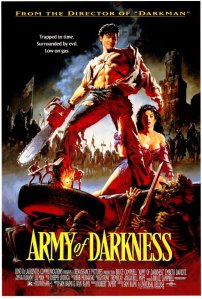 Director: Sam Raimi
Writers: Sam Raimi & Ivan Raimi
Cast: Bruce Campbell, Embeth Davidtz, Marcus Gilbert, Ian Abercrombie, Richard Grove, Bridget Fonda, Patricia Tallman, Ted Raimi
Plot: S-Mart employee Ash Williams (Bruce Campbell) has had a hard time of it – finding the Necronomicon (Book of the Dead), awakening something terrible, getting attacked by zombie-like “Deadites,” being forced to kill his possessed girlfriend and chop off his own hand, and then getting hurled back in time to the middle ages. As the film opens, Ash recalls how he fell through a time portal (along with his car, shotgun, and chainsaw) and was taken into captivity by the soldiers of a warlord named Arthur (Marcus Gilbert). Although Arthur’s Wise Man (Ian Abercrombie) believes Ash to be a prophesied savior, Arthur has him chained with the men of his captured enemy, Henry the Red (Richard Grove). As the captives are marched to a pit for execution, Arthur is attacked by a woman named Sheila (Embeth Davidtz) whose brother was slain by Henry’s men. Arthur blames Henry for loosing an evil upon the land, but Henry claims his men have fallen prey to the same beast. Arthur opens the pit and a captive is tossed in, blood erupting from the bottom. Ash tries to convince Arthur he’s not one of Henry’s men, but Sheila hurls a rock at him and he falls into the pit, where a Deadite awaits. The Wise Man throws Ash’s chainsaw into the pit and, his weapon returned, he escapes. He sets Henry free and uses his shotgun to intimidate Arthur’s men, into obeying him.
The Wise Man tells Ash his only hope of returning home lies in finding the Necronomicon. He prepares for battle, making a mechanical hand for himself. Sheila gives him a blanket, hoping to apologize for her actions, but he rebuffs her at first. When it’s clear she’s upset, he instructs her to “Give me some sugar, baby,” and she sends him off with a kiss. The Wise Man gives Ash the words he needs to allow him to take the book safely: “Klatu Verada Nikto,” but the overconfident Ash refuses to repeat them more than once. He’s pursued by the dark forces from inside the book, who burst from a broken mirror as several miniature versions of himself, tormenting him in painful and amusing ways. One manages to to jump down his throat and sprouts from him as a full-grown “Evil Ash,” whom Ash manages to subdue, chop up, and bury. Ash makes his way to the stone altar where the Necronomicon awaits, but finds he has forgotten the Wise Man’s magic words. He tries to fake his way through it, but when he takes the book an army of skeletal Deadites rises from the earth. Evil Ash, now rotting and mutating, rises to lead them.
Returning to the Castle, Ash insists the Wise Man send him home as soon as possible. Before it can happen, a flying Deadite swoops in and takes Sheila captive. It brings her to Evil Ash, who is opening every grave to set free even more Deadites. When word of the army reaches Arthur he debates fleeing, but Ash is determined to stand and fight. He convinces Arthur’s remaining me to stay, and sends an envoy to Henry the Red, hoping to recruit his army to their cause as well. The Deadite Army approaches, a now-possessed Sheila at Evil Ash’s side, and battle ensues.
Ash’s homemade gunpowder gives Arthur’s forces an early advantage, but the Deadites break down a gate and get inside the fortress walls. Just as it seems the living will be overwhelmed by the dead, Henry the Red’s forces arrive and turn the tide. Evil Ash and Sheila overwhelm the guards protecting the Necronomicon, but Ash manages to toss her over the side of the wall and face his counterpart. The two battle, and Ash defeats the monster and saves the book. The rest of the Deadites retreat, and Sheila is restored. Arthur and Henry make peace and the Wise Man gives Ash a potion that will send him to his own time, provided he can remember the magic words. He bids Sheila farewell and returns to his time and his home, working in S-Mart, where we see him telling the story to an unconvinced, unimpressed coworker. Suddenly, a customer transforms into a Deadite, attacking, and Ash grabs a rifle from the store’s case, blowing her away. It’s not too bad to be home.
Thoughts: The Evil Dead franchise (I covered the first film in the original Reel to Reel project) is a strange animal. The first film is a straight-up “Cabin in the Woods” sort of horror movie. The sequel, Evil Dead II, is a virtual remake of the first, copying the plot and largely ignoring the first film, but providing better special effects and a brand of dark comedy the first laughed. By this third installment, writer/director Sam Raimi decided to go for a full-blown comedy. Bruce Campbell’s Ash – a struggling everyman in the first film – had become a cool-as-ice balls-of-steel action hero capable of creating advanced robotic prosthetics with 14th-century technology. And yes, we love him for it.
Early in the movie Raimi ramps up the already-gory franchise to a truly comical degree, with a literal geyser of blood early. The violence, however, has a much more comical tone than in the first two films, and after that initial spout, there’s surprisingly little blood. A lot of that comes down to the monsters that make up most of the movie – rather than fleshy pseudo-zombies as in the first two movies, the majority of the Deadites this time around are reanimated skeletons – fun to break, but not much blood to spray at the camera. As Ash battles the stop-motion skeletal Deadites, there’s a nice feel of the Three Stooges meeting Jason and the Argonauts. Every bit of action is far sillier than would have been allowed in the earlier movies, in fact. The scene where Ash leaps into the air and snaps his chains aw on to his dismembered hand would be preposterous even in a more serious, Type-A horror/comedy. This movie rides the line between the two types – the basic plot is something out of a horror (or perhaps more accurately, medieval fantasy) film. The antics of Ash and the Deadites, however, are too broad to really place in the same category as Ghostbusters and the like.
For sheer silly, though, nothing tops the battle with the mini-Ashes. This segment is full of pure slapstick, comedic moments that aren’t too far off from the antics of Home Alone, about as far from a straight-up horror movie as you can get. The only thing that keeps things even a little creepy here is Bruce Campbell’s attitude as he does battle with the miniatures, his face growing truly maniacal as he guzzles boiling hot water in the hopes of destroying one that forced itself down his throat. The rest of the scene spins wildly though different gags: Ash finds an eyeball growing on his shoulder and it’s goofy (although there is, to be fair, a nice dose of body horror in that moment), the eye begins sprouting into a second Ash and it gets silly again. If it weren’t for the unique charm Campbell brings to the character, the whole thing would be entirely too inane to give even a moment’s consideration.
That said, Ash truly is an iconic character, thanks mostly to this movie. One of the greatest horror/comedy moments of all time has to be Bruce Campbell’s “boomstick” speech, where he extols the virtues of shopping at S-Mart to a crowd of medieval screwheads (I quote him directly, of course) who live in a world where the fictional retail giant won’t even exist for another 700 years. If you know a movie fan who loves Bruce Campbell and you can’t figure out why, I can only assume you’ve never watched this movie.
The Army of the Dead itself is a pretty macabre sight. Raimi gives us a complex mixture of stop-motion skeletons, mechanical puppets, and people in costumes. Although it’s fairly easy to tell the difference between them, at this point you’ve bought so completely into the world in front of you that you don’t even care if the effects aren’t seamless, the greenscreen is obvious and the action is more like a live action Looney Tunes short than anything else. In fact, some of the more technically absurd moments are the most entertaining. Whenever one of the skeletons explodes in a sudden burst of white dust, you get a visceral thrill, and if you can watch a group of skeletons storming a castle with a battering ram without your inner 11-year-old thinking about how awesome it is, something is terribly wrong with you. By the time Bruce Campbell fights two Deadites with two different swords at the same time, you’re either a fan for life or you’re never going to appreciate what you’re watching.
I know a lot of people prefer this movie’s rather famous original ending, in which Ash is returned home via a magic sleeping potion, but he takes too much, sleeps too long, and awakens in a post-apocalyptic wasteland. Thematically, it actually fits the trilogy pretty well. The first movie was unflinchingly bleak, the sequel only marginally less so. Ending the series with a completely hopeless climax would have been perfectly in character. That said, I’m kind of glad Raimi relented and gave us the ending he did. Maybe it’s just because I’m basically a positive person. Maybe it’s because I think Ash deserves a happy ending after everything he’s been through. Or maybe it’s just because the S-Mart finale gives Ash one last moment to be kick a little ass, I don’t know. All I know is that if the theatrical ending had never been filmed, we never would have been treated to Ash’s immortal “Hail to the King, baby.” And that would be a damn shame.
Lunatics and Laughter Day 10: Buffy the Vampire Slayer (1992)
 Director: Fran Rubel Kuzui
Writer: Joss Whedon
Cast: Kristy Swanson, Donald Sutherland, Paul Rubens, Rutger Hauer, Luke Perry, Michele Abrams, Hilary Swank, David Arquette, Stephen Root, Natasha Gregson Wagner
Plot: Once in every generation a Chosen One is born, a young woman with the power to stand against the tide of the greatest predator in the world, the vampire. Unfortunately, this generation’s slayer is a ditzy cheerleader named Buffy Summers. Buffy (Kristy Swanson) and her friends are hanging out at the mall one day when she’s startled by a creepy figure (Donald Sutherland). She tries to shrug it off, but begins having dreams of an earlier life where she battled a vampire named Lothos (Rutger Hauer). In the present day, Lothos sleeps, but his minion Amilyn (Paul Reubens) is ready to wake him up. A pair of burnouts, Pike (Luke Perry) and Benny (David Arquette) encounter the girls a few times before wandering off, drunk. Benny is taken by Amilyn, while Pike is saved by the strange man from the mall, Merrick. He approaches Buffy and asks her to accompany him to a graveyard so she can claim her “birthright.” She doesn’t believe his claim that she is the Chosen One, but when he begins describing her dreams to her, she agrees to accompany him. Two freshly dead people rise, transformed into vampires, and Buffy instinctively stakes them.
Pike, home in bed, is approached by Benny, who hovers outside his window and cannot enter without an invitation. Benny cries that he’s hungry, brandishing a new pair of fangs, and Pike refuses him entry. Unnerved by the strange things he’s seen, Pike plans to leave town. Meanwhile Buffy, after some persuasion, begins the training she should have undergone years ago, taking to the night to slay the vampires. She winds up saving Pike, whose effort to escape town is thwarted when he’s jumped by Amilyn. Amilyn escapes, but loses an arm in the process, and is scolded by Lothos for his failure.
At a basketball game, Buffy realizes one of her friends has been turned and pursues him through the streets of the city. Pike joins in the chase and the two, on motorcycles, hunt him to a storage yard for parade floats. Lothos and Merrick both intervene in the fight, and the vampire lord slays Buffy’s mentor. Buffy’s friends show no sympathy when she turns up depressed the next day, and she and Pike get in a fight in public over her unwillingness to continue the fight. Neither of them know Benny is nearby, hears the fight, and learns that Buffy is the Chosen One. With her name revealed, Amilyn and Lothos plan to destroy her.
Pike crashes the senior dance, dancing with and kissing Buffy just before Lothos’s vampires break through the windows and attack the hundreds of assembled teens. Pike presents Buffy with a bag of stakes he prepared, and she goes on a slaying spree. Benny and Pike fight in the dance, Benny offering to change his buddy into a vampire, but Pike refuses and slays him. Buffy encounters Amilyn in a stairwell, staking him in front of Lothos, who is unmoved by his minion’s death (or melodramatic death scene). Their battle spreads back to the gym, and Buffy stakes Lothos in full view of the school. Together, Buffy and Pike ride his motorcycle into the sunrise, leaving the town to wonder what the hell just happened.
Thoughts: Joss Whedon is, today, a god among geeks, creator of such cult favorites as Firefly and Dollhouse, director of the biggest superhero movie of all time in The Avengers, and pioneer of original online content with Doctor Horrible’s Sing-Along Blog. (Not to mention is more recent film Cabin in the Woods, a great entry into the horror canon, my analysis of which is available exclusively in the eBook edition of Reel to Reel: Mutants, Monsters and Madmen.) His star began to rise in earnest in 1997, when his Buffy the Vampire Slayer TV show became a hit for the fledgling CW network. That show largely ignored the film that birthed the character, though. Released in 1992, Whedon was never happy with the way director Fran Rubel Kuzui treated his script, playing it as a much broader comedy than he intended. And in truth, anybody who watches more than a few minutes of the TV show will agree that the film pales in comparison. That said, though, looking back 20 years later, there is a bit of cheesy charm in this original version of the Slayer.
Whedon’s initial concept was to take the typical horror movie victim – the teenage girl – and turn her into the hero. It’s a great, simple idea, but the final film goes a bit too far in playing up the stereotypes. Buffy and her friends (including future Oscar winner Hilary Swank) are vapid to the point of obnoxiousness. That may well be the intent, but once they start jabbering about choosing “litter” as the theme for a socially-conscious school dance, you kinda want to see them all die. The only thing more irritating is the basketball coach shouting to his team to “actualize” as though it’s a defensive strategy. Pretty much all of the humor is too broad for the characters, in fact. The only really goofy moment that works is when you realize the vampires have, in fact, been invited to the dance and thus can enter. Of course they were invited. They’re seniors.
Much of the violence and action isn’t quite believable either. An early scene where Buffy chops up a hot dog Benny is using to taunt her is supposed to be an early indicator that she’s got power, but instead just seems like the director used poor editing to cover a joke that had no punch. A few minutes later, when Merrick throws a knife at her and Buffy catches it, it’s even worse. The image is so stilted I’m inclined to believe Swanson was actually filmed throwing the knife away and Kuzui played it in reverse.
For all its faults, there are some good moments in the film. Some of Buffy’s dreams are a bit silly, but others are played for straight horror. There’s a nice one, for example, where she’s going to bed and the viewer doesn’t quite realize she’s already asleep when she lies down, Lothos beside her. For a moment you think she’s just oblivious to her enemy (even though it’s already been made clear a vampire cannot enter a person’s home without an invitation), but when he gives her a teddy bear and she curls up on him it’s downright unnerving. You feel a little relief, moments later, when she wakes up. Placing one of the fight scenes in the parade float storage yard is another nice touch – the oversized figures and statuary make for a suitably eerie backdrop for a fight. It’s kind of sad this is the last thing Kuzui directed, she actually has an okay eye for horror that would have worked well in the darker-toned Buffy TV show (where she served as an executive producer). That less broad version of the character may not have been too bad in her hands.
Buffy would later become a great character in the hands of Sarah Michelle Gellar, but the embryonic form still has a bit of steel in her. Swanson’s Buffy is never quite as vapid as her friends, and begins to grow rather quickly. She isn’t the girl power icon she would later become, though. I still keep going back and forth on an element of the character that was disposed of entirely when she transitioned to television – the use of menstrual cramps as an early warning that vampires are nearby. Somebody out there help me – is it empowering to use a nuisance that is unique to women as a weapon in the fight against evil, or is it patronizing to base Buffy’s Spider-Sense surrogate on a natural process that is so often played as a negative stereotype? I feel somehow that the answer to that question would go a long way towards explaining if it’s okay to like this movie or not, but having a Y chromosome (as I do), I don’t think I’m actually qualified to answer it.
Paul Reubens is a really bizarre casting choice. At this point in his career he was already known primarily as Pee-Wee Herman, a role that he put away after an embarrassing public incident the year before. (Don’t pretend you don’t know what I’m talking about.) Doing Buffy felt like an effort to rejuvenate his career, and although it didn’t really succeed, it wasn’t for lack of trying. His Amilyn works well as a sort of Renfield, the second banana to the main vampire, with just enough of an edge to feel like a credible threat. The only time he gets silly or plays up his traits as a physical comedian is during his extremely protracted death scene. (That scene, by the way, isn’t a bad joke, but it’s a joke that goes on entirely too long.) He, at least, is memorable, though. Rutger Hauer’s Lothos… not so much. It’s not that he’s bad, he’s just dull compared to all of the other great vampire performances out there.
It’s an early 90s film, but it actually carries with it a lot of the tropes of the 80s teen sports movie: the character who doesn’t want to play the game, a training montage in which she unlocks her natural talent, and a Big Game at the end for all the glory. There’s even the requisite clueless authority figure (a very funny turn by Stephen Root) who both hassles Buffy for the change in her behavior and tries to be her pal, sharing far too much information with her than anybody is really comfortable with. There’s also a fun little game of “spot the future celebrity” worth playing. Hilary Swank has a sizable role, but you can also catch Ben Affleck as an opposing basketball player, Thomas Jane as a punk teenager, and Ricki Lake and Seth Green (who would go on to have a regular role on the Buffy TV show) as vampires.
For all the crap it gets, the movie isn’t really all that bad. It’s competently made, and none of the performances are horrible. The plot works, but the tone is off. This never would have made any credible “worst of all time” list, it would simply have been forgotten, one of hundreds of movies made every year that are completely off the cultural radar short months later. We remember it, though, if for no other reason than because it gave us one of the greatest horror heroines of all time.
Lunatics and Laughter Day 9: Arachnophobia (1990)
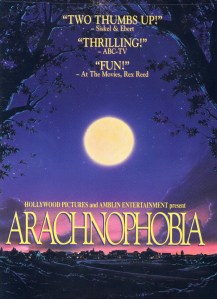 Director: Frank Marshall
Writers: Don Jakoby, Al Williams & Wesley Strick
Cast: Jeff Daniels, Harley Jane Kozak, John Goodman, Julian Sands, Stuart Pankin, Brian McNamara, Mark L. Taylor, Henry Jones, Peter Jason, James Handy, Roy Brocksmith, Kathy Kinney
Plot: Dr. James Atherton (Julian Sands) takes photographer Jerry Manley (Mark L. Taylor) with him on a hunt through the Amazon rainforest, hoping to discover new species of insects and arachnids. Manley has been ill, and fights a fever as they march through Venezuela. The search bears fruit – the team discovers a large, highly aggressive spider Atherton has never seen before. When the still-sick Manley goes to bed, a male “General” spider that stowed away in his pack bites him, killing him in seconds. When his body is found, his death is attributed to the fever and he is sent back to the United States, with the spider that bit him hiding inside.
Manley’s body is returned to his family in Canaima, where town mortician Irv Kendall (Roy Brocksmith) opens the box and finds him shriveled up, drained of fluid, and in a state that’s not at all conducive to an open casket. The spider sneaks outside, gets snared by a bird and is carried to the barn of a house where Dr. Ross Jennings (Jeff Daniels) and his family are moving in, Ross replacing the retiring town doctor Sam Metcalf (Henry Jones). Ross even starts a wine cellar in the basement. When his son discovers a house spider, the arachnophobic Ross has his wife Molly (Harley Jane Kozak) take it to the barn, unaware of the enormous Venezuelan spider hiding in the hay. That night the spiders meet, and mate.
Ross is shocked the next day when Dr. Metcalf tells him he’s decided not to retire after all, crushing Ross, who was supposed to inherit his patients and establish a practice. As he leaves Metcalf’s office he encounters Sheriff Lloyd Parsons (Stuart Pankin) writing him a ticket. He’s rescued by Margaret Hollins (Mary Carver), a retired schoolteacher who dislikes Metcalf and is glad to have the option of another doctor. She’s pleased to be Ross’s first patient. Unfortunately, she’s also his only patient.
Mary turns out to be perfectly healthy, and she tries to cheer him by offering to throw a “Welcome to Canaima” party. While he’s at the office, Molly goes to photograph the barn and discovers a gargantuan spider web in the rafters. She misses the huge egg sac that soon looses a new generation of spiders. Over the next few days they spread out, one of them sneaking into Margaret’s house and killing her.
Ross gets more bad news the next day when he finds the wood in his cellar is weak and rotten. It gets worse when he goes to Margaret’s and finds her body. Although most of the town believes Metcalf’s diagnosis of a heart attack, Ross insists on an autopsy, but the Sheriff blocks him. The spiders strike again soon afterwards, killing a high school football player. Metcalf is next, bitten on the toe and dying as his wife sees the spider.
Convinced the deaths are spider-related, Ross calls the closest expert he can find, Atherton, who is skeptical until he realizes Ross is calling from the late Jerry Manley’s hometown. Atherton sends his assistant, Chris Collins (Brian McNamara) to help with the investigation, and joins himself when bites are found on all three victims. Chris manages to capture a live specimen in Margaret’s house for study. Meanwhile town exterminator Delbert McClintock (John Goodman) discovers the spiders are immune to his toxins – if not a heavy boot.
Atherton examines the captured spider and determines it’s the hybrid of the Venezuelan spider and a house spider. It has a short lifespan, but the General male no doubt has a queen hiding somewhere that will have the ability to create a new generation capable of reproduction. If they can’t destroy it before her nest hatches, Canaima will fall, then the next town, then the next. Phil, Chris and Delbert map out the attacks and realize the nest is on Ross’s property. Atherton, meanwhile, finds Molly’s photograph of the web and comes to the same conclusion. He arrives first, and is bitten and dead by the time the others arrive. Delbert finds Atherton’s body and pulls out his own “special” blend of toxins to fight the creatures.
Ross and Chris go to the house to try to get his family out. The living room is suddenly filled with thousands of deadly spiders. Everyone but Ross escapes, and he falls through the rotten floor into the cellar, where he finds the egg sac. He starts to douse the sac with wine so he can burn it, but is attacked by the original General male. He manages to burn it just as the sac starts to hatch, but it isn’t dead. Grabbing his nail gun, he fires the torched male into the egg sac, killing it and destroying the rest of them in one strike. In the end, the Jennings return to San Francisco, glad to be back in a world where events are totally under their own control… until the earthquake starts.
Thoughts: Although not remembered as well as many of the other films on this list, Arachnophobia holds a special place in my heart – it’s the first horror/comedy I remember actually seeing in theaters. (Yes, even my beloved Ghostbusters was a video find for me. I may even have seen the cartoon first before I ever saw the movie, I honestly don’t remember.) And no matter how much technology may improve the home theater experience over the years – higher resolution, more DPI (whatever that is) streaming video that also makes popcorn in a variety of flavors, whatever – there will always be an irreproducible charm in going to a theater, sitting in a darkened room with others, and absorbing a fun movie in a community experience. This was such a movie for me.
Arachnophobia falls into the more “serious,” Type-A category of horror/comedy. In fact, the first act of the film, while we’re in Venezuela, has little comedy at all, giving us a prologue that very easily could have led into a straight (albeit somewhat cheesy and overdone) traditional horror film. The comedy comes in once we get back to Canaima, and even then it’s very dry at first. Ross, depressed at only having one patient, hopes that she’ll turn out to be “ravaged by disease,” then moments later (on screen, at least) coolly denies that very wish when she turns out to be in perfect health. For much of the film, the comedy we get is well below the threshold that flips the switch and makes it a legitimate horror/comedy and not simply a lite PG-13 horror film. When that switch finally is flipped, it’s due almost entirely to the injection of the John Goodman character.
Delbert is the one wacky character in the midst of a group that doesn’t really have time to be funny. Once the real situation becomes clear, Daniels and company have to deal with thousands of very fast murderers about the size of a quarter… that’s about as serious a situation as we’ve yet seen in this horror/comedy project, and they don’t really play it for laughs. Delbert is our comic relief, an exaggerated character that borders on the cartoonish. Goodman is a fantastic actor, a wonderful comedian (with dramatic chops that are frequently overlooked), but Delbert actually takes things almost too far a few times. Part of it may simply be familiarity with John Goodman – he’s well-known enough now that it’s hard to see him play the part without just getting a very strong sense of him putting on the character. But at the same time, he’s really an odd man out in this movie. That isn’t necessarily a bad thing, that’s his role after all, but there are moments where he goes far enough to jolt you out of the scene.
By contrast, Jeff Daniels works well as the sort of small-town everyman (although the Ross Jennings character is, technically, a San Francisco transplant). He does, however, latch on to several stereotypes. If you’re going to do a movie where the monster is a spider, you almost have to make your hero an arachnophobe, and Frank Marshall actually takes him to the ridiculously young age of two to establish the initial childhood trauma. That scene, where he describes a spider assaulting him in the crib, is one of the funnier moments in the earlier part of the movie, in fact. He still keeps his dryness with him, even after the spiders attack. (In the climax, as he tries to pelt the male with wine bottles, he stops himself from using a particularly good vintage). But nothing he does would be funny enough to classify the movie as a comedy, in and of itself, without Goodman tipping the scales.
Director Frank Marshall is much better known for his straight comedies, but he does a decent job here conveying the horror. There are plenty of small touches that add to the horror – slow pans across spider webs and small shadows that twitch and creep … they’re all wonderful moments that will chill you nicely if you’ve got a fear of spiders already. For all the hairy legs and downright chilling movement that a spider brings with it, though, the really scary thing about this movie isn’t what the monster looks like. Most horror films rely on showing you something grotesque or mutating something mundane into an object of terror. Not so much in Arachnophobia. The hybrid spiders, for all the terror they create, don’t look that different from a traditional spider. The fear comes from the fact that these tiny killers – unlike the likes of Jason Voorhees or Michael Myers – could literally be anywhere. How often do you look under your blankets before you get into bed or peek in your shoes before you put them on? Marshall even manages to work in a twist on the old “wiggling doorknob” routine so prevalent in horror movies – in this version, it’s the swarm of spiders actually pushing through and rattling the knob in the process.
There’s a bit towards the end, while Daniels tries to battle the hiding spider in his cellar, where he’s looking around frantically for a monster that is utterly invisible. It brings to mind every time you’ve ever walked into a spiderweb and started flailing madly, looking like a lunatic to anybody who happens to see you. That’s a really funny moment, when it happens to someone else. But that moment encapsulates the whole movie. In the world Marshall creates, every miniscule nook and cranny of every room could be hiding grim death for anyone unlucky enough to encounter it at the wrong time. If you’re not scared of spiders, that thought could be enough to drive the fear into you.
Lunatics and Laughter Day 8: Beetlejuice (1988)
 Director: Tim Burton
Writers: Michael McDowell, Larry Wilson & Warren Skaaren
Cast: Alec Baldwin, Geena Davis, Michael Keaton, Winona Ryder, Catherine O’Hara, Jeffrey Jones, Glenn Shadix, Sylvia Sidney, Robert Goulet, Annie McEnroe
Plot: Adam and Barbara Maitland (Alec Baldwin and Geena Davis) decide to a vacation at home, decorating their quaint New England house. On their way home from a shopping trip, Barbara swerves to avoid a dog and the two plunge off a bridge. Returning home, they are startled to find they don’t feel fire, they have no memory of how they got back from the bridge, and attempting to leave the house teleports them to a bizarre, horrific landscape full of enormous sandworms. They have no reflection, and a book is waiting for them: Handbook For the Recently Deceased. Adam and Barbara are dead.
Some time later a new family moves into their house: Charles Deetz (Jeffrey Jones), his wife Delia (Catherine O’Hara), and his cynical daughter Lydia (Winona Ryder). Delia, a pretentious would-be artist, begins to gut Adam and Barbara’s charming home, transforming it into a wild, gaudy funhouse with the help of interior designer Otho (Glen Shadix). Adam and Barbara try haunting the Deetzes to drive them from the house, but find the living cannot see them at all. Adam locks the attic, protecting his prized model train set from Delia and Otho. He uses the Handbook to open a portal to a “waiting room” full of other ghosts who have died in various grotesque ways. In the waiting room, the Maitlands learn that they must spend 125 years on Earth, in their house, during which they can contact their caseworker Juno (Sylvia Sidney) for help three times. As they wait, Lydia uses a skeleton key to open the attic, where she finds the Handbook. When the Maitlands finally meet with Juno, they find they’ve been waiting for three months and their home has been completely transformed. Juno tells them to study the Handbook for tips on how to haunt the Deetzes, but warns them not to turn to Betelgeuse, her former assistant, for help. She warns them not even to say his name, as saying it three times will summon him.
The Maitlands try again to haunt the Deetzes, but instead wind up revealing themselves to Lydia, who can see them. When they fail to scare her and she warns them that her parents aren’t likely to leave, they give in and summon Betelgeuse, or “Beetlejuice”. A quick interview disturbs Barbara, and she refuses his help. Their next attempt forces the Deetzes and their dinner guests to perform an impromptu dance to “Day-O,” but rather than scaring them off, they love it and try to convince the Maitlands to come out for another performance. With nowhere else to turn, they again summon Betelgeuse who turns up the haunting in earnest – transforming into a giant snake and attacking. Barbara prevents him from hurting Charles, but Beetlejuice has taken a liking to Lydia.
The Maitlands are tasked with driving out the Deetzes – without Betelgeuse – before it goes too far, but Barbara is upset, not wanting to frighten Lydia. They go to her just before Betelgeuse tricks her into freeing him and tell her they want her family to stay, but Charles arrives with his boss, Maxie Dean (Robert Goulet). Charles wants to turn the house into a tourist attraction, and Maxie is still skeptical about the existence of the ghosts. Otho summons the Maitlands via a séance, in view of everyone, but they immediately begin to age and decay. Lydia turns to Betelgeuse to save them, but he’ll only do it if she agrees to marry him. She agrees, and he unleashes his madness on the living. He drives out Maxie and Otho, then summons a ghoul to perform the ceremony and marry him to Lydia. The Maitlands try to save her, but he banishes Adam to his train set and Barbara to the sandworm-plane beyond the house. Adam distracts him while Barbara steers a sandworm back into the house, devouring Betelgeuse whole. In the end, the Maitlands and Deetzes find peace with one another, living together in harmony, while Betelgeuse is sent to face the ultimate punishment for his crimes… he’s sent to the waiting room.
Thoughts: Tim Burton has had an interesting career, starting with shorts and cartoons that blended a twisted sense of humor with a macabre sense of story. Over the years he’s tapped into blockbuster franchises like Batman, ruined blockbuster franchises like Planet of the Apes, and tackled everything from Pee Wee Herman to Roald Dahl. To my way of thinking, his best work is done when he gets to create a whole world with his unique, bizarre perspective, and he’s never better than when it’s a world he conjures from whole cloth rather than an existing property. This is the first time he did it really well, before A Nightmare Before Christmas marked him as a master of this quirky, “safe” kind of horror/comedy mashup. This movie also allows him to practice his beloved stop-motion animation, a style he’d use much more in the aforementioned Nightmare (with director Henry Sellick) and, on his own, in The Corpse Bride and Frankenweenie. In anybody but an artist, you’d start to get worried if they focused on this sort of macabre style. Fortunately, for storytellers, sharing the bizarre is nice therapy.
This movie, more so than most others, treads the line between Type A and Type B very neatly. Although the plot isn’t “pure” horror, the way we saw with Ghostbusters, the gags are a little too gory and bizarre to classify it as a straight comedy either. An early scene with the ghosts attempting to haunt the Deetz family gives us a hanged woman, a missing face, bulging eyeballs and a decapitation – not exactly kid stuff. In the waiting room we see people who’ve been cut in half, a flattened man who was run over by a car, and plenty of other people whose violent deaths have marred them indelibly in death. We even get a nasty realization from the receptionist with her slashed wrists – suicides, in the afterlife, are sentenced to be civil servants. In many ways, this is big a departure from our other movies with dark situations and light comedy. The actual jokes in this story are far darker than in most of the films we’ve discussed so far. This is as true a Black Comedy as we have yet encountered.
The good news is, for all its darkness, the movie really is very funny. This was Michael Keaton at his peak, playing the sort of wild character he was known for at the time. (The irony is that finally escaping the stereotype, thanks to teaming with Burton on 1989’s Batman, somewhat crippled his career since then.) Oddly enough he isn’t even the main character here – like Julius Caesar, he plays a supporting role in his own eponymous story, and doesn’t even join the plot in earnest until 45 minutes into the film. But once he appears, the energy he brings to the film is undeniable. His “qualification” speech was, for some time, the stuff of quotable film gold, and his wild impressions and boundary issues seem natural and unforced.
Winona Ryder, meanwhile, did a lot of this sort of dark comedy earlier in her career (Heathers came out the same year), and attaching herself to the always-entertaining Catherine O’Hara was a great move. The two of them clash a lot in this film, with O’Hara’s Delia desperate to transform the Maitland house and Lydia desperate to save her friends. The regular stepmother/stepdaughter antagonism comes through here as well, as the two of them clearly clash on all points, putting Jeffrey Jones in the middle of the daughter he’s raised and the wife he’s a bit intimidated by. The women are nice foils for one another, with O’Hara’s considerable skills on display and Ryder developing her own talents next to her.
From a technical standpoint, the movie is incredibly impressive. The stop motion animation is good in and of itself, but the makeup, prosthetics, and animatronics that make up the ghosts and other creatures in and from the world of the dead are absolutely amazing. Burton has a bizarre, wild imagination that is so perfectly suited to this kind of story one almost wonders why he ever bothers to do anything else. The world he shapes for us is part carnival funhouse and part Halloween haunted house, with a bit of Looney Tunes cartoons mixed in for good measure. (Once Beetlejuice shows up full-force, he even starts throwing in cartoon sound effects.) The resulting world is horribly familiar, despite its complete alien nature. The finale, when a fully-powered Beetlejuice is allowed to run wild, is one of the most visually creative things I’ve ever seen in a horror/comedy, a perfect blend of grotesque imagery with pure, electric mania.
It was years since I watched this movie until I screened it for this project. In fact, I’d forgotten how much I liked it. I was 11 years old when it was released and, like many of the films of the 80s, it turned into a hot topic of discussion on the schoolyard for months after afterwards, then again when it hit home video. Kids in my class were just at that right age, understanding we were watching something somewhat subversive without taking us so far over the edge that we would wind up scarred for life. I’m really glad to see that this film, unlike so many of the others that we loved back then, really holds up all these years later. Although there’s always talk of a sequel (and for a while there was an actual, horrifying treatment for Beetlejuice Goes Hawaiian floating around Hollywood), for the most part this movie has drifted out of public consciousness. It’s a shame – it’s a lot of wild, crazy fun, and just perfect for Halloween viewing.
Lunatics and Laughter Day 7: The Toxic Avenger (1984)
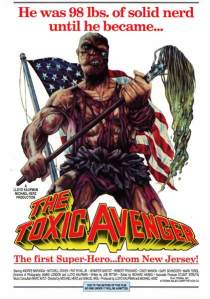 Directors: Michael Herz & Lloyd Kaufman
Writers: Lloyd Kaufman & Joe Ritter
Cast: Mitch Cohen, Andree Maranda, Jennifer Babtist, Cindy Manion, Robert Prichard, Gary Schneider Dick Martinsen, Pat Ryan Jr., Kenneth Kessler, Patrick Kilpatrick
Plot: Welcome to Tromaville, a small suburb of New York City, and the number one dumping ground for toxic chemicals in America. Melvin Ferd (Mark Torgl) the janitor at a local health club, is constantly tormented by a group of club members, including Bozo (Gary Schneider), Slug (Robert Prichard), Wanda (Jennifer Babtist), and Julie (Cindy Manion). They decide to teach him a lesson, with Julie luring him into a locker room just as a truck full of exposed barrels of toxic waste parks outside. She tricks him into putting on a pink tutu and poka-dotted leotard, and he is humiliated in front of the club’s customers, fleeing through a window and landing in the toxic barrels. People continue to mock him as the chemicals burn through his skin and Melvin, now burning alive, stumbles home and sits in a cold bath, where he transforms into a hulking brute of incredible size and strength.
A group of drug dealers, meanwhile, try to buy off a cop (O’Clancy, played by Dick Martinsen) who refuses to cooperate. Before they can castrate him with his own gun, a huge man (Mitch Cohen, voiced by Kenneth Kessler) appears and savagely kills two of the criminals (well… kind of savagely, the fight itself is actually played mostly for laughs), leaving a mop across their faces. Mayor Peter Belgoody (Pat Ryan Jr.) is horrified by the murders… mostly because the dead criminals were some of the best dealers in his employ.
The Monster – a mutated Melvin, of course – shocks his own mother into a dead faint. Despondent, he makes his way to the Tromaville garbage dump and constructs a crude home for himself there. Later, a group of criminals robs a Mexican restaurant, killing a bystander and a seeing-eye dog belonging to a blind woman named Sarah (Andree Maranda). The crooks’s leader, Leroy (Patrick Kilpatrick) is preparing to rape her, when the Monster Hero appears and fights them, ripping an arm off the would-be rapist and sending the customers fleeing in terror. The Monster beats the crooks and finishes them off in the restaurant’s kitchen. He goes to the sobbing Sarah and she begs him to help her home, where they begin to become friends. Given new confidence, Melvin begins a one-man war on crime, battling pimps, drug dealers, and other criminals, and saving lives along the way. The newspapers begin to run stories about the “Monster Hero” of Tromaville. Belgoody sends his men to hunt the monster down.
Melvin and Sarah fall in love, and he takes her back to his junkyard hideout to live. He returns to the health club, attacking Julie in the locker room. Minutes later he finds Bozo and Slug, fresh from beating an old woman to steal her car. He hurls Slug from the car and sends Bozo through a series of crashes, burning him alive but leaving Melvin unharmed.
Things go bad when Melvin kills a little old woman in a dry cleaner’s shop, turning people against the Monster Hero. Ashamed, he goes home and tells Sarah the truth about who he is and what he has done. They decide to leave town, and Belgoody rejoices… until he discovers the old woman was the leader of a slavery ring. Belgoody covers it up and sends the cops out to hunt the Monster. They find him and Sarah in the woods, and the town assembles outside their tent, torn between people who want to protect the monster and Belgoody and his men who want to kill him. The townspeople stand in front of Melvin to protect him, soon joined by O’Clancy and the rest of the cops. Belgoody opens fire, but the bullets bounce off Melvin. He stalks Belgoody to his limo and rips his guts out, literally. The townspeople applaud the vicious murder, Melvin kisses Sarah, and all in Tromaville is well once again.
Thoughts: It would be impossible to get through a month of horror/comedy without touching upon the films of Troma. Lloyd Kaufman’s legendary low-budget B-movie studio has become synonymous with campy sci-fi and monster flicks, and how better to represent them than with this, their flagship property?
Buoyed by the likes of Attack of the Killer Tomatoes, Lloyd Kaufman and Michael Herz built this film (and, for that matter, their entire film studio) on the premise of the “So Bad It’s Good” movie. Whereas older movies – the sci-fi and horror clunkers of the 50s and 60s – made an earnest attempt at making good movies and simply fell short, Kaufman has no such delusions. From the beginning of the movie the acting is terrible, the script laughable, and the special effects and graphics absurdly cheap, even by 1984 standards. Watch the quality of this film compared to Ghostbusters and you’d swear that Toxie’s debut is at least ten years older, instead of both films coming out in the same year.
The film’s absurdity doesn’t just come from the effects and acting, though. Kaufman sets out to be as deliberately offensive as possible. There’s an early scene where one of the punks and his girlfriend recite a litany of racial slurs and other negative stereotypes, ranking them on a point system for running them over with a car, before finally deciding to target a kid on a bicycle (children under 12 being worth maximum points). They hit the kid once, then back over him to crush his head, stop, and take pictures. The sympathies of the audience are swinging wildly at this point. You hate the gang for doing it, which is how you’re supposed to feel, but by the time the girls whip out the Polaroid camera, you’re pretty much ready to hate the filmmakers as well.
Our hero, ladies and gentlemen…
(It is worth noting, at this point, that the Toxic Avenger films eventually spawned a children’s cartoon show. I doubt most of the moms who let their kids sit through it would have been thrilled if they saw this particular sequence.)
Kaufman actually triples the genres he plays with here. His heavy layer of goofy comedy is draped over a plot that draws upon nuclear-mutant themed monster movies and wraps it around the skeleton of a superhero origin story. No superhero has ever been so ridiculous, though – even the drivers of the truck that gives us the “toxic” part of the hero’s name comment on how ridiculous it is for them to drive around with open, sloshing barrels full of chemical sludge. Belgoody is also an extreme stereotype of a villain. It’s hard to believe even the most corrupt politician in a serious film would think he could get away with dumping toxic chemicals literally twenty feet away from the city’s drinking water. Even Belgoody’s gang is comical – it’s a patchwork of stereotypes, containing a street hood, a Capone-style gangster, and representatives of just about every crime stereotype there is. The notion is preposterous enough to remind us that this film takes place in, at best, an exaggerated reality, where all of the elements that make up monster movies and superhero films have been amplified to a ridiculous degree.
At times, the movie starts to outsmart itself. The toxic reservoir scare, for instance, is played up as though it will be a major plot point, perhaps even the Big Evil the hero will battle in the film’s climax. That isn’t what happens, though – it’s mentioned once and then abandoned as Belgoody’s resources are turned exclusively towards seeking out the monster. Most of the villains are portrayed as one-off as well – the theatrical mob Leroy leads is all killed right away, for example. Even the moments where Melvin confronts his tormentors seem like they’re worked in simply to tie off those dangling threads while we’re waiting to get back to the real plot, such as it is.
Kaufman picks up on a lot of sources, with Melvin’s transformation smacking of the Incredible Hulk and his relationship with Sarah echoing both the friendship Frankenstein’s monster shared with the blind (Gene Hackman in the Mel Brooks version) and the longtime romance in the Fantastic Four comics, in which the mutated Thing finds love with blind sculptor Alicia Masters. He even picks up on a few slasher tropes – Melvin’s fatal confrontation with Julie comes complete with a silhouette shot of the monster approaching her with a pair of menacingly raised scissors. It sends images of Freddy Krueger and Jason Voorhees across the brain, until you remember that this is your hero.
Sarah takes us to the extremes of broad comedy, knocking over an entire rack of canes and smacking Melvin accidentally, playing up on pretty much every joke you could think of making about the blind. Although not as bad as the scene with the racial slurs, this starts to tread close to the line of being offensive as well. And true to form, Kaufman doesn’t care at all. In a way, it’s almost a liberating thought. When you see so clearly that you’re dealing with somebody who doesn’t give a damn what you think of him, you manage to stop giving a damn and concentrate more on the actual content of what you’re watching.
Is it cheap? Yes. Is it exploitive? Oh yeah. Is it ludicrous? To be kind. But like the makers of Attack of the Killer Tomatoes, Lloyd Kaufman and his Troma team have never attempted to take themselves seriously. They know what they are, they know what their audience expects, and they deliver it as effectively (and as cheaply) as they possibly can. It will never make for great cinema, but nobody can deny that this is a film studio that consistently meets its goal, artistically. It’s easy when you set the bar so low.
Lunatics and Laughter Day 6: Ghostbusters (1984)
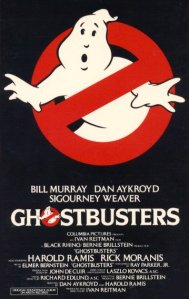 Director: Ivan Reitman
Writers: Dan Aykroyd & Harold Ramis
Cast: Bill Murray, Dan Aykroyd, Harold Ramis, Ernie Hudson, Sigourney Weaver, Rick Moranis, Annie Potts, William Atherton, David Margulies, Slavitza Jovan
Plot: A librarian in the New York is terrified by an apparition that levitates books and spits cards into the air. A team of university parapsychologists are called in to investigate the phenomenon: Dr. Peter Venkman (Bill Murray), Dr. Ray Stantz (Dan Aykroyd) and Dr. Egon Spengler (Harold Ramis). They find a fully-materialized ghost in the stacks, and when it attacks, they flee. Returning to the university, they find that they’ve being evicted for sloppy and inconsistent results, not to mention Venkman’s immature behavior. But Venkman has an idea: Ray and Egon are on the verge of developing a system to capture a ghost. Venkman convinces Ray to mortgage his family home to fund their new operation: the Ghostbusters.
The team buys an abandoned firehouse and sets up shop, but are initially low on clients. They finally get a break when contacted by a violinist named Dana Barrett (Sigourney Weaver). When Dana opens her refrigerator, she sees a bizarre temple with a hellhound that growls a name: “Zuul.” Although she is skeptical of the Ghostbusters’s credentials, she doesn’t know where else to turn, and she winds up bringing Venkman to investigate her apartment. Although he finds no evidence of ghosts, he makes a pass at Dana and vows to solve her problem.
They finally get a paying job when a swank hotel summons them to investigate a disturbance on the 12th floor. Using Egon’s new inventions – a proton pack to use as a weapon against the creatures and a trap to contain them – the three of them locate and capture their first ghost, a little green spudball that manages to slime Venkman before they take him down. Egon does give them one bit of safety advice while working: don’t cross the streams from your proton pack, as “it would be bad.”
Suddenly, the New York area is awash with reports of spectral activity and the Ghostbusters are swamped with work, rushing from one bust to another and becoming media darlings in the progress. They get so busy they hire more help, Winston Zeddmore (Ernie Hudson). As they train him on the equipment, they get a visit from Environmental Protection Agency representative Walter Peck (William Atherton). Venkman refues to show him their storage facility, and Peck promises to come back with court order. Egon, meanwhile, is growing concerned that the amount of spectral activity in the city is growing to dangerous proportions.
Venkman goes back to Dana, telling her he’s found the name Zuul in his research: Zuul was a minion of a dark Sumerian apparition called Gozer. He convinces her to go to dinner with him so they can “discuss the case.” That night, a gargoyle on the roof of her building cracks open, revealing a living hellhound underneath. The beast attacks and pulls Dana into a glowing doorway. A second beast attacks and possesses Dana’s neighbor, the nebbishy Louis Tully (Rick Moranis). When Venkman arrives to pick Dana up, she is clearly possessed, asking him if he “the Keymaster.” She introduces herself as “Zuul, the Gatekeeper,” preparing for the coming of “Gozer the Destructor.” Louis, now calling himself Vinz Clortho, the Keymaster, bumbles through the city seeking the Gatekeeper. The police pick him up and bring him to the Ghostbusters’s firehouse, where Egon examines him.
The next morning Peck returns with the police, an electrical worker, and a court order giving him access to the basement. Although Egon and Venkman implore the electrical worker to leave their machines alone, Peck forces him to turn the containment facility off. The machines blow up, spilling all of the captured ghosts back out into the city, and Louis escapes in the chaos. Peck has the Ghostbusters arrested and brought to jail. While in their cell, Ray reveals that he’s been studying the blueprints of Dana and Louis’s apartment building and believes it was designed to act as an antenna of sorts, drawing ghosts to that spot. It was designed by a Gozer-worshipper who wanted to use it to cause the end of the world. The Keymaster returns to the apartment building, where he and the Gatekeeper ascend to the roof.
The Mayor (David Margulies) has the Ghostbusters brought to his office, where Peck accuses them of using hallucinogens and light shows to take advantage of people. Venkman convinces the mayor to let them out, giving them a police escort and national guard backup all the way to the apartment building, where the roof has transformed into Gozer’s temple. As the Ghostbusters reach the roof an enormous doorway opens, spilling light into the city and transforming Dana and Louis back into the Hellhounds. Gozer appears in the form of a woman (Slavitza Jovan). Ray tries to make contact, but when he makes the mistake of telling her they aren’t gods, she blasts them, nearly hurling them from the roof. (This results in one of the greatest lines, not only in movie history, but in western civilization. Don’t even pretend you don’t know what I’m talking about.)
The Ghosbusters go on the offensive, but Gozer easily evades them and vanishes. Her disembodied voice tells them to choose the form of their destroyer. Although Venkman warns them to empty their minds, Ray is unable to draw a blank. Gozer plucks a form from his mind and the city is suddenly attacked by the enormous form of the Stay-Puft Marshmallow Man. Egon concludes the only way to reverse the portal through which Gozer came to New York is to cross the streams of the proton packs. The plan works, Gozer’s power is eliminated, and the boys, Dana, and Louis miraculously survive. The city proclaims them to be heroes. Which is great, even when you’ve got 22 stories worth of marshmallow to clean up.
Thoughts: The eighties, by my way of thinking, produced three truly great film franchises. George Lucas and Steven Spielberg gave us Indiana Jones. Robert Zemekeis and Bob Gale gave us Back to the Future. And Ivan Reitman and the boys gave us Ghostbusters. Here we are, nearly 30 years later, and the love of this franchise remains undiminished: a sequel and a beloved cartoon series spun off, we’re still seeing video games and comic books, and despite the fact that they haven’t seen the inside of a movie theater since 1989, it’s still one of the most popular Halloween costume choices a person can make. Dressing as a Ghostbuster brings the same cache and recognizability you get if you’re the Boris Karloff Frankenstein or Bela Lugosi Dracula. If you don’t love the Ghostbusters, you are objectively wrong.
To me, this is the quintessential A-Type of horror/comedy. Every beat of the plot is straight out of a horror movie – the opening scenes where the monsters are first identified, the building tension as they grow stronger and stronger, the situation worsening due to the stupid actions of an interloper, and finally a grand climax with the fate of the world at stake. The comedy isn’t slapstick, is rarely broad, and is entirely character-based. Ghostbusters is funny because Bill Murray, Dan Aykroid and Harold Ramis are funny, funny guys.
From the Marx Brothers to the Stooges, these guys have picked up on the comedic power of three by developing a trio of unique, highly entertaining characters. Venkman is all libido, driven by lust and impulse with little regards to the future, the idof the group. Egon is the ego, driven by logic and reason to the detriment of those same baser urges (he barely realizes the way Annie Potts’s Janine throws herself at him throughout the movie). Even in Egon’s rare moments of humanity, such as when he embraces a frightened Janine, he breaks away quickly, clearly uncomfortable showing even that minor hint of feeling.
You’d think this would make Ray the superego, but he’s hardly a balance between the other two. Although his character isn’t as pronounced as it would be in the sequel or the cartoon series, Ray is a sort of wide-eyed innocent, technically very knowledgeable and every bit Egon’s equal, but with a naivety and a love of simple things (like sliding down the fireman’s pole) that serves him well. Of course, this comes back to bite them in the ass when Ray is unable to empty his mind and accidentally chooses the Stay-Puft Man as the form of the destroyer, sent to annihilate New York City. It’s a great moment, in fact, as Mr. Stay-Puft marches down the street, the huge smile on his fluffy face, as he steps on and crushes everything and everyone. Way to go, Ray.
Ray is a child’s id, Venkman an adult’s. If there is a superego in the group (and even this is stretching the metaphor) it would be the mid-film addition of Ernie Hudson’s Winston – the everyman, the audience’s viewpoint character. Winston is the blue-collar guy in the group. He’s the one you can throw back a beer with, the one who is there so Egon can explain the technical stuff, but also to cut through some of Ray and Venkman’s crap. He completes the group in a very unexpected way.
All four of the Ghostbusters serve vital functions, both in comedy and in terms of relatability. We all want to be Venkman, most of us are more like Ray or Winston, but for my money the real underrated comedy gem of the team is Harold Ramis’s Egon. He has a sort of clinical distance, a way of looking at the world as though he isn’t really a part of it, that makes the movie. I was in elementary school when this movie came out, and I remember all the kids talking about Slimer, about the Stay-Puft Marshmallow Man, about Gozer slithering around in her skintight suit that looked like it was made of bathtub bubbles. But if I’m ranking the great moments in this movie, I look at the bit in the hotel when Egon, waving his PKE meter, casually scans a hotel guest, then gives him a little poke in the arm and walks away, clearly disappointed that he’s just an ordinary man instead of a walking corpse. The classic Twinkie metaphor is a close second, but that’s more due to Bill Murray’s brilliant delivery: “What about the Twinkie?”
The film also passes the true test of a memorable comedy: quotability. Aside from the aforementioned Twinkie line, we get such classics as “There is no Dana, only Zuul,” and “Yes it’s true, this man has no dick.” And If not for the Ghostbusters, how would we ever know the correct response if someone asks you if you’re a god? (Hint: “Yes.”)
There were a lot of great movies made in this time period, a lot of great horror films and a lot of great comedies. But here we are, all these years later, and people are still hoping for a third film in the series. Is it the tone of the film? The cast? The way that kids and adults alike can lock on to these characters and this story and enjoy it on totally different levels? I think it’s a combination of all these things, frankly. Whatever the reason, Ghostbusters has permanently chiseled a place in my heart. It’s a fantastic comedy, it’s an awesome monster movie, and it is simply put, one of my favorite films of all time.
Lunatics and Laughter Day 5: An American Werewolf in London (1981)
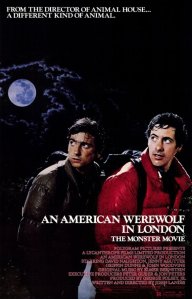 Director: John Landis
Writer: John Landis
Cast: David Naughton, Griffin Dunne, Jenny Agutter, Anne-Marie Davies, John Woodvine, Frank Oz
Plot: American college students David Kessler (David Naughton) and Jack Goodman (Griffin Dunne) are backpacking across Europe, beginning in northern England with plans to work their way south to Italy. The plans are shattered, though, when they stop at a small-town pub called the Slaughtered Lamb in the town of East Proctor. The locals distrust them, and Jack distrusts the five-pointed star painted on the wall. They leave, disturbing the barmaid and prompting warnings to stay on the road and beware the moon. The Americans are attacked by a huge wolf, which kills Jack and bites David before the villagers arrive and shoot it down. As he passes out, David sees that the beast has turned into a man.
He wakes up in a hospital in London three weeks later, where the police take his statement, but believe he was attacked by a lunatic rather than an animal. One of the Nurses, Alex Price (Jenny Agutter) takes a personal interest in him, convincing him to eat even when he isn’t hungry, keeping him company at night. He begins having dreams of running through the woods, naked, slaughtering and eating animals, then later seeing himself in a hospital bed, threatening Alex. After a particularly bad dream, Jack appears in his room, chatting jovially with his friend despite the fact that he’s a mutilated corpse. As David struggles to figure out if he’s dreaming, Jack starts quipping about his own funeral, putting him at ease before he can drop the bomb on his buddy. They were attacked by a werewolf, and since he was killed by a supernatural being Jack is cursed to walk the earth until the werewolf’s bloodline is severed. David, bitten by the wolf, is now part of that line, and Jack begs him to kill himself so they can both find peace. Jenny comes into his room, thinking him waking up from another nightmare, and he kisses her and declares himself a werewolf. When David is discharged, Jenny invites him to stay with her, and their relationship progresses quickly. Despite his newfound happiness, Jack’s corpse continues to haunt David, again begging him to kill himself before tomorrow’s full moon.
David’s doctor, Dr. Hirsch (John Woodvine) drives to the town where David was attacked, trying to figure out why David’s version of events differs so greatly from the official report. He finds himself blocked by the same villagers who turned out David and Jack, but this time, one is willing to talk. He warns Hirsch that David is in danger, and will “change” with the full moon. That night, as Jenny works a late shift at the hospital, the predictions come true – David undergoes a terrifying change from man to monster. He rushes into the night and attacks people, as the previous werewolf attacked him. Hirsch returns to London and compares notes with Jenny. Convinced that something is wrong in East Proctor – and wrong with David by extension – he calls her apartment. When David doesn’t answer, he calls the police.
The next day, David wakes up in the zoo, naked, in a wolf pen. With some quick thinking, he covers up and gets away. Hirsch, meanwhile, finds the morning paper full of stories about a brutal series of murders where the victims were half-eaten. When David returns to Alex’s apartment, particularly excitable and enthusiastic, she plans to take him back to the hospital. Along the way, the cab driver tells them about the murders, and David flees, planning to turn himself into the police, but the officer dismisses him. He runs away and Alex, Hirsch and the police who investigated his attack begin searching for him. David calls his family in America, hurriedly telling his sister he loves her before attempting to slit his wrists. Finding himself unable to do so, Jack’s corpse appears again, leading David into an adult ovie theater. The corpse, now more decrepit than ever, introduces David to the people he killed the night before, now trapped as a living dead just like Jack. He’s still in the theater when night falls again, and the killing begins again. The wolf escapes into the London streets, going on a bloody rampage, killing some and causing traffic crashes that kill many more. The police corner it in an alley and Alex rushes to the scene, approaching it and trying to draw the real David out. It lunges at her and the police open fire. The beast turns back into David as it dies, and Alex weeps.
Thoughts: Reportedly, director John Landis wrote the first draft of this script in 1969 and fought for over a decade to get it released, as studios thought it was too funny to market as a comedy and too scary to market as a horror film. You’ll excuse me if I find that just precious – as the whole point of my project is that the two both can, and have worked hand in hand for decades. On the other hand, the fact that I’ve located so few great horror/comedies before 1980 to include in this project seems to indicate that it wasn’t always the relatively easy sell it is today, and I have to suspect the success of An American Werewolf in London is one of the things that helped turn the tide and convince filmmakers that the conflicting styles could, and do, work together.
Landis is clearly a fan of the old Lon Chaney Jr. Wolfman pictures, even throwing out several references to them throughout film. He goes much farther than Universal could in the 40s, though, showing extremes of violence that wouldn’t have been allowed at the time. His special effects are, as to be expected, considerably more advanced as well. The transformation scenes are very good – simply done, but effective. Not to harp on it, but there’s no way this movie would be made today without giving in to the temptation to do the entire transformation via CGI (see the 2010 remake of The Wolfman if you don’t believe me), and that would really kill one of the most memorable sequences in this film. Naughton’s performance during the transformation is really excellent – even before any of the special effects show up he’s putting on a terrific, very convincing show of agony that makes you receptive when the limbs and face start to transform and the hair begins to sprout.
But the truly innovative thing about the movie, to me, is the tone of the film. This takes us back to a Type A picture, and an extreme Type A at that, far more horror than comedy. Landis basically wrote a monster movie, a modernized retelling of the Lon Chaney Jr. picture, and laced it with just enough humor and off-the-cuff commentary to market it partially as a comedy. Most of the humor actually comes through Jack – a snarky type even when he’s alive, but he becomes the master of the deadpan quip after he dies. David gets a little bit of physical comedy later, once he transforms for the first time. The sequence where he tries to sneak out of the zoo naked, stealing bits and pieces of cover-up along the way, feels like it could have fallen out of an old Marx Brothers or Hope and Crosby routine.
Landis is great at pulling an emotional reversal as well. When David calls home and tells his sister he loves her, there’s a horrible sense of finality to it. It’s a very genuine moment, where you understand you’re listening to a man who’s planning to die, trying to get everything straight before it happens. Considering that David was dancing around in a red fur-trimmed coat just minutes before, the viewer is left completely unprepared. The pace of the film as a whole is surprising, in fact. There’s a very long build-up to David’s first transformation, and once he realizes he’s responsible for the murders you blink and realize there are only about 20 minutes left in the film. It feels like there should be more, like everything has happened much too fast. When the end finally comes, it’s over in the blink of an eye. BAM-David is shot! Alex cries! Begin credits! There’s no denouement to cling to, no moment to allow your emotions to work themselves out before you feel a bit of a tear turn up for the poor American who became something he never wanted to be, did terrible things he never wanted to do, and died in a way he never would have wanted to die. It was a departure for Animal House director Landis and it’s a bit of a departure for this project, but it’s a good one.
Lunatics and Laughter Day 4: Attack of the Killer Tomatoes (1978)
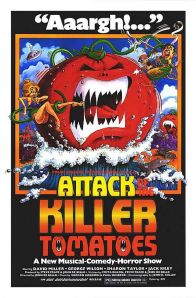 Director: John DeBello
Writer: Costa Dillon, John DeBello, Steve Peace, Rick Rockwell
Cast: David Miller, George Wilson, Sharon Taylor, Steve Peace, Ernie Meyers, Eric Christmas, Ron Shapiro, Al Sklar, Jerrold Anderson, Don Birch
Plot: A series of people begin dying in assorted tomato-related incidents: a man keels over drinking a glass of tomato juice, a woman is beaten to death by a tomato in the kitchen, a boy is gobbled up by a tomato… and the authorities scramble into action to solve the crisis. Presidential Press Secretary Jim Richardson (George Wilson) is sent to calm an increasingly worried public, but when he fails, the task of halting the tomato menace is given to top agent Mason Dixon (David Miller). Miller and his team of “experts” begin their investigation even as the attacks continue and the government feels more and more pressure to take action. Meanwhile, gossip columnist Lois Fairchild (Sharon Taylor) is given the task of reporting on the tomato menace, mostly because everybody else is busy.
Dixon and his team pick up their final member, Lt. Wilbur Finletter (Steve Peace), and the members are sent out on individual missions. Richardson is sent to meet Ted Swann(Al Sklar), head of the “Mind Makers” agency, about ways to convince people that tomatoes are safe. His sales pitch (including a spontaneous and incongruous musical number) fail to do the job. Things only get worse when Dixon encounters a scientist studying a tomato the size of a basketball. The real horror, however, comes in the revelation that this is merely a cherry tomato – the full-sized ones have grown enormous. Mere moments later, one of Dixon’s team is murdered by a tomato the size of a man. Dixon continues to seek a way to combat the menace, but it grows all the more intense, with attacks across the country and people panicking at the slightest reference to the deadly fruit.
Fairchild, stymied by her lack of progress in the case, begins to trail Dixon’s team, finally winding up in Finletter’s hotel room in an attempt to charm him with her feminine wiles. Instead, he mistakes her for an enemy spy and drives her out, screaming. Dixon, meanwhile, is fired upon by a hidden gunman – someone is trying to stop his investigation. The would-be assassin comes after Finletter next, but loses him across a railroad track. The army forces amass as the tomatoes make a brutal assault, destroying large portions of the country, somehow “burning, pillaging, and raping” along the way. (The movie doesn’t explain it and I don’t want to ask.) Dixon and Finletter get caught in a high-speed chase with the assassin, which turns into a slow-speed race as both cars malfunction. Dixon is captured, only to discover the killer is Richardson. He plans to use the tomatoes to overthrow the government and seize power in the chaos. Finletter saves Dixon and kills Richardson, but does so right before Richardson is going to confess the secret of controlling the tomatoes. Dixon realizes that the tomatoes have failed, twice, while the hit song “Puberty Love” has been playing on the radio. He has Finletter bring all the people left in the city to a football stadium, where the tomatoes predictably come to attack. They are rendered helpless, however, when “Puberty Love” blasts from the speakers. As the tomatoes shrink back to normal size, the humans press the attack, smashing and squashing them into pulp.
Thoughts: From the opening crawl, this movie takes its refuge in audacity. John DeBello decides to start the film by reminding people of how silly the concept of Hitchcock’s The Birds seemed in 1963, and that a real-life bird attack in 1975 made people stop laughing. I don’t know if there’s any truth to that at all, but you’ve got to admire the guts of the man who made this movie starting things off by comparing tomatoes to seagulls… or for that matter, himself to Hitchcock.
But that’s actually part of the movie’s bizarre charm. Starting with the crawl and going into an almost disturbingly-catchy opening theme song over credits that include several jokes (including a few “advertisements” and a blatant lie about the story’s origin), there is never any chance that this is a movie that takes itself too seriously. It can’t. And it knows it can’t. So it starts with the ridiculous. It’s another Type B horror/comedy, and a far broader one than Young Frankenstein, but it still stays close enough to the concept of legitimate storytelling to remain entertaining instead of just being a litany of joke after joke after joke.
The “killer tomato concept, in and of itself, comes across as a parody of 1950s sci-fi films, so many of which featured ordinary creatures – ants, lizards, and even the occasional plant – mutating into killing machines. As few of those films were self-aware enough to roll with the joke, though, Attack does it for them. The horror nods don’t stop there, though. The opening sequence feels like it was taken from a George Romero zombie movie, featuring random attacks striking random people. The scene where the girl swimmers are assaulted by tomatoes from beneath is a clear reference to Jaws (even down to a musical sting that mimics the John Williams theme without treading quite close enough to feel like legal action should be considered).
Now I’m not going to lie to you and say this is a good movie. The acting is miserable, the effects are weak, and at no point are you convinced that the tomatoes are actually “attacking” (a better term to use is “being lobbed gently at the actors from immediately off-camera”). Some of the humor does get a little too broad, as well. Taylor’s character seems to be named “Lois” purely for the sake of slipping in a Superman joke that doesn’t really go anywhere or add anything. But despite these relatively mild gripes, there’s still something oddly, inexplicably charming about this movie.
Part of it, I think, is that I never knew exactly how zany it is. I’ve heard of the movie for years, even watched the cartoon spin-off in the 90s (it didn’t last long, don’t be surprised if you never heard of it), but I guess I always had it in my head that it was a more tongue-in-cheek sort of film. Instead, it’s a straight-up spoof movie, and it hit me at a time when I wasn’t expecting one and, at the same time, was particularly turned off of them after seeing such a flurry of poor ones in recent years. In contrast, a lot of these jokes actually do hit. Sam Smith’s terrible (yet astonishingly effective) disguise skills never failed to elicit at least a chuck from me, and an early gag in which a Japanese scientist – all of his dialogue poorly dubbed for no real reason – accidentally knocks a very unfortunate picture into an aquarium pulled one of those simultaneous gasps and laughs. It was that moment where you start to laugh because it’s funny, then immediately try to stop yourself because you know it shouldn’t be. It’s not easy to do that really well, and if you fail to land a joke like that it’ll kill you. This doesn’t.
Some of the writing is also really clever. The bit where Dixon, Finletter, Fairchild and her editor all argue on the phone is cut perfectly, at one point making you question who was talking to who. The dialogue itself isn’t actually funny, but when cut together in such a way that you wonder if the speakers have somehow gotten their lines crossed, it makes you laugh.
This movie is, of course, a cult classic at best, but that’s fair. A lot of those movies that have a small but dedicated audience fall into that category, and even more of them blend together the horror and comedy tropes that mash up so very, very well. This is a movie you start to watch expecting it to be so bad it’s good. The fact that there are a few moments where it’s actually, genuinely good is a nice added bonus.
Lunatics and Laughter Day 3: Young Frankenstein (1974)
 Director: Mel Brooks
Writers: Gene Wilder & Mel Brooks
Cast: Gene Wilder, Peter Boyle, Marty Feldman, Cloris Leachman, Teri Garr, Kenneth Mars, Madeline Khan, Richard Haydn, Gene Hackman, Anne Beesley
Plot: Dr. Frederick Frankenstein (pronounced “Fronkensteen,” Gene Wilder), grandson of the infamous Victor Frankenstein, leaves his inconsistently affectionate fiancé Elizabeth (Madeline Khan), for Transylvania. He is met by Igor (“I-gor,” Marty Feldman), grandson of his grandfather’s assistant, and Inga (Teri Garr), his temporary lab assistant, who quickly displays more affection than the fiancé he left behind. Frankenstein’s castle is kept by Frau Blucher (Cloris Leachman), who Frederick questions about his grandfather’s “private” library. That night, Frederick is awakened from a nightmare by Inga, and, after a classic spinning bookcase gag, the two of them locate a secret passageway. At the bottom of a cobweb-covered staircase, they find Igor and the elder Frankenstein’s lab. Frederick reads his grandfather’s notes and finds the secret of animating lifeless matter, something he always believed impossible.
Igor and Frederick steal the corpse of an enormous, freshly-executed man to repeat Victor’s experiment. Igor goes on his own to steal a suitable brain for the beast, but as happened to his grandfather, fumbles with it and is forced to take an abnormal brain instead. In town, the people fear Frankenstein’s grandson, certain he is repeating his grandfather’s crimes (which, of course, he is). They recruit Inspector Kemp (Kenneth Mars) to discover what Frederick is doing.
That night the Monster (Peter Boyle) comes to life. Although he seems gentle at first, when Igor strikes a match, he goes berserk and nearly kills Frederick. Igor confesses that he took a brain from “Abby Normal” just as Kemp arrives. Frederick sends him off, but while he’s preoccupied Frau Blucher finds the monster and releases it. The creature breaks free from the castle, and Frederick vows to find it before it can hurt anyone. They set a trap for it the next evening, luring it with a violin and sedating it. Frederick insists upon trying to convince the creature it is loved. As he speaks to the beast, he not only takes it under his wing, but accepts his own destiny, declaring, “MY NAME IS FRANKENSTEIN!”
He presents the creature to the town, charming them with a song and dance routine before a light blows and it turns on the crowd and the police haul it away. As Frederick and Inga find comfort in each other’s arms, they receive a telegram that Elizabeth will be coming to the castle that night. After Elizabeth again rebuffs Frederick’s advances for the night, the creature – having escaped — returns to the castle. She passes out and he takes her with him to a hiding place in the woods, where she soon succumbs to its own animal desires. After a mere six times, though, the violin from the castle summons him back. Frederick decides the only way to protect the creature is to use his own brain to stabilize it. Kemp leads an angry mob, complete with torches and pitchforks, into the castle, and are about to make off with Frederick’s body, when the stable creature commands them to put him down. He gives a stirring speech and Kemp realizes the error of his ways. In the end, Frederick and Inga are married, whilst Elizabeth and the creature go off to enjoy domestic bliss of their own.
Thoughts: Coming off the magnificent western/comedy Blazing Saddles, it’s not surprising that Mel Brooks would turn his attention to the horror/comedy genre. (He’d later tackle the epic in History of the World Part I, science fiction in Spaceballs and high adventure with Robin Hood: Men in Tights. He’d return to horror with Dracula: Dead and Loving it, but the less said about that one, the better.) Working off an idea by Gene Wilder, these two took one of the most enduring classics of horror and turned it into one of the best horror/comedies ever.
Young Frankenstein works as a kinda-sequel to the original Frankenstein, building on the mythology of the original Universal films even though there was no official connection. (Young Frankenstein was produced by 20th Century Fox.) It doesn’t really contradict any of the older films, at least no more than some of the official sequels did, but it takes the franchise into an entirely different direction. This is the first film in my little experiment that I’d classify as a “Type B” horror/comedy – more comedy, but using the tropes of horror and spoofing them. The difference is in the plot, really – what puts this in the second category is that the story couldn’t exist without the comedy tropes. Even Abbott and Costello’s antics with the monsters followed a fairly straightforward scary movie plot for the 1940s, whereas certain elements of this film could not be removed or altered without drastic changes being made to the story structure. You could maybe replace the musical number towards the end with something more King Kong-eque, but that would simply feel derivative. And it’d be a lot harder to play up the creature’s abduction and romancing of Elizabeth without the comedy elements in any way that doesn’t make it tread uncomfortably close to plain rape.
The other thing, and the more all-encompassing thing, that makes this a Type B is the characterization. In a Type A universe, we’ve got a frightening situation populated by some funny characters. Bela Lugosi wasn’t a quippy Dracula, and Bob Hope’s cracks about the ghosts were only funny in the context of a world where nobody would take such a thing seriously. Not so for Type B, where all characters – and everything else – can become fodder for humor. In Young Frankenstein, as in most Mel Brooks comedies, anybody can play straight man to anybody else at any moment. Everyone can crack a joke or make a comment that’s hysterical – to the audience. In-universe, however, nobody recognizes the humor.
The only exception would be Marty Feldman’s Igor, who leans heavily on the fourth wall, winking at the audience, and throwing out some meta-puns that make him seem both wackier than and more savvy than the rest of the characters. His comedy is easily the broadest of the troupe Brooks and Wilder assembled, and he’s probably the funniest as well. His timing is flawless, his sense of propriety non-existent, and his ability to key into other comedy from other eras makes his performance as funny now as 40 years ago.
What elevates this above most other Type B horror/comedies (coughScaryMoviecough) is the way Brooks and Wilder are still capable of crafting real characters instead of caricatures, telling a real story instead of just creating their own Frankenstein-patchwork of other movies. Even this film, which literally could not exist without Mary Shelley’s Frankenstein as its inspiration, feels fresh and original.
Just as important, Brooks and Wilder don’t simply repeat moments, but build upon them. The crummy spoofs of the 21st century are frequently completely devoid of actual jokes, instead just referencing a better movie under the assumption that the audience will understand the reference and laugh at the recognition. This is a stupid, asinine way to make a movie that far too many of my 11th grade students mistake for humor. In a Brooks comedy, though, we touch on the familiar moments and make them new. Igor stealing the brain, for example, begins with a glance at the camera, because he knows that we know what’s coming. Then, when the brain of a “scientist and saint” is accidentally destroyed, he goes for the abnormal brain immediately, despite the fact that the next brain over is clearly labeled “visionary.” The camera just pans past the other label, though, and a viewer may watch the movie two or three times before they even notice it. Modern films are incapable of this sort of subtle, Easter Egg humor – a film by Jason Freidberg and Aaron Seltzer (perpetrators of such crimes against comedy as Meet the Spartans and Vampires Suck) would be sure to hover over that label, make sure everybody sees it, and drain every iota of comedic potential from it before moving on to what everybody knows they’re going to do anyway.
Modern spoof movies suck, is the point I’m trying to make.
Anyway, the film is built on small moments. Kenneth Mars’s assorted shtick with his artificial arm, the disastrous game of darts, and the bit where a choking Frederick has to play charades to make his incompetent accomplices understand he wants them to sedate the monster that is actively murdering him are the sorts of thing that make for a great spoof. None of these are repeat jokes, they’re built on the characters and story as presented instead of spending all their time making allusions to everything else. In fact, except for the full-film allusion to the original, the only references to anything else are when the town elders imply they’ve dealt with monsters five times in the past (referring, of course, to the line of Frankenstein pictures made by Universal) and Madeline Kahn’s hairstyle after she becomes the creature’s “bride.” And as those are both clearly references to the Frankenstein lore as a whole, if not the first movie specifically, we accept them.
When the movie references the original directly, it often does so in order to subvert it. When the creature encounters a little girl playing with flowers, we’re prepared for the worst, based on what happened to the little girl in the Boris Karloff original. Instead, we get a hysterical seesaw gag which completely takes us by surprise and is more than funny enough for us to forgive the fact that it really doesn’t have anything to do with the rest of the story. Gene Hackman’s cameo as the blind man serves a similar purpose – not actually progressing the plot, but showing us the character of the beast as it attempts to make friends and is thwarted, not because he’s a monster, but because his potential companions aren’t entirely capable.
When I asked for help assembling the movies for Lunatics and Laughter, one of the first suggestions I got was Scary Movie. And while I considered it, I decided not to do it, at least for the first phase. It may make the expanded edition, but only because of its influence on movie as a whole, not because of the quality. As you’ll see as we continue our march to Halloween, the vast majority of the movies I’ve chosen for this project are A-Type horror comedies, because most of the B-Types, frankly, are terrible. This is hands-down the best, the finest, the funniest horror spoof I’ve ever seen, and it’s frankly ruined me for most of the other ones. And for that, Mel Brooks and Gene Wilder most assuredly have earned my thanks.
Lunatics and Laughter Day 2: Abbott and Costello Meet Frankenstein (1948)
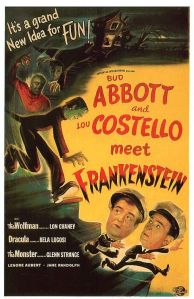 Director: Charles Barton
Writers: Robert Lees, Frederic I. Rinaldo & John Grant
Cast: Bud Abbott, Lou Costello, Lon Chaney Jr., Bela Lugosi, Glenn Strange, Lenore Aubert, Jane Randolph, Frank Ferguson, Charles Bradstreet
Plot: Chick and Wilbur (Abbott and Costello, respectively, although why they even bothered with giving their characters names at this point is beyond me) are employees of a delivery company. They get a nervous phone call from Larry Talbot (Lon Chaney Jr.) in London, asking about a pair of crates being sent to a house of horrors. He tells them that he’s flying to Florida the next day, and they are under no circumstances to deliver the crates until he arrives. The full moon rises in London and Talbot undergoes a startling transformation, becoming a Wolfman. Confused by the growling on the phone, Wilbur hangs up. Moments later, Mr. McDougal (Frank Ferguson) arrives to pick up the crates, which he claims contain the remains of the true Count Dracula and Frankenstein Monster. He tells this to Sandra (Lenore Aubert), Wilbur’s girlfriend, who Chick thinks is far too alluring to be with his bumbling friend.
Despite the call from Talbot, McDougal has the proper paperwork, so Chick and Wilbur deliver the crates To McDougal’s House of Horrors. Wilbur is on-edge, surrounded by the creepy contents, but Chick is convinced Dracula and the Monster are just characters from stories. As he leaves Wilbur alone, Dracula (Bela Lugosi, reprising his role for the first time since 1931) rises from his coffin, terrorizes him, and mesmerizes him. With Wilbur entranced, Dracula awakens the Frankenstein Monster (Glenn Strange). McDougal and Chick arrive and argue over where the exhibits are while Wilbur, hysterical, tries to explain what happened, but McDougal has them arrested.
Dracula flies to a remote castle where waits Dr. Stevens (Charles Bradstreet) and his assistant… Wilbur’s girlfriend, Sandra. Dracula wants to avoid Frankenstein’s mistake and give the monster a new brain, one so simple and naïve that it will never question his master. Sandra, of course, has just the brain in mind.
Talbot finds Wilbur and Chick, just out of jail, and confirms Wilbur’s story. He has been chasing Dracula, but he can’t go to the police for fear of revealing his own secret. As the moon is about to rise, he gives Wilbur the key to his hotel room and begs him to lock him up overnight, not letting him out no matter what he hears inside. Wilbur’s compliance lasts almost 45 whole seconds, before he goes into Talbot’s room to bring him a bag he left behind. In another comedy sequence, Wilbur narrowly avoids being torn to shreds by a Wolfman he never sees.
McDougal, furious over Wilbur and Chick’s release from jail, meets insurance investigator Joan Raymond (Jane Randolph), who plans to use her feminine wiles to trick Wilbur into revealing the location of the missing exhibits. She narrowly avoids Sandra, who came by to arrange a meeting with Wilbur for that evening’s masquerade ball. Joan convinces him to take her to the ball as well, and while Wilbur revels in his two dates, Chick tries to figure out what his dumpy friend has that he doesn’t. (As Sandra tells him, “A brain.”) The two go to Talbot’s room, where they find it’s been torn apart. Talbot wakes and tells them about his curse – he was bitten by a werewolf, and transforms whenever the moon was full. As Wilbur saw the monsters, he pleads with him to help him. They don’t believe him, and continue their preparations for the ball.
Chick, Wilbur and Joan pick up Sandra for the ball (Wilbur allowing each girl to believe the other is Chick’s date). Sandra finds Joan’s ID card for the insurance agency, while Joan finds Sandra’s copy of Frankenstein’s book on life and death. Each suspicious of the other, they return and meet Sandra’s employer, Dr. Lejos, who Wilbur somehow fails to recognize as Dracula wearing a robe instead of his cape. Lejos insists that Dr. Stevens join them for the party, but Sandra suddenly claims she has a headache and can’t go. She brings Dracula aside and says that Joan and Wilbur’s snooping and Stevens’s inconveniently inquisitive nature are making the operation too dangerous. Angry, he hypnotizes her and bites her, and they go to the ball.
At the ball, Chick and Wilbur encounter a fearful Talbot, who is upset by Chick’s wolf-mask. Sandra, now a vampire, tries to bite Wilbur, but he’s saved by Chick and Talbot, seeking the now-missing Joan. As they search, the full moon appears and Talbot transforms. He attacks McDougal, who blames Chick when he sees the wolf-mask. The party goes mad and people flee, with Chick and Wilbur finding a hypnotized Joan with Dracula. He mesmerizes the boys and takes Wilbur and the girls away. Finally convinced, Chick finds Talbot and they go to Dracula’s mansion, where Wilbur’s brain is being prepared for transplant. Talbot and Chick burst in. Talbot is about to free Wilbur, but once again, he transforms, and Frankenstein’s Monster breaks free. The five of them engage in a mansion-encompassing battle of positively Scooby-Doo-ian proportions, until finally the Wolfman seizes Dracula and they plunge off a cliff. The Monster chases Chick and Wilbur to the dock, where Stevens and Joan set him on fire. As they sit in a boat, Wilbur berating Chick for not believing him, a cigarette hovers in the air, and the unmistakable voice of Vincent Price introduces himself… he’s the Invisible Man.
Thoughts: This film is, inarguably, the greatest horror-comedy ever made. Okay, maybe it’s not inarguable. You can argue it. You’d just be wrong. What’s not arguable, however, is that it is by far my favorite movie out of all the films selected for Lunatics and Laughter, and (with the possible exception of Ghostbusters) the one that I’ve watched the most times. It isn’t Halloween unless I see Bud and Lou go toe-to-toe with the greatest Universal Monsters.
That, in fact, is what makes this such a fantastic movie, friends. Universal Studios took their two greatest comedic stars at the height of their popularity and mashed them into a movie with three of their most popular monster franchises, even getting the classic Bela Lugosi and Lon Chaney Jr. to reprise their roles as Dracula and the Wolfman, respectively. (Only Boris Karloff as Frankenstein’s monster is missing from the classic trinity, and he would get his chance to dance with the boys later in Abbott and Costello Meet the Killer, Boris Karloff and again in Abbott and Costello Meet Dr. Jekyll and Mr. Hyde).
It’s such simple alchemy – director Charles Barton got five amazing performers and allowed them to do what they do best for 83 incredible minutes. Abbott and Costello pull off the same sort of brilliant wordplay and slapstick that made them Hollywood legends, while Lugosi, Chaney and Strange (playing the Monster for the third time since Karloff’s retirement) give their performances all the force and horror they had in their respective series. The film doesn’t bother with little things like continuity either – there’s no effort to explain how Talbot knew Dracula or the monster, how Dracula found the creature’s remains, or even how any of the monsters were alive, as most of them had a tendency to die at the ends of all of their films. The sequels usually had a halfhearted resurrection scene, but Barton sees no need to even bother with that. The audience doesn’t care about any of these things. They know who Bud and Lou are, who Dracula and the Wolfman and the Monster are, and that’s all they need.
And damned if they weren’t right.
Like I’ve said, comedy and horror are flip sides of the same coin, and I’ve never seen a movie that demonstrates it as perfectly as this one. Our five lead characters (because that’s who Bud and Lou are, no matter what names they were using in the movie, they played the same two characters they always did) come from totally different styles of film: slapstick comedy and tales of pure terror. But when we put them together there is no clash. Everybody is themselves, everyone is entirely in-character, and it all fits together seamlessly. Even the scenes with Lugosi popping in and out of his coffin, giving Costello the stimuli for one of his legendary freak-outs, works for a Dracula who simply enjoys toying with his eventual prey. He even pulls the same sort of hypnosis and gets the same light-across-the-eyes treatment as he did in the original 1931 version of Dracula.
The plot, meanwhile, is straight out of the horror movie handbook. Dracula’s scheme to give the monster a simple brain keys into Costello’s movie persona perfectly. At the same time, it’s still the kind of devilish plan that many a horror movie villain has concocted over the years. Hell, let’s be honest – it’s a more logical plan than thousands of the others movie monster baddies have conjured up over the years. Talbot’s logic – “the police won’t believe me unless I tell them I’m a wolfman” – is kind of sketchy. It’s more likely they’ll just think him even crazier. But it’s still the same sort of logic that dominated this sort of movie back in the 40s and 50s, and therefore is easy to forgive. Similarly, the special effects are of the highest quality available at the time. Talbot’s werewolf transformation looks as good as it ever did in his own films. And while it may be pretty obvious that the Monster burning on the dock at the end is a mannequin being pushed along with sticks, in 1948, how else were you gonna get that shot?
Truly, the only moment that strains credibility, even for the time, is when Talbot and Chick plan their rescue mission. Talbot tells Chick they should hide and wait, since it is now morning and Dracula will be helpless until nightfall. Um… wouldn’t that make this the perfect time to attack? Come on, dude. (Honorable mention, though, goes to the fact that Talbot makes his transformation four nights in a row. Isn’t three usually the limit for a full moon?)
Bud and Lou, a classic vaudevillian comedy team whose act translated to film and television far better than most of their contemporaries, pull off a lot of the same shtick they usually do. They engage in verbal battles, with Bud tossing out unnecessarily complicated words so Lou can amusingly misunderstand them. Bud leaves Lou alone at inconvenient moments so he can be the sole witness to creepy happenings and have entertaining panic attacks. And once or twice, Lou is allowed to get the better of his buddy in a battle of the logical fallacies. In short, they take their standard routine and inject it into a horror movie. But not for one second does it feel forced, do any of the comedic interludes feel like a distraction, or does any of it feel like padding. They’re just there to have fun, as they always do. (Reportedly one scene – where Wilbur sits on the Monster’s without realizing it – took an absurdly long time to film because Glenn Strange simply couldn’t stop laughing at Costello’s antics in his lap.)
Even the old comedy trope – the panicky one sees the madness, the straight man conveniently misses everything until the last minute – feels fresh and original here. And no, it wasn’t, not even in 1948. When Chick pulls out the wolf-mask, you just know there’s going to be a moment when Wilbur encounters the real Wolfman and thinks it’s his buddy in disguise. You’re waiting for it. You would feel disappointed if it didn’t happen. But Abbott and Costello never disappointed on that front.
The finale is simply great. From the moment Talbot and Chick arrive at the mansion until Vincent Price makes his uncredited cameo, we go through one chase after another, with doors and props being smashed at every turn, our heroes bumbling into the monsters at the worse possible moments, often saved through circumstance, luck, or the good ol’ Rule of Funny. If you are physically capable of watching this movie without laughing, you need intense psychoanalysis. And if you didn’t love the Universal monsters before, this will do the trick.
 Reel to Reel