Category Archives: 1-Mutants Monsters and Madmen
Mutants, Monsters, and Madmen Day 27: Poltergeist (1982)
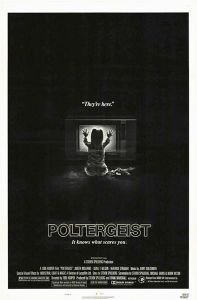 Director: Tobe Hooper
Writers: Steven Spielberg, Michael Grais, Mark Victor
Cast: Craig T. Nelson, JoBeth Williams, Heather O’Rourke, Beatrice Straight, Dominique Dunne, Oliver Robins, Zelda Rubinstein, Richard Lawson, Martin Casella, James Karen
Plot: The film begins simply enough, with a television playing the national anthem and going to static (reminding us of those quaint days when television stations actually went off the air). As her father Steven (Craig T. Nelson) sleeps in front of the TV, little Carol Anne Freeling (Heather O’Rourke) wakes up, walks to the flickering TV, and begins to speak to it. The next day, the family’s pet bird dies, and mother Diane (JoBeth Williams) is forced by Carol Anne to give it a proper cigar box funeral. The older children, Dana (Dominique Dunne) and Robbie (Oliver Robins) are nonplussed by the loss of the bird. Robbie is, however, disturbed by the gnarled tree outside his bedroom window. The next night, when a storm scares Carol Anne and Robbie into their parents’ bed, the static appears on the television and again summons Carol Anne. This time, a spectral hand reaches out of the screen and rattles the room, waking up the Freelings and prompting one of the most famous lines in scary movie history: Carol Anne’s, “Theeeeeey’re here!”
The next day, Diane begins to notice strange phenomena around the house, such as a spot on the kitchen floor that sends objects sliding across the room. The fun evaporates, though, when Robbie’s gnarled tree comes to life and snatches him. As Steven and Diane try to save their son, the closet blows open with an intense white light, and little Carol Anne is sucked in and vanishes. After a frantic search for the girl, the family hears her voice coming from the television set. Steven turns to a group of paranormal investigators for help. The investigators: Ryan (Richard Lawson), Marty (Martin Casella) and Dr. Lesh (Beatrice Straight) find the children’s room in a state of chaos – the bed spinning, objects hurtling through the air, the closet glowing.
The investigators believe the events to be the work of a poltergeist instead of a traditional haunting, which means it could stop at any time and the missing Carol Anne – whose voice they keep hearing coming from… somewhere – could vanish forever. With a time limit, the family and investigators grow more desperate and begin conducting experiments to find the girl even as her disembodied voice cries for help. Steven discovers from his boss, real estate developer Mr. Teague (James Karen) their house was built on the remains of an old cemetery. They send the other children away and bring in a medium, Tangina Barrons (Zelda Rubinstein), who believes the spirits in the house are attracted to Carol Anne’s “light,” and thus are keeping her captive. There’s a demon, “the Beast,” using her to restrain the other spirits, who don’t realize they’re dead and flee the Light that would send them to the next world. Tangina proves that the portal in the closet eventually comes out in the Freelings’ living room, and Diane ties herself to a rope and plunges into the abyss to find her daughter. When he realizes Tangina is trying to use Carol Anne to force the demon into the light, Steven pulls on the rope and finds himself face-to-face with the Beast. With the creature distracted, Diane and Carol Anne fall free, and Tangina declares the house “clean.”
The family decides to move (because people just don’t have the guts to stand up to a supernatural infestation anymore). In their last night in the house, Diane is left alone with Robbie and Carol Anne. Robbie is attacked by a demonic clown doll and the Beast assaults Diane, preventing her from getting to the children. As the closet begins to transform, Diane rushes outside for help and falls into the muddy pit the family had dug for a swimming pool, only to find herself facing the rising corpses of the graveyard Steven’s company built over. Diane makes it back into the house and gets the children away from the closet, but the corpses – and their coffins – begin rising everywhere as Steven and Teague arrive. Dana gets back from her date just as the rest of the Freelings escape, and the house itself implodes in front of the whole neighborhood, disappearing in a flash of light. Exhausted, but together, the family checks into a hotel for the night… and Steven shoves the television out onto the balcony.
Thoughts: Like The Exorcist and, to a lesser degree, The Shining, Poltergeist makes childhood a target of the supernatural. That idea is something that comes back on us time and again over the years, and with good reason. Childhood is supposed to be the time of innocence, the time when we’re protected from the nasty things in the world by Mommy and Daddy. Even when you’re an adult, seeing a symbol of innocence corrupted by a monster can terrify you. The filmplays on our fears by tapping into a very normal situation – a standard suburban family – and throwing it into the grip of something horrible. And Hooper and Spielberg work hard to make this family as typical as possible, while still showing off a little geek cred – the younger Freelings’ bedroom is rife with posters for Sesame Street, Star Wars and Alien, there’s a Los Angeles Rams helmet in the corner, Nelson’s character reads a biography of new president Ronald Reagan, and so forth. This is a film that wears its early 80s time frame as a badge of honor. (There’s so much Star Wars, in fact, you’d suspect the producer was buds with George Lucas or something.)
Speaking of the producer, there are stories that Spielberg had a much heavier directorial influence than the filmmakers admitted (and, in fact, probably only skipped directing it himself because he was busy with E.T. at the time). Spielberg’s fingerprints are all over the movie. Yes, technically it’s a supernatural horror flick, but the tone of the story and the quality and type of the special effects all fit in very neatly with the Spielberg sci-fi films of the time period. This movie doesn’t look like The Shining, it looks like Close Encounters of the Third Kind. This isn’t a bad thing, though. So much horror – even great horror – tends to have a very similar flavor to it. It’s refreshing to see a Spielberg come in every once in a while and tell a ghost story that doesn’t feel exactly like every other ghost story out there.
That said, although the movie is a lot of fun, it’s fun in the way that a lot of 80s family adventures are: you watch the film, you think how awesomely authentic the portrayal of the children are, and you wish you could experience the cooler moments of the story. Granted, this movie doesn’t have as many moments a person would actually want to experience as, say, Goonies, but it’s hard today to find this PG-rated fright flick actually scary. In fact, it’s very much the kind of ghost story a parent could feel comfortable sharing with some children. (I’ve got to stress some children here – let’s face it, there are kids who get nightmares at the slightest provocation, and this movie would most definitely give them that provocation. But if you’ve got a slightly older child that has proven he or she can handle a little bit of a scare, this movie would be okay.)
Once the film does start going for more traditional scares, it can be a little cheesy. The scene with the maggots bursting from a raw steak isn’t bad, but a few seconds later when Marty starts peeling his face off, it’s terribly obvious that you’re looking at someone ripping make-up from a mannequin head – the hands clutching at the face don’t even look like they’re coming from the proper angle. It jerks you out of it. Later on, when Robbie gets attacked by the Clown doll, it’s really effective – Hooper got a nice fake-out by making you expect to see something under the bed. But that doesn’t make the doll itself less cheesy. Other scenes seem to want to mine a little bit of comedy – when Steven’s boss visits him to find out why he hasn’t been coming to work, Steve’s efforts to prevent him from noticing the ghostly goings-on are a little funnier than they probably need to be.
It’s the last third of the film that’s the scariest and the most effective. Once Tangina enters the picture, the intensity increases significantly and you start to fear for the rest of the family, the child, and the investigators throughout the house. Tangina’s actually a magnificent creation – she’s Yoda with a southern accent, (ah – Star Wars again) making Steven and Diane do whatever they need to do to get their daughter back, up to and including threatening her, growing angry with her, and manipulating her into laying a trap for the Beast. She’s an awesome character that helps the film work, serving the same function as Father Merrin in The Exorcist (in fact, many of the scenes where the parents and investigators try to tap into the spirit world evoke a much more special-effects heavy version of The Exorcist). She’s the Mentor, even if she’s a Mentor who doesn’t show up until late in the game, and she brings just the right touch of awesome to make the movie work. The climax – except for the clown doll – is also great. The corpses bubbling up out of the pool are creepy as hell, the telescoping hallway adds to the feeling of hopelessness and desperation that Diane has to defeat, and the effects on the gaping maw of the closet… scary stuff. We’re getting into Spielberg-Gremlins here. (And in fact, some of the fleshy appearance of the portal is very similar to what Spielberg and Chris Columbus would do in that other little monster movie a couple of years later.)
In the end, we still get the expected Spielberg feel-good ending, but that’s okay. This is a scary movie, but not in the same vein as most of the others we’ve watched. This is a chill for everyone, something that parents and kids can watch and both hold on to each other a little tighter.
From the warmth of the family to the cold of Antarctica – tomorrow we see the return of John Carpenter to this list with a sci-fi classic – his 1982 remake of The Thing.
Mutants, Monsters, and Madmen Day 26: The Evil Dead (1981)
 Director: Sam Raimi
Writer: Sam Raimi
Cast: Bruce Campbell, Ellen Sandweiss, Betsy Baker, Hal Delrich, Sarah York
Plot: Five college students head out to a cabin in the woods, looking for a short getaway. From the very beginning, though, the trip seems to be in trouble. The bridge they have to take is crumbling and their car almost gets stuck. The cabin isn’t in any better shape than the bridge itself. And something, some presence in the woods seems to be watching them for some malevolent purpose. Cheryl (Ellen Sandweiss), while sketching an old clock, finds her hand seemingly possessed, and draws a crude image of a book with a face on it, then sees a trapdoor rattling in the corner. She dismisses her experience and returns to her friends, where her brother Ash (Bruce Campbell) lightens the mood with a stumbling toast that’s interrupted when the trapdoor is thrown open. Ash and Scott (Hal Delrich) investigate the cellar, finding some horrific artifacts, including an ancient book wrapped in human skin and inked in blood, The Book of the Dead, and a tape recorder. When they play back the recording, they hear a message from the cabin’s previous occupant – an archeologist who was studying the Book of the Dead and the demons it can summon. The voice on the tape recites an old chant and a horrible light glows from beneath the ground. Horrified, Cheryl storms off. Ash is left alone with his girlfriend, Linda, and gives her a necklace with a magnifying glass pendant. Cheryl, believing she’s being watched, walks out alone into the woods (a stupid move that girls in horror movies had been doing for years and would keep doing for years to come), only to be attacked by a demon in the trees. (Literally, in the trees.) She demands Ash drive her back into town, but the bridge they used on the way in has been destroyed. Returning to the cabin, Cheryl suddenly transforms into a “Deadite” – possessed by a demon, possessing strange power. She attacks, stabbing Linda with a pencil and throwing Ash into a shelf before Scott manages to lock her in the cellar. Shelly (Sarah York) is next, transforming and attacking Scott, and he kills her to save himself.
Scott wants to leave the injured Linda behind and look for a way back to town, but Ash refuses, so he wanders off alone. Linda’s injury spreads, transforming her into another Deadite, and Scott reappears, horribly wounded by something in the woods. While the possessed girls taunt them, Scott tells Ash there’s a trail in the woods. The girls suddenly become themselves again, but when Ash goes to free Cheryl, she breaks through the floor and tries to strangle him. He escapes and drags the again-possessed Linda outside, and returns to find that Scott has died. The girls attack and Ash kills Linda. Remembering that Shelly didn’t stop until her body was completely dismembered, Ash chains up Linda and is about to cut her up with a chainsaw when he sees her pendant. Grief-stricken, he carries her outside to bury her intact, but she reanimates and attacks him again; he finally beheads her. Returning to the cabin, he finds that Cheryl has escaped and arms himself with a shotgun. As he barricades himself in, Scott reanimates and Ash loses the gun. He gets free of Scott as Cheryl breaks in, and the two Deadites try to hold him down and kill him. Ash manages to use Linda’s necklace (which somehow, miraculously appeared at the right time) to grab the Book of the Dead and hurl it into the fireplace. The two Deadites deteriorate before his eyes, collapsing into piles of gore. As the sun rises Ash – broken, battered, and covered in blood – stands up, alive and victorious. But as he steps into the light, something else approaches… and attacks.
Thoughts: To be perfectly, frank, this isn’t a masterpiece of a movie. Sam Raimi is still very raw as a director at this point, with ineffective angles and stiff performances from his actors. But the film is significant nonetheless in that we can see the germ of greatness in here. Raimi, who has gone on to do a great many very good movies, was cutting his teeth at this point, and was learning the basics of telling a story. Campbell was not yet the tongue-in-cheek master of camp that he would later become.
Some scenes, in fact, are downright awkward. The scene where Ash pretends to be asleep to give Linda the necklace, for example, includes a weird game where the camera keeps doing close-ups of Campbell and Baker’s eyes while she tries to decide if she’s going to take the box and keeps feigning sleep, while watching her at the same time. It’s supposed to be sweet, but even for the audience, it’s kind of uncomfortable. And while that feeling fits in with the rest of the film very well, in this scene it somewhat undermines the intent. Ash himself has a long way to go before he becomes the badass we know from Army of Darkness. When Shelly attacks, he’s actually paralyzed with fear, leaving Scott to take care of dismembering her himself.
But one thing that was effective right away was the mood. Raimi managed to put together scenes that combined shadow, nice tricks of the camera, and haunting music to make you feel that the characters’ fear was justified, even if it wasn’t presented in a flawless manner. There are several moments where the viewer is placed in the eyes of the Evil itself, as it zooms in on the characters, watches them from the woods, and otherwise stalks them.
By the time we reached the sequel, 1987’s Evil Dead II, both Raimi and Campbell had improved dramatically. In fact, the sequel is little more than a more successful remake of the original – it tells the same story, but injects it with superior storytelling, a healthy dose of black comedy, and a much stranger ending, making it a true classic of the horror/comedy mashup genre. (If and when I do the follow-up to this project about horror/comedies, you can bet Evil Dead II will occupy a place of honor.)
That’s not to say that none of the scenes work, though. The scene of Cheryl’s “possession” (which, let’s be honest, is a nice way to say she’s “raped by a bunch of freaking trees”) is horrible in all the ways the filmmaker wants. Considering that so much of it is dependent on our ability to believe that the branches and sprigs that are wrapping themselves around her body are acting of their own accord and not being manipulated right off-camera by a guy in a sweaty t-shirt, it looks very convincing and pretty horrifying. In fact, the makeup and gore effects on the whole are very well-done. There’s also some impressive stop-motion animation at the end, as the book burns and the two Deadites decay.
Speaking of them, the Deadite makeup is instantly frightening, and the scene where she stabs Linda with the pencil is convincing as all hell. And man, man is there a lot of blood in this movie. Every wound, every cut, every scrape absolutely gushes, and it all looks real enough for me. It multiplies when Ash hides in the cellar – pipes drip with blood, electrical outlets, blood flows into a lightbulb, drips down the lens of a movie projector… Raimi must have spent half his budget on corn syrup and food coloring. This does, however, lead to some amusing continuity errors. At one point, Ash bashes the possessed Cheryl’s hand in the door and it explodes with blood – in the next shot he slams the door shut and the door and frame are totally clean. Similarly, the pattern of gore on Ash’s increasingly dirty face and clothes changes noticeably from shot to shot. It’s a small thing, but when you notice it, it takes you out of the film.
The ending of the film is particularly – if justifiably – bleak. Ash, who has managed to survive all the horror around him – is attacked once more as we cut to black. Raimi’s philosophy for the movie, he says, was “everything dies,” and if he had stopped here, that would have come across very well. Of course, in the sequels we learn that not only does Ash live, he rules. But that’s neither here nor there. If nothing else, we owe this film and Sam Raimi an unending debt of gratitude for giving the world the awesomeness that is Bruce Campbell. And even though you know the forthcoming remake has both Raimi and Campbell’s stamp of approval, there’s just no way it capture the thrill of watching Ashley Williams become one of the great cult movie heroes.
After spending a couple of days in the woods, let’s get back to civilization… a nice little house in the suburbs. In a film called Poltergeist.
Mutants, Monsters, and Madmen Day 25: Friday the 13th (1980)
 Director: Sean S. Cunningham
Writer: Victor Miller
Cast: Betsy Palmer, Adrienne King, Harry Crosby, Laurie Bartram, Mark Nelson, Jeannine Taylor, Robbi Morgan, Kevin Bacon, Ari Lehman, Peter Brouwer
Plot: Camp Crystal Lake: a typical place of fun and frolic for children during the summer… and a typical place for the teenage councilors to engage in various acts of debauchery. Such was the case in 1958, when a pair of the councilors were murdered while having sex — the scandal shut down the camp, seemingly for good. Flash forward to 1980. Crystal Lake has earned the name “Camp Blood” among the people of the town, but a young girl named Annie (Robbi Morgan) is hitchhiking there to begin preparing to re-open. On her way, Annie learns about the camp’s history – the murders in ’58, the drowning of a boy in ’57, a series of tragedies and mishaps with no explanation. The rest of the councilors arrive (including a young Kevin Bacon) and begin pitching in on the repairs to the run-down cabins and facilities. One of them, Alice (Adrienne King) has a history with the camp’s new owner Steve (Peter Brouwer) and is unsure she wants to stay, but he convinces her to give it one more week before making up her mind. Annie, is picked up by a green jeep, but the driver races right past the camp entrance. Annie flees, but the driver captures and murders her. Unaware of this, the rest of the teens go about the equally-important tasks of fixing up broken stuff and engaging in copious sexual activities and the frequent smoking of “the pot.” During a rainstorm that night, a shadowy figure begins picking off the teenagers one at a time – an arrow here, an axe to the skull there, usually in moments right after they’ve engaged in some sort of unwholesome behavior.
Eventually, we’re down to two survivors – Alice and Bill (Harry Crosby). With the power out, the two begin investigating the camp, finding the bloody murder weapons and, eventually, the corpses of their friends. Bill is killed with an arrow to the face, and Alice is left alone, terrified. When a Jeep pulls up, she runs out of the cabin, thinking it’s (the now-dead) Steve. Instead, she finds Mrs. Voorhees (Betsy Palmer). She tells Alice the story of a boy named Jason who drowned because the counselors that should have been watching him were having sex. Jason was her son, and today – Friday the 13th – is his birthday. Alice realizes Mrs. Voorhees has been killing her friends as some sort of mad retribution for her son’s death. Alice escapes, finding even more corpses, and getting caught in a game of hide-and-seek with Mrs. Voorhees. In the film’s climax, Alice beheads the old woman with an ax, seemingly putting an end to the horror of Camp Crystal Lake. Or does she? Even after she is rescued, Alice still has horrible dreams… not of Mrs. Voorhees, but of little Jason, rising from the water of the lake to exact his revenge.
Thoughts: Friday the 13th certainly didn’t invent the trope of using a slasher killer to exact vengeance on the sinners of the world (typically teenagers). We’ve seen it in several movies so far – Last House on the Left, Texas Chainsaw Massacre, and Halloween, for example. But Sean Cunningham’s movie – and its endless chain of sequels – raised that idea to an art form. While the murderer (Mrs. Voorhees in this film, Jason in the sequels) is clearly a lunatic, there is an element of schadenfreude to the deaths of the teenagers who were engaged in Naughty Behavior: sex, drugs, even a game of strip Monopoly. On the other hand, the film subverts this concept slightly as well – at least one of the councilors, Brenda (Laurie Bartram) dies because Mrs. Voorhees plays upon her best instincts, imitating a child in the storm and calling for help, then murdering the girl when she tries to come to the rescue.
Considering how ubiquitous Jason Voorhees has become in common culture, it’s really easy to forget that he wasn’t the killer in this first film (and even easier to forget that his signature hockey mask didn’t show up until part three). So casting your brain back to 1980, when the movie first came out and nobody knew about it, the idea that the killer could be an old lady was pretty shocking. Having been weaned on to the slasher through those movies I mentioned before, where the killer was always a hulking, brutish man, it was nearly impossible to see the revelation coming. Cunningham increases the tensions by showing many of the death scenes in the killer’s point-of-view, or from other angles that hide her true identity. Looking through the eyes of the murderer, you never suspect it’s a woman, making the final reveal even more effective. Granted, some of the fleeting glimpses we see of the killer slashing seem to imply that Mrs. Voorhees has a serious case of Man Hands, but that’s something we can live with for the sake of a great revelation.
I’ve mentioned musical scores a lot over the course of this experiment, and I think that’s important. Music is an extremely effective way to set mood, and whether it’s used properly can make or break a film. Harry Manfredini did it well here. We do get moments of rambling, good-time music (such as when the councilors are on their way to the camp), but that’s reserved for scenes where such a mood is appropriate. When things get serious, so does the music – creepy and chilling, with a chanting undercurrent that’s supposed to echo the madness in the mind of the Voorhees family: Ki-ki-ki-ma-ma-ma… You hear that six-syllable chant in any circumstance and it calls to mind a series of murders in the woods. (In the woods in the rain. How often have we seen characters in these horror movies die during nasty weather? It’s like nature itself is sending down the killer’s fury in their final moments.)
This movie definitely takes more care with its characters than most of the sequels would do. Many of the subsequent Friday movies (and slasher movies in general for that matter) would reduce the pool of potential victims to a group of caricatures at best, with only the main Survivor Girl or Hero Boy getting even a cursory attempt at development. In this early effort, most of the characters are at least given an opportunity to stand out from the others. Granted, we don’t necessarily like them all – we’ve got the obnoxious prankster frequently making a fool of himself, for example – but that’s not a bad thing in a movie like this. You root for the characters you like, you have a brief, visceral thrill when the characters you hate get stabbed through a mattress. Alice, as expected, turns out to be our sole survivor, which again is a common horror trope today. Sadly, the sequel also participates in one of the horror tropes I like the least: starting a franchise horror movie by killing off the survivors of the previous installment. I hate that – it makes the character’s struggle in the previous film seem pointless. (For other particularly egregious examples, see Alien 3 and, worse of all, Halloween: Resurrection, which committed the unforgivable sin of killing off the greatest Survivor Girl in horror movie history, Laurie Strode.)
Speaking of Survivor Girls, Alice again manages to maintain the tone established by Jamie Lee Curtis in Halloween. She’s the “good girl,” even though she’s clearly had a sexual relationship with Steve in the past. In a way, she’s the “reformed girl” – she’s rejected him, although she hasn’t completely discounted the possibility of a reconciliation, but at the same time she’s trying to be part of the group. Even then, she doesn’t partake in the sort of devilish behavior that marks her friends for death. Even in the strip Monopoly game, she’s the only one still fully clothed when a burst of wind blows the door open and calls it quits.
In the early part of the movie, writer Victor Miller spends a lot of time on little scenes that don’t really add to the story – one of the councilors nearly drowning, the girls freaking out over a snake in their bunk, and so forth. This may have been intended to come across as building the tension, making us worry that the killer is going to choose that moment to strike, but few of those cases actually achieve that particular goal. There may be some parallelism – Jason drowned in the lake, the knife they use to kill the snake is similar to one used by Mrs. Voorhees, and so forth – but even that may be giving the movie a little more credit than it really deserves.
Things pick up really quickly once the bloodbath begins, though. At the 40-minute mark, less than halfway through the picture, we pan up from the bed where Jack and Marcie (Bacon and Jeannine Taylor) are having their fun only to see prankster Ned (Mark Nelson) lying with a slit throat. We didn’t see his death explicitly, so the exposition of his body is a shocker. These days, I don’t know if a filmmaker would be unable to resist showing him getting cut and ruining the shock, but in this case it works perfectly and sets the tone for the rhythm of chase sequence/death sequence that makes up the rest of the film.
Kevin Bacon’s death is particularly effective – he’s lying in bed, having just had himself a little teenage sex, when a hand reaches up from underneath and grabs him. He’s held in place and a point juts from his throat, erupting in a fountain of blood that reveals an arrowhead being driven into him from underneath. As far as horror makeup effects go, it’s extremely well done, looks very realistic, and kicks off the murder spree.
Mrs. Voorhees herself, once revealed as the killer, can come across a little hokey at times. In a way, she’s a reverse Norman Bates, speaking for her dead son as though he’s compelling her to commit the murders. The intent could easily have been that she was simply a woman driven crazy by her son’s death, although the dream sequence at the end seems to imply that even at this early stage, Miller and Cunningham were thinking of sequels, and the way “Jason” pops out of the lake at Alice hints at a shred the supernatural even there. Whatever the case, listening to Betsy Palmer talk to “herself” – first in Jason’s little boy voice than in her own – isn’t as effective as the assorted voices Alfred Hitchcock used for Norman Bates’ Mother during his own legendary run as a serial killer. The ending itself is also a bit too extended – Mrs. Voorhees is revealed as the killer with nearly 20 minutes left in the film, and only one potential victim left. The cat-and-mouse game that follows probably could have been more memorable if it was quicker, but instead you’re just left waiting moment after moment for the inevitable final confrontation.
The fake-out at the end works pretty well, though. After she kills Mrs. Voorhees, Alice drifts out onto the lake in a boat. We see her next in the morning as the police arrive, and we hear some music that seems to indicate the nightmare is over… until a decaying corpse leaps from the water and pulls her under. It seems like the terror is beginning again, but Alice wakes up in the hospital. Did Jason really attack, or was that just a dream? It’s clearly a sequel hook, in retrospect, but if there had never been another film (a laughable notion now) it would have been simple enough to write this off as the last moments of terror trying to resolve themselves in Alice’s dreams.
The franchise that eventually grew from this relatively simple film is remarkable. It starts off as a very down-to-Earth, effective creepy film about teenagers starring in their very own campfire horror story. Later on, we get a supernatural killer, a Superzombie if you will, that cannot be destroyed and winds up with a link to Hell. It eventually leads the way to Jason X, where the character is cryogenically frozen, thawed out in the future and kills a space station.Quite a long way from Crystal Lake, isn’t it? Still, the legacy of the original continues today, and if nothing else, the original Friday the 13th gives a bunch of actors who never really worked again an easy link in the Six Degrees of Kevin Bacon game.
We’re staying in the woods tomorrow, this time to a cabin that, itself, is a gateway to Hell. Join us for The Evil Dead.
Mutants, Monsters, and Madmen Day 24: The Shining (1980)
 Director: Stanley Kubrick
Writer: Stanley Kubrick and Diane Johnson, based on the novel by Stephen King
Cast: Jack Nicholson, Shelley Duvall, Danny Lloyd, Scatman Crothers, Joe Turkel
Plot: Jack Torrance (Jack Nicholson), a desperate writer, takes a job as the winter caretaker to a mountain resort hotel. Jack and his family – wife Wendy (Shelly Duvall) and son Danny (Danny Lloyd) — move to the hotel for the long, isolated winter months, during which there will be little or no contact with the outside world. Even before arriving at the hotel, Danny (via his imaginary friend, “Tony”) has visions of a pair of horrifying twin girls and a river of blood gushing from an elevator. The family makes the long drive to the hotel and meets the outgoing staff, including the chef, Dick Halloran (Scatman Crothers). Halloran senses Danny has a psychic gift, and reveals to the boy that he shares the same power, something Halloran’s grandmother called “Shining.” Halloran tells Danny that the hotel has its own “shine,” including some bad memories, and warns him to stay away from room 237.
After a month in the hotel, Jack is struggling with his writing and thirsting for alcohol (he’s been fighting his alcohol addiction since it previously cost him a teaching job and nearly his marriage, when he hurt Danny in a drunken stupor). Fortunately, while the hotel is well-stocked with food for the winter, there’s no booze left in the Overlook. A storm rolls in and knocks out the phone lines to the hotel, and Danny’s visions grow more horrific, while Jack’s behavior grows more surly, abusive, and erratic. When Wendy finds bruises on Danny’s neck she blames Jack, driving him to the hotel’s ballroom, where a friendly bartender ghost (Joe Turkel) pours him his first drink in months. Wendy suddenly bursts in, saying that Danny told her his wound was really the act of a crazy woman in Room 237. Jack investigates the room, seeing a dead woman rising from the bathtub even as Danny – and far away in Miami, Dick Halloran – has horrible visions of the same. Jack lies to Wendy, reporting that the room was empty and that Danny must have bruised himself.
Jack returns to the ballroom, now full of ghosts in a full-on 1920s soiree, and goes for another drink, only to encounter the ghost of a previous caretaker, who advises Jack to “correct” Wendy and Danny. Halloran decides to return to the Overlook, flying in to Denver and renting a Snowcat to get there. Wendy discovers the “work” Jack has been doing – page after page of nothing but the phrase “All work and no play makes Jack a dull boy.” She knocks him out and locks him in the pantry, but learns he damaged their own Snowcat, making escape impossible. As Jack returns, Danny escapes, but Wendy is unable to follow him. He hides in the kitchen as Halloran arrives. Jack kills the old man, and Danny’s scream as he “feels” the death alerts him to the boy’s location. Danny flees into the hotel’s hedge maze and Jack follows him, but Danny manages to trick his father by backtracking over his own footprints. When Wendy arrives, fleeing the ghosts of the hotel, she and Danny take Halloran’s Snowcat and run for safety, leaving Jack to freeze to death in the maze. As the film ends, we see an old photograph of Jack, smiling… in a hotel party from 1921.
Thoughts: The statement I’m about to make will firmly divide everybody reading this, so let’s just get it out of the way quickly: I don’t like Stanley Kubrick’s The Shining. And the thing is, it’s not because I don’t think it’s a good movie – it is, for many reasons I’ll discuss in the next few paragraphs. The reason I don’t like it is because I think it’s a poor adaptation of Stephen King’s novel. I understand that it’s necessary to change some elements of any book when you make it into a movie – some things that work on the printed page just flat-out don’t work on the screen. I get it. But as the sort of person who always comes down on the side of the original storyteller, I think it should be the job of the filmmaker to at least capture the spirit of the original as much as possible. Kubrick took the skeleton of King’s novel and twisted it around, the ending in particular, to make something far more bleak and pessimistic. The amazing thing about King is (with a few exceptions, most of them written under his pseudonym of Richard Bachman) he’s actually a pretty optimistic writer. Good usually wins in his stories, although evil is rarely fully defeated, and the hero usually has to pay a pretty devastating cost. But he ends things with a grain of hope. In the novel, the story ends with Jack Torrance managing to overcome the demons that have him in their grip long enough to blow the Overlook Hotel’s massive boiler unit, destroying the hotel and sacrificing his own life to save his family. The way Kubrick ends the story, with Torrance freezing to death as he tries to kill the son he’d professed such love for earlier, strips the story and the character of Jack Torrance of any element of good he had. If he had done that with his own characters, that’d be fine. Doing that with someone else’s character, to me, is practically a crime.
Okay, enough of that. Let’s talk about why this film is considered to be a classic by many people. Kubrick was a very effective visual storyteller. Even though he downplayed the supernatural elements in favor of having the sense of danger emanating from Jack (were it not for the telepathic moments with Danny and Halloran and Wendy’s brief encounters with the ghosts at the very end, you could almost dismiss everything as the product of Jack’s insanity), he did managed to craft a very expressive Haunted House story, along with all the necessary tropes. The characters are completely removed from outside help – in their case by geography and, once winter comes, weather. Even when Halloran attempts to come in to help out, he has to get a snowmobile and winds up getting killed for the effort. The supernatural elements are introduced fairly early, then used as part of the story’s very slow build-up, with some characters ignoring their existence and others showing a particular sensitivity to the ghosts of the hotel.
The story does lose a point for going with the rather clichéd “Indian Burial Ground” excuse for the hotel’s nasty disposition, but there’s at least a theory that Kubrick tried to use that to make a statement on the plight of the Native American. It’s kind of a strained metaphor, but if you squint really hard and tilt your head a little bit to the left, you can sort of make it out. The other cliché is much more on-the-nose, though. When Jack makes his way to the ballroom, he actually offers his soul for a beer, verbally, out loud, in case the Faustian elements could possibly be lost on the audience. Then again, when Lloyd the Ghost Bartender pours him a drink, he gets bourbon instead. Perhaps this was a subtle cue that the contract wasn’t entirely fulfilled? That Jack – at this point in the story – was still in rudimentary control of his own destiny? Perhaps I think about this a bit too much?
The hotel itself is nearly perfect – a gorgeous, classic-looking setting that changes very easily to a place of sheer terror. The film has a very slow build – we’re over a half-hour into the 144-minute running time before the Torrance family is finally left alone in the hotel, and with the danger implicit therein. Even once we’re alone, Kubrick uses slow techniques to build the tension, such as the long steadicam shots following Danny as he roams the hallways on his Big Wheel bike or the images of Wendy and Danny wandering the hotel’s hedge maze, juxtaposed with the terminally blocked Jack as he wanders the hotel itself.
King reportedly was against the casting of Jack Nicholson, on the grounds that audiences familiar with his role in One Flew Over the Cuckoo’s Nest would anticipate him going crazy too early. That may be the case, but he still plays the descent into madness well, if a bit too abruptly. Once he starts going loco about 45 minutes into the movie or so, he’s on a pretty straightforward plunge. Again – and I apologize for harping on this – this is a problem for me. We rarely get the sense that Jack is fighting his descent, or that he’s trying to cling to the love of his family. The scene where he tells Danny how much he loves him could have been played as a man who wants terribly to fight back the darkness, and is losing. It’d be a tragic scene in that case. But instead, you get the feeling right away that at this point he’s already completely Looney Toons and he’s going through the motions, even as the madness creeps through his eyes. To Kubrick’s credit, the next scene does show him waking up from a dream, horrified at the vision of himself murdering Wendy and Danny. It’s a rare moment where Jack is legitimately the victim of horror instead of the source. Later, in the ballroom, Jack bemoans Wendy’s lack of trust, claiming he’d never harm Danny and confessing to the one time Danny was injured by him – a “momentary loss of muscle control” when he yanked the boy up too hard by the arm. Again, this is an attempt to humanize Jack a bit, make him less of an out-of-control outlet for evil, and it’s appreciated. It would just be appreciated more if we saw some of that when he was actually with Danny.
Shelly Duvall – who was by many accounts brutalized by Kubrick on-set to get the performance he wanted – works as a woman who is clinging to a dying hope, then sees it shatter. Danny Lloyd is okay – not particularly memorable amongst the pantheon of child actors but not particularly offensive either. And Scatman Crothers? Hell, there isn’t anything in the world that couldn’t have been made 83 percent cooler by the addition of Scatman Crothers. In truth, I’ve always felt the Halloran character was somewhat wasted in this story – after a fairly epic run where it seems like he’s going to play the cavalry, he instead dies moments after entering the hotel, serving no purpose other than to reveal to Jack where Danny is hiding and to provide a second Snowcat – which, once Jack is dead, is kind of unnecessary. He’s a great character, and gets thrown away pretty much for nothing.
The pop culture footprint of this film is enormous, of course, and I don’t just mean that one SimpsonsHalloween episode that parodies it. Danny’s refrain of “Redrum” and the steady typing that gives us “All work and no play makes Jack a dull boy” have both become milestones, shortcuts to demonstrate horror in parody. Images like the blood flowing from the elevator and the frozen Jack in the hedge maze, too, are iconic at this point. Although perhaps the most recognizable moment of the film – Jack bursting through the door with a fire axe and exclaiming “Here’s Johnny!” was an ad lib by Nicholson on the set. It’s funny how things like that can happen – a moment of playfulness by Jack Nicolson makes it into the nightmare highlight reels for the next 30 years.
Moving on, it’s time to get to some of the real boogeymen of the 80s, the characters that kept my generation up at night (either scared or laughing, I’ll leave you to be the judge). Tomorrow we look at the first Friday the 13th.
Mutants, Monsters, and Madmen Day 23: Alien (1979)
 Director: Ridley Scott
Writer: Dan O’Bannon, Ronald Shusett
Cast: Sigourney Weaver, Tom Skerritt, Veronica Cartwright, Harry Dean Stanton, John Hurt, Ian Holm, Yaphet Kotto
Plot: In the far future, the mining ship Nostromo is making a run to Earth, hauling a refinery and 20 million tons of ore for a Corporation. The ship’s computer awakens the crew from its cryogenic sleep, and they expect they’re approaching hope. Captain Dallas (Tom Skeritt) informs the crew they’re only halfway to Earth, but the ship has intercepted a strange transmission that may be of intelligent origin. The ship is damaged upon landing on the planetoid, and Dallas, Kane (John Hurt) and Lambert (Veronica Cartwright) go off to search for the source of the transmission while Ripley (Sigourney Weaver), Ash (Ian Holm), and engineers Brett (Harry Dean Stanton) and Parker (Yaphet Kotto) remain behind to monitor them and make repairs to the ship. Kane’s team discovers an alien ship in ruins. The body of the creature inside the alien craft is enormous, and was apparently destroyed from the inside-out. Kane discovers an alien egg, which bursts open, allowing a tiny creature to affix itself to his face. Dallas and Lambert return him to the ship, but Ripley initially refuses to allow him to enter the ship, citing quarantine regulations. Ash defies her and allows them inside, where he tries to examine the creature. Dallas and Ash try to cut the creature off, only to discover it has acidic blood. The creature dies and Kane wakes up, seemingly in good health. As the crew sits down to dinner, though, he begins going through horrible convulsions. He falls over on the table and his chest explodes, setting free a tiny creature that escapes into the ship.
Hunting for the beast, Brett and Dallas are killed in short order. Ripley investigates the ship’s computer, only to discover that Ash is acting under special orders of the Corporation that sent them into space in the first place. They were deliberately sent to the derelict to find an alien organism and return it for study, and the crew is considered expendable. Ash attacks Ripley, displaying extraordinary strength and leaking a strange white fluid when wounded instead of blood – he is an android. Parker and Lambert save Ripley and destroy the mechanical man. Parker and Lambert go off to retrieve coolant while Ripley preps the escape shuttle, planning to blow up the ship. The alien kills Parker and Lambert and Ripley rushes to activate the ship’s self-destruct mechanism herself. She manages to fight her way to the shuttle and escape the Nostromo before it is destroyed, unaware the alien has boarded the escape craft with her. She comes across the creature sleeping, puts on an atmosphere suit and opens the hatch, blasting the creature into space. As the film ends she records a message to anyone who finds the ship and climbs into suspended animation, hoping she is found sooner rather than later.
Thoughts: I’ve largely avoided science fiction movies in this list, mainly because I hope this “story structure” experiment will be something I can do again and again, and science fiction most certainly deserves its own category (if not several). However, out of all the movies that straddle the fence between science fiction and horror, there are a few that keep to the horror side so firmly that to not include them in this project would be a disgrace. Hence, Ridley Scott’s Alien.
In essence, Alien is a haunted house movie in outer space. It meets the tropes of that genre very nicely – you’ve got a small cast in a confined area from which they cannot easily escape or summon outside help. (How many good Haunted House movies take place in a remote location, during a power outage, or in some sort of horrible weather? There’s always a reason the people trapped in the house can’t just leave, otherwise they look like idiots.) As they run around the “house” (or in this case, spaceship) they make their way through enormous labyrinthine hallways, find evidence of a creature that is beyond human that appears with greater, more violent, and more alarming frequency, and are picked off a few at a time until a single or small group of survivors finally manages to escape. You see parts of the monster, or shadows of its inhuman shape, long before you see the creature in all its glory, building the tension and the fear as you go along. This is why Alien had to go in this list – not only does it fit every Haunted House trope other than the ghost itself, but it does so brilliantly.
Aside from Ridley Scott getting great performances from his actors, much of the credit for this film’s success has to go to creature creator H.R. Giger. Giger’s artwork helped inspire screenwriter Dan O’Bannon, and thus he really was the logical choice to design not only the alien creature itself, but also the environments found on the alien spacecraft. There are scenes, admittedly, where you can tell you’re looking at a matte painting, but it’s an H.R. Giger matte painting, and that automatically makes it 99 percent more awesome than any other matte painting you’ve ever seen, including the one you helped color on your 11th grade production of Oklahoma.
Even certain things that could have looked terrible under other circumstances really work in this film. When Dallas is attacked in the air vent, the beast thrusts its arms at him. If you do a freeze-frame on the image, it’s kind of goofy… the creature throws out jazz hands like it wants to give Tom Skeritt a big, motherly hug. When you only get a glimpse of it, though, it’s scary as hell. And like all good scary movies, you get caught up in it enough that you forget some of the logical holes, like why the ship’s self-destruct mechanism is so damn far away from the escape shuttle. (Seriously, The Corporation? Talk about a design flaw.) Or the fact that we can hear the big ol’ Nostromo explosion in the vacuum of outer space, which is impossible… and this from the film that uses that little nugget of science in its own tagline: “In space, no one can hear you scream.”
The English teacher in me also has to give O’Bannon credit for abandoning the film’s original title, Star Beast. This was 1979, both Star Wars and Star Trek were heavily on the public consciousness and going with the “Star” title probably would have made the film successful. But Alien is just flat-out a superior title. It works both as a noun – describing the creature that hunts the crew of the Nostromo – and as an adjective, describing the fact that the thing they’ve found is utterly unlike anything we’ve ever seen in the universe. It’s a nice bit of wordplay that I think helps the movie just a tad.
When the time came, inevitably, to make a sequel to this film, the filmmakers realized it would be nearly impossible to replicate the terror of the original. After all, much of what makes Alien so scary is the fact that you don’t really see the adult creature in full until the near end of the film, allowing the deadly power of the human imagination to do its work. By the time Aliens went into production, the creature was already pretty much public knowledge, so James Cameron took the film in another direction: instead of making an awesome sci-fi/horror movie, Aliens was an awesome sci-fi/action movie. This, of course, was followed by Alien3, a film that was a hybrid of science fiction and “a movie so poorly conceived and directed I got disgusted with the whole franchise and, to this day, haven’t seen the fourth one.” There are also, of course, the two Alien Vs. Predator movies, of which there isn’t much to say. I am looking forward to Ridley Scott’s upcoming film Prometheus, though, which is apparently going to be connected to Alien, although how tightly or in what way is something he’s still playing very close to the vest.
Tomorrow we return to Earth, Stephen King, and the more traditional haunted house idea with Stanley Kubrick’s The Shining.
Mutants, Monsters, and Madmen Day 22: Halloween (1978)
 Director: John Carpenter
Writer: John Carpenter, Debra Hill
Cast: Jamie Lee Curtis, Donald Pleasence, P.J. Soles, Nancy Loomis, Nick Castle, Peter Griffith, John Michael Graham, Bryan Andrews
Plot: In Haddonfield, Illinois, 1963, a 6-year-old boy named Michael Myers inexplicably murders his older sister on Halloween Night. Michael is sent to a mental institution where, for 15 years, Dr. Sam Loomis (Donald Pleasence) attempts to treat the boy for his psychosis. Eventually, Loomis surrenders, believing the boy to be beyond redemption, and turns his efforts towards containing the monster that has grown up to become a brute of a man. On October 30, 1978, Michael (Nick Castle) escapes from the institution and begins a trek back to Haddonfield.
The next morning, the day of Halloween, high school senior Laurie Strode (Jamie Lee Curtis) drops off a package at the old, empty Myers house as a favor to her realtor father (Peter Griffith). She and the child she babysits, Tommy Doyle (Bryan Andrews) relate the legend the Myers story has become, unaware that a now-masked Michael is watching them. Laurie and her friend Annie (Nancy Loomis) encounter Annie’s father, Sheriff Brackett (Charles Cyphers), who informs them about a break-in and theft of a Halloween mask from a store in town. Loomis recruits Brackett to help him both in searching for Michael and in keeping his presence in town a secret.
That night, Annie and Laurie are both on babysitting jobs until Annie drops off her charge with Laurie and Tommy across the street so she can spend the evening with her boyfriend, only to return to what she thinks is an empty house. Naturally, it’s not. Soon afterwards, Lynda (P.J. Soles) and her boyfriend Bob (John Michael Graham) come over and find the house empty, seeing a free reign for some amorous activities of their own. Instead, they simply give Michael two more victims to add to his count. Still-nervous Laurie, across the street, decides to check out the unnaturally quiet house, only to find Michael’s victims, including Annie laid out in a gruesome tableau beneath the stolen headstone of Judith Myers. Laurie screams, tries to flee, and winds up taking a tumble down the stairs to escape Michael. Hurt, she staggers across the street to protect the children, but Michael follows her. In the final scenes, Laurie and Michael engage in an incredible cat-and-mouse game for her life, until finally she sends the kids out to seek help, drawing Loomis’s attention. He arrives just in time to save Laurie, shooting Michael and sending him falling from the window. A shattered Laurie asks Loomis if it really was the Boogeyman. Loomis confirms that it was… as he looks out the window and sees that Michael is gone.
Thoughts: Not the first “slasher” film, of course (we’ve already discussed at least two others that fit in that category), John Carpenter’s Halloween is truly the one that created the template future slashers would follow. In a simple 20-day shoot, on a shoestring budget, Carpenter gave us the synthesis of the mysterious figure, the slow build-up of one death after another to lead to a final confrontation, the use of the killer as some sort of karmic punishment for teenagers that get wrapped up in the evils of sex and drugs and alcohol, and of course the Survivor Girl in Jamie lee Curtis’s Laurie Strode.
Carpenter also uses visual tricks to great effect. The long opening scene is a single-take shot, all from the point of view of little Michael, as he watches his sister with her boyfriend, waits until she’s alone, and makes his first kill. The audience doesn’t even realize it’s a point of view shot for the first minute or two, until we see Michael’s little clown-clad arm reach out and grab the kitchen knife. Once he puts on his mask, our vision is impaired and reduced to a pair of small eye-holes, which covers up just enough of the brutality of his sister’s murder to make it all the more horrifying. He bookends this at the end of the movie, after Michael’s disappearance, with images of the empty rooms and exterior of the house where the rampage took place. Although we don’t see Michael again at this point, the idea that we are again looking through his eyes strikes you immediately.
For pure horror atmosphere, Halloween is undoubtedly one of the greatest films ever made. Some of the earlier slasher prototypes – here I’m specifically thinking of Last House on the Left and Texas Chainsaw Massacre – spent a good deal of time on mundane or even goofy nonsense before delving into anything horrifying. Halloween starts with a murder, and although it’s some time before Michael kills again, there’s a pervasive feeling of dread and terror that lasts throughout the film. Carpenter also composed the movie’s theme, which has really become an iconic piece of scary music, right up there with the themes to Psycho and Jaws.
In fact, Carpenter obviously draws on the history of Psycho in several places: his killer is obsessed with slaying women, particularly those of his own family; Dr. Sam Loomis is named after the John Gavin character from Psycho; Michael’s knife –his stance – echoes “Mother” and her weapon as she stalked Marion Crane; even his heroine is played by Jamie Lee Curtis, real-life daughter of Janet Leigh, who played Norman Bates’s most famous victim. I’m pretty sure the film’s original title was The Babysitter Murders (or) I Love Hitchcock. In a curious bit of pre-reflection, the babysitters and their charges spend Halloween night watching the 50s sci-fi chiller The Thing From Another World, which Carpenter himself would remake a few years later, and which we’ll actually discuss here in a few days.
Michael, in this film, is almost omnipresent. He’s an enormous, white-faced ninja, appearing at random times, able to pop up from virtually anywhere, and always, always watching. When you consider how relatively little violence there is in the film – the death scenes are few and brief – it’s amazing how effective Michael’s presence is at creating the overwhelming sense of fear. At the same time, there’s an odd sense of innocence to the character… or at the very least, confusion, like he doesn’t fully comprehend anything he’s doing. Bob’s death in particular demonstrates this: Michael pins the boy to the wall hard enough to leave him dangling there in his death-gurgles. As he’s dying, Michael tilts his head at him, almost quizzically, like a puppy looking at a stranger he can’t quite figure out.
Oddly enough, the family obsession isn’t actually that clear in this first film, except for the fact that Michael’s original victim is his older sister. There’s no reason at this point, though, to believe that his madness is anything other than a random killing spree. Halloween II, also written by Carpenter and Hill, is probably one of the all-time great horror sequels. It picks up immediately after the climax of this film and the entirety of the action takes place on the same night: Halloween 1978. If one views the two of them together, as if it was one long film, you get a richer story and uncover much more about the Myers family – namely the fact that Laurie was adopted by the Strodes and is, in fact, Michael’s younger sister. I have no idea if Carpenter and Hill were thinking along these lines when they wrote the original screenplay, but in the sequel they pull out a revelation that makes the earlier installment better by adding a totally different subtext. (Contrast that to the Star Wars revelations: no matter how much you love the original film or Empire Strikes Back, don’t you always feel a little squicky now when Leia plants a wet one on Luke Skywalker?)
As much as Michael Myers became emblematic of the horror movie boogieman, so did Jamie Lee Curtis’s Laurie Strode come to embody the Survivor Girl trope – the one girl who remains (relatively) clean and innocent while all her friends are busy drinking, smoking (anything they can get their hands on), and engaging in lots and lots of teenage sex. We go back to the old Horror Movie As Morality Play idea, as these other teens are picked off one at a time, leaving only the clean, sober, virginal one to make the final stand against the killer. And truly, Curtis’s final stand is one of the best ever. She’s scared, but she’s also tough and determined, more so to protect the children than to protect herself. At every step of those final scenes, while Michael stalks her through the house, her first concern is to protect the kids, then herself. It’s a heroic stance that makes us sympathize even more than we would have originally (and the Babysitter Versus the Boogeyman idea is already one that wins her a great deal of sympathy from the audience). When she’s scared, you buy the terror on her face wholeheartedly. When she’s angry, you wouldn’t want to be the one to cross her.
And yes, like every horror movie in the history of ever, you’ve got those scenes where you want to just scream at her to turn around, dammit, he’s right behind you! But you usually say this while laughing, knowing the teenager is going to bite it and you’re really just there to see how it’s going to happen. This is one time where you really want her to turn around before it’s too late.
The series went off the rails with its third installment, Halloween III: Season of the Witch, which didn’t feature Michael at all. The idea was to try to turn Halloween into an annual Tales From the Crypt-style anthology series, each installment telling a totally different scary story. It’s not a bad idea and it may have worked if it wasn’t that Halloween II had already cemented Michael as the star of the franchise and if Halloween III wasn’t such a hot mess. Future installments never quite matched the original two, drifting Michael further and further down the road of the supernatural, which undermined what made the original so great in the first place. In the first two films, Michael is a terrifying figure because he represents a hidden dark side that could exist even in the most seemingly innocent person, a darkness that could erupt at any time and become the shadow in the window or the boogeyman behind the closet door. Once you make Michael the victim of a curse or a demon, you lose that. So go out and watch the first two Halloween films as part of your seasonal festivities, and ignore the rest.
From the terror in the house next door, tomorrow we’re going to the depths of deep space for perhaps the greatest blend of science fiction and horror ever made: Ridley Scott’s Alien.
Mutants, Monsters, and Madmen Day 21: Susperia (1977)
 Director: Dario Argento
Writers: Dario Argento and Daria Nicolodi
Cast: Jessica Harper, Stefania Casini, Flavio Bucci, Miguel Bosé, Alida Valli, Joan Bennett
Plot: Suzy Bannion (Jessica Harper), an American ballet student, is attempting to enroll in a prestigious dancing academy in Freiburg, Germany. When her flight in from Munich arrives late on a terribly stormy night, though, she is unable to enter the school, and must spend the night around town. As she searches, a student who has been expelled from the academy, Pat Hingle (played by Eva Axén, although I find it hysterical that the character has the same name as the actor who played Commissioner Gordon in the Tim Burton Batman movies), takes refuge with a friend, but both girls are brutally murdered by a strange, largely unseen creature. The next morning, Suzy returns to the academy and meets Madame Blanc (Joan Bennett) and Miss Tanner (Alida Valli), as the school is buzzing about Pat’s death. Suzy is sent off-campus to live with another student , Olga (Barbara Magnolfi. When a dormitory room is made available, she declines the offer. In her first dancing class, Suzy suffers a fainting spell, and wakes up to find that she’s been moved into the dorm room anyway, and the doctor wants her to eat bland foods with a glass of red wine at every meal for a week. When maggots suddenly fall from the ceiling, supposedly due to a box of spoiled food in the attic, the girls are forced to sleep in the academy’s practice hall. There, Suzy’s friend Sarah (Stefania Casini) recognizes a whistling sound as the snore of the school director, who is supposedly out-of-town. Suzy and Sarah search Pat’s room for notes, but Suzy falls asleep, leaving Sarah to be lured, alone, into a trap of razor wires, where the unseen creature returns and slits her throat.
The next morning, finding Sarah missing, Suzy seeks out a psychologist (Udo Kier) who tells her that the academy was actually founded by a Greek woman believed to be a witch, and that her coven cannot survive without their queen. Suzy returns to the school and finds that all of the students are missing, having gone to the theater. She follows a mysterious set of footprints to Blanc’s office, where she finds the staff plotting her death in a horrible ritual. She flees, encountering the school’s director – the original witch who founded the school . The witch sends Sarah’s reanimated corpse to kill Suzy. Suzy fights her way out, and the building burns to the ground with the witches inside, Suzy barely escaping the horror.
Thoughts: This is one of those times where I really must stress the importance of taking care of and pride in your work. Susperia has a place in the hallowed ranks of horror, but its effectiveness was seriously damaged for me by the shoddy presentation. The DVD release available through Netflix was absolutely terrible, with picture and sound that both appeared to have been ripped directly from some ancient VHS tape that had long since begun to degrade. If a movie like this doesn’t deserve a quality restoration, why even release it on DVD?
This isn’t the fault of the film, of course, but it does detract from one’s enjoyment. Trying to get past that, we look at the strong points of the film. Sadly, considering how poor the video quality of my copy was, this is a movie that is largely remarkable for its visual style. Dario Argento sets the film in bright, primary colors –red hallways that have an almost velvety texture to them, blue walls in the main hall, and ubiquitous use of yellow in the dance studio and other places. When the deaths happen, the precise shade of red is so bright and eye-popping as to be almost unrealistic, while at the same time giving the film a very different look that most of the other films we’ve discussed on this list. The blood in, for example, Last House on the Left probably looks more realistic, but the blood in this film is more memorable.
The makeup is also impressive towards the end of the film. Sarah’s corpse, done up in a horror mask for her terrible attack on Suzy, is in fact the stuff of nightmares. Although Sarah isn’t really referred to as a zombie, she’s not far off from the original Haitian concept of the creature: a deceased person brought back to a semblance of life to serve the bidding of a master. In this case, it also plays on the most evocative fears of the zombie trope, the idea of taking something familiar and safe and transforming it into something horrible and deadly.
One of the weaknesses, though, is that the movie often tries too hard to inject fright in mundane scenes. Suzy’s constant encounters with creepy members of the staff at the ballet academy are often punctuated with loud, hypnotic music that succeeds in creating the desired mood. When combined with the looks of the characters, though, it starts to feel a bit much, like we the audience are being beaten over the head with the fact that something EEEEEEEVIL is going on around here, consarn it, and we’re gonna take notice whether we like it or not. Back to the music for a moment – it’s really very good. It’s scary and evocative, and I could imagine it being a Halloween standard like the themes to Psycho and Jaws if not for the fact that the main theme is played approximately 18,921 times throughout the course of the 92-minute film, robbing it largely of its effectiveness.
What’s more, the story isn’t particularly strong. Go back and read my synopsis again. Does it seem like a kind of bizarre, disjointed story here things happen for no reason and nothing really seems to make sense in the context of anything else? Excellent: I have successfully conveyed the feeling of watching Suspiria.
Contextually, I find it interesting that 1977’s great Italian horror film goes back to witches, a topic which had largely lapsed in the United States at this point. Perhaps I’m projecting – I’m an English teacher, remember, and at the time I write this particular analysis my 11-grade class is deep in study of Arthur Miller’s The Crucible – but it’s difficult to think of an American audience of the late 70s putting this much stock into the concept of witchcraft. In Italy, who knows? Maybe it was different.
The marketing certainly was different – look at the tagline on the movie poster. “The only thing more terrifying than the last 12 minutes of this film are the first 92.” Maybe I’m splitting hairs here, but isn’t that essentially saying the end of this film isn’t as good as the rest of it? If that’s the case, it’s true. Except for the creepy attack by the ex-Sarah, the ending is horribly anticlimactic, with a weak appearance by the head witch and Suzy pretty much just waltzing out of the academy just before it bursts into flames for no apparent reason.
Except for the visuals, honestly, I’ve got nothing to recommend this movie. Thank goodness tomorrow’s film is, for me, a proven commodity: John Carpenter’s classic Halloween.
Mutants, Monsters, and Madmen Day 20: Carrie (1976)
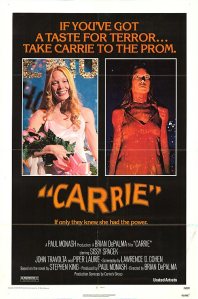 Director: Brian DePalma
Writer: Lawrence D. Cohen, based on the novel by Stephen King
Cast: Sissy Spacek, Amy Irving, William Katt, Nancy Allen, John Travolta, Betty Buckley, P.J. Soles, Piper Laurie
Plot: Slow-to-develop Carrie White (Sissy Spacek) is a high school senior, the frequent scapegoat of her classmates due to her sheltered life and the oppressive nature of her mother (Piper Laurie). Carrie’s troubles are compounded on the day she gets her first menstrual cycle, without any idea what it means. The other girls torment her mercilessly, and Carrie is sent home. But along with the changes to her body, something is happening to Carrie’s mind as well. In moments of stress or anger, she finds herself moving objects without touching them. When her mother learns about the incident, she tells Carrie the “curse of blood” is punishment for sin and locks her in the closet to pray. The girls who mocked Carrie are given a harsh detention with the gym teacher, Miss Collins (Betty Buckley). One of the girls, Sue Snell (Amy Irving) feels guilty about tormenting the girl, and convinces her boyfriend Tommy (William Katt) to ask her to the prom. The ringleader, Chris Hargensen (Nancy Allen), wants to get back at Carrie for her trouble, and convinces her high school dropout boyfriend Billy Nolan (John Travolta) to help her get a brutal revenge. Carrie agrees to go with Tommy, but her mother forbids it. Carrie lashes out wither powers, declaring that she’s going to go and sending her mother into fits of prayer. Billy and Chris, meanwhile, set up a bucket of pig’s blood above the stage of the gym, waiting for Carrie’s big moment. At the prom, Carrie unexpectedly finds a measure of acceptance from her classmates, who treat her as just any other girl – something Carrie has wanted all her life. Her joy is shattered when Chris springs her trap: she’s rigged the prom election so Carrie will win, and just as she comes up to the stage, the pig’s blood spills on her. Tommy is knocked unconscious when the bucket itself falls and strikes him in the head, and the audience erupts in laughter.
If you’ve ever watched a horror movie, you probably recognize this as the point where the students made a particularly stupid mistake.
The already-fragile Carrie snaps, locking the doors to the gym and setting it on fire, trapping everybody inside. When she leaves the burning gym, Billy and Chris try to run her over, but Carrie simply flips the car and causes it to explode. Returning home, Carrie cries to her mother, who now believes her daughter to be the product of the devil. Margaret White stabs Carrie, and Carrie uses her powers to hurl dozens of blades at her mother, killing her. Finally, Carrie destroys her mother’s house and kills herself in the process. The film ends with an image of Carrie crawling from her own grave, but it’s only a bad dream for survivor Sue Snell, whom one suspects will never have a good dream again.
Thoughts: I became a fan of Stephen King in high school, probably when I was about the age of Carrie White in the film, but I didn’t get around to reading his early works until many years later. In fact, by the time I actually read Carrie or saw the movie, I was already a high school teacher myself, so I think I have something of an odd perspective on the story. King was ahead of the curve when it came to depicting the victims of high school bullying becoming monsters in their own right (he explored a similar theme, sans the supernatural element, in his novel Rage), and these days when I see a kid in the sort of dire straits Carrie finds herself in, I feel particularly strong about trying to help them before it goes bad. Sometimes, though, you just can’t do anything.
It’s hard to see Carrie White as a monster, though. She lashes out, and she causes an incredible amount of death and destruction, but it’s hard to say that anyone else wouldn’t have reacted the same way in her situation. Her overbearing mother is a chilling creature, and would drive anyone mad.
Sissy Spacek and Piper Laurie make the film, Laurie being cruel and sadistic, Spacek being a broken, shattered creature even when we first meet her, which makes those moments when Chris snatches away her brief moment of happiness all the more tragic. In fact, if Carrie’s rampage had ended with the deaths of her tormenters instead of spreading out to the rest of the school, the audience likely would sympathize with her entirely. The deaths would be understandable, if not entirely justified. But at that point, she can’t control herself. She gets her tormentors, but she also gets Tommy and Miss Collins, the two people who have never been unkind to her at all (even Sue, the lone survivor of the massacre, joined in on the initial mocking of Carrie at the beginning of the film). Sometimes you’ll see that the one person who treats the “monster” well is spared its wrath. Not so, in the case of Carrie White. By then, Spacek’s face grows hard and her eyes empty, as if she’s no longer even in control, just an uncontrollable force of nature being used to guide the chaos all around her to its horrific end.
Even then, though, she’s never as horrible as Piper Laurie in her final moments, walking towards her daughter with a bloody knife in the air, smiling with the confidence that she’s doing God’s work. The last moment of horror comes when Carrie slays her, pinning her up in a sort of grotesque crucifix that mirrors the unsettling one her mother forced her to pray under in the closet.
The story itself is actually very simple – I’m pretty sure this is the shortest plot synopsis I’ve written in weeks – but that doesn’t make it any less effective. Sometimes it’s those simple beats that hit close to home. We see the archetypes here – Carrie as the victim-turned-killer, her mother as the iron fist that squeezes until her child pops, Chris as the cruel one, Sue as the guilty party that tries to make good. We recognize all of the characters, and that helps us get into the story easily. There isn’t much of a backstory behind Carrie’s powers, but again, one isn’t really needed. She’s telekinetic, and at this particular time in the 70s that was something that was making the rounds of speculative fiction.
The film draws from interesting sources to create its mood. The musical sting we hear whenever Carrie uses her powers is inarguably reminiscent of the legendary shower scene from Psycho, for example. It’s Carrie lashing out, but the music brings Norman Bates to mind. Otherwise, the music is fairly unremarkable – perhaps even a little too soft and lyrical most of the time. It’s there to disarm you, of course, to prevent you from being prepared for the incoming horror, but it doesn’t really succeed.
The odd moments in the movie are when Brian DePalma works in a few moments of comedy, particularly as Tommy and his friends try on tuxedoes. For some reason that still doesn’t make any sense to me, he goes into fast-forward just for a few seconds, speeding up the conversation so the boys sound like the Chipmunks. It’s a bizarre moment that doesn’t fit at all with the atmosphere of the rest of the film. DePalma also works really hard to artificially draw out the tension. From the time Carrie steps on stage until the blood falls on her head we’ve got a long, protracted scene of Sue discovering the prank and trying to warn Miss Collins, all stretched out due to slow-motion and made a little more horrible by the lack of audio. He goes into split-screen at this point, alternately showing Carrie herself or various points in the gym as she begins to trap her victims. Strangely, the split screen works very well, allowing you to see more of the terror and give it a sort of real-time element. I’m reminded of the TV show 24 whenever it breaks this way, although whether the producers of that show were specifically influenced by Carrie, who can say?
The measure of any movie is really the way it’s remembered, of course. Carrie is still considered a landmark horror film, with echoes in every story of high school terror that came afterwards, everything from A Nightmare on Elm Street right down to The Faculty. Horribly, you can see the reactions in the real world as well, any time some high school outcast snaps under the pressure and turns on his classmates. How many times have you seen a story like that on television or in the newspaper that compares a real-world killer to Carrie White? Carrie should have been a simple little horror story. Instead, it became part warning, part social commentary, part prophecy. I liked it better when it was just a horror story.
We’ve spent most of our time on this project in America, mainly because I don’t really know the history of foreign horror enough to speculate on it. But there are a few foreign films with a large enough footprint to make it on to my radar. Tomorrow, we go to Italy, for Susperia.
Mutants, Monsters, and Madmen Day 19: Jaws (1975)
 Director: Steven Spielberg
Writer: Peter Benchly & Carl Gottlieb, based on the novel by Benchly
Cast: Roy Scheider, Robert Shaw, Richard Dreyfuss, Lorraine Gray, Murray Hamilton
Plot: On Amity Island, tourists come to spend relaxing summer months. There’s nothing relaxing this year, though. A young woman is drawn underwater and killed by some unseen creature, and police chief Martin Brody (Roy Scheider) finds her mutilated remains a few days later. The coroner labels her death as the result of a shark attack, prompting Brody to order the beaches closed. The town Mayor (Murray Hamilton) overrules him, worried that shutting down the beaches will ruin the summer tourist season, the town’s main source of income for the year. Predictably, there’s another attack – this time a child, and in the middle of a busy afternoon on the water. The child’s parents offer a $3000 reward for the shark, and the town goes wild. As a debate rages about closing the beaches, a professional shark hunter named Quint (Robert Shaw) offers to kill the beast, but will only do so for $10,000.
Brody calls in a marine biologist named Matt Hooper (Richard Dreyfuss) to help, even as would-be hunters from all around converge on the island to try to find the shark. Hooper can tell from examining the first victim that not only was it most definitely a shark, but the one that’s much bigger than any ordinary shark. The mayor still refuses to close the beaches on the Fourth of July, and on the big day the beaches are more crowded than ever. Brody and Hooper assemble a small army to patrol the waters, but the beast strikes again. The Mayor finally agrees to hire Quint to kill it, and Brody and Hooper join the old salt on the water. As the men share a drink, the creature strikes the boat, cracking the hull. The shark starts to pull the boat out to sea, flooding it in the process. Quint heads for the shallow water, hoping to suffocate the beast, but he burns out the boat’s flooded engine and it dies. Hooper enters a shark cage and gets into the water, hoping to shoot the shark in the mouth with a poisoned harpoon, but fails. The shark breaks the cage apart, coming after Hooper before surfacing and going for the boat. As the ship begins to sink under its weight, Quint is eaten. Brody manages to cram Hooper’s space scuba tank into the monster’s mouth, then shoots the tank, causing an explosion that kills the beast. With the shark dead, Hooper surfaces and the survivors begin to piece together a crude raft to paddle back to shore.
Thoughts: Some people will argue that this isn’t a horror film. I say they should tell that to anyone who was afraid to go to the beach in 1975. Although the film is only rated PG, this in the years before there was a PG-13, Spielberg managed to get in some pretty gruesome imagery, such as when the shark’s first victim is found. You don’t really see how mutilated her body actually is, because what’s left of it is swarming with crabs. Other films would use flies or maggots, but somehow this is just as disturbing, if not more. Spielberg also gives us a nice chill using the “less is more” philosophy. The truth is, we see very little of the shark because the mechanical beast built for the movie really wasn’t all that convincing. But because Spielberg had a crappy shark-bot, he avoids actually letting you see it for as long as possible, scaring you way more than he could have if he’d actually shown you a convincing shark. Like Hitchcock in Psycho, Spielberg avoids showing you the evil and allows your brain to fill in the blanks.
Atmosphere, of course, is all-important in these movies, and Spielberg achieves that perfectly with the help of his frequent collaborator, John Williams. Williams has scored (I believe) all but one of Spielberg’s directorial efforts, and he’s turned out some of the most memorable movie music of all time, starting here. The Jaws theme is still emblematic of fear, and the rest of the score lets you feel the danger all around you.
The film works on the level of the “townies versus the outsider” mindset as well. Brody is the outsider – he’s been sheriff and lived on the island for less than a year. When he wants to shut down the beach, not only does the mayor strongarm him out of it, but he gets the coroner to change his diagnosis from “shark attack” to “boating accident.” I’m no doctor, but I can’t imagine that any competent one couldn’t tell the difference between a body that’s been hacked up by a propeller and one that’s been chewed, if for no other reason than the pattern of damage to the bone would be different.
In some ways, you almost watch two different movies when you watch Jaws. For the first 70 minutes or so, you’re in the town, experiencing the fear of the townies as the truth about the shark becomes evident. The last 50 minutes is all about the three men at sea, hunting the creature, and taking on a somewhat different tone. There’s still fear, but it’s more immediate. In the first half of the movie, as long as you’re on the land you know you’re safe. Once they set out to sea, the danger is most definitely all around. It gets even worse in the climactic scene, when the engine kills and our heroes are stranded with no means of escape. There’s something terrifying about that, and that’s what makes this movie work so damn well. I don’t even care if the Mythbusters proved that the exploding scuba tank wouldn’t really work, that doesn’t make the finale of this movie any less exciting.
And let’s be fair here – this is one of the most eminently quotable scary movies of all time. Little quips like Brody’s “That’s some bad hat, Harry” or Hooper’s “They’re all gonna die” have pervaded the common lexicon. Quint’s speech about killing the beast or the injury-comparing scene have been quoted, copied, and parodied so often that younger people familiar with the tropes may not even be aware of where they originated. And who can forget, “We’re gonna need a bigger boat”?
Jaws changed not only horror movies, but the movie business itself. It was the first film to use “wide release” as part of its campaign, opening everywhere instead of rolling out in a few cities at a time, which is now the common practice. It was also a gargantuan success financially, inventing the blockbuster motion picture and starting the practice of films distributing their major releases during the summer months. It was the first film to advertise heavily on television as well. Pretty much everything standard about the film industry today is true because of Jaws.
More specifically in terms of horror, the film spawned the inevitable rash of imitators: Piranha to Deep Blue Sea to this summer’s Shark Night. On land, we’ve had animal horror films like Anaconda and Lake Placid, and more and more of these imitators are drifting away from any real attempt to scare the audience in favor of going for shock and laughter. Cinematically, Jaws has two thriving descendants today: the way you see any movie, regardless of genre, and the made-for-TV monster goofs SyFy shows on Saturday nights.
In the mid-70s, a name that would become synonymous with fear first made its mark, and tomorrow we’ll look at the first movie made from his first published novel: Stephen King’s Carrie.
Mutants, Monsters, and Madmen Day 18: The Texas Chainsaw Massacre (1974)
 Director: Tobe Hooper
Writer: Tobe Hooper, Kim Henkel
Cast: Marilyn Burns, Paul A. Partain, William Vail, Teri McMinn, Allen Danziger, Edwin Neal, Jim Siedow, Gunnar Hansen, John Dugan
Plot: The film opens with grisly images and a radio news report of some horrific “sculpture” found by police, made out of bodies stolen from their graves. As the radio continues to talk about the case, we meet a group of young people on their way to visit the grave of Sally Hardesty (Marilyn Burns)’s grandfather. On the way home, they pick up a hitchhiker (Edwin Neal), who proceeds to cut himself and slashes Sally’s wheelchair-bound brother Franklin (Paul A. Partain) before they throw him out. At a run-down gas station, Franklin asks for directions to his father’s old property, but the manager (Jim Siedow) tries to warn them away. Instead, they decide to check out the old place and return later after the transport refills the station’s gas tanks.
Kirk (William Vail) and Pam (Teri McMinn) decide to set out to seek a nearby swimming hole, but instead find a house full of animal skulls, hide, and heads. Kirk enters, only to be confronted by a giant man (Gunnar Hansen) wearing a horrible mask of human skin. When Pam enters to search for him, she finds the house full of skeletons – both animal and human – arranged in bizarre, horrible tableaus. The man with the mask snatches her too, impaling her on a hook and making her watch as he dismembers Kirk with a chainsaw.
Back at the van Jerry (Allen Danizger) sets out to search for Kirk and Pam (breaking the cardinal rule of horror movies – don’t go anywhere alone). With the sun going down arrives at Leatherface’s house and enters, finding Pam barely alive and locked in a freezer chest. Leatherface kills him, because that’s what you do when you’re wearing human skin. It’s after dark now, and Franklin begins to panic over his missing friends and the fact that they have the keys. Sally and Franklin go through the high grass and shrubs, calling for their friends… until Leatherface appears with his chainsaw and hacks up Franklin. Sally runs for her life but, unfortunately, runs right to his house. Instead of help, she finds decaying, partially mummified bodies set up in a terrible sort of diorama. She escapes by leaping from a second-story window, running back into the darkness, screaming. (Hey Sally, pro tip for you: when you’re running from the chainsaw-wielding maniac into the darkness of the night, stop making noises that let him know where you are.)
Sally makes it to the gas station, where the owner knocks her out and ties her up. Driving her back to Leatherface’s house, they encounter the hitchhiker – Leatherface’s little brother. Inside, Leatherface is now wearing a dress and wig, preparing the “family” for supper. The brothers bring down “grandpa” from the attic – the desiccated old man Sally found before. But he’s not a corpse – he’s still alive. The family decides to let grandpa (John Dugan) kill Sally, but he’s too weak to hold the hammer, and she manages to escape, jumping through (another) window to find it’s now morning. She flees into the road, the brother behind her. An 18-wheeler comes around the corner, killing him. Sally leaps into the bed of a passing pickup truck, leaving Leatherface flailing about in the road.
Thoughts: It’s another entry in the “no, really, this actually happened” category of horror films. In truth, the story and characters were a complete fabrication, although Tobe Hooper and Kim Henkel were reportedly inspired by real-life serial killer Ed Gein (also the inspiration for Robert Bloch’s original novel of Psycho – there’s a little trivia for you).
Unlike some of the later horror icons (Jason, Freddy, Michael Myers), Leatherface never really grabbed me. Part of it may be his choice of victims – Pam is an airheaded hippie, Franklin is a self-pitying lout, and Kirk and Jerry come across as rather cold and heartless. Even Sally has moments of cruelty towards her brother, although considering the stress she’s under at that point, it’s a little more forgivable. Still you want to have somebody to root for when the killer is busy hacking people to shreds.
The thing that makes this movie effective, if not to my personal tastes, is how abrupt much of the horror is. The hitchhiker is weird, sure, but you’re still shocked when he grabs Franklin’s knife and cuts into the meat of his own palm. The house Kirk and Pam find is bizarre, but you’re simply not expecting it when Leatherface leaps out and pounds him in the head. When the horror begins, Tobe Hooper avoided the telltales that Something Bad Is Happening – no ominous music, no creepy sound effects, no shadows moving in the background. It just goes from one minute looking at a weird little house to, the next, finding yourself getting attacked by a monster. Again, as Franklin and Sally push through the weeds in the dark, Leatherface appears without warning. Movies aren’t made this way anymore.
This movie does, however, give birth to many of the other slasher film clichés: the “Last Girl,” the girl who can’t outrun the killer despite his enormous size, the victim who runs up the stairs instead of running the hell away and so forth. In truth, most of those clichés are embodied in Sally who – although terrified – really isn’t the smartest horror movie character you’ve ever seen. Think about it, Sal – the killer was right outside the door, then vanishes when the creepy old man opens the door again to get his truck? To her credit, she does figure out that something is wrong, but way too slowly.
As for Leatherface himself – maybe it’s decades of exposure to horror movies, but the horror mask doesn’t really unnerve me all that much. What’s creepy is the face beneath the mask. Gunnar Hansen is wearing enormous, jagged teeth, and his eyes dart about whenever you see him in close-up, as if his brain is flitting about in his head, ready to pop out at any moment.
It’s a fast-paced movie, which is to the good. The running time is short – only 84 minutes – but even taking that into account, things move along at quite a clip. We’re deep into the movie before Leatherface appears, but you don’t actually feel how long it has been. Amazingly, by the time Leatherface disposes of the first four victims and only Sally is left, there’s still a half-hour left in the film.
Hooper also works in a little macabre comedy towards the film’s end. The father’s reaction to how Leatherface chopped up the door could have come from an exasperated TV father. He may as well have said, “We just can’t have nice things!” Leatherface prancing around in the dress, cringing from his angry father, feels like Hooper took Norman Bates and twisted him into an even weirder configuration. The thing is, once Leatherface puts the wig on and allows his father to browbeat him, he ceases to be menacing and becomes an object of ridicule. Well, for me, at least. Sally probably felt different. The horror comes back when “grandpa” makes an appearance, and actually recovers pretty well considering how the rhythm of the piece had been disrupted seconds before.
The film is inconsistent with its characters, too. The father alternately claims he takes no pleasure in killing and there’s no sense in torturing Sally before she has to die, then switches to giggling and mocking her along with his warped sons. He even jumps up and down with glee as grandpa tries to hammer Sally in the head. There’s no real reason for these inexplicable shifts, save perhaps to pad out the film a bit, as it is accompanied by long scenes of Sally screaming, with close-ups of her eyes cut with shots of the laughing family (including dad).
Even the film’s conclusion is terribly abrupt, with Sally’s savior coming out of nowhere and whisking her away as the credits roll. There’s no follow-up here, and this is a film that kind of needs it. Sally must have alerted the police – was the family still there when they arrived? Were they attacked? These are the sort of things I suppose may have been addressed in the sequels, but I’ve never seen any of them and, honestly, I’m not really compelled to.
From terror of the human variety, we’re going to face off with the nastiest predator of the animal kingdom. Tomorrow, you’re going to want to stay out of the water, because we’re watching Jaws.
 Reel to Reel