Category Archives: Superhero
Batman Week Day 2: Adam West in Batman: The Movie (1966)
 Director: Leslie H. Martinson
Writer: Lorenzo Semple Jr.
Cast: Adam West, Burt Ward, Lee Meriwether, Cesar Romero, Burgess Meredith, Frank Gorshin, Alan Napier, Neil Hamilton, Stafford Repp, Madge Blake, Reginald Denny
Plot: On a peaceful afternoon, Bruce Wayne (Adam West) and his young ward Dick Grayson (Burt Ward) are summoned to save a yacht carrying an important scientific innovation to Gotham City. In their other identities as Batman and Robin, the two board their Batcopter (conveniently held and prepared for them by the employees of the Gotham airport) and fly off to investigate the disturbance. After a tussle with a shark (yep), the yacht vanishes. Batman later denies the yacht’s disappearance in a press conference, during which a young Russian reporter named Kitka asks him to take off his mask for a picture. Commissioner Gordon (Neil Hamilton) and Chief O’Hara (Stafford Repp) both rebuke the woman, but Batman is more understanding… while still refusing her request.
As the press leave, Batman and the police review known super-criminals at large who could be behind the current unrest. As it turns out there are four: the Penguin (Burgess Meredith), the Joker (Cesar Romero), the Riddler (Frank Gorshin) and Catwoman (Lee Meriwether). Through a thought process too ridiculous to even attempt to replicate, our heroes determine the four villains are working together and set off to look for clues.
Kitka goes to the Gotham docks, where we discover she’s really Catwoman in disguise. She joins the other villains in their “United Underworld” organization, where they reveal their plan is the disruption of the United World conference in Gotham using a secret invention developed by a man on the yacht, the daft Commodore Schmidlapp (Reginald Denny). Batman and Robin determine the yacht that vanished was, in fact, an illusion, and the real yacht was stolen some point prior. As they take to sea in the Batboat, they cruise the ocean above the Penguin’s highly-themed submarine. (How in the hell does he afford a penguin-themed submarine? He never successfully commits a crime, Batman always stops him on this show. Did he win a contest?) The Penguin traps the dynamic duo on a buoy and fires a series of torpedoes at them. When the third hits its target the villains celebrate, but we quickly cut to Batman and Robin in their boat, mourning an (unseen) heroic porpoise that swam in front of the torpedo, giving its life for theirs, and I seriously cannot believe I just typed the preceding sentence.
Back in her “Kitka” disguise, Catwoman makes a date with Bruce Wayne, planning to kidnap him as bait for a trap for Batman. Batman orders Robin and Alfred (Alan Napier) to tail him on the date in case the villains make a move. That night, after a dinner at the sort of restaurant that only exists in movies (with wandering violinists and no other customers), she takes Bruce to her apartment, and Robin turns off his monitor after seeing the two of them engage in the most awkward kiss in movie history. Unfortunately, this means he isn’t watching seconds later as the villains and their henchmen burst in and kidnap Bruce, who still thinks Kitka is their real target.
The next day the villains are confused as to why Batman hasn’t followed the clues they left and come stumbling into their trap, now baited with Bruce Wayne. A furious Bruce demands to see Kitka, so they blindfold him and toss him into a room with her after Catwoman switches identities. While trying to “comfort” her, asks Kitka to help him retrieve a hidden radio in his coat, but the villains remove him from the room and untie him to retrieve the radio. With his hands free, Bruce springs into action, battling all four villains and their henchmen at once, escaping into the bay.
Growing desperate, the Penguin hatches a new plan. Selecting five henchmen as guinea pigs, he activates Commodore Schmidlapp’s invention, a “total dehydrator” which reduces the henchmen to powder, extracting all moisture from their bodies. Batman and Robin return to the villains’ hideout which is now deserted, but sports a sparkling bomb. After a series of (frankly legendary) misadventures, Batman concludes that on some days, you just can’t get rid of a bomb. They encounter the Penguin disguised as the Commodore and see through the ruse immediately (making you wonder why Batman can’t tell Kitka is Catwoman without her mask). Having been taken to the Batcave, the Penguin rehydrates the five thugs, but uses heavy water from Batman’s nuclear reactor. All five are reduced to anti-matter with the slightest impact. Because science.
Batman pretends to think the Commodore was brainwashed and takes him back to the city, allowing him to escape. The villains dehydrate the United World Security Council (who can’t even stop arguing with each other long enough to notice they’re being dehydrated) and place them in vials to hold them for ransom. The heroes track them to their submarine and force it to surface, boarding and engaging in a battle royale during which nobody actually lands a punch but everybody pretends like they’ve been hit anyway. Catwoman stumbles and loses her mask, revealing to Batman and Robin that she is, in fact, Kitka, and simultaneously taking away any rights either of them would ever have to make fun of Lois Lane. Although the vials containing the security council members have miraculously escaped unscathed, Commodore Schmidlapp stumbles in and smashes them, mixing the powders. Batman and Robin use their super molecular dust separator (of course they have a super molecular dust separator) to extract the representatives from one another and rehydrate them, but the procedure is imperfect. The arguing representatives are now weird, mishmashed amalgams of each other, speaking the wrong languages and having each others’ personalities. Batman tells Robin this may be “the single greatest service ever performed for mankind,” then the heroes sneak the hell out of there.
Thoughts: I must confess to having something of a love/hate relationship with Adam West’s Batman. Although as a child I watched the reruns of this series and found it enjoyable, as I got older I started to grow disenchanted with it. You see, as I got more and more into examining comic books as an art form, I started to get angry about the way the mainstream media so often depicts comic book culture – childish, immature, lacking real artistic merit. The fact that for decades you couldn’t get a single news story about comics without including “Biff! Pow!” in the title eventually led me to realize how much the cultural perception of superheroes and comic books was formed by this goofy Batman TV show, and I grew to resent it. (This was during a period of my life in which I tended to take everything way the hell too seriously, a time many of us identify as “being a teenager”.) Eventually I learned to lighten up, learned to accept that some characters are big enough to allow for multiple interpretations, and learned that Adam West and company essentially saved Batman from extinction during a time when interest in the character was dying away. So I’ve made my peace with it. But it’s still not my favorite version of the Batman.
People who remember the Batman TV show may not always be aware of this movie, filmed and released in theaters between the first and second seasons of the series. As a result, it has the feel and tone of the series after it gained its footing, rather than the awkward feeling you get from early episodes of many classic TV shows after you go back and watch them years later. The performances of the actors and the film as a whole carry a sense of barely-contained insanity, starting right from the beginning where a spotlight features a dedication to “lovers of adventure… pure escapism… unadulterated entertainment… the ridiculous and the bizarre,” then rolls over a couple making out and apologizes for any other groups of lovers they may have missed.
“This,” I say to myself, “is Batman?”
My spine starts to crinkle a bit in the first few minutes, as they approach the yacht in the Batcopter, drop the Bat-ladder (the labeled Bat-Ladder) and I anticipate what’s coming next… the Bat-Shark Repellant. It’s things like this that really made me hate this incarnation of Batman for a few years, and even now, still bug me a little bit. Having seen the 1943 movie serial, it’s clear that a lot of the inspiration for this version came from taking the campier bits of that to the extreme. Then I think about the other extreme, when the dreaded Joel Schumaker 30 years later would take over the Batman film franchise and go to an extreme version of this Batman… the stilted puns, the bizarre non sequiturs, the thrice-damned “Bat Credit Card,” and I’ve got to take a breath or two to calm down.
The heroes here (all the characters, really, but let’s focus on the heroes) are caricatures. West’s Batman speaks in short, stilted passages, frequently lapsing into speeches that have bizarrely inappropriate and ill-timed morality lessons and making leaps of logic that are quite simply ludicrous. The only reason this Batman ever solves any crime is because his foes are as insane as he is, and their respective brands of madness overlap. The entire universe of this series, in fact, is quite crazy. This incarnation of Bruce Wayne pretends to be the straight man, attempts to appear as an oasis of sanity in the midst of it all, but it’s an act in and of itself. The only way to accept Ward and West’s Batman and Robin is by giving in to a world of lunacy.
As ridiculous as Batman and Robin themselves are, I find myself much more entertained by the antics of the villains. Romero, Gorshin, Meriwether and Meredith are at their scene-chewing best here, grinding up film with performances so incredibly over-the-top you can only admire their skill. The first scene with the four of them features snippets of dialogue as quick and rapid-fire as Joss Whedon or Alan Sorkin would turn out decades later. I could watch them go back and forth for hours, either having the time of their lives in their silliest roles or doing a great impression of it. By contrast, West and Ward have the unenviable task of trying to pretend they’re taking things seriously while surrounded by colors that would give Jackson Pollock eyestrain and keeping a straight face when they conclude that the crime took place at sea, which means Catwoman must be the culprit, because her name begins with the letter “C”. (That’s not even a joke, that’s an example of the actual logic used in this film.) The villains aren’t the same kind of crazy we would see in later years, with Heath Ledger’s Joker, but they’re a brand of crazy that can actually be a lot of fun to watch in small doses.
The movie deals heavily in parody, which is fair enough, but at times it gets so ridiculous it’s hard to swallow, such as when we meet a Naval Admiral stupid enough to sell a preatomic submarine (complete with missiles, apparently) to a fellow named “P.N. Guinn” who had no credentials other than a post office box. The film actually taps into the anti-establishment vibe of the 60s, making the military and police into buffoons, with only Batman there to save their hides. It’s easy to see how it became so popular at the time, but the leaps in logic required for it to make any sense go too far for me at times. At most times, actually.
In truth, while I certainly understand the people who are big fans of the Adam West-era Batman, I still can’t really count myself among them anymore. I prefer a Batman who is shrewd, villains who are actually threatening, a Commissioner Gordon who is a hero in his own right rather than the head of the clown college that is the GCPD. For people who appreciate this Batman, it’s here, and it’s a cult classic. For me, though, I really can only enjoy it when I’m sitting around with my friends, cracking jokes about how ridiculous it is.
The first Reel to Reel study, Mutants, Monsters and Madmen, is now available as a $2.99 eBook in the Amazon Kindle store and Smashwords.com bookstore. And you can find links to all of my novels, collections, and short stories, in their assorted print, eBook and audio forms, at the Now Available page!
Batman Week Day 1: Lewis Wilson in Batman (1943)
 Welcome, friends to Batman Week, the first in the ongoing Reel to Reel: Icons series. Each week in this series we’re going to take a look at a different character and five different actors who have brought him or her to life. We begin today, in 1943, with the first ever on-screen appearance of the Caped Crusader himself, Batman.
Director: Lambert Hillyer
Writer: Victor McCleod, Leslie Swabaker, Harry L. Fraser
Cast: Lewis Wilson, Douglas Croft, J. Carrol Naish, Shirley Patterson, William Austin, Gus Glassmire, Sam Flint, Robert Fiske, Charles Middleton
Plot: In this version, Batman and Robin (Lewis Wilson and Douglas Croft) are America’s premiere government-sanctioned crimefighters. They round up a gang of criminals who warn them he’s crossing “Dr. Daka,” but Batman has no time to investigate… he’s got a date coming up with Linda Page (Shirley Patterson). Linda is concerned about her uncle Martin (Gus Glassmire), and as it turns out, she has good reason. Martin is kidnapped by thugs and brought before Dr. Tito Daka (J. Carrol Naish), who introduces himself as a servant of Hirohito, sent to destroy the United States government and enslave the people of America. Daka drugs Martin and forces him to reveal the location of a radium supply, which he plans to use to power a new secret weapon: a ray capable creating reducing even the hardest substance to powder.
I’m going to get heavily abbreviated with the plot synopsis here: for the next 15 chapters, Daka comes up with one scheme after another to get some radium – stealing it, kidnapping the owner of a radium mine, intercepting a supply being airlifted from a plane, etc. Each time, Batman and Robin stumble upon the plot and thwart it, only surviving by the skin of their teeth, because in the 1940s superheroes were either thrown from a precipice or caught in an explosion every 15 to 20 minutes. Fortunately, there was always a convenient scaffold or rope beneath them or a convenient archway above them to protect them from falling debris.
Eventually, Daka manages to get his hands on some radium and make a larger, more powerful radium gun. He captures Linda (this is the third or fourth time), and brings her to his lab where he subjects her to a machine that transforms people into brainwashed zombies that will do his bidding. Batman rushes to the rescue, but is overwhelmed by the zombies and strapped into the machine. Before Daka can unmask him or activate the device, Robin arrives and captures the villain. With Batman free, he makes Daka show him how to reverse Linda’s brainwashing. Daka makes a play to escape, but tumbles into his own open alligator pit, because what’s a supervillain lair without an open alligator pit? When the police arrive, Batman allows them to take the credit for the bust. At the end, Bruce Wayne walks off with Linda, sad that he once again missed seeing the world-famous Batman.
Thoughts: Made only four years after Batman’s first comic book appearance, this early film shows a version of the character that’s still somewhat unformed. While director Lambert Hillyer attempts to bring in a sort of dark warrior approach, comic book characters at the time (and for a long time to come) always seemed to invite a sort of camp element. The first image of Batman in the movie, even, shows him sitting in the Batcave behind a desk that looks like Bruce Wayne had it taken out of an unused office in his corporate headquarters, washed out by too much light with bat-shaped shadows dancing across his face. This lasts long enough for Robin to show up, complete with a curly-topped white ‘fro, and Batman beams like grandpa seeing his children coming over for a visit in the nursing home. All I can do at this point is cross my fingers and hope it’s at least better than anything Joel Schumacher ever did.
Fortunately for us all, it is.
Lewis Wilson’s Batman is far more flippant than the character he would become, and there’s little sign of most of the elements that would make him so popular in the future. There’s no Commissioner Gordon (even though he appeared in the very first Batman comic), no familiar foes, not even a Batmobile. The only things that mark this as a Batman film, in the eyes of a modern fan, are Batman and Robin themselves, Alfred, and the “Bat’s Cave” headquarters. (Ironically, this film actually created the Batcave concept – the cave set was left over from another film, re-used as Batman’s headquarters to save on production costs, and made so much sense they imported the headquarters into the comic books as well.)
Wilson’s version of Batman is also less driven than other versions… the sheer obsession that motivates the character in most other incarnations isn’t present at all… in fact, his origin (including the death of his parents) is never mentioned throughout the course of the story. What’s more, this is a Batman who is uncomfortably comfortable with the deaths of his adversaries, casually allowing Daka’s men to die when their vehicle goes off a cliff and not batting an eye as Alfred fires a pistol at them (although this could potentially be justified as him knowing there’s little chance of Alfred actually hitting anything). The filmmakers do manage to work in a least a few familiar tropes, including an amusing scene where one of the henchmen suggests that Batman may actually be this “Bruce Wayne” fella who keeps turning up, but Daka dismisses the idea that such a fool could be the Batman. We more often see this particular cliché applied to Clark Kent, but over the years the Bruce Wayne masquerade has left Batman open to it from time to time as well. There’s also a rather amusing bit towards the end where the villains decide they’ve killed Batman so many times that there must be multiple men wearing the costume… and maybe Wayne really is one of them after all (another conceit which later stories have explored from time to time).
One thing that doesn’t help the film is how little detective work Batman actually does. Even in his early days, he was painted as a crimefighter with a fierce mind, but this Batman doesn’t show much of that at all, stumbling into the information he needs through luck. There’s the occasional moment of trickery, such as when he cons one of Daka’s thugs into calling for help so he can get the phone number and find their hideout, but even then, it doesn’t come off as particularly clever. Instead, the thug looks stupid for falling into the most obvious trap imaginable. It helps Batman crack the case, but it doesn’t do wonders for his reputation.
 The fight scenes showcase just how far filmmaking has come since the 1940s… the stunts are often more laughable than thrilling. Wilson is particularly unimpressive as he struggles against the crooks, looking more like the fake Batmen who would get caught by the real one over 60 years later in The Dark Knight than the Dark Knight himself. On the other hand, Douglas Croft’s Robin is actually impressive – a whirling dervish of energy that is believably formidable. This is probably due to the serial format, of course – each chapter (effectively every 15-to-20 minutes of the film) has to end with a cliffhanger, most of which require you to place your hero in mortal danger. It’s a staple of the format, but it winds up leaving Batman looking rather ineffective, with Robin (a character who, in other films and media, was sometimes portrayed as being so useless he was called the “boy hostage”) there to consistently save his ass again and again.
William Austin’s Alfred is distinctly different from the comic book depiction of the character at the time – a plump bumbler. This version, though, became iconic, and Alfred’s thin frame and thin mustache in the comics have been based on Austin’s appearance ever since. His frequent propensity to disguise himself would make its way into the comics as well, eventually evolving into a rather complicated backstory where Alfred was both a celebrated actor and a British secret agent before finally following in his father’s footsteps as the Wayne family butler.
As this was a World War II-era film, the propaganda machine is in full force. Bruce Wayne casually mentions a (false) 4-F status to explain why he’s not in the army, and the villain’s hideout is in the Japanese section of town, which has been – and I’m quoting the narrator here – “cleaned out of those shifty-eyed Japs.” Try to picture a movie getting away with a line like that today, even ironically. Then we meet Daka himself, an unflattering Japanese stereotype if ever there were one. He’s sly, cruel, with a “twisted Oriental brain” (that line courtesy of Uncle Martin) bent on destroying the good old US of A. He’s just a pointy beard and kimono away from being Fu Manchu himself. Even when one of his henchmen turns against him (seconds before his death), his betrayal comes with a healthy dose of anti-Japanese racism, referencing his cowardice as matching the color of his skin, among other things. Daka also falls into some generic supervillain stereotypes – the arrogance that comes with the role, for example. He also uses the Bond Villain trope two decades before Bond does – when he finally has Batman captured in his hideout, he gloats instead of killing or even unmasking him, just long enough for Robin to show up and stop him.
As befit the serials of the time, which needed to pad themselves out for a few months, the plot seems unnecessarily complex. The scene where Bruce impersonates a Swami to warn Linda away from the investigation, for example, is pointless. She winds up unconscious (again) anyway, and the whole episode could easily have been sidestepped… there’s almost no plot progression at all, and we roll straight into Batman chasing the thugs to try to save the radium. In fact, the radium angle leads into one mini adventure after another where the goal is always the same: Daka is trying to get his hands on some radium, Batman stumbles into the plot and tries to thwart it, over and over and over again without actually changing anything. One could easily jump from episode four to about thirteen and still have no problem understanding the ending of the series. I’ll give Daka this much – he’s not like some supervillains who give up on a perfectly good scheme the first time it’s thwarted – but watching the entire serial in one sitting displays how repetitive the storytelling was. Daka comes across as foolish, even naive, considering how many times his men promise him, cross their hearts, and pinky swear that they really did kill Batman this time, honest, and he always believes them, despite all evidence to the contrary.
This serial is fondly remembered, and for good reason. There’s some silly charm to it, if you can get past the severe culture shock of the way our heroes treat not only the Japanese villain, but the Japanese in general. It may be remembered as just a footnote, however, if not for what came next… a rerelease of this film in the 60s helped stir up support for the then-weakening Batman franchise, and led to 20th Century Fox taking a chance on producing a TV show. That show had more in common with this camp Batman than the dark hero he would later become, but its popularity helped save Batman from going away entirely like many of the other heroes born during World War II. If not for this serial, you see, we may never have had the incarnation of the hero we’re going to talk about tomorrow: Adam West’s Batman.
The first Reel to Reel study, Mutants, Monsters and Madmen, is now available as a $2.99 eBook in the Amazon Kindle store and Smashwords.com bookstore. And you can find links to all of my novels, collections, and short stories, in their assorted print, eBook and audio forms, at the Now Available page!
If I was making the Justice League movie…
 Fans of DC Comics’s Justice League franchise saw what seems to be another setback this week, when word leaked the script that has been in development is being scrapped entirely. For those who just want to see the damn movie made already, this is obviously distressing news. But my approach is slightly different. I absolutely want to see a Justice League movie, but I want to see a great movie. So if Warner Bros recognized that the script they’re working with is crap, by all means, start over and do it right.
Earlier this week over at CXPulp, I wrote about how Disney seems to be planning to apply the lessons of Marvel Studios to their recently-acquired Star Wars franchise. (For those of you who may not follow this stuff the way I do, let me briefly explain that Disney bought Marvel in 2009 and that Marvel and DC have been the two biggest publishers – and therefore the two biggest rivals – in American comic books for decades). Marvel created films for several of their characters, brought them together in their mega-hit The Avengers, and are now breaking them off into smaller films again before the next combined go-around. Comic book fans, delighted with what Marvel is doing, are asking why the hell the movies based on DC Comics – the Justice League, Superman, Batman, and many more — can’t do the same thing. Although DC Comics, for a long time, had properties with more mainstream recognition than Marvel, in the past decade Marvel has dominated superhero movies. The only hit from the DC Universe in recent years has been Christopher Nolan’s Dark Knight trilogy, while Marvel’s X-Men, Spider-Man, and Avengers-related films have become legitimate powerhouses.
The reason for this, I believe, goes back to the late 90s. Marvel, at the time, was still an independent company, although one reorganizing after a bankruptcy. DC, however, has been wholly owned by Warner Bros for a very long time. That means Warner Bros is the only game in town to make a DC movie. If Warner Bros isn’t interested, it won’t happen, and if Warner Bros doesn’t understand what makes the property work, we get crap like Steel and Catwoman. Marvel, on the other hand, had the freedom to shop their properties around. Universal doesn’t have the right feel for Spider-Man? Take it to Sony. Paramount can’t give us a decent X-Men film? Bring them to Fox. Granted, this system turned out its share of clunkers too (let’s not forget that some genocidal maniac gave approval to not one, but TWO Ghost Rider movies starring Nicolas Cage), but their batting average over this period, beginning with Blade in 1998, is pretty damn good.
Things are different now, of course, since Marvel is owned by Disney. But by the time of that purchase in 2009, Marvel had already launched their own film unit to make movies with the characters other studios didn’t have – Iron Man and Incredible Hulk had both already come out and production was underway on Iron Man 2, Thor and Captain America: The First Avenger. By the time Marvel was a Disney property, they’d proven that they could make great films on their own, and Disney has wisely stayed the hell back and let them do it, the way they did when they bought Pixar in 2006. (Disney seems to have a three-year cycle for buying other companies, they got Lucasfilm in 2012. That means I have until 2015 to create a franchise with lucrative enough IPs that I can sell them to Disney and retire in luxury.)
This, more than anything else, is what Warner Bros needs to learn in regards to any DC Cinematic Universe. It’s not about copying Marvel’s storytelling or casting tricks or format. It’s about letting the people who know the characters do what they do best and getting out of their way while they do it.
Marvel needed to raise the profiles of their lesser-known characters or Avengers never would have been the hit that it was. DC has a different problem. Ten years ago, nobody who wasn’t a comic book fan knew who Iron Man or Thor were. DC’s problem is that everybody knows many of their characters – Wonder Woman, Aquaman – but they fundamentally misunderstand them. Aquaman is a punchline, he’s “the guy that talks to fish.” But as writers like Geoff Johns and Peter David have shown us, he can be so much more than that – a tragic monarch, a man who struggles with the responsibility of protecting two-thirds of the surface of the Earth… not to mention the fact that the physical changes necessary to allow a person to survive on the ocean’s floor would make them pretty strong and otherwise badass on land. Putting Aquaman in a movie doesn’t necessitate that you explain who he is, it necessitates you explain what makes him awesome.
So if I was in charge of the Justice League movie, this is what I would do.
First, start with this summer’s Man of Steel. The film is generating some positive buzz and I’m excited about it. I’d work in a small reference to a larger DC Universe – have some news report about Green Lantern in the background, or a page of the Daily Planet referencing the chaos in Gotham City that happened during The Dark Knight Rises. Nothing that would really influence Superman’s story, but enough to nod at the fact that he’s not – as Nick Fury said in the first Iron Man – the only superhero in the world.
Then, I’d work on putting together a phenomenal Justice League story. I wouldn’t start with the big bad that was in the previous script, Darkseid, for two reasons. First, Marvel is already using Thanos in their movies, and although Thanos was largely a Darkseid rip-off when he was created in the comics, movie fans won’t get that and will think it’s the Justice League that’s being derivative. Second, he’s too big for the first movie. Where do you build from there? You need a threat big enough to justify bringing all of these characters together, of course, but they shouldn’t go up against the biggest threat in the universe their first time out.
Next, get the recognizable aspects from the current DC films and put them together: Henry Cavill as Superman, build off the end of The Dark Knight Rises (as a spoiler consideration I won’t be more specific than that), and yes, I’d get Ryan Reynolds back as Green Lantern. That movie had problems, but his casting really wasn’t one of them. Then I’d add the characters that the public has heard of but doesn’t understand – Wonder Woman, Aquaman, the Flash. Use this movie to showcase them the way Avengers suddenly turned everyone in America into fans of the Hulk for the first time in decades.
Don’t bother with everybody’s origin. It’s a convention of the superhero genre, true, but it’s often the least exciting part of it. You don’t need to know why John McClane became a cop to enjoy Die Hard, so why do I need to see Barry Allen get struck by lightning when I’ve already accepted a world with a man from Krypton and another guy with a magic ring? After Justice League, we’ll start spinning the other characters off into their individual movies – if necessary, work in the origins there. There’s no rule that says they have to take place after the Justice League movie just because they’re made in that order, although even then, I think a quick flashback would probably be more than sufficient in most cases.
Finally, make it clear that the Justice League isn’t the be-all and end-all of the DCU. Marvel can’t reference Spider-Man, the X-Men, or the Fantastic Four, because the rights to those characters are still tied up with other studios thanks to deals they made before they were purchased by Disney. DC doesn’t have that problem. Guillermo Del Toro is working on a movie featuring some of DC’s supernatural characters like Swamp Thing and Deadman – a Justice League movie could drop in a reference to them. Give us veiled hints or rumors about other Leaguers from the comics like Zatanna, Plastic Man, Firestorm… characters that have potential for their own films in the future, assuming of course that they’re done right. Even better – if you have some sort of huge battle for the end piece, the sort of thing that the public can’t help but notice (like the battle of New York in The Avengers, and it just shows how great that movie was structured that it keeps being the best analogy), give us glimpses of some of these other heroes fighting their own battles while the League takes on the Big Bad, whoever it happens to be.
And most importantly, make sure that the story is one that satisfies the fans but is broad enough to grab people who don’t know all of the characters. This is what Marvel has done brilliantly and what Warner Bros has prevented DC from doing for years. If you can pull off that trick, we’d have a movie that could launch not just one franchise, but an entire universe.
Of course, that’s what I would do. But what do I know? I’m just a guy who reads comics and watches movies. It’s not like I’ve got the pedigree of the man who gave the green light to Jonah Hex.
(If that line isn’t enough to convince people I should be running the show, nothing will be.)
Lunatics and Laughter Day 7: The Toxic Avenger (1984)
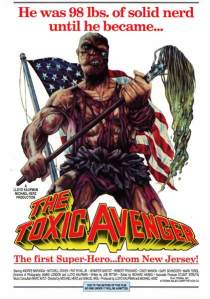 Directors: Michael Herz & Lloyd Kaufman
Writers: Lloyd Kaufman & Joe Ritter
Cast: Mitch Cohen, Andree Maranda, Jennifer Babtist, Cindy Manion, Robert Prichard, Gary Schneider Dick Martinsen, Pat Ryan Jr., Kenneth Kessler, Patrick Kilpatrick
Plot: Welcome to Tromaville, a small suburb of New York City, and the number one dumping ground for toxic chemicals in America. Melvin Ferd (Mark Torgl) the janitor at a local health club, is constantly tormented by a group of club members, including Bozo (Gary Schneider), Slug (Robert Prichard), Wanda (Jennifer Babtist), and Julie (Cindy Manion). They decide to teach him a lesson, with Julie luring him into a locker room just as a truck full of exposed barrels of toxic waste parks outside. She tricks him into putting on a pink tutu and poka-dotted leotard, and he is humiliated in front of the club’s customers, fleeing through a window and landing in the toxic barrels. People continue to mock him as the chemicals burn through his skin and Melvin, now burning alive, stumbles home and sits in a cold bath, where he transforms into a hulking brute of incredible size and strength.
A group of drug dealers, meanwhile, try to buy off a cop (O’Clancy, played by Dick Martinsen) who refuses to cooperate. Before they can castrate him with his own gun, a huge man (Mitch Cohen, voiced by Kenneth Kessler) appears and savagely kills two of the criminals (well… kind of savagely, the fight itself is actually played mostly for laughs), leaving a mop across their faces. Mayor Peter Belgoody (Pat Ryan Jr.) is horrified by the murders… mostly because the dead criminals were some of the best dealers in his employ.
The Monster – a mutated Melvin, of course – shocks his own mother into a dead faint. Despondent, he makes his way to the Tromaville garbage dump and constructs a crude home for himself there. Later, a group of criminals robs a Mexican restaurant, killing a bystander and a seeing-eye dog belonging to a blind woman named Sarah (Andree Maranda). The crooks’s leader, Leroy (Patrick Kilpatrick) is preparing to rape her, when the Monster Hero appears and fights them, ripping an arm off the would-be rapist and sending the customers fleeing in terror. The Monster beats the crooks and finishes them off in the restaurant’s kitchen. He goes to the sobbing Sarah and she begs him to help her home, where they begin to become friends. Given new confidence, Melvin begins a one-man war on crime, battling pimps, drug dealers, and other criminals, and saving lives along the way. The newspapers begin to run stories about the “Monster Hero” of Tromaville. Belgoody sends his men to hunt the monster down.
Melvin and Sarah fall in love, and he takes her back to his junkyard hideout to live. He returns to the health club, attacking Julie in the locker room. Minutes later he finds Bozo and Slug, fresh from beating an old woman to steal her car. He hurls Slug from the car and sends Bozo through a series of crashes, burning him alive but leaving Melvin unharmed.
Things go bad when Melvin kills a little old woman in a dry cleaner’s shop, turning people against the Monster Hero. Ashamed, he goes home and tells Sarah the truth about who he is and what he has done. They decide to leave town, and Belgoody rejoices… until he discovers the old woman was the leader of a slavery ring. Belgoody covers it up and sends the cops out to hunt the Monster. They find him and Sarah in the woods, and the town assembles outside their tent, torn between people who want to protect the monster and Belgoody and his men who want to kill him. The townspeople stand in front of Melvin to protect him, soon joined by O’Clancy and the rest of the cops. Belgoody opens fire, but the bullets bounce off Melvin. He stalks Belgoody to his limo and rips his guts out, literally. The townspeople applaud the vicious murder, Melvin kisses Sarah, and all in Tromaville is well once again.
Thoughts: It would be impossible to get through a month of horror/comedy without touching upon the films of Troma. Lloyd Kaufman’s legendary low-budget B-movie studio has become synonymous with campy sci-fi and monster flicks, and how better to represent them than with this, their flagship property?
Buoyed by the likes of Attack of the Killer Tomatoes, Lloyd Kaufman and Michael Herz built this film (and, for that matter, their entire film studio) on the premise of the “So Bad It’s Good” movie. Whereas older movies – the sci-fi and horror clunkers of the 50s and 60s – made an earnest attempt at making good movies and simply fell short, Kaufman has no such delusions. From the beginning of the movie the acting is terrible, the script laughable, and the special effects and graphics absurdly cheap, even by 1984 standards. Watch the quality of this film compared to Ghostbusters and you’d swear that Toxie’s debut is at least ten years older, instead of both films coming out in the same year.
The film’s absurdity doesn’t just come from the effects and acting, though. Kaufman sets out to be as deliberately offensive as possible. There’s an early scene where one of the punks and his girlfriend recite a litany of racial slurs and other negative stereotypes, ranking them on a point system for running them over with a car, before finally deciding to target a kid on a bicycle (children under 12 being worth maximum points). They hit the kid once, then back over him to crush his head, stop, and take pictures. The sympathies of the audience are swinging wildly at this point. You hate the gang for doing it, which is how you’re supposed to feel, but by the time the girls whip out the Polaroid camera, you’re pretty much ready to hate the filmmakers as well.
Our hero, ladies and gentlemen…
(It is worth noting, at this point, that the Toxic Avenger films eventually spawned a children’s cartoon show. I doubt most of the moms who let their kids sit through it would have been thrilled if they saw this particular sequence.)
Kaufman actually triples the genres he plays with here. His heavy layer of goofy comedy is draped over a plot that draws upon nuclear-mutant themed monster movies and wraps it around the skeleton of a superhero origin story. No superhero has ever been so ridiculous, though – even the drivers of the truck that gives us the “toxic” part of the hero’s name comment on how ridiculous it is for them to drive around with open, sloshing barrels full of chemical sludge. Belgoody is also an extreme stereotype of a villain. It’s hard to believe even the most corrupt politician in a serious film would think he could get away with dumping toxic chemicals literally twenty feet away from the city’s drinking water. Even Belgoody’s gang is comical – it’s a patchwork of stereotypes, containing a street hood, a Capone-style gangster, and representatives of just about every crime stereotype there is. The notion is preposterous enough to remind us that this film takes place in, at best, an exaggerated reality, where all of the elements that make up monster movies and superhero films have been amplified to a ridiculous degree.
At times, the movie starts to outsmart itself. The toxic reservoir scare, for instance, is played up as though it will be a major plot point, perhaps even the Big Evil the hero will battle in the film’s climax. That isn’t what happens, though – it’s mentioned once and then abandoned as Belgoody’s resources are turned exclusively towards seeking out the monster. Most of the villains are portrayed as one-off as well – the theatrical mob Leroy leads is all killed right away, for example. Even the moments where Melvin confronts his tormentors seem like they’re worked in simply to tie off those dangling threads while we’re waiting to get back to the real plot, such as it is.
Kaufman picks up on a lot of sources, with Melvin’s transformation smacking of the Incredible Hulk and his relationship with Sarah echoing both the friendship Frankenstein’s monster shared with the blind (Gene Hackman in the Mel Brooks version) and the longtime romance in the Fantastic Four comics, in which the mutated Thing finds love with blind sculptor Alicia Masters. He even picks up on a few slasher tropes – Melvin’s fatal confrontation with Julie comes complete with a silhouette shot of the monster approaching her with a pair of menacingly raised scissors. It sends images of Freddy Krueger and Jason Voorhees across the brain, until you remember that this is your hero.
Sarah takes us to the extremes of broad comedy, knocking over an entire rack of canes and smacking Melvin accidentally, playing up on pretty much every joke you could think of making about the blind. Although not as bad as the scene with the racial slurs, this starts to tread close to the line of being offensive as well. And true to form, Kaufman doesn’t care at all. In a way, it’s almost a liberating thought. When you see so clearly that you’re dealing with somebody who doesn’t give a damn what you think of him, you manage to stop giving a damn and concentrate more on the actual content of what you’re watching.
Is it cheap? Yes. Is it exploitive? Oh yeah. Is it ludicrous? To be kind. But like the makers of Attack of the Killer Tomatoes, Lloyd Kaufman and his Troma team have never attempted to take themselves seriously. They know what they are, they know what their audience expects, and they deliver it as effectively (and as cheaply) as they possibly can. It will never make for great cinema, but nobody can deny that this is a film studio that consistently meets its goal, artistically. It’s easy when you set the bar so low.
 Reel to Reel