Category Archives: Science Fiction
Dorothy Gale Week BONUS: Zooey Deschanel in Tin Man (2007)
 Director: Nick Willing
Writer: Steven Long Mitchell, Craig Van Sickle, based on the novel The Wonderful Wizard of Oz by L. Frank Baum
Cast: Zooey Deschanel, Alan Cumming, Neal McDonough, Kathleen Robertson, Raoul Trujillo, Callum Keith Rennie, Richard Dreyfuss, Blu Mankuma, Anna Galvin, Ted Whittall, Rachel Pattee, Alexia Fast, Gwynyth Walsh, Kevin McNulty, Karin Konoval, Andrew Francis, Grace Wheeler.
Plot: DG (Zooey Deschanel) is a waitress in a Kansas farm town who doesn’t feel like she fits into her life. She’s been having dreams about a woman with lavender eyes (Anna Galvin) – a dream that seriously concerns her parents (Gwynyth Walsh and Kevin McNulty). Elsewhere, in another realm called the Outer Zone (O.Z. – get it?), a brutal witch named Azkadellia (Kathleen Robertson) is struggling against spies who are trying to wrest control from her. She turns to a captive lion-like creature called a “viewer,” who predicts trouble coming from “the other side.” Azkadellia tells her general to launch a travel storm, find the trouble, and destroy it. They arrive at DG’s farmhouse, coming after her. Her parents force DG onto the roof in the midst of the storm and tell her to jump to escape Azkadellia’s Longcoats. She is swept away into the storm .
She wakes up in a forest and is captured by a group of diminutive resistance fighters from the Eastern Guild who take her as a spy sent by Azkadellia. In her cage, DG meets a man named Glitch (Alan Cumming), who has had half his brain (and memories) removed by Azkadellia. Together, they escape and find Wyatt Cain (Neal McDonough), formerly one of Azkadellia’s “Tin Man” police who has been imprisoned for years for disobeying her. His family was taken from him, and his years of imprisonment have turned his heart cold, bent only on revenge. When they stop to rescue a viewer named Raw (Raoul Trujillo) from a group of predators, they all plunge off a cliff to escape. Azkadellia’s viewer shows the escape, and when she realizes DG is alive, she is outraged.
DG finds her parents amidst a town full of cyborgs. Her parents reveal they are androids, programmed to protect DG until return to the Outer Zone. Her true mother is the woman with lavender eyes. She’s instructed to find the Mystic Man of Central City, and DG and her friends flee as the Longcoats arrive. They sneak into Central City, where DG’s picture is on a wanted poster, and Wyatt leaves the group to search for Zero (Callum Keith Rennie), who took his family. The others find the Mystic Man (Richard Dreyfuss), a carnival showman who is bombed out on Azkadellia’s mind-altering vapors. As they watch his show, Zero and the Longcoats appear, looking for DG. Wyatt saves them and the Mystic Man tells DG her search for her mother must begin at the Northern Island. He makes Wyatt promise to protect DG at all costs, and covers while they escape. At the ice-covered Northern Island, they find a hidden palace, and the truth. DG’s mother was Queen of the Outer Zone, and Glitch her advisor. Raw uses his power to show them a glimpse of the past, when Azkadellia – DG’s older sister – killed her. Their mother restored her to life, giving up her magic to do so. She tells DG she is sending her away until the time is right for her to find the only thing that can stop Azkadellia – the Emerald of the Eclipse. As they watch, the adult Azkadellia arrives and demands the location of the Emerald. Raw and DG are captured, and Zero reveals to Wyatt that his family is still alive, just before shooting him and sending him plunging into the icy water outside.
Part 2 of the film begins with DG waking up in her house in Kansas, her parents talking about the nightmares she’s been having. Her father is terribly interested in the dream, particularly about where the Emerald is. DG realizes it’s fake – Azkadellia used a hologram projector to recreate Kansas and reprogrammed the androids to trick DG into revealing the location of the Emerald. Raw is tossed in a dungeon with the other viewers, who say he is no longer one of them, while back at the northern palace, Glitch finds Wyatt in the snow.
DG is put in prison, where she finds the Mystic Man, his mind now clear, who encourages her to go south. Frustrated, Azkadellia kills him with the same life-draining spell she once used on DG. A strange dog helps DG escape, and she finds and rescues Raw. They encounter Glitch and Wyatt, who broke into the dungeon to find them, and the dog leads them to safety. It transforms into a man (Blu Mankuma) who was once DG’s tutor (which she mispronounced as “Toto”), and has been sent by her mother to help her reclaim her lost memories. She begins recalling times when Azkadellia actually helped her and treated her kindly, and starts to wonder if there may be redemption for her sister yet. In truth, Azkadellia sent Tutor as a spy, and he occasionally drops a glass disc to allow the witch to track them.
Wyatt finds the house where his wife and son lived, but instead of his wife, finds her gravestone. As he mourns, Glitch finds a glass disc on the ground just as one of Azkadellia’s monkey-bats attacks. Wyatt kills it and Tutor nervously suggests they move along, finally arriving at the former home of the royal family, an abandoned lakeside city called Finaqua. DG has another memory flash, remembering a time when she and Azkadellia found a cave in the woods. DG accidentally released an ancient witch (Karin Konoval) who possessed her sister – all of the trouble that has befallen the Outer Zone is DG’s fault.
In Part 3, DG finds a message from her mother who tells her to find her father, Ahamo (Ted Whittall), in the Realm of the Unwanted. After they depart, Azkadellia arrives and finds the same message. Wyatt discovers Tutor has been dropping Azkadellia’s discs, and Tutor swears he was using the discs to buy time while DG recalled her past and powers. The Realm of the Unwanted turns out to be an underground city, where the Outer Zone’s outcasts are in hiding. An attempt to locate Ahamo instead lands DG’s friends in Zero’s clutches, although Tutor escapes. DG, meanwhile, is taken by the “Seeker,” who turns out to be Ahamo himself.
Ahamo tries to teach DG to use her powers and reveals he’s from Nebraska, and first crossed to the Outer Zone years ago via a hot air balloon. Followed by Tutor, they take the balloon and find a hidden doorway. Inside is DG’s family crypt, including the first member: a woman named Dorothy Gale – DG’s namesake — who was brought over from the other side just like Ahamo. DG steps into the crypt into a greytone vision of Kansas. There, the original Dorothy (Grace Wheeler) gives her the Emerald of the Eclipse. As they leave, Azkadellia captures Ahamo and takes the emerald from DG, sealing her in a tomb.
DG’s friends are rescued by a band of resistance fighters who turn out to be led by Wyatt’s son, Jeb (Andrew Francis). Zero confesses that Azkadellia plans to use the Emerald and a machine Glitch doesn’t remember inventing to lock the two suns behind the moon and plunge the Outer Zone into darkness. Azkadellia reunites her parents, completely taken over by the Dark Witch, and tells them their family’s royal line ends today. In the tomb, DG remembers Tutor’s lessons about her magic, and uses her power to free herself. She finds her friends and the resistance plans an attack on Central City as a diversion. Raw is losing his nerve, though, and DG makes him recall the times he’s shown his courage. She has similar moments with the “brainless” Glitch and the “heartless” Wyatt, bolstering each of them in turn, but Wyatt cautions her that he won’t be there to help at the climax of their plan.
Breaking into the city, they find the missing half of Glitch’s brain and reconnect it so he will know how to shut down the machine, but they are interrupted by the Longcoats, and the Outer Zone goes dark. DG confronts the Dark Witch, trying to appeal to Azkadellia’s memories of their childhood love, and pleads for her sister to take her hand so their magic will be strong again. Azkadellia breaks free of the witch, and the sisters try to hold her off. Below, Raw defeats the Witch’s men and Glitch turns off the machine. The Dark Witch melts and the sisters, finally together again, embrace. As DG’s friends arrive, the suns come out from behind the moon, and the Outer Zone is once again filled with light.
Thoughts: Once upon a time, kids, there was a lovely little place called the Sci-Fi Channel, a realm where you could reliably turn for tales of science fiction and fantasy of all stripes. That is, until a cruel television executive came in, changed the name to a Scandinavian word for Herpes, and started loading it up with professional wrestling and ghost hunter shows. But before that happened, in 2007, they produced a new version of The Wizard of Oz called Tin Man.
This is the strangest vision of Oz we’ve seen yet, a bizarre mixture of science fiction and fantasy you rarely see these days. Most writers try to keep the two totally separate – something is either sci-fi or fantasy, as if there’s no room for both (a notion I personally consider ludicrous). There’s plenty of stuff in here that feels like science fiction – the hologram device, Wyatt’s particularly inventive torture chamber, the robots and cyborgs all seem to belong in that realm. They even use cars and guns that are basically retro versions of the things we have in the real world. Most of the things we see, though, are purely magic – DG’s handprint, the “travelling storm” the Longcoats use to traverse dimensions, or the power of the viewers have no attempt at a scientific explanation, nor do they require one. At the end, it’s the combination of the magic Emerald and Glitch’s technological Sun Seeker machine that the Dark Witch’s entire plan hinges on. The two elements blend very well together, and while it’s true that may be because there’s no real effort to explain the science behind the machine, there’s at least an implication that there’s science in there somewhere.
One thing I really like about this version of the story is how many of the changes are simply additive in nature. It was originally broadcast as a three-part miniseries, with part one ending with DG and Azkadellia’s confrontation at the Northern Island. By then, we’d already covered most of the important plot points from The Wizard of Oz – Dorothy is taken to Oz in a storm, meets her three friends, encounters the Wizard and confronts the witch. Even then, the writers managed to fill part one with rich backstory for all four of the heroes. Parts two and three, while still holding on to the skeleton of Baum’s story, go on to introduce lots of new elements that give the story more of an epic quality than it usually has. Even the wildest interpretations of Oz rarely attempt to expand the plot in any significant way. It was an interesting gamble for writers Miller and Van Sickle to take, and it’s one that paid off for the most part.
With the addition, though, is a healthy respect for the original. The revelation of Dorothy Gale as DG’s “greatest” grandmother, and the first “slipper” between the O.Z. and the other side, links this back neatly to Baum’s work. While it seems too far-fetched to think that the original Dorothy’s story is exactly the one that Baum wrote (there are simply too many differences between the Outer Zone and the real Oz for that to be the case) it does leave the door open for earlier stories, prequels about Dorothy and the rest of the O.Z. Royal Family, or about how the Dark Witch was imprisoned in the first place that could potentially tap into that book or the other Oz books even more than this film did. Sadly, as it’s been six years since this miniseries was made and no such movement in that direction is evident, that probably isn’t in the cards. Still, it’s nice to dream.
Even this version, though, couldn’t resist a few nods to the MGM movie. DG’s waitress uniform is the classic blue checked dress, and at the beginning of part 2 she makes a joke about dreaming “in Technicolor.” One flashback even has young Azkadellia cautioning DG to be on the lookout for “lions and tigers and…” then a bear appears. Cue DG’s line: “Oh my.” They’re funny bits, admittedly, but they kind of take the viewer out of the moment of the story. It’s not too bad in a mostly lighthearted interpretation of Oz, but with the darker attitude this miniseries reached for, it’s somewhat distracting.
In certain hipsterish circles, it’s become very fashionable to hate Zooey Deschanel. I really don’t care – I’m a fan of hers in general and I like her in this miniseries. She does have a very understated approach to the character, rarely showing extreme emotion until she’s really pushed far, and that’s an approach that seems to fit very well with this mystic/steampunk vision of Oz.
Kathleen Robertson as Azkadellia is a little less impressive. While she’s certainly got the looks for this sort of beautiful fairy tale evil queen, she lacks a certain intensity. She’s the bad guy of the piece, the one everyone in the Outer Zone is terrified of, but it’s hard to get a feeling of menace from her. She’s more of a Mean Girl than a real Wicked Witch. It’s a little more justified when you realize, at the end of Part 2, that she’s being possessed, but if that’s the intention it’s telegraphed too early.
The transformation in Dorothy’s friends works pretty well here. Although none of them are, strictly speaking, analogous to their classic counterparts, each of them has qualities that are suitable. Alan Cumming’s Glitch, for example, isn’t a scarecrow, but the large zipper atop his head (where his brain was removed) gives him a touch of the patchwork feel that the character requires. He’s also got the sort of long-limbed, lanky motion that you’d expect from a scarecrow. Raoul Trujillo, Raw, looks most like his classic counterpart. The viewers are covered in long, golden fur, with a tail and facial features that evoke the Bert Lahr Cowardly Lion in some ways. In terms of development, though, he’s probably the least developed of the three of them and doesn’t really have enough to do except for occasionally using his powers to reveal a little backstory. Richard Dreyfuss’s Mystic Man only appears in two scenes, in one of which he’s almost completely stoned. While his performance is perfectly good, like Raw, it seems like much more could have been done with him. It’s curious that they took the most interesting thing about the Wizard – his origin as an American swept to Oz via balloon – and instead transferred that role to DG’s father. The character of the Wizard is essentially split between the two of them. Dreyfuss’s character has the recognition and gives DG her quest, Ted Whittall’s Ahamo is the false mystic, the “humbug” as it were, and gives DG guidance when it really matters.
Neal McDonough as Wyatt, the titular “Tin Man,” gets the most emotional meat here. He’s got the best backstory and the deepest well of feeling to draw from, and he does a superb job tapping that mine while still trying to put forth that cold shell he insists on showing the world. The point of the original Wizard of Oz is that Dorothy’s three friends each already had exactly what they most desired, they just needed to find it within themselves. That’s not really true of Glitch (what he wants is something that has literally been taken from him) and we don’t see enough of Raw to get that impression, but Wyatt personifies this trope. I’m still not quite sure why he gets the naming rights to the whole miniseries, mind you – he’s a very important character but not really the protagonist – but he at least gives the most impressive performance out of the principals. (And with a group that includes Alan Cumming, that’s saying a lot.)
I’m a tad disappointed in the ending. There’s a little too much of the “love conquers all, hold hands and sing Kumbaya” thing going on for my taste. Don’t get me wrong – I’m all for the power of love and all that, but it always feels like a little bit of a cheat when used as literally as it is here. Fortunately we get a little more than that to contribute to the Dark Witch’s downfall – DG’s love may have helped free her sister, but the Witch still would have one if Raw, Glitch and Wyatt had failed at their task of actually turning off the machine.
As far as the actual production goes, Sci-Fi Channel productions (or “SyFy” as they call themselves now) are strange. Their original movies are famously, fabulously terrible, but they really put very high quality into their miniseries and original TV shows. This is no exception. The set design, costumes and makeup are all film-quality here, with absolutely nothing to complain about. The complaints come in whenever they start trying to use computer effects, most noticeably the creatures that attack them when they free Raw. The CGI is done on a TV budget, which even 20 years after it became commonplace, still isn’t really enough to make things look convincing. If they had done puppets or guys in suits, it may have still looked kind of cheesy, but probably would have been more convincing. The reason the Wheelers in Return to Oz were so damn scary is because they were played by real people wearing real weird suits they had to learn to use to roller-skate on all fours. It just wouldn’t have been as frightening if little Fairuza Balk had been running from a computer effect, just as it isn’t scary when little Zooey Deschanel does it here.
It’s not the greatest film version of Oz, but it’s by no means a bad one. It’s entertaining and unusual, and most importantly, it’s unique. It gives us something no other version of Oz has, and that’s the toughest part of the job.
The first Reel to Reel study, Mutants, Monsters and Madmen, is now available as a $2.99 eBook in the Amazon Kindle store and Smashwords.com bookstore. And you can find links to all of my novels, collections, and short stories, in their assorted print, eBook and audio forms, at the Now Available page!
So… J.J. Abrams.
 If you pay any attention to movie news at all, you no doubt were aware earlier this week when Disney announced that Episode 7 of their shiny new Star Wars franchise would be directed by none other than Star Trek rebooter J.J. Abrams. And the internet went berserk, because that’s what the internet does. People who loved the new Star Trek loved the idea. People who hated the new Star Trek hated the idea. People who hated the ending of Lost hated the idea (even though Abrams’s contributions to that show ended some time in the first season when he got caught up in moviemaking). People who loved Fringe were too busy watching the last episode of that series over and over to notice that anything else was going on. But by the time the dust had settled, pretty much everybody had an opinion. As I created this blog specifically to have a place to pontificate about movies, I thought I’d share my opinion here.
I’m cool with it.
Okay, that’s the short version. Let me talk a little bit about why I’m cool with it. The problem with this sort of speculation is that nothing made by a Hollywood studio is the result of a single auteur vision, and that makes it incredibly difficult to predict how any creator will fit a project by basing your opinion on their earlier projects — producer notes, diva actor notes, studio interference, budgetary concerns and any other number of things can and will affect any movie, and even when you have an unmitigated cinematic disaster it had be hard to accurately place blame. (Take George Clooney’s willingness to accept blame for the fiasco that was Batman and Robin. I still think Clooney, at that age, could have played a decent Bruce Wayne, but he was saddled with a terrible script, a terrible director, terrible casting for his co-stars and a studio that made them keep adding idiotic nonsense so they could produce Happy Meal toys.) That said, there’s really nothing else we can base our judgment on, so flawed or not, I’m going to look at Abrams’s previous filmography to explain why giving him this job gives me hope for a good Episode 7.
First and foremost, I trust Abrams as an idea man. True, he’s directing this film, but that doesn’t mean he won’t keep his finger in the story — I’d be shocked if he didn’t. He has relatively few movies to his credit as a director (the two Star Trek films, Mission: Impossible III and his own Super 8, which we’ll talk more about in a minute), but he had a hand in creating or producing lots of quality television. Besides the aforementioned Lost and Fringe, he was also behind NBC’s Revolution, the Jennifer Garner launch vehicle Alias, the hit Person of Interest, and the underrated (and sadly cancelled) Alcatraz. In film, besides the movies he’s directed himself, he helped conceive Cloverfield (a film I’m a big fan of). And let’s not forget his greatest success… Felicity.
(No, I’ve never seen an episode of Felicity.)
 Since Star Trek is what everybody is focusing on, though, let’s talk about that for a moment. In 2009, let’s be honest here, Star Trek was dead. The underwhelming Star Trek: Nemesis had frozen any plans to continue with the movie series and, although Enterprise was an okay TV series, it wasn’t nearly good enough to wash from people’s mouths the effluvia of Star Trek: Voyager, the low point of the franchise. I was a huge Trek fan growing up, I loved the movies, I loved The Next Generation, and I especially loved Deep Space Nine (which I still contend, in terms of writing, is the best of the various Star Trek TV shows). But at that point, I honestly didn’t care if we ever saw another Star Trek property.
Enter Abrams.
He rebooted the franchise in a way that preserved the original (by creating an alternate timeline in which his series will take place), and from there, he ran wild. I’ll grant you, not everything in the reboot meshes with the original — the technology and physics of it doesn’t fit at all. As many of my more green-blooded Trekker friends constantly remind me, in the original timeline it was explicitly stated that starships were built in space because they couldn’t be constructed and launched on Earth, as they are in the reboot. And yes, Tyler Perry was in it, and was somehow the only thing not covered by a lens flare. But despite all that, the film was fun. It was full of more energy and excitement than I’d felt from Trek in years. Older Trek, the really good older Trek at least, was admittedly a more cerebral sort of thing, full of allegory and depth, whereas Abrams took the approach of “let’s blow up a damn planet”. But Abrams had a different task than the earlier films — he had to present a version of Star Trek that presented the sort of enormous cinematic landscape viewers were now demanding (thanks to films like Lord of the Rings) and won over an audience that previously was uninterested in Trek. He couldn’t just make a movie to appeal to existing Trek fans, because as the Enterprise ratings had already proven, there weren’t enough left to sustain the franchise.
Now there are, and now I’m very excited for Star Trek Into Darkness as a result.
But Trek, honestly, is not the reason I’m particularly interested in seeing what Abrams does with Star Wars. For that, my attention turns to the film he wrote and directed between Trek outings: the Steven Spielberg production Super 8.
 If you grew up in the 80s and you haven’t seen Super 8, you’ve made a mistake. Even though the film is set in 1979, it’s a love letter to the sort of movies we grew up with. The slow burn of the alien threat has shades of Close Encounters of the Third Kind and E.T., but even more important than that, the interaction of the kids feels like this could have been a sequel to Goonies or Explorers. The kids in this movie are so perfectly cast and so genuine in their dialogue and interactions with one another that you could easily believe that they’d been friends their entire lives instead of pulled together by a casting director. It’s the kind of movie people my age watched when we were the age of the kids in the movies. Abrams proved with this film that he understands that era of moviemaking perfectly.
And when, my friends, was Star Wars truly great?
If Abrams can bring his 80s sensibility together with his 21st century visual skill and ability to create amazing action pieces, the new Star Wars has the potential to eclipse the prequel trilogy. (I know, I’m not setting the bar particularly high there, but still.) I’m not saying that the movie will be great, I’m saying that Disney has given it the first ingredient it needs to be great. (Well, second — getting Toy Story 3 screenwriter Michael Arndt on board was the first ingredient.) It’s still up to Abrams to gather the rest of the ingredients and put them together properly, and he may yet fail. But damned if I’m not willing to give him a chance.
It’s The Odyssey… IN SPACE!
It was recently announced that Warner Brothers is working on taking the epic poem, The Odyssey, and turning it into a science fiction film. Because the internet exists, responses ranged from the cautiously optimistic to the blindly cynical to several hundred ancient Greeks complaining that Hollywood is raping their childhood like they did with that Jason and the Argonauts debacle. Amongst all the responses, though, only one took me by surprise. At /Film, Germain Lussier said, “Even in our wildest, 11th grade English class imaginations, few could have seen this one coming.”
To which my response is… “Really? Is it that big a surprise?” If anything, I can’t believe it hasn’t been done before.
The great thing about science fiction, friends, is its infinite adaptability. There is virtually no story you can’t tell in the proper sci-fi setting… in fact, many of the greatest works of sci-fi are largely metaphorical in nature. Both the Star Trek and X-Men franchises, at least early in their early incarnations in the 1960s, were often used to discuss the civil rights movement. Battlestar Galactica was known to deal with modern-day politics. Superman is often spoken of as an extraterrestrial Christ figure, despite being created by a couple of Jewish kids from Cleveland. Everything from 1984 to 2012 has taken then-current fears and put them on display through a sci-fi prism.
Then there are the stories that pick up on specific plots and tropes. Alien, as I’ve argued many times, is essentially a haunted house movie with the house replaced by a spaceship and the ghost replaced by a drippy, hard-shelled monstrosity with acid blood. Forbidden Planet shares much of its DNA with William Shakespeare’s The Tempest. Throw the Swiss Family Robinson off their island — off the planet — and you have Lost in Space. That one didn’t even change the family’s last name.
Much has been written about George Lucas homaged big ol’ chunks of Akira Kurasowa’s Hidden Fortress when he wrote Star Wars. That’s probably the reason people were so willing to believe the recent rumor — since debunked — that Disney had Zach Snyder working on a Star Wars universe adaptation of another Kurasowa film, Seven Samurai. (You may know it better by the title of the American remake: the classic western The Magnificent Seven.) That story could easily work in outer space. Hell, why stop there? Take the death of Qui-Gon Jinn and retell it Rashomon style.
The Odyssey in space? Why not? Look at the basic DNA of the story: it’s about a general who has been gone from home for years who gets lost and goes through many dangers and adventures on his way home, where everybody but his wife and son believe he’s dead. Gerry Dugan and Phil Noto put that story in a contemporary military setting and called the graphic novel The Infinite Horizon. The Cohen brothers dropped it into the American south and gave us O Brother, Where Art Thou? The Civil War drama Cold Mountain picks up on parts of Homer’s epic. James Joyce loosely adapted it in Ireland at the turn of the 20th century and called it Ulysses, which the Modern Library declared the best novel in 100 years.
Hell, why stop at The Odyssey? Give us space opera versions of The Iliad and The Aeneid while you’re at it. Hollywood loves a trilogy.
Good science fiction can handle almost anything you throw at it.
Lunatics and Laughter Day 17: Slither (2006)
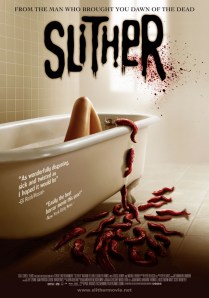 Director: James Gunn
Writer: James Gunn
Cast: Nathan Fillion, Elizabeth Banks, Michael Rooker, Don Thompson, Gregg Henry, Tania Saulnier, Haig Sutherland, Jennifer Copping, Brenda James, Jenna Fisher, Lloyd Kaufman
Plot: Thesmall town of Wheelsy, South Carolina is in danger. A meteor has fallen to Earth. Local car dealer Grant Grant (Michael Rooker)’s relationship with his wife Starla (Elizabeth Banks) hasn’t been great lately, and he’s in the woods with a woman he picked up in a bar (Brenda James, as Brenda) when they come upon the meteor. A parasite infests Grant’s body, and the next day, he begins stocking up on meat. Starla returns home to find a lock on the basement. Grant is changing – odd sores appearing on his body, and intense discomfort in his abdomen. A pair of fleshy tendrils sprout from his chest and almost reach for Starla, but he makes up an excuse about leaving something at work and flees. He goes to Brenda’s home and abducts her.
Starla, meanwhile, reconnects with Sheriff Bill Pardy (Nathan Fillion), a childhood sweetheart who never stopped carrying a torch for her. At home she finds Grant covered in bumps and sores. He claims it’s just a bee sting and the doctor has already treated him. She calls the doctor the next day, though, and he denies having seen Grant. Grant, meanwhile, has chained Brenda in a barn in the woods, and is bringing her huge bags of meat. Her stomach has become grotesquely distended, and she is ravenous. Bill and his deputy Wally (Don Thompson) pay Starla a visit. Brenda has been reported missing, and the neighbors saw Grant enter her house. Scared, Starla breaks the lock off the basement door to find a grotesque, flyblown nest full of animal corpses. Grant attacks her, but Bill and the cops return just in time to see his mutated form as he runs away.
Three days later Mayor Jack MacReady (Gregg Henry) is up in arms. Although he doesn’t believe reports that Grant has turned into a monster, he does believe he’s behind Brenda’s kidnapping and the rash of animal slayings that has sent the town into a frenzy. Bill rounds up a posse to stake out the next farm in Grant’s attack pattern, and Starla asks to come with him. Grant has mutated further, turning into a horrible, fleshy mass covered with tentacles, and the horrified police watch as he slays and consumes one of the farmer’s cows. Starla tries to reason with him, but when a deputy tries to play hardball, Grant kills the man and flees into the woods. They track him to the barn and find Brenda, now transformed into an enormous, pulsating blob. She explodes into a torrent of sluglike creatures that attack the cops, slithering into their mouths. Billy, Starla and a few others escape by covering their mouths until the slugs are gone, but most of the cops are down – alive, but comatose. The slugs converge on the farmhouse, where one attacks the farmer’s daughter Kylie (Tania Saulnier). Although it makes it into her mouth, she digs her fingernails in and yanks it out – but not before she has visions of its horrific alien homeworld. When she stumbles from the bathroom, she finds her parents and sisters have been taken by the hundreds of slugs overwhelming the house. She locks herself in her father’s truck as the slugs swarm over it.
Back at the barn Bill calls for help and tries to get the fallen cops outside. Wally wakes up and begins talking to Starla, saying he’s sorry and that he didn’t tell her because he was afraid she wouldn’t love him anymore. As the rest of the posse stands, it becomes clear Grant’s mind is controlling them all. Starla shoot Wally and rest of the Grant-zombies give chase. Back at the truck, the slugs have slithered away, but Kylie’s blood-soaked family is now trying to get to her. Bill saves her, but a horde of zombiefied people from nearby homes attack. Starla and MacReady run by, pursued by the zombies, and Starla slays another. The four survivors climb into Bill’s car and flee, while the zombies they leave behind cry Starla’s name.
Kylie explains what she saw when the slug attacked her – a creature that moves from planet to planet, consuming everything and turning what it doesn’t eat into part of its hive-mind. Bill calls his dispatch officer Shelby (Jenna Fischer) and tells her to call the CDC, but the slugs burst into the office before she has a chance. Instead, Shelby sends a zombie in a van to collide with Bill’s car. A horde of the zombies kidnap Starla. Bill and Kylie hide while one of the zombies gets MacReady. The zombies bring Starla and MacReady back to Grant’s house, and the thing that used to be Grant puts on some romantic music for a night at home with the wife. She approaches him as he continues to absorb the zombies into his own mass. She finds him in a twisted shrine to their marriage, surrounded by pictures of the two of them. She attacks as Bill and Kylie arrive, but Bill misses with his grenade. The creature stabs Bill, but he manages to get a tentacle jammed into a propane tank. Starla grabs Bill’s gun and shoots Grant, igniting the gas. As he dies, everyone taken by the slugs collapses. Bill, Starla and Kylie stumble out into the rising sun, surrounded by the bodies of the zombies, and begin to go down the road, planning to walk to the hospital in the next town.
Thoughts: If Eight Legged Freaks was a love letter to 50s-era giant animal monster movies, Slither is a tribute to that time period’s other great fear: alien zombies. Of course, the zombies of that time aren’t zombies as we know them today (that was largely a creation of George Romero in 1968’s Night of the Living Dead – virtually all zombie movies since have taken their cues from Romero). At the time, pretty much anything that turned ordinary people into mindless beasts or, even better, part of an alien hive-mind, could qualify. Slither fits in well with that brand of horror film.
It’s most certainly a Type-A horror/comedy, though. In terms of sheer gore, this movie far outstrips anything we’ve yet watched in this project. James Gunn (writer of the Scooby Doo films and the Dawn of the Dead remake, here making his directorial debut) is a product of Troma Studios, and it shows with horrific monster designs, highly realistic animals, and garbage bags full of blood and offal. Gunn pays his dividends to his alma mater in this movie. Not only is the story like something ripped right from a Troma film (albeit with a less campy tone and much better production values), but he works in a cameo by Lloyd Kaufman as a town drunk and even throws in a clip from The Toxic Avenger on Brenda’s TV screen. That’s only the obvious stuff, though. Less obvious, but still undeniably Tromantic, are some of the monster scenes. When Grant infects Brenda, for instance, the scene is surprisingly brutal, but shot in many ways like a sex scene, right down to the rhythmic gyrations one would expect at such a moment. It’s the sort of thing that’s either wildly funny or horribly disturbing depending on how you want to look at it. The part where Bill grapples with a zombie deer? Well, that’s just funny any way you cut it.
The true expression of how warped Gunn’s sensibilities are (and I mean this as a compliment) is the finale. Grant – now a truly hideous creature – has Starla trapped in the house while dozens of zombies walk around calling her name and pounding on the walls, all to the dulcet tones of Air Supply’s “Every Woman in the World.” The disconnect between the music and what we’re watching on the screen is jolting, funny, and terrifying all at the same time. There’s a bit of genius there too – when Starla begins talking to Grant about how long he’s been alone, it takes you just a moment to realize she’s not really talking to him, she’s talking to the alien. It’s really well-scripted and well-acted, and all the blood and gore is just a bonus.
Grant Grant actually manages to transcend his stereotype a bit. He’s the big lummox, the sort of guy you expect to turn into the threat in these situations, but it’s worth noting that before the alien takes over his body he actually turns down the chance to cheat on his wife. That’s not something most characters of his type would do. Even after the parasite takes him, we see him try to resist. There’s real pain in his eyes when Starla looks at him covered in the bumps and sores, when he realizes she’s starting to see the monster inside him. He even protects Starla when the monster wants to go after her in the shower, and although he quickly finds an alternate victim, it’s hard to argue that his love for his wife isn’t genuine.
If anyone fits into the dumb beefcake archetype, it’s Mayor MacReady (a nice nod to another of Gunn’s obvious influences, John Carpenter’s The Thing). He’s rude, crass, and uses his obnoxious personality to cover a streak of cowardice. When Bill shoots him in the head after his transformation, it’s the sort of horror movie kill that makes the audience cheer with approval. He does, however, get some of the film’s best lines – lots of tasteless jokes and panicked exclamations (he’s never seen anything like this, and he watches Animal Planet all the time).
Fans of Firefly have long known Nathan Fillion has leading man quality, and this film helps get that across. He’s got a heroic, self-sacrificing nature, not quite as bold or bombastic as the characters he usually plays. When he drops a one-liner (and he does, frequently), it’s more likely to be dry and a little self-deprecating than any kind of braggadocio. The scene in the car, when he nervously tries to explain to Starla how he’s responsible for stopping up his mother’s toilet and then gets into an argument with MacReady over the definition of “Martian,” is one of the best bits of writing I’ve seen in one of these movies.
Besides MacReady’s name, Gunn continues the now well-worn tradition of peppering the film with references to other horror stories. The scene where the slug attacks Kylie in the bathtub is very reminiscent of Freddy Krueger’s attack on Nancy in the first Friday the 13th for instance, with other scenes calling to mind great bits from Night of the Living Dead, Return of the Living Dead, and dozens of other films. Even Kylie’s little sisters are caught reading R.L. Stine’s Goosebumps books before they turn into monsters themselves.
Like Eight Legged Freaks, the downfall of this movie comes in the CGI. Four years later than the other film, the technology has improved. Individual slugs actually look fairly convincing. But when you see an entire swarm of the slugs, the visuals start to break down. The worst bit is actually the first time you’re sure you’re looking at computer effects, when Brenda explodes and the slugs rush out in a wave. It looks very much like a 90s video game at that point. Although the rest of the movie looks better, that one moment tends to taint your perception.
Both Gunn and Fillion have gone on to bigger projects in years past, with it recently announced that Gunn would helm Marvel Studios’ upcoming Guardians of the Galaxy movie. Although we probably can’t expect the level of guts and gore he gave us in Slither, this movie really shows without a doubt that he’s got a powerful, unique visual style and a good eye for creatures and practical effects. If he can polish off the CGI, that movie is going to look fantastic. Hopefully though, he won’t stay in that relatively safe realm of sci-fi for too long, because this movie proves very neatly he’s got great chops for horror.
Mutants, Monsters, and Madmen Day 28: The Thing (1982)
 Director: John Carpenter
Writer: Bill Lancaster, based on the story “Who Goes There?” by John W. Campbell
Cast: Kurt Russell, Donald Moffat, Wilfred Brimley, T.K. Carter, David Clennon, Keith David, Richard Dysart, Charles Hallahan, Joel Polis
Plot: An American antarctic research station is rocked when a Malamute dog rushes onto the base being pursued by a Norwegian helicopter, whose pilot is throwing explosives at the dog. The helicopter lands, but one of the two men on board fumbles with an explosive, blowing up himself and the helicopter. The remaining Norwegian opens fire on the dog, injuring one of the Americans, and is finally brought down with a bullet to the head fired by the base commander, Garry (Donald Moffat). Base pilot R.J. MacReady (Kurt Russell) and doctor Dr. Copper (Richard Dysart) decide to take their own helicopter to the Norwegian base to investigate what happened, while the rest of the Americans adopt the abandoned Malamute. Arriving at the Norwegian base, they find it devastated – burned, holes blown in the sides, an axe embedded in the wall and more. They also find a strange organism frozen in ice and another strange, semi-humanoid body burned to a husk. They bring the burned body back to their own base so Dr. Blair (Wilfred Brimley) can perform an autopsy, but all it shows is that its internal organs appear to be normal. As the Malamute begins to get underfoot, Clark (Richard Masur) puts it in with the other dogs. The Malamute suddenly transforms, its body splitting open and strange appendages attacking the other dogs. As Clark comes to investigate the barking, the dogs flee, and he sees the tendrils of the Thing. Seeing the creature, MacReady hits the base’s fire alarm and tells somebody to come with a flamethrower. He tries shooting the beast as it assimilates the other dogs, but part of it ultimately escapes by breaking into the ceiling. The flamethrower arrives and Childs (Keith David) burns what’s left of the monster.
Blair examines the body and declares it’s some sort of creature with the ability to absorb and imitate other life forms… and what’s worse, the Malamute was free to roam the base for a full night before it was kenneled. A film retrieved from the Norwegian camp shows a spot where they blasted a hole in the ice, and MacReady takes off to investigate. In the hole the Norwegians blasted, they find what appears to be an alien spacecraft, which could have been buried for over 100,000 years. Blair runs some computer projections on the creature’s reproduction rate and, calculating that it could take over the entire world in three years if it reaches civilization, kills the remaining dogs and sabotages the base radio and helicopter. The creature assimilates its first human, and the rest of the crew kills him, rounds up all the bodies, and torches them. While they try to clean up, they find Blair with a gun and an axe, holding off the rest of the crew. Once he runs out of bullets, they manage to overpower and sequester him, but he warns MacReady – watch Clark. Copper proposes testing each person’s blood to prove if they’re really human, but finds that the Thing (whoever It is) has destroyed the supply of untainted blood needed for the test. The men begin hurling accusations at each other, each suspecting the others of being the Monster in disguise. MacReady logically argues that they can’t all the disguised creature, and sequesters Garry, Clark and Copper, the most likely suspects, while Norris (Charles Hallahan) prepares to test them. With a storm approaching, a fuse is blown, Fuchs (Joel Polis) disappears and MacReady separates the crew into groups to search. They find Fuchs’ body, burnt, in the snow, and Nauls (T.K. Carter) finds some of MacReady’s clothes, shredded. He returns with dynamite and the crew debates his fate. In the middle of the standoff, Norris explodes into a creature, killing Copper. MacReady torches the Thing, but the question of who among them may be infected still hangs in the air. He orders the men to submit to a test, but kills Clark when he tries to attack. MacReady’s test is to draw blood from each person – including the dead – and burn it, having learned from Norris’s Thing that each piece of the creature will react. The test begins to exonerate people, including the dead Clark, but when he tests Palmer (David Clennon)’s blood, Palmer transforms into a Thing. MacReady torches It and blows up the body in the snow. The four remaining men – MacReady, Nauls, Childs and Garry, all test clean, and plan to go test Blair, but his shed is empty. They find a tunnel beneath, where Blair has been trying to reconstruct the alien ship. Realizing they can’t risk the creature surviving or even freezing again, MacReady declares they have to blow up the base, even at the cost of their own lives. After a final explosive confrontation, only MacReady and Childs remain. Sitting by the fire, waiting to freeze to death, they decide to wait… and see what happens.
Thoughts: Although a great number of the movies on my list have been remade at some point or another, this is the only time I’m going to discuss the remake of a movie in lieu of its original. John Carpenter’s film is far more faithful to John W. Campbell’s original novella “Who Goes There?” than the less-remembered 1951 Christian Nyby movie The Thing From Another World (which, you may remember, was the movie the kids were watching in Carpenter’s previous entry on this list, Halloween). I picked the remake for several reasons: it’s a better movie, first of all. It’s far more memorable than the original. And pretty much every cultural reference made to this story today is based not on the 1951 film, but on this 1982 outing. Simply put, people remember Carpenter’s film. They don’t really remember Nyby’s. Carpenter himself hasn’t turned out many impressive films in the last few years, but this and Halloween give him two very well-deserved spots on this list.
This is different from a typical horror movie in several ways, beginning with the setting. The Antarctic location is different enough in its own right (let’s not forget many of the films we’ve looked at lately have been set in the woods or suburbia), and the constant snow makes it look very different than any other film, even the similarly snowbound The Shining.
This is another one of the few entries in this experiment that crosses the line between science fiction and horror, but this is even easier to place in the horror camp than Alien was. Whereas that film is sci-fi through and through, its only the extraterrestrial nature of the monster that puts this movie in the science fiction category. Had it been supernatural instead – a change that could have theoretically been made without substantially altering the plot – the movie would be a pure horror romp. As it is, it fits in the horror category without any trouble.
Like the best horror, John Carpenter uses fear itself as the core of the movie. The fear actually doesn’t come from the unknown this time, though, but from the perversion of what is known. Before anybody realizes the true nature of the monster that threatens them, it’s already begun to infect the population of the camp. Suddenly any living creature – any of the dogs, any of your fellow researchers – may in fact be a monster in disguise (and this time in a far more literal sense than old Norman Bates was). That fear that something you know and trust can be perverted and turn on you is chilling under any circumstances… and even more so in a setting like this one, an Antarctic base where there’s no way to contact the outside world and no hope of rescue.
Of course, let’s not discount the effectiveness of a great makeup and puppeteering department either. The first inkling that we’re dealing with something inhuman is the corpse at the Norwegian base – a horrible thing that looks like two separate human bodies were somehow melting together. When we see the dog-creature actually alive, actually moving, it gets far worse. Sometimes, hiding the beast works better. In this movie, where the monster can perfectly imitate any lifeform, there’s not really a “true form” to reveal, so showing it in mid-transformation gives us a jolt of horror that carries us through when we start to wonder what – or who – has been subject to that very process. The Thing that bursts out of Norris is especially grotesque and powerful – it’s an ugly beast that has a very realistic way of moving (considering that its primary means of locomotion is an absurdly long tongue, anyway). But nothing is as mind-bendingly horrible as the creature’s final form, where it attacks MacReady as a sort of horrible biomass in which we can see the trace elements of the different people and beasts it assimilated over the course of the movie. These are the kinds of effects that you know – you know – most filmmakers today would try to create with CGI, and which wouldn’t be one iota as effective.
The new version of The Thing, released just a couple of weeks ago, I find somewhat odd. It’s not a remake of the remake, but supposedly a prequel that shows what happened at the Norwegian base, using all of the visuals Carpenter created in this movie as its blueprint. It’s not a bad idea, and I’d certainly rather see that than watch them try to remake this one, but why call it The Thing again? That’s just going to lead to confusion, my friends. This is why subtitles were invented. On the plus side, from my understanding the creators of the new movie are insistent on using practical effects – makeup and puppets – instead of relying on CGI, and for that at least, they’ve earned my respect. And quite possibly the price of my admission ticket.
Brr. I think we need to warm up tomorrow, don’t you? We’re going to leave behind the frozen waste of Antarctica for the warmth of hearth and home and a scorching boiler room… in a nice, quiet community where dreams are growing disturbed. We’re going to have a bit of a Nightmare on Elm Street.
Mutants, Monsters, and Madmen Day 23: Alien (1979)
 Director: Ridley Scott
Writer: Dan O’Bannon, Ronald Shusett
Cast: Sigourney Weaver, Tom Skerritt, Veronica Cartwright, Harry Dean Stanton, John Hurt, Ian Holm, Yaphet Kotto
Plot: In the far future, the mining ship Nostromo is making a run to Earth, hauling a refinery and 20 million tons of ore for a Corporation. The ship’s computer awakens the crew from its cryogenic sleep, and they expect they’re approaching hope. Captain Dallas (Tom Skeritt) informs the crew they’re only halfway to Earth, but the ship has intercepted a strange transmission that may be of intelligent origin. The ship is damaged upon landing on the planetoid, and Dallas, Kane (John Hurt) and Lambert (Veronica Cartwright) go off to search for the source of the transmission while Ripley (Sigourney Weaver), Ash (Ian Holm), and engineers Brett (Harry Dean Stanton) and Parker (Yaphet Kotto) remain behind to monitor them and make repairs to the ship. Kane’s team discovers an alien ship in ruins. The body of the creature inside the alien craft is enormous, and was apparently destroyed from the inside-out. Kane discovers an alien egg, which bursts open, allowing a tiny creature to affix itself to his face. Dallas and Lambert return him to the ship, but Ripley initially refuses to allow him to enter the ship, citing quarantine regulations. Ash defies her and allows them inside, where he tries to examine the creature. Dallas and Ash try to cut the creature off, only to discover it has acidic blood. The creature dies and Kane wakes up, seemingly in good health. As the crew sits down to dinner, though, he begins going through horrible convulsions. He falls over on the table and his chest explodes, setting free a tiny creature that escapes into the ship.
Hunting for the beast, Brett and Dallas are killed in short order. Ripley investigates the ship’s computer, only to discover that Ash is acting under special orders of the Corporation that sent them into space in the first place. They were deliberately sent to the derelict to find an alien organism and return it for study, and the crew is considered expendable. Ash attacks Ripley, displaying extraordinary strength and leaking a strange white fluid when wounded instead of blood – he is an android. Parker and Lambert save Ripley and destroy the mechanical man. Parker and Lambert go off to retrieve coolant while Ripley preps the escape shuttle, planning to blow up the ship. The alien kills Parker and Lambert and Ripley rushes to activate the ship’s self-destruct mechanism herself. She manages to fight her way to the shuttle and escape the Nostromo before it is destroyed, unaware the alien has boarded the escape craft with her. She comes across the creature sleeping, puts on an atmosphere suit and opens the hatch, blasting the creature into space. As the film ends she records a message to anyone who finds the ship and climbs into suspended animation, hoping she is found sooner rather than later.
Thoughts: I’ve largely avoided science fiction movies in this list, mainly because I hope this “story structure” experiment will be something I can do again and again, and science fiction most certainly deserves its own category (if not several). However, out of all the movies that straddle the fence between science fiction and horror, there are a few that keep to the horror side so firmly that to not include them in this project would be a disgrace. Hence, Ridley Scott’s Alien.
In essence, Alien is a haunted house movie in outer space. It meets the tropes of that genre very nicely – you’ve got a small cast in a confined area from which they cannot easily escape or summon outside help. (How many good Haunted House movies take place in a remote location, during a power outage, or in some sort of horrible weather? There’s always a reason the people trapped in the house can’t just leave, otherwise they look like idiots.) As they run around the “house” (or in this case, spaceship) they make their way through enormous labyrinthine hallways, find evidence of a creature that is beyond human that appears with greater, more violent, and more alarming frequency, and are picked off a few at a time until a single or small group of survivors finally manages to escape. You see parts of the monster, or shadows of its inhuman shape, long before you see the creature in all its glory, building the tension and the fear as you go along. This is why Alien had to go in this list – not only does it fit every Haunted House trope other than the ghost itself, but it does so brilliantly.
Aside from Ridley Scott getting great performances from his actors, much of the credit for this film’s success has to go to creature creator H.R. Giger. Giger’s artwork helped inspire screenwriter Dan O’Bannon, and thus he really was the logical choice to design not only the alien creature itself, but also the environments found on the alien spacecraft. There are scenes, admittedly, where you can tell you’re looking at a matte painting, but it’s an H.R. Giger matte painting, and that automatically makes it 99 percent more awesome than any other matte painting you’ve ever seen, including the one you helped color on your 11th grade production of Oklahoma.
Even certain things that could have looked terrible under other circumstances really work in this film. When Dallas is attacked in the air vent, the beast thrusts its arms at him. If you do a freeze-frame on the image, it’s kind of goofy… the creature throws out jazz hands like it wants to give Tom Skeritt a big, motherly hug. When you only get a glimpse of it, though, it’s scary as hell. And like all good scary movies, you get caught up in it enough that you forget some of the logical holes, like why the ship’s self-destruct mechanism is so damn far away from the escape shuttle. (Seriously, The Corporation? Talk about a design flaw.) Or the fact that we can hear the big ol’ Nostromo explosion in the vacuum of outer space, which is impossible… and this from the film that uses that little nugget of science in its own tagline: “In space, no one can hear you scream.”
The English teacher in me also has to give O’Bannon credit for abandoning the film’s original title, Star Beast. This was 1979, both Star Wars and Star Trek were heavily on the public consciousness and going with the “Star” title probably would have made the film successful. But Alien is just flat-out a superior title. It works both as a noun – describing the creature that hunts the crew of the Nostromo – and as an adjective, describing the fact that the thing they’ve found is utterly unlike anything we’ve ever seen in the universe. It’s a nice bit of wordplay that I think helps the movie just a tad.
When the time came, inevitably, to make a sequel to this film, the filmmakers realized it would be nearly impossible to replicate the terror of the original. After all, much of what makes Alien so scary is the fact that you don’t really see the adult creature in full until the near end of the film, allowing the deadly power of the human imagination to do its work. By the time Aliens went into production, the creature was already pretty much public knowledge, so James Cameron took the film in another direction: instead of making an awesome sci-fi/horror movie, Aliens was an awesome sci-fi/action movie. This, of course, was followed by Alien3, a film that was a hybrid of science fiction and “a movie so poorly conceived and directed I got disgusted with the whole franchise and, to this day, haven’t seen the fourth one.” There are also, of course, the two Alien Vs. Predator movies, of which there isn’t much to say. I am looking forward to Ridley Scott’s upcoming film Prometheus, though, which is apparently going to be connected to Alien, although how tightly or in what way is something he’s still playing very close to the vest.
Tomorrow we return to Earth, Stephen King, and the more traditional haunted house idea with Stanley Kubrick’s The Shining.
Mutants, Monsters, and Madmen Day 9: The Fly (1958)
 Director: Kurt Neumann
Writer: James Clavell, based on the short story by George Langelaan
Cast: Vincent Price, David Hedison, Patricia Owens, Charles Hebert, Herbert Marshall
Plot: A scientist (David Hedison) is found dead, his head and arm crushed into an unrecognizable mess. His wife (Patricia Owens) confesses to the crime, but refuses to provide details, although she seems obsessed with finding a strange white-headed fly. As the investigation begins they find she actually crushed him in a hydraulic press twice… something the victim’s brother (Vincent Price) cannot fathom, as they had a loving marriage. Owens begins to come unraveled, going berserk when a nurse crushes a fly on the wall. Finally, Price coaxes the truth from her: his brother was destroyed by his own invention – a disintegrator-integrator – which horribly mingled his body with that of a housefly, turning him from man to beast. As they attempted to find the fly that now had his arm and head, his mind became more and more frayed, until he finally begged her to kill him. Price keeps the story to himself, allowing the court to believe her insane, and sparing her from a murder charge.
Thoughts: I wish I could have found other films between the last one (1942’s Cat People) and this 1958 classic, but as I tried compiling my list, I was stunned at the utter dearth of memorable horror films from the late 1940s and early 1950s. This isn’t to say there weren’t scary movies, but that doesn’t necessarily make them the right choice for my little project here. It actually gets back to what I said about horror at the very beginning – horror is subjective. Each person, and in a larger sense, each culture determines for itself what it considers terrifying, and in the late 40s and 50s the fears of the American public weren’t running along the lines of vampires and witches and monsters. In the wake of the atom bomb, we were afraid of science gone wrong. With the rise of the Soviet Union, we feared the threat of international communism. The result is that the best, most iconic scary movies of this era don’t necessarily fall into the category of horror, but belong more appropriately on the science fiction list (which I hope to use for this same sort of project in the future). The truly disquieting films of the time were things like The Day the Earth Stood Still (1951) and Invasion of the Body Snatchers (1956) – both excellent films worth discussing, but I feel like they belong more in the realm of sci-fi than true horror.
So that brings us to 1958 and The Fly, which still straddles the line between science fiction and horror, but falls with enough of its bulk on this side of the line to make it on the list. While not exactly built on hard science, the movie attempts more of a feeling of realism than most other sci-fi shockers of the area, which often dealt with the likes of insects and other animals mutating into giant beasts thanks to radiation exposure, eventually leading to their death by missile and their ridicule at the hands of a guy in a satellite and his two little robot pals. In The Fly, director Kurt Neumann does make an effort to help the science seem plausible, at least to an audience without deep understanding of such things. (At one point, while trying to guess the nature of his brother’s experiment, Price even suggests a flatscreen television.)
Vincent Price, of course, gets top billing for this movie, but for my money that really should have belonged to Patricia Owens as Helene. Price is in the framing sequence – the 30-minute buildup to the flashback and the 10-minute denouement at the end – but Owens really carries the film. We see her at the beginning as the shellshocked, borderline deranged woman who has just witnessed her husband’s death, then go to the backstory where she’s a kind, devoted wife. She’s really magnificent in the part, going from the heights of joy for her husband’s success to a slow spiral into despair when his experiment falls apart. Finally, at the end we get pain and resignation from her. Genre pictures are rarely recognized for the performances of their actors when award season rolls around, but I would put Owens’s performance in this film right up there with any great actress of the era.
The film follows a fairly standard format for horror films of the era, where the truly terrifying stuff happens largely off-screen. This is to the good, because when the blanket comes off David Hedison and we finally see his transformation… well… just as Owens is as fine an actress as any of the day, his creature costume is as goofy as any of the day. It’s a silly-looking monster helmet with a some device to make the pincers twitch a little bit. I find the final scene far more chilling – Price and the inspector (Herbert Marshall) manage to track down the white-headed fly to a spider’s web where it’s been captured and about to be consumed. The effect of a tiny little David Hedison caught in the spider’s web, superimposed against film of a real spider, is impressive by 1958 standards, and the effect of his miniscule voice pleading for help as the predator advances upon him is creepy even today. It’s probably the most memorable scene of terror from the film, far more so than the human-size fly.
The film plays upon the fear of unchecked science, questions of insanity, and a good dose of body horror (which, no doubt, is why David Cronenberg was the man tapped for the 1986 remake). All of these elements add up to one of the best films of the era.
From the end of the age of monsters, we’re about to step into the world of more psychological terror. Next on my list is the film many consider the first slasher movie, the 1960 film Peeping Tom.
 Reel to Reel