Category Archives: Fantasy
Dorothy Gale Week Day 3: Liza Minnelli in Journey Back to Oz (1974)
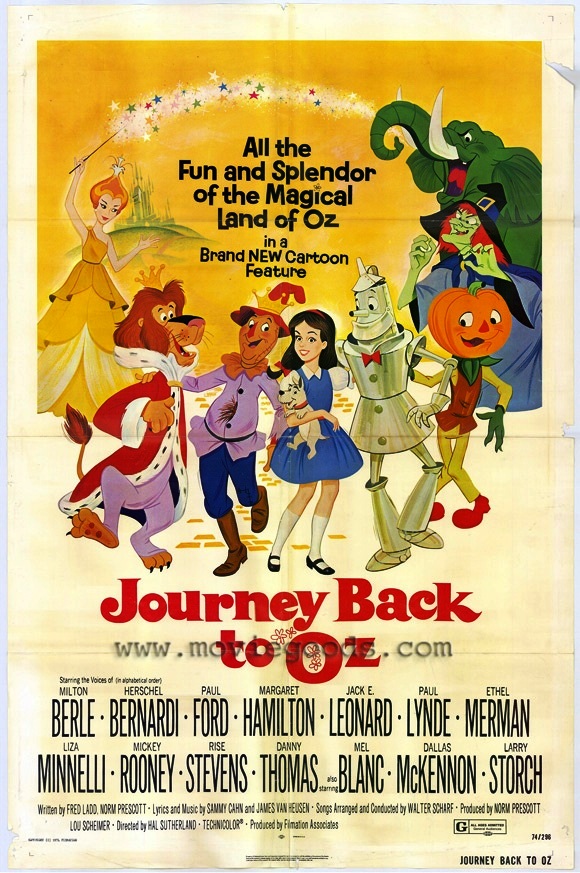 Director: Hal Sutherland
Writer: Fred Land & Norman Prescott
Cast: Liza Minnelli, Milton Berle, Margaret Hamilton, Paul Ford, Paul Lynde, Ethel Merman, Mickey Rooney, Danny Thomas, Mel Blanc, Dal McKennon, Larry Storch, Risë Stevens, Jack E. Leonard, Herschel Bernardi
Plot: In this animated kind-of sequel to the 1939 MGM film, a storm is brewing in Kansas again, and Henry (Paul Ford) is getting worried. His niece Dorothy (Liza Minnelli) feels a-tingle, remembering how a similar storm once swept her away to the land of Oz, but her Aunt Em (Margaret Hamilton) swears to her that Oz is simply a figment of her imagination. As she sings to Toto about wishing to return, a cyclone snaps the two of them up and pulls them into the air. When Dorothy comes to her senses, she realizes she’s landed by the Yellow Brick Road in Oz, and rushes off to find her old friends in the Emerald City. Setting off, Dorothy encounters a creature with a pumpkin for a head (Paul Lynde). Pumpkinhead is fleeing from an evil witch named Mombi (Ethel Merman), who created him to help her conjure some powerful, terrible work of magic. Dorothy tells Pumpkinhead to come with her to the Emerald City, where her friend the Scarecrow will help him.
Dorothy finds Mombi’s hut, where a crow (Mel Blanc) invites her to peek at the cauldron simmering on the fire. Mombi traps her and reveals her brew will create an army of green elephants to conquer Oz and destroy the Scarecrow. When Mombi leaves to get firewood, Pumpkinhead sneaks in and rescues Dorothy. As they escape, they encounter a carousel horse called Woodenhead (Herschel Bernardi), stuck upside-down in the ground. They free him and he joins their party.
Arriving at the Emerald City, they warn the Scarecrow (Mickey Rooney about Mombi’s attack just as the Witch and her Green Elephants arrive. Dorothy and her friends climb on Woodenhead’s back, but Toto and the Scarecrow are captured in the escape. Dorothy, Pumpkinhead and Woodenhead set out for Tinland, to enlist the aid of her old friend the Tin Man (Danny Thomas). At first he’s eager to help, but loses heart when told of the army of elephants. The Cowardly Lion (Milton Berle) initially puts on a show of bravado, but quickly reverts back to quaking when told of the elephants. Glinda, the Good Witch (Risë Stevens) who has been watching the proceedings with her… “Glinda-Bird”… arrives to offer her aid, and gives Dorothy a package which she warns her not to open until she arrives at the Emerald City.
Mombi sends a group of enchanted trees after the friends, but Glinda – watching through the Glinda-Bird – gives Pumpkinhead a magic axe that turns them into… well… hippies. Saved, they return to an Emerald City that has rapidly fallen into decay. They are attacked by an elephant, but Dorothy opens Glinda’s box and a swarm of magic mice pop out and chase it away, freeing them to assault the palace. The mice make it to Mombi’s chambers and chase her the gardens, where she disguises herself as a rose bush. The mice have sent the elephants on a stampede, though, and she is trampled flat. Toto, recognizing Mombi’s true form, leads Dorothy to the flattened rose, who blames Dorothy for her fate just as she dies. As she withers, the elephants fade and the Emerald City is restored to its former glory. The celebration is short-lived, though, as Pumpkinhead has fallen along with the rest of Mombi’s creations. Glinda tells Dorothy her magic cannot restore him, and Dorothy weeps for her fallen friend. As she cries, her tears touch Pumpkinhead’s face, and the magic of her love restores him to life. The Scarecrow awards his friends, making Woodenhead his own royal steed and knighting Pumpkinhead, then offers Dorothy anything she desires. She asks, as always, simply to return home. The Scarecrow find a loophole in the Oz Constitution that will only allow Dorothy to return home the way she came, and Glinda creates a cyclone to carry her back.
Thoughts: In the 1970s theatrical animation could be divided pretty squarely into two categories: Disney, and everything else. This Filmation effort falls into the latter category: limited animation, competent but unimpressive voice acting and weak music. The idea of doing an Oz sequel was all well and good, but Filmation went with stunt casting (Judy Garland’s daughter voicing Dorothy, original Wicked Witch Margaret Hamilton doing a cameo as Aunt Em, plus several celebrities of the time) and an uncredited rewrite of Baum’s second Oz book, The Marvelous Land of Oz. This movie plucks some of the characters from that book – Mombi and Pumpkinhead – turns the Sawhorse into a Merry-Go-Round horse, then turns the plot into something that’s trying hard to be The Wizard of Oz all over again. Instead of that other story, in which a young boy named Tip and his friends wind up stumbling on a plot to conquer Oz by an army of angry women, this movie has Dorothy once again marching to the Emerald City, once again picking up unusual friends along the way, once again being plagued by a Wicked Witch out for revenge. It’s incomprehensible to me why, with 14 Oz books to choose from by Baum alone, filmmakers never seem to look past the first three for inspiration, and often try to shoehorn elements from the latter two into the mold of the first one all over again. It’s equally baffling why they would create new elements when the originals (such as General Jinjur’s all-girl army, which the elephants are standing in for) work so much better. And for Heaven’s sake, why elephants? Okay, they’re big, they’re powerful, but the way the Tin Man and Cowardly Lion react to them you’d think elephants are their natural predators or something. Even mammoths might make sense, but the Tin Man going into a panic over green elephants simply doesn’t make any sense.
The performances, as I said, are merely adequate. Liza Minnelli is clearly cast simply for the gimmick of having her take up her mother’s role, as she brings nothing to the part. She’s not terrible, but there are most certainly more talented voice performers who could have done more, granted the character the sweetness and innocence she demands. As it is, the only thing that really can be said about Dorothy in this film is that she “kinda sounds a little like Judy Garland.” The animation is weak as well – Filmation does a far better job with the non-human characters than Dorothy. She’s surrounded by characters like the Tin Man and Pumpkinhead, which at least look amusing, but Dorothy herself is a stiff, unemotive creature that only really has one expression. This isn’t one of those times where I’m willing to chalk it up to the limited resources of the time, either. If Disney could make magical, powerful characters in the 1930s, the only excuse for the poor animation of the 70s is pencil-pushers cutting corners, and that I refuse to forgive.
Some of the other characters are better, at least. Milton Berle as the Cowardly Lion and Mickey Rooney as the Scarecrow fit the parts nicely. Danny Thomas’s Tin Man is less impressive, and Paul Lynde… well, he’s pretty much Paul Lynde talking out of a Jack O’Lantern. Ethel Merman’s Mombi isn’t bad at all, but she’s playing a typical, stereotypical witch, not particularly doing anything innovative. But my biggest problem with them is more along the lines of characterization than animation. The notion that the Tin Man or Lion would ever refuse to help Dorothy is preposterous. Hell, the entire point of the Lion’s story arc in the first book (or movie) is that he will always overcome his fear to help his friends! You mean to tell me you wave a little thing like an army of magic green elephants in his face and the king of beasts will lose his ability to fight? Absolutely not, my friends. I cannot accept this. The scenes with the Tin Man and Lion ultimately have no impact on the plot anyway, they’re included simply so that the recognizable characters could put in an appearance. It would have been just as effective and far less insulting, from a story standpoint, if the movie skipped from the escape from the Emerald City to the point where Glinda pops up. (It would actually be better, in fact, because if Glinda was watching the whole time, why the hell did she wait so long before taking action?)
Speaking of Glinda, here we see one of those oft-used fantasy tropes that usually irritates me: the “don’t open it until the proper time” gimmick. Writers often use this to create some false suspense, but at least they usually make some effort to explain why the giver of the gift won’t say what it is: magic, arbitrary rules of the game, “you wouldn’t have believed me,” something. None of those are brought into play here, though, there was no reason for Glinda to make a secret out of the box’s contents. It’s just there so we can have a brief moment in the forest where Woodenhead suggests opening the box to escape the trees and Dorothy can tell him no, reminding us that she’s a good little girl who does as Glinda tells her.
The songs, like the voice acting, are merely adequate. Each character gets at least one, Dorothy gets several, none of them are particularly memorable. This was par for the course for films of this nature, sadly, and that’s even sadder when you compare it to the incomparable music from the 1939 film.
When I learned of the existence of this movie, I was initially very excited – as I always am when I find out about a version of Oz I haven’t encountered before. Sadly, the whole thing fell very flat for me. It was at least more recognizable than the 1925 Wizard of Oz, but in truth, that’s mostly because it was built on the back of the Judy Garland film. That’s not to say you can’t tell a good Oz story that way – many people have – but this didn’t hold up for me. Still, I can see a lot of similarities to the cartoons I grew up watching, the ones that hold a special place in my heart even today. On the other hand, I can also recognize that a large number of those cartoons I loved as a kid are terribly weak when looked back upon with a discerning eye. I suspect that if I had watched this movie as a child, I’d probably upon it with rose-colored glasses. As it is, I’m just left sliding the disc back into its NetFlix sleeve and feeling a little disappointed for the second time in this week’s experiment.
The first Reel to Reel study, Mutants, Monsters and Madmen, is now available as a $2.99 eBook in the Amazon Kindle store and Smashwords.com bookstore. And you can find links to all of my novels, collections, and short stories, in their assorted print, eBook and audio forms, at the Now Available page!
Dorothy Gale Week Day 2: Judy Garland in The Wizard of Oz (1939)
 Director: Victor Fleming
Writer: Noel Langley, Florence Ryerson, Edgar Allan Woolf, based on the novel by L. Frank Baum
Cast: Judy Garland, Frank Morgan, Ray Bolger, Bert Lahr, Jack Haley, Billie Burke, Margaret Hamilton, Charley Grapewin, Clara Blandick
Plot: On a farm in Kansas, Dorothy Gale (Judy Garland) has to defend her dog, Toto, from the angry reproach of her neighbor, Mrs. Gulch (Margaret Hamilton). Because Toto has bitten Gulch, she’s within her rights to take the dog and have it destroyed. Dorothy and Toto run away, encountering a carnival performer called Professor Marvel (Frank Morgan), who convinces her to return home to her upset Uncle Henry and Aunt Em (Charley Grapewin & Clara Blandwick). When she returns, a tornado has sprung up and her family is hiding in the storm cellar. Dorothy and Toto rush into the farmhouse, which the tornado plucks from the ground and hurls through the air.
Dorothy crashes in a brilliantly colorful land called Oz, where she finds herself the darling of a group of small people called Munchkins. She is met by a good witch named Glinda (Billie Burke), who explains that Dorothy’s house crushed the tyrannical Wicked Witch of the East. Her sister, the Wicked Witch of the West (Hamilton again) arrives for vengeance, but finds she cannot harm Dorothy directly, as Glinda has given her the dead witch’s powerfully magic Ruby Slippers.
Glinda sets Dorothy on a path to the fabled Emerald City, where the Wizard of Oz may be able to help her get home. Along the way she is joined by three others, each who need help from the Wizard: a living Scarecrow (Ray Bolger) was made without a brain, a Tin Woodsman (Jack Haley) who was crafted without a heart, and a Lion (Bert Lahr) who is sadly a coward. The three of them encounter the witch several times, narrowly escaping her traps before finally arriving in the Emerald City. When they go into the Wizard’s chambers, they encounter an enormous floating head that tells them he can grant their wishes, but will only do so if they can bring him the broomstick of the Wicked Witch of the West.
Dorothy and her friends travel to the Witch’s palace, where she is captured by the Witch’s flying monkeys. The other three disguise themselves as guards and rescue her, but encounter the witch upon escape. In desperation, Dorothy hurls a bucket of water at the witch, who immediately melts away, destroyed by her one weakness. Returning to the Emerald City, the Wizard tells them he needs time to think about their requests. As the friends despair, Toto discovers a little man (Morgan again) hiding behind a curtain, operating a machine that projects the image of the head. The Great and Powerful Wizard of Oz, it seems, is a humbug – a simple performer from the United States who accidentally drifted into Oz years ago in a hot air balloon.
Recognizing that the Scarecrow, Tin Woodsman and Lion already possess those very things they most desire, he gives each of them a small token: a diploma to signify the Scarecrow’s wisdom, a testimonial in the shape of a heart for the Tin Woodsman, and a medal to proclaim the courage of the Lion. For Dorothy, though, the only thing he can do is repair his balloon and take her home himself. Before they’re about to leave, though, Toto leaps from the basket. Dorothy rushes after him, and the balloon drifts away with the Wizard alone. Dorothy fears she’ll be trapped in Oz forever, but Glinda appears again and reveals that the Ruby Slippers she wears have the power to transport her: she need only click her heels together three times and recite “There’s no place like home.” When Dorothy does this, the world swims around her and she wakes up back in Kansas, surrounded by her Aunt and Uncle, three farmhands who bear a striking resemblance to her friends in Oz, and Professor Marvel, who has come to check on her. Although they all believe she dreamed her adventure in Oz, Dorothy doesn’t care – she is content to simply be home.
Thoughts: After yesterday’s somewhat disturbing look at a silent Oz, spending time with the MGM classic is just what I needed. This is the movie we all know and love, the apex of the musical fantasy, the film that virtually everybody in the world has seen as a child, hidden from the flying monkeys, sang along with the Munchkins, and then later pretended they didn’t like a few years later while going through a hipster phase. It is, in fact, a masterpiece.
Although the film seemed like it was going to be a disaster for much of the production, with prospective directors and screenwriters playing musical chairs before we finally landed on the people who got the credit, the final result is something that was spectacular to look at in 1939 and is still lovely today. The transition from the sepia tone of Kansas to the brilliant color of Oz is beautiful both artistically and technically. The shift demonstrates a transition from a sad, humdrum world into a place of incredible wonders, and when you consider most people in 1939 would never have seen much color before, it’s easy to see it as a game-changer. The color in this film mattered as a storytelling choice, it sold the idea that color can influence the telling of the tale. This was Al Jolson in The Jazz Singer all over again, looking at the camera and proclaiming “you ain’t seen nothin’ yet.” This (if I may briefly tangent) is why I still don’t care for 3-D movies – no matter how pretty any of them may be, I’ve yet to see a movie become more effective as a story because it is in 3-D, the way this film could never have been filmed in black and white.
Judy Garland has become the gold standard for Dorothy Gale. Not only is the actress most identified with the role, but a vast majority of the artistic representations since then have used her likeness and costume as the basis, even though later Oz books specified her as blonde and depicted her in different clothes than the blue checkered dress. In truth, at 16 when the movie was filmed, Garland was really too old to fit the part as written (at one point, then 10-year-old Shirley Temple was a frontrunner for the role). Yet her youthful charm, innocence, and amazing voice sold her like few actresses have ever sold a part. You cannot use the name Dorothy without summoning up a vision of Judy Garland, and that’s all to the good.
Despite the various cast changes, it’s now virtually impossible to imagine anyone filling in the other principle roles than the actors we had. Ray Bolger flawlessly plays the wise man who doesn’t understand his own worth, Jack Haley has tenderness without seeming weak, and Bert Lahr is a living cartoon, silly and heartwarming all at once. Morgan and Hamilton, similarly, have become the benchmark for their parts as the Wizard and Witch. Hamilton in particular deserves special credit, I think, taking a character who had little personality in the original novel and creating one of the most enduring villains in cinematic history.
The film leaves out certain sequences from the book, and changes too many things for it to really succeed as an adaptation, but the alterations are forgivable in the context of the film MGM was trying to make. Sequences like the China town (brought back by Disney in this year’s Oz the Great and Powerful) would have been difficult to make convincing with the special effects of the time. Other scenes featured Dorothy’s friends getting rather violent in defense of the little girl – could you imagine seeing Ray Bolger standing atop a pile of crows after snapping their necks or Jack Haley swinging his axe to behead a pack of ravenous wolves? The original story left a lot of blood on the page that never made it to the movie screen, and that’s honestly okay.
This is one of those films that’s so well-known, so well-loved, it’s hard to imagine anything I could say that hasn’t been said already. As an Oz fan, I’m still waiting for a truly faithful adaptation of the L. Frank Baum novel, but as a fan of musical cinema, this is one of the greatest movies ever made.
The first Reel to Reel study, Mutants, Monsters and Madmen, is now available as a $2.99 eBook in the Amazon Kindle store and Smashwords.com bookstore. And you can find links to all of my novels, collections, and short stories, in their assorted print, eBook and audio forms, at the Now Available page!
Gut Reactions: Ruby Sparks (2012)
 Directors: Jonathan Dayton & Valerie Faris
Writer: Zoe Kazan
Cast: Paul Dano, Zoe Kazan, Chris Messina, Annette Bening, Antonio Banderas, Aasif Mandvi, Steve Coogan, Toni Trucks, Deborah Ann Woll, Elliott Gould, Alia Shawkat
Plot: After an early success, writer Calvin Weir-Fields (Paul Dano) has been stuck with writer’s block for years and has found failure after failure in his relationships with women. Upon the advice of his therapist (Elliott Gould), he begins writing about a girl he sees in a dream. After a few dreams, the girl, Ruby (Zoe Kazan) appears in his home, miraculously brought to life. The two begin a romance that starts to crack when it becomes apparent that Ruby wants more of a life than the sequestered world Calvin has created for her, and in the end, Calvin finds himself in a struggle between love with the girl of his dream and trying to control that which he made.
Thoughts: Every so often those Netflix recommendations get it right. I’d never heard of this film, but when I read the description I figured I’d give it a try. I had no idea just how deeply it would hit me.
Admittedly, I may have a bit of an occupational bias when it comes to this movie. I may not be quite the success as a writer that Calvin Weir-Fields is (of course, as he reminds us during the film, he’s “no J.D. Salinger”), but I think any person who really pursues creative arts will be able to relate to this movie. The story hits upon a time in Calvin’s life when he’s struggling between crushing creative blockage and unbearable loneliness, something that’s all too real. And in fact, I can’t imagine there’s any writer out there who didn’t – at his weakest point – fantasize about doing exactly what he does in this movie. The idea of creating the perfect person, the perfect companion out of your imagination is tantalizing, powerful, and engaging.
SPOILERS AFTER THIS LINE. ———————————————————————————————-
Of course, this is just a fantasy, and like most fantasies it doesn’t really maintain if you hold it up to the light of reality. We all may have imagined being able to create the perfect girl, but a little critical thinking will reveal a thousand reasons this would be a bad idea. Zoe Kazan (who both played Ruby and wrote the screenplay) takes this idea and dissects it beautifully. Early on Calvin’s brother Harry (Chris Messina) points out the difference between this perfect, idealized girl and the realities of a functional adult relationship. When Ruby turns out to be more real and less idealized than Calvin thought, he begins to use his writing to manipulate her, which again backfires. His first effort makes her frighteningly clingy and needy, the next turns her into a bounding child. Even attempting to erase his mistakes bounces back on him, as he instead leaves her an emotional wreck.
The climax of the movie, I admit, is somewhat painful to watch. Frustrated and angry, Calvin reveals the truth of Ruby’s existence to her and “writes” her into performing a series of degrading, humiliating tasks (barking like a dog, for instance) to demonstrate his power over her. I cringed at each moment, watching him take someone he loved and turn her into a puppet. Each time he finished a sentence I found myself asking how he could do it, how he could possibly treat someone he loved in such a fashion, how anyone could be so frustrated that he’d do something that so utterly stains his own soul? Like the most painful things we see, though, it’s at its most horrible when we question what we would do in that same predicament. I don’t think I’d have it in me to do what Calvin does at the end, but it’s very easy to say that, knowing I’ll never have to face such a situation. In the heat of the moment, who can say what any of us are truly capable of? And if we ever did cross that line, would we ever be deserving of forgiveness, or capable of forgiving ourselves?
Although billed as a comedy, Ruby Sparks is definitely not cut from the standard romcom cloth that churns out so many practically identical movies a year. It’s not even the same as other “romantic dramadies.” For example, I recently watched Seeking a Friend For the End of the World, another romance from last year that treads the line between comedy and drama, including a dose of speculative fiction for the sake of the plot. In that one, Steve Carrell and Keira Knightley set out to find his lost high school sweetheart amidst the collapse of society that comes after final efforts to prevent an extinction-level asteroid from colliding with Earth fail. (Yes, this too is ostensibly a comedy.) While that movie wasn’t bad, in the end I found it sadly predictable. Ruby Sparks, on the other hand, isn’t predictable at all. Once Kazan deals with some of the more necessary tropes (showing how people react to this mysterious girl who’s appeared in Calvin’s life, a little interaction with his wacky family), the film is left in a sort of free roaming state where it could go absolutely anywhere. I never felt like I knew how the movie was going to end, which is probably the most exciting feeling I can imagine having during a movie. That open-endedness, that powerful, driving uncertainty finally brings us to an ending that’s ultimately sweet and hopeful, and a final line that couldn’t fit any better.
Again, this is a movie that struck me on a very personal level, which makes it difficult to say if I would recommend it to just anybody – I can’t honestly tell you if you would have the same visceral reaction that I did. But I can tell you that it’s well-written, well-acted, very emotional, and different from all the other cookie cutter movie romances in ways that satisfied me greatly.
The first Reel to Reel study, Mutants, Monsters and Madmen, is now available as a $2.99 eBook in the Amazon Kindle store and Smashwords.com bookstore. And you can find links to all of my novels, collections, and short stories, in their assorted print, eBook and audio forms, at the Now Available page!
How The Neverending Story broke my brain
 A few days ago, my brother dropped a major knowledge-bomb on me. Limahl, the singer of the theme song to the 1984 film The Neverending Story, was not a woman, as I’d always believed. Limahl, evidently, is an English pop star, former lead singer of the group Kajagoogoo, and most definitely male. If you, like me, have gone your entire life hearing that song without seeing the music video, I have no doubt it’s as big a shock to you as it was to me.
Regardless, having gotten the movie into my head, I felt the need to watch it again. Although it was a perennial favorite of mind as a child, it had been several years since I actually sat down at watched it, and that’s just not right. So after getting home from work earlier this week, I pulled out the DVD and popped it in. If you’ve never seen the movie, I can only assume you’re in your 70s or older, blind, or have no soul. The short version is that it’s the story of a young boy named Bastian (Barret Oliver) who – having spent the day facing a distant widower father (Gerald McRaney), a mob of school bullies, and a math test – retreats to the school attic to read a book he swiped from a knowing old shopkeeper Thomas Hill). The book, The Neverending Story, focuses on a warrior named Atreyu (Noah Hathaway) who is tasked with finding a cure for a mysterious Nothing that is destroying the world of Fantasia and slowly killing its Childlike Empress (Tami Stronach).
As the story continues (and here the spoilers commence) Bastian finds himself getting pulled deeper and deeper into the book as the nature of the Nothing becomes clear. Fantasia is created from the hopes and fantasies of the human world. As people give up their enchantments, the Nothing is destroying the world of magic, and it will take the power of a human boy to save it. The biggest shock for Bastian is when he realizes the human boy the book is discussing… is him.
The movie came out in 1984, when I was seven years old, but it’s safe to say that virtually everybody who saw it at about my age had the same fantasies afterwards that I did: having that last grain of sand from Fantasia, infused with the power to grant wishes… that brilliant dream of riding Falkor the Luck-Dragon through the sky and exacting swift and just retribution on your enemies (if anyone tries to tell you a seven-year-old has no enemies ask them what it was like to be home schooled)… that sort of escapism is what has driven children’s literature for decades. Everything from Alice in Wonderland to The Wizard of Oz to the Harry Potter series is, in some way about taking a child from the ordinary world and exposing them to a place of wonder and magic. We keep going to that well again and again, because it’s as deep and rich a storytelling pool as exists anywhere.
Even as a kid I recognized that. But going back to watch the movie again today, for the first time in years, I’m realizing just how profoundly it influenced my philosophy as a storyteller as well. (I apologize for the preceding sentence, I tried for five minutes to think of a way to say “my philosophy as a storyteller” that didn’t sound pretentious as hell, but I failed utterly.) The basic concept behind the story is that all human imagination flows into and out of the same place. Sure, they give that place a name, but as I watched the film it struck me that this is exactly the concept that drove me to start this website in the first place. I definitely believe, in a very concrete way, that human imagination is based on this very same idea, that we all contribute to and draw from an ocean of inspiration, and that it’s the different ways we find to employ the ideas we all share that make for true innovation.
Looking back, as an adult, I can tell that the movie isn’t as perfect as I always gave it credit for. It feels somewhat incomplete, like there’s more story to tell. As it turns out, this wasn’t just a sort of meta-commentary on the “Neverending” part of the title. The film only adapts about the first half of the original novel by Michael Ende, and in fact, just about everything we actually see on screen, in the book, is just setup for the real story, about Bastian losing himself in Fantastica (the novel’s name for the magical world) and ultimately having to face the harsh reality of his mother’s death and his father’s emotional abandonment. Some of those ideas eventually made their way into The Neverending Story II: The Next Chapter, but most of them came forth in name only and didn’t have the same emotional impact as the book. On the plus side the movie did have the guy who played the Flash on the 90s TV show, which is something the 1979 German novel can never claim.
What’s great about The Neverending Story though, both the film and the book, is how it is so firmly rooted not in what the imagination can create, but in the idea of imagination itself. There’s something powerful in that, something eternal, and something I hold to rather dearly.
Gut Reactions: Oz the Great and Powerful (2013)
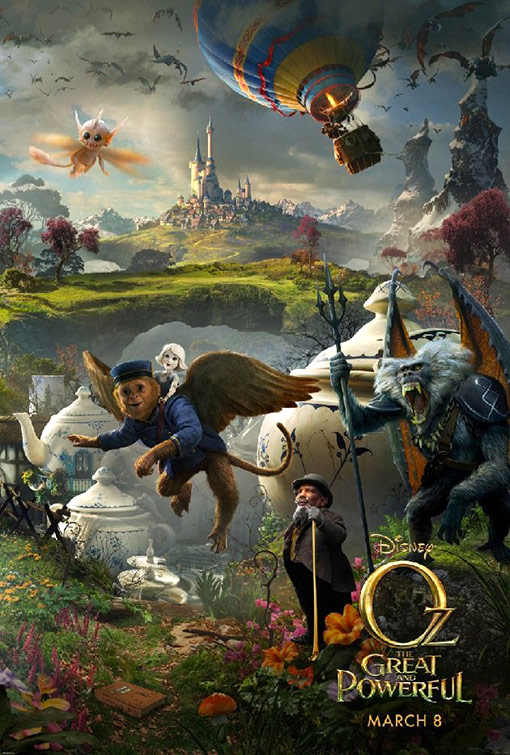 Director: Sam Raimi
Writers: Mitchell Kapner & David Lindsay-Abaire, based on the works of L. Frank Baum
Cast: James Franco, Mila Kunis, Rachel Weisz, Michelle Williams, Zach Braff, Bill Cobbs, Joey King, Tony Cox, Bruce Campbell
Plot: Carnival huckster Oscar Zoroaster Diggs (James Franco) is swept up by a cyclone and hurled away to the mysterious, magical land of Oz. There, he finds himself caught in a power struggle between three witches (Mila Kunis, Rachel Weisz and Michelle Williams) over the realm’s vacant throne. A prophesy claims that a wizard from another land will save Oz from wickedness, but can this humbug of a man find in himself the hero that Oz needs?
Thoughts: Before I really dig into this movie, I think it’s only fair that I (briefly) tell you about my personal history with Oz, so you can understand where my opinion is coming from. Like most people these days, my first exposure to Oz was the 1939 MGM film, which I saw as a child and enjoyed. When I was a bit older, though, at my local public library (visit ‘em kids, they’re awesome) I found an entire shelf of Oz books by the creator, L. Frank Baum. I devoured the books they had (which, as it turned out, weren’t all of them), and since then I’ve been a devoted consumer of any book, movie, or comic book I can find that offers a different vision of the land of Oz. Although I think there is plenty of room in media for many, many different Ozzes (a phenomenon I discussed in more depth on my other blog yesterday), in my heart, my favorite visions of Oz are those that pay due deference to Baum.
And it’s with that perspective that I can say I enjoyed Oz the Great and Powerful immensely. (Don’t worry, I’ll put up a warning before I get into any spoilers for those of you who haven’t seen it.)
The biggest problem with prequels, as George Lucas proved, is that it’s difficult to maintain suspense when the audience already knows where the characters will be when the story ends. This isn’t really a big problem with this film, though. Baum gave precious little backstory on many of his main characters, and almost none on the witches of Oz (although subsequent writers would often turn to this as their inspiration), and that leaves the screenwriters an enormous amount of room to play in. They also create a version of Oz that is mostly consistent with the books, while still giving a few nods to the 1939 film that they know is what most people will use as their measuring stick.
The casting is very good. Zach Braff as Finley the Flying Monkey brings a totally unexpected element of comedy to the film, one that serves to give us a glimpse of light in very dark moments. Each of the witches feels very natural in their respective roles – Mila Kunis’s naïve Theodora and Rachel Weisz’s sly Evanora work very well as the sister witches, and from the beginning present an interesting question to the audience… which of the two will someday become the insidious Wicked Witch of the West, and which one has a date with a house that’s going to fall out of the next tornado?
Michelle Williams is almost perfect as Glinda. While Billie Burke’s portrayal from 1939 is that of a hands-off fairy godmother, the sort who prefers to pulls the strings and not get directly involved, Williams is a much fiercer, braver woman. The display of power she puts forth in this movie is impressive, and certainly more in keeping with the character Baum created. He didn’t go in for the pyrotechnics quite as much as this movie does, mind you, but it’s easy to see Williams’s Glinda capable of maturing into the strong, confidant witch she becomes in the original books.
Then there’s Oz himself, James Franco. Oddly enough, he’s the only one of the main cast that doesn’t always work for me, and it’s for an strange reason. Franco plays Oz as a snake oil salesman, a con man who has a good heart buried somewhere deep inside, and that’s all well and good, that’s how he should come across. But there are moments in the film where it feels like he’s actually overselling the overselling, moments where you’d want Sam Raimi to ask him to dial it back down to 11 from 12 or 13.
As for Raimi’s directing… it’s fantastic. His visual effects team has built a brilliant, remarkable Oz that satisfies me on absolutely every level. Even the 3-D in this film is superior to most others. It’s funny – I’ve long said that I’ve never seen a movie that convinces me that 3-D is a tool that improves storytelling, that there is no movie that does for 3-D what the 1939 The Wizard of Oz did for color… and this film almost does it. Raimi’s transition from Kansas to Oz is a truly remarkable moment, and one that uses 3-D in a very clever way, similar to the way the ’39 film did with color. It’s visually stunning and, for a few scarce moments, I was glad I saw it in 3-D. Then later on he starts throwing monsters and spears straight at the camera and I was over it. Raimi also throws in a few moments of self-reference, which I think are fun as well… there’s one scene that’s almost straight out of his own Army of Darkness, which had my friends and me in hysterics, probably because we’re the only people in the theater that got the joke.
I’ve got other things to say about this movie, including a few problems, but nothing I can discuss without putting up a spoiler wall. So if you’ve read this far and you haven’t seen the movie yet, let me assure you that it has my wholehearted recommendation. It’s a great fantasy film, probably too scary for the little kids, but well worth watching in the movie theater. And I won’t even judge you for choosing the 3-D this time.
SPOILERS AFTER THIS LINE. ———————————————————————————————-
Aside from Franco being a bit over the top, my biggest problem with the story itself is one of timing… not pacing, timing. Once Franco arrives in Oz, it feels like things happen entirely too fast. For one thing, I think it’s clear too early in the film that it is Theodora, not Evanora, who is fated to become the Wicked Witch of the West. In fact, I think it’s clear too early that Evanora is the real villain, and not the “Wicked Witch” the sisters are warning us about. Granted, as soon as we learn the “Wicked Witch” is named Glinda, the audience should know Franco is being conned, but that moment should be played as a reveal and never really gets that chance.
Theodora’s emotional turns are also hurt by the sheer speed of the piece. I’m not entirely sure (after just one viewing) but it seems like no more than three days pass between her meeting Oz and her transformation. In that time she falls madly in love with him, decides she’s going to marry him and become his queen, and then grows to utterly hate him when she sees a glimpse of him talking to Glinda and learns that he “romanced” her sister the same way he did her. (Incidentally, I think the film does a nice turn leaving it a little ambiguous as to whether or not this actually happened. We see Oz work his charms on various women in the movie, but never Evanora, which leads me to suspect he never did. Instead, I got the impression Evanora pulls off the con on her sister because she was spying on the two of them in her globe the whole time.) The sheer speed with which Theodora’s affections turn weakens the character, making her the fantasy equivalent of the internet Overly Attached Girlfriend meme. Even more problematic, she truly becomes wicked not because her heart is broken, but because after her heart is broken she allows her sister to make her evil. It’s still the character making a choice, but I think it’s a weak choice, she doesn’t “earn” her evil, so to speak… not so much a monster as a victim, which will give her death at Dorothy’ s hands a level of forced tragedy I don’t think works.
It seems very clear to me that this movie was made to be the beginning of a franchise, despite its prequel status – and in fact, Disney was already talking about sequel plans the day before the movie was released. I’ve got no problem with this turning into a franchise, but it’s a little too obvious that was the intent… instead of taking us from point A to point Z (“Z” being where The Wizard of Oz begins), this gets us to about… let’s say “J.” The film ends with Oz in power and the witches banished, but there are a lot of things that don’t mesh up. Evanora doesn’t have the Silver Shoes (or, if you insist on going with the MGM version, Ruby Slippers). Theodora isn’t in command of the Flying Monkeys. Both sisters have been driven out and humiliated, where Evanora pretty much has dominion over Munchkinland when the original begins. Probably lots of other little bits I’m forgetting now, but will remember when I (inevitably) see the movie again.
The biggest sequel hooks come in for the Wizard himself, though… specifically, he’s not the recluse we know he’s doomed to become. He and Glinda have a romantic relationship, which simply doesn’t fit the first movie (or any other incarnation, for that matter). This gives the screenwriters a delicate task – they have to do something to alter the relationship in such a way that they are no longer together, that he has retreated into his palace, but where she still has enough faith in him to send Dorothy down the Yellow Brick Road when she drops from the sky. Then there are Finley and the China Girl, Oz’s surrogate family. Their inclusion in this story is actually wonderful, but it has us poised for tragedy. The moment Finley swears his life debt to Oz, pledging to remain with him until he (Finley) dies, I had a chill at every moment he was in danger. We know that the Wizard has no Finley when Dorothy arrives, and there’s simply no way the character Zach Braff played would ever turn on his friend… which leaves only one possible reason for his absence in the later stories.
I appreciated a lot of the little touches that were brought in from the original book, for example, the inclusion of all four of the peoples of Oz, and not only the Munchkins as the original film did. The prominence of the China Town was good too, although it does raise the question of how it will be rebuilt to the point it will be when Dorothy arrives. (Then again, as this is a point left out of the original film, perhaps the filmmakers don’t plan to address it again.) And although there were a few creatures we encountered that didn’t come straight from the books, there was nothing that would feel out of place in a Baum story, and so I’m perfectly happy with that.
As a lifelong Oz fan, though, there’s one glaring red flag waving in my face, one thing that simply flat-out contradicts any version of Oz I’ve ever seen, one thing I’m having a little trouble getting over, and that’s the notion that Glinda is the daughter of the murdered King of Oz. This doesn’t fit in anywhere, and I have a hard time wrapping my brain around it… not only idea that Glinda is the king’s daughter, but also the question of what this means for the true ruler of Oz in the original novels, Princess Ozma. Considering how much work was done to mine the book, making a change of this magnitude is really troublesome to me. At the end of the movie, I kept waiting for an exchange like this:
OZ: Hey, if your father was the king, doesn’t that mean you should be queen?
GLINDA: No, I had to renounce my claim to the throne when I chose to become a witch. My sister was supposed to take over, but she’s been missing ever since our father died.
Not a perfect solution, I admit, but at least it would be something. The point is, it’s not a minor quibble, but a major chance to the Oz canon that I think the sequels simply have to address.
That said, as big an issue as I have with that element, I still really enjoyed this movie. It’s a modern Oz with a timeless feeling, which is as much as anybody could possibly have hoped for, and I hope to see Disney march forward with this franchise for a long time… even, if they have the guts, rolling into an actual adaptation of the original novel. Despite all the different versions of Oz that have hit the screen, very few filmmakers have dared try a full-on adaptation of the original, fearing comparisons to the MGM film. If the Disney juggernaut doesn’t have the courage to finally make a version of The Wizard of Oz that’s closer to the book, nobody ever will. And that, my friends, is where I really want to see this franchise go.
The first Reel to Reel study, Mutants, Monsters and Madmen, is now available as a $2.99 eBook in the Amazon Kindle store and Smashwords.com bookstore. And you can find links to all of my novels, collections, and short stories, in their assorted print, eBook and audio forms, at the Now Available page!
The Christmas Special Day 15: The Life and Adventures of Santa Claus (1985)
 Director: Jules Bass, Arthur Rankin Jr.
Writer: Jules Bass, based on the novel by L. Frank Baum
Cast: Earl Hammond, Earle Hyman, Larry Kenney, Lynne Lipton, Bob McFadden, Lesley Miller, Peter Newman, Joey Grasso, J.D. Roth, Alfred Drake
Plot: In the forest of Burzee, the Great Ak (Alfred Drake) summons a council of the immortals. As dozens of fairies, nooks, and other fantastic creatures come together, the Great Ak tells them the mortal named Santa Claus is about to be visited by the Spirit of Death. This mortal, Ak says, has earned possession of the world’s one and only Mantle of Immortality. To convince them, the Great Ak tells them his story, the tale of the life and adventures of Santa Claus.
Sixty years prior, the Great Ak found a mortal baby abandoned in the snow. He gives the child to a lioness to rear, but the fairy Necile (Lesley Miller) is curious about what a “child” is. She observes the lioness and decides she wants to care for the baby herself. She begs the Great Ak permission, which he grants, assigning the lioness to remain with the baby as its protector. Necile names the baby Claus, “little one” in her language. Claus doesn’t remain little for long, though. In the view of the immortals, he begins to grow up in the blink of an eye, and young Claus (voiced by J.D. Roth) begins his education in the ways of the forest. Ak decides Claus should see his own people, and takes him on a magical tour of the world of Man, where Claus sees terrible misery, violence, and suffering. He also begins to understand that he is mortal, unlike Necile and his friends, and one day he will die and become just a memory to his loved ones. Claus decides to live in the world of mortals, hoping to make it better, and he takes his lioness protector and teacher Tingler (Bob McFadden) with him. As he grows older, he begins to visit the nearby settlements of mankind, taking particular care in being a friend to the children. (His voice also changes, just like real life! Adult Claus is voiced by Earl Hammond.)
One winter night, as Claus carves a cat out of wood, he finds a child outside his home, nearly frozen. He brings the boy inside to warm up, and the child quickly takes a liking to Claus’s cat, Blinky. As the child sleeps, he finishes carving the cat, paints it, and gives it to the boy when he wakes up. When the other children in town learn of the wooden cat, they all want one of their own. He starts making cats, then other animals and dolls for the children… he has invented the toy. He brings his friends the Nooks to his home to help make toys in bulk, but soon receives a threat from a beast called King Awgwa (Earle Hyman), lord of the dark creatures who convince children to misbehave. King Awgwa abducts Claus, but the immortals easily rescue him. The Awgwa realize they cannot capture him easily, but they can prevent him from delivering his toys. They attack him the next day as he travels, stealing all the toys he’s made and taking them to their caves. The attacks continue, over and over. Finally, the Great Ak, Master Woodsman of the World, takes out his Silver Axe and leads the fairies and nooks into battle with the Awgwa and a mighty dragon. The Great Ak and his forces defeat the Awgwa, and Claus is free to deliver toys again. His sled is now so heavy with toys he can’t pull it, and his friend Peter Nook (Peter Newman) offers to allow Claus to use some of his reindeer to pull the sleigh, provided he can return them to their forest home by daybreak. The reindeer are impossibly fast, eventually finding the ability to fly through the air. Claus begins making regular trips to deliver toys, and is soon beloved by children everywhere, who call him “Santa Claus.” He returns home too late, though, and Peter is angry. Claus asks him to allow him to use the reindeer again, and Peter finally agrees, but only for one night a year… Christmas Eve. With just ten days, Claus won’t have enough toys to make the trip and will have to skip an entire year, unless he can find the toys stolen by the Awgwa. He goes to bed on Christmas Eve, convinced he’ll lose a year, but Peter Nook arrives with the reindeer and the sleigh full of recovered toys.
Years later, Santa Claus has won the love of all the world, and now stands on the brink of death. He decorates a tree with small toys as a symbol of his good work, and Tingler vows to decorate the tree every year. In the forest of Burzee, the Great Ak petitions the rest of the immortals to give Claus the Mantle of Immortality. In all the world there is only one, and can only be given to one mortal. Touched by his story, the immortals agree to present it to Claus. Just before he dies, Necile delivers the golden shroud to her son. Revitalized, he thanks Ak, pledging to prove himself worthy of the mantle for all time to come.
Thoughts: It had to happen sooner or later, my friends. This, I’m sorry to say, is the last Rankin and Bass special in our Reel to Reel countdown. It’s not one of the best-known specials either, but it’s one of my favorites. Based on the novel by The Wizard of Oz creator L. Frank Baum, this is a version of Santa Claus’s origin that doesn’t quite jive with any of the others we’ve seen, doesn’t fit in with the rest of the Rankin and Bass “universe,” but stands on its own as a lovely fairy tale version of this holiday icon’s story.
The Baum touch is one of my favorite things about this special, I admit. I am an unabashed fan of all things Oz and I love to see different takes on the Oz mythos. While Baum never directly linked this book to his Oz novels, there are enough of his magical creatures common to the different books for me to accept this as a part of the Oz Universe. Which I know is something only a nerd of my particular stripe cares about, but as I can say that for roughly 87 percent of the observations I’ve made this month, I feel perfectly justified in doing so again.
Children may find parts of this special a bit odd. Although it was made in 1985, it’s a faithful adaptation of a novel written in 1902, before many of the elements now considered part of Santa Claus lore became standard. He’s still a plump, jolly man who enters through the chimney, who rides in a sleigh pulled by reindeer. But kids will ask why his toy shop is in the Laughing Valley instead of the North Pole, why his toys are made by nooks instead of elves. My nerd response will be to tell them this is the Santa Claus of Earth-2. Of course, then you’ll have to explain that, so maybe you’d better just find a way to explain it that suits your own children.
Most of the Rankin and Bass specials are more or less timeless. If there’s anything that links them to their era it is a tendency to model their narrators after the stars who voice them (Fred Astaire in Santa Claus is Comin’ to Town and Andy Griffith in Frosty’s Winter Wonderland being prime examples). This one is a little different, with the nook (or fairy or gnome – I’m not sure) named Tingler being clearly inspired by Chico Marx, of call people. Which would have made a lot more sense in an early Rankin and Bass special – this was made in 1985. It’s an odd choice, one that most kids watching this won’t even notice, but older viewers will see it quickly.
This special doesn’t have as much music as most Rankin and Bass specials either. The “Big Surprise” number the children sing to Claus is the centerpiece, coming almost exactly halfway through the film and helping Claus realize exactly what his mission will be. It works pretty well as far as providing the character with motivation, but it isn’t as great a musical number as we’d like from Rankin and Bass. The special also isn’t as funny as we’ve come to expect from Rankin and Bass. Except for the Biblical specials, most of their cartoons at least had an element of comedy to them. This has almost nothing. Claus is motivated by seeing true darkness in the world, and although the battle sequences aren’t gory or bloody, they’re fairly intense for a film of this nature. The violence is real, not played in a cartoonish nature.
These elements are all perfectly good, though. This isn’t another cookie-cutter Santa movie like so many of them are. (To fully understand what I’m talking about, just turn it on the Hallmark Channel or Lifetime whenever you’re reading this. If it’s still December, there’s a 90 percent chance they’re showing a Christmas movie starring washed-up stars that is virtually indistinguishable from all of the other Christmas movies starring washed-up stars they show this time of year.) If you’re looking for something a little different – something that still has the charm and joy that comes with the names of Rankin and Bass but that is totally unique from every other version of the Santa Claus myth you’ve seen this year, this is the special for you.
NOTE: This story was remade as a traditionally animated direct-to-video movie in 2000 starring Robby Benson of Disney’s Beauty and the Beast. Don’t get the two confused. While the Benson version is… okay… the Rankin and Bass version is great.
The Christmas Special Day 7: The Year Without a Santa Claus (1974)
 Directors: Jules Bass & Arthur Rankin, Jr.
Writer: William J. Keenan, based on the novel by Phyllis McGinley
Cast: Mickey Rooney,Shirley Booth, Dick Shawn, George S. Irving, Bob McFadden, Rhoda Mann, Bradley Bolke, Colin Duffy
Plot: One year Santa Claus (Mickey Rooney) comes down with a terrible cold. His elfin doctor tells him people don’t care about Christmas anymore anyway, and the sad Santa cancels Christmas this year. With everyone distraught, Mrs. Santa Claus (Shirley Booth) sends elves Jingle and Jangle (Bob McFadden and Bradley Bolke, respectively) — with the reindeer Vixen — south to try to find some leftover Christmas spirit from the year before to convince Santa to get back on his feet. When Santa finds out they’ve left, he gets out of bed to try to fetch them, fearing they’ll run afoul of “the Miser Brothers.”
The elves, as it turn out, are heading right between the kingdoms of the warring Snow Miser (Dick Shawn) and Heat Miser (George S. Irving). Vixen barely escapes the Misers, and the trio land in nearby Southtown, U.S.A. They begin their search for Christmas spirit, but run into one person after another who doesn’t care… even children ambivalent about Santa Claus skipping his annual visit. They leave the children when Vixen – disguised as a dog – is taken away by the dogcatcher. One of the children, Ignatius Thistlewhite (Colin Duffy) is later approached by Santa Claus. Ignatius directs Santa to the dog pound and he leaps upon Donner to fly to the rescue. Ignatius and his parents see the flying reindeer, and he realizes his mistake. The elves and Ignatius arrive at town hall at the same time, trying to plead to the mayor for Vixen’s freedom. The mayor doesn’t believe them, and jokingly offers to free Vixen if they can make it snow in Southtown. Meeting up with Mrs. Claus, the elves visit Snow Miser who – after one of the most rousing and memorable musical numbers Rankin and Bass ever produced – they ask to bring snow to Southtown. As it turns out he’d love to do that very thing, but his brother the Heat Miser won’t allow it. When they turn to Heat Miser, he agrees to allow snow in the south, but only if Snow Miser will cede to him the North Pole for a day. Realizing the brothers will never come to terms, Mrs. Claus goes over their heads to their mother… the notoriously reclusive Mother Nature herself (Rhoda Mann). Mother forces them to cooperate.
Unbeknownst to them, Santa has taken Vixen – sick from the heat – back home to the North Pole. Santa, still feeling ill himself, sits down for a nap, unaware snow is falling in Southtown. Mrs. Claus returns with newspapers proclaiming an official holiday in celebration of Santa Claus. All over the world, children come together to visit the North Pole and give gifts to Santa for a change. On Christmas Eve however, Santa receives a letter from a child who proclaims she’ll have a blue Christmas without him. Santa, touched despite the blatant plagiarism from an Elvis Presley hit, demands his sleigh be prepared for his traditional Christmas rounds. He makes a special journey to Southtown, appearing in public (I told you guys he constantly breaks that rule in the Rankin-Bass universe) to thank the children who taught him his lesson. He leaves to perform his duty, taking off from the newly-renamed Santa Claus Lane.
Thoughts: I was almost reluctant to include this one, based on my “one-per-franchise” rule. This film is considered by some to be a sequel to Santa Claus is Comin’ to Town, mostly due to the fact that Mickey Rooney returns as Santa Claus. But then I decided screw it – it would be easy to link together most of the Rankin-Bass specials and just as easy to declare that each one exists in a totally separate reality from all the others, so I’m just going to do the ones I want to. It’s my project, after all.
If I did want to think of it as a sequel (which I don’t), this is the Superman II of the franchise. The origin stuff is out of the way, so we can tell a solid, self-contained story without worrying about wasting time placing the pieces on the board. The cast is expanded and the threat is considerably greater than in the first film. Also like Superman II, this film features the hero deciding to eschew his responsibilities and struggle with questions of his own relevance, only to learn a harsh lesson about just how needed he truly is. In both films, our hero is rendered ill, wounded, and is eventually prodded forward by the urging of an outside party (Santa’s letter to the little girl, Superman given a plea by the President of the United States). Even the villains in each film take the opportunity to screw each other, setting up circumstances that directly lead to the solution to the threat. This movie, it should be noted, has 100 percent fewer Super Roofie Kisses than Superman II, so the metaphor isn’t a perfect one.
I honestly like this much more than Santa Claus is Comin’ to Town, mostly because – although it suffers from an unforgivable lack of Topper the Penguin (something else it has in common with Superman II) — it more than makes up for it with the introduction of the Miser Brothers. These are characters that have really become cultural hallmarks, at least for my generation. Their respective Heat Miser and Snow Miser songs have been covered by pop groups and rock bands, and even the most ardent Scrooge will find themselves singing along if that particular tune starts piping in through the mall sound system. Of all the characters created by the Rankin-Bass people from whole cloth (as opposed to being based on a preexisting tune or legend), these are the two that have most fully acclimated into American pop culture. They are the perfect example of a Rankin and Bass creep-to-be-redeemed. They aren’t evil, they’re just childish, and the ire they’ve directed at one another for such a long time has contributed directly to the lack of Christmas spirit in the world around them. It’s not a question of turning them away from being bad, it’s just a case of making them realize it will be better for everyone if they would simply cooperate with one another, a lesson similar to that learned by General Zod and Lex Luthor, and I swear to Krampus himself that’s the last Superman II reference. Today.
On a more personal note, the notion of snow in the south being the hallmark of real magic is something else that helps this special resonate with me. I’m from Louisiana, friends. White Christmases aren’t exactly common here. Neither are white New Years, white Valentine’s Days, or white Mardi Gras. It doesn’t snow down here much, is the point I’m making. So the idea of a little snow hitting specifically on Christmas really does carry magic in the south that those of you in colder climes may not realize. I offer the following evidence: a few years ago, against all odds, it actually got cold enough to snow in New Orleans on Christmas Day. It wasn’t much snow, just a dusting really, and my Yankee now-fiancé Erin just laughed when she saw how excited we were… but on that day, people flooded the streets. Everybody in the neighborhood was outside, kids who hadn’t taken their eyes off their X-Boxes in years were playing in the sun, throwing snowballs at each other and embracing the sudden burst of joy that was falling down as surely as the ice. My sister, who was 23 at the time, actually pulled the doorknob out of the door in her rush to get outside. It doesn’t happen here, friends. So I know how the folks of Southtown feel.
Like A Charlie Brown Christmas, this special proves that the fear of waning Christmas spirit isn’t a new problem at all. It’s actually kind of encouraging to realize people were afraid of these same problems forty and fifty years ago – if we’ve made it this far, maybe it’s just one of those things that never really goes away. But that’s okay, because there are people like Mrs. Claus, people of goodwill like you and me (admit it, you love Christmas, you wouldn’t have made it this far if you didn’t), and through our own small efforts and acts of kindness and acts of will, we’ll help the holiday persevere.
The Christmas Special Day 6: Santa Claus is Comin’ to Town (1970)
 Directors: Jules Rankin & Arthur Bass
Writer: Romeo Muller
Cast: Fred Astaire, Mickey Rooney, Keenan Wynn, Paul Frees, Joan Gardner, Robie Lester, the Westminster Children’s Choir
Plot: Friendly mailman S.D. Kluger (Fred Astaire) has once again rounded up a cart full of letters about Santa Claus. To answer all the questions at once, he decides to share with us the story of Santa’s life. Years ago, in a vaguely Eastern European land called Sombertown, a baby is found. He’s brought to the town’s mayor, the Burgermeister Meisterburger (Paul Frees), who immediately sends the baby to the local orphanage. On the way, though, the Winter Warlock (Keenan Wynn) sends up a terrific snowstorm that snatches the child away. The forest animals find him and hide him from the Warlock, taking him to a safe place – the home of an elf family named Kringle. The elves name him Kris, raising him as their own. As he grows up he learns all of their skills, including making toys. Sadly, the elves have mountains of toys that go undelivered thanks to the Burgermeister, even though they were once the royal toymakers to the king. Kris eventually grows into a strapping young man with the voice of Mickey Rooney. He vows to set out and begin delivering the toys, with an official red-and-white Kringle suit and a penguin named Topper. In Sombertown, though, the Burgermeister has outlawed toys entirely. Ignoring the decree, Kris hands out toys to children, and a schoolteacher named Jessica chastises him for breaking the law. The Burgermeister declares Kris a rebel and orders him arrested, but Kris distracts him with a yo-yo and escapes. Kris and Topper turn up in the lands of the Winter Warlock and are captured. Before he can destroy them, Kris gives him a wooden train, and Winter’s frozen heart melts away, restoring his humanity. Winter offers to use his magic to help Kris in exchange for toys once in a while, and he demonstrates his power by showing him a vision of Jessica, who is wandering the woods looking for him. She’s got a handful of letters from the children asking for toys to replace the ones the Burgermeister destroyed, and Kris begins using the Warlock’s tricks to watch over them, to be sure they’re being good, for goodness sake.
The next night Kris returns to Sombertown with a sleigh full of toys and a list of the good children (which, naturally, he checks twice), and the next morning the Burgermeister is again outraged at the proliferation of toys. He orders the doors and windows locked all over town, but Jessica and the animals continue to deliver letters to Kris. Refusing to disappoint a child with a special request, Topper suggests Kris try entering homes through the chimney, a task which quickly becomes standard operating procedure. The Burgermeister turns over all the houses looking for toys, so Kris starts hiding them in stockings hung to dry by the fireplace. The Burgermeister finally uses Jessica to track down the Kringles’ home, and Kris, the Kringles, and Winter are all captured and arrested. Jessica tries to break Winter out of prison, but the only remnants of his power are some magic kernels of corn. She feeds them to eight of Kris’s reindeer friends, who gain the ability to fly. They sweep into the prison and break out the inmates, taking them away. With the Kringle home destroyed by the Burgermeister, Kris and his family are now outlaws. Kris grows a beard to help disguise himself (doesn’t bother to change his bright red clothes, but, y’know, a beard… that should do the trick) and decides to use an alias. The eldest Kringle shows him a medal with his birth name on it: Claus. Taking back his real name, he asks Jessica to share it and the two are married in the woods on Christmas Eve while the Kringles decorate the pine trees and place their wedding gifts beneath the boughs. With his last burst of magic, Winter fills the trees with brilliant lights.
Kris and the Kringles march further north and build a home, where they continue to make toys for years. Eventually, the Meisterburgers die out, and Kris is able to make his journeys more freely. The letters from the children grow more and more frequent, though, and he decides to restrict his deliveries to one night a year, the holiest night, Christmas Eve.
Thoughts: Although, as we’ve seen, Rankin and Bass made a cottage industry out of turning Christmas songs into Christmas specials, this may be their crowning achievement of adaptation. The song “Santa Claus is Comin’ to Town” has even less of a plot than Rudolph or Frosty’s titular claims to fame. It’s basically a reminder to kids not to act like jerks because Santa won’t give them any loot on Christmas morning, and as this is a one-hour special, they’re going to need a lot more to go on. Romeo Muller, who has earned a permanent spot in Christmas Heaven for writing so many of these, does an absolutely heroic job weaving the tale of Santa’s life. This is without a doubt the longest synopsis I’ve written yet in the Christmas project, and that’s due entirely to the complexity of the story and the number of important touchstones along the way.
Muller manages to work in most of the major points of the Santa legend – the elves, the toymaking, the reason Christmas Eve is so sacred to him. For the most part, he does it very organically, almost seamlessly. The only thing that breaks the spell, that reminds you that he’s going through a checklist of Santa Facts, is that every so often Fred Astaire and the children break in with some narration to point out that you just learned something important: “So that’s why he makes such wonderful toys!” Yeah kid, we got that. No need to call attention to it. Muller also gives Santa a Mrs. Claus, elves, flying reindeer and the charming voyeuristic powers that probably weren’t nearly as creepy in the pre-Internet days.
There are a few interesting trends in here that would later reach out and lay branches in future Rankin and Bass productions. We’ve got multiple antagonists, at least at first, in the Warlock and the Burgermeister. The Warlock’s menace ends quickly, though, and he reforms, becoming a friend to our heroes. We’d see this later in other cartoons, including Jack Frost in Frosty’s Winter Wonderland and, to a lesser degree, the Miser Brothers in Year Without a Santa Claus. It’s a good way to work in themes of redemption into these cartoons without actually making an icon like Santa or Rudolph a jerk at any point in their respective careers. Not every villain can be redeemed, of course, but the way we see the Burgermeister waste away in self-imposed loneliness and misery says a lot for the power of having a winning personality.
The story is a tad anticlimactic – the Burgermeister never really gets his comeuppance, he just loses his prisoner, and it’s implied that he dies a pathetic wretch. But Fred Astaire comes in at the end of the special and delivers a speech of pure sincerity to rival “Yes Virginia.” It’s a beautiful moment and it leads right into the musical finale.
This isn’t my favorite of the Rankin and Bass specials, and none of the elements created for this show specifically have ever really caught on with the public at large the way some of the other Rankin and Bass creations have. (Not even Topper. What’s up with that? Topper is awesome.) But on the whole, it’s a fine origin for Santa Claus, one that is perfectly satisfying for any child who wants to know all of the things kids tend to ask about Santa. Even after all these years, it’s still a joy to watch.
The Christmas Special Day 5: Frosty the Snowman (1969)
 Directors: Jules Bass, Arthur Rankin Jr.
Writer: Romeo Muller
Cast: Jimmy Durante, Billy DeWolfe, Jackie Vernon, Paul Frees, June Foray
Plot: Children’s entertainer Professor Hinkle (Billy DeWolfe) is perhaps the world’s worst performer, with tricks that won’t work and a rabbit named Hocus Pocus who won’t cooperate. After a failed show at an elementary school, the children race outside to build a snowman, whom they christen Frosty (Jackie Vernon). Hocus and Hinkle rush outside, where Hinkle throws his hat at the rabbit. It’s retrieved by one of the children, Karen (June Foray, again, proving that if there is a goddess of voice animation it’s her), who places it on Frosty’s head. The snowman snaps to life and bids everyone a happy birthday, but Hinkle snatches his hat back and leaves. Hocus steals the hat again and returns it to the children, who use it to bring Frosty to life again. He plays and dances with the children until he notices the temperature is rising, and he’s beginning to melt. Karen and the children promise to send him to the one place he’ll never melt: the North Pole. They parade through town to the train station to send him off (startling a traffic cop along the way) but are stumped when they realize they can’t possibly afford the ticket. At Hocus’s suggestion, Frosty and Karen hop into a refrigerated boxcar on a north-bound train. Hinkle, who realizes the hat has genuine magic power, hops on the same train, determined to steal it back.
When Frosty realizes the frozen car is making Karen sick, he and Hocus get off with her at the next stop. Hinkle jumps from the train so as not to lose them, crashing in the process. Karen is still in danger of freezing, so Hocus tries to rouse the local forest animals to build her a fire. Although Karen is safe for the moment, Frosty knows they need to find help soon, and Hocus suggests Santa Claus, who is scheduled to make his Christmas Eve rounds in mere hours. To keep her warm in the meantime, Frosty finds a greenhouse, but Hinkle manages to trap them both inside. When Santa arrives, Hocus brings him to the greenhouse, where Karen is safe, but in tears: Frosty has been reduced to a puddle with a corncob pipe and an old silk hat. Santa tells her that Frosty is made of magical Christmas snow, which can never go away forever. He uses his magic to rebuild Frosty, but before he places the hat upon his head, Hinkle shows up to demand its return. When Santa warns him he’ll never give him another Christmas present again if he hurts Frosty, Hinkle backs down and is sent away to write a massive apology. Santa places the hat back on Frosty’s head, restoring him to life. He takes Karen home and promises her that Frosty will return every year with the Christmas snow.
Thoughts: Frosty the Snowman gives us yet another case of Rankin and Bass magic, but this time, we’re going for traditional animation. This studio is much better known for their stop motion work, but they did several specials in this format, and later applied it to their version of Tolkien’s Lord of the Rings and 80s TV shows like Thundercats.
Like Rudolph and Little Drummer Boy, this film takes a classic song and gives us an expanded storyline to fill out its half-hour running time. The song even shares DNA with Rudolph – Gene Autry commissioned the piece from Walter Rollins as a follow-up to his earlier Christmas hit. And a hit it was, but like Rudolph, it needs some work to succeed as a narrative. The original song, let’s be honest here, doesn’t exactly have a riveting plot: Snowman gets magic hat, snowman comes to life, snowman starts to melt, snowman leaves. Hard to get a full-length special, and what’s more, there’s no antagonist.
That, in fact, is what really makes this special: Professor Hinkle. He’s a really entertaining bad guy, very different from the usual Rankin/Bass assortment of monsters, evil wizards, and misers. Hinkle is kind of a pathetic figure, but in a funny way. He’s utterly failed at life, he’s a disaster as a magician, but he seems to have more greed than genuine evil in him (despite his own protests to the contrary). Even as he’s trailing Frosty and Karen he has to keep reminding himself to “think nasty… think nasty…”
Looking back on this as an adult, you start to realize that Hocus Pocus, the rabbit, is actually a pretty lousy influence on the children. His refusal to work with his partner in the first place is what costs Professor Hinkle his hat. Hocus steals the hat later (for a good cause, perhaps, but it’s still theft). He convinces an underage girl to illegally board a train with a man she’s known for all of seventeen minutes, without so much as a phone call home to tell her parents not to worry. Yes, he technically helps to save her life multiple times, but seeing as how she would never have been in danger if not for him, it’s hard to give him too much credit for that.
Christmas is almost an afterthought in this special. It’s not really mentioned at all in the original song, and you’ve only got a quarter of the special left when it’s even mentioned that this is all taking place on Christmas Eve. (What school is in session on Christmas Eve? Did they used to do it that way?) It works out for Karen, of course, because otherwise Santa Claus wouldn’t be around to save her and…
Wait a minute, this all happened on Christmas Eve? What did they even need the train ticket for? Why didn’t Frosty just wait around for Santa in town in the first place? They could have saved themselves all kinds of trouble! And don’t tell me it’s because Santa wouldn’t show up while the kids were awake, because this is a Rankin and Bass special and he breaks that rule all the time. He even breaks this rule in this very cartoon, because if he was waiting for all of the animals to be asleep before he shows up Hocus couldn’t even have flagged him down in the first place! Good grief, Romeo Muller, were you even trying?
Yet, this is a classic.
You see, out of all the great characters in the Rankin and Bass catalogue, there may be none as ridiculously endearing as Frosty. His sweetness, his heart that remains warm despite being encased in snow, the fact that he even apologizes to Hocus for some truly ridiculous suggestions for getting help… well, he’s a better snowman than I. This cartoon is the reason I can’t put on a top hat without getting the urge to wish everyone a happy birthday. It’s ludicrous! It’s incomprehensible!
And it’s a valued part of our collective childhood, and I wouldn’t change a minute of it.
Frosty returned twice more in the annals of Rankin and Bass – in 1976’s Frosty’s Winter Wonderland he’s given a snowwife, Crystal. In 1979, the Frosty family teamed up with Rudolph for the stop-motion feature length film Rudolph and Frosty’s Christmas in July. Both of these are worthy sequels. Less so is 1992’s Frosty Returns, a terrible, painfully preachy cartoon produced by CBS and unforgivably directed by Bill Melendez (of A Charlie Brown Christmas), and in 2005 there was the CGI Legend of Frosty the Snowman, which is more faithful to the original, but still merely okay. As usual with these characters, Rankin and Bass did it best. All others need not apply.
The Christmas Special Day 3: How the Grinch Stole Christmas (1966)
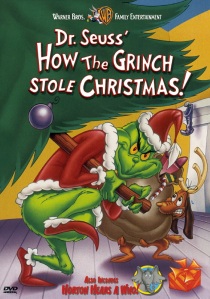 Director: Chuck Jones
Writers: Irv Spector & Bob Ogle, based on the book by Dr. Seuss
Cast: Boris Karloff, June Foray
Plot: In the town of Whoville, Christmas is a season beloved by all. The Whos in Whoville gather together to cut down the town tree, decorate the community, and celebrate the season. But not everybody is happy with the season. North of Whoville, in a mountain cave, lives a green creature called the Grinch (Boris Karloff, doing double-duty as the narrator) who hates Christmas with all of his two-sizes-too-small heart. As he watches their celebration begin, he vows to destroy Christmas for everyone. Stitching together a Santa Claus suit and putting “antlers” on his dog Max, the Grinch sweeps into town and begins breaking into houses, stealing every present, every decoration, every morsel of food, even the roast beast. As he goes to work in one house, however, he’s interrupted by little Cindy Lou Who (June Foray).Cindy Lou mistakes him for Santa and asks him why he’s taking their Christmas tree. He tells her he’s bringing the tree to his workshop to repair a broken light, then ushers her off to bed and finishes his insidious task.
The Grinch and Max take their loot to the top of a mountain, where he plans to spy on the Whos as they wake up and find their Christmas ruined. To his shock, though, the Whos come from their houses, join hands, and begin to sing despite their lack of gifts, of trees, of boxes and bags. That’s when it dawns on him… that perhaps Christmas has a deeper meaning than those things one can buy from a store. As his heart fills for the first time in years, his sleigh of toys begins to tip over the side of the mountain. His newfound Christmas spirit gives him the strength to rescue the sleigh and he races back to Whoville to return everything he stole. The Whos welcome him with open arms and even allow him to carve the roast beast.
Thoughts: Like most movies (even short films) that are based on children’s books, when the time came to animate How the Grinch Stole Christmas there was a need to beef up the story considerably in order to make it fill the allotted running time. Fortunately, this is a case where just enough was added to make the story a real classic (as opposed to the 2001 feature film where just enough was added to make the whole thing feel like a waste of time).
Out of all the specials I’m going to talk about this month, this may be the most singularly perfect case of voice casting we’ll see. Boris Karloff, as both the narrator and the Grinch himself, delivers a legitimately flawless performance. The Narrator has the sort of homespun quality you want – it’s like having a grandfather or a gruff uncle calling you around the fireplace to tell you a story. Then he shifts into the Grinch persona, adopting a nasty edge to his timbre that sends him from being your grandfather to that creepy old man down the street you’re really afraid of but feel compelled to pester at Halloween. Complimenting Karloff in the small but vital role of Cindy Lou Who is the legendary June Foray, one of the two greatest voice artists of all time (the other being Mel Blanc, and if you want to rank anybody else above those two you are wrong). Foray gives Cindy Lou a tender innocence that could easily be obnoxious and saccharine, but she imbues it with such sincerity that she’s impossible to dislike. Cindy Lou is the child every parent wishes they could present to Santa Claus down at the mall.
Then there’s the direction. Chuck Jones, perhaps the greatest animator in American history, takes the performances of these voice artists and crafts a beautifully rendered, visually amazing world that perfectly captures the wonderful lunacy of Dr. Seuss’s best work, while still maintaining his own inimitable comedic style. In the antics of the Grinch and his dog Max, you can see the finest moments of Wile E. Coyote and the Road Runner or of Tom and Jerry, both of whom experienced their best years when directed by Jones.
The Grinch slinks along like a snake in this cartoon, he casually licks his fingers to unscrew a light bulb, and in one of the greatest moments in the special, his face grows into this insidious, far-too-wide grin when he concocts his terrible scheme. This sort of thing is all Jones, all part of his amazing animated style. The action sequences, when he’s racing up and down the mountain in his sled, or where he desperately tries to save the presents at the end… again, Jones is the star here, showing off the potential of animation to tell a story of this nature in a thrilling fashion.
Rounding out a perfect crew was Thurl Ravenscroft, best known as the voice of cereal mascot Tony the Tiger, singing “You’re a Mean One, Mr. Grinch.” The song is great in and of itself, but planting it in Ravenscroft’s deep baritone gives it a feeling that no other Christmas song can boast. That song, that performance, is just as famous as any other part of this cartoon, and it’s well-deserved.
This film also passes a rather unique test when it comes to Christmas specials. There are honestly far too few truly original stories out there. We live in a world where half the Christmas stories told are just retreads of A Christmas Carol or It’s a Wonderful Life. This film is its own story, though, not a parody, which makes it impressive enough. But eventually, it reached the stage where it is the source of parody – plenty of movies and TV shows have spoofed the Grinch over the years. That places it in the upper echelon of Christmas stories, the strata of tale that writers who can’t come up with their own story choose instead to build upon. If that isn’t the sign of a cultural landmark, I don’t know what is.
 Reel to Reel