Category Archives: Fantasy
Scrooge Month Day 8: Bill Murray in SCROOGED (1988)
 Director: Richard Donner
Writers: Mitch Glazer & Michael O’Donoghue, suggested by A Christmas Carol by Charles Dickens
Cast: Bill Murray, Karen Allen, John Forsythe, John Glover, Bobcat Goldthwait, David Johansen, Carol Kane, John Murray, Robert Mitchum, Alfre Woodard, Jamie Farr, Robert Goulet, Buddy Hackett, John Houseman, Lee Majors, Brian Doyle-Murray, Mary Lou Retton, Michael J. Pollard, Wendie Malick, Nicholas Phillips
Notes: This is one of the biggest departures from Dickens we’ve seen yet (and the biggest, I suspect, that we will see in this project, although other movies stray even further from the formula). Bill Murray plays Frank Cross, a disgruntled television network president who is planning a live production of Scrooge on Christmas Eve, loaded with stars like Buddy Hackett as Ebenezer Scrooge and Mary Lou Retton as Tiny Tim. But Frank has lived a rather Scrooge-like life himself, and the Ghosts of Past (Carol Kane), present (David Johansen) and Future are at work once more. We also get Bobcat Goldthwait splitting the Bob Cratchit role with Alfre Woodard (whose young son Calvin, unable to speak for some reason, is our Tiny Tim stand-in), Murray’s younger brother John playing a Fred-like part in the story, and Karen Allen filling in for Scrooge’s lost love Belle in a greatly expanded part than the character has had in any other version of the tale. John Forsythe plays Frank’s late boss, taking the Jacob Marley part.
Thoughts: This weird version of Dickens kicks off with Lee Majors leading an expedition into the North Pole to save Santa from a bunch of terrorists, which he accomplishes by arming the crap out of Santa, Mrs. Claus and all the Elves, all cast against a setting that could have fallen from Tim Burton’s brain. (It doesn’t hurt that we get a Danny Elfman score). It turns out to be one of several horrendous specials planned for the IBC network this year, all being shown to Frank Cross (Bill Murray). As we get to know Frank, we see quickly he’s not exactly Scrooge. Sure, he’s self-centered and greedy and completely lost touch with everything that matters in life – he’s so callous that when a woman has a heart attack and dies after seeing his Scrooge promo he considers it nothing but world-class publicity — but he’s still played by Bill Murray. Such a character cannot be without a sense of humor, and after yesterday’s bitingly joyless performance by George C. Scott, this is already a drastic improvement.
Forsythe’s Lew Hayward is the most gruesome apparition I’ve seen all month. Although he’s talkative and chipper, he looks like a zombie – and not a fresh one either. He’s dried up, desiccated, with rats crawling from a hole in his skull caused by the still-embedded golf ball that killed him. He fills his role neatly, but the sarcastic way Bill Murray deals with him deflates the character right up until Lew gets pissed and dangles him out the window to prove his point. It’s a shame that Murray didn’t have time to call his friends – he knows some people with ghost experience, after all.
Yet another thing that sets Frank Cross’s story apart from Ebenezer Scrooge is that he’s given a chance to return to his life after each ghostly encounter. His meeting with Lew Hayward puts him in touch with Claire Phillips – played to charming perfection by Karen Allen. Claire, it seems, is the one that got away, the love of Frank’s life, the girl who he left behind when he got big. Unlike Scrooge, Frank has a second chance – Claire is still single and she’s clearly happy to see him again. Of course, it wouldn’t be much of a movie if he didn’t come close to screwing it up all over again.
David Johansen is our Ghost of Christmas Past – here depicted as a rough New York cab driver whose taxi takes Frank back in time to relive childhood Christmases where his father (Brian Doyle-Murray) gave him meat and less distant years when things with Claire were pretty good… until they went bad. Johansen is a nice character – funny and sarcastic at the same time, even with his harsh edge. Despite that, though, despite heaping verbal (and even a little physical) abuse on Frank, you never lose your faith that his ultimate goal is for Frank’s ultimate good.
In Carol Kane, we get a Christmas Present that looks like a tooth fairy and has the clear-headedness of a toddler. She also has no problem with smacking Frank around when he needs it, which he frequently does. Her visits with Frank’s brother and Alfre Woodard’s family do more than the traditional Christmas Present visits, where Scrooge usually sees what he’s missing out on and begins to feel empathy for Tiny Tim. Here we also see how good everyone else is in comparison to him—Woodard goes behind Frank’s back and sends his brother a VCR for Christmas rather than the proscribed towel he’s handing out to everyone else. This is also where the movie takes a sharp turn into melancholy when we encounter a homeless man (Michael J. Pollard) Frank had earlier met at Claire’s soup kitchen, now frozen to death. It’s a perhaps the saddest moment in the film, and it gives Frank just the right blow to turn the chink forming in his armor into a full-on crack. It’s just such a sad, hopeless, pathetic sight you can’t help but be affected, and Murray’s enraged screaming at Pollard’s frozen corpse is the clearest indication yet he has a conscience in there somewhere. He may be yelling at Herman for being stupid, but he really hates himself for not doing anything to save the man when he had the chance.
The puppet they use for Christmas Future here is the scariest damn version of the character yet, making his first appearance on a wall of television monitors and reaching out of it for Murray just before Bobcat Goldthwait bursts in with his shotgun. (More on that shortly.) The future he shows Frank is even bleaker than Scrooge’s usual future. Claire isn’t just alone, she’s embraced Frank’s gospel of greed. The non-talking Calvin (Nicholas Phillips) isn’t dead, but he’s been committed to a sanitarium. Brother James comes off the best in the future – he and his wife (Wendie Malick) are the only two people who show up to watch Frank’s cremation, except for Frank himself… and he, naturally, winds up in the coffin.
Although Bobcat Goldthwait’s Eliot Loudermilk is filling the Bob Cratchit archetype, a Cratchit he’s not. He has good intentions, but after Frank fires him in the opening scenes of the movie, he goes nuts. He shows up later toting a shotgun, planning to get his revenge. Fortunately for him, Frank has been redeemed by that point and not only gives him his job back, but recruits him as his sidekick in the glorious finale, in which he takes over the studio at gunpoint and shows off his newly-discovered Christmas spirit to the world.
The finale, in fact, is why I love this movie so much. Not to say the rest of it isn’t entertaining, but if it weren’t for the ending, when Bill Murray stands in front of the cameras and expresses his joyful spirit to the whole world (even winning back Claire) it may not stick with you so clearly. The happiness and sincerity in that final sequence is maybe the most believable such redemption I’ve ever seen a Scrooge undergo. He shouts at the camera, he pleads with the audience for everybody to embrace the feeling that’s overtaking him, and Bill Murray sells every inch of it. And if you don’t laugh when he starts talking to the audience in the movie theater, compelling them to sing along, I don’t know if I want to know you. Scrooged may be the least Dickensian of the films we’ve watched, but it’s easily one of my favorites.
The first Reel to Reel study, Mutants, Monsters and Madmen, is now available as a $2.99 eBook in the Amazon Kindle store and Smashwords.com bookstore. And you can find links to all of my novels, collections, and short stories, in their assorted print, eBook and audio forms, at the Now Available page!
Scrooge Month Day 7: George C. Scott in A CHRISTMAS CAROL (1984)
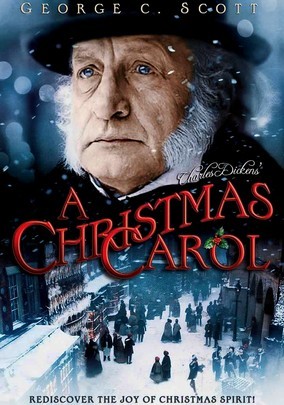 Director: Clive Donner
Writer: Roger O. Hirson, based on the novel by Charles Dickens
Cast: George C. Scott, Frank Finlay, Angela Pleasance, Edward Woodward, Michael Carter, David Warner, Susannah York, Anthony Walters, Roger Rees, Lucy Gutteridge, Timothy Bateson, Nigel Davenport, Joanne Whalley, Kieron Hughes
Notes: This production of A Christmas Carol was a made-for-TV movie in the United States, aired on CBS, and netted George C. Scott an Emmy nomination for best lead actor in a miniseries or special. It was good enough to get a theatrical release in Great Britain. Scott himself, interestingly enough, owned the rights to the film, and it went into syndication for many years, gaining a large following. It wasn’t released on VHS until 1995, however, with a DVD release following in 1999. The film is still popular today, and is often seen on AMC at this time of year (although a few years ago, the Hallmark Channel managed to work it in between installments of their 60-day marathon of different original movies in which former sitcom stars or models play the children of Santa Claus attempting to find true love in the modern world).
Thoughts: From the first frame of the film, this edition of A Christmas Carol takes a markedly different tone than most. It opens up with Roger Rees’s narrator reciting the first line of the novel: “Marley was dead to begin with…” The scene is a hearse carting old Jacob’s coffin through the streets of London, and you get this terrible, all-pervading chill that makes you feel like you’re about to get the hell scared out of you.
Then the mood whiplash hits you, with a cheery fanfare and a burst of music that shows people walking around the city, gleefully wishing one another Merry Christmas and celebrating with music and packages and a guy playing a trombone which – I know from experience – will freeze right to your lips on a day like that if you’re not careful. It’s a great contrast to Scrooge’s counting house, where Scrooge (George C. Scott) is berating Bob Cratchit (David Warner) for his picky request of a lump of coal to keep himself from freezing to death. Ah, we’re in familiar Dickensian territory now. When Roger Rees – now playing Fred – walks into the office, we’re getting right into the most well-known lines in Dickens’s remarkable catalogue.
Scott takes a different tack with Scrooge than many of his predecessors. While many of them portray the character as an incurable grump, taking no joy at anything, Scott’s Scrooge is not above a good laugh in the face of his ever-so-foolish nephew. In this opening sequence, the filmmakers start adding to the Dickens story. In an early scene, for example, Scrooge encounters Tiny Tim (Anthony Walters) waiting outside for his father. It serves no real purpose other than to show Scrooge being a jerk even to a little crippled boy. Traditionally, Scrooge (and the audience) doesn’t usually see Tim until Christmas Present pops over to the Cratchit house. This, plus a few other minutes of Scrooge making deals, all go just to show him as an even nastier, more miserly creature than usual. Scrooge is usually a pathetic, greedy man. This is the first version of the story I’ve seen in which he actually seems to exude a little evil in his demeanor.
I really like Frank Finlay’s design as the ghost of Jacob Marley. We get the traditional brushed iron moneyboxes blending nicely into the iron chains, all of which match his clothes and skin and cold, dead eyes perfectly. The chains cross in front of him, meeting in an enormous lock that gives the whole thing a look of being intentional, being planned. A lot of Marleys have the chains just draped on them. This is a Marley for whom the chains were specifically forged.
Angela Pleasance’s Ghost of Christmas Past has a unique look as well. She carries her “cap” – the light of truth – which often accompanies one of the candle-like versions of the character. She’s not particularly waxen in her appearance, though. With her white-blond hair, loose robes and sprig of greenery clutched in her hands, she has a sort of elfin appearance, like she belongs in a version of a Tolkien story. She gives more attention to Scrooge’s father than most versions do as well. Usually, all we hear of Scrooge Senior is that he’s “kinder than he used to be.” This time, though, Fan (Joanne Whalley) brings him to a father who coldly insists a three-day reunion is sufficient and Scrooge is to be sent straight to Fezziwig’s to begin his apprenticeship. This time around, it’s not Fan’s death that hardens Scrooge’s heart. It’s quite clearly the tender ministrations of his father. It just gets worse as he sees himself leaving his beloved Belle (Lucy Gutteridge), then flashing to a later Christmas in which she is married with children and – worst of all – pitying poor, lonely Scrooge. When he uses Christmas Past’s own “cap” to smother her away, it’s almost a blessing.
Edward Woodward’s Christmas Present is about as traditional as it gets – an enormous mountain of a man draped in his green robe and holly wreath around his head. He has an energy that’s practically bubbling out, giggling in Scrooge’s face, but like much of this movie, his laugh is cold. It’s in his scene that I’m really starting to feel what sets this version apart from most others. Usually, the point of A Christmas Carol is that Scrooge has cut himself off from a warm world and he needs to find a way to let it back in. The impression George C. Scott’s version gives is that he lives in a world with very little pity, and he must work to earn back the comfort of the rest of the human race.
This segment, again, adds to the story. Bob Cratchit comes home to tell his eldest son Peter (Kieron Hughes) that Scrooge’s nephew, Fred, has offered him a job. Scrooge is convinced Fred is doing it just to spite him, but his veneer is cracking – when Bob says the blessing over their Christmas Eve dinner, Scrooge is unable to resist whispering an “Amen” along with the family, then promptly denies it to Christmas Present. When they hit the famous bit where Christmas Present throws Scrooge’s own words back at him – “decrease the surplus population” and all that – he does so not with the ironic amusement of most performers, but with a bitter anger. Once we get to the reveal of Ignorance and Want beneath his robes, it just seems like more of the same from him.
Scrooge, in fact, does his best to remain stoic, even in the Christmas Future segment while he watches Bob Cratchit discussing Tiny Tim’s death. While David Warner breaks down discussing his dead child, displaying depths of compassion not seen since his turn as Sark in TRON, George C. Scott just stands off to the side offering commentary. He’s seen it all, he needs to go. He has a sadness in his voice, but he’s trying to bottle it right up until the spirit shows him his own grave.
If this version of A Christmas Carol has a failing, it’s in its nihilism. This is a bitter London full of bitter people. Scrooge comes across not as the outcast he’s made himself, but as another cold man who reluctantly, in the end, decides to try to make his way into the minority of happy people. Sadly, this is probably a bit more realistic a depiction of the time period than most other versions of the story. Even if that’s true, though, it gives this film a powerful strike against it: we never feel like this is a Scrooge that has earned his redemption. Scott’s performance is good, but the world he inhabits feels a bit off, and for that if no other reason, this just isn’t one of my preferred versions of the Dickens classic.
The first Reel to Reel study, Mutants, Monsters and Madmen, is now available as a $2.99 eBook in the Amazon Kindle store and Smashwords.com bookstore. And you can find links to all of my novels, collections, and short stories, in their assorted print, eBook and audio forms, at the Now Available page!
Scrooge Month Day 6: Scrooge McDuck in MICKEY’S CHRISTMAS CAROL (1983)
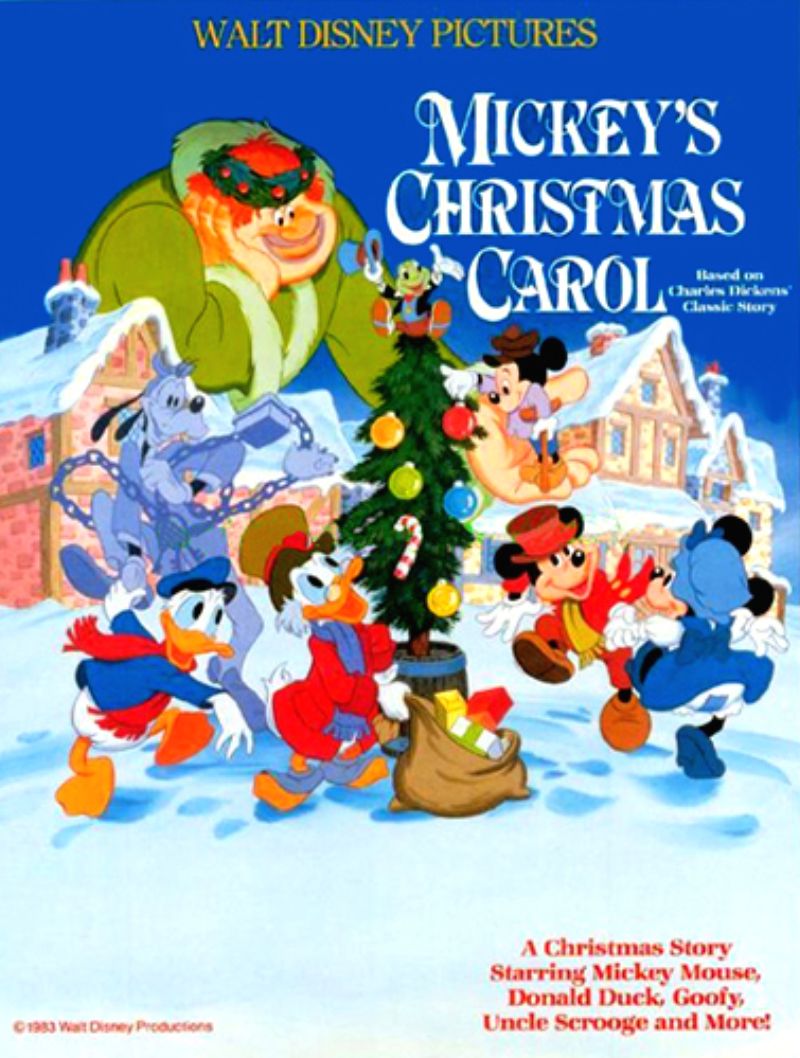 Director: Burny Mattinson
Writers: Burny Mattinson, Tony Marino, Ed Gombert, Don Griffith, Alan Young, Alan Dinehart, based on the novel A Christmas Carol by Charles Dickens
Cast: Alan Young, Wayne Allwine, Hal Smith, Will Ryan, Eddie Carroll, Patricia Parris, Dick Billingsley, Clarence Nash
Notes: Paired with a re-release of the 1977 film The Rescuers, Mickey’s Christmas Carol is significant in the annals of Disney animation for several reasons. It was the first theatrical short starring Mickey Mouse in 30 years; it was the final time Donald Duck’s original voice actor, Clarence Nash, would voice the character; and it was the first time Alan Young would voice Donald’s Uncle Scrooge, a role he has continued with through the classic DuckTales TV show and every other depiction of the character right through the present day. Despite its short length, the film is remarkably faithful to the Dickens novel, keeping most of the important scenes and characters, although racing through them in the 26-minute running time. The Disney characters who take part in this adaptation include Scrooge McDuck (Young) as Ebenezer Scrooge, Mickey Mouse (Wayne Allwine) as Bob Cratchit, Donald Duck (Nash) as Scrooge’s nephew Fred, Goofy (Hal Smith) as Jacob Marley, Jiminy Cricket (Eddie Carroll) as the Ghost of Christmas Past, Willie the Giant (Will Ryan) as the Ghost of Christmas Present, and Black Pete (Ryan again) as one of the few versions of Christmas Yet to Come to actually have lines. Other minor characters and background extras come from various Disney shorts and films starring animals, particularly The Wind in the Willows and Robin Hood, which you may remember I talked about here once before.
Thoughts: This is the shortest version of A Christmas Carol I’ve talked about yet, and is probably the shortest I’ll discuss all month, but it’s also one of my favorites. Part of that can no doubt be chalked up to nostalgia – I was six years old when this cartoon was released, and I think I saw it in the theater, but I honestly can’t say for sure. Regardless, I am sure this was the first version of the story I remember in any detail, and as such it holds a special place in my heart. That said, it’s worth talking about even without the nostalgia factor because – again, despite its short running time – it’s really good.
First of all: Alan Young. I’m not sure how many people are aware that Uncle Scrooge has the voice of Wilbur from TV’s Mr. Ed, and I’m not sure how many would care if they did, because his work with this character is by far a more enduring legacy. Scrooge McDuck is a character who has to be firm and grumpy, but with a good heart at the core. In truth, from the outset he was a (slightly) milder version of the Dickens character Carl Barks named him after. Young’s voice performance is flawless.
The “casting” all around is good. Mickey Mouse – so long portrayed as a sweet, well-meaning everyman — is the natural choice for Bob Cratchit. Jiminy Cricket is Pinocchio’s conscience, and as such is the logical choice for Christmas Past. Willie and Pete, both nominal “villains” in their usual Disney performances, fit their roles well, with the man-child Willie making an even larger version of Christmas Present than we usually see and Pete taking real delight in his nasty work. The only one that doesn’t really seem to fit is Goofy as Jacob Marley – a character full of regret. Even if Goofy had anything to regret (he doesn’t – the character is far too innocent for that), he’s not self-aware enough to realize it. I imagine he was given the part simply because they felt the need to get all of Disney’s top three characters into the cartoon somewhere and they just couldn’t think of any other way to include him.
The only major character omitted from this version of the story is Scrooge’s sister, Fan. Considering it was billed as a Mickey Mouse cartoon, that’s understandable – kids may be able to accept ghosts and hellfire and redemption, but I doubt any parent wanted to have a discussion with their children about the potential of a mother dying in childbirth. Besides, there’s a long precedent in Disney cartoons of obvious orphans whose parents are never referenced (Donald and Mickey’s nephews and Donald himself being the prime examples).
Scrooge’s reformation is a bit more subtle in this film, although we do see the stages. After Christmas Past shows Scrooge the scene where he breaks the heart of Isabelle (Donald’s girlfriend Daisy, which must have been kind of awkward on the set), Scrooge berates himself for being foolish. A few seconds later, though, as Christmas Present preaches generosity, Scrooge stubbornly argues that he has no reason to be generous to others, as no one has ever shown such kindness to him. In response, we go to the Cratchit house, where Tiny Tim himself encourages his family to thank Mr. Scrooge. That’s all Scrooge gets from Christmas Present, though, as he’s left standing between a pair of giant footprints before a cloud of cigar smoke whisks him to the cemetery. He’s scared now, and you can feel it, but instead of asking about himself, he inquires as to Tim’s welfare. It’s a good moment, and it’s heartbreaking a moment later when we see Mickey Mouse, in tears, laying a crutch on a tombstone. If that isn’t enough to give kids watching permanent scarring, Christmas Future whips off his hood, lights a match on Scrooge’s tombstone, and kicks him into the open grave, where fire being blazing from the coffin and reaches for Scrooge just before he’s whisked home for the joyful finale.
It is still a Disney cartoon, and as such has to work in some comedy amidst the dark subject matter. The balance is good, and never at the expense of character, whether we’re looking at a verbal gag, a bit of ironic wording, or a quick sight gag. The moment where Scrooge tells Fred he’s coming to Christmas dinner after all, Fred and the horse look each other in the eye and Nash gives the line reading of his career: a simple “Well I’ll be doggone” that never fails to get a laugh out of me.
I do so love this cartoon, and not just because I got to watch it and write the whole article in less than a half-hour. It’s a wonderful rendition of Dickens’s story, even in its condensed form, and it just came out on a 30th anniversary edition Blu-Ray and DVD, along with several other classic Disney Christmas shorts, and one brand new one. If you don’t already own it, get it now.
The first Reel to Reel study, Mutants, Monsters and Madmen, is now available as a $2.99 eBook in the Amazon Kindle store and Smashwords.com bookstore. And you can find links to all of my novels, collections, and short stories, in their assorted print, eBook and audio forms, at the Now Available page!
Scrooge Month Day 5: Albert Finney in SCROOGE (1970)
 Director: Ronald Neame
Writer: Leslie Bricusse, based on A Christmas Carol by Charles Dickens
Cast: Albert Finney, Edith Evans, Kenneth More, Laurence Naismith, Susanne Neve, Michael Medwin, David Collings, Derek Francis, Roy Kinnear, Richard Beaumont, Alec Guinness, Paddy Stone
Notes: This version of Scrooge is a musical extravaganza that got four Academy Award nominations, including best original song and best score. Albert Finney’s Ebenezer Scrooge scored the Golden Globe award for best actor in a motion picture, musical or comedy. For the most part, this version of the story is quite faithful to Dickens, with a few small additions at the end that really make its mark.
Thoughts: To many people, the battle for the ultimate version of A Christmas Carol comes down to the Alastair Sim version we discussed a few days ago and this musical version. It’s hard to argue. There have been dozens, maybe hundreds of different incarnations of the story since then, but these two seem to be the purest and most entertaining renditions of the story ever put to film.
Credit for the longevity of this version, I think, is to be shared between Albert Finney – for a phenomenal performance as Scrooge – and Leslie Bricusse, who wrote both the screenplay and the music for this film. Scrooge’s intonation of “I Hate People” is as perfect a summation of the miserable wretch he is that I’ve ever seen. He’s cold, he’s bitter, and he’s angry at the world. Such a person is, of course, both miserable and terribly comfortable in his misery. Going back to the Sim version, the Scrooge who was afraid of change, Finney’s Scrooge comes off as a man who is also very set in his ways, and doesn’t care if that comfortable place is one of loneliness and pain.
Sir Alec Guinness steps in as Marley’s ghost this time around, and his interpretation is… unique. Guinness has this slow, deliberate walk, almost like he’s moving through water. If you really want to try to analyze it, I suppose you could intuit that ghosts have less substance than matter in the world of the living, and therefore ordinary matter has a degree of resistance that has an unexpected impact on their ability to move. Of course, anyone who would go to such lengths to rationalize such a relatively short scene in the movie would be kind of crazy, so I’m not going to try to do such a thing. Regardless, Guinness’s odd motion is creepy, even more so when he begins floating, bellowing his warning to Scrooge and bound to the Earth only by one of this oh-so-heavy chains.
Like Marley, Edith Evans as Christmas Past is unique. The filmmakers take advantage of Dickens’s non-description to whip up a character that looks, talks and dresses like the sort of uptight grandmother you see in movies where kids have to teach the grown-ups to lighten up, okay? There’s a bit of irony there – her task, after all, is to teach that same lesson to Scrooge. And what’s more, he starts learning that lesson right away. As soon as he sees himself sitting alone in his schoolhouse while his classmates rush about and celebrate Christmas, he expresses regret that he didn’t join them. This version, too, implies that Scrooge’s sister (“Fran” instead of the traditional “Fan”) died giving birth to young Fred, and as I’ve already discussed why I think that works for the character in a previous article, I won’t belabor the point.
This section also includes one of the peppiest musical numbers in the film – Laurence Naismith and Suzanne Neve as Mr. and Mrs. Fezziwig, cheerfully extolling the virtues of “December the 25th” as a rhythmless Scrooge looks on, unable to dance. It’s a rather old-fashioned tune, one that feels like it could have spilled right out of the golden age of the Broadway musical, and I actually think it’s quite a shame it doesn’t get more play when people are lining up their traditional Christmas song lists.
Kenneth More’s Christmas Present is much more traditional – green robe, holly wreath around his head, sitting atop a mountain of food and riches, as he always makes his appearance. His powerful anthem, “I Like Life,” is a perfect counterpoint for Scrooge’s earlier “I Hate People.” At first, it feels like he’s berating Scrooge, calling the miser’s philosophy “self-pitying drivel.” As the song progresses, though, we get to the root of it – he’s putting the skinflint through a sort of spiritual boot camp, shaking down all his pretenses so that he can be rebuilt into a man who truly does enjoy the pleasures of life he’s denied himself for such a long time. Many versions of this story make the moment when Christmas Present whisks Scrooge out the window into the air into a scene of terror, but not here. By this point, Scrooge is on-board, singing along and joyously joining in on their flight above London… right until they crash into the snow outside Bob Cratchit’s house.
Christmas Future is where this version of the film really begins taking liberties, and in fact, I like the ones that they take. Rather than starting out with people talking about the death of a lonely man and Scrooge not realizing they’re talking about him, this version starts with people outside of Scrooge’s counting house, cheering for him, joyfully talking about the “wonderful thing” Scrooge has done for them. Scrooge is moved and swept away with emotion, believing himself already redeemed, and doesn’t even notice when his own casket is carried out of the counting house. The irony of the scene is made even worse as the people start singing the gleeful tune “Thank You Very Much” (the song nominated for an Oscar). He marches along, dancing with people, completely oblivious to the fact that they’re celebrating his corpse. It’s happy and chilling all at the same time.
Once we make it to the cemetery, though, things get really freaky, with Christmas Yet To Come (here a sort of fossilized corpse) shoving Scrooge into his own grave and allowing him to plunge all the way to Hell! Scrooge’s final destination if he doesn’t change is always clear in this story, but this is the first one I know of that goes far enough to actually drop him into the pit, where he wakes up in a coffin-shaped hole and is told by Marley he’s been bound to be Lucifer’s bookkeeper. Director Ronald Neame didn’t bother with subtlety here.
“I’ll Begin Again,” Scrooge’s song when he wakes up and realizes he’s not dead after all, is a fantastic number. There’s a hope, a glee, and a sincerity inherent in his words that sells every moment. When we watch this old man dancing through a drafty old mansion covered in cobwebs, you feel every bit of the change he’s experienced. Once he sends the urchin off to buy the turkey and he chirps, “I think I’m going to like children,” even the stoniest heart will have come on-board with Scrooge’s reformation.
This is one of the truly classic renditions of A Christmas Carol, one of the best ever put to film, and I think I’d have that opinion even without the powerful tweaks we’re given in the Christmas Yet to Come segment. Beautiful music and a magnificent Scrooge combine to give us a film one really should watch every year. And let’s not forget the most important lesson of all: Alec Guinness really knows how to play a ghost, doesn’t he?
The first Reel to Reel study, Mutants, Monsters and Madmen, is now available as a $2.99 eBook in the Amazon Kindle store and Smashwords.com bookstore. And you can find links to all of my novels, collections, and short stories, in their assorted print, eBook and audio forms, at the Now Available page!
Scrooge Month Day 3: Fredric March in A CHRISTMAS CAROL (1954)
 Director: Ralph Levy
Writer: Maxwell Anderson, based on the novel by Charles Dickens
Cast: Fredric March, Basil Rathbone, Bob Sweeney, Christopher Cook, Sally Fraser, Ray Middleton, Dick Elliott, Bonnie Franklin
Notes: This 48-minute version of A Christmas Carol was produced as an episode of the CBS variety show Shower of Stars. The network was heavy on dramas at the time and created this more lighthearted musical/variety show as a way to open up their own programming to different audiences. Aside from having the magnificent Basil Rathbone as Marley’s ghost, this special also features an early TV appearance from future sitcom star Bonnie Franklin as one of the Cratchit children. This particular episode was nominated for four Emmy awards, including best original music composed for TV to Bernard Hermann and Best Actor in a single performance for Fredric March as Scrooge. It won the Emmy for best art direction of a filmed show. Rathbone would later go on to play Scrooge himself in the film The Stingiest Man in Town (1956, not to be confused with the Rankin and Bass adaptation of the same name), which I somehow don’t have a copy of on DVD. Maybe some other year, guys.
Thoughts: When I heard this was a musical version, my mind automatically went to the idea of some heavily produced Broadway-style extravaganza. As it turned out, that’s not what we got at all. Instead, the music is very traditional in nature, performed in a chorale style that wouldn’t seem out of place in a Church. Much of it is produced by a group of carolers who wander in between scenes with Scrooge and company, another song turning up at Fezziwig’s party during the Christmas Past segment. Tiny Tim gets a solo in the Cratchit house, but it’s really quite subdued, sweet, and sad.
The only song that really feels like most musicals is Christmas Present’s, which he sings the instant he meets Scrooge, with the film going so far into musically-inspired lunacy that he pulls a long garland from Scrooge’s robe, makes the hands of a clock wiggle around, and shuts some doors telekinetically. But it’s just the one scene that takes this tactic. The rest of the film is more of a diegetic musical than a traditional one. Later musical versions of the story wouldn’t bother with attempts to explain where the music came from.
In an interesting Wizard of Oz-style twist, the two more talkative ghosts are played by actors doing double-duty as one of the characters significant to that segment of Scrooge’s life. Sally Fraser plays both his lost love Belle and the Ghost of Christmas Past, while Ray Middleton bounds in as the bombastic nephew Fred and returns as the thunderous Ghost of Christmas Future. It’s an unusual conceit, and one the film carries very well. Fraser is lovely as both the Ghost and as Belle, carrying that sort of classic beauty and charm actresses of the 40s all seemed to have. (Yes, I know this was 1954. She still had the charm of an actress of the 40s, and that alone makes it clear why March’s Scrooge grew so infatuated with her.) Her performance, however, is a bit stiff. The same cannot be said for Middleton’s Christmas Present, who appears in the midst of a song and practically explodes cheer all over Scrooge.
All of these songs, of course, come at the expense of a little story. The Fezziwig party is pretty much the only part of Scrooge’s past we get to see, with Belle dumping his greedy ass right after they perform a duet about being with your loved one at Christmas. It’s a bit disconcerting, actually, without the usual lapse of many years during which we presume he got colder and crueler. In the Christmas Present sequence, the traditional guessing game — which makes Scrooge realize just how poorly everybody thinks about him — is moved from Fred’s home to the Cratchit house, cutting out Fred’s scene. It comes at the expense of character. The Bob Cratchit who defends his stingy employer to his wife seems unlikely to make the same man the object of ridicule, even if there’s no real malice behind it (Fred, it should be pointed out, usually doesn’t mean it to be cruel.) Even Christmas future skips most of the prelude stuff and jumps right to the cemetery, where Scrooge sees his own tombstone, then Tim’s, then breaks down crying until he pops into his bed. The Ghost of Christmas Yet to Come gets a sort of name drop from Ray Middleton, but otherwise is absent.
Rathbone’s Jacob Marley is fantastic. He’s not loud and terrifying, not a sort of jump-in-your-face apparition as some of them are. Instead, his version is rather quiet and matter-of-fact, staring at Scrooge as if he can barely see him. Somehow it’s even more disquieting that way than if he simply chose to scream at us all and warn Scrooge he’s going to Hell, damn it, if he doesn’t straighten up and fly right.
March is a solid Scrooge. He pulls off the transition from angry to joyful mostly convincingly, although at the end, when he shows up at the Cratchit house, he’s got a bit of the crazy eyes going on, particularly in the closing musical number, where the camera focuses on him fidgeting for two minutes instead of showing absolutely anything else. Before that there’s a nice bit where he leans on Bob Cratchit just a little, but in the interest of making him lighten up. It’s a fun way to show just how profound the change in Scrooge is, allowing him to take a tool from his Old Self and put it to use as his New Self.
I like this version. It’s not great, but it’s quick and has some very good music (Hermann deserved that Emmy). If you happen across it in your holiday viewing this year, it’s well worth watching.
The first Reel to Reel study, Mutants, Monsters and Madmen, is now available as a $2.99 eBook in the Amazon Kindle store and Smashwords.com bookstore. And you can find links to all of my novels, collections, and short stories, in their assorted print, eBook and audio forms, at the Now Available page!
Scrooge Month Day 2: Alastair Sim in A CHRISTMAS CAROL (1951)
 Director: Brian Desmond-Hurst
Writer: Noel Langley, based on the novel by Charles Dickens
Cast: Alastair Sim, Mervyn Jones, Kathleen Harrison, Hermione Braddeley, Michael Hordern, Rona Anderson, Francis de Wolff, Carol Marsh, Brian Worth, Michael Dolan, Glyn Dearman, Roddy Hughes, C. Konarski, Peter Bull
Notes: This well-known version of the story was released in the UK as Scrooge. Although originally slated to have its US premiere at Radio City Music Hall, it was rejected for being “too grim.” Evidently, the Radio City folks didn’t know what they were getting into when they booked the most well-known Christmas ghost story of all time. The movie wound up having its premiere at a different theater, on Halloween night. A colorized version was released in 1989, as part of Ted Turner’s ongoing pact with Satan.
Thoughts: Another fairly straightforward production of A Christmas Carol today, friends, although we’re getting into some of the most well-remembered versions now. The Alastair Sim Scrooge has been considered a classic for sixty years, and with good reason. His depiction of the character is remarkable, and the rest of the cast is quite impressive as well. Glyn Dearman’s Tiny Tim, for instance, is much more convincing than the one we saw in the Seymour Hicks film, whose perfect hair and chipper tone made it somewhat difficult to believe we were looking at a child on death’s door. Michael Hordern as Marley is notable as well – he has this distant, forlorn keening in his voice that makes it really easy to accept he’s spent the last seven years suffering torment for the sins of his life… and that he knows he has an eternity more to look forward to.
This version ratchets up the spooky very well, starting with Marley. He shows Scrooge visions of other tormented souls, a nice shot of toiling, despairing ghosts imposed over Alastair Sim that really has a haunting quality to it. No wonder Radio City thought this movie might freak people out.
This time around get see a story that really plays up Scrooge’s relationship to his sister, Fan (Carol Marsh). I’ve always liked when a version of this story gives her the proper respect. Early on we see her talking to Scrooge about their father, and how he’s kinder now than he used to be; Scrooge later comments how much of Fan he sees in his nephew, Fred. In this production Fan dies giving birth to her son, something that wasn’t stated in the Dickens book, but that has passed into many of the versions of the story since then. Fan even calls Scrooge to her deathbed, but he storms out in a rage when he hears the baby cry. He never hears Fan’s last words, in which she begs him to take care for Fred, until Christmas Past shows the moment to him, and Old Scrooge breaks down in tears, begging for forgiveness.
The reason this works for me is purely character-focused. Fan was a ray of light in what was obviously a very gloomy childhood, and her death is one of the clearest events that could have caused Scrooge’s slide away from the good young man he was into the cold old man he became. What’s more, by connecting her death to Fred’s birth, we’ve also got a rock-solid reason for Scrooge’s distance from his only remaining family: not only does he blame Fred for the death of his beloved sister, but seeing so much of her in the young man he becomes is no doubt painful for Scrooge. Every minute he looks at Fred, he’s reminded of his beloved sister’s death. Hell, when viewed through that prism, who could blame him for not wanting to spend Christmas with Fred’s family?
This version spends more time with Christmas Past than most others, even taking us to Marley’s deathbed, at which point Scrooge has already become a miserable old miser. Before Marley dies, though, he whispers to Scrooge that they were “wrong” – he’s realized his mistake before he dies, but too late to do anything about it. This focus on the past really works well, showing Scrooge his own fall so that he can fully understand the mistakes he made in his life. Most versions of the story pluck out different highlights that force the viewer to merely assume that Scrooge turned into a bigger jerk in-between each scene we actually get to see. Here, the changes are apparent. When Christmas Present (Francis de Wolff) finally shows up, Scrooge already realizes he’s made terrible choices in his life. The Present serves mostly to show him that those decisions go beyond ruining himself, and indeed carry a heavy cost for those around him as well.
The way Sim plays his interaction with Christmas Yet to Come is pretty unique. He begs the Spirit to leave him be, not because he’s unwilling to change, but because he’s “too old to change.” What’s more the way he says it sounds sincere, not like someone just making an excuse. I don’t know that I’ve seen any other versions of A Christmas Carol that put this particular spin on Scrooge (although now that I’ve said that I’ll probably find exactly that thing next Thursday or something). Taking this approach changes the story just a little. When you combine it with the earlier scenes with Fan, we now see Ebenezer Scrooge as a man craving stability. Why did he run before his sister died? Why did he drive away Alice (changed from “Belle” for some reason) before they could be married? Why, even now, does he cling to his horrible ways, even after he has come to accept how horrible they are? Because anything else would require something different, and that’s something Scrooge is unequipped to deal with. With just a few lines, screenwriter Noel Langley gave Dickens’s story a much different subtext than we usually get.
In the end, this all leads to a beautiful transformation: Scrooge sits in his counting house, berating himself because he doesn’t deserve such happiness, but laughing all the time because, with the goodness he’s managed to find within himself, he simply can’t help it. This version perfectly encapsulates the real meaning of Dickens’s work: it is, first and foremost, a story of redemption, which is tailor-made for Christmas.
This is, simply stated, one of the real classic versions of A Christmas Carol, and with good reason. It’s a great cast with a take on the characters that’s just slightly off-center, while still being fully respectful of the story Charles Dickens told back in 1843. That’s not easy to pull off, but director Brian Desmond-Hurst and his actors handled the task with style.
The first Reel to Reel study, Mutants, Monsters and Madmen, is now available as a $2.99 eBook in the Amazon Kindle store and Smashwords.com bookstore. And you can find links to all of my novels, collections, and short stories, in their assorted print, eBook and audio forms, at the Now Available page!
Scrooge Month Day 1: Sir Seymour Hicks in SCROOGE (1935)
 Director: Henry Edwards
Writer: H. Fowler Mear, based on the novel A Christmas Carol by Charles Dickens
Cast: Seymour Hicks, Donald Calthrop, Robert Cochran, Mary Glynne, Garry Marsh, Oscar Asche, Marie Ney, C.V. France, Barbara Everest, Philip Frost
Notes: Look, it would be insane of me to try to recap the plot of A Christmas Carol seventeen times. Even more insane than I usually am. I know the story, you know the story. Scrooge is a greedy jerk. His dead partner, Jacob Marley, pops into his house on Christmas Eve and warns him if he doesn’t change his ways death is gonna suck even worse for him, and tonight three spirits are going to convince him. Christmas Past reminds him he wasn’t always a greedy jerk. Christmas Present shows him his family thinks he’s a joke and his employee, Bob Cratchit, has a kid who’s going to die because they didn’t have Obamacare. Christmas Future shows him that when Scrooge pops off, nobody is going to give a damn. When he gets back to the present he promises to stop being a jerk, and by most accounts, he keeps that promise.
So rather than making you read that every day this month, I’m going to instead use the usual “Plot” section of these articles to note any particular changes or deviations from the norm that specific version of the story features. Fair enough?
Thoughts: This is the oldest version of A Christmas Carol currently gracing my DVD shelf, and as far as it goes, it’s a pretty standard rendition. We open up with Seymour Hicks as Scrooge being grumpy to Bob Cratchit (Donald Calthrop) and his nephew Fred (Robert Cochran), who is trying his hardest to cheer him up. (Spoiler warning: he fails.) The film goes through pretty much all the standard beats, the lines about “picking a man’s pocket every 25th of December” and Scrooge warning Cratchit to get his lazy butt to work early the next day. This was, after all, a film from the early days of the form, before people realized that the Scrooge formula could be easily applied to all sorts of different misers and tell different stories. It was before it got so well known that parodies became inevitable, and before it started to get twisted for the sake of musicals, for political satire, for cheesy romantic comedies, and for virtually every TV show imaginable. (Seriously, folks, among the shows that did their own riffs on Dickens we had Family Ties, Alvin and the Chipmunks, The Jetsons and Smallville, the latter of which wasn’t even a Christmas episode).
What surprises me most about this film, actually, is that the filmmakers actually choose to add some stuff that’s not in the original book or in any other version of the film. After Scrooge leaves his counting-house at the very beginning, he stops off for dinner and our attention is shifted to – of all things – a royal dinner for the Queen of England! It would be a baffling addition to any version of A Christmas Carol but is even stranger in this one, which boasts a running time of a mere 59 minutes. Marley’s ghost doesn’t appear until almost 20 minutes — or one-third –of the way through the film. And even “appear” is a misnomer. We hear Marley’s voice (provided by an uncredited actor), but he never shows up on-camera. We only see Scrooge talking to somebody off-screen as Marley recites the famous “Mankind was my business” speech from the novel.
Christmas Past is credited as actress Marie Ney, but the strange effect around her body and her low voice made me initially think this was one of those versions where that ghost is played by a man. I’m not sure why, but I always picture the character as a woman, despite the fact that Dickens himself described this ghost as being a somewhat amorphic, shifting creature of indeterminate gender. At any rate, this is where the filmmakers compensate for that time spent on the royal ball at the beginning – rushing through Christmas Past, with several of the earlier scenes condensed and shown in a dialogue-free montage that’s supposed to just give us the impression that Scrooge done screwed up somehow.
The film picks up considerably with C.V. France’s powerfully rotund Ghost of Christmas Present. He handles Scrooge with a small measure of well-deserved condescension, shaming him profusely when he catches him laughing along with the joyful antics of the Cratchit family. This too, is rushed through to get us to Christmas future – who appears when there are 20 minutes, or one-third of the film, remaining. Seymour Hicks does his best work in this segment, showing remorse already.
I actually much prefer when an adaptation of Dickens takes this particular beat: the idea that Scrooge has already begun to change before Christmas Yet to Come even appears, and all that apparition really does is seal a bargain that’s already mostly made. Any time we see a Scrooge who faces Yet to Come with smug stubbornness, it makes me want to shout, “Dude, what is it gonna take?” Which of course is a little silly to ask. We already know what it’s going to take: the vision of people selling the blankets stripped from his bed before his corpse was even cold and the fact that nobody bothers to show up when he’s laid in the ground. Dickens really nailed it here – for a man of Scrooge’s station, such an ignoble end is the worst fate imaginable, and if there’s any ice left in his heart after seeing Philip Frost as the pathetic little Tiny Tim, this is going to shatter it.
Hicks is a good, classic Scrooge – ugly and nasty at the beginning, melting into fear as the story progresses. The end is nice – instead of a sudden explosion of joy like some Scrooges have, he actually weeps with happiness before thanking Marley and the Spirits for doing their work. Is it a great version of A Christmas Carol? No. But for the time it’s perfectly serviceable and it tells the story in a compressed time frame without any real glaring omissions. There are better versions of the story you can give your time to, but there’s nothing really wrong with this one.
The first Reel to Reel study, Mutants, Monsters and Madmen, is now available as a $2.99 eBook in the Amazon Kindle store and Smashwords.com bookstore. And you can find links to all of my novels, collections, and short stories, in their assorted print, eBook and audio forms, at the Now Available page!
Dorothy Gale Week BONUS: Zooey Deschanel in Tin Man (2007)
 Director: Nick Willing
Writer: Steven Long Mitchell, Craig Van Sickle, based on the novel The Wonderful Wizard of Oz by L. Frank Baum
Cast: Zooey Deschanel, Alan Cumming, Neal McDonough, Kathleen Robertson, Raoul Trujillo, Callum Keith Rennie, Richard Dreyfuss, Blu Mankuma, Anna Galvin, Ted Whittall, Rachel Pattee, Alexia Fast, Gwynyth Walsh, Kevin McNulty, Karin Konoval, Andrew Francis, Grace Wheeler.
Plot: DG (Zooey Deschanel) is a waitress in a Kansas farm town who doesn’t feel like she fits into her life. She’s been having dreams about a woman with lavender eyes (Anna Galvin) – a dream that seriously concerns her parents (Gwynyth Walsh and Kevin McNulty). Elsewhere, in another realm called the Outer Zone (O.Z. – get it?), a brutal witch named Azkadellia (Kathleen Robertson) is struggling against spies who are trying to wrest control from her. She turns to a captive lion-like creature called a “viewer,” who predicts trouble coming from “the other side.” Azkadellia tells her general to launch a travel storm, find the trouble, and destroy it. They arrive at DG’s farmhouse, coming after her. Her parents force DG onto the roof in the midst of the storm and tell her to jump to escape Azkadellia’s Longcoats. She is swept away into the storm .
She wakes up in a forest and is captured by a group of diminutive resistance fighters from the Eastern Guild who take her as a spy sent by Azkadellia. In her cage, DG meets a man named Glitch (Alan Cumming), who has had half his brain (and memories) removed by Azkadellia. Together, they escape and find Wyatt Cain (Neal McDonough), formerly one of Azkadellia’s “Tin Man” police who has been imprisoned for years for disobeying her. His family was taken from him, and his years of imprisonment have turned his heart cold, bent only on revenge. When they stop to rescue a viewer named Raw (Raoul Trujillo) from a group of predators, they all plunge off a cliff to escape. Azkadellia’s viewer shows the escape, and when she realizes DG is alive, she is outraged.
DG finds her parents amidst a town full of cyborgs. Her parents reveal they are androids, programmed to protect DG until return to the Outer Zone. Her true mother is the woman with lavender eyes. She’s instructed to find the Mystic Man of Central City, and DG and her friends flee as the Longcoats arrive. They sneak into Central City, where DG’s picture is on a wanted poster, and Wyatt leaves the group to search for Zero (Callum Keith Rennie), who took his family. The others find the Mystic Man (Richard Dreyfuss), a carnival showman who is bombed out on Azkadellia’s mind-altering vapors. As they watch his show, Zero and the Longcoats appear, looking for DG. Wyatt saves them and the Mystic Man tells DG her search for her mother must begin at the Northern Island. He makes Wyatt promise to protect DG at all costs, and covers while they escape. At the ice-covered Northern Island, they find a hidden palace, and the truth. DG’s mother was Queen of the Outer Zone, and Glitch her advisor. Raw uses his power to show them a glimpse of the past, when Azkadellia – DG’s older sister – killed her. Their mother restored her to life, giving up her magic to do so. She tells DG she is sending her away until the time is right for her to find the only thing that can stop Azkadellia – the Emerald of the Eclipse. As they watch, the adult Azkadellia arrives and demands the location of the Emerald. Raw and DG are captured, and Zero reveals to Wyatt that his family is still alive, just before shooting him and sending him plunging into the icy water outside.
Part 2 of the film begins with DG waking up in her house in Kansas, her parents talking about the nightmares she’s been having. Her father is terribly interested in the dream, particularly about where the Emerald is. DG realizes it’s fake – Azkadellia used a hologram projector to recreate Kansas and reprogrammed the androids to trick DG into revealing the location of the Emerald. Raw is tossed in a dungeon with the other viewers, who say he is no longer one of them, while back at the northern palace, Glitch finds Wyatt in the snow.
DG is put in prison, where she finds the Mystic Man, his mind now clear, who encourages her to go south. Frustrated, Azkadellia kills him with the same life-draining spell she once used on DG. A strange dog helps DG escape, and she finds and rescues Raw. They encounter Glitch and Wyatt, who broke into the dungeon to find them, and the dog leads them to safety. It transforms into a man (Blu Mankuma) who was once DG’s tutor (which she mispronounced as “Toto”), and has been sent by her mother to help her reclaim her lost memories. She begins recalling times when Azkadellia actually helped her and treated her kindly, and starts to wonder if there may be redemption for her sister yet. In truth, Azkadellia sent Tutor as a spy, and he occasionally drops a glass disc to allow the witch to track them.
Wyatt finds the house where his wife and son lived, but instead of his wife, finds her gravestone. As he mourns, Glitch finds a glass disc on the ground just as one of Azkadellia’s monkey-bats attacks. Wyatt kills it and Tutor nervously suggests they move along, finally arriving at the former home of the royal family, an abandoned lakeside city called Finaqua. DG has another memory flash, remembering a time when she and Azkadellia found a cave in the woods. DG accidentally released an ancient witch (Karin Konoval) who possessed her sister – all of the trouble that has befallen the Outer Zone is DG’s fault.
In Part 3, DG finds a message from her mother who tells her to find her father, Ahamo (Ted Whittall), in the Realm of the Unwanted. After they depart, Azkadellia arrives and finds the same message. Wyatt discovers Tutor has been dropping Azkadellia’s discs, and Tutor swears he was using the discs to buy time while DG recalled her past and powers. The Realm of the Unwanted turns out to be an underground city, where the Outer Zone’s outcasts are in hiding. An attempt to locate Ahamo instead lands DG’s friends in Zero’s clutches, although Tutor escapes. DG, meanwhile, is taken by the “Seeker,” who turns out to be Ahamo himself.
Ahamo tries to teach DG to use her powers and reveals he’s from Nebraska, and first crossed to the Outer Zone years ago via a hot air balloon. Followed by Tutor, they take the balloon and find a hidden doorway. Inside is DG’s family crypt, including the first member: a woman named Dorothy Gale – DG’s namesake — who was brought over from the other side just like Ahamo. DG steps into the crypt into a greytone vision of Kansas. There, the original Dorothy (Grace Wheeler) gives her the Emerald of the Eclipse. As they leave, Azkadellia captures Ahamo and takes the emerald from DG, sealing her in a tomb.
DG’s friends are rescued by a band of resistance fighters who turn out to be led by Wyatt’s son, Jeb (Andrew Francis). Zero confesses that Azkadellia plans to use the Emerald and a machine Glitch doesn’t remember inventing to lock the two suns behind the moon and plunge the Outer Zone into darkness. Azkadellia reunites her parents, completely taken over by the Dark Witch, and tells them their family’s royal line ends today. In the tomb, DG remembers Tutor’s lessons about her magic, and uses her power to free herself. She finds her friends and the resistance plans an attack on Central City as a diversion. Raw is losing his nerve, though, and DG makes him recall the times he’s shown his courage. She has similar moments with the “brainless” Glitch and the “heartless” Wyatt, bolstering each of them in turn, but Wyatt cautions her that he won’t be there to help at the climax of their plan.
Breaking into the city, they find the missing half of Glitch’s brain and reconnect it so he will know how to shut down the machine, but they are interrupted by the Longcoats, and the Outer Zone goes dark. DG confronts the Dark Witch, trying to appeal to Azkadellia’s memories of their childhood love, and pleads for her sister to take her hand so their magic will be strong again. Azkadellia breaks free of the witch, and the sisters try to hold her off. Below, Raw defeats the Witch’s men and Glitch turns off the machine. The Dark Witch melts and the sisters, finally together again, embrace. As DG’s friends arrive, the suns come out from behind the moon, and the Outer Zone is once again filled with light.
Thoughts: Once upon a time, kids, there was a lovely little place called the Sci-Fi Channel, a realm where you could reliably turn for tales of science fiction and fantasy of all stripes. That is, until a cruel television executive came in, changed the name to a Scandinavian word for Herpes, and started loading it up with professional wrestling and ghost hunter shows. But before that happened, in 2007, they produced a new version of The Wizard of Oz called Tin Man.
This is the strangest vision of Oz we’ve seen yet, a bizarre mixture of science fiction and fantasy you rarely see these days. Most writers try to keep the two totally separate – something is either sci-fi or fantasy, as if there’s no room for both (a notion I personally consider ludicrous). There’s plenty of stuff in here that feels like science fiction – the hologram device, Wyatt’s particularly inventive torture chamber, the robots and cyborgs all seem to belong in that realm. They even use cars and guns that are basically retro versions of the things we have in the real world. Most of the things we see, though, are purely magic – DG’s handprint, the “travelling storm” the Longcoats use to traverse dimensions, or the power of the viewers have no attempt at a scientific explanation, nor do they require one. At the end, it’s the combination of the magic Emerald and Glitch’s technological Sun Seeker machine that the Dark Witch’s entire plan hinges on. The two elements blend very well together, and while it’s true that may be because there’s no real effort to explain the science behind the machine, there’s at least an implication that there’s science in there somewhere.
One thing I really like about this version of the story is how many of the changes are simply additive in nature. It was originally broadcast as a three-part miniseries, with part one ending with DG and Azkadellia’s confrontation at the Northern Island. By then, we’d already covered most of the important plot points from The Wizard of Oz – Dorothy is taken to Oz in a storm, meets her three friends, encounters the Wizard and confronts the witch. Even then, the writers managed to fill part one with rich backstory for all four of the heroes. Parts two and three, while still holding on to the skeleton of Baum’s story, go on to introduce lots of new elements that give the story more of an epic quality than it usually has. Even the wildest interpretations of Oz rarely attempt to expand the plot in any significant way. It was an interesting gamble for writers Miller and Van Sickle to take, and it’s one that paid off for the most part.
With the addition, though, is a healthy respect for the original. The revelation of Dorothy Gale as DG’s “greatest” grandmother, and the first “slipper” between the O.Z. and the other side, links this back neatly to Baum’s work. While it seems too far-fetched to think that the original Dorothy’s story is exactly the one that Baum wrote (there are simply too many differences between the Outer Zone and the real Oz for that to be the case) it does leave the door open for earlier stories, prequels about Dorothy and the rest of the O.Z. Royal Family, or about how the Dark Witch was imprisoned in the first place that could potentially tap into that book or the other Oz books even more than this film did. Sadly, as it’s been six years since this miniseries was made and no such movement in that direction is evident, that probably isn’t in the cards. Still, it’s nice to dream.
Even this version, though, couldn’t resist a few nods to the MGM movie. DG’s waitress uniform is the classic blue checked dress, and at the beginning of part 2 she makes a joke about dreaming “in Technicolor.” One flashback even has young Azkadellia cautioning DG to be on the lookout for “lions and tigers and…” then a bear appears. Cue DG’s line: “Oh my.” They’re funny bits, admittedly, but they kind of take the viewer out of the moment of the story. It’s not too bad in a mostly lighthearted interpretation of Oz, but with the darker attitude this miniseries reached for, it’s somewhat distracting.
In certain hipsterish circles, it’s become very fashionable to hate Zooey Deschanel. I really don’t care – I’m a fan of hers in general and I like her in this miniseries. She does have a very understated approach to the character, rarely showing extreme emotion until she’s really pushed far, and that’s an approach that seems to fit very well with this mystic/steampunk vision of Oz.
Kathleen Robertson as Azkadellia is a little less impressive. While she’s certainly got the looks for this sort of beautiful fairy tale evil queen, she lacks a certain intensity. She’s the bad guy of the piece, the one everyone in the Outer Zone is terrified of, but it’s hard to get a feeling of menace from her. She’s more of a Mean Girl than a real Wicked Witch. It’s a little more justified when you realize, at the end of Part 2, that she’s being possessed, but if that’s the intention it’s telegraphed too early.
The transformation in Dorothy’s friends works pretty well here. Although none of them are, strictly speaking, analogous to their classic counterparts, each of them has qualities that are suitable. Alan Cumming’s Glitch, for example, isn’t a scarecrow, but the large zipper atop his head (where his brain was removed) gives him a touch of the patchwork feel that the character requires. He’s also got the sort of long-limbed, lanky motion that you’d expect from a scarecrow. Raoul Trujillo, Raw, looks most like his classic counterpart. The viewers are covered in long, golden fur, with a tail and facial features that evoke the Bert Lahr Cowardly Lion in some ways. In terms of development, though, he’s probably the least developed of the three of them and doesn’t really have enough to do except for occasionally using his powers to reveal a little backstory. Richard Dreyfuss’s Mystic Man only appears in two scenes, in one of which he’s almost completely stoned. While his performance is perfectly good, like Raw, it seems like much more could have been done with him. It’s curious that they took the most interesting thing about the Wizard – his origin as an American swept to Oz via balloon – and instead transferred that role to DG’s father. The character of the Wizard is essentially split between the two of them. Dreyfuss’s character has the recognition and gives DG her quest, Ted Whittall’s Ahamo is the false mystic, the “humbug” as it were, and gives DG guidance when it really matters.
Neal McDonough as Wyatt, the titular “Tin Man,” gets the most emotional meat here. He’s got the best backstory and the deepest well of feeling to draw from, and he does a superb job tapping that mine while still trying to put forth that cold shell he insists on showing the world. The point of the original Wizard of Oz is that Dorothy’s three friends each already had exactly what they most desired, they just needed to find it within themselves. That’s not really true of Glitch (what he wants is something that has literally been taken from him) and we don’t see enough of Raw to get that impression, but Wyatt personifies this trope. I’m still not quite sure why he gets the naming rights to the whole miniseries, mind you – he’s a very important character but not really the protagonist – but he at least gives the most impressive performance out of the principals. (And with a group that includes Alan Cumming, that’s saying a lot.)
I’m a tad disappointed in the ending. There’s a little too much of the “love conquers all, hold hands and sing Kumbaya” thing going on for my taste. Don’t get me wrong – I’m all for the power of love and all that, but it always feels like a little bit of a cheat when used as literally as it is here. Fortunately we get a little more than that to contribute to the Dark Witch’s downfall – DG’s love may have helped free her sister, but the Witch still would have one if Raw, Glitch and Wyatt had failed at their task of actually turning off the machine.
As far as the actual production goes, Sci-Fi Channel productions (or “SyFy” as they call themselves now) are strange. Their original movies are famously, fabulously terrible, but they really put very high quality into their miniseries and original TV shows. This is no exception. The set design, costumes and makeup are all film-quality here, with absolutely nothing to complain about. The complaints come in whenever they start trying to use computer effects, most noticeably the creatures that attack them when they free Raw. The CGI is done on a TV budget, which even 20 years after it became commonplace, still isn’t really enough to make things look convincing. If they had done puppets or guys in suits, it may have still looked kind of cheesy, but probably would have been more convincing. The reason the Wheelers in Return to Oz were so damn scary is because they were played by real people wearing real weird suits they had to learn to use to roller-skate on all fours. It just wouldn’t have been as frightening if little Fairuza Balk had been running from a computer effect, just as it isn’t scary when little Zooey Deschanel does it here.
It’s not the greatest film version of Oz, but it’s by no means a bad one. It’s entertaining and unusual, and most importantly, it’s unique. It gives us something no other version of Oz has, and that’s the toughest part of the job.
The first Reel to Reel study, Mutants, Monsters and Madmen, is now available as a $2.99 eBook in the Amazon Kindle store and Smashwords.com bookstore. And you can find links to all of my novels, collections, and short stories, in their assorted print, eBook and audio forms, at the Now Available page!
Dorothy Gale Week Day 5: Fairuza Balk in Return to Oz (1985)
 Director: Walter Murch
Writer: Walter Murch, Gill Dennis, based on the novels The Marvelous Land of Oz and Ozma of Oz by L. Frank Baum
Cast: Fairuza Balk, Nicol Williamson, Jean Marsh, Piper Laurie, Matt Clark, Sean Barrett, Michael Sundin, Tim Rose, Mak Wilson, Denise Bryer, Brian Henson, Lyle Conway, Justin Case, John Alexander, Deep Roy, Emma Ridley, Sophie Ward, Fiona Victory, Pons Maar
Plot: It has been six months since Dorothy Gale (Fairuza Balk) came home following her adventure in Oz. Her Uncle Henry (Matt Clark) is working to rebuild the farm, destroyed by the tornado, and Aunt Em (Piper Laurie) is worried that the little girl is sleepless, stuck imagining the fairy land she “dreamed” about before. Dorothy scolds a chicken named Billina who has been unable to produce eggs, and finds an old key in the chicken coop. The design on the end of it seems to bear an “O-Z” – the symbol of the land of Oz. She shows it to Em as proof of her stories, but it only furthers her resolve to bring Dorothy to the a doctor. She tells Dr. Worley (Nicol Williamson) her stories of Oz, of her friends, of the Ruby Slippers that were lost as she flew home. Worley unveils an electrical device with a “face” that may cure her, and Dorothy sees a reflection of a girl (Emma Ridley) looking at her. The doctor and his nurse (Jean Marsh) prepare Dorothy to stay overnight for treatment. Dorothy is strapped onto a gurney for treatment, but she’s frightened by the device placed on her head. Before the Doctor can turn it on, the power to the hospital is knocked out by a storm. The Nurse goes to check on a screaming patient while the Doctor tries to repair the power, leaving Dorothy alone so the mysterious girl can unstrap her and let her free. Rushing outside, the girls are separated by a flash flood, and Dorothy clings to a floating chicken coop to ride out the storm.
In the morning, Dorothy finds that her hen Billina is in the coop with her, she begins speaking (voice of Denise Bryer). The coop has washed up on the edge of a desert, with lush, green land nearby. Dorothy realizes they must be in Oz, which means the sands beneath them are those of the Deadly Desert, which transforms any living creature that touches it to sand. Dorothy carries Billina to safety, leaping from one stone to another until she reaches the grass, unaware that some of those stones are watching her. The creature watching from the rocks rushes off to inform his king that she has returned to Oz, and has a chicken with her.
Dorothy and Billina find the old farmhouse where it crashed in Munchkinland, but realize the Munchkin City is gone, and the Munchkins with it. The Yellow Brick Road has been reduced to rubble, and she races along it until she comes to the destroyed remains of the Emerald City. The people have been turned to stone, including the Tin Woodsman and Cowardly Lion. They are attacked by creatures with wheels for hands and feet, who chase them into a hidden chamber. The lead Wheeler (Pans Maar) tells them they’ll destroy them, for the Nome King doesn’t allow chickens in Oz. Turning around, Dorothy finds a clockwork man with a plate that proclaims him “The Royal Army of Oz.” Winding him up with the key she found in Kansas, he activates and introduces himself at Tik-Tok (Sean Barrett). Upon the orders of the Scarecrow, he was locked in the chamber to wait for Dorothy’s return after the people began to turn to stone. Tik-Tok defeats the Wheelers and interrogates the leader, who tells them the Nome King is responsible for Oz’s devastation, and that only Princess Mombi can tell them where the Scarecrow is. In Mombi’s palace, they find a beautiful woman with a room full of interchangeable heads. She imprisons Dorothy in the attic, planning to come back for her when her own head is a bit older.
In the attic, Dorothy finds a pumpkin-headed man named Jack (Brian Henson), who tells her he was built by Mombi’s former servant to scare the witch. Instead of destroying him, Mombi tested a “Powder of Life” on him, then locked up the remaining powder with her original head. Jack believes his “mother” was enchanted by Mombi and hidden away. Dorothy and Jack sneaks out to steal the powder, but Mombi is alerted when her original head (Jean Marsh again) wakes up and shouts for help. The others have constructed a flying contraption from couches, leaves, and the mounted head of a Gump (Lyle Conway), which they bring to life with the powder and escape. They fly until the Gump comes apart and crashes on the mountain of the Nome King (Williamson), where the Scarecrow (Justin Case) is imprisoned.
The Nome King (happy that Billina has seemingly disappeared, although she is merely resting inside Jack’s hollow head) has transformed the Scarecrow into an amusing ornament for his vast collection, and claims his conquest of Oz was simply taking back what belonged to him – the gems from the Emerald City were all mined from his underground kingdom, after all. As she weeps for her missing friend, the Nome King seems genuinely touched by her tears, and offers her an opportunity to win him back – if she or her friends can guess which ornament he is, he will be set free. The Gump goes first, but fails in his effort and is transformed into an ornament himself – a condition of the contest the Nome King failed to mention before. Jack goes next, then Tik-Tok, and each are transformed. The Nome King offers to send Dorothy back home using the Ruby Slippers, which he found after she lost them, but she insists on trying to save her friends. She manages to rescue the Scarecrow, who was turned into an emerald, and realizes the people from Oz are all green ornaments. They quickly rescue the Gump, and the Nome King grows angry, sending an earthquake through the mountain. They find and transform Jack as the Nome King attacks them, enraged, tired of the games. He grabs Jack, lifting him to his mouth, but he’s stopped by a sudden clucking sound. Inside Jack’s head, Billina lays an egg, which rolls into the Nome King’s mouth. As he shrieks, he begins to crumble away, revealing that eggs are poison to Nomes. The mountain collapses, and Dorothy takes the Ruby Slippers from the Nome King’s body, using the magic to bring them back to the Emerald City, bring the people back to life, and return Oz to its former glory. With them is a green medal that was somehow stuck to the Gump. Dorothy guesses the truth, and transforms the medal back into the missing Tik-Tok.
The people of Oz ask Dorothy to stay and be their queen, but she wishes to return to Kansas. As she debates what to do, the women whose heads Mombi took tell the truth about her serving-girl: she is Ozma, queen and rightful ruler of Oz. (Also Jack’s “mother” and the girl who helped Dorothy escape the hospital), lost after the Wizard came. Freed from Mombi’s magic, Ozma is restored to the throne and promises to send Dorothy home, on the condition that she signal her should she ever wish to return to Oz again.
Thoughts: This film is an old favorite of mine, probably my first experience with Oz beyond the MGM Musical. It may, in fact, be what first stirred me on to read the further Oz books, when I heard it was essentially a combination of the second and third novels in the series, The Marvelous Land of Oz and Return to Oz. (Honestly, I don’t remember if I read the books before I saw the movie or vice-versa. I would have been 8 years old when this movie was released, and certainly old enough to have discovered the Oz shelf at the St. Charles Parish Public Library where I would be utterly lost for the next few years – a sojourn for which I am eternally grateful.) The writers took the characters and plots of both books and blended them together in a very satisfying way, creating a story that evokes parts of each of them, but manages to feel complete in and of itself. I won’t go into what parts came from which book (read them yourself – they’re in the public domain and free on the internet), but I can say that if I hadn’t read them myself, I wouldn’t have guessed the movie is a mash-up.
Fairuza Balk is the most age-appropriate Dorothy we’ve had yet (she was 11 at the time the film was released), and puts out a decent performance. She’s a young actor, obviously still learning, and you frequently hear the stilted delivery of a child actor trying to remember her lines. But there’s a nice bit of emotion and determination in her voice, even during those abrupt and unnecessary pauses. She feels like a Dorothy who’s already been through a lot and has to reconcile the world she experienced with the ordinary one in which she was raised. It’s a nuanced idea, one that Baum never dealt with much in the books (except perhaps in The Emerald City of Oz), and rather daring for Disney to attempt in the 80s.
Except for Dorothy and Mombi, most of the cast is realized through the use of Jim Henson’s Creature Shop, doing a job that these days would probably be mostly CGI. I find the practical puppetry of Tik-Tok and Jack Pumpkinhead far more impressive than most computer animated creations, however, and they add a sense of realism to this fantastic setting. The character designs also skew very close to the illustrations in the original Oz books — even the three characters from the original Wizard of Oz are made up to look like their book versions rather than Jack Haley, Ray Bolger or Bert Lahr. Of all the versions of Oz I’ve looked at this week, this is the one that feels most like the fantasy epic it is at its heart, and I attribute a lot of that to the designs of the characters and sets used here. There’s also some well-done stop motion animation for the Nomes, which are more like living rocks here than the dumpy creatures of the novel. The animation, done by Claymation creator Will Vinton, looks very impressive, and I can try to reconcile the changes to the characters with an attempt to make them more menacing – although the Nome King in Baum’s novels is one of the few truly credible threats to the power of Ozma and Glinda, his appearance is by no means something that will inspire fright.
Return to Oz was thought of by many people as an attempt to do a sequel to the Judy Garland movie, but this film has only a few nods to the MGM musical – the use of Ruby Slippers being the most obvious. The sequence in Kansas at the beginning, like in the MGM movie, introduces actors that would reoccur in Oz and elements that would reflect back on Dorothy’s second adventure (the pumpkin, the lunchpail, and the mechanical man most obviously). Fortunately, the end of the movie makes it pretty clear this time, it’s not just a dream, which Baum never intended in the first place.
As far as deviating from Baum’s intentions, the villains are farther off than anything else. Mombi has little in common with her counterpart from the books, borrowing her most distinctive aspects from Langwidere, the head-swappin’ princess from Ozma of Oz. The Nome King himself, though, is the biggest departure, showing a sense of compassion that doesn’t bespeak the character from the book at all, although the temper he displays at the end feels appropriate. His appearance is also very different from the pudgy, deceptively silly character he is in the books. In this version, he begins as a creature made of solid rock, and slowly becomes more human with each person added to his collection of ornaments. Once Dorothy starts setting her friends free he grows more and more inhuman again, finally crumbling to skeletal rock after Billina’s egg poisons him. It’s an interesting idea that would probably work with some villains, but doesn’t really fit the Nome King of L. Frank Baum’s novels all that well.
Despite that, this movie feels more like Baum’s Oz than any Oz movie I’ve ever seen – not perfect, mind you (the Emerald City’s sudden proximity to the very edge of Oz still strikes me as being somewhat ridiculous in the context of any version of the first story), but closer than anything else. We’ve still yet to have a truly faithful big-screen adaptation of The Wonderful Wizard of Oz, let alone the rest of the books in the series, but if we ever get them, the look and flavor of this movie wouldn’t be a bad template to use at all.
Now I know I promised you five films for each week of this project, but I feel a little bad, as the most recent significant version of Dorothy Gale I can find in cinema is nearly 30 years old. Hollywood really needs to pick up the pace. But in order to have something a little more recent, just for perspective, come back tomorrow for a Dorothy Gale Week bonus! This time we’re going to the small screen to see how Zooey Deschanel depicted Dorothy Gale (or “D.G.”) in the 2007 Sci-Fi Channel miniseries Tin Man.
The first Reel to Reel study, Mutants, Monsters and Madmen, is now available as a $2.99 eBook in the Amazon Kindle store and Smashwords.com bookstore. And you can find links to all of my novels, collections, and short stories, in their assorted print, eBook and audio forms, at the Now Available page!
Dorothy Gale Week Day 4: Diana Ross in The Wiz (1978)
 Director: Sidney Lumet
Writer: Joel Schumacher, based on the play by Charlie Smalls and William F. Brown, based on the novel by L. Frank Baum
Cast: Diana Ross, Michael Jackson, Nipsey Russell, Ted Ross, Mabel King, Theresa Merritt, Thelma Carpenter, Lena Horne, Richard Pryor, Stanley Greene
Plot: In modern-day Harlem, a family gathers for Thanksgiving dinner. Dorothy (Diana Ross) is a schoolteacher, living with her Aunt Em (Theresa Merritt) and Uncle Henry (Stanley Greene), who wishes for her to break free and find a life of her own. Her dog Toto rushes out into a snowstorm after dinner, and Dorothy races after him. A cyclone appears in the snow, grabbing them both and pulling them into the air, where we see the cyclone being manipulated by a woman in the stars (Lena Horne). She drops Dorothy into a pit of sand near a graphitti-covered wall, and the people painted onto the wall come to life. Although initially frightened, the people from the walls begin celebrating her for killing the Wicked Witch of the East, knocking down a sign on her during her descent. The people, the Munchkins, were trapped in the wall by the Witch’s magic, and now are free. Miss One (Thelma Carpenter), the Good Witch of the North, thanks Dorothy and gives her the Wicked Witch’s Silver Shoes. Miss One doesn’t have the power to send Dorothy home to New York herself, and she knows the Wicked Witch of the West will be uninclined to help. Even Glinda, the Good Witch of the South, will likely be unavailable. Instead, she suggests Dorothy follow the Yellow Brick Road to talk to the Wiz.
As Dorothy walks through the strange city, unable to find the Road, she finds a Scarecrow (Michael Jackson) being tormented by a group of crows. She shoos the birds away and frees the Scarecrow. When he realizes the crows had tricked him into captivity, he reveals to Dorothy his head is stuffed with garbage instead of a brain. She suggests he come with her to see the Wiz for help. The Scarecrow finds the rubble of yellow bricks and they finally trace them to the Road. As they walk through the remains of an amusement park they find a trapped mechanical man beneath some rubble (Nipsey Russell). The Tin Man says it’s okay – he lacks a heart, and cannot feel. They help him to his feet and he joins them. As they pass the library, the Tin Man notices a statue of a lion is watching them. Inside the statue they find a real Lion (Ted Ross), who boasts to them but is soon revealed as a coward. He joins them as well.
Following encounters with creatures in the subway and a group of “Poppies” that try to tempt the friends away from the path, they arrive at the Emerald City, where the Great and Power Oz summons “the one with the silver slippers” to his chambers. Oz, appearing as a giant mechanical head, hears their requests and bargains with them: he’ll aid them if they can destroy Evillene, the Wicked Witch of the West (Mabel King). They find Evillene in a sweatshop beneath the city, where her Winkie captives are toiling away, when she hears of Dorothy’s quest. She sends out her motorcycle gang, the Flying Monkeys, to capture the girl. Although they are captured easily, Evillene finds she cannot take the Silver Slippers from Dorothy against her will, and instead begins torturing her friends, cutting the Scarecrow in half, flattening the Tin Man, and dangling the Lion from his tail as he shouts to Dorothy not to give up the shoes. When the Witch is about to throw Toto into a flaming cauldron, the Scarecrow tells Dorothy to pull the fire alarm, setting off the sprinklers. Toto is saved, and the water melts Evillene to nothing. The Winkies, free from the Witch’s enchantment, release Dorothy and her friends and celebrate. When they return to the Emerald City, they find the Wiz (Richard Pryor) has closed up shop, and is a phony, powerless little man sleeping on a cot. He reveals he’s just an ordinary man from Atlantic City, and only sent Dorothy to destroy Evillene because he feared her. As her friends lament, Dorothy points out to each of them how they’ve already proven they have everything they need. It seems that Dorothy will be trapped, though, when the woman in the stars appears. She is Glinda, the Good Witch of the South, and reveals to Dorothy that her silver shoes have the power to send her home, now that she truly knows herself. The Wiz asks Dorothy if she can help him, and she tells him that he, like the rest of them, can only be helped by letting people see who he really is. She says goodbye to her friends and she and Toto finally return home.
Thoughts: I can’t believe my first official Reel to Reel encounter with the dreaded Joel Schumacher comes in the form of this Broadway adaptation. There’s just something terribly twisted about that. Anyway, Schumacher’s script takes some liberties not only with the Oz formula, but even with the original play, which skewed closer to L. Frank Baum’s book. The play kept Dorothy on a farm, it’s the movie that moved her to a school in Harlem and put in the metaphor of Oz as a fantastic version of New York City. Fortunately, the changes actually work to create something that feels very different than other versions of Oz, yet still undeniably taps into the soul of what Baum created.
What I like about this version of the story is that is really shows the diversity of the basic Oz concept. The writers of the play and creators of the film took the skeleton of Baum’s story and created something different and unique. The appearance of the Munchkins, for example, is initially terrifying, even for someone who knows the story and surmises that they don’t actually mean her any harm. Resetting Oz in a dark fairy tale version of New York is an effective change as well, giving it a feeling of urban magic that sets it apart from the very rural feel of most traditional interpretations of the story.
On the other hand, there are some aspects in which this version skews closer to Baum than most other film versions… Dorothy wears Silver Shoes instead of Ruby Slippers, and doesn’t (technically) encounter Glinda until the end of the story, keeping the Witch of the North in her proper role at the beginning, whereas the MGM film and most other versions just have Glinda fill both of those parts. On the other hand, the implication that Glinda manipulated events just to bring Dorothy to Oz is a new idea to this version. It would be easy to see it as somewhat cruel, but I think it feels more like the actions of a fairy godmother, putting the pieces in just the right place to do her charge some good. Baum didn’t really have a particular moral lesson for Dorothy, the MGM film added a considerable weight to the idea that “there’s no place like home.” With this film, the message seems to be exactly the opposite – there’s a big world out there and it takes courage to find it.
Diana Ross works very well in this incarnation of Dorothy. At the beginning of the movie she comes across as very timid, even frightened of the smallest things. She slowly changes as the movie goes on, first needing to find a well of courage when she saves the Scarecrow, and expressing joy in the antics of the Tin Man. By the time they reach the Emerald City (which the Wiz then changes to Ruby, then to Gold on whim), she’s becoming more fully-formed. At first, he won’t allow her friends to see him, but Dorothy refuses to speak to him without the others. Ross still has some timidity in her voice here, but it’s paired with determination in a way that shows how far she’s grown as a character already.
The small tweaks to Dorothy’s friends all feel very natural and in keeping with the concept that they all really had what they wanted all along. Michael Jackson’s Scarecrow, for instance, is never particularly foolish, and we accentuate this point by having him periodically pull a scrap of “garbage” from his head with some sort of wise fortune cookie-style quotation on it. Nipsey Russell’s Tin Man, from the beginning, has a lively energy that simply doesn’t fit the conceit that he has no feelings. He seems thrilled from the beginning to have friends and a purpose again. The Lion is the only one who really displays his fault – cowardice – and in fact has a fine moment after the encounter with the Poppies where he laments his weakness. Dorothy, as usual, helps him back from the edge (literally), and from then on when they approach danger, he may tremble, but he pulls himself together in the end.
The music in this version takes a few different paths. “Ease on Down the Road,” probably the most famous number, is vibrant, energetic, and fun. Evillene’s “Don’t Nobody Bring Me No Bad News” has a similar energy, but a much more sinister flavor. Other songs, like the Scarecrow’s “You Can’t Win,” are considerably darker, and still more project homely feelings, or soulful rhythms. A lot of them are particularly quiet and emotional – Dorothy’s “Believe in Yourself” in particular clearly is meant to reach right to the heartstrings. It makes for an eclectic mix that fits nicely with the wild, unique vision of Oz presented in this movie. Some of them do tend to go on a little too long, with endless refrains and dance numbers that probably work better on stage than in the filmed version, but there’s nothing that ever really gets tedious… just a few moments where I wanted them to get on with it.
This is the first time I’ve ever seen this version of the story, and I’m rather sorry it took so long. While not really like the classic versions, it has a spirit and vibe of its own that’s very entertaining and very satisfying. As far as efforts to “reimagine” Oz have gone, this is one of the better ones.
The first Reel to Reel study, Mutants, Monsters and Madmen, is now available as a $2.99 eBook in the Amazon Kindle store and Smashwords.com bookstore. And you can find links to all of my novels, collections, and short stories, in their assorted print, eBook and audio forms, at the Now Available page!
 Reel to Reel