Category Archives: Fantasy
Scrooge Month Day 19: Jim Carrey in A CHRISTMAS CAROL (2009)
 Director: Robert Zemeckis
Writer: Robert Zemeckis, based on the novel by Charles Dickens
Cast: Jim Carrey, Gary Oldman, Colin Firth, Cary Elwes, Robin Wright, Daryl Sabara, Bob Hoskins, Molly Quinn, Fay Masterson, Fionnula Flanagan
Notes: This was the third film from director Robert Zemeckis in which he used his motion capture process to animate in 3D, following The Polar Express and Beowulf and preceding Mars Needs Moms, which flopped so painfully that his animation study was shut down. Although a fairly straightforward retelling of the story, he employs a lot of the motion capture tricks he’d used in previous films, such as using the same actor to play different characters opposite himself or at various ages. Jim Carrey, for example, plays Scrooge at every stage of his life, as well as all three of the Ghosts, using the logic that the ghosts are extensions of Scrooge’s own soul. Okay, I can buy that. Gary Oldman, meanwhile, plays both Bob Cratchit and Tiny Tim and – for some reason – Marley, while Robin Wright plays both Scrooge’s sister Fan and the love of his life, Belle, which has some disturbingly Freudian implications.
Thoughts: Once there was a little boy named Robert Zemeckis. Robert made great movies in a far-off land called the 1980s, but as the 21st century began, he fell in love with a pretty girl named “Motion Capture CGI.” They had four children together before they broke up, and of the four, this is probably the best.
Part of it, let’s be honest, is the source material. A Christmas Carol is by far more classic than Zemeickis’s first or last motion capture films, and while Beowulf is a classic in its own right, he took too many liberties with that one (Grendel’s mom is hot? That’s sick.) for it to really rank. Here, though, he takes a legendary tale and gives it a pretty decent polish that makes it worth revisiting at this time of year.
One of the interesting things that Zemeickis pulls off is creating characters recognizable as the actors that play them while still giving them enough of a twist to work as animated figures. Carrey is clearly visible inside Scrooge, but his elongated nose and chin would look silly in real life. Gary Oldman can be squished down to play a short little Bob Cratchit, Colin Firth can be puffed up a bit so Fred looks comfortably plump. Carrey can also be seen in each of the three ghosts. It’s an odd choice, to have him portray the three of them, and I’m not entirely convinced of the point Zemeckis was trying to make, but Carrey’s performances as the ghosts are just fine. Christmas Past is light and airy, Christmas Present is enormous and bombastic. Christmas Yet to Come… well, he’s barely there, and that’s a good thing.
This version is also a good bit scarier than many of them, and at the same time, more in keeping with the original Dickens. Marley’s head wrapping – which was actually a tradition at the time to keep a corpse’s mouth from hanging open – comes loose, and his jaw opens up to a horrific degree. As he howls at Scrooge his mouth rattles around like something out of a zombie movie. Christmas Present doesn’t just age, as he often does, he withers away until there’s nothing left but a skeleton, its teeth chattering with maniacal laughter. Then there’s Christmas Yet to Come, who shows up initially just as a shadow – Scrooge’s shadow, in fact, in a warped and twisted form. We don’t really see much of a physical form for him at all, in fact, which is terribly effective. This is about as scary a version of A Christmas Carol as I’ve ever seen.
The scenes with the three ghosts are pretty by-the-book, but done well. In fact, one of the few times where Zemeckis’s love affair with his computer (more on that later) really works is when Scrooge is facing Christmas Present. Rather than teleporting him to the other locations, as he usually does, he turns the floor in Scrooge’s house transparent and we watch as they “fly” from one place to another. The visuals here – throughout the Christmas Present sequence, really – are absolutely top-notch, and are an example of what Zemeckis can do with his CGI at its best.
There are a lot of good things about this movie, but Robert Zemeckis brings the same problems to this as he did with all of his motion-capture films. First, and most problematic, the characters are largely expressionless. He can make a character move like a human, but he hasn’t mastered the skill of putting feeling into their eyes, which makes them seem somewhat stiff and lifeless. It’s the classic Uncanny Valley problem writ large.
What’s more, Zemeckis was so in love with the technology that he often did things just because it was possible that didn’t really add anything to the story. There’s an extended sequence where Scrooge – for absolutely no reason – is shrunk to the size of a mouse and whips around London. It reminds me of the scene from The Polar Express in which a train ticket is taken by the wind and blown around. It looks good, but ultimately, it’s a meaningless scene that doesn’t go anywhere or do anything. In both instances, I felt like I was watching the film of one of those motion simulator amusement park rides, which is pretty dull when you’re in a stationary seat. Zemeckis does similar things several times throughout the film, to the point where it starts to get actually obnoxious when you sense the first few seconds of the next such sequence.
It’s actually a shame that he never quite got a handle on how best to use this sort of technology, because when it works it works well. But like George Lucas dropping in added effects to the Star Wars special editions, Zemeckis got so excited that he could do certain things that he never stopped to think about whether they should be done. The result is like going to an industrial sawmill to cut a single two-by-four in half. It’ll work, but it’s overkill, and there are much better ways to do the same thing.
The first Reel to Reel study, Mutants, Monsters and Madmen, is now available as a $2.99 eBook in the Amazon Kindle store and Smashwords.com bookstore. And you can find links to all of my novels, collections, and short stories, in their assorted print, eBook and audio forms, at the Now Available page!
Scrooge Month Day 18: Robert Wagner in A DENNIS THE MENACE CHRISTMAS (2007)
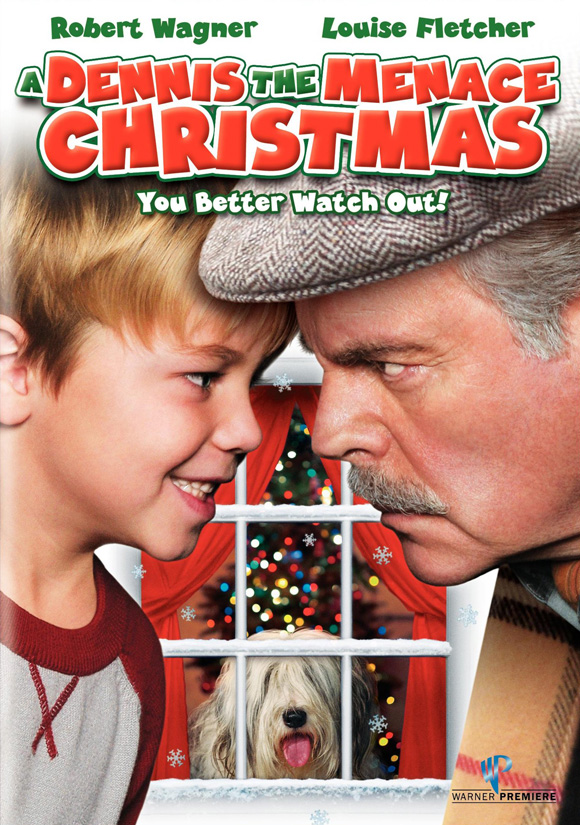 Director: Ron Oliver
Writer: Kathleen Laccinole
Cast: Maxwell Perry Cotton, Robert Wagner, Louise Fletcher, George Newburn, Kim Schraner, Isaac Durnford, Jake Beale, China Anne McClain, Heidi Hayes, Godfrey, Richard Notkin, Jack Noseworthy, Michael Lerner, Walter Massey, Elliott Larson
Notes: Dennis the Menace is one of those properties Hollywood periodically takes down from the shelf, dusts off, and tries again. This is technically a sequel to the 1993 Dennis the Menace film starring Walter Matthau as Mr. Wilson, although none of the original cast is in it as they’re all either dead or way too old to play the parts again. In this version, an encounter with Dennis (Maxwell Perry Cotton) has crushed any Christmas Spirit Mr. Wilson (Robert Wagner) has left. The Christmas Carol stuff doesn’t come in at all until the third act of the movie, where rather than multiple ghosts we get Bob the Angel (Godfrey), who handles the chores for everybody. In fact, for much of the film Bob’s presence makes it feels a little more like an It’s a Wondeful Life pastiche than a take on Dickens.
Thoughts: In case you’ve never read the comic strip or seen the previous movies, here’s Dennis the Menace in a nutshell: he’s a little boy who’s basically good-hearted, but has a propensity towards mischief and disaster. This causes no end of torment for his next door neighbor, retired mailman Mr. Wilson, who Dennis regards as his best friend. This is not a mutual feeling on Mr. Wilson’s part.
This time out the movie begins with the school’s Thanksgiving pageant, where Dennis’s parents Henry and Alice Mitchell (George Newburn and Kim Schraner) are a bit nervous he may wreck the whole thing. George Wilson and his wife Martha (Louise Fletcher) are also in attendance, and Mr. Wilson is even more terrified than the Mitchells that things are going to go haywire. Backstage, pushy stage parent David Bratcher (Jack Noseworthy) instructs his son Jack (Jake Beale) to do whatever it takes to get front and center for the show. Mr. Wilson’s concerns turn out to be correct and disaster strikes. As it turns out, David is an old rival of Henry’s and also the school’s insurance provider, and he points out the “Dennis Clause” in their policy, absolving his company from paying for any destruction caused by Dennis Mitchell. Geez, and Mr. Wilson is the Scrooge in this story? This guy really needs a comeuppance.
As Christmas approaches, Jack harasses Dennis and his friends outside a toy store. Dennis challenges Jack to a bicycle race to get him off his back, but he’ll need a new bike from Santa Claus to pull it off. Back at the Wilson’s house, Mr. Wilson refuses his wife’s pleas to decorate for Christmas. She – along with everyone in town – wishes for a little snow for Christmas, which we’re reminded multiple times hasn’t happened in 30 years, virtually guaranteeing a blizzard by the end of the movie.
Alice gets a part-time job wrapping presents at a department store, and Mrs. Wilson agrees to watch Dennis. When Mr. Wilson falls asleep, though, Dennis gets his hands on a stamp collection worth $10,000, which causes some real trouble for the Mitchells thanks to the aforementioned “Dennis Clause.” I have to admit, I put the blame on Wilson here – if you’ve got a trouble-prone 6-year-old and something worth $10,000 in the same house, you don’t take a nap.
Things get worse and worse, with one disaster after another happening until, on Christmas Eve, Mr. Wilson tells Dennis to go away and never come back and – just to twist the knife a little – says there’s no such thing as Santa Claus. This is the last straw, and he’s visited by Bob the Angel, who has actually been wandering around for most of the movie getting involved in Dennis’s various capers for no apparent reason.
Finally, 59 minutes into the 87-minute movie, Bob starts the Christmas Spiriting. He takes Mr. Wilson back to his childhood, where he’s reminded of his neighbor, Mr. Newman (Walter Massey). Little George (Elliott Larson) turns out to be as dangerous to Mr. Newman’s collection of model ships as Dennis was to Mr. Wilson’s stamps. In the present, he’s shown Henry and Alice tallying up how much money they owe Mr. Wilson for his assorted escapades and they realize they can’t afford to give Dennis much of a Christmas. In fact, they may have to move to a smaller house. Upstairs, Dennis rejects Christmas as “stupid.” When Mr. Wilson hears him saying “the s-word,” he breaks. He’s then tossed to a future where a boy shows up at the Mitchell house, trying to impart some Christmas spirit, but he’s rejected. Dennis – now an old man played by Richard Notkin — spent his whole life trying to get back the house he cost his parents, but never had time for any family or friends. He lives there, pathetic and alone. You can argue, pretty convincingly, that his is a fate worse than Tiny Tim.
When Dennis and the Mitchells wake up in the morning, there’s a new bike there courtesy of “Santa Claus,” and Mr. Wilson shows up to forgive the Mitchells’ debt to him and make up with Dennis. Mrs. Wilson wakes up to a fully-decorated house, because it was the one sin of Mr. Wilson’s that hadn’t been addressed yet. As for the bike race – Dennis actually loses. As it turns out, though, he throws the race – hearing Jack’s father shouting about losers, Dennis realizes Jack needs the win more than he does. The boys make friends, and predictably, the snow starts to fall.
The movie takes an interminably long time to get around to the Scrooge-ish stuff, and it goes through the whole thing (past, present, and future) in less than 15 minutes. It makes sense, I suppose. This isn’t a case like Disney or the Muppets, where the characters are going concerns that are simply being dropped into the classic story. This time around, the focus is more on trying to jumpstart a franchise, with a little Dickens thrown into the mix. Judged purely as a Dennis the Menace movie, therefore, it’s not too bad. The characters are simple enough, and Robert Wagner’s grumpy turn as Mr. Wilson balances things nicely to keep it from getting too saccharine. They take things a bit too far into the cartoony though, with Wagner’s face literally turning red and whistling as smoke hisses from some unseen edifice after Dennis ruins his stamps.
It’s also the kind of story that has virtually no suspense. The conflicts are all laid out in a cookie-cutter fashion and the film marches on directly towards the most obvious solution. You know it’s going to snow simply because it’s been 30 years since it happened. You know Mr. Wilson will forgive Dennis because he does that in every movie. You know Dennis is going to get his bike, and you know there’s a 99 percent chance Mr. Wilson is the one who’ll buy it for him. I know they’re not trying to make groundbreaking cinema here, but does that mean the movie has to feel so cut-and-paste? The only thing that comes as a surprise is when Dennis loses the race, and then there’s an added segment of heartwarming just to make up for it.
I give the film a little credit for self-awareness. At one point, Mr. Wilson turns on Bob saying, “I get it. I’m Scrooge, I need to learn my lesson.” That actually shows the power of Dickens, really. Even when a character is fully aware that he’s getting the Christmas Carol treatment, it still works.
The weird thing is, I probably wouldn’t have cared for this movie too much if I’d watched it by itself. As part 18 of a Scrooge-a-thon, though, it’s actually kind of a refreshing change of pace. So I guess what I’m saying is, if you really want to enjoy A Dennis the Menace Christmas, the best way to do that is to watch 17 other versions of A Christmas Carol first.
The first Reel to Reel study, Mutants, Monsters and Madmen, is now available as a $2.99 eBook in the Amazon Kindle store and Smashwords.com bookstore. And you can find links to all of my novels, collections, and short stories, in their assorted print, eBook and audio forms, at the Now Available page!
All New Showcase at the Movies: The Hobbit-The Desolation of Smaug
 Once again, I’ve released a movie review episode of my podcast, the All New Showcase. This time out, Jason, Kenny and I tackle The Hobbit: The Desolation of Smaug. In a (mostly) spoiler-free discussion, we talk about how the movie diverges from the book, how they feel about the additions to the original story, and their overall feelings about the film.
And what’s cool this week? Jason has been watching Gypsy Sisters, Kenny got a new toy from Japan, and I’m doing my annual re-read of The Autobiography of Santa Claus by Jeff Guinn.
All New Showcase at the Movies Episode 39: The Hobbit-The Desolation of Smaug
Scrooge Month Day 16: Oscar the Grouch in A SESAME STREET CHRISTMAS CAROL (2006)
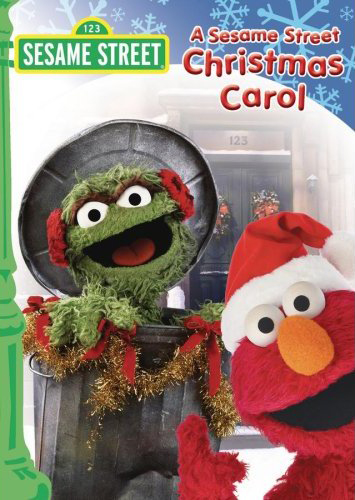 Directors: Victor DiNapoli, Ken Giego, Emily Squires, Jon Stone
Writers: Rickey Boyd, Jon Stone, Joseph A. Bailey, Christine Ferraro, Tony Geiss
Cast: Caroll Spinney, Kristin Chenoweth, Joey Mazzarino, Matt Vogel, Jim Martin, Tim Curry, Rickey Boyd, Kevin Clash, Jim Henson, Frank Oz, Pam Arciero, Fran Brill, Alice Dinnean, Eric Jacobson, Peter Linz, Noel MacNeal, Jerry Nelson, Carmen Osbahr, Martin P. Robinson, David Rudman, John Tartaglia, Steve Whitmire, Bryant Young, Carlo Alban, Alison Bartlett, Desiree Casado, Emilio Delgado, Will Lee, Loretta Long, Sonia Manzano, Bob McGrath, Roscoe Orman, Imani Patterson, David Langston Smyrl, Brian Gore
Notes: This is, of course, not the first time the Muppet characters have tackled A Christmas Carol, but sadly the Muppet Show Muppets and the Sesame Street Muppets are so far removed from one another these days that it almost doesn’t even matter. At any rate, this (much toned down) version of the Dickens story casts Oscar the Grouch as the most natural Scrooge since McDuck. New characters – all computer animated rather than traditional puppets – appear as the three ghosts. My favorite bit of this, though, is that the special uses footage from classic Sesame Street Christmas shows, thus allowing us to see performances from the likes of the late Jim Henson and Will Lee and the mostly-retired Frank Oz, all right alongside the modern cast of the show.
Thoughts: Tim Curry starts us off in his usual role as The Best Narrator In the World Assuming You Can’t Afford Morgan Freeman, and introduces us to an Oscar the Grouch (Caroll Spinney) who’s looking forward to sleeping through Christmas entirely. His plan is wrecked, though, when a messenger named Joe Marley (Joey Mazzarino) shows up with news. Marley is there to deliver Oscar the first of three Ghost-O-Grams, beginning with a vintage 1843 baked beans can. (1843, in case you didn’t know, is the year A Christmas Carol was first published. Cute.)
It hardly seems necessary to critique Caroll Spinney as Oscar the Grouch – he’s played the character for over four decades and he’s made him one of the most enduring childhood icons in the history of the world. Let’s instead just agree that Oscar as Scrooge is such an obvious idea that one wonders why they didn’t try it before and move on, shall we?
Rickey Boyd provides the voice for the first “ghost” – Rhubarb, the Grouch of Christmas Past. Rhubarb and Oscar agree to watch the old films of previous Christmases, even as they agree not to enjoy them, and we see the “Gift of the Magi” segment from 1978’s Christmas Eve on Sesame Street, which I wrote about last year. It’s a clever use of the old footage, something very few other versions of A Christmas Carol could even imagine, but it does raise an important question: what’s the point of all this? There hasn’t been any talk of “redeeming” Oscar the way Scrooge usually needs to be redeemed, and even if there was, this clip doesn’t even include him. Why is Rhubarb being sent to show Oscar heartwarming clips? Even Oscar asks this question, and Rhubarb doesn’t have an answer.
But you know what? It’s Jim Henson, Frank Oz and Will Lee, all together. I’m not about to complain about that.
In the next segment, we have an old musical number with Big Bird (Spinney again) singing about how he misses his best friend, Mr. Snuffleupagus, who’s away for Christmas. It’s a cute song, one I don’t really remember, which probably suggests this clip came some time after I grew out of the prime Sesame Street demographic. There’s not really anything to hint as to just when it was made. Once it was over, we cut back to Rhubarb and Oscar, laughing about how bad the clips are. Call me a racist, but this is the kind of typical Grouch behavior that has caused people to have certain opinions about them for decades.
Marley returns with the next Ghost-O-Gram. This time Oscar gets a jack-in-the-box that releases Christmas Carol (Kristin Chenoweth), a woman in a Christmas tree outfit, who decides to dress up Oscar’s trash can with a little holiday makeover. It gets worse for Oscar when she pops a Santa Claus hat and beard on him. Carol presents a contemporary segment featuring Sesame Street’s current cash cow, Elmo (Kevin Clash), on a visit to Santa’s workshop. Santa sings Elmo a song which can be summarized as, “Boy, it’s nice that you’re not a selfish jerk,” and we then spin off into another clip. This time, Elmo has somehow caused it to be Christmas every day, because he’s never seen a Christmas special before, and he sings a song explaining that Christmas is only special because it’s once a year. Oscar sarcastically quips, “Christmas every day is a bad idea,” as if he didn’t know that already. For once, Oscar, I’m with you.
Then, to ensure that Sesame Workshop maintained its educational grant, we get a couple of Muppet-free segments about Hanukkah and Kwanzaa.
The last Ghost-O-Gram introduces us to a flying robot named i-SAM (Kevin Clash), who is there to show Oscar Christmas Future. Instead of a Sesame Street clip, though, we get an animated segment in which we “tour” a future where homes decorate themselves, giant holiday dinners are reduced to pills, and families are whisked around in oversized Christmas tree ornaments. It’s a silly, charming little cartoon that fulfills the “Future” requirement in a decidedly non-frightening way. Oscar suddenly wakes up and sees it’s Christmas morning, and he’s being visited by Joe Marley again – only this time he claims to be “Little Joey Dickens from Brooklyn,” who tells Oscar all he had was a bad dream. He gives Oscar a present, though – a sticky ball of used wrapping paper – and all seems well. Especially since tomorrow is the best time of the year for a Grouch – the longest possible time until it’s Christmas again.
I don’t usually like stories that end with the “it was all a dream” conceit, but in a way it’s the only thing that makes sense here. There’s no real reason for Oscar to be visited by these ghosts, nothing changes, nothing actually happens in this film. It’s just an excuse to use a classic framing device to show old clips of the show. It’s not the worst premise in the world, but it feels like there could have been more than a little lip service given to Dickens in the framework. It’s cute, and it’s perfectly acceptable as a Sesame Street special, but remembering just how special some of those specials have been, it seems it could have been better.
The first Reel to Reel study, Mutants, Monsters and Madmen, is now available as a $2.99 eBook in the Amazon Kindle store and Smashwords.com bookstore. And you can find links to all of my novels, collections, and short stories, in their assorted print, eBook and audio forms, at the Now Available page!
Scrooge Month Day 15: ??? in A CHRISTMAS CAROL: SCROOGE’S GHOSTLY TALE (2006)
 Director: Ric Machin
Writer: Sean Catherine Derek, Charles Dickens
Cast: Tim Bentink, Brian Bowles, Theresa Gallagher, Adam Rhys Dee, Keith Wickham, Jo Wyatt
Notes: I’m trying to figure out where, exactly, I got this version of A Christmas Carol. I’m pretty sure it was on sale at Half-Price Books for a few dollars, and I got it because I’ve got a weird obsession with such things. Also, the DVD case has a liquid pouch with glittery “snow” in it, and I’m a sucker for such things. Anyway, this animated version of the story recasts the Dickens characters: the Scrooge family are skunks, the Cratchits are rabbits, and Marley is a Cricket. Past, Present and Future are a stork, a kangaroo, and a walrus, respectively. There are no voice actors credited for this movie either on IMDB or Wikipedia, which I’ve never seen before, and makes me wonder how exactly this short (48 minute) adaptation happened other than spontaneous combustion. There are credits at the end (which is where the above cast list came from), but the film doesn’t bother to tell you who provided each voice, so I can’t even help you there. One of the above people played Scrooge. I’m betting on Theresa Gallagher.
Thoughts: Another animated version of Dickens, this one with weak computer animation rather than weak traditional animation, it’s hard to qualify the film. This is a post-Pixar world, friends. This came out the same year as Cars and Monster House, but the quality of the animation isn’t even as sharp as that of Pixar’s earliest efforts. The animation is in computerized 3d, but the coloring is flat, like it’s trying to mimic a hand-drawn effect. I almost want to believe this was somebody’s student animation class project (made because you don’t have to pay for the rights to Dickens) that somehow got a DVD release.
We have a narrator and the characters are familiar, but the Dickens dialogue is thrown out the window immediately. Instead we’ve got super-greedy Scrooge berating Bob Cratchit over a missing farthing he’s too blind to realize is sitting on his own forehead until Fred arrives and points it out to him. The plot – for now at least – follows Dickens fairly closely. Scrooge is grouchy to Cratchit and grouchy to Fred and even blames his food for upsetting his stomach when Marley shows up. Speaking of Marley, the flaming cricket that plays the part shows even less animation than the rest of the cast. When he flails about on his chain, it looks like a toy on the end of a stick being waved around both willy and nilly.
When Christmas Past shows up, it appears first as Scrooge’s pillow, which scares the crap out of him. Cute enough. When she turns into a stork, though, she drops a joke about “pillow talk” that almost made me choke to death on the gingerbread M&M I was eating – not because it was funny, but because the filmmakers included such a (relatively) adult joke in the middle of a cartoon that, until now, seemed to be crafted to cater specifically to the 3-to-3 ½ year old demographic. Christmas Past whisks Scrooge to the past, where he sees himself and Sister Fan making the world’s ugliest snowman.
This time, for the first time in any version of the film, we see baby Fred. He’s not the cause of Fan’s death, but he is the cause of Scrooge’s isolation. Fan had promised Scrooge he could leave school and live with her, but with the baby there’s just no room for him. Young Scrooge storms out, not hearing Fan tell her baby how much she loves and misses her brother. Old Scrooge hears it, of course, but the whole thing rings pretty hollow, seeing as how these computer animated figures move at about the speed of a radio controlled car with a missing wheel. She could have caught up with him pretty easily.
Christmas Present hops onto the scene, a kangaroo, with an Australian accent because duh. At the Cratchit house we meet Tiny Tim, who isn’t even sick in this version. He still makes Scrooge feel like kind of a jerk, though, as he expresses a child’s love for the old miser.
Christmas Future, the walrus, is surprisingly funny. He sparks with red lightning and he has a broken tusk that looks like it’s been lashed together with a leather strap. And as he talks (yep, this one talks), his big jowls flap around over the tusks. His is actually the best animation in the entire film.
This is when the film goes off the Dickensian rails. Instead of dying, we see that Tiny Tim has grown up into an old, bitter codger just like Scrooge. This doesn’t seem to make any sense at all; there’s no motivation that seems in place to push Tim down that particular path. Then the movie actually makes a funny point when it gets to Scrooge’s death. In this version, Scrooge learns that he’s been crushed to death under the weight of his own gold. It’s goofy and ridiculous, and it actually entertains me for about five seconds before the character pushes it too far and changes the subtext into text by announcing Scrooge was killed by his own greed. You know. In case anybody didn’t get that.
So at the end, the Walrus of Christmas Future tells Scrooge to open his heart and he wakes up back in his own bed, and I realize with utter shock that there are still 15 minutes left in this movie. Considering how quickly everything has been rushed through, what could they possibly have to fill up that gargantuan amount of time?
Oh god. A musical number.
Scrooge starts to dance and sing about dancing and singing, informing everybody he meets that he won’t need another chance, which is swell, but the movie seems to have forgotten one of the primary rules of musicals. Namely, you need to have a musical number before the final reel of the film, or else it feels like it comes out of nowhere. Because it does.
Then there’s the last scene, which again departs from Dickens in a big way, as Marley reappears and tells Scrooge that he’s been set free from his eternal torment. Somehow, his concern for Scrooge has redeemed Marley as well. I have to admit, as deviancies from the classic go, I’m… I’m kind of okay with this one. I mean, it does somewhat undercut the notion that Scrooge had to change before it was too late, because evidently it’s never too late in this universe, but that’s not necessarily the worst message to take away from a story like this.
This isn’t a good version of A Christmas Carol, don’t get me wrong. The animation is terrible, the dialogue is weak and the song at the end is guaranteed to make you want to plunge a stake of holly through each eardrum. That said, it’s not the worst version I’ve watched either.
The first Reel to Reel study, Mutants, Monsters and Madmen, is now available as a $2.99 eBook in the Amazon Kindle store and Smashwords.com bookstore. And you can find links to all of my novels, collections, and short stories, in their assorted print, eBook and audio forms, at the Now Available page!
Scrooge Month Day 14: Kelsey Grammer in A CHRISTMAS CAROL: THE MUSICAL (2004)
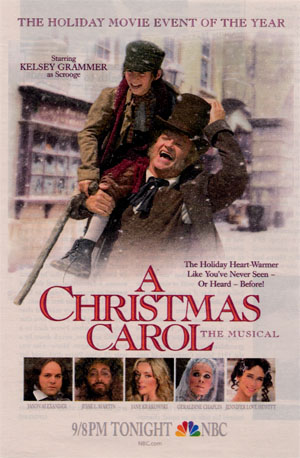 Director: Arthur Allan Seidelman
Writers: Mike Ockrent, Lynn Ahrens, based on the novel by Charles Dickens
Cast: Kelsey Grammer, Jesse L. Martin, Jane Krakowski, Jennifer Love Hewitt, Geraldine Chaplin, Jason Alexander, Brian Bedford, Jacob Moriarity, Julian Ovenden, Edward Gower, Steven Miller
Notes: Based on a stage musical from 1994 with music by Lynn Ahrens and Alan Menken, this was a pretty good adaptation starring Fraser star Kelsey Grammer and several other TV actors. It managed to win an Emmy award for Outstanding Music Direction, as well as picking up nominations in various other awards, including a “Grace Award” nomination for Grammer as “most inspiring television actor.” The film entered the cable rotation and is now pretty easy to find, usually on the Hallmark Channel, at this time of year.
Incidentally, the title of this one doesn’t bother me the way yesterday’s Christmas Carol: The Movie did. Sure, it’s not the first musical version of the story, but relatively few of them have been, whereas calling something “The Movie” after it’s been filmed a dozen times… geez, come on. I guess I’m still angry at that stupid movie.
Thoughts: As a card-carrying Christmas nerd (note to self: have cards printed) and a fan of Kelsey Grammar since his Cheers days, I remember being particularly excited when this made-for-TV film premiered. I don’t know if I’ve watched it in full since its first airing in 2004, but I’ve definitely seen parts of it, and I even have the soundtrack mixed in with my Christmas playlist. (You mean you don’t have a Christmas playlist? Weirdo.) Watching the film is like a return to an old friend.
The film opens in an odd place – a musical number as the people of the town cheer for the oncoming Christmas, until a typically Dickensian family arrives searching for Scrooge and hoping he’ll show leniency. Everyone considers it a laughable notion. Although the man’s wife has just died and his money went to funeral expenses rather than rent, Scrooge is more than ready to boot them out on the street the next day – Christmas. The music begins and I’m quickly impressed by the cleverness of the lyrics. Lynn Ahrens weaves a good amount of genuine Dickens dialogue into the songs, altering or adding to it just enough to satisfy the demands of rhyme and meter. As a result, we get music that sounds very fresh, but at the same time, still cozy and familiar when we realize we can anticipate many of the lines.
The movie is billed as “The Musical,” but it actually goes a good bit further than many stage musicals do. In almost operatic fashion, the bulk of the dialogue is sung rather than spoken. In weak musicals, the songs are incidental, crammed in-between plot points simply for the sake of having music. Great musicals use the songs to advance the plot and reveal the characters, which is what this one does. With its 97-minute running time, you could probably cut together every spoken line into less than ten minutes of video. The early moments all set up the rest of the film as well – music that will be echoed later, themes that are going to be woven into the narrative as the movie progresses. Taking a nod from The Wizard of Oz, the film also introduces us to the three actors who will play the ghosts early, each playing a person in need that Scrooge ignores and belittles on his way home from his counting-house.
Kelsey Grammar as Scrooge is a unique sight. I don’t know if he’s actually the youngest actor to have played Scrooge on this list, but he’s most certainly the youngest-looking, and as such he’s put under a gray wig and thick gray mutton chops that, combined with a squint, are intended to age him. It doesn’t exactly work, though. Grammar doesn’t look old, he looks like a young man playing an old man in a community theater production. (I should know, I’ve been a young man playing an old man in enough community theater productions myself.) His voice is wonderful – strong and booming, and he sings his songs with true power and ferocity. But after having listened to the music without watching the film for several years now, it’s hard for me to reconcile the image with the voice. Grammar’s makeup is just so goofy that I can’t separate the actor from the character, and that’s a shame.
Jason Alexander, best known from Seinfeld, suffers from a similar problem when he appears as Jacob Marley’s ghost. His makeup job is little better, topped off with wild hair and a good special effect when he touches Scrooge, but the pale pancake on his skin doesn’t quite extend to his eyes. Like Grammar, Alexander is actually a really talented actor and a remarkably good singer, but like Grammar, it’s difficult to get past the image of the character he played on TV for such a long time. His song, fortunately, is fantastic. “Link By Link” is a nice bit of self-damnation for Marley – chilling in a way that feels nicely theatrical. One could easily imagine this performance on stage, where the distance from Alexander would ironically make it easier to see the character instead of the actor. The inclusion of other, similarly-damned ghosts to serve as a chorus really ratchets up the intensity of the scene, and makes it more effective.
Jane Krakowski, another sitcom actor with either a very good singing voice or an excellent audio production team, turns up next as the Ghost of Christmas Past. Krakowski is dressed up like a teenage girl’s depiction of a pixie, which actually is a bit too young for her here, but she mostly pulls it off. With a nice flying effect, she whisks Scrooge off to the past, beginning with the imprisonment of Scrooge’s own father for nonpayment of debts. It’s interesting – several of the adaptations I’ve seen have decided to extrapolate backwards towards what kind of father Scrooge had, and although none of them have done exactly the same thing with the non-character, almost every version that has touched upon Scrooge Sr. has successfully imagined a father that could conceivably have pushed Ebenezer in the direction we all know he wound up going.
Jennifer Love Hewitt pops in as Scrooge’s sweetheart, Emily. (Again, what was wrong with Belle? I don’t know why it irritates me so much when they change the character’s name for no reason, but it does.) She sings a lovely duet with young Scrooge (Steven Miller), “A Place Called Home,” that really resonates for anyone who’s ever been young and in love. The warmth is chilled, though, when Grammar’s Old Scrooge interrupts the duet, singing along with the agony of a man who has squandered the promise of his young self. Before Christmas Past ends, though, we get a shocking dog-kicking moment we’ve never seen in another version of the story: in later years old Fezziwig (Brian Bedford) asks a slightly older, much more successful Scrooge for help, and Scrooge stabs him in the back. At this point, I’ve watched various Scrooges drop their versions of Belle and mistreat Bob Cratchit over a dozen times, it’ll take more than that to shock me. Scrooge callously tossing aside good Fezziwig really does it.
Jesse L. Martin steps up next as Christmas Present. Martin’s Ghost really kicks things up from the usual versions of the character. Rather than singing Scrooge his anthem (“Abundance and Charity”) while atop the traditional mountain of food, he whisks him into a theater where he performs with a troop of living nutcrackers in front of a live audience, then forces Scrooge into the show. Grammar really hams it up here, bumbling around stage as if he’s never been on one before and is, in fact, terrified at the very notion. From there, it’s off to the Cratchits, where Tiny Tim (Jacob Moriarity) begins the first of many, many choruses of “Christmas Together,” which will practically be this film’s unofficial theme song by the time it’s over.
Unlike most Christmas Futures, Geraldine Chaplin isn’t a faceless spectre. Instead, she’s a speechless one, who mimes at Scrooge as a chorus of undertakers sing a grim song as they go about burying his coffin. The scene quickly shifts to Tiny Tim’s grave, where Bob Cratchit is singing a goodbye to his son. Seeing them lay Tim’s crutch on the wooden grave marker really is a powerfully sad moment, one that propels us right into the finale, as Scrooge sees his own tombstone and realizes that he will be left “scorned and unmourned.”
As much as I poked fun at Grammar’s makeup as the film began, by the end of it I wasn’t paying attention to the mutton chops anymore. His performance really is quite good, and the music in this film is wonderful. Ahrens and Menken created a sound that was very much in keeping with the tone of the original novel, stirring the heart and reminding us – as it reminds Scrooge – of the true meaning of the Christmas season. By the end, as a chorus of children and his late loved ones surround Scrooge in the cemetery and begin singing “God Bless Us Everyone,” we’ve completely bought in and we’re part of the jubilation Scrooge feels moments later when he wakes up in his own bed. His transformation made even more convincing as Grammar straightens up his posture and loses the perpetual scowl he’s worn for the entire film: he’s gone from Clark Kent to Superman. Y’know, if Clark Kent had been a raging jackass in the first place.
Anyway, Scrooge encounters the “Spirits” again, once more in the mortal forms they wore as the film began, and they dance off with a palpable sense of self-satisfaction as Scrooge rushes off to the Cratchit house to hoist Tim on his shoulders for a final rendition of “Christmas Together,” a song I’ve heard – at this point – approximately seven thousand times and damn it I promised myself I wasn’t going to get teary-eyed at this this time. Stupid beautiful music.
The best Christmas Carol? Probably not. The best musical version? Eh, it’s hard to beat the Muppets. But for a made-for NBC special starring (mostly) NBC stars, it’s pretty darn effective. I said at the beginning that it’s been quite a while since I watched this one, but I now realize I’ve got to work it back into the regular rotation.
The first Reel to Reel study, Mutants, Monsters and Madmen, is now available as a $2.99 eBook in the Amazon Kindle store and Smashwords.com bookstore. And you can find links to all of my novels, collections, and short stories, in their assorted print, eBook and audio forms, at the Now Available page!
Scrooge Month Day 13: Simon Callow in CHRISTMAS CAROL: THE MOVIE (2001)
 Director: Jimmy T. Murakami
Writer: Piet Kroon, Robert Llewellyn, based on A Christmas Carol by Charles Dickens
Cast: Simon Callow, Kate Winslet, Nicolas Cage, Jane Horrocks, Michael Gambon, Rhys Ifans, Juliet Stevenson, Robert Llewellyn, Iain Jones, Colin McFarlane, Beth Winslet, Arthur Cox, Keith Wickham
Notes: This film, produced by the British Pathé Films and released on DVD by MGM in the United States, is among one of the more critically-reviled versions of the story. Despite an all-star voice cast, including Nicolas Cage, Jane Horrocks, Michael Gambon and Kate Winslet (who also sang the film’s theme “What If?”), it got lousy reviews in its theatrical release overseas and was largely ignored in America. But you know, you’ve gotta give the filmmakers credit for having the audacity to give this production the title Christmas Carol: The Movie, as if all the dozens of other versions that came beforehand weren’t actually movies at all, but rather live performances, interpretive dances, brands of licensed underwear or dried fruit snacks… anything but “a movie.” Really.
Thoughts: Although some releases of this movie feature a live-action bookend with Simon Callow as Dickens reading his book to a group of children, the DVD release I have cuts straight to the animation, which looks like it was done by a better-than-average Flash artist. (Which is to say: it’s still pretty bad.) But rather than starting with Scrooge or Marley or… y’know… anything recognizable, things kick off with Dr. Lambert (Arthur Cox) being arrested for his debts and leaving his wards – an entire hospital of what I have to assume are orphans – without any hope, as Lambert’s debt has been transferred to the offices of Scrooge & Marley.
As it turns out, the woman left in charge of the orphans (Kate Winslet) is Belle, an old acquaintance of Ebenezer Scrooge (Simon Callow again). She writes a personal letter pleading for mercy, which she delivers to an uncharacteristically unsympathetic Bob Cratchit (Rhys Ifans). It takes almost 15 minutes (in a movie that lasts 77) before we get to something that resembles the Dickens novel, as Fred (Iain Jones) shows up to beg his uncle to come to Christmas Dinner. The Fred design here is awful – ragged and wearing a thin cap, looking more like a waif out of Oliver Twist than Scrooge’s fairly well-off nephew.
Then we watch mice play in a bucket. Why are we watching mice play in a bucket?
I have no flippin’ clue what Kroon and Llewellyn were trying to do with this script. If I didn’t know this was a British production, I would think this was the result of Hollywood filmmaking-by-committee. Some yutz in a boardroom says he doesn’t get the story or he thinks it needs more of a hook so the audience can relate to the characters or some other stupid comment that makes you think he knows better than Charles Dickens how to tell this story, and the next thing we know we’ve got an entire hospital full of kids about to freeze to death and a couple of mice sidekicks. Then, just to make Scrooge a little more evil and to make the stakes in the story a little more personal, Scrooge dumps the bucket of water out the window right on Tiny Tim’s head, in the freezing cold. You can probably guess where this is going.
Nicolas Cage plays Marley’s Ghost, which is a bizarre choice. You cast Nicolas Cage in a movie for one reason and one reason only: so that everybody knows you cast Nicolas Cage. But the reading he gives Marley’s lines doesn’t even sound like Nicolas Cage, and by that I don’t mean that it’s not wild or crazy like many of his roles are, I mean it literally sounds like somebody else performed the voice. If I wasn’t staring at the IMDB page I wouldn’t have thought it was –
–why in the hell are the charity workers showing up after Marley’s ghost? Scrooge’s redemption was supposed to have already begun, having him denying Marley at this point is just stupid. Before everything could be chalked up to Scrooge’s greed, but once he’s already been told he has to change and he keeps rambling on about decreasing the surplus population, he just starts to sounds like an idiot.
And why are the mice riding in his pocket? Dear God, they’re going to subject us to those things for the entire movie, aren’t they?
Anyway, off to the Cratchit house, where Tim (who doesn’t appear to be crippled in this version) is exhibiting the Cough of Death, no doubt because Scrooge himself doused the kid with water, because it wasn’t enough that he was just neglectful. Nope, he had to actively murder the child. We’re 26 minutes in and I hate everyone involved with this movie.
Back in his room, the same Ebenezer Scrooge that just fatally soaked a little boy and callously refused to give money to the poor finds the mice in his pocket and cheerfully agrees to share his gruel with them, because the writers of this movie tore the page of their dictionary with “characterization” on it out when they ran out of toilet paper one day. Just as he’s nodding off, Jane Horrocks shows up as a Candle-like Christmas Past that fluctuates inexplicably between a child and a ghoulish old woman. We go from there to Schoolhouse Scrooge on the day his sister picked him up from school and introduces him to her best friend: Belle! Because nobody would believe it if he met her at Fezziwig’s like in every other version of the story.
I feel like I need to say something here: I’m not opposed to minor changes in the story in principle. If there were no changes from one version to another it would be sheer lunacy to even make another one. But I do insist that those changes make sense or bring something to the story that other versions do not. Having Scrooge meet Belle as a child doesn’t change anything. Having her present to watch his father dress him down doesn’t improve the story. The subplot with the hospital is utterly superfluous to the point Dickens was making about a man’s redemption – if anything it weakens it, because instead of doing good for the sake of goodness, now we have to wonder if Scrooge’s later good deeds all come as a result of him feeling guilty over how he treated Belle or, even worse, holding hopes of some sort of reconciliation with her.
And the damn mice. Add. Nothing.
And before we leave the past we see the reading of Scrooge’s father’s will, where he gives everything to Scrooge and leaves a pregnant Fan out in the cold and about to die, which Scrooge is perfectly happy to allow to happen. Then, in a move that would make Sheldon Cooper proud, he presents Belle with a “marriage contract” before she walks out on him. This movie strives to make Scrooge and everyone in his world as miserable and heartless as possible, except for when it comes to giving mice food. But by the time Christmas Present shows up we don’t even want Scrooge to be redeemed anymore, we want him to die of typhoid and get buried at the bottom of the river.
Michael Gambon is our Christmas Present, and he at least feels true to the character, showing Scrooge his feast and talking about giving it out in the spirit of love. Unfortunately, the filmmakers choose to waste our time showing us the mice eating a pie instead of focusing on the ghost. He flies around, showing off people making merry in a sequence that looks hand-drawn in a way that would actually be kind of charming if the rest of the animation was adequate and therefore serving as a real contrast.
Christmas Yet to Come is a similarly poorly-animated apparition, waving his arms around at a rate of four seconds per frame to show Scrooge the aftermath of Tim’s death (which, in case we forgot, Mrs. Cratchit directly attributes to him). Marley shows up to tell Scrooge he’s dead, then he wakes up alive. Ebenezer Scrooge has been redeemed, but as someone forced to watch Christmas Carol: The Movie, I have officially lost all hope.
Anyway, because the screenwriters added a completely useless subplot, as the redeemed Scrooge walks around town, Belle weeps over her empty hospital. Scrooge takes the blood money he got for foreclosing on the place and gives it to a homeless guy, because lord knows Belle couldn’t use it at this point, and then starts wandering the city aimlessly. When he gets home, Belle shows up and chews him out for closing the place down. He begs forgiveness from her and she tells him it’s not too late, which of course begs the question of why she was just dressing him down instead of asking him for help. Dr. Lambert is let out of prison and sent to treat Tiny Tim, Bob Cratchit gets his raise, the damn mice ride around on Scrooge’s shoulder and I resist the urge to club a puppy over the head. The end.
The good news is that, thanks to this film, An All Dogs Christmas Carol only had to keep the title of “worst adaptation” for a mere three years. The bad news is that this version even exists. I used to think the worst thing a version of A Christmas Carol could be was forgettable. Now I’m afraid I’m going to remember this one because of how stupidly bad it actually is.
Also, buy mouse traps.
The first Reel to Reel study, Mutants, Monsters and Madmen, is now available as a $2.99 eBook in the Amazon Kindle store and Smashwords.com bookstore. And you can find links to all of my novels, collections, and short stories, in their assorted print, eBook and audio forms, at the Now Available page!
Scrooge Month Day 12: Sir Patrick Stewart in A CHRISTMAS CAROL (1999)
 Director: David Hugh Jones
Writer: Peter Barnes, based on the novel by Charles Dickens
Cast: Patrick Stewart, Richard E. Grant, Joel Grey, Ian McNeice, Saskia Reeves, Desmond Barrit, Bernard Lloyd, Dominic West, Laura Fraser, Ben Tibber, Rosie Wiggins
Notes: In the 90s, Sir Patrick Stewart performed a one-man stage version of A Christmas Carol, which garnered great acclaim for several years. The TNT Network, recognizing a good thing when they see it, then produced this film starring Stewart as Scrooge. Stewart got a Screen Actors Guild nomination for best actor in a television movie or miniseries and both the movie and Stewart were nominated for Saturn Awards, the big prize for science fiction and fantasy. It’s a very straightforward version of the story, with the inclusion several scenes from the novel that many adaptations omit.
Thoughts: Patrick Stewart rarely fails to bring the Awesome, let’s be honest. Even when he’s in a bad movie, he’s typically the bright spot in a miasma of mediocrity, and here I am specifically thinking of X-Men: The Last Stand. So it’s not surprising that in this made-for-TV movie, he puts forth a Scrooge every bit as powerful and definitive as Alastair Sim or Albert Finney.
This film kicks things off with Marley’s funeral, a spot adaptations don’t cover that often, and from the start we see screenwriter Peter Barnes trying to bring in some of the Dickens language into the film. Although there’s no narrator as in the Muppets film, here we have some of the narration dropped properly into the mouths of Scrooge and others – the opening diatribe about why a doornail is considered particularly “dead.” When reading the book, that tangent in the first paragraph of the first page has always felt a bit odd to me. Here, it serves to show the mundane way Scrooge treats the death of his partner and sole friend. Much of the dialogue is verbatim Dickens, and Stewart delivers each line with the power and certainty that always drips from his voice.
In the opening scenes we see that this isn’t a Scrooge that explodes in anger or mocks those foolish enough to entreat him for donations to the poor. Stewart’s Scrooge is rather quiet and subdued. Even when he threatens a caroler with a beating, his voice doesn’t raise above the level of a bitter growl. Even in his quiet moments, though, Stewart is perhaps the most intimidating Scrooge we’ve met yet. So often Scrooge is portrayed as a feeble old man. Here he moves with weight and rage that is almost visible around him
TV or no, this Christmas Carol has some of the most impressive special effects we’ve seen yet. Bernard Lloyd appears as Marley’s ghost: he has a spectral form, his hair constantly shifting as though blown by a breeze that doesn’t affect anything else in the room. At one point his jaw falls open in a rather hideous sight that probably gave the willies to a few kids watching this. On a performance level, this gives us the chance to see Scrooge interacting with that rarest of things for him – an equal. He speaks to Marley with a casual familiarity that we didn’t see as he spoke to Bob Cratchit (Richard E. Grant) or his nephew Fred (Dominic West). Even now, before his redemption has begun, we see that Stewart’s Scrooge is more layered than most of those who came before him.
Joel Grey’s Christmas Past is perhaps my favorite of the human actors to portray the part. He has a light air about him, and constantly stands bathed in light. It’s a twist on the “candle” conceit that many versions go with, and it suits him nicely. He comes across as a little patronizing towards Scrooge, which the old codger sort of deserves at this point in the story. As Scrooge starts to feel the effects of his own past, such as when he sees his sister (Rosie Wiggins), we see the Ghost’s smile change from one of condescension to pride that he’s having the proper influence already.
I haven’t said much about the assorted Fezziwigs in this project, because there’s rarely much to say. He’s the jolly shopkeeper Scrooge apprenticed under, he throws a slammin’ Christmas party every year, but he doesn’t have too much to do. Ian McNeice, however, really steals his scene this time around. The man brings so much joy and energy to the screen that you want to watch a whole special about him. Even his musical number plays the character as a sweet, good-hearted ham, like everybody’s goofy uncle that makes the same lousy jokes at every Christmas dinner, but you love him and you love them and it just wouldn’t feel like Christmas if they were missing. Even Scrooge himself defends the man with a real ferocity when Christmas Past dares to disparage him. Somebody at TNT take note, if McNeice is available and amenable, I want to watch A Very Fezziwig Christmas next year.
Next it’s Desmond Barrit’s turn as Christmas Present, complete with the green robes and holly wreath. Barrit is a more low-key than most Presents. He’s not loud or bombastic, and in fact he seems almost sluggish as he walks around sprinkling his “milk of human kindness” onto the food of the poor. He doesn’t have the judgment of Scrooge in his voice that many people do, but rather a profound sadness. I’ve got to say, much as I like this version of the story, I’m not really keen on Barrit’s ghost.
Christmas Yet to Come here is a shadowed figure with glowing embers for eyes. Of the ghosts in this film, though, it’s also the least convincing. The unaltered, human hands that reach out from beneath the robes to point Scrooge around are somewhat jarring, and only further serve to make you feel like you’re looking at a guy wearing a false head on top of his own like a theme park costume. The other ghosts, including Barrit’s, all have a sufficiently otherworldly (or at least Dickensian) look to them. Christmas Yet to Come looks like something a moderately-skilled cosplayer puts together on his weekend off.
Fortunately, the rest of this sequence is considerably more effective. Scrooge’s pain when he realizes he’s watching the results of his own death comes across perfectly, with Patrick Stewart agonizing over the idea of looking at his own body and asking to see emotion connected to his death. From there we cut to a young couple rejoicing in that they’ll have time to get the money to pay their mortgage now – not exactly what Scrooge had in mind. The scene in the Cratchit home is a real gut-punch, as Bob talks to Tiny Tim’s body, still lying in his bed. It’s rare we actually see the dead child – most adaptations show Bob coming home from the cemetery or visiting the grave. Something about seeing him lying there makes the scene all the more heartbreaking.
The Redeemed Ebenezer Scrooge at the end, like the bitter one at the beginning, is also a little subdued. Stewart doesn’t simply explode out of his bed, but he goes through some really clever ticks – touching his hand to make sure he’s corporeal, choking a bit before he remembers how to laugh and finally spinning into a man wrapped up with joy. Maybe my favorite bit comes when he asks the passing child to go and buy the turkey for Bob Cratchit, he actually has to take a moment to force out his newfound generosity. He’s made the decision to change, but just for a second we get a reminder that old habits die hard. Once he hands over the first few coins to the child, though, it’s like the dam has burst – he gives the man with the turkey extra money for a cab, walks through the streets depositing coins in the cups of beggars, and even engages the children in a snowball fight. He has to push the wall down, but when it’s down by God it stays down. Even then, though, it’s hard for him to knock on Fred’s door, and he almost passes by entirely. He’s willing, but ashamed at his past, and he has to overcome it. Bless ya, Sir Patrick, for making Ebenezer Scrooge a real human.
Although this isn’t the best adaptation of the novel (as I said, the latter two ghosts were really quite weak), most of the performances are pretty good, and Patrick Stewart puts out one of the finest performances as Ebenezer Scrooge I’ve ever seen. It’s worth watching this movie for him alone.
The first Reel to Reel study, Mutants, Monsters and Madmen, is now available as a $2.99 eBook in the Amazon Kindle store and Smashwords.com bookstore. And you can find links to all of my novels, collections, and short stories, in their assorted print, eBook and audio forms, at the Now Available page!
Scrooge Month Day 11: Carface Carruthers in AN ALL DOGS CHRISTMAS CAROL (1998)
 Director: Paul Sabella, Gary Selvaggio
Writer: Jymn Magon, based on A Christmas Carol by Charles Dickens
Cast: Ernest Borgnine, Dom DeLuise, Sheena Easton, Taylor Emerson, Bebe Neuwirth, Charles Nelson Reilly, Steven Weber, Dee Bradley Baker, Ashley Tisdale
Notes: This TV movie was the third and (so far) final film in the All Dogs Go to Heaven series, and also followed the popular TV show based on the films. In this version the evil dog Carface (Ernest Borgnine) harasses other dogs for bones and money and the like just before Christmas, prompting Charlie (Steven Weber) to re-enact A Christmas Carol in an attempt to set him straight: Itchy (Dom DeLuise) becomes Christmas Past, Sasha (Sheena Easton) Christmas Present, and Charlie Himself becomes Christmas Yet to Come. I’ll be honest, I’ve never seen an All Dogs Go to Heaven movie or TV show before, so other than the fact that it’s about dead dogs, I really don’t know what to expect. The only reason I even own this film is because it was included in a pack of animated Christmas movies on DVD I got a while back, so reviewing it will be an experience.
Thoughts: The film has a cute enough framing sequence – puppy angels (try not to let the obvious implications of that be depressing) ask the angel Annabella (Bebe Neuwirth) for a story, and she tells about how her favorite dogs once stopped her evil cousin Belladonna (Neuwirth again) from ruining Christmas. As the film shifts from Heaven down to a San Francisco decorated for the holidays, it’s clear from the production values that this was created on a TV budget. I try not to hold that against the movie – after all, so was the Flintstones special four years earlier – but the animation is really stiff compared to many of the other animated versions of A Christmas Carol we’ve watched. I also have to deduct points for an obvious “Santa Paws” joke in the first five minutes.
Despite the notes at the beginning, the film takes a long time to get to the actual Christmas Carol content, going through this long opening slog in which Belladonna plans to hypnotize every dog in the city with a giant dog whistle or… or something like that. I’ve got to admit, my attention started to wander, because this most definitely is not a movie for me. Eventually, Annabella gives Charlie a magic amulet that allows him to pull the Dickens bit on Carface, with Charlie sort of taking on the Marley role to introduce the segment. It’s here that the Carface character finally gets some (and by some I mean “any”) depth. The trip to Christmas Past shows Carface as a puppy, loved by a child but put out into the cold and rain one Christmas. It’s about as sad a sight as I’ve ever seen in animation, actually, a pit bull with a beanie propeller walking away from a kid who used to love him.
Christmas Present grinds the movie to a halt with a lame villains song about how the big bad and the minion have differing feelings about Christmas. The whole time I listened to it, I kept thinking that Bebe Neuwirth deserved better. Anyway, eventually Sasha gets around to showing Carface little Timmy, a puppy with a lame leg who was among the dogs he robbed earlier in the movie. (I suspect Timmy was NOT a regular on the TV show.) As it turns out, the money Carface stole was earmarked for a life-saving operation for Timmy, and although the puppy shows heart, he doesn’t have any sort of physical prowess. This is the first version of the story where we get an actual direct link between “Scrooge” and Tim’s death – most of the time it’s just implied that the Cratchits couldn’t afford decent medical care because of Bob’s low wages. Here there’s no denying it’s entirely Carface’s fault.
Then a boring reprise of the boring song that started Christmas Present. Ernest Borgnine – you were great, but if Bebe Neuwirth can’t make the song fly, you don’t really have a chance.
In Christmas Future, we skip the usual preliminaries where Scrooge doesn’t know who they’re talking about and go straight to Carface’s cronies talking about how glad they are to be rid of him. It’s a surprisingly edgy way to approach the subject. Then Charlie kicks off a musical number that parodies – of all things – The Mask to show Carface he’s going down to Hell if he doesn’t change his ways. Which, now that I think about it completely contradicts the title of the franchise. Actually, if all dogs go to Heaven, what incentive do dogs have to behave? They’re going to Heaven anyway, right? Either the title is lying or there’s a huge cosmic loophole here. I’m really giving it far more thought that it deserves, but it’s that or give my complete attention to this lousy musical number, so I’m going to stick with the pontificating for a bit. Christmas Future ends with Carface realizing he was a heel for helping her in her evil scheme and setting out to stop her. Which he does, of course, because kids’ movie. And at the end he gives back everything he stole and Timmy lives and I check my blood sugar levels because I’m afraid they’ve gotten dangerously high.
I like good all-ages movies, ask anybody, but I think the mistake a lot of people make is that by assuming you’re making something for a children’s market means that it’s okay to make something that fails as entertainment for everybody else. To put it another way: when a Christmas-loving musical theatre nerd like myself wants to start fast-forwarding through every song in your movie, you have done something wrong.
There are numerous shows and movie throughout history that prove this simply doesn’t have to be the case: the Looney Tunes, the Flintstones, the Muppets, Animaniacs, Phineas and Ferb and the entire Pixar library come to mind. That makes me considerably less forgiving of a film like this one, where the jokes are stale, the songs are weak, and the animation stodgy, because the creators just assumed nobody over the age of 8 was going to watch it. The thing is, it’s the franchises that do have that crossover appeal that turn out to be long-lasting and classic. I still look forward to the Muppet and Disney specials every year. I don’t remember the last time I heard anyone mention All Dogs Go to Heaven.
I do give the film credit in one instance – although we’ve thrice seen films about characters performing A Christmas Carol, this is the first one we’ve gotten where the characters deliberately invoke Dickens in order to effect change in someone who needs to learn a lesson. I’ve read a few stories based around that trope in books and comics (my personal favorite is Teen Titans #13 from 1967, “TT’s Swingin’ Christmas Carol” for you cool cats in the know), but for such an obvious idea, precious few movie adaptations have activated it.
My unfamiliarity with the property kind of kills my enjoyment of it. This movie builds on character relationships established in two prior movies and a whole TV series, and as I haven’t seen any of them, I feel like I’m left out of the joke. I get why this was the finale, though – it essentially ends with the redemption of (I assume) the primary villain of the TV show, which isn’t exactly something you can do during the run of the series without altering the dynamic dramatically, and an after-school kids’ show circa 1998 wasn’t about to take that sort of chance while it was still on the air. As it is, all I can really say is that the film is at best serviceable and inoffensive, but unless you’re already a fan of the franchise, it’s just not going to do it for you.
The first Reel to Reel study, Mutants, Monsters and Madmen, is now available as a $2.99 eBook in the Amazon Kindle store and Smashwords.com bookstore. And you can find links to all of my novels, collections, and short stories, in their assorted print, eBook and audio forms, at the Now Available page!
Scrooge Month Day 9: Michael Caine in THE MUPPET CHRISTMAS CAROL (1993)
 Director: Brian Henson
Writer: Jerry Juhl, based on A Christmas Carol by Charles Dickens
Cast: Michael Caine, Dave Goelz, Steve Whitmire, Jerry Nelson, Frank Oz, David Rudman, Don Austen, Jessica Fox, Robert Tygner, Steven Mackintosh, Meredith Braun, Robin Weaver
Notes: The early 90s were a rough time for the Jim Henson Studio. After Jim died in 1990, there was a serious doubt in the minds of many that the Muppets could go on. But before his death, Jim had begun working out a deal with the Disney studio to produce more Muppet films, with one of them being an adaptation of A Christmas Carol. After Jim died, his characters were passed on to other performers. This was the first theatrical production for the Muppets after Jim’s passing, and the film is dedicated to him and Muppeteer Richard Hunt, who died in 1991. Although a musical and mostly comedic, this is a pretty faithful adaptation of the original novel, with Michael Caine playing Scrooge, new Muppets created for the three ghosts, and classic Muppets filling most of the other roles. Statler and Waldorf played Jacob and Robert Marley (rimshot), Fozzie Bear became Scrooge’s old boss Fozziwig, Sam the Eagle was Scrooge’s headmaster in school. Most notably, we got Kermit the Frog and Miss Piggy as Bob and Emily Cratchit and Kermit’s nephew Robin as Tiny Tim. The film’s stroke of genius, something that gives it an added dimension of fun, is casting the Great Gonzo as Charles Dickens himself, and allowing him to act as narrator, with additional commentary by his oft-time sidekick, Rizzo the Rat.
Thoughts: Not to put too fine a point on it, but this may well be my favorite version of A Christmas Carol. Yeah, there are probably better films, but something about this one works for me. Maybe it’s the amazing music by Paul Williams (who also wrote the songs for the original Muppet Movie). Maybe it’s the silly charm that I still feel when I see humans and Muppets walking around a set together as if there was nothing unusual about that at all. Maybe it’s because this is the movie that, in many people’s hearts, proved that the Muppets could survive after Jim Henson was gone. Whatever the reason, I love The Muppet Christmas Carol like I do few other Christmas movies.
Michael Caine is, of course, an acting legend. He’s done amazing work in dozens of fine films, such as Jaws: The Revenge, which made him the logical choice for Scrooge. His Scrooge starts out as bitter as any, but he has a quality of containment about him. He’s mean and angry, but even in the first scene you get the sense that his greatest degree of hatred is turned inward. He seems like a man ready to explode, and few people present that quality as clearly as a man who is keeping everything inside. When the film ends, when he lets his emotion finally free, it’s not anger but happiness that explodes into the old town. For all his lively parading through the streets, though, nothing serves to illustrate his reformation as well as the quiet moment where he approaches the charity collectors (here played by Dr. Bunsen Honeydew and his assistant Beaker) to give them a generous donation. Bunsen is speechless, but Beaker (always speechless) finds a way to express his gratitude: giving Scrooge the scarf from around his neck. The surprised look on Caine’s face makes you believe it’s truly the first Christmas present he’s ever been given.
This wasn’t Steve Whitmire’s first time playing Kermit the Frog, but it was here that he really had to prove himself. The simple kindness and sincerity of America’s favorite amphibian was perfect for Bob Cratchit… but it wouldn’t necessarily have been all that funny in and of itself. The solution was to surround him with Muppet rats who alternately support him and sell him out when Scrooge bellows. It’s a funny juxtaposition, and when he’s paired off with Miss Piggy (Frank Oz) for the scene in the Cratchit home, her overbearing personality plays off of him in much the same way. Whitmire has had the Kermit job ever since. He acquitted himself well.
At one point, the plan was to use existing Muppets to play the three ghosts, but the filmmakers decided it would detract from the seriousness of the story. Instead, we got three all-new Muppet creations. Christmas Past is a softly floating, ethereal puppet that looks like a bizarre combination of elf and child, glowing and floating. In fact, the performance was filmed in a tank of water to give it the sort of weightless effect they wanted, then greenscreened onto the film. For such a simple effect it’s remarkably effective, giving the ghost an ethereal quality that truly makes it look like it belongs to a different world than our own (or even an alternate version of our own where Muppets coexist with humans). Jessica Fox’s Ghost takes Scrooge on the traditional trip through his past – the joy as he left school and went to Fozziwig’s Christmas party, the heartbreak of losing Belle (Meredith Braun) when she realized he loved his money more than her. The song they sing together is devastating – she sings “The Love is Gone” with fresh sadness, while behind her Michael Caine joins in. Near the end she turns back and, just for a second, you think she’s going to acknowledge the older Scrooge… but she doesn’t. She can’t hear or see him, of course, but the audience sees the agony in his face – the pain of a man forced to relive the greatest mistake of his life.
Christmas Present is presented in a form much in keeping with other versions. He’s huge, of course, but cloaked in the traditional green robe with a holly wreath and a long red mane of hair. There’s a nice tick they give the character, though – being the Ghost of Christmas Present, he has a difficult time focusing on the future or remembering the past, and frequently repeats himself. Throughout his segment, as he and Scrooge get closer and closer to the end of Christmas Day, the Muppet grows visibly older. At the end, he’s practically ancient, and vanishes with the wind. It’s a brilliant effect that gives a nice subtext to the movie. We’ve already seen that the Past is forever, and Present reminds us the now is transient. But what’s coming next, the future… that can still be changed.
Caine sells the present scenes very well. When he realizes he’s the butt of the joke at Fred’s family party, there’s genuine pain on his face. The scene at the Cratchit family house invites a few uncomfortable questions about a world where frogs and pigs are genetically compatible, and are exclusively male and female, respectively. You forget those things when Tiny Tim launches into his song, “Bless Us All.” This part improves on many versions of the story. So often, you just see Scrooge look upon Tim and start to feel bad for him… his transformation is brought on more from pity than anything else. But here, as Tim sings his song you get an impression of just how good and pure a soul he is, and when he starts to cough Scrooge’s change of heart is no longer that of a man who simply feels bad for a sick child, but a man grieving for a world that will be deprived of such light.
The Ghost of Christmas Yet to Come, even in Muppet form, is a sight to behold. Although not quite the skeletal figure he sometimes is, he’s got your standard robe and large, oversized hands that make it look like Michael Caine is being escorted by something wholly inhuman and terrible. This segment goes pretty quickly, rushing from one scene of terror to another before they get to Scrooge’s tombstone. Once again, Caine proves himself, begging for his chance to change in a way that makes you believe in him, believe it’s possible to change, maybe even regain a little of your overall faith in the human race.
Surrounding the whole film is Gonzo as Charles Dickens. His antics with Rizzo provide added energy and comedy in scenes that traditionally aren’t that funny – when Scrooge holes himself up in his mansion before encountering the Marleys, for example. Gonzo is smart enough to know when to keep quiet, though, and in fact the characters make a show of running off and hiding just before Christmas Yet to Come pops in, then make a grand return for the finale. Using him as a narrator also allows this film to layer in much of Dickens’s beautiful prose that rarely makes it to screen, as it’s not dialogue. For that reason alone, that helps this stand as one of the most surprisingly faithful adaptations of the book I’ve ever seen.
I mentioned Paul Williams’s music before, but it’s certainly worthy of its own paragraph. The opening song, “Scrooge,” is somehow gloomy and peppy at the same time – a snappy number about a miserable man. It perfectly encapsulates the character, even giving a hint that there may be goodness within him somewhere (although the Muppets quickly dismiss that notion). Kermit and Robin later sing “One More Sleep ‘Til Christmas,” a lovely, happy song that’s worth singing every Christmas Eve. But the crowning gem is Christmas Present’s number, “It Feels Like Christmas.” There’s something undeniably joyous about the song, something that clutches the heart and the ear so tightly that it bubbles out of me at random moments in the middle of July.
Fair warning, though – the theatrical release of the film and some of the subsequent DVD and Blu-Ray editions left out the duet between Scrooge and Belle, “When Love is Gone.” Disney thought it slowed down the film too much, but when left out it kills the emotional impact of the scene, and furthermore hurts the finale, which contains a counterpoint mixed with “It Feels Like Christmas.” My DVD, fortunately, includes it, and I’d never upgrade to a Blu-Ray that leaves it out.
If you haven’t seen this version of A Christmas Carol before I can only presume that you hate the Muppets, hate Christmas, or hate joy itself. Again, I do not deny that there may be objectively superior adaptations of the book, but I very much doubt anything will ever take its place as my favorite.
The first Reel to Reel study, Mutants, Monsters and Madmen, is now available as a $2.99 eBook in the Amazon Kindle store and Smashwords.com bookstore. And you can find links to all of my novels, collections, and short stories, in their assorted print, eBook and audio forms, at the Now Available page!
 Reel to Reel