Category Archives: Comedy
The Christmas Special Day 18: A Garfield Christmas Special (1987)
 Directors: Phil Roman & George Singer
Writer: Jim Davis
Cast: Lorenzo Music, Thom Huge, Gregg Berger, Pat Carroll, Pat Harrington Jr., David Lander, Julie Payne
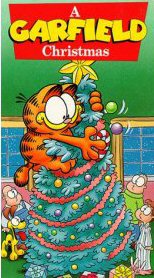
Plot: Garfield the Cat (Lorenzo Music) wakes up on Christmas morning to find his owner Jon (Thom Huge) has arranged an incredible gift – a chair that will read his mind and produce any gift he can imagine. Garfield produces dozens of presents before he realizes it’s all a dream. Jon wakes him up in the real world, on Christmas Eve, planning to pack up and go to his parents’ farm for Christmas. On the farm Jon, Garfield and Odie (Gregg Berger) get caught up in the preparations, while his mom (Julie Payne) and Grandma (Pat Carroll) clash in the kitchen. After dinner, Jon’s father (Pat Harrington Jr.) can’t get the star on top of the tree, and Garfield is sent in to do the job. After a few heart-rending moments, he pops out of the branches, places the star, and falls back down, taking the half of the decorations with him. Despite the chaos, when Dad plugs the tree in, it’s perfect. Jon’s parents have his brother Doc Boy (David Lander) sit down at the piano to lead a singalong, but Grandma quickly takes over. After, as she relaxes with Garfield in her lap, she relates how her late husband always made Christmas magical for her and the kids.
After Dad’s rousing recitation of Binky: The Clown Who Saved Christmas, the family goes to bed. Garfield watches Odie sneak off to the barn, where the dog struggles to put together some bizarre contraption. Garfield helps without Odie’s knowledge, then stumbles onto a bundle of old letters. Inside, Jon and Doc Boy try to rouse their parents to open presents – at 1:30 a.m. Dad forces them to go back to bed until morning – real morning – when Garfield presents Grandma with the letters he found. She’s stunned to realize Garfield found the love letters her husband sent her years ago, letters she thought were lost forever. Odie then pops in with his own gift – the contraption from the barn, a backscratcher for Garfield. Touched, Garfield comments on the true meaning of Christmas… love… before he tells us all to get out.
Thoughts: It’s easy to forget, considering how bland it’s grown in recent years, but Garfield actually used to be pretty funny. Both the comic strip and the 80s/90s cartoon had some really good years, and this 1987 special is one of the earlier efforts with the newspaper star.
Garfield’s cynicism is a trademark of the character, of course, but for a children’s Christmas special in 1987 to open up with a main character proclaiming the virtues of greed and avarice was a rather surprising way to kick things off. His complete lack of excitement and enthusiasm is what makes the character so funny, in fact. While Jon bubbles over with excitement about Christmas, Garfield bemoans days of work, chores, “electrical contracting,” and other such activities that draw him away from his cozy bed. Looking back as an adult, it’s a lot easier to sympathize with Garfield than Jon’s family. Even if you forget everything else that goes along with Christmas, life on a farm… it’s not easy.
Grandma Arbuckle (who made a return appearance, triumphantly, in Garfield’s Thanksgiving special a few years later) is another comedic gem, throwing out such bizarre observations as “in my day all we had were wood-burning cats.” That sort of weird, surreal comment is just the thing to elevate this beyond being just a wacky kids’ show and into something with a little bit of an absurdist quality that adults can enjoy too. As the show progresses, though, we start to get the sense that her lunacy is a bit of a front, a shield she puts up to hide a bit of loneliness that’s come upon her in her age.
Lorenzo Music was truly fantastic in the Garfield role, bringing in a amusing, dry quality that sells every line. Even Frank Welker, who does the character in the modern version of the cartoon, doesn’t really hold a candle to Music, who passed away in 2001. Pat Carroll’s Grandma is another great find, straddling the line between sweet little old lady and aging hellfire. Fans who like to play “who’s that voice?” get a nice puzzle as well – Jon’s brother Doc Boy is voiced by David Lander, alias Squiggy of Laverne and Shirley fame.
The story of this special is pretty loose. Although I don’t think most of it is based on any specific comic strips, it definitely has the feel of being plucked from assorted holiday-themed strips that don’t necessarily have anything to do with one another, then stitched together into something resembling a plot. The later Peanuts specials have often been fraught with this problem, but this is one of the few times Garfield fell victim to it.
With the loose feeling, the special doesn’t really latch on to the real Christmas spirit until the end. Suitably, the cartoon maintains Garfield’s rather pessimistic air until the moment Garfield realizes Odie is trying to make him a gift. After that, it quickly swings into the realm of the sweet – Garfield helps Odie and improbably finds the one thing that would mean more to Grandma than anything else. It’s quite a coincidence, but it’s not hard to accept in a cartoon of this sort.
This is one of my favorite of the various Garfield specials, and it set things up very nicely for his weekly cartoon series the next year. That one became a staple for me for many years, and even now, I’d rather watch some of those old episodes than most other cartoons on the air today. The modern Garfield Show doesn’t really hold a candle to the old one (despite having much of the same cast and writing staff), but I still like to go to this one every Christmas season.
The Christmas Special Day 17: A Claymation Christmas Celebration (1987)
 Director: Will Vinton
Writer: Ralph Liddle
Cast: Tim Conner, Johnny Counterfit, Greg Black, Ron Tinsley, Patric Miller (Musical Director)
Plot: Unlike most of the Christmas specials we’ve covered this month, A Claymation Christmas Celebration doesn’t exactly have a “plot.” This film instead features a pair of dinosaurs named Herb (Tim Conner) and Rex (Johnny Counterfit) as they host a revue of classic Christmas songs starring Will Vinton’s animated characters, including the California Raisins. In London, Herb and Rex try to give us some background into the first song, but are interrupted as a set of dogs come by singing “Here We Come A-Waffleing.” As Rex tries to correct them, he realizes he has no idea what “Wassailing” actually is, and sends us into “We Three Kings.” Herb then tells us that bell-ringing ceremonies have their roots in attempts to ward off evil, which takes us into “Carol of the Bells.” As the dinosaurs go into their next, a group of geese begin to sing “Here We Come A-Waddling,” Rex throws us to “O Christmas Tree.” When we return, the dinosaurs are looking up “Wassail,” tossing us into an ice ballet for “Angels We Have Heard on High.” A cart of hungry, hedonistic pigs gives their version of “Here We Come A-Wallowing,” tempting Herb away as Rex tries to introduce “Joy to the World.” The various wassailers begin arguing as the dinosaurs send us to the real stars of the special, the California Raisins performing “Rudolph the Red-Nosed Reindeer.” Finally, a load of cider-guzzling elves arrive and explain the meaning of “Wassailing” – going around the neighborhood, singing carols, and sharing treats and drinks. The dinosaurs and the rest of the cast join in to sing the proper version of the song, dovetailing into “We Wish You a Merry Christmas” as they all say farewell.
Thoughts: This special is such a product of its time. In the 80s, the California Raisins turned up for a series of ads, were rock stars for a while, provided parents with the cheapest Halloween costume imaginable, and then faded from the public consciousness. It’s a shame too, because I really do love Will Vinton’s work. This special shows off his considerable talents as an animator, not just with the clay figures of the Raisins and other characters, but on other forms of animation as well. During “We Three Kings,” for example, as the Magi sing, we drift into different styles of animation that look like oil paintings. Later, in “Joy to the World,” the style mimics the look of stained glass, while still having a very lively, evocative feel to it. It’s the most unique visual in the entire special, and a wonderful showcase of the potential inherent in this kind of animation.
“O Christmas Tree” is another display piece for Vinton’s skill, beginning in a simple setting with a pair of children decorating their tree. The camera zooms in on an ornament on their tree, taking us to a scene in a candyland, then repeats the process. We go through Santa’s workshop, then into Santa and Mrs. Claus’s own home. Each scene has a similar composition, but a distinctly unique decorating style that shows off the different sorts of stories Claymation can be used to depict.
Vinton also has real skill at comedic animation. In “Carol of the Bells,” we see several different bells (each with distinct faces that reveal a lot of personality) engage in a head-bonging chorus that would have made Jim Henson himself proud. The scene also has a good punchline, delivering the final note in a Chuck Jones fashion. The ice ballet has a bit of Disney’s Fantasia and a bit of Disney’s Donald Duck (the cartoon where he engages in an ice battle with his nephews comes distinctly to mind). Vinton is a smart writer as well, dropping in nice little literary Easter Eggs like making Quasimodo the director of the Bell Choir.
The music is also phenomenal in this special. This is one of my all-time favorite renditions of “We Three Kings,” in which the Magi sing a quiet, respectful, traditional version, which then spins into a peppy, jazzy chorus provided by the camels. “Joy to the World” has a sort of bluesy feel, while the California Raisins cover of “Rudolph” is right up there with Burl Ives as one of the best versions of the song.
Sadly, Vinton’s studio has been gone for some time now, and with CGI ruling the animation roost there aren’t too many people left doing this sort of thing. Even the final few stalwarts of stop-motion – Aardman, Henry Selick, Tim Burton – don’t do the sort of wild, experimental stuff Vinton tried to bring to the table. We don’t see the likes of this anymore, and that’s a real shame. As of this writing, the DVD (which also includes Vinton’s Halloween and Easter specials) is still available from Amazon. It’s definitely worth getting.
The Christmas Special Day 14: A Chipmunk Christmas (1981)
 Director: Phil Monroe
Writers: Janice Karman, Ross Bagdasarian Jr., Hal Mason
Cast: Ross Bagdasarian Jr., Janice Karman, June Foray, Frank Welker, Charles Berendt, R.J. Williams
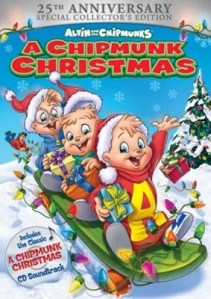
Plot: Five days before Christmas, the Chipmunks rouse David Seville (Ross Bagdasarian Jr., taking over the roles of Dave, Alvin and Simon from his late father, with Janice Karman playing Theodore) from a sound sleep and start to rush him out the door. As the boys go to the stores, Alvin overhears a little girl admiring a golden harmonica like Alvin’s, wishing she could get it for her sick brother Tommy (R.J. Williams). Tommy’s mother, however, seems skeptical Tommy will live to see the holiday. As the Chipmunks head into the recording studio, Alvin’s spirit has been diminished, and he heads out on an unscheduled break just minutes after recording begins. He finds Tommy at home and visits the sick boy, giving him with his harmonica and telling him he won it in a contest. Alvin rushes back to the studio and joins in the singing, his spirits restored. The Chipmunks are later booked to do a Christmas Eve concert at Carnegie Hall – a huge break – but they want Alvin to do a harmonica solo. Alvin can’t tell Dave (who gave him the harmonica) he gave it up, so he and his brothers try to buy a new one. He dresses up as Santa and charges kids for a picture, which Dave breaks up, admonishing his sons for trying to use Christmas to make money. When his brothers bumble out that Alvin needs money to buy something for himself, a disappointed Dave sends him to his room. That night, Alvin dreams of visiting mad inventor Clyde Crashcup (Charles Berendt), asking him for a loan, but the addle-brained Crashcup proves little help. Dave’s disappointment only grows when he walks past the dreaming Alvin, hearing the boy cry out for money in his sleep.
With two hours to go before the Christmas Eve concert, Alvin sets out to try to buy a new harmonica. While he’s gone Dave gets a phone call from Tommy’s mother, telling him the harmonica did wonders for the sick child. At the mall, Alvin stares at the harmonica he still can’t afford, when a kind old lady (June Foray) comes from nowhere and buys it for him. To thank her, he begins playing “Silent Night,” and a crowd forms to listen, including Dave, Simon and Theodore. Dave apologizes for misjudging Alvin, and the Sevilles head to Carnegie Hall for the concert. As he finishes his harmonica solo, Alvin runs into Tommy, out of bed and well. Alvin pulls him on stage to play an encore with the Chipmunks. Their song even reaches Santa Claus (Frank Welker), passing overhead on his rounds. He returns home to Mrs. Claus, telling her she should get out on Christmas some time and see what it’s like. As he drifts to sleep Mrs. Claus – a familiar, kindly old woman – looks at the audience and hushes us… why tell Santa, after all?
Thoughts: The Chipmunks, those animated anthropomorphs who rocketed to novelty album fame with “The Chipmunk Song,” had been off TV screens for some time in 1981. Although I didn’t know it at the time, this special was the start of a comeback, leading into a new Saturday morning cartoon that would be the version of the Chipmunks throughout my formative years. And it’s fitting, as their first hit was a Christmas song, that Christmas would factor into their comeback as well.
This special was something of an all-star piece, with the already-great June Foray stepping in as Mrs. Claus and the soon-to-be great Frank Welker as her husband. Even better, Chuck Jones pitched in on animation and character design for the special, and having watched it so relatively soon after How the Grinch Stole Christmas, it’s not hard to see some of his trademark gestures and designs, even if the flow of the animation isn’t really his. Some of the visual gags are distinctly Jonesian, though, such as Alvin as a miniature Santa being hoisted and lowered onto kids’ laps via a pulley… there’s a Wile E. Coyote flavor to it. (There’s also a great nod to Jones and Foray’s previous Christmas collaboration, as Alvin encounters a little girl named Cindy Lou.) The Clyde Crashcup sequence is a double whammy, bringing back a great (and mostly forgotten) cartoon star of the past, as well as presenting a sequence of confusion and misunderstanding that echoes a Dr. Seuss poem – or even one of Jones’s few feature films, the great The Phantom Tollbooth.
Although the Chipmunks would return during the run of their TV show with takes on A Christmas Carol and It’s a Wonderful Life, this special was all-new, and a really refreshing change. So many Christmas specials hinge on a character lacking Christmas spirit and finding it at the last minute. This time we see Alvin – often presented as the self-centered one in the group – show true Christmas spirit at the very beginning, and still winding up in a jam. The arc of the story is utterly unlike any other Christmas film I’m aware of. There’s not even really a lesson to be learned – Alvin knows and does the right thing right away, without having to go through trials or face the intervention of some wise mentor. If there’s anything he does wrong it’s not confessing to Dave that he gave up the harmonica, and given the circumstances, I think most people would have done the same thing. It’s a really refreshing change of pace, and makes for a unique special, unlike any of the others we’ve watched so far.
I have to confess, friends, I think the Chipmunks have hit something of a low point. I’m not at all a fan of the current movie series, where I think some of the silly charm of the original has been traded in for gross-out humor and tendrils of raunch that just don’t fit the spirit of Ross Bagdasarian’s characters. But that doesn’t mean I don’t still love Alvin and the boys, and especially at Christmas, I like looking back at these old cartoons and remembering when they were… y’know… good.
The Christmas Special Day 13: Christmas Eve on Sesame Street (1978)
 Director: Jon Stone
Writer: Jon Stone, Joseph A. Bailey
Cast: Caroll Spinney, Jim Henson, Frank Oz, Jerry Nelson, Richard Hunt, Linda Bove, Northern Calloway, Debbie Chen, Will Lee, Loretta Long, Sonia Manzano, Bob McGrath, Roscoe Orman, Alaina Reed
Plot: On Christmas Eve the gang on Sesame Street takes a trip to the local ice skating rink. While everyone else is having a good time, Oscar the Grouch (Carroll Spinney) decides to poke fun at the naive Big Bird (Spinney again), asking him how Santa Claus can possibly fit through the tiny chimneys the buildings on Sesame Street have. Dismayed at the thought that Santa may not be able to get in, Big Bird and his friend Patty (Debbie Chen) set out to solve the mystery. They turn to Kermit the Frog (Jim Henson, and if you didn’t know that stop reading my article right now, you heathen), who suggests turning to the Santa Claus experts – the children – to find the answer.
Meanwhile, Bert (Frank Oz) is stuck for a Christmas present for his best friend Ernie (Henson again, I mean it, stop reading if you didn’t know that already because I don’t want you here). When he comes across Ernie’s Rubber Duckie, he gets an idea. Ernie, facing a similar dilemma, stumbles across one of Bert’s prize paperclips and decides to get him a cigar box to keep his paperclip collection safe. Going to Mr. Hooper’s store, Ernie finds he doesn’t have enough money for the box, and offers Mr. Hooper (Will Lee) his Rubber Duckie as a trade. As Ernie leaves, Bert enters with a similar offer: he wants to trade his paperclip collection for a soap dish where Ernie can keep Rubber Duckie. Mr. Hooper takes both deals, even though Bert and Ernie are both clearly distraught over surrendering their prized possessions.
When Kermit’s investigation proves fruitless, Big Bird and Patty recruit Mr. Snuffleupagus (Jerry Nelson) to try to test out a method for squeezing into a chimney. Snuffy, unfortunately, gets stuck. Outside, as Bob (Bob McGrath) and Mr. Hooper exchange holiday pleasantries, Oscar groans and launches into his own seasonal anthem: “I Hate Christmas.”
Bert and Ernie exchange gifts, and both are stunned to realize they’ve been given a gift intended specifically to compliment the very item they have sacrificed. Neither wants to confess to the other that his gift is now useless, and before either of them have to, there’s a knock at the door. Mr. Hooper is there with gifts for the boys – Ernie’s Rubber Duckie and Bert’s paperclips. Bert and Ernie are overjoyed at having their treasures back, but sadly say they haven’t a gift to give Mr. Hooper. The kind old man smiles and tells them they’ve already given him the best gift ever: the chance to see everyone get what they want for Christmas.
When the snow begins to fall that evening, Big Bird sends Patty home. As she leaves she tells him not to worry, she’s certain Santa will come, even if they don’t know how he’ll do it. Left alone, Big Bird decides to go to the roof and wait for him. Patty later turns up at Gordon and Susan’s apartment (Roscoe Orman and Loretta Long, respectively) to tell them she went back to Big Bird’s nest and he’s gone. Everyone on Sesame Street begins searching for him, while on the roof Big Bird watches them, wondering what all the fuss is about. With the temperature dropping and everyone worrying Maria (Sonia Manzano) confronts Oscar over upsetting Big Bird in the first place. Guilty, Oscar sets out to find him. On the roof, away from his safe, warm nest, Big Bird falls asleep, unaware of the figure that has joined him there. When he wakes up he sees nothing, not even footprints, and decides to go downstairs and warm up. He meets Gordon and Patty on the stairs, and Gordon refuses to let him go back outside. In Gordon and Susan’s apartment, he finds a beautiful Christmas tree and stockings loaded with presents for everyone – Santa must have passed while he slept. Gordon explains to Big Bird that it isn’t important to explain a miracle; the important thing is that they’re all together again. Oscar turns up and tells Big Bird he’s glad he’s back… but the Grouch can’t resist one last dig. “How do you think the Easter Bunny can hide all those eggs in one night?”
Thoughts: Jim Henson and company return, although this time he’s joined by some of the other great “J”s of his era – Jon Stone, the writer responsible for so many of the greatest Sesame Street moments of your youth; Jerry Nelson, who gave us the Count and Mr. Snuffleupagus (a word which, somehow, is not in my spellcheck); producer Joan Ganz Cooney, the woman who conceived of using entertaining television to educate children in what would become the Sesame Street style. Henson and his Muppets were integral to the success of this show, but he sure didn’t do it alone. Regardless, as fantastic as each of those creators are, the true magic of Christmas Eve on Sesame Street isn’t brought to you by the letter J, but rather by C and S: Carroll Spinney, the Muppeteer responsible for both Big Bird and Oscar the Grouch.
Unlike the regular daily episodes of the show, this prime time special didn’t have any of the cutaway educational segments, didn’t include lessons on counting or spelling… instead, the Children’s Television Workshop used the opportunity to teach a moral lesson or three. And like they did in all their finest moments, they did so without preaching, presenting the lesson in a way that would be easy for children to accept, understand, and internalize.
The A-plot of this special belongs to Oscar and Big Bird in a way that shows off their relationship for what it is: an older sibling (Oscar) who enjoys picking on the younger (Big Bird), but still feels responsible and tries to set things right when confronted with the consequences of his actions. Anyone who has a brother or sister can probably relate – it’s crafted in a very realistic, natural and believable way. Spinney plays their relationship with Oscar’s edge and Big Bird’s unrelenting sweetness clashing at every turn, allowing the kids to worry along with Big Bird until the obvious conclusion is reached at the end. Spinney is a master performer, and I only wish I could have been there to watch him rushing back and forth between the two characters as the camera cut away. Dude must have been exhausted.
The story reveals a depth of character I don’t think is obvious when you’re a child watching these specials. It’s telling to me that only Maria, out of all the adults on Sesame Street, is able to convince Oscar to go out and look for Big Bird and fix what he did wrong. That’s not an accident – Maria and Oscar have a surprisingly complex relationship, in which Maria plays both mother and big sister to the Muppets. It’s one of the few moments in Sesame Street history where I remember seeing one of the human characters get genuinely, justifiably angry, and Sonia Manzano pulls it off wonderfully. Oscar comes across as the problem child who reacts to a stern but loving hand when gentleness fails. (I also maintain that Oscar – at least in my formative years of watching Sesame Street – was written to harbor a forever-unspoken crush on Maria, but that’s neither here nor there.)
The B-plot, featuring Bert, Ernie, and Mr. Hooper, is surprisingly only the second story in our countdown to play with the “Gift of the Magi,” although this is a much more straightforward retelling than Emmet Otter’s Jug-Band Christmas. Bert and Ernie fill the roles nicely, with writer Jon Stone playing on their legendary friendship and slightly childlike outlook to create a story where you can naturally accept them sacrificing for one another. Seeing Mr. Hooper step in to save the day is a lovely moment, and one that still touches the heart all these years after actor Will Lee’s death. (A rare non-Christmas tangent: if you’ve never seen the Sesame Street episode where Big Bird learns that Mr. Hooper has died, watch it on YouTube. And if it doesn’t make you cry, stop reading my blog forever and go back to your day job strangling baby owls and selling their feathers to stuff pillows for Neo-Nazis.) Although this story was once copied almost as often as A Christmas Carol, it’s fallen a bit by the wayside in recent years. That may be a good thing. A child seeing this special now wouldn’t necessarily see the ending coming, and the message of the piece will more likely remain intact.
One thing I didn’t mention much in my synopsis of the episode are the musical numbers peppered throughout. In truth, most of these do little (or nothing) to advance the plot, so they didn’t really belong there, but that doesn’t mean they aren’t memorable in and of themselves. Bob McGrath and Linda Bove (playing Bob and Linda, respectively) lead the children of the cast in the haunting “Keep Christmas With You (All Through the Year),” and the whole cast joins in for “True Blue Miracle,” another one of those songs that has transcended the special that birthed it and become something you may well hear on the radio or in a shopping mall. It’s nice to have some traditional music in there as well – Bert and Ernie’s duet of “Have Yourself a Merry Little Christmas” is lovely. Hardcore Muppet fans can probably hear just a bit of Frank and Jim’s friendship in the performance as well. And Oscar’s “I Hate Christmas” is just a joy whether you’re a true believer or an eternal humbug.
There are other moments that don’t actually contribute to either of the two main plots. Grover has a few scenes where he interviews children about Santa’s efforts to enter the chimney, similar to scenes in the regular episodes of the TV show. There’s a running gag about Cookie Monster trying to write a letter to Santa and eating his assorted writing implements as well. It’s a good bit, but there may be no moment of sheer comedy in the special as great as when he realizes the traditional Santa Claus exchange: when he leaves you a present, Gordon tells him, you should leave him a plate of cookies.
But as far as those moments that don’t go with the plot are concerned, the champion is the very first scene in the ice skating rink. As wonderful as the rest of the episode is, this opening scene is still bizarre, with ice skaters wearing full-size costumes of the Muppets skating on the ice. Seeing a six-foot Bert and Ernie or an adult-sized Count is just bizarre. And yes, I know they’ve been doing essentially the same thing with the Sesame Street Live shows for decades. I think it’s weird there, too.
This special won two Emmy awards, ironically beating out A Special Sesame Street Christmas, which aired in prime time on CBS. Both of these shows are now available on DVD, and a quick comparison makes it clear why Christmas Eve walked home with the awards. Out of the two, this special is far more special than Special.
The Christmas Special Day 11: A Flintstones Christmas (1977)
 Director: Charles A. Nichols
Writers: Duane Poole & Dick Robbins
Cast: Henry Corden, Jean Vander Pyl, Mel Blanc, Gay Hartwig, Lucille Bills, Virginia Gregg, Hal Smith, John Stephenson
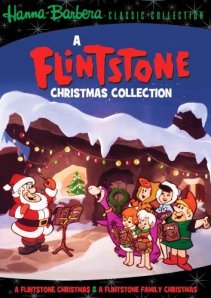
Plot: It’s Christmas Eve in Bedrock and the Flintstones and Rubbles are finishing up their preparations. Wilma (Jean Vander Pyl) and Betty (Gay Hartwig) try to persuade Fred (Henry Corden, taking over the role seamlessly from the late Alan Reed) to play Santa at the orphanage’s Christmas party that night, but Fred refuses and heads to work. When he arrives his boss, Mr. Slate (John Stephenson) informs him that his wife wants Fred to play Santa for the same party. This time, to protect his job, Fred agrees. At home, Fred and Barney (Mel Blanc) prepare for the party, but hear a thumping from the roof. They find Santa Claus (great voice actor Hal Smith, who played Santa in no less than five different cartoon series over the years) in the snow. Although Fred is skeptical at first, Barney finds the sleigh and reindeer, proving they’ve got the real Santa in the Flintstone house. Santa sprained his ankle on Fred’s roof, and Barney suggests Fred as a substitute while he heals. Santa gives them a dose of magic and sends them on their way.
Things go relatively smoothly for Fred and Barney’s first few deliveries, but some turbulence knocks the sack of presents out of the sleigh. Barney calls Santa on the sleigh’s CB radio (it was the 70s, people), and Santa tells them to go back to the North Pole for another load. As they wait for the sleigh to be reloaded, Fred and Barney take a tour of Santa’s high-tech operation and pitch in making some toys. They get back in the air and speed up their deliveries, realizing Fred is still scheduled to play Santa for the orphans. Back in Bedrock, the children are starting to get upset – almost as upset as Mr. Slate. Fortunately, Fred and Barney finally arrive, spilling in through the chimney with such a spectacular entrance Mr. Slate forgives their tardiness… until Fred realizes they’ve given out all the presents already. With a little of Santa’s Christmas magic, Fred produces more, and the children are overjoyed. As they open their gifts, the boys return home to send Santa on his way. Wilma and Betty return home, angry at their husbands for rushing out of the party, and Santa ducks out before they see him. Although the girls don’t believe Fred and Barney’s story about filling in for Santa, they forgive them and begin trading gifts. Fred is horrified to realize, in all the commotion, he didn’t get Wilma a present, but Santa saves the day one last time, slipping one down the chimney. Pebbles and Bamm-Bamm spot Santa flying away, and their fathers join them at the window, waving goodbye, while the girls just chuckle at the four kids looking up at the skies over Bedrock.
Thoughts: Like Fat Albert, this 1977 special takes characters from a popular cartoon show and gives them a Christmas adventure, although unlike Fat Albert, by 1977 the original run of The Flintstones had been over for several years. Fortunately, with animation, it’s easier to do a reunion special without worrying about actors getting older or passing away or refusing to reprise their role – in almost every case, a new voice artist is always a possibility. This special managed to get most of the original voices back, but one wonders if Mel Blanc felt a little confused that he was remaking a cartoon he’d done 13 years prior.
A Flintstones Christmas borrows much of its plot from the 1964 episode of the TV show, “Christmas Flintstone” (brilliantly clever with titles, these Hanna-Barbera folks), specifically the story of Fred filling in for Santa Claus after he injures himself. This special adds in more and different music and ages the children – Pebbles and Bamm-Bamm are elementary school age, whereas they were still babies in the original. They also trade out B-plots – in the original, Fred was working as a department store Santa for extra money, whereas here he’s dealing with Mr. Slate and playing Santa for orphans. The B-plot is used to give urgency to the A-plot as well, while in the original Fred was pretty much done with his gig when he stumbles into the real Santa and is called upon to fill in. Still, if one were to sit down for a marathon of the assorted Flintstones Christmas specials and episodes throughout the years (something a guy like me is honestly very likely to do), you’d be a bit shocked when you essentially saw the same show twice.
Having dealt with that particular elephant in the room (I’m going to ignore the one about characters celebrating Christmas before the birth of Christ), let’s talk about the story for what it is. The notion of Fred filling in for Santa is a wonderfully natural one – the heart of the character is that of a sort of good-natured lummox. For all the times throughout the years where Fred gets short-tempered or angry, at the core of the character is a deep, abiding love for his wife and friends, the sort of thing that lends itself perfectly to playing Santa. The actual mechanism for getting him into the suit was pretty clever for the time, although it seems that Disney picked at this cartoon when they made Tim Allen’s more morbid The Santa Clause.
Although there was music in the original version of this, this version has much more of it, almost making it into a full-blown musical as both Fred and Barney break into song about how much they love Christmas at assorted points in the show. While none of the music has broken out and become of particular note, it’s perfectly passable and a nice addition to the cartoon. The animation style is really indicative of the sort of thing we got from Hanna-Barbera, up to and including a nice little Rube Goldberg-style montage sequence in Santa’s workshop, where Fred and Barney spill out onto the conveyer belts and get temporarily caught up in the mechanisms of the toymaking machines. We saw this sort of thing a lot in the old Hanna-Barbera cartons, second only to the “hall of doors” chase scenes they did so often, particularly in Scooby Doo.
In terms of sheer volume, the good folks at Hanna-Barbera may have been second only to Rankin and Bass for producing great Christmas cartoons. However, there aren’t a lot of ‘em I could use for this project, as so many of them are feature film length, regular episodes of assorted TV shows or, saddest of all, not available on DVD. Maybe next year. But for now we’re not quite done with the Hanna-Barbera characters… not yet.
The Christmas Special Day 10: The Fat Albert Christmas Special (1977)

Note: Revelations about Bill Cosby himself have obviously tainted perceptions of much of his work, this special included. However, I have chosen to keep this article in its entirety as a sort of archival piece. Regardless of who Cosby himself turned out to be, I stand by my thoughts on the work itself as being valid.
Director: Hal Sutherland
Writer: Bill Danch & Jim Ryan
Cast: Bill Cosby, Jan Crawford, Gerald Edward, Eric Suter, Marshall Franklin, Eric Greene, Kim Hamiton, Julius Harris, Ty Henderson
Plot: Fat Albert (Bill Cosby, who did about 75 percent of the voices) and his gang are preparing for their Christmas pageant, when old “Tightwad” Tyrone – owner of the junkyard where they’ve built their clubhouse – shows up and declares he’s tearing down the clubhouse. While the gang tries to think of a way out of their predicament, they’re approached by a boy named Marshall (Marshall Franklin). His father is out of a job and their car broke down right outside. To make matters worse, his mother is about to have a baby. Fat Albert invites them in to warm up, and sends Bill to help Marshall’s father find a hospital. Fat Albert chases down Tyrone to try to convince him to leave the clubhouse alone, fearing it’ll be torn down with Mrs. Franklin inside. Tyrone agrees to leave the clubhouse standing if Fat Albert plays Santa Claus outside of his secondhand store to try to draw in customers. Bill and Mr. Franklin return, unable to get help at the local hospital without insurance. Mrs. Franklin stands up to go to the distant city charity hospital, but can’t go any farther. Bill and his brother, Russell, rush off to find help.
The rest of the gang finds Fat Albert outside Tyrone’s store and begin snatching his free samples, and an angry Tyrone fires Albert and promises to demolish the clubhouse. Old Mudfoot Brown arrives and snaps at Tyrone that he’s become a miserable old man since his wife died. Embarrassed, Tyrone asks how he can redeem himself, but Mudfoot simply tells him he wouldn’t know how to do a good deed. At the clubhouse, Marshall overhears his father say he’s afraid he can’t even afford to feed his first child, let alone the second, and Marshall decides to run away. When the gang returns with the promise of a doctor, they realize Marshall is missing and set out to look for him just as Mrs. Franklin begins to deliver. They find Marshall down at the docks, and the boy is trapped on an ice floe when he tries to flee. Fat Albert and the others manage to save him, but he slips away again. When they return to the clubhouse the baby has arrived. Mr. Franklin asks where Marshall is, but before Fat Albert can answer, Mr. Tyrone arrives – with Marshall. Hearing the Franklins’ story, he offers Mr. Franklin a job and says he can no longer tear down the clubhouse, since it’s a “landmark.” The gang and Tyrone give the Franklins a merry Christmas, and Tyrone looks to the sky to ask his wife how he’s doing now.
Thoughts: By 1977, we had reached the point where a Christmas episode of a popular cartoon wasn’t enough. We needed a full-blown Christmas special, and Bill Cosby and company delivered here. Although Tyrone definitely has a dash of Scrooge about him, the story isn’t just another Dickens rehash. If anything, the plot is more intent on echoing the nativity story, with a pregnant woman who has nowhere to go.
The plot is nicely layered, with the story of the Franklin family colliding with the Cosby Kids’ problem with Mr. Franklin. Not too many children’s cartoons today would have the wherewithal to take two entirely unrelated problems and intertwine them this way. The kids’ problem, furthermore, makes the Franklins’ dilemma even more dire. Sure, Mrs. Franklin is safe from the cold, but the viewer legitimately wonders if Mr. Tyrone will get over his anger long enough to realize there’s a pregnant woman inside the clubhouse, or if that would even matter to him before he demolishes it. Marshall has a pretty standard waif reaction to the situation – he’s causing a problem for his parents, so he decides to run away. Rather than one huge, overriding issue like a lot of these cartoons deal with, The Fat Albert Christmas Special deals with a lot of little things, and is the better for it.
Mr. Tyrone is an interesting villain. Like I said, he has elements of Scrooge, but not all of his actions make as much logical sense as Ebenezer’s. Evidently, the presence of a clubhouse somehow decreases the value of a junkyard. I know. I don’t get it either.
Like many of the half-hour Christmas specials, especially the ones that have a real villain, the climax seems to come a little too easily. It’s a bit more forgivable in this case, though… I’m not really sure where else they could have taken Mr. Tyrone’s story without dovetailing into a straight-up Dickens parody. As it is, Mudfoot plays the role of Jacob Marley and all three ghosts, delivering in 30 seconds the sort of realization that takes most films 90 minutes to do. I think it actually helps that we don’t see a traditional “moment of redemption” here. Tyrone’s change of heart happens largely off-camera, helping to drive in the idea that he isn’t really a bad man, just one who’s sad and angry, and who tries to make amends when he’s called on being sad and angry.
It’s hard to believe this cartoon is as old as I am. The story ages very well, the ideas are timeless and the backdrop is sadly relevant to modern times. Really, the only point that’s not completely current is the notion of kids playing in a clubhouse they made themselves, rather than sitting around with X-Box controllers. One can only hope, were the Franklins to break down today, they could still find a Fat Albert to bring them a little hope.
The Christmas Special Day 5: Frosty the Snowman (1969)
 Directors: Jules Bass, Arthur Rankin Jr.
Writer: Romeo Muller
Cast: Jimmy Durante, Billy DeWolfe, Jackie Vernon, Paul Frees, June Foray
Plot: Children’s entertainer Professor Hinkle (Billy DeWolfe) is perhaps the world’s worst performer, with tricks that won’t work and a rabbit named Hocus Pocus who won’t cooperate. After a failed show at an elementary school, the children race outside to build a snowman, whom they christen Frosty (Jackie Vernon). Hocus and Hinkle rush outside, where Hinkle throws his hat at the rabbit. It’s retrieved by one of the children, Karen (June Foray, again, proving that if there is a goddess of voice animation it’s her), who places it on Frosty’s head. The snowman snaps to life and bids everyone a happy birthday, but Hinkle snatches his hat back and leaves. Hocus steals the hat again and returns it to the children, who use it to bring Frosty to life again. He plays and dances with the children until he notices the temperature is rising, and he’s beginning to melt. Karen and the children promise to send him to the one place he’ll never melt: the North Pole. They parade through town to the train station to send him off (startling a traffic cop along the way) but are stumped when they realize they can’t possibly afford the ticket. At Hocus’s suggestion, Frosty and Karen hop into a refrigerated boxcar on a north-bound train. Hinkle, who realizes the hat has genuine magic power, hops on the same train, determined to steal it back.
When Frosty realizes the frozen car is making Karen sick, he and Hocus get off with her at the next stop. Hinkle jumps from the train so as not to lose them, crashing in the process. Karen is still in danger of freezing, so Hocus tries to rouse the local forest animals to build her a fire. Although Karen is safe for the moment, Frosty knows they need to find help soon, and Hocus suggests Santa Claus, who is scheduled to make his Christmas Eve rounds in mere hours. To keep her warm in the meantime, Frosty finds a greenhouse, but Hinkle manages to trap them both inside. When Santa arrives, Hocus brings him to the greenhouse, where Karen is safe, but in tears: Frosty has been reduced to a puddle with a corncob pipe and an old silk hat. Santa tells her that Frosty is made of magical Christmas snow, which can never go away forever. He uses his magic to rebuild Frosty, but before he places the hat upon his head, Hinkle shows up to demand its return. When Santa warns him he’ll never give him another Christmas present again if he hurts Frosty, Hinkle backs down and is sent away to write a massive apology. Santa places the hat back on Frosty’s head, restoring him to life. He takes Karen home and promises her that Frosty will return every year with the Christmas snow.
Thoughts: Frosty the Snowman gives us yet another case of Rankin and Bass magic, but this time, we’re going for traditional animation. This studio is much better known for their stop motion work, but they did several specials in this format, and later applied it to their version of Tolkien’s Lord of the Rings and 80s TV shows like Thundercats.
Like Rudolph and Little Drummer Boy, this film takes a classic song and gives us an expanded storyline to fill out its half-hour running time. The song even shares DNA with Rudolph – Gene Autry commissioned the piece from Walter Rollins as a follow-up to his earlier Christmas hit. And a hit it was, but like Rudolph, it needs some work to succeed as a narrative. The original song, let’s be honest here, doesn’t exactly have a riveting plot: Snowman gets magic hat, snowman comes to life, snowman starts to melt, snowman leaves. Hard to get a full-length special, and what’s more, there’s no antagonist.
That, in fact, is what really makes this special: Professor Hinkle. He’s a really entertaining bad guy, very different from the usual Rankin/Bass assortment of monsters, evil wizards, and misers. Hinkle is kind of a pathetic figure, but in a funny way. He’s utterly failed at life, he’s a disaster as a magician, but he seems to have more greed than genuine evil in him (despite his own protests to the contrary). Even as he’s trailing Frosty and Karen he has to keep reminding himself to “think nasty… think nasty…”
Looking back on this as an adult, you start to realize that Hocus Pocus, the rabbit, is actually a pretty lousy influence on the children. His refusal to work with his partner in the first place is what costs Professor Hinkle his hat. Hocus steals the hat later (for a good cause, perhaps, but it’s still theft). He convinces an underage girl to illegally board a train with a man she’s known for all of seventeen minutes, without so much as a phone call home to tell her parents not to worry. Yes, he technically helps to save her life multiple times, but seeing as how she would never have been in danger if not for him, it’s hard to give him too much credit for that.
Christmas is almost an afterthought in this special. It’s not really mentioned at all in the original song, and you’ve only got a quarter of the special left when it’s even mentioned that this is all taking place on Christmas Eve. (What school is in session on Christmas Eve? Did they used to do it that way?) It works out for Karen, of course, because otherwise Santa Claus wouldn’t be around to save her and…
Wait a minute, this all happened on Christmas Eve? What did they even need the train ticket for? Why didn’t Frosty just wait around for Santa in town in the first place? They could have saved themselves all kinds of trouble! And don’t tell me it’s because Santa wouldn’t show up while the kids were awake, because this is a Rankin and Bass special and he breaks that rule all the time. He even breaks this rule in this very cartoon, because if he was waiting for all of the animals to be asleep before he shows up Hocus couldn’t even have flagged him down in the first place! Good grief, Romeo Muller, were you even trying?
Yet, this is a classic.
You see, out of all the great characters in the Rankin and Bass catalogue, there may be none as ridiculously endearing as Frosty. His sweetness, his heart that remains warm despite being encased in snow, the fact that he even apologizes to Hocus for some truly ridiculous suggestions for getting help… well, he’s a better snowman than I. This cartoon is the reason I can’t put on a top hat without getting the urge to wish everyone a happy birthday. It’s ludicrous! It’s incomprehensible!
And it’s a valued part of our collective childhood, and I wouldn’t change a minute of it.
Frosty returned twice more in the annals of Rankin and Bass – in 1976’s Frosty’s Winter Wonderland he’s given a snowwife, Crystal. In 1979, the Frosty family teamed up with Rudolph for the stop-motion feature length film Rudolph and Frosty’s Christmas in July. Both of these are worthy sequels. Less so is 1992’s Frosty Returns, a terrible, painfully preachy cartoon produced by CBS and unforgivably directed by Bill Melendez (of A Charlie Brown Christmas), and in 2005 there was the CGI Legend of Frosty the Snowman, which is more faithful to the original, but still merely okay. As usual with these characters, Rankin and Bass did it best. All others need not apply.
The Christmas Special Day 3: How the Grinch Stole Christmas (1966)
 Director: Chuck Jones
Writers: Irv Spector & Bob Ogle, based on the book by Dr. Seuss
Cast: Boris Karloff, June Foray
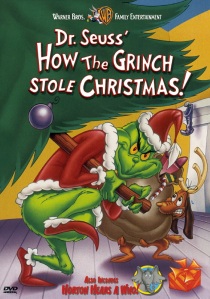
Plot: In the town of Whoville, Christmas is a season beloved by all. The Whos in Whoville gather together to cut down the town tree, decorate the community, and celebrate the season. But not everybody is happy with the season. North of Whoville, in a mountain cave, lives a green creature called the Grinch (Boris Karloff, doing double-duty as the narrator) who hates Christmas with all of his two-sizes-too-small heart. As he watches their celebration begin, he vows to destroy Christmas for everyone. Stitching together a Santa Claus suit and putting “antlers” on his dog Max, the Grinch sweeps into town and begins breaking into houses, stealing every present, every decoration, every morsel of food, even the roast beast. As he goes to work in one house, however, he’s interrupted by little Cindy Lou Who (June Foray).Cindy Lou mistakes him for Santa and asks him why he’s taking their Christmas tree. He tells her he’s bringing the tree to his workshop to repair a broken light, then ushers her off to bed and finishes his insidious task.
The Grinch and Max take their loot to the top of a mountain, where he plans to spy on the Whos as they wake up and find their Christmas ruined. To his shock, though, the Whos come from their houses, join hands, and begin to sing despite their lack of gifts, of trees, of boxes and bags. That’s when it dawns on him… that perhaps Christmas has a deeper meaning than those things one can buy from a store. As his heart fills for the first time in years, his sleigh of toys begins to tip over the side of the mountain. His newfound Christmas spirit gives him the strength to rescue the sleigh and he races back to Whoville to return everything he stole. The Whos welcome him with open arms and even allow him to carve the roast beast.
Thoughts: Like most movies (even short films) that are based on children’s books, when the time came to animate How the Grinch Stole Christmas there was a need to beef up the story considerably in order to make it fill the allotted running time. Fortunately, this is a case where just enough was added to make the story a real classic (as opposed to the 2001 feature film where just enough was added to make the whole thing feel like a waste of time).
Out of all the specials I’m going to talk about this month, this may be the most singularly perfect case of voice casting we’ll see. Boris Karloff, as both the narrator and the Grinch himself, delivers a legitimately flawless performance. The Narrator has the sort of homespun quality you want – it’s like having a grandfather or a gruff uncle calling you around the fireplace to tell you a story. Then he shifts into the Grinch persona, adopting a nasty edge to his timbre that sends him from being your grandfather to that creepy old man down the street you’re really afraid of but feel compelled to pester at Halloween. Complimenting Karloff in the small but vital role of Cindy Lou Who is the legendary June Foray, one of the two greatest voice artists of all time (the other being Mel Blanc, and if you want to rank anybody else above those two you are wrong). Foray gives Cindy Lou a tender innocence that could easily be obnoxious and saccharine, but she imbues it with such sincerity that she’s impossible to dislike. Cindy Lou is the child every parent wishes they could present to Santa Claus down at the mall.
Then there’s the direction. Chuck Jones, perhaps the greatest animator in American history, takes the performances of these voice artists and crafts a beautifully rendered, visually amazing world that perfectly captures the wonderful lunacy of Dr. Seuss’s best work, while still maintaining his own inimitable comedic style. In the antics of the Grinch and his dog Max, you can see the finest moments of Wile E. Coyote and the Road Runner or of Tom and Jerry, both of whom experienced their best years when directed by Jones.
The Grinch slinks along like a snake in this cartoon, he casually licks his fingers to unscrew a light bulb, and in one of the greatest moments in the special, his face grows into this insidious, far-too-wide grin when he concocts his terrible scheme. This sort of thing is all Jones, all part of his amazing animated style. The action sequences, when he’s racing up and down the mountain in his sled, or where he desperately tries to save the presents at the end… again, Jones is the star here, showing off the potential of animation to tell a story of this nature in a thrilling fashion.
Rounding out a perfect crew was Thurl Ravenscroft, best known as the voice of cereal mascot Tony the Tiger, singing “You’re a Mean One, Mr. Grinch.” The song is great in and of itself, but planting it in Ravenscroft’s deep baritone gives it a feeling that no other Christmas song can boast. That song, that performance, is just as famous as any other part of this cartoon, and it’s well-deserved.
This film also passes a rather unique test when it comes to Christmas specials. There are honestly far too few truly original stories out there. We live in a world where half the Christmas stories told are just retreads of A Christmas Carol or It’s a Wonderful Life. This film is its own story, though, not a parody, which makes it impressive enough. But eventually, it reached the stage where it is the source of parody – plenty of movies and TV shows have spoofed the Grinch over the years. That places it in the upper echelon of Christmas stories, the strata of tale that writers who can’t come up with their own story choose instead to build upon. If that isn’t the sign of a cultural landmark, I don’t know what is.
The Christmas Special Day 2: A Charlie Brown Christmas (1965)
 Director: Bill Melendez
Writer: Charles M. Schulz
Cast: Peter Robbins, Christopher Shea, Kathy Steinberg, Tracy Stratford, Chris Doran, Geoffrey Ornstein, Karen Mendelson, Sally Dryer, Ann Altieri, Bill Melendez
Plot: It’s nearly Christmas, but Charlie Brown (Peter Robbins) can’t seem to find it within himself to enjoy the season. Nobody is sending him any Christmas cards, his little sister Sally (Kathy Steinberg) is more concerned with getting presents than any spirit of generosity, and even his dog Snoopy (Bill Melendez) is giving himself over to a Christmas decorating contest. His “psychiatrist,” Lucy (Tracy Stratford), suggests that he take a hand in directing the children’s Christmas play. She also confides that she feels the holiday blahs as well, never getting the gift she really wants: real estate. Charlie Brown arrives at the theater to find a disjointed group of performers who lack any real holiday spirit, and his best efforts to turn things around avail him nothing. Lucy finally suggests that he find a big, shiny aluminum Christmas tree to help with the celebration, and he sets out with her brother Linus (Christopher Shea) to search. Instead of one of the garish plastic and metal monstrosities that Lucy wants, though, Charlie Brown finds a little sprig of a tree that looks like it needs love. Lucy and the others mock the tree and Charlie Brown, depressed, asks if there’s anyone who can tell him what Christmas is all about.
Linus, of course, can. In one of the most memorable moments in animation history, Linus Van Pelt recites the Christmas story from the Bible, reminding his friends that the season is not about plays or trees or decorations, but about something much, much deeper. Encouraged, Charlie Brown tries to decorate his little tree, but with one ornament it collapses. He slinks away, heartbroken, and Linus leads the rest of the children in fixing the tree and making it beautiful. Charlie Brown returns to see what they’ve done, and his friends wish him a Merry Christmas.
Thoughts: Is there any special as beloved, and as deservedly so, as A Charlie Brown Christmas? I’ve always thought that Peanuts in general, the classic comic strip by Charles M. Schulz, represents the pinnacle of human philosophy in the 20th century. There is no other work of art that so succinctly and completely captures the human spirit as Schulz’s squiggle children and their outlandish dog. And this, the first of what would become a mini-empire of animated classics, is perhaps the greatest of them all.
The special, as the story goes, was difficult to get made. Schulz and Melendez had collaborated on some short animated pieces for commercials and a TV documentary about the comic strip, and crafted the story in just a few days after Melendez committed the pair to producing it. They insisted on using real child actors to voice the children, which was unheard of at the time and especially problematic in that some of the cast was too young to read and needed their lines cued by Melendez (whose heavy Mexican accent can actually be heard in a few of the lines where the children parroted his voice too closely). The CBS network objected to Vince Guaraldi’s jazz soundtrack, to the inclusion of the Biblical passage, to the lack of a laugh track on the cartoon, but Schulz and Melendez stood their ground. I would imagine by the time the Emmy and Peabody awards started rolling in, CBS would have realized their mistake.
It is this film’s lack of perfection, I think, that makes it perfect. The animation isn’t polished, the voice actors are clearly amateurs, the editing can be choppy at times. But at the same time, the entire point of the story is that Christmas is supposed to be about something more than glitz and glamour, that the heart of the season is what really matters, and that there’s no reason to be ashamed of loving something, flaws and all. How hollow would that message ring in some of the computer animated films of today, the ones where all the characters look like polished plastic and none of them seem to have any souls? (Yes, I know that there’s currently a CGI Peanuts feature film in the works. I’m trying not to think about it.)
The imperfection of the plotting leads to some of this cartoon’s best character moments. This is one of the shortest synopses I’ve written for a Reel to Reel study since the early days of the first project, and the reason for that is that the actual plot is wonderfully short. Nearly half the cartoon is taken up by tangents that have nothing to do with the story – an ice-skating sequence, Linus showing up the rest of the kids pelting snowballs at a tin can, Lucy flirting with Schroeder on his piano. All of these bits are superfluous as far as the story goes, but go a long way towards demonstrating who these characters are and why they should matter to us.
It doesn’t matter if the lips don’t sync with the words, that the mouths disappear when characters stop talking, that there’s no physical universe in which Charlie Brown’s face in profile and Charlie Brown’s face head-on could possible occupy the same head. If you’re focusing on stuff like that, my friends, you have completely missed the point of this film.
In addition to being an excellent cartoon about the true meaning of Christmas, this special goes a long way towards making Peanuts the cultural icon it is are today. This cartoon was made 15 years into the comic strip’s legendary 50-year run, and while 15 years seems like a long time, in those early years the comic strip and its characters were very much in flux. Lucy was introduced as a baby then aged to being the elder of the group. Sally and Linus were both born during the course of the strip. Snoopy began as a relatively normal dog, but his imagination and behavior grew more and more outlandish. By the time this cartoon was made, the characters had finally settled into the personalities and roles that would define them for the rest of the century. To many of us, Lucy will always be the fussbudget in the psychiatrist booth, Snoopy will always be the dog capable of winning a decorating contest, and Linus will be the child wise beyond his years, the one who puts everything into perspective. (At least until Halloween.)
For all the generations that have been born since this cartoon premiered, how many of us first formed our opinions of these characters by watching A Charlie Brown Christmas? It’s not just a great Christmas special, this is an important piece of Americana. It’s part of our cultural heritage. And on our best days, as it always was with Charles Schulz’s comics, it is who we really are.
For all the dozens of Peanuts cartoons that followed, it was almost 30 years before they tried another Christmas tale – this time with 1992’s It’s Christmastime Again, Charlie Brown. This would be followed again by Charlie Brown’s Christmas Tales in 2002 and the ambitious hour-long special I Want a Dog For Christmas, Charlie Brown in 2003. While these cartoons, like all Peanuts specials, have their moments of sweetness, nothing has ever approached the pure, sincere beauty of the original, and I daresay nothing ever will.
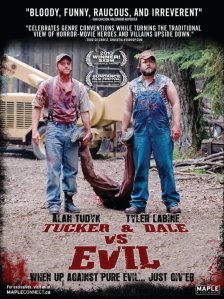
Lunatics and Laughter Day 20: Tucker and Dale Vs. Evil (2010)
 Director: Eli Craig
Writer: Eli Craig & Morgan Jurgenson
Cast: Tyler Labine, Alan Tudyk, Katrina Bowden, Jesse Moss, Travis Nelson, Chelan Simmons, Christie Laing, Brandon Jay McLaren, Alex Arsenault, Adam Beauchesne, Philip Granger, Joseph Allan Sutherland
Plot: In the Appalachian Mountains, a group of college students takes a trip to the woods. They stop to get beer, encountering a pair of rednecks. One of the girls, Allison (Katrina Bowden) is startled by the appearance of redneck Dale (Tyler Labine), and the kids hustle back to their car. Dale admires Allison from afar, and his buddy Tucker (Alan Tudyk) tries to convince him to take a chance and approach her. His weak attempt to be friendly frightens the girls. Chad (Jesse Moss) ushers them back into the car, and they speed off. Dejected, Dale slumps back to his truck and Tucker urges him to find the courage to pursue what he wants. The boys are on their way to a “summer home” Tucker bought by the lake, with an eye towards fixing it up. When a beam slips from the ceiling and nearly hits Tucker in the face, they decide they’d better start on the repairs.
At the college students’ campsite, Chad begins telling his friends the story of the “Memorial Day Massacre.” Twenty years ago, a bloodthirsty hillbilly slaughtered a group of college students just like them. Chad comes on to Allison, but she rejects him and goes to her friends, who are skinny-dipping in the lake. Tucker and Dale, meanwhile, are night fishing. When Dale spots Allison stripping, he accidentally startles her and she falls in the water, hitting her head. They pull her from the lake, saving her life, but the other kids mistake the rescue operation for a kidnapping and flee in terror. In the morning, Allison wakes up in Tucker’s cabin, head bandaged, wearing one of Dale’s flannel shirts. As he approaches her, she’s terrified of him… until she realizes he’s just bringing her breakfast. She’s stunned to realize her friends abandoned her when they thought she was in danger, and finds herself slowly charmed by the gentle, sweetly awkward Dale, even giving him permission to call her Allie.
Chad plans an assault on the hillbillies, sending Chuck (Travis Nelson) to try to find the police and Mitch (Adam Beauchesne) to attack Tucker, who’s chopping wood with a chainsaw. Tucker accidentally saws into a beehive and begins to run, Mitch fleeing in a blind panic, impaling himself on a fallen tree and dying. The teens believe Tucker killed him. Back in the cabin, Dale and Allie start playing board games, Allie impressed by his knowledge of trivia and tells him of her plans to become a therapist. Tucker summons him to help outside, and the kids hide from them as they chat about Allison, mistaking their comments and Dale’s misspelled note (“We got yur frend”) for a threat.
Allie joins Dale in digging a hole for the outhouse, revealing she grew up on a farm and is used to hard work, while Tucker gets to work disposing of all the dead wood near the cabin in a huge chipper. (If you have paid any attention since the beginning of this project, you know exactly where this is going.) The teens attack, one of them spearing himself on the stick he planned to use to kill Dale and another leaping at Tucker and landing right in the wood chipper. Allison is accidentally knocked out. The boys bring her inside, believing the college students have entered into some sort of crazy suicide pact. Outside, the kids meet up with Chuck and the Sheriff (Philip Granger).
The Sheriff pulls up at the cabin just as Tucker and Dale get the remains out of the wood chipper. The Sheriff (understandably) doesn’t believe their story, and insists they take him inside to check on Allison. He accidentally triggers the beam that nearly hit Tucker earlier, and a board full of nails is drilled into his forehead. He stumbles outside and dies next to his car full of terrified teens. Chuck takes his gun and tries to shoot the rednecks, but forgets about the safety until Dale reminds him. Chuck winds up blowing his own head off. Chad manages to capture Tucker, dangling him upside-down from a tree and torturing him for being “pure evil.”
Allison wakes up and Dale tearfully says her friends are trying to murder his best friend and his dog. Allison starts to understand the misunderstanding and steps outside to calm her friends, but finds a package left on the stoop: a part of Tucker’s shirt with two fingers and a note from Chad, daring Dale to try to save his friend. Allison’s attempt to explain reveals she was afraid of Dale when she first saw him, and he blames himself for everything that’s happened. He asks her to tell her friends he never wanted to hurt anyone and sets out to rescue Tucker. He stumbles into a trap set by Chad, but the trap misses and he saves his friend. As night falls, Chad and Naomi (Christie Laing) sneak into the cabin. They find Allison alone and Chad begins pouring gas around the cabin, calling the boys evil freaks. Naomi accuses Allison of falling in love with her captor, Chad growing angry before Tucker and Dale arrive. Allie tries to make everyone talk things out, making Earl Gray tea (because Chad is allergic to Chamomile). Chad reveals his mother was the lone survivor of the Memorial Day Massacre. Outside, the last two teens (Jason-Brandon Jay McLaren, and Chloe-Chelan Simmons) break in. They wind up setting the cabin on fire. The remaining teens, except Chad, are killed, and Dale crashes the truck trying to escape. When he wakes up, Allison is missing and Tucker too injured to go on. Tucker tells Dale he’s a better man than he knows, and that Allison sees it too, and sends him off to be the hero. He tracks Chad to a mill, where Allison is tied up. Dale cuts her free and they run, finding an attic with more newspapers and boxes of tea. The papers reveal that Chad’s mother was actually raped by the hillbilly killer… and the photo of the murderer looks just like Chad. Chad refuses to believe it and he slashes at Dale, but Dale hits him in the face with Chamomile tea. Chad staggers backwards and falls from the window.
The news blames the deaths of the college students on a deranged killer (Chad), and Tucker watches the report from his hospital room, where his fingers have been (mostly) reattached. Dale takes Allison out bowling that night. As he awkwardly tries to profess his feelings for her, she silences him with a kiss.
Thoughts: Being, as I am, from Louisiana, cinematic depictions of the south frequently infuriate me. While every geographic region has some legitimate stereotypes, the notion that being from the south automatically makes someone lackwitted or intolerant is personally insulting and as ignorant as anything the people who make those claims are upset about. And that is why I love Tucker and Dale Vs. Evil. On its face, the movie seems to play into all the backwoods hillbilly stereotypes. It soon becomes clear, though, that writers Eli Craig and Morgan Jurgenson had a totally different agenda with this film. Granted, Tucker and Dale could stand a few more showers and they may not be as refined as the Chads of the world, but they’re unrelentingly clever, hard-working, loyal, and brave. They are the salt of the Earth, and every death in the movie comes not at their hands, but because the college kids are far more stupid and intolerant than they accuse our heroes of being, and bring disaster upon themselves.
Even more so than most modern slasher movies, the death scenes are played for laughs, mainly because every single injury in the movie is either self-inflicted or Chad-inflicted. As it turns out, the only thing funnier than watching a teenager get hacked up by Jason Voorhees is watching a pretentious douche get hacked up because he thinks he’s being chased by Jason Voorhees.
The therapy scene is a great little double-punch. It comes across as a minor dig at the modern attitude of trying to talk through problems that may be beyond talking. Chad is clearly harboring deep, violent issues and it’s doubtful from the outset that there’s anything anyone could say to make him see reason. At the same time, it’s a great way to establish more of Chad’s character (he’s still a one-note villain, but now he’s a one-note villain with a motivation), and get some of the film’s funniest lines out all at once.
In terms of legitimate horror, there isn’t too much here. Some of the death scenes are a little gory and violent, but they’re never played realistically enough to get too horrified. Tucker and Dale are supposed to look disturbing at the outset, but that switch is flipped virtually as soon as they start talking. And while Chad makes for a solid villain, he’s never particularly frightening or intimidating. Tucker and Dale could easily take him out at any point if they weren’t trying to hold back, which they do either because they don’t realize they’re in danger, don’t want to hurt anybody, or are instead more concerned with protecting Allison.
In a strange way, this movie is a further deconstruction of the sort that began with Buffy the Vampire Slayer, although it takes its inspiration more from the Last House on the Left or Texas Chainsaw Massacre school of terror. In Buffy, we watched as the typical horror movie victim got the upper hand on the monsters and became a superhero. In Tucker and Dale the reversal goes a step further, with the usual victim becoming the monster himself and the usual monsters becoming champions. It’s such a simple, brilliant change-up that it’s almost impossible to believe it hasn’t been done before. (Unless it has been done before. If it has been done, please let me know.)
Although I wasn’t sure what to make of this movie the first time I watched it, it won me over almost instantly. The change to the usual horror movie formula is fresh and entertaining. Tyler Labine and Alan Tudyk are charming comedic actors that work really well together, coming across as a great movie duo. This is the newest movie on the list, receiving only a limited theatrical release and a DVD release earlier this year, so I won’t be surprised if a lot of you haven’t seen it yet. If you fall into that category, go to NetFlix streaming and stream the heck out of it, now, before your Halloween passes. It’s a great way to cap off the season.
 Reel to Reel