Blog Archives
Dorothy Gale Week Day 2: Judy Garland in The Wizard of Oz (1939)
 Director: Victor Fleming
Writer: Noel Langley, Florence Ryerson, Edgar Allan Woolf, based on the novel by L. Frank Baum
Cast: Judy Garland, Frank Morgan, Ray Bolger, Bert Lahr, Jack Haley, Billie Burke, Margaret Hamilton, Charley Grapewin, Clara Blandick
Plot: On a farm in Kansas, Dorothy Gale (Judy Garland) has to defend her dog, Toto, from the angry reproach of her neighbor, Mrs. Gulch (Margaret Hamilton). Because Toto has bitten Gulch, she’s within her rights to take the dog and have it destroyed. Dorothy and Toto run away, encountering a carnival performer called Professor Marvel (Frank Morgan), who convinces her to return home to her upset Uncle Henry and Aunt Em (Charley Grapewin & Clara Blandwick). When she returns, a tornado has sprung up and her family is hiding in the storm cellar. Dorothy and Toto rush into the farmhouse, which the tornado plucks from the ground and hurls through the air.
Dorothy crashes in a brilliantly colorful land called Oz, where she finds herself the darling of a group of small people called Munchkins. She is met by a good witch named Glinda (Billie Burke), who explains that Dorothy’s house crushed the tyrannical Wicked Witch of the East. Her sister, the Wicked Witch of the West (Hamilton again) arrives for vengeance, but finds she cannot harm Dorothy directly, as Glinda has given her the dead witch’s powerfully magic Ruby Slippers.
Glinda sets Dorothy on a path to the fabled Emerald City, where the Wizard of Oz may be able to help her get home. Along the way she is joined by three others, each who need help from the Wizard: a living Scarecrow (Ray Bolger) was made without a brain, a Tin Woodsman (Jack Haley) who was crafted without a heart, and a Lion (Bert Lahr) who is sadly a coward. The three of them encounter the witch several times, narrowly escaping her traps before finally arriving in the Emerald City. When they go into the Wizard’s chambers, they encounter an enormous floating head that tells them he can grant their wishes, but will only do so if they can bring him the broomstick of the Wicked Witch of the West.
Dorothy and her friends travel to the Witch’s palace, where she is captured by the Witch’s flying monkeys. The other three disguise themselves as guards and rescue her, but encounter the witch upon escape. In desperation, Dorothy hurls a bucket of water at the witch, who immediately melts away, destroyed by her one weakness. Returning to the Emerald City, the Wizard tells them he needs time to think about their requests. As the friends despair, Toto discovers a little man (Morgan again) hiding behind a curtain, operating a machine that projects the image of the head. The Great and Powerful Wizard of Oz, it seems, is a humbug – a simple performer from the United States who accidentally drifted into Oz years ago in a hot air balloon.
Recognizing that the Scarecrow, Tin Woodsman and Lion already possess those very things they most desire, he gives each of them a small token: a diploma to signify the Scarecrow’s wisdom, a testimonial in the shape of a heart for the Tin Woodsman, and a medal to proclaim the courage of the Lion. For Dorothy, though, the only thing he can do is repair his balloon and take her home himself. Before they’re about to leave, though, Toto leaps from the basket. Dorothy rushes after him, and the balloon drifts away with the Wizard alone. Dorothy fears she’ll be trapped in Oz forever, but Glinda appears again and reveals that the Ruby Slippers she wears have the power to transport her: she need only click her heels together three times and recite “There’s no place like home.” When Dorothy does this, the world swims around her and she wakes up back in Kansas, surrounded by her Aunt and Uncle, three farmhands who bear a striking resemblance to her friends in Oz, and Professor Marvel, who has come to check on her. Although they all believe she dreamed her adventure in Oz, Dorothy doesn’t care – she is content to simply be home.
Thoughts: After yesterday’s somewhat disturbing look at a silent Oz, spending time with the MGM classic is just what I needed. This is the movie we all know and love, the apex of the musical fantasy, the film that virtually everybody in the world has seen as a child, hidden from the flying monkeys, sang along with the Munchkins, and then later pretended they didn’t like a few years later while going through a hipster phase. It is, in fact, a masterpiece.
Although the film seemed like it was going to be a disaster for much of the production, with prospective directors and screenwriters playing musical chairs before we finally landed on the people who got the credit, the final result is something that was spectacular to look at in 1939 and is still lovely today. The transition from the sepia tone of Kansas to the brilliant color of Oz is beautiful both artistically and technically. The shift demonstrates a transition from a sad, humdrum world into a place of incredible wonders, and when you consider most people in 1939 would never have seen much color before, it’s easy to see it as a game-changer. The color in this film mattered as a storytelling choice, it sold the idea that color can influence the telling of the tale. This was Al Jolson in The Jazz Singer all over again, looking at the camera and proclaiming “you ain’t seen nothin’ yet.” This (if I may briefly tangent) is why I still don’t care for 3-D movies – no matter how pretty any of them may be, I’ve yet to see a movie become more effective as a story because it is in 3-D, the way this film could never have been filmed in black and white.
Judy Garland has become the gold standard for Dorothy Gale. Not only is the actress most identified with the role, but a vast majority of the artistic representations since then have used her likeness and costume as the basis, even though later Oz books specified her as blonde and depicted her in different clothes than the blue checkered dress. In truth, at 16 when the movie was filmed, Garland was really too old to fit the part as written (at one point, then 10-year-old Shirley Temple was a frontrunner for the role). Yet her youthful charm, innocence, and amazing voice sold her like few actresses have ever sold a part. You cannot use the name Dorothy without summoning up a vision of Judy Garland, and that’s all to the good.
Despite the various cast changes, it’s now virtually impossible to imagine anyone filling in the other principle roles than the actors we had. Ray Bolger flawlessly plays the wise man who doesn’t understand his own worth, Jack Haley has tenderness without seeming weak, and Bert Lahr is a living cartoon, silly and heartwarming all at once. Morgan and Hamilton, similarly, have become the benchmark for their parts as the Wizard and Witch. Hamilton in particular deserves special credit, I think, taking a character who had little personality in the original novel and creating one of the most enduring villains in cinematic history.
The film leaves out certain sequences from the book, and changes too many things for it to really succeed as an adaptation, but the alterations are forgivable in the context of the film MGM was trying to make. Sequences like the China town (brought back by Disney in this year’s Oz the Great and Powerful) would have been difficult to make convincing with the special effects of the time. Other scenes featured Dorothy’s friends getting rather violent in defense of the little girl – could you imagine seeing Ray Bolger standing atop a pile of crows after snapping their necks or Jack Haley swinging his axe to behead a pack of ravenous wolves? The original story left a lot of blood on the page that never made it to the movie screen, and that’s honestly okay.
This is one of those films that’s so well-known, so well-loved, it’s hard to imagine anything I could say that hasn’t been said already. As an Oz fan, I’m still waiting for a truly faithful adaptation of the L. Frank Baum novel, but as a fan of musical cinema, this is one of the greatest movies ever made.
The first Reel to Reel study, Mutants, Monsters and Madmen, is now available as a $2.99 eBook in the Amazon Kindle store and Smashwords.com bookstore. And you can find links to all of my novels, collections, and short stories, in their assorted print, eBook and audio forms, at the Now Available page!
Dorothy Gale Week Day 1: Dorothy Dwan in The Wizard of Oz (1925)
 Director: Larry Semon
Writer: Frank Joslyn Baum, Leon Lee & Larry Semon, adapted from the novel by L. Frank Baum
Cast: Dorothy Dwan, Mary Carr, Virginia Pearson, Bryant Washburn, Josef Swickard, Charles Murray, Oliver Hardy, Frank Alexander, Otto Lederer, Frederick Ko Vert, Larry Semon, G. Howe Black
Plot: A toymaker (Larry Semon) crafts a set of dolls for his granddaughter, recreating the characters from L. Frank Baum’s The Wonderful Wizard of Oz, then sits her down and to read the book with her. Or rather, he reads some alternate universe version of the book that only exists in this movie, because despite the fact that Baum’s own son got a screenwriting credit, it is almost unrecognizable from the book. My friends, I have written about 80 or so different movies since I first started this project, but this may be the craziest thing I’ve ever watched. Normally I don’t blame you if you skim over my somewhat detailed synopses, but this time I implore you… read on.
In this version, the people of Oz have managed to achieve a tense, suspicious peace many years after their baby princess was kidnapped and lost. In the place of the royal family is the treacherous Prime Minister Kruel (Josef Swickard). His actions (which are completely undefined) are beginning to bring the people of Oz to rally around Prince Kynd (Bryant Washburn), who demands the return of the rightful queen. Kruel turns to his advisor, Ambassador Wikked (Otto Lederer), who suggests they take their case to the Wizard (Charles Murray) and ask him to use his power to distract the people while Kruel schemes. Nobody knows the Wizard is merely a huckster – a man with impressive tricks, but no real magic.
Upset by the story, the toymaker’s granddaughter urges him to read the part about Dorothy and her friends, and he complies. In Kansas, we meet a rose-adorned girl named Dorothy (Dorothy Dwan) and her loving Aunt Em (Mary Carr). Her Uncle Henry (Frank Alexander) is less enamored of her, and grows angry at her for wasting time on the farm, where a farmhand (Oliver Hardy) defends the women as Henry berates them. Semon and G. Howe Black also appear as buffoonish farmhands, also victims of Henry’s temper. Semon and Hardy (both nameless) fight over Dorothy’s affections, and Henry gets angry at them all. Dorothy turns to Em, upset at Henry’s cruelty, and Em confesses that he isn’t really her uncle. She tells Dorothy the story of how, many years ago, baby Dorothy was delivered to their doorstep in a basket, and if you don’t know where this is going then congratulations on making it this far in life without ever having watched a movie before. Anyway, Dorothy arrived with a letter to be opened by her on her 18th birthday and not a moment before.
Back in Oz, things are getting even more tense, as Kynd warns Kruel that coronation day is approaching. He has until the new moon to produce Oz’s rightful queen, or Kynd will throw him into the dungeon. Kruel knows there are papers in a faraway place called Kansas that will save his regime, and sends Wikked on a journey to find them. The granddaughter, showing the sort of patience that would no doubt lead her to blow up her high school science lab in later years, forces her grandmother to jump back ahead in the story to Dorothy, who now is celebrating her 18th birthday. She goes to Henry, reminding him that today is the day he gives her the papers that came with her upon her birth. Before he can do so, Wikked arrives, flying in a biplane and landing on Henry’s farm. He demands the letter that came with Dorothy, offering to bribe Henry to prevent Dorothy from knowing the contents of the letter, but Henry grows angry and shoos them away. Wikked turns to the farmhands, who are fighting over Dorothy’s hand, and tells Hardy that she will never marry him if she reads her papers. Henry is about to give the papers to Dorothy, but Wikked and his thugs capture them at gunpoint. Henry manages to hide the letter, and Wikked has Dorothy tied to a watertower, threatening to burn the rope and let her fall if he doesn’t get the papers. Semon manages to catch her, because physics don’t apply in silent movies, and gives her the letter, which he found. Wikked tries to attack again, but apparently even God wants them to just get the hell to Oz, because all of a sudden a storm comes out of nowhere, lightning striking the bad guys (and knocking off Semon’s hat and bow tie) and wind forcing everyone else inside. Dorothy, Henry and the farmhands, in the house, are caught by the wind and blown away.
The five of them and Wikked crash outside the land of Oz. Semon hands Dorothy the letter, which indicates that her true name is Dorothea, rightful ruler of Oz, and destined to take the throne upon her 18th birthday. Kynd, Kruel, and the Wizard come out to greet them, although only Kynd is happy. Kruel orders the wizard to do something to the farmhands while he deals with Dorothy and Henry, but the Wizard is powerless. The farmhands each disguise themselves so that they and the Wizard won’t get in trouble – Semon putting on the clothes of a Scarecrow, Hardy a suit made of tin. Kruel captures them all and Hardy and Semon each accuse the other of kidnapping Dorothy in the first place. Black (the remaining farmhand) and Semon are sent into a dungeon where they are immediately mistreated by people dressed like pirates. I think this movie is going to give me a nosebleed.
With Dorothy’s true status revealed, Wikked advises Kruel to marry the new Queen to maintain his power. Hardy is made a “knight of the garter,” which somehow makes him immune to metal, and Henry is made Prince of Whales, which is not a typo. Back in the dungeon, the Wizard approaches Black and has him don a lion costume so he can frighten his captors and WHY THE HELL IS THE WIZARD TRYING TO HELP THE FARMHANDS THIS DOESN’T MAKE ANY SENSE AND he and Semon manage to escape. Semon plans to help save Dorothy from being the victim of a frame-up (FRAME UP? WHAT IS SHE BEING FRAMED FOR?) and sneaks out of the dungeon, but winds up being chased back down by Hardy, where he and Black encounter real lions. But Semon isn’t worried because lions like “dark meat” and Black is actually black and I think I need to sit down.
Kruel and Dorothy are about to get married (I think) when Kynd shows up and engages him in a swordfight and the Wizard helps Semon escape the dungeon. Together they defeat Kruel, who confesses to kidnapping Dorothy in the first place, claiming he whisked her away to save her from a “hostile faction.” Dorothy turns to Kynd, who she has apparently fallen in love with because of his mustache, and Black and Semon fly away in Wikked’s biplane.
Thoughts: This is truly a bizarre movie, unlike any other version of Oz I’ve seen put to screen. The long, frankly tedious focus on the bumbling farmhands at the beginning makes it clear that the film was really intended as a starring vehicle for actor/director/co-writer Larry Semon (he in fact is the only actor credited on the only original movie poster I could find). As a historical footnote, the film is more notable for featuring a young Oliver Hardy, who would go on to be one-half of one of the greatest comedy teams of all time, whereas Semon would go on to die of pneumonia at the age of 39. This is especially notable as, even when he’s not wearing his old man makeup, he looks like he’s about 64 years old in this movie.
The story here is something of a chore to get through. I can handle a story that adds new things to the Oz mythology, but the almost unforgivable thing here is the way Semon and his co-writers spend a ridiculously long time showing the various farmhands going through comedic antics back in Kansas, this after the granddaughter has specifically asked to hear about Dorothy and the Scarecrow, the Tin Woodsman, and so forth. I’m also very uncomfortable with re-casting Uncle Henry as this cruel, heartless man who practically tortures Dorothy and Em, regardless of the question of Dorothy’s true parentage. Even worse, though, it’s internally inconsistent, as the cold-hearted Henry suddenly becomes Dorothy’s stalwart defender when Wikked shows up to take back her birth papers.
I admit that I’m not exactly privy to the demands of a 1925 filmgoing audience, but I can’t imagine anybody who loved the novel (which was 25 years old at this point, enough for parents and their children alike to have grown up with the book) watched this and came away satisfied. So much of it simply makes no sense. How did Kruel come to power? What the hell is Prince Kynd actually the prince of? What were Kruel and Wikked doing that turned the people of Oz against them? And didn’t anybody find their names at all suspicious? Why do the farmhands disguise themselves? What the hell does it matter to them if the Wizard gets in trouble for faking his powers all these years? They have literally just met the man, and he’s working with the guy who wants to destroy them. Typing this paragraph is giving me a headache.
Considering the complete mess made of the story here, perhaps the thing that disturbs me about this movie the most is the way it completely strips away all of the magic of Oz. Not only is the Wizard a humbug, but there’s no magic anywhere – the scarecrow and tin man are just disguises, and the route between Oz and Kansas is easily accessible by a 1920s-era crop duster. The closest thing to magic is the storm that hurls them to Oz, and I’m still willing to chalk that up to the intervention of a deity that can’t believe they were 44 minutes into an adaptation of The Wizard of Oz and Dorothy hadn’t left Kansas.
The characters, meanwhile, are paper-thin. Dorothy Dwan (Semon’s wife) as Dorothy is less of a character and more of a living doll for the men to fight over. Her affections bounce between men from moment to moment with no reason or logic, and we’re never given a satisfactory reason why she should fall in love with Kynd in the end. The rest of the characters are similarly ill-developed, acting without any real motivation. Howe’s “Cowardly Lion” farmhand is the sort of racial stereotype you expect in a movie from this time period, which I usually try to tolerate for the sake of context, but the line about lions liking “dark meat” just sent me over the edge. In the end, the whole thing seems to exist solely to showcase Larry Semon’s slapstick abilities. That’s fair, I suppose – a lot of the comedies in the era of silent movies were little more than the star comedian performing their antics in front of a camera. But I have to ask – is an adaptation of The Wizard of Oz really the right place for that kind of one-man show?
The good news is that this movie is largely a footnote in Oz lore. Very few people watch it anymore, which is as it should be, and it’s not remembered very well. The bad news is that the one thing from this movie that did make it into the greater Oz Mythology is probably one of my least-favorite parts: the conceit that Dorothy’s friends in Oz are based on the people she knew back home. In and of itself, that’s not really a bad idea. It’s cute, it’s fanciful, and it has worked its way into many other fantasy films over the years. The problem, though, is that the way it was used in the 1939 film birthed the notion that Dorothy dreamed her entire Oz adventure. This is something Baum never intended, but something a lot of people think is Oz canon… and the whole thing rather cheapens Oz to me, almost as much as the stripped-down Oz we got in this movie.
I need to cleanse my palette, friends. I need a good movie to cleanse my mind. Fortunately, the next one on this list is the classic to end all classics. Tomorrow it’s time for Judy Garland in MGM’s 1939 film The Wizard of Oz.
The first Reel to Reel study, Mutants, Monsters and Madmen, is now available as a $2.99 eBook in the Amazon Kindle store and Smashwords.com bookstore. And you can find links to all of my novels, collections, and short stories, in their assorted print, eBook and audio forms, at the Now Available page!
Next week is DOROTHY GALE WEEK!
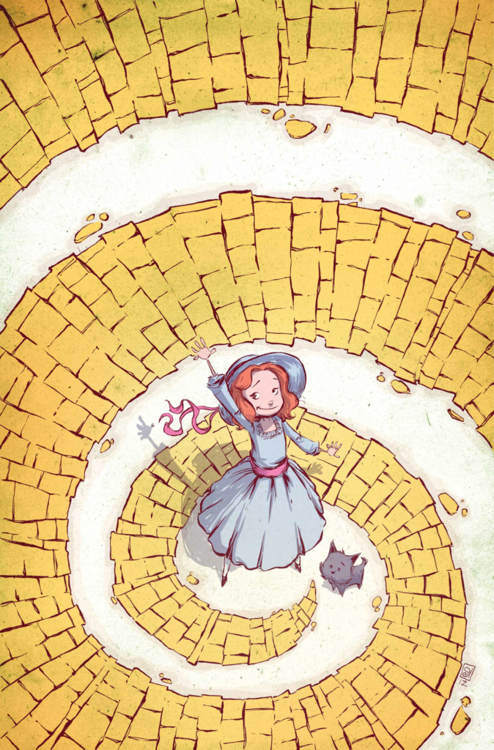
From Marvel’s “The Road to Oz” comic book, artwork by Skottie Young.
It’s time for our second monthly “Icons Week” here at Reel to Reel, friends, and starting Monday we’re going to be focusing on that lovely little girl from Kansas who took us all on a journey over the rainbow. I think I’ve written enough here by now about how much I love The Wizard of Oz and its various interpretations, and this week I’m going to bring you five different looks at the story, including three variants of Dorothy’s original journey and two films that depict future adventures in the land of Oz. Here are the movies and actresses we’ll talk about next week:
- Dorothy Dwan in The Wizard of Oz (1925)
- Judy Garland in The Wizard of Oz (1939)
- Liza Minnelli in Journey Back to Oz (1974)
- Diana Ross in The Wiz (1978)
- Fairuza Balk in Return to Oz (1985)
Five films, five very different interpretations of the Land of Oz that I’m really looking forward to sharing with you guys. But as we did with Batman, we really need to have a sort of baseline, a way to understand who this character is, so that we can understand what these different versions bring to the table. So in case you don’t know, let’s talk about…
The Character
Dorothy Gale is a little girl from the farmland of Kansas, where she lives with her Uncle Henry and Aunt Em. One day, a tornado rips Dorothy’s house from the ground with her in it, tossing her through the air, crashing her into the magical Land of Oz, and crushing the evil Wicked Witch of the East in the process. Dorothy’s only hope to return home is to visit the Wonderful Wizard of Oz, taking a long trip down a road of Yellow Brick, and encountering new friends and incredible dangers along the way.
There are the basics, friends, that’s who Dorothy is at her core, and that’s who we’ll be talking about in just a few days time. So have a good weekend, spread the word, and I’ll see you back here Monday to discuss the 1925 silent version of this classic tale.
How many Oz movies are there, anyway?
 After I posted my April Icons announcement (Dorothy Gale week) along with my March viewing list, a few people expressed surprise to me that there are so many movies based on L. Frank Baum’s Oz books. Ozophile that I am, I’m always on the lookout for new films and new entries into the land of Oz, but I forget at times that most people are only familiar with the 1939 MGM film starring Judy Garland (which will be a part of the Dorothy Gale Icons week, don’t worry). So that in mind, I’ve put together a list of Oz films, culled from a glance at IMDB.com. This may not be comprehensive, but even if I missed a bunch of movies, this should give you an idea that the world of Oz is so much bigger than many people think.
1. The Wonderful Wizard of Oz (1910)
2. The Land of Oz (1910)
3. The Patchwork Girl of Oz (1914)
4. The New Wizard of Oz (1914, uses elements of Baum’s novel The Scarecrow of Oz)
5. The Wizard of Oz (1925)
6. The Land of Oz (1932)
7. The Wizard of Oz (1933 short)
8. Oz University (1936)
9. The Wizard of Oz (1938 Short)
10. The Wizard of Oz (1939 — This is the classic version that everyone knows… the FIFTH attempt at adapting the first Oz novel, and the last time anyone would try to do it directly for a long time…)
11. The Land of Oz (1960 episode of series Shirley Temple’s Storybook)
12. Return to Oz (1964 TV movie)
13. The Wizard of Mars (1965, based on The Wonderful Wizard of Oz and Glinda of Oz)
14. Oz: The Tin Woodman’s Dream (1967)
15. The Wonderful Land of Oz (1969)
16. Favorite Children’s Books: The Wizard of Oz (1970)
17. Journey Back to Oz (1974)
18. 20th Century Oz (1976)
19. The Wiz (1978)
20. Thanksgiving in the Land of Oz (1980)
21. The Marvelous Land of Oz (1981)
22. The Wizard of Malta (1981)
23. The Adventures of a Man in Search of a Heart (1984 — Film about the Tin Woodman)
24. The Whimsical World of Oz (1985 — Documentary)
25. Return to Oz (1985 — Disney mashup of the novels The Land of Oz and Ozma of Oz)
26. The Life and Adventures of Santa Claus (1985 — Not strictly an Oz movie, but a Rankin/Bass film based on the novel by Baum with certain fairy characters and locations that would recur in the Oz books)
27. The Emerald City of Oz (1987)
28. The Marvelous Land of Oz (1987)
29. Ozma of Oz (1987)
30. Dorothy Meets Ozma of Oz (1987)
31. Toto’s Rescue (1989)
32. Trouble in Oz (1989)
33. The Wonderful Galaxy of Oz (1990 — Japanese sci-fi anime)
34. The Hollywood Road to Oz (1990 — Documentary)
35. The Dreamer of Oz (1990 — Biopic of L. Frank Baum starring John Ritter)
36. Dorothy and the Wizard in Oz (1993)
37. We’re Off to See the Munchkins (1993 — Documentary)
38. The Magic Book of Oz (1994)
39. Christmas in Oz (1996)
40. The Nome Prince and the Magic Belt (1996 — Uses parts of five different Oz novels)
41. Toto Lost in New York (1996)
42. The Return of Mombi (1997)
43. Underground Advnture (1997, based on Dorothy and the Wizard in Oz)
44. The Wicked Witch Project (1999)
45. Twister: A Musical Catastrophe (2000)
46. Lion of Oz (2000, based on the novel by Baum’s great-grandson, Roger S. Baum)
47. The Life and Adventures of Santa Claus (2000 — Remake of 1985 Rankin/Bass film)
48. The Muppets’ Wizard of Oz (2005)
49. Apocalypse Oz (2006)
50. Tin Man (2007 Miniseries)
51. The Patchwork Girl of Oz (2009)
52. The Tin Woodman of Oz (2009),
53. Heartless: The Story of the Tinman (2010)
54. The Witches of Oz (2011 Miniseries)
55. Tom and Jerry and the Wizard of Oz (2011 — Remakes MGM film with Tom and Jerry having a parallel adventure to that of Dorothy, surprisingly good)
56. Dorothy and the Witches of Oz (2012 sequel to 2011 miniseries)
57. Oz the Great and Powerful (2013)
And upcoming…
L. Frank Baum’s The Wonderful Wizard of Oz (2013, an attempt at a more faithful adaptation of the novel than most others)
Legends of Oz: Dorothy’s Return (CGI musical based on Roger Baum’s novel Dorothy of Oz)
Oz the Great and Powerful 2
Again, this is by no means a comprehensive list. I left off foreign language versions (of which there are many), video games and TV series (although I kept miniseries and made-for-TV movies), and film releases of “live” shows like The Wizard of Oz in Concert and The Wizard of Oz on Ice. I also stopped counting straight-up adaptations of the first Oz novel after we reached the Judy Garland film, but they came back after a while. Other versions were made in 1950, 1967, 1975, two in 1976, and 1982. Plus, this list was created just by looking at L. Frank Baum’s IMDB page, it doesn’t list most of the Oz films, adaptations, or “reimaginings” in which he received no credit on the website.
And we could still be here watching these for weeks.
So again, while I don’t expect anybody to rush out and become the sponge for Oz that I am, it’s nice to call attention to the fact that for those who want more, there’s almost always more available.
What I Watched In… March 2013
In the interest of full disclosure (and to generate a little content here) I thought I’d present a regular tally of what movies I managed to see in the previous month. Some of them I’ve written about, most of them I haven’t. This list includes movies I saw for the first time, movies I’ve seen a thousand times, movies I saw in the theater, movies I watched at home, direct-to-DVD, made-for-TV and anything else that qualifies as a movie. Feel free to discuss or ask about any of them!
1. Dreamer of Oz (1990), B
2. Lion of Oz (2000), C
3. The Boy in the Plastic Bubble (1976), D; Rifftrax, B
4. Wreck-It Ralph (2012), A
5. The Babysitters (2007), C
6. Batman (1943), C+
7. The Wonderful Galaxy of Oz (1990), D
8. Master of the Rings: The Unauthorized Story Behind J.R.R. Tolkien’s ‘Lord of the Rings’ (2001), C+
9. Tom and Jerry and the Wizard of Oz (2011), B-
10. Willy Wonka and the Chocolate Factory (1971), A
11. Pure Imagination: The Story of ‘Willy Wonka and the Chocolate Factory’ (2001), B
12. Oz the Great and Powerful (2013), B+
13. Toy Story (1995), A
14. Batman: The Movie (1966), C
15. Batman (1989), B+
16. Star Wars Episode V: The Empire Strikes Back (1980), A+
17. Frankenstein Island (1981), D; RiffTrax, B-
18. The Brute Man (1946), D-; MST3K Riff, B
19. Dick Tracy (1990), B
20. Future War (1997), F, MST3K Riff, B
21. Abbott and Costello Meet Captain Kidd (1952), C
22. The Invincible Iron Man (2007), C
23. Batman: Mask of the Phantasm (1993), A
24. When a Stranger Calls Back (1993), F; RiffTrax Riff, B+
25. The Dark Knight (2008), A
26. Africa Screams (1949), B-
27. Animal Crackers (1930), A-
28. Jack and the Beanstalk (1952), B
29. The House on Haunted Hill (1959), B-; RiffTrax Riff, B+
30. The Easter Bunny is Comin’ to Town (1977), B
31. Sophia the First: Once Upon a Princess (2012), B
32. It’s the Easter Beagle, Charlie Brown! (1974), B+
33. It’s Arbor Day, Charlie Brown (1976), B-
34. Ben-Hur (1959), A+
35. The Ten Commandments (1956), A+
36. Jack the Giant Killer (1962), C; Rifftrax Riff, B
Gut Reactions: Oz the Great and Powerful (2013)
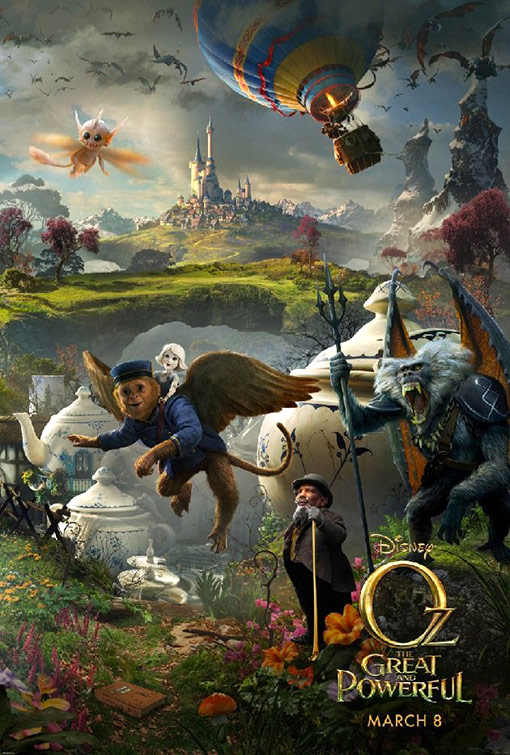 Director: Sam Raimi
Writers: Mitchell Kapner & David Lindsay-Abaire, based on the works of L. Frank Baum
Cast: James Franco, Mila Kunis, Rachel Weisz, Michelle Williams, Zach Braff, Bill Cobbs, Joey King, Tony Cox, Bruce Campbell
Plot: Carnival huckster Oscar Zoroaster Diggs (James Franco) is swept up by a cyclone and hurled away to the mysterious, magical land of Oz. There, he finds himself caught in a power struggle between three witches (Mila Kunis, Rachel Weisz and Michelle Williams) over the realm’s vacant throne. A prophesy claims that a wizard from another land will save Oz from wickedness, but can this humbug of a man find in himself the hero that Oz needs?
Thoughts: Before I really dig into this movie, I think it’s only fair that I (briefly) tell you about my personal history with Oz, so you can understand where my opinion is coming from. Like most people these days, my first exposure to Oz was the 1939 MGM film, which I saw as a child and enjoyed. When I was a bit older, though, at my local public library (visit ‘em kids, they’re awesome) I found an entire shelf of Oz books by the creator, L. Frank Baum. I devoured the books they had (which, as it turned out, weren’t all of them), and since then I’ve been a devoted consumer of any book, movie, or comic book I can find that offers a different vision of the land of Oz. Although I think there is plenty of room in media for many, many different Ozzes (a phenomenon I discussed in more depth on my other blog yesterday), in my heart, my favorite visions of Oz are those that pay due deference to Baum.
And it’s with that perspective that I can say I enjoyed Oz the Great and Powerful immensely. (Don’t worry, I’ll put up a warning before I get into any spoilers for those of you who haven’t seen it.)
The biggest problem with prequels, as George Lucas proved, is that it’s difficult to maintain suspense when the audience already knows where the characters will be when the story ends. This isn’t really a big problem with this film, though. Baum gave precious little backstory on many of his main characters, and almost none on the witches of Oz (although subsequent writers would often turn to this as their inspiration), and that leaves the screenwriters an enormous amount of room to play in. They also create a version of Oz that is mostly consistent with the books, while still giving a few nods to the 1939 film that they know is what most people will use as their measuring stick.
The casting is very good. Zach Braff as Finley the Flying Monkey brings a totally unexpected element of comedy to the film, one that serves to give us a glimpse of light in very dark moments. Each of the witches feels very natural in their respective roles – Mila Kunis’s naïve Theodora and Rachel Weisz’s sly Evanora work very well as the sister witches, and from the beginning present an interesting question to the audience… which of the two will someday become the insidious Wicked Witch of the West, and which one has a date with a house that’s going to fall out of the next tornado?
Michelle Williams is almost perfect as Glinda. While Billie Burke’s portrayal from 1939 is that of a hands-off fairy godmother, the sort who prefers to pulls the strings and not get directly involved, Williams is a much fiercer, braver woman. The display of power she puts forth in this movie is impressive, and certainly more in keeping with the character Baum created. He didn’t go in for the pyrotechnics quite as much as this movie does, mind you, but it’s easy to see Williams’s Glinda capable of maturing into the strong, confidant witch she becomes in the original books.
Then there’s Oz himself, James Franco. Oddly enough, he’s the only one of the main cast that doesn’t always work for me, and it’s for an strange reason. Franco plays Oz as a snake oil salesman, a con man who has a good heart buried somewhere deep inside, and that’s all well and good, that’s how he should come across. But there are moments in the film where it feels like he’s actually overselling the overselling, moments where you’d want Sam Raimi to ask him to dial it back down to 11 from 12 or 13.
As for Raimi’s directing… it’s fantastic. His visual effects team has built a brilliant, remarkable Oz that satisfies me on absolutely every level. Even the 3-D in this film is superior to most others. It’s funny – I’ve long said that I’ve never seen a movie that convinces me that 3-D is a tool that improves storytelling, that there is no movie that does for 3-D what the 1939 The Wizard of Oz did for color… and this film almost does it. Raimi’s transition from Kansas to Oz is a truly remarkable moment, and one that uses 3-D in a very clever way, similar to the way the ’39 film did with color. It’s visually stunning and, for a few scarce moments, I was glad I saw it in 3-D. Then later on he starts throwing monsters and spears straight at the camera and I was over it. Raimi also throws in a few moments of self-reference, which I think are fun as well… there’s one scene that’s almost straight out of his own Army of Darkness, which had my friends and me in hysterics, probably because we’re the only people in the theater that got the joke.
I’ve got other things to say about this movie, including a few problems, but nothing I can discuss without putting up a spoiler wall. So if you’ve read this far and you haven’t seen the movie yet, let me assure you that it has my wholehearted recommendation. It’s a great fantasy film, probably too scary for the little kids, but well worth watching in the movie theater. And I won’t even judge you for choosing the 3-D this time.
SPOILERS AFTER THIS LINE. ———————————————————————————————-
Aside from Franco being a bit over the top, my biggest problem with the story itself is one of timing… not pacing, timing. Once Franco arrives in Oz, it feels like things happen entirely too fast. For one thing, I think it’s clear too early in the film that it is Theodora, not Evanora, who is fated to become the Wicked Witch of the West. In fact, I think it’s clear too early that Evanora is the real villain, and not the “Wicked Witch” the sisters are warning us about. Granted, as soon as we learn the “Wicked Witch” is named Glinda, the audience should know Franco is being conned, but that moment should be played as a reveal and never really gets that chance.
Theodora’s emotional turns are also hurt by the sheer speed of the piece. I’m not entirely sure (after just one viewing) but it seems like no more than three days pass between her meeting Oz and her transformation. In that time she falls madly in love with him, decides she’s going to marry him and become his queen, and then grows to utterly hate him when she sees a glimpse of him talking to Glinda and learns that he “romanced” her sister the same way he did her. (Incidentally, I think the film does a nice turn leaving it a little ambiguous as to whether or not this actually happened. We see Oz work his charms on various women in the movie, but never Evanora, which leads me to suspect he never did. Instead, I got the impression Evanora pulls off the con on her sister because she was spying on the two of them in her globe the whole time.) The sheer speed with which Theodora’s affections turn weakens the character, making her the fantasy equivalent of the internet Overly Attached Girlfriend meme. Even more problematic, she truly becomes wicked not because her heart is broken, but because after her heart is broken she allows her sister to make her evil. It’s still the character making a choice, but I think it’s a weak choice, she doesn’t “earn” her evil, so to speak… not so much a monster as a victim, which will give her death at Dorothy’ s hands a level of forced tragedy I don’t think works.
It seems very clear to me that this movie was made to be the beginning of a franchise, despite its prequel status – and in fact, Disney was already talking about sequel plans the day before the movie was released. I’ve got no problem with this turning into a franchise, but it’s a little too obvious that was the intent… instead of taking us from point A to point Z (“Z” being where The Wizard of Oz begins), this gets us to about… let’s say “J.” The film ends with Oz in power and the witches banished, but there are a lot of things that don’t mesh up. Evanora doesn’t have the Silver Shoes (or, if you insist on going with the MGM version, Ruby Slippers). Theodora isn’t in command of the Flying Monkeys. Both sisters have been driven out and humiliated, where Evanora pretty much has dominion over Munchkinland when the original begins. Probably lots of other little bits I’m forgetting now, but will remember when I (inevitably) see the movie again.
The biggest sequel hooks come in for the Wizard himself, though… specifically, he’s not the recluse we know he’s doomed to become. He and Glinda have a romantic relationship, which simply doesn’t fit the first movie (or any other incarnation, for that matter). This gives the screenwriters a delicate task – they have to do something to alter the relationship in such a way that they are no longer together, that he has retreated into his palace, but where she still has enough faith in him to send Dorothy down the Yellow Brick Road when she drops from the sky. Then there are Finley and the China Girl, Oz’s surrogate family. Their inclusion in this story is actually wonderful, but it has us poised for tragedy. The moment Finley swears his life debt to Oz, pledging to remain with him until he (Finley) dies, I had a chill at every moment he was in danger. We know that the Wizard has no Finley when Dorothy arrives, and there’s simply no way the character Zach Braff played would ever turn on his friend… which leaves only one possible reason for his absence in the later stories.
I appreciated a lot of the little touches that were brought in from the original book, for example, the inclusion of all four of the peoples of Oz, and not only the Munchkins as the original film did. The prominence of the China Town was good too, although it does raise the question of how it will be rebuilt to the point it will be when Dorothy arrives. (Then again, as this is a point left out of the original film, perhaps the filmmakers don’t plan to address it again.) And although there were a few creatures we encountered that didn’t come straight from the books, there was nothing that would feel out of place in a Baum story, and so I’m perfectly happy with that.
As a lifelong Oz fan, though, there’s one glaring red flag waving in my face, one thing that simply flat-out contradicts any version of Oz I’ve ever seen, one thing I’m having a little trouble getting over, and that’s the notion that Glinda is the daughter of the murdered King of Oz. This doesn’t fit in anywhere, and I have a hard time wrapping my brain around it… not only idea that Glinda is the king’s daughter, but also the question of what this means for the true ruler of Oz in the original novels, Princess Ozma. Considering how much work was done to mine the book, making a change of this magnitude is really troublesome to me. At the end of the movie, I kept waiting for an exchange like this:
OZ: Hey, if your father was the king, doesn’t that mean you should be queen?
GLINDA: No, I had to renounce my claim to the throne when I chose to become a witch. My sister was supposed to take over, but she’s been missing ever since our father died.
Not a perfect solution, I admit, but at least it would be something. The point is, it’s not a minor quibble, but a major chance to the Oz canon that I think the sequels simply have to address.
That said, as big an issue as I have with that element, I still really enjoyed this movie. It’s a modern Oz with a timeless feeling, which is as much as anybody could possibly have hoped for, and I hope to see Disney march forward with this franchise for a long time… even, if they have the guts, rolling into an actual adaptation of the original novel. Despite all the different versions of Oz that have hit the screen, very few filmmakers have dared try a full-on adaptation of the original, fearing comparisons to the MGM film. If the Disney juggernaut doesn’t have the courage to finally make a version of The Wizard of Oz that’s closer to the book, nobody ever will. And that, my friends, is where I really want to see this franchise go.
The first Reel to Reel study, Mutants, Monsters and Madmen, is now available as a $2.99 eBook in the Amazon Kindle store and Smashwords.com bookstore. And you can find links to all of my novels, collections, and short stories, in their assorted print, eBook and audio forms, at the Now Available page!
Anticipating 2013
Okay, folks, since people are talking about such things, I’ve put together a list of my ten most-anticipated films of 2013. This, of course, is based on what trailers I’ve seen, what news I’ve heard, and my previous experience with the franchises in question. Assuming I remember, I’ll come back at the end of the year, take a look at these ten films, and let you know if I think they met with my expectations. In alphabetical order, because I find it hard to rank such things.
- Ender’s Game-One of my favorite books of all time. Harrison Ford as Admiral Graff. I know some fans are upset that they aged the kids and compressed the story into a year, but I can honestly understand why. It’s a reasonable concession to make the story work for a movie, and I’m willing to give them a pass on it if everything else works.
- The Hobbit: The Desolation of Smaug-I’ve always enjoyed Tolkien and I liked the first installment quite a bit. Looking forward to watching it continue.
- Iron Man 3-I really loved the first two and Avengers was amazing. I’m hoping Marvel Studios can keep the energy up there.
- Man of Steel-Because I am a lifelong Superman fan and the trailer kicked ass. Amy Adams is a perfect choice for Lois Lane, and Christopher Nolan’s involvement as producer gives this movie some serious potential.
- Monsters University-The original Monsters, Inc. is one of my favorite Pixar films, and the trailers for this prequel have made me laugh.
- Oz: The Great and Powerful-I’ve loved the Oz books my whole life, and this looks like Sam Raimi actually mined the novels for material pretty deeply. I’m interested.
- Pacific Rim-Directed by Guillermo del Toro, first of all. And judging by the trailers, it’s basically Robotech versus Godzilla. If that doesn’t get you excited, I don’t want to know you.
- Saving Mr. Banks-Tom Hanks playing Walt Disney in the story of how Mary Poppins was brought to the screen. Perfect casting, high hopes.
- Star Trek Into Darkness-The last movie made me a Trek fan again long after I thought Voyager killed that piece of my heart.
- The Stupidest Angel-I’m a big fan of Christopher Moore’s novel about an idiot angel who screws up a kid’s Christmas wish and almost brings about a zombie apocalypse. A heartwarming tale of Christmas terror indeed. And Rhea Perlman is in it, for crying out loud.
The Christmas Special Day 15: The Life and Adventures of Santa Claus (1985)
 Director: Jules Bass, Arthur Rankin Jr.
Writer: Jules Bass, based on the novel by L. Frank Baum
Cast: Earl Hammond, Earle Hyman, Larry Kenney, Lynne Lipton, Bob McFadden, Lesley Miller, Peter Newman, Joey Grasso, J.D. Roth, Alfred Drake
Plot: In the forest of Burzee, the Great Ak (Alfred Drake) summons a council of the immortals. As dozens of fairies, nooks, and other fantastic creatures come together, the Great Ak tells them the mortal named Santa Claus is about to be visited by the Spirit of Death. This mortal, Ak says, has earned possession of the world’s one and only Mantle of Immortality. To convince them, the Great Ak tells them his story, the tale of the life and adventures of Santa Claus.
Sixty years prior, the Great Ak found a mortal baby abandoned in the snow. He gives the child to a lioness to rear, but the fairy Necile (Lesley Miller) is curious about what a “child” is. She observes the lioness and decides she wants to care for the baby herself. She begs the Great Ak permission, which he grants, assigning the lioness to remain with the baby as its protector. Necile names the baby Claus, “little one” in her language. Claus doesn’t remain little for long, though. In the view of the immortals, he begins to grow up in the blink of an eye, and young Claus (voiced by J.D. Roth) begins his education in the ways of the forest. Ak decides Claus should see his own people, and takes him on a magical tour of the world of Man, where Claus sees terrible misery, violence, and suffering. He also begins to understand that he is mortal, unlike Necile and his friends, and one day he will die and become just a memory to his loved ones. Claus decides to live in the world of mortals, hoping to make it better, and he takes his lioness protector and teacher Tingler (Bob McFadden) with him. As he grows older, he begins to visit the nearby settlements of mankind, taking particular care in being a friend to the children. (His voice also changes, just like real life! Adult Claus is voiced by Earl Hammond.)
One winter night, as Claus carves a cat out of wood, he finds a child outside his home, nearly frozen. He brings the boy inside to warm up, and the child quickly takes a liking to Claus’s cat, Blinky. As the child sleeps, he finishes carving the cat, paints it, and gives it to the boy when he wakes up. When the other children in town learn of the wooden cat, they all want one of their own. He starts making cats, then other animals and dolls for the children… he has invented the toy. He brings his friends the Nooks to his home to help make toys in bulk, but soon receives a threat from a beast called King Awgwa (Earle Hyman), lord of the dark creatures who convince children to misbehave. King Awgwa abducts Claus, but the immortals easily rescue him. The Awgwa realize they cannot capture him easily, but they can prevent him from delivering his toys. They attack him the next day as he travels, stealing all the toys he’s made and taking them to their caves. The attacks continue, over and over. Finally, the Great Ak, Master Woodsman of the World, takes out his Silver Axe and leads the fairies and nooks into battle with the Awgwa and a mighty dragon. The Great Ak and his forces defeat the Awgwa, and Claus is free to deliver toys again. His sled is now so heavy with toys he can’t pull it, and his friend Peter Nook (Peter Newman) offers to allow Claus to use some of his reindeer to pull the sleigh, provided he can return them to their forest home by daybreak. The reindeer are impossibly fast, eventually finding the ability to fly through the air. Claus begins making regular trips to deliver toys, and is soon beloved by children everywhere, who call him “Santa Claus.” He returns home too late, though, and Peter is angry. Claus asks him to allow him to use the reindeer again, and Peter finally agrees, but only for one night a year… Christmas Eve. With just ten days, Claus won’t have enough toys to make the trip and will have to skip an entire year, unless he can find the toys stolen by the Awgwa. He goes to bed on Christmas Eve, convinced he’ll lose a year, but Peter Nook arrives with the reindeer and the sleigh full of recovered toys.
Years later, Santa Claus has won the love of all the world, and now stands on the brink of death. He decorates a tree with small toys as a symbol of his good work, and Tingler vows to decorate the tree every year. In the forest of Burzee, the Great Ak petitions the rest of the immortals to give Claus the Mantle of Immortality. In all the world there is only one, and can only be given to one mortal. Touched by his story, the immortals agree to present it to Claus. Just before he dies, Necile delivers the golden shroud to her son. Revitalized, he thanks Ak, pledging to prove himself worthy of the mantle for all time to come.
Thoughts: It had to happen sooner or later, my friends. This, I’m sorry to say, is the last Rankin and Bass special in our Reel to Reel countdown. It’s not one of the best-known specials either, but it’s one of my favorites. Based on the novel by The Wizard of Oz creator L. Frank Baum, this is a version of Santa Claus’s origin that doesn’t quite jive with any of the others we’ve seen, doesn’t fit in with the rest of the Rankin and Bass “universe,” but stands on its own as a lovely fairy tale version of this holiday icon’s story.
The Baum touch is one of my favorite things about this special, I admit. I am an unabashed fan of all things Oz and I love to see different takes on the Oz mythos. While Baum never directly linked this book to his Oz novels, there are enough of his magical creatures common to the different books for me to accept this as a part of the Oz Universe. Which I know is something only a nerd of my particular stripe cares about, but as I can say that for roughly 87 percent of the observations I’ve made this month, I feel perfectly justified in doing so again.
Children may find parts of this special a bit odd. Although it was made in 1985, it’s a faithful adaptation of a novel written in 1902, before many of the elements now considered part of Santa Claus lore became standard. He’s still a plump, jolly man who enters through the chimney, who rides in a sleigh pulled by reindeer. But kids will ask why his toy shop is in the Laughing Valley instead of the North Pole, why his toys are made by nooks instead of elves. My nerd response will be to tell them this is the Santa Claus of Earth-2. Of course, then you’ll have to explain that, so maybe you’d better just find a way to explain it that suits your own children.
Most of the Rankin and Bass specials are more or less timeless. If there’s anything that links them to their era it is a tendency to model their narrators after the stars who voice them (Fred Astaire in Santa Claus is Comin’ to Town and Andy Griffith in Frosty’s Winter Wonderland being prime examples). This one is a little different, with the nook (or fairy or gnome – I’m not sure) named Tingler being clearly inspired by Chico Marx, of call people. Which would have made a lot more sense in an early Rankin and Bass special – this was made in 1985. It’s an odd choice, one that most kids watching this won’t even notice, but older viewers will see it quickly.
This special doesn’t have as much music as most Rankin and Bass specials either. The “Big Surprise” number the children sing to Claus is the centerpiece, coming almost exactly halfway through the film and helping Claus realize exactly what his mission will be. It works pretty well as far as providing the character with motivation, but it isn’t as great a musical number as we’d like from Rankin and Bass. The special also isn’t as funny as we’ve come to expect from Rankin and Bass. Except for the Biblical specials, most of their cartoons at least had an element of comedy to them. This has almost nothing. Claus is motivated by seeing true darkness in the world, and although the battle sequences aren’t gory or bloody, they’re fairly intense for a film of this nature. The violence is real, not played in a cartoonish nature.
These elements are all perfectly good, though. This isn’t another cookie-cutter Santa movie like so many of them are. (To fully understand what I’m talking about, just turn it on the Hallmark Channel or Lifetime whenever you’re reading this. If it’s still December, there’s a 90 percent chance they’re showing a Christmas movie starring washed-up stars that is virtually indistinguishable from all of the other Christmas movies starring washed-up stars they show this time of year.) If you’re looking for something a little different – something that still has the charm and joy that comes with the names of Rankin and Bass but that is totally unique from every other version of the Santa Claus myth you’ve seen this year, this is the special for you.
NOTE: This story was remade as a traditionally animated direct-to-video movie in 2000 starring Robby Benson of Disney’s Beauty and the Beast. Don’t get the two confused. While the Benson version is… okay… the Rankin and Bass version is great.
 Reel to Reel