Blog Archives
Mutants, Monsters, and Madmen Day 15: Night of the Living Dead (1968)
 Director: George Romero
Writer: George Romero, John Russo
Cast: Duane Jones, Judith O’Dea, Russell Streiner, Karl Hardman, Marilyn Eastman, Keith Wayne, Judith Ridley, Kyra Schon
Plot: Barbara (Judith O’Dea) and her brother Johnny (Russell Streiner) are visiting their mother’s grave outside of Pittsburgh when they are attacked by a lumbering dead man. Johnny is killed and Barbara flees, surrounded by a flock of the dead who have somehow regained animation and seem to hunger for other human beings. Barbara finally finds herself in a near-catatonic state, trapped in a house, barely escaping the swarming dead. When Ben (Duane Jones) arrives, fleeing the ghouls, Barbara has been shocked into muteness. To their surprise, they find more survivors – a family and a young couple have been hiding in the cellar of the house the entire time. Ben gets into an argument with Harry Cooper (Karl Hardman) about whether it’s safer to try to fight in the house or to hole up in the cellar, and eventually the Cooper family bolts itself downstairs while the young couple, Tom (Keith Wayne) and Judy (Judith Ridley) stay up top with Ben and Barbara.
Downstairs, Cooper and his wife (Marilyn Eastman) repeat Cooper’s argument with Ben, this time with their ill and unconscious daughter Karen (Kyra Schon) lying between them. Ben and Tom decide on a plan to help them all make for a rescue station, but they will have to brave the undead outside to get to a shed with gas pumps. Tom and Judy die in the attempt and Ben is almost killed when Cooper is afraid to open the door and let him in.
Back inside, Cooper reveals his daughter’s illness came about when she was bit by one of the creatures, while on TV a mob of armed men discuss their efforts to kill the ghouls… a shot to the head is the surefire way to do it. Cooper takes advantage of the situation to go for Ben’s gun, but Ben wrestles it away and shoots Cooper in the side. The invading zombies grab Mrs. Cooper, and her husband staggers back down into the cellar, where his daughter has died, reanimated, and kills her father. Barbara snaps out of her shock and saves Mrs. Cooper, but she too rushes downstairs where her daughter is waiting, and hungry. Barbara is grabbed and pulled into the swarm of zombies by her own dead brother, Johnny, leaving Ben alone to fight off the rest of the horde. Karen emerges from the cellar, but he escapes through the cellar door, kills the re-animated Mr. and Mrs. Cooper, and holes himself up for the night. When morning comes, the zombies have gone and Ben exits the house. A group of roving hunters has shot them all, freeing our hero… until one of them mistakes Ben for another zombie, casually puts a bullet in his head, and throws his body into the funeral pyre with all the rest.
Thoughts: This is one of those films that flat-out defines a genre. George Romero didn’t invent the concept of the zombie, and in fact the word “zombie” is never actually used during the movie, but Night of the Living Dead has shaped the way that we envision this particular menace from beyond the grave ever since. Prior to 1968, cinematic zombies were either of the Haitian voodoo variety (people who had their will stripped from them, forced to do the bidding of a living master) or the occasional alien-controlled mindless husk. It was Romero that took the Haitian concept of the body brought back to life to the extreme of having his heroes battle actual, lumbering corpses, and it was Romero that first gave zombies their hunger for human flesh. (Flesh, mind, you, not brains. That comes later.)
Once again, we see how effective black and white is for these horror films. The scenes – particularly at night – stand in sharp contrast. The characters live in a world of white, while the darkness seems intent to close in on them, and ultimately consume them. The colorized versions – even the particularly good colorized version from 2004 – loses so much of the atmosphere as to make it totally ineffective. The scenes where they zombies gobble up what’s left of Tom and Judy – even thick, ropy intestines – are by far more gruesome than anything else we’ve seen so far in this little horror project. The bar was raised as to how graphic on-screen violence could get, and although Romero certainly had to fight detractors, once that particular Pandora’s Box was opened there was no going back. Even the credits sequence is disturbing – a series of still photographs showing the hunters using hooks to drag Ben’s body to the bonfire where the zombies are being destroyed for good.
Romero and Russo have an interesting structure. With most horror films, you’ll start with a large group of characters, then whittle it down one or two at a time as people are picked off by the monsters. In this case we start with a “sole survivor” in Barbara, then add to the group one or two at a time. Once we reach full strength, with the Cooper family and the teenagers joining Ben and Barbara, the whittling can begin again.
Much of the film has become legendary. The amount of gore depicted on-screen – both in the death scenes and just in images of bodies lying around – was far beyond what one expected from a movie in 1968. Little things – Johnny’s “They’re coming to get you, Barbara…” have lapsed into the public consciousness. If you say that with the right intonation (“They’re coming to get you, Baaaaaaar-ber-aaaaah…”) people who haven’t even seen the film will recognize the line. That idea of a small group of survivors in a boarded-up house, trying to hold off the horde… here’s where it comes from.
Even the way zombies move in this film are what we base every zombie walk on today… slow, shambling, and relentless. This movie is the reasons purists like my girlfriend refuse to accept films like the 2005 Dawn of the Dead remake as a true zombie film – because “Zombies don’t run!” And there’s some truth in the basic idea here. As easy as it would be to escape or kill a single zombie for any able-bodied adult, what makes zombies truly terrifying is the way they just keep coming, the way they march on through any injury short of the destruction of the brain itself, and the way they can start to swarm upon you. The “zombie apocalypse” idea is here, but it’s in its infancy. This is a small film, focusing on a small group of survivors, but we get a radio news commentary that informs us that the phenomenon is happening across the eastern part of the United States, and growing more widespread. Later filmmakers and authors (including Romero himself) would run with this idea and make our zombies just one of the ways the world ends… not with a bang or a whimper, but with a low moan and a gnashing of teeth.
One of the things that many zombie movies – certainly the best ones – have taken from this film is the way there’s no attempt to explain the supernatural. The dead are rising, and there’s a little lip service paid to it in the form of a short newscast reporting on “radioactive contamination,” but there’s certainly no sort of definitive explanation for why the dead have chosen this particular moment to rise. In truth, the “why” doesn’t really matter – there are monsters, they want to eat you and turn you into one of them, so who cares why they’re doing it? Just run! Zombies (thanks largely to this movie) have become such an all-pervasive aspect of culture that there’s really no reason to muck about with explaining it. Just get straight down to your plot, your characters, and if necessary, your social commentary.
Speaking of which, Romero also gets credit for making the zombie film a commentary on society. Many of his films – and dozens of imitators – have tried to use zombies as allegory for everything from consumerism to the military-industrial complex to the war on terror, all citing Night of the Living Dead’s commentary on racism as their justification. And it’s easy to do – the character of Ben is smart, competent, but utterly helpless to save all of the white people around him who either die thanks to foolish mistakes or self-destruct out of fear or distrust. And then poor Ben, sole survivor, dies at the last second, shot down by a gun-toting white man who thinks Ben is just another zombie. Commentary, right? Except that, to hear Romero tell it, it was never intended. The role of Ben was never written specifically with a black actor in mind, it just so happened that Duane Jones was the best man for the role. The social commentary that people have salivated over for decades is largely a case of people projecting their own issues on to the film. Still, it’s a credit to the film that such projection is even possible, and so convincing when it happens.
Because of a ridiculous blunder on the part of the film’s original distributors – a failure to place a copyright notice on the print – the movie is in the public domain. So it’s really easy to find a copy of it on DVD. But there are very few really good prints of it out there. If you’re hunting out the DVD, do yourself a favor and try to get the “official” one, approved by Romero. And stay away from the “reimagined” 30th anniversary edition released by John Russo in 1999. The less said about that version, the better.
Tomorrow, it’s taken us until 1972, but we’re getting to some of the goriest films we’ve seen yet. Is blood really necessary for suspense? We’ll talk about it in our look at the original version of Last House on the Left.
Mutants, Monsters, and Madmen Day 9: The Fly (1958)
 Director: Kurt Neumann
Writer: James Clavell, based on the short story by George Langelaan
Cast: Vincent Price, David Hedison, Patricia Owens, Charles Hebert, Herbert Marshall
Plot: A scientist (David Hedison) is found dead, his head and arm crushed into an unrecognizable mess. His wife (Patricia Owens) confesses to the crime, but refuses to provide details, although she seems obsessed with finding a strange white-headed fly. As the investigation begins they find she actually crushed him in a hydraulic press twice… something the victim’s brother (Vincent Price) cannot fathom, as they had a loving marriage. Owens begins to come unraveled, going berserk when a nurse crushes a fly on the wall. Finally, Price coaxes the truth from her: his brother was destroyed by his own invention – a disintegrator-integrator – which horribly mingled his body with that of a housefly, turning him from man to beast. As they attempted to find the fly that now had his arm and head, his mind became more and more frayed, until he finally begged her to kill him. Price keeps the story to himself, allowing the court to believe her insane, and sparing her from a murder charge.
Thoughts: I wish I could have found other films between the last one (1942’s Cat People) and this 1958 classic, but as I tried compiling my list, I was stunned at the utter dearth of memorable horror films from the late 1940s and early 1950s. This isn’t to say there weren’t scary movies, but that doesn’t necessarily make them the right choice for my little project here. It actually gets back to what I said about horror at the very beginning – horror is subjective. Each person, and in a larger sense, each culture determines for itself what it considers terrifying, and in the late 40s and 50s the fears of the American public weren’t running along the lines of vampires and witches and monsters. In the wake of the atom bomb, we were afraid of science gone wrong. With the rise of the Soviet Union, we feared the threat of international communism. The result is that the best, most iconic scary movies of this era don’t necessarily fall into the category of horror, but belong more appropriately on the science fiction list (which I hope to use for this same sort of project in the future). The truly disquieting films of the time were things like The Day the Earth Stood Still (1951) and Invasion of the Body Snatchers (1956) – both excellent films worth discussing, but I feel like they belong more in the realm of sci-fi than true horror.
So that brings us to 1958 and The Fly, which still straddles the line between science fiction and horror, but falls with enough of its bulk on this side of the line to make it on the list. While not exactly built on hard science, the movie attempts more of a feeling of realism than most other sci-fi shockers of the area, which often dealt with the likes of insects and other animals mutating into giant beasts thanks to radiation exposure, eventually leading to their death by missile and their ridicule at the hands of a guy in a satellite and his two little robot pals. In The Fly, director Kurt Neumann does make an effort to help the science seem plausible, at least to an audience without deep understanding of such things. (At one point, while trying to guess the nature of his brother’s experiment, Price even suggests a flatscreen television.)
Vincent Price, of course, gets top billing for this movie, but for my money that really should have belonged to Patricia Owens as Helene. Price is in the framing sequence – the 30-minute buildup to the flashback and the 10-minute denouement at the end – but Owens really carries the film. We see her at the beginning as the shellshocked, borderline deranged woman who has just witnessed her husband’s death, then go to the backstory where she’s a kind, devoted wife. She’s really magnificent in the part, going from the heights of joy for her husband’s success to a slow spiral into despair when his experiment falls apart. Finally, at the end we get pain and resignation from her. Genre pictures are rarely recognized for the performances of their actors when award season rolls around, but I would put Owens’s performance in this film right up there with any great actress of the era.
The film follows a fairly standard format for horror films of the era, where the truly terrifying stuff happens largely off-screen. This is to the good, because when the blanket comes off David Hedison and we finally see his transformation… well… just as Owens is as fine an actress as any of the day, his creature costume is as goofy as any of the day. It’s a silly-looking monster helmet with a some device to make the pincers twitch a little bit. I find the final scene far more chilling – Price and the inspector (Herbert Marshall) manage to track down the white-headed fly to a spider’s web where it’s been captured and about to be consumed. The effect of a tiny little David Hedison caught in the spider’s web, superimposed against film of a real spider, is impressive by 1958 standards, and the effect of his miniscule voice pleading for help as the predator advances upon him is creepy even today. It’s probably the most memorable scene of terror from the film, far more so than the human-size fly.
The film plays upon the fear of unchecked science, questions of insanity, and a good dose of body horror (which, no doubt, is why David Cronenberg was the man tapped for the 1986 remake). All of these elements add up to one of the best films of the era.
From the end of the age of monsters, we’re about to step into the world of more psychological terror. Next on my list is the film many consider the first slasher movie, the 1960 film Peeping Tom.
Mutants, Monsters, and Madmen Day 8: The Cat People (1942)
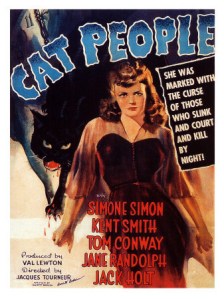 Director: Jacques Tourneur
Writer: DeWitt Bodeen
Cast: Simone Simon, Kent Smith, Tom Conway, Jane Randolph
Plot: A young woman from Serbia meets and marries a handsome young American man. But their relationship is stalled due to a fear that, should she allow herself to become intimate with her new husband, she will fall victim to an ancient curse that causes people in her family to transform into killer panthers. After they’ve been married for some time – during which she never allows herself so much as a moment of physical passion with her husband – she begins to suspect that he is having an affair with his attractive young assistant. And then we realize lust isn’t the only emotion that can trigger the curse… jealousy works, too.
Thoughts: Like a lot of early horror films, this one uses folktales (real or imagined) as the basis of the monster, such as it is. The idea of an “old curse” is standard. What’s interesting to me is the way Irena (Simone Smith) claims the curse came upon her family: in centuries past, they dabbled in witchcraft and consorted with the devil, and as such were branded with this inability to grow close to anyone. This immediately calls to mind the question of how, exactly, they’ve managed to perpetuate the family line over the centuries, if they turn into monsters and slaughter anyone they grow physically intimate with. (The 1982 remake answered this question in the logical and extremely squicky way of saying that family members could only be intimate with one another, despite them being from Serbia and not members of any particular royal family.)
Of more interest – to me, anyway – is the way the perception of witchcraft has changed over time. Sure, whenever a movie that seems vaguely related to the topic is released today you get your requisite group of picket sign-carrying protestors condemning everybody who’s going to see the movie to Hell, but they’re considered a joke by both the media and most passerby who see them. In truth, these days if a movie uses witchcraft as its hook, we usually see a case of an innocent person accused of witchcraft and being tormented by an oppressive society. (For the best example of this, see 1996’s The Crucible, the script for which was written by the original playwright, Arthur Miller.) The alternative is typically a more classic representation of witchcraft wrapped up in a movie that’s laughable in its presentation of something that was once considered a very legitimate threat. (For the most recent example, as of this writing, see 2011’s Season of the Witch. This movie gets bonus cheese points for having Nicolas Cage with long hair while simultaneously being bald.)
At any rate, in 1942 witchcraft was seen as a much more legitimate source for horror, and a curse being a punishment that goes down generations was something that could cause true fear. The 1982 version of the film throws away the witchcraft elements in favor of a more vague curse, which is apparently still acceptable so long as you don’t specify that it’s a result of bubbling cauldrons or dancing in the moonlight with Mephistopheles. Even the specific manifestation of the curse is given a Biblical connection – Irena chats with a zookeeper who kindly takes the time to explain who the Book of Revelations describes a beast from Hell that is “like a leopard, but not a leopard,” which to him is pretty much the definition of a panther.
The other thing about this film that I find really odd is the way the relationship grows. In 1942, when filmmakers didn’t get quite as explicit about sex as they do today, they got away with a man falling and love with and marrying a woman who refuses any sort of physical intimacy – even so much as a kiss – giving him an excuse that would today either have the man drop her for a loony after the first date or do everything he can to get her onto Dr. Phil. Granted, Oliver (Kent Smith) eventually does seek out psychological help for Irena, but only several chaste months after they are married. I don’t care it if is 1942, nobody is that good. Let’s be clear about this: this is not a fear that Irena developed some time after she and Oliver got involved, this was a barrier between them from the day they met. A month after they start dating, he mentions to her that, y’know, normal people in love kiss, and she starts with the whole “I turn into a cat” thing. This, Oliver, this is the time to seek out mental help. Not after you marry a woman who insists on separate bedrooms and a bowl of Fancy Feast at night.
In many ways, this Oliver Reed character begins the film as something of a fantasy man. He’s good-looking, square-jawed, loves Irena from the moment he meets her despite her little “quirks,” and is resistant to temptation from Alice (Jane Randolph) even once she pretty much starts throwing herself at him. But even Mr. Perfect eventually starts to break down – he gets mad at Irena when she starts skipping her therapy sessions, and ultimately decides to leave her for Alice. Even then, though, the film doesn’t give us reason to believe there’s any hanky-panky going on before he proclaims he wants a divorce. Look at the timeline here: Irena is given the 1942 Man of the Year on a silver platter, then drives him away because she acts cold, jealous, and irrational. (Well, okay, it only seemed irrational, turns out she really did turn into a murderous cat, but one can hardly blame Oliver for not quite believing that.) You can’t tell me that the writer of this film wasn’t firing a warning shot across the stern of the Women of America, whose husbands at this point were increasingly getting shots fired across their own sterns over in Europe and the Pacific.
The movie’s ending is suitably tragic, and the body count is remarkably low (compared to modern films). And to be frank, while it’s entertaining in its own way, I don’t see it as being that great a precursor to modern films, except perhaps to show how different societal norms have become in the last 70 years. There’s a taste of Jekyll and Hyde in here, a flash of the subtle sexuality that would later become more dominant in the works of Anne Rice, but nothing I really feel is definitive the way I’ve felt about some of the other movies I’ve seen. The film’s sequel, 1944′s Curse of the Cat People, is even less memorable, with no “cat people” present, instead tapping into The Legend of Sleepy Hollow and turning into a ghost story about a married Oliver and Alice terrorized when Irena’s ghost begins visiting their six-year-old daughter. Weirdness.
We’re taking our biggest jump in time yet next, and I’ll talk about why that is tomorrow, when we get down to the classic 1958 sci-fi chiller The Fly.
Mutants, Monsters, and Madmen Day 6: The Mummy (1932)
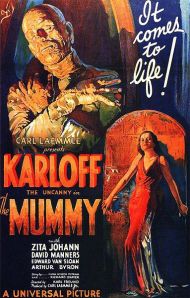 Director: Karl Freund
Writer: John L. Balderston
Cast: Boris Karloff, Zita Johann, David Manners, Edward Van Sloan
Plot: While uncovering an ancient Egyptian tomb, an archeologist accidentally resurrects the priest Imhotep (Boris Karloff). Imhotep flees, and returns ten years later posing as a modern Egyptian and seeking a way to bring back his lover, Princess Ankh-es-en-amon. He meets a woman (Zita Johann) he believes to be the reincarnation of his love, and attempts to reawaken within her the memory of their past, leading to a terrifying final confrontation.
Thoughts: Now this is interesting. I admit, this is my first time watching the original, 1932 version of The Mummy, although I was a fan of Stephen Sommers’ remake in 1999. However, I’d always assumed that the 1999 version was one of those sequels in name only, just an attempt by Universal to jumpstart a long-dead franchise in a modern way. Watching the original, I’m surprised to see just how much of the original film actually made it into Sommers’ version. The mummy, Imhotep, was cursed in both for similar crimes (love of/attempting to resurrect a forbidden princess). Also, in both versions the mummy is resurrected by accident (not really a surprise there, who would do it on purpose?), and finds a woman he believes to be his ancient lover, and thus attempts to bring her back to him.
The difference, of course, is in scale. By 1999, special effects had progressed considerably, so instead of a mummy that basically did his work by walking around and creeping everybody the hell out, we had Arnold Vosloo, who morphed from a wet, gushy corpse into… well… Arnold Vosloo, and at the same time had the power to whip up sandstorms that looked like his face. The remake is far more of an action movie than a horror movie, but I think you can attribute that to the fact that these old Universal Monsters aren’t really considered anything to be afraid of. They’ve become beloved icons of creepiness, but aren’t actually creepy anymore. They’re instantly recognizable Halloween costumes, and cartoons that sell us breakfast cereal.
At least… the iconic image of the mummy has become that. This is what’s interesting to me. When you think of a horror movie mummy in your head, you conjure up that immediate image of a desiccated corpse wrapped up in gauze or, if your parents didn’t make it to the store until 6:30 in the afternoon on October 31st, toilet paper. But Boris Karloff only appears in that particular mummy form for a scant few minutes at the beginning of the film. When he turns up again after the ten-year lapse, he looks more or less human. Old, kind of leathery, like he’s been out in the sun for a hell of a long time, but not the mystical monster he actually is. His power is internalized, and you don’t really get a sense of him being a creature of the undead until his destruction at the end, when the goddess Isis ages him instantly and he drops dead.
David Manners, who I found rather dull and lifeless in Dracula, returns to again be rather dull and lifeless here. I’m not really sure what to make of this, why in all these old-school horror films it seemed like an attempt was made to make the ostensible hero as boring as possible. Manners really does nothing in the film. He’s there to give Zita Johann’s character a love interest, but he doesn’t come to the rescue, he doesn’t get her into the trouble in the first place in any meaningful way… he simply doesn’t need to be there. By the 80s, of course, it wouldn’t matter. You’d have a thousand slasher flicks where the audience no longer really needs to identify with the supposed protagonist, and instead is really pulling for the monster, waiting to see how many kills he can rack up and how creative the filmmakers can be in throwing blood at the screen. The other characters are placeholders until they get killed, except for the final survivor – usually a teenager girl. She may survive with her boyfriend, who will be easily identified as he’ll be the only male in the movie who isn’t a complete douchenozzle.
But in 1932 that wasn’t the case. Karloff was supposed to be the bad guy, Manners was supposed to be the good guy, and the good guy was just plain dull. Karloff steals the show entirely, and while his comeuppance at the end is inevitable, it’s really hard not to wish that he had at least managed to take out David Manners on his way out.
1932 was a big year for horror, as it turned out. Next up will be one of the most controversial films of the time – and honestly, it’s still controversial today. It’s time to get into Freaks.
Mutants, Monsters, and Madmen Day 5: Frankenstein (1931)
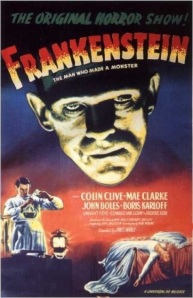 Director: James Whale
Writer: John L. Balderston, based on the novel by Mary Shelley
Cast: Colin Clive, Mae Clarke, Boris Karloff, Dwight Frye, Lionel Belmore, Marilyn Harris
Plot: Dr. Henry Frankenstein (Colin Clive) has a plan to create life. Assembling a body from the pieces of corpses, he builds an enormous monster of a man. But alas, his plan goes awry when his assistant Fritz (Dwight Frye) places a criminal brain into the creature. The creation (Boris Karloff, climbing that rocketship to stardom) is innocent, but powerful and terrifying. When it gets loose and accidentally kills a small child, there can be only one solution – destroy the creature before it’s too late.
Thoughts: Right off the bat, this film is more engrossing than Dracula was for me. Henry Frankenstein (changed, for some reason, from the novel’s “Victor”) and his assistant begin the film with the eerie process of excavating the recently-dead to use their parts in Victor’s creation. Like Dracula, this actually adds to the original novel in ways that have become accepted as part of the lore – for instance, Mary Shelley was somewhat ambiguous about where Victor obtained the pieces he used to construct his man, even implying some of the parts were not human in origin. The whole segment with the abnormal brain, which is not pretty iconic for Frankenstein, started here.
That’ s by no means the only place where the film deviates from the source material, of course. It’s a pretty loose adaptation and abandons volumes worth of backstory, but it succeeds in creating a memorable, timeless interpretation of the character that has dominated our perceptions ever since. Every legendary image of Frankenstein — the green skin, square and scarred forehead, and bolts sprouting from the neck — originates here. This, my friends, is the reason Herman Munster was the man he was.
And let’s be honest here – it’s justified. This is a powerful piece of work. The creature in this film (Karloff, interestingly, was not named in the opening credits, but was given his due at the end) isn’t really a monster. He’s huge, he’s powerful, but he has no real desire to do harm until harm is done to him. This assertion, of course, is somewhat undercut by the idea that Fritz places a “criminal” brain into his body – that seems to imply that violence is in his nature after all. But then again, maybe that’s the point the filmmakers were going for.
Speaking of Fritz, I’m really starting to become a fan of actor Dwight Frye. His Renfield was one of the most memorable aspects of Dracula to me, and his portrayal of Fritz is creepy, laced with just a touch of comedy. The man really was a gifted actor, and did some magnificent work here in the early days of Universal Pictures. The classic “Igor” version of the mad scientist’s assistant actually doesn’t show up until later in Universal’s Frankenstein series, but Fritz is where the archetype has its foundation, making Frye responsible for two of the most enduring villainous second bananas in cinematic history.
Karloff, of course, is unequaled as the monster. He wasn’t really that big of a man, and reportedly the four-inch platform boots he wore as the monster were hell on him, but he brought in a tragedy to the performance that would make you think he was doing Shakespeare. You watched this creature and you felt for him. You watched the townspeople (in the classic torch-and-pitchfork wielding mob) chase after him and you had to wonder exactly who was in the wrong here. That’s what’s so great about this story – the way it can chill and still, at the same time, raise ethical questions. The creature did kill Marylin Harris, but is he actually responsible for her death? He didn’t know what he was doing. Counter-argument: if a wild animal kills a child, you put it down. Counter-counter argument: a wild animal isn’t a human being, and can’t be taught as one. Could the creature? We have to ask here – was he a monster, or was he an infant, unaware of his own strength, who had the potential to grow into a thinking, feeling man if it weren’t for all those people who wanted to poke him with stabby things and burn him with burny things?
To be fair, later films in the franchise would sort of throw away this particular hook, with the monster becoming less innocent and more malevolent, not to mention outright dangerous. But you can’t judge the original on those grounds. In this case, we can look at Frankenstein and his mob attacking the beast and wonder who was in the right. Frankenstein’s monster isn’t a zombie in the strictest sense of the word, but the ethical questions raised here feel like a precursor to the sort of things George Romero was later going to do in Night of the Living Dead and its better sequels, and that other, lesser filmmakers have attempted to do ever since.
I think it’s safe to say that Frankenstein – both the film and the creature – is my favorite of the classic Universal Monsters. But we are going to look at one more of them before we move on. So tomorrow let’s fire up the DVD player and step forward in time one year to 1932, and thrill to the tale of The Mummy.
Mutants, Monsters, and Madmen Day 4: Dracula (1931)
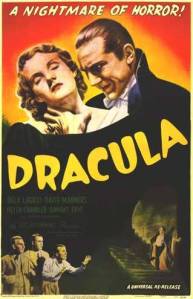 Director: Tod Browning
Writer: Hamilton Dean & John L. Balderston, based on the play by Garrett Fort, based in turn on the novel by Bram Stoker
Cast: Bela Lugosi, Helen Chandler, David Manners, Dwight Frye, Edward Van Solan & Francis Dade
Plot: The mysterious Count Dracula and his unwitting slave, Renfield, travel to England. When the ship is arrived, the entire crew and passenger manifest is dead, save for Renfield, who has gone mad. Dracula takes up residence in an abbey near Renfield’s sanitarium, and mysterious sightings and deaths occur, spurring the noted professor Van Helsing to confront the Count, and expose him for what he truly is – a vampire.
Thoughts: I’ve been waiting for this one. The Bela Lugosi version of Dracula, more than any other film or piece of pop culture, is what has helped to inform our current perception of the vampire. (Because the things in Twilight are not vampires, damn you Stephenie Meyer.) A lot of people don’t even realize how many of our current tropes come from this film or its sequels or imitators – the explicit connection of the vampire to bats, for example (where in the past – and even in this film – vampires could transform into bats, wolves, mist, and other things), or their aversion to sunlight. As important as those things are to current vampire lore, they didn’t come from the classic lore. (Which raises the question – if the Universal pictures depiction of the vampire hadn’t made him allergic to sunlight, would Meyer still have felt the urge to make Edward Cullen sparkle as an aversion to that trope? Hmm. Okay, I think I need to stop talking about Twilight now.)
Lugosi pops in with his tuxedo, his cape, his pendant, and those convenient beams of light that always seem to fall across his eyes and he absolutely owns the room, mesmerizing whoever’s on screen with him and whoever happens to be watching him. He may not be overtly sexual in the way that writers have tried to make vampires since the rise of Anne Rice, but he’s clearly seductive in a way that defies explanation. Even without the supernatural powers of the vampire, Lugosi’s presence would command anybody.
Other classic horror character tropes appear to be in their infancy here as well. Renfield, once Dracula has possessed him, is extremely effective. Dwight Frye has a madness in his eyes that spreads throughout his entire face. As he smiles and peers up the staircase of the ship at the camera, you find yourself absolutely chilled to the bone – he’s a madman, and he’s coming after you next. The Renfields of this world may come second to the Igors as the horror movie second bananas, but when played right, I’d be more scared of a Renfield any day. The atmosphere of the film is powerful as well – the scenery is fantastic, and the scenery is the stuff of every classic haunted house.
As masterful as Lugosi and Frye’s performances are, however, some of the other elements of this 80-year-old film just don’t hold up as well. Granted, you’ve got to make allowances for the special effects limitations of the time, but the scene towards the beginning where Renfield leans out of his carriage to see a bat flying in front just yanks a modern audience out entirely – it looks as though someone is dangling a rubber bat from a fishing pole, which probably isn’t that far from the truth.
You can’t blame age on stale performances, though, and Lugosi and Frye are really the only memorable actors in the film. The women are mannequins, and Edward Van Solan’s Van Helsing is forgettable at best. David Manners as Jonathan Harker is just plain bland, vanilla, and utterly unexciting.
The climax of the film, however, is what really hurts it. After so much tension and so much buildup, the ending just doesn’t excite. Van Helsing simply marches into Dracula’s lair and stakes him – off-camera at that. Again, I’m trying to make allowances for the time period. There wasn’t going to be any gory close-ups or a fountain of blood (like in the painfully weak Mel Brooks comedy, Dracula: Dead and Loving It), but at the same time, I can’t help thinking there could have been more. In truth, I think it speaks to how the still-evolving language of film hadn’t really been solidified yet. The film is based on the stage play based (legally, unlike Nosferatu) on Bram Stoker’s novel, and in 1931 they were still filming movies as if they were stage plays. I actually worked backstage on a production of this play several years ago, and I know how effective the final scene can be when done properly, but film is an entirely different medium with different demands.
The same goes for the novel – in the book, a great deal of the tension and fear is internal. It’s a lot harder to do that in a movie. You need to give the audience something to look at, something to see and fear. This is one of the reasons I’m not a purist when it comes to film adaptations. Sometimes, what works great on the printed page just doesn’t work on film. This is a case where the screenwriters should have found a more dramatic way to stage that final moment between Van Helsing and Dracula, some way to get the audience more engaged, than just waltzing in and driving in the stake.
I look back at these comments and I start to feel a little worried about myself. This film is a classic of the genre, isn’t it? I sure as hell haven’t endured for 80 years, do I really have the right dismiss something that millions have found frightening? Worst of all, what if I’m falling victim to the same mindset that I so often accuse my high school English students of having? What if I’m unable to divorce myself from my modern mindset and appreciate the film for what it was when it was created?
A terrifying thought.
But then I look at the next film on my list, a film released in the same year as Dracula, and one that I do consider a masterpiece of cinema. And I think, “Maybe Dracula simply doesn’t hold up the way Frankenstein does.”
Mutants, Monsters, and Madmen Day 2: Nosferatu (1922)
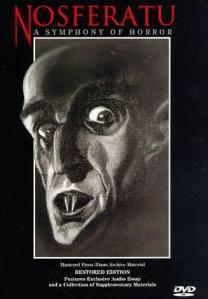 Director: F.W. Murnau
Writer: Henrik Galeen
Cast: Max Schreck, Gustav Van Wangenheim, Greta Schröder, Alexander Granach, Georg H. Schnell
Plot: A wizened old man seeks a new home and becomes obsessed with the wife of his real estate agent. As it turns out, the mysterious Count Orlok has a much darker agenda than finding a castle to call his own. This unauthorized adaptation of Bram Stoker’s Dracula is rightly considered a classic.
Thoughts: You don’t often see a movie that resulted in the bankruptcy of a studio considered one of the greats (except, of course, Cutthroat Island), but here ya go. The estate of Bram Stoker refused to allow permission for F.W. Murnau to adapt Dracula in a movie, but showing the kind of spunk and sass that have made the Germans so beloved throughout history, Murnau just changed the names, abandoned some subplots, and made it anyway. Stoker’s estate sued, Prana Film went out of business, and an attempt was made to destroy all copies of the movie. Fortunately for us, that attempt failed, and the movie is now in public domain.
This film, a silent movie of course, is incredibly successful at creeping you the hell out, and a lot of the credit for that has to go to Max Schreck as Count Orlok. Although he doesn’t really fit into what we not think of as a classical interpretation of Dracula (although the “classic” Dracula is really Bela Lugosi’s interpretation), he’s become an archetypical monster in his own right. Orlok’s body is incredibly slender, almost unnaturally so – his limbs, his torso, his head all look like they’ve been stretched out. The extremities, on the other hand, are all pointed and sharp – his fingers, his nose, his chin, his ears. Add that to his sunken eyes and you can see monsters from throughout the 20th century. The long body stirs up images of H.R. Giger’s Alien, the pseudo-zombies from the 2007 I Am Legend, any manner of creeps and crawlies, all the way up to the new Slender Man urban legend. In the introduction to this little project, I talked about the unknown being one of the pervading human fears. I didn’t mention one that may be even a little stronger – the manipulation of what is known. Orlok’s body is supposed to be human, but the little tweaks and alterations that define the character make him something even worse than what we don’t know: it makes him into what we should know, but don’t.
Think of it this way. We turn on the news, we hear terrible stories about things done to children by some nutjob or psychopath. I don’t feel the need to elaborate here, you guys know as well as I do what some human-shaped monsters are capable of. We hear these stories, and we think it’s terrible. But how much worse is it if the monster isn’t some random stranger, but someone the victim knows, someone they thought was a friend, maybe even a member of their own family?
It’s an extreme example, but the same principle that makes Orlok so creepy. Fortunately, trapped as he is on the movie screen, it’s a hell of a lot safer than the psycho on the news.
Anyway, on to a bit lighter fare. I haven’t included many silent films in this project (just one more after this one), but this movie really illustrates the need for a good print of these films. Nosferatu, of course, is in public domain now, which allows anybody to do whatever they want with it. In some ways, that’s a good thing – look at the 2000 film Shadow of the Vampire, about the making of Nosferatu, in which Willem DaFoe plays Max Schreck as a real vampire. It’s a great piece of work that couldn’t have been made were it not for public domain laws. (Which is funny, when you think about how Nosferatu was made in the first place, but there ya go.) The problem is, this allows people to put out really bad versions of the film. This was one case where I didn’t think I would need to turn to NetFlix for my hit, as I already happened to have a DVD set of many, many vampire films, Nosferatu included. As I started the movie, I realized that this version had actually changed all the title cards, replacing the names of Orlok and company with the original names from the Dracula novel. I realize, logically, that this shouldn’t have impacted my enjoyment of the movie, but I had a gut-level reaction that rejected the entire thing as wrong and bad and evil!
I turn into a purist at incredibly strange times.
So I did turn to NetFlix, where I found Nosferatu: The Original Version, which did in fact have all the classic names right where they belonged. This was much more acceptable… but in a few minutes, I found a flaw with this version as well. The music. Dear lord, the music. Old silent films we watch today don’t have any soundtrack except the one tagged on by whoever releases the DVD, and whoever put out the “original Version” of Nosferatu included one god awful super-synthesized soundtrack that went from happy, chirpy music at the beginning to a better (but weak) score towards the end. You’ve got to have the right music for these silent movies to make them come across properly. NetFlix also has a listing for Nosferatu: The Gothic Industrial Mix which, frankly, is a prospect I find horrifying.
While I can appreciate the artistry of these old silent films, I do have to admit, it’s hard to connect with them. I’m used to a completely different kind of filmmaking, and although there’s a definite style to telling a story I this way, it’s not my style. Only one more film from the silent era, and then we’ll move on to the talkies. Come back tomorrow for 1925’s Phantom of the Opera.
Mutants, Monsters, and Madmen Day 1: The Golem-How He Came Into the World (1920)
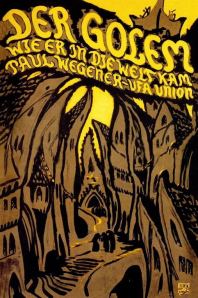 Directors: Carl Boese & Paul Wegener
Writer: Henrik Galeen & Paul Wegener
Cast: Paul Wegener, Albert Steinrück, Lyda Salmonova, Ernst Deutsch, Hans Stürm, Max Kronert & Otto Gebühr
Plot: In 16th century Prague, the Jewish people are being oppressed by a vindictive emperor who blames them for the death of Christ and accuses them of engaging in black magic. To protect his people Rabbi Löw (Albert Steinrück) creates a Golem (Paul Wegener), a powerful creature made from clay. Löw summons the demon Azaroth for the magic word needed to bring the Golem to life, and brings him to the Emperor’s court. During a display of magic the people of the court break the one rule they’re told to obey – don’t talk or laugh – proving that people in horror movies have been unable to follow simple directions since the beginning of the medium. The Golem goes on a tear and the Emperor agrees to pardon the Jews if Löw saves them. All is well, until Löw bothers to read the next page in his magic book, where he learns that Azaroth is going to come back and turn the Golem against him. No problem, though, he simply removes the amulet with the word of life from the Golem’s chest. It looks like things are fine, until Löw’s assistant gets jealous that the girl he desires is running around with someone else. He brings the Golem back to life, and he goes on a tear that threatens the entire city, forcing Löw to step forward and fight his creation once more. In the end, the Golem escapes Löw, but is defeated when he befriends a little girl, who simply plucks the amulet from his chest.
Thoughts: I didn’t know it when I chose this film to begin my experiment, but this silent German classic is actually the third film in a trilogy. The original The Golem was released in 1914, and its sequel, The Golem and the Dancing Girl, came out in 1917. This concluding chapter is the prequel to the other two, though, and is the one that is best-remembered today, and for good reason. First of all, it’s the only film in the trilogy that survives intact. More importantly, even at this incredibly early juncture, it’s easy to see in this movie a lot of the horror movie tropes that are so familiar today.
Beginning with Rabbi Löw himself, the character visually evokes both the archetypical pointy hat-wearing wizard, and the lab coated mad scientist of the likes of Victor Frankenstein. In fact, even though this film predates the most famous version of Frankenstein by eleven years, it displays a lot of the themes and ideas that we most clearly recognize as part of that franchise: the Golem himself is the creation of man, a giant creature of incredible strength that is turned to dark purposes against his will. Even his interaction with the children at the end seems to feed the later scenes of the Frankenstein monster playing with the famous little blind girl.
This film is considerably darker than Frankenstein, though. While Vic’s monster is usually portrayed as the misunderstood beast, a gentle giant of sorts, the Golem is no benign creature. He’s angry and surly from the first, and seems to revel in the destruction he causes. In fact, in the scene where he carries Miriam (Lyda Salmonova) down from the tower where he kills her lover, there’s a truly disturbing hunger in his eyes. When he lays her down on a table and runs his hands over her body, there’s a second there where the clay beast actually raping the young woman seems like a distinct possibility. Then there’s the demon-summoning scene itself. When the creature’s head first appears, it’s a jump-out-of-your-seat moment. It snaps into frame, this ugly face with bulging eyes that seems to be looking down at Löw with terrible glee. Once the shock passes and the camera zooms in at the head, you start to appreciate it for the prop that it actually is, but by then you’re already invested in it as a creature of darkness. Smoke billows out of its mouth, and you question just what the hell kind of Rabbi Löw actually is, if he’s willing to deal with a beast of this nature. Today, you know the head would be CGI and the smoke would probably billow with the shapes of Hell itself, and you know that it wouldn’t be a tenth as effective as it is in this simple scene.
This isn’t the first horror movie ever, of course, although it seems to be credited as being the first ever horror franchise, and I think that’s fair enough. It also gives me a chance, very early in the process, to make an important point: although I’m looking at film in this project, it would be a terrible mistake to pretend any art form exists in a vacuum. Movies can be influenced by novels, can influence comic books, can later be influenced by comic books, can feed influence back into novels. The film is based on actual Hebrew legend, but the filmmaker presents the legend in a way that’s very evocative of Mary Shelley’s Frankenstein, first published in 1818. The actual framework, though, as is the case with so much supernatural horror, comes from a religious stance. Regardless of your own personal religious faith (or lack thereof), it would be foolish not to recognize religion as part of culture, and as those things we find scary come directly from our culture, religion plays a vital role in deciding that. If anything, that’s only going to become more obvious as this little adventure continues.
Come back tomorrow and we’ll look at what may be the first vampire film of all time, the 1922 classic Nosferatu.
 Reel to Reel