Blog Archives
Scrooge Month Day 6: Scrooge McDuck in MICKEY’S CHRISTMAS CAROL (1983)
 Director: Burny Mattinson
Writers: Burny Mattinson, Tony Marino, Ed Gombert, Don Griffith, Alan Young, Alan Dinehart, based on the novel A Christmas Carol by Charles Dickens
Cast: Alan Young, Wayne Allwine, Hal Smith, Will Ryan, Eddie Carroll, Patricia Parris, Dick Billingsley, Clarence Nash
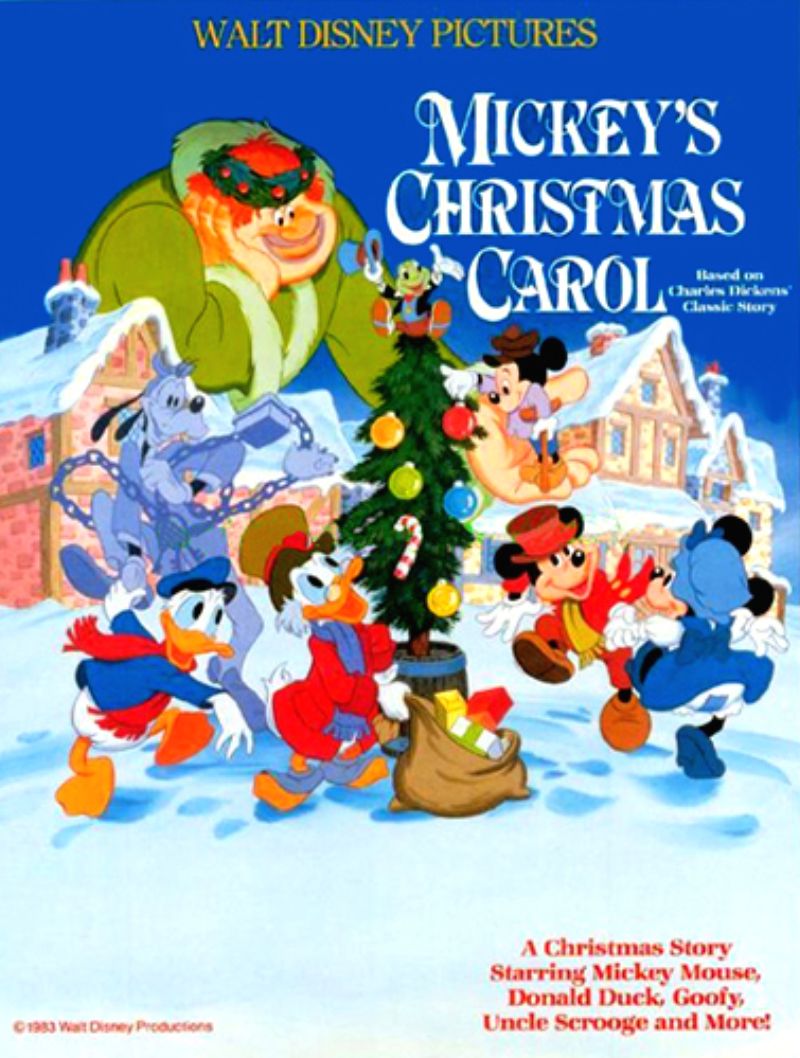
Notes: Paired with a re-release of the 1977 film The Rescuers, Mickey’s Christmas Carol is significant in the annals of Disney animation for several reasons. It was the first theatrical short starring Mickey Mouse in 30 years; it was the final time Donald Duck’s original voice actor, Clarence Nash, would voice the character; and it was the first time Alan Young would voice Donald’s Uncle Scrooge, a role he has continued with through the classic DuckTales TV show and every other depiction of the character right through the present day. Despite its short length, the film is remarkably faithful to the Dickens novel, keeping most of the important scenes and characters, although racing through them in the 26-minute running time. The Disney characters who take part in this adaptation include Scrooge McDuck (Young) as Ebenezer Scrooge, Mickey Mouse (Wayne Allwine) as Bob Cratchit, Donald Duck (Nash) as Scrooge’s nephew Fred, Goofy (Hal Smith) as Jacob Marley, Jiminy Cricket (Eddie Carroll) as the Ghost of Christmas Past, Willie the Giant (Will Ryan) as the Ghost of Christmas Present, and Black Pete (Ryan again) as one of the few versions of Christmas Yet to Come to actually have lines. Other minor characters and background extras come from various Disney shorts and films starring animals, particularly The Wind in the Willows and Robin Hood, which you may remember I talked about here once before.
Thoughts: This is the shortest version of A Christmas Carol I’ve talked about yet, and is probably the shortest I’ll discuss all month, but it’s also one of my favorites. Part of that can no doubt be chalked up to nostalgia – I was six years old when this cartoon was released, and I think I saw it in the theater, but I honestly can’t say for sure. Regardless, I am sure this was the first version of the story I remember in any detail, and as such it holds a special place in my heart. That said, it’s worth talking about even without the nostalgia factor because – again, despite its short running time – it’s really good.
First of all: Alan Young. I’m not sure how many people are aware that Uncle Scrooge has the voice of Wilbur from TV’s Mr. Ed, and I’m not sure how many would care if they did, because his work with this character is by far a more enduring legacy. Scrooge McDuck is a character who has to be firm and grumpy, but with a good heart at the core. In truth, from the outset he was a (slightly) milder version of the Dickens character Carl Barks named him after. Young’s voice performance is flawless.
The “casting” all around is good. Mickey Mouse – so long portrayed as a sweet, well-meaning everyman — is the natural choice for Bob Cratchit. Jiminy Cricket is Pinocchio’s conscience, and as such is the logical choice for Christmas Past. Willie and Pete, both nominal “villains” in their usual Disney performances, fit their roles well, with the man-child Willie making an even larger version of Christmas Present than we usually see and Pete taking real delight in his nasty work. The only one that doesn’t really seem to fit is Goofy as Jacob Marley – a character full of regret. Even if Goofy had anything to regret (he doesn’t – the character is far too innocent for that), he’s not self-aware enough to realize it. I imagine he was given the part simply because they felt the need to get all of Disney’s top three characters into the cartoon somewhere and they just couldn’t think of any other way to include him.
The only major character omitted from this version of the story is Scrooge’s sister, Fan. Considering it was billed as a Mickey Mouse cartoon, that’s understandable – kids may be able to accept ghosts and hellfire and redemption, but I doubt any parent wanted to have a discussion with their children about the potential of a mother dying in childbirth. Besides, there’s a long precedent in Disney cartoons of obvious orphans whose parents are never referenced (Donald and Mickey’s nephews and Donald himself being the prime examples).
Scrooge’s reformation is a bit more subtle in this film, although we do see the stages. After Christmas Past shows Scrooge the scene where he breaks the heart of Isabelle (Donald’s girlfriend Daisy, which must have been kind of awkward on the set), Scrooge berates himself for being foolish. A few seconds later, though, as Christmas Present preaches generosity, Scrooge stubbornly argues that he has no reason to be generous to others, as no one has ever shown such kindness to him. In response, we go to the Cratchit house, where Tiny Tim himself encourages his family to thank Mr. Scrooge. That’s all Scrooge gets from Christmas Present, though, as he’s left standing between a pair of giant footprints before a cloud of cigar smoke whisks him to the cemetery. He’s scared now, and you can feel it, but instead of asking about himself, he inquires as to Tim’s welfare. It’s a good moment, and it’s heartbreaking a moment later when we see Mickey Mouse, in tears, laying a crutch on a tombstone. If that isn’t enough to give kids watching permanent scarring, Christmas Future whips off his hood, lights a match on Scrooge’s tombstone, and kicks him into the open grave, where fire being blazing from the coffin and reaches for Scrooge just before he’s whisked home for the joyful finale.
It is still a Disney cartoon, and as such has to work in some comedy amidst the dark subject matter. The balance is good, and never at the expense of character, whether we’re looking at a verbal gag, a bit of ironic wording, or a quick sight gag. The moment where Scrooge tells Fred he’s coming to Christmas dinner after all, Fred and the horse look each other in the eye and Nash gives the line reading of his career: a simple “Well I’ll be doggone” that never fails to get a laugh out of me.
I do so love this cartoon, and not just because I got to watch it and write the whole article in less than a half-hour. It’s a wonderful rendition of Dickens’s story, even in its condensed form, and it just came out on a 30th anniversary edition Blu-Ray and DVD, along with several other classic Disney Christmas shorts, and one brand new one. If you don’t already own it, get it now.
The first Reel to Reel study, Mutants, Monsters and Madmen, is now available as a $2.99 eBook in the Amazon Kindle store and Smashwords.com bookstore. And you can find links to all of my novels, collections, and short stories, in their assorted print, eBook and audio forms, at the Now Available page!
Scrooge Month Day 5: Albert Finney in SCROOGE (1970)
 Director: Ronald Neame
Writer: Leslie Bricusse, based on A Christmas Carol by Charles Dickens
Cast: Albert Finney, Edith Evans, Kenneth More, Laurence Naismith, Susanne Neve, Michael Medwin, David Collings, Derek Francis, Roy Kinnear, Richard Beaumont, Alec Guinness, Paddy Stone
Notes: This version of Scrooge is a musical extravaganza that got four Academy Award nominations, including best original song and best score. Albert Finney’s Ebenezer Scrooge scored the Golden Globe award for best actor in a motion picture, musical or comedy. For the most part, this version of the story is quite faithful to Dickens, with a few small additions at the end that really make its mark.
Thoughts: To many people, the battle for the ultimate version of A Christmas Carol comes down to the Alastair Sim version we discussed a few days ago and this musical version. It’s hard to argue. There have been dozens, maybe hundreds of different incarnations of the story since then, but these two seem to be the purest and most entertaining renditions of the story ever put to film.
Credit for the longevity of this version, I think, is to be shared between Albert Finney – for a phenomenal performance as Scrooge – and Leslie Bricusse, who wrote both the screenplay and the music for this film. Scrooge’s intonation of “I Hate People” is as perfect a summation of the miserable wretch he is that I’ve ever seen. He’s cold, he’s bitter, and he’s angry at the world. Such a person is, of course, both miserable and terribly comfortable in his misery. Going back to the Sim version, the Scrooge who was afraid of change, Finney’s Scrooge comes off as a man who is also very set in his ways, and doesn’t care if that comfortable place is one of loneliness and pain.
Sir Alec Guinness steps in as Marley’s ghost this time around, and his interpretation is… unique. Guinness has this slow, deliberate walk, almost like he’s moving through water. If you really want to try to analyze it, I suppose you could intuit that ghosts have less substance than matter in the world of the living, and therefore ordinary matter has a degree of resistance that has an unexpected impact on their ability to move. Of course, anyone who would go to such lengths to rationalize such a relatively short scene in the movie would be kind of crazy, so I’m not going to try to do such a thing. Regardless, Guinness’s odd motion is creepy, even more so when he begins floating, bellowing his warning to Scrooge and bound to the Earth only by one of this oh-so-heavy chains.
Like Marley, Edith Evans as Christmas Past is unique. The filmmakers take advantage of Dickens’s non-description to whip up a character that looks, talks and dresses like the sort of uptight grandmother you see in movies where kids have to teach the grown-ups to lighten up, okay? There’s a bit of irony there – her task, after all, is to teach that same lesson to Scrooge. And what’s more, he starts learning that lesson right away. As soon as he sees himself sitting alone in his schoolhouse while his classmates rush about and celebrate Christmas, he expresses regret that he didn’t join them. This version, too, implies that Scrooge’s sister (“Fran” instead of the traditional “Fan”) died giving birth to young Fred, and as I’ve already discussed why I think that works for the character in a previous article, I won’t belabor the point.
This section also includes one of the peppiest musical numbers in the film – Laurence Naismith and Suzanne Neve as Mr. and Mrs. Fezziwig, cheerfully extolling the virtues of “December the 25th” as a rhythmless Scrooge looks on, unable to dance. It’s a rather old-fashioned tune, one that feels like it could have spilled right out of the golden age of the Broadway musical, and I actually think it’s quite a shame it doesn’t get more play when people are lining up their traditional Christmas song lists.
Kenneth More’s Christmas Present is much more traditional – green robe, holly wreath around his head, sitting atop a mountain of food and riches, as he always makes his appearance. His powerful anthem, “I Like Life,” is a perfect counterpoint for Scrooge’s earlier “I Hate People.” At first, it feels like he’s berating Scrooge, calling the miser’s philosophy “self-pitying drivel.” As the song progresses, though, we get to the root of it – he’s putting the skinflint through a sort of spiritual boot camp, shaking down all his pretenses so that he can be rebuilt into a man who truly does enjoy the pleasures of life he’s denied himself for such a long time. Many versions of this story make the moment when Christmas Present whisks Scrooge out the window into the air into a scene of terror, but not here. By this point, Scrooge is on-board, singing along and joyously joining in on their flight above London… right until they crash into the snow outside Bob Cratchit’s house.
Christmas Future is where this version of the film really begins taking liberties, and in fact, I like the ones that they take. Rather than starting out with people talking about the death of a lonely man and Scrooge not realizing they’re talking about him, this version starts with people outside of Scrooge’s counting house, cheering for him, joyfully talking about the “wonderful thing” Scrooge has done for them. Scrooge is moved and swept away with emotion, believing himself already redeemed, and doesn’t even notice when his own casket is carried out of the counting house. The irony of the scene is made even worse as the people start singing the gleeful tune “Thank You Very Much” (the song nominated for an Oscar). He marches along, dancing with people, completely oblivious to the fact that they’re celebrating his corpse. It’s happy and chilling all at the same time.
Once we make it to the cemetery, though, things get really freaky, with Christmas Yet To Come (here a sort of fossilized corpse) shoving Scrooge into his own grave and allowing him to plunge all the way to Hell! Scrooge’s final destination if he doesn’t change is always clear in this story, but this is the first one I know of that goes far enough to actually drop him into the pit, where he wakes up in a coffin-shaped hole and is told by Marley he’s been bound to be Lucifer’s bookkeeper. Director Ronald Neame didn’t bother with subtlety here.
“I’ll Begin Again,” Scrooge’s song when he wakes up and realizes he’s not dead after all, is a fantastic number. There’s a hope, a glee, and a sincerity inherent in his words that sells every moment. When we watch this old man dancing through a drafty old mansion covered in cobwebs, you feel every bit of the change he’s experienced. Once he sends the urchin off to buy the turkey and he chirps, “I think I’m going to like children,” even the stoniest heart will have come on-board with Scrooge’s reformation.
This is one of the truly classic renditions of A Christmas Carol, one of the best ever put to film, and I think I’d have that opinion even without the powerful tweaks we’re given in the Christmas Yet to Come segment. Beautiful music and a magnificent Scrooge combine to give us a film one really should watch every year. And let’s not forget the most important lesson of all: Alec Guinness really knows how to play a ghost, doesn’t he?
The first Reel to Reel study, Mutants, Monsters and Madmen, is now available as a $2.99 eBook in the Amazon Kindle store and Smashwords.com bookstore. And you can find links to all of my novels, collections, and short stories, in their assorted print, eBook and audio forms, at the Now Available page!
Scrooge Month Day 4: Quincy Magoo in MR. MAGOO’S CHRISTMAS CAROL (1962)
 Director: Abe Levitow
Writer: Barbara Chain, based on A Christmas Carol by Charles Dickens
Cast: Jim Backus, Morey Amsterdam, Jack Cassidy, Royal Dano, Paul Frees, Joan Gardener, John Hart, Jane Kean, Marie Matthews, Laura Olsher, Les Tremayne
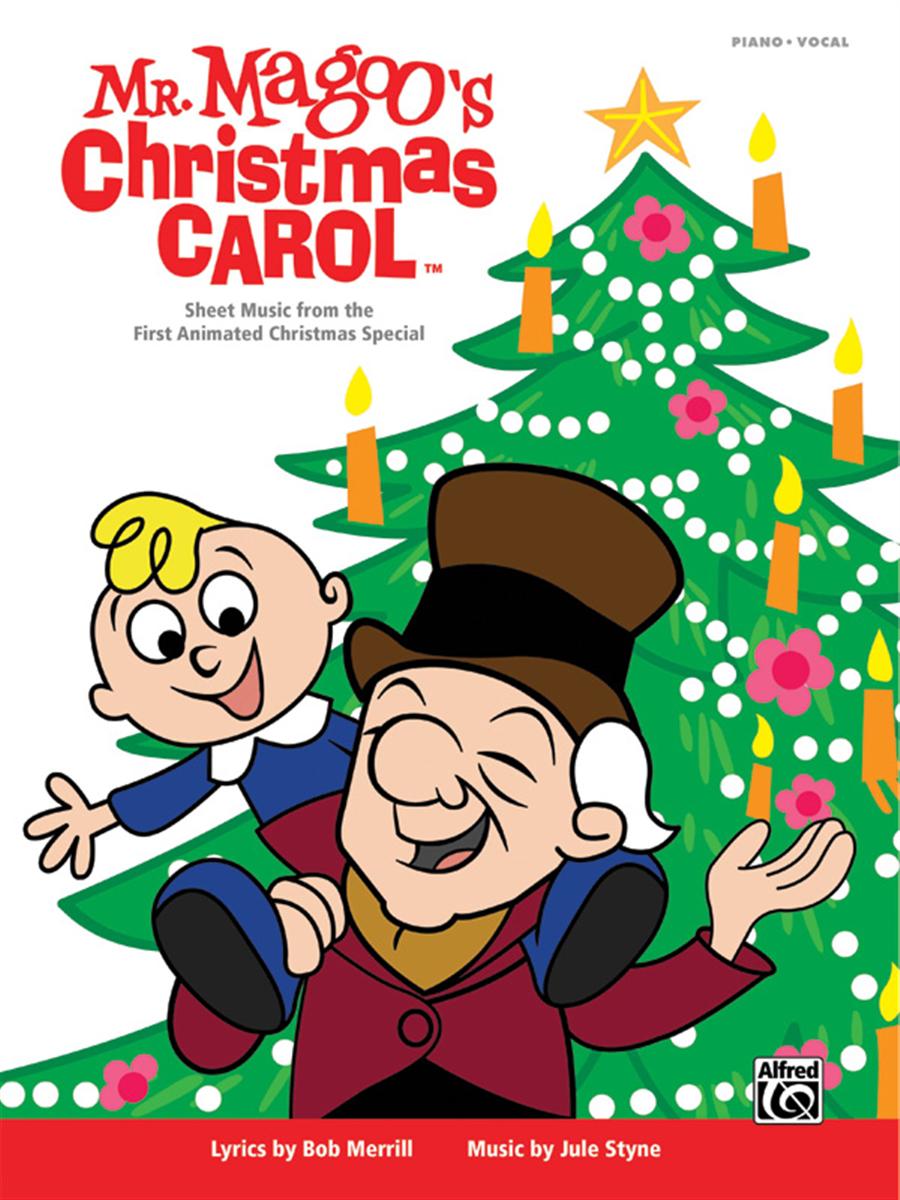
Note: Mr. Magoo’s Christmas Carol is credited as being the first ever animated Christmas special, beating Rudolph the Red-Nosed Reindeer by two years. The special brought back Quincy Magoo, star of a series of theatrical shorts from the 40s and 50s, and led him into his own television series in 1964. In the framing device we learn that we’re actually watching a musical Broadway production of A Christmas Carol, one that evidently drops all references to Scrooge’s family, switches the order of Christmas Past and Christmas Present for some reason, and makes occasional references to Scrooge’s (Magoo’s) poor eyesight.
Thoughts: After three days of extremely traditional renditions of A Christmas Carol, I’m glad to be able to dip my toes into this less serious version. The opening scene, where Magoo – voiced, as always, by Jim Backus — sings about how happy he is to be returning to Broadway, sets the stage well. It’s silly, the music is catchy, and it lets you know that you’re watching a play-within-a-TV special (a conceit the Flintstones would borrow 30 years later).
Once that opening scene is done away with, though, we go into a version of the Dickens classic that is clearly adapted, but still very recognizable. There aren’t a bunch of side jokes about the theatrical production, just a few “act breaks” where we see the curtain closing. There’s no attempt to explain the translucent Marley (voiced by Royal Dano) or how such a thing would be accomplished on a live stage, to say nothing of the times when the time-traveling Scrooge appears on stage with his younger self, both of them clearly played by Magoo. The gags about Magoo’s lousy vision, a staple of most of his cartoons, are reduced to a minimum. And although much of the book is dismissed in the name of expediency, the stuff that remains is often verbatim Dickens, albeit performed by the cast of the cartoon. Backus isn’t really playing Scrooge here, he’s playing Mr. Magoo as Mr. Magoo, reading the lines of Ebenezer Scrooge, but not making a huge effort to portray a different character than he usually does in the animated series.
The decision to jump straight to Christmas Present (Les Tremayne) is baffling. Why in the world would you do the present before the past? It doesn’t particularly hurt the abbreviated version of the story, but it doesn’t help it either. The design of the character is slightly problematic as well – a red robe and long, white whiskers. No doubt most small children who watch this would confuse the character with Santa Claus. This may be deliberate, I suppose – with his compassion for Tiny Tim and the rest of the downtrodden impacted by Scrooge, Christmas Present is certainly the most Santa-like of the Spirits. Still, he’s not Santa Claus, and it doesn’t serve the special to pretend he is.
Christmas Past looks a bit better, more of the “living candle” depiction of the character that we’ve seen in some of the other renditions of the story. Of the three ghosts, Past is the one that has the most variance in his/her/its different incarnations in the media, with Dickens having a pretty vague description in the first place. That said, I find it interesting that a few versions have become common – the Candle and the Angel in particular.
This is going to sound strange, but the highlight of the special to me is actually the musical number that accompanies the Ghost of Christmas Yet to Come segment. In many versions of the story, we see a gathering of people gloating over selling the deceased Scrooge’s possessions (the fact that the deceased in question is Scrooge is usually obvious to the audience, but Scrooge himself refuses to admit it yet). In this version, we get a snappy, creepy little song that feels like it should be in a Halloween special. And yes, I love that. Ghost stories, as you may know, used to be more traditionally associated with Christmas than Halloween; the reversal really only happened in the 20th century. I’m old school in this way. I love the juxtaposition of the frightening ghost story with the joy of Christmas as a way to really hammer home the lesson that Scrooge needs to learn. Dickens did it right, and the makers of this special did him right in this department.
This is a first in many ways – the first animated Christmas special, the first time we saw another fictional character “play” Scrooge, and as such it deserves a proud place in the annals of Christmas TV. And it’s a good special, don’t get me wrong. But it’s not even close to my favorite.
The first Reel to Reel study, Mutants, Monsters and Madmen, is now available as a $2.99 eBook in the Amazon Kindle store and Smashwords.com bookstore. And you can find links to all of my novels, collections, and short stories, in their assorted print, eBook and audio forms, at the Now Available page!
Scrooge Month Day 3: Fredric March in A CHRISTMAS CAROL (1954)
 Director: Ralph Levy
Writer: Maxwell Anderson, based on the novel by Charles Dickens
Cast: Fredric March, Basil Rathbone, Bob Sweeney, Christopher Cook, Sally Fraser, Ray Middleton, Dick Elliott, Bonnie Franklin
Notes: This 48-minute version of A Christmas Carol was produced as an episode of the CBS variety show Shower of Stars. The network was heavy on dramas at the time and created this more lighthearted musical/variety show as a way to open up their own programming to different audiences. Aside from having the magnificent Basil Rathbone as Marley’s ghost, this special also features an early TV appearance from future sitcom star Bonnie Franklin as one of the Cratchit children. This particular episode was nominated for four Emmy awards, including best original music composed for TV to Bernard Hermann and Best Actor in a single performance for Fredric March as Scrooge. It won the Emmy for best art direction of a filmed show. Rathbone would later go on to play Scrooge himself in the film The Stingiest Man in Town (1956, not to be confused with the Rankin and Bass adaptation of the same name), which I somehow don’t have a copy of on DVD. Maybe some other year, guys.
Thoughts: When I heard this was a musical version, my mind automatically went to the idea of some heavily produced Broadway-style extravaganza. As it turned out, that’s not what we got at all. Instead, the music is very traditional in nature, performed in a chorale style that wouldn’t seem out of place in a Church. Much of it is produced by a group of carolers who wander in between scenes with Scrooge and company, another song turning up at Fezziwig’s party during the Christmas Past segment. Tiny Tim gets a solo in the Cratchit house, but it’s really quite subdued, sweet, and sad.
The only song that really feels like most musicals is Christmas Present’s, which he sings the instant he meets Scrooge, with the film going so far into musically-inspired lunacy that he pulls a long garland from Scrooge’s robe, makes the hands of a clock wiggle around, and shuts some doors telekinetically. But it’s just the one scene that takes this tactic. The rest of the film is more of a diegetic musical than a traditional one. Later musical versions of the story wouldn’t bother with attempts to explain where the music came from.
In an interesting Wizard of Oz-style twist, the two more talkative ghosts are played by actors doing double-duty as one of the characters significant to that segment of Scrooge’s life. Sally Fraser plays both his lost love Belle and the Ghost of Christmas Past, while Ray Middleton bounds in as the bombastic nephew Fred and returns as the thunderous Ghost of Christmas Future. It’s an unusual conceit, and one the film carries very well. Fraser is lovely as both the Ghost and as Belle, carrying that sort of classic beauty and charm actresses of the 40s all seemed to have. (Yes, I know this was 1954. She still had the charm of an actress of the 40s, and that alone makes it clear why March’s Scrooge grew so infatuated with her.) Her performance, however, is a bit stiff. The same cannot be said for Middleton’s Christmas Present, who appears in the midst of a song and practically explodes cheer all over Scrooge.
All of these songs, of course, come at the expense of a little story. The Fezziwig party is pretty much the only part of Scrooge’s past we get to see, with Belle dumping his greedy ass right after they perform a duet about being with your loved one at Christmas. It’s a bit disconcerting, actually, without the usual lapse of many years during which we presume he got colder and crueler. In the Christmas Present sequence, the traditional guessing game — which makes Scrooge realize just how poorly everybody thinks about him — is moved from Fred’s home to the Cratchit house, cutting out Fred’s scene. It comes at the expense of character. The Bob Cratchit who defends his stingy employer to his wife seems unlikely to make the same man the object of ridicule, even if there’s no real malice behind it (Fred, it should be pointed out, usually doesn’t mean it to be cruel.) Even Christmas future skips most of the prelude stuff and jumps right to the cemetery, where Scrooge sees his own tombstone, then Tim’s, then breaks down crying until he pops into his bed. The Ghost of Christmas Yet to Come gets a sort of name drop from Ray Middleton, but otherwise is absent.
Rathbone’s Jacob Marley is fantastic. He’s not loud and terrifying, not a sort of jump-in-your-face apparition as some of them are. Instead, his version is rather quiet and matter-of-fact, staring at Scrooge as if he can barely see him. Somehow it’s even more disquieting that way than if he simply chose to scream at us all and warn Scrooge he’s going to Hell, damn it, if he doesn’t straighten up and fly right.
March is a solid Scrooge. He pulls off the transition from angry to joyful mostly convincingly, although at the end, when he shows up at the Cratchit house, he’s got a bit of the crazy eyes going on, particularly in the closing musical number, where the camera focuses on him fidgeting for two minutes instead of showing absolutely anything else. Before that there’s a nice bit where he leans on Bob Cratchit just a little, but in the interest of making him lighten up. It’s a fun way to show just how profound the change in Scrooge is, allowing him to take a tool from his Old Self and put it to use as his New Self.
I like this version. It’s not great, but it’s quick and has some very good music (Hermann deserved that Emmy). If you happen across it in your holiday viewing this year, it’s well worth watching.
The first Reel to Reel study, Mutants, Monsters and Madmen, is now available as a $2.99 eBook in the Amazon Kindle store and Smashwords.com bookstore. And you can find links to all of my novels, collections, and short stories, in their assorted print, eBook and audio forms, at the Now Available page!
Scrooge Month Day 2: Alastair Sim in A CHRISTMAS CAROL (1951)
 Director: Brian Desmond-Hurst
Writer: Noel Langley, based on the novel by Charles Dickens
Cast: Alastair Sim, Mervyn Jones, Kathleen Harrison, Hermione Braddeley, Michael Hordern, Rona Anderson, Francis de Wolff, Carol Marsh, Brian Worth, Michael Dolan, Glyn Dearman, Roddy Hughes, C. Konarski, Peter Bull
Notes: This well-known version of the story was released in the UK as Scrooge. Although originally slated to have its US premiere at Radio City Music Hall, it was rejected for being “too grim.” Evidently, the Radio City folks didn’t know what they were getting into when they booked the most well-known Christmas ghost story of all time. The movie wound up having its premiere at a different theater, on Halloween night. A colorized version was released in 1989, as part of Ted Turner’s ongoing pact with Satan.
Thoughts: Another fairly straightforward production of A Christmas Carol today, friends, although we’re getting into some of the most well-remembered versions now. The Alastair Sim Scrooge has been considered a classic for sixty years, and with good reason. His depiction of the character is remarkable, and the rest of the cast is quite impressive as well. Glyn Dearman’s Tiny Tim, for instance, is much more convincing than the one we saw in the Seymour Hicks film, whose perfect hair and chipper tone made it somewhat difficult to believe we were looking at a child on death’s door. Michael Hordern as Marley is notable as well – he has this distant, forlorn keening in his voice that makes it really easy to accept he’s spent the last seven years suffering torment for the sins of his life… and that he knows he has an eternity more to look forward to.
This version ratchets up the spooky very well, starting with Marley. He shows Scrooge visions of other tormented souls, a nice shot of toiling, despairing ghosts imposed over Alastair Sim that really has a haunting quality to it. No wonder Radio City thought this movie might freak people out.
This time around get see a story that really plays up Scrooge’s relationship to his sister, Fan (Carol Marsh). I’ve always liked when a version of this story gives her the proper respect. Early on we see her talking to Scrooge about their father, and how he’s kinder now than he used to be; Scrooge later comments how much of Fan he sees in his nephew, Fred. In this production Fan dies giving birth to her son, something that wasn’t stated in the Dickens book, but that has passed into many of the versions of the story since then. Fan even calls Scrooge to her deathbed, but he storms out in a rage when he hears the baby cry. He never hears Fan’s last words, in which she begs him to take care for Fred, until Christmas Past shows the moment to him, and Old Scrooge breaks down in tears, begging for forgiveness.
The reason this works for me is purely character-focused. Fan was a ray of light in what was obviously a very gloomy childhood, and her death is one of the clearest events that could have caused Scrooge’s slide away from the good young man he was into the cold old man he became. What’s more, by connecting her death to Fred’s birth, we’ve also got a rock-solid reason for Scrooge’s distance from his only remaining family: not only does he blame Fred for the death of his beloved sister, but seeing so much of her in the young man he becomes is no doubt painful for Scrooge. Every minute he looks at Fred, he’s reminded of his beloved sister’s death. Hell, when viewed through that prism, who could blame him for not wanting to spend Christmas with Fred’s family?
This version spends more time with Christmas Past than most others, even taking us to Marley’s deathbed, at which point Scrooge has already become a miserable old miser. Before Marley dies, though, he whispers to Scrooge that they were “wrong” – he’s realized his mistake before he dies, but too late to do anything about it. This focus on the past really works well, showing Scrooge his own fall so that he can fully understand the mistakes he made in his life. Most versions of the story pluck out different highlights that force the viewer to merely assume that Scrooge turned into a bigger jerk in-between each scene we actually get to see. Here, the changes are apparent. When Christmas Present (Francis de Wolff) finally shows up, Scrooge already realizes he’s made terrible choices in his life. The Present serves mostly to show him that those decisions go beyond ruining himself, and indeed carry a heavy cost for those around him as well.
The way Sim plays his interaction with Christmas Yet to Come is pretty unique. He begs the Spirit to leave him be, not because he’s unwilling to change, but because he’s “too old to change.” What’s more the way he says it sounds sincere, not like someone just making an excuse. I don’t know that I’ve seen any other versions of A Christmas Carol that put this particular spin on Scrooge (although now that I’ve said that I’ll probably find exactly that thing next Thursday or something). Taking this approach changes the story just a little. When you combine it with the earlier scenes with Fan, we now see Ebenezer Scrooge as a man craving stability. Why did he run before his sister died? Why did he drive away Alice (changed from “Belle” for some reason) before they could be married? Why, even now, does he cling to his horrible ways, even after he has come to accept how horrible they are? Because anything else would require something different, and that’s something Scrooge is unequipped to deal with. With just a few lines, screenwriter Noel Langley gave Dickens’s story a much different subtext than we usually get.
In the end, this all leads to a beautiful transformation: Scrooge sits in his counting house, berating himself because he doesn’t deserve such happiness, but laughing all the time because, with the goodness he’s managed to find within himself, he simply can’t help it. This version perfectly encapsulates the real meaning of Dickens’s work: it is, first and foremost, a story of redemption, which is tailor-made for Christmas.
This is, simply stated, one of the real classic versions of A Christmas Carol, and with good reason. It’s a great cast with a take on the characters that’s just slightly off-center, while still being fully respectful of the story Charles Dickens told back in 1843. That’s not easy to pull off, but director Brian Desmond-Hurst and his actors handled the task with style.
The first Reel to Reel study, Mutants, Monsters and Madmen, is now available as a $2.99 eBook in the Amazon Kindle store and Smashwords.com bookstore. And you can find links to all of my novels, collections, and short stories, in their assorted print, eBook and audio forms, at the Now Available page!
Scrooge Month Day 1: Sir Seymour Hicks in SCROOGE (1935)
 Director: Henry Edwards
Writer: H. Fowler Mear, based on the novel A Christmas Carol by Charles Dickens
Cast: Seymour Hicks, Donald Calthrop, Robert Cochran, Mary Glynne, Garry Marsh, Oscar Asche, Marie Ney, C.V. France, Barbara Everest, Philip Frost
Notes: Look, it would be insane of me to try to recap the plot of A Christmas Carol seventeen times. Even more insane than I usually am. I know the story, you know the story. Scrooge is a greedy jerk. His dead partner, Jacob Marley, pops into his house on Christmas Eve and warns him if he doesn’t change his ways death is gonna suck even worse for him, and tonight three spirits are going to convince him. Christmas Past reminds him he wasn’t always a greedy jerk. Christmas Present shows him his family thinks he’s a joke and his employee, Bob Cratchit, has a kid who’s going to die because they didn’t have Obamacare. Christmas Future shows him that when Scrooge pops off, nobody is going to give a damn. When he gets back to the present he promises to stop being a jerk, and by most accounts, he keeps that promise.
So rather than making you read that every day this month, I’m going to instead use the usual “Plot” section of these articles to note any particular changes or deviations from the norm that specific version of the story features. Fair enough?
Thoughts: This is the oldest version of A Christmas Carol currently gracing my DVD shelf, and as far as it goes, it’s a pretty standard rendition. We open up with Seymour Hicks as Scrooge being grumpy to Bob Cratchit (Donald Calthrop) and his nephew Fred (Robert Cochran), who is trying his hardest to cheer him up. (Spoiler warning: he fails.) The film goes through pretty much all the standard beats, the lines about “picking a man’s pocket every 25th of December” and Scrooge warning Cratchit to get his lazy butt to work early the next day. This was, after all, a film from the early days of the form, before people realized that the Scrooge formula could be easily applied to all sorts of different misers and tell different stories. It was before it got so well known that parodies became inevitable, and before it started to get twisted for the sake of musicals, for political satire, for cheesy romantic comedies, and for virtually every TV show imaginable. (Seriously, folks, among the shows that did their own riffs on Dickens we had Family Ties, Alvin and the Chipmunks, The Jetsons and Smallville, the latter of which wasn’t even a Christmas episode).
What surprises me most about this film, actually, is that the filmmakers actually choose to add some stuff that’s not in the original book or in any other version of the film. After Scrooge leaves his counting-house at the very beginning, he stops off for dinner and our attention is shifted to – of all things – a royal dinner for the Queen of England! It would be a baffling addition to any version of A Christmas Carol but is even stranger in this one, which boasts a running time of a mere 59 minutes. Marley’s ghost doesn’t appear until almost 20 minutes — or one-third –of the way through the film. And even “appear” is a misnomer. We hear Marley’s voice (provided by an uncredited actor), but he never shows up on-camera. We only see Scrooge talking to somebody off-screen as Marley recites the famous “Mankind was my business” speech from the novel.
Christmas Past is credited as actress Marie Ney, but the strange effect around her body and her low voice made me initially think this was one of those versions where that ghost is played by a man. I’m not sure why, but I always picture the character as a woman, despite the fact that Dickens himself described this ghost as being a somewhat amorphic, shifting creature of indeterminate gender. At any rate, this is where the filmmakers compensate for that time spent on the royal ball at the beginning – rushing through Christmas Past, with several of the earlier scenes condensed and shown in a dialogue-free montage that’s supposed to just give us the impression that Scrooge done screwed up somehow.
The film picks up considerably with C.V. France’s powerfully rotund Ghost of Christmas Present. He handles Scrooge with a small measure of well-deserved condescension, shaming him profusely when he catches him laughing along with the joyful antics of the Cratchit family. This too, is rushed through to get us to Christmas future – who appears when there are 20 minutes, or one-third of the film, remaining. Seymour Hicks does his best work in this segment, showing remorse already.
I actually much prefer when an adaptation of Dickens takes this particular beat: the idea that Scrooge has already begun to change before Christmas Yet to Come even appears, and all that apparition really does is seal a bargain that’s already mostly made. Any time we see a Scrooge who faces Yet to Come with smug stubbornness, it makes me want to shout, “Dude, what is it gonna take?” Which of course is a little silly to ask. We already know what it’s going to take: the vision of people selling the blankets stripped from his bed before his corpse was even cold and the fact that nobody bothers to show up when he’s laid in the ground. Dickens really nailed it here – for a man of Scrooge’s station, such an ignoble end is the worst fate imaginable, and if there’s any ice left in his heart after seeing Philip Frost as the pathetic little Tiny Tim, this is going to shatter it.
Hicks is a good, classic Scrooge – ugly and nasty at the beginning, melting into fear as the story progresses. The end is nice – instead of a sudden explosion of joy like some Scrooges have, he actually weeps with happiness before thanking Marley and the Spirits for doing their work. Is it a great version of A Christmas Carol? No. But for the time it’s perfectly serviceable and it tells the story in a compressed time frame without any real glaring omissions. There are better versions of the story you can give your time to, but there’s nothing really wrong with this one.
The first Reel to Reel study, Mutants, Monsters and Madmen, is now available as a $2.99 eBook in the Amazon Kindle store and Smashwords.com bookstore. And you can find links to all of my novels, collections, and short stories, in their assorted print, eBook and audio forms, at the Now Available page!
Next week is EBENEZER SCROOGE… MONTH?
 You may be asking yourself, “Blake, as the humble Reel to Reel host, what’s the stupidest thing you could possibly do this holiday season?” And I would think to myself, “Well… I guess that would be to attempt to watch and review as many different versions of Charles Dickens’s A Christmas Carol as possible.” And you might say, “Well why don’t you do that, then?” And I would reply, “…okay.”
I’m such a sucker.
You see, friends, when I first conceived of the Icons project, I intended to give Scrooge his week in the sun, same as Batman, as Dorothy Gale, as Dracula… you know, the other characters he has so much in common with. But the thing is, as I started to pluck out my five chosen versions of Scrooge, I saw so many others being left on the shelf. Great ones. Mediocre ones. Versions best remembered mostly for their hilarity. And I just could not, in good conscience, allow them to wallow.
So instead, I found myself pulling every version of A Christmas Carol I own from the DVD shelf — minus any TV episodes that covered this ground, because December is still only one month long — and stacking them up, and counting them. And lo and behold, I have 17. (I have seventeen versions of A Christmas Carol. What is wrong with me?) And it just so happens, this year, there are 17 weekdays in December before Christmas. It’s like fate, guys. Kismet. Insanity.
So, strap yourself in, because I’m gonna try to hit you with my reviews of every version of Dickens’s classic tale that I have. Now keep in mind, even this will not come close to being a comprehensive list. This is merely a list based on the versions I already own. A quick glance at Amazon.com confirms that I could easily find enough versions to do this again next Christmas without any duplicates! (Note to readers that I happen to be marrying in June of 2014: I promise not to do this again next Christmas.)
But this year, guys, you’re going to get the full force of my insanity as I slam you with Scrooge after Scrooge after Scrooge. Also characters that aren’t technically Scrooge, but are filling his role in different versions of the story. And also other fictional characters playing Ebenezer Scrooge. And this time, I’m not even gonna tell you who’s on the list. I’ll let you wonder.
So who is Ebenezer Scrooge, anyway? Well…
The Character: Ebenezer Scrooge is a miserly owner of a counting house, ruthlessly squeezing money from his clients and mercilessly foreclosing on those who cannot pay. Although once a good, kind man, life has turned Scrooge cold and cruel. On one fateful Christmas Eve, it will be the task of three spirits to show him the error of his ways before it’s too late.
And if you want some pre-December goodness or suggestions for your own DVD player this holiday season, I invite you to check out last year’s Reel to Reel project, The Christmas Special, in which I gave the R2R treatment to 25 of the greatest Christmas TV specials ever made!
 Reel to Reel