Blog Archives
Reel to Reel ranks 2013 in movies
And once again, we reach the end of another year. And as usual, I didn’t get to see as many movies as I wanted to. I saw most of the ones I was really excited about, all but one in fact (which wound up not being made at all, sadly). For the record, the ones I didn’t see yet that are still on my to-see list are American Hustle, Wolf of Wall Street and Her, all of which will be readily available after the holidays, what with being award bait and all.
So here, for the second year (here’s last year’s list if you’re interested), the list of movies I saw this year roughly in order of how much I liked them, along with brief comments on a few films. This list includes made-for-TV, direct-to-video, and streaming films, as long as they were feature length. The rankings are based purely on how much I enjoyed watching the movie, and no other criteria. I caution you, though, that my opinions on rankings and such change frequently, so if you ask me to make this same list tomorrow, it may well be slightly different:
1. Saving Mr. Banks. Simply a beautiful movie that hits me hard as a writer. I get where both the characters of P.L. Travers and Walt Disney were coming from, I sympathize with them both, and I found the movie deeply moving. I know that a lot of it was conjured up for the sake of cinema, but I’m kind of afraid to look up how much for fear it would ruin the film for me.
2. Frozen. Disney’s best animated movie in years. I particularly like that the film was undeniably a love story, but at the same time, broke every major rule in the usual “princess” formula.
3. Man of Steel. A controversial choice to be this high, I know, but I don’t care. As someone who’s loved Superman since childhood, I thought this film was a worthy jumpstart for both the character and for DC’s effort at a cinematic universe.
4. Pacific Rim. The most underrated movie of the year, in my opinion. Visually exciting and a hell of a lot of fun.
5. Monsters University.
6. The Hunger Games: Catching Fire.
7. Ender’s Game.
8. The Hobbit: The Desolation of Smaug.
9. An Adventure in Space and Time. TV film about the original star of Doctor Who, William Hartnell, made in conjunction with the series’ 50th anniversary. I really liked it.
10. Evil Dead.
11. The World’s End
12. Oz, The Great and Powerful.
13. Star Trek Into Darkness.
14. Thor: The Dark World.
15. Justice League: The Flashpoint Paradox.
16. Batman: The Dark Knight Returns Part II.
17. The Rubber Room. Intriguing documentary about the New York public school system, specifically the practice that leaves teachers accused of assorted mistakes stranded without work for months or years without the opportunity to defend themselves.
18. Crystal Lake Memories:The Complete History of Friday the 13th. Good and terribly thorough documentary about the horror movie series. Make sure you’ve got the time to watch it, though – it’s SEVEN HOURS LONG.
19. Iron Man 3.
20. LEGO Batman The Movie: DC Superheroes Unite.
21. The Wolverine.
22. The Sound of Music. Live TV production of the classic musical.
23. Necessary Evil: The Villains of DC Comics.
24. Europa Report.
25. Superman Unbound.
26. Kick-Ass 2.
27. Warm Bodies.
28. Upstream Color. I really liked the director’s last movie, Primer, so I had high hopes for this one. I felt somewhat let down, though. The movie thought it was smarter than it really was.
29. Escape From Planet Earth.
30. Side Effects.
31. A Good Day to Die Hard.
32. World War Z.
33. Mister Scrooge to See You.
34. Jack the Giant Slayer.
35. Iron Man: Rise of Technovore.
36. The Purge. Intriguing idea – a world where all crime is legal for 12 hours a year – but the film is handled poorly, set up on a soapbox, has a horribly predictable ending and is so heavy-handed it’s impossible to enjoy as a thriller.
37. The Host. The only thing I have to say about this Stephanie Meyer adaptation is that I initially mistyped it as The Hose, and I couldn’t help but think that would have been a more interesting movie.
38. Riddick.
39. Oblivion. I challenge anybody to explain the backstory and plot of this film in a way that does not invite a six-year-old child to point out how outrageously stupid the aliens are. I DARE YOU.
40. Hansel and Gretel: Witch Hunters.
41. Sharknado. I know that this TV production was supposed to be bad, but I disagree with those who think it was both bad and fun. I just didn’t enjoy it.
Scrooge Month Day 19: Jim Carrey in A CHRISTMAS CAROL (2009)
 Director: Robert Zemeckis
Writer: Robert Zemeckis, based on the novel by Charles Dickens
Cast: Jim Carrey, Gary Oldman, Colin Firth, Cary Elwes, Robin Wright, Daryl Sabara, Bob Hoskins, Molly Quinn, Fay Masterson, Fionnula Flanagan
Notes: This was the third film from director Robert Zemeckis in which he used his motion capture process to animate in 3D, following The Polar Express and Beowulf and preceding Mars Needs Moms, which flopped so painfully that his animation study was shut down. Although a fairly straightforward retelling of the story, he employs a lot of the motion capture tricks he’d used in previous films, such as using the same actor to play different characters opposite himself or at various ages. Jim Carrey, for example, plays Scrooge at every stage of his life, as well as all three of the Ghosts, using the logic that the ghosts are extensions of Scrooge’s own soul. Okay, I can buy that. Gary Oldman, meanwhile, plays both Bob Cratchit and Tiny Tim and – for some reason – Marley, while Robin Wright plays both Scrooge’s sister Fan and the love of his life, Belle, which has some disturbingly Freudian implications.
Thoughts: Once there was a little boy named Robert Zemeckis. Robert made great movies in a far-off land called the 1980s, but as the 21st century began, he fell in love with a pretty girl named “Motion Capture CGI.” They had four children together before they broke up, and of the four, this is probably the best.
Part of it, let’s be honest, is the source material. A Christmas Carol is by far more classic than Zemeickis’s first or last motion capture films, and while Beowulf is a classic in its own right, he took too many liberties with that one (Grendel’s mom is hot? That’s sick.) for it to really rank. Here, though, he takes a legendary tale and gives it a pretty decent polish that makes it worth revisiting at this time of year.
One of the interesting things that Zemeickis pulls off is creating characters recognizable as the actors that play them while still giving them enough of a twist to work as animated figures. Carrey is clearly visible inside Scrooge, but his elongated nose and chin would look silly in real life. Gary Oldman can be squished down to play a short little Bob Cratchit, Colin Firth can be puffed up a bit so Fred looks comfortably plump. Carrey can also be seen in each of the three ghosts. It’s an odd choice, to have him portray the three of them, and I’m not entirely convinced of the point Zemeckis was trying to make, but Carrey’s performances as the ghosts are just fine. Christmas Past is light and airy, Christmas Present is enormous and bombastic. Christmas Yet to Come… well, he’s barely there, and that’s a good thing.
This version is also a good bit scarier than many of them, and at the same time, more in keeping with the original Dickens. Marley’s head wrapping – which was actually a tradition at the time to keep a corpse’s mouth from hanging open – comes loose, and his jaw opens up to a horrific degree. As he howls at Scrooge his mouth rattles around like something out of a zombie movie. Christmas Present doesn’t just age, as he often does, he withers away until there’s nothing left but a skeleton, its teeth chattering with maniacal laughter. Then there’s Christmas Yet to Come, who shows up initially just as a shadow – Scrooge’s shadow, in fact, in a warped and twisted form. We don’t really see much of a physical form for him at all, in fact, which is terribly effective. This is about as scary a version of A Christmas Carol as I’ve ever seen.
The scenes with the three ghosts are pretty by-the-book, but done well. In fact, one of the few times where Zemeckis’s love affair with his computer (more on that later) really works is when Scrooge is facing Christmas Present. Rather than teleporting him to the other locations, as he usually does, he turns the floor in Scrooge’s house transparent and we watch as they “fly” from one place to another. The visuals here – throughout the Christmas Present sequence, really – are absolutely top-notch, and are an example of what Zemeckis can do with his CGI at its best.
There are a lot of good things about this movie, but Robert Zemeckis brings the same problems to this as he did with all of his motion-capture films. First, and most problematic, the characters are largely expressionless. He can make a character move like a human, but he hasn’t mastered the skill of putting feeling into their eyes, which makes them seem somewhat stiff and lifeless. It’s the classic Uncanny Valley problem writ large.
What’s more, Zemeckis was so in love with the technology that he often did things just because it was possible that didn’t really add anything to the story. There’s an extended sequence where Scrooge – for absolutely no reason – is shrunk to the size of a mouse and whips around London. It reminds me of the scene from The Polar Express in which a train ticket is taken by the wind and blown around. It looks good, but ultimately, it’s a meaningless scene that doesn’t go anywhere or do anything. In both instances, I felt like I was watching the film of one of those motion simulator amusement park rides, which is pretty dull when you’re in a stationary seat. Zemeckis does similar things several times throughout the film, to the point where it starts to get actually obnoxious when you sense the first few seconds of the next such sequence.
It’s actually a shame that he never quite got a handle on how best to use this sort of technology, because when it works it works well. But like George Lucas dropping in added effects to the Star Wars special editions, Zemeckis got so excited that he could do certain things that he never stopped to think about whether they should be done. The result is like going to an industrial sawmill to cut a single two-by-four in half. It’ll work, but it’s overkill, and there are much better ways to do the same thing.
The first Reel to Reel study, Mutants, Monsters and Madmen, is now available as a $2.99 eBook in the Amazon Kindle store and Smashwords.com bookstore. And you can find links to all of my novels, collections, and short stories, in their assorted print, eBook and audio forms, at the Now Available page!
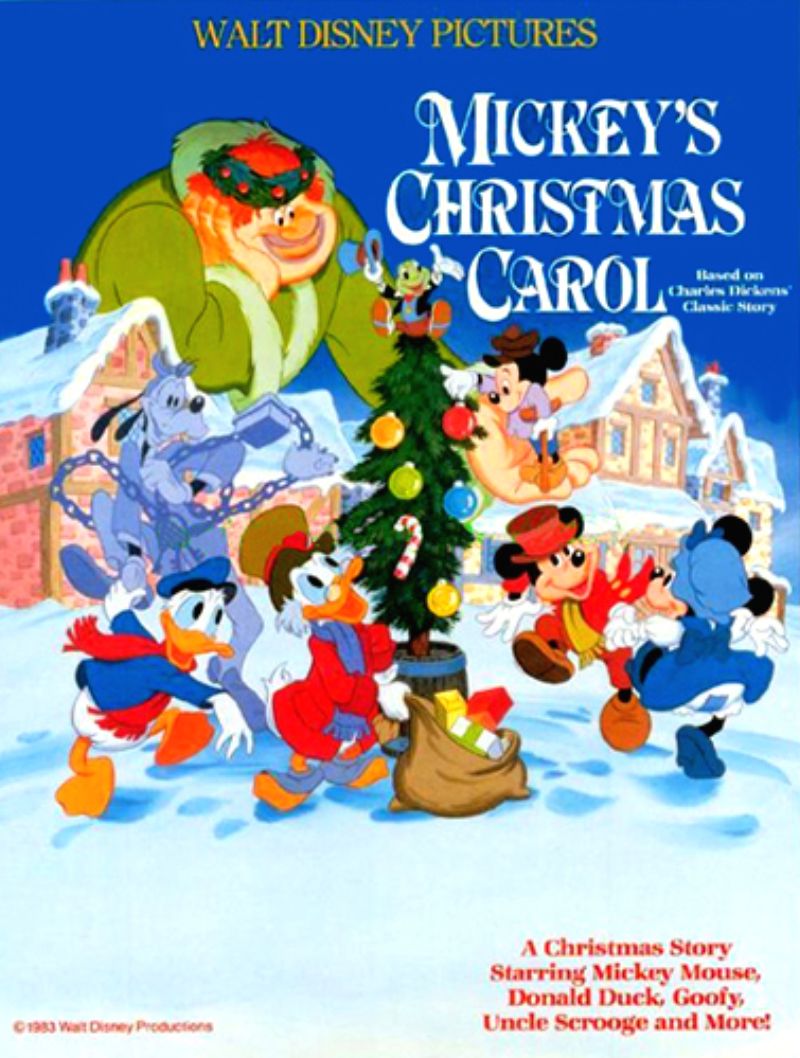
Scrooge Month Day 6: Scrooge McDuck in MICKEY’S CHRISTMAS CAROL (1983)
 Director: Burny Mattinson
Writers: Burny Mattinson, Tony Marino, Ed Gombert, Don Griffith, Alan Young, Alan Dinehart, based on the novel A Christmas Carol by Charles Dickens
Cast: Alan Young, Wayne Allwine, Hal Smith, Will Ryan, Eddie Carroll, Patricia Parris, Dick Billingsley, Clarence Nash
Notes: Paired with a re-release of the 1977 film The Rescuers, Mickey’s Christmas Carol is significant in the annals of Disney animation for several reasons. It was the first theatrical short starring Mickey Mouse in 30 years; it was the final time Donald Duck’s original voice actor, Clarence Nash, would voice the character; and it was the first time Alan Young would voice Donald’s Uncle Scrooge, a role he has continued with through the classic DuckTales TV show and every other depiction of the character right through the present day. Despite its short length, the film is remarkably faithful to the Dickens novel, keeping most of the important scenes and characters, although racing through them in the 26-minute running time. The Disney characters who take part in this adaptation include Scrooge McDuck (Young) as Ebenezer Scrooge, Mickey Mouse (Wayne Allwine) as Bob Cratchit, Donald Duck (Nash) as Scrooge’s nephew Fred, Goofy (Hal Smith) as Jacob Marley, Jiminy Cricket (Eddie Carroll) as the Ghost of Christmas Past, Willie the Giant (Will Ryan) as the Ghost of Christmas Present, and Black Pete (Ryan again) as one of the few versions of Christmas Yet to Come to actually have lines. Other minor characters and background extras come from various Disney shorts and films starring animals, particularly The Wind in the Willows and Robin Hood, which you may remember I talked about here once before.
Thoughts: This is the shortest version of A Christmas Carol I’ve talked about yet, and is probably the shortest I’ll discuss all month, but it’s also one of my favorites. Part of that can no doubt be chalked up to nostalgia – I was six years old when this cartoon was released, and I think I saw it in the theater, but I honestly can’t say for sure. Regardless, I am sure this was the first version of the story I remember in any detail, and as such it holds a special place in my heart. That said, it’s worth talking about even without the nostalgia factor because – again, despite its short running time – it’s really good.
First of all: Alan Young. I’m not sure how many people are aware that Uncle Scrooge has the voice of Wilbur from TV’s Mr. Ed, and I’m not sure how many would care if they did, because his work with this character is by far a more enduring legacy. Scrooge McDuck is a character who has to be firm and grumpy, but with a good heart at the core. In truth, from the outset he was a (slightly) milder version of the Dickens character Carl Barks named him after. Young’s voice performance is flawless.
The “casting” all around is good. Mickey Mouse – so long portrayed as a sweet, well-meaning everyman — is the natural choice for Bob Cratchit. Jiminy Cricket is Pinocchio’s conscience, and as such is the logical choice for Christmas Past. Willie and Pete, both nominal “villains” in their usual Disney performances, fit their roles well, with the man-child Willie making an even larger version of Christmas Present than we usually see and Pete taking real delight in his nasty work. The only one that doesn’t really seem to fit is Goofy as Jacob Marley – a character full of regret. Even if Goofy had anything to regret (he doesn’t – the character is far too innocent for that), he’s not self-aware enough to realize it. I imagine he was given the part simply because they felt the need to get all of Disney’s top three characters into the cartoon somewhere and they just couldn’t think of any other way to include him.
The only major character omitted from this version of the story is Scrooge’s sister, Fan. Considering it was billed as a Mickey Mouse cartoon, that’s understandable – kids may be able to accept ghosts and hellfire and redemption, but I doubt any parent wanted to have a discussion with their children about the potential of a mother dying in childbirth. Besides, there’s a long precedent in Disney cartoons of obvious orphans whose parents are never referenced (Donald and Mickey’s nephews and Donald himself being the prime examples).
Scrooge’s reformation is a bit more subtle in this film, although we do see the stages. After Christmas Past shows Scrooge the scene where he breaks the heart of Isabelle (Donald’s girlfriend Daisy, which must have been kind of awkward on the set), Scrooge berates himself for being foolish. A few seconds later, though, as Christmas Present preaches generosity, Scrooge stubbornly argues that he has no reason to be generous to others, as no one has ever shown such kindness to him. In response, we go to the Cratchit house, where Tiny Tim himself encourages his family to thank Mr. Scrooge. That’s all Scrooge gets from Christmas Present, though, as he’s left standing between a pair of giant footprints before a cloud of cigar smoke whisks him to the cemetery. He’s scared now, and you can feel it, but instead of asking about himself, he inquires as to Tim’s welfare. It’s a good moment, and it’s heartbreaking a moment later when we see Mickey Mouse, in tears, laying a crutch on a tombstone. If that isn’t enough to give kids watching permanent scarring, Christmas Future whips off his hood, lights a match on Scrooge’s tombstone, and kicks him into the open grave, where fire being blazing from the coffin and reaches for Scrooge just before he’s whisked home for the joyful finale.
It is still a Disney cartoon, and as such has to work in some comedy amidst the dark subject matter. The balance is good, and never at the expense of character, whether we’re looking at a verbal gag, a bit of ironic wording, or a quick sight gag. The moment where Scrooge tells Fred he’s coming to Christmas dinner after all, Fred and the horse look each other in the eye and Nash gives the line reading of his career: a simple “Well I’ll be doggone” that never fails to get a laugh out of me.
I do so love this cartoon, and not just because I got to watch it and write the whole article in less than a half-hour. It’s a wonderful rendition of Dickens’s story, even in its condensed form, and it just came out on a 30th anniversary edition Blu-Ray and DVD, along with several other classic Disney Christmas shorts, and one brand new one. If you don’t already own it, get it now.
The first Reel to Reel study, Mutants, Monsters and Madmen, is now available as a $2.99 eBook in the Amazon Kindle store and Smashwords.com bookstore. And you can find links to all of my novels, collections, and short stories, in their assorted print, eBook and audio forms, at the Now Available page!
What I Watched In… November 2013
In the interest of full disclosure (and to generate a little content here) I thought I’d present a regular tally of what movies I managed to see in the previous month. Some of them I’ve written about, most of them I haven’t. This list includes movies I saw for the first time, movies I’ve seen a thousand times, movies I saw in the theater, movies I watched at home, direct-to-DVD, made-for-TV and anything else that qualifies as a movie. Feel free to discuss or ask about any of them!
(Sharp-witted readers may notice the vast majority of these came in the last week, when school was out for Thanksgiving. The first few weeks of November were busy as hell for me. I’ve been trying to make up for lost time.)
1. Ender’s Game (2013), B+
2. Supersonic Man (1979), F; RiffTrax Riff, B+
3. Doctor Who (1996), B-
4. Thor: The Dark World (2013), B+
5. An Adventure in Space and Time (2013), A-
6. Necessary Evil: The Super-Villains of DC Comics (2013), B
7. The Hunger Games: Catching Fire (2013), B+
8. The Wizard of Oz (1939), A
9. Jack the Giant Slayer (2013), C-
10. Side Effects (2013), B-
11. Europa Report (2013), B
12. A Charlie Brown Thanksgiving (1973), B+
13. The Star Wars Holiday Special (1978), F; RiffTrax Riff, B+
14. Garfield’s Thanksgiving (1989), A-
15. Rudolph the Red-Nosed Reindeer (1948), B; RiffTrax Riff, B+
16. Nestor, the Long-Eared Christmas Donkey (1977), B; RiffTrax Riff, B
17. Get a Horse! (2013), A
18. Frozen (2013), A
19. Scrooge (1935), C+
20. The Polar Bears (2013), B-
21. A Christmas Carol (1954), B-
22. A Christmas Carol (1951), A-
23. Mr. Magoo’s Christmas Carol (1962), B+
24. Rise of the Guardians (2012), B
The 2013 Holiday Movie Preview
Twice a year my podcast, the All New Showcase, devotes an episode to movie previews. This week, my fiance Erin and I look ahead at all of the big releases coming out in the months of November and December — which ones we’re excited by, which ones we’re passing on, and which ones look utterly ridiculous. If’n you’re so inclined, give it a listen.
All New Showcase #296: The 2013 Holiday Movie Preview




What I watched in… September 2013
In the interest of full disclosure (and to generate a little content here) I thought I’d present a regular tally of what movies I managed to see in the previous month. Some of them I’ve written about, most of them I haven’t. This list includes movies I saw for the first time, movies I’ve seen a thousand times, movies I saw in the theater, movies I watched at home, direct-to-DVD, made-for-TV and anything else that qualifies as a movie. Feel free to discuss or ask about any of them!
1. Castle Freak (1995), F
2. The Lost Skeleton Returns Again (2009), B-
3. Tourist Trap (1979), D; RiffTrax Riff, B+
4. Parts: The Clonus Horror (1979), F; MST3K Riff, B
5. The Iron Giant (1999), A+
6. Hellraiser III: Hell on Earth (1992), D
7. Incident at Loch Ness (2004), B+
8. Upside Down (2012), C
9. This Island Earth (1955), C+
10. Mystery Science Theater 3000: The Movie (1996), B+
11. Pocahontas (1995), C-
12. The Host (2013), D+
13. Riddick (2013), D-
14. Rocky (1976), A
15. World War Z (2013), B-
16. Hellraiser: Bloodline (1996), D
17. The Touch of Satan (1971), F; MST3K Riff, B
18. Room 237 (2012), B+
19. 2001: A Space Odyssey (1968), A
20. Escape From Planet Earth (2013), B
What I Watched In… August 2013
In the interest of full disclosure (and to generate a little content here) I thought I’d present a regular tally of what movies I managed to see in the previous month. Some of them I’ve written about, most of them I haven’t. This list includes movies I saw for the first time, movies I’ve seen a thousand times, movies I saw in the theater, movies I watched at home, direct-to-DVD, made-for-TV and anything else that qualifies as a movie. Feel free to discuss or ask about any of them!
1. Pete’s Dragon (1977), B+
2. Ernest in the Army (1998), D
3. The Artist (2011), A-
4. The Wolverine (2013), B
5. 101 Dalmatians (1961), B+
6. Puppet Master (1989), C
7. Cloud Atlas (2012), B
8. The Revenge of Dr. X (1970), F; RiffTrax Riff, B-
9. A Goofy Movie (1995), B+
10. Chicken Run (2000), A
11. Starship Troopers (1997), C; RiffTrax Riff, B+
12. Enchanted (2007), A
13. Hellbound: Hellraiser II (1988), C
14. Nightmares in Red, White and Blue: The Evolution of the American Horror Film (2009), B-
15. Kick-Ass 2 (2013), B+
16. Shaun of the Dead (2004), A
17. Hot Fuzz (2007), A-
18. The World’s End (2013), A-
19. The Adventures of Robin Hood (1938), A
20. Robin Hood (1973), B
21. Robin and Marian (1976), B
22. Robin Hood: Prince of Thieves (1991), B+
23. Robin Hood: Men in Tights (1993), C+
24. Would You Rather (2012), B
25. Masters of the Universe (1987), C
26. Gamer (2009), C
Robin Hood Week Day 2: Brian Bedford in Robin Hood (1973)
 Director: Wolfgang Reitherman
Writer: Larry Clemmons & Ken Anderson
Cast: Brian Bedford, Monica Evans, Phil Harris, Roger Miller, Peter Ustinov, Terry-Thomas, Andy Devine, Carole Shelley, Pat Buttram, George Lindsey, Ken Curtis, Billy Whitaker
Plot: When good King Richard (a lion) left for the crusades, he left his brother Prince John as ruler of England, despite the fact that they were both voiced by Peter Ustinov. The rooster minstrel Alan-A-Dale (Roger Miller) tells us the story of the crusader who fought against John – a clever fox named Robin Hood (Brian Bedford), who defended Sherwood Forest with his friend, a bear named Little John (Phil Harris). The two outlaws disguise themselves and rob a coach carrying Prince John and his right-hand snake, Sir Hiss (Terry-Thomas).
John’s flunky, the Sheriff of Nottingham (Pat Buttram) makes the rounds to collect the exorbitant taxes from the townsfolk, snatching up every cent Robin’s friend Friar Tuck (Andy Devine) has managed to smuggle to them, even snaring a rabbit child’s birthday present of a single coin. As he leaves, Robin arrives in disguise and gives the boy a bow and arrow, along with one of his hats. The boy, Skippy (Billy Whitaker) leads his friends to play, but loses the bow in a palace courtyard. When he goes to retrieve it, he encounters Maid Marian (Monica Evans) and her friend Lady Cluck (Carole Shelley). The kids question Marian about her past relationship with Robin, and Skippy winds up playacting a “rescue” of Marian, culminating with her giving the unsuspecting boy a kiss.
Back in the forest, Robin is busy mooning over Marian himself when Friar Tuck brings him the news of an archery tournament, with the prize to include a kiss from Marian. Robin cannot help himself from entering the tournament, albeit disguised as a stork. He wins easily, but his disguise slips and he’s captured. Before the Sheriff can execute him, Little John forces the Prince to release him, and taking Marian with him, Robin and the others flee into the forest.
When Prince John learns how the people of Sherwood have begun to mock him, he triples the taxes and arrests anyone who can’t pay. The Sheriff tries to empty the church’s poorbox to line John’s coffers, sending Friar Tuck into a rage. He’s arrested and John sentences him to death in order to lure Robin Hood out of hiding. Disguising himself as one of the Sheriff’s Vulture henchmen, Robin sneaks into the palace late that night. Little John frees the Friar and the rest of their friends who have been arrested, while Robin sneaks off to steal the sacks of money in Prince John’s private quarters right under the sleeping prince’s nose. As he makes off with the last of it, Sir Hiss wakes up and alerts John (in a cartoonishly violent way). After a daring escape, Robin dives into the moat, followed by a shower of arrows, and Prince John believes him dead… but he pops up and chimes out “A pox on the phony king of England!” sending Prince John crying for his mommy.
Eventually, King Richard returns to England and pardons Robin and his men, placing John, Sir Hiss, and the Sheriff in irons, just in time for Robin and Marian’s wedding.
Thoughts: As with many people my age, this was the first version of Robin Hood I remember seeing, and in fact was the only version I was aware of for many years. In fact, even though Roger Miller’s Alan-A-Dale starts the movie by pointing out there are many versions of the Robin Hood and that this is, in fact, the version told by the animals, I remember being distinctly surprised when I got a little older and realized that Robin Hood was not, in fact, an original Disney character, and that what’s more, most versions of him were human and did not start anthropomorphic animals. Then I had to stop and look up what “anthropomorphic” meant, because I was like eight years old.
What’s more, this is the first time I watched this movie in years, and I’m catching a number of things I never would have noticed before. For example, the first scene with Robin Hood and Little John, after some cartoon antics escaping Prince John’s men, sees them engaging in a moralistic debate over the ethics of the whole “robbing the rich to give to the poor” angle. It’s a bit more thoughtful than one would expect from an early-70’s Disney movie, but it’s highly appropriate. In fact, there’s a lot of ethical moralizing in this movie. Whereas Errol Flynn (despite his loyalty) blamed Richard for leaving England in the hands of his brother to engage in the Crusades, Disney lightens it up a bit by making Richard the victim of the hypnotic Sir Hiss, who sent him off on what John calls a “silly crusade.”
The 70s were sort of a nebulous time for Disney. Walt was gone and, although it was still many years before the company’s second renaissance would begin with The Little Mermaid, it was also long before they would really hit the skids in the 80s. There’s a roughness to the quality of the films of the period, and while it now marks them indelibly as products of their time, it’s also the time in which I was introduced to Disney animation. I’ve got a soft spot for it. Even this film has a lot going for it in terms of animation and performance – the way Sir Hiss slithers his body underneath himself to simulate the elbows of a petulant teenager is a great image that gives you the perfect amount of character development. Brian Bedford and Phil Harris as Robin Hood and Little John remain the voices I hear when I think of the characters, and folk singer Roger Miller made for a fantastic bard.
Despite the animal players, the movie has lots of tiny moments that humanize the characters, such as Robin’s gift to the rabbit boy. As the kids leave, he gives the mother a sweet speech about keeping faith that Nottingham will return to glory. While Errol Flynn was loud and bombastic with his approach to rousing the townspeople, Brian Bedford’s Robin Hood is a quieter hero, one who sneaks in and out, going unnoticed until he’s discovered. Of course, once a disguise fails and he’s made, he’s just as likely to bring forth a spectacle as any other incarnation of the character. (The disguises, it’s worth pointing out, are only slightly above Bugs Bunny quality in the concealment department, but they usually work exceedingly well.)
The movie also sidesteps the usual beginning of the Robin/Marian relationship. In the Flynn movie, and in most other versions, the two are initially at odds, as he’s an outlaw and she’s a ward of the King and (technically) under the protection of the Prince. In this version, Marian loved Robin as a young girl and still does, eliminating the need for him to win her over and cutting right to the chase. I would imagine this is in deference to the cartoon nature of the film – while the scenes of Robin winning Marian over can work really well from an emotional standpoint, I can imagine in 1973 the animators thought a young audience would lose patience with such a thing.
Compared to the Errol Flynn film, the villains are far less menacing. Prince John is a spoiled mama’s boy with no air of danger about him whatsoever. Sir Hiss – a stand-in for Sir Guy of Ginsbourne – is a pompous, browbeaten serpent. The only thing about him that’s even remotely dangerous is his ability to hypnotize people, which he never even really uses to any serious effect once the story begins. (Dispatching Richard on the Crusades, the most important plot point to his hypnotism, happens before the film opens.) Only the Sheriff is an improvement in the villain department from The Adventures of Robin Hood, and that says more about the latter’s buffoonery than anything in favor of the Disney version. He’s less oafish and more dangerous than the other two, but still not the sort of villain that would give any kid trouble sleeping.
The biggest complaint I’ve got about the film is the ending. The final rescue at Prince John’s palace is fine, but Richard’s return to the throne and the arrest of the villains happens entirely off-camera. It’s not all that satisfying to cut from Robin’s escape, even as the prince pouts, to seeing them in chains with nothing in-between. Sure, these cartoons films are often short (at a crisp 83 minutes there’s little filler in this movie), but it certainly feels as though they could have given us just a bit more closure.
This isn’t the grand adventure of the Errol Flynn Robin Hood nor the attempt at an epic that the character would take later. It is, however, a grand and entertaining family version of the film with some sweet music, excellent voice performances, and mid-era Disney charm. It’s hard to say anything bad about that.
The first Reel to Reel study, Mutants, Monsters and Madmen, is now available as a $2.99 eBook in the Amazon Kindle store and Smashwords.com bookstore. And you can find links to all of my novels, collections, and short stories, in their assorted print, eBook and audio forms, at the Now Available page!
What I Watched in… July 2013
In the interest of full disclosure (and to generate a little content here) I thought I’d present a regular tally of what movies I managed to see in the previous month. Some of them I’ve written about, most of them I haven’t. This list includes movies I saw for the first time, movies I’ve seen a thousand times, movies I saw in the theater, movies I watched at home, direct-to-DVD, made-for-TV and anything else that qualifies as a movie. Feel free to discuss or ask about any of them!
- Man of Steel (2013), A
- The Incredibles (2004), A
- Independence Day (1996), B+
- Brave (2012), A-
- Despicable Me (2010), B+
- Star Wars Episode VI: Return of the Jedi (1984), B+
- Flash Gordon (1980), D
- Howard the Duck (1986), D
- Snow White and the Seven Dwarfs (1937), A
- Star Wars Vs. Star Trek: The Rivalry Continues (2004), F
- Lockout (2012), B-
- Q: The Winged Serpent (1982), C-
- Warm Bodies (2013), B
- Fangs of the Living Dead (1969), D; RiffTrax Riff, B
- The Deadly Bees (1967), D+; MST3K Riff, B+
- Monsters University (2013), A-
- That Guy… Who Was In That thing (2012), B+
- Pacific Rim (2012), B+
- Peter Pan (1953), B+
- The Lost Skeleton of Cadavra (2001), B-
- Godzilla (1954), B+
- Lethal Weapon (1987), B+
- Little Shop of Horrors (1986), A-
- Cloverfield (2008), B+
- Gamera (1965), C; MST3K Riff, A
- The Invisible Maniac (1990), F
- Gamera Vs. Barugon (1966), D; MST3K Riff, B+
- YellowBrickRoad (2010), C-
- Gamera Vs. Gaos (1967), D; MST3K Riff, B
- Gamera Vs. Guiron (1969), D; MST3K Riff, B+
- Gamera Vs. Zigra (1971), C-; MST3K Riff, B
- Sharknado (2013), F
- Chopping Mall (1986), F
- Lilo and Stitch (2002), B+
- Lilo and Stitch 2: Stitch has a Glitch (2005), B-
- Dave Barry’s Complete Guide to Guys (2005), B-
- Little Shop of Horrors (1960), D; RiffTrax, B+
- The Rubber Room (2013), B+
- The Dark Crystal (1982), B
- Dark City (1998), A
- Justice League: The Flashpoint Paradox (2013), A-
2 in 1 Showcase at the Movies: Monster-Sized Double Feature
 For those of you who listen to the podcasts, I reviewed a pair of movies in this week’s episode of my show. If you feel like listening to me ramble a bit about Pacific Rim and Monsters University, here’s a link!
(If you dig comic books, I also briefly talk about the new issues of Astro City and Quantum and Woody.)
2 in 1 Showcase At the Movies #36: Monster-Sized Double Feature
 Reel to Reel