Category Archives: Projects
Lunatics and Laughter Day 16: Behind the Mask-The Rise of Leslie Vernon (2006)
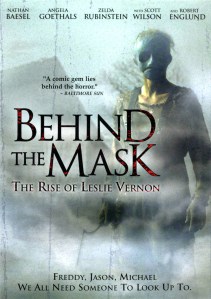 Director: Scott Glosserman
Writers: Scott Glosserman & David J. Stieve
Cast: Nathan Baesel, Angela Goethals, Robert Englund, Scott Wilson, Zelda Rubinstein, Bridgett Newton, Ben Pace, Britain Spellings, Kate Lang Johnson
Plot: Taylor Gentry (Angela Goethals), a journalism grad student, has found the perfect subject for her student film. Leslie Vernon (Nathan Baesel) was a child possessed by a terrible evil and murdered by an unruly mob years ago. Now, he has risen from the grave to terrorize the town of Glen Echo, Maryland. At least, that’s the story. Vernon, very much alive, has grown up idolizing the likes of Jason Voorhees, Freddy Krueger, and Michael Myers, and today he’s working to join their ranks. He’s allowing Taylor and her camera crew to film him in the process of becoming the next great slasher killer. Leslie leads Taylor and her crew members, Doug and Todd (Ben Pace and Britain Spellings) to the old house where he lived before his “death.” Teenagers sneak out to the house every year on the anniversary of his demise, and this year, Leslie is planning to return.
But that’s a month away, there’s still a lot of work to do to prepare his “survivor girl’ – the one person he’s going to attack that’s going to survive to carry on his legend. Leslie stakes out waitress Kelly Curtis (Kate Lang Johnson). He waits for her to dump the garbage from the diner and sets up a quick scare for her. The burst of adrenaline from shocking Kelly goes throughout Taylor and the crew, and they and Leslie begin to bond. The crew visits Leslie’s friends Eugene and Jaime (Scott Wilson and Bridgett Newton). Eugene is a retired killer who has been a mentor to Leslie, Jamie his supportive wife. Eugene advises Leslie to make his preliminary strike against someone only loosely connected to Kelly, and he chooses a librarian (Zelda Rubinstein). He plants a fake newspaper article for Kelly to find implying a “great uncle” she never knew about raped Leslie’s mother, thus creating a connection between himself and his target, then waits for her to find it. After the librarian “explains” the article he slays her, but instead of chasing Kelly as intended, he’s interrupted by the sudden appearance of Doc Halloran (Robert Englund). Leslie is ecstatic: he has an “Ahab,” a good person who knows the killer and will stop at nothing to defend the innocent.
Despite Leslie’s insistence that they stay away from Kelly, Taylor visits her diner. Halloran is there, and he warns them that Leslie is not who he claims to be, that he’s from Nevada and is using a fake name. When Kelly approaches, nervous, Taylor and Todd flee. When they return to Leslie he’s enraged, shoving her into their van, but he calms down and promises to tell her everything she needs to know. He confesses he’s not Molly Vernon’s son, just using her name to build his legend, and that he understands if Taylor wants to leave. Reluctantly, she decides to see it through.
He takes her back to the Vernon farm to show her his preparations to the house, barn, apple orchard and mill. He’s made it easy to cut the power, put dead batteries in the flashlights, sabotaged the available weapons, set up rooms to be open to teens having sex and other places to make it easy to dispose bodies… it’s all about narrowing it down to just him and Kelly for a final confrontation. When the teenagers arrive, he even swipes a sparkplug from their car.
When a pair of Kelly’s friends begin having sex, Leslie starts his killing. Taylor and the film crew are suddenly unnerved, realizing how real the situation has become, and Leslie ushers them outside. He goodbye to them, knowing that at the end of the night he’ll be hiding, locked up, or dead anyway. Todd and Doug are ready to leave, but Taylor finds herself unable to stand aside and allow the killing spree to continue. They go into the house to warn Kelly and the others and, to their shock, find the “virginal” Kelly having rambunctious sex. Taylor is unable to understand why Kelly is behaving like just another victim instead of a Survivor Girl. With the teens’ cars sabotaged they rush to Taylor’s van, finding two bodies and an engine that doesn’t work. Taylor tries to urge Kelly to become the heroine Leslie wants him to be, but instead, she turns out to be the next victim. He chases the rest to the barn, killing Todd on the way, and Taylor realizes that Leslie had planned everything from the beginning. Kelly was never supposed to be the real Survivor Girl. Taylor was.
Halloran arrives, but neither he nor Doug – who confesses his love for Taylor – can stop Leslie. Soon he and Taylor are all that remain, racing through the apple orchard and playing out the final confrontation as planned. They arrive at the apple mill, where Taylor knows Leslie has planned the last showdown. Taylor traps him in the apple press and, with his head clamped down, he removes his mask and whispers to Taylor that he knew she was the one. With one final crank of the press, she crushes his head, then sets the mill on fire, weeping. She finds Doug and Halloran, still alive, and they watch the mill burn.
As the credits roll, Leslie’s charred remains are rolled into a police morgue. We watch and listen to his whispering voice. Just as the film ends, he sits up on the slab behind a hapless scrub. Just like the monsters he so idolizes, Leslie Vernon will rise again.
Thoughts: Although not as well-known as most of the other movies in this project, there was never any doubt for me that I would include it. I really don’t remember how I first discovered this little movie a few years back, but it instantly became one of my favorites. Like Shaun of the Dead, it’s ripe with meta-commentary on horror movies. Like Eight Legged Freaks, it manages to parody the genre it loves. But unlike either of these, it twists the entire world of the movie on its ear for a fantastic final act.
During the buildup, the movie comes across as a typical mockumentary. Leslie gives talking head interviews, Taylor follows him in his preparation and asks dozens of questions, and you quickly find yourself as charmed by Leslie as Taylor is. By all appearances, Leslie is a very warm, friendly, congenial young man. He shows great care for his pet turtles and is intensely proud of his enormous library, which is loaded with medical journals and books about escape artists and illusionists. He reminds me of a more gregarious Norman Bates – at the beginning of Psycho Anthony Perkins feels like a really nice (if somewhat browbeaten) sort of guy. Leslie has that same quality, with the added bonus of being funny and entertaining to boot. When the film turns later on and we realize that Taylor and her crew are, in fact, his targets, the effect is shocking. Leslie is a remorseless murderer. The entire movie is about following him as he plans his murders. And yet, when he suddenly starts murdering our heroes, we are shocked and horrified, as if there was no way we could have seen this coming. There’s a brilliance here that is almost impossible to quantify.
Eugene is a very good addition to the cast, allowing the (real) filmmakers to put out commentary on the state of horror movies and of fear itself. The sort of things he says actually make a lot of sense if you filter them through a real-world prism and consider the words as film criticism instead of the actual words of a killer. He comes across as a pretty typical character type – the old pro who’s upset because things just aren’t as good as they used to be. If it weren’t for the fact that he’s talking about cold-blooded murder, he’d be like somebody’s grumpy old uncle.
If you want more horror movie commentary, the extended sequence where Leslie describes the way the killing spree is supposed to go down is going to delight you to no end. Leslie taps into every psychological theory and trope used in the construction of horror movies, pounding home things like imagery, the importance of gender roles in the weapons used and in the Survivor Girl’s metamorphosis into a heroine, and probably a dozen other things I’m forgetting, even though I’m literally typing this paragraph while watching the scene. There’s just too much for me to keep in my head. Glosserman and Stieve could teach a graduate class in the psychology of horror.
A lot of the more lighthearted stuff doesn’t even come from the story or the characters, but from little Easter Eggs the filmmakers throw in for those who know where to look. The references to Freddy, Jason and Michael are obvious, and Robert Englund’s sizable role is a lot of fun. But people wondering where they’ve seen the librarian before would do well to check out Zelda Rubinstein in Poltergeist, and most people won’t even realize the Elm Street resident Taylor tries to talk to is Kane Hodder, the man who played Jason Voorhees more times than any other. Other things, smaller things, litter the background of the film, all of them there to make you laugh if you know where to look.
There are nice tricks on the technical side of the movie as well. Whenever we see one of Leslie’s “attacks,” we switch from the videotaped “mockumentary” style to a more traditional film stock, complete with a musical score, coverage, and all of the other techniques common to movies that don’t fit into the “found footage” subgenre. The “real” scenes grow progressively longer, until the finale, when the movie drops the comedy and the commentary and turns into a straight-up horror movie, with Leslie hunting down Taylor, the true survivor girl.
Towards the end of the film, things begin spiraling through a litany of emotions. Jamie reveals that she was once Eugene’s Survivor Girl, which makes you ask a dozen questions about how the hell she ended up married to him. Taylor and Leslie have a soft, somewhat disturbing conversation as he puts on his makeup and prepares for the evening, and the way he begins sobbing, claiming to be happy at the sudden culmination of his life’s work… it’s eerie. Even now, though, even though we’ve already seen him kill one person for real and watched his plans to kill a dozen more, there’s an unnerving humanity to him that feels somehow honest and wrong at the same time.
I’m also a fan of the visuals of the movie. The “real” segments are high-quality and well-shot, and I love the design of Leslie’s costume and mask. He’s the sort of character that kids should be dressing up as for Halloween every year – creepy mask, shredded clothes, an easy prop weapon to lug around with him… Well, maybe if the sequel ever gets made.
Sadly, the Kickstarter campaign to fund the already-scripted prequel/sequel didn’t succeed, and plans are currently in limbo. The filmmakers and cast – including Robert Englund – are all willing to return to the world of Leslie Vernon, and so is the small but dedicated fan base. So perhaps you’ll allow me to play advocate for a moment. If you’ve read this far into Lunatics and Laughter, I’m willing to bet this is exactly the kind of movie you’d be into. Unfortunately, you also probably never saw it. Do yourself a favor and hunt down the DVD or call it down from NetFlix. It’s a great movie that has everything you love about horror in a unique, incredibly entertaining package. Join us in Leslie’s legion, and help us bring Before the Mask: The Return of Leslie Vernon to life.
Lunatics and Laughter Day 15: Shaun of the Dead (2004)
 Director: Edgar Wright
Writers: Edgar Wright & Simon Pegg
Cast: Simon Pegg, Nick Frost, Kate Ashfield, Lucy Davis, Dylan Moran, Penelope Wilton, Bill Nighy, Jessica Stevenson, Peter Serafinowicz
Plot: Retail employee Shaun (Simon Pegg) is having a rough time. His job is a joke, his relationship with his stepfather Philip (Bill Nighy) is strained, and his roommate Pete (Peter Serafinowicz) has had it with Shaun’s best buddy Ed (Nick Frost) sleeping on their couch. If that wasn’t bad enough, a chance encounter with his friend Yvonne (Jessica Stevenson) reminds him that it’s his anniversary and he’s forgotten to book a table at a restaurant. He tries to convince his girlfriend Liz (Kate Ashfield) to join him for a fun-filled evening at their favorite pub, the Winchester, but Liz has wasted one too many night at the bar. She dumps him and he returns home where he has one more spat with an agitated Pete (who was bitten by a bunch of crackheads) before going to bed.
In the morning, a tired Shaun schleps down to the local convenience store and home without ever noticing the few people around him are acting strange – grunting, stumbling, and covered with blood. Returning home, he and Ed finally figure out something is wrong they are attacked. The reports on the news and the ghouls outside their house make the situation clear. Although neither Shaun nor Ed wants to say it, London is overrun with zombies. The friends fight their way clear with vinyl records and a cricket bat, getting past Pete before escaping. Shaun plans to collect his mother and Liz and hide out at the Winchester until the crisis has passed.
His mother, Barbara (Penelope Winton) is nursing Phillip, who has been bitten. Shaun reluctantly loads them into the car then heads to Liz’s flat, where she’s hiding out with her roommate Dianne (Lucy Davis) and Dianne’s boyfriend David (Dylan Moran). Although they are reluctant to go with him, the encroaching undead soon change their minds. As they flee, Phillip succumbs to his bite and they are forced to abandon the car, trapping him inside. They encounter Yvonne, who has gathered her own oddly familiar group of survivors and who is planning to find help. Shaun insists on following through his his own plan. When they reach the Winchester, they find it surrounded by zombies, and struggling actress Dianne gives the rest of the group a crash course in acting undead. Remarkably, the ruse works and they march through the army of zombies unmolested, until Ed’s mobile phone rings and blows their cover. They barely get to cover inside the bar.
In the Winchester, Shaun discovers that his mother has been hiding a bite of her own. He and David begin sniping at each other as Barbara struggles against the disease inside her, but when she finally dies and rises, Shaun puts her down with the rifle hanging over the bar. As they continue to argue, raw emotions are exposed: David is in love with Liz, something Dianne knows fully well, but she has been settling for what little affection he gives her. As they fight, the zombies overwhelm their barricades and pull David outside. Dianne snaps and rushes after him, being consumed as well. The last three break for the basement, but Ed is bitten on the way. Trapped, the three of them contemplate suicide, but before they can do anything, they find a secret hatch. Ed promises to cover Shaun and Liz as they escape. Biddign his best friend farewell, Ed can’t resist sending a fragrant flume of gas his way one more time. Making their way to the surface, Shaun and Liz are met by Yvonne, along with an entire army battalion that has arrived to put the zombies down. Six months later, Liz has moved in with Shaun and the world has adapted, using the zombies for menial labor and cheap entertainment. Shaun goes out to the shed to relax a little while, sitting down next to his best friend. Ed is now a zombie, but that doesn’t mean they two of them can’t continue to enjoy their video games.
Thoughts: I’ve said that Ghostbusters is my favorite horror/comedy and I stand by that, but damned if Shaun of the Dead doesn’t come in a close second. This film is a flawless combination of things that I love: emotionally honest characters, dry British wit, zombies, Bill Nighy… Any one of those elements is worthy of being loved, cherished, and having praise heaped upon them. Putting them together makes for one of the best horror/comedies ever made.
This film came in near the beginning of the current zombie wave, which has actually gone on much longer than I would have expected. It wasn’t the first zombie/comedy hybrid, but it was without a doubt the most effective, and I doubt the later entries into this subgenre (Fido and Zombieland, for example) would have enjoyed their respective success if Wright and Pegg hadn’t come along first and done such a remarkable job with this movie. The zombies themselves are played perfectly straight, a Type-A horror threat. In fact, they could have marched right off the set of a George Romero movie. In truth, if not for the sort of happy ending at the end of the film, one could easily make the meta-argument that it showed the British side of one of the many zombie apocalypses (apocalypsi?) that make him his own films. He himself was enough of a fan of Shaun that he invited Wright and Pegg to make a cameo appearance in Land of the Dead. (They played zombies.)
The zombie stuff works really well, and the comedy is near-flawless. Nick Frost’s Ed ranks up there with one of the great comedic bumblers. He slows down the group, makes poor decisions, and nearly gets them all killed several times. He’s like Gilligan – anybody in their right mind would have left him to die ten minutes after the zombies attacked. But for all his buffoonery, there’s some sort of inexplicable charm that makes you want to keep him around. It’s probably this, more than anything else, that helps him last right up until the very end. Let’s be honest, if Shaun had walked into the shed to reveal Pete or David chained to the wall, it would have just felt creepy. Watching him chide Ed for trying to bite him, though? It’s weirdly sweet.
Pegg himself is successful as the harried everyman, the ordinary guy who is in way over his head and needs to find a way to rise above it all if he’s to have any shot at survival, let alone getting the girl. It’s that status that makes him such a successful protagonist. Virtually everybody has felt like Shaun at one point in their life. It’s just that few of us are lucky enough to have a plague of the undead come along at just the right time to help us snap out of our funk.
Shaun’s character is just the beginning of these very real characters, though. David’s bitterness comes across as very genuine, and Dianne is a terribly sad character that you can wholeheartedly believe in. The moment of Phillip’s death is a remarkable one as well, turning a character that could have been a cartoon wicked stepfather into someone with genuine heart who just didn’t know how to express his feelings until it was too late. Liz is, if you’ll pardon the gender-specific term, the film’s straight man. She’s not particularly funny, but she allows Shaun and Ed to play off her rather well. The core of her relationship with Shaun, though, is one of true love and legitimate concern for their life. You never think poorly of her in the movie, never imagine her to be the sort of bitchy ex-girlfriend that a lot of movies would transform her into in order to make Shaun seem more heroic. I’ve come to realize that the truly great horror/comedies, whether they’re Type A or Type B, can fall into two categories: either they’re remarkably funny or surprisingly tender. Like Bubba Ho-Tep, Shaun of the Dead presents us with excellent characters that we really feel for. Their deaths aren’t just plot points or gags like in Eight Legged Freaks or Attack of the Killer Tomatoes. Each major member of this cast has a role, a purpose, a meaning.
Not to say that it’s 100 minutes of zombies wrenching feelings out of you, not at all. The film is full of sharp running gags (Shaun has red on him, Ed is addicted to his phone, etc.) and Yvonne pops up just at the right time to lend some really successful levity just after Phillip’s crushing end. Shaun’s dream sequences about fighting to the Winchester are both really funny and highly relatable – unless you honestly expect me to believe you’ve never imagined your Zombie Apocalypse Contingency Plan beginning with thrilling heroics and ending with tossing back a cold one at your favorite hangout. Yes it has. You liar.
To put it simply, Shaun of the Dead is the perfect package of horror movie monsters, dramatic story beats, and rip-snorting laughter. If anyone tries to call it a parody of zombie movies, I feel the need to correct them right away. This isn’t a parody at all, this is a zombie movie. It just happens to be one where the prospective buffet left out for the undead is made up of some very, very funny people.
Lunatics and Laughter Day 14: Eight-Legged Freaks (2002)
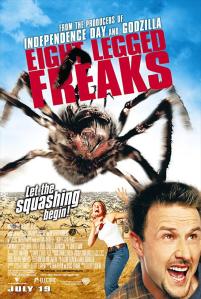 Director: Ellory Elkayem
Writers: Ellory Elkayem, Randy Kornfield, Jesse Alexander
Cast: David Arquette, Kari Wuhrer, Scott Terra, Scarlett Johansson, Doug E. Doug, Rick Overton, Leon Rippy, Matt Czuchry, Tom Noonan, Eileen Ryan
Plot: A highway accident causes a barrel of toxic waste to spill into a reservoir in the little town of Prosperity, Arizona, where the chemicals spread to a spider farm. The owner, Joshua (Tom Noonan) collects contaminated crickets to feed his beasts. A boy named Mike (Scott Terra) stops by for a visit, and Joshua shows him the various species of arachnid in his collection. After Mike leaves, Joshua notices some of his spiders have gotten loose. They suddenly attack and destroy him.
A week later, Chris McCormick (David Arquette) comes back to Prosperity after a decade away. His father owned the town mines, and he’s come home to stand against the mayor who wants to sell all the town property and relocate. Meanwhile Mike’s mother, Sheriff Sam Stroud (Kari Wuhrer), has uncovered the toxic waste barrel. On her way home, she pulls over a group of teenagers on dirt bikes, including her daughter Ashley (Scarlett Johanssen). She takes her home, warning her about her boyfriend Brett (Matt Czuchry), who also happens to be the mayor’s stepson.
At a town meeting Mayor Wade (Tom Rippy) tries to convince the people to sell their property to a company that wants to use their empty mines (to dump waste, but he leaves that part out). Chris insists his father saw a lode of gold in the mine before he died, and punches Wade, who orders Sam to arrest him. Sam, who shares a history with Chris, lets him go. His aunt Gladys (Eileen Ryan) mentions that Sam is divorced now, and urges him to tell her the real reason he hated her husband so much he left town.
Sam gives Ashley a stun gun to protect herself while Mike follows spider tracks to the mines, noting that they appear to have grown to enormous size. Hitchhiking home, he’s picked up by Chris, who has been sending miners to look for the lode his father found, at the same time trying to avoid deadly pockets of methane. Mike shows Chris a segment of a huge spider leg he’s found, admitting he fears the spiders are growing and have hurt Joshua. Chris, of course, doesn’t believe him, because “they never believe the kid.” Back in the mine, Chris’s employees are attacked by the giant beasts. Their next attack is on Wade’s ostrich farm, gobbling up birds whole. Local crank radio host Harlan Griffith (Doug E. Doug) starts reporting on stories of pets and other animals being devoured by some sort of creature, which he believes to be an alien.
Ashley, in the desert with Brett, uses the stun gun when he tries to pressure her into sex. She takes his truck and leaves him with his friends, just before the spiders attack. Brett manages to escape into the mines, where he finds several of the miners still alive, webbed into coccoons. Gladys is in the mines as well, through a shaft that opened up into her basement. Chris goes after her, finding an enormous spider leg, and rushes to Sam’s house to talk to Mike. While a puzzled Sam watches, the two of them begin to calculate just how big the spiders are. Down the hall, one of the giants climbs into Ashley’s bedroom. When she screams, Sam and Chris burst into the room and she kills it.
With the phone lines down, Mike suggests they go to Harlan’s radio station and broadcast a warning. They fight their way past the spiders to the station and Sam tells the townspeople to arm themselves, urging them to gather at the mall to make a united stand. With the spiders in force, the people flood the mall and lock themselves in. Their only hope to call for help is Wade’s cell phone, but Chris and Harlan have to climb the antenna on the roof to get a signal. Everyone else raids the mall for weapons. Chris calls the army, but they ignore him, believing it to be a prank call. As he screams at the phone, the spiders begin to punch through the gates protecting the people inside the mall.
The townspeople escape the overrun mall by fleeing into the mines and Chris tries to lead them to an exit. Instead, they find the methane pocket, and Wade and other living people, cocooned to be fed to the queen. Chris tells Sam how to find the way out while he continues to search for Gladys. Before he leaves her, he tries to explain why he left town, but she already knows: his father told her Chris loved her, he knew her husband was cheating on her, but didn’t want to break up her family. She kisses him, tells him to make it up to her later, and they run. Chris finds Gladys, and the vein of gold his father found… but the enormous spider queen is there as well. Afraid to shoot his gun because of the methane, Chris uses advice Mike gave him earlier and spritzes the spider with perfume, driving it back so they can escape. Outside, Sam and Mike fuel the generator that powers the mines, sparking it to life with Ashley’s stun gun. The electricity lights the gas and Chris and Gladys just barely an explosion, which roasts the spiders in the mines, along with the toxic waste Wade had tried to hide, destroying his property in the process. As the cleanup begins, Chris and Sam hold each other, and she tells him she’s glad he came home.
Thoughts: Fear evolves over time, with each generation drawing on the context of its own world to create the things it fears the most: witches in the 17th century, Nazi domination during World War II, trans-fats in the year 2012… but in the 1950s, the big fears were nuclear power and the Soviet Union, which somehow melded in a series of movies where small animals mutated into giant ones and terrorized teenagers and scientists who all smoked pipes. Eight Legged Freaks is a tribute of sorts to that subgenre of the monster movie.
I’m not sure if it says anything about horror/comedies specifically, but looking at David Arquette again certainly brings to mind certain things about Hollywood in general. Just ten years earlier, in Buffy the Vampire Slayer, Arquette was cast as the punk teenager. By Scream in 1996, he was the punk teenager’s older brother. Now, in 2002, he’s the love interest to the punk teenager’s mother. Either the years were not kind to him, or Hollywood has tacitly admitted he was really too old to play those other parts in the first place. (If he made another movie with Scarlett Johanssen today, ten years later, I’d bet you even money he would be her love interest rather than her mother’s. Hollywood is weird.)
The sweet-natured, awkward character he plays here isn’t all that different from his character in the Scream films, but it happens to be the sort of character he plays very well. You show me David Arquette playing kind-hearted and a little dorky, and I’m totally on board. I rather liked Scott Terra as Mike as well. He’s the sort of kid who could easily turn into an obnoxious know-it-all, but he’s balanced much better than that. Instead, he comes across as a particularly young example of the one sane man in a room full of lunatics, and the moment when Chris recognizes that and implores the townspeople to “listen to the kid, for once,” is a good little meta-commentary on horror movies and a nice character moment for them all. It’s only made stronger by the fact that most of the people actually do listen.
The monsters themselves, to be frank, could have looked better. The movie uses a lot of CGI, and not great CGI at that. It really would have served the film much better to use campy puppets or models, truly embracing its B-movie roots. When the spiders start crawling out of a miner’s mouth, all I can see is a man standing there, jaw agape, while someone sitting at a computer Photoshops lots of little spiders all over his face. It’s even worse when the giant spiders attack the kids on dirt bikes. In broad daylight, the effects team can’t even rely on the cover of darkness to hide just how weak the computer animation actually is. On the other hand, the movie does use practical effects to show an ostrich exploding, and there’s literally no way to complain about that.
The bad effects really hurt the overall charm of the film, and there’s a lot of it. The plot has an old-school B-movie feel, while the production values (aside from the CGI) are pretty good. I also give the filmmakers credit for using a variety of different spiders throughout the film. There are dozens of different looks and feels of creature in this movie, and while I don’t have nearly enough ichthyologic knowledge to tell you how accurate any of the spiders are (in either appearance or behavior), they at least made an effort, which is more than you can say for a lot of movies. There are plenty of good comedic moments here too. The scene in the mall, when the townspeople grab baseball bats and pitchforks and crossbows and hockey masks and suit up for war, is a nice sort of statement on small-town fortitude. Sure, there turn out to be a few cowards in the group, but many of them stand and fight true, getting out some good quips and solid action (CGI notwithstanding) in the process.
And composer John Ottman deserves every shred of credit one can muster for making a creepy version of “Itsy Bitsy Spider” the core of the movie’s musical score. Every time the strains of that tune begin to play, it’s impossible not to smile.
I really want to love this movie, and there are a lot of parts of it that are wonderfully fun. This is actually a case where I wish they could somehow remake the movie with cheaper special effects. The filmmakers overreached, tried to make an A-movie out of a delightful B-script, and it falls a little flat as a result. I do like this movie, I like it a lot, but if only director Ellory Elkayem had stayed true to the cheesy roots of the film, it could have been a classic.
Lunatics and Laughter Day 13: Bubba Ho-Tep (2002)
 Director: Don Coscarelli
Writer: Don Coscarelli, from the short story by Joe Lansdale
Cast: Bruce Campbell, Ossie Davis, Ella Joyce, Heidi Marnhout, Bob Ivy
Plot: In Mud Creek Texas, there’s a quiet little nursing home called Shady Rest with a few extraordinary residents. Sebastian Haff (Bruce Campbell) lies in bed bemoaning how his grand “plan” went horribly wrong. As he feeling sorry for himself, his roommate loudly expires in the bed next to him. That night, a woman is attacked in bed by a huge scarab beetle. After the beetle bites her, a horrific man appears in her bedroom. Down the hall, Sebastian sees her being dragged past his door, asking for help. Thinking it’s a dream, he goes back to sleep, and the next morning, she’s found dead.
Sebastian wakes up to find a young woman going through his deceased roommate’s belongings. Callie (Heidi Marnhout), the man’s daughter, starts throwing things out, and Sebastian asks if he can keep some of them. He’s dismayed that she hasn’t been to visit him in the three years since he’d come to the home, and he wonders if his own daughter would visit him if she knew he was still alive. His nurse (Ella Joyce) comes in and he insists she call him by his given name. He doesn’t go by Sebastian Haff anymore – he’s Elvis Presley. The nurse insists he’s an old Elvis impersonator who has had mental problems since he came out of a coma years ago. Elvis claims he traded place with the real Haff, an Elvis impersonator, after he decided he was tired of the manufactured thing his managers had turned him into. Elvis isn’t Shady Rest’s only celebrity tenant, though. His friend Jack (Ossie Davis) claims to be John F. Kennedy, victim of a conspiracy. Jack says his brain was tampered with and his skin dyed black in order to get him out of the way years ago. Even Elvis is skeptical of Jack’s story.
That night, when Elvis wakes up to go to the bathroom, he sees a scarab the size of his hand. He manages to kill it and goes to Jack’s room, where his wheelchair-bound friend is lying on the floor facedown. He’s alive, but confused, saying he saw someone “scuttling” through the hall, someone he believes the conspiracy sent to finish him off (possibly Lyndon Johnson). As he thinks about the bugs, about Jack, about Callie, Elvis starts to feel an energy he hasn’t had in years. For the first time in years, something interesting is happening.
The next night, Jack wakes Elvis up to show him bathroom graffiti that turns out to be Egyptian hieroglyphics. Jack tells Elvis that, the night before, his strange assassin tried to suck out his soul, and he believes there’s a connection. Elvis finds a book that indicates the creature may be a mummy, one that survives by eating souls, but can’t last long on “small souls,” souls of people who have little joy for life. The nursing home makes for the perfect place to feed without drawing suspicion. As the lights start to flash Elvis steps into the hall and encounters the mummy – a gnarled, ancient man in cowboy attire (Bob Ivy). Their eyes lock and Elvis sees moments of the mummy’s life. As it walks away, another resident comes out of his room and dies of a ruptured heart. Elvis and Jack take comfort in the knowledge that the mummy failed to consume the old man’s soul.
The next day Elvis tries to track the mummy, finding his way to a creek nearby. In the water, he finds a submerged van near a bridge, and recalls the mummy – from its own memories – being lost in a van crash. Jack meets him later with research that indicates there was a mummy stolen from a museum years ago by a pair of crooks in a van, on the night of an incredible storm. Although Jack wants to adopt a defensive strategy against the monster, Elvis persuades him to go on the offensive. Suited up and armed, the old men prepare for battle. When the mummy appears and tries to suck out Jack’s soul, Elvis douses it with lighter fluid and sets it ablaze. Jack implores him to “take care of business,” and dies. Elvis climbs in Jack’s wheelchair and charges, battling the mummy to the edge of the creek. He lights the mummy on fire again, and it plunges into the water, inert. Too wounded to go on, Elvis Aaron Presley dies as what he always only pretended to be in his movies: a hero.
Thoughts: By the time Bubba Ho-Tep came out in 2002, ten years after the final Evil Dead/Army of Darkness film, Bruce Campbell had legitimately ascended to the status of a cult hero, even if he’d never had any real mainstream success. It’s a double-edged sword. On the one hand, much of the mainstream public still is unaware of his sheer awesometude. On the other hand, he’s largely avoided making any tremendous suck-fests (largely, not entirely), because he has a lot of freedom to pick movies that really speak to him. This utterly, utterly bizarre film fits that bill perfectly.
At its core, this movie has all the hallmarks of a Type-B horror spoof: Nursing Home Elvis and Black JFK team up to fight a mummy. How could that be anything but a goofy farce? But in fact, although the characters and performances are very funny, the movie is surprisingly grim, from the unending pallor of death around the nursing home to the thoughtless, sometimes cruel things the residents do to each other. An early scene features a woman stealing a tin of cookies from a friend in an iron lung, a crime for which she is targeted by the scarabs. It’s actually a neat sort of twist on the classic horror-as-morality-play motif. The characters who fall victim to that trope are usually teenagers. Seeing an old woman chosen to be struck down for her sins is an interesting change of pace.
With the horror played straight, it’s largely up to Campbell and Davis – and the ludicrous nature of their situation – to provide the comedy. Campbell’s voiceover narration does a lot of the heavy lifting in that regard. His commentary on the world around him, his feelings about being an old man, and his regret over how his “new life” went so terribly wrong, are actually pretty amusing. The flashbacks that show him trading places with Haff are entertaining as well, if they’re left somewhat unclear as to exactly how real they are. The film doesn’t bother to explain whether our heroes really are who they say they are, or if they simply suffer the delusions of old age, and I’m rather glad they don’t. Confirmation would make the film almost too ridiculous to be believed, while busting the myths would just make them sad figures. The ambiguity is practically essential for the film to remain entertaining.
Coscarelli makes liberal use of the comedy factor in seeing older characters throw around toilet humor. Elvis is constantly concerned with a growth in a private area under his pants, and is overjoyed when it starts to show a little life while his nurse applies ointment. The discussion of the mummy itself is ripe with scatological commentary (pardon the pun). It’s all justified in that it works for the purposes of the story, but one can’t help but get the impression it was structured in such a way as to wring out a few extra laughs by the juxtaposition.
One of the few bits where the laughs fall flat comes from the pair of hearse drivers who arrive after each death. The first one is treated fairly straight, but the next one comes with jokes about the smell of the corpse, and by the final time they appear it’s an outright comedy of errors, as they drop the body and stumble into the bushes. Sandwiched, as it is, between two fairly intense scenes, it’s no doubt intended to be a little light comic relief, but as Coscarelli just made us feel a sense of honor for the body they’re transporting (it’s the man who died naturally and escaped the mummy), treating him as a slapstick prop just feels wrong.
I give Coscarelli some slack, though, for the way he manages to pull some genuine tenderness out of these two truly absurd characters. The friendship between them feels honest and genuine, even if you suspect they’re both totally off their rockers. The scene where Elvis asks Jack what Marilyn Monroe was like in bed would feel crass in most other cases, but instead, it comes across like a bonding moment between two old soldiers, and it makes us believe in both of them just before they’re about to risk their lives to stop the monster. By the time Jack dies, it’s actually heart-wrenching. When Elvis dies a few minutes later, his last words are simultaneously funny, sad, and absolutely perfect: “Thank you. Thank you very much.”
On paper, even as a spoof this movie would sound like a ridiculous, unbelievable, unworkable jumble of big ideas that can’t possibly work in concert. Somehow, though, Coscarelli wrings out a clever, entertaining, and impressively emotional film, one of the deepest movies we’ve yet encountered here in Lunatics and Laughter. That’s not the sort of thing I would have expected, and it’s surprises like this one that make this project worth doing.
Lunatics and Laughter Day 12: Bride of Chucky (1998)
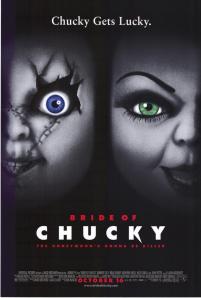 Director: Ronny Yu
Writer: Don Mancini
Cast: Brad Dourif, Jennifer Tilly, Katherine Heigl, Nick Stabile, Alexis Arquette, Gordon Michael Woolvett, John Ritter, Michael Louis Johnson
Plot: A police officer steals a bagged item from an evidence locker, bringing it to a mysterious woman (Jennifer Tilly) in a parking garage. The woman, Tiffany, kills him and retrieves from the bag the shattered remains of the “Good Guy” doll, Chucky, possessed by the spirit of serial killer Charles Lee Ray (Brad Dourif). As she stitches the doll back together, she begins a ritual to restore it to life. Although her first attempt seems unsuccessful, she uses a pathetic wanna-be Goth named Damian (Alexis Arquette) to help bring him back. Chucky, you see, was her boyfriend for years before he died… and he was violently jealous. With Damian trapped, the doll returns to life and slays him. Tiffany is dismayed when she learns the ring she found in Chucky’s house after he died was not an engagement ring, as she suspected, but just another bauble stolen from one of his victims. Angry, she refuses to continue with the plan to help Chucky regain a human body and locks him up.
Elsewhere, we see a young man named David (Gordon Michael Woolvett) pick up a girl named Jade (Katherine Heigl) for a date. David is just a ruse, though, a clean-cut young man her uncle Warren (John Ritter) doesn’t object to. Once they leave the house, she jumps in the back seat of David’s car, where her boyfriend Jesse (Nick Stabile) is waiting. They’re busted when a beat cop, Norton (Michael Louis Johnson) pulls them over and Jade’s uncle – the Chief of Police — shows up to take her away.
The next day, Tiffany moves a crate with Damian’s corpse out of her trailer and asks her neighbor – Jesse – for help loading it into her car. She flirts with him, but he resists, telling her he’s seeing someone. Tiffany asks him to “treat her right” and leaves. When she returns she has a surprise for Chucky – a Bride Doll she places into his cage to mock him. He uses the ring she places on the doll to cut through his wooden bars and, as she relaxes in a bubble bath, pushes in a television and electrocutes her. As she dies, Chuck repeats the voodoo ritual that trapped him in the doll 10 years ago, placing her spirit into the Bride Doll.
Chucky tells her their only hope of getting human bodies is by means of an amulet that was buried with his real body ten years ago, but they have no way of getting to the cemetery in New Jersey. Tiffany calls Jesse and offers him a thousand dollars to pick up a pair of special dolls from her trailer and transport them. Before he leaves, he goes to Jade’s house and begs her to run away with him. She agrees, and as she rushes to pack, Warren tries to find a way into Jesse’s van. Chucky prepare to stab him, but Tiffany urges him to get more creative. When Warren enters the van, he stumbles into a trap the dolls prepared, riddling his face with nails. The teens, unaware that Warren’s body is in the van, are pulled over by Norton. As he calls the station, the dolls sneak out, light his gas tank on fire, and blow up his car. Jesse and Jade floor it, each suspecting the other of killing Norton and afraid the media is going to pin his death on them.
Despite this, they swing through a wedding chapel in Niagara Falls. Tiffany grows more nostalgic over the prospect of a wedding. Chucky starts to apologize for getting them into the situation, but everything goes crazy as a still-living Warren pops out. As Jade and Jesse are nervously married, Chucky chops up Jade’s uncle with a knife. Jade joins the fun later, butchering another couple at the hotel who steals from Jesse and Jade, and Chucky goes mad with love. The next morning the bodies are found by a maid (Kathy Najimy in a weird cameo) and Jesse and Jade panic and flee.
They’re met by David, who knows each of them have been suspecting each other of killing the people in their wake, but David is convinced there’s a third party: Warren. That theory is shattered, though, when he finds Warren’s body hidden in the van. Now afraid that one of his friends is a killer, he takes Warren’s gun and demands they pull over, revealing the body. The dolls reveal themselves, pulling out guns. Terrified, David stumbles into the street and it pulverized by an 18-wheeler. The dolls demand Jesse starts driving. The plan is revealed now – they want to place their spirits into Jesse and Jade’s bodies.
On the radio, a news bulletin says that Charles Lee Ray’s fingerprints were found at the scene of one of the “Jesse and Jade” murders, and that Ray’s body will be exhumed. As they continue towards New Jersey in a stolen camper, Jesse and Jade stir a little discord between the grotesque couple. While they argue, the teens take advantage and shove Tiffany into the oven and Chucky out the window. The camper crashes and the teens barely get out. Jesse takes Tiffany hostage as Chucky takes Jade and forces her to take him to the cemetery. The men force each other to let the women go, and Chucky throws a knife at Jade, but Jesse takes it in his back instead. Tiffany distracts him, taking his knife and stabbing him in the back, too touched by Jesse and Jade’s love to destroy it. The dolls fight, Chucky stabbing Tiffany. Jesse knocks the doll into Ray’s open grave and Jade guns him down. A cop who’s been pursuing them arrives in time to see Chucky’s death and lets them go, swearing no one will believe it. Moments later, Tiffany begins screaming, her stomach twitching… and a little baby doll spurts out in a gout of blood.
Thoughts: The original Child’s Play movie was an earnest effort at a scary movie about a murderer who took over the body of a creepy little doll and went on a killing spree. Like I said in the eBook edition of Reel to Reel: Mutants, Monsters and Madmen (totally available on Amazon.com for just $2.99, you guys), it never quite worked for me. It was a little too ridiculous, a little too silly, and eventually, the filmmakers came to agree with me. By this film, fourth in the series and the first to drop the Child’s Play banner and begin marketing it via Chucky himself, they realized it wasn’t as scary as it should be and decided instead to play it for laughs.
The movie, and the franchise, takes a sharp turn in this film. It’s the first time the movie abandons the concept of a child possessing the abandoned doll in favor of the new adventures of Chucky and Tiffany. I’m guessing this was a practical concern – putting a child in danger makes for good drama in a horror film. It’s a little tasteless to do the same if you’re trying to make a joke out of the whole thing. But hacking up teens and adults? That’s fair game for a few good chuckles.
Let’s face it – if one murderous doll is hard to take seriously as a movie monster, two of them are virtually impossible. Once Tiffany is inside her doll as well, it’s like watching some horrific version of It’s A Small World. The jokes start flying fast and furious as well – Tiffany tells Chucky she wouldn’t be with him if he had G.I. Joe’s body, she sits around reading Voodoo For Dummies… there are moments where the film trends dangerously close to becoming a flat-out spoof.
There’s an odd sort of visual transition here as well. In order to make Chucky less frightening, they make him more menacing. Tiffany’s crude stitch job has become the de facto image for Chucky, replacing the pristine and far creepier Good Guy doll look he started with. We also start getting a lot of good visual gags as well. My favorite bit is at the police evidence room at the very beginning, where we see a couple of familiar masks, a chainsaw, and a bladed glove. I’m not sure if this was an actual effort to join the fun of smashing horror movie killers together (something people had been calling for since Freddy Krueger’s surprise cameo in 1993’s Jason Goes to Hell) or just a little treat for the fans, but it was a cool visual moment for someone like me, someone who lives off looking for the connections and influences amongst these films. If that isn’t enough for you, though, Yu pulls out the most blatant homage in Tiffany’s death scene. The movie she’s watching in the bathtub as Chucky roasts her? The universal classic Bride of Frankenstein. The Easter Eggs keep coming after that, with references to Hellraiser and others sprinkled in throughout the film. (It’s worth noting, by the way, that Ronny Yu would go on to finally marry the two biggest franchises of the 80s in 2003′s Freddy Vs. Jason.)
Perhaps a less inspired choice was the decision to insert cartoon sound effects into the moments of violence. The same thing happened a few times in Army of Darkness, but as that was more of a cartoony sort of violence, it didn’t really bother me. The violence in this movie is much more graphic, though. Using a sound clip that sounds like it came out of a Wile E. Coyote cartoon when Chucky rips out Damian’s piercings in a bloody fountain, though… well now, that’s different. Fortunately, they don’t maintain that for every kill. The moment where Tiffany slays the couple in the hotel room by shattering the mirror over their waterbed and letting the shards rain down on them is the equal to any good horror film. We lose the horror, though, and go into just plain bizarre a few seconds later when the dolls consummate their relationship. Pretty much the only way to absorb the tender way in which the scene is filmed is to keep telling yourself it’s just a parody, just a parody, repeat it until it’s over, just a pa– oh god the dolls are talking about condoms.
In the weirdest way, the movie kind of follows the track of a romantic comedy. Chucky and Tiffany are reunited after a long absence; they’re torn apart by a misunderstanding, and slowly find each other again. It would almost be sweet if it wasn’t for the fact that they’re a pair of murderous dolls. There’s also a weird sort of statement about gender roles here. Chucky keeps trying to force Tiffany into the 50s domestic housewife stereotype, which she seems perfectly willing to do until someone points out to her that it’s kind of demeaning. Then, once we’re down to the two couples in the climax, the two men take the two women hostage in order to battle it out. On the other hand, the ladies get the upper hand in the end – Tiffany thwarts Chucky and Jade is the one to blow him away.
Like so many of the horror movies of this past, this one is often talked about for either yet another sequel or a remake. I have to be honest, although I haven’t seen the final film in the series (2004’s Seed of Chucky) I’d rather they continue the story on the track they’re on, because I really get more enjoyment out of the franchise when they’re cracking wise about how ridiculous their situation is and how goofy horror films in general tend to be. This is definitely a case where going back to the beginning would cost us something in translation.
Lunatics and Laughter Day 11: Army of Darkness (1992)
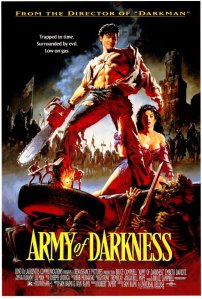 Director: Sam Raimi
Writers: Sam Raimi & Ivan Raimi
Cast: Bruce Campbell, Embeth Davidtz, Marcus Gilbert, Ian Abercrombie, Richard Grove, Bridget Fonda, Patricia Tallman, Ted Raimi
Plot: S-Mart employee Ash Williams (Bruce Campbell) has had a hard time of it – finding the Necronomicon (Book of the Dead), awakening something terrible, getting attacked by zombie-like “Deadites,” being forced to kill his possessed girlfriend and chop off his own hand, and then getting hurled back in time to the middle ages. As the film opens, Ash recalls how he fell through a time portal (along with his car, shotgun, and chainsaw) and was taken into captivity by the soldiers of a warlord named Arthur (Marcus Gilbert). Although Arthur’s Wise Man (Ian Abercrombie) believes Ash to be a prophesied savior, Arthur has him chained with the men of his captured enemy, Henry the Red (Richard Grove). As the captives are marched to a pit for execution, Arthur is attacked by a woman named Sheila (Embeth Davidtz) whose brother was slain by Henry’s men. Arthur blames Henry for loosing an evil upon the land, but Henry claims his men have fallen prey to the same beast. Arthur opens the pit and a captive is tossed in, blood erupting from the bottom. Ash tries to convince Arthur he’s not one of Henry’s men, but Sheila hurls a rock at him and he falls into the pit, where a Deadite awaits. The Wise Man throws Ash’s chainsaw into the pit and, his weapon returned, he escapes. He sets Henry free and uses his shotgun to intimidate Arthur’s men, into obeying him.
The Wise Man tells Ash his only hope of returning home lies in finding the Necronomicon. He prepares for battle, making a mechanical hand for himself. Sheila gives him a blanket, hoping to apologize for her actions, but he rebuffs her at first. When it’s clear she’s upset, he instructs her to “Give me some sugar, baby,” and she sends him off with a kiss. The Wise Man gives Ash the words he needs to allow him to take the book safely: “Klatu Verada Nikto,” but the overconfident Ash refuses to repeat them more than once. He’s pursued by the dark forces from inside the book, who burst from a broken mirror as several miniature versions of himself, tormenting him in painful and amusing ways. One manages to to jump down his throat and sprouts from him as a full-grown “Evil Ash,” whom Ash manages to subdue, chop up, and bury. Ash makes his way to the stone altar where the Necronomicon awaits, but finds he has forgotten the Wise Man’s magic words. He tries to fake his way through it, but when he takes the book an army of skeletal Deadites rises from the earth. Evil Ash, now rotting and mutating, rises to lead them.
Returning to the Castle, Ash insists the Wise Man send him home as soon as possible. Before it can happen, a flying Deadite swoops in and takes Sheila captive. It brings her to Evil Ash, who is opening every grave to set free even more Deadites. When word of the army reaches Arthur he debates fleeing, but Ash is determined to stand and fight. He convinces Arthur’s remaining me to stay, and sends an envoy to Henry the Red, hoping to recruit his army to their cause as well. The Deadite Army approaches, a now-possessed Sheila at Evil Ash’s side, and battle ensues.
Ash’s homemade gunpowder gives Arthur’s forces an early advantage, but the Deadites break down a gate and get inside the fortress walls. Just as it seems the living will be overwhelmed by the dead, Henry the Red’s forces arrive and turn the tide. Evil Ash and Sheila overwhelm the guards protecting the Necronomicon, but Ash manages to toss her over the side of the wall and face his counterpart. The two battle, and Ash defeats the monster and saves the book. The rest of the Deadites retreat, and Sheila is restored. Arthur and Henry make peace and the Wise Man gives Ash a potion that will send him to his own time, provided he can remember the magic words. He bids Sheila farewell and returns to his time and his home, working in S-Mart, where we see him telling the story to an unconvinced, unimpressed coworker. Suddenly, a customer transforms into a Deadite, attacking, and Ash grabs a rifle from the store’s case, blowing her away. It’s not too bad to be home.
Thoughts: The Evil Dead franchise (I covered the first film in the original Reel to Reel project) is a strange animal. The first film is a straight-up “Cabin in the Woods” sort of horror movie. The sequel, Evil Dead II, is a virtual remake of the first, copying the plot and largely ignoring the first film, but providing better special effects and a brand of dark comedy the first laughed. By this third installment, writer/director Sam Raimi decided to go for a full-blown comedy. Bruce Campbell’s Ash – a struggling everyman in the first film – had become a cool-as-ice balls-of-steel action hero capable of creating advanced robotic prosthetics with 14th-century technology. And yes, we love him for it.
Early in the movie Raimi ramps up the already-gory franchise to a truly comical degree, with a literal geyser of blood early. The violence, however, has a much more comical tone than in the first two films, and after that initial spout, there’s surprisingly little blood. A lot of that comes down to the monsters that make up most of the movie – rather than fleshy pseudo-zombies as in the first two movies, the majority of the Deadites this time around are reanimated skeletons – fun to break, but not much blood to spray at the camera. As Ash battles the stop-motion skeletal Deadites, there’s a nice feel of the Three Stooges meeting Jason and the Argonauts. Every bit of action is far sillier than would have been allowed in the earlier movies, in fact. The scene where Ash leaps into the air and snaps his chains aw on to his dismembered hand would be preposterous even in a more serious, Type-A horror/comedy. This movie rides the line between the two types – the basic plot is something out of a horror (or perhaps more accurately, medieval fantasy) film. The antics of Ash and the Deadites, however, are too broad to really place in the same category as Ghostbusters and the like.
For sheer silly, though, nothing tops the battle with the mini-Ashes. This segment is full of pure slapstick, comedic moments that aren’t too far off from the antics of Home Alone, about as far from a straight-up horror movie as you can get. The only thing that keeps things even a little creepy here is Bruce Campbell’s attitude as he does battle with the miniatures, his face growing truly maniacal as he guzzles boiling hot water in the hopes of destroying one that forced itself down his throat. The rest of the scene spins wildly though different gags: Ash finds an eyeball growing on his shoulder and it’s goofy (although there is, to be fair, a nice dose of body horror in that moment), the eye begins sprouting into a second Ash and it gets silly again. If it weren’t for the unique charm Campbell brings to the character, the whole thing would be entirely too inane to give even a moment’s consideration.
That said, Ash truly is an iconic character, thanks mostly to this movie. One of the greatest horror/comedy moments of all time has to be Bruce Campbell’s “boomstick” speech, where he extols the virtues of shopping at S-Mart to a crowd of medieval screwheads (I quote him directly, of course) who live in a world where the fictional retail giant won’t even exist for another 700 years. If you know a movie fan who loves Bruce Campbell and you can’t figure out why, I can only assume you’ve never watched this movie.
The Army of the Dead itself is a pretty macabre sight. Raimi gives us a complex mixture of stop-motion skeletons, mechanical puppets, and people in costumes. Although it’s fairly easy to tell the difference between them, at this point you’ve bought so completely into the world in front of you that you don’t even care if the effects aren’t seamless, the greenscreen is obvious and the action is more like a live action Looney Tunes short than anything else. In fact, some of the more technically absurd moments are the most entertaining. Whenever one of the skeletons explodes in a sudden burst of white dust, you get a visceral thrill, and if you can watch a group of skeletons storming a castle with a battering ram without your inner 11-year-old thinking about how awesome it is, something is terribly wrong with you. By the time Bruce Campbell fights two Deadites with two different swords at the same time, you’re either a fan for life or you’re never going to appreciate what you’re watching.
I know a lot of people prefer this movie’s rather famous original ending, in which Ash is returned home via a magic sleeping potion, but he takes too much, sleeps too long, and awakens in a post-apocalyptic wasteland. Thematically, it actually fits the trilogy pretty well. The first movie was unflinchingly bleak, the sequel only marginally less so. Ending the series with a completely hopeless climax would have been perfectly in character. That said, I’m kind of glad Raimi relented and gave us the ending he did. Maybe it’s just because I’m basically a positive person. Maybe it’s because I think Ash deserves a happy ending after everything he’s been through. Or maybe it’s just because the S-Mart finale gives Ash one last moment to be kick a little ass, I don’t know. All I know is that if the theatrical ending had never been filmed, we never would have been treated to Ash’s immortal “Hail to the King, baby.” And that would be a damn shame.
Lunatics and Laughter Day 10: Buffy the Vampire Slayer (1992)
 Director: Fran Rubel Kuzui
Writer: Joss Whedon
Cast: Kristy Swanson, Donald Sutherland, Paul Rubens, Rutger Hauer, Luke Perry, Michele Abrams, Hilary Swank, David Arquette, Stephen Root, Natasha Gregson Wagner
Plot: Once in every generation a Chosen One is born, a young woman with the power to stand against the tide of the greatest predator in the world, the vampire. Unfortunately, this generation’s slayer is a ditzy cheerleader named Buffy Summers. Buffy (Kristy Swanson) and her friends are hanging out at the mall one day when she’s startled by a creepy figure (Donald Sutherland). She tries to shrug it off, but begins having dreams of an earlier life where she battled a vampire named Lothos (Rutger Hauer). In the present day, Lothos sleeps, but his minion Amilyn (Paul Reubens) is ready to wake him up. A pair of burnouts, Pike (Luke Perry) and Benny (David Arquette) encounter the girls a few times before wandering off, drunk. Benny is taken by Amilyn, while Pike is saved by the strange man from the mall, Merrick. He approaches Buffy and asks her to accompany him to a graveyard so she can claim her “birthright.” She doesn’t believe his claim that she is the Chosen One, but when he begins describing her dreams to her, she agrees to accompany him. Two freshly dead people rise, transformed into vampires, and Buffy instinctively stakes them.
Pike, home in bed, is approached by Benny, who hovers outside his window and cannot enter without an invitation. Benny cries that he’s hungry, brandishing a new pair of fangs, and Pike refuses him entry. Unnerved by the strange things he’s seen, Pike plans to leave town. Meanwhile Buffy, after some persuasion, begins the training she should have undergone years ago, taking to the night to slay the vampires. She winds up saving Pike, whose effort to escape town is thwarted when he’s jumped by Amilyn. Amilyn escapes, but loses an arm in the process, and is scolded by Lothos for his failure.
At a basketball game, Buffy realizes one of her friends has been turned and pursues him through the streets of the city. Pike joins in the chase and the two, on motorcycles, hunt him to a storage yard for parade floats. Lothos and Merrick both intervene in the fight, and the vampire lord slays Buffy’s mentor. Buffy’s friends show no sympathy when she turns up depressed the next day, and she and Pike get in a fight in public over her unwillingness to continue the fight. Neither of them know Benny is nearby, hears the fight, and learns that Buffy is the Chosen One. With her name revealed, Amilyn and Lothos plan to destroy her.
Pike crashes the senior dance, dancing with and kissing Buffy just before Lothos’s vampires break through the windows and attack the hundreds of assembled teens. Pike presents Buffy with a bag of stakes he prepared, and she goes on a slaying spree. Benny and Pike fight in the dance, Benny offering to change his buddy into a vampire, but Pike refuses and slays him. Buffy encounters Amilyn in a stairwell, staking him in front of Lothos, who is unmoved by his minion’s death (or melodramatic death scene). Their battle spreads back to the gym, and Buffy stakes Lothos in full view of the school. Together, Buffy and Pike ride his motorcycle into the sunrise, leaving the town to wonder what the hell just happened.
Thoughts: Joss Whedon is, today, a god among geeks, creator of such cult favorites as Firefly and Dollhouse, director of the biggest superhero movie of all time in The Avengers, and pioneer of original online content with Doctor Horrible’s Sing-Along Blog. (Not to mention is more recent film Cabin in the Woods, a great entry into the horror canon, my analysis of which is available exclusively in the eBook edition of Reel to Reel: Mutants, Monsters and Madmen.) His star began to rise in earnest in 1997, when his Buffy the Vampire Slayer TV show became a hit for the fledgling CW network. That show largely ignored the film that birthed the character, though. Released in 1992, Whedon was never happy with the way director Fran Rubel Kuzui treated his script, playing it as a much broader comedy than he intended. And in truth, anybody who watches more than a few minutes of the TV show will agree that the film pales in comparison. That said, though, looking back 20 years later, there is a bit of cheesy charm in this original version of the Slayer.
Whedon’s initial concept was to take the typical horror movie victim – the teenage girl – and turn her into the hero. It’s a great, simple idea, but the final film goes a bit too far in playing up the stereotypes. Buffy and her friends (including future Oscar winner Hilary Swank) are vapid to the point of obnoxiousness. That may well be the intent, but once they start jabbering about choosing “litter” as the theme for a socially-conscious school dance, you kinda want to see them all die. The only thing more irritating is the basketball coach shouting to his team to “actualize” as though it’s a defensive strategy. Pretty much all of the humor is too broad for the characters, in fact. The only really goofy moment that works is when you realize the vampires have, in fact, been invited to the dance and thus can enter. Of course they were invited. They’re seniors.
Much of the violence and action isn’t quite believable either. An early scene where Buffy chops up a hot dog Benny is using to taunt her is supposed to be an early indicator that she’s got power, but instead just seems like the director used poor editing to cover a joke that had no punch. A few minutes later, when Merrick throws a knife at her and Buffy catches it, it’s even worse. The image is so stilted I’m inclined to believe Swanson was actually filmed throwing the knife away and Kuzui played it in reverse.
For all its faults, there are some good moments in the film. Some of Buffy’s dreams are a bit silly, but others are played for straight horror. There’s a nice one, for example, where she’s going to bed and the viewer doesn’t quite realize she’s already asleep when she lies down, Lothos beside her. For a moment you think she’s just oblivious to her enemy (even though it’s already been made clear a vampire cannot enter a person’s home without an invitation), but when he gives her a teddy bear and she curls up on him it’s downright unnerving. You feel a little relief, moments later, when she wakes up. Placing one of the fight scenes in the parade float storage yard is another nice touch – the oversized figures and statuary make for a suitably eerie backdrop for a fight. It’s kind of sad this is the last thing Kuzui directed, she actually has an okay eye for horror that would have worked well in the darker-toned Buffy TV show (where she served as an executive producer). That less broad version of the character may not have been too bad in her hands.
Buffy would later become a great character in the hands of Sarah Michelle Gellar, but the embryonic form still has a bit of steel in her. Swanson’s Buffy is never quite as vapid as her friends, and begins to grow rather quickly. She isn’t the girl power icon she would later become, though. I still keep going back and forth on an element of the character that was disposed of entirely when she transitioned to television – the use of menstrual cramps as an early warning that vampires are nearby. Somebody out there help me – is it empowering to use a nuisance that is unique to women as a weapon in the fight against evil, or is it patronizing to base Buffy’s Spider-Sense surrogate on a natural process that is so often played as a negative stereotype? I feel somehow that the answer to that question would go a long way towards explaining if it’s okay to like this movie or not, but having a Y chromosome (as I do), I don’t think I’m actually qualified to answer it.
Paul Reubens is a really bizarre casting choice. At this point in his career he was already known primarily as Pee-Wee Herman, a role that he put away after an embarrassing public incident the year before. (Don’t pretend you don’t know what I’m talking about.) Doing Buffy felt like an effort to rejuvenate his career, and although it didn’t really succeed, it wasn’t for lack of trying. His Amilyn works well as a sort of Renfield, the second banana to the main vampire, with just enough of an edge to feel like a credible threat. The only time he gets silly or plays up his traits as a physical comedian is during his extremely protracted death scene. (That scene, by the way, isn’t a bad joke, but it’s a joke that goes on entirely too long.) He, at least, is memorable, though. Rutger Hauer’s Lothos… not so much. It’s not that he’s bad, he’s just dull compared to all of the other great vampire performances out there.
It’s an early 90s film, but it actually carries with it a lot of the tropes of the 80s teen sports movie: the character who doesn’t want to play the game, a training montage in which she unlocks her natural talent, and a Big Game at the end for all the glory. There’s even the requisite clueless authority figure (a very funny turn by Stephen Root) who both hassles Buffy for the change in her behavior and tries to be her pal, sharing far too much information with her than anybody is really comfortable with. There’s also a fun little game of “spot the future celebrity” worth playing. Hilary Swank has a sizable role, but you can also catch Ben Affleck as an opposing basketball player, Thomas Jane as a punk teenager, and Ricki Lake and Seth Green (who would go on to have a regular role on the Buffy TV show) as vampires.
For all the crap it gets, the movie isn’t really all that bad. It’s competently made, and none of the performances are horrible. The plot works, but the tone is off. This never would have made any credible “worst of all time” list, it would simply have been forgotten, one of hundreds of movies made every year that are completely off the cultural radar short months later. We remember it, though, if for no other reason than because it gave us one of the greatest horror heroines of all time.
Lunatics and Laughter Day 9: Arachnophobia (1990)
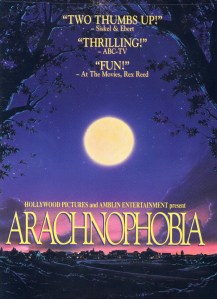 Director: Frank Marshall
Writers: Don Jakoby, Al Williams & Wesley Strick
Cast: Jeff Daniels, Harley Jane Kozak, John Goodman, Julian Sands, Stuart Pankin, Brian McNamara, Mark L. Taylor, Henry Jones, Peter Jason, James Handy, Roy Brocksmith, Kathy Kinney
Plot: Dr. James Atherton (Julian Sands) takes photographer Jerry Manley (Mark L. Taylor) with him on a hunt through the Amazon rainforest, hoping to discover new species of insects and arachnids. Manley has been ill, and fights a fever as they march through Venezuela. The search bears fruit – the team discovers a large, highly aggressive spider Atherton has never seen before. When the still-sick Manley goes to bed, a male “General” spider that stowed away in his pack bites him, killing him in seconds. When his body is found, his death is attributed to the fever and he is sent back to the United States, with the spider that bit him hiding inside.
Manley’s body is returned to his family in Canaima, where town mortician Irv Kendall (Roy Brocksmith) opens the box and finds him shriveled up, drained of fluid, and in a state that’s not at all conducive to an open casket. The spider sneaks outside, gets snared by a bird and is carried to the barn of a house where Dr. Ross Jennings (Jeff Daniels) and his family are moving in, Ross replacing the retiring town doctor Sam Metcalf (Henry Jones). Ross even starts a wine cellar in the basement. When his son discovers a house spider, the arachnophobic Ross has his wife Molly (Harley Jane Kozak) take it to the barn, unaware of the enormous Venezuelan spider hiding in the hay. That night the spiders meet, and mate.
Ross is shocked the next day when Dr. Metcalf tells him he’s decided not to retire after all, crushing Ross, who was supposed to inherit his patients and establish a practice. As he leaves Metcalf’s office he encounters Sheriff Lloyd Parsons (Stuart Pankin) writing him a ticket. He’s rescued by Margaret Hollins (Mary Carver), a retired schoolteacher who dislikes Metcalf and is glad to have the option of another doctor. She’s pleased to be Ross’s first patient. Unfortunately, she’s also his only patient.
Mary turns out to be perfectly healthy, and she tries to cheer him by offering to throw a “Welcome to Canaima” party. While he’s at the office, Molly goes to photograph the barn and discovers a gargantuan spider web in the rafters. She misses the huge egg sac that soon looses a new generation of spiders. Over the next few days they spread out, one of them sneaking into Margaret’s house and killing her.
Ross gets more bad news the next day when he finds the wood in his cellar is weak and rotten. It gets worse when he goes to Margaret’s and finds her body. Although most of the town believes Metcalf’s diagnosis of a heart attack, Ross insists on an autopsy, but the Sheriff blocks him. The spiders strike again soon afterwards, killing a high school football player. Metcalf is next, bitten on the toe and dying as his wife sees the spider.
Convinced the deaths are spider-related, Ross calls the closest expert he can find, Atherton, who is skeptical until he realizes Ross is calling from the late Jerry Manley’s hometown. Atherton sends his assistant, Chris Collins (Brian McNamara) to help with the investigation, and joins himself when bites are found on all three victims. Chris manages to capture a live specimen in Margaret’s house for study. Meanwhile town exterminator Delbert McClintock (John Goodman) discovers the spiders are immune to his toxins – if not a heavy boot.
Atherton examines the captured spider and determines it’s the hybrid of the Venezuelan spider and a house spider. It has a short lifespan, but the General male no doubt has a queen hiding somewhere that will have the ability to create a new generation capable of reproduction. If they can’t destroy it before her nest hatches, Canaima will fall, then the next town, then the next. Phil, Chris and Delbert map out the attacks and realize the nest is on Ross’s property. Atherton, meanwhile, finds Molly’s photograph of the web and comes to the same conclusion. He arrives first, and is bitten and dead by the time the others arrive. Delbert finds Atherton’s body and pulls out his own “special” blend of toxins to fight the creatures.
Ross and Chris go to the house to try to get his family out. The living room is suddenly filled with thousands of deadly spiders. Everyone but Ross escapes, and he falls through the rotten floor into the cellar, where he finds the egg sac. He starts to douse the sac with wine so he can burn it, but is attacked by the original General male. He manages to burn it just as the sac starts to hatch, but it isn’t dead. Grabbing his nail gun, he fires the torched male into the egg sac, killing it and destroying the rest of them in one strike. In the end, the Jennings return to San Francisco, glad to be back in a world where events are totally under their own control… until the earthquake starts.
Thoughts: Although not remembered as well as many of the other films on this list, Arachnophobia holds a special place in my heart – it’s the first horror/comedy I remember actually seeing in theaters. (Yes, even my beloved Ghostbusters was a video find for me. I may even have seen the cartoon first before I ever saw the movie, I honestly don’t remember.) And no matter how much technology may improve the home theater experience over the years – higher resolution, more DPI (whatever that is) streaming video that also makes popcorn in a variety of flavors, whatever – there will always be an irreproducible charm in going to a theater, sitting in a darkened room with others, and absorbing a fun movie in a community experience. This was such a movie for me.
Arachnophobia falls into the more “serious,” Type-A category of horror/comedy. In fact, the first act of the film, while we’re in Venezuela, has little comedy at all, giving us a prologue that very easily could have led into a straight (albeit somewhat cheesy and overdone) traditional horror film. The comedy comes in once we get back to Canaima, and even then it’s very dry at first. Ross, depressed at only having one patient, hopes that she’ll turn out to be “ravaged by disease,” then moments later (on screen, at least) coolly denies that very wish when she turns out to be in perfect health. For much of the film, the comedy we get is well below the threshold that flips the switch and makes it a legitimate horror/comedy and not simply a lite PG-13 horror film. When that switch finally is flipped, it’s due almost entirely to the injection of the John Goodman character.
Delbert is the one wacky character in the midst of a group that doesn’t really have time to be funny. Once the real situation becomes clear, Daniels and company have to deal with thousands of very fast murderers about the size of a quarter… that’s about as serious a situation as we’ve yet seen in this horror/comedy project, and they don’t really play it for laughs. Delbert is our comic relief, an exaggerated character that borders on the cartoonish. Goodman is a fantastic actor, a wonderful comedian (with dramatic chops that are frequently overlooked), but Delbert actually takes things almost too far a few times. Part of it may simply be familiarity with John Goodman – he’s well-known enough now that it’s hard to see him play the part without just getting a very strong sense of him putting on the character. But at the same time, he’s really an odd man out in this movie. That isn’t necessarily a bad thing, that’s his role after all, but there are moments where he goes far enough to jolt you out of the scene.
By contrast, Jeff Daniels works well as the sort of small-town everyman (although the Ross Jennings character is, technically, a San Francisco transplant). He does, however, latch on to several stereotypes. If you’re going to do a movie where the monster is a spider, you almost have to make your hero an arachnophobe, and Frank Marshall actually takes him to the ridiculously young age of two to establish the initial childhood trauma. That scene, where he describes a spider assaulting him in the crib, is one of the funnier moments in the earlier part of the movie, in fact. He still keeps his dryness with him, even after the spiders attack. (In the climax, as he tries to pelt the male with wine bottles, he stops himself from using a particularly good vintage). But nothing he does would be funny enough to classify the movie as a comedy, in and of itself, without Goodman tipping the scales.
Director Frank Marshall is much better known for his straight comedies, but he does a decent job here conveying the horror. There are plenty of small touches that add to the horror – slow pans across spider webs and small shadows that twitch and creep … they’re all wonderful moments that will chill you nicely if you’ve got a fear of spiders already. For all the hairy legs and downright chilling movement that a spider brings with it, though, the really scary thing about this movie isn’t what the monster looks like. Most horror films rely on showing you something grotesque or mutating something mundane into an object of terror. Not so much in Arachnophobia. The hybrid spiders, for all the terror they create, don’t look that different from a traditional spider. The fear comes from the fact that these tiny killers – unlike the likes of Jason Voorhees or Michael Myers – could literally be anywhere. How often do you look under your blankets before you get into bed or peek in your shoes before you put them on? Marshall even manages to work in a twist on the old “wiggling doorknob” routine so prevalent in horror movies – in this version, it’s the swarm of spiders actually pushing through and rattling the knob in the process.
There’s a bit towards the end, while Daniels tries to battle the hiding spider in his cellar, where he’s looking around frantically for a monster that is utterly invisible. It brings to mind every time you’ve ever walked into a spiderweb and started flailing madly, looking like a lunatic to anybody who happens to see you. That’s a really funny moment, when it happens to someone else. But that moment encapsulates the whole movie. In the world Marshall creates, every miniscule nook and cranny of every room could be hiding grim death for anyone unlucky enough to encounter it at the wrong time. If you’re not scared of spiders, that thought could be enough to drive the fear into you.
Lunatics and Laughter Day 8: Beetlejuice (1988)
 Director: Tim Burton
Writers: Michael McDowell, Larry Wilson & Warren Skaaren
Cast: Alec Baldwin, Geena Davis, Michael Keaton, Winona Ryder, Catherine O’Hara, Jeffrey Jones, Glenn Shadix, Sylvia Sidney, Robert Goulet, Annie McEnroe
Plot: Adam and Barbara Maitland (Alec Baldwin and Geena Davis) decide to a vacation at home, decorating their quaint New England house. On their way home from a shopping trip, Barbara swerves to avoid a dog and the two plunge off a bridge. Returning home, they are startled to find they don’t feel fire, they have no memory of how they got back from the bridge, and attempting to leave the house teleports them to a bizarre, horrific landscape full of enormous sandworms. They have no reflection, and a book is waiting for them: Handbook For the Recently Deceased. Adam and Barbara are dead.
Some time later a new family moves into their house: Charles Deetz (Jeffrey Jones), his wife Delia (Catherine O’Hara), and his cynical daughter Lydia (Winona Ryder). Delia, a pretentious would-be artist, begins to gut Adam and Barbara’s charming home, transforming it into a wild, gaudy funhouse with the help of interior designer Otho (Glen Shadix). Adam and Barbara try haunting the Deetzes to drive them from the house, but find the living cannot see them at all. Adam locks the attic, protecting his prized model train set from Delia and Otho. He uses the Handbook to open a portal to a “waiting room” full of other ghosts who have died in various grotesque ways. In the waiting room, the Maitlands learn that they must spend 125 years on Earth, in their house, during which they can contact their caseworker Juno (Sylvia Sidney) for help three times. As they wait, Lydia uses a skeleton key to open the attic, where she finds the Handbook. When the Maitlands finally meet with Juno, they find they’ve been waiting for three months and their home has been completely transformed. Juno tells them to study the Handbook for tips on how to haunt the Deetzes, but warns them not to turn to Betelgeuse, her former assistant, for help. She warns them not even to say his name, as saying it three times will summon him.
The Maitlands try again to haunt the Deetzes, but instead wind up revealing themselves to Lydia, who can see them. When they fail to scare her and she warns them that her parents aren’t likely to leave, they give in and summon Betelgeuse, or “Beetlejuice”. A quick interview disturbs Barbara, and she refuses his help. Their next attempt forces the Deetzes and their dinner guests to perform an impromptu dance to “Day-O,” but rather than scaring them off, they love it and try to convince the Maitlands to come out for another performance. With nowhere else to turn, they again summon Betelgeuse who turns up the haunting in earnest – transforming into a giant snake and attacking. Barbara prevents him from hurting Charles, but Beetlejuice has taken a liking to Lydia.
The Maitlands are tasked with driving out the Deetzes – without Betelgeuse – before it goes too far, but Barbara is upset, not wanting to frighten Lydia. They go to her just before Betelgeuse tricks her into freeing him and tell her they want her family to stay, but Charles arrives with his boss, Maxie Dean (Robert Goulet). Charles wants to turn the house into a tourist attraction, and Maxie is still skeptical about the existence of the ghosts. Otho summons the Maitlands via a séance, in view of everyone, but they immediately begin to age and decay. Lydia turns to Betelgeuse to save them, but he’ll only do it if she agrees to marry him. She agrees, and he unleashes his madness on the living. He drives out Maxie and Otho, then summons a ghoul to perform the ceremony and marry him to Lydia. The Maitlands try to save her, but he banishes Adam to his train set and Barbara to the sandworm-plane beyond the house. Adam distracts him while Barbara steers a sandworm back into the house, devouring Betelgeuse whole. In the end, the Maitlands and Deetzes find peace with one another, living together in harmony, while Betelgeuse is sent to face the ultimate punishment for his crimes… he’s sent to the waiting room.
Thoughts: Tim Burton has had an interesting career, starting with shorts and cartoons that blended a twisted sense of humor with a macabre sense of story. Over the years he’s tapped into blockbuster franchises like Batman, ruined blockbuster franchises like Planet of the Apes, and tackled everything from Pee Wee Herman to Roald Dahl. To my way of thinking, his best work is done when he gets to create a whole world with his unique, bizarre perspective, and he’s never better than when it’s a world he conjures from whole cloth rather than an existing property. This is the first time he did it really well, before A Nightmare Before Christmas marked him as a master of this quirky, “safe” kind of horror/comedy mashup. This movie also allows him to practice his beloved stop-motion animation, a style he’d use much more in the aforementioned Nightmare (with director Henry Sellick) and, on his own, in The Corpse Bride and Frankenweenie. In anybody but an artist, you’d start to get worried if they focused on this sort of macabre style. Fortunately, for storytellers, sharing the bizarre is nice therapy.
This movie, more so than most others, treads the line between Type A and Type B very neatly. Although the plot isn’t “pure” horror, the way we saw with Ghostbusters, the gags are a little too gory and bizarre to classify it as a straight comedy either. An early scene with the ghosts attempting to haunt the Deetz family gives us a hanged woman, a missing face, bulging eyeballs and a decapitation – not exactly kid stuff. In the waiting room we see people who’ve been cut in half, a flattened man who was run over by a car, and plenty of other people whose violent deaths have marred them indelibly in death. We even get a nasty realization from the receptionist with her slashed wrists – suicides, in the afterlife, are sentenced to be civil servants. In many ways, this is big a departure from our other movies with dark situations and light comedy. The actual jokes in this story are far darker than in most of the films we’ve discussed so far. This is as true a Black Comedy as we have yet encountered.
The good news is, for all its darkness, the movie really is very funny. This was Michael Keaton at his peak, playing the sort of wild character he was known for at the time. (The irony is that finally escaping the stereotype, thanks to teaming with Burton on 1989’s Batman, somewhat crippled his career since then.) Oddly enough he isn’t even the main character here – like Julius Caesar, he plays a supporting role in his own eponymous story, and doesn’t even join the plot in earnest until 45 minutes into the film. But once he appears, the energy he brings to the film is undeniable. His “qualification” speech was, for some time, the stuff of quotable film gold, and his wild impressions and boundary issues seem natural and unforced.
Winona Ryder, meanwhile, did a lot of this sort of dark comedy earlier in her career (Heathers came out the same year), and attaching herself to the always-entertaining Catherine O’Hara was a great move. The two of them clash a lot in this film, with O’Hara’s Delia desperate to transform the Maitland house and Lydia desperate to save her friends. The regular stepmother/stepdaughter antagonism comes through here as well, as the two of them clearly clash on all points, putting Jeffrey Jones in the middle of the daughter he’s raised and the wife he’s a bit intimidated by. The women are nice foils for one another, with O’Hara’s considerable skills on display and Ryder developing her own talents next to her.
From a technical standpoint, the movie is incredibly impressive. The stop motion animation is good in and of itself, but the makeup, prosthetics, and animatronics that make up the ghosts and other creatures in and from the world of the dead are absolutely amazing. Burton has a bizarre, wild imagination that is so perfectly suited to this kind of story one almost wonders why he ever bothers to do anything else. The world he shapes for us is part carnival funhouse and part Halloween haunted house, with a bit of Looney Tunes cartoons mixed in for good measure. (Once Beetlejuice shows up full-force, he even starts throwing in cartoon sound effects.) The resulting world is horribly familiar, despite its complete alien nature. The finale, when a fully-powered Beetlejuice is allowed to run wild, is one of the most visually creative things I’ve ever seen in a horror/comedy, a perfect blend of grotesque imagery with pure, electric mania.
It was years since I watched this movie until I screened it for this project. In fact, I’d forgotten how much I liked it. I was 11 years old when it was released and, like many of the films of the 80s, it turned into a hot topic of discussion on the schoolyard for months after afterwards, then again when it hit home video. Kids in my class were just at that right age, understanding we were watching something somewhat subversive without taking us so far over the edge that we would wind up scarred for life. I’m really glad to see that this film, unlike so many of the others that we loved back then, really holds up all these years later. Although there’s always talk of a sequel (and for a while there was an actual, horrifying treatment for Beetlejuice Goes Hawaiian floating around Hollywood), for the most part this movie has drifted out of public consciousness. It’s a shame – it’s a lot of wild, crazy fun, and just perfect for Halloween viewing.
Lunatics and Laughter Day 7: The Toxic Avenger (1984)
 Directors: Michael Herz & Lloyd Kaufman
Writers: Lloyd Kaufman & Joe Ritter
Cast: Mitch Cohen, Andree Maranda, Jennifer Babtist, Cindy Manion, Robert Prichard, Gary Schneider Dick Martinsen, Pat Ryan Jr., Kenneth Kessler, Patrick Kilpatrick
Plot: Welcome to Tromaville, a small suburb of New York City, and the number one dumping ground for toxic chemicals in America. Melvin Ferd (Mark Torgl) the janitor at a local health club, is constantly tormented by a group of club members, including Bozo (Gary Schneider), Slug (Robert Prichard), Wanda (Jennifer Babtist), and Julie (Cindy Manion). They decide to teach him a lesson, with Julie luring him into a locker room just as a truck full of exposed barrels of toxic waste parks outside. She tricks him into putting on a pink tutu and poka-dotted leotard, and he is humiliated in front of the club’s customers, fleeing through a window and landing in the toxic barrels. People continue to mock him as the chemicals burn through his skin and Melvin, now burning alive, stumbles home and sits in a cold bath, where he transforms into a hulking brute of incredible size and strength.
A group of drug dealers, meanwhile, try to buy off a cop (O’Clancy, played by Dick Martinsen) who refuses to cooperate. Before they can castrate him with his own gun, a huge man (Mitch Cohen, voiced by Kenneth Kessler) appears and savagely kills two of the criminals (well… kind of savagely, the fight itself is actually played mostly for laughs), leaving a mop across their faces. Mayor Peter Belgoody (Pat Ryan Jr.) is horrified by the murders… mostly because the dead criminals were some of the best dealers in his employ.
The Monster – a mutated Melvin, of course – shocks his own mother into a dead faint. Despondent, he makes his way to the Tromaville garbage dump and constructs a crude home for himself there. Later, a group of criminals robs a Mexican restaurant, killing a bystander and a seeing-eye dog belonging to a blind woman named Sarah (Andree Maranda). The crooks’s leader, Leroy (Patrick Kilpatrick) is preparing to rape her, when the Monster Hero appears and fights them, ripping an arm off the would-be rapist and sending the customers fleeing in terror. The Monster beats the crooks and finishes them off in the restaurant’s kitchen. He goes to the sobbing Sarah and she begs him to help her home, where they begin to become friends. Given new confidence, Melvin begins a one-man war on crime, battling pimps, drug dealers, and other criminals, and saving lives along the way. The newspapers begin to run stories about the “Monster Hero” of Tromaville. Belgoody sends his men to hunt the monster down.
Melvin and Sarah fall in love, and he takes her back to his junkyard hideout to live. He returns to the health club, attacking Julie in the locker room. Minutes later he finds Bozo and Slug, fresh from beating an old woman to steal her car. He hurls Slug from the car and sends Bozo through a series of crashes, burning him alive but leaving Melvin unharmed.
Things go bad when Melvin kills a little old woman in a dry cleaner’s shop, turning people against the Monster Hero. Ashamed, he goes home and tells Sarah the truth about who he is and what he has done. They decide to leave town, and Belgoody rejoices… until he discovers the old woman was the leader of a slavery ring. Belgoody covers it up and sends the cops out to hunt the Monster. They find him and Sarah in the woods, and the town assembles outside their tent, torn between people who want to protect the monster and Belgoody and his men who want to kill him. The townspeople stand in front of Melvin to protect him, soon joined by O’Clancy and the rest of the cops. Belgoody opens fire, but the bullets bounce off Melvin. He stalks Belgoody to his limo and rips his guts out, literally. The townspeople applaud the vicious murder, Melvin kisses Sarah, and all in Tromaville is well once again.
Thoughts: It would be impossible to get through a month of horror/comedy without touching upon the films of Troma. Lloyd Kaufman’s legendary low-budget B-movie studio has become synonymous with campy sci-fi and monster flicks, and how better to represent them than with this, their flagship property?
Buoyed by the likes of Attack of the Killer Tomatoes, Lloyd Kaufman and Michael Herz built this film (and, for that matter, their entire film studio) on the premise of the “So Bad It’s Good” movie. Whereas older movies – the sci-fi and horror clunkers of the 50s and 60s – made an earnest attempt at making good movies and simply fell short, Kaufman has no such delusions. From the beginning of the movie the acting is terrible, the script laughable, and the special effects and graphics absurdly cheap, even by 1984 standards. Watch the quality of this film compared to Ghostbusters and you’d swear that Toxie’s debut is at least ten years older, instead of both films coming out in the same year.
The film’s absurdity doesn’t just come from the effects and acting, though. Kaufman sets out to be as deliberately offensive as possible. There’s an early scene where one of the punks and his girlfriend recite a litany of racial slurs and other negative stereotypes, ranking them on a point system for running them over with a car, before finally deciding to target a kid on a bicycle (children under 12 being worth maximum points). They hit the kid once, then back over him to crush his head, stop, and take pictures. The sympathies of the audience are swinging wildly at this point. You hate the gang for doing it, which is how you’re supposed to feel, but by the time the girls whip out the Polaroid camera, you’re pretty much ready to hate the filmmakers as well.
Our hero, ladies and gentlemen…
(It is worth noting, at this point, that the Toxic Avenger films eventually spawned a children’s cartoon show. I doubt most of the moms who let their kids sit through it would have been thrilled if they saw this particular sequence.)
Kaufman actually triples the genres he plays with here. His heavy layer of goofy comedy is draped over a plot that draws upon nuclear-mutant themed monster movies and wraps it around the skeleton of a superhero origin story. No superhero has ever been so ridiculous, though – even the drivers of the truck that gives us the “toxic” part of the hero’s name comment on how ridiculous it is for them to drive around with open, sloshing barrels full of chemical sludge. Belgoody is also an extreme stereotype of a villain. It’s hard to believe even the most corrupt politician in a serious film would think he could get away with dumping toxic chemicals literally twenty feet away from the city’s drinking water. Even Belgoody’s gang is comical – it’s a patchwork of stereotypes, containing a street hood, a Capone-style gangster, and representatives of just about every crime stereotype there is. The notion is preposterous enough to remind us that this film takes place in, at best, an exaggerated reality, where all of the elements that make up monster movies and superhero films have been amplified to a ridiculous degree.
At times, the movie starts to outsmart itself. The toxic reservoir scare, for instance, is played up as though it will be a major plot point, perhaps even the Big Evil the hero will battle in the film’s climax. That isn’t what happens, though – it’s mentioned once and then abandoned as Belgoody’s resources are turned exclusively towards seeking out the monster. Most of the villains are portrayed as one-off as well – the theatrical mob Leroy leads is all killed right away, for example. Even the moments where Melvin confronts his tormentors seem like they’re worked in simply to tie off those dangling threads while we’re waiting to get back to the real plot, such as it is.
Kaufman picks up on a lot of sources, with Melvin’s transformation smacking of the Incredible Hulk and his relationship with Sarah echoing both the friendship Frankenstein’s monster shared with the blind (Gene Hackman in the Mel Brooks version) and the longtime romance in the Fantastic Four comics, in which the mutated Thing finds love with blind sculptor Alicia Masters. He even picks up on a few slasher tropes – Melvin’s fatal confrontation with Julie comes complete with a silhouette shot of the monster approaching her with a pair of menacingly raised scissors. It sends images of Freddy Krueger and Jason Voorhees across the brain, until you remember that this is your hero.
Sarah takes us to the extremes of broad comedy, knocking over an entire rack of canes and smacking Melvin accidentally, playing up on pretty much every joke you could think of making about the blind. Although not as bad as the scene with the racial slurs, this starts to tread close to the line of being offensive as well. And true to form, Kaufman doesn’t care at all. In a way, it’s almost a liberating thought. When you see so clearly that you’re dealing with somebody who doesn’t give a damn what you think of him, you manage to stop giving a damn and concentrate more on the actual content of what you’re watching.
Is it cheap? Yes. Is it exploitive? Oh yeah. Is it ludicrous? To be kind. But like the makers of Attack of the Killer Tomatoes, Lloyd Kaufman and his Troma team have never attempted to take themselves seriously. They know what they are, they know what their audience expects, and they deliver it as effectively (and as cheaply) as they possibly can. It will never make for great cinema, but nobody can deny that this is a film studio that consistently meets its goal, artistically. It’s easy when you set the bar so low.
 Reel to Reel