Category Archives: Projects
The Christmas Special Day 5: Frosty the Snowman (1969)
 Directors: Jules Bass, Arthur Rankin Jr.
Writer: Romeo Muller
Cast: Jimmy Durante, Billy DeWolfe, Jackie Vernon, Paul Frees, June Foray
Plot: Children’s entertainer Professor Hinkle (Billy DeWolfe) is perhaps the world’s worst performer, with tricks that won’t work and a rabbit named Hocus Pocus who won’t cooperate. After a failed show at an elementary school, the children race outside to build a snowman, whom they christen Frosty (Jackie Vernon). Hocus and Hinkle rush outside, where Hinkle throws his hat at the rabbit. It’s retrieved by one of the children, Karen (June Foray, again, proving that if there is a goddess of voice animation it’s her), who places it on Frosty’s head. The snowman snaps to life and bids everyone a happy birthday, but Hinkle snatches his hat back and leaves. Hocus steals the hat again and returns it to the children, who use it to bring Frosty to life again. He plays and dances with the children until he notices the temperature is rising, and he’s beginning to melt. Karen and the children promise to send him to the one place he’ll never melt: the North Pole. They parade through town to the train station to send him off (startling a traffic cop along the way) but are stumped when they realize they can’t possibly afford the ticket. At Hocus’s suggestion, Frosty and Karen hop into a refrigerated boxcar on a north-bound train. Hinkle, who realizes the hat has genuine magic power, hops on the same train, determined to steal it back.
When Frosty realizes the frozen car is making Karen sick, he and Hocus get off with her at the next stop. Hinkle jumps from the train so as not to lose them, crashing in the process. Karen is still in danger of freezing, so Hocus tries to rouse the local forest animals to build her a fire. Although Karen is safe for the moment, Frosty knows they need to find help soon, and Hocus suggests Santa Claus, who is scheduled to make his Christmas Eve rounds in mere hours. To keep her warm in the meantime, Frosty finds a greenhouse, but Hinkle manages to trap them both inside. When Santa arrives, Hocus brings him to the greenhouse, where Karen is safe, but in tears: Frosty has been reduced to a puddle with a corncob pipe and an old silk hat. Santa tells her that Frosty is made of magical Christmas snow, which can never go away forever. He uses his magic to rebuild Frosty, but before he places the hat upon his head, Hinkle shows up to demand its return. When Santa warns him he’ll never give him another Christmas present again if he hurts Frosty, Hinkle backs down and is sent away to write a massive apology. Santa places the hat back on Frosty’s head, restoring him to life. He takes Karen home and promises her that Frosty will return every year with the Christmas snow.
Thoughts: Frosty the Snowman gives us yet another case of Rankin and Bass magic, but this time, we’re going for traditional animation. This studio is much better known for their stop motion work, but they did several specials in this format, and later applied it to their version of Tolkien’s Lord of the Rings and 80s TV shows like Thundercats.
Like Rudolph and Little Drummer Boy, this film takes a classic song and gives us an expanded storyline to fill out its half-hour running time. The song even shares DNA with Rudolph – Gene Autry commissioned the piece from Walter Rollins as a follow-up to his earlier Christmas hit. And a hit it was, but like Rudolph, it needs some work to succeed as a narrative. The original song, let’s be honest here, doesn’t exactly have a riveting plot: Snowman gets magic hat, snowman comes to life, snowman starts to melt, snowman leaves. Hard to get a full-length special, and what’s more, there’s no antagonist.
That, in fact, is what really makes this special: Professor Hinkle. He’s a really entertaining bad guy, very different from the usual Rankin/Bass assortment of monsters, evil wizards, and misers. Hinkle is kind of a pathetic figure, but in a funny way. He’s utterly failed at life, he’s a disaster as a magician, but he seems to have more greed than genuine evil in him (despite his own protests to the contrary). Even as he’s trailing Frosty and Karen he has to keep reminding himself to “think nasty… think nasty…”
Looking back on this as an adult, you start to realize that Hocus Pocus, the rabbit, is actually a pretty lousy influence on the children. His refusal to work with his partner in the first place is what costs Professor Hinkle his hat. Hocus steals the hat later (for a good cause, perhaps, but it’s still theft). He convinces an underage girl to illegally board a train with a man she’s known for all of seventeen minutes, without so much as a phone call home to tell her parents not to worry. Yes, he technically helps to save her life multiple times, but seeing as how she would never have been in danger if not for him, it’s hard to give him too much credit for that.
Christmas is almost an afterthought in this special. It’s not really mentioned at all in the original song, and you’ve only got a quarter of the special left when it’s even mentioned that this is all taking place on Christmas Eve. (What school is in session on Christmas Eve? Did they used to do it that way?) It works out for Karen, of course, because otherwise Santa Claus wouldn’t be around to save her and…
Wait a minute, this all happened on Christmas Eve? What did they even need the train ticket for? Why didn’t Frosty just wait around for Santa in town in the first place? They could have saved themselves all kinds of trouble! And don’t tell me it’s because Santa wouldn’t show up while the kids were awake, because this is a Rankin and Bass special and he breaks that rule all the time. He even breaks this rule in this very cartoon, because if he was waiting for all of the animals to be asleep before he shows up Hocus couldn’t even have flagged him down in the first place! Good grief, Romeo Muller, were you even trying?
Yet, this is a classic.
You see, out of all the great characters in the Rankin and Bass catalogue, there may be none as ridiculously endearing as Frosty. His sweetness, his heart that remains warm despite being encased in snow, the fact that he even apologizes to Hocus for some truly ridiculous suggestions for getting help… well, he’s a better snowman than I. This cartoon is the reason I can’t put on a top hat without getting the urge to wish everyone a happy birthday. It’s ludicrous! It’s incomprehensible!
And it’s a valued part of our collective childhood, and I wouldn’t change a minute of it.
Frosty returned twice more in the annals of Rankin and Bass – in 1976’s Frosty’s Winter Wonderland he’s given a snowwife, Crystal. In 1979, the Frosty family teamed up with Rudolph for the stop-motion feature length film Rudolph and Frosty’s Christmas in July. Both of these are worthy sequels. Less so is 1992’s Frosty Returns, a terrible, painfully preachy cartoon produced by CBS and unforgivably directed by Bill Melendez (of A Charlie Brown Christmas), and in 2005 there was the CGI Legend of Frosty the Snowman, which is more faithful to the original, but still merely okay. As usual with these characters, Rankin and Bass did it best. All others need not apply.
The Christmas Special Day 4: The Little Drummer Boy (1968)
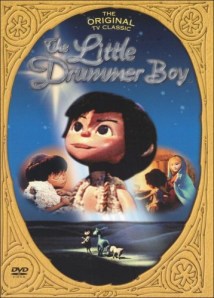 Directors: Jules Bass & Arthur Rankin Jr.
Writer: Romeo Muller
Cast: Jose Ferrer, Paul Frees, June Foray, Ted Eccles, Greer Garson, music by the Vienna Boys Choir
Plot: Aaron, an orphaned drummer boy (Ted Eccles), has grown up with a disdain for all humanity after his family was killed by bandits. His hatred grows even more intense when he and his few animal friends are abducted by a travelling salesman, Ben Haramed (Jose Ferrer). Ben Haramed paints Aaron’s face and forces him to perform at the marketplace for donations. He grows angry and lashes out at the people around him, and Ben Haramed’s troupe is driven from town. As they cross the desert, they encounter a group of three kings (all voiced by the great Paul Frees, who also voices Aaron’s father) who are breaking camp on a long journey to follow a star in the heavens. One of their camels has collapsed under the weight of his pack, and Ben Haramed sells them Aaron’s camel Joshua to replace it. Enraged, Aaron takes his remaining animals and sets out to find his missing friend.
He follows the same star as the Magi, finally arriving at the town of Bethlehem. Dozens of shepherds arrive as well, all following the same star. He tracks them to a stable, where they are bowing before a manger. Aaron and his animals rush to their missing friend, but his sheep Baba is struck by a Roman chariot in the streets. Aaron takes the dying sheep to the Magi, where he finds them presenting a baby in the manger with their gifts of gold, frankincense and myrrh. When one of the Magi tells him he cannot save Baba, he suggests Aaron take Baba to the newborn king in the manger. With no gift to present the baby, Aaron begins to play his drum. As he finishes, Baba comes back to him, miraculously healed. Aaron’s angry heart melts, as the star shines brilliantly over the little town of Bethlehem.
Thoughts: I don’t typically get religious in my writing, but it would be somewhat negligent to do a project like this one, examining the all-time great Christmas specials, without touching upon a few of them that actually deal with the true meaning of Christmas. Take this 1968 special by our friends at Rankin and Bass (oh, we’re just getting started with them, folks), which dramatizes the old favorite of the Little Drummer Boy.
Rankin and Bass took the classic song and greatly expanded upon it, giving the little drummer boy a backstory, a reason for being in Bethlehem, and a name. For the most part, the additions to the song work very well. The add-ons make Aaron a very different kind of character than the cipher who arrives in the song to humbly play his drum for Jesus. Instead, we’re introduced to a child who has shut himself off from the world, keeping his affection only for his animals. Aaron turns to Jesus to save his friend, but viewed through a spiritual prism, it’s clear that Aaron himself is the one who truly needs salvation. In a very real way, this special makes the Little Drummer Boy the first soul to be saved by the Son of God. It’s a very clever angle to take, rooting the story very strongly with the Bible tales and making Aaron a far more significant character than he was described as previously. It doesn’t change anybody’s religion, of course, but taken from a narrative standpoint, writer Romeo Muller came up with a really good way to make this cartoon matter in a way the original song really didn’t.
The music here is strong, if not quite as iconic as many of the other Rankin and Bass specials. The original “Little Drummer Boy” is the only one that really stays with you after the show is over, and that’s mostly because it’s a piece that virtually everybody who watches this will know already.
More so than some of the other films we’ve looked at (or will look at) this short does express some of the limitations of early stop motion animation, especially in terms of precision. As Aaron plays his drum, the beat doesn’t match the movement of his hands. When we get to the line where “the ox and lamb kept time,” the camera pans across them nodding rhythmically, but not in the same rhythm as the song. You feel a little bad for chuckling at this, as it is supposed to be a wonderfully somber moment, but fortunately the emotion of Baba’s rejuvenation sweeps in as the song ends to save the day.
This isn’t the greatest religious-themed Christmas special, but it’s one of the earliest greats. Other films would later tread over some of the same ground, and one imagines director Don Bluth was drawing on this ten years later when he created his last short for Disney before striking out on his own, The Small One. Were this a project about Christmas films in general and not just television specials, you can rest assured, Small One would have a place of honor. As far as the TV spots goes, if you’re looking for one that actually features the nativity, this is as good as it gets.
The Christmas Special Day 3: How the Grinch Stole Christmas (1966)
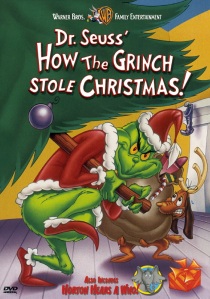 Director: Chuck Jones
Writers: Irv Spector & Bob Ogle, based on the book by Dr. Seuss
Cast: Boris Karloff, June Foray
Plot: In the town of Whoville, Christmas is a season beloved by all. The Whos in Whoville gather together to cut down the town tree, decorate the community, and celebrate the season. But not everybody is happy with the season. North of Whoville, in a mountain cave, lives a green creature called the Grinch (Boris Karloff, doing double-duty as the narrator) who hates Christmas with all of his two-sizes-too-small heart. As he watches their celebration begin, he vows to destroy Christmas for everyone. Stitching together a Santa Claus suit and putting “antlers” on his dog Max, the Grinch sweeps into town and begins breaking into houses, stealing every present, every decoration, every morsel of food, even the roast beast. As he goes to work in one house, however, he’s interrupted by little Cindy Lou Who (June Foray).Cindy Lou mistakes him for Santa and asks him why he’s taking their Christmas tree. He tells her he’s bringing the tree to his workshop to repair a broken light, then ushers her off to bed and finishes his insidious task.
The Grinch and Max take their loot to the top of a mountain, where he plans to spy on the Whos as they wake up and find their Christmas ruined. To his shock, though, the Whos come from their houses, join hands, and begin to sing despite their lack of gifts, of trees, of boxes and bags. That’s when it dawns on him… that perhaps Christmas has a deeper meaning than those things one can buy from a store. As his heart fills for the first time in years, his sleigh of toys begins to tip over the side of the mountain. His newfound Christmas spirit gives him the strength to rescue the sleigh and he races back to Whoville to return everything he stole. The Whos welcome him with open arms and even allow him to carve the roast beast.
Thoughts: Like most movies (even short films) that are based on children’s books, when the time came to animate How the Grinch Stole Christmas there was a need to beef up the story considerably in order to make it fill the allotted running time. Fortunately, this is a case where just enough was added to make the story a real classic (as opposed to the 2001 feature film where just enough was added to make the whole thing feel like a waste of time).
Out of all the specials I’m going to talk about this month, this may be the most singularly perfect case of voice casting we’ll see. Boris Karloff, as both the narrator and the Grinch himself, delivers a legitimately flawless performance. The Narrator has the sort of homespun quality you want – it’s like having a grandfather or a gruff uncle calling you around the fireplace to tell you a story. Then he shifts into the Grinch persona, adopting a nasty edge to his timbre that sends him from being your grandfather to that creepy old man down the street you’re really afraid of but feel compelled to pester at Halloween. Complimenting Karloff in the small but vital role of Cindy Lou Who is the legendary June Foray, one of the two greatest voice artists of all time (the other being Mel Blanc, and if you want to rank anybody else above those two you are wrong). Foray gives Cindy Lou a tender innocence that could easily be obnoxious and saccharine, but she imbues it with such sincerity that she’s impossible to dislike. Cindy Lou is the child every parent wishes they could present to Santa Claus down at the mall.
Then there’s the direction. Chuck Jones, perhaps the greatest animator in American history, takes the performances of these voice artists and crafts a beautifully rendered, visually amazing world that perfectly captures the wonderful lunacy of Dr. Seuss’s best work, while still maintaining his own inimitable comedic style. In the antics of the Grinch and his dog Max, you can see the finest moments of Wile E. Coyote and the Road Runner or of Tom and Jerry, both of whom experienced their best years when directed by Jones.
The Grinch slinks along like a snake in this cartoon, he casually licks his fingers to unscrew a light bulb, and in one of the greatest moments in the special, his face grows into this insidious, far-too-wide grin when he concocts his terrible scheme. This sort of thing is all Jones, all part of his amazing animated style. The action sequences, when he’s racing up and down the mountain in his sled, or where he desperately tries to save the presents at the end… again, Jones is the star here, showing off the potential of animation to tell a story of this nature in a thrilling fashion.
Rounding out a perfect crew was Thurl Ravenscroft, best known as the voice of cereal mascot Tony the Tiger, singing “You’re a Mean One, Mr. Grinch.” The song is great in and of itself, but planting it in Ravenscroft’s deep baritone gives it a feeling that no other Christmas song can boast. That song, that performance, is just as famous as any other part of this cartoon, and it’s well-deserved.
This film also passes a rather unique test when it comes to Christmas specials. There are honestly far too few truly original stories out there. We live in a world where half the Christmas stories told are just retreads of A Christmas Carol or It’s a Wonderful Life. This film is its own story, though, not a parody, which makes it impressive enough. But eventually, it reached the stage where it is the source of parody – plenty of movies and TV shows have spoofed the Grinch over the years. That places it in the upper echelon of Christmas stories, the strata of tale that writers who can’t come up with their own story choose instead to build upon. If that isn’t the sign of a cultural landmark, I don’t know what is.
The Christmas Special Day 2: A Charlie Brown Christmas (1965)
 Director: Bill Melendez
Writer: Charles M. Schulz
Cast: Peter Robbins, Christopher Shea, Kathy Steinberg, Tracy Stratford, Chris Doran, Geoffrey Ornstein, Karen Mendelson, Sally Dryer, Ann Altieri, Bill Melendez
Plot: It’s nearly Christmas, but Charlie Brown (Peter Robbins) can’t seem to find it within himself to enjoy the season. Nobody is sending him any Christmas cards, his little sister Sally (Kathy Steinberg) is more concerned with getting presents than any spirit of generosity, and even his dog Snoopy (Bill Melendez) is giving himself over to a Christmas decorating contest. His “psychiatrist,” Lucy (Tracy Stratford), suggests that he take a hand in directing the children’s Christmas play. She also confides that she feels the holiday blahs as well, never getting the gift she really wants: real estate. Charlie Brown arrives at the theater to find a disjointed group of performers who lack any real holiday spirit, and his best efforts to turn things around avail him nothing. Lucy finally suggests that he find a big, shiny aluminum Christmas tree to help with the celebration, and he sets out with her brother Linus (Christopher Shea) to search. Instead of one of the garish plastic and metal monstrosities that Lucy wants, though, Charlie Brown finds a little sprig of a tree that looks like it needs love. Lucy and the others mock the tree and Charlie Brown, depressed, asks if there’s anyone who can tell him what Christmas is all about.
Linus, of course, can. In one of the most memorable moments in animation history, Linus Van Pelt recites the Christmas story from the Bible, reminding his friends that the season is not about plays or trees or decorations, but about something much, much deeper. Encouraged, Charlie Brown tries to decorate his little tree, but with one ornament it collapses. He slinks away, heartbroken, and Linus leads the rest of the children in fixing the tree and making it beautiful. Charlie Brown returns to see what they’ve done, and his friends wish him a Merry Christmas.
Thoughts: Is there any special as beloved, and as deservedly so, as A Charlie Brown Christmas? I’ve always thought that Peanuts in general, the classic comic strip by Charles M. Schulz, represents the pinnacle of human philosophy in the 20th century. There is no other work of art that so succinctly and completely captures the human spirit as Schulz’s squiggle children and their outlandish dog. And this, the first of what would become a mini-empire of animated classics, is perhaps the greatest of them all.
The special, as the story goes, was difficult to get made. Schulz and Melendez had collaborated on some short animated pieces for commercials and a TV documentary about the comic strip, and crafted the story in just a few days after Melendez committed the pair to producing it. They insisted on using real child actors to voice the children, which was unheard of at the time and especially problematic in that some of the cast was too young to read and needed their lines cued by Melendez (whose heavy Mexican accent can actually be heard in a few of the lines where the children parroted his voice too closely). The CBS network objected to Vince Guaraldi’s jazz soundtrack, to the inclusion of the Biblical passage, to the lack of a laugh track on the cartoon, but Schulz and Melendez stood their ground. I would imagine by the time the Emmy and Peabody awards started rolling in, CBS would have realized their mistake.
It is this film’s lack of perfection, I think, that makes it perfect. The animation isn’t polished, the voice actors are clearly amateurs, the editing can be choppy at times. But at the same time, the entire point of the story is that Christmas is supposed to be about something more than glitz and glamour, that the heart of the season is what really matters, and that there’s no reason to be ashamed of loving something, flaws and all. How hollow would that message ring in some of the computer animated films of today, the ones where all the characters look like polished plastic and none of them seem to have any souls? (Yes, I know that there’s currently a CGI Peanuts feature film in the works. I’m trying not to think about it.)
The imperfection of the plotting leads to some of this cartoon’s best character moments. This is one of the shortest synopses I’ve written for a Reel to Reel study since the early days of the first project, and the reason for that is that the actual plot is wonderfully short. Nearly half the cartoon is taken up by tangents that have nothing to do with the story – an ice-skating sequence, Linus showing up the rest of the kids pelting snowballs at a tin can, Lucy flirting with Schroeder on his piano. All of these bits are superfluous as far as the story goes, but go a long way towards demonstrating who these characters are and why they should matter to us.
It doesn’t matter if the lips don’t sync with the words, that the mouths disappear when characters stop talking, that there’s no physical universe in which Charlie Brown’s face in profile and Charlie Brown’s face head-on could possible occupy the same head. If you’re focusing on stuff like that, my friends, you have completely missed the point of this film.
In addition to being an excellent cartoon about the true meaning of Christmas, this special goes a long way towards making Peanuts the cultural icon it is are today. This cartoon was made 15 years into the comic strip’s legendary 50-year run, and while 15 years seems like a long time, in those early years the comic strip and its characters were very much in flux. Lucy was introduced as a baby then aged to being the elder of the group. Sally and Linus were both born during the course of the strip. Snoopy began as a relatively normal dog, but his imagination and behavior grew more and more outlandish. By the time this cartoon was made, the characters had finally settled into the personalities and roles that would define them for the rest of the century. To many of us, Lucy will always be the fussbudget in the psychiatrist booth, Snoopy will always be the dog capable of winning a decorating contest, and Linus will be the child wise beyond his years, the one who puts everything into perspective. (At least until Halloween.)
For all the generations that have been born since this cartoon premiered, how many of us first formed our opinions of these characters by watching A Charlie Brown Christmas? It’s not just a great Christmas special, this is an important piece of Americana. It’s part of our cultural heritage. And on our best days, as it always was with Charles Schulz’s comics, it is who we really are.
For all the dozens of Peanuts cartoons that followed, it was almost 30 years before they tried another Christmas tale – this time with 1992’s It’s Christmastime Again, Charlie Brown. This would be followed again by Charlie Brown’s Christmas Tales in 2002 and the ambitious hour-long special I Want a Dog For Christmas, Charlie Brown in 2003. While these cartoons, like all Peanuts specials, have their moments of sweetness, nothing has ever approached the pure, sincere beauty of the original, and I daresay nothing ever will.
The Christmas Special Day 1: Rudolph the Red-Nosed Reindeer (1964)
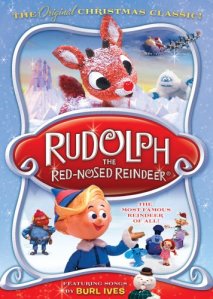 Director: Larry Roemer
Writers: Robert May, Romeo Muller
Cast: Burl Ives, Billie Mae Richards, Paul Soles, Larry D. Mann, Stan Francis, Paul Kligman, Janis Orenstein, Alfie Scopp
Plot: On a cold winter’s day Sam the Snowman (Burl Ives) invites us to listen to the story of the most tumultuous Christmas of all time. The reindeer Donner (Paul Kligman) is shocked when his wife gives birth to a fawn with a glowing red nose. Naming the child Rudolph (Billie Mae Richards), Donner attempts to hide the strange nose from the rest of the reindeer, afraid the boy will never be accepted enough to join Santa’s sleigh team. Rudolph joins in the reindeer games, and his attempt to impress a doe named Clarice (Janis Orenstein) goes off brilliantly… until, in his joy, he exposes his nose. The rest of the reindeer mock him and drive him away, but Clarice follows, trying to convince him his nose is something to be proud of.
In Santa’s workshop, meanwhile, an elf named Hermey (Paul Soles) is feeling trapped in his toymaking tasks… he really wants to be a dentist. He encounters Rudolph, who has just been warned off by Clarice’s father, and the two outcasts strike up a friendship, deciding to become “independent together.” They set off from the North Pole, hoping to find a place where they fit in, but find themselves tracked by the Abominable Snowman. They get stuck in ice, but are rescued by a prospector named Yukon Cornelius (Larry D. Mann), who is determined to mine for silver and gold in the great white north. The three of them are attacked by Abominable, and Yukon breaks them off onto an ice floe to escape. Eventually they arrive at the Island of Misfit Toys, a land populated entirely by playthings that are flawed in some way: a Jack-in-the-Box named Charlie, a train with square wheels, a water pistol that only shoots jelly, and other such manufacturer’s defects. They’re taken to the island’s king, Moonracer (Stan Francis, who also voices Santa), who offers to give them shelter for a night if Rudolph agrees to ask Santa to deliver the misfit toys to children so they can finally be happy. That night, however, Rudolph realizes the Abominable Snowman is tracking them via his nose, so he leaves his friends behind.
As time passes, Rudolph grows up and returns to the North Pole two days before Christmas Eve, where he finds that his parents and Clarice are missing, having spent months searching for him. Before he can set out to look for them, an incredible snowstorm strikes. Rudolph manages to find the missing reindeer in a cave, trapped by the Abominable Snowman. He saves them as Hermey and Yukon arrive. Hermey extracts the Snowman’s teeth, but he traps them all before Yukon plunges off a cliff with the monster and is lost. The misfits return to the North Pole, where Santa agrees to deliver the Misfit Toys and Hermey is given permission to set up his dentist’s practice. As apologies are made, Yukon Cornelius appears with the bound and reformed snowman, now called “Bumble,” who cheerfully joins in the celebration by placing the star atop the Christmas tree. All may still be lost, though, because the storm isn’t letting up… until Santa realizes Rudolph’s brilliant nose is just the thing to guide his sleigh.
Thoughts: As far as beloved symbols of the holiday season go, Rudolph didn’t get the most auspicious start… and I’m not talking about the whole “Reindeer Games” thing. Rudolph began life not because someone had a vision, not because of an abiding thirst to add something to the Christmas pantheon, but because a department store wanted to save money. Montgomery Ward had been giving away coloring books to children for a few years and decided it would be cheaper if they made their own instead of just buying them from others, so in 1939 the company assigned copyrighter Robert May to come up with a story. The resulting poem, about an outcast reindeer with a red nose, became a hit. In 1944 Max Fleisher’s studio made an animated short starring the character, in 1949 songwriter Johnny Marks adapted the poem into a song made legendary by Gene Autry, and throughout the 1950s and 60s he starred in an annual comic book special published by DC. But the most enduring (and, I’d argue, most endearing) version of the character is this one, the one who raced onto NBC and 1964 and brought with him not only the hope for the Christmas season, but also the beginning of a golden age of animated specials by Rankin/Bass Productions.
Rudolph’s tale has a good, positive message even in the original poem: it’s a story about accepting who you are and finding your utmost potential. But the added dimension this special gives to a relatively simple story is a big part of what makes it so memorable. When Hermey first shows up, wanting to practice dentistry, it feels like a throwaway joke at first. And it’s a funny joke, don’t misunderstand. The notion of an elf tossing away his heritage to do something so decidedly un-elflike is silly on the face of it. But Hermey’s character arc parallel’s Rudolph’s in a very interesting way. Rudolph is separated from the other reindeer by something physical that he can’t change; Hermey is separated from the other elves by something spiritual that he wants to change. The friendship the two of them strike up is undeniably heartwarming.
Although the rest of the cast hasn’t become as famous as Rudolph himself, Hermey, Yukon Cornelius and Bumble have most definitely ascended to the level of B-list players on the Christmas scene. Yukon is goofy enough to be fun in any context, and in most company you need only say “I want to be a dentist!” in Hermey’s intonation to get across the point that you feel like a square peg being forced into a round hole. But Bumble is my favorite of the trio. Although Rankin/Bass are best known for their Christmas specials (and for their later 80s animation), they did occasionally swerve into other seasons. Bumble was their first great monster, and the sensibility that went into his design would turn up three years later, when they produced the feature film Mad Monster Party, including versions of all the great Universal monsters.
The Misfit Toys, likewise, have become classics, but I’ve always felt like the writers were stretching just a bit with this section. Some of the “defects” seem almost too silly to accept (the Charlie-in-the-Box, for example… doesn’t it occur to anybody he could just change his name?). Still, the charm of the characters is enough to deflate these more practical notions, and the idea that a toy needs the love of a child to be complete is the sort of beautiful thing that Jim Henson and the boys at Pixar would pick up on in years to come. I’m not saying that Toy Story never would have happened if it weren’t for Rudolph, but I guarantee you the people who made that movie were fans of this one.
Although the original Johnny Marks song is the hallmark of the special’s musical numbers, it would be practically criminal to ignore the rest of the music he composed to accompany it. “We’re a Couple of Misfits,” the song Rudolph and Hermey each sing solo before coming together for a brilliant duet, is almost an anthem for outcasts, and deservedly so. It’s quick, it’s catchy, and it’s infinitely adaptable. Burl Ives is at his all-time best turning out “Silver and Gold” and “Holly Jolly Christmas,” both songs that have become perennials in their own right – and with all due respect to Gene Autry, it’s the Ives version of “Rudolph the Red-Nosed Reindeer” I hear whenever the music begins playing in my head (usually a few days before Thanksgiving, at which point I attempt to force it back until the turkey and stuffing are digested… or at least eaten).
Having Rudolph grow up during the course of this cartoon was an interesting choice. This was, if you’ll recall, Rankin/Bass’s first big Christmas hit, and they probably didn’t expect it to become the trademark of their brand. They’d bring Rudolph back for other specials over the years, when he would save the New Year and, along with Frosty, the Fourth of July, but whenever he turned up after this, he was the young Rudolph again. And that’s as it should be. That is, after all, the way he went down in history.
The Christmas Special: An Introduction
Once again, my friends, the Christmas season is underway, and that means it’s time to immerse ourselves in the sort of cheerful yuletide content that we all love. There are Christmas books, Christmas movies, Christmas music, Christmas food (oh… oh dear Heaven the Christmas food…) but there’s one entertainment medium that, as far as I’m concerned, Christmas dominates like no other.
The television Christmas special.
Let’s think about it here. Think for a moment about what a TV special is – a short film made for the small screen. It’s not long enough to block out the two hours for a legitimate TV movie. It’s not necessarily part of a regular TV series, although it may be a spin-off, reunion show, or a backdoor pilot for one. Sometimes the characters are familiar, sometimes they’re one-off visitors, sometimes they’re telling a timeless story and sometimes they’re giving us something new.
And I don’t know about you guys, but the vast majority of the great television specials that linger in my mind are Christmas specials
Oh sure, there are a few Halloween greats, the odd Thanksgiving or Valentine’s Day yarn, but let’s be honest here. During those golden days when the word “SPECIAL” would spin out at us from our TV screens to announce the next thirty to sixty minutes of CBS would not be our regular programming, we were hoping to see Rudolph, or Frosty, or Charlie Brown putting up his sad little Christmas tree.
So this year, I’m giving my month of December to a discussion of 25 of the most memorable Christmas specials, at least as far as I’m concerned. Interestingly, this project has proven to have the opposite problem of this Halloween’s comedy/horror project, in which I simply couldn’t find very many old movies to discuss. This time around, the closer we get to the present day, the harder it is to find a truly great special. I managed to scrape up a few, but we’re still going to spend most of the month without getting past the 80s. I also tried to restrict myself to just one special per franchise, although there are countless Muppet, Sesame Street and Peanuts films I could have gone with. And I also refused to go with any of the endless reiterations of Charles Dickens’s A Christmas Carol, not because I don’t like them, but because there are so damn many of them I rather think it would be fun to do a Reel to Reel project someday looking exclusively at those films.
So come back tomorrow and we’re going to begin, appropriately enough, with the first great special from the good people at Rankin/Bass productions. We’re traveling back to 1964 to spend some time with Rudolph the Red-Nosed Reindeer.
Lunatics and Laughter Day 20: Tucker and Dale Vs. Evil (2010)
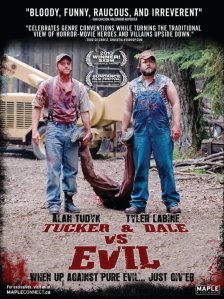 Director: Eli Craig
Writer: Eli Craig & Morgan Jurgenson
Cast: Tyler Labine, Alan Tudyk, Katrina Bowden, Jesse Moss, Travis Nelson, Chelan Simmons, Christie Laing, Brandon Jay McLaren, Alex Arsenault, Adam Beauchesne, Philip Granger, Joseph Allan Sutherland
Plot: In the Appalachian Mountains, a group of college students takes a trip to the woods. They stop to get beer, encountering a pair of rednecks. One of the girls, Allison (Katrina Bowden) is startled by the appearance of redneck Dale (Tyler Labine), and the kids hustle back to their car. Dale admires Allison from afar, and his buddy Tucker (Alan Tudyk) tries to convince him to take a chance and approach her. His weak attempt to be friendly frightens the girls. Chad (Jesse Moss) ushers them back into the car, and they speed off. Dejected, Dale slumps back to his truck and Tucker urges him to find the courage to pursue what he wants. The boys are on their way to a “summer home” Tucker bought by the lake, with an eye towards fixing it up. When a beam slips from the ceiling and nearly hits Tucker in the face, they decide they’d better start on the repairs.
At the college students’ campsite, Chad begins telling his friends the story of the “Memorial Day Massacre.” Twenty years ago, a bloodthirsty hillbilly slaughtered a group of college students just like them. Chad comes on to Allison, but she rejects him and goes to her friends, who are skinny-dipping in the lake. Tucker and Dale, meanwhile, are night fishing. When Dale spots Allison stripping, he accidentally startles her and she falls in the water, hitting her head. They pull her from the lake, saving her life, but the other kids mistake the rescue operation for a kidnapping and flee in terror. In the morning, Allison wakes up in Tucker’s cabin, head bandaged, wearing one of Dale’s flannel shirts. As he approaches her, she’s terrified of him… until she realizes he’s just bringing her breakfast. She’s stunned to realize her friends abandoned her when they thought she was in danger, and finds herself slowly charmed by the gentle, sweetly awkward Dale, even giving him permission to call her Allie.
Chad plans an assault on the hillbillies, sending Chuck (Travis Nelson) to try to find the police and Mitch (Adam Beauchesne) to attack Tucker, who’s chopping wood with a chainsaw. Tucker accidentally saws into a beehive and begins to run, Mitch fleeing in a blind panic, impaling himself on a fallen tree and dying. The teens believe Tucker killed him. Back in the cabin, Dale and Allie start playing board games, Allie impressed by his knowledge of trivia and tells him of her plans to become a therapist. Tucker summons him to help outside, and the kids hide from them as they chat about Allison, mistaking their comments and Dale’s misspelled note (“We got yur frend”) for a threat.
Allie joins Dale in digging a hole for the outhouse, revealing she grew up on a farm and is used to hard work, while Tucker gets to work disposing of all the dead wood near the cabin in a huge chipper. (If you have paid any attention since the beginning of this project, you know exactly where this is going.) The teens attack, one of them spearing himself on the stick he planned to use to kill Dale and another leaping at Tucker and landing right in the wood chipper. Allison is accidentally knocked out. The boys bring her inside, believing the college students have entered into some sort of crazy suicide pact. Outside, the kids meet up with Chuck and the Sheriff (Philip Granger).
The Sheriff pulls up at the cabin just as Tucker and Dale get the remains out of the wood chipper. The Sheriff (understandably) doesn’t believe their story, and insists they take him inside to check on Allison. He accidentally triggers the beam that nearly hit Tucker earlier, and a board full of nails is drilled into his forehead. He stumbles outside and dies next to his car full of terrified teens. Chuck takes his gun and tries to shoot the rednecks, but forgets about the safety until Dale reminds him. Chuck winds up blowing his own head off. Chad manages to capture Tucker, dangling him upside-down from a tree and torturing him for being “pure evil.”
Allison wakes up and Dale tearfully says her friends are trying to murder his best friend and his dog. Allison starts to understand the misunderstanding and steps outside to calm her friends, but finds a package left on the stoop: a part of Tucker’s shirt with two fingers and a note from Chad, daring Dale to try to save his friend. Allison’s attempt to explain reveals she was afraid of Dale when she first saw him, and he blames himself for everything that’s happened. He asks her to tell her friends he never wanted to hurt anyone and sets out to rescue Tucker. He stumbles into a trap set by Chad, but the trap misses and he saves his friend. As night falls, Chad and Naomi (Christie Laing) sneak into the cabin. They find Allison alone and Chad begins pouring gas around the cabin, calling the boys evil freaks. Naomi accuses Allison of falling in love with her captor, Chad growing angry before Tucker and Dale arrive. Allie tries to make everyone talk things out, making Earl Gray tea (because Chad is allergic to Chamomile). Chad reveals his mother was the lone survivor of the Memorial Day Massacre. Outside, the last two teens (Jason-Brandon Jay McLaren, and Chloe-Chelan Simmons) break in. They wind up setting the cabin on fire. The remaining teens, except Chad, are killed, and Dale crashes the truck trying to escape. When he wakes up, Allison is missing and Tucker too injured to go on. Tucker tells Dale he’s a better man than he knows, and that Allison sees it too, and sends him off to be the hero. He tracks Chad to a mill, where Allison is tied up. Dale cuts her free and they run, finding an attic with more newspapers and boxes of tea. The papers reveal that Chad’s mother was actually raped by the hillbilly killer… and the photo of the murderer looks just like Chad. Chad refuses to believe it and he slashes at Dale, but Dale hits him in the face with Chamomile tea. Chad staggers backwards and falls from the window.
The news blames the deaths of the college students on a deranged killer (Chad), and Tucker watches the report from his hospital room, where his fingers have been (mostly) reattached. Dale takes Allison out bowling that night. As he awkwardly tries to profess his feelings for her, she silences him with a kiss.
Thoughts: Being, as I am, from Louisiana, cinematic depictions of the south frequently infuriate me. While every geographic region has some legitimate stereotypes, the notion that being from the south automatically makes someone lackwitted or intolerant is personally insulting and as ignorant as anything the people who make those claims are upset about. And that is why I love Tucker and Dale Vs. Evil. On its face, the movie seems to play into all the backwoods hillbilly stereotypes. It soon becomes clear, though, that writers Eli Craig and Morgan Jurgenson had a totally different agenda with this film. Granted, Tucker and Dale could stand a few more showers and they may not be as refined as the Chads of the world, but they’re unrelentingly clever, hard-working, loyal, and brave. They are the salt of the Earth, and every death in the movie comes not at their hands, but because the college kids are far more stupid and intolerant than they accuse our heroes of being, and bring disaster upon themselves.
Even more so than most modern slasher movies, the death scenes are played for laughs, mainly because every single injury in the movie is either self-inflicted or Chad-inflicted. As it turns out, the only thing funnier than watching a teenager get hacked up by Jason Voorhees is watching a pretentious douche get hacked up because he thinks he’s being chased by Jason Voorhees.
The therapy scene is a great little double-punch. It comes across as a minor dig at the modern attitude of trying to talk through problems that may be beyond talking. Chad is clearly harboring deep, violent issues and it’s doubtful from the outset that there’s anything anyone could say to make him see reason. At the same time, it’s a great way to establish more of Chad’s character (he’s still a one-note villain, but now he’s a one-note villain with a motivation), and get some of the film’s funniest lines out all at once.
In terms of legitimate horror, there isn’t too much here. Some of the death scenes are a little gory and violent, but they’re never played realistically enough to get too horrified. Tucker and Dale are supposed to look disturbing at the outset, but that switch is flipped virtually as soon as they start talking. And while Chad makes for a solid villain, he’s never particularly frightening or intimidating. Tucker and Dale could easily take him out at any point if they weren’t trying to hold back, which they do either because they don’t realize they’re in danger, don’t want to hurt anybody, or are instead more concerned with protecting Allison.
In a strange way, this movie is a further deconstruction of the sort that began with Buffy the Vampire Slayer, although it takes its inspiration more from the Last House on the Left or Texas Chainsaw Massacre school of terror. In Buffy, we watched as the typical horror movie victim got the upper hand on the monsters and became a superhero. In Tucker and Dale the reversal goes a step further, with the usual victim becoming the monster himself and the usual monsters becoming champions. It’s such a simple, brilliant change-up that it’s almost impossible to believe it hasn’t been done before. (Unless it has been done before. If it has been done, please let me know.)
Although I wasn’t sure what to make of this movie the first time I watched it, it won me over almost instantly. The change to the usual horror movie formula is fresh and entertaining. Tyler Labine and Alan Tudyk are charming comedic actors that work really well together, coming across as a great movie duo. This is the newest movie on the list, receiving only a limited theatrical release and a DVD release earlier this year, so I won’t be surprised if a lot of you haven’t seen it yet. If you fall into that category, go to NetFlix streaming and stream the heck out of it, now, before your Halloween passes. It’s a great way to cap off the season.
Lunatics and Laughter Day 19: Zombieland (2009)
 Director: Ruben Fleischer
Writers: Rhett Reese & Paul Wernick
Cast: Jesse Eisenberg, Woody Harrelson, Emma Stone, Abigail Breslin, Bill Murray
Plot: Zombies have taken over the world, and only a few isolated survivors remain. A young man from Columbus, Ohio (Jesse Eisenberg) has lasted longer than anyone he knows thanks to a carefully constructed set of rules, assembled mainly through trial and error. Little things make a difference in Zombieland: cardio, “double tapping” (always use a second bullet to make sure the zombie is dead), and of course, fastening your seatbelt. He’s a nervous sort, afraid of clowns, and mostly a loner. “Columbus” is making the long journey home from Texas in the hopes that his parents may still be alive. He is picked up by a cowboy hat-wearing fella in an SUV who calls himself Tallahassee (Woody Harrelson). In order not to get attached, Tallahassee insists on using their hometowns as identifiers, rather than bothering with real names. Tallahassee’s passion for killing zombies is matched only by his craving to find a Twinkie, and when they encounter a supermarket, Tallahassee insists on stopping to check it out. Instead, they find a young woman who identifies herself as Wichita (Emma Stone). Her younger sister, Little Rock (Abigail Breslin) has been bitten, and they’re begging for help – they need a gun to kill her. Tallahassee is about to pull the trigger, but Wichita asks to do it herself. Taking the gun, she turns on the men, stealing their car, ammunition, and weapons; it was all a scam.
The girls head west, planning to get to a supposed safe zone called Pacific Playland. Tallahassee, meanwhile, finds a Hummer in good condition, loaded with big guns. They set out to find the girls, and although Columbus cautions Tallahassee not to let his anger take him, Tallahassee says he’s got nothing but the little pleasures since he lost his puppy, Buck. They find the SUV on the side of the road, hood open, abandoned. While Tallahassee checks it out, Little Rock hijacks Columbus in the Hummer. The girls rob them, again, but this time take them on the road. Wichita drops the sad news that Columbus, Ohio, burned to the ground during the outbreak. She offers to drop Columbus off so he can find a new path, but he decides to stay with her.
Eventually, they make it to California, where Tallahassee suggests finding and resting in the home of his favorite celebrity: Bill Murray, an unknown quantity to the 12-year-old Little Rock. They split up to search the place for zombies, and Columbus decides to culture Little Rock by showing her Ghostbusters in Murray’s own movie theater. Tallahassee and Wichita, elsewhere, make enough noise to summon a zombie – Murray himself. Or so it seems. Murray, still alive, had himself made up in zombie makeup as a defense. He begins showing his guests a good time, reenacting scenes from his movies, and they convince him to prank the jittery Columbus by pretending to be a zombie again. The joke goes too far and Columbus shoots Bill Murray in the chest. As he dies, Murray identifies his one regret: Garfield.
As they decompress and remember the things they miss from the Pre-Zombieland world, Columbus realizes the “Buck” Tallahassee has been mourning isn’t really his dog, like he said, but his son. He has a good cry, finally letting the emotion out. Later, Wichita brings Columbus a bottle of wine. As they trade life stories, Wichita asks him to dance, and he’s about to kiss her when Tallahassee interrupts, asking for help in moving the couch to build a fort.
In the morning, the girls take the Hummer and leave the guys behind, Wichita upset that she almost broke her cardinal rule: the sisters trust no one but each other. They drive the last few miles to the Pacific Playland amusement park. Instead of the zombie-free paradise they were promised, when Wichita turns the power back on the lights and sounds draw all the undead for miles. They are trapped at the top of a ride, surrounded. At Murray’s house, Columbus fails to persuade Tallahassee to help him find the girls and starts to set out on his own. When he drives a motorcycle into a hedge, Columbus takes pity on him, and they take one of Murray’s cars to Pacific Playland. Tallahassee lures the zombies away from the ride so he can blow them away. He locks himself in a carnival booth, shooting through the bars and ceiling, killing all the zombies he can. Columbus, meanwhile, makes it to the girls just in time: there’s a zombie climbing the ladder towards them and they’re out of ammo. But before he can charge to the rescue he encounters his greatest fear: a zombie clown. Taking a page from Tallahasse, he beats the clown to hell and saves the girls. Wichita gives him a special prize – her real name – and he kisses her. As they leave, Little Rock tosses Tallahassee a Twinkie from the snack bar, and the odd little family sets out on the road again.
Thoughts: Writers Rhett Reese and Paul Wernick originally conceived Zombieland as a TV series, and looking at the movie through that prism, it’s actually pretty obvious. It plays much like a TV pilot, introducing a cast of characters and a situation through which it would be easy to tell a lot of stories over an extended period of time. It also explains why, unlike most zombie movies, the entire principal cast survives the film. There are a lot of short holdovers from that TV script as well – the rules for surviving Zombieland were intended as part of the TV framing sequence, and the “Zombie Kill of the Week” was going to literally be a “kill of the week.” It also suggests that there may have been intended answers to some of the assorted questions the story leaves open – why sisters Wichita and Little Rock have different home towns, for example, or perhaps even more tellingly, why on Earth the electricity is still on everywhere we go. Seriously, throughout the film we see a total of five living people post-outbreak, how is it that the only place with no energy is the amusement park, and all it takes to get that going again is Wichita hitting a few switches?
Those minor holes aside, the movie is still intensely enjoyable. The story comes across as a clear Type A horror movie, but that doesn’t diminish the comedy at all. We get a group of very funny, very relatable characters in this movie, each of whom displays more depth and potential than their archetypes would suggest. Columbus is your standard awkward nerd, and the others tease him as such, but at the same time the very fact that he’s survived so long on his own reveals the sort of steel he really has. Tallahassee’s tenderness is hidden for much of the movie, but obvious when he decides to open up about his son, and integral in his decision to join Columbus on the rescue mission. The girls are tough and fight dirty, but at the core is a mutual desire to protect each other. We don’t know why, exactly, they’re so damaged, but that damage is presented in a believable way that makes their behavior easy to understand. The four of them fit together very naturally and very organically, in a way that leaves open plenty of room for the comedy.
I was reluctant to talk about the Bill Murray sequence in my recap, because not only is it a delicious, hysterical segment of the film, but it was such a surprise when I saw it that I think it ratcheted my overall enjoyment of the movie as a whole, and I hate to spoil that for anybody else. But then, I suppose anyone who hasn’t seen the movie yet either won’t read this recap or doesn’t care about spoilers, so why skip talking about something so memorable? The thing is, the film was planned in such a way that any of several celebrities could have been plugged into those scenes, depending entirely on who they could get to agree to do it. I don’t know who else was under consideration and I don’t care: Murray was perfect. His pedigree, the chance to listen to him as he performed some of his greatest one-liners, the admission that making Garfield was a terrible mistake… who else could have possibly filled that role in such a perfect fashion?
The finale, not to overstate it, is the greatest thing ever committed to celluloid. Killing zombies is always fun. Doing it while riding roller coasters, marching through a haunted house, or dangling from one of those spinning swing rides? It’s the stuff that dreams are made of. Or at least a bitchin’ video game. In fact, that’s what the last fight actually feels like: we’re watching Tallahassee and Columbus fight their way through the final level, except instead of one boss it’s just more zombies than anybody has ever seen.
The zombies themselves really feel like a secondary element to this film. While it wouldn’t work as well if the apocalypse was caused by vampires or a virus or something of those sorts, the zombies are just stage dressing. In many ways, this movie shares a lot in common with that other zombie TV show that did get made. In The Walking Dead, the zombies are usually relegated to the background – a problem to be dealt with, to be sure, but not the major thrust of the stories. The same is true here. The major difference is that The Walking Dead plays the scenario for drama, while this is a relatively lighthearted comedy. The only truly serious moment, in terms of character, is when we realize that Tallahassee is mourning a dead child instead of a dead puppy, and our hearts break a little… something that is rectified only moments later when he wipes his tears away with a wad of now-useless money.
Like I’ve said for several of our recent films, I hope the suggested sequel to this someday gets made. Sure, Eisenberg and Stone have both become much bigger stars since the film premiered and Breslin is a teenager now, but that doesn’t mean the time lapse couldn’t be worked into the story in an organic way. By design, these are characters that have a lot of life left in them and much more story to tell. I just hope, sooner or later, we get to see it.
Lunatics and Laughter Day 18: Trick ‘r Treat (2007)
 Director: Michael Dougherty
Writer: Michael Dougherty
Cast: Dylan Baker, Rochelle Aytes, Quinn Lord, Lauren Lee Smith, Moneca Delain, Tahmoh Penikett, Brett Kelly, Britt McKillip, Isabelle Deluce, Jean-Luc Bilodeau, Alberto Ghisi, Samm Todd, Anna Paquin, Brian Cox, Leslie Bibb, Connor Christopher Levins, James Willson
Plot: (Note: Trick ‘r Treat is a movie in the Robert Altman tradition – not just an anthology film, but a film in which multiple plotlines tend to weave in and out of one another. Although I’ll attempt to give as straightforward a synopsis as possible, it may be best if you just watch the movie. Come to think of it, just watch the movie anyway. It rocks.)
On Halloween night, Emma (Leslie Bibb) and Henry (Tahmoh Penikett) return home after a party. Despite Henry’s objections, Emma blows out the candle in their Jack O’Lantern and begins taking down their decorations, even as kids on the street continue trick-or-treating. Something leaps out at her, covered in a sheet, and slashes her throat open with a pumpkin-shaped lollipop sharpened into a blade. Henry comes outside later to find her head severed and limbs dismembered, dangling from a scarecrow, the lollipop stuffed in her mouth.
Earlier that evening, elsewhere in town, the streets of Warren Valley, Ohio are loaded with partiers and revelers – this is a town that takes Halloween seriously. But not everyone is ready yet. Laurie (Anna Paquin) and her friends are at the local costume shop, trying to find last-minute outfits. Laurie is reluctant to join the fun, but her sister Danielle (Lauren Lee Smith) insists. Laurie selects a Red Riding Hood costume. As they check out, Danielle invites the sales clerk to join them at a party they’re going to in the woods. After the others chide Laurie for being a virgin at 22, Laurie abandons her friends, saying she’ll meet them at the party later. She’s decided she wants to find “her guy” herself.
Elsewhere, a young boy named Charlie (Brett Kelly) marches down a street, knocking over pumpkins as he goes. He approaches the home of his school principal, Mr. Wilkins (Dylan Baker), who catches him stealing candy. As he carves a new Jack O’Lantern, he gives Charlie a lecture about respecting the dead and the traditions of the past no one cares about anymore. Charlie begin throwing up blood. Wilkins gleefully confesses that he poisoned the candy, and Charlie dies. He takes the body into the house, but is interrupted by trick-or-treaters. As he gives them candy, one of the kids asks if they could have his Jack O’Lantern for a scavenger hunt. He drags Charlie to his backyard, dumping the body into a hole where another body already waits. While working, his son Billy (Connor Christopher Levins) loudly yells for him from the window. His next interruption is the neighbor’s dog, which he distracts by throwing one of Charlie’s fingers to him… but his neighbor Mr. Kreeg (Brian Cox) comes out. As Wilkins hides in the grave, the second body squeals, not quite dead. He gives Kreeg a story about his septic tank being backed up, sending him back inside. Billy pops out again, begging to go with Wilkins to the Halloween party, but Wilkins says he can’t, he has a date. He finally manages to get the bodies buried. When he walks inside, Kreeg shrieks at him from the window, but Wilkins ignores him, and we see someone attack Kreeg. Inside, Wilkins and Billy sit down to carve their Jack O’Lantern… Charlie’s severed head. Billy sweetly tells his daddy to help him with the eyes.
The trick-or-treaters who took Wilkins’s pumpkin meet up with some other friends who’ve been gathering pumpkins. Macy (Britt McKillip) says they need more, so they visit “idiot savant” Rhonda (Samm Todd), who has carved dozens. Schrader (Jean-Luc Bilodeau) charms Rhonda into joining them. They make their way to a quarry where, according to the legend Macy tells them, 30 years ago a school bus full of mentally challenged students were taken instead. The children’s parents – exhausted and embarrassed– asked him to do “the unthinkable.” As he passes out candy and checks the chains on the students, one of them gets free and starts the bus, sending it into the lake at the bottom of the quarry. Only the driver survivs, and no one knows what happened to him. Finishing the story, Macy says they’re going to leave the Jack O’Lanterns by the lake. They manage to activate the old quarry elevator, taking Macy, Schrader and Sara (Isabelle Deluce) to the bottom. Macy says she’ll send the elevator back up for Rhonda and Chip (Alberto Ghisi).
Back at the Halloween party, a hooded figure in black kisses a girl in an alley. He bites her with a pair of fangs, drinking her blood. She flees into the streets, running into Emma and Henry and begging for help, but they think she’s just drunk. The hooded man returns, finishing her off. Laurie, meanwhile, is having no luck finding a suitable single man – until she sees the man in the hood.
At the quarry, Rhonda hears a howling in the distance and declares it to be werewolves. She and Chip take the elevator down, hearing their friends shouting for help as they come down. When they reach the bottom, the others are nowhere to be found. Rhonda leaves the frightened Chip behind and seeks the others, finding the half-submerged school bus in the lake, along with shredded and bloody remains of the other kids’ costumes. A pair of creatures emerge from the slime, and she runs. She falls into the lake, hitting her head, and the attackers reveal themselves to be Schrader, Macy and Sara – the whole thing was a cruel prank. Schrader tries to apologize, but Macy seems more irritated that their trick is over. Packing up, Macy kicks the last lit Jack O’Lantern into the lake, and voices begin to come from the water. The children from the bus crawl from the lake, pursuing the pranksters. They get back to the elevator, where Rhonda sits with her Jack O’Lanterns. The dead children approach, and Rhonda turns the elevator on, leaving her tormentors behind, screaming.
Laurie walks through the woods to her party alone, afraid she’s being pursued, until she encounters the hooded man. Danielle, at the party, is nervous for the sister her mother always called “the runt of the litter.” As she waits, a body in a Red Riding Hood cloak falls from the trees. Danielle lifts the cape to reveal the hooded man, begging for help. Laurie suddenly steps out of the trees, casually, albeit with a little blood on her. Danielle admonishes her for being late, and one of the other girls, Maria (Rochelle Aytes) removes fake fangs from the Hooded Man’s mouth. She removes his mask to reveal Principal Wilkins. She smiles, saying she’s glad he’ll be Laurie’s first. Laurie admits to Danielle that she’s nervous, and her big sister tells her to just be herself. She walks to Wilkins, sits on his chest, and transforms into a werewolf, opening her mouth wide for her first kill.
Earlier (again), a group of trick-or-treaters visits Mr. Kreeg’s house. He scares them off, taking the candy they left behind, and desperately tries to find something on television that isn’t about Halloween. He’s alerted to an intruder when his gate begins creaking, and someone begins pelting his window with eggs. He steps into the backyard, where his dog is nibbling on something and, over his fence, his neighbor is digging a hole. While they chtalkat, someone watches him from the bushes. Kreeg sees a figure running through his house – a small child in orange pajamas with a burlap sack for a mask (Quinn Lord). (“Sam,” as he’s called, has turned up several times throughout the film, watching our stories.) Kreeg goes to his bedroom, where a burning pumpkin reveals “Trick or Treat, give me something good to eat” written on the walls and ceiling, over and over again, in blood. Sam slashes his ankle with a knife hidden in a candy bar. Kreeg runs for help, slipping on candy and broken glass that sends him tumbling down the stairs. He goes to the window and begs Wilkins for help, but his neighbor ignores him and Sam leaps again. Kreeg rips off Sam’s mask, revealing a horrible pumpkin-like head. Sam finally gets the upper hand on Kreeg, approaching him with a sharpened pumpkin lollipop… but instead of stabbing him, he takes the candy Kreeg stole earlier. As Sam leaves, we see in Kreeg’s fire a burning photograph… years before, when he was a bus driver, at a home for mentally challenged children.
Later that night Kreeg, wounded and heavily bandaged, gives candy to a group of trick-or-treaters who come to his door. As he looks around the street he sees Billy Wilkins, bloody, handing out candy, Rhonda coming home with a wagon of pumpkins, Laurie and her friends driving by and giggling… and Sam, on the sidewalk, watching him. Across the street, Emma and Henry arrive at home, Henry admonishing her not to blow out the candle in their pumpkin. When she does it anyway, Sam looks down at his sharpened lollipop and walks towards their home. Kreeg drags himself back inside, but there’s one last knock on the door. The dead children from the quarry are back… and they want their candy.
Thoughts: Trick ‘r Treat is one of those movies that sat on a shelf for a few years, scoring only a limited theatrical release before coming to DVD. As such, many people dismissed it – straight-to-DVD movies have a rather negative reputation, you may have heard. But when I finally got a chance to watch the movie I realized that, not only was this a cut above most DVD-first fare, it was actually one of the best horror movies I’ve seen in a very long time.
Writer/director Michael Dougherty’s film puts its inspiration on display in the opening credits, which are structured to resemble old-fashioned horror comics of the Tales From the Crypt variety (inspiration for the TV show and movies, the Creepshow series, and countless other contemporary horrormeisters). He displays his four tales (and pieces of others) as part of a single night of insane terror across a little town, connecting them in subtle ways and using the audience’s own expectations of horror movies against it. The effect is a movie that makes you chuckle, jump, and scream, all the while giving you a brand-new horror icon that really could stand right up there with the Freddies and Jasons of the world.
The movie isn’t quite a gag-laden comedy the way a lot of the other movies in this project have been. In fact, someone unfamiliar with horror movie tropes may not find much to laugh about at all. The laughter almost always comes in when you realize the direction the story is going is not at all what you expected. In the principal’s story, for instance, Dougherty shows us early that Wilkins has no qualms about murdering a child, and when he begins showing clear frustration at Billy, we’re certain that either Billy will die or Wilkins will get some sort of cosmic comeuppance at the hands of his son. In virtually any other horror movie, in fact, that’s exactly what would happen. The end of the scene, where they tenderly begin to carve Charlie’s mutilated head up together, works brilliantly against everything a normal horror movie does, while delivering a powerful kick to close off that story (for the moment, at least).
Even more brilliant, perhaps, is the twist at the end of Laurie’s story. Dougherty sets her up perfectly as the sweet, innocent, virginal “survivor girl,” even making it seem as though she’s going to be pitted against a vampire for her grand moment of triumph. He nails us with two reversals here – first, making her the killer instead of the victim, and second, pulling a werewolf out of nowhere to close it off. Well… almost nowhere. Rhonda, earlier, did claim she heard werewolves in the woods, something that is easy to blow off the first time you watch the movie but that seems like a brilliant bit of foreshadowing on the second viewing.
Those little connected moments, by the way, also work brilliantly to make this a strong, cohesive film. Each of the four main stories could be chopped out of the anthology and shown as individual short films, and each would feel more or less complete. The connections, though, make things a lot more fun and help us connect the characters to one another and keep track, mentally, of the timeline. The movie doesn’t jump around quite as much as, say, Pulp Fiction, but it does jump.
The good thing is that the nonlinear nature of the story helps with the playfulness of the plot. When Sam kills Emma at the beginning, it seems sort of random. Okay, so she didn’t like Halloween, but surely that isn’t enough to deserve a death sentence. The callous way Henry blows off the girl who died at the party – which happened earlier but which we see later – helps bring things around to Emma getting what (in a twisted scary movie sort of way) she had coming to her. Mr. Kreeg’s story also benefits tremendously from this technique. Chronologically speaking, Sam attacks him long before we hear the story at the quarry, but had the film been shown in that order, the burning photograph would have been meaningless. We would have picked up the meaning later, but it would have robbed the story at the quarry of much of the impact. What’s more, when the dead children drag themselves out of the lake, it’s the first time the movie shows anything that’s explicitly supernatural. Rearranging the story would undercut that, and lord only knows what it would do the werewolf story.
Then there’s our new horror icon. Sam, at first, appears to be just a sort of playful phantasm, something that appears everywhere. He gets candy from Wilkins, visits the massacre at the quarry, and observes the murders at Laurie’s party. At first, he’s actually cute. He comes across as a mischievous little sprite that seems to be a watcher of sorts, but not actually connected to the chaos around him. The encounter at Kreeg’s house changes all that, of course, and does so in a clever way. Without actually spelling things out, Dougherty reveals why Sam is after Kreeg, ties many of the stories together, and makes the jolly little pixie truly horrific. You even understand – kinda – why Sam decides to let Kreeg live at the end. (It’s telling that perhaps the most disturbing part is that when Sam is injured, he doesn’t explode in blood, but in pumpkin seeds and entrails.)
Dougherty and producer Bryan Singer have been working for a few years to get a sequel to this film made. Although progress is slow, unlike the perpetually-stalled Behind the Mask sequel, it seems like this one will make it to the screen sooner or later – the movie is not only critically acclaimed, but eventually achieved solid commercial success on DVD. The FearNet TV channel has also embraced the film, having Dougherty direct several holiday shorts starring Sam and showing the film for 24 hours on Halloween, mimicking the success of A Christmas Story on TBS. In fact, if you’ve never watched this movie and you get the FearNet network, there’s the perfect chance to rectify this egregious error. Just check out the various shorts on YouTube, then set the DVR or carve out any two-hour block on Halloween night, and prepare to discover a movie that has become a tradition for horror fans everywhere.
Lunatics and Laughter Day 17: Slither (2006)
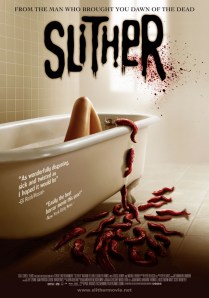 Director: James Gunn
Writer: James Gunn
Cast: Nathan Fillion, Elizabeth Banks, Michael Rooker, Don Thompson, Gregg Henry, Tania Saulnier, Haig Sutherland, Jennifer Copping, Brenda James, Jenna Fisher, Lloyd Kaufman
Plot: Thesmall town of Wheelsy, South Carolina is in danger. A meteor has fallen to Earth. Local car dealer Grant Grant (Michael Rooker)’s relationship with his wife Starla (Elizabeth Banks) hasn’t been great lately, and he’s in the woods with a woman he picked up in a bar (Brenda James, as Brenda) when they come upon the meteor. A parasite infests Grant’s body, and the next day, he begins stocking up on meat. Starla returns home to find a lock on the basement. Grant is changing – odd sores appearing on his body, and intense discomfort in his abdomen. A pair of fleshy tendrils sprout from his chest and almost reach for Starla, but he makes up an excuse about leaving something at work and flees. He goes to Brenda’s home and abducts her.
Starla, meanwhile, reconnects with Sheriff Bill Pardy (Nathan Fillion), a childhood sweetheart who never stopped carrying a torch for her. At home she finds Grant covered in bumps and sores. He claims it’s just a bee sting and the doctor has already treated him. She calls the doctor the next day, though, and he denies having seen Grant. Grant, meanwhile, has chained Brenda in a barn in the woods, and is bringing her huge bags of meat. Her stomach has become grotesquely distended, and she is ravenous. Bill and his deputy Wally (Don Thompson) pay Starla a visit. Brenda has been reported missing, and the neighbors saw Grant enter her house. Scared, Starla breaks the lock off the basement door to find a grotesque, flyblown nest full of animal corpses. Grant attacks her, but Bill and the cops return just in time to see his mutated form as he runs away.
Three days later Mayor Jack MacReady (Gregg Henry) is up in arms. Although he doesn’t believe reports that Grant has turned into a monster, he does believe he’s behind Brenda’s kidnapping and the rash of animal slayings that has sent the town into a frenzy. Bill rounds up a posse to stake out the next farm in Grant’s attack pattern, and Starla asks to come with him. Grant has mutated further, turning into a horrible, fleshy mass covered with tentacles, and the horrified police watch as he slays and consumes one of the farmer’s cows. Starla tries to reason with him, but when a deputy tries to play hardball, Grant kills the man and flees into the woods. They track him to the barn and find Brenda, now transformed into an enormous, pulsating blob. She explodes into a torrent of sluglike creatures that attack the cops, slithering into their mouths. Billy, Starla and a few others escape by covering their mouths until the slugs are gone, but most of the cops are down – alive, but comatose. The slugs converge on the farmhouse, where one attacks the farmer’s daughter Kylie (Tania Saulnier). Although it makes it into her mouth, she digs her fingernails in and yanks it out – but not before she has visions of its horrific alien homeworld. When she stumbles from the bathroom, she finds her parents and sisters have been taken by the hundreds of slugs overwhelming the house. She locks herself in her father’s truck as the slugs swarm over it.
Back at the barn Bill calls for help and tries to get the fallen cops outside. Wally wakes up and begins talking to Starla, saying he’s sorry and that he didn’t tell her because he was afraid she wouldn’t love him anymore. As the rest of the posse stands, it becomes clear Grant’s mind is controlling them all. Starla shoot Wally and rest of the Grant-zombies give chase. Back at the truck, the slugs have slithered away, but Kylie’s blood-soaked family is now trying to get to her. Bill saves her, but a horde of zombiefied people from nearby homes attack. Starla and MacReady run by, pursued by the zombies, and Starla slays another. The four survivors climb into Bill’s car and flee, while the zombies they leave behind cry Starla’s name.
Kylie explains what she saw when the slug attacked her – a creature that moves from planet to planet, consuming everything and turning what it doesn’t eat into part of its hive-mind. Bill calls his dispatch officer Shelby (Jenna Fischer) and tells her to call the CDC, but the slugs burst into the office before she has a chance. Instead, Shelby sends a zombie in a van to collide with Bill’s car. A horde of the zombies kidnap Starla. Bill and Kylie hide while one of the zombies gets MacReady. The zombies bring Starla and MacReady back to Grant’s house, and the thing that used to be Grant puts on some romantic music for a night at home with the wife. She approaches him as he continues to absorb the zombies into his own mass. She finds him in a twisted shrine to their marriage, surrounded by pictures of the two of them. She attacks as Bill and Kylie arrive, but Bill misses with his grenade. The creature stabs Bill, but he manages to get a tentacle jammed into a propane tank. Starla grabs Bill’s gun and shoots Grant, igniting the gas. As he dies, everyone taken by the slugs collapses. Bill, Starla and Kylie stumble out into the rising sun, surrounded by the bodies of the zombies, and begin to go down the road, planning to walk to the hospital in the next town.
Thoughts: If Eight Legged Freaks was a love letter to 50s-era giant animal monster movies, Slither is a tribute to that time period’s other great fear: alien zombies. Of course, the zombies of that time aren’t zombies as we know them today (that was largely a creation of George Romero in 1968’s Night of the Living Dead – virtually all zombie movies since have taken their cues from Romero). At the time, pretty much anything that turned ordinary people into mindless beasts or, even better, part of an alien hive-mind, could qualify. Slither fits in well with that brand of horror film.
It’s most certainly a Type-A horror/comedy, though. In terms of sheer gore, this movie far outstrips anything we’ve yet watched in this project. James Gunn (writer of the Scooby Doo films and the Dawn of the Dead remake, here making his directorial debut) is a product of Troma Studios, and it shows with horrific monster designs, highly realistic animals, and garbage bags full of blood and offal. Gunn pays his dividends to his alma mater in this movie. Not only is the story like something ripped right from a Troma film (albeit with a less campy tone and much better production values), but he works in a cameo by Lloyd Kaufman as a town drunk and even throws in a clip from The Toxic Avenger on Brenda’s TV screen. That’s only the obvious stuff, though. Less obvious, but still undeniably Tromantic, are some of the monster scenes. When Grant infects Brenda, for instance, the scene is surprisingly brutal, but shot in many ways like a sex scene, right down to the rhythmic gyrations one would expect at such a moment. It’s the sort of thing that’s either wildly funny or horribly disturbing depending on how you want to look at it. The part where Bill grapples with a zombie deer? Well, that’s just funny any way you cut it.
The true expression of how warped Gunn’s sensibilities are (and I mean this as a compliment) is the finale. Grant – now a truly hideous creature – has Starla trapped in the house while dozens of zombies walk around calling her name and pounding on the walls, all to the dulcet tones of Air Supply’s “Every Woman in the World.” The disconnect between the music and what we’re watching on the screen is jolting, funny, and terrifying all at the same time. There’s a bit of genius there too – when Starla begins talking to Grant about how long he’s been alone, it takes you just a moment to realize she’s not really talking to him, she’s talking to the alien. It’s really well-scripted and well-acted, and all the blood and gore is just a bonus.
Grant Grant actually manages to transcend his stereotype a bit. He’s the big lummox, the sort of guy you expect to turn into the threat in these situations, but it’s worth noting that before the alien takes over his body he actually turns down the chance to cheat on his wife. That’s not something most characters of his type would do. Even after the parasite takes him, we see him try to resist. There’s real pain in his eyes when Starla looks at him covered in the bumps and sores, when he realizes she’s starting to see the monster inside him. He even protects Starla when the monster wants to go after her in the shower, and although he quickly finds an alternate victim, it’s hard to argue that his love for his wife isn’t genuine.
If anyone fits into the dumb beefcake archetype, it’s Mayor MacReady (a nice nod to another of Gunn’s obvious influences, John Carpenter’s The Thing). He’s rude, crass, and uses his obnoxious personality to cover a streak of cowardice. When Bill shoots him in the head after his transformation, it’s the sort of horror movie kill that makes the audience cheer with approval. He does, however, get some of the film’s best lines – lots of tasteless jokes and panicked exclamations (he’s never seen anything like this, and he watches Animal Planet all the time).
Fans of Firefly have long known Nathan Fillion has leading man quality, and this film helps get that across. He’s got a heroic, self-sacrificing nature, not quite as bold or bombastic as the characters he usually plays. When he drops a one-liner (and he does, frequently), it’s more likely to be dry and a little self-deprecating than any kind of braggadocio. The scene in the car, when he nervously tries to explain to Starla how he’s responsible for stopping up his mother’s toilet and then gets into an argument with MacReady over the definition of “Martian,” is one of the best bits of writing I’ve seen in one of these movies.
Besides MacReady’s name, Gunn continues the now well-worn tradition of peppering the film with references to other horror stories. The scene where the slug attacks Kylie in the bathtub is very reminiscent of Freddy Krueger’s attack on Nancy in the first Friday the 13th for instance, with other scenes calling to mind great bits from Night of the Living Dead, Return of the Living Dead, and dozens of other films. Even Kylie’s little sisters are caught reading R.L. Stine’s Goosebumps books before they turn into monsters themselves.
Like Eight Legged Freaks, the downfall of this movie comes in the CGI. Four years later than the other film, the technology has improved. Individual slugs actually look fairly convincing. But when you see an entire swarm of the slugs, the visuals start to break down. The worst bit is actually the first time you’re sure you’re looking at computer effects, when Brenda explodes and the slugs rush out in a wave. It looks very much like a 90s video game at that point. Although the rest of the movie looks better, that one moment tends to taint your perception.
Both Gunn and Fillion have gone on to bigger projects in years past, with it recently announced that Gunn would helm Marvel Studios’ upcoming Guardians of the Galaxy movie. Although we probably can’t expect the level of guts and gore he gave us in Slither, this movie really shows without a doubt that he’s got a powerful, unique visual style and a good eye for creatures and practical effects. If he can polish off the CGI, that movie is going to look fantastic. Hopefully though, he won’t stay in that relatively safe realm of sci-fi for too long, because this movie proves very neatly he’s got great chops for horror.
 Reel to Reel