Category Archives: 1-Mutants Monsters and Madmen
Mutants, Monsters, and Madmen Day 17: The Exorcist (1973)
 Director: William Friedkin
Writer: William Peter Blatty, based on his novel
Cast: Ellen Burstyn, Linda Blair, Max Von Sydow, Lee J. Cobb, Jason Miller, Mercedes McCambridge
Plot: In Washington, DC, we meet Father Damien Karras (Jason Miller), whose faith beginning to crumble as his mother lies dying. Chris MacNeil (Ellen Burstyn) is an actress who in town to make a movie. Her marriage is dissolving, but she’s clinging to her young daughter, Regan (Linda Blair). Regan begins to exhibit strange behavior, beginning with disrupting a dinner party by announcing to one of the guests, “You’re going to die up there,” and urinating on the carpet. Later that night, her bed begins thrashing wildly, terrifying girl and mother alike. Although Chris initially seeks out a medical explanation for Regan’s odd behavior, the horrible events persist, increasing to violent outbursts, exclamations of profanity and blasphemy, and even levitation. Meanwhile, the local church has been desecrated, and the director of Chris’s movie dies in an apparent accident, assuming one can “accidentally” turn his head around 180 degrees.
Believing Regan’s symptoms to be psychosomatic, a psychiatrist suggests an exorcism, reasoning that if she believes she is possessed by a demon, she may be cured by making her believe she is freed. Chris turns to Karras, a psychiatrist as well as a priest. When he sees how desperate Chris has grown, he agrees to examine the girl. Karras splashes Regan with Holy Water and records the strange words she howls in pain. He later reveals to Chris that he lied – the water was unblessed, which supports the case that everything is in Regan’s mind. When he later plays the tape backwards, though, he hears Regan speaking clearly, threateningly, menacingly… in English.
When Karras turns to his superiors to request an exorcism, they summon Father Lankester Merrin (Max von Sydow). Merrin and Karras begin the ritual of exorcism. As they pray, the demon inside Regan assaults them, first verbally, then physically by hurling things around the room, cracking the ceiling, and finally striking Karras from behind. Karras leaves the room, returning to find Merrin seemingly dead. He attacks Regan, viciously striking her and commanding the demon to take him instead. It leaps from Regan into Karras, and he hurls himself from the window, falling to his death on the steps below. In an epilogue, Chris and Regan leave town, Regan having no memory of her ordeal, hoping the demons of all kinds stay behind them.
Thoughts: This one was a lock as soon as I decided to try this little project. The Exorcist has turned up on just about every “scariest of all time” list I’ve ever seen, and with good reason. The scenes of Regan’s slow deterioration are expertly staged and performed. Linda Blair begins as a charming, gregarious child, transforming stage by stage into a real monster in innocent form. Blair also is very effective as a physical actress, going through her terrible convulsions, flapping her tongue menacingly at the priests, and thrashing about like a madwoman.
The special effects are rather impressive for 1973 as well – the scene where Regan’s head turns backwards is still creepy as hell today. The classic scene with the projective-vomit pea soup is a little cheesy by today’s measure, but you fall right back into fright just moments later when you see Regan, caked in her demon makeup, soup dripping from her chin, and a look of utter hatred and madness in her unnaturally green eyes. And of course, Mike Oldfield’s “Tubular Bells” remains one of the all-time great horror movie scores. Those haunting chimes, even today, are enough to give anyone who has seen the movie a chill.
However, coming back to the film for the first time in several years, it’s interesting just how different it is from modern horror films. The first real supernatural occurrence – the shaking of Regan’s bed – doesn’t happen until 40 minutes into this 122-minute film! Blatty spends nearly a third of his running time on exposition and character before he actually gets into the meat of the storyline, a technique that a modern movie studio would consider absolute poison. It’s another full 35 minutes before Chris and Karras meet for the first time, and Karras doesn’t see Regan for the first time (in heavy make-up and strapped into a bed that has been heavily padded – in a very effective visual) until the movie hits the 80-minute mark. Merrin himself – the titular exorcist – doesn’t really factor into the story in any substantive way until the final 30 minutes. It’s also hard to imagine a movie today ending without little Regan engaging both priests personally, physically, hand-to-hand, with lots of overdone CGI, instead of allowing her demonic powers to do the work for her. And let’s not forget the most horrific thing in this film that would never, never turn up even in the most soulless, horrific perversion of cinema in 2011: the scene where the doctor lights up a cigarette in his own waiting room.
Terrors.
Speaking of the doctor, the film also continues the proud cinematic tradition of having people in authority be absolute idiots. “She’s thrashing wildly, throat is bulging, eyeballs turn white… oh, and her entire bed is levitating. It must be psychosomatic.” Sure, there’s an effort to justify their disbelief by cooking up the old stories about tiny women lifting up cars in times of stress, but that really feels like quick lip service to get us past the perfunctory need for these characters to exist.
Like all great horror films, it works because it taps into genuine fears of the time. The idea of the devil is nothing new, nor is the idea of possession. This movie – and the novel it’s based on – hit just when people were ready to fear these classic horrors again. Besides the religious implications, the film works because it taps into the fear that comes with changing the familiar into something unfamiliar. Taking a child – particularly a little girl, perhaps the most innocent form of human life one can imagine – and turning her into an object of terror is a very effective way to gut the audience. If it didn’t speak to something primal in the human psyche, it wouldn’t have done so well, nor given birth to so many imitators. In terms of influence, this film kind of kicked off a rash of movies about children possessed by (or embodying) the supernatural: The Omen, Rosemary’s Baby, Poltergeist, and Children of the Corn all come to mind. Each of those, and many others, bear the fingerprints of this tale in one way or another.
Once again, we see the fears of America shifting from the supernatural to the demons within. Tomorrow we tousle with the original Texas Chainsaw Massacre.
Mutants, Monsters, and Madmen Day 16: Last House on the Left (1972)
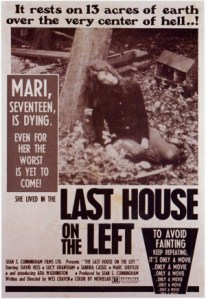 Director: Wes Craven
Writer: Wes Craven
Cast: Sandra Cassel, Lucy Grantham, David A. Hess, Fred Lincoln, Jeramie Rain, Marc Sheffler, Gaylord St. James, Cynthia Carr
Plot: Celebrating her 17th birthday, Mari (Sandra Cassel) and her friend Phyllis (Lucy Grantham) head out to attend a concert, despite the concern of her parents (Gaylord St. James and Cynthia Carr). On the radio, they hear about the prison escape of a rapist and serial killer named Krug (David A. Hess), who has joined up with his son Junior (Marc Sheffler), a psychopath named Sadie (Jeramie Rain) and a child molester and killer called “Weasel” (Fred Lincoln). After the concert, the girls meet Junior, who they attempt to buy marijuana from. Junior leads them into the clutches of the rest of the gang.
The next morning, the gang stuffs the girls into the trunk of a car to take them to their hideout in the woods. On the way, their car happens to break down in front of Mari’s house. As the police try to convince Mari’s parents that kids sometimes need to just “let off a little steam” and that she’ll come home soon, the gang marches the girls out into the woods. Phyllis makes a run for it, instructing Mari to run in the opposite direction, but she’s left with Junior. She tries to befriend him, even giving him the peace medallion her parents gave her before the concert. The gang finally recaptures Phyllis, killing her in a particularly grotesque fashion.
With Phyllis dead, Krug brutally takes his aggression out on Mari. The gang washes up and changes out of their bloody clothes, while Mari’s corpse drifts away. Pretending to be salesmen whose car broke down, they return to Mari’s parents’ home and ask to spend the night. Estelle, Mari’s mother, realizes they’re lying when she sees Junior wearing Mari’s peace medallion. She listens in as the gang talks, then finds their bloody clothes. She and her husband rush into the woods where they find Mari’s body, then come back for bloody revenge.
Thoughts: Wes Craven and producer Sean S. Cunningham – both of whom would go on to father far more memorable American boogeymen – kick things off by immediately embracing the more permissive 70s in this film. Nudity, language, gore – this film absolutely catapults over just about everything we’ve looked at before. In fact, the uncut version of the film was denied an 18 certificate in the United Kingdom until 2002. The exploitation films of the 70s had arrived.
This is where that image of Splatter-Film-as-Morality-Tale really starts to kick in. Why are the girls in town in the first place? They wanted to see a concert by a band that includes the mutilation of animals in their act. Why did they get caught by the criminals? They wanted to buy drugs. It’s debatable whether or not the filmmakers were actually attempting to make a point of some sort, but no doubt it was at least a little easier to convince the censors to accept such a harsh film by convincing them that there was a moral to the story.
Craven worked hard to juxtapose the horror of the story with sweeter scenes and jovial tones. The scenes of Mari’s parents setting up the party could have come from any sitcom of the era, while the music played as the gang transports the girls to their hideout sounds like it belongs in a slapstick comedy, followed by scenes of a babbling brook that belongs in a nature film. All of this just makes what’s really going on all the more horrible by comparison. Then the singing starts… the jolly, cheerful music launches into verses about the gang rambling around, having fun, trying to leave the state, and planning to leave the girls for dead. At this point in the film, the music is the most horrible part. The cops, for the most part, are played for laughs – incompetent, ineffective, and an object of shame. They neglect to investigate a broken down and abandoned car outside of Mari’s home, then hear a description of Krug’s car. When they come back, their own car breaks down, they’re humiliated by a mob in a truck, and even get made fools by a woman carting a truckload of chickens. Trouble is, their scenes are far more pathetic than funny… which may have been the intent, true, but that doesn’t make it any better.
Even some of the harsher scenes aren’t as effective as they could be, and that comes down to production issues – when Mari’s parents discover her body, she’s clearly moving of her own accord, even though she’s supposed to be dead. As Mari’s father begins to set booby traps for the killers, it doesn’t scare so much as remind me of Home Alone. Her mother’s seduction of Weasel smacks of a sex farce, right up until she strikes. The revenge part of the film, the last 15 minutes or so, delivers a little satisfaction, but it’s come at a hard price, and it’s undermined entirely by the return of the goofy musical number in the end credits. It’s hard to look at this movie and believe this was made by the same director who would so effectively blend horror and comedy in Scream over 20 years later. Clearly, in the interim, he learned the error of his ways.
It’s a graphic film in terms of sexual content, but there’s nothing titillating about those scenes – it’s all presented as terror. The girls are scared for their lives, forced into horrible situations while the gang watches and the audience cringes. Phyllis’s murder scene is particularly horrible, as she’s stabbed over and over until the lunatic Sadie actually gets to start pulling her organs out of her body. The zombies in Night of the Living Dead weren’t this gore-hungry, and for the first time, the color makes the blood more shocking than it would have been in black and white.
The film also uses the time-honored technique of pretending it’s based on a true story to shock the audiences. I don’t know how effective this was in 1972 – today I think most sophisticated filmgoers have become inured against such techniques. Even taking horror as a morality play, even playing into the collective fears of parents and teenagers of the early 70s, the movie is trying terribly hard to shock and horrify. The movie helped to make Wes Craven’s name, but it would be later films that made him a name worth remembering. We’ll see him again before this project is over. But this is the first one of his films – and the first film in this project – that I really didn’t enjoy watching at all.
Tomorrow we’ll more on to something I’m more familiar with and have a bit more respect for – The Exorcist.
Mutants, Monsters, and Madmen Day 15: Night of the Living Dead (1968)
 Director: George Romero
Writer: George Romero, John Russo
Cast: Duane Jones, Judith O’Dea, Russell Streiner, Karl Hardman, Marilyn Eastman, Keith Wayne, Judith Ridley, Kyra Schon
Plot: Barbara (Judith O’Dea) and her brother Johnny (Russell Streiner) are visiting their mother’s grave outside of Pittsburgh when they are attacked by a lumbering dead man. Johnny is killed and Barbara flees, surrounded by a flock of the dead who have somehow regained animation and seem to hunger for other human beings. Barbara finally finds herself in a near-catatonic state, trapped in a house, barely escaping the swarming dead. When Ben (Duane Jones) arrives, fleeing the ghouls, Barbara has been shocked into muteness. To their surprise, they find more survivors – a family and a young couple have been hiding in the cellar of the house the entire time. Ben gets into an argument with Harry Cooper (Karl Hardman) about whether it’s safer to try to fight in the house or to hole up in the cellar, and eventually the Cooper family bolts itself downstairs while the young couple, Tom (Keith Wayne) and Judy (Judith Ridley) stay up top with Ben and Barbara.
Downstairs, Cooper and his wife (Marilyn Eastman) repeat Cooper’s argument with Ben, this time with their ill and unconscious daughter Karen (Kyra Schon) lying between them. Ben and Tom decide on a plan to help them all make for a rescue station, but they will have to brave the undead outside to get to a shed with gas pumps. Tom and Judy die in the attempt and Ben is almost killed when Cooper is afraid to open the door and let him in.
Back inside, Cooper reveals his daughter’s illness came about when she was bit by one of the creatures, while on TV a mob of armed men discuss their efforts to kill the ghouls… a shot to the head is the surefire way to do it. Cooper takes advantage of the situation to go for Ben’s gun, but Ben wrestles it away and shoots Cooper in the side. The invading zombies grab Mrs. Cooper, and her husband staggers back down into the cellar, where his daughter has died, reanimated, and kills her father. Barbara snaps out of her shock and saves Mrs. Cooper, but she too rushes downstairs where her daughter is waiting, and hungry. Barbara is grabbed and pulled into the swarm of zombies by her own dead brother, Johnny, leaving Ben alone to fight off the rest of the horde. Karen emerges from the cellar, but he escapes through the cellar door, kills the re-animated Mr. and Mrs. Cooper, and holes himself up for the night. When morning comes, the zombies have gone and Ben exits the house. A group of roving hunters has shot them all, freeing our hero… until one of them mistakes Ben for another zombie, casually puts a bullet in his head, and throws his body into the funeral pyre with all the rest.
Thoughts: This is one of those films that flat-out defines a genre. George Romero didn’t invent the concept of the zombie, and in fact the word “zombie” is never actually used during the movie, but Night of the Living Dead has shaped the way that we envision this particular menace from beyond the grave ever since. Prior to 1968, cinematic zombies were either of the Haitian voodoo variety (people who had their will stripped from them, forced to do the bidding of a living master) or the occasional alien-controlled mindless husk. It was Romero that took the Haitian concept of the body brought back to life to the extreme of having his heroes battle actual, lumbering corpses, and it was Romero that first gave zombies their hunger for human flesh. (Flesh, mind, you, not brains. That comes later.)
Once again, we see how effective black and white is for these horror films. The scenes – particularly at night – stand in sharp contrast. The characters live in a world of white, while the darkness seems intent to close in on them, and ultimately consume them. The colorized versions – even the particularly good colorized version from 2004 – loses so much of the atmosphere as to make it totally ineffective. The scenes where they zombies gobble up what’s left of Tom and Judy – even thick, ropy intestines – are by far more gruesome than anything else we’ve seen so far in this little horror project. The bar was raised as to how graphic on-screen violence could get, and although Romero certainly had to fight detractors, once that particular Pandora’s Box was opened there was no going back. Even the credits sequence is disturbing – a series of still photographs showing the hunters using hooks to drag Ben’s body to the bonfire where the zombies are being destroyed for good.
Romero and Russo have an interesting structure. With most horror films, you’ll start with a large group of characters, then whittle it down one or two at a time as people are picked off by the monsters. In this case we start with a “sole survivor” in Barbara, then add to the group one or two at a time. Once we reach full strength, with the Cooper family and the teenagers joining Ben and Barbara, the whittling can begin again.
Much of the film has become legendary. The amount of gore depicted on-screen – both in the death scenes and just in images of bodies lying around – was far beyond what one expected from a movie in 1968. Little things – Johnny’s “They’re coming to get you, Barbara…” have lapsed into the public consciousness. If you say that with the right intonation (“They’re coming to get you, Baaaaaaar-ber-aaaaah…”) people who haven’t even seen the film will recognize the line. That idea of a small group of survivors in a boarded-up house, trying to hold off the horde… here’s where it comes from.
Even the way zombies move in this film are what we base every zombie walk on today… slow, shambling, and relentless. This movie is the reasons purists like my girlfriend refuse to accept films like the 2005 Dawn of the Dead remake as a true zombie film – because “Zombies don’t run!” And there’s some truth in the basic idea here. As easy as it would be to escape or kill a single zombie for any able-bodied adult, what makes zombies truly terrifying is the way they just keep coming, the way they march on through any injury short of the destruction of the brain itself, and the way they can start to swarm upon you. The “zombie apocalypse” idea is here, but it’s in its infancy. This is a small film, focusing on a small group of survivors, but we get a radio news commentary that informs us that the phenomenon is happening across the eastern part of the United States, and growing more widespread. Later filmmakers and authors (including Romero himself) would run with this idea and make our zombies just one of the ways the world ends… not with a bang or a whimper, but with a low moan and a gnashing of teeth.
One of the things that many zombie movies – certainly the best ones – have taken from this film is the way there’s no attempt to explain the supernatural. The dead are rising, and there’s a little lip service paid to it in the form of a short newscast reporting on “radioactive contamination,” but there’s certainly no sort of definitive explanation for why the dead have chosen this particular moment to rise. In truth, the “why” doesn’t really matter – there are monsters, they want to eat you and turn you into one of them, so who cares why they’re doing it? Just run! Zombies (thanks largely to this movie) have become such an all-pervasive aspect of culture that there’s really no reason to muck about with explaining it. Just get straight down to your plot, your characters, and if necessary, your social commentary.
Speaking of which, Romero also gets credit for making the zombie film a commentary on society. Many of his films – and dozens of imitators – have tried to use zombies as allegory for everything from consumerism to the military-industrial complex to the war on terror, all citing Night of the Living Dead’s commentary on racism as their justification. And it’s easy to do – the character of Ben is smart, competent, but utterly helpless to save all of the white people around him who either die thanks to foolish mistakes or self-destruct out of fear or distrust. And then poor Ben, sole survivor, dies at the last second, shot down by a gun-toting white man who thinks Ben is just another zombie. Commentary, right? Except that, to hear Romero tell it, it was never intended. The role of Ben was never written specifically with a black actor in mind, it just so happened that Duane Jones was the best man for the role. The social commentary that people have salivated over for decades is largely a case of people projecting their own issues on to the film. Still, it’s a credit to the film that such projection is even possible, and so convincing when it happens.
Because of a ridiculous blunder on the part of the film’s original distributors – a failure to place a copyright notice on the print – the movie is in the public domain. So it’s really easy to find a copy of it on DVD. But there are very few really good prints of it out there. If you’re hunting out the DVD, do yourself a favor and try to get the “official” one, approved by Romero. And stay away from the “reimagined” 30th anniversary edition released by John Russo in 1999. The less said about that version, the better.
Tomorrow, it’s taken us until 1972, but we’re getting to some of the goriest films we’ve seen yet. Is blood really necessary for suspense? We’ll talk about it in our look at the original version of Last House on the Left.
Mutants, Monsters, and Madmen Day 14: Wait Until Dark (1967)
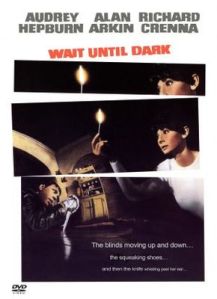 Director: Terence Young
Writer: Robert Carrington, Jane-Howard Carrington, from the play by Frederick Knott
Cast: Audrey Hepburn, Alan Arkin, Richard Crenna, Samantha Jones, Efram Zimbalist Jr., Jack Weston, Julie Herrod
Plot: Lisa (Samantha Jones) smuggles a doll filled with heroin into New York City, but hands off the doll to a man she met on the plane, Sam (Efram Zimbalist, Jr.), when she suspects she’s being followed. Sam comes home to his blind wife, Susy (Audrey Hepburn), and the two of them somehow misplace the doll, unaware of its contents. Lisa’s two partners, Mike Talman (Richard Crenna) and Carlino (Jack Weston) are met at Susy and Sam’s apartment by the man who intercepted Lisa at the airport, Harry Roat (Alan Arkin). Roat offers them a chance to help him find the doll, replacing Lisa, who he has killed for trying to “go into business” by herself. Susy arrives home, sensing the presence of people in her apartment but believing the crooks to be her neighbor’s daughter, Gloria (Julie Herrod), playing pranks on her because she has a crush on Sam. She leaves, and the men go about the business of disposing of Lisa’s body.
The next day, after Sam leaves for a business trip, Talman enters the apartment, posing as an old friend of Sam’s. Carlino and Roat get in on the con game, attempting to convince Susy that Sam has been unfaithful to her, and that his lover brought the doll to their home. Susy and Tallman search the apartment for the doll, Susy believing that if the police find it they’ll use it as evidence to charge Sam with murder. Later, Gloria appears with the doll, which she stole earlier. Gloria’s observations feed Susy’s suspicions, and they hide both the doll and Gloria when Carlino returns. Susy sends the crooks on a wild goose chase for the doll, and alone in the apartment, realizes they have cut the phone line and left her stranded, so she destroys all the light bulbs in the house, planning a final offensive. As Talman returns for the doll, Roat runs down Carlino with his car to get him out of the way, then returns and kills Talman, leaving him alone in the house with Susy. The final showdown between Susy and Roat, of course, takes place in the dark.
Thoughts: Audrey Hepburn was not only one of the most beautiful women God ever placed on this Earth, but also one of the most talented actresses. Her portrayal of blind Susy Hendrix is absolutely convincing, from the look in her eyes to the way she moves about without actually looking at what she’s doing. How many actors could pull that off so consistently without relying on the cheat of dark sunglasses to hide their eye movements?
I’ve done plenty of college and community theater, and it’s pretty easy to see this movie’s pedigree as an adaptation of a stage play. The plot is somewhat complicated, but is still mostly contained in the Hendrix apartment. Any scenes that take place beyond the apartment give only fleeting bits of information, things that were probably kept in the apartment itself when the story was told on stage. (With the possible exception of Carlino’s death scene – and even that could have easily been explained. I doubt the stage production includes someone getting run over by a car.) The rhythm of the dialogue, the expository nature of it, also feels much more like a stage play than a screenplay. There’s even a great moment where Gloria, acting as Susy’s secret weapon, quips that she wishes something like this would happen every day. In the context of the film, it’s kind of a ridiculous thing to say, but on stage I can see it helping the audience laugh and relieve a hint of tension just at the right moment.
That said, the writing really is magnificent. Frederick Knott’s original story and the screenplay by the Carringtons both paint Susy as a remarkable, resourceful woman. The criminals think her blindness will make her an easy mark, but she turns it around on them, first using her other senses to poke holes in their con game, and then turning it into a weapon in the brilliant climax.
Strictly speaking, this isn’t really a “scary” movie, not like the ghost and monster films on this list, not even like the serial killer shocker Psycho. But it’s undeniably thrilling. Part of it is Hepburn herself – she’s so universally charming and beloved that you can’t imagine anybody wanting to harm her. Part of it is the character – Susy is someone with real courage and intelligence, the sort of person you just want to see achieve a victory over the dark forces are plaguing her. The cool, calm way she faces Talman after the masquerade is exposed is completely gripping, the sort of thing that makes theatre audiences cheer with excitement. In the end, I only wish I could have seen this movie in the theaters when it first came out, when the managers shut off even the dimmest lights, bringing the audience into total blackness just when the lights go out for the bad guys.
The final scenes of this film are legendary. Susy kills the lights, then douses Roat in his own gasoline so he doesn’t dark strike a match. Plunging the screen (and theater) into darkness, Susy keeps him tapping her cane so she knows where he is, while at the same time holding him off with his own matches, the only light source. Roat gets the upper hand again when he opens the refrigerator door, but again, Susy’s blindness becomes a weapon. The musical doll tell her exactly where he is, the noisy, plastic gloves he’s wearing alert her to the fact that his hands are not currently holding a weapon. And when he drags her off to the bedroom, where again, the light is gone, it’s Susy who gets the upper hand. The finale does pull out what has since become a horror cliché – the presumed-dead villain who comes back in the last seconds – but in this early stage it’s still thrilling, and just this once, it leads to a spectacular finale.
Tomorrow it’s time to get supernatural again, with the godfather of modern zombie movies: Night of the Living Dead!
Mutants, Monsters, and Madmen Day 13: The Haunting (1963)
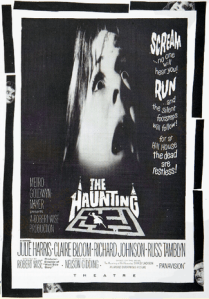 Director: Robert Wise
Writer: Nelson Gidding from the novel The Haunting of Hill House by Shirley Jackson
Cast: Richard Johnson,Julie Harris, Ronald Adams, Claire Bloom, Lois Maxwell, Russ Tamblyn
Plot: Dr. John Markway (Richard Johnson) and a team of paranormal investigators win the opportunity to spend a few weeks in Hill House, an old manor with a history of tragic deaths amongst its inhabitants. One of them, Eleanor “Nell” Lance, goes behind the back of her overbearing sister to gain access to the car she helped pay for in order to make the trip. Luke Sanderson (Russ Tamblyn) is the nephew of the owner of the house, sent along to gain an appreciation for the property he hopes to inherit one day. She befriends a fellow investigator named Theodora (Claire Bloom), whose interest in Nell seems more than academic. As the house begins to “greet” them in its own way, Nell starts to feel a certain attraction to the house, despite its terrors. The spirits seem to be summoning her, even calling to her, taking advantage of a woman who has no real direction in her life following the death of her invalid mother. Luke, meanwhile, is interested in the house only as a moneymaking scheme – what parts he can sell, what parts he can renovate, even to the point of planning to use the spiral staircase scene of a famous suicide as a nightclub.
Nell finds herself attracted to Markway, only to be devastated when his skeptic wife (Lois Maxwell) arrives and insists on joining the hunt. Nell suggests she sleep in the nursery – the sealed-off and most mysterious room in the house – but immediately regrets it. The locked room opens by itself, though, and Mrs. Markway decides to stay. After the rest of the group finds itself cornered in the parlor, loud noises and bulging walls coming in upon them, they find Mrs. Markway missing. As the others begin to tear apart the house searching, Nell (who now believes herself destined to be a part of this house) begins to roam the mansion, joyfully seeking out the spirits, finally finding herself at the wobbly, unstable staircase, climbing to the top. Markway coaxes her down, but Mrs. Markway leaps out and terrifies her, causing her to faint. Markway declares an end to the experiment and orders them all home, but Nell tells them she has no home, refusing to return to her sister and begging to stay at the house. She drives for the gate, losing control of the car and seeing a white figure leap in front of her just before she strikes a tree, killing her. The white figure turns out to be Mrs. Markway, who got lost in the massive, confusing house. Markway reveals the tree Eleanor struck was the same one where the house’s first victim died in an “accident.” He returns to the house to collect their things knowing he’ll be safe. The house has want it wants… for now.
Thoughts: From the very beginning, it’s interesting to note how different filmmaking and storytelling is today compared to 1963, when the movie was made. The film begins with Markway narrating an extended flashback sequence, detailing the history of the house and the gruesome deaths of those who have been associated with it. All this before we know who Markway is or what his association with the house actually is. A modern film is far more likely to begin with Markway begging for permission to go to the house, with the backstory being uncovered later. It’s debatable which approach is better, but since this is my little project I’ll tell you: it’s the latter one. Kicking things off with a infodump – scary as it is – takes some of the momentum out of the film from the very beginning.
The events that happen inside the house are exactly what you come to expect in Haunted House stories – odd noises, doors that close themselves, doors that open thanks to convenient gusts of wind, cold spots, and strange writing that appears on the wall (specifically “Help Eleanor come home,” a message that scares poor Nell half to death.) We deal with exceedingly creepy statues, the skeptics who try to debunk the supernatural nature of the house, the caretakers who refuse to stay in the house at night and so forth. Theo seems unnaturally perceptive about Nell, making offhanded comments about her and her life that border on the telepathic. Nell’s sensitivity to the ghosts of the house also mark her. Characters in these stories with special gifts or powers has become another trademark of the genre.
You know all of these tropes because every haunted house story uses them, but all the others were really mimicking this original. Basically, if you’ll excuse the pun, this story is the blueprint from which all other haunted house stories are built. It’s one of those stories that has been redone – in whole or in part – over and over again over the years to the point where the original almost seems derivative, even though it’s exactly the opposite. Not to say that all of these elements were 100 percent original even when Shirley Jackson wrote the novel in 1959, but her novel and this movie pulled them all together and fused them into a genre in a way that no other film had.
Interestingly, this is one of those movies where it’s what you don’t see that’s most effective. There’s no blood in the film (although I understand there’s one scene in the novel with a message written in blood which the filmmakers excised), and although you see the evidence of the spirits, you never see the spirits themselves. Even the “ghost” that startles Nell at the end turns out to be the very living, very confused Grace Markway.
In one bit of infodump that actually works, Markway takes some time to explain to the ladies why the house is so confusing – it’s constructed specifically to be that way. The doors are off-center, none of the angles are at 90 degrees, and the entire structure is built in such a way to make it nearly impossible to find your way around. Watching the film, it’s a credit to the set designers that you really do get that sense. It’s hard to tell for sure, watching only those elements the director wants us to see from the angles he wants us to see them, but the house looks incredibly confusing. There are so many doors that anybody could get confused quickly, the mirrors are all hanging at strange angles that give you peeks into obscure corners of a room that you wouldn’t expect to see in normal circumstances. Purely from a visual standpoint, the director has more than succeeded in making the house look bizarre as hell, and it’s very easy to imagine yourself getting lost in its halls.
Some of the simplest scares work the best. While the entire cast is assembled in the parlor, tremendous rumbling noises elsewhere begin to torment them. It gets worse when the doorknob begins to rattle (easily accomplished by a crew member tinkering with it slowly from the other side), then the door itself begins to bulge inward impossibly, stretching like rubber instead of wood. It’s a very simple effect, but far more effective than the expensive CGI version of the effect we saw in the 1999 remake of the film.
The ending is suitably bleak for a haunted house film, no happy ending and no real chance at redemption for the house or for the sad, broken characters. It’s not a bad film, but not nearly as good as some of the other films we’ve discussed recently. (It’s not much of a follow-up to Psycho, for instance.) Still, I think it’s notable in and of itself. It isn’t a masterpiece, but it’s a good movie, and it leaves a cinematic footprint that is clear, vivid, and continues even today.
Next is Audrey Hepburn in a classic chiller, Wait Until Dark.
Mutants, Monsters, and Madmen Day 12: Whatever Happened to Baby Jane? (1962)
 Director: Robert Aldrich
Writer: Lukas Heller, based on the novel by Henry Farrell
Cast: Bette Davis, Joan Crawford, Victor Buono, Maidie Norman
Plot: Baby Jane Hudson (Bette Davis) was once the toast of vaudeville, a child star whose singing and dancing made her famous, while the sales of her lookalike doll made her father wealthy. As an adult, Jane’s star fell and her sister Blanche (Joan Crawford) became one of Hollywood’s most acclaimed actresses. Now as old women, the sisters share a house where Jane drinks heavily amidst the memories of her youth and Blanche – confined to a wheelchair following an accident for which Jane is blamed – is experiencing a minor renaissance as her old films find a new audience on television. The relationship between the two sisters is strained to begin with, but grows worse as the mentally unstable Jane begins to torment her sister, taking the telephone from her bedroom and scaring her to the point that Blanche refuses to eat anything Jane brings her, and begins to starve. Jane attempts to restart her career, hiring a piano player (Victor Buono) to accompany her.
Their maid Elvira (Maidie Norman) discovers Blanche in captivity, and Jane murders her. When the piano player stumbles upon the captive Blanche, he manages to flee, and Jane takes her sister to one of the few places she was happy – the beach. There, Blanche reveals to Jane that she was never responsible for the car accident. It was Blanche, trying to run over her cruel, drunken sister, who caused the accident that trapped her in a wheelchair. Jane, stunned at the knowledge that they “could have been friends,” fetches her sister an ice cream cone. When the police stop her on the way back to her sister, a crowd forms, and Jane does what she always did for the crowds… she begins to dance.
Thoughts: This is another entry into that whole “psychological terror” subgenre, the type of film that relies far more on the madness of your villain and the suspense developed by the director to scare you, instead of throwing blood at the screen. In fact, of the two or three genuinely violent acts in this film, I don’t think any of them include so much as a drop of blood. But the film is no less effective for that.
In many ways, What Ever Happened to Baby Jane? is almost prophetic. How many times have we heard tales of former child stars who were unable to cope with the real world when their fame vanished? How many of them have turned to lives of crime or drugs? How many died so much earlier than they should have as the result of an insane lifestyle they couldn’t maintain into adulthood? I have no idea if such a thing was prevalent in 1960, when the novel was written, but looking at this film today makes it feel almost as though it could be ripped from the headlines. As a rule, I’m against remaking movies that were this good in the first place (although ABC television attempted to do so in the early 90s), but if someone were to transplant this story into the modern day, I think it would hold up just as well.
Much of Jane’s cruelty is verbal. She shouts at her sister, mistreats her, and generally tries to impress upon her that Blanche couldn’t possibly live without her, which the audience knows isn’t true. Blanche has already made plans to sell their house, put Jane into an institution, and hire Elvira to care for her full time. The story carefully upgrades Jane’s madness, beginning with her angry words, then moving up to the memorable scene where she puts Blanche’s own pet parakeet on her dinner plate, then later moving on to a dead rat. That’s when the real violence begins, with Jane serving up a savage beating to her sister when she catches Blanche on the phone to her doctor, trying to summon help, and even further to Elvira’s death. There’s a steady escalation for Jane’s madness that makes it feel very authentic.
For a moment, I was a bit irritated at the end of the movie, which leaves the audience wondering whether or not Blanche survives. As I thought about it more, though, I realize the brilliance in it. Jane is already dangerously unhinged. The question is, what will be worse for her – if Blanche lives, or if Blanche dies? I’m honestly not really sure, and therefore, leaving the question hanging is a clever way to cap the tale.
Like usual, with psychological thrillers, it’s the performances of the actors that make or break the film. Bette Davis received an Oscar for her portrayal of Baby Jane Hudson, and it was well deserved. The way she ricochets from anger to insanity, from a bitter old woman to a scared little girl, is a really masterful work. Crawford, famously, was very bitter over the fact that Davis was nominated and she wasn’t. And in truth, I think she was robbed. Blanche’s character doesn’t allow for the wild array of emotion and terror that Jane does, but Crawford was just as effective at portraying a kind woman who is living a life of eternal penance for her one moment of cruelty. Victor Buono, as the piano player, is a sort of charming cad. His British accent is terrible, frankly, but he really sells the part, as he cringes through Davis’s performance of her childhood signature number “Writing a Letter to Daddy,” then turns right around and pretends he thought it was wonderful.
Some of the influence of this film has been lost – there was a brief glut of films where the villain was an old woman, but that’s mostly dried up over time. (Let’s face it, in Hollywood of the21st century the villains have to be just as sexy – if not more – than the heroes.) This movie isn’t watched or talked about as much as the likes of Psycho these days, but I think it’s right up there as one of the greats in this particular subset of terror.
Tomorrow we’re getting back to the supernatural with perhaps the greatest haunted house movie ever made, the appropriately-named The Haunting.
Mutants, Monsters, and Madmen Day 11: Psycho (1960)
 Director: Alfred Hitchcock
Writer: Joseph Stefano, from the novel by Robert Bloch
Cast: Anthony Perkins, Janet Leigh, Vera Miles, John Gavin, Martin Balsam
Plot: Marion Crane (Janet Leigh) steals $40,000 from her employer to help her boyfriend (John Gavin) pay off his debts. As she’s running to him, she stops overnight at a secluded hotel run by Norman Bates (Anthony Perkins), whose elderly mother lives with him in the adjacent house. When Leigh vanishes (following perhaps the most memorable death sequence in thriller history), her sister (Vera Miles) and boyfriend begin to seek her out, following the trail back to the hotel where she met her fate. A thrilling final confrontation reveals the true depths of Norman Bates’ insanity, jolting the viewers with shock after shock that still resonates 50 years later.
Thoughts: Truly, is there any thriller more classic, more iconic, more memorable than Alfred Hitchcock’s Psycho? The movie launched a whole new subgenre of terror, making the psychology of a killer a vital element to the story. (True, Peeping Tom did the same thing, but far more people remember Psycho.)
Let’s get the necessary stuff out of the way first, though. The film was amazing precisely because it broke so many off the conventions of the day. The film begins with following Janet Leigh as she steals the money and takes off. We watch her go through a red herring sequence where a police officer grows suspicious of her and watches her trade in her car (it adds nothing to the plot, but substantially increases the viewer’s false presumption that Leigh is the film’s protagonist and, therefore, going to be with us for a while). We don’t meet Norman Bates until about a half-hour into the film, and then – assuming you’re one of the three people left on the planet unfamiliar with this sequence – we’re shocked when “Mother” murders Leigh with a full hour remaining. How could this be? She’s the main character, she’s the one we’ve been following! Where will the movie go now?
The truth is that the story isn’t really hers at all, but that false assumption is incredibly effective at distracting us from the true star – Anthony Perkins as Norman Bates. Norman, as we learn, is the classic victim-turned-victimizer, repressed by an overbearing mother whom he later killed when he felt she was leaving him behind for her new lover. Afterwards, Bates develops a dissociative identity disorder, with “Mother” taking up residence in his head and murdering any woman he feels an attraction to, leading up to the climax of the film, where “Mother” takes over entirely.
Speaking – as I am wont to do – of the influence in both directions, Mother really strikes me as being a construct straight out of William Faulkner. Bates poisons his mother and her lover, then keeps Mother’s corpse with him in the house, carrying her from room to room, speaking to her as if she was alive. I’d be hard-pressed to believe that Robert Bloch wasn’t inspired here by Faulkner’s “A Rose For Emily,” a short story where (in a twist ending — so, y’know, spoiler warning) we learn that the main character poisoned her lover years ago. He was planning to leave her, so she dosed him with rat poison and kept his corpse in her house – and bed – for the rest of her very long life. Something about that idea of living with a corpse, of sleeping next to the dead, is unfailingly creepy. It’s one of the short stories I most enjoy teaching to my 11th grade students every year, just because of the reaction when they get to the end. I wonder how these 16-year-olds would react to seeing Psycho. But more on that later.
Aside from just being a great story and screenplay, Hitchcock’s direction and Perkins’s performance combine to make this a movie that truly deserves the label “masterpiece.” Nearly every frame of the film is a work of art, expertly combining shadow and shape to create an all-pervasive feeling of terror. The 1998 shot-for-shot remake of the film was an abomination in many, many ways, but most notably because you simply can’t create the mood Hitchcock conjured up in a color film. This is a movie that needs to be in black and white to really work. The death scene in particular just isn’t as scary in color. Leigh steps into the shower, blissfully unaware of the figure in the long dress and wig creeping up on the translucent shower curtain. We see the knife raised and brought down, over and over again. The dripping blood (probably chocolate syrup or something of the sort) strikes the pure white tile of the shower and your brain fills in the rest of the blanks as it all swirls down the drain. Sure, we live in a world where the likes of the Saw movies do their level best to be as graphic as possible with the deaths of the characters, but Psycho proves you don’t need to do that to scare the hell out of people.
Janet Leigh – rightly – was given an Academy Award nomination for the film, but I can’t help but feel Perkins was robbed. As good as everything else in the film was, none of it would have worked if his Norman Bates wasn’t so remarkable. When we first meet the character, he’s very kind, polite, handsome, and instantly likable. In other films, he’d be the best friend the leads confide in during their darkest moments. But as the movie progresses, as we learn more about his dysfunctional relationship with Mother, our perception of him begins to change. He becomes an object of pity. With his tall, almost preternaturally slender frame, he somehow looks younger than he really is, almost childlike despite how he rises above Marion. The scene immediately following Janet Leigh’s murder really sticks out. Norman (who the unspoiled viewer doesn’t yet know is the killer) stands in the doorway to the bathroom, mop and bucket in his hand, to clean up the mess Mother made this time. His shoulders slump and we realize the jacket he’s wearing is far too big for his spindly body, making him look like a little boy trying on Daddy’s clothes in the hopes of looking like a grown-up. His discomfort and slip ups when speaking to a private investigator (Martin Balsam) are spot-on perfect, with the sense of unease slowly spreading across his face throughout the scene, leading into a pronounced stutter as his ball of lies becomes too large for him to control.
And then there’s the final shot of the character, once he’s been captured and institutionalized, with Mother’s voice doing the voiceover. The madness hardwired into his brain, projected through the speakers of a movie theater, would be creepy enough, but then Perkins looks up directly at the camera. This is a man that, an hour earlier, any person in the theater would have wanted for his best friend. But now the shape of his smile and the look of madness in his eyes sends an electric jolt of fear straight into the viewer’s brain. He’s clearly mad, clearly an abomination… and then the really chilling thought manages to creep in. If somebody as nice and kind as Norman Bates could be a mask for something so horrible, is there anybody we can really trust? Hitchcock finishes icing the cake as the scene fades and he quickly – almost imperceptibly – superimposes the image of Mother’s skull over Norman’s face. It’s so fast many in the audience probably don’t even consciously notice it, but they know something just happened to scare them even more.
There are only two things that really keep me from considering this a perfect movie experience – one of which is a fault of the film, the other a symptom of its success. The movie ends, after Bates’ capture, with an unforgivably long sequence in which his psychiatrist gets into a highly technical and totally unnecessary explanation of Bates’ psychosis. Any reasonably intelligent moviegoer has already figured out that Bates was insane and killed his mother, the first of his many victims. Giving a clinical explanation for it somehow makes it a little less scary. The few details this scene adds that we couldn’t have figured out – such as the fact that Bates killed at least two other girls between the death of his mother and that of Marion Crane – aren’t needed for us to appreciate the depths of his depravity.
The other problem is that the film is now so well known, so influential, that much of the shock has gone. Even someone who has never seen the movie likely already knows, before they even turn it on, that Norman Bates is the killer and that Mother is dead, a mummified corpse he keeps with him out of a twisted sense of love. In this sense, I almost envy my 11th graders. For many of these kids, 15- and 16-year-olds, any movie made before the turn of the century is practically ancient history, and not on their radar at all. They’ll probably have heard of Psycho, but not really know anything about it. If their apathy allows them to watch this movie for the first time with a blank slate… oh, for the first time, I envy them.
Moving right along, tomorrow we’ll tackle one of the cinema’s most chilling cases of sibling rivalry: Whatever Happened to Baby Jane?
Mutants, Monsters, and Madmen Day 10: Peeping Tom (1960)
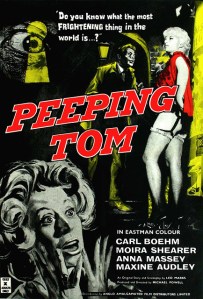 Director: Michael Powell
Writer: Leo Marks
Cast: Carl Boehm, Moira Shearer, Anna Massey, Maxine Audley
Plot: Mark Lewis (Carl Boehm) is a part-time photographer, making ends meet by taking lurid photographs of women in lewd vignettes, while pursuing his true aspiration of being a filmmaker. But his filmmaking is part of a darker thirst – Lewis is stalking the streets, luring women home and filming as he murders them. As Mark befriends a neighbor, he reveals to her how his own father used to photograph him in moments of discomfort, terror, or fear, even including the boy standing by his own mother’s deathbed. Despite this, Helen (Anna Massey) asks him to take photographs to illustrate a children’s book she has written, to which he enthusiastically agrees.
As Mark comes under the suspicions of the police investigating the killings, Helen convinces him to go out with her, but makes him leave behind his omnipresent camera. Helen’s blind mother (Maxine Audley) becomes uncomfortable with Helen and Mark’s relationship, and confronts Mark in his darkroom. Mark is upset that his most recent film didn’t come out the way he wanted, and almost reenacts the murder with Helen’s mother, but barely stops himself. She demands he stay away from Helen until his “unhealthy” fixation with photography is done away with, threatening to move away. He kills once more, this time knowing that the police are watching him, and rushes home, where Helen has found his films. He tells her how he attached a mirror to his camera, forcing his victims to watch their own terrified faces at the moments of their death. As the police arrive to take him away, Mark runs through a long-prepared gauntlet of cameras to the completion of his film – his own suicide.
Thoughts: This is one of those films that, upon its release, was deemed so controversial that the filmmaker’s career was effectively ruined. Its portrayal of raw sexuality was pretty risqué for the time, although there’s nothing so provocative in the final cut of the film that you couldn’t show it on basic cable today. (Well… at certain times of the day, at least.) There’s a brief glimpse of a bare breast on Mark’s last victim before the screen fades to black (something removed from many cuts of the film), but most of the gore takes place off-camera. Even Mark’s self-inflicted fatal wound to the neck doesn’t really look like that big a deal. As he falls backwards, clutching the wound, you could easily think he just nicked himself shaving.
Although the film is called the “first slasher movie” by many, it’s markedly different from the way we picture the genre today. Later, better-known slasher films are all about the psychology of terror: Halloween and Friday the 13th are all about the fear the audience feels. Even in Halloween, when we see the attacks through the eyes of Michael Myers himself, we’re supposed to feel the terror of the victim. Not so with Peeping Tom – this movie is all about the psychology of the killer. First of all, there’s never any question of the murderer’s identity. We know from the very beginning that Mark Lewis is a killer, and even though the police and other characters in the film are trying to solve a mystery, for the audience, there is none. So rather than question who is murdering young women, we are allowed instead to focus our curiosity on why he’s doing such a horrific thing.
While most of the movies I’ve talked about (and will talk about over the rest of this project) have been American, this one is a British film, and as such, plays heavily on British fears. While over in the States, we were worried about the Red Menace, in England they were still licking their wounds from World War II, and this film toys with that. There’s a distinct tinge of a German accent to Mark – who himself is a blond-haired chap cast in the mold of Hitler’s perfect Aryan. Mark is twisted and shaped by his father’s experiments, turned into a monster, something that could easily be looked upon as a metaphor for the Nazi subjugation of the German people before their country went on to become a boogeyman to the rest of the world. In this case, the father begets the monster.
I’m not sure if – at any point – we’re actually supposed to be sympathetic to Mark. In fact, the scene where he forces Anna Massey’s character Helen to watch the truly disturbing films of his own childhood is the scene where Mark first starts to feel like an all-out psychopath. The record of Mark’s descent into madness isn’t about excusing him, it’s about explaining him. “We aren’t saying it wasn’t his fault, we’re just giving him a motivation.” I rather like that – at times cinema seems to waste entirely too much time trying to find ways to explain away the actions of our monsters, and some of them just don’t deserve that consideration. He’s a horribly disturbing creature, from the way he encroaches upon his victims before he kills them straight through to him transferring the light kiss Helen gives him to the lens of his camera. Helen is the sympathetic character here, a girl who takes pity on a broken bird and through it finds a sort of friendship, which breaks her heart when it collapses at the end.
This is the film where we see the core of those movies about what makes a killer. This is where we see the heart of Hannibal Lector, and it draws from the same well as Norman Bates. And speaking of Norman Bates, it’s about time. Come back tomorrow as we introduce ourselves to Alfred Hitchcock, Anthony Perkins, and Janet Leigh for one of the most acclaimed thrillers of all time. It’s time… for Psycho.
Mutants, Monsters, and Madmen Day 9: The Fly (1958)
 Director: Kurt Neumann
Writer: James Clavell, based on the short story by George Langelaan
Cast: Vincent Price, David Hedison, Patricia Owens, Charles Hebert, Herbert Marshall
Plot: A scientist (David Hedison) is found dead, his head and arm crushed into an unrecognizable mess. His wife (Patricia Owens) confesses to the crime, but refuses to provide details, although she seems obsessed with finding a strange white-headed fly. As the investigation begins they find she actually crushed him in a hydraulic press twice… something the victim’s brother (Vincent Price) cannot fathom, as they had a loving marriage. Owens begins to come unraveled, going berserk when a nurse crushes a fly on the wall. Finally, Price coaxes the truth from her: his brother was destroyed by his own invention – a disintegrator-integrator – which horribly mingled his body with that of a housefly, turning him from man to beast. As they attempted to find the fly that now had his arm and head, his mind became more and more frayed, until he finally begged her to kill him. Price keeps the story to himself, allowing the court to believe her insane, and sparing her from a murder charge.
Thoughts: I wish I could have found other films between the last one (1942’s Cat People) and this 1958 classic, but as I tried compiling my list, I was stunned at the utter dearth of memorable horror films from the late 1940s and early 1950s. This isn’t to say there weren’t scary movies, but that doesn’t necessarily make them the right choice for my little project here. It actually gets back to what I said about horror at the very beginning – horror is subjective. Each person, and in a larger sense, each culture determines for itself what it considers terrifying, and in the late 40s and 50s the fears of the American public weren’t running along the lines of vampires and witches and monsters. In the wake of the atom bomb, we were afraid of science gone wrong. With the rise of the Soviet Union, we feared the threat of international communism. The result is that the best, most iconic scary movies of this era don’t necessarily fall into the category of horror, but belong more appropriately on the science fiction list (which I hope to use for this same sort of project in the future). The truly disquieting films of the time were things like The Day the Earth Stood Still (1951) and Invasion of the Body Snatchers (1956) – both excellent films worth discussing, but I feel like they belong more in the realm of sci-fi than true horror.
So that brings us to 1958 and The Fly, which still straddles the line between science fiction and horror, but falls with enough of its bulk on this side of the line to make it on the list. While not exactly built on hard science, the movie attempts more of a feeling of realism than most other sci-fi shockers of the area, which often dealt with the likes of insects and other animals mutating into giant beasts thanks to radiation exposure, eventually leading to their death by missile and their ridicule at the hands of a guy in a satellite and his two little robot pals. In The Fly, director Kurt Neumann does make an effort to help the science seem plausible, at least to an audience without deep understanding of such things. (At one point, while trying to guess the nature of his brother’s experiment, Price even suggests a flatscreen television.)
Vincent Price, of course, gets top billing for this movie, but for my money that really should have belonged to Patricia Owens as Helene. Price is in the framing sequence – the 30-minute buildup to the flashback and the 10-minute denouement at the end – but Owens really carries the film. We see her at the beginning as the shellshocked, borderline deranged woman who has just witnessed her husband’s death, then go to the backstory where she’s a kind, devoted wife. She’s really magnificent in the part, going from the heights of joy for her husband’s success to a slow spiral into despair when his experiment falls apart. Finally, at the end we get pain and resignation from her. Genre pictures are rarely recognized for the performances of their actors when award season rolls around, but I would put Owens’s performance in this film right up there with any great actress of the era.
The film follows a fairly standard format for horror films of the era, where the truly terrifying stuff happens largely off-screen. This is to the good, because when the blanket comes off David Hedison and we finally see his transformation… well… just as Owens is as fine an actress as any of the day, his creature costume is as goofy as any of the day. It’s a silly-looking monster helmet with a some device to make the pincers twitch a little bit. I find the final scene far more chilling – Price and the inspector (Herbert Marshall) manage to track down the white-headed fly to a spider’s web where it’s been captured and about to be consumed. The effect of a tiny little David Hedison caught in the spider’s web, superimposed against film of a real spider, is impressive by 1958 standards, and the effect of his miniscule voice pleading for help as the predator advances upon him is creepy even today. It’s probably the most memorable scene of terror from the film, far more so than the human-size fly.
The film plays upon the fear of unchecked science, questions of insanity, and a good dose of body horror (which, no doubt, is why David Cronenberg was the man tapped for the 1986 remake). All of these elements add up to one of the best films of the era.
From the end of the age of monsters, we’re about to step into the world of more psychological terror. Next on my list is the film many consider the first slasher movie, the 1960 film Peeping Tom.
Mutants, Monsters, and Madmen Day 8: The Cat People (1942)
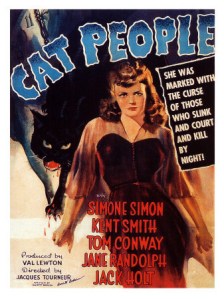 Director: Jacques Tourneur
Writer: DeWitt Bodeen
Cast: Simone Simon, Kent Smith, Tom Conway, Jane Randolph
Plot: A young woman from Serbia meets and marries a handsome young American man. But their relationship is stalled due to a fear that, should she allow herself to become intimate with her new husband, she will fall victim to an ancient curse that causes people in her family to transform into killer panthers. After they’ve been married for some time – during which she never allows herself so much as a moment of physical passion with her husband – she begins to suspect that he is having an affair with his attractive young assistant. And then we realize lust isn’t the only emotion that can trigger the curse… jealousy works, too.
Thoughts: Like a lot of early horror films, this one uses folktales (real or imagined) as the basis of the monster, such as it is. The idea of an “old curse” is standard. What’s interesting to me is the way Irena (Simone Smith) claims the curse came upon her family: in centuries past, they dabbled in witchcraft and consorted with the devil, and as such were branded with this inability to grow close to anyone. This immediately calls to mind the question of how, exactly, they’ve managed to perpetuate the family line over the centuries, if they turn into monsters and slaughter anyone they grow physically intimate with. (The 1982 remake answered this question in the logical and extremely squicky way of saying that family members could only be intimate with one another, despite them being from Serbia and not members of any particular royal family.)
Of more interest – to me, anyway – is the way the perception of witchcraft has changed over time. Sure, whenever a movie that seems vaguely related to the topic is released today you get your requisite group of picket sign-carrying protestors condemning everybody who’s going to see the movie to Hell, but they’re considered a joke by both the media and most passerby who see them. In truth, these days if a movie uses witchcraft as its hook, we usually see a case of an innocent person accused of witchcraft and being tormented by an oppressive society. (For the best example of this, see 1996’s The Crucible, the script for which was written by the original playwright, Arthur Miller.) The alternative is typically a more classic representation of witchcraft wrapped up in a movie that’s laughable in its presentation of something that was once considered a very legitimate threat. (For the most recent example, as of this writing, see 2011’s Season of the Witch. This movie gets bonus cheese points for having Nicolas Cage with long hair while simultaneously being bald.)
At any rate, in 1942 witchcraft was seen as a much more legitimate source for horror, and a curse being a punishment that goes down generations was something that could cause true fear. The 1982 version of the film throws away the witchcraft elements in favor of a more vague curse, which is apparently still acceptable so long as you don’t specify that it’s a result of bubbling cauldrons or dancing in the moonlight with Mephistopheles. Even the specific manifestation of the curse is given a Biblical connection – Irena chats with a zookeeper who kindly takes the time to explain who the Book of Revelations describes a beast from Hell that is “like a leopard, but not a leopard,” which to him is pretty much the definition of a panther.
The other thing about this film that I find really odd is the way the relationship grows. In 1942, when filmmakers didn’t get quite as explicit about sex as they do today, they got away with a man falling and love with and marrying a woman who refuses any sort of physical intimacy – even so much as a kiss – giving him an excuse that would today either have the man drop her for a loony after the first date or do everything he can to get her onto Dr. Phil. Granted, Oliver (Kent Smith) eventually does seek out psychological help for Irena, but only several chaste months after they are married. I don’t care it if is 1942, nobody is that good. Let’s be clear about this: this is not a fear that Irena developed some time after she and Oliver got involved, this was a barrier between them from the day they met. A month after they start dating, he mentions to her that, y’know, normal people in love kiss, and she starts with the whole “I turn into a cat” thing. This, Oliver, this is the time to seek out mental help. Not after you marry a woman who insists on separate bedrooms and a bowl of Fancy Feast at night.
In many ways, this Oliver Reed character begins the film as something of a fantasy man. He’s good-looking, square-jawed, loves Irena from the moment he meets her despite her little “quirks,” and is resistant to temptation from Alice (Jane Randolph) even once she pretty much starts throwing herself at him. But even Mr. Perfect eventually starts to break down – he gets mad at Irena when she starts skipping her therapy sessions, and ultimately decides to leave her for Alice. Even then, though, the film doesn’t give us reason to believe there’s any hanky-panky going on before he proclaims he wants a divorce. Look at the timeline here: Irena is given the 1942 Man of the Year on a silver platter, then drives him away because she acts cold, jealous, and irrational. (Well, okay, it only seemed irrational, turns out she really did turn into a murderous cat, but one can hardly blame Oliver for not quite believing that.) You can’t tell me that the writer of this film wasn’t firing a warning shot across the stern of the Women of America, whose husbands at this point were increasingly getting shots fired across their own sterns over in Europe and the Pacific.
The movie’s ending is suitably tragic, and the body count is remarkably low (compared to modern films). And to be frank, while it’s entertaining in its own way, I don’t see it as being that great a precursor to modern films, except perhaps to show how different societal norms have become in the last 70 years. There’s a taste of Jekyll and Hyde in here, a flash of the subtle sexuality that would later become more dominant in the works of Anne Rice, but nothing I really feel is definitive the way I’ve felt about some of the other movies I’ve seen. The film’s sequel, 1944′s Curse of the Cat People, is even less memorable, with no “cat people” present, instead tapping into The Legend of Sleepy Hollow and turning into a ghost story about a married Oliver and Alice terrorized when Irena’s ghost begins visiting their six-year-old daughter. Weirdness.
We’re taking our biggest jump in time yet next, and I’ll talk about why that is tomorrow, when we get down to the classic 1958 sci-fi chiller The Fly.
 Reel to Reel