Category Archives: Genres
Batman Week Day 4: Kevin Conroy in Batman: Mask of the Phantasm (1993)
 Directors: Eric Radomski & Bruce Timm
Writer: Alan Burnett, Paul Dini, Martin Pasko & Michael Reaves
Cast: Kevin Conroy, Dana Delany, Hart Bochner, Stacy Keach, Abe Vigoda, Dick Miller, John P. Ryan, Efrem Zimbalist Jr., Bob Hastings, Robert Costanzo, Mark Hamill
Plot: As Batman (Kevin Conroy) chases after a gang of mobsters in Gotham City, one of them manages to escape, only to encounter a chilling robed figure with a bladed scythe for a hand. This masked shape, far more brutal than Batman himself, sends gangster Chuckie Sol’s (Dick Miller) car over the edge of a parking garage and into a nearby building. Batman arrives in time to see the traces of this “Phantasm”’s wrath, but is unable to capture him.
At a party at Wayne Manor Bruce encounters Councilman Arthur Reeves (Hart Bochner), whose anti-Batman crusade has been making papers. Reeves reminds Bruce of Andrea Beaumont (Dana Delany), one of those classic girls who got away. Bruce remembers meeting Andrea at a cemetery years ago, before he adopted his Batman persona but after he made his pledge to his murdered parents to seek justice. Andrea is visiting her mother’s grave and Bruce his parents. The two quickly feel a connection, and within days Bruce’s butler Alfred (Efrem Zimbalist Jr.) is walking in on them in a deep kiss.
Back in the present, gangster Buzz Bronski (John P. Ryan) arrives to pay his “respects” to the late Chuckie Sol, but is attacked by the Phantasm, who implies a previous relationship with the criminal. The Phantasm forces Bronski into an open grave and topples an angel statue, killing him. Reeves blames the second gangland killing on Batman, but Commissioner James Gordon (Bob Hastings) defends the Dark Knight. As Batman investigates the murder scene at the cemetery, he sees Andrea Beaumont, who has returned to town. Batman watches as she meets Reeves for dinner, and again begins to reminisce.
Soon after he and Andrea begin dating, Bruce takes her on a visit to an exhibition of the future, full of amazing technology and a particularly impressive car. Andrea invites Bruce to meet her father Carl (Stacy Keach), and while Bruce agrees, he confesses to Alfred that he’s concerned about deviating from his plans to become a crimefighter. Alfred, however, is fully supportive of the relationship. When Bruce meets Carl, he also meets Reeves for the first time – at this point, just a “hot young turk” in Beaumont’s legal department. Carl is very welcoming to Bruce, who finds himself unnerved when their meeting is interrupted by a surprise visit from the intimidating Salvadore Valestra (Abe Vigoda). As they leave Beaumont, Bruce sees a group of motorcycle punks attacking a vendor and rushes in to fight them. Although formidable, one of the crooks gets in a hard blow to Bruce and escapes. Andrea is worried, but Bruce brushes her off. He finds himself torn between his promise to his dead parents and his relationship with Andrea, certain he can’t have both. He goes to his parents’ grave, begging their permission to abandon his quest for justice and allow himself to be happy, but is interrupted by Andrea, who suggests that maybe she was sent by his parents because he already has their blessing.
In the present, Valestra speaks to Reeves, who assures him that it’s Batman killing the crimelords. Valestra, now old and infirm, is beginning to fear for his life. Batman, meanwhile, finds Sol and Bronski were connected through a series of dummy corporations along with a third partner: Valestra. Alfred tries to persuade him to see Andrea again after he’s done with Valestra, but Batman refuses. He painfully recalls his awkward proposal to Andrea years ago. Even as she accepts, though, a swarm of bats escapes the caves beneath Wayne Manor and swallows the couple. Shaking it off, they go to Carl’s house to announce the good news, but the house is full of business associates. Andrea convinces Bruce to wait. The next day, as he explores the bat-caves beneath his house, Bruce receives a message from Andrea saying she’s leaving town with her father, and that he should forget about her. Along with the note is her engagement ring. Broken-hearted, he continues with his pledge to his parents.
In the present, Valestra visits the now run-down and decrepit “future” exhibition where Bruce once romanced Andrea. It’s not abandoned, though – here Valestra encounters the Joker (Mark Hamill), who he begs for protection from Batman. Batman approaches Andrea with a photograph of the targeted gangsters and Carl Beaumont, asking where Carl is now. Andrea claims she doesn’t know, and angrily tells Batman, “the way I see it, the only one in this room controlled by his parents is you.” As Batman leaves, she weeps.
The Phantasm goes to Valestra’s home, but he’s already been murdered by the Joker, who has rigged the corpse up with a video camera and a bomb. Although he’s surprised it isn’t Batman, the Joker blows the bomb anyway, and the Phantasm just barely escapes, but is soon pursued by Batman. The police arrive, but don’t see the Phantasm at all, and believe Batman bombed the house. He barely escapes, losing his mask in the process, but Andrea races in and rescues him. She confesses what really happened the night of their engagement: she returned home to find her father with the criminals in the picture, who threatened her if her father didn’t give them money he’d been embezzling. They give him 24 hours to get the money, but he can’t free it in time. Carl forces Andrea to pack a bag and flee Gotham, breaking her engagement to save her life, and he angrily swears to free her from the criminals “whatever it takes.” Andrea tells Bruce she believes the Phantasm is her father, come back to Gotham to set them both free from his past. She tries to leave but he stops her, and Alfred – again – walks in on the two of them as they kiss. The next morning she leaves just before Bruce has an epiphany. There’s a fourth, unidentified criminal in the old photograph… a swipe with a red pencil makes him realize it’s the Joker, in those long-ago days before his skin was bleached and his mind shattered.
The Joker approaches Reeves, accusing him of using Beaumont’s ill-gotten money for his own gains. The Joker denies that Batman is the killer and doses Reeves with a chemical that sends him to the hospital, giggling uncontrollably. As he lies in his hospital bed, Reeves is visited by Batman. Reeves confesses helping Beaumont escape Gotham years ago, but hasn’t heard from him since he asked for money for his first campaign. When Beaumont denied him, Reeves sold his location to the mob. Batman goes to Andrea’s apartment for clues and he finds a locket he gave her years ago. The Joker attack him with a drone, and reveals his hideout in the abandoned exhibition.
At the exhibition, Andrea remembers the last time she saw her father – after the mob murdered him. Putting on the Phantasm’s costume, she attacks the Joker, who has already seen through her masquerade. He nearly kills her, but Batman saves her, at the same time refusing to let her murder anybody else. He asks her what vengeance will solve, a question whose irony she points out before disappearing in a puff of smoke. Batman pursues the Joker through the exhibits, which he has wired to explode. Eventually, Andrea captures him. Although Batman begs her to flee from the explosives, she and the Joker both disappear in the smoke as the exhibition begins to explode all around them. Batman falls into a storm drain and is swept away. Back in the cave, Alfred tells him his greatest fear is that Bruce will someday fall into the vengeance-craving Pit that consumed Andrea. As he mourns, he sees a glint in the darkness of the cave: Andrea’s locket. We glimpse her on a ship out of town, approached by a man. When he asks her if she wants to be alone, she simply answers, “I am.”
Thoughts: Like the 1966 Batman: The Movie, this 1993 offering is a theatrical spinoff of a television show. Batman: The Animated Series launched in 1992, and quickly proved that animation was a perfect medium for the Dark Knight. Paul Dini and Bruce Timm crafted a version of Batman that was sleek, powerful, and respectful to the comic books. It was much harsher and more violent than other cartoons of the time, and the designs were bold and striking, mixing in a 40s-era design aesthetic (particularly in the buildings, vehicles and fashion) with a modern storytelling style. This film takes everything that made the TV show great and amplified it, giving us what was (at the time) the greatest version of Batman ever put on the big screen. The climactic fight scene, where Batman and the Joker fight it out in the miniature city, has a sort of reverse King Kong feel to it. It’s the sort of thing you’d see in a goofy Silver Age comic – Batman swatting tiny planes out of the air while the Joker uses the tip of a skyscraper to bash his foe’s head – but it’s played perfectly straight and deadly seriously.
You’ll forgive me if I talk a bit about the TV show along with the movie, but everything that made the one great also applies to the other. Kevin Conroy’s Batman voice was so perfectly iconic that he remains the most popular performer for the character in animation or video games over 20 years later. He does with his voice what Christopher Reeve did with Superman – shifting flawlessly from a powerful, heroic presence to an entirely different character when he’s not uniform. Conroy’s Bruce Wayne isn’t the faux geek that Reeve’s Clark Kent was, of course, but he has a different tenor, a different attitude, and a different feel that you can accept transforming into Batman, but at the same time, could be forgiven for failing to make the connection if you didn’t know better.
The rest of the cast from the TV show is similarly magnificent. Efrem Zimbalist Jr.’s Alfred is the perfect mixture of supportive and sarcastic, with a quiet wit that speaks to the character perfectly. Bob Hastings as Commissioner Jim Gordon is, likewise, a definitive version of the character. And Mark Hamill as the Joker… He’ll always be remembered for playing Luke Skywalker in the Star Wars films, of course, but to so many Bat-fans, he’ll be one of the greatest Jokers ever. He’s more menacing than Nicholson, crazier than Romero, and if he wasn’t in a franchise that had to be sanitized for children, he could easily play a Joker that would give you nightmares. Like Conroy, he was the voice of the character for decades, and everyone was sad when he formally announced his retirement from the character a few years ago.
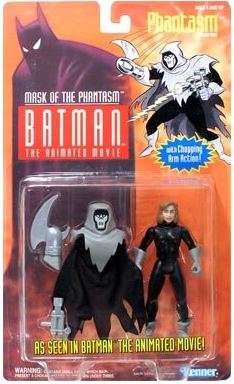
Seriously, who the hell thought this packaging was a good idea?
The one major addition to the cast who wasn’t in the show was Dana Delany as Andrea Beaumont. The voice she puts on here is sweet and kind, with less of an edge than she would use a few years later as Lois Lane in Superman: The Animated Series. Her character works perfectly for the story, though, despite the toy licensees’ attempts to sabotage it. The film works really hard to keep the Phantasm’s identity secret. The design of the character is male, and Stacy Keach provides the voice when he’s in his mask, making it seem as though Carl Beaumont is the one seeking revenge for anyone who can recognize the voice through the modulation. Therefore, when Andrea is revealed as the Phantasm it’s a legitimate shock, a great kick in the gut… unless you happened to go to Toys ‘R Us earlier that day and saw the Phantasm action figure with an unmasked Andrea Beaumont in plain view.
One thing you’ve got to give Superman over Batman – he’s had a much more stable love life. Oh sure, there have been dalliances with Lana Lang, Wonder Woman, that mermaid that one time, but pretty much every movie version has always come back to Lois Lane. This is the fourth Batman movie I’ve watched for this project, and there’s been a different woman in each one (and there’ll be still a fifth tomorrow). I suppose part of it is the attempt to make Batman seem like the perpetual loner, although that image is quickly dispelled by the plethora of Robins, Batgirls, Outsiders and Justice Leagues he typically surrounds himself with. On the other hand, that makes a story like this one work much better than it would with Superman or Spider-Man or any hero who has a more traditionally stable love life on screen. No one would really take Andrea seriously, start to picture her as the girl Bruce belongs with, if they were accustomed to seeing him with somebody else full-time. This way, we get to fall in love with her a little bit along with Bruce, making the ending of the film all the more tragic and powerful.
The TV show and movie both take certain elements from the Tim Burton version of Batman from 1989, including the designs for the Batmobile and Batwing and, most notably, music inspired by the Danny Elfman score. But while the popularity of the Burton films may have helped get this version produced in the first place, Dini and Timm quickly took the franchise in different directions, making it more serious most of the time. This is a far deeper, more psychologically intriguing and –frankly –more realistic portrayal of Batman than any of the previous ones. This is a Batman that can actually get hurt physically as well as emotionally. He gets tired, he gets cut, he bleeds. And while Michael Keaton’s Batman did have a degree of brooding about him, Kevin Conroy’s is a rich, multi-layered character that actually struggles with his choices in a way that no film version of Batman had ever done.
For the most part, our culture still marginalizes animation as a tool only suitable for children’s stories. Although there has been some improvement on that front, in 1993 it was even worse than it is today, so there was no small amount of surprise at this film’s heavy violence and implied sex. (It was still a PG-rated movie, but much harsher than even this same production team would have dared to put on television at the time.) But then, as now, I loved this movie completely. There is room, as I’ve said many times, for a lot of different versions of the Batman in popular culture, but that doesn’t mean that individual fans might not feel loyalty to certain interpretations of the hero. As good as the stuff that was coming (which we’ll discuss tomorrow) turned out to be, to me, this is still the truest version of Batman ever put to screen. And I don’t just mean by 1993, I mean in the two decades since then as well.
The first Reel to Reel study, Mutants, Monsters and Madmen, is now available as a $2.99 eBook in the Amazon Kindle store and Smashwords.com bookstore. And you can find links to all of my novels, collections, and short stories, in their assorted print, eBook and audio forms, at the Now Available page!
Batman Week Day 3: Michael Keaton in Batman (1989)
 Director: Tim Burton
Writer: Sam Hamm & Warren Skaaren
Cast: Jack Nicholson, Michael Keaton, Kim Basinger, Robert Wuhl, Pat Hingle, Billy Dee Williams, Michael Gough, Jack Palance, Jerry Hall, Tracey Walter, William Hootkins
Plot: As a pair of muggers in Gotham City go through their loot, a black-clad figure wearing a bat symbol attacks, incapacitating them both in seconds. When one of the criminals begs for his life, the man in black tells him he wants a favor… he wants him to tell all his friends. When the crook asks who he is, he hisses in reply, “I’m Batman.”
Commissioner James Gordon (Pat Hingle) and District Attorney Harvey Dent (Billy Dee Williams) make a public pledge to take down crimelord Carl Grissom (Jack Palance), an announcement watched on TV by Grissom’s chief lieutenant, Jack Napier (Jack Nicholson). Jack has been having a fling with Grissom’s girlfriend Alicia (Jerry Hall), but is confidant Grissom has no idea what’s going on under his nose. Reporter Alexander Knox (Robert Wuhl) is approached by an award-winning photographer named Vicki Vale (Kim Basinger). As two of the only people in town who believe the Batman exists, they form a partnership to try to dig out the story. They attend a casino night hosted by Gotham’s richest son, Bruce Wayne (Michael Keaton), hoping to get the authorities on record about the Batman. Encountering Bruce, who comes across as somewhat absent-minded, leaving a bizarre impression before he is called away by his butler, Alfred (Michael Gough). While at the party, Gordon is given a tip that Napier is robbing a local chemical company. Bruce, now in a hidden cave beneath the mansion, listens to Gordon’s conversation as picked up by a hidden camera.
At Axis Chemicals, corrupt police Lieutenant Eckhardt (William Hootkins) prepares his men to take down Napier’s gang, giving orders to shoot to kill. Inside, Jack finds the safe empty and realizes they’re being set up. The cops and gangsters begin a shootout, but Gordon arrives and commands the police to take Napier alive. Batman rounds up the criminals and manages to grab Jack, but his chief goon Bob (Tracey Walter) threatens to kill Gordon if he doesn’t let him go. Although Batman tries to save him, Jack tumbles over a rail into a vat of chemicals, his face damaged in the battle.
The next evening, Vicki returns to Wayne Manor for a dinner with Bruce. It goes well, but she can’t help but notice that so much of the image of the playboy doesn’t fit as she begins to get to know him. Jack, meanwhile, has escaped the chemical bath, but not without damage. As he removes the bandages from his face, he smashes the mirror and stumbles away, giggling maniacally. He returns to Grissom’s home, confronting him over the double-cross. He reveals the extent of the damage – his skin bleached, his hair turned green, his mouth frozen in a permanent grin. Calling himself the Joker, Jack guns Grissom down.
Jack (wearing fleshtone makeup) meets with the rest of Gotham’s crimelords, announcing he’s taking over Grissom’s operation. One of them indicates an unwillingness to cooperate, so Jack offers a friendly handshake, roasting him with a supercharged joy buzzer. His power solidified, he instructs Bob to trail Knox and find out what he knows about the Batman. Vicki leaves Wayne Manor the next morning, happy with Bruce and looking forward to seeing him again after he returns from a business trip. As she bids farewell to Alfred, though, he lets it slip that no such trip is forthcoming. She leaves, confused, and trails Bruce to a bad part of town, where she sees him lay a pair of roses on the ground in an alley.
That night, Gotham’s Action News reports on the deaths of two models who died after an extreme reaction to cosmetics leaving them with horrible grins on their faces. A bulletin announces three more similar deaths, when suddenly one of the anchors has an uncontrollable laughing fit and keels over. Suddenly, the Joker cuts into the feed, announcing his “Joker Brand” products – products that, chances are, everybody in town has already bought. Bruce studies Jack’s past, learning he has a background in chemistry, and he and Alfred go on a shopping trip. Gotham begins to struggle as everyone is terrified to use food, cosmetics, or anything that may contain the Joker’s “Smilex” chemical.
Vicki leaves a message for Bruce to tell him she’ll be late meeting him at the museum, but he has no date planned. It’s a trap by the Joker, who has become infatuated with her after seeing one of Bob’s surveillance photos of Knox. The Joker and his goons come in, smashing and defacing the exhibits. He approaches Vicki, proclaiming himself to be the “world’s first fully-functioning homicidal artist.” As proof, he has Bob bring in Alicia, whose face he has horribly scarred, and tells Vicki he wants her to record his “art” in photography. Batman rescues her, but the Joker’s thugs pursue him and nearly take him down. Just as Bob is about to remove his mask, Vicki snaps a picture, distracting them long enough for Batman to fight free. He brings Vicki back to the Batcave, where he tells her he’s cracked the “Joker Products” code – there’s no one single product that’s harmful, but certain combinations of products that are deadly. He gives her his research, instructs her to bring it to the press, and gasses her. When she wakes up, she’s safe at home, and realizes he took the film from her camera with the picture of his upturned mask.
As Gotham returns to normal, Alfred urges Bruce to tell Vicki the truth about his identity. He visits her apartment, intending to do just that, but they’re interrupted by the Joker, who tells her that Alicia tragically “threw herself out of the window.” Bruce reveals himself and threatens the Joker, who casually asks him if he’s ever “danced with the devil in the pale moonlight” before shooting him. He leaves Vicki alone, and she turns to find Bruce gone, a tray from her mantle lying on the floor with a bullet-sized dent.
Knox has researched the alley where Bruce left the roses and discovered his parents were murdered there before Bruce’s eyes when he was just a child. Bruce, meanwhile, is delving back into the case himself. The Joker’s “dance with the devil” taunt has dredged up memories, and he realizes Jack Napier is he nameless thug that murdered his parents. The battle is personal now, and becomes moreso when the Joker seizes Gotham’s airwaves again to announce he’s going to dump $20 million on the crowd for Gotham’s 200th anniversary celebration that night, challenging Batman to a confrontation.
Using the Batmobile via remote control, Batman destroys the Axis Chemical Plant, taking a number of the Joker’s goons with it, but the Joker remains at large, flying above in a helicopter. He retreats to the city, where he’s started a parade full of balloons and floats, hurling money into the crowd before gassing it with Smilex. In his Batwing jet, Batman cuts the gas-filled balloons loose. The Joker shoots the Batwing down with an improbably long-barreled gun, but Batman survives the crash. The Joker snares Vicki and leads her to the bell tower in Gotham City Cathedral where he awaits his helicopter. Batman and the Joker face off at the top of the Cathedral, where Batman vents his rage at Jack Napier for killing his parents. The three of them wind up dangling over the edge of the Cathedral, Joker dangling from a ladder to his helicopter. Batman snares him with a line, attaching him to a gargoyle broken from the cathedral. The added weight is too much, and the Joker plunges to his death. Soon afterwards, the police round up the Joker’s men and announce an alliance with the Batman, complete with a signal – an enormous spotlight that casts the emblem of the bat against the night sky. Vicki meets Alfred in a waiting limo… he apologizes for Bruce. He’s going to be a little late.
Thoughts: When Tim Burton’s Batman came out I was 12 years old, just at the perfect age to be heavily influenced by it. The prospect of Batman on the big screen was thrilling to me, and I was excited as I’d ever been to see a movie in my life. Looking back, my perspective has changed a little. While I never achieved the level of distaste I sometimes have for the Adam West incarnation, looking back on this film nearly 25 years later, I realize that it’s a good Tim Burton movie, but it isn’t really a great rendition of Batman.
You see, Tim Burton is a particularly distinctive filmmaker. He’s got lots of visual tricks, certain pacing techniques and other elements that all combine to make a movie distinctly his. This would be the first time he did a major adaptation of somebody else’s characters, but it sets the stage for his career in the future. Years later when he’d tackle Planet of the Apes, Alice in Wonderland, Charlie and the Chocolate Factory and the like, it would become clear he had his own sub-category of film… adaptations run through a Burton filter. Sometimes it works, sometimes it’s a disaster. This Burton-filtered Batman is a good movie, much darker and more serious than the movies we’ve discussed in this project so far, but still lacks certain elements that keep it from being great as a Batman film.
There is a lot of good here. This is the first film in the project to tackle Batman’s origin, for instance, and it does it in a very good way. Certain superhero origins are so well known that it’s become redundant to go over them yet again, and working it in as exposition rather than taking an hour to cover it works very much to this film’s advantage. It’s also the first time we’ve seen a Batman that isn’t a fully authorized officer of the law. The outlaw status works better for the character, even when he’s allied with the police.
I also really like Michael Keaton’s version of Bruce Wayne. There isn’t a lot of comedy in this movie, but Keaton (who previously worked with Burton in Beetlejuice) supplies most of it when he’s trying to maintain his absent-minded playboy image. There’s a sort of awkward sincerity to him, but he has a distinct competence right beneath the surface that makes it easy to accept him as Batman when the transformation begins. There was, I’m told, quite a controversy around casting Keaton (best known as a comedic actor) in the role, but he balances the humor with the depth of the character very well. The scene where he struggles to explain the truth of his double life to Vicki is just fantastic – very human, very charming, very honest.
Jack Nicholson also puts in a bravura performance as the Joker. He’s got some of the chaos of Cesar Romero, but unlike that earlier incarnation, he actually manages to apply some menace to it. Romero’s Joker was fun, but never scary. Nicholson’s Joker is both. There’s a great moment in the boardroom scene where it really starts to come through… not when he murders the unsuspecting Antoine, but a few seconds later when he orders Bob to trail Knox. Nicholson imitates a speech Palance gave to him just before sending him to his death, and although he’s not planning to have Bob killed, the result is downright disturbing. His cheerful chant that he’s glad Antoine is dead a few seconds later simply compounds it. While not the best Joker of all time (we’ll get to that), Nicholson is a great Joker.
The performances really are excellent. The elements that make it harder for me to accept this as a straight Batman movie and more of a Tim Burton movie come in plot, tone, and atmosphere. For example, the first moment where the “Burtonian” elements overtake the “Batmanian” is when the newly-christened Joker kills Carl Grissom. While not at all out of character for him, Burton uses a rousing carnival tune as the background music for the scene, something that stands in stark contrast to what we’re watching. It’s a very effective moment, something that encapsulates the madness of the character, but it’s also a very Burtonian trick, and the first point where we’re clearly seeing his fingerprints on the mythology.
From there, there are many other such moments that feel Burtonian. The more we see of Gotham City, the more it feels like the sort of world he’s conjured up for films like Edward Scissorhands – not exactly reality, but a strange sort of postcard that depicts a version of some stereotypical world at Halloween. (In Scissorhands it was a Leave it to Beaver-style community, in this it’s a grungy cityscape.) Even the woods outside of Wayne Manor, where the Batmobile drives to reach the Batcave, are distinctive. Something about the bare, sparse trunks of the trees combined with the pounding Danny Elfman score (the #2 superhero theme of all time, after John Williams’s Superman) give an effect that reminds me more of Burton’s The Nightmare Before Christmas than any other film I can think of. The cathedral where the climactic battle takes place appears to be deserted, the wood rotting away and everything is ready to break for the sake of the fight scene. For sheer Burtonian symbolism, though, there’s no bigger moment than when the Batwing sweeps up in front of the full moon, forming a perfect Bat-Signal for absolutely no reason other than the rule of cool, before diving back down at the city.
Burton and the screenwriters introduce another element that happened in a lot of superhero films afterwards and, in fact, continues to this day: the idea that the hero’s origin has to be tied into the villain of the piece. From a purely thematic standpoint I understand it – it makes things much more personal for the characters and gives you a tighter narrative. From a larger perspective, though, I think it’s often a mistake. It requires either an uncomfortable level of coincidence or a ridiculous level of conspiracy that only a few movies have pulled off well.
Then there’s one thing that I’m never comfortable with in any incarnation of this character – a Batman who kills. His bombing of the Axis plant bothers the hell out of me… no matter how scummy the Joker’s goons were, they were still humans, and it’s hard to accept Batman killing them. The end of the film presents a similar problem, where Batman first opens fire upon the Joker with an array of bullets and missiles (all of which miss, but still), and then apparently drops the Joker to his death. Ironically, in the earliest comics Batman had no code against killing, and even used guns to cut down hoods on more than one occasion. The no-killing code has worked its way into most versions of the character, though, to the point where a Batman who kills feels wrong in any context.
I like this movie, I like it a lot actually. It’s just that being years removed from the childhood excitement of actually seeing Batman on the big screen, the various faults and flaws are a lot easier to pick out. None of them are enough to kill the movie for me, but shifting perspectives over the years have made me want something different out of Batman than what Burton gave us. Still, it was leaps and bounds ahead of the Adam West incarnation, and lightyears ahead of what was to come, when Burton stepped back from directing with the third film in the franchise and ushered in the disastrous Joel Schumacher years. Either way, though, the popularity of this movie helped to lead to the first screen version of Batman that I felt – and still feel – was truly, purely, and amazingly true to the character, and it’s that version we’re going to look at next.
The first Reel to Reel study, Mutants, Monsters and Madmen, is now available as a $2.99 eBook in the Amazon Kindle store and Smashwords.com bookstore. And you can find links to all of my novels, collections, and short stories, in their assorted print, eBook and audio forms, at the Now Available page!
Batman Week Day 2: Adam West in Batman: The Movie (1966)
 Director: Leslie H. Martinson
Writer: Lorenzo Semple Jr.
Cast: Adam West, Burt Ward, Lee Meriwether, Cesar Romero, Burgess Meredith, Frank Gorshin, Alan Napier, Neil Hamilton, Stafford Repp, Madge Blake, Reginald Denny
Plot: On a peaceful afternoon, Bruce Wayne (Adam West) and his young ward Dick Grayson (Burt Ward) are summoned to save a yacht carrying an important scientific innovation to Gotham City. In their other identities as Batman and Robin, the two board their Batcopter (conveniently held and prepared for them by the employees of the Gotham airport) and fly off to investigate the disturbance. After a tussle with a shark (yep), the yacht vanishes. Batman later denies the yacht’s disappearance in a press conference, during which a young Russian reporter named Kitka asks him to take off his mask for a picture. Commissioner Gordon (Neil Hamilton) and Chief O’Hara (Stafford Repp) both rebuke the woman, but Batman is more understanding… while still refusing her request.
As the press leave, Batman and the police review known super-criminals at large who could be behind the current unrest. As it turns out there are four: the Penguin (Burgess Meredith), the Joker (Cesar Romero), the Riddler (Frank Gorshin) and Catwoman (Lee Meriwether). Through a thought process too ridiculous to even attempt to replicate, our heroes determine the four villains are working together and set off to look for clues.
Kitka goes to the Gotham docks, where we discover she’s really Catwoman in disguise. She joins the other villains in their “United Underworld” organization, where they reveal their plan is the disruption of the United World conference in Gotham using a secret invention developed by a man on the yacht, the daft Commodore Schmidlapp (Reginald Denny). Batman and Robin determine the yacht that vanished was, in fact, an illusion, and the real yacht was stolen some point prior. As they take to sea in the Batboat, they cruise the ocean above the Penguin’s highly-themed submarine. (How in the hell does he afford a penguin-themed submarine? He never successfully commits a crime, Batman always stops him on this show. Did he win a contest?) The Penguin traps the dynamic duo on a buoy and fires a series of torpedoes at them. When the third hits its target the villains celebrate, but we quickly cut to Batman and Robin in their boat, mourning an (unseen) heroic porpoise that swam in front of the torpedo, giving its life for theirs, and I seriously cannot believe I just typed the preceding sentence.
Back in her “Kitka” disguise, Catwoman makes a date with Bruce Wayne, planning to kidnap him as bait for a trap for Batman. Batman orders Robin and Alfred (Alan Napier) to tail him on the date in case the villains make a move. That night, after a dinner at the sort of restaurant that only exists in movies (with wandering violinists and no other customers), she takes Bruce to her apartment, and Robin turns off his monitor after seeing the two of them engage in the most awkward kiss in movie history. Unfortunately, this means he isn’t watching seconds later as the villains and their henchmen burst in and kidnap Bruce, who still thinks Kitka is their real target.
The next day the villains are confused as to why Batman hasn’t followed the clues they left and come stumbling into their trap, now baited with Bruce Wayne. A furious Bruce demands to see Kitka, so they blindfold him and toss him into a room with her after Catwoman switches identities. While trying to “comfort” her, asks Kitka to help him retrieve a hidden radio in his coat, but the villains remove him from the room and untie him to retrieve the radio. With his hands free, Bruce springs into action, battling all four villains and their henchmen at once, escaping into the bay.
Growing desperate, the Penguin hatches a new plan. Selecting five henchmen as guinea pigs, he activates Commodore Schmidlapp’s invention, a “total dehydrator” which reduces the henchmen to powder, extracting all moisture from their bodies. Batman and Robin return to the villains’ hideout which is now deserted, but sports a sparkling bomb. After a series of (frankly legendary) misadventures, Batman concludes that on some days, you just can’t get rid of a bomb. They encounter the Penguin disguised as the Commodore and see through the ruse immediately (making you wonder why Batman can’t tell Kitka is Catwoman without her mask). Having been taken to the Batcave, the Penguin rehydrates the five thugs, but uses heavy water from Batman’s nuclear reactor. All five are reduced to anti-matter with the slightest impact. Because science.
Batman pretends to think the Commodore was brainwashed and takes him back to the city, allowing him to escape. The villains dehydrate the United World Security Council (who can’t even stop arguing with each other long enough to notice they’re being dehydrated) and place them in vials to hold them for ransom. The heroes track them to their submarine and force it to surface, boarding and engaging in a battle royale during which nobody actually lands a punch but everybody pretends like they’ve been hit anyway. Catwoman stumbles and loses her mask, revealing to Batman and Robin that she is, in fact, Kitka, and simultaneously taking away any rights either of them would ever have to make fun of Lois Lane. Although the vials containing the security council members have miraculously escaped unscathed, Commodore Schmidlapp stumbles in and smashes them, mixing the powders. Batman and Robin use their super molecular dust separator (of course they have a super molecular dust separator) to extract the representatives from one another and rehydrate them, but the procedure is imperfect. The arguing representatives are now weird, mishmashed amalgams of each other, speaking the wrong languages and having each others’ personalities. Batman tells Robin this may be “the single greatest service ever performed for mankind,” then the heroes sneak the hell out of there.
Thoughts: I must confess to having something of a love/hate relationship with Adam West’s Batman. Although as a child I watched the reruns of this series and found it enjoyable, as I got older I started to grow disenchanted with it. You see, as I got more and more into examining comic books as an art form, I started to get angry about the way the mainstream media so often depicts comic book culture – childish, immature, lacking real artistic merit. The fact that for decades you couldn’t get a single news story about comics without including “Biff! Pow!” in the title eventually led me to realize how much the cultural perception of superheroes and comic books was formed by this goofy Batman TV show, and I grew to resent it. (This was during a period of my life in which I tended to take everything way the hell too seriously, a time many of us identify as “being a teenager”.) Eventually I learned to lighten up, learned to accept that some characters are big enough to allow for multiple interpretations, and learned that Adam West and company essentially saved Batman from extinction during a time when interest in the character was dying away. So I’ve made my peace with it. But it’s still not my favorite version of the Batman.
People who remember the Batman TV show may not always be aware of this movie, filmed and released in theaters between the first and second seasons of the series. As a result, it has the feel and tone of the series after it gained its footing, rather than the awkward feeling you get from early episodes of many classic TV shows after you go back and watch them years later. The performances of the actors and the film as a whole carry a sense of barely-contained insanity, starting right from the beginning where a spotlight features a dedication to “lovers of adventure… pure escapism… unadulterated entertainment… the ridiculous and the bizarre,” then rolls over a couple making out and apologizes for any other groups of lovers they may have missed.
“This,” I say to myself, “is Batman?”
My spine starts to crinkle a bit in the first few minutes, as they approach the yacht in the Batcopter, drop the Bat-ladder (the labeled Bat-Ladder) and I anticipate what’s coming next… the Bat-Shark Repellant. It’s things like this that really made me hate this incarnation of Batman for a few years, and even now, still bug me a little bit. Having seen the 1943 movie serial, it’s clear that a lot of the inspiration for this version came from taking the campier bits of that to the extreme. Then I think about the other extreme, when the dreaded Joel Schumaker 30 years later would take over the Batman film franchise and go to an extreme version of this Batman… the stilted puns, the bizarre non sequiturs, the thrice-damned “Bat Credit Card,” and I’ve got to take a breath or two to calm down.
The heroes here (all the characters, really, but let’s focus on the heroes) are caricatures. West’s Batman speaks in short, stilted passages, frequently lapsing into speeches that have bizarrely inappropriate and ill-timed morality lessons and making leaps of logic that are quite simply ludicrous. The only reason this Batman ever solves any crime is because his foes are as insane as he is, and their respective brands of madness overlap. The entire universe of this series, in fact, is quite crazy. This incarnation of Bruce Wayne pretends to be the straight man, attempts to appear as an oasis of sanity in the midst of it all, but it’s an act in and of itself. The only way to accept Ward and West’s Batman and Robin is by giving in to a world of lunacy.
As ridiculous as Batman and Robin themselves are, I find myself much more entertained by the antics of the villains. Romero, Gorshin, Meriwether and Meredith are at their scene-chewing best here, grinding up film with performances so incredibly over-the-top you can only admire their skill. The first scene with the four of them features snippets of dialogue as quick and rapid-fire as Joss Whedon or Alan Sorkin would turn out decades later. I could watch them go back and forth for hours, either having the time of their lives in their silliest roles or doing a great impression of it. By contrast, West and Ward have the unenviable task of trying to pretend they’re taking things seriously while surrounded by colors that would give Jackson Pollock eyestrain and keeping a straight face when they conclude that the crime took place at sea, which means Catwoman must be the culprit, because her name begins with the letter “C”. (That’s not even a joke, that’s an example of the actual logic used in this film.) The villains aren’t the same kind of crazy we would see in later years, with Heath Ledger’s Joker, but they’re a brand of crazy that can actually be a lot of fun to watch in small doses.
The movie deals heavily in parody, which is fair enough, but at times it gets so ridiculous it’s hard to swallow, such as when we meet a Naval Admiral stupid enough to sell a preatomic submarine (complete with missiles, apparently) to a fellow named “P.N. Guinn” who had no credentials other than a post office box. The film actually taps into the anti-establishment vibe of the 60s, making the military and police into buffoons, with only Batman there to save their hides. It’s easy to see how it became so popular at the time, but the leaps in logic required for it to make any sense go too far for me at times. At most times, actually.
In truth, while I certainly understand the people who are big fans of the Adam West-era Batman, I still can’t really count myself among them anymore. I prefer a Batman who is shrewd, villains who are actually threatening, a Commissioner Gordon who is a hero in his own right rather than the head of the clown college that is the GCPD. For people who appreciate this Batman, it’s here, and it’s a cult classic. For me, though, I really can only enjoy it when I’m sitting around with my friends, cracking jokes about how ridiculous it is.
The first Reel to Reel study, Mutants, Monsters and Madmen, is now available as a $2.99 eBook in the Amazon Kindle store and Smashwords.com bookstore. And you can find links to all of my novels, collections, and short stories, in their assorted print, eBook and audio forms, at the Now Available page!
Batman Week Day 1: Lewis Wilson in Batman (1943)
 Welcome, friends to Batman Week, the first in the ongoing Reel to Reel: Icons series. Each week in this series we’re going to take a look at a different character and five different actors who have brought him or her to life. We begin today, in 1943, with the first ever on-screen appearance of the Caped Crusader himself, Batman.
Director: Lambert Hillyer
Writer: Victor McCleod, Leslie Swabaker, Harry L. Fraser
Cast: Lewis Wilson, Douglas Croft, J. Carrol Naish, Shirley Patterson, William Austin, Gus Glassmire, Sam Flint, Robert Fiske, Charles Middleton
Plot: In this version, Batman and Robin (Lewis Wilson and Douglas Croft) are America’s premiere government-sanctioned crimefighters. They round up a gang of criminals who warn them he’s crossing “Dr. Daka,” but Batman has no time to investigate… he’s got a date coming up with Linda Page (Shirley Patterson). Linda is concerned about her uncle Martin (Gus Glassmire), and as it turns out, she has good reason. Martin is kidnapped by thugs and brought before Dr. Tito Daka (J. Carrol Naish), who introduces himself as a servant of Hirohito, sent to destroy the United States government and enslave the people of America. Daka drugs Martin and forces him to reveal the location of a radium supply, which he plans to use to power a new secret weapon: a ray capable creating reducing even the hardest substance to powder.
I’m going to get heavily abbreviated with the plot synopsis here: for the next 15 chapters, Daka comes up with one scheme after another to get some radium – stealing it, kidnapping the owner of a radium mine, intercepting a supply being airlifted from a plane, etc. Each time, Batman and Robin stumble upon the plot and thwart it, only surviving by the skin of their teeth, because in the 1940s superheroes were either thrown from a precipice or caught in an explosion every 15 to 20 minutes. Fortunately, there was always a convenient scaffold or rope beneath them or a convenient archway above them to protect them from falling debris.
Eventually, Daka manages to get his hands on some radium and make a larger, more powerful radium gun. He captures Linda (this is the third or fourth time), and brings her to his lab where he subjects her to a machine that transforms people into brainwashed zombies that will do his bidding. Batman rushes to the rescue, but is overwhelmed by the zombies and strapped into the machine. Before Daka can unmask him or activate the device, Robin arrives and captures the villain. With Batman free, he makes Daka show him how to reverse Linda’s brainwashing. Daka makes a play to escape, but tumbles into his own open alligator pit, because what’s a supervillain lair without an open alligator pit? When the police arrive, Batman allows them to take the credit for the bust. At the end, Bruce Wayne walks off with Linda, sad that he once again missed seeing the world-famous Batman.
Thoughts: Made only four years after Batman’s first comic book appearance, this early film shows a version of the character that’s still somewhat unformed. While director Lambert Hillyer attempts to bring in a sort of dark warrior approach, comic book characters at the time (and for a long time to come) always seemed to invite a sort of camp element. The first image of Batman in the movie, even, shows him sitting in the Batcave behind a desk that looks like Bruce Wayne had it taken out of an unused office in his corporate headquarters, washed out by too much light with bat-shaped shadows dancing across his face. This lasts long enough for Robin to show up, complete with a curly-topped white ‘fro, and Batman beams like grandpa seeing his children coming over for a visit in the nursing home. All I can do at this point is cross my fingers and hope it’s at least better than anything Joel Schumacher ever did.
Fortunately for us all, it is.
Lewis Wilson’s Batman is far more flippant than the character he would become, and there’s little sign of most of the elements that would make him so popular in the future. There’s no Commissioner Gordon (even though he appeared in the very first Batman comic), no familiar foes, not even a Batmobile. The only things that mark this as a Batman film, in the eyes of a modern fan, are Batman and Robin themselves, Alfred, and the “Bat’s Cave” headquarters. (Ironically, this film actually created the Batcave concept – the cave set was left over from another film, re-used as Batman’s headquarters to save on production costs, and made so much sense they imported the headquarters into the comic books as well.)
Wilson’s version of Batman is also less driven than other versions… the sheer obsession that motivates the character in most other incarnations isn’t present at all… in fact, his origin (including the death of his parents) is never mentioned throughout the course of the story. What’s more, this is a Batman who is uncomfortably comfortable with the deaths of his adversaries, casually allowing Daka’s men to die when their vehicle goes off a cliff and not batting an eye as Alfred fires a pistol at them (although this could potentially be justified as him knowing there’s little chance of Alfred actually hitting anything). The filmmakers do manage to work in a least a few familiar tropes, including an amusing scene where one of the henchmen suggests that Batman may actually be this “Bruce Wayne” fella who keeps turning up, but Daka dismisses the idea that such a fool could be the Batman. We more often see this particular cliché applied to Clark Kent, but over the years the Bruce Wayne masquerade has left Batman open to it from time to time as well. There’s also a rather amusing bit towards the end where the villains decide they’ve killed Batman so many times that there must be multiple men wearing the costume… and maybe Wayne really is one of them after all (another conceit which later stories have explored from time to time).
One thing that doesn’t help the film is how little detective work Batman actually does. Even in his early days, he was painted as a crimefighter with a fierce mind, but this Batman doesn’t show much of that at all, stumbling into the information he needs through luck. There’s the occasional moment of trickery, such as when he cons one of Daka’s thugs into calling for help so he can get the phone number and find their hideout, but even then, it doesn’t come off as particularly clever. Instead, the thug looks stupid for falling into the most obvious trap imaginable. It helps Batman crack the case, but it doesn’t do wonders for his reputation.
 The fight scenes showcase just how far filmmaking has come since the 1940s… the stunts are often more laughable than thrilling. Wilson is particularly unimpressive as he struggles against the crooks, looking more like the fake Batmen who would get caught by the real one over 60 years later in The Dark Knight than the Dark Knight himself. On the other hand, Douglas Croft’s Robin is actually impressive – a whirling dervish of energy that is believably formidable. This is probably due to the serial format, of course – each chapter (effectively every 15-to-20 minutes of the film) has to end with a cliffhanger, most of which require you to place your hero in mortal danger. It’s a staple of the format, but it winds up leaving Batman looking rather ineffective, with Robin (a character who, in other films and media, was sometimes portrayed as being so useless he was called the “boy hostage”) there to consistently save his ass again and again.
William Austin’s Alfred is distinctly different from the comic book depiction of the character at the time – a plump bumbler. This version, though, became iconic, and Alfred’s thin frame and thin mustache in the comics have been based on Austin’s appearance ever since. His frequent propensity to disguise himself would make its way into the comics as well, eventually evolving into a rather complicated backstory where Alfred was both a celebrated actor and a British secret agent before finally following in his father’s footsteps as the Wayne family butler.
As this was a World War II-era film, the propaganda machine is in full force. Bruce Wayne casually mentions a (false) 4-F status to explain why he’s not in the army, and the villain’s hideout is in the Japanese section of town, which has been – and I’m quoting the narrator here – “cleaned out of those shifty-eyed Japs.” Try to picture a movie getting away with a line like that today, even ironically. Then we meet Daka himself, an unflattering Japanese stereotype if ever there were one. He’s sly, cruel, with a “twisted Oriental brain” (that line courtesy of Uncle Martin) bent on destroying the good old US of A. He’s just a pointy beard and kimono away from being Fu Manchu himself. Even when one of his henchmen turns against him (seconds before his death), his betrayal comes with a healthy dose of anti-Japanese racism, referencing his cowardice as matching the color of his skin, among other things. Daka also falls into some generic supervillain stereotypes – the arrogance that comes with the role, for example. He also uses the Bond Villain trope two decades before Bond does – when he finally has Batman captured in his hideout, he gloats instead of killing or even unmasking him, just long enough for Robin to show up and stop him.
As befit the serials of the time, which needed to pad themselves out for a few months, the plot seems unnecessarily complex. The scene where Bruce impersonates a Swami to warn Linda away from the investigation, for example, is pointless. She winds up unconscious (again) anyway, and the whole episode could easily have been sidestepped… there’s almost no plot progression at all, and we roll straight into Batman chasing the thugs to try to save the radium. In fact, the radium angle leads into one mini adventure after another where the goal is always the same: Daka is trying to get his hands on some radium, Batman stumbles into the plot and tries to thwart it, over and over and over again without actually changing anything. One could easily jump from episode four to about thirteen and still have no problem understanding the ending of the series. I’ll give Daka this much – he’s not like some supervillains who give up on a perfectly good scheme the first time it’s thwarted – but watching the entire serial in one sitting displays how repetitive the storytelling was. Daka comes across as foolish, even naive, considering how many times his men promise him, cross their hearts, and pinky swear that they really did kill Batman this time, honest, and he always believes them, despite all evidence to the contrary.
This serial is fondly remembered, and for good reason. There’s some silly charm to it, if you can get past the severe culture shock of the way our heroes treat not only the Japanese villain, but the Japanese in general. It may be remembered as just a footnote, however, if not for what came next… a rerelease of this film in the 60s helped stir up support for the then-weakening Batman franchise, and led to 20th Century Fox taking a chance on producing a TV show. That show had more in common with this camp Batman than the dark hero he would later become, but its popularity helped save Batman from going away entirely like many of the other heroes born during World War II. If not for this serial, you see, we may never have had the incarnation of the hero we’re going to talk about tomorrow: Adam West’s Batman.
The first Reel to Reel study, Mutants, Monsters and Madmen, is now available as a $2.99 eBook in the Amazon Kindle store and Smashwords.com bookstore. And you can find links to all of my novels, collections, and short stories, in their assorted print, eBook and audio forms, at the Now Available page!
Gut Reactions: Oz the Great and Powerful (2013)
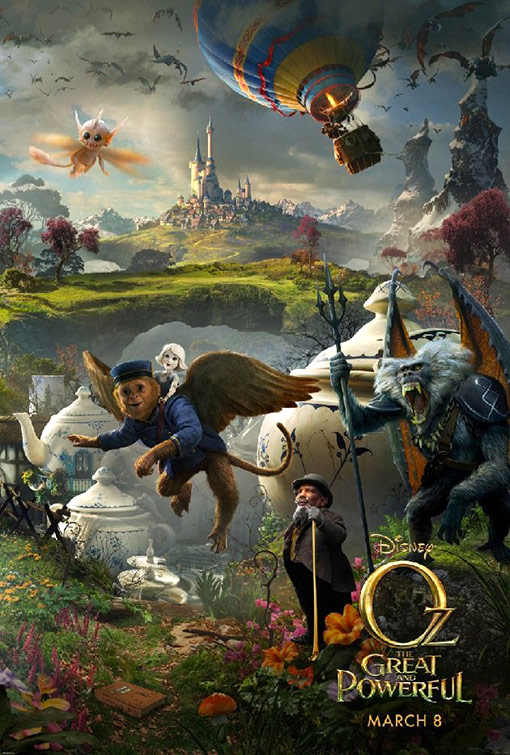 Director: Sam Raimi
Writers: Mitchell Kapner & David Lindsay-Abaire, based on the works of L. Frank Baum
Cast: James Franco, Mila Kunis, Rachel Weisz, Michelle Williams, Zach Braff, Bill Cobbs, Joey King, Tony Cox, Bruce Campbell
Plot: Carnival huckster Oscar Zoroaster Diggs (James Franco) is swept up by a cyclone and hurled away to the mysterious, magical land of Oz. There, he finds himself caught in a power struggle between three witches (Mila Kunis, Rachel Weisz and Michelle Williams) over the realm’s vacant throne. A prophesy claims that a wizard from another land will save Oz from wickedness, but can this humbug of a man find in himself the hero that Oz needs?
Thoughts: Before I really dig into this movie, I think it’s only fair that I (briefly) tell you about my personal history with Oz, so you can understand where my opinion is coming from. Like most people these days, my first exposure to Oz was the 1939 MGM film, which I saw as a child and enjoyed. When I was a bit older, though, at my local public library (visit ‘em kids, they’re awesome) I found an entire shelf of Oz books by the creator, L. Frank Baum. I devoured the books they had (which, as it turned out, weren’t all of them), and since then I’ve been a devoted consumer of any book, movie, or comic book I can find that offers a different vision of the land of Oz. Although I think there is plenty of room in media for many, many different Ozzes (a phenomenon I discussed in more depth on my other blog yesterday), in my heart, my favorite visions of Oz are those that pay due deference to Baum.
And it’s with that perspective that I can say I enjoyed Oz the Great and Powerful immensely. (Don’t worry, I’ll put up a warning before I get into any spoilers for those of you who haven’t seen it.)
The biggest problem with prequels, as George Lucas proved, is that it’s difficult to maintain suspense when the audience already knows where the characters will be when the story ends. This isn’t really a big problem with this film, though. Baum gave precious little backstory on many of his main characters, and almost none on the witches of Oz (although subsequent writers would often turn to this as their inspiration), and that leaves the screenwriters an enormous amount of room to play in. They also create a version of Oz that is mostly consistent with the books, while still giving a few nods to the 1939 film that they know is what most people will use as their measuring stick.
The casting is very good. Zach Braff as Finley the Flying Monkey brings a totally unexpected element of comedy to the film, one that serves to give us a glimpse of light in very dark moments. Each of the witches feels very natural in their respective roles – Mila Kunis’s naïve Theodora and Rachel Weisz’s sly Evanora work very well as the sister witches, and from the beginning present an interesting question to the audience… which of the two will someday become the insidious Wicked Witch of the West, and which one has a date with a house that’s going to fall out of the next tornado?
Michelle Williams is almost perfect as Glinda. While Billie Burke’s portrayal from 1939 is that of a hands-off fairy godmother, the sort who prefers to pulls the strings and not get directly involved, Williams is a much fiercer, braver woman. The display of power she puts forth in this movie is impressive, and certainly more in keeping with the character Baum created. He didn’t go in for the pyrotechnics quite as much as this movie does, mind you, but it’s easy to see Williams’s Glinda capable of maturing into the strong, confidant witch she becomes in the original books.
Then there’s Oz himself, James Franco. Oddly enough, he’s the only one of the main cast that doesn’t always work for me, and it’s for an strange reason. Franco plays Oz as a snake oil salesman, a con man who has a good heart buried somewhere deep inside, and that’s all well and good, that’s how he should come across. But there are moments in the film where it feels like he’s actually overselling the overselling, moments where you’d want Sam Raimi to ask him to dial it back down to 11 from 12 or 13.
As for Raimi’s directing… it’s fantastic. His visual effects team has built a brilliant, remarkable Oz that satisfies me on absolutely every level. Even the 3-D in this film is superior to most others. It’s funny – I’ve long said that I’ve never seen a movie that convinces me that 3-D is a tool that improves storytelling, that there is no movie that does for 3-D what the 1939 The Wizard of Oz did for color… and this film almost does it. Raimi’s transition from Kansas to Oz is a truly remarkable moment, and one that uses 3-D in a very clever way, similar to the way the ’39 film did with color. It’s visually stunning and, for a few scarce moments, I was glad I saw it in 3-D. Then later on he starts throwing monsters and spears straight at the camera and I was over it. Raimi also throws in a few moments of self-reference, which I think are fun as well… there’s one scene that’s almost straight out of his own Army of Darkness, which had my friends and me in hysterics, probably because we’re the only people in the theater that got the joke.
I’ve got other things to say about this movie, including a few problems, but nothing I can discuss without putting up a spoiler wall. So if you’ve read this far and you haven’t seen the movie yet, let me assure you that it has my wholehearted recommendation. It’s a great fantasy film, probably too scary for the little kids, but well worth watching in the movie theater. And I won’t even judge you for choosing the 3-D this time.
SPOILERS AFTER THIS LINE. ———————————————————————————————-
Aside from Franco being a bit over the top, my biggest problem with the story itself is one of timing… not pacing, timing. Once Franco arrives in Oz, it feels like things happen entirely too fast. For one thing, I think it’s clear too early in the film that it is Theodora, not Evanora, who is fated to become the Wicked Witch of the West. In fact, I think it’s clear too early that Evanora is the real villain, and not the “Wicked Witch” the sisters are warning us about. Granted, as soon as we learn the “Wicked Witch” is named Glinda, the audience should know Franco is being conned, but that moment should be played as a reveal and never really gets that chance.
Theodora’s emotional turns are also hurt by the sheer speed of the piece. I’m not entirely sure (after just one viewing) but it seems like no more than three days pass between her meeting Oz and her transformation. In that time she falls madly in love with him, decides she’s going to marry him and become his queen, and then grows to utterly hate him when she sees a glimpse of him talking to Glinda and learns that he “romanced” her sister the same way he did her. (Incidentally, I think the film does a nice turn leaving it a little ambiguous as to whether or not this actually happened. We see Oz work his charms on various women in the movie, but never Evanora, which leads me to suspect he never did. Instead, I got the impression Evanora pulls off the con on her sister because she was spying on the two of them in her globe the whole time.) The sheer speed with which Theodora’s affections turn weakens the character, making her the fantasy equivalent of the internet Overly Attached Girlfriend meme. Even more problematic, she truly becomes wicked not because her heart is broken, but because after her heart is broken she allows her sister to make her evil. It’s still the character making a choice, but I think it’s a weak choice, she doesn’t “earn” her evil, so to speak… not so much a monster as a victim, which will give her death at Dorothy’ s hands a level of forced tragedy I don’t think works.
It seems very clear to me that this movie was made to be the beginning of a franchise, despite its prequel status – and in fact, Disney was already talking about sequel plans the day before the movie was released. I’ve got no problem with this turning into a franchise, but it’s a little too obvious that was the intent… instead of taking us from point A to point Z (“Z” being where The Wizard of Oz begins), this gets us to about… let’s say “J.” The film ends with Oz in power and the witches banished, but there are a lot of things that don’t mesh up. Evanora doesn’t have the Silver Shoes (or, if you insist on going with the MGM version, Ruby Slippers). Theodora isn’t in command of the Flying Monkeys. Both sisters have been driven out and humiliated, where Evanora pretty much has dominion over Munchkinland when the original begins. Probably lots of other little bits I’m forgetting now, but will remember when I (inevitably) see the movie again.
The biggest sequel hooks come in for the Wizard himself, though… specifically, he’s not the recluse we know he’s doomed to become. He and Glinda have a romantic relationship, which simply doesn’t fit the first movie (or any other incarnation, for that matter). This gives the screenwriters a delicate task – they have to do something to alter the relationship in such a way that they are no longer together, that he has retreated into his palace, but where she still has enough faith in him to send Dorothy down the Yellow Brick Road when she drops from the sky. Then there are Finley and the China Girl, Oz’s surrogate family. Their inclusion in this story is actually wonderful, but it has us poised for tragedy. The moment Finley swears his life debt to Oz, pledging to remain with him until he (Finley) dies, I had a chill at every moment he was in danger. We know that the Wizard has no Finley when Dorothy arrives, and there’s simply no way the character Zach Braff played would ever turn on his friend… which leaves only one possible reason for his absence in the later stories.
I appreciated a lot of the little touches that were brought in from the original book, for example, the inclusion of all four of the peoples of Oz, and not only the Munchkins as the original film did. The prominence of the China Town was good too, although it does raise the question of how it will be rebuilt to the point it will be when Dorothy arrives. (Then again, as this is a point left out of the original film, perhaps the filmmakers don’t plan to address it again.) And although there were a few creatures we encountered that didn’t come straight from the books, there was nothing that would feel out of place in a Baum story, and so I’m perfectly happy with that.
As a lifelong Oz fan, though, there’s one glaring red flag waving in my face, one thing that simply flat-out contradicts any version of Oz I’ve ever seen, one thing I’m having a little trouble getting over, and that’s the notion that Glinda is the daughter of the murdered King of Oz. This doesn’t fit in anywhere, and I have a hard time wrapping my brain around it… not only idea that Glinda is the king’s daughter, but also the question of what this means for the true ruler of Oz in the original novels, Princess Ozma. Considering how much work was done to mine the book, making a change of this magnitude is really troublesome to me. At the end of the movie, I kept waiting for an exchange like this:
OZ: Hey, if your father was the king, doesn’t that mean you should be queen?
GLINDA: No, I had to renounce my claim to the throne when I chose to become a witch. My sister was supposed to take over, but she’s been missing ever since our father died.
Not a perfect solution, I admit, but at least it would be something. The point is, it’s not a minor quibble, but a major chance to the Oz canon that I think the sequels simply have to address.
That said, as big an issue as I have with that element, I still really enjoyed this movie. It’s a modern Oz with a timeless feeling, which is as much as anybody could possibly have hoped for, and I hope to see Disney march forward with this franchise for a long time… even, if they have the guts, rolling into an actual adaptation of the original novel. Despite all the different versions of Oz that have hit the screen, very few filmmakers have dared try a full-on adaptation of the original, fearing comparisons to the MGM film. If the Disney juggernaut doesn’t have the courage to finally make a version of The Wizard of Oz that’s closer to the book, nobody ever will. And that, my friends, is where I really want to see this franchise go.
The first Reel to Reel study, Mutants, Monsters and Madmen, is now available as a $2.99 eBook in the Amazon Kindle store and Smashwords.com bookstore. And you can find links to all of my novels, collections, and short stories, in their assorted print, eBook and audio forms, at the Now Available page!
If I was making the Justice League movie…
 Fans of DC Comics’s Justice League franchise saw what seems to be another setback this week, when word leaked the script that has been in development is being scrapped entirely. For those who just want to see the damn movie made already, this is obviously distressing news. But my approach is slightly different. I absolutely want to see a Justice League movie, but I want to see a great movie. So if Warner Bros recognized that the script they’re working with is crap, by all means, start over and do it right.
Earlier this week over at CXPulp, I wrote about how Disney seems to be planning to apply the lessons of Marvel Studios to their recently-acquired Star Wars franchise. (For those of you who may not follow this stuff the way I do, let me briefly explain that Disney bought Marvel in 2009 and that Marvel and DC have been the two biggest publishers – and therefore the two biggest rivals – in American comic books for decades). Marvel created films for several of their characters, brought them together in their mega-hit The Avengers, and are now breaking them off into smaller films again before the next combined go-around. Comic book fans, delighted with what Marvel is doing, are asking why the hell the movies based on DC Comics – the Justice League, Superman, Batman, and many more — can’t do the same thing. Although DC Comics, for a long time, had properties with more mainstream recognition than Marvel, in the past decade Marvel has dominated superhero movies. The only hit from the DC Universe in recent years has been Christopher Nolan’s Dark Knight trilogy, while Marvel’s X-Men, Spider-Man, and Avengers-related films have become legitimate powerhouses.
The reason for this, I believe, goes back to the late 90s. Marvel, at the time, was still an independent company, although one reorganizing after a bankruptcy. DC, however, has been wholly owned by Warner Bros for a very long time. That means Warner Bros is the only game in town to make a DC movie. If Warner Bros isn’t interested, it won’t happen, and if Warner Bros doesn’t understand what makes the property work, we get crap like Steel and Catwoman. Marvel, on the other hand, had the freedom to shop their properties around. Universal doesn’t have the right feel for Spider-Man? Take it to Sony. Paramount can’t give us a decent X-Men film? Bring them to Fox. Granted, this system turned out its share of clunkers too (let’s not forget that some genocidal maniac gave approval to not one, but TWO Ghost Rider movies starring Nicolas Cage), but their batting average over this period, beginning with Blade in 1998, is pretty damn good.
Things are different now, of course, since Marvel is owned by Disney. But by the time of that purchase in 2009, Marvel had already launched their own film unit to make movies with the characters other studios didn’t have – Iron Man and Incredible Hulk had both already come out and production was underway on Iron Man 2, Thor and Captain America: The First Avenger. By the time Marvel was a Disney property, they’d proven that they could make great films on their own, and Disney has wisely stayed the hell back and let them do it, the way they did when they bought Pixar in 2006. (Disney seems to have a three-year cycle for buying other companies, they got Lucasfilm in 2012. That means I have until 2015 to create a franchise with lucrative enough IPs that I can sell them to Disney and retire in luxury.)
This, more than anything else, is what Warner Bros needs to learn in regards to any DC Cinematic Universe. It’s not about copying Marvel’s storytelling or casting tricks or format. It’s about letting the people who know the characters do what they do best and getting out of their way while they do it.
Marvel needed to raise the profiles of their lesser-known characters or Avengers never would have been the hit that it was. DC has a different problem. Ten years ago, nobody who wasn’t a comic book fan knew who Iron Man or Thor were. DC’s problem is that everybody knows many of their characters – Wonder Woman, Aquaman – but they fundamentally misunderstand them. Aquaman is a punchline, he’s “the guy that talks to fish.” But as writers like Geoff Johns and Peter David have shown us, he can be so much more than that – a tragic monarch, a man who struggles with the responsibility of protecting two-thirds of the surface of the Earth… not to mention the fact that the physical changes necessary to allow a person to survive on the ocean’s floor would make them pretty strong and otherwise badass on land. Putting Aquaman in a movie doesn’t necessitate that you explain who he is, it necessitates you explain what makes him awesome.
So if I was in charge of the Justice League movie, this is what I would do.
First, start with this summer’s Man of Steel. The film is generating some positive buzz and I’m excited about it. I’d work in a small reference to a larger DC Universe – have some news report about Green Lantern in the background, or a page of the Daily Planet referencing the chaos in Gotham City that happened during The Dark Knight Rises. Nothing that would really influence Superman’s story, but enough to nod at the fact that he’s not – as Nick Fury said in the first Iron Man – the only superhero in the world.
Then, I’d work on putting together a phenomenal Justice League story. I wouldn’t start with the big bad that was in the previous script, Darkseid, for two reasons. First, Marvel is already using Thanos in their movies, and although Thanos was largely a Darkseid rip-off when he was created in the comics, movie fans won’t get that and will think it’s the Justice League that’s being derivative. Second, he’s too big for the first movie. Where do you build from there? You need a threat big enough to justify bringing all of these characters together, of course, but they shouldn’t go up against the biggest threat in the universe their first time out.
Next, get the recognizable aspects from the current DC films and put them together: Henry Cavill as Superman, build off the end of The Dark Knight Rises (as a spoiler consideration I won’t be more specific than that), and yes, I’d get Ryan Reynolds back as Green Lantern. That movie had problems, but his casting really wasn’t one of them. Then I’d add the characters that the public has heard of but doesn’t understand – Wonder Woman, Aquaman, the Flash. Use this movie to showcase them the way Avengers suddenly turned everyone in America into fans of the Hulk for the first time in decades.
Don’t bother with everybody’s origin. It’s a convention of the superhero genre, true, but it’s often the least exciting part of it. You don’t need to know why John McClane became a cop to enjoy Die Hard, so why do I need to see Barry Allen get struck by lightning when I’ve already accepted a world with a man from Krypton and another guy with a magic ring? After Justice League, we’ll start spinning the other characters off into their individual movies – if necessary, work in the origins there. There’s no rule that says they have to take place after the Justice League movie just because they’re made in that order, although even then, I think a quick flashback would probably be more than sufficient in most cases.
Finally, make it clear that the Justice League isn’t the be-all and end-all of the DCU. Marvel can’t reference Spider-Man, the X-Men, or the Fantastic Four, because the rights to those characters are still tied up with other studios thanks to deals they made before they were purchased by Disney. DC doesn’t have that problem. Guillermo Del Toro is working on a movie featuring some of DC’s supernatural characters like Swamp Thing and Deadman – a Justice League movie could drop in a reference to them. Give us veiled hints or rumors about other Leaguers from the comics like Zatanna, Plastic Man, Firestorm… characters that have potential for their own films in the future, assuming of course that they’re done right. Even better – if you have some sort of huge battle for the end piece, the sort of thing that the public can’t help but notice (like the battle of New York in The Avengers, and it just shows how great that movie was structured that it keeps being the best analogy), give us glimpses of some of these other heroes fighting their own battles while the League takes on the Big Bad, whoever it happens to be.
And most importantly, make sure that the story is one that satisfies the fans but is broad enough to grab people who don’t know all of the characters. This is what Marvel has done brilliantly and what Warner Bros has prevented DC from doing for years. If you can pull off that trick, we’d have a movie that could launch not just one franchise, but an entire universe.
Of course, that’s what I would do. But what do I know? I’m just a guy who reads comics and watches movies. It’s not like I’ve got the pedigree of the man who gave the green light to Jonah Hex.
(If that line isn’t enough to convince people I should be running the show, nothing will be.)
Gut Reaction: Birdemic-Shock and Terror (2010)
 Director: James Nguyen
Writer: James Nguyen
Cast: Alan Bagh, Whitney Moore, Janae Caster, Colton Osborne, Adam Sessa, Catherine Batcha, Patty van Ettinger, Rick Camp, Stephen Gustavson, Danny Webber, Mona Lisa Moon
Plot: Rod (Alan Bagh), a preposterously successful software salesman, meets Natalie (Whitney Moore), an up-and-coming supermodel. As the two begin a romance that was clearly written in the stars, legions of birds lose their minds and begin attacking humanity because Global Warming is a thing. Warning: Do NOT attempt to take this movie seriously. Normally I would also include a spoiler warning, because I will talk some spoilers, but with a movie this remarkably stupid they aren’t so much “spoilers” as they are “cautionary examples.”
Thoughts: For a couple of years now, I’ve heard people talk about Birdemic: Shock and Terror as the new “So Bad It’s Good” movie, placing it in the ranks of dubious classics like The Room, Troll 2, and the über-entry in that category, Plan 9 From Outer Space. There are a lot of bad movies, but for a movie to be so bad as to be entered into that pantheon takes an awful lot of effort on the part of a director that is seriously delusional and, more often than not, a cast that wonders what the hell it got itself into.
My friends. On that front, Birdemic: Shock and Terror totally delivers.
James Nguyen’s 2010 film is the clunkiest, least-effective attempt at a “nature gone bad” horror film I’ve ever seen, so bad in fact that it’s hard to know exactly where to begin. It seems clear that Nguyen was attempting to emulate Alfred Hitchcock’s classic The Birds, which also featured a young couple that meets early in the film, a slow build to establish their relationship, and a sudden, inexplicable attack by birds that dominates the rest of the movie. However, Nguyen manages to take these elements that Hitchcock used in a masterpiece and screw every single one of them up.
Let’s take the slow beginning. In Hitchcock’s film, while it does start slowly, he’s building an interesting group of characters with dynamics, personalities and relationships that could probably sustain a movie even without the threat of lunatic bird attack. Not so Nguyen. Rod works as a salesman for a software company that gets sold for a billion dollars (an even billion, that’s right) right after he makes a big sale worth a million dollars (after giving the client a 50 percent discount). Natalie, meanwhile, is informed at the beginning that she’s been selected as the next Victoria’s Secret cover girl, which delights her mother, who also suggests she look into selling real estate as a back-up. However, despite the fact that these two people are remarkably successful, almost every location in the film (including their homes, motel room, and places of business) look like they were shot in the same spare bedroom of a cheap apartment with a half-assed attempt at decoration by changing the bedspread and swapping out laughably small signs the local print shop turned out for a grand total of sixteen dollars.
What’s more, their incredible success never factors into the movie. Rod’s salesmanship? His money? Natalie’s… covergirl-ness? Once the bird attack begins — an unforgivably long 45 minutes into this stinker – all of that immediately becomes irrelevant. Again, this is Nguyen at least trying to emulate Hitchcock. In The Birds, many of the circumstances behind Tippi Hedren and Rod Taylor’s meeting (oh geez, Rod Taylor, I just realized what Nguyen was trying to do there) cease to matter, but the character dynamics and the local politics of the small town they’re in are still important. For example, we feel bad when Rod Taylor’s ex-girlfriend dies trying to protect his little sister. When the main characters of Birdemic find their two best friends (who also happen to be dating one another, although somehow neither Rod nor Natalie knew this when they started dating) dead in a car, the audience really only wonders what the point was in including them in the film at all, as they contributed exactly nothing.
The only thing worse than the writing in this movie is the special effects used to create the birds. From the first time we see a bird – a trio of parrots circling a tree – it becomes clear we’re in for a treat. This is the worst, weakest CGI I have ever seen, without qualification. On TV, in theaters, in direct-to-video releases, on viral videos on the internet, every human being who has ever attempted to make pixels on a computer screen move was more successful than the people who made Birdemic. The dancing baby from Ally McBeal looks realistic and lifelike in comparison to the birds in this movie. They attack in droves, sometimes, dive-bombing random targets and exploding, with fire that stays exactly in the spot the bird made contact and burns upwards in a perfect column. They hover – eagles that hover – in front of windows or cars. And whenever one of the characters manages to shoot a bird, that bird they hit inexplicably becomes the only one in the shot, popping in a manner reminiscent of an arcade-style duck hunting game circa 1991.
There is one aspect, however, in which this film clearly and deliberately rejects the framework of Hitchcock’s classic. In his film, as well as in the Daphne Du Maurier story upon which it is based, no explanation for the bird attack is ever given. James Nguyen turns this trope on its ear by giving us multiple, increasingly stupid explanations for what’s happening, all of which boil down to the same thing: Global Warming. That’s right, friends, everything in this movie is because of Global Warming… somehow. One random scientist they meet standing on a bridge blames Global Warming for a pile of dead birds on the ground, but then soundly rejects the notion that it could be responsible for the bird attack. A nutcase in the woods (wearing a wig so terrible that your delusional Uncle Morty suddenly will feel incredibly dapper by comparison) blames Global Warming for the deaths of certain trees and the explosion in the bark beetle population, which… also somehow made the birds go crazy?
Whatever, it’s obviously Global Warming, because we are told the birds are only attacking people in cars or at gas stations. Except for that one time it kills a girl trying to go to the bathroom in the middle of an open field. We also have to accept the danger despite the fact that in the background of almost every single shot we can see a steady, orderly stream of two-directional traffic completely unmolested by birds, because Nguyen couldn’t afford to shut the roads down when filming and couldn’t be arsed to find a road that didn’t have a lot of traffic on it. If that wasn’t enough, the characters sometimes pause the film to talk – in stilted dialogue that would get you kicked out of a high school drama club – about how great their hybrid cars are, including one that gets exactly 100 miles to the gallon, and walk around discussing how great they think the movie An Inconvenient Truth is. (This is an actual line of dialogue: “What a great movie. An Inconvenient Truth.” Because evidently Rod’s idiot friends forgot what movie they all just ostensibly watched together. Incidentally, I’m told that film is the perfect choice for a double-date.)
Everything about this movie is horrible, ill-made, and heavy-handed. By the time it was over I expected to see Al Gore, the Dancing Baby and Alfred Hitchcock (appearing as a Jedi ghost) to release a joint statement emphasizing that James Nguyen in no way speaks for them.
BUT… you gotta watch this.
Don’t watch it the way you usually would, of course. Don’t just turn it on as a bit of entertainment for two hours, because it fails on every possible level. But when you get your friends together with the intent of ripping into a crappy movie, this is a perfect choice. If you get the RiffTrax version of the film, Mike Nelson, Bill Corbett and Kevin Murphy give us one of the funniest riffs they’ve done in their decades of mocking terrible movies. Unlike some movies, which could be used for torture, this movie could be an alternative to taking anti-depressants. What’s better – popping a Xanax, or watching Rod and his friends use metal clothes hangers to try to fight off a flock of CGI birds that are hovering mere inches in front of their faces but that they cannot seem to hit, mainly because the computer effects team couldn’t move the birds somewhere that they might actually come close to one of the spastically-flailing hangars?
A while back, the TV show Mythbusters proved that – despite the old adage – it is in fact possible to polish a turd. They could have saved themselves the trouble and just watched Birdemic.
For my take on a much better film that uses some of these tropes, The Birds was one of the “bonus films” available only in the eBook edition of the first Reel to Reel study, Mutants, Monsters and Madmen. It’s now available as a $2.99 eBook in the Amazon Kindle store and Smashwords.com bookstore. And you can find links to all of my novels, collections, and short stories, in their assorted print, eBook and audio forms, at the Now Available page!
So… J.J. Abrams.
 If you pay any attention to movie news at all, you no doubt were aware earlier this week when Disney announced that Episode 7 of their shiny new Star Wars franchise would be directed by none other than Star Trek rebooter J.J. Abrams. And the internet went berserk, because that’s what the internet does. People who loved the new Star Trek loved the idea. People who hated the new Star Trek hated the idea. People who hated the ending of Lost hated the idea (even though Abrams’s contributions to that show ended some time in the first season when he got caught up in moviemaking). People who loved Fringe were too busy watching the last episode of that series over and over to notice that anything else was going on. But by the time the dust had settled, pretty much everybody had an opinion. As I created this blog specifically to have a place to pontificate about movies, I thought I’d share my opinion here.
I’m cool with it.
Okay, that’s the short version. Let me talk a little bit about why I’m cool with it. The problem with this sort of speculation is that nothing made by a Hollywood studio is the result of a single auteur vision, and that makes it incredibly difficult to predict how any creator will fit a project by basing your opinion on their earlier projects — producer notes, diva actor notes, studio interference, budgetary concerns and any other number of things can and will affect any movie, and even when you have an unmitigated cinematic disaster it had be hard to accurately place blame. (Take George Clooney’s willingness to accept blame for the fiasco that was Batman and Robin. I still think Clooney, at that age, could have played a decent Bruce Wayne, but he was saddled with a terrible script, a terrible director, terrible casting for his co-stars and a studio that made them keep adding idiotic nonsense so they could produce Happy Meal toys.) That said, there’s really nothing else we can base our judgment on, so flawed or not, I’m going to look at Abrams’s previous filmography to explain why giving him this job gives me hope for a good Episode 7.
First and foremost, I trust Abrams as an idea man. True, he’s directing this film, but that doesn’t mean he won’t keep his finger in the story — I’d be shocked if he didn’t. He has relatively few movies to his credit as a director (the two Star Trek films, Mission: Impossible III and his own Super 8, which we’ll talk more about in a minute), but he had a hand in creating or producing lots of quality television. Besides the aforementioned Lost and Fringe, he was also behind NBC’s Revolution, the Jennifer Garner launch vehicle Alias, the hit Person of Interest, and the underrated (and sadly cancelled) Alcatraz. In film, besides the movies he’s directed himself, he helped conceive Cloverfield (a film I’m a big fan of). And let’s not forget his greatest success… Felicity.
(No, I’ve never seen an episode of Felicity.)
 Since Star Trek is what everybody is focusing on, though, let’s talk about that for a moment. In 2009, let’s be honest here, Star Trek was dead. The underwhelming Star Trek: Nemesis had frozen any plans to continue with the movie series and, although Enterprise was an okay TV series, it wasn’t nearly good enough to wash from people’s mouths the effluvia of Star Trek: Voyager, the low point of the franchise. I was a huge Trek fan growing up, I loved the movies, I loved The Next Generation, and I especially loved Deep Space Nine (which I still contend, in terms of writing, is the best of the various Star Trek TV shows). But at that point, I honestly didn’t care if we ever saw another Star Trek property.
Enter Abrams.
He rebooted the franchise in a way that preserved the original (by creating an alternate timeline in which his series will take place), and from there, he ran wild. I’ll grant you, not everything in the reboot meshes with the original — the technology and physics of it doesn’t fit at all. As many of my more green-blooded Trekker friends constantly remind me, in the original timeline it was explicitly stated that starships were built in space because they couldn’t be constructed and launched on Earth, as they are in the reboot. And yes, Tyler Perry was in it, and was somehow the only thing not covered by a lens flare. But despite all that, the film was fun. It was full of more energy and excitement than I’d felt from Trek in years. Older Trek, the really good older Trek at least, was admittedly a more cerebral sort of thing, full of allegory and depth, whereas Abrams took the approach of “let’s blow up a damn planet”. But Abrams had a different task than the earlier films — he had to present a version of Star Trek that presented the sort of enormous cinematic landscape viewers were now demanding (thanks to films like Lord of the Rings) and won over an audience that previously was uninterested in Trek. He couldn’t just make a movie to appeal to existing Trek fans, because as the Enterprise ratings had already proven, there weren’t enough left to sustain the franchise.
Now there are, and now I’m very excited for Star Trek Into Darkness as a result.
But Trek, honestly, is not the reason I’m particularly interested in seeing what Abrams does with Star Wars. For that, my attention turns to the film he wrote and directed between Trek outings: the Steven Spielberg production Super 8.
 If you grew up in the 80s and you haven’t seen Super 8, you’ve made a mistake. Even though the film is set in 1979, it’s a love letter to the sort of movies we grew up with. The slow burn of the alien threat has shades of Close Encounters of the Third Kind and E.T., but even more important than that, the interaction of the kids feels like this could have been a sequel to Goonies or Explorers. The kids in this movie are so perfectly cast and so genuine in their dialogue and interactions with one another that you could easily believe that they’d been friends their entire lives instead of pulled together by a casting director. It’s the kind of movie people my age watched when we were the age of the kids in the movies. Abrams proved with this film that he understands that era of moviemaking perfectly.
And when, my friends, was Star Wars truly great?
If Abrams can bring his 80s sensibility together with his 21st century visual skill and ability to create amazing action pieces, the new Star Wars has the potential to eclipse the prequel trilogy. (I know, I’m not setting the bar particularly high there, but still.) I’m not saying that the movie will be great, I’m saying that Disney has given it the first ingredient it needs to be great. (Well, second — getting Toy Story 3 screenwriter Michael Arndt on board was the first ingredient.) It’s still up to Abrams to gather the rest of the ingredients and put them together properly, and he may yet fail. But damned if I’m not willing to give him a chance.
Gut Reaction: Paranorman (2012)
 Directors: Chris Butler & Sam Fell
Writer: Chris Butler
Cast: Kodi Smit-McPhee, Tucker Albrizzi, Anna Kendrick, Casey Affleck, Christopher Mintz-Plasse, Leslie Mann, Jeff Garlin, Elaine Stritch, Bernard Hill, Tempest Bledsoe, Alex Borstein, John Goodman, Hannah Noyes, Jodelle Ferland
Plot: Norman Babcock (Kodi Smit-McPhee) was born with a terrible gift – the ability to see and communicate with ghosts. The problem is, nobody believes him, except for his mysterious Uncle Prendergast (John Goodman), who has the same power. Prendergast warns Norman that a witch’s curse is about to overwhelm his small town unless he can stop it… but the spirits of the undead may not even be the worst danger – first Norman has to navigate a sea of school bullies, unbelieving townspeople, and parents who think something is wrong with him.
As always, this Reel to Reel is not simply a review, but a study of the themes and tropes of the movie. So fair warning: SPOILERS LIE AHEAD.
Thoughts: Last fall we got hit by not one, but three stop-motion films that seemed to be grasping for the young Halloween-lover’s moviegoing dollars: this, Hotel Transylvania and Frankenweenie. I wanted to see all three, so naturally, circumstances conspired to keep me from seeing any of them. Now that they’re rolling out on DVD, I’m making up for lost time.
From the basic description, it’s impossible not to see Paranorman as taking some of its lead from The Sixth Sense – both films are about young boys with the ability to talk to the dead and the earlier film is far too large a cultural milestone to imagine writer Chris Butler could have been unaware of it. It’s even less likely when you realize just how culturally aware this movie is – it’s full of tiny little jokes, tidbits and Easter Eggs that link us to the great horror movies of the past — gags about zombie movies, Norman’s friend Neil showing up in a hockey mask, and Norman’s phone having John Carpenter’s Halloween theme as his ringtone being some of the most prominent examples.
That said, this isn’t a problem for the movie at all. In fact, you could almost look at Paranorman as a sort of thematic sequel to M. Night Shyamalan’s breakthrough film. At the end of that movie, Haley Joel Osment’s Cole Sear character had started to make peace with his ability to talk to the dead and was attempting to use his ability to help spirits in need. Norman Babcock is at that point when this movie begins, but an unbelieving family and the fact that the town is aware of – but doesn’t believe in – his power helps make him a real outcast, perfectly positioning him to be the hero when the zombies hit the fan.
Chris Butler and Sam Fell are clearly drawing from the Tim Burton/Henry Sellick school of filmmaking. Although parents frequently forget, a lot of kids love the creepy and the macabre. It’s why Roald Dahl is still popular, why the Universal Monsters will never die, and why The Nightmare Before Christmas is still the most popular thing Tim Burton’s name has ever been associated with. Kids, however, don’t really want to be legitimately scared the way adults sometimes do. Kids want the trappings of horror around them, because it makes them feel older, like they can take it. Plus, that line between terror and laughter is really very slim. (I may have mentioned it before.)
The interesting thing about Paranorman is that it treads the line between an all-ages movie and an adult film very carefully, but not only in terms of the horror content. When Mitch (Casey Affleck) drop-kicks a zombie’s head, that’s a little gross… but part of my brain was still processing the moment a few minutes before when he was joking about his little brother Neil (Tucker Albrizzi) freeze-framing their mother’s aerobics DVDs, with a screenshot that leaves no room for interpretation as to what he’s looking for.
Like the horror, the comedy in this movie draws heavily from classic sources. Zombie hands chasing after people feel like they could have been dragged out of a Three Stooges short or an episode of The Addams Family. The mob violence calls to mind Frankenstein in the campier moments of the franchise, and the script even drops in a shout-out to Scooby-Doo. The action, on the other hand, evokes some of the great kids’ adventures movies of the 80s. We used to get movies like Explorers, like Monster Squad, like the greatest kids’ adventure of all time, Goonies, in which the young have to come together to fight the bad guy or save the day. I grew up in this mythical fairyland – it was called the 80s. Halfway through the movie, Paranorman takes a turn in this direction, when Norman and Neil are joined by their older siblings and the school bully, none of whom can afford to remain skeptical anymore, what with the actual hordes of the undead coming after them.
The way those characters come together, though, is pretty realistic. Norman’s sister Courtney (Anna Kendrick) turns against him, even after they’ve all fought the monsters and know for a fact he isn’t just crazy. Alvin the Bully (Christopher Mintz-Plasse) is still a jerk. Neil’s brother Mitch (Casey Affleck) is still a bonehead. In a lot of movies, these lesser antagonistic characters turn on a dime and join the heroes in the face of a greater threat (such as in the legendary Shakespearean drama Ernest Goes to Camp.) Things don’t go nearly so well for Norman, who really has only one stalwart in his corner, and when the story begins, it’s Norman who tries to reject Neil. The characters do come around eventually, of course, because that’s the sort of story this is, but it doesn’t come easily. They need real convincing, an idea that becomes more important at the climax when Norman confronts the witch and tries to talk her down from the monster she’s become to the little girl she once was.
The big moment for the film, the one where we really start to understand we’re in a complex world where nothing is black and white, is when Norman gets a pensieve-style glimpse into the sentencing of the witch Agatha Prendergast (Jodelle Ferland), who started all this in the first place when she cursed the people who condemned her. At this point, after an hour of running from the monsters, everything becomes clear. Agatha was a child when she was condemned – we’re not seeing a spell cast by a bloodthirsty witch, we’re seeing a tantrum being thrown by a scared, powerful child. Then the next domino falls – the zombies beg Norman to complete the ritual to put Agatha asleep again for another year… they aren’t out for blood, they just want the curse to end.
In truth, it takes a bullied, misunderstood child to comprehend what a bullied misunderstood child actually needs, and that’s as true in this movie as it is in real life.
Although rated PG, I would be hesitant to show this movie to some kids. The mass numbers of double entendre aside, a lot of the monsters and violence – although played for laughs – are perhaps a little too realistic for the littlest of them. If you’ve got a kid under 10, I’d recommend watching the movie yourself first to decide if you think your kid can handle it. If you’re older, though – if you’re from that demographic that loves Nightmare Before Christmas, Beetlejuice, The Munsters, this really is an excellent movie.
Don’t forget the first Reel to Reel movie study, Mutants, Monsters and Madmen, is now available as a $2.99 eBook in the Amazon Kindle store and Smashwords.com bookstore. And you can find links to all of my novels, collections, and short stories, in their assorted print, eBook and audio forms, at the Now Available page!
It’s The Odyssey… IN SPACE!
It was recently announced that Warner Brothers is working on taking the epic poem, The Odyssey, and turning it into a science fiction film. Because the internet exists, responses ranged from the cautiously optimistic to the blindly cynical to several hundred ancient Greeks complaining that Hollywood is raping their childhood like they did with that Jason and the Argonauts debacle. Amongst all the responses, though, only one took me by surprise. At /Film, Germain Lussier said, “Even in our wildest, 11th grade English class imaginations, few could have seen this one coming.”
To which my response is… “Really? Is it that big a surprise?” If anything, I can’t believe it hasn’t been done before.
The great thing about science fiction, friends, is its infinite adaptability. There is virtually no story you can’t tell in the proper sci-fi setting… in fact, many of the greatest works of sci-fi are largely metaphorical in nature. Both the Star Trek and X-Men franchises, at least early in their early incarnations in the 1960s, were often used to discuss the civil rights movement. Battlestar Galactica was known to deal with modern-day politics. Superman is often spoken of as an extraterrestrial Christ figure, despite being created by a couple of Jewish kids from Cleveland. Everything from 1984 to 2012 has taken then-current fears and put them on display through a sci-fi prism.
Then there are the stories that pick up on specific plots and tropes. Alien, as I’ve argued many times, is essentially a haunted house movie with the house replaced by a spaceship and the ghost replaced by a drippy, hard-shelled monstrosity with acid blood. Forbidden Planet shares much of its DNA with William Shakespeare’s The Tempest. Throw the Swiss Family Robinson off their island — off the planet — and you have Lost in Space. That one didn’t even change the family’s last name.
Much has been written about George Lucas homaged big ol’ chunks of Akira Kurasowa’s Hidden Fortress when he wrote Star Wars. That’s probably the reason people were so willing to believe the recent rumor — since debunked — that Disney had Zach Snyder working on a Star Wars universe adaptation of another Kurasowa film, Seven Samurai. (You may know it better by the title of the American remake: the classic western The Magnificent Seven.) That story could easily work in outer space. Hell, why stop there? Take the death of Qui-Gon Jinn and retell it Rashomon style.
The Odyssey in space? Why not? Look at the basic DNA of the story: it’s about a general who has been gone from home for years who gets lost and goes through many dangers and adventures on his way home, where everybody but his wife and son believe he’s dead. Gerry Dugan and Phil Noto put that story in a contemporary military setting and called the graphic novel The Infinite Horizon. The Cohen brothers dropped it into the American south and gave us O Brother, Where Art Thou? The Civil War drama Cold Mountain picks up on parts of Homer’s epic. James Joyce loosely adapted it in Ireland at the turn of the 20th century and called it Ulysses, which the Modern Library declared the best novel in 100 years.
Hell, why stop at The Odyssey? Give us space opera versions of The Iliad and The Aeneid while you’re at it. Hollywood loves a trilogy.
Good science fiction can handle almost anything you throw at it.
 Reel to Reel