Blog Archives
Lunatics and Laughter Day 19: Zombieland (2009)
 Director: Ruben Fleischer
Writers: Rhett Reese & Paul Wernick
Cast: Jesse Eisenberg, Woody Harrelson, Emma Stone, Abigail Breslin, Bill Murray
Plot: Zombies have taken over the world, and only a few isolated survivors remain. A young man from Columbus, Ohio (Jesse Eisenberg) has lasted longer than anyone he knows thanks to a carefully constructed set of rules, assembled mainly through trial and error. Little things make a difference in Zombieland: cardio, “double tapping” (always use a second bullet to make sure the zombie is dead), and of course, fastening your seatbelt. He’s a nervous sort, afraid of clowns, and mostly a loner. “Columbus” is making the long journey home from Texas in the hopes that his parents may still be alive. He is picked up by a cowboy hat-wearing fella in an SUV who calls himself Tallahassee (Woody Harrelson). In order not to get attached, Tallahassee insists on using their hometowns as identifiers, rather than bothering with real names. Tallahassee’s passion for killing zombies is matched only by his craving to find a Twinkie, and when they encounter a supermarket, Tallahassee insists on stopping to check it out. Instead, they find a young woman who identifies herself as Wichita (Emma Stone). Her younger sister, Little Rock (Abigail Breslin) has been bitten, and they’re begging for help – they need a gun to kill her. Tallahassee is about to pull the trigger, but Wichita asks to do it herself. Taking the gun, she turns on the men, stealing their car, ammunition, and weapons; it was all a scam.
The girls head west, planning to get to a supposed safe zone called Pacific Playland. Tallahassee, meanwhile, finds a Hummer in good condition, loaded with big guns. They set out to find the girls, and although Columbus cautions Tallahassee not to let his anger take him, Tallahassee says he’s got nothing but the little pleasures since he lost his puppy, Buck. They find the SUV on the side of the road, hood open, abandoned. While Tallahassee checks it out, Little Rock hijacks Columbus in the Hummer. The girls rob them, again, but this time take them on the road. Wichita drops the sad news that Columbus, Ohio, burned to the ground during the outbreak. She offers to drop Columbus off so he can find a new path, but he decides to stay with her.
Eventually, they make it to California, where Tallahassee suggests finding and resting in the home of his favorite celebrity: Bill Murray, an unknown quantity to the 12-year-old Little Rock. They split up to search the place for zombies, and Columbus decides to culture Little Rock by showing her Ghostbusters in Murray’s own movie theater. Tallahassee and Wichita, elsewhere, make enough noise to summon a zombie – Murray himself. Or so it seems. Murray, still alive, had himself made up in zombie makeup as a defense. He begins showing his guests a good time, reenacting scenes from his movies, and they convince him to prank the jittery Columbus by pretending to be a zombie again. The joke goes too far and Columbus shoots Bill Murray in the chest. As he dies, Murray identifies his one regret: Garfield.
As they decompress and remember the things they miss from the Pre-Zombieland world, Columbus realizes the “Buck” Tallahassee has been mourning isn’t really his dog, like he said, but his son. He has a good cry, finally letting the emotion out. Later, Wichita brings Columbus a bottle of wine. As they trade life stories, Wichita asks him to dance, and he’s about to kiss her when Tallahassee interrupts, asking for help in moving the couch to build a fort.
In the morning, the girls take the Hummer and leave the guys behind, Wichita upset that she almost broke her cardinal rule: the sisters trust no one but each other. They drive the last few miles to the Pacific Playland amusement park. Instead of the zombie-free paradise they were promised, when Wichita turns the power back on the lights and sounds draw all the undead for miles. They are trapped at the top of a ride, surrounded. At Murray’s house, Columbus fails to persuade Tallahassee to help him find the girls and starts to set out on his own. When he drives a motorcycle into a hedge, Columbus takes pity on him, and they take one of Murray’s cars to Pacific Playland. Tallahassee lures the zombies away from the ride so he can blow them away. He locks himself in a carnival booth, shooting through the bars and ceiling, killing all the zombies he can. Columbus, meanwhile, makes it to the girls just in time: there’s a zombie climbing the ladder towards them and they’re out of ammo. But before he can charge to the rescue he encounters his greatest fear: a zombie clown. Taking a page from Tallahasse, he beats the clown to hell and saves the girls. Wichita gives him a special prize – her real name – and he kisses her. As they leave, Little Rock tosses Tallahassee a Twinkie from the snack bar, and the odd little family sets out on the road again.
Thoughts: Writers Rhett Reese and Paul Wernick originally conceived Zombieland as a TV series, and looking at the movie through that prism, it’s actually pretty obvious. It plays much like a TV pilot, introducing a cast of characters and a situation through which it would be easy to tell a lot of stories over an extended period of time. It also explains why, unlike most zombie movies, the entire principal cast survives the film. There are a lot of short holdovers from that TV script as well – the rules for surviving Zombieland were intended as part of the TV framing sequence, and the “Zombie Kill of the Week” was going to literally be a “kill of the week.” It also suggests that there may have been intended answers to some of the assorted questions the story leaves open – why sisters Wichita and Little Rock have different home towns, for example, or perhaps even more tellingly, why on Earth the electricity is still on everywhere we go. Seriously, throughout the film we see a total of five living people post-outbreak, how is it that the only place with no energy is the amusement park, and all it takes to get that going again is Wichita hitting a few switches?
Those minor holes aside, the movie is still intensely enjoyable. The story comes across as a clear Type A horror movie, but that doesn’t diminish the comedy at all. We get a group of very funny, very relatable characters in this movie, each of whom displays more depth and potential than their archetypes would suggest. Columbus is your standard awkward nerd, and the others tease him as such, but at the same time the very fact that he’s survived so long on his own reveals the sort of steel he really has. Tallahassee’s tenderness is hidden for much of the movie, but obvious when he decides to open up about his son, and integral in his decision to join Columbus on the rescue mission. The girls are tough and fight dirty, but at the core is a mutual desire to protect each other. We don’t know why, exactly, they’re so damaged, but that damage is presented in a believable way that makes their behavior easy to understand. The four of them fit together very naturally and very organically, in a way that leaves open plenty of room for the comedy.
I was reluctant to talk about the Bill Murray sequence in my recap, because not only is it a delicious, hysterical segment of the film, but it was such a surprise when I saw it that I think it ratcheted my overall enjoyment of the movie as a whole, and I hate to spoil that for anybody else. But then, I suppose anyone who hasn’t seen the movie yet either won’t read this recap or doesn’t care about spoilers, so why skip talking about something so memorable? The thing is, the film was planned in such a way that any of several celebrities could have been plugged into those scenes, depending entirely on who they could get to agree to do it. I don’t know who else was under consideration and I don’t care: Murray was perfect. His pedigree, the chance to listen to him as he performed some of his greatest one-liners, the admission that making Garfield was a terrible mistake… who else could have possibly filled that role in such a perfect fashion?
The finale, not to overstate it, is the greatest thing ever committed to celluloid. Killing zombies is always fun. Doing it while riding roller coasters, marching through a haunted house, or dangling from one of those spinning swing rides? It’s the stuff that dreams are made of. Or at least a bitchin’ video game. In fact, that’s what the last fight actually feels like: we’re watching Tallahassee and Columbus fight their way through the final level, except instead of one boss it’s just more zombies than anybody has ever seen.
The zombies themselves really feel like a secondary element to this film. While it wouldn’t work as well if the apocalypse was caused by vampires or a virus or something of those sorts, the zombies are just stage dressing. In many ways, this movie shares a lot in common with that other zombie TV show that did get made. In The Walking Dead, the zombies are usually relegated to the background – a problem to be dealt with, to be sure, but not the major thrust of the stories. The same is true here. The major difference is that The Walking Dead plays the scenario for drama, while this is a relatively lighthearted comedy. The only truly serious moment, in terms of character, is when we realize that Tallahassee is mourning a dead child instead of a dead puppy, and our hearts break a little… something that is rectified only moments later when he wipes his tears away with a wad of now-useless money.
Like I’ve said for several of our recent films, I hope the suggested sequel to this someday gets made. Sure, Eisenberg and Stone have both become much bigger stars since the film premiered and Breslin is a teenager now, but that doesn’t mean the time lapse couldn’t be worked into the story in an organic way. By design, these are characters that have a lot of life left in them and much more story to tell. I just hope, sooner or later, we get to see it.
Lunatics and Laughter Day 18: Trick ‘r Treat (2007)
 Director: Michael Dougherty
Writer: Michael Dougherty
Cast: Dylan Baker, Rochelle Aytes, Quinn Lord, Lauren Lee Smith, Moneca Delain, Tahmoh Penikett, Brett Kelly, Britt McKillip, Isabelle Deluce, Jean-Luc Bilodeau, Alberto Ghisi, Samm Todd, Anna Paquin, Brian Cox, Leslie Bibb, Connor Christopher Levins, James Willson
Plot: (Note: Trick ‘r Treat is a movie in the Robert Altman tradition – not just an anthology film, but a film in which multiple plotlines tend to weave in and out of one another. Although I’ll attempt to give as straightforward a synopsis as possible, it may be best if you just watch the movie. Come to think of it, just watch the movie anyway. It rocks.)
On Halloween night, Emma (Leslie Bibb) and Henry (Tahmoh Penikett) return home after a party. Despite Henry’s objections, Emma blows out the candle in their Jack O’Lantern and begins taking down their decorations, even as kids on the street continue trick-or-treating. Something leaps out at her, covered in a sheet, and slashes her throat open with a pumpkin-shaped lollipop sharpened into a blade. Henry comes outside later to find her head severed and limbs dismembered, dangling from a scarecrow, the lollipop stuffed in her mouth.
Earlier that evening, elsewhere in town, the streets of Warren Valley, Ohio are loaded with partiers and revelers – this is a town that takes Halloween seriously. But not everyone is ready yet. Laurie (Anna Paquin) and her friends are at the local costume shop, trying to find last-minute outfits. Laurie is reluctant to join the fun, but her sister Danielle (Lauren Lee Smith) insists. Laurie selects a Red Riding Hood costume. As they check out, Danielle invites the sales clerk to join them at a party they’re going to in the woods. After the others chide Laurie for being a virgin at 22, Laurie abandons her friends, saying she’ll meet them at the party later. She’s decided she wants to find “her guy” herself.
Elsewhere, a young boy named Charlie (Brett Kelly) marches down a street, knocking over pumpkins as he goes. He approaches the home of his school principal, Mr. Wilkins (Dylan Baker), who catches him stealing candy. As he carves a new Jack O’Lantern, he gives Charlie a lecture about respecting the dead and the traditions of the past no one cares about anymore. Charlie begin throwing up blood. Wilkins gleefully confesses that he poisoned the candy, and Charlie dies. He takes the body into the house, but is interrupted by trick-or-treaters. As he gives them candy, one of the kids asks if they could have his Jack O’Lantern for a scavenger hunt. He drags Charlie to his backyard, dumping the body into a hole where another body already waits. While working, his son Billy (Connor Christopher Levins) loudly yells for him from the window. His next interruption is the neighbor’s dog, which he distracts by throwing one of Charlie’s fingers to him… but his neighbor Mr. Kreeg (Brian Cox) comes out. As Wilkins hides in the grave, the second body squeals, not quite dead. He gives Kreeg a story about his septic tank being backed up, sending him back inside. Billy pops out again, begging to go with Wilkins to the Halloween party, but Wilkins says he can’t, he has a date. He finally manages to get the bodies buried. When he walks inside, Kreeg shrieks at him from the window, but Wilkins ignores him, and we see someone attack Kreeg. Inside, Wilkins and Billy sit down to carve their Jack O’Lantern… Charlie’s severed head. Billy sweetly tells his daddy to help him with the eyes.
The trick-or-treaters who took Wilkins’s pumpkin meet up with some other friends who’ve been gathering pumpkins. Macy (Britt McKillip) says they need more, so they visit “idiot savant” Rhonda (Samm Todd), who has carved dozens. Schrader (Jean-Luc Bilodeau) charms Rhonda into joining them. They make their way to a quarry where, according to the legend Macy tells them, 30 years ago a school bus full of mentally challenged students were taken instead. The children’s parents – exhausted and embarrassed– asked him to do “the unthinkable.” As he passes out candy and checks the chains on the students, one of them gets free and starts the bus, sending it into the lake at the bottom of the quarry. Only the driver survivs, and no one knows what happened to him. Finishing the story, Macy says they’re going to leave the Jack O’Lanterns by the lake. They manage to activate the old quarry elevator, taking Macy, Schrader and Sara (Isabelle Deluce) to the bottom. Macy says she’ll send the elevator back up for Rhonda and Chip (Alberto Ghisi).
Back at the Halloween party, a hooded figure in black kisses a girl in an alley. He bites her with a pair of fangs, drinking her blood. She flees into the streets, running into Emma and Henry and begging for help, but they think she’s just drunk. The hooded man returns, finishing her off. Laurie, meanwhile, is having no luck finding a suitable single man – until she sees the man in the hood.
At the quarry, Rhonda hears a howling in the distance and declares it to be werewolves. She and Chip take the elevator down, hearing their friends shouting for help as they come down. When they reach the bottom, the others are nowhere to be found. Rhonda leaves the frightened Chip behind and seeks the others, finding the half-submerged school bus in the lake, along with shredded and bloody remains of the other kids’ costumes. A pair of creatures emerge from the slime, and she runs. She falls into the lake, hitting her head, and the attackers reveal themselves to be Schrader, Macy and Sara – the whole thing was a cruel prank. Schrader tries to apologize, but Macy seems more irritated that their trick is over. Packing up, Macy kicks the last lit Jack O’Lantern into the lake, and voices begin to come from the water. The children from the bus crawl from the lake, pursuing the pranksters. They get back to the elevator, where Rhonda sits with her Jack O’Lanterns. The dead children approach, and Rhonda turns the elevator on, leaving her tormentors behind, screaming.
Laurie walks through the woods to her party alone, afraid she’s being pursued, until she encounters the hooded man. Danielle, at the party, is nervous for the sister her mother always called “the runt of the litter.” As she waits, a body in a Red Riding Hood cloak falls from the trees. Danielle lifts the cape to reveal the hooded man, begging for help. Laurie suddenly steps out of the trees, casually, albeit with a little blood on her. Danielle admonishes her for being late, and one of the other girls, Maria (Rochelle Aytes) removes fake fangs from the Hooded Man’s mouth. She removes his mask to reveal Principal Wilkins. She smiles, saying she’s glad he’ll be Laurie’s first. Laurie admits to Danielle that she’s nervous, and her big sister tells her to just be herself. She walks to Wilkins, sits on his chest, and transforms into a werewolf, opening her mouth wide for her first kill.
Earlier (again), a group of trick-or-treaters visits Mr. Kreeg’s house. He scares them off, taking the candy they left behind, and desperately tries to find something on television that isn’t about Halloween. He’s alerted to an intruder when his gate begins creaking, and someone begins pelting his window with eggs. He steps into the backyard, where his dog is nibbling on something and, over his fence, his neighbor is digging a hole. While they chtalkat, someone watches him from the bushes. Kreeg sees a figure running through his house – a small child in orange pajamas with a burlap sack for a mask (Quinn Lord). (“Sam,” as he’s called, has turned up several times throughout the film, watching our stories.) Kreeg goes to his bedroom, where a burning pumpkin reveals “Trick or Treat, give me something good to eat” written on the walls and ceiling, over and over again, in blood. Sam slashes his ankle with a knife hidden in a candy bar. Kreeg runs for help, slipping on candy and broken glass that sends him tumbling down the stairs. He goes to the window and begs Wilkins for help, but his neighbor ignores him and Sam leaps again. Kreeg rips off Sam’s mask, revealing a horrible pumpkin-like head. Sam finally gets the upper hand on Kreeg, approaching him with a sharpened pumpkin lollipop… but instead of stabbing him, he takes the candy Kreeg stole earlier. As Sam leaves, we see in Kreeg’s fire a burning photograph… years before, when he was a bus driver, at a home for mentally challenged children.
Later that night Kreeg, wounded and heavily bandaged, gives candy to a group of trick-or-treaters who come to his door. As he looks around the street he sees Billy Wilkins, bloody, handing out candy, Rhonda coming home with a wagon of pumpkins, Laurie and her friends driving by and giggling… and Sam, on the sidewalk, watching him. Across the street, Emma and Henry arrive at home, Henry admonishing her not to blow out the candle in their pumpkin. When she does it anyway, Sam looks down at his sharpened lollipop and walks towards their home. Kreeg drags himself back inside, but there’s one last knock on the door. The dead children from the quarry are back… and they want their candy.
Thoughts: Trick ‘r Treat is one of those movies that sat on a shelf for a few years, scoring only a limited theatrical release before coming to DVD. As such, many people dismissed it – straight-to-DVD movies have a rather negative reputation, you may have heard. But when I finally got a chance to watch the movie I realized that, not only was this a cut above most DVD-first fare, it was actually one of the best horror movies I’ve seen in a very long time.
Writer/director Michael Dougherty’s film puts its inspiration on display in the opening credits, which are structured to resemble old-fashioned horror comics of the Tales From the Crypt variety (inspiration for the TV show and movies, the Creepshow series, and countless other contemporary horrormeisters). He displays his four tales (and pieces of others) as part of a single night of insane terror across a little town, connecting them in subtle ways and using the audience’s own expectations of horror movies against it. The effect is a movie that makes you chuckle, jump, and scream, all the while giving you a brand-new horror icon that really could stand right up there with the Freddies and Jasons of the world.
The movie isn’t quite a gag-laden comedy the way a lot of the other movies in this project have been. In fact, someone unfamiliar with horror movie tropes may not find much to laugh about at all. The laughter almost always comes in when you realize the direction the story is going is not at all what you expected. In the principal’s story, for instance, Dougherty shows us early that Wilkins has no qualms about murdering a child, and when he begins showing clear frustration at Billy, we’re certain that either Billy will die or Wilkins will get some sort of cosmic comeuppance at the hands of his son. In virtually any other horror movie, in fact, that’s exactly what would happen. The end of the scene, where they tenderly begin to carve Charlie’s mutilated head up together, works brilliantly against everything a normal horror movie does, while delivering a powerful kick to close off that story (for the moment, at least).
Even more brilliant, perhaps, is the twist at the end of Laurie’s story. Dougherty sets her up perfectly as the sweet, innocent, virginal “survivor girl,” even making it seem as though she’s going to be pitted against a vampire for her grand moment of triumph. He nails us with two reversals here – first, making her the killer instead of the victim, and second, pulling a werewolf out of nowhere to close it off. Well… almost nowhere. Rhonda, earlier, did claim she heard werewolves in the woods, something that is easy to blow off the first time you watch the movie but that seems like a brilliant bit of foreshadowing on the second viewing.
Those little connected moments, by the way, also work brilliantly to make this a strong, cohesive film. Each of the four main stories could be chopped out of the anthology and shown as individual short films, and each would feel more or less complete. The connections, though, make things a lot more fun and help us connect the characters to one another and keep track, mentally, of the timeline. The movie doesn’t jump around quite as much as, say, Pulp Fiction, but it does jump.
The good thing is that the nonlinear nature of the story helps with the playfulness of the plot. When Sam kills Emma at the beginning, it seems sort of random. Okay, so she didn’t like Halloween, but surely that isn’t enough to deserve a death sentence. The callous way Henry blows off the girl who died at the party – which happened earlier but which we see later – helps bring things around to Emma getting what (in a twisted scary movie sort of way) she had coming to her. Mr. Kreeg’s story also benefits tremendously from this technique. Chronologically speaking, Sam attacks him long before we hear the story at the quarry, but had the film been shown in that order, the burning photograph would have been meaningless. We would have picked up the meaning later, but it would have robbed the story at the quarry of much of the impact. What’s more, when the dead children drag themselves out of the lake, it’s the first time the movie shows anything that’s explicitly supernatural. Rearranging the story would undercut that, and lord only knows what it would do the werewolf story.
Then there’s our new horror icon. Sam, at first, appears to be just a sort of playful phantasm, something that appears everywhere. He gets candy from Wilkins, visits the massacre at the quarry, and observes the murders at Laurie’s party. At first, he’s actually cute. He comes across as a mischievous little sprite that seems to be a watcher of sorts, but not actually connected to the chaos around him. The encounter at Kreeg’s house changes all that, of course, and does so in a clever way. Without actually spelling things out, Dougherty reveals why Sam is after Kreeg, ties many of the stories together, and makes the jolly little pixie truly horrific. You even understand – kinda – why Sam decides to let Kreeg live at the end. (It’s telling that perhaps the most disturbing part is that when Sam is injured, he doesn’t explode in blood, but in pumpkin seeds and entrails.)
Dougherty and producer Bryan Singer have been working for a few years to get a sequel to this film made. Although progress is slow, unlike the perpetually-stalled Behind the Mask sequel, it seems like this one will make it to the screen sooner or later – the movie is not only critically acclaimed, but eventually achieved solid commercial success on DVD. The FearNet TV channel has also embraced the film, having Dougherty direct several holiday shorts starring Sam and showing the film for 24 hours on Halloween, mimicking the success of A Christmas Story on TBS. In fact, if you’ve never watched this movie and you get the FearNet network, there’s the perfect chance to rectify this egregious error. Just check out the various shorts on YouTube, then set the DVR or carve out any two-hour block on Halloween night, and prepare to discover a movie that has become a tradition for horror fans everywhere.
Lunatics and Laughter Day 15: Shaun of the Dead (2004)
 Director: Edgar Wright
Writers: Edgar Wright & Simon Pegg
Cast: Simon Pegg, Nick Frost, Kate Ashfield, Lucy Davis, Dylan Moran, Penelope Wilton, Bill Nighy, Jessica Stevenson, Peter Serafinowicz
Plot: Retail employee Shaun (Simon Pegg) is having a rough time. His job is a joke, his relationship with his stepfather Philip (Bill Nighy) is strained, and his roommate Pete (Peter Serafinowicz) has had it with Shaun’s best buddy Ed (Nick Frost) sleeping on their couch. If that wasn’t bad enough, a chance encounter with his friend Yvonne (Jessica Stevenson) reminds him that it’s his anniversary and he’s forgotten to book a table at a restaurant. He tries to convince his girlfriend Liz (Kate Ashfield) to join him for a fun-filled evening at their favorite pub, the Winchester, but Liz has wasted one too many night at the bar. She dumps him and he returns home where he has one more spat with an agitated Pete (who was bitten by a bunch of crackheads) before going to bed.
In the morning, a tired Shaun schleps down to the local convenience store and home without ever noticing the few people around him are acting strange – grunting, stumbling, and covered with blood. Returning home, he and Ed finally figure out something is wrong they are attacked. The reports on the news and the ghouls outside their house make the situation clear. Although neither Shaun nor Ed wants to say it, London is overrun with zombies. The friends fight their way clear with vinyl records and a cricket bat, getting past Pete before escaping. Shaun plans to collect his mother and Liz and hide out at the Winchester until the crisis has passed.
His mother, Barbara (Penelope Winton) is nursing Phillip, who has been bitten. Shaun reluctantly loads them into the car then heads to Liz’s flat, where she’s hiding out with her roommate Dianne (Lucy Davis) and Dianne’s boyfriend David (Dylan Moran). Although they are reluctant to go with him, the encroaching undead soon change their minds. As they flee, Phillip succumbs to his bite and they are forced to abandon the car, trapping him inside. They encounter Yvonne, who has gathered her own oddly familiar group of survivors and who is planning to find help. Shaun insists on following through his his own plan. When they reach the Winchester, they find it surrounded by zombies, and struggling actress Dianne gives the rest of the group a crash course in acting undead. Remarkably, the ruse works and they march through the army of zombies unmolested, until Ed’s mobile phone rings and blows their cover. They barely get to cover inside the bar.
In the Winchester, Shaun discovers that his mother has been hiding a bite of her own. He and David begin sniping at each other as Barbara struggles against the disease inside her, but when she finally dies and rises, Shaun puts her down with the rifle hanging over the bar. As they continue to argue, raw emotions are exposed: David is in love with Liz, something Dianne knows fully well, but she has been settling for what little affection he gives her. As they fight, the zombies overwhelm their barricades and pull David outside. Dianne snaps and rushes after him, being consumed as well. The last three break for the basement, but Ed is bitten on the way. Trapped, the three of them contemplate suicide, but before they can do anything, they find a secret hatch. Ed promises to cover Shaun and Liz as they escape. Biddign his best friend farewell, Ed can’t resist sending a fragrant flume of gas his way one more time. Making their way to the surface, Shaun and Liz are met by Yvonne, along with an entire army battalion that has arrived to put the zombies down. Six months later, Liz has moved in with Shaun and the world has adapted, using the zombies for menial labor and cheap entertainment. Shaun goes out to the shed to relax a little while, sitting down next to his best friend. Ed is now a zombie, but that doesn’t mean they two of them can’t continue to enjoy their video games.
Thoughts: I’ve said that Ghostbusters is my favorite horror/comedy and I stand by that, but damned if Shaun of the Dead doesn’t come in a close second. This film is a flawless combination of things that I love: emotionally honest characters, dry British wit, zombies, Bill Nighy… Any one of those elements is worthy of being loved, cherished, and having praise heaped upon them. Putting them together makes for one of the best horror/comedies ever made.
This film came in near the beginning of the current zombie wave, which has actually gone on much longer than I would have expected. It wasn’t the first zombie/comedy hybrid, but it was without a doubt the most effective, and I doubt the later entries into this subgenre (Fido and Zombieland, for example) would have enjoyed their respective success if Wright and Pegg hadn’t come along first and done such a remarkable job with this movie. The zombies themselves are played perfectly straight, a Type-A horror threat. In fact, they could have marched right off the set of a George Romero movie. In truth, if not for the sort of happy ending at the end of the film, one could easily make the meta-argument that it showed the British side of one of the many zombie apocalypses (apocalypsi?) that make him his own films. He himself was enough of a fan of Shaun that he invited Wright and Pegg to make a cameo appearance in Land of the Dead. (They played zombies.)
The zombie stuff works really well, and the comedy is near-flawless. Nick Frost’s Ed ranks up there with one of the great comedic bumblers. He slows down the group, makes poor decisions, and nearly gets them all killed several times. He’s like Gilligan – anybody in their right mind would have left him to die ten minutes after the zombies attacked. But for all his buffoonery, there’s some sort of inexplicable charm that makes you want to keep him around. It’s probably this, more than anything else, that helps him last right up until the very end. Let’s be honest, if Shaun had walked into the shed to reveal Pete or David chained to the wall, it would have just felt creepy. Watching him chide Ed for trying to bite him, though? It’s weirdly sweet.
Pegg himself is successful as the harried everyman, the ordinary guy who is in way over his head and needs to find a way to rise above it all if he’s to have any shot at survival, let alone getting the girl. It’s that status that makes him such a successful protagonist. Virtually everybody has felt like Shaun at one point in their life. It’s just that few of us are lucky enough to have a plague of the undead come along at just the right time to help us snap out of our funk.
Shaun’s character is just the beginning of these very real characters, though. David’s bitterness comes across as very genuine, and Dianne is a terribly sad character that you can wholeheartedly believe in. The moment of Phillip’s death is a remarkable one as well, turning a character that could have been a cartoon wicked stepfather into someone with genuine heart who just didn’t know how to express his feelings until it was too late. Liz is, if you’ll pardon the gender-specific term, the film’s straight man. She’s not particularly funny, but she allows Shaun and Ed to play off her rather well. The core of her relationship with Shaun, though, is one of true love and legitimate concern for their life. You never think poorly of her in the movie, never imagine her to be the sort of bitchy ex-girlfriend that a lot of movies would transform her into in order to make Shaun seem more heroic. I’ve come to realize that the truly great horror/comedies, whether they’re Type A or Type B, can fall into two categories: either they’re remarkably funny or surprisingly tender. Like Bubba Ho-Tep, Shaun of the Dead presents us with excellent characters that we really feel for. Their deaths aren’t just plot points or gags like in Eight Legged Freaks or Attack of the Killer Tomatoes. Each major member of this cast has a role, a purpose, a meaning.
Not to say that it’s 100 minutes of zombies wrenching feelings out of you, not at all. The film is full of sharp running gags (Shaun has red on him, Ed is addicted to his phone, etc.) and Yvonne pops up just at the right time to lend some really successful levity just after Phillip’s crushing end. Shaun’s dream sequences about fighting to the Winchester are both really funny and highly relatable – unless you honestly expect me to believe you’ve never imagined your Zombie Apocalypse Contingency Plan beginning with thrilling heroics and ending with tossing back a cold one at your favorite hangout. Yes it has. You liar.
To put it simply, Shaun of the Dead is the perfect package of horror movie monsters, dramatic story beats, and rip-snorting laughter. If anyone tries to call it a parody of zombie movies, I feel the need to correct them right away. This isn’t a parody at all, this is a zombie movie. It just happens to be one where the prospective buffet left out for the undead is made up of some very, very funny people.
Lunatics and Laughter Day 1: The Ghost Breakers (1940)
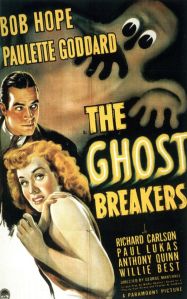 Director: George Marshall
Writers: Walter DeLeon, based on the play The Ghost Breaker by Paul Dickey & Charles W. Goddard
Cast: Bob Hope, Paulette Goddard, Richard Carlson, Paul Lukas, Willie Best, Pedro de Cordoba, Virginia Brissac, Noble Johnson, Anthony Quinn
Plot: On a rainy evening in New York City, Mary Carter (Paulette Goddard) packs to visit her great-great grandfather’s “haunted” island off the coast of Cuba, which she has inherited . Although the Cuban representative Havez (Pedro de Cordoba) tries to dissuade her from visiting, Mary is skeptical of the claims of ghosts on what he calls “Black Island.” Elsewhere in the hotel we meet radio “ghostbreaker” Lawrence Lawrence (Bob Hope), who reveals secrets, uncovers skeletons in the closet, and blows the lid off, as he puts it later, “family ghosts.” Larry is planning to leave for fishing vacation after that evening’s broadcast with his valet, Alex (a somewhat insensitive racial stereotype, by modern standards, played by Willie Best). When Mr. Parada (Paul Lukas) arrives to transfer the castle to Mary, he offers her a princely sum of $50,000 for the land. Before she decides on the deal, she receives a mysterious phone call from a man named Ramon (Anthony Quinn) warning her not to sell. The combination of the call and the offer simply makes her more determined to visit her grandfather’s estate. Left alone, she listens to Larry’s radio broadcast where he dishes on a mob operation.
When Larry returns, there are a series of shootings in the hallways and Larry believes he kills Ramon. Mary helps him hide as the police search the building, but he winds up in her trunk and is mistakenly sent to her cruise ship. Mary and Alex locate the trunk, but are unable to free Larry before he’s loaded onto the ship. In her room, Mary receives a letter warning her that death awaits her on the island. Alex helps Larry out and shows him a newspaper report about the shooting (remember evening editions? Neither do I) where he points out that Ramon was shot by a different caliber bullet– Larry couldn’t have killed him. Larry realizes someone is trying to intimidate Mary into avoiding the castle. As they discuss the situation on the deck, someone pushes a heavy potted plant over a railing, nearly killing the couple. They flee back to her stateroom, where the strain of the evening starts to show on Mary. When Alex arrives and says they can ride back to New York on a speedboat if they hurry, he refuses to leave, determined to help Mary. Before leaving the ship, Parada warns Larry about the castle, while Mary runs into an old acquaintance, Geoff Montgomery (Richard Carlson) who is skeptical of Parada and tries to warn her from dealing with him. Larry is excited when Parada tells him about a voodoo priestess on the island, one who allegedly has the power to create mindless zombies. (“You mean like Democrats?” Larry quips.)
That evening Geoff begins to romance Mary, who asks him to accompany her to Black Island. He refuses, fearful of the zombies. Mary is shocked when she believes she sees a ghost – Ramon, the murdered man. He introduces himself as Ramon’s twin brother, Francisco Mederos, who angrily demands information about his brother’s death. Larry and Alex, meanwhile, have taken a rowboat out to Black Island, where they encounter “Mother Zombie” (Virginia Brissac) and one of her zombies (Noble Johnson). They enter the house, where they hear noises that indicate someone else is there and find a strange painting that is the perfect image of Mary – her great-great-grandmother Maria. The two split up, and Alex observes a ghostly figure emerging from a trunk. Larry chases but only finds a skeleton. At the shore, Mother Zombie watches as Mary suddenly swims onto the beach carrying a waterproof bag with a dry robe. Inside, Larry and Alex hear Mary calling for them, but believe it’s a trick. She, meanwhile, hears voices telling her to run away before it’s too late – but runs right into the clutches of the Zombie. She flees, observed by the hidden Parada, who himself is captured by an unseen figure. Larry and Alex are attacked by the Zombie, hiding in a suit of armor, but before the creature can deliver a death-blow, they see the image of Maria Sebastian walk down the stairs. As it is distracted, Larry and Alex lock it in a closet and run to Maria – really Mary wearing her great-grandmother’s clothes after her own were ripped fleeing from the zombie. Mary notices the painting of Maria is pointing towards the crypt, and she and Larry investigate. In the crypt, Larry and Mary find Parada stabbed, stuffed in one of the caskets, bleeding to death. As he dies, he directs them to the organ in the crypt. Mary solves the puzzle, using the organ to open a hidden door that leads to an old mine beneath the castle. Francisco and Geoff both appear with guns, and Geoff shoots the gun from Francisco’s hand backing the other three against the wall. Geoff reveals that he was behind the threats and the offer to buy the castle, determined to gain ownership of an enormous vein of silver beneath the island. He’s about to shoot them, but the ceiling above collapses and clobbers him. A puzzled Alex looks down and says, “Boss, did I press the wrong button?”
Thoughts: At the top of his game, Bob Hope was one of the funniest human beings ever placed on the planet. He had a sly, sharp wit that was just this side of being truly subversive, and was just as likely to deliver a merciless zinger as he was to take a shot across his own rather prodigious nose. It’s not surprising, given the immensity of his library, that we start our march through the creepy comedy catalogue with him.
From the beginning, this film demonstrates how far afield certain comedies go. If you strip the movie down to its bare plot, it’s actually pretty dramatic – a reporter Is falsely accused of murder, flees from justice, and winds up in a haunted house. It could very easily be the set-up for a more traditional horror movie. The comedy comes not from anything in the situation or setting, but from the wonderfully funny performances by Hope and Best. Horror/comedies tend fall one way or another – either a dark story with funny characters (let’s call this “Type A” for the sake of discussion) or a pure comedy that plays with the tropes of a horror for its humor(“Type B”). While both sorts of film have strong examples (and we’ll discuss films from both categories before this little experiment is over), I find that the Type A movie is typically much more satisfying. (Virtually any “spoof” movie is in the Type B category, and as so many terrible spoofs have been made since Scary Movie jumpstarted that particular subgenre in 2000, I may be a bit unfairly biased against Type B. But at least I can admit it.)
The story is creepy, and the house is covered with cobwebs and dust, straight out of the pages of Better Haunted Homes and Gardens. The moment when the armored zombie slowly raises its mace over the head of the oblivious Larry is genuinely tense, and you’re afraid for him until Alex saves the day. No matter how tough the situation gets, though, Hope’s one-liners and Best’s witty retorts keep the mood light at all times. The best sequence, when Larry and Alex explore the mansion, is full of stuff like this – a distant sneeze prompts Hope to observe “The ghost has a cold,” for instance, and when the two commit the Scary Movie Cardinal Sin of splitting up, Larry tells Alex that, if he sees a couple of fellows running, let the first one go, because “That’ll be me.” Perhaps the greatest thing is how close to the vest the film plays the notion of the supernatural. These days, anyone trying to make a movie of this nature would feel the need to have Mary plagued by odd noises and startling images in the mirror practically from the beginning. Here, there’s nothing close to a confirmation the ghosts are real until Alex sees one in the trunk, almost exactly one hour into the film’s running time. (Okay, admittedly, we see the Zombie before that, but voodoo zombies aren’t the same thing we think of today, and even in this film can just as easily be explained as someone who is heavily drugged rather than someone under any some sort of legitimate magical curse.)
As a Type A, the film allows for more of a slow burn than many movies do today get to the genuinely frightening elements. It takes almost a half hour of the film’s short 85 minute running time to even get on the ship to Cuba, and the closest thing we’ve gotten to horror at this point are the brief allusions to ghosts in Mary’s castle, which she hasn’t even left for yet. The comedy, oddly, is also light, built primarily out of Hope’s quipping and his physical acting ability – the scene where Alex helps him out of Mary’s trunk, for example, is hysterical.
In fact, a lot of the movie is packed with red herrings and somewhat questionable moments that, in retrospect, are simple plot devices with no other value but to complicate the situation. The entire subplot regarding the mobster angry at Larry and Francisco seeking justice for his brother’s murder, in the end, amount to almost nothing. You could lift those characters out of the film entirely, come up with another explanation for getting Larry and Mary together (Larry was planning on a vacation, for Heaven’s sake, it would have been far more expedient simply to have him meet Mary on the cruise ship and get involved in her case when the potted plant is pushed towards her) and you’d still have essentially the same movie. Despite that, though, the movie doesn’t feel padded, and whips forward at a nice clip to the very entertaining finale.
As a rule, I try to not let cultural differences hurt my enjoyment of a movie too much. The 1940s were simply a different time, and I don’t really feel it’s fair to judge a film from that earlier period with the same standards as a contemporary film. That said, the portrayal of Alex frequently borders on the offensive. Although Willie Best gives a solid comedic performance, it’s based on the sort of minstrel show stereotype that, today, would get a film picketed from the moment it’s released. Alex is a clever character – frequently more logical and sensible than Larry, in fact – but it can be a bit hard to accept his cadence and intonation in the 21st century. Perhaps the worst moment is when a frightened Alex hides in a dust-filled clock, emerging covered with white powder and explaining that, when he gets scared, his “Al-bee-no blood shows through.” To his credit, though, Best also gets one of the film’s flat-out funniest moments, when Alex, at the end of his rope, knocks on the door to the closet where he trapped the zombie just to make sure it’s still there, then starts patiently pacing back and forth in front of one of the few things he can control.
To use the film’s age to its benefit, there is a degree of quaintness that makes it even more charming. The ease with which Larry is placed on the boat to Cuba is funny (the idea that anyone in 2012 could make it onto a ship that easily, let alone one to Cuba, is laughable). Hope’s Larry Lawrence is his typical charming screwball, particularly when he sees how shaken up Mary is by the whole affair and turns on some music, putting on a persona and dancing with her to cheer her up. The word today would be “adorkable” – he gladly plays the buffoon, but it’s purely for her benefit. Mary later calls him chivalrous, and when the obvious attraction between the two (who have only known each other for a few murder-obsessed hours) surfaces, there’s no trouble believing it.
Although the movie isn’t without its faults, it’s still a fun excursion with Bob Hope and well worth watching if you want lighter fare in the run-up to Halloween. The creepy moments are genuinely so, and the funny moments are as full of Hope’s timeless charm as any film he ever made.
Mutants, Monsters, and Madmen Day 30: Return of the Living Dead (1985)
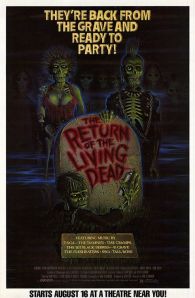 Director: Dan O’Bannon
Writers: John Russo, Rudy Ricci, Russell Streiner, Dan O’Bannon
Cast: Clu Gulager, James Karen, Don Calfa, Thom Matthews, Beverly Randolph, Linnea Quigley, Miguel Nunez, Allan Trautman
Plot: At the Uneeda Medical Supply company, manager Frank (James Karen) shows around trainee Freddy (Thom Matthews), and asks him if he’s ever seen Night of the Living Dead. Showing off, Frank tells Freddy the film was based on reality. A strange chemical called Trioxin animated corpses in Pittsburgh, but the truth was suppressed… and the bodies are being stored right there in barrels of the chemical. Frank shows the barrels to Freddy, but accidentally causes a leak of the gas, dousing both men and reanimating the dead bodies – even the parts of dead bodies – kept in storage at Uneeda. Freddy’s friends – a group of punk teenagers who look like the 80s threw up leather and piercings all over them – decide to kill time in a nearby cemetery while waiting to pick him up from work. As they proceed to party in the graveyard, Frank and Freddy wake up from their encounter with the Trioxin gas feeling sick. One of the barrels has broken open and is empty, and Frank assumes the body melted. They soon find the rest of the corpses (human and otherwise) throughout the warehouse animated and hungry.
Back in the graveyard one of the teens, Trash (Linnea Quigley) begins to fantasize about the more horrific ways to die, leading to one of the most bizarre and gratuitous striptease sequences in horror movie history. Frank and Freddy summon their boss, Burt (Clu Gulagar), about the cadaver screaming and banging on the walls of cold storage. Remembering Night of the Living Dead, Burt tries to kill the cadaver by driving an axe into its brain, then cutting off its head, but it doesn’t kill the monster. They reach a horrible revelation: the movies lied to them. Burt decides to bring the cadavers to his pal Ernie (Don Calfa) at the crematorium, hoping to destroy them that way. It works, but the smoke that spills out of the oven seeds the clouds above, and it begins to rain on the graveyard. The water filters down through the soil, into the coffins, and the dead begin to claw their way to the surface.
Frank and Freddy are getting sicker and sicker, and Ernie calls an ambulance. Meanwhile Freddy’s girlfriend, Tina (Beverly Randolph), has made it to Uneeda, where she finds the place seemingly deserted. As she searches for Freddy, she encounters the zombie that escaped from the first barrel, a slender figure that has become known as Tarman (Allan Trautman). The rest of the teens arrive just in time to save her, but Tarman gets his first snack of brains in the process. The paramedics arrive to treat Freddy and Frank, but are unable to find a pulse or blood pressure in either one of them, and their bodies are room temperature. The teens are attacked in the cemetery, and three of them (Tina included) make it to the mortuary, while two more get back to Uneeda. As the paramedics return to their ambulance, they hear screams and try to call for back-up, only to be attacked and devoured by the swarming dead. The survivors in the mortuary board up the place to hold out the zombies, and Freddy begins experiencing pain as his body goes into rigor mortis. One of the zombies manages to make it into the mortuary and Ernie straps it down, questioning it. It tells the survivors they want to eat brains because it relieves the pain of being dead. Burt locks Freddy and Frank in the mortuary chapel with Tina, who insists on staying with Freddy. Burt, Ernie, and Spider (Miguel Nunez) begin to seek an escape, while in the chapel, Freddy attacks Tina, hungry for brains. Spider and Burt make a run for the police car, fighting the zombies on the way. They drive the car to the door to collect Tina and Ernie, can’t get through the mob and drive away for help, but a swarm of zombies traps them at the Uneeda warehouse. Not wanting to become like the rest of the zombies, Frank turns on the crematorium, says a prayer for forgiveness, and climbs into the oven. Burt calls the army hotline on the Trioxin barrel and reports what has happened, and the army activates its contingency plan. Ernie and Tina hide from Freddy while the survivors at Uneeda protect themselves from Tarman, and just as everyone makes a final stand, the army drops a bomb on the whole damn city of Louisville, Kentucky, wiping it – and the zombies – off the map. But as the zombies burn, the smoke rises… and the rain starts to fall.
Thoughts: This movie has perhaps the strangest pedigree of any film on this list. George Romero – writer and director of Night of the Living Dead – got into a disagreement with co-producer John Russo about the direction of the franchise. Russo walked away with the right to use the “Living Dead” name for his own franchise, and this was the result: a world where Night of the Living Dead was a movie, but was based on its own reality. It’s a weird premise, to be sure, and I was at first reluctant to include this movie in my little horror movie project, mainly because I think it may be more deserving of a place in the eventual horror/comedy project I intend to present in the future. But I decided use it for two reasons: first, like Night of the Living Dead, this movie helped influence the way zombies are portrayed in popular culture even today, and second, I’m not really convinced that all of the comedy in this movie was intentional.
The zombies (with the exception of Tarman) are all kind of silly, particularly the first, fresh cadaver, where the actor seemed to just be stripped, shaved, and painted yellow. And a lot of the violence seems to be played for laughs. Trash’s legendary tombstone striptease isn’t really scary or sexy, just weird. On the other hand, the parts that probably were intentionally funny (such as the hungry zombie calling for “more paramedics” on the ambulance scanner) are legitimately funny. Even the 80s-style montage (in this one the characters are barricading themselves in the mortuary instead of training to win the big ski tournament) is funny enough, juxtaposed against a goofy rock ballad about the Living Dead.
The characters in this movie really are jokes, especially the teenagers. They’re all caricatures, and the way one of them (I don’t even remember the characters’ name, making it impossible to look up the actor, that’s how generic they are) gives a speech about how his leather and chains is a “way of life” and not a costume is groan-inducing, and the way they resist calling the cops (because they’ll “kick our ass”) even as one of their buddies is having his brain eaten takes them from the realm of stereotype to the land of the remarkably stupid. It’s really no loss when any of them gets turned into a zombie hors d’oeuvre. As for naming the two old chums “Burt” and “Ernie”… really, O’Bannon? Sesame Street was pushing 20 years old at the time you wrote this script, you can’t tell me that wasn’t intentional.
There seems to have been an ill-fated attempt at poignancy with “Trash,” who proclaims early in the film that she believes the worst way to die would be to be eaten to death by old men, but seeing as how she says that immediately before she begins taking off her clothes for no apparent reason, it’s doubtful most audience members remember that bit. Frank’s suicide is a little more satisfying from an audience standpoint – it’s the one point in the movie where someone shows anything like a little human regret – and the moment where he dies is a good capper to what little of a character arc there is.
The zombies in this movie are different from Romero zombies in many ways. First off, they’re more intelligent, with the ability to speak and reason (although later Romero films did start to show zombies exhibiting a few higher-order skills). Second, they can’t be killed by a simple bullet to the brain, and in fact, dismemberment does no good as each individual chunk of the zombie continues to move of its own accord. Finally, and most importantly to popular culture, this is the movie that gave us zombies obsessed with braaaaaaaains. A Romero zombie (and those of most of his imitators) is perfectly happy with any chunk of living flesh, and it’s these zombies that we still see in most movies and TV shows. If you’re a fan of The Walking Dead, you’re watching a Romero zombie. But whenever you see a zombie that wants specifically to chomp on a brain, you can thank John Russo and Dan O’Bannon.
From the perspective of a horror movie fan, there’s nothing in this movie as scary or visually cool as Tarman. The first zombie, one whose flesh has mostly melted into slime from years of Trioxin storage, is a grotesque, slimy creature that could give anybody nightmares. Allan Trautman, who played the character, is rather underappreciated in the strata of horror icons. His slim frame and marvelous physical performance created the best monster from this movie, and one of the most memorable single zombies of all time. While the other zombies aren’t nearly as recognizable or as entertaining, there are a couple of cool scenes. The moment where the rainwater filters down through the ground into the coffins and the dead claw their way out to the surface, for example, looks really great, and the zombie Ernie interrogates is a nice piece of puppeteering, even if the movement of its mouth doesn’t remotely match the words she’s saying.
The end of the movie is almost as literal a deus ex machina as one could hope for. There’s a short bit earlier where someone from the army shows a bit of concern about the barrels (which have been missing for sixteen years thanks to some sort of paperwork screw-up), but it seems tacked on to justify a conclusion that otherwise would come totally from out of the blue. While I give the filmmakers credit for going for the nuclear option (pun intended), it makes everything else in the movie feel somewhat hollow.
While Return of the Living Dead is by no means the only movie to use the “we swear it’s a true story” gag, it’s by far the least convincing. And although there’s fun to be had in watching the movie, it’s horror movie fun at its cheesiest. It’s hard to imagine this film being sincerely frightening to any adult, but there’s still room for enjoyment in watching it. Just don’t go into it looking for a scare.
Stephen King makes one more appearance tomorrow, with one of his most down-to-earth tales of horror… and, I admit, one of my personal favorites: Misery.
Mutants, Monsters, and Madmen Day 15: Night of the Living Dead (1968)
 Director: George Romero
Writer: George Romero, John Russo
Cast: Duane Jones, Judith O’Dea, Russell Streiner, Karl Hardman, Marilyn Eastman, Keith Wayne, Judith Ridley, Kyra Schon
Plot: Barbara (Judith O’Dea) and her brother Johnny (Russell Streiner) are visiting their mother’s grave outside of Pittsburgh when they are attacked by a lumbering dead man. Johnny is killed and Barbara flees, surrounded by a flock of the dead who have somehow regained animation and seem to hunger for other human beings. Barbara finally finds herself in a near-catatonic state, trapped in a house, barely escaping the swarming dead. When Ben (Duane Jones) arrives, fleeing the ghouls, Barbara has been shocked into muteness. To their surprise, they find more survivors – a family and a young couple have been hiding in the cellar of the house the entire time. Ben gets into an argument with Harry Cooper (Karl Hardman) about whether it’s safer to try to fight in the house or to hole up in the cellar, and eventually the Cooper family bolts itself downstairs while the young couple, Tom (Keith Wayne) and Judy (Judith Ridley) stay up top with Ben and Barbara.
Downstairs, Cooper and his wife (Marilyn Eastman) repeat Cooper’s argument with Ben, this time with their ill and unconscious daughter Karen (Kyra Schon) lying between them. Ben and Tom decide on a plan to help them all make for a rescue station, but they will have to brave the undead outside to get to a shed with gas pumps. Tom and Judy die in the attempt and Ben is almost killed when Cooper is afraid to open the door and let him in.
Back inside, Cooper reveals his daughter’s illness came about when she was bit by one of the creatures, while on TV a mob of armed men discuss their efforts to kill the ghouls… a shot to the head is the surefire way to do it. Cooper takes advantage of the situation to go for Ben’s gun, but Ben wrestles it away and shoots Cooper in the side. The invading zombies grab Mrs. Cooper, and her husband staggers back down into the cellar, where his daughter has died, reanimated, and kills her father. Barbara snaps out of her shock and saves Mrs. Cooper, but she too rushes downstairs where her daughter is waiting, and hungry. Barbara is grabbed and pulled into the swarm of zombies by her own dead brother, Johnny, leaving Ben alone to fight off the rest of the horde. Karen emerges from the cellar, but he escapes through the cellar door, kills the re-animated Mr. and Mrs. Cooper, and holes himself up for the night. When morning comes, the zombies have gone and Ben exits the house. A group of roving hunters has shot them all, freeing our hero… until one of them mistakes Ben for another zombie, casually puts a bullet in his head, and throws his body into the funeral pyre with all the rest.
Thoughts: This is one of those films that flat-out defines a genre. George Romero didn’t invent the concept of the zombie, and in fact the word “zombie” is never actually used during the movie, but Night of the Living Dead has shaped the way that we envision this particular menace from beyond the grave ever since. Prior to 1968, cinematic zombies were either of the Haitian voodoo variety (people who had their will stripped from them, forced to do the bidding of a living master) or the occasional alien-controlled mindless husk. It was Romero that took the Haitian concept of the body brought back to life to the extreme of having his heroes battle actual, lumbering corpses, and it was Romero that first gave zombies their hunger for human flesh. (Flesh, mind, you, not brains. That comes later.)
Once again, we see how effective black and white is for these horror films. The scenes – particularly at night – stand in sharp contrast. The characters live in a world of white, while the darkness seems intent to close in on them, and ultimately consume them. The colorized versions – even the particularly good colorized version from 2004 – loses so much of the atmosphere as to make it totally ineffective. The scenes where they zombies gobble up what’s left of Tom and Judy – even thick, ropy intestines – are by far more gruesome than anything else we’ve seen so far in this little horror project. The bar was raised as to how graphic on-screen violence could get, and although Romero certainly had to fight detractors, once that particular Pandora’s Box was opened there was no going back. Even the credits sequence is disturbing – a series of still photographs showing the hunters using hooks to drag Ben’s body to the bonfire where the zombies are being destroyed for good.
Romero and Russo have an interesting structure. With most horror films, you’ll start with a large group of characters, then whittle it down one or two at a time as people are picked off by the monsters. In this case we start with a “sole survivor” in Barbara, then add to the group one or two at a time. Once we reach full strength, with the Cooper family and the teenagers joining Ben and Barbara, the whittling can begin again.
Much of the film has become legendary. The amount of gore depicted on-screen – both in the death scenes and just in images of bodies lying around – was far beyond what one expected from a movie in 1968. Little things – Johnny’s “They’re coming to get you, Barbara…” have lapsed into the public consciousness. If you say that with the right intonation (“They’re coming to get you, Baaaaaaar-ber-aaaaah…”) people who haven’t even seen the film will recognize the line. That idea of a small group of survivors in a boarded-up house, trying to hold off the horde… here’s where it comes from.
Even the way zombies move in this film are what we base every zombie walk on today… slow, shambling, and relentless. This movie is the reasons purists like my girlfriend refuse to accept films like the 2005 Dawn of the Dead remake as a true zombie film – because “Zombies don’t run!” And there’s some truth in the basic idea here. As easy as it would be to escape or kill a single zombie for any able-bodied adult, what makes zombies truly terrifying is the way they just keep coming, the way they march on through any injury short of the destruction of the brain itself, and the way they can start to swarm upon you. The “zombie apocalypse” idea is here, but it’s in its infancy. This is a small film, focusing on a small group of survivors, but we get a radio news commentary that informs us that the phenomenon is happening across the eastern part of the United States, and growing more widespread. Later filmmakers and authors (including Romero himself) would run with this idea and make our zombies just one of the ways the world ends… not with a bang or a whimper, but with a low moan and a gnashing of teeth.
One of the things that many zombie movies – certainly the best ones – have taken from this film is the way there’s no attempt to explain the supernatural. The dead are rising, and there’s a little lip service paid to it in the form of a short newscast reporting on “radioactive contamination,” but there’s certainly no sort of definitive explanation for why the dead have chosen this particular moment to rise. In truth, the “why” doesn’t really matter – there are monsters, they want to eat you and turn you into one of them, so who cares why they’re doing it? Just run! Zombies (thanks largely to this movie) have become such an all-pervasive aspect of culture that there’s really no reason to muck about with explaining it. Just get straight down to your plot, your characters, and if necessary, your social commentary.
Speaking of which, Romero also gets credit for making the zombie film a commentary on society. Many of his films – and dozens of imitators – have tried to use zombies as allegory for everything from consumerism to the military-industrial complex to the war on terror, all citing Night of the Living Dead’s commentary on racism as their justification. And it’s easy to do – the character of Ben is smart, competent, but utterly helpless to save all of the white people around him who either die thanks to foolish mistakes or self-destruct out of fear or distrust. And then poor Ben, sole survivor, dies at the last second, shot down by a gun-toting white man who thinks Ben is just another zombie. Commentary, right? Except that, to hear Romero tell it, it was never intended. The role of Ben was never written specifically with a black actor in mind, it just so happened that Duane Jones was the best man for the role. The social commentary that people have salivated over for decades is largely a case of people projecting their own issues on to the film. Still, it’s a credit to the film that such projection is even possible, and so convincing when it happens.
Because of a ridiculous blunder on the part of the film’s original distributors – a failure to place a copyright notice on the print – the movie is in the public domain. So it’s really easy to find a copy of it on DVD. But there are very few really good prints of it out there. If you’re hunting out the DVD, do yourself a favor and try to get the “official” one, approved by Romero. And stay away from the “reimagined” 30th anniversary edition released by John Russo in 1999. The less said about that version, the better.
Tomorrow, it’s taken us until 1972, but we’re getting to some of the goriest films we’ve seen yet. Is blood really necessary for suspense? We’ll talk about it in our look at the original version of Last House on the Left.
 Reel to Reel