Blog Archives
Mutants, Monsters, and Madmen Day 22: Halloween (1978)
 Director: John Carpenter
Writer: John Carpenter, Debra Hill
Cast: Jamie Lee Curtis, Donald Pleasence, P.J. Soles, Nancy Loomis, Nick Castle, Peter Griffith, John Michael Graham, Bryan Andrews
Plot: In Haddonfield, Illinois, 1963, a 6-year-old boy named Michael Myers inexplicably murders his older sister on Halloween Night. Michael is sent to a mental institution where, for 15 years, Dr. Sam Loomis (Donald Pleasence) attempts to treat the boy for his psychosis. Eventually, Loomis surrenders, believing the boy to be beyond redemption, and turns his efforts towards containing the monster that has grown up to become a brute of a man. On October 30, 1978, Michael (Nick Castle) escapes from the institution and begins a trek back to Haddonfield.
The next morning, the day of Halloween, high school senior Laurie Strode (Jamie Lee Curtis) drops off a package at the old, empty Myers house as a favor to her realtor father (Peter Griffith). She and the child she babysits, Tommy Doyle (Bryan Andrews) relate the legend the Myers story has become, unaware that a now-masked Michael is watching them. Laurie and her friend Annie (Nancy Loomis) encounter Annie’s father, Sheriff Brackett (Charles Cyphers), who informs them about a break-in and theft of a Halloween mask from a store in town. Loomis recruits Brackett to help him both in searching for Michael and in keeping his presence in town a secret.
That night, Annie and Laurie are both on babysitting jobs until Annie drops off her charge with Laurie and Tommy across the street so she can spend the evening with her boyfriend, only to return to what she thinks is an empty house. Naturally, it’s not. Soon afterwards, Lynda (P.J. Soles) and her boyfriend Bob (John Michael Graham) come over and find the house empty, seeing a free reign for some amorous activities of their own. Instead, they simply give Michael two more victims to add to his count. Still-nervous Laurie, across the street, decides to check out the unnaturally quiet house, only to find Michael’s victims, including Annie laid out in a gruesome tableau beneath the stolen headstone of Judith Myers. Laurie screams, tries to flee, and winds up taking a tumble down the stairs to escape Michael. Hurt, she staggers across the street to protect the children, but Michael follows her. In the final scenes, Laurie and Michael engage in an incredible cat-and-mouse game for her life, until finally she sends the kids out to seek help, drawing Loomis’s attention. He arrives just in time to save Laurie, shooting Michael and sending him falling from the window. A shattered Laurie asks Loomis if it really was the Boogeyman. Loomis confirms that it was… as he looks out the window and sees that Michael is gone.
Thoughts: Not the first “slasher” film, of course (we’ve already discussed at least two others that fit in that category), John Carpenter’s Halloween is truly the one that created the template future slashers would follow. In a simple 20-day shoot, on a shoestring budget, Carpenter gave us the synthesis of the mysterious figure, the slow build-up of one death after another to lead to a final confrontation, the use of the killer as some sort of karmic punishment for teenagers that get wrapped up in the evils of sex and drugs and alcohol, and of course the Survivor Girl in Jamie lee Curtis’s Laurie Strode.
Carpenter also uses visual tricks to great effect. The long opening scene is a single-take shot, all from the point of view of little Michael, as he watches his sister with her boyfriend, waits until she’s alone, and makes his first kill. The audience doesn’t even realize it’s a point of view shot for the first minute or two, until we see Michael’s little clown-clad arm reach out and grab the kitchen knife. Once he puts on his mask, our vision is impaired and reduced to a pair of small eye-holes, which covers up just enough of the brutality of his sister’s murder to make it all the more horrifying. He bookends this at the end of the movie, after Michael’s disappearance, with images of the empty rooms and exterior of the house where the rampage took place. Although we don’t see Michael again at this point, the idea that we are again looking through his eyes strikes you immediately.
For pure horror atmosphere, Halloween is undoubtedly one of the greatest films ever made. Some of the earlier slasher prototypes – here I’m specifically thinking of Last House on the Left and Texas Chainsaw Massacre – spent a good deal of time on mundane or even goofy nonsense before delving into anything horrifying. Halloween starts with a murder, and although it’s some time before Michael kills again, there’s a pervasive feeling of dread and terror that lasts throughout the film. Carpenter also composed the movie’s theme, which has really become an iconic piece of scary music, right up there with the themes to Psycho and Jaws.
In fact, Carpenter obviously draws on the history of Psycho in several places: his killer is obsessed with slaying women, particularly those of his own family; Dr. Sam Loomis is named after the John Gavin character from Psycho; Michael’s knife –his stance – echoes “Mother” and her weapon as she stalked Marion Crane; even his heroine is played by Jamie Lee Curtis, real-life daughter of Janet Leigh, who played Norman Bates’s most famous victim. I’m pretty sure the film’s original title was The Babysitter Murders (or) I Love Hitchcock. In a curious bit of pre-reflection, the babysitters and their charges spend Halloween night watching the 50s sci-fi chiller The Thing From Another World, which Carpenter himself would remake a few years later, and which we’ll actually discuss here in a few days.
Michael, in this film, is almost omnipresent. He’s an enormous, white-faced ninja, appearing at random times, able to pop up from virtually anywhere, and always, always watching. When you consider how relatively little violence there is in the film – the death scenes are few and brief – it’s amazing how effective Michael’s presence is at creating the overwhelming sense of fear. At the same time, there’s an odd sense of innocence to the character… or at the very least, confusion, like he doesn’t fully comprehend anything he’s doing. Bob’s death in particular demonstrates this: Michael pins the boy to the wall hard enough to leave him dangling there in his death-gurgles. As he’s dying, Michael tilts his head at him, almost quizzically, like a puppy looking at a stranger he can’t quite figure out.
Oddly enough, the family obsession isn’t actually that clear in this first film, except for the fact that Michael’s original victim is his older sister. There’s no reason at this point, though, to believe that his madness is anything other than a random killing spree. Halloween II, also written by Carpenter and Hill, is probably one of the all-time great horror sequels. It picks up immediately after the climax of this film and the entirety of the action takes place on the same night: Halloween 1978. If one views the two of them together, as if it was one long film, you get a richer story and uncover much more about the Myers family – namely the fact that Laurie was adopted by the Strodes and is, in fact, Michael’s younger sister. I have no idea if Carpenter and Hill were thinking along these lines when they wrote the original screenplay, but in the sequel they pull out a revelation that makes the earlier installment better by adding a totally different subtext. (Contrast that to the Star Wars revelations: no matter how much you love the original film or Empire Strikes Back, don’t you always feel a little squicky now when Leia plants a wet one on Luke Skywalker?)
As much as Michael Myers became emblematic of the horror movie boogieman, so did Jamie Lee Curtis’s Laurie Strode come to embody the Survivor Girl trope – the one girl who remains (relatively) clean and innocent while all her friends are busy drinking, smoking (anything they can get their hands on), and engaging in lots and lots of teenage sex. We go back to the old Horror Movie As Morality Play idea, as these other teens are picked off one at a time, leaving only the clean, sober, virginal one to make the final stand against the killer. And truly, Curtis’s final stand is one of the best ever. She’s scared, but she’s also tough and determined, more so to protect the children than to protect herself. At every step of those final scenes, while Michael stalks her through the house, her first concern is to protect the kids, then herself. It’s a heroic stance that makes us sympathize even more than we would have originally (and the Babysitter Versus the Boogeyman idea is already one that wins her a great deal of sympathy from the audience). When she’s scared, you buy the terror on her face wholeheartedly. When she’s angry, you wouldn’t want to be the one to cross her.
And yes, like every horror movie in the history of ever, you’ve got those scenes where you want to just scream at her to turn around, dammit, he’s right behind you! But you usually say this while laughing, knowing the teenager is going to bite it and you’re really just there to see how it’s going to happen. This is one time where you really want her to turn around before it’s too late.
The series went off the rails with its third installment, Halloween III: Season of the Witch, which didn’t feature Michael at all. The idea was to try to turn Halloween into an annual Tales From the Crypt-style anthology series, each installment telling a totally different scary story. It’s not a bad idea and it may have worked if it wasn’t that Halloween II had already cemented Michael as the star of the franchise and if Halloween III wasn’t such a hot mess. Future installments never quite matched the original two, drifting Michael further and further down the road of the supernatural, which undermined what made the original so great in the first place. In the first two films, Michael is a terrifying figure because he represents a hidden dark side that could exist even in the most seemingly innocent person, a darkness that could erupt at any time and become the shadow in the window or the boogeyman behind the closet door. Once you make Michael the victim of a curse or a demon, you lose that. So go out and watch the first two Halloween films as part of your seasonal festivities, and ignore the rest.
From the terror in the house next door, tomorrow we’re going to the depths of deep space for perhaps the greatest blend of science fiction and horror ever made: Ridley Scott’s Alien.
Mutants, Monsters, and Madmen Day 18: The Texas Chainsaw Massacre (1974)
 Director: Tobe Hooper
Writer: Tobe Hooper, Kim Henkel
Cast: Marilyn Burns, Paul A. Partain, William Vail, Teri McMinn, Allen Danziger, Edwin Neal, Jim Siedow, Gunnar Hansen, John Dugan
Plot: The film opens with grisly images and a radio news report of some horrific “sculpture” found by police, made out of bodies stolen from their graves. As the radio continues to talk about the case, we meet a group of young people on their way to visit the grave of Sally Hardesty (Marilyn Burns)’s grandfather. On the way home, they pick up a hitchhiker (Edwin Neal), who proceeds to cut himself and slashes Sally’s wheelchair-bound brother Franklin (Paul A. Partain) before they throw him out. At a run-down gas station, Franklin asks for directions to his father’s old property, but the manager (Jim Siedow) tries to warn them away. Instead, they decide to check out the old place and return later after the transport refills the station’s gas tanks.
Kirk (William Vail) and Pam (Teri McMinn) decide to set out to seek a nearby swimming hole, but instead find a house full of animal skulls, hide, and heads. Kirk enters, only to be confronted by a giant man (Gunnar Hansen) wearing a horrible mask of human skin. When Pam enters to search for him, she finds the house full of skeletons – both animal and human – arranged in bizarre, horrible tableaus. The man with the mask snatches her too, impaling her on a hook and making her watch as he dismembers Kirk with a chainsaw.
Back at the van Jerry (Allen Danizger) sets out to search for Kirk and Pam (breaking the cardinal rule of horror movies – don’t go anywhere alone). With the sun going down arrives at Leatherface’s house and enters, finding Pam barely alive and locked in a freezer chest. Leatherface kills him, because that’s what you do when you’re wearing human skin. It’s after dark now, and Franklin begins to panic over his missing friends and the fact that they have the keys. Sally and Franklin go through the high grass and shrubs, calling for their friends… until Leatherface appears with his chainsaw and hacks up Franklin. Sally runs for her life but, unfortunately, runs right to his house. Instead of help, she finds decaying, partially mummified bodies set up in a terrible sort of diorama. She escapes by leaping from a second-story window, running back into the darkness, screaming. (Hey Sally, pro tip for you: when you’re running from the chainsaw-wielding maniac into the darkness of the night, stop making noises that let him know where you are.)
Sally makes it to the gas station, where the owner knocks her out and ties her up. Driving her back to Leatherface’s house, they encounter the hitchhiker – Leatherface’s little brother. Inside, Leatherface is now wearing a dress and wig, preparing the “family” for supper. The brothers bring down “grandpa” from the attic – the desiccated old man Sally found before. But he’s not a corpse – he’s still alive. The family decides to let grandpa (John Dugan) kill Sally, but he’s too weak to hold the hammer, and she manages to escape, jumping through (another) window to find it’s now morning. She flees into the road, the brother behind her. An 18-wheeler comes around the corner, killing him. Sally leaps into the bed of a passing pickup truck, leaving Leatherface flailing about in the road.
Thoughts: It’s another entry in the “no, really, this actually happened” category of horror films. In truth, the story and characters were a complete fabrication, although Tobe Hooper and Kim Henkel were reportedly inspired by real-life serial killer Ed Gein (also the inspiration for Robert Bloch’s original novel of Psycho – there’s a little trivia for you).
Unlike some of the later horror icons (Jason, Freddy, Michael Myers), Leatherface never really grabbed me. Part of it may be his choice of victims – Pam is an airheaded hippie, Franklin is a self-pitying lout, and Kirk and Jerry come across as rather cold and heartless. Even Sally has moments of cruelty towards her brother, although considering the stress she’s under at that point, it’s a little more forgivable. Still you want to have somebody to root for when the killer is busy hacking people to shreds.
The thing that makes this movie effective, if not to my personal tastes, is how abrupt much of the horror is. The hitchhiker is weird, sure, but you’re still shocked when he grabs Franklin’s knife and cuts into the meat of his own palm. The house Kirk and Pam find is bizarre, but you’re simply not expecting it when Leatherface leaps out and pounds him in the head. When the horror begins, Tobe Hooper avoided the telltales that Something Bad Is Happening – no ominous music, no creepy sound effects, no shadows moving in the background. It just goes from one minute looking at a weird little house to, the next, finding yourself getting attacked by a monster. Again, as Franklin and Sally push through the weeds in the dark, Leatherface appears without warning. Movies aren’t made this way anymore.
This movie does, however, give birth to many of the other slasher film clichés: the “Last Girl,” the girl who can’t outrun the killer despite his enormous size, the victim who runs up the stairs instead of running the hell away and so forth. In truth, most of those clichés are embodied in Sally who – although terrified – really isn’t the smartest horror movie character you’ve ever seen. Think about it, Sal – the killer was right outside the door, then vanishes when the creepy old man opens the door again to get his truck? To her credit, she does figure out that something is wrong, but way too slowly.
As for Leatherface himself – maybe it’s decades of exposure to horror movies, but the horror mask doesn’t really unnerve me all that much. What’s creepy is the face beneath the mask. Gunnar Hansen is wearing enormous, jagged teeth, and his eyes dart about whenever you see him in close-up, as if his brain is flitting about in his head, ready to pop out at any moment.
It’s a fast-paced movie, which is to the good. The running time is short – only 84 minutes – but even taking that into account, things move along at quite a clip. We’re deep into the movie before Leatherface appears, but you don’t actually feel how long it has been. Amazingly, by the time Leatherface disposes of the first four victims and only Sally is left, there’s still a half-hour left in the film.
Hooper also works in a little macabre comedy towards the film’s end. The father’s reaction to how Leatherface chopped up the door could have come from an exasperated TV father. He may as well have said, “We just can’t have nice things!” Leatherface prancing around in the dress, cringing from his angry father, feels like Hooper took Norman Bates and twisted him into an even weirder configuration. The thing is, once Leatherface puts the wig on and allows his father to browbeat him, he ceases to be menacing and becomes an object of ridicule. Well, for me, at least. Sally probably felt different. The horror comes back when “grandpa” makes an appearance, and actually recovers pretty well considering how the rhythm of the piece had been disrupted seconds before.
The film is inconsistent with its characters, too. The father alternately claims he takes no pleasure in killing and there’s no sense in torturing Sally before she has to die, then switches to giggling and mocking her along with his warped sons. He even jumps up and down with glee as grandpa tries to hammer Sally in the head. There’s no real reason for these inexplicable shifts, save perhaps to pad out the film a bit, as it is accompanied by long scenes of Sally screaming, with close-ups of her eyes cut with shots of the laughing family (including dad).
Even the film’s conclusion is terribly abrupt, with Sally’s savior coming out of nowhere and whisking her away as the credits roll. There’s no follow-up here, and this is a film that kind of needs it. Sally must have alerted the police – was the family still there when they arrived? Were they attacked? These are the sort of things I suppose may have been addressed in the sequels, but I’ve never seen any of them and, honestly, I’m not really compelled to.
From terror of the human variety, we’re going to face off with the nastiest predator of the animal kingdom. Tomorrow, you’re going to want to stay out of the water, because we’re watching Jaws.
Mutants, Monsters, and Madmen Day 11: Psycho (1960)
 Director: Alfred Hitchcock
Writer: Joseph Stefano, from the novel by Robert Bloch
Cast: Anthony Perkins, Janet Leigh, Vera Miles, John Gavin, Martin Balsam
Plot: Marion Crane (Janet Leigh) steals $40,000 from her employer to help her boyfriend (John Gavin) pay off his debts. As she’s running to him, she stops overnight at a secluded hotel run by Norman Bates (Anthony Perkins), whose elderly mother lives with him in the adjacent house. When Leigh vanishes (following perhaps the most memorable death sequence in thriller history), her sister (Vera Miles) and boyfriend begin to seek her out, following the trail back to the hotel where she met her fate. A thrilling final confrontation reveals the true depths of Norman Bates’ insanity, jolting the viewers with shock after shock that still resonates 50 years later.
Thoughts: Truly, is there any thriller more classic, more iconic, more memorable than Alfred Hitchcock’s Psycho? The movie launched a whole new subgenre of terror, making the psychology of a killer a vital element to the story. (True, Peeping Tom did the same thing, but far more people remember Psycho.)
Let’s get the necessary stuff out of the way first, though. The film was amazing precisely because it broke so many off the conventions of the day. The film begins with following Janet Leigh as she steals the money and takes off. We watch her go through a red herring sequence where a police officer grows suspicious of her and watches her trade in her car (it adds nothing to the plot, but substantially increases the viewer’s false presumption that Leigh is the film’s protagonist and, therefore, going to be with us for a while). We don’t meet Norman Bates until about a half-hour into the film, and then – assuming you’re one of the three people left on the planet unfamiliar with this sequence – we’re shocked when “Mother” murders Leigh with a full hour remaining. How could this be? She’s the main character, she’s the one we’ve been following! Where will the movie go now?
The truth is that the story isn’t really hers at all, but that false assumption is incredibly effective at distracting us from the true star – Anthony Perkins as Norman Bates. Norman, as we learn, is the classic victim-turned-victimizer, repressed by an overbearing mother whom he later killed when he felt she was leaving him behind for her new lover. Afterwards, Bates develops a dissociative identity disorder, with “Mother” taking up residence in his head and murdering any woman he feels an attraction to, leading up to the climax of the film, where “Mother” takes over entirely.
Speaking – as I am wont to do – of the influence in both directions, Mother really strikes me as being a construct straight out of William Faulkner. Bates poisons his mother and her lover, then keeps Mother’s corpse with him in the house, carrying her from room to room, speaking to her as if she was alive. I’d be hard-pressed to believe that Robert Bloch wasn’t inspired here by Faulkner’s “A Rose For Emily,” a short story where (in a twist ending — so, y’know, spoiler warning) we learn that the main character poisoned her lover years ago. He was planning to leave her, so she dosed him with rat poison and kept his corpse in her house – and bed – for the rest of her very long life. Something about that idea of living with a corpse, of sleeping next to the dead, is unfailingly creepy. It’s one of the short stories I most enjoy teaching to my 11th grade students every year, just because of the reaction when they get to the end. I wonder how these 16-year-olds would react to seeing Psycho. But more on that later.
Aside from just being a great story and screenplay, Hitchcock’s direction and Perkins’s performance combine to make this a movie that truly deserves the label “masterpiece.” Nearly every frame of the film is a work of art, expertly combining shadow and shape to create an all-pervasive feeling of terror. The 1998 shot-for-shot remake of the film was an abomination in many, many ways, but most notably because you simply can’t create the mood Hitchcock conjured up in a color film. This is a movie that needs to be in black and white to really work. The death scene in particular just isn’t as scary in color. Leigh steps into the shower, blissfully unaware of the figure in the long dress and wig creeping up on the translucent shower curtain. We see the knife raised and brought down, over and over again. The dripping blood (probably chocolate syrup or something of the sort) strikes the pure white tile of the shower and your brain fills in the rest of the blanks as it all swirls down the drain. Sure, we live in a world where the likes of the Saw movies do their level best to be as graphic as possible with the deaths of the characters, but Psycho proves you don’t need to do that to scare the hell out of people.
Janet Leigh – rightly – was given an Academy Award nomination for the film, but I can’t help but feel Perkins was robbed. As good as everything else in the film was, none of it would have worked if his Norman Bates wasn’t so remarkable. When we first meet the character, he’s very kind, polite, handsome, and instantly likable. In other films, he’d be the best friend the leads confide in during their darkest moments. But as the movie progresses, as we learn more about his dysfunctional relationship with Mother, our perception of him begins to change. He becomes an object of pity. With his tall, almost preternaturally slender frame, he somehow looks younger than he really is, almost childlike despite how he rises above Marion. The scene immediately following Janet Leigh’s murder really sticks out. Norman (who the unspoiled viewer doesn’t yet know is the killer) stands in the doorway to the bathroom, mop and bucket in his hand, to clean up the mess Mother made this time. His shoulders slump and we realize the jacket he’s wearing is far too big for his spindly body, making him look like a little boy trying on Daddy’s clothes in the hopes of looking like a grown-up. His discomfort and slip ups when speaking to a private investigator (Martin Balsam) are spot-on perfect, with the sense of unease slowly spreading across his face throughout the scene, leading into a pronounced stutter as his ball of lies becomes too large for him to control.
And then there’s the final shot of the character, once he’s been captured and institutionalized, with Mother’s voice doing the voiceover. The madness hardwired into his brain, projected through the speakers of a movie theater, would be creepy enough, but then Perkins looks up directly at the camera. This is a man that, an hour earlier, any person in the theater would have wanted for his best friend. But now the shape of his smile and the look of madness in his eyes sends an electric jolt of fear straight into the viewer’s brain. He’s clearly mad, clearly an abomination… and then the really chilling thought manages to creep in. If somebody as nice and kind as Norman Bates could be a mask for something so horrible, is there anybody we can really trust? Hitchcock finishes icing the cake as the scene fades and he quickly – almost imperceptibly – superimposes the image of Mother’s skull over Norman’s face. It’s so fast many in the audience probably don’t even consciously notice it, but they know something just happened to scare them even more.
There are only two things that really keep me from considering this a perfect movie experience – one of which is a fault of the film, the other a symptom of its success. The movie ends, after Bates’ capture, with an unforgivably long sequence in which his psychiatrist gets into a highly technical and totally unnecessary explanation of Bates’ psychosis. Any reasonably intelligent moviegoer has already figured out that Bates was insane and killed his mother, the first of his many victims. Giving a clinical explanation for it somehow makes it a little less scary. The few details this scene adds that we couldn’t have figured out – such as the fact that Bates killed at least two other girls between the death of his mother and that of Marion Crane – aren’t needed for us to appreciate the depths of his depravity.
The other problem is that the film is now so well known, so influential, that much of the shock has gone. Even someone who has never seen the movie likely already knows, before they even turn it on, that Norman Bates is the killer and that Mother is dead, a mummified corpse he keeps with him out of a twisted sense of love. In this sense, I almost envy my 11th graders. For many of these kids, 15- and 16-year-olds, any movie made before the turn of the century is practically ancient history, and not on their radar at all. They’ll probably have heard of Psycho, but not really know anything about it. If their apathy allows them to watch this movie for the first time with a blank slate… oh, for the first time, I envy them.
Moving right along, tomorrow we’ll tackle one of the cinema’s most chilling cases of sibling rivalry: Whatever Happened to Baby Jane?
Mutants, Monsters, and Madmen Day 10: Peeping Tom (1960)
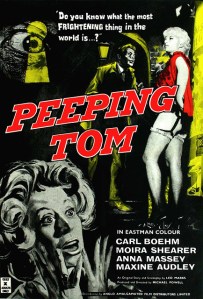 Director: Michael Powell
Writer: Leo Marks
Cast: Carl Boehm, Moira Shearer, Anna Massey, Maxine Audley
Plot: Mark Lewis (Carl Boehm) is a part-time photographer, making ends meet by taking lurid photographs of women in lewd vignettes, while pursuing his true aspiration of being a filmmaker. But his filmmaking is part of a darker thirst – Lewis is stalking the streets, luring women home and filming as he murders them. As Mark befriends a neighbor, he reveals to her how his own father used to photograph him in moments of discomfort, terror, or fear, even including the boy standing by his own mother’s deathbed. Despite this, Helen (Anna Massey) asks him to take photographs to illustrate a children’s book she has written, to which he enthusiastically agrees.
As Mark comes under the suspicions of the police investigating the killings, Helen convinces him to go out with her, but makes him leave behind his omnipresent camera. Helen’s blind mother (Maxine Audley) becomes uncomfortable with Helen and Mark’s relationship, and confronts Mark in his darkroom. Mark is upset that his most recent film didn’t come out the way he wanted, and almost reenacts the murder with Helen’s mother, but barely stops himself. She demands he stay away from Helen until his “unhealthy” fixation with photography is done away with, threatening to move away. He kills once more, this time knowing that the police are watching him, and rushes home, where Helen has found his films. He tells her how he attached a mirror to his camera, forcing his victims to watch their own terrified faces at the moments of their death. As the police arrive to take him away, Mark runs through a long-prepared gauntlet of cameras to the completion of his film – his own suicide.
Thoughts: This is one of those films that, upon its release, was deemed so controversial that the filmmaker’s career was effectively ruined. Its portrayal of raw sexuality was pretty risqué for the time, although there’s nothing so provocative in the final cut of the film that you couldn’t show it on basic cable today. (Well… at certain times of the day, at least.) There’s a brief glimpse of a bare breast on Mark’s last victim before the screen fades to black (something removed from many cuts of the film), but most of the gore takes place off-camera. Even Mark’s self-inflicted fatal wound to the neck doesn’t really look like that big a deal. As he falls backwards, clutching the wound, you could easily think he just nicked himself shaving.
Although the film is called the “first slasher movie” by many, it’s markedly different from the way we picture the genre today. Later, better-known slasher films are all about the psychology of terror: Halloween and Friday the 13th are all about the fear the audience feels. Even in Halloween, when we see the attacks through the eyes of Michael Myers himself, we’re supposed to feel the terror of the victim. Not so with Peeping Tom – this movie is all about the psychology of the killer. First of all, there’s never any question of the murderer’s identity. We know from the very beginning that Mark Lewis is a killer, and even though the police and other characters in the film are trying to solve a mystery, for the audience, there is none. So rather than question who is murdering young women, we are allowed instead to focus our curiosity on why he’s doing such a horrific thing.
While most of the movies I’ve talked about (and will talk about over the rest of this project) have been American, this one is a British film, and as such, plays heavily on British fears. While over in the States, we were worried about the Red Menace, in England they were still licking their wounds from World War II, and this film toys with that. There’s a distinct tinge of a German accent to Mark – who himself is a blond-haired chap cast in the mold of Hitler’s perfect Aryan. Mark is twisted and shaped by his father’s experiments, turned into a monster, something that could easily be looked upon as a metaphor for the Nazi subjugation of the German people before their country went on to become a boogeyman to the rest of the world. In this case, the father begets the monster.
I’m not sure if – at any point – we’re actually supposed to be sympathetic to Mark. In fact, the scene where he forces Anna Massey’s character Helen to watch the truly disturbing films of his own childhood is the scene where Mark first starts to feel like an all-out psychopath. The record of Mark’s descent into madness isn’t about excusing him, it’s about explaining him. “We aren’t saying it wasn’t his fault, we’re just giving him a motivation.” I rather like that – at times cinema seems to waste entirely too much time trying to find ways to explain away the actions of our monsters, and some of them just don’t deserve that consideration. He’s a horribly disturbing creature, from the way he encroaches upon his victims before he kills them straight through to him transferring the light kiss Helen gives him to the lens of his camera. Helen is the sympathetic character here, a girl who takes pity on a broken bird and through it finds a sort of friendship, which breaks her heart when it collapses at the end.
This is the film where we see the core of those movies about what makes a killer. This is where we see the heart of Hannibal Lector, and it draws from the same well as Norman Bates. And speaking of Norman Bates, it’s about time. Come back tomorrow as we introduce ourselves to Alfred Hitchcock, Anthony Perkins, and Janet Leigh for one of the most acclaimed thrillers of all time. It’s time… for Psycho.
 Reel to Reel