Category Archives: Projects
Mutants, Monsters, and Madmen Day 13: The Haunting (1963)
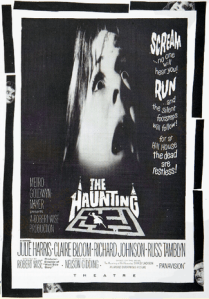 Director: Robert Wise
Writer: Nelson Gidding from the novel The Haunting of Hill House by Shirley Jackson
Cast: Richard Johnson,Julie Harris, Ronald Adams, Claire Bloom, Lois Maxwell, Russ Tamblyn
Plot: Dr. John Markway (Richard Johnson) and a team of paranormal investigators win the opportunity to spend a few weeks in Hill House, an old manor with a history of tragic deaths amongst its inhabitants. One of them, Eleanor “Nell” Lance, goes behind the back of her overbearing sister to gain access to the car she helped pay for in order to make the trip. Luke Sanderson (Russ Tamblyn) is the nephew of the owner of the house, sent along to gain an appreciation for the property he hopes to inherit one day. She befriends a fellow investigator named Theodora (Claire Bloom), whose interest in Nell seems more than academic. As the house begins to “greet” them in its own way, Nell starts to feel a certain attraction to the house, despite its terrors. The spirits seem to be summoning her, even calling to her, taking advantage of a woman who has no real direction in her life following the death of her invalid mother. Luke, meanwhile, is interested in the house only as a moneymaking scheme – what parts he can sell, what parts he can renovate, even to the point of planning to use the spiral staircase scene of a famous suicide as a nightclub.
Nell finds herself attracted to Markway, only to be devastated when his skeptic wife (Lois Maxwell) arrives and insists on joining the hunt. Nell suggests she sleep in the nursery – the sealed-off and most mysterious room in the house – but immediately regrets it. The locked room opens by itself, though, and Mrs. Markway decides to stay. After the rest of the group finds itself cornered in the parlor, loud noises and bulging walls coming in upon them, they find Mrs. Markway missing. As the others begin to tear apart the house searching, Nell (who now believes herself destined to be a part of this house) begins to roam the mansion, joyfully seeking out the spirits, finally finding herself at the wobbly, unstable staircase, climbing to the top. Markway coaxes her down, but Mrs. Markway leaps out and terrifies her, causing her to faint. Markway declares an end to the experiment and orders them all home, but Nell tells them she has no home, refusing to return to her sister and begging to stay at the house. She drives for the gate, losing control of the car and seeing a white figure leap in front of her just before she strikes a tree, killing her. The white figure turns out to be Mrs. Markway, who got lost in the massive, confusing house. Markway reveals the tree Eleanor struck was the same one where the house’s first victim died in an “accident.” He returns to the house to collect their things knowing he’ll be safe. The house has want it wants… for now.
Thoughts: From the very beginning, it’s interesting to note how different filmmaking and storytelling is today compared to 1963, when the movie was made. The film begins with Markway narrating an extended flashback sequence, detailing the history of the house and the gruesome deaths of those who have been associated with it. All this before we know who Markway is or what his association with the house actually is. A modern film is far more likely to begin with Markway begging for permission to go to the house, with the backstory being uncovered later. It’s debatable which approach is better, but since this is my little project I’ll tell you: it’s the latter one. Kicking things off with a infodump – scary as it is – takes some of the momentum out of the film from the very beginning.
The events that happen inside the house are exactly what you come to expect in Haunted House stories – odd noises, doors that close themselves, doors that open thanks to convenient gusts of wind, cold spots, and strange writing that appears on the wall (specifically “Help Eleanor come home,” a message that scares poor Nell half to death.) We deal with exceedingly creepy statues, the skeptics who try to debunk the supernatural nature of the house, the caretakers who refuse to stay in the house at night and so forth. Theo seems unnaturally perceptive about Nell, making offhanded comments about her and her life that border on the telepathic. Nell’s sensitivity to the ghosts of the house also mark her. Characters in these stories with special gifts or powers has become another trademark of the genre.
You know all of these tropes because every haunted house story uses them, but all the others were really mimicking this original. Basically, if you’ll excuse the pun, this story is the blueprint from which all other haunted house stories are built. It’s one of those stories that has been redone – in whole or in part – over and over again over the years to the point where the original almost seems derivative, even though it’s exactly the opposite. Not to say that all of these elements were 100 percent original even when Shirley Jackson wrote the novel in 1959, but her novel and this movie pulled them all together and fused them into a genre in a way that no other film had.
Interestingly, this is one of those movies where it’s what you don’t see that’s most effective. There’s no blood in the film (although I understand there’s one scene in the novel with a message written in blood which the filmmakers excised), and although you see the evidence of the spirits, you never see the spirits themselves. Even the “ghost” that startles Nell at the end turns out to be the very living, very confused Grace Markway.
In one bit of infodump that actually works, Markway takes some time to explain to the ladies why the house is so confusing – it’s constructed specifically to be that way. The doors are off-center, none of the angles are at 90 degrees, and the entire structure is built in such a way to make it nearly impossible to find your way around. Watching the film, it’s a credit to the set designers that you really do get that sense. It’s hard to tell for sure, watching only those elements the director wants us to see from the angles he wants us to see them, but the house looks incredibly confusing. There are so many doors that anybody could get confused quickly, the mirrors are all hanging at strange angles that give you peeks into obscure corners of a room that you wouldn’t expect to see in normal circumstances. Purely from a visual standpoint, the director has more than succeeded in making the house look bizarre as hell, and it’s very easy to imagine yourself getting lost in its halls.
Some of the simplest scares work the best. While the entire cast is assembled in the parlor, tremendous rumbling noises elsewhere begin to torment them. It gets worse when the doorknob begins to rattle (easily accomplished by a crew member tinkering with it slowly from the other side), then the door itself begins to bulge inward impossibly, stretching like rubber instead of wood. It’s a very simple effect, but far more effective than the expensive CGI version of the effect we saw in the 1999 remake of the film.
The ending is suitably bleak for a haunted house film, no happy ending and no real chance at redemption for the house or for the sad, broken characters. It’s not a bad film, but not nearly as good as some of the other films we’ve discussed recently. (It’s not much of a follow-up to Psycho, for instance.) Still, I think it’s notable in and of itself. It isn’t a masterpiece, but it’s a good movie, and it leaves a cinematic footprint that is clear, vivid, and continues even today.
Next is Audrey Hepburn in a classic chiller, Wait Until Dark.
Mutants, Monsters, and Madmen Day 12: Whatever Happened to Baby Jane? (1962)
 Director: Robert Aldrich
Writer: Lukas Heller, based on the novel by Henry Farrell
Cast: Bette Davis, Joan Crawford, Victor Buono, Maidie Norman
Plot: Baby Jane Hudson (Bette Davis) was once the toast of vaudeville, a child star whose singing and dancing made her famous, while the sales of her lookalike doll made her father wealthy. As an adult, Jane’s star fell and her sister Blanche (Joan Crawford) became one of Hollywood’s most acclaimed actresses. Now as old women, the sisters share a house where Jane drinks heavily amidst the memories of her youth and Blanche – confined to a wheelchair following an accident for which Jane is blamed – is experiencing a minor renaissance as her old films find a new audience on television. The relationship between the two sisters is strained to begin with, but grows worse as the mentally unstable Jane begins to torment her sister, taking the telephone from her bedroom and scaring her to the point that Blanche refuses to eat anything Jane brings her, and begins to starve. Jane attempts to restart her career, hiring a piano player (Victor Buono) to accompany her.
Their maid Elvira (Maidie Norman) discovers Blanche in captivity, and Jane murders her. When the piano player stumbles upon the captive Blanche, he manages to flee, and Jane takes her sister to one of the few places she was happy – the beach. There, Blanche reveals to Jane that she was never responsible for the car accident. It was Blanche, trying to run over her cruel, drunken sister, who caused the accident that trapped her in a wheelchair. Jane, stunned at the knowledge that they “could have been friends,” fetches her sister an ice cream cone. When the police stop her on the way back to her sister, a crowd forms, and Jane does what she always did for the crowds… she begins to dance.
Thoughts: This is another entry into that whole “psychological terror” subgenre, the type of film that relies far more on the madness of your villain and the suspense developed by the director to scare you, instead of throwing blood at the screen. In fact, of the two or three genuinely violent acts in this film, I don’t think any of them include so much as a drop of blood. But the film is no less effective for that.
In many ways, What Ever Happened to Baby Jane? is almost prophetic. How many times have we heard tales of former child stars who were unable to cope with the real world when their fame vanished? How many of them have turned to lives of crime or drugs? How many died so much earlier than they should have as the result of an insane lifestyle they couldn’t maintain into adulthood? I have no idea if such a thing was prevalent in 1960, when the novel was written, but looking at this film today makes it feel almost as though it could be ripped from the headlines. As a rule, I’m against remaking movies that were this good in the first place (although ABC television attempted to do so in the early 90s), but if someone were to transplant this story into the modern day, I think it would hold up just as well.
Much of Jane’s cruelty is verbal. She shouts at her sister, mistreats her, and generally tries to impress upon her that Blanche couldn’t possibly live without her, which the audience knows isn’t true. Blanche has already made plans to sell their house, put Jane into an institution, and hire Elvira to care for her full time. The story carefully upgrades Jane’s madness, beginning with her angry words, then moving up to the memorable scene where she puts Blanche’s own pet parakeet on her dinner plate, then later moving on to a dead rat. That’s when the real violence begins, with Jane serving up a savage beating to her sister when she catches Blanche on the phone to her doctor, trying to summon help, and even further to Elvira’s death. There’s a steady escalation for Jane’s madness that makes it feel very authentic.
For a moment, I was a bit irritated at the end of the movie, which leaves the audience wondering whether or not Blanche survives. As I thought about it more, though, I realize the brilliance in it. Jane is already dangerously unhinged. The question is, what will be worse for her – if Blanche lives, or if Blanche dies? I’m honestly not really sure, and therefore, leaving the question hanging is a clever way to cap the tale.
Like usual, with psychological thrillers, it’s the performances of the actors that make or break the film. Bette Davis received an Oscar for her portrayal of Baby Jane Hudson, and it was well deserved. The way she ricochets from anger to insanity, from a bitter old woman to a scared little girl, is a really masterful work. Crawford, famously, was very bitter over the fact that Davis was nominated and she wasn’t. And in truth, I think she was robbed. Blanche’s character doesn’t allow for the wild array of emotion and terror that Jane does, but Crawford was just as effective at portraying a kind woman who is living a life of eternal penance for her one moment of cruelty. Victor Buono, as the piano player, is a sort of charming cad. His British accent is terrible, frankly, but he really sells the part, as he cringes through Davis’s performance of her childhood signature number “Writing a Letter to Daddy,” then turns right around and pretends he thought it was wonderful.
Some of the influence of this film has been lost – there was a brief glut of films where the villain was an old woman, but that’s mostly dried up over time. (Let’s face it, in Hollywood of the21st century the villains have to be just as sexy – if not more – than the heroes.) This movie isn’t watched or talked about as much as the likes of Psycho these days, but I think it’s right up there as one of the greats in this particular subset of terror.
Tomorrow we’re getting back to the supernatural with perhaps the greatest haunted house movie ever made, the appropriately-named The Haunting.
Mutants, Monsters, and Madmen Day 11: Psycho (1960)
 Director: Alfred Hitchcock
Writer: Joseph Stefano, from the novel by Robert Bloch
Cast: Anthony Perkins, Janet Leigh, Vera Miles, John Gavin, Martin Balsam
Plot: Marion Crane (Janet Leigh) steals $40,000 from her employer to help her boyfriend (John Gavin) pay off his debts. As she’s running to him, she stops overnight at a secluded hotel run by Norman Bates (Anthony Perkins), whose elderly mother lives with him in the adjacent house. When Leigh vanishes (following perhaps the most memorable death sequence in thriller history), her sister (Vera Miles) and boyfriend begin to seek her out, following the trail back to the hotel where she met her fate. A thrilling final confrontation reveals the true depths of Norman Bates’ insanity, jolting the viewers with shock after shock that still resonates 50 years later.
Thoughts: Truly, is there any thriller more classic, more iconic, more memorable than Alfred Hitchcock’s Psycho? The movie launched a whole new subgenre of terror, making the psychology of a killer a vital element to the story. (True, Peeping Tom did the same thing, but far more people remember Psycho.)
Let’s get the necessary stuff out of the way first, though. The film was amazing precisely because it broke so many off the conventions of the day. The film begins with following Janet Leigh as she steals the money and takes off. We watch her go through a red herring sequence where a police officer grows suspicious of her and watches her trade in her car (it adds nothing to the plot, but substantially increases the viewer’s false presumption that Leigh is the film’s protagonist and, therefore, going to be with us for a while). We don’t meet Norman Bates until about a half-hour into the film, and then – assuming you’re one of the three people left on the planet unfamiliar with this sequence – we’re shocked when “Mother” murders Leigh with a full hour remaining. How could this be? She’s the main character, she’s the one we’ve been following! Where will the movie go now?
The truth is that the story isn’t really hers at all, but that false assumption is incredibly effective at distracting us from the true star – Anthony Perkins as Norman Bates. Norman, as we learn, is the classic victim-turned-victimizer, repressed by an overbearing mother whom he later killed when he felt she was leaving him behind for her new lover. Afterwards, Bates develops a dissociative identity disorder, with “Mother” taking up residence in his head and murdering any woman he feels an attraction to, leading up to the climax of the film, where “Mother” takes over entirely.
Speaking – as I am wont to do – of the influence in both directions, Mother really strikes me as being a construct straight out of William Faulkner. Bates poisons his mother and her lover, then keeps Mother’s corpse with him in the house, carrying her from room to room, speaking to her as if she was alive. I’d be hard-pressed to believe that Robert Bloch wasn’t inspired here by Faulkner’s “A Rose For Emily,” a short story where (in a twist ending — so, y’know, spoiler warning) we learn that the main character poisoned her lover years ago. He was planning to leave her, so she dosed him with rat poison and kept his corpse in her house – and bed – for the rest of her very long life. Something about that idea of living with a corpse, of sleeping next to the dead, is unfailingly creepy. It’s one of the short stories I most enjoy teaching to my 11th grade students every year, just because of the reaction when they get to the end. I wonder how these 16-year-olds would react to seeing Psycho. But more on that later.
Aside from just being a great story and screenplay, Hitchcock’s direction and Perkins’s performance combine to make this a movie that truly deserves the label “masterpiece.” Nearly every frame of the film is a work of art, expertly combining shadow and shape to create an all-pervasive feeling of terror. The 1998 shot-for-shot remake of the film was an abomination in many, many ways, but most notably because you simply can’t create the mood Hitchcock conjured up in a color film. This is a movie that needs to be in black and white to really work. The death scene in particular just isn’t as scary in color. Leigh steps into the shower, blissfully unaware of the figure in the long dress and wig creeping up on the translucent shower curtain. We see the knife raised and brought down, over and over again. The dripping blood (probably chocolate syrup or something of the sort) strikes the pure white tile of the shower and your brain fills in the rest of the blanks as it all swirls down the drain. Sure, we live in a world where the likes of the Saw movies do their level best to be as graphic as possible with the deaths of the characters, but Psycho proves you don’t need to do that to scare the hell out of people.
Janet Leigh – rightly – was given an Academy Award nomination for the film, but I can’t help but feel Perkins was robbed. As good as everything else in the film was, none of it would have worked if his Norman Bates wasn’t so remarkable. When we first meet the character, he’s very kind, polite, handsome, and instantly likable. In other films, he’d be the best friend the leads confide in during their darkest moments. But as the movie progresses, as we learn more about his dysfunctional relationship with Mother, our perception of him begins to change. He becomes an object of pity. With his tall, almost preternaturally slender frame, he somehow looks younger than he really is, almost childlike despite how he rises above Marion. The scene immediately following Janet Leigh’s murder really sticks out. Norman (who the unspoiled viewer doesn’t yet know is the killer) stands in the doorway to the bathroom, mop and bucket in his hand, to clean up the mess Mother made this time. His shoulders slump and we realize the jacket he’s wearing is far too big for his spindly body, making him look like a little boy trying on Daddy’s clothes in the hopes of looking like a grown-up. His discomfort and slip ups when speaking to a private investigator (Martin Balsam) are spot-on perfect, with the sense of unease slowly spreading across his face throughout the scene, leading into a pronounced stutter as his ball of lies becomes too large for him to control.
And then there’s the final shot of the character, once he’s been captured and institutionalized, with Mother’s voice doing the voiceover. The madness hardwired into his brain, projected through the speakers of a movie theater, would be creepy enough, but then Perkins looks up directly at the camera. This is a man that, an hour earlier, any person in the theater would have wanted for his best friend. But now the shape of his smile and the look of madness in his eyes sends an electric jolt of fear straight into the viewer’s brain. He’s clearly mad, clearly an abomination… and then the really chilling thought manages to creep in. If somebody as nice and kind as Norman Bates could be a mask for something so horrible, is there anybody we can really trust? Hitchcock finishes icing the cake as the scene fades and he quickly – almost imperceptibly – superimposes the image of Mother’s skull over Norman’s face. It’s so fast many in the audience probably don’t even consciously notice it, but they know something just happened to scare them even more.
There are only two things that really keep me from considering this a perfect movie experience – one of which is a fault of the film, the other a symptom of its success. The movie ends, after Bates’ capture, with an unforgivably long sequence in which his psychiatrist gets into a highly technical and totally unnecessary explanation of Bates’ psychosis. Any reasonably intelligent moviegoer has already figured out that Bates was insane and killed his mother, the first of his many victims. Giving a clinical explanation for it somehow makes it a little less scary. The few details this scene adds that we couldn’t have figured out – such as the fact that Bates killed at least two other girls between the death of his mother and that of Marion Crane – aren’t needed for us to appreciate the depths of his depravity.
The other problem is that the film is now so well known, so influential, that much of the shock has gone. Even someone who has never seen the movie likely already knows, before they even turn it on, that Norman Bates is the killer and that Mother is dead, a mummified corpse he keeps with him out of a twisted sense of love. In this sense, I almost envy my 11th graders. For many of these kids, 15- and 16-year-olds, any movie made before the turn of the century is practically ancient history, and not on their radar at all. They’ll probably have heard of Psycho, but not really know anything about it. If their apathy allows them to watch this movie for the first time with a blank slate… oh, for the first time, I envy them.
Moving right along, tomorrow we’ll tackle one of the cinema’s most chilling cases of sibling rivalry: Whatever Happened to Baby Jane?
Mutants, Monsters, and Madmen Day 10: Peeping Tom (1960)
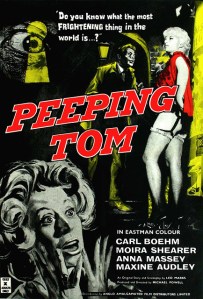 Director: Michael Powell
Writer: Leo Marks
Cast: Carl Boehm, Moira Shearer, Anna Massey, Maxine Audley
Plot: Mark Lewis (Carl Boehm) is a part-time photographer, making ends meet by taking lurid photographs of women in lewd vignettes, while pursuing his true aspiration of being a filmmaker. But his filmmaking is part of a darker thirst – Lewis is stalking the streets, luring women home and filming as he murders them. As Mark befriends a neighbor, he reveals to her how his own father used to photograph him in moments of discomfort, terror, or fear, even including the boy standing by his own mother’s deathbed. Despite this, Helen (Anna Massey) asks him to take photographs to illustrate a children’s book she has written, to which he enthusiastically agrees.
As Mark comes under the suspicions of the police investigating the killings, Helen convinces him to go out with her, but makes him leave behind his omnipresent camera. Helen’s blind mother (Maxine Audley) becomes uncomfortable with Helen and Mark’s relationship, and confronts Mark in his darkroom. Mark is upset that his most recent film didn’t come out the way he wanted, and almost reenacts the murder with Helen’s mother, but barely stops himself. She demands he stay away from Helen until his “unhealthy” fixation with photography is done away with, threatening to move away. He kills once more, this time knowing that the police are watching him, and rushes home, where Helen has found his films. He tells her how he attached a mirror to his camera, forcing his victims to watch their own terrified faces at the moments of their death. As the police arrive to take him away, Mark runs through a long-prepared gauntlet of cameras to the completion of his film – his own suicide.
Thoughts: This is one of those films that, upon its release, was deemed so controversial that the filmmaker’s career was effectively ruined. Its portrayal of raw sexuality was pretty risqué for the time, although there’s nothing so provocative in the final cut of the film that you couldn’t show it on basic cable today. (Well… at certain times of the day, at least.) There’s a brief glimpse of a bare breast on Mark’s last victim before the screen fades to black (something removed from many cuts of the film), but most of the gore takes place off-camera. Even Mark’s self-inflicted fatal wound to the neck doesn’t really look like that big a deal. As he falls backwards, clutching the wound, you could easily think he just nicked himself shaving.
Although the film is called the “first slasher movie” by many, it’s markedly different from the way we picture the genre today. Later, better-known slasher films are all about the psychology of terror: Halloween and Friday the 13th are all about the fear the audience feels. Even in Halloween, when we see the attacks through the eyes of Michael Myers himself, we’re supposed to feel the terror of the victim. Not so with Peeping Tom – this movie is all about the psychology of the killer. First of all, there’s never any question of the murderer’s identity. We know from the very beginning that Mark Lewis is a killer, and even though the police and other characters in the film are trying to solve a mystery, for the audience, there is none. So rather than question who is murdering young women, we are allowed instead to focus our curiosity on why he’s doing such a horrific thing.
While most of the movies I’ve talked about (and will talk about over the rest of this project) have been American, this one is a British film, and as such, plays heavily on British fears. While over in the States, we were worried about the Red Menace, in England they were still licking their wounds from World War II, and this film toys with that. There’s a distinct tinge of a German accent to Mark – who himself is a blond-haired chap cast in the mold of Hitler’s perfect Aryan. Mark is twisted and shaped by his father’s experiments, turned into a monster, something that could easily be looked upon as a metaphor for the Nazi subjugation of the German people before their country went on to become a boogeyman to the rest of the world. In this case, the father begets the monster.
I’m not sure if – at any point – we’re actually supposed to be sympathetic to Mark. In fact, the scene where he forces Anna Massey’s character Helen to watch the truly disturbing films of his own childhood is the scene where Mark first starts to feel like an all-out psychopath. The record of Mark’s descent into madness isn’t about excusing him, it’s about explaining him. “We aren’t saying it wasn’t his fault, we’re just giving him a motivation.” I rather like that – at times cinema seems to waste entirely too much time trying to find ways to explain away the actions of our monsters, and some of them just don’t deserve that consideration. He’s a horribly disturbing creature, from the way he encroaches upon his victims before he kills them straight through to him transferring the light kiss Helen gives him to the lens of his camera. Helen is the sympathetic character here, a girl who takes pity on a broken bird and through it finds a sort of friendship, which breaks her heart when it collapses at the end.
This is the film where we see the core of those movies about what makes a killer. This is where we see the heart of Hannibal Lector, and it draws from the same well as Norman Bates. And speaking of Norman Bates, it’s about time. Come back tomorrow as we introduce ourselves to Alfred Hitchcock, Anthony Perkins, and Janet Leigh for one of the most acclaimed thrillers of all time. It’s time… for Psycho.
Mutants, Monsters, and Madmen Day 9: The Fly (1958)
 Director: Kurt Neumann
Writer: James Clavell, based on the short story by George Langelaan
Cast: Vincent Price, David Hedison, Patricia Owens, Charles Hebert, Herbert Marshall
Plot: A scientist (David Hedison) is found dead, his head and arm crushed into an unrecognizable mess. His wife (Patricia Owens) confesses to the crime, but refuses to provide details, although she seems obsessed with finding a strange white-headed fly. As the investigation begins they find she actually crushed him in a hydraulic press twice… something the victim’s brother (Vincent Price) cannot fathom, as they had a loving marriage. Owens begins to come unraveled, going berserk when a nurse crushes a fly on the wall. Finally, Price coaxes the truth from her: his brother was destroyed by his own invention – a disintegrator-integrator – which horribly mingled his body with that of a housefly, turning him from man to beast. As they attempted to find the fly that now had his arm and head, his mind became more and more frayed, until he finally begged her to kill him. Price keeps the story to himself, allowing the court to believe her insane, and sparing her from a murder charge.
Thoughts: I wish I could have found other films between the last one (1942’s Cat People) and this 1958 classic, but as I tried compiling my list, I was stunned at the utter dearth of memorable horror films from the late 1940s and early 1950s. This isn’t to say there weren’t scary movies, but that doesn’t necessarily make them the right choice for my little project here. It actually gets back to what I said about horror at the very beginning – horror is subjective. Each person, and in a larger sense, each culture determines for itself what it considers terrifying, and in the late 40s and 50s the fears of the American public weren’t running along the lines of vampires and witches and monsters. In the wake of the atom bomb, we were afraid of science gone wrong. With the rise of the Soviet Union, we feared the threat of international communism. The result is that the best, most iconic scary movies of this era don’t necessarily fall into the category of horror, but belong more appropriately on the science fiction list (which I hope to use for this same sort of project in the future). The truly disquieting films of the time were things like The Day the Earth Stood Still (1951) and Invasion of the Body Snatchers (1956) – both excellent films worth discussing, but I feel like they belong more in the realm of sci-fi than true horror.
So that brings us to 1958 and The Fly, which still straddles the line between science fiction and horror, but falls with enough of its bulk on this side of the line to make it on the list. While not exactly built on hard science, the movie attempts more of a feeling of realism than most other sci-fi shockers of the area, which often dealt with the likes of insects and other animals mutating into giant beasts thanks to radiation exposure, eventually leading to their death by missile and their ridicule at the hands of a guy in a satellite and his two little robot pals. In The Fly, director Kurt Neumann does make an effort to help the science seem plausible, at least to an audience without deep understanding of such things. (At one point, while trying to guess the nature of his brother’s experiment, Price even suggests a flatscreen television.)
Vincent Price, of course, gets top billing for this movie, but for my money that really should have belonged to Patricia Owens as Helene. Price is in the framing sequence – the 30-minute buildup to the flashback and the 10-minute denouement at the end – but Owens really carries the film. We see her at the beginning as the shellshocked, borderline deranged woman who has just witnessed her husband’s death, then go to the backstory where she’s a kind, devoted wife. She’s really magnificent in the part, going from the heights of joy for her husband’s success to a slow spiral into despair when his experiment falls apart. Finally, at the end we get pain and resignation from her. Genre pictures are rarely recognized for the performances of their actors when award season rolls around, but I would put Owens’s performance in this film right up there with any great actress of the era.
The film follows a fairly standard format for horror films of the era, where the truly terrifying stuff happens largely off-screen. This is to the good, because when the blanket comes off David Hedison and we finally see his transformation… well… just as Owens is as fine an actress as any of the day, his creature costume is as goofy as any of the day. It’s a silly-looking monster helmet with a some device to make the pincers twitch a little bit. I find the final scene far more chilling – Price and the inspector (Herbert Marshall) manage to track down the white-headed fly to a spider’s web where it’s been captured and about to be consumed. The effect of a tiny little David Hedison caught in the spider’s web, superimposed against film of a real spider, is impressive by 1958 standards, and the effect of his miniscule voice pleading for help as the predator advances upon him is creepy even today. It’s probably the most memorable scene of terror from the film, far more so than the human-size fly.
The film plays upon the fear of unchecked science, questions of insanity, and a good dose of body horror (which, no doubt, is why David Cronenberg was the man tapped for the 1986 remake). All of these elements add up to one of the best films of the era.
From the end of the age of monsters, we’re about to step into the world of more psychological terror. Next on my list is the film many consider the first slasher movie, the 1960 film Peeping Tom.
Mutants, Monsters, and Madmen Day 8: The Cat People (1942)
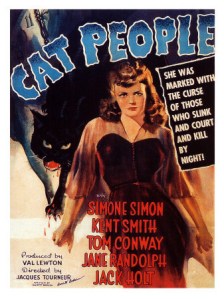 Director: Jacques Tourneur
Writer: DeWitt Bodeen
Cast: Simone Simon, Kent Smith, Tom Conway, Jane Randolph
Plot: A young woman from Serbia meets and marries a handsome young American man. But their relationship is stalled due to a fear that, should she allow herself to become intimate with her new husband, she will fall victim to an ancient curse that causes people in her family to transform into killer panthers. After they’ve been married for some time – during which she never allows herself so much as a moment of physical passion with her husband – she begins to suspect that he is having an affair with his attractive young assistant. And then we realize lust isn’t the only emotion that can trigger the curse… jealousy works, too.
Thoughts: Like a lot of early horror films, this one uses folktales (real or imagined) as the basis of the monster, such as it is. The idea of an “old curse” is standard. What’s interesting to me is the way Irena (Simone Smith) claims the curse came upon her family: in centuries past, they dabbled in witchcraft and consorted with the devil, and as such were branded with this inability to grow close to anyone. This immediately calls to mind the question of how, exactly, they’ve managed to perpetuate the family line over the centuries, if they turn into monsters and slaughter anyone they grow physically intimate with. (The 1982 remake answered this question in the logical and extremely squicky way of saying that family members could only be intimate with one another, despite them being from Serbia and not members of any particular royal family.)
Of more interest – to me, anyway – is the way the perception of witchcraft has changed over time. Sure, whenever a movie that seems vaguely related to the topic is released today you get your requisite group of picket sign-carrying protestors condemning everybody who’s going to see the movie to Hell, but they’re considered a joke by both the media and most passerby who see them. In truth, these days if a movie uses witchcraft as its hook, we usually see a case of an innocent person accused of witchcraft and being tormented by an oppressive society. (For the best example of this, see 1996’s The Crucible, the script for which was written by the original playwright, Arthur Miller.) The alternative is typically a more classic representation of witchcraft wrapped up in a movie that’s laughable in its presentation of something that was once considered a very legitimate threat. (For the most recent example, as of this writing, see 2011’s Season of the Witch. This movie gets bonus cheese points for having Nicolas Cage with long hair while simultaneously being bald.)
At any rate, in 1942 witchcraft was seen as a much more legitimate source for horror, and a curse being a punishment that goes down generations was something that could cause true fear. The 1982 version of the film throws away the witchcraft elements in favor of a more vague curse, which is apparently still acceptable so long as you don’t specify that it’s a result of bubbling cauldrons or dancing in the moonlight with Mephistopheles. Even the specific manifestation of the curse is given a Biblical connection – Irena chats with a zookeeper who kindly takes the time to explain who the Book of Revelations describes a beast from Hell that is “like a leopard, but not a leopard,” which to him is pretty much the definition of a panther.
The other thing about this film that I find really odd is the way the relationship grows. In 1942, when filmmakers didn’t get quite as explicit about sex as they do today, they got away with a man falling and love with and marrying a woman who refuses any sort of physical intimacy – even so much as a kiss – giving him an excuse that would today either have the man drop her for a loony after the first date or do everything he can to get her onto Dr. Phil. Granted, Oliver (Kent Smith) eventually does seek out psychological help for Irena, but only several chaste months after they are married. I don’t care it if is 1942, nobody is that good. Let’s be clear about this: this is not a fear that Irena developed some time after she and Oliver got involved, this was a barrier between them from the day they met. A month after they start dating, he mentions to her that, y’know, normal people in love kiss, and she starts with the whole “I turn into a cat” thing. This, Oliver, this is the time to seek out mental help. Not after you marry a woman who insists on separate bedrooms and a bowl of Fancy Feast at night.
In many ways, this Oliver Reed character begins the film as something of a fantasy man. He’s good-looking, square-jawed, loves Irena from the moment he meets her despite her little “quirks,” and is resistant to temptation from Alice (Jane Randolph) even once she pretty much starts throwing herself at him. But even Mr. Perfect eventually starts to break down – he gets mad at Irena when she starts skipping her therapy sessions, and ultimately decides to leave her for Alice. Even then, though, the film doesn’t give us reason to believe there’s any hanky-panky going on before he proclaims he wants a divorce. Look at the timeline here: Irena is given the 1942 Man of the Year on a silver platter, then drives him away because she acts cold, jealous, and irrational. (Well, okay, it only seemed irrational, turns out she really did turn into a murderous cat, but one can hardly blame Oliver for not quite believing that.) You can’t tell me that the writer of this film wasn’t firing a warning shot across the stern of the Women of America, whose husbands at this point were increasingly getting shots fired across their own sterns over in Europe and the Pacific.
The movie’s ending is suitably tragic, and the body count is remarkably low (compared to modern films). And to be frank, while it’s entertaining in its own way, I don’t see it as being that great a precursor to modern films, except perhaps to show how different societal norms have become in the last 70 years. There’s a taste of Jekyll and Hyde in here, a flash of the subtle sexuality that would later become more dominant in the works of Anne Rice, but nothing I really feel is definitive the way I’ve felt about some of the other movies I’ve seen. The film’s sequel, 1944′s Curse of the Cat People, is even less memorable, with no “cat people” present, instead tapping into The Legend of Sleepy Hollow and turning into a ghost story about a married Oliver and Alice terrorized when Irena’s ghost begins visiting their six-year-old daughter. Weirdness.
We’re taking our biggest jump in time yet next, and I’ll talk about why that is tomorrow, when we get down to the classic 1958 sci-fi chiller The Fly.
Mutants, Monsters, and Madmen Day 7: Freaks (1932)
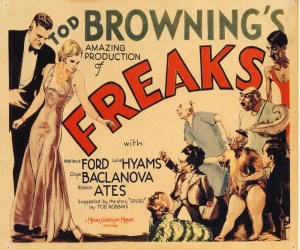 Director: Tod Browning
Writer: Willis Goldbeck & Leon Gordon, suggested by the story “Spurs” by Tod Robbins
Cast: Wallace Ford, Leila Hyams, Olga Baclanova, Roscoe Ates, Henry Victor, Harry Earles, Daisy Earles, Rose Dione, Daisy Hilton, Violet Hilton
Plot: Filmed with circus performers rather than professional actors, this film smacks of classic Greek tragedy. A circus midget named Hans (Harry Earles) falls in love with a beautiful trapeze artist named Cleopatra (Olga Baclanova). The other circus performers discover she only wishes to marry him for an inheritance that’s waiting for him, and decide to seek retribution for their friend in a horrific fashion.
Thoughts: This is one of those films whose name I’ve always heard whispered, but didn’t really know much about. For that matter, I don’t know that I’ve ever talked to anyone who’s actually seen it. But the fact that everyone seems to know about it definitely suggests that it’s worth delving into for this little project of mine. As it turns out, it’s one of those movies responsible for stuff that’s become so pervasive that people don’t even know the origins of it anymore. (Check out the initiation scene – suddenly you’ll start to get pop culture references you never understood before.)
The structure of the film is fantastic, beginning with a carnival barker leading a crowd of onlookers to some horrifying (but yet unseen) exhibit, then cutting away to the main story. Hans is already engaged to another performer, Frieda (Daisy Earles), and initially denies that he is infatuated with the lovely Cleopatra. Cleo is already involved with the circus strongman, Hercules (Henry Victor), and with him hatches the scheme to bilk Hans out of his money.
This is one of those films that’s particularly difficult to judge, thanks to the prism of modern experience. My own gut reaction is surprise at how the story is pieced together. Although the characters, the titular “freaks,” aren’t necessarily brilliant actors, I’m intrigued at how human their depiction is. Although there are a few things played for laughs (a stutter, for example) that would seem cruel today, many of the freaks are shown displaying very normal emotion and desires, which I find surprising in a film made in 1932. I’m not sure that’s really fair of me, though. I don’t know exactly what the expected reaction would have been at the time. Certainly, we tend to think of a period nearly 80 years ago as being a less permissive, less inclusive time period, but is that the same thing as saying that a 1932 audience would have expected a group of circus sideshow performers to be less than human? Just because they were alive in the 30s? Seems rather intolerant of me, doesn’t it?
One thing that’s undeniable is that director Tod Browning – who also directed Dracula and several silent films starring Lon Chaney – places his allegiances firmly with the freaks. The members of the circus sideshow have a code of conduct and honor, particularly when it comes to how “normal” people interact with their clan of outsiders. Those “normal” people – Cleopatra and Hercules in particular – are the real monsters of the film. The horror doesn’t originate with the abnormal in this movie, but from the way ordinary people choose to treat those they view as less than human. The freaks do wind up doing some pretty nasty things, but in retaliation. Cleopatra attempts to slowly poison Hans, but with the help of his friends he grows wise to her scheme and, together, they find a grotesque retribution. Overkill, perhaps, but it’s hard to feel bad for their victim, whose own actions were just as damning emotionally as any physical torment she was put through.
The final scenes, admittedly, are hard to watch. One of the few sympathetic “normals” – a circus clown – is shoved against a burning stove by Hercules as he tries to defend Hans. Of course, what happens to ol’ Herc makes any injuries the clown gets seem almost bearable by comparison. As for Cleopatra herself, we see her flee just before we go back to the barker from the beginning of the film and see the end result of Cleopatra’s greed, a poetic justice imposed by the freaks.
Browning, from what I’ve learned, actually grew up working in a circus, so it’s quite possible that the things he saw and experienced at the time influenced this film greatly. Sadly, it seems the film influenced his career in a negative way. Audiences at the time were so horrified by it that his booming career fizzled, and he only directed four more films in his life, two of them uncredited – having directed sixty-seven previously. (And I doubt it was a question of just easing into retirement – he lived until 1962, 23 years after his final film, Miracles For Sale.) Were people that horrified? Did they find the film that threatening? One woman even sued Browning, claiming the film shocked her into having a miscarriage… not because of the human horror of the things Cleopatra did, but because of the shock of seeing the freaks in action. The film was actually changed several times, toning down some of the final scenes, cutting out nearly 30 minutes of footage (the final film’s running time is a brisk and all-too-brief 62 minutes) and grafting a happier ending that very, very much feels tacked-on. Had they left things with Cleopatra’s fate, it would have been a gut-wrenching final image that would linger with you. Instead, they drift back to Hans and Frieda one last time, evidently attempting to give the audiences some sort of good vibe to go out on. But this isn’t a movie that really suits a “good vibe.” It’s about horrible people and the horrible things they do, and leaving it on an up note weakens it.
Should you happen to get your hands on the DVD, make sure to watch the alternate endings. It’s more powerful, and considerably creepier.
We’re leaving the 1930s behind now, leaping forward in time. Join me tomorrow as we travel to 1942, and the horror classic The Cat People.
Mutants, Monsters, and Madmen Day 6: The Mummy (1932)
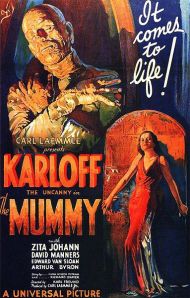 Director: Karl Freund
Writer: John L. Balderston
Cast: Boris Karloff, Zita Johann, David Manners, Edward Van Sloan
Plot: While uncovering an ancient Egyptian tomb, an archeologist accidentally resurrects the priest Imhotep (Boris Karloff). Imhotep flees, and returns ten years later posing as a modern Egyptian and seeking a way to bring back his lover, Princess Ankh-es-en-amon. He meets a woman (Zita Johann) he believes to be the reincarnation of his love, and attempts to reawaken within her the memory of their past, leading to a terrifying final confrontation.
Thoughts: Now this is interesting. I admit, this is my first time watching the original, 1932 version of The Mummy, although I was a fan of Stephen Sommers’ remake in 1999. However, I’d always assumed that the 1999 version was one of those sequels in name only, just an attempt by Universal to jumpstart a long-dead franchise in a modern way. Watching the original, I’m surprised to see just how much of the original film actually made it into Sommers’ version. The mummy, Imhotep, was cursed in both for similar crimes (love of/attempting to resurrect a forbidden princess). Also, in both versions the mummy is resurrected by accident (not really a surprise there, who would do it on purpose?), and finds a woman he believes to be his ancient lover, and thus attempts to bring her back to him.
The difference, of course, is in scale. By 1999, special effects had progressed considerably, so instead of a mummy that basically did his work by walking around and creeping everybody the hell out, we had Arnold Vosloo, who morphed from a wet, gushy corpse into… well… Arnold Vosloo, and at the same time had the power to whip up sandstorms that looked like his face. The remake is far more of an action movie than a horror movie, but I think you can attribute that to the fact that these old Universal Monsters aren’t really considered anything to be afraid of. They’ve become beloved icons of creepiness, but aren’t actually creepy anymore. They’re instantly recognizable Halloween costumes, and cartoons that sell us breakfast cereal.
At least… the iconic image of the mummy has become that. This is what’s interesting to me. When you think of a horror movie mummy in your head, you conjure up that immediate image of a desiccated corpse wrapped up in gauze or, if your parents didn’t make it to the store until 6:30 in the afternoon on October 31st, toilet paper. But Boris Karloff only appears in that particular mummy form for a scant few minutes at the beginning of the film. When he turns up again after the ten-year lapse, he looks more or less human. Old, kind of leathery, like he’s been out in the sun for a hell of a long time, but not the mystical monster he actually is. His power is internalized, and you don’t really get a sense of him being a creature of the undead until his destruction at the end, when the goddess Isis ages him instantly and he drops dead.
David Manners, who I found rather dull and lifeless in Dracula, returns to again be rather dull and lifeless here. I’m not really sure what to make of this, why in all these old-school horror films it seemed like an attempt was made to make the ostensible hero as boring as possible. Manners really does nothing in the film. He’s there to give Zita Johann’s character a love interest, but he doesn’t come to the rescue, he doesn’t get her into the trouble in the first place in any meaningful way… he simply doesn’t need to be there. By the 80s, of course, it wouldn’t matter. You’d have a thousand slasher flicks where the audience no longer really needs to identify with the supposed protagonist, and instead is really pulling for the monster, waiting to see how many kills he can rack up and how creative the filmmakers can be in throwing blood at the screen. The other characters are placeholders until they get killed, except for the final survivor – usually a teenager girl. She may survive with her boyfriend, who will be easily identified as he’ll be the only male in the movie who isn’t a complete douchenozzle.
But in 1932 that wasn’t the case. Karloff was supposed to be the bad guy, Manners was supposed to be the good guy, and the good guy was just plain dull. Karloff steals the show entirely, and while his comeuppance at the end is inevitable, it’s really hard not to wish that he had at least managed to take out David Manners on his way out.
1932 was a big year for horror, as it turned out. Next up will be one of the most controversial films of the time – and honestly, it’s still controversial today. It’s time to get into Freaks.
Mutants, Monsters, and Madmen Day 5: Frankenstein (1931)
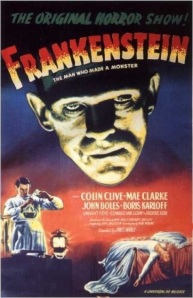 Director: James Whale
Writer: John L. Balderston, based on the novel by Mary Shelley
Cast: Colin Clive, Mae Clarke, Boris Karloff, Dwight Frye, Lionel Belmore, Marilyn Harris
Plot: Dr. Henry Frankenstein (Colin Clive) has a plan to create life. Assembling a body from the pieces of corpses, he builds an enormous monster of a man. But alas, his plan goes awry when his assistant Fritz (Dwight Frye) places a criminal brain into the creature. The creation (Boris Karloff, climbing that rocketship to stardom) is innocent, but powerful and terrifying. When it gets loose and accidentally kills a small child, there can be only one solution – destroy the creature before it’s too late.
Thoughts: Right off the bat, this film is more engrossing than Dracula was for me. Henry Frankenstein (changed, for some reason, from the novel’s “Victor”) and his assistant begin the film with the eerie process of excavating the recently-dead to use their parts in Victor’s creation. Like Dracula, this actually adds to the original novel in ways that have become accepted as part of the lore – for instance, Mary Shelley was somewhat ambiguous about where Victor obtained the pieces he used to construct his man, even implying some of the parts were not human in origin. The whole segment with the abnormal brain, which is not pretty iconic for Frankenstein, started here.
That’ s by no means the only place where the film deviates from the source material, of course. It’s a pretty loose adaptation and abandons volumes worth of backstory, but it succeeds in creating a memorable, timeless interpretation of the character that has dominated our perceptions ever since. Every legendary image of Frankenstein — the green skin, square and scarred forehead, and bolts sprouting from the neck — originates here. This, my friends, is the reason Herman Munster was the man he was.
And let’s be honest here – it’s justified. This is a powerful piece of work. The creature in this film (Karloff, interestingly, was not named in the opening credits, but was given his due at the end) isn’t really a monster. He’s huge, he’s powerful, but he has no real desire to do harm until harm is done to him. This assertion, of course, is somewhat undercut by the idea that Fritz places a “criminal” brain into his body – that seems to imply that violence is in his nature after all. But then again, maybe that’s the point the filmmakers were going for.
Speaking of Fritz, I’m really starting to become a fan of actor Dwight Frye. His Renfield was one of the most memorable aspects of Dracula to me, and his portrayal of Fritz is creepy, laced with just a touch of comedy. The man really was a gifted actor, and did some magnificent work here in the early days of Universal Pictures. The classic “Igor” version of the mad scientist’s assistant actually doesn’t show up until later in Universal’s Frankenstein series, but Fritz is where the archetype has its foundation, making Frye responsible for two of the most enduring villainous second bananas in cinematic history.
Karloff, of course, is unequaled as the monster. He wasn’t really that big of a man, and reportedly the four-inch platform boots he wore as the monster were hell on him, but he brought in a tragedy to the performance that would make you think he was doing Shakespeare. You watched this creature and you felt for him. You watched the townspeople (in the classic torch-and-pitchfork wielding mob) chase after him and you had to wonder exactly who was in the wrong here. That’s what’s so great about this story – the way it can chill and still, at the same time, raise ethical questions. The creature did kill Marylin Harris, but is he actually responsible for her death? He didn’t know what he was doing. Counter-argument: if a wild animal kills a child, you put it down. Counter-counter argument: a wild animal isn’t a human being, and can’t be taught as one. Could the creature? We have to ask here – was he a monster, or was he an infant, unaware of his own strength, who had the potential to grow into a thinking, feeling man if it weren’t for all those people who wanted to poke him with stabby things and burn him with burny things?
To be fair, later films in the franchise would sort of throw away this particular hook, with the monster becoming less innocent and more malevolent, not to mention outright dangerous. But you can’t judge the original on those grounds. In this case, we can look at Frankenstein and his mob attacking the beast and wonder who was in the right. Frankenstein’s monster isn’t a zombie in the strictest sense of the word, but the ethical questions raised here feel like a precursor to the sort of things George Romero was later going to do in Night of the Living Dead and its better sequels, and that other, lesser filmmakers have attempted to do ever since.
I think it’s safe to say that Frankenstein – both the film and the creature – is my favorite of the classic Universal Monsters. But we are going to look at one more of them before we move on. So tomorrow let’s fire up the DVD player and step forward in time one year to 1932, and thrill to the tale of The Mummy.
Mutants, Monsters, and Madmen Day 4: Dracula (1931)
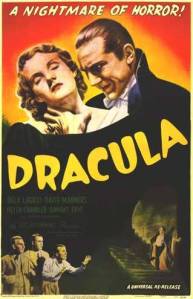 Director: Tod Browning
Writer: Hamilton Dean & John L. Balderston, based on the play by Garrett Fort, based in turn on the novel by Bram Stoker
Cast: Bela Lugosi, Helen Chandler, David Manners, Dwight Frye, Edward Van Solan & Francis Dade
Plot: The mysterious Count Dracula and his unwitting slave, Renfield, travel to England. When the ship is arrived, the entire crew and passenger manifest is dead, save for Renfield, who has gone mad. Dracula takes up residence in an abbey near Renfield’s sanitarium, and mysterious sightings and deaths occur, spurring the noted professor Van Helsing to confront the Count, and expose him for what he truly is – a vampire.
Thoughts: I’ve been waiting for this one. The Bela Lugosi version of Dracula, more than any other film or piece of pop culture, is what has helped to inform our current perception of the vampire. (Because the things in Twilight are not vampires, damn you Stephenie Meyer.) A lot of people don’t even realize how many of our current tropes come from this film or its sequels or imitators – the explicit connection of the vampire to bats, for example (where in the past – and even in this film – vampires could transform into bats, wolves, mist, and other things), or their aversion to sunlight. As important as those things are to current vampire lore, they didn’t come from the classic lore. (Which raises the question – if the Universal pictures depiction of the vampire hadn’t made him allergic to sunlight, would Meyer still have felt the urge to make Edward Cullen sparkle as an aversion to that trope? Hmm. Okay, I think I need to stop talking about Twilight now.)
Lugosi pops in with his tuxedo, his cape, his pendant, and those convenient beams of light that always seem to fall across his eyes and he absolutely owns the room, mesmerizing whoever’s on screen with him and whoever happens to be watching him. He may not be overtly sexual in the way that writers have tried to make vampires since the rise of Anne Rice, but he’s clearly seductive in a way that defies explanation. Even without the supernatural powers of the vampire, Lugosi’s presence would command anybody.
Other classic horror character tropes appear to be in their infancy here as well. Renfield, once Dracula has possessed him, is extremely effective. Dwight Frye has a madness in his eyes that spreads throughout his entire face. As he smiles and peers up the staircase of the ship at the camera, you find yourself absolutely chilled to the bone – he’s a madman, and he’s coming after you next. The Renfields of this world may come second to the Igors as the horror movie second bananas, but when played right, I’d be more scared of a Renfield any day. The atmosphere of the film is powerful as well – the scenery is fantastic, and the scenery is the stuff of every classic haunted house.
As masterful as Lugosi and Frye’s performances are, however, some of the other elements of this 80-year-old film just don’t hold up as well. Granted, you’ve got to make allowances for the special effects limitations of the time, but the scene towards the beginning where Renfield leans out of his carriage to see a bat flying in front just yanks a modern audience out entirely – it looks as though someone is dangling a rubber bat from a fishing pole, which probably isn’t that far from the truth.
You can’t blame age on stale performances, though, and Lugosi and Frye are really the only memorable actors in the film. The women are mannequins, and Edward Van Solan’s Van Helsing is forgettable at best. David Manners as Jonathan Harker is just plain bland, vanilla, and utterly unexciting.
The climax of the film, however, is what really hurts it. After so much tension and so much buildup, the ending just doesn’t excite. Van Helsing simply marches into Dracula’s lair and stakes him – off-camera at that. Again, I’m trying to make allowances for the time period. There wasn’t going to be any gory close-ups or a fountain of blood (like in the painfully weak Mel Brooks comedy, Dracula: Dead and Loving It), but at the same time, I can’t help thinking there could have been more. In truth, I think it speaks to how the still-evolving language of film hadn’t really been solidified yet. The film is based on the stage play based (legally, unlike Nosferatu) on Bram Stoker’s novel, and in 1931 they were still filming movies as if they were stage plays. I actually worked backstage on a production of this play several years ago, and I know how effective the final scene can be when done properly, but film is an entirely different medium with different demands.
The same goes for the novel – in the book, a great deal of the tension and fear is internal. It’s a lot harder to do that in a movie. You need to give the audience something to look at, something to see and fear. This is one of the reasons I’m not a purist when it comes to film adaptations. Sometimes, what works great on the printed page just doesn’t work on film. This is a case where the screenwriters should have found a more dramatic way to stage that final moment between Van Helsing and Dracula, some way to get the audience more engaged, than just waltzing in and driving in the stake.
I look back at these comments and I start to feel a little worried about myself. This film is a classic of the genre, isn’t it? I sure as hell haven’t endured for 80 years, do I really have the right dismiss something that millions have found frightening? Worst of all, what if I’m falling victim to the same mindset that I so often accuse my high school English students of having? What if I’m unable to divorce myself from my modern mindset and appreciate the film for what it was when it was created?
A terrifying thought.
But then I look at the next film on my list, a film released in the same year as Dracula, and one that I do consider a masterpiece of cinema. And I think, “Maybe Dracula simply doesn’t hold up the way Frankenstein does.”
 Reel to Reel