Category Archives: Genres
2 in 1 Showcase at the Movies: Monster-Sized Double Feature
 For those of you who listen to the podcasts, I reviewed a pair of movies in this week’s episode of my show. If you feel like listening to me ramble a bit about Pacific Rim and Monsters University, here’s a link!
(If you dig comic books, I also briefly talk about the new issues of Astro City and Quantum and Woody.)
2 in 1 Showcase At the Movies #36: Monster-Sized Double Feature
Learning the wrong lessons from The Lone Ranger
 Allow me to preface this by saying I have not yet, as of this writing, seen Disney’s The Lone Ranger. I probably will eventually, but it’s looking increasingly like the sort of movie I can wait to get from NetFlix, one I’m not particularly looking forward to anymore. I love the character, though, and in my capacity as a fully-accredited Geek Pundit, I sort of feel obligated to see the movie in order to completely analyze what’s wrong with it.
That said, this article is going to tell you what’s wrong with it. Well… not with the movie itself, I’ve got no intention of discussing the plot or performances beyond the snippets revealed in the trailers, but I’m going to discuss what I think went wrong in the production of this $215 million film that, in a five day opening weekend that included the Fourth of July holiday, only managed to scrape up $49 million. (It came in second to Universal’s Despicable Me 2, a $76 million film that pulled in $142 million in the same frame.) Most importantly, I’m going to talk about how the Disney studio is going to look at the weak performance of this movie, analyze the problem, and as they have done so often in the past, completely misunderstand what they did wrong.
I’m going to pick on Disney here because they made this movie and they make these mistakes a lot, but to be fair I should point out most of these problems apply to any major movie studio, where decisions are made by people with business degrees and not anybody with the first idea what makes for an entertaining motion picture. I’m talking about the Disney that could only bring in $104 million for a wonderful movie like The Princess and the Frog — a charming fairy tale with classic Disney charm and, four years later, persistent popularity among fans. They took a look at the film’s underperformance, decided that the problem is that “boys won’t see a movie with Princess and the title,” and forced their upcoming sci-fi epic to change its title from A Princess of Mars to John Carter of Mars, then cutting it to the unbearably bland John Carter under the logic that girls wouldn’t want to see a movie with Mars in the title (because Mars Needs Moms tanked in-between the two films). John Carter, of course, has been marked as a cinematic blunder of Hindenburg-level proportions, but it was a strong, deserving film that got sunk because the Disney suits played musical chairs with their marketing department and didn’t know what the hell to do with it. The Princess and the Frog and John Carter were both good movies that could have had success at the box office if they’d found their audience, but Disney insists on trying to make the box office audience for their movies “everybody on the planet.”
And that gets us to the root of Disney’s problem. In the last two decades, they have become increasingly identified as a studio that produces content that is more appealing to girls than boys (the various princess films, for instance, or the avalanche of girl-led sitcoms on the Disney Channel). There’s nothing wrong with making content that appeals to girls, of course, but all Disney sees is a gaping black hole where the money they want to get from boys and their parents should be. They’ve tried to combat this in multiple ways — changing their Toon Disney network to “Disney XD” and loading it with sitcoms starring boys, turning their 80s sci-fi film Tron into a modern franchise and, of course, purchasing Marvel Comics and Lucasfilm to exploit their superhero lines and Star Wars, respectively. The thing is, Tron: Legacy wasn’t a blockbuster either, and although the Marvel films have done extremely well, the general public didn’t walk out of The Avengers satisfied that they had seen a great Disney movie. Marvel has its own brand, and while Disney is perfectly happy to rake in the money from that success, they want a property they can put their own stamp on.
 Arguably, the biggest success of Disney proper in the past decade has been its Pirates of the Caribbean franchise. To the Disney suits, this is a movie that has everything: swords and fighting and monsters for the boys, dreamy hunks like Orlando Bloom and Johnny Depp for the girls. (Note for the benefit of readers who happen to be my fiance: I’m not saying I personally believe in this incredibly sexist attitude. I’m saying that this is what a Hollywood suit sees when he tries to determine why a movie has made money.) What this exec fails to see is that the Pirates movies… well, the first Pirates movie, and to some degree the fourth one… are actually good movies. They’re fun, full of energy, exciting, and for the most part deliver what you expected when you saw the trailers. Monsters were abundant, adventure was had, swashes were buckled. Great.
Compare this, if you will, to the major complaints I’m hearing about The Lone Ranger. Most people who have been dissatisfied (and even many of those who liked it) have reported a long, dull stretch in the middle and a surprisingly violent climax, neither of which is something you would expect from the trailers, which show trains blowing up, Helena Bonham Carter shooting a gun out of her garter belt, and Johnny Depp unforgivably mugging for the camera. People don’t expect excessive violence out of the Disney brand. (Even the fights in the Pirates franchise are largely cartoonish, without showing the real consequences of such action.)
However, such violence is in keeping with The Lone Ranger. On the other hand, Depp seems to have imported his Captain Jack Sparrow shtick into Tonto, a character that traditionally is rather solemn and wise, and turned him into just another facet of the same clown Depp has been playing in assorted movies since the first Pirates film. So Disney took a franchise with an 80-year history, tweaked it enough that longtime fans won’t like it, but failed to change it enough so that the four quadrant “family” audience they keep chasing will buy into it. The result of Disney trying to make a movie that appeals to everyone is a movie that appeals to no one.
Pixar notwithstanding, it’s virtually impossible to make a movie that will appeal to every possible demographic. In truth, it’s not even smart to try. Invariably, something that appeals to one group will turn off another group, so by trying to make something that everybody likes, you have to cut out pretty much everything that makes something interesting, original, or worth watching. This is why so many cookie-cutter action movies, romantic comedies, or brainless horror movies keep getting turned out over and over again. It’s the reason you can watch a brand-new movie and feel like you’ve seen it a thousand times before.
The Lone Ranger could be an excellent movie if made properly: that is to say, made in a way that appeals to the existing fanbase and a potential new audience that would be into a western adventure. In the same way that some people try to argue that Superman is a character who no longer matters, some say the same about the Lone Ranger. These people miss the point — properties don’t last for three quarters of a century or longer if there isn’t something about them that matters in a timeless way. The Lone Ranger is, in fact, rather timeless — a man whose family is murdered and left for dead, then uses the anonymity of his “death” to seek justice. In many ways, characters like he and Zorro and the Scarlet Pimpernel are all prototypes for the modern superhero, and superheroes are huge at the box office these days. Why can’t they make that work?
 What’s more, the story is primarily one about a man’s search for justice, which is a major theme in many of the greatest westerns ever made. But westerns are an entire genre that, like the Lone Ranger himself, constantly struggle to prove they still matter. Every time we get a great western like True Grit, Hollywood has to balance it with a movie that feels like it has to “justify” the western by combining it with something else. Take Jonah Hex, a comic book western about a Confederate soldier that turned against the south, was hideously scarred, and now makes his way as a bounty hunter. It’s grim and gritty and, when played properly, enormously engaging and dramatic. But when Warner Bros decided to make a movie out of the character, they decided a solid western wasn’t good enough and instead threw in a bunch of stupid supernatural elements ripped off from The Sixth Sense and The Crow, tossed out some steampunk weapons that didn’t belong there at all, and wound up with a film that ranks somewhere between X-Men: The Last Stand and Halle Berry’s Catwoman on the scale of comic book movies that are an utter disgrace to the source material.
The Lone Ranger couldn’t “just” be a great western. It had to be a western that looked like a family comedy. And also had that dreamy Johnny Depp in it to get the girls to come.
Let’s talk about Depp, by the way. It could be easy to get the impression, from this piece, that I hate Johnny Depp, and that’s simply not true. He’s a talented actor and he’s made some great movies. I’m just getting a little sick and tired of seeing him. He doesn’t have to be in every movie, and he sure as hell doesn’t need to play Tonto. Reportedly, when this film began having budget problems and was almost derailed, he took a big pay cut to ensure it got made. Good for him. He still shouldn’t have been cast as Tonto in the first place. Honestly, I’m of the opinion that most cases where an actor is cast against the usual race of an established character it’s something of a stunt, but there are times when it can be made to work. Laurence Fishburne as Perry White in Man of Steel, for example, was no big deal because Perry’s ethnicity isn’t really of any importance to his role in the story. Tonto, however, is a Native American Indian. This is vital to the character. And casting Johnny Depp in the part makes you unable to see Tonto at all — all you see is Depp in that goofy makeup he insisted on wearing, contrary to pretty much every interpretation of Tonto ever.
Even if Depp had played the character completely straight, even if he’d done a remarkably faithful interpretation of Tonto, do you honestly mean to tell me that Disney couldn’t find one Native American actor in the country who could do the part just as well, if not better?
Of course, then Disney couldn’t have promoted the film on Depp’s “star power.” Which of course, makes all the difference. Just look at the raging success of last year’s Dark Shadows, in which he turned a supernatural soap opera into a goofy 70s comedy. Smash hit, right?
(Side note: Johnny Depp, Helena Bonham Carter, and Tim Burton all need to take a break from each other. They’ve made great movies in the past, but their routine has gotten really old. The three of them need to pledge to stop working together for at least 10 years, and which point we’ll have forgotten why we got sick of them and they can come back with a triumphant “reunion” movie. Probably a slapstick reinterpretation of Creature From the Black Lagoon.)
What should Disney take away from this? They should learn to make a good movie first, one that appeals to existing fans but also has the potential to grow the fanbase, and that they should make a movie that will be successful with a smaller group of people instead of a movie that fails across the board. They need to properly identify the audience that will enjoy this film and target it instead of trying to cut trailers that make the movie look like something it isn’t. They may not do Avengers numbers that way, but they could make movie that’s entertaining, profitable, and will have longevity.
What lessons will they likely learn? “People don’t like westerns or the Lone Ranger. What’s the next classic franchise we can try to homogenize into a mass market hit?”
Movies to Watch: 1776 (1972)
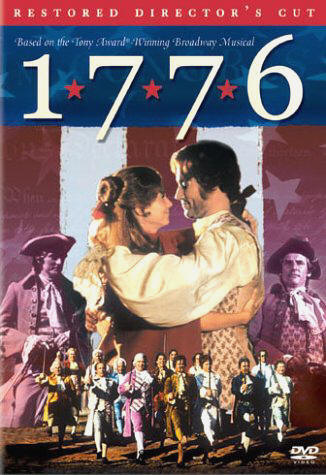 Director: Peter H. Hunt
Writers: Peter Stone & Sherman Edwards
Cast: William Daniels, Howard Da Silva, Ken Howard, Donald Madden, John Cullum, Ron Holgate, Blythe Danner, Viginia Vestoff, James Noble
Why You Should Watch It: I started to write this as one of my “Gut Reactions” pieces, but that really wouldn’t be right. “Gut Reactions” are typically reserved for my immediate thoughts about films I’ve just watched for the first time, and that in no way applies to 1776, a movie I’ve seen so many times I have large sections memorized. This is my favorite musical of all time. Getting the chance to perform in it remains one of my two great unfulfilled ambitions as an amateur actor (the other being to play Max Bialystock in The Producers, if you’re curious), and I’m fairly certain I was the only nerd in New Orleans to go up to Brent Spiner at last winter’s Wizard World convention and talk to him about his work in the Broadway revival of this show instead of Star Trek. With the Fourth of July coming up next week, it’s just about time for my annual re-watch of the movie, and this year, I thought I’d mention to you guys why you should watch it too.
1776 is, in its simplest terms, a musical about the writing of the Declaration of Independence. Much of the plot focuses on the efforts of John Adams (William Daniels) and Benjamin Franklin (Howard Da Silva) to spur Thomas Jefferson (Ken Howard) to craft the document, then the struggles of bringing it before the First Continental Congress and actually getting the thing signed. Now I know what you’re thinking here — it’s a movie about writing and signing a document? That quite literally may be the dullest synopsis in the history of cinema. But I promise you, my friends, that description in no way does this film justice. This is a movie loaded with energy, tension, just the right amount of comedy, and sincere and powerful character-driven drama.
Jefferson, for instance, needs to be convinced, almost drafted into writing the Declaration, wanting nothing more than to get home to his wife Martha (Blythe Danner at her most radiant). The comedy comes in when Adams and Franklin have to harangue him into picking up the quill, then resort to some rather extreme measures to conquer his writer’s block. Adams, meanwhile, spends much of the film in a musical correspondence with his own wife, Abigail (Virginia Vestoff) that humanizes the man. Throughout the scenes in Congress we see a powerful, driven figure trying to do the best thing for his country — frustrated, yes, but driven. It’s only when he writes to Abigail that he lets his guard down. Franklin, meanwhile, spends much of the film as a bit of light relief, tossing out pithy quotes (including many attributed to the historical Ben Franklin) and witty observations that cut through everybody else’s crap.
Things take a sharply dramatic turn in the second act over two seemingly insurmountable obstacles. Jefferson clashes with South Carolina delegate Edward Rutledge (a powerful performance by John Cullum), who refuses to sign the Declaration unless Jefferson remove a portion of the text that condemns the slave trade. (Yes, Jefferson the slave owner. And yes, he did try to include such a clause in the original Declaration.) Considering that we’re only lightly playing with history here, that this isn’t a Tarantino-style rewriting that will allow for the end of the piece to be changed from what we know to be true, it could be hard to draw real suspense. We know the Declaration is signed, we know the United States wins its independence, so how could we feel any tension over a delegate threatening to refuse his signature? Daniels really sells it, turning this from a rote exercise in acting out history to a powerful examination of how much of a man’s soul he’s willing to sacrifice for the greater good.
The second obstacle comes from Pennsylvania delegate John Dickinson (Donald Madden), a British loyalist who threatens to derail the whole enterprise by refusing to approve the Declaration — a vote which must be unanimous. Again, there isn’t tension over the outcome. The tension comes in with how that obstacle is overcome. Madden’s performance is vital to this picture as well — it would be easy to paint those who didn’t want to cede from Britain as fools or zealots, but he’s neither. His Dickinson comes across as a bit arrogant, but at his core he’s a good man trying to do what he believes is right, the same as Adams, Jefferson and Franklin.
And of course, driving all of this is the music. If you can walk away from this picture without “The Lees of Old Virginia” or “But, Mr. Adams” ringing through your head, you’ve got a thicker skull than I do. Dickinson and Rutledge each also get a powerful number dramatizing their largely antagonistic roles, and there’s a heartbreaking piece (“Mama Look Sharp”) that briefly lets us feel the plight of the Revolutionary soldier, who is of course largely absent from the plot of the film itself.
I’m not a historian. I know some of the things in this movie are based on real life (Jefferson having to withdraw his objection to slavery to placate the southern states) and some are severely dramatized (such as Dickinson’s role), but most of it is in that nebulous realm of stuff that “could have happened.” Ultimately, as long as you understand you’re watching a play and not reading a historical document, this film really gives you exactly what you need. It’s a fantastic presentation of one of the most dramatic moments in history, it gives life to men who risked everything, and it reminds us of a few lessons that some people sorely need even today.
Superman Week Day 5: Henry Cavill in Man of Steel (2013)

WARNING: Spoilers begin very soon in the plot recap in this article. If you haven’t seen Man of Steel yet and don’t want to be spoiled, READ NO FARTHER.
Director: Zack Snyder
Writers: David S. Goyer & Christopher Nolan
Cast: Henry Cavill, Amy Adams, Michael Shannon, Diane Lane, Russell Crowe, Antje Traue, Harry Lennix, Richard Schiff, Christopher Meloni, Kevin Costner, Laurence Fishburne, Ayelet Zurer, Michael Kelly, Rebecca Bueller
Plot: The planet Krypton is embroiled in a civil war. Jor-El (Russell Crowe), leader of their scientific community, believes the planet to be doomed, but the ruling caste refuses to believe him. One person who does believe him is General Zod (Michael Shannon). Zod stages a violent coup, during which Jor-El steals the Kryptonian Codex, an artifact that carries in it the pre-determined genetic code for all Kryptonians. He and his wife Lara (Ayelet Zurer) have conceived a child in secret, Krypton’s first natural birth in centuries. Hiding the Codex with the baby Kal-El, Jor-El sends him into space to the planet Earth, a distant world where Krypton sent scouting parties eons ago. Zod kills Jor-El, but is captured. He and his followers are sentenced to an orbital phantom stasis, which allows them to escape soon afterwards, when Krypton is destroyed.
Flashing forward, we see an adult Clark Kent (Henry Cavill) working on an Alaskan fishing boat until an oil rig disaster forces him to reveal his incredible strength and resistance to injury. This is not the first time it’s happened – the wandering Clark has been roaming for some time ever since leaving his mother Martha (Diane Lane) back in Smallville, Kansas. Clark makes his way to an arctic research station, where he has heard rumors of an alien spaceship deep beneath the ice. There, he encounters Daily Planet reporter Lois Lane (Amy Adams). Saving Lois from the Kryptonian spaceship’s built-in defenses, he leaves her safe and takes the ship elsewhere. Using a key he’s had with him since childhood, he activates the ship and a hologram of Jor-El, who tells him the history of the planet Krypton and begins teaching him to use his powers for a greater purpose, one that seems to echo the wishes of the man who raised him, Jonathan Kent (Kevin Coster). Through a series of flashbacks throughout the film, we see young Clark trying to deal with his enhanced senses and using his gifts to help people. Jonathan has always been afraid, though, knowing that Clark is an alien, that people would not accept him. He impresses on his son that he will – one way or the other – change the world when he is revealed, but the time for that reveal hasn’t come yet. Jonathan ultimately dies in a tornado rather than allow Clark to save him and show his powers.
Lois tracks down the activities of her savior, eventually finding the home of Martha Kent in Smallville. She meets with Clark again and the two strike up a friendship, with her deciding to bury her intended story about him as she returns to the Daily Planet. The point is quickly overshadowed when Zod’s ship appears in the skies above Earth. It announces, in a broadcast translated into every Earthly language, that they are harboring Kal-El of Krypton somewhere on the planet, and promises to bring down great suffering if they do not turn him over. After some soul-searching, Kal-El gives himself up to the military, who turn him over to Zods’ lieutenant, Faora (Antje Traue). Faora insists that Lois Lane come with them as well.
On Zod’s ship, Lois activates the recording of Jor-El, who guides her in an escape attempt while Kal-El finds the truth about Zod’s plan: he wants to find the Codex stolen by Jor-El and use it to transform Earth into a new Krypton, a process which would necessitate the extinction of the human race. Kal-El escapes and saves Lois, but not before the Kryptonians manage to read both of their memories, revealing that the Codex has been imprinted the very cells of Kal-El’s body. Faora leads a Kryptonian excursion to Kal-El’s home in Smallville. As Kal-El and his brethren go to war in Kansas, the American military initially targets them both, but Col. Nathan Hardy (Christopher Meloni) soon comes to realize that Kal-El is not an enemy.
The Kryptonian warship splits into two, using “world engine” technology to sandwich the planet and begin the terraforming process, beginning with Metropolis. Kal-El, now being called “Superman” by the soldiers, provides the military with the ship that brought him to Earth, explaining that it uses the same sort of technology that powers the engine, and that crashing it into the Kryptonian ship will rip open the portal and toss them back into the Phantom Zone, provided he can destroy the engine on the other side of the globe first. As he battles his way to the engine, in Metropolis, Hardy’s army pitches a desperate battle against the Kryptonians. Both Superman and Hardy succeed, but at the cost of Hardy’s life. Returning to Metropolis in time to save Lois from falling to her death, Superman realizes one Kryptonian remains: Zod. The two engage in a pitched battle, Zod blaming Superman for destroying Krypton a second time. Although Superman does his best to minimize the destruction and save the humans, when Zod discovers how to activate his heat vision, Superman is left with no choice but to kill the General. Realizing what he’s done, the Man of Steel screams in agony and collapses in Lois’s arms.
Some time later, Superman again shuts down military efforts to track him, promising he’s on their side, but won’t stand for being watched. Returning home to Martha, Clark tells his mother his decision: to use his powers for the betterment of mankind, and to do so, to take a job where he can monitor danger and where no one will question him for running off at a moment’s notice: that of a reporter. In Metropolis, he takes a tour of the newspaper where he’s been hired as a stringer, culminating with “meeting” Lois Lane. With a sly, knowing grin, she shakes his hand and says, “Welcome to the Planet.”
Thoughts: It’s been several days, as I write this, since I saw Man of Steel, and my brain is still processing a lot of it. The reaction, from comic book fans, comic book professionals, and the general public has been remarkably mixed, with some people loving the changes to the mythos and others who hated them. I’m not here to keep you in suspense, friends: I absolutely loved the movie.
Not every minute of it, mind you. There were some slow moments, particularly in the middle, and a few times when I thought things didn’t quite feel right, but most of those were overshadowed by the things I did like. Christopher Nolan, who directed the Dark Knight trilogy, took the reigns as a producer for this film, with the directing chores going to Watchmen and 300 director Zack Snyder. The story was by Nolan and screenwriter David Goyer, who also worked on the Batman movies. The resultant film has a tone and emotional impact that’s similar to Nolan’s Batman with a visual style that’s the best parts of what Snyder brought to his other movies, but without some of the over-the-top elements (such as his frequent use of slow motion) that can sometimes make those films a little hokey.
Unlike any other version of Superman we’ve discussed this week (or, for that matter, any other version I’ve ever seen on film) this film really plays up the alien “first contact” aspect of the character. Initially, this made me nervous, as I prefer my Superman to be Clark Kent in tights and not an alien who pretends to be human. Those fears melted away pretty quickly, though. Jor-El is a much bigger presence in this movie than he’s been in any of the other versions, and Krypton plays an enormous role in the story, but at the core we still have the son of Jonathan and Martha Kent trying to solve the mystery of his own life and, once that puzzle is cracked, trying to learn his place in the world. Like Batman Begins did for that franchise, Man of Steel ends its story much earlier in the character’s personal mythos than we’re used to, with the very beginning of Clark’s life in Metropolis and many of the familiar elements (working as a reporter, donning his trademark glasses) not clicking into place until the final moments. This wouldn’t work, except for the fact that the whole film is about building up to that, about Kal-El and Clark Kent learning how to be Superman. In my mind that’s why all of the movie – including (hell, especially) the drastically shocking ending worked.
I’ll address that particular elephant in the room later, though – it’s important enough to save it for last. Let’s get back to Snyder for a moment. His 300 was a fun movie, full of action and violence, but it was hardly a serious picture. Watchmen, if anything, suffered a bit from remaining too faithful to the source material, much of which comes across as rather ponderous when put on the screen. His first original project, Sucker Punch, was a garbled mess of a film that looked pretty but didn’t have a scrap of logic, development, or coherence to it. Worrying about him taking on the premiere superhero franchise was a fair reaction.
But by giving him a solid story to work with, Snyder did some fantastic work. These are the most intense, brutal, energizing and electrifying action sequences a Superman movie has ever had – the most almost any superhero movie has ever had. The only thing that comes close, to my mind, is the final alien invasion sequence from Joss Whedon’s Avengers (another great superhero movie with an entirely different tone, despite a mild structural similarity to the conclusion of this film). Snyder didn’t only land the action moments, though… the quiet bits in Smallville worked very well, and the scenes of Clark learning how to fly were a joy to watch. They did, however, inspire a small chuckle from me when I thought about how similar they were to bits from Andrew Stanton’s John Carter, a 2012 sci-fi film that didn’t get nearly the credit it deserved. Carter is one of the characters Superman’s creators, Jerry Siegel and Joe Shuster, had in mind when they were pulling together the many pieces of the Man of Steel back in the 1930s.
Henry Cavill works very well as a young Clark Kent. The earliest scene with him, chronologically, is the death of Jonathan Kent. There, we see him as a frustrated young man (a late teen or early 20something) still fighting against a father who he feels has repressed him. The pain in his face when Jonathan dies lingers, and informs so much of what the character does later. Looking back on the previous scenes of him saving the men on the oil rig, you can now recognize in him someone who has something to atone for. That pain is amplified exponentially after Zod’s death, and it will be very interesting to see whether the promised sequel (which has already been pushed into production) will follow up on that sort of emotional beat.
Amy Adams as Lois Lane is another fine touch. She’s a great actress in her own right (I am, I admit, a fan), and she brings a strength and courage to the character. She’s not the spitfire that Margot Kidder was, but she’s not a wallflower either. This is a Lois that doesn’t go out of her way to be antagonistic, but she isn’t about to back down from a fight either. What’s more, she’s also the first Lois we’ve seen to actually solve the mystery – she figures out that her Guardian Angel is Clark Kent of Smallville before there’s even a “Superman” identity to look for. It’s a great moment for the character that deviates a bit from the usual pieces of the Superman mythology, but it does so in a way that strengthens Lois’s character without weakening Clark. What’s more, it will also easily allow the filmmakers to sidestep any future questions of how the person closest to both Clark and Superman is fooled by his rather simple disguise.
The entire cast, really, acquits itself well. Russell Crowe and Kevin Coster both feel like good, rational and admirable fathers for Superman. (Whether the fact that both of Superman’s fathers have played Robin Hood was considered during the casting process or not is a question for the ages, but I like to think it brings a little bit of metatextual gravitas to the casting.) Crowe’s Jor-El is a larger presence than the other versions have been, even Marlon Brando’s, but he also feels more like a loving father than those other versions. Even his holographic replica, at the end, sounds like he’s proud of his son.
Costner’s Jonathan Kent dies before he gets to see what Clark does with his power, but the way he dies is just brilliant. Almost every other version of the character has died of a heart attack – believable, sad, but not the character-defining moment we get here. In this version, Jonathan is saving people in traffic from a coming tornado, goes back for the dog, and realizes he’s not going to make it. His son could easily save him, even at this early stage of his development, but Jon refuses to allow it. At this point, Clark’s secret is more important than his own life. The one thing that’s always set Superman apart from the likes of Batman and Spider-Man is that he’s not usually driven by tragedy or survivor’s guilt… sure, he’s the last son of Krypton, but his home planet is one he never knew until he was an adult, it wasn’t formative for him. Jonathan’s death, in this manner, gives him something to atone for. His father – just minutes after Clark denied that he was his father – made a supreme sacrifice on his behalf. From that moment on, we’ve got a Clark Kent trying to be worthy of that sacrifice. It’s powerful as hell.
Michael Shannon was an interesting choice as General Zod. He doesn’t quite have the devilish look of Terrence Stamp, he could almost be a hero in the right circumstances, and he certainly believes himself to be the hero of the story. That’s what makes him compelling – from his way of thinking, he’s doing exactly the right thing. To use a rather overused metaphor, if you knew that the only way to save the human race was to destroy an anthill, would you hesitate to do it? Ants aren’t sentient, of course, so it’s a metaphor that falls apart, but using Zod’s logic, it’s perfectly sound. The best villains are always those that believe themselves to be in the right.
So having danced around it enough, let’s get to the most contentious part of this movie: Superman kills Zod. There’s no question about it here, no way to dress it up like an accident, no way to say that he didn’t know it would be fatal or that maybe Zod really survived. Superman wrapped his arms around Zod’s head, twisted with all his incredible strength, and killed him. And Superman is a character who should never kill.
And that is why it worked.
I’m about to get super damn nerdy here, pointing back to specific comic book stories and everything, but please bear with me. I’ve got a point to make. Superman is the character who believes in life above all else. Superman is the character who will do anything to find another way. Superman is a character who believes that death is not the last resort, but it is never a resort at all. But this is a lesson that has to be learned, and how else do we learn than from our mistakes?
I’m about to blow some minds for people who don’t read comics, but Superman has killed before. At least twice, in fact. In Alan Moore’s epic Whatever Happened to the Man of Tomorrow? (recently voted by fans as the greatest Superman story of all time), he kills the interdimensional menace Mr. Mxyzptlk, who has gone from being a pest to being a homicidal god. Then, to punish himself for killing – something he believes nobody, even Superman, has the right to do – he removes his own powers and walks away into the arctic waste. Fans accepted this pretty readily, most likely because it was presented as an “imaginary story,” something that was not technically in-continuity and was, in fact, the final story of the previous 50 years of Superman continuity before writer/artist John Byrne came in and relaunched the character with his Man of Steel miniseries. It’s a good story. But the second one I’m going to mention is even more applicable.
 A few years later, Byrne left the Superman comic books with a story called the “Supergirl Saga.” In this story, Superman discovers an alternate dimension where his counterpart is dead, there are no other superheroes in the world (no Batman, no Wonder Woman, no Justice League, etc.), and three Kryptonian criminals are laying waste to the entire planet. Superman is brought there to stop these alternate versions of Zod, Faora and Quex-Ul, but he’s too late, and the planet is left with just one survivor. Superman plans to strand the Kryptonians on this dead Earth, but Zod taunts him, promising to find his way to Superman’s own dimension and repeat his massacre there. Realizing Zod is right, that he can do it, Superman uses a piece of Kryptonite and executes them.
This being a part of the regular Superman line, it got a much bigger reaction than the Moore story. It was horrifying. It was shocking. Superman isn’t supposed to kill. And the writers who followed Byrne recognized it – Superman was so emotionally scarred by what he did that he wound up exiling himself from Earth for months, no longer believing himself worthy of being among humans. Both the “Supergirl Saga” and the subsequent “Exile” storylines also made that list of the best Superman stories, as voted on by fans, and I think it’s because they so brilliantly exemplify the point I’m trying to make here.
Superman doesn’t kill, that’s true, but that’s not the whole statement. The whole statement should read thusly: “Superman doesn’t kill, because the one time he did, it almost destroyed him.”
Zod’s death in Man of Steel isn’t a calculated, premeditated act. Superman never sets out to kill anybody. It’s not even the cold execution of the alternate Zod from the “Supergirl Saga.” It’s done in the heat of battle, by a young Superman who has only recently learned the full extent of his powers, and it’s done while Zod is actively threatening the lives of innocent people. And after it’s over, Superman is shattered. He screams in pain and agony, not at Zod for placing himself in that position, but at himself for failing to find another way. In circumstances where virtually anybody on the planet would consider his actions justified, Superman considers himself a failure, because he didn’t live up to the ideal that Jor-El has set for him.
And it’s that ideal, more than anything else, that drives the character. Clark Kent is not Superman because he can fly or see through walls or juggle tanks. He’s Superman because he reminds all of us that there’s a better way, and nobody will be harder on him for failing to reach that ideal than he will be himself. This may be the first Superman movie that actually demonstrates that influence on others as well. Repeatedly, throughout this movie, we see characters step up and be heroes because of the example he has set: Hardy’s death at the end, where he throws a one-liner back in Faora’s face, is priceless. Perry White (Laurence Fishburne) and Steve Lombard (in every version of the mythos, the biggest douchebag who ever worked at the Daily Planet – here played nicely by Michael Kelly) risk their lives to save an intern named Jenny (Rebecca Bueller, who many believe is this universe’s gender-flipped stand-in for Jimmy Olsen, as her last name is never spoken) even while Metropolis is crumbling all around them. Even before there is a Superman, we see young Clark save a bus full of kids, including a bully named Pete Ross (Jack Foley as a kid, Joseph Cranford as an adult). After he saves him, the next time we see Pete he’s helping Clark to his feet after he stops himself from crushing another group of thugs who are picking on him. Adult Pete shows up too, around the time that Zod is demanding Kal-El be turned over, and warning the people that know who he is to step forward. It seems pretty clear that Pete knows who they’re talking about, but he doesn’t say a word.
(I would, in fact, love to see this in the Man of Steel sequel – some circumstance where the entire town of Smallville turns a blind eye to the Clark/Superman connection, because there’s simply no way to believe they don’t know who Superman is, but it’s easy to believe that they’ve all silently decided to keep his secret.)
So yes, I loved Man of Steel, and if you didn’t, I hope I’ve at least articulated exactly why I think it worked so well. Warner Bros, as I’ve said, has already kicked off work on Man of Steel 2, with the promise of it leading to a Justice League movie down the line. After so many false starts over the years, if this is the template they use, they may finally have found a way to get it right.
The first Reel to Reel study, Mutants, Monsters and Madmen, is now available as a $2.99 eBook in the Amazon Kindle store and Smashwords.com bookstore. And you can find links to all of my novels, collections, and short stories, in their assorted print, eBook and audio forms, at the Now Available page!
Superman Week Day 4: Brandon Routh in Superman Returns (2006)
 Director: Bryan Singer
Writer: Michael Dougherty & Dan Harris
Cast: Brandon Routh, Kate Bosworth, Kevin Spacey, James Marsden, Parker Posey, Frank Langella, Sam Huntington, Eva Marie Saint, Marlon Brando, Kal Penn, Tristan Lake Lebu, Jack Larson, Noel Neill, James Karen
Plot: Picking up where the 1980 Superman II left off (and wisely ignoring Superman III and Superman IV: The Quest For Peace), this film opens five years after scientists pinpointed Krypton in space, and Superman left Earth to examine the remains of his dead planet. Back on Earth, Lex Luthor (Kevin Spacy) is claiming a vast fortune pulling a scam on a dying woman (the original filmic Lois Lane, Noel Neill, in a cameo). On his yacht, Lex tells his new girlfriend Kitty Kowalski (Parker Posey) his plan – to find and raid the arctic fortress Superman left behind for the crystal technology that ran Krypton.
In Kansas, Martha Kent (Eva Marie Saint) sees a startlingly familiar sight: a spacecraft landing on her property. She finds her long-missing son, Clark (Brandon Routh), exhausted from his return to Earth from Krypton. In the morning, rested, he tells his mother all he found of Krypton was a graveyard. Returning to Metropolis and the Daily Planet, he reunites with Jimmy Olsen (Sam Huntington) and Perry White (Frank Langella), but Lois Lane (Kate Bosworth) is out of the office, covering the launch of a new experimental spacecraft. Examining her desk he sees she’s moved on in his absence, winning a Pulitzer Prize for an editorial explaining why the world doesn’t need Superman, getting engaged to Perry White’s nephew Richard (James Marsden), and having a son named Jason (Tristan Lake Lebu).
Luthor demonstrates his plan to his henchmen, using the Kryptonian crystal technology to create a new land mass. The experiment causes an electrical pulse that shuts down power across the country, including the tandem space shuttle/Boeing Lois is on board for the launch. The news reports on the damage to the twin aircraft, and Clark springs into action. Superman, making his first appearance on Earth in years, saves the two vessels and everyone on board, and the world cheers his return.
Back at the Planet, Perry and Lois bicker over their coverage, with Lois wanting to write about the blackout and Perry wanting to focus on Superman’s return. Lois is glad to have Clark back, but he soon realizes she’s carrying a deep anger towards Superman for leaving without saying goodbye. Superman glances in on the family that night, where he hears Richard ask Lois if she was ever in love with Superman, a notion she denies. When he speaks to her later on the rooftop of the Planet, she pointedly tells him the world doesn’t need a savior, and neither does she.
Luthor has Kitty stage a car accident to distract Superman while he breaks into a museum to steal a chunk of Kryptonite. As he plans, Lois tracks down the source of the blackout to Luthor’s yacht and, with Jason in tow, is captured. Luthor explains his plot – to create a new continent of his own that will engulf most of the United States, and he’s got the Kryptonite to back it up. When Jason has a reaction to the Kryptonite, Luthor asks Lois just who the boy’s father really is. Combining the Kryptonite with a crystal stolen from the Fortress, Luthor begins growing his new continent off the coast of Metropolis.
Lois sends the coordinates of the yacht to the Planet office, where Perry, Richard, and Clark are searching for her. When she’s caught by one of Luthor’s thugs he threatens her, only to be flattened when the wheezing, asthmatic Jason hurls a piano into him. Her fax makes it through and Clark and Richard (in his seaplane) both fly to her rescue. As they do, the growing continent sends out an earthquake that hits Metropolis. With Superman trying to minimize the damage to the city, Richard reaches Luthor’s yacht first, but a tidal wave takes it down. Superman pulls it above water and sends Lois and Jason off with Richard while he goes to Lex’s new landmass to face him, unaware of the Kryptonite in its makeup.
Luthor begins beating the weakened Superman and Lois begs Richard to turn back so they can help him. They find him stabbed by a Kryptonite crystal. Pulling the Kryptonite from his side, Superman dives beneath the ocean, ripping the growing landmass from the water, and hurling it into space. He crashes to Earth, nearly dead. As he recovers in a hospital, Lois and Jason visit him and she whispers something in his ear. When he recovers, he again goes to Lois’s house, looks in on Jason, and remembers his father Jor-El’s long-ago words to him… how the son becomes the father, and the father, the son. He promises Lois he’ll always be around, and flies once more into the sky, to gaze down on the Earth from above.
Thoughts: I know I’ll catch crap for this, but I’ve always felt Superman Returns was unfairly maligned by a lot of people. It’s not a perfect film, by any stretch, but neither is it as bad as so many make it out to be. After so many years without a Superman film, watching other superheroes populate cinemas, the opening sequence of this movie was just what we needed: a fantastic tribute and update to the Richard Donner/John Williams sequence from 1978.
The biggest problem with this movie overall, I think, is that it’s somewhat too faithful, too reverent to the Christopher Reeve films. Lex Luthor’s plot, just like in 1978, is essentially a massive, very deadly real estate scam. Marlon Brando is brought back to reprise the role of Jor-El despite the inconvenience of being dead. (They used archive footage shot for Superman II but unseen in the theatrical cut. Quick aside here – in 2006 Warner Bros released Superman II: The Richard Donner Cut to DVD. If you can find it, watch it. It solves virtually every problem with the original cut, and probably could have been a masterpiece if producer Alexander Salkind and Richard Donner hadn’t had a falling-out.) They brought back Noel Neill and her Adventures of Superman TV Jimmy Olsen, Jack Larson, for cameos. Composer John Ottman makes liberal use of the John Williams score, and even that opening sequence spins through space just like the original, but with flashier effects.
This is the good stuff, but the screenwriters and director also brought with them limitations that shouldn’t have existed anymore. In the 70s and 80s, before special effects technology could give us dinosaurs that we believed were real and outer space battles that could match any real aerial combat, the Christopher Reeve Superman was limited in how physical he could get with his opponents. His most intense battle in four films was that with the three Kryptonian criminals in Superman II, and while that Battle of Metropolis is impressive by the standards of the time, it doesn’t deliver the sort of Red Bull-charged action modern audiences demand. Most of the Reeve’s Superman’s feats were of the rescue variety, without a lot of actual violence, because what human foe could possibly stand up to the Man of Steel in a physical confrontation?
Here, once again, we see Superman battling a human foe, dealing with Kryptonite (a crapload of Kryptonite, to be certain), and not getting particularly physical except for a few moments when the filmmakers deliberately tried to show off the special effects, such as the scene where a bullet bounces off Superman’s eye. Like Reeve, Superman uses his powers far more for disaster relief than for combat. The really startling thing is that this came from director Bryan Singer, director of the first two X-Men movies, which were both full of action and a lot of fun to watch. (When he chose to do this movie instead of the third X-Men, 20th Century Fox rushed it into production with director Brett Ratner, and the film was an unmitigated disaster. Singer returned to the X-Men to produce 2011’s X-Men: First Class, which to date is the best film in that franchise and one of my favorite superhero movies in general.)
That said, in those moments where the film makes the most of these techniques, it does it well. The scene where Superman rescues the airplane (itself a bit of a nod to the 1986 John Byrne Man of Steel comic book) is as visually exciting and thrilling as anything I’ve ever seen on screen. His efforts to stop the destruction of Metropolis are exciting and visually satisfying. If the rest of the film had the energy and power as those sequences, there would be nothing to complain about at all. Even the airplane scene, though, ends with a nod backwards – Routh cribs Reeve’s line about flying being, statistically, the safest way to travel.
Let’s talk about Routh, now. Of all the ways I think this film got a raw deal, Routh got it worst. His performances as Clark Kent and Superman were both really good. As with everything great about the film, though, the greatness comes through imitation. Routh does the best impression of Christopher Reeve’s Clark Kent and Superman duet any actor possibly could, imitating his voice, his tone, his mannerisms, his speech patterns. It’s an impressive performance, but it’s not really his own. The same goes for Kevin Spacey as Lex Luthor – he’s doing a Gene Hackman impression. It’s a very good Gene Hackman impression, with the sort of manic energy that would swing from subtle moments of frustration to wild anger with lots of solid humorous moments in-between, but it’s an impression nonetheless.
The only major performer not doing an impression is, ironically, also the worst thing about this movie: Kate Bosworth as Lois Lane. While Routh and Spacey drew on Reeve and Hackman, Bosworth has none of the fire or spark that Margot Kidder brought to Lois Lane, and as those are her two most defining characteristics, we’re left with a bland and lifeless performance. Neill and Kidder both gave us Loises that felt like a real match for Superman, a brave, witty, intellectual equal who lived up to being a love interest for the world’s greatest hero. Bosworth simply never feels worthy of the role, and she and Routh have no chemistry together whatsoever. Kidder’s Lois was a joy to watch, even when she was just sitting around the Planet office asking for orange juice (“freshly squeezed”). Every moment Bosworth is on the screen, I’m just waiting for the scene to end so we can move on to something interesting.
Plotwise, Jason is another issue that doesn’t make a lot of sense. The fact that Clark left a son behind when he left Earth inspired a lot of “deadbeat dad” jokes that aren’t really fair – you can’t blame a man for not taking care of a son he didn’t know existed. (That doesn’t quite excuse the scene where he spies on her at home, mind you.) That said, we’re now being asked to accept that human and Kryptonian DNA could mingle and create a half-breed. I suppose we can accept that, if we can accept a world where a journey from a red sun to a yellow one allows a person to fly… but if that’s the case, why is Jason so frail and sickly until the plot demands otherwise? The idea here is clear – Singer and the screenwriters wanted to employ the unused Marlon Brando “son becomes the father, father becomes the son” speech from Superman II, and they wanted to do that by giving Superman a child and removing from him the weight of being the literal “last son of Krypton.” That didn’t come across, though. In practice, Jason just weighed him down more, and probably would have been even more difficult to deal with had they ever moved forward with a sequel.
In my opinion, the good in this film outweighs the bad, but it suffers mainly from not being what people wanted out of the franchise at the time. It would be another seven years before a new movie would try to resurrect Superman again, this time deliberately starting from scratch and doing away with the trappings of Donner, Williams, and Reeve. Just last week, Man of Steel hit theaters. Come back tomorrow, and I’ll tell you how well it succeeds.
At the time I write this, I still haven’t seen Man of Steel yet (although I will have by the time you read it), so I’m as excited as anyone to see just how it all turns out.
The first Reel to Reel study, Mutants, Monsters and Madmen, is now available as a $2.99 eBook in the Amazon Kindle store and Smashwords.com bookstore. And you can find links to all of my novels, collections, and short stories, in their assorted print, eBook and audio forms, at the Now Available page!
Superman Week Day 3: Christopher Reeve in Superman (1978)
 Director: Richard Donner
Writers: Mario Puzo, David Newman, Leslie Newman, Robert Benton
Cast: Christopher Reeve, Gene Hackman, Margot Kidder, Marlon Brando, Ned Beatty, Jackie Cooper, Marc McClure, Glenn Ford, Phyllis Thaxter, Terrence Stamp, Jack O’Halloran, Sara Douglas, Jeff East, Valerie Perrine, Larry Hagman
Plot: On the distant planet Krypton, Jor-El (Marlon Brando) successfully prosecutes a trio of murderous criminals, exiling them from the planet, trapped in a “Phantom Zone.” His feeling of triumph is short-lived, however… Jor-El knows that Krypton is doomed. The council refuses to believe him, and he sends his son away from the planet before its destruction. Kal-El is brought to Earth, where he is found by a farming couple, Jonathan and Martha Kent (Glenn Ford and Phyllis Thaxter). Although Jonathan is initially skeptical, Martha convinces him to take the child in and raise him as their own.
As a teenager (played by Jeff East), Clark has begun to develop incredible power, and feels frustrated when he’s forbidden to play sports or excel in any way that would draw attention to himself. Jonathan tells him that he has a purpose on Earth far greater than scoring touchdowns, and Clark’s spirits are lifted, then immediately shattered when Jonathan is struck by a heart attack and dies. That night, Clark feels a summons to the barn, where he discovers a glowing green crystal from the ship that brought him to Earth. He tells his mother he has to leave and, carrying his father’s last words with him, makes his way north. On the arctic ice, the crystal constructs an enormous fortress, and a recorded hologram of Jor-El begins to instruct Clark towards his destiny. After years of tutelage, the adult Clark (Christopher Reeve) dons a brilliant uniform and takes flight.
In the city of Metropolis, Clark gets at job at the Daily Planet, where reporter Lois Lane (Margot Kidder) is threatened by his encroachment onto her beat. She’s even more put-off by Clark’s oafish nature, his use of outdated vernacular, and the way he seems to crumble when the two of them are threatened by a mugger. He tries to talk the crook down, but is seemingly shot for his troubles. As the mugger escapes Lois checks on Clark only to find he’s “fainted.” With sly glance, Clark shows us the truth: he caught the bullet and saved Lois’s life for the first time. The next time comes later, when a helicopter on the Planet building crashes with Lois inside. She falls out, only to be caught in the arms of a bold figure in red, blue and yellow. Carried back to the roof, Lois asks him who he is. “A friend,” he replies.
In his new identity, Clark begins thwarting criminals and rescuing people from disasters across Metropolis and all over the world, even saving Air Force One from a destructive storm. Planet editor Perry White (Jackie Cooper) demands that his paper become the official mouthpiece for the new hero, and Clark arranges a rooftop meeting with Lois, giving her the exclusive on the figure she dubs “Superman,” as well as taking her for a flight she’ll never forget.
Beneath the streets of Metropolis, criminal mastermind Lex Luthor (Gene Hackman) is planning the biggest land scam in history. Along with his assistant Otis (Ned Beatty) and girlfriend Miss Teschmacher (Valerie Perrine), he steals a piece of meteor from a museum and hijacks the guidance systems of a pair of missiles. Luthor uses a high-frequency message to lure Superman to his lair and reveals his plan: he’s going to use the missiles to trigger an earthquake, making all the seemingly-worthless land he’s bought in California instant beachfront property, at the expense of millions of innocent lives. Before Superman can act to stop him, Luthor uses the stolen meteor – a fragment of Kryptonite from Superman’s home planet – to incapacitate him. As added insurance, Luthor launches one of the missiles in the opposite direction, to Hackensack, New Jersey. As he leaves, Miss Teschmacher is struck with a moral crisis – her mother lives in Hackensack. She saves Superman from the Kryptonite, but only after making him promise to stop the missile going to New Jersey first.
The missile hits the fault, triggering Luthor’s earthquake. Superman dives into the Earth’s crust to hold the fault together and minimize the damage, but cataclysmic destruction is wreaked, destroying the Hoover Dam. Once he stops as much of the devastation as he can, Superman sees a final tragedy: Lois, who was sent to California to cover the strange land deal, has died in the earthquake. Heartbroken, he disobeys Jor-El’s decree not to interfere with history and flies into space, spinning time backwards and saving Lois. Superman captures Luthor and Otis and brings them into custody before taking flight once again.
Thoughts: You will forgive me, I hope, if I fail to maintain even a pretense of objectivity about this movie. I have been a Superman fan my entire life – unironically and unapologetically – and a huge portion of that is due to the 1978 Superman. It left a mark on me, shaping my feelings about the character, about superheroes, about orchestral music, about cinema in general. I regard it, to this day, as a near-perfect film, and I make no bones about it.
The movie opens with a double breaking of the fourth wall, starting with movie curtains opening, reminding us we’re watching a film, then going into a segment with a child reading an issue of Action Comics, reminding us of the hero’s pedigree. Both of these moments are short, though, and we quickly plunge headlong into outer space, into the magnificent John Williams score, and into what I still regard as one of the greatest opening sequences in cinematic history.
In retrospect, the opening could seem a bit bloated – Jor-El’s confrontation with General Zod (Terrence Stamp) has nothing to do with the rest of the movie, but it perfectly sets up Superman II, which was written alongside this film and filmed back-to-back. The producers, Alexander and Ilya Salkind, were doing what Peter Jackson did twenty years later with Lord of the Rings, and taking an enormous risk in doing so. The risk pays off, though. It’s almost 50 minutes into the movie before Christopher Reeve or Margot Kidder appear, before Superman puts on his costume for the first time, but it never feels like wasted time. We’re going through what we need to go through to tell the story, and it flows perfectly.
The film has a gravity to it. From the beginning, as Jor-El makes his plans to send Kal-El to Earth, we see film with great production values that takes its character seriously. There’s genuine heartbreak as Jor-El and Lara place their baby in his spacecraft, there’s genuine terror as Krypton begins to crumble. Williams, again, blows us away with his magnificent musical score – aside from the main fanfare, the Krypton scenes have my favorite music in the entire film. You can close your eyes and listen, imagining all the while an ancient civilization full of beauty and grandeur, and you can hear it sicken and die. About 15 minutes later into the film, Jeff East as young Clark grieves for Jonathan’s death, and we grieve with him, for the fact that all of his power couldn’t save his father from a mundane heart attack.
This, friends, is what so many people don’t understand about Superman. They focus so much on his power and all of the things that he can do that they totally miss moments like this one, the moment where his power simply isn’t enough. This is where the true Clark Kent is shown, when he finds something he can’t just punch his way through, and bleeds for it. The compelling thing about Superman is that no matter how much he does, he always wants to do more. If you don’t see something uplifting about that, I don’t know how to talk to you.
Not to say that everything about the film is weighty or depressing. Once we reach Metropolis there are many good, lighthearted moments, and not just from Ned Beatty’s clownish performance as Otis. (It’s not a bad performance, mind you, but it’s almost too goofy at times.) Once in Metropolis, the film has to strike a balance between the silly and the serious, and this is where it’s time to talk about Christopher Reeve.
Reeve is perfect. Flawless. Without error or fault. In this film, he does no wrong. He’s pretty good, is the point I’m making. This is the movie where any argument about how silly Clark Kent’s disguise is falls apart, and it’s solely due to Reeve’s performance. As Clark, he adopts a bit of a silly, corn-fed attitude. It puts people off, it makes them underestimate him, it makes them think he’s less of a man than he really is. It’s a sacrifice he chooses to make, because the moment he drops the mask he becomes remarkably charismatic, emboldened, and powerful. Even when he’s pretending to be the oaf, there are plenty of moments when he allows his true personality to shine through, even if it’s just for the audience. Any doubts about the disguise crumble the moment he catches the bullet in the alley. As soon as Lois walks away we see his true glee at the success of his ruse shine through on his face. Superman’s disguise isn’t a pair of glasses, it’s the performance of a master actor who adopts a persona that would never even allow people to think of him in the same breath as Superman. Reeve plays two characters who are both the same man, and he nails it.
As Reeve is the perfect Clark Kent, Margot Kidder is almost as good as Lois Lane. She’s Noel Neill on a caffeine rush – a quick, clever wit and a biting sarcasm that befits the character. She also plays Lois as someone utterly without fear – she’ll rush in to any situation to get her story. The chemistry between Kidder and Reeve is almost tangible. They play off one another with verve and vigor, each of them playing a bit of a chess game over the question of identity, even if Lois isn’t fully aware of who her opponent is. The game, in fact, begins even before Superman appears. The first time Lois and Clark meet, he puts on his act and struggles to open a bottle of soda. She “helpfully” takes it and bangs it on the desk a few times, loosening the cap, but causing it to spray all over him when he opens it. At first blush, it seems like a simple comic moment, establishing who this incarnation of Clark Kent is, but in the next beat it tells us everything we know about both characters. Lois apologizes and says it was an accident, and Clark says he’s sure it was, because who would try to make a complete stranger look like a fool? It’s a brilliant moment of characterization: Lois pulls a little passive aggressive crap because she’s mildly threatened by the new reporter in the room, and Clark calls her on it without ever allowing his disguise to slip. The game has begun.
For the time, the special effects are pretty impressive. The outer space sequences are as good as anything in the first Star Wars film, the creation of the Fortress of Solitude is awesome, and the flying scenes… there’s a reason why the tagline for this movie was “You’ll believe a man can fly.” Today, no doubt people would mock the clear use of greenscreen for the flying effects, but in 1978 it absorbed audiences completely, and if somebody can get over a modern hipster attitude and look at the film in context, it’s still pretty damn impressive.
As I say, the movie is merely “nearly” perfect. There are some small flaws that I can recognize. For example, in the sequence where Kal-El is sent to Earth, we listen to Marlon Brando’s voice tutoring him in the history of Krypton and the “28 known galaxies,” which sounds like a cool sci-fi premise, but doesn’t go anywhere. Kal-El is still a baby, and Clark Kent doesn’t remember any of this later. At most, you can point out the philosophy, where Brando entreats him not to interfere with human history… which, of course, he does at the end of the movie anyway. At any rate, most of the instruction is repeated later when Clark enters the Fortress of Solitude, making that voiceover portion of that otherwise-stunning sequence redundant.
Other problems are more due to the inherent limitations of the time. Today, we refuse to accept a supervillain plot that doesn’t include some sort of massive special effects spectacle, which is fine. Today we can do that. In 1978, as impressive as this movie was, it wasn’t at the point where we could see high-speed in-flight battles or massive explosions that weren’t obvious models. So the supervillain’s scheme is, in essence, a real estate scam with a massive loss of life. It works for the movie, but it isn’t quite as thrilling as it could be.
And finally, the one sequence where the film falls from the heights of Olympus to the pit of a pot of cheese whiz: the “Can You Read My Mind?” scene. The interview with Lois works very well, with Reeve now given the chance to be bold and aggressive while Kidder plays a little bumbling and awkward for a change. Then he takes her to fly, another beautiful piece of music begins… and it’s all derailed by one of the most unnecessary and irritating voiceovers in movie history. Lois ponders, in verse, who this strange man is and the audience rolls its eyes.
On the other hand, it’s hard to be too mad at this scene. As awful as the flight sequence dialogue is, the line “I like pink very much, Lois” is one of the greatest things ever written.
I love this movie and I don’t care who knows it. Even now, it stirs the soul, brings a tear to my eye at all the right moments, and makes me believe in things like courage, and heroes, and the basic decency of humanity. It does everything Superman is supposed to do, bringing out the best of the human spirit, and reminding us what “truth, justice, and the American way” is supposed to mean. Today, 35 years later, this movie has aged very well. Today, 35 years later, it is still a wonder.
The first Reel to Reel study, Mutants, Monsters and Madmen, is now available as a $2.99 eBook in the Amazon Kindle store and Smashwords.com bookstore. And you can find links to all of my novels, collections, and short stories, in their assorted print, eBook and audio forms, at the Now Available page!
Superman Week Day 2: George Reeves in Superman and the Mole-Men (1951)
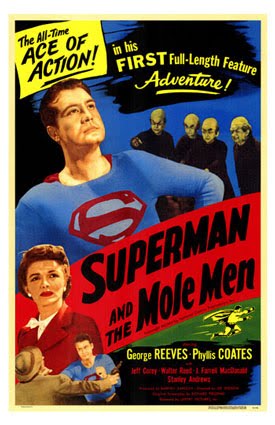 Director: Lee Sholem
Writer: Robert Maxwell
Cast: George Reeves, Phyllis Coates, Jeff Corey, Walter Reed, J. Farrell MacDonald, Stanley Andrews
Plot: Daily Planet reporters Lois Lane and Clark Kent (Phyllis Coates and George Reeves) are sent to cover the opening of the deepest oil well in the world, but arrive to find that unknown problems in the drill shaft have caused the company to shut the oil well down. As the two of them find rooms at a local hotel for the night, the oil shaft is opened from the inside and two bizarre creatures stumble out. In the morning, Clark and Lois arrive back at the oil shaft to find the night watchmen dead, frightened to death Lois glimpses one of the creatures, but Clark and the oil rig’s foreman are skeptical of her claim. The foreman confesses to Earth that the super-deep drill hadn’t struck oil as planned, but phosphorescent radium, then burst into an enormous hollow area deep beneath the Earth’s surface.
The two Mole creatures are spotted in town and an angry mob forms, planning to hunt them down. Switching his clothes to his Superman uniform, the man of steel races the mob, led by Luke Benson (Jeff Corey). The Mole Men have already escaped, and Superman’s effort to placate the mob is only partially successful – several of them head out that night and find the Mole creatures atop the town dam. One of the Mole Men is shot, and Superman catches him in the air, racing him to the hospital, while the other escapes. Benson’s mob chases the remaining Mole creature to a shack, trapping him, then set the building on fire. He narrowly escapes, but Benson believes him dead, allowing him to return to the drill shaft and slip back underground.
At the hospital, the doctor is afraid to operate on the Mole Man due to the radiation, and Benson is assembling his mob again again. Superman faces down the mob, and the second creature returns from the drill shaft with reinforcements and a weapon. They approach Superman, who realizes they’ve only come to rescue the wounded creature. Benson tries to attack them, and they turn their weapon on him, but Superman saves him. He helps the Mole Men return to the drill shaft, which they destroy from within. No one will ever disturb the Mole Men again.
Thoughts: After two movie serials starring Kirk Alyn, this short movie (only 58 minutes) was made as a sort of test for the proposed Adventures of Superman TV show. The show was given the greenlight and this movie was heavily edited and shown on television as the last two episodes of the first season. These days, such a thing would be really obvious, but at the time, the production values of a TV show versus a B-movie weren’t really that disparate from each other… I’m sure a lot of the audience never even knew.
The film absolutely presumes audience familiarity with the characters. Aside from a short bit of voiceover at the beginning, it doesn’t waste any time with Superman’s origin or establishing Clark Kent’s life at the Planet. In fact, except for Lois Lane, none of the other characters who would be regulars on the TV show make an appearance at all. Reeves and Coates are cut from the same cloth as Kirk Alyn and Noel Neill, who filled those roles just the previous year (and Neill would replace Coates on the TV show after the first season). Reeves is the square-jawed paragon of heroism that we all expect Superman to be – strong and bold. Like Alyn, his Clark Kent is earnest, but he also has a bit of swagger, a bit of cockiness that we don’t often see in Superman. He’s not a jerk or anything, but neither is he the oafish, bumbling Clark Kent later adaptations would have. Reeves’s Clark is virtually the same character as his Superman, just with a change of clothes. As the TV show progressed over the next few years, he began to adopt a real sense of tongue-in-cheek humor, a bit of a wink at the camera, but in this early appearance we don’t see any of that.
All things considered, there’s surprisingly little Superman in this movie. If you skip the opening narration, Reeves doesn’t put on the famous costume until 24 minutes in (and I remind you, the total running time is just 58 minutes). If a viewer somehow didn’t know who “Clark Kent” and “Lois Lane” are, they could easily think this was just another “monsters from beneath the Earth” sci-fi flick like hundreds of others being turned out at the time. This falls into the edict of the TV producers, I suppose – there was a rule on the show that Superman didn’t show up until the third act. This limited the need for special effects (a term used here loosely), but also helped force Reeves’s Clark into being a tougher character, otherwise the audience probably couldn’t have stood him for that long. The best effect in the film, by the way, are the bursts of light when the Mole Men try to zap Benson… it wasn’t much of a wad, but they blew it at the end.
Coates is a passable Lois Lane, but doesn’t quite have the energy that Neill (and later actresses) brought to the role. She moves the story along and doesn’t embarrass the character, but at the same time, she doesn’t really keep pace with Superman the way you’d want her to. She has a brief exchange with Clark, berating him for always disappearing when there’s trouble and completely missing the obvious answer, even when he slips and says “I” saved one of the Mole Men before correcting himself to “Superman.” It’s stuff like this that sometimes gets Lois branded as less of formidable woman than she deserves to be.
The Mole Men themselves, visually at least, are probably the least-effective thing about this film. They’re creepy, to be certain, but that mostly comes through their odd way of moving and the expressions on their faces. Like so many science fiction movies of the era, the monsters look like actors in bizarre suits, covered in fur and wearing skullcaps that make them look less human, but not totally convincing as monsters.
From a story standpoint, though, the Mole Men work much better than the makeup budget allows. There’s a hint of tragedy to them. They’re never portrayed as evil or even accidentally menacing – they’re simply creatures taken from their own world and placed in one where they don’t belong. Even at the end, when they fight back, it feels much more like self-defense, like a rescue mission, than it does an intentional threat. The scene where they meet the little girl has echoes of the Universal Frankenstein, while the agonized face of the creature trapped in the burning shack reminds me of nothing so much as Tod Browning’s Freaks from 1932. Like the people in that film, you sympathize with the creature far more than the people who torment him.
In the end, the biggest reason to watch this movie is for Reeves. Both as Clark Kent and as Superman, he’s got a strength and a commanding presence, a clear-headed rationality that the character deserves. Reeves was wonderful in this role, even if it did weigh down upon him for the rest of his life. That life ended tragically, of course, and one will always have to question how much of that tragedy was a result of his association with his most famous role… but as a Superman fan, we can only be grateful to have had a performer this early who embodied the hero so well.
The first Reel to Reel study, Mutants, Monsters and Madmen, is now available as a $2.99 eBook in the Amazon Kindle store and Smashwords.com bookstore. And you can find links to all of my novels, collections, and short stories, in their assorted print, eBook and audio forms, at the Now Available page!
Superman Week Day 1: Kirk Alyn in Superman (1948)
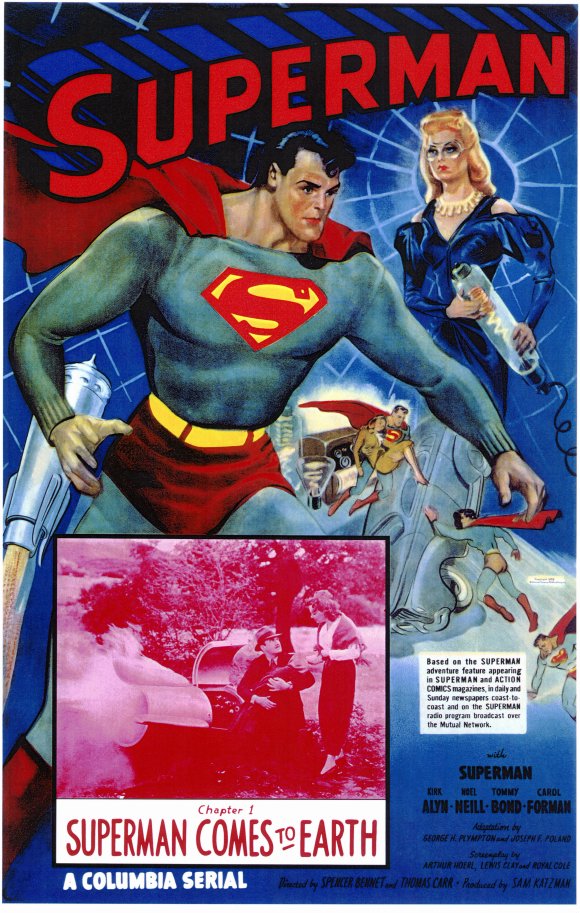 Directors: Spencer Gordon Bennett & Thomas Carr
Writers: George H. Plympton, Joseph F. Poland, Arthur Hoerl, Lewis Clay, Royal K. Cole
Cast: Kirk Alyn, Noel Neill, Tommy Bond, Carol Forman, George Meeker, Jack Ingram, Pierre Watkin, Terry Frost, Charles King, Charles Quigley, Herbert Rawlingson, Forrest Taylor, Stephen Carr, Rusty Wescoatt, Robert Barron, Virginia Carroll, Ed Cassidy, Mason Alan Dinehart, Nelson Leigh, Luana Walters
Plot: On the distant planet Krypton, scientist Jor-El (Nelson Leigh) has discovered his world is being drawn towards its sun. He and his wife, Lara (Luana Walters) prepare an experimental spacecraft that would allow his people to escape the world’s destruction, but only has time to complete a prototype before the cataclysm begins. Unable to rescue the people of Krypton, Jor-El places his infant son Kal-El into the ship and sends him away just before their world is destroyed. Landing on the planet Earth, the infant is found by Eben and Martha Kent (Ed Cassidy and Virginia Carroll), who adopt the child and raise him as their own. As he grows up, young Clark Kent (played by Ralph Hodges as a teenager, then Kirk Alyn as an adult) discovers he has the power to fly, incredible strength, super-hearing, and a sort of “X-Ray vision.” When he reaches adulthood, Eben implores his son to use his power for good. Martha makes a special indestructible uniform from the blankets he was wrapped in on his way to Earth, and Clark goes out into the world.
Wearing his costume and using the name “Superman,” Clark saves a train, whose passengers include Daily Planet reporter Lois Lane (Noel Neill) and cub reporter Jimmy Olsen (Tommy Bond), from derailing on a broken track. Clark later approaches Planet editor Perry White (Pierre Watkin) for a job, as working at a newspaper will allow him to stay up-to-date on potential danger that needs Superman’s intervention. Although reluctant to hire the neophyte, Perry gives Clark a chance when he claims to be able to get inside a collapsed mine to get the story. Naturally, Lois is after the same story, and gets trapped inside. As this is a movie serial, this begins a series of disasters roughly every 15 to 20 minutes, which require Superman’s intervention.
Clark gets the mine story and the job at the Planet, and both his career and Superman’s begin. The Man of Steel is soon considered a national hero, and is summoned to Washington D.C. to help guard an experimental “Reducer Ray” developed by the government. A mysterious villainess called the Spider Lady (Carol Forman) plans to turn the technology for evil. A meteor shower later brings chunks of the destroyed planet Krypton to Earth, and Clark discovers exposure to the radioactive rocks saps his power and, with prolonged exposure, could kill him, or at the very least, make it harder for him to wrap this plot up in about seven seconds.
Over the course of the serial’s 15 episodes, Spider Lady tries time and again to trap or kill Superman, often with Lois and/or Jimmy (and even Perry White, on rare occasions) getting caught up in the schemes, but he always manages to pull through. In the final segments, the Spider Lady gets on the radio to announce she’s perfected the Reducer Ray and will use it to destroy the Daily Planet building in nearly four hours. Rather than… y’know… evacuate the building, the police ask them to keep quiet and everyone carries on with business as usual. Lois and Jimmy get a tip that the ignition systems of cars are oddly breaking down, and reason that the Ray may be responsible, so they decide to fly a plane into the area. Suddenly, and with no warning (except for the fact that cars are oddly breaking down), their plane breaks down, crashes, and they’re captured again by the Spider-Lady. Superman fakes a Kryptonite reaction to trick one of the Spider Lady’s henchmen to bring him to her hideout. He finally faces the villain, who stumbles into her own device and is killed, proving once again that criminals really need to build their hideouts according to OSHA requirements. Returning to the Planet office, Lois and Jimmy find Clark “asleep” at his desk, wake him, and they all have a good laugh over a woman’s brutal death.
Thoughts: It saddens me how Kirk Alyn has been forgotten by so many Superman fans. The first live-action Superman may not have made the mark on history that some of the others did, but by virtue of being first, he deserves at least some respect. It especially saddens me because Alyn is really good in the role. His Clark Kent has a sweet earnestness about him, and his Superman brings just the power the role demands. Alyn seems to take his inspiration from the Max Fleischer-directed animated features from the early 40s, almost perfectly replicating voice actor Bud Collyer’s change in tenor from Clark Kent’s high-pitched “This looks like a job…” then plunging into a powerful baritone with “…for Superman!”Alyn’s performance is almost Collyer’s brought to life. These days, Warner Bros seems intent on keeping every incarnation of the character as different from the others as possible. In 1948 the producers of this film drew on the Collyer’s well-known voice from the shorts and from the radio. The story is even credited as being “adapted from” the popular radio program. Synergy may not have been a corporate buzzword yet, but it was there.
Noel Neill was a prototypical Lois Lane, with a wardrobe and hairstyle lifted directly from the comics of the time, and a nice, biting sort of sarcasm that set her eternally apart from the wallflower females that surrounded the typical action hero of the era. Neill’s Lois is smart, confident, and fearless, perfectly willing to stumble into the most dangerous situations in pursuit of her story. At times, this can make her seem reckless or foolhardy, bumbling into the most obvious kind of trap, such as at the end of the series where she has Jimmy fly a plane into an area specifically because car engines are malfunctioning there, never stopping to think that a plane engine isn’t that different a device. There’s a delicate line that has to be walked here – Lois can seem single-minded and even unconcerned with danger, but the minute she looks foolish the character loses everything that makes her work and turns her into the caricature she often becomes in the hands of lesser writers or actresses. Neill usually walks that line very well, rarely straying too far into the territory that makes Lois look bad.
This movie serial wraps itself in the trappings of the comic book of the era, including using scenes from the comic to introduce each chapter. The opening chapter on Krypton also feels like a classic sci-fi film – the “distant planet” of “superior aliens” that’s clearly a bunch of guys in robes standing on a set that looks like it was drawn up by the artist of the Buck Rogers comic strip. It’s a little silly, a little cheesy, but all the more charming for that.
Even more charming are the special effects, most of which are animated sequences overlaid on the live-action. The first time we see Superman fly, Alyn literally transforms into a cartoon and zooms into a burning building. It was at that point I pretty much fell in love with this film. There’s really no attempt at anything resembling real physics, either. The “Reducer Ray” is powered by the natural reducing rays that bombard Earth all the time (look out your window, you’ll probably see them), and at one point Superman sees through somebody’s disguise by using his X-Ray Vision on a photograph of that person, which is somehow both ludicrous and awesome.
It’s interesting how much of a slow burn was permissible back then. The first two chapters of the serial are concerned entirely with Superman’s origins from outer space and establishing himself in Metropolis, both as a hero and as a reporter. There isn’t even a hint of the serial’s main plot – the battle with Spider Lady over the Reducer Ray – until chapter three. These days there’d be a compulsion to work such a thing in artificially, much earlier, possibly even trying to tie it in to the hero’s origin, all supposedly in the name of creating a more “sophisticated” story. If nothing else, this serial is evidence that sometimes a lack of sophistication can be a glorious thing.
As is often the case with these older movies, the modern part of the brain feels the need to invoke certain tropes and gimmicks that hadn’t quite been developed yet. In the Chapter 3 cliffhanger, for example, a scientist shows Clark Kent a meteor he has discovered, and Clark collapses, nearly dead. When Chapter 4 begins and Clark lies there, you want to shout at the screen: “It’s Kryptonite, you idiot! Close the box!” But this is 1948 – Superman as a character is only ten years old, and Kryptonite is an even newer invention (first created for the radio show before migrating to the comic books). Being so young, though, the film is also able to avoid certain bits that would become common shtick later on. In later adaptations, if Clark is threatened by Kryptonite when he’s not in his Superman suit he’d come up with some sort of lame excuse to explain why the meteor seemed to affect a mild-mannered reporter. In 1948? What the hell, he’s a scientist, right? Why not reveal your secret identity? If you can’t trust a professor, who can you trust?
For all the charm, this isn’t a movie that has a particularly high opinion of its audience. The voiceover narration can sometimes be rather intrusive… it’s hamfisted in the early chapters, giving us virtually every beat of the plot, especially on Krypton. Once we get to Earth and the story begins in earnest, a little recap at the beginning of each chapter is to be expected. But is it really necessary for the narrator to announce every time Superman uses his super-hearing or X-Ray vision, as if the fact that the wall of the safe just vanished before our eyes won’t be enough to clue us in as to what’s happening? Even the death of his foster parents is done away with quickly in a voiceover – Martha gives him his uniform and we cut to him leaving the house with a suitcase as the narrator helpfully tells us, “Okay, the Kents are dead now.”
Alyn would play Superman once more in the 1950 serial Atom Man Vs. Superman, but then was replaced by George Reeves, who went on to play Superman in the Adventures of Superman TV show and wound up pretty much defining the character for over 20 years. We’re going to spend some time tomorrow with Reeves in his one cinematic appearance as the Man of Steel in Superman and the Mole-Men.
The first Reel to Reel study, Mutants, Monsters and Madmen, is now available as a $2.99 eBook in the Amazon Kindle store and Smashwords.com bookstore. And you can find links to all of my novels, collections, and short stories, in their assorted print, eBook and audio forms, at the Now Available page!
2 in 1 Showcase At the Movies Episode #35: Man of Steel
 Later this week, I’m going to give you guys a much more analytical discussion of the newest Superman movie, Man of Steel. But for this week’s podcast, my crew and I recorded our immediate gut reactions literally minutes after we left the movie theater. If you want to listen to some old-school fanboys get geeky over Superman, this is the podcast to listen to. We DO tell you when to stop listening before we get into spoilers, but spoilers ABOUND. Don’t listen if you haven’t seen the movie don’t want to know how it ends.
Get ready for the Man of Steel…
It is absolutely no surprise or secret that the movie I’m the most excited for this year is finally hitting theaters this Friday. Lifelong comic book fan, and more importantly, Superman fan that I am, Man of Steel couldn’t possibly get here soon enough to suit me. I’m on a mini-vacation with my fiance, Erin, right now, but once I’m home with my DVD shelf I fully intend to immerse myself in the Superman films of the past. Chances are you’re aware of the four Christopher Reeve movies, the one Brandon Routh movie… you no doubt know about the Fleischer Studios shorts of the early 40s, the assorted TV shows starring George Reeves, Dean Cain, and Tom Welling. You may even know about the Helen Slater Supergirl movie, and you no doubt watched the 90s Superman: The Animated Series starring Tim Daly.
Today, I’m going to give you a quick rundown of a few Superman movies you may not know about. In 2007, Warner Brothers and DC Comics began a series of animated movies based on their superhero comics, beginning with a Superman film. Many of these are available via Netflix steaming, and all of them are being flooded back into stores this week, with the big Man of Steel push. Here are those DCU Animated Superman movies you may not have seen…
 Superman/Doomsday (2007). The first film in the series was based on the early 90s Death of Superman storyline from the comic books, although it is a very trimmed-down version. In this version, Metropolis is attacked by a rampaging beast that comes to be known as Doomsday, a mindless killing machine that threatens to destroy his city. Superman faces down the beast, seemingly at the cost of his own life, but both friend and foe alike are unwilling to accept that his death is that simple. The film wasn’t bad — Adam Baldwin made for a good Superman and James Marsters was a great Lex Luthor. Anne Heche’s Lois Lane was weak, though, and I think they trimmed a bit too much to allow the story to fit in the extremely abbreviated running time of the animated series. Still, this was the DC Animated Universe’s first shot, and the series got better very quickly.
 Superman/Batman: Public Enemies (2009). This movie reunited the TV voices of Superman and Batman, Tim Daly and Kevin Conroy, for the first of two films based on a comic book series by Jeph Loeb. In Public Enemies Lex Luthor (also voiced by his TV actor, Clancy Brown), has been elected president of the United States, and uses that influence to draw together a group of heroes under the government payroll. Luthor uses the threat of an impending strike of a massive meteor of Kryptonite to turn the public against Superman and he and Batman go on the run, fighting their fellow heroes in an attempt to clear their names and reveal Luthor as the villain he is. This is a really great flick, one that plays not just with Superman, but with the larger DC Universe, with lots of heroes and villains that casual fans may be introduced to for the first time.
 Superman/Batman: Apocalypse (2010). The sequel to Public Enemies again reunites Daly and Conroy. The shower of Kryptonite meteors in the first movie brought with it a large chunk with some mysterious technology inside. Batman investigates the chunk to discover a girl in suspended animation — Kara Zor-El (Summer Glau), daughter of Superman’s uncle, and the first blood family he has seen since coming to Earth as an infant. The heroes take Kara to Wonder Woman (Susan Eisenberg) to teach her how to use her powers and help her adapt to life on Earth, but she soon becomes embroiled in a battle between the heroes and the powerful villain Darkseid (Andre Braugher). I rather like this movie even more than Public Enemies, adding Supergirl to the mix and bringing in the most dangerous foe Superman has ever faced.
 All-Star Superman (2011). Based on a graphic novel by Grant Morrison and Frank Quitely, in All-Star, Superman (James Denton) receives a fatal overdose of solar radiation while thwarting one of Lex Luthor’s (Anthony LaPaglia) schemes. The radiation is killing him slowly, and giving him additional powers in the process. With his time limited, Superman embarks on a quest to make permanent, lasting changes to the world, leaving it better before his death. This film is based on one of the greatest Superman comics of all time and, sadly, came out just days after the death of its screenwriter, Justice League Unlimited showrunner Dwayne McDuffie. If you can only watch one of the movies on this list, or if you don’t understand what makes Superman a brilliant and compelling character, this is the movie to watch.
 Superman Vs. the Elite (2012). George Newburn, who voiced Superman on the Justice League cartoons, returns to the character in this film based on a comic book by Joe Kelly. Manchester Black (Robin Atkin Downes) is a new superhero, one whose team the Elite initially appears like a welcome addition in the war on crime. Superman soon realizes, however, that Manchester and the Elite have much more violent and permanent solutions to villainy than he is comfortable with. As the people of Earth start to gravitate towards the Elite and question whether Superman is outdated, the man of steel is forced to confront questions of his own relevance. Like All-Star, this is a brilliant story made into a very good movie. This film is the answer to everyone who ever says that Superman is “too old fashioned,” “too good,” or just plain “boring.” This is a story that explains the importance of Superman, and why he has to be who he is… because the alternative is chilling.
 Superman Unbound (2013). The most recent film on this list came out just last month. based on a graphic novel by Geoff Johns and Gary Frank, Matt Bomer takes on the role of Superman in this film. Brainiac, a highly-intelligent alien that menaced Krypton in the past, has come to Earth, terrifying Supergirl (Molly Quinn), who remembers the villain from Krypton. Brainiac travels through the universe, miniaturizing and stealing cities from different planets before destroying them, and Metropolis is his next target. The graphic novel this movie is based on is great, the movie is just okay. Like some of the earlier films on the list, it suffers a little from having to strip away a bit too much from the original story to fit in the short animated running time. For the Superman fan, though, it’s still worth watching.
 Reel to Reel