Category Archives: Comedy
Scrooge Month Day 6: Scrooge McDuck in MICKEY’S CHRISTMAS CAROL (1983)
 Director: Burny Mattinson
Writers: Burny Mattinson, Tony Marino, Ed Gombert, Don Griffith, Alan Young, Alan Dinehart, based on the novel A Christmas Carol by Charles Dickens
Cast: Alan Young, Wayne Allwine, Hal Smith, Will Ryan, Eddie Carroll, Patricia Parris, Dick Billingsley, Clarence Nash
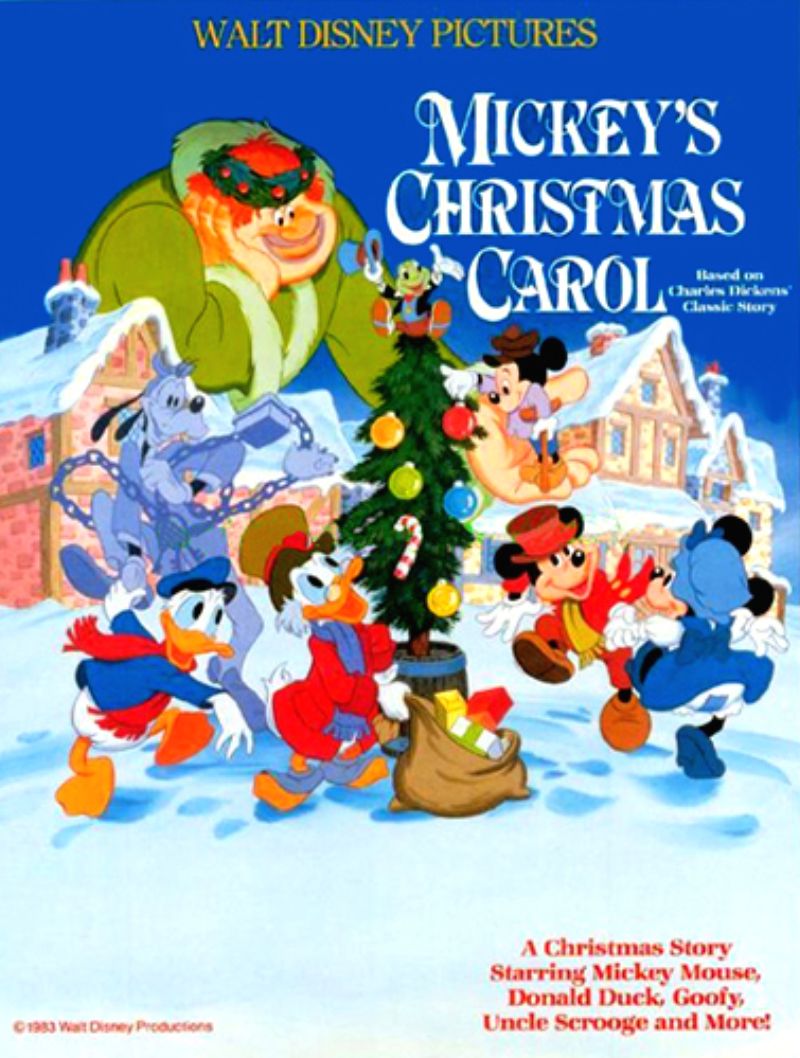
Notes: Paired with a re-release of the 1977 film The Rescuers, Mickey’s Christmas Carol is significant in the annals of Disney animation for several reasons. It was the first theatrical short starring Mickey Mouse in 30 years; it was the final time Donald Duck’s original voice actor, Clarence Nash, would voice the character; and it was the first time Alan Young would voice Donald’s Uncle Scrooge, a role he has continued with through the classic DuckTales TV show and every other depiction of the character right through the present day. Despite its short length, the film is remarkably faithful to the Dickens novel, keeping most of the important scenes and characters, although racing through them in the 26-minute running time. The Disney characters who take part in this adaptation include Scrooge McDuck (Young) as Ebenezer Scrooge, Mickey Mouse (Wayne Allwine) as Bob Cratchit, Donald Duck (Nash) as Scrooge’s nephew Fred, Goofy (Hal Smith) as Jacob Marley, Jiminy Cricket (Eddie Carroll) as the Ghost of Christmas Past, Willie the Giant (Will Ryan) as the Ghost of Christmas Present, and Black Pete (Ryan again) as one of the few versions of Christmas Yet to Come to actually have lines. Other minor characters and background extras come from various Disney shorts and films starring animals, particularly The Wind in the Willows and Robin Hood, which you may remember I talked about here once before.
Thoughts: This is the shortest version of A Christmas Carol I’ve talked about yet, and is probably the shortest I’ll discuss all month, but it’s also one of my favorites. Part of that can no doubt be chalked up to nostalgia – I was six years old when this cartoon was released, and I think I saw it in the theater, but I honestly can’t say for sure. Regardless, I am sure this was the first version of the story I remember in any detail, and as such it holds a special place in my heart. That said, it’s worth talking about even without the nostalgia factor because – again, despite its short running time – it’s really good.
First of all: Alan Young. I’m not sure how many people are aware that Uncle Scrooge has the voice of Wilbur from TV’s Mr. Ed, and I’m not sure how many would care if they did, because his work with this character is by far a more enduring legacy. Scrooge McDuck is a character who has to be firm and grumpy, but with a good heart at the core. In truth, from the outset he was a (slightly) milder version of the Dickens character Carl Barks named him after. Young’s voice performance is flawless.
The “casting” all around is good. Mickey Mouse – so long portrayed as a sweet, well-meaning everyman — is the natural choice for Bob Cratchit. Jiminy Cricket is Pinocchio’s conscience, and as such is the logical choice for Christmas Past. Willie and Pete, both nominal “villains” in their usual Disney performances, fit their roles well, with the man-child Willie making an even larger version of Christmas Present than we usually see and Pete taking real delight in his nasty work. The only one that doesn’t really seem to fit is Goofy as Jacob Marley – a character full of regret. Even if Goofy had anything to regret (he doesn’t – the character is far too innocent for that), he’s not self-aware enough to realize it. I imagine he was given the part simply because they felt the need to get all of Disney’s top three characters into the cartoon somewhere and they just couldn’t think of any other way to include him.
The only major character omitted from this version of the story is Scrooge’s sister, Fan. Considering it was billed as a Mickey Mouse cartoon, that’s understandable – kids may be able to accept ghosts and hellfire and redemption, but I doubt any parent wanted to have a discussion with their children about the potential of a mother dying in childbirth. Besides, there’s a long precedent in Disney cartoons of obvious orphans whose parents are never referenced (Donald and Mickey’s nephews and Donald himself being the prime examples).
Scrooge’s reformation is a bit more subtle in this film, although we do see the stages. After Christmas Past shows Scrooge the scene where he breaks the heart of Isabelle (Donald’s girlfriend Daisy, which must have been kind of awkward on the set), Scrooge berates himself for being foolish. A few seconds later, though, as Christmas Present preaches generosity, Scrooge stubbornly argues that he has no reason to be generous to others, as no one has ever shown such kindness to him. In response, we go to the Cratchit house, where Tiny Tim himself encourages his family to thank Mr. Scrooge. That’s all Scrooge gets from Christmas Present, though, as he’s left standing between a pair of giant footprints before a cloud of cigar smoke whisks him to the cemetery. He’s scared now, and you can feel it, but instead of asking about himself, he inquires as to Tim’s welfare. It’s a good moment, and it’s heartbreaking a moment later when we see Mickey Mouse, in tears, laying a crutch on a tombstone. If that isn’t enough to give kids watching permanent scarring, Christmas Future whips off his hood, lights a match on Scrooge’s tombstone, and kicks him into the open grave, where fire being blazing from the coffin and reaches for Scrooge just before he’s whisked home for the joyful finale.
It is still a Disney cartoon, and as such has to work in some comedy amidst the dark subject matter. The balance is good, and never at the expense of character, whether we’re looking at a verbal gag, a bit of ironic wording, or a quick sight gag. The moment where Scrooge tells Fred he’s coming to Christmas dinner after all, Fred and the horse look each other in the eye and Nash gives the line reading of his career: a simple “Well I’ll be doggone” that never fails to get a laugh out of me.
I do so love this cartoon, and not just because I got to watch it and write the whole article in less than a half-hour. It’s a wonderful rendition of Dickens’s story, even in its condensed form, and it just came out on a 30th anniversary edition Blu-Ray and DVD, along with several other classic Disney Christmas shorts, and one brand new one. If you don’t already own it, get it now.
The first Reel to Reel study, Mutants, Monsters and Madmen, is now available as a $2.99 eBook in the Amazon Kindle store and Smashwords.com bookstore. And you can find links to all of my novels, collections, and short stories, in their assorted print, eBook and audio forms, at the Now Available page!
Scrooge Month Day 4: Quincy Magoo in MR. MAGOO’S CHRISTMAS CAROL (1962)
 Director: Abe Levitow
Writer: Barbara Chain, based on A Christmas Carol by Charles Dickens
Cast: Jim Backus, Morey Amsterdam, Jack Cassidy, Royal Dano, Paul Frees, Joan Gardener, John Hart, Jane Kean, Marie Matthews, Laura Olsher, Les Tremayne
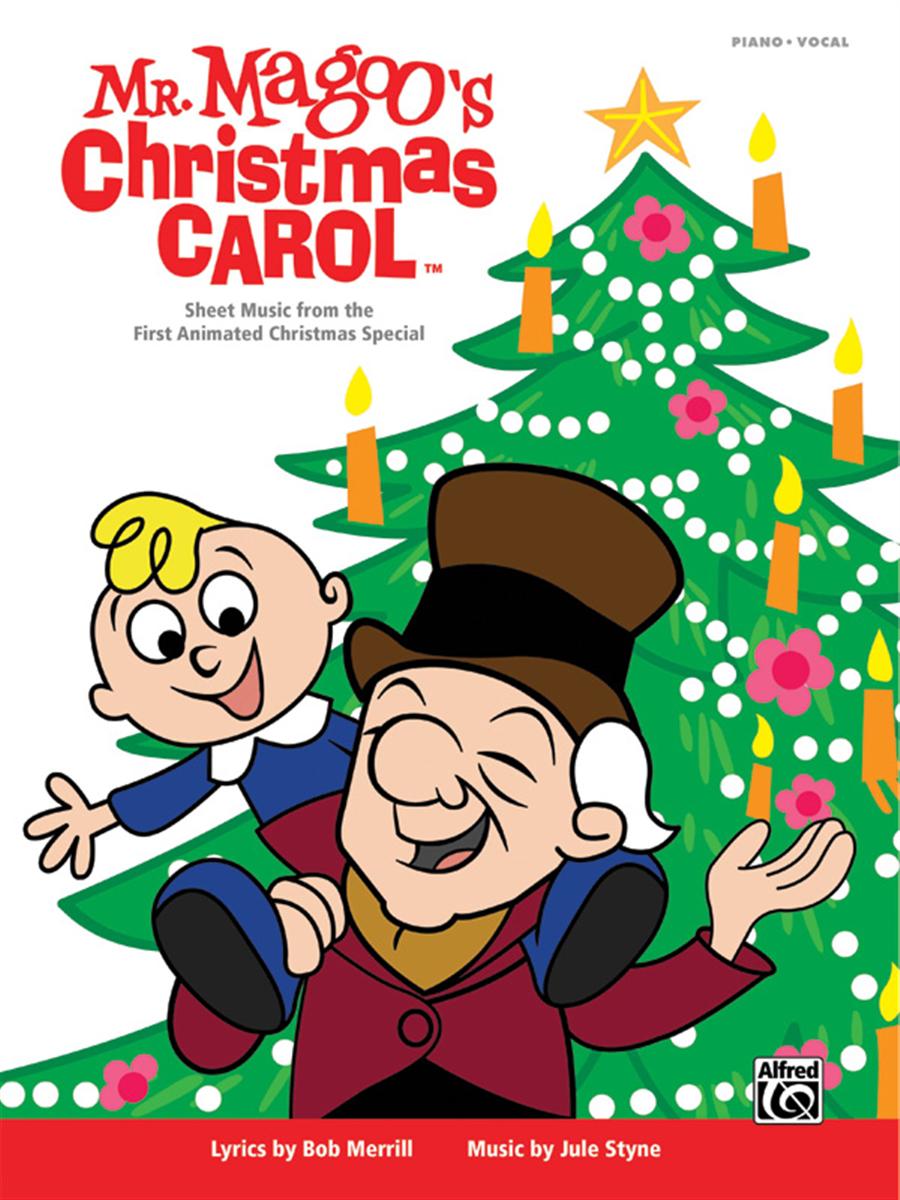
Note: Mr. Magoo’s Christmas Carol is credited as being the first ever animated Christmas special, beating Rudolph the Red-Nosed Reindeer by two years. The special brought back Quincy Magoo, star of a series of theatrical shorts from the 40s and 50s, and led him into his own television series in 1964. In the framing device we learn that we’re actually watching a musical Broadway production of A Christmas Carol, one that evidently drops all references to Scrooge’s family, switches the order of Christmas Past and Christmas Present for some reason, and makes occasional references to Scrooge’s (Magoo’s) poor eyesight.
Thoughts: After three days of extremely traditional renditions of A Christmas Carol, I’m glad to be able to dip my toes into this less serious version. The opening scene, where Magoo – voiced, as always, by Jim Backus — sings about how happy he is to be returning to Broadway, sets the stage well. It’s silly, the music is catchy, and it lets you know that you’re watching a play-within-a-TV special (a conceit the Flintstones would borrow 30 years later).
Once that opening scene is done away with, though, we go into a version of the Dickens classic that is clearly adapted, but still very recognizable. There aren’t a bunch of side jokes about the theatrical production, just a few “act breaks” where we see the curtain closing. There’s no attempt to explain the translucent Marley (voiced by Royal Dano) or how such a thing would be accomplished on a live stage, to say nothing of the times when the time-traveling Scrooge appears on stage with his younger self, both of them clearly played by Magoo. The gags about Magoo’s lousy vision, a staple of most of his cartoons, are reduced to a minimum. And although much of the book is dismissed in the name of expediency, the stuff that remains is often verbatim Dickens, albeit performed by the cast of the cartoon. Backus isn’t really playing Scrooge here, he’s playing Mr. Magoo as Mr. Magoo, reading the lines of Ebenezer Scrooge, but not making a huge effort to portray a different character than he usually does in the animated series.
The decision to jump straight to Christmas Present (Les Tremayne) is baffling. Why in the world would you do the present before the past? It doesn’t particularly hurt the abbreviated version of the story, but it doesn’t help it either. The design of the character is slightly problematic as well – a red robe and long, white whiskers. No doubt most small children who watch this would confuse the character with Santa Claus. This may be deliberate, I suppose – with his compassion for Tiny Tim and the rest of the downtrodden impacted by Scrooge, Christmas Present is certainly the most Santa-like of the Spirits. Still, he’s not Santa Claus, and it doesn’t serve the special to pretend he is.
Christmas Past looks a bit better, more of the “living candle” depiction of the character that we’ve seen in some of the other renditions of the story. Of the three ghosts, Past is the one that has the most variance in his/her/its different incarnations in the media, with Dickens having a pretty vague description in the first place. That said, I find it interesting that a few versions have become common – the Candle and the Angel in particular.
This is going to sound strange, but the highlight of the special to me is actually the musical number that accompanies the Ghost of Christmas Yet to Come segment. In many versions of the story, we see a gathering of people gloating over selling the deceased Scrooge’s possessions (the fact that the deceased in question is Scrooge is usually obvious to the audience, but Scrooge himself refuses to admit it yet). In this version, we get a snappy, creepy little song that feels like it should be in a Halloween special. And yes, I love that. Ghost stories, as you may know, used to be more traditionally associated with Christmas than Halloween; the reversal really only happened in the 20th century. I’m old school in this way. I love the juxtaposition of the frightening ghost story with the joy of Christmas as a way to really hammer home the lesson that Scrooge needs to learn. Dickens did it right, and the makers of this special did him right in this department.
This is a first in many ways – the first animated Christmas special, the first time we saw another fictional character “play” Scrooge, and as such it deserves a proud place in the annals of Christmas TV. And it’s a good special, don’t get me wrong. But it’s not even close to my favorite.
The first Reel to Reel study, Mutants, Monsters and Madmen, is now available as a $2.99 eBook in the Amazon Kindle store and Smashwords.com bookstore. And you can find links to all of my novels, collections, and short stories, in their assorted print, eBook and audio forms, at the Now Available page!
Robin Hood Week Day 5: Cary Elwes in Robin Hood-Men in Tights (1993)
 Director: Mel Brooks
Writers: J.D. Shapiro, Evan Chandler, Mel Brooks
Cast: Cary Elwes, Richard Lewis, Roger Rees, Amy Yasbeck, Mark Blankfield, Dave Chappelle, Isaac Hayes, Megan Cavanagh, Eric Allan Kramer, Matthew Porretta, Tracey Ullman, Dom DeLuise, Dick Van Patten, Mel Brooks
Plot: With King Richard away in the Crusades, his brother Prince John (Richard Lewis) and the corrupt Sheriff of Rottingham (Roger Rees) have seized power in England. Really… if you guys have been reading these articles all week this should be no surprise by now. In Mel Brooks’s parody of earlier Robin Hood films (most notably the Costner and Flynn versions), we begin in Khalil Prison in Jerusalem, where Robin of Loxley (Cary Elwes) has been taken captive. He meets a Moorish prisoner named Asneeze (Isaac Hayes), imprisoned for jaywalking. Together they free the captives and Asneeze asks Robin to look after his son Ahchoo (Dave Chapelle), an exchange student, when he returns home. Robin agrees and swims from Jerusalem back to England.
Robin finds Ahchoo and rescues him from a band of the Sheriff’s men. They return to Loxley Hall to find it repossessed by the Prince’s accountant, leaving behind only Robin’s old blind servant Blinkin (Mark Bankfield). The Sheriff of Rottingham pursues a boy who killed a deer on the King’s lands, but Robin humiliates him and drives him off. In the palace, Maid Marian (Amy Yasbeck) confides to her servant Broomhilde (Megan Cavanagh) her wish that she could find her one true love: the man with the key to her “heart.” (Also her chastity belt.)
Worried about Robin’s return to England, Prince John turns to his gnarled, witchlike servant, Latrine (Tracey Ullman), who offers to brew a potion to disable Robin. In the forest, Robin meets Little John (Eric Allan Kramer) and Will Scarlett O’Hara (Matthew Porretta), battling over the right to use the bridge over a ludicrously small creek. After besting John and saving his life… sort of… Robin invites the two of them to join his band of Merry Men. Robin barges into one of the Prince’s feasts, charming Marian and antagonizing the Prince and Sheriff before battling free.
Robin’s men stop the wandering Rabbi Tuckman (Mel Brooks), who agrees to join them – along with his stores of Sacramental Wine. As the men “bless” everything in the forest, the Sheriff turns to Don Giovanni (Dom DeLuise), a lord who suggests using an archery contest to trap Robin. Overhearing the plot, Marian and Broomhilde rush to the forest to warn him, arriving just after the show-stopping “Men in Tights” musical number. Robin professes his love to Marian and promises to avoid the contest, a promise he promptly breaks.
The disguised Robin nearly loses to one of Don Giovanni’s men before checking the script for the movie and confirming that he has another shot. With his “Patriot Arrow,” he annihilates the target. He’s captured and almost killed, but Marian promises to marry the Sheriff if he allows Robin to live. Ahchoo saves Robin just before she can say “I do,” and the Prince’s men go to battle with Robin’s. The Sheriff drags Marian away hoping to consummate the marriage, only to be stymied by Marian’s Chastity Belt. Robin and the Sheriff duel, breaking open a medallion from Robin’s father and revealing the key to Marian’s belt. The Sheriff impales himself on Robin’s sword while trying to stab him from behind, and Latrine offers to save him if he’ll marry her. He agrees, and immediately regrets it. Robin and Marian plan a wedding, but are interrupted by the return of King Richard (a cameo by Patrick Stewart), who has his brother arrested and makes Robin a knight. Tuchman finishes the marriage ceremony and Robin and Marian dance away… only to find Robin’s key doesn’t turn in the lock.
Thoughts: Just as the Kevin Costner Robin Hood hit when I was 13 and looking for adventure, this version hit when I was 15 and looking for things to be cynical about. A Mel Brooks comedy was just the thing. And like the Kevin Costner version, I still like this film despite its flaws. Unlike the Costner film, though, I find the flaws in this movie a bit harder to defend.
Brooks is credited with co-writing the screenplay with the two men credited for the story, one of whom never wrote anything else and the other of whom went on to write Battlefield Earth. When you realize just how drastically this film lacks the sharp verbal wit of Brooks’s superior films, the preceding sentence makes a lot more sense. The best Brooks movies (by which I mean Blazing Saddles and Young Frankenstein) were so great because of how sharp and clever the writing and characters were. This movie doesn’t quite rise to that level, relying more on anachronistic dated references like Ahchoo’s pump sneakers and a kid parodying Macaulay Culkin’s character in Home Alone. Anachronisms in Brooks comedies isn’t new, of course, but compare the impromptu musical numbers and wild finale of Blazing Saddles with Blinkin holding a braille Playboy magazine in this movie and tell me they belong in the same conversation. Other nuggets feel like lame Mad magazine gags (Will Scarlett O’Hara – “We’re from Georgia”), or the “Wide load” sign on the back of Loxley Hall as it’s carted away.
The best bits, in fact, are the ones that harken to Errol Flynn’s The Adventures of Robin Hood, a movie a good 75 percent of this audience never saw. Robin and Little John’s battle at the creek is great – the two of them duel over the right to cross a body of water approximately ten inches wide, their fighting staffs breaking in half over and over until they’re left swatting at each others’ fingers. The battle at the feast is set up much like the fights in Flynn’s movie, with added visual gags which work infinitely better than many of the verbal jokes in the film. The archery contest, similarly, is really funny. Brooks is no stranger to breaking the fourth wall, but having every character stop to check the script to make sure Robin was entitled to another shot… I don’t really know why, but I still chuckle at that.
A great Brooks comedy always has great performances, but this is the only one I can think of where the performances actually save the weak material. Cary Elwes is really great here, only a few years after The Princess Bride and playing a broader version of the swashbuckler from that film. While he does his share of mugging for the camera, he does it with charm and wit. His famous dig at Kevin Costner (“Unlike some other Robin Hoods, I can speak with an English accent”) is the one thing everybody remembers from this movie even 20 years later, and he sells it with real panache. Had he been born sixty years earlier, I think Elwes would have gone down as one of the all time great movie heroes. As it is, he has that one great movie, this lesser movie, and Saw. Wow, it’s depressing when you think of it that way.
Amy Yasbeck isn’t a bad Marian. While not a classic beauty, she has a sweetness to her that feels like it’s been amplified for the sake of the comedy, but remains sincere at heart. Richard Lewis and Roger Rees, similarly, work well in this film. While Lewis would never fit in to a straight version of Robin Hood, he’s perfect as this sort of weasely, incompetent Prince John. Roger Rees, probably best known for his recurring role in Cheers, is the perfect smarmy right-hand man. He’s the enforcer, with a little bit of muscle to back up the Prince’s gutless orders. At the same time, though, he’s a bumbler himself, constantly tripping over his words and never exuding any real menace.
This isn’t the best Robin Hood movie, I concede. And it’s certainly not Brooks’s best movie. But if there’s one thing I think we can all agree on, it’s this: at least it’s not Dracula: Dead and Loving It.
The first Reel to Reel study, Mutants, Monsters and Madmen, is now available as a $2.99 eBook in the Amazon Kindle store and Smashwords.com bookstore. And you can find links to all of my novels, collections, and short stories, in their assorted print, eBook and audio forms, at the Now Available page!
Fun with Riffing
 Once upon a time, there was a thing called the “Cable Ace Awards.” It was basically the Emmys for cable TV. They stopped giving them out about the same time HBO started winning all of the real Emmys, at which point they realized there was no longer any reason for the Ace Awards to exist, showing the sort of self-awareness the MPAA can only dream of. As far as I’m concerned, there’s only one lasting contribution the Ace Awards made to modern society: they’re responsible for my introduction to Mystery Science Theater 3000. One year, whichever network was broadcasting the awards showed a bunch of the nominated shows over a weekend, including an episode of MST3K. As my parents’ cable provider did not, at that time, carry Comedy Central, I’d never seen an episode before. I stumbled upon the image of a guy and two robots in a darkened theater cracking jokes about a terrible 50s-era monster movie, the sort that local TV channels still showed all weekend even then. I was instantly mesmerized, but it would be about two years before our local cable got Comedy Central and I was given my real entryway into becoming a hardcore MSTie for life.
MST3K went away many years ago, of course, but it has its spiritual successors, my favorite of which is RiffTrax. The RiffTrax crew consists of Michael J. Nelson, Bill Corbett, and Kevin Murphy – essentially the second cast of MST3K. They’re doing the same job as before, making fun of movies, but now they do it through video on demand you can download from their website or buy on DVD, MP3 commentary riffs for blockbuster movies that you can synch and watch on your own, and a few times a year, live riffs of movies they perform in front of an audience and broadcast to movie theaters across America. Last night, I went to the first RiffTrax Live event I’ve had the chance to attend – a Kickstarter-fueled riffing of director Paul Verhoven’s laughably bad sci-fi “satire” Starship Troopers. The riff was great, picking apart the movie mercilessly. Even several cast members, including Casper Van Dien, Clancy Brown, Jake Busey, and Neil Patrick Harris (who has joined Mike Nelson for riffs in the past) spread the word about the riffing, none of which particularly spared them from the crew’s jokes… although it should be noted that Denise Richards undoubtedly got the worst of their jabs, and she didn’t seem to have anything to do with promoting the riffing.
I’m not here to sell you on the riff, though – you can go to their website and download any of their riffs if you need convincing. What I loved about this, more than anything else, was the actual experience of watching the film. I went with my friends Kenny, Daniel and Lauren, all of whom have gone to RiffTrax Live shows before, and therefore knew a bit more about what to expect than I did. As we sat down, the screen rolled with what appeared to be the usual pre-movie spiel you get in any multiplex in America… but soon, the resounding laughter would make it clear even to the blind that this wasn’t just your ordinary stuff. Instead, it was RiffTrax-generated jokes. Anagrams that poked fun at recent summer blockbusters, “Movie Mistakes” gags that invariably turned into jokes about Casper Van Dien’s post-Troopers career, and so on. With each change of the scene there’d be quiet, then laughter.
In-between the new screens, though, the atmosphere was nothing like a usual movie theater, where disinterested strangers sit around chomping down their popcorn at best or yammering on their phone at worst. Instead, it was a sort of carnival atmosphere, full of people who came not just to watch a movie, but to have a good time. People roamed around, talking, chatting to strangers. There was a sort of unspoken promise that the general volume level would drop to read the preshow cards (even though there was no technical reason for it to do so), and a bizarre feeling of community. It was like everybody in the room was in on a joke that we knew the people wandering in and out of whatever Tyler Perry joint was soiling the adjacent theater would never understand.
Once the movie started, the conversation stopped, but not the noise. People laughed, people cheered, people applauded their favorite riffs. I don’t usually clap even in the best of movies, because it’s not like the actors can hear me. But when Mike Nelson dropped a fairly obvious gag at the expense of AT&T, it hit a sort of universal chord that made the theater almost explode with energy, and I found myself pounding my hands together along with everybody else.
Because I wasn’t just “at the movies,” like I am any other time, even when the best movies are on the screen. Years ago, the MST3K commercials included a line that was something like, “It’s like watching cheesy movies with three of your funniest friends.” Last night, I felt like I was in an entire theater full of friends who wanted to have a good time together.
They’re going to rebroadcast the Starship Troopers show on September 12, again in theaters across America. Then they’re coming back on October 24 to riff the granddaddy of the modern zombie film, Night of the Living Dead. I can’t wait to see that one too, and I intend to go to as many of these as I can from now on. In a world where even movie theaters are so often dens of misery, it’s great to know that for just a little while, you can stop in for some pure, untarnished fun.
2 in 1 Showcase at the Movies: Monster-Sized Double Feature
 For those of you who listen to the podcasts, I reviewed a pair of movies in this week’s episode of my show. If you feel like listening to me ramble a bit about Pacific Rim and Monsters University, here’s a link!
(If you dig comic books, I also briefly talk about the new issues of Astro City and Quantum and Woody.)
2 in 1 Showcase At the Movies #36: Monster-Sized Double Feature
Gut Reaction: Dark and Stormy Night (2009)
 Director: Larry Blamire
Writer: Larry Blamire
Cast: Jim Beaver, Jennifer Blaire, Larry Blamire, Bob Burns, Dan Conroy, Robert Deveau, Bruce French, Betty Garrett, Trish Geiger, Brian Howe, Marvin Kaplan, James Karen, Alison Martin, Fay Masterson, Susan McConnell, Andrew Parks, Kevin Quinn, Mark Redfield, Tom Reese, Daniel Roebuck, Christine Romeo, H.M. Wynant
Plot: After the demise of millionaire Sinas Cavinder, an eccentric group of friends, family, rivals, employees, reporters, total strangers, and a dude in a gorilla costume gather for the reading of his will. When the lawyer is murdered in the midst of the reading, the gathered survivors have to solve the crime, or any one of them could be next.
Thoughts: Have you ever gotten a disc from NetFlix with no memory of the movie or any idea why you put it in your queue, let alone how it got close enough to the front to actually make it to your mailbox? When that happens, you pop the disc in just so it doesn’t feel like a waste before you send it back, usually disappointing you in the process. But every so often, you get a movie that delights you so much you wish you could go back in time, figure out who clued you in on the film in the first place, and thank them.
Larry Blamire’s micro-budget motion picture Dark and Stormy Night is exactly this kind of movie. This black-and-white buffet of assorted cheeses is a loving tribute and send-up of old-fashioned murder mysteries, mixing together parts of Agatha Christie, Raymond Chandler, Dashiell Hammett and Clue with the sort of killers and freaks that made for the richest mocking in the glory days of Mystery Science Theater 3000. Every actor, without exception, delivers their lines with an excess of camp and self-awareness, gleefully hamming up preposterous dialogue and overreacting to the most simple of situations. It’s as if somebody is deliberately putting on the most melodramatic dinner theater production ever made, and that’s what makes it glorious.
The show-stealers here are Daniel Roebuck and Jennifer Blair as competing reporters 8 O’Clock Farraday and Billy Tuesday, respectively. The two of them bounce off each other with energy and vigor, chewing through Python-esque logical leaps that eat up one noir cliché after another. Dan Conroy is funny as hell as hapless cab driver Happy Codburn, who only got drawn into the whole mess because Farraday stiffed him out of 35 cents. Jim Beaver’s Jack Tugdon brings in a sort of faux intensity to the proceedings, pulling in a taste of The Most Dangerous Game with his humorless (and, by result, hysterical) delivery of such lines as “I went to bed… once.”
Blamire drops in plenty of tired clichés and runs with them – Alison Martin as the terrible psychic Mrs. Cupcupboard, who has the audacity to announce “I sense death” while standing over a fresh corpse. The staff includes a butler (Bruce French) who seems to have some skeletons in his closet and a chef (Robert Deveau) who wields his meat cleaver in a particularly disturbing way, spouting out lines that feel like Norman Bates talking to Mother. Blamire even gets into the act himself, playing a stranger whose “car broke down” outside, then immediately asks if he can stay for the reading of the will, which nobody has mentioned to him yet.
As funny as the performances are, it’s Blamire’s script that makes this work. His lines go from painful puns to razor-sharp wordplay without missing a beat, and he takes great joy in using every cliché you can imagine for this sort of “trapped in the mansion” mystery, then deconstructing the hell out of it. I admit I was a little shaky about the film for the first few minutes, when we saw an obvious model car driving up to an obvious model mansion. But when the lights go off and the guests all panic until the frustrated maid (Trish Geiger) turns the switch back on and shows her exasperation when the idiotic guests behave as if she’s performed some sort of miracle, I found myself buying in entirely.
Most importantly, you really get the sense that the cast is having fun. None of them are making a fortune performing in a film released by the Shout! Factory, but all of them take what they’re given and run with it. Half the time when you go to the movies these days you get a film with a blockbuster budget and a bunch of actors walking through their parts, taking the paycheck, clearly having no passion for what they’re doing. Dark and Stormy Night is the opposite of that in every way, and it’s glorious because of it.
Looking up info about this movie for the sake of this review, I notice that Blamire has two other films with most of this same cast, The Lost Skeleton of Cadavra and The Lost Skeleton Returns Again. Both of those are going to the front of my NetFlix queue right away. And this time, I’ll remember how they got there.
The first Reel to Reel study, Mutants, Monsters and Madmen, is now available as a $2.99 eBook in the Amazon Kindle store and Smashwords.com bookstore. And you can find links to all of my novels, collections, and short stories, in their assorted print, eBook and audio forms, at the Now Available page!
Sherlock Holmes Week Day 3: Robert Stephens in The Private Life of Sherlock Holmes (1970)
 Director: Billy Wilder
Writer: I.A.L. Diamond and Billy Wilder, based on the characters created by Sir Arthur Conan Doyle
Cast: Robert Stephens, Colin Blakely, Genevieve Page, Christopher Lee, Tamara Toumanova, Clive Revill, Irene Handl, Mollie Maureen, Stanley Holloway
Plot: Many years after the death of Dr. John Watson (Colin Blakely), a lockbox is opened containing previously unrevealed tales of his adventures with the great Sherlock Holmes (Robert Stephens) – tales too sensitive, or perhaps too personal, to share with the general public as he published their adventures during Holmes’s life. This film presents us with two such tales.
In the first, Holmes berates Watson for the romantic nature of his published tales – making him out to seem taller, more quirky and more capable than he really is (the last charge Watson vehemently disagrees with). What’s more, he’s growing bored – the criminal class has become too unimaginative for his tastes. Holmes is turning more and more to a cocaine solution to distract himself. Concerned, Watson convinces Holmes to accompany him to a performance of Swan Lake. Holmes is invited backstage to meet the show’s star, Madame Petrova (Tamara Toumanova), who has a proposal – she wishes to conceive a child with him, hoping to combine her physical perfection with Holmes’s flawless mind. Unwilling to participate, Holmes tries to find a delicate way out of the situation, claiming to be a hemophiliac, claiming that English men are terrible lovers… Petrova is not swayed until Holmes implies that he and Watson are more “involved” than the Doctor’s published stories reveal. Although Holmes slips from the ballerina’s grasp, Watson is enraged when he discovers the rumor. Holmes convinces Watson his reputation as a ladies’ man will protect him, but Watson is stunned when he realizes Holmes has no such protection – he has virtually no track record with women at all.
As Watson ponders his friend, a cabbie arrives with a Belgian woman named Gabrielle (Genevieve Page). Watson puts her to bed, diagnosing her with temporary amnesia, and is determined to help her. Holmes agrees, but only to get rid of her as soon as possible. The woman awakes, mistaking Holmes for her missing husband, Emil. He plays along, hoping to uncover clues. In the morning, she has regained her senses and begs the detective for help finding her husband. The investigation leads them to a message from Holmes’s brother Mycroft (Christopher Lee), who asks them to abandon their search for Gabrielle, in the name of national security. Instead, Holmes takes her to Scotland, where he believes the solution to the mystery lies.
Holmes follows the clues to a cemetery, an anonymous man found in the river is being buried. They search the coffin to find Gabrielle’s husband, Emil, while Watson makes a very different discovery – the Loch Ness Monster. On the lake they see the creature and set out to find it, instead encountering Mycroft in an experimental submarine, its periscope disguised with a monster head. Mycroft reveals that the real Gabrielle Valladon is dead and the woman they travel with is a German spy, sent to use Holmes’s keen mind to help hunt down the missing Emil and steal the submersible from the British government. Queen Victoria (Mollie Maureen) arrives to inspect the submersible. Initially impressed, when she realizes it is intended as a warship, she declares it “unsportsmanlike” and orders it destroyed.
Holmes returns to Gabrielle – really Ilsa Von Hoffmanstal, and uses her to send a signal to her German friends to lure them into a trap. Mycroft will obey the Queen’s command to destroy the ship, but takes the German spies with it. Holmes, meanwhile, arranges for Ilsa to be sent back to Germany, traded for a captured British spy, instead of being sent to jail.
Some time later, Holmes receives a letter from Mycroft with painful news – Ilsa was captured spying in Japan and executed. Holmes is struck silent for a moment before asking Watson for his cocaine for the first time in months. The great detective locks himself away, while Watson picks up his pen and begins to write.
Thoughts: This film has a rather odd pedigree. Originally conceived and shot as a 165-minute “road show” picture intended to tour the country and play special engagements, United Artists suffered a series of flops that led to them forcing Billy Wilder to cut it down to 125 minutes for a standard theatrical run. Fortunately, the series of short stories in the film made it easy to cut, but there are two whole episodes and a framing sequence that were excised completely. Some chunks have been restored on the film’s DVD release, but to date a complete original print has never been discovered.
I fear my synopsis doesn’t quite get across the tone of this movie. Although it deals with some serious ideas, such as Holmes’s cocaine addiction, the script itself is actually quite funny. An early scene during the ballet, for example, contains a perfectly-written and timed scene in which Watson relates the number of men who have committed suicide out of love for the prima ballerina. (I swear, that’s funnier than it sounds.) Watson’s delight at being left alone with a set of Russian-speaking ballerinas is also really amusing. Unlike the first two films in this project, this is a Watson I can get behind. He’s lighthearted, he’s unrelentingly male in his behavior, but he never comes across as goofy or incompetent, and that makes him my favorite Watson to date.
Robert Stephens’s Holmes isn’t quite as iconic as Basil Rathbone (who gets a bit of a nod in this film, as Stephens laments the fact that he has to wear a seersucker hat and matching coat because the public now expects it thanks to the illustrations published with Watson’s stories). His performance, nevertheless, is exemplary. He comes across as very clever, but a trifle less eccentric than Rathbone or Lee, which well befits the conceit that Watson has always exaggerated Holmes in his writing.
I’m not sure what the missing segments of this film are about, but the ones we get here fit together nicely, with an undercurrent of doubt regarding Holmes’s sexuality being the connecting thread. There could be no doubt that Billy Wilder, creator of classics like Some Like it Hot, would be perfect for this material. Although in the canon Holmes fiction the detective never has any real romantic connections, it always seems clear that this stems from a distrust of women. This movie brings that up at the beginning, but allows it to dangle as a sort of question mark. Is that the real reason Holmes has remained alone for so long? Gabrielle complicates things in a very pleasant way, giving us hints that Holmes’s interest in her case (despite the fact that he believes her to be a married woman) is more than simply professional without ever knocking us over the head with his attraction to the point where there can be no doubt.
By the end, the ambiguity is somewhat sponged away. It seems clear that Holmes allows his affection for the woman he called Gabrielle to arrange the freedom of a dangerous enemy spy. It’s a small but very humanizing gesture on Holmes’s part. The look on Stephens’s face as she rides away, signaling “auf Wiedersehen” with her umbrella, truly sells the storyline – there’s a bit of satisfaction mingled in with just a hint of regret. When he reads Mycroft’s letter, the face shifts again to severe – but contained – agony.
For a while on Loch Ness the film seems like it’s going to veer a bit too far into silly territory, particularly with Watson’s determination to hunt down the Loch Ness Monster and the cheesy way the legendary beast manifests itself. When we discover the truth, though, those qualms are sponged away – the idea of Mycroft using the legend of the creature as a distraction is really quite brilliant and builds the character well. In fact, Christopher Lee acquits himself very well as Holmes in this movie, far better than he comes off as the detective himself in Sherlock Holmes and the Deadly Necklace.
Without a doubt, this is my favorite of the Holmes movies I’ve taken in this week so far. It will be interesting to see how future adventures with the detective really measure up.
The first Reel to Reel study, Mutants, Monsters and Madmen, is now available as a $2.99 eBook in the Amazon Kindle store and Smashwords.com bookstore. And you can find links to all of my novels, collections, and short stories, in their assorted print, eBook and audio forms, at the Now Available page!
Get my short story ASSOCIATED PRESSURE for free tomorrow!
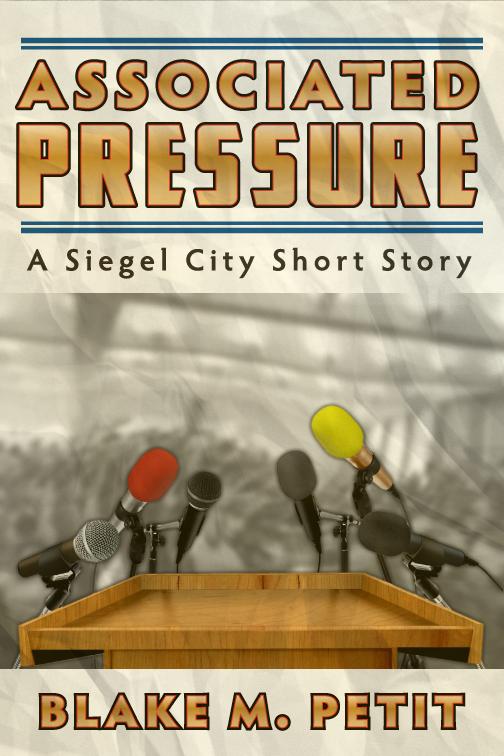 Hey, guys — if you’ll permit me a rare post that has nothing to do with movies whatsoever, I’ve got a new short story that’s going to be available for free in the Amazon Kindle store for five days starting tomorrow, May 4. Click on the link for more details and please, if you’ve got a Kindle or any device with a Kindle App, download the book and help me boost my numbers. (And if you don’t have a Kindle App, find something you can download it on — iPhone, iPad, iPod Touch, Android, any Mac or PC computer, and the apps are all free too!)
Gut Reactions: Condorman (1981)
 Director: Charles Jarrott
Writer: Marc Stirdivant, based on the novel by The Game of X Robert Sheckley
Cast: Michael Crawford, Oliver Reed, Barbara Carrera, James Hampton, Jean-Pierre Kalfon, Dana Elcar, Vernon Dobtcheff, Robert Arden
Plot: Comic book creator Woody Wilkins (Michael Crawford) is about to debut his new superhero: Condorman. Woody insists on authenticity in his character, though, and travels to Paris to test the gadgets he designed for the comic. His friend Harry (Oliver Reed), a CIA file clerk, asks him to carry out a special delivery for which a civilian has been requested. The over-enthusiastic Harry goes too far trying to impress his beautiful contact Natalia (Barbara Carrera), who is actually a KGB operative. Natalia returns to Moscow where her superior and lover Krokov (Oliver Reed) treats her cruelly. She decides to defect, and requests the agent known as “Condorman” be sent to retrieve her. Woody agrees to the mission, provided the CIA fabricate the rest of his comic book designs so he can test them in the field. Woody, Natalia and Harry are soon pursued by Krokov in a race across Europe to bring the beautiful spy to safety.
Thoughts: There is always a danger, when you go back and watch a movie or TV show you loved as a kid, that it simply won’t hold up. We’ve all been disappointed as adults, looking back and realizing things like the old Masters of the Universe TV show really wasn’t very good, or wondering how in the hell we were ever able to sit through Mac and Me more than once. Still, my fiancé Erin managed to secure a copy of this movie after she heard me mention how much I loved it back in the 80s, and I recently managed to find the time to watch it again for the first time in at least 20 years.
Condorman comes from the Disney company during that long stretch in the 70s and 80s when the company simply didn’t know what it was supposed to be anymore. After Walt Disney’s death in 1966, the company coasted on projects he’d already put in the works for a few years, then started to flounder, trying to figure out a direction now that its founder was gone. This film is the perfect example of that. The studio tried to simultaneously capitalize on the popularity of superheroes (thanks to the Christopher Reeve Superman franchise) and James Bond-style spy thrillers, while at the same time creating the sort of family friendly comedy that Disney’s live action properties were expected to be. The result is a film that fails to live up to the standards of any of the three.
That’s not to say the film is terrible. I mean… it kind of is, but at the same time, there’s something about it that still entertains me. Michael Crawford is chewing the scenery so much you expect him to blow a bubble, and James Hampton plays the same sort of big-smiling best buddy he is in most of his work. In fact, if you told me his character in this film retired from the CIA and returned to the states so he could raise his son properly before the family’s werewolf curse made itself known, I wouldn’t think you were that crazy. Just in terms of performance, Barbara Carrera and Oliver Reed are the ones that actually do the most acting. Carrera in particular is fun to watch, putting out a sort of Disney-friendly sensuality that you didn’t get to see often. In essence, she’s a G-rated Bond Girl, which is exactly what the script required her to be. (She would get another chance to be an sort-of Bond girl two years later in the infamous non-canon Sean Connery Bond film Never Say Never Again.)
The concept here is actually perfectly sound – a goofy, good-hearted man leaps at the chance for a little adventure and to test out the toys he’s only, until now, created on paper. It’s the execution that falls flat. The flying scenes are pretty uniformly terrible, with weak bluescreen effects and sometimes even visible cables. The rest of the tech is a bit more acceptable; the “Condormobile” in particular has a cool design and neat gadgets, and I can forgive the 80s-era computer display on the inside. Truth be told, to this day I occasionally fantasize about having a switch in my car that would allow me to blow off the outer shell and reveal a super-sleek high-speed sports car underneath. (These fantasies are usually prompted by sitting in traffic.)
I don’t want you to misunderstand me, guys. This is not a good movie. In fact, if the guys from RiffTrax could somehow get Disney to allow them to do a Video on Demand riff of this, I think it could be one of their greatest productions ever. But despite its cheese, this is one of those rare films from my past that I can look back on and still kind of love, warts and all. I can’t explain it, and I don’t feel the need to defend it. It’s silly, it’s crazy, it’s goofy…. And that’s why I like it.
The first Reel to Reel study, Mutants, Monsters and Madmen, is now available as a $2.99 eBook in the Amazon Kindle store and Smashwords.com bookstore. And you can find links to all of my novels, collections, and short stories, in their assorted print, eBook and audio forms, at the Now Available page!
Dorothy Gale Week Day 1: Dorothy Dwan in The Wizard of Oz (1925)
 Director: Larry Semon
Writer: Frank Joslyn Baum, Leon Lee & Larry Semon, adapted from the novel by L. Frank Baum
Cast: Dorothy Dwan, Mary Carr, Virginia Pearson, Bryant Washburn, Josef Swickard, Charles Murray, Oliver Hardy, Frank Alexander, Otto Lederer, Frederick Ko Vert, Larry Semon, G. Howe Black
Plot: A toymaker (Larry Semon) crafts a set of dolls for his granddaughter, recreating the characters from L. Frank Baum’s The Wonderful Wizard of Oz, then sits her down and to read the book with her. Or rather, he reads some alternate universe version of the book that only exists in this movie, because despite the fact that Baum’s own son got a screenwriting credit, it is almost unrecognizable from the book. My friends, I have written about 80 or so different movies since I first started this project, but this may be the craziest thing I’ve ever watched. Normally I don’t blame you if you skim over my somewhat detailed synopses, but this time I implore you… read on.
In this version, the people of Oz have managed to achieve a tense, suspicious peace many years after their baby princess was kidnapped and lost. In the place of the royal family is the treacherous Prime Minister Kruel (Josef Swickard). His actions (which are completely undefined) are beginning to bring the people of Oz to rally around Prince Kynd (Bryant Washburn), who demands the return of the rightful queen. Kruel turns to his advisor, Ambassador Wikked (Otto Lederer), who suggests they take their case to the Wizard (Charles Murray) and ask him to use his power to distract the people while Kruel schemes. Nobody knows the Wizard is merely a huckster – a man with impressive tricks, but no real magic.
Upset by the story, the toymaker’s granddaughter urges him to read the part about Dorothy and her friends, and he complies. In Kansas, we meet a rose-adorned girl named Dorothy (Dorothy Dwan) and her loving Aunt Em (Mary Carr). Her Uncle Henry (Frank Alexander) is less enamored of her, and grows angry at her for wasting time on the farm, where a farmhand (Oliver Hardy) defends the women as Henry berates them. Semon and G. Howe Black also appear as buffoonish farmhands, also victims of Henry’s temper. Semon and Hardy (both nameless) fight over Dorothy’s affections, and Henry gets angry at them all. Dorothy turns to Em, upset at Henry’s cruelty, and Em confesses that he isn’t really her uncle. She tells Dorothy the story of how, many years ago, baby Dorothy was delivered to their doorstep in a basket, and if you don’t know where this is going then congratulations on making it this far in life without ever having watched a movie before. Anyway, Dorothy arrived with a letter to be opened by her on her 18th birthday and not a moment before.
Back in Oz, things are getting even more tense, as Kynd warns Kruel that coronation day is approaching. He has until the new moon to produce Oz’s rightful queen, or Kynd will throw him into the dungeon. Kruel knows there are papers in a faraway place called Kansas that will save his regime, and sends Wikked on a journey to find them. The granddaughter, showing the sort of patience that would no doubt lead her to blow up her high school science lab in later years, forces her grandmother to jump back ahead in the story to Dorothy, who now is celebrating her 18th birthday. She goes to Henry, reminding him that today is the day he gives her the papers that came with her upon her birth. Before he can do so, Wikked arrives, flying in a biplane and landing on Henry’s farm. He demands the letter that came with Dorothy, offering to bribe Henry to prevent Dorothy from knowing the contents of the letter, but Henry grows angry and shoos them away. Wikked turns to the farmhands, who are fighting over Dorothy’s hand, and tells Hardy that she will never marry him if she reads her papers. Henry is about to give the papers to Dorothy, but Wikked and his thugs capture them at gunpoint. Henry manages to hide the letter, and Wikked has Dorothy tied to a watertower, threatening to burn the rope and let her fall if he doesn’t get the papers. Semon manages to catch her, because physics don’t apply in silent movies, and gives her the letter, which he found. Wikked tries to attack again, but apparently even God wants them to just get the hell to Oz, because all of a sudden a storm comes out of nowhere, lightning striking the bad guys (and knocking off Semon’s hat and bow tie) and wind forcing everyone else inside. Dorothy, Henry and the farmhands, in the house, are caught by the wind and blown away.
The five of them and Wikked crash outside the land of Oz. Semon hands Dorothy the letter, which indicates that her true name is Dorothea, rightful ruler of Oz, and destined to take the throne upon her 18th birthday. Kynd, Kruel, and the Wizard come out to greet them, although only Kynd is happy. Kruel orders the wizard to do something to the farmhands while he deals with Dorothy and Henry, but the Wizard is powerless. The farmhands each disguise themselves so that they and the Wizard won’t get in trouble – Semon putting on the clothes of a Scarecrow, Hardy a suit made of tin. Kruel captures them all and Hardy and Semon each accuse the other of kidnapping Dorothy in the first place. Black (the remaining farmhand) and Semon are sent into a dungeon where they are immediately mistreated by people dressed like pirates. I think this movie is going to give me a nosebleed.
With Dorothy’s true status revealed, Wikked advises Kruel to marry the new Queen to maintain his power. Hardy is made a “knight of the garter,” which somehow makes him immune to metal, and Henry is made Prince of Whales, which is not a typo. Back in the dungeon, the Wizard approaches Black and has him don a lion costume so he can frighten his captors and WHY THE HELL IS THE WIZARD TRYING TO HELP THE FARMHANDS THIS DOESN’T MAKE ANY SENSE AND he and Semon manage to escape. Semon plans to help save Dorothy from being the victim of a frame-up (FRAME UP? WHAT IS SHE BEING FRAMED FOR?) and sneaks out of the dungeon, but winds up being chased back down by Hardy, where he and Black encounter real lions. But Semon isn’t worried because lions like “dark meat” and Black is actually black and I think I need to sit down.
Kruel and Dorothy are about to get married (I think) when Kynd shows up and engages him in a swordfight and the Wizard helps Semon escape the dungeon. Together they defeat Kruel, who confesses to kidnapping Dorothy in the first place, claiming he whisked her away to save her from a “hostile faction.” Dorothy turns to Kynd, who she has apparently fallen in love with because of his mustache, and Black and Semon fly away in Wikked’s biplane.
Thoughts: This is truly a bizarre movie, unlike any other version of Oz I’ve seen put to screen. The long, frankly tedious focus on the bumbling farmhands at the beginning makes it clear that the film was really intended as a starring vehicle for actor/director/co-writer Larry Semon (he in fact is the only actor credited on the only original movie poster I could find). As a historical footnote, the film is more notable for featuring a young Oliver Hardy, who would go on to be one-half of one of the greatest comedy teams of all time, whereas Semon would go on to die of pneumonia at the age of 39. This is especially notable as, even when he’s not wearing his old man makeup, he looks like he’s about 64 years old in this movie.
The story here is something of a chore to get through. I can handle a story that adds new things to the Oz mythology, but the almost unforgivable thing here is the way Semon and his co-writers spend a ridiculously long time showing the various farmhands going through comedic antics back in Kansas, this after the granddaughter has specifically asked to hear about Dorothy and the Scarecrow, the Tin Woodsman, and so forth. I’m also very uncomfortable with re-casting Uncle Henry as this cruel, heartless man who practically tortures Dorothy and Em, regardless of the question of Dorothy’s true parentage. Even worse, though, it’s internally inconsistent, as the cold-hearted Henry suddenly becomes Dorothy’s stalwart defender when Wikked shows up to take back her birth papers.
I admit that I’m not exactly privy to the demands of a 1925 filmgoing audience, but I can’t imagine anybody who loved the novel (which was 25 years old at this point, enough for parents and their children alike to have grown up with the book) watched this and came away satisfied. So much of it simply makes no sense. How did Kruel come to power? What the hell is Prince Kynd actually the prince of? What were Kruel and Wikked doing that turned the people of Oz against them? And didn’t anybody find their names at all suspicious? Why do the farmhands disguise themselves? What the hell does it matter to them if the Wizard gets in trouble for faking his powers all these years? They have literally just met the man, and he’s working with the guy who wants to destroy them. Typing this paragraph is giving me a headache.
Considering the complete mess made of the story here, perhaps the thing that disturbs me about this movie the most is the way it completely strips away all of the magic of Oz. Not only is the Wizard a humbug, but there’s no magic anywhere – the scarecrow and tin man are just disguises, and the route between Oz and Kansas is easily accessible by a 1920s-era crop duster. The closest thing to magic is the storm that hurls them to Oz, and I’m still willing to chalk that up to the intervention of a deity that can’t believe they were 44 minutes into an adaptation of The Wizard of Oz and Dorothy hadn’t left Kansas.
The characters, meanwhile, are paper-thin. Dorothy Dwan (Semon’s wife) as Dorothy is less of a character and more of a living doll for the men to fight over. Her affections bounce between men from moment to moment with no reason or logic, and we’re never given a satisfactory reason why she should fall in love with Kynd in the end. The rest of the characters are similarly ill-developed, acting without any real motivation. Howe’s “Cowardly Lion” farmhand is the sort of racial stereotype you expect in a movie from this time period, which I usually try to tolerate for the sake of context, but the line about lions liking “dark meat” just sent me over the edge. In the end, the whole thing seems to exist solely to showcase Larry Semon’s slapstick abilities. That’s fair, I suppose – a lot of the comedies in the era of silent movies were little more than the star comedian performing their antics in front of a camera. But I have to ask – is an adaptation of The Wizard of Oz really the right place for that kind of one-man show?
The good news is that this movie is largely a footnote in Oz lore. Very few people watch it anymore, which is as it should be, and it’s not remembered very well. The bad news is that the one thing from this movie that did make it into the greater Oz Mythology is probably one of my least-favorite parts: the conceit that Dorothy’s friends in Oz are based on the people she knew back home. In and of itself, that’s not really a bad idea. It’s cute, it’s fanciful, and it has worked its way into many other fantasy films over the years. The problem, though, is that the way it was used in the 1939 film birthed the notion that Dorothy dreamed her entire Oz adventure. This is something Baum never intended, but something a lot of people think is Oz canon… and the whole thing rather cheapens Oz to me, almost as much as the stripped-down Oz we got in this movie.
I need to cleanse my palette, friends. I need a good movie to cleanse my mind. Fortunately, the next one on this list is the classic to end all classics. Tomorrow it’s time for Judy Garland in MGM’s 1939 film The Wizard of Oz.
The first Reel to Reel study, Mutants, Monsters and Madmen, is now available as a $2.99 eBook in the Amazon Kindle store and Smashwords.com bookstore. And you can find links to all of my novels, collections, and short stories, in their assorted print, eBook and audio forms, at the Now Available page!
 Reel to Reel