Author Archives: blakemp
Blake’s Friday the 13th Marathon
Many, many years ago, in a magical land called 2006, my local Wal-Mart had a sale on the Friday the 13th series. Although I’d seen some of the films before, I never saw all of them, and I took the opportunity to get the films, watch them all (some of them for the first time) and review them. It became an annual tradition. The next year, I recruited some of my friends to join me in a marathon of the Nightmare on Elm Street series, and when we launched our podcast, it became a special Halloween episode every year.
Earlier this evening, I got into a talk online about the merits of the various Friday films and that reminded me of this long-ago review. With Halloween coming up (my second-favorite time of year, after Christmas), I thought it might be fun to dust off that old post and re-present it here. I’ll unearth the other Halloween marathons too, and present them to you in the weeks approaching the big night. So let’s start here, from the long-ago past of 2006, when I reviewed all (at the time) eleven Fridays!

When I was a kid, I didn’t watch scary movies. For one thing, my folks didn’t let me – which in retrospect is probably a good thing in light of reason #2: I would have wet the bed every night for a month after seeing one. I was kind of a skittish kid, and even as my classmates would talk about how cool Jason or Freddy Krueger were, as much as I tried to join in the conversation faking my way through it, I knew that actually watching the scary movies of the 80s would be a really bad move, especially for my bedsheets.
As I got older, I started reading the likes of Stephen King and began to appreciate films like Alien and The Birds. By the time The Sixth Sense rolled along, it had finally dawned on me that I was majorly into horror, and it wasn’t keeping me up at nights. Although I may succumb to the cheap startle in a horror flick like anyone else, by the time the credits roll, the actual sense of danger has evaporated and I’m fine. The real world is frightening enough.
Even though I was into horror, I wasn’t into what I think of as the “slasher” genre. Buckets of blood and piles of gore wouldn’t even elicit a cheap scare out of me, and I avoided the movies handily. Then, a few years ago, my buddy Chase began to teach me how to appreciate the movies not as horror, but as camp. They were goofy, they were cheesy, and they were way over the top… and that’s what you’re supposed to love about them. By the time Freddy Versus Jason rolled around in 2003, I had decided to see it with my friends, but before that I wanted to at least see how the stories had started. I’d already seen the original A Nightmare on Elm Street, but I hadn’t seen any Friday the 13th movies, so the week before the release I rented the first two. They were okay, but very different from what I’d come to expect. I saw Freddy Versus Jason and thought it was brilliant as camp. Eventually, I saw a few more Jason movies, Jason Goes to Hell and Jason X.
As I was preparing the Halloween Party for my blog I discovered the local Wal-Mart had a biiiiiiiiig display of horror movies for only $4.58 (or something like that) a pop. Included in the display were all eight of the old Friday the 13th movies, the ones done before Paramount dropped the property. As I already owned the three movies made by its new home, New Line Cinema, I decided to pick up one or two of the classics at a time. Then, once I completed the collection, I’d do a massive Halloween Party article reviewing not one movie, not two, but all eleven motion pictures featuring Jason Voorhees. Because I’m crazy, that’s why.
So as you read these reviews, keep in mind a few things. First up, this is written through the perspective of someone in his late 20s who has grown an appreciation for both horror and camp, but is well aware of the distinction between the two. Second, this weekend Friday marathon will be my first time watching many of these films. Out of an 11-film series, I’ve only seen #s 1, 2, 11, 9 and 10. Oddly enough, in that order. And finally, these movies have been out for years – decades in some cases. There will be spoilers, especially concerning the first movie which (let’s face it) is the only one in the series that really has a big enough twist to even constitute calling it a spoiler. So without further ado, let’s begin.
 Friday the 13th (1980)
The original Friday film was actually really reserved, especially compared to how far the series would go in future installments. Years after a pair of counselors at Camp Crystal Lake are murdered, the owner of the camp decides to reopen, apparently unaware that he is in a horror movie and these things invariably lead to people getting killed. As he brings in a group of teenagers to begin getting the camp ready for the summer – and this is the shocker – people begin getting killed. Particularly the more promiscuous ones, which in fact means virtually all of them, except for sweet little Alice. As Alice watches her friends die gruesome deaths all around her, she’s the one left to face the killer before it’s too late.
Like I said, this movie actually had a genuine surprise at the end, and if you don’t know what it is (or don’t want to know what it is), skip the rest of this paragraph. Actually, skip the whole article and go read my review of the Superman trick-or-treat pail again. Anyway, we’d spent the entire movie watching these kids get butchered by some unseen killer, and we thought Alice was finally safe when she met a nice, sweet little old lady names Mrs. Vorhees. Then Mrs. V begins telling the story of the camp, how a little boy drowned in the lake years ago because a couple of counselors were off being promiscuous in the fashion that gets teenagers in slasher movies killed instead of keeping an eye on the kid. Then Mrs. V goes a little loony, and before we know it, Alice is fighting for her life. Hence the twist: a cross-dressing Anthony Perkins aside, you just don’t expect the killer in a horror movie to be the little old lady.
It’s easy to forget, as the later films were focused firmly on making Jason an unstoppable machine, programmed to kill as many people as possible in as graphic a fashion as possible, that the original Friday was a pretty effective suspense flick for its day. It had all the hallmarks – surprising deaths, twists and turns and a killer you didn’t get to see until the very end. More than that, though, there weren’t even any hints of the supernatural killer Jason would turn out to be, except for a brief flash of him popping out of the lake in which he supposedly drowned at the end of the movie, in a scene that very easily could have been written off as a hallucination. The menace in the first movie was human – crazy Mrs. Vorhees, grief-stricken over her son, even muttering dialogue between herself and her boy in a particularly freaky sequence.
The acting was wooden, of course, and the effects don’t hold up at all, but all things considered, it wasn’t a bad little thriller. Which is what makes it so incongruous with the rest of the series. Now we want the big, crazy, over-the-top monster. The first movie doesn’t quite fit anymore.
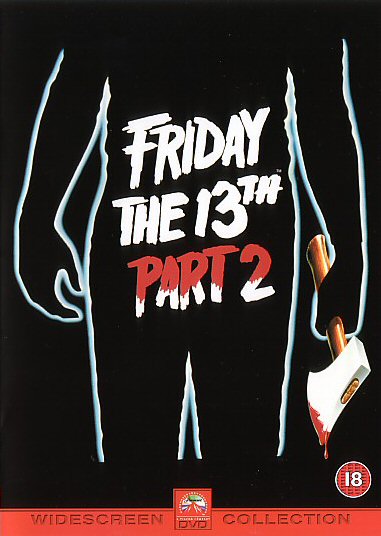 Friday the 13th Part 2 (1981)
Buoyed by the success of the film, the next year Paramount studios cranked out the first of what would be an interminable chain of sequels. We open up on Alice, who has apparently grown out her hair because she has nothing better to do while lying around having nightmares, then we get an extended sequence of archival footage from the first movie in case there was anyone who missed it, which seemed kind of redundant to me as the gap between watching the first movie and the second was only as long as it took to put a frozen pizza in the oven. Plus there was a perfectly good sequence later in the film where one of the new teenagers told the story of the first movie as a campfire tale, which did the job perfectly well without boring the hell out of the people who’d seen the first one. Also, it was kind of stupid as it gave us a good 10 minutes or so of getting reacquainted with our heroine, Alice, before (spoiler for ya) she winds up getting killed by Jason before we even see the opening credits.
After the credits we find out it’s now five years later and a new group of counselors is heading out to the lake, but not to Camp Crystal Lake. To the Camp next door. Because if there’s a psycho killer on the loose, he won’t make the hike or something. Actually, most of the new campers don’t believe the story at all, which makes them feel downright foolish when the first person gets garroted against a tree trunk with a string of barbed wire.
This is Jason’s first time out as the killer (although he didn’t yet have his trademark hockey mask), and he was quite a different character from who he would later become. He still didn’t speak, and he had a burlap sack over his head for most of the film, but he wasn’t the mindless beast we’re used to. He actually had intelligence. He laid traps. He came up with some clever murders that didn’t rely on conveniently placed props or explosive devices. And what’s more, he was human. Strong, yes, and a cold blooded killer, but still not the super-zombie we would all grow to know and love. Still, it’s a step closer, and this is probably where real devotees of the franchise began to fall in love with it.
The ending works fairly well, as the Obligatory Last Teenage Girl pretends to be Jason’s mother and confuses him long enough for them to make their escape. Of course, as we know from the first movie, there’s still room for one more shocker at the end.
 Friday the 13th Part 3 (1982)
The third installment in the franchise took an interesting path – the movie was filmed in 3-D. This was no doubt very cool in the theaters, but just makes it look a little silly on DVD without the benefit of the funky glasses. [2013 Note: Remember, I wrote this in a pre-Avatar universe where there was little to no demand for 3-D movies and I, as a viewer, had not yet grown violently angry about how the technique is overused.] There are tons of shots that clearly serve no other purpose than to take advantage of the gimmick – knives and pitchforks thrust right at the screen, a snake jumping out at you and other such things. There are also a lot of shots like this that probably seemed nonsensical even when it was in 3-D – a totally irrelevant shot of a baseball bat pointing at the screen while some kids are playing in the street, a few stoners shoving a joint at the camera, a yo-yo scene that no doubt got this film serious Academy Award consideration, a crazy old man waving around an eyeball shouting warnings and so forth. On the upside, we did get the funkiest opening credit sequence in the series so far.
The story is exactly what you would expect. The film opens with an extended flashback from the previous film, then we find out it’s the next day (which means it’s no longer Friday the 13th, doesn’t it?) as couple in a general store down the road watch the news reports about the killings. Things don’t turn out too well for them. Next, a group of teenagers decide to go up to “the lake” where a bunch of people have been killed, because teenagers were as stupid in 1982 as many of them are today, and Jason starts slaughtering them. Actually, the teenagers in this series are even stupider than most of the other ones – the girl whose family owns the farmhouse where the teens are staying actually escaped an encounter with Jason two years earlier, but she decided not just to come back anyway, but to bring all of her friends with her. She would most certainly be off my Christmas Card list.
We get a few series milestones in this film – we see Jason acquire his now-trademark hockey mask and machete, we see the beginnings of the strains of humor in the series, and we also introduce, for the first time, the Dork Factor in the character of Shelly, an afro-ed prankster who keeps scaring the hell out of the other characters in a series of pathetic attempts to be liked. I think we’re supposed to sympathize with him, but by the time he starts popping out of the water under the dock, we’re kinda waiting for him to die.
Jason honestly doesn’t come off very well in this movie. Sure, he gets to kill people, but he often comes across as kind of clumsy – even buffoonish. The things the obligatory Last Surviving Teenage Girl does to him, successfully slowing him down just enough, turns him into a monster that Abbott and Costello could have had a ball with. I guess that’s understandable, though – in this installment, Jason is still at least kind of human. He still hasn’t become Superzombie. Not yet.
The story structure as a whole is pretty poor, actually. Early in the film one of the teenagers announces she’s pregnant, after which the filmmakers make the bold choice of completely ignoring that plot point for the rest of the film. Then, after an hour of fake scares and the occasional killing – often off-camera – we get ten minutes of a bloodbath, then the remaining 20 minutes are the surviving teenage girl running around and screaming.
Ah well, when I got into this, I wasn’t expecting Orson Welles or anything.
 Friday the 13th: The Final Chapter (1984)
In perhaps the single most misleadingly-named film outside of The Neverending Story, the filmmakers tried to wrap up the series by killing off Jason far more definitively than they had in previous installments. Clearly, it didn’t take.
This time out, we begin with a montage from the three previous films, framed in the campfire story from Part 2, which actually works pretty well. Then we pick up right at the end of Part 3, as they take Jason’s body to the hospital. (The hospital? Come on, guys.) There, of course, he wakes up and kills a very nice young couple making the mistake of doing the dirty down in the morgue, which now that I think about it, doesn’t really make them all that nice to begin with.
Then our attention shifts to – you guessed it – a group of teenagers trying to have a fun little weekend. (Apparently the second, third and fourth films in this series all take place during a bizarre chronal anomaly which resulted in five or six Friday the 13ths being held one after the other, without any of those pesky Saturdays or Thursdays getting in the way). This time out, one of the teenagers has brought along her little brother Tommy – played by Corey Feldman. The sad thing is, were it not for Goonies, this clearly would have been the high point of his career.
The filmmakers then begin to try to make up for the lack of sex in Part 3 by throwing about ten times more than in the first two films combined. We’ve got twins, we’ve got vintage films, we’ve even got Crispin Glover as one of the teenagers who should have known better than to have sex while Jason was around. (The sad thing is, were it not for Back to the Future, this clearly would have been the high point of his career.)
I’ll give director Joseph Zito credit – this is the film where the deaths in the series really started to get elaborate. They weren’t too over-the-top yet, but Jason was no longer content with simple stab wounds and the odd strangulation. Here we’ve got people slaughtered with corkscrews, killed through movie screens, crushed through shower glass – he goes all out.
Then finally, little Tommy comes up with a plan. He shaves his head and pretends to be baby Jason, confusing the big brute. (Anyone who thinks this sounds suspiciously like how he was defeated in Part 2, there’s a reason for that. It is suspiciously like how he was defeated in Part 2.) Lil’ Tommy then gets Jason in the head with a machete, which apparently is supposed to be more effective than being knifed in the chest with a machete, hung in a noose and getting an axe lodged in his skull, because those didn’t seem to work in the last two films. Then, in a rare burst of common sense for these films, Tommy sees Jason’s hand twitch and, instead of screaming, running away and/or getting slaughtered after the killer appeared to be dead, he just picks up his machete again and goes to town.
So Jason is dead, but Tommy is clearly very disturbed by the whole thing. Still, it’s all over now. Right? Right?
Yeah. Right.
 Friday the 13th Part V: A New Beginning (1985)
Paramount couldn’t even wait a year before changing its mind on this one. Apparently in this franchise, “final” means “final” in the same way that “dead” means “dead” in a comic book universe, a philosophy that would later be adopted by the makers of the Final Fantasy video game series and the Final Destination franchise.
Jason, who’s busy being dead, gets a break after three films that run right into each other. It’s a few years later and Tommy (now a rugged teenager played by John Shephard) has been institutionalized due to his childhood trauma. He’s sent away to a retreat where he shares his hideous rubber masks with Steve Urkel’s pal Weasel from Family Matters (not a joke, friends, I looked this up). As he tries to acclimate to life at the home, he meets the other teens, each of whom is troubled in his or her own way. One of them, for example, is troubled in that he goes bonkers and hacks up one of the others with an axe. This is widely regarded as a bad thing, as later that day other people start getting hacked up in ways very reminiscent of Jason’s murders at Camp Crystal Lake.
There’s lots of blood, lots of hacking, a truly disturbing eye fetish, and the psycho in the hockey mask returns. We’re all supposed to imagine that this is Jason back from the dead, but frankly, it’s not very convincing. Yeah, he’s tall, but the hockey mask is all wrong and the big, bulky Jason is now built like a skinny little basketball player. In the end Tommy and his friends (and here’s another spoiler warning) manage to kill off Jason by chucking him off the side of a barn onto a conveniently-placed array of spikes. As he dies, his mask falls off and we realize it wasn’t Jason at all, but Roy Burns, one of the docs who investigated the killing of the teenager back in the beginning… who evidently was his son, whose very existence he managed to keep a secret all this time. Okaaaaay, if you say so.
For all its flaws, I do believe in credit where credit is due. This movie comes across like a clear attempt by the studio to escape the crutch of having to kill off Jason in at the end of every movie only to have to bring him back at the beginning of the next one. Switching killers and then implying that the evil had traveled on to someone else at the end wasn’t that bad an idea, and at least was more intelligent than the Halloween franchise’s attempt to divorce the property from Michael Myers in its third installment. But let’s face it, fans of Friday want Jason, and this movie didn’t feature Jason at all. Hey, wait a minute… “didn’t feature Jason at all?” Wasn’t my stated purpose at the beginning of this experiment to review “all of the films featuring Jason Vorhees?” Could I have skipped this one on a technicality? Aw, crap.
 Friday the 13th Part VI: Jason Lives (1986)
Okay, this is where it really started to get ridiculous.
About a decade after the events of A New Beginning (judging by the fact that Tommy is now played by Thom Mathews, who looks like he’s in his 30s, which is a neat trick for someone who just two movies ago was not only 12 years old, but also Corey Feldman), Tommy can’t escape the spectre of Jason. He grabs his friend Allen and… hey, wait a minute. Is that Horshack? Is that freaking Horshack from Welcome Back, Kotter? playing Allen? Okay, this movie automatically gets ten more cool points. Don’t worry, it’ll lose them by the opening credits.
Anyway, Tommy is freaking out about Jason, so he and Allen go to dig up his corpse and cremate him. Tommy freaks out, though, and stabs Jason’s body with a metal pole. This proves to be a really bad idea, when lightning strikes the body and reanimates it. Yes, friends, it’s Superzombie! He’s finally here! As he pulls himself out, Tommy runs away like a little scaredy cat and Jason imitates the opening titles of a James Bond movie.
Tommy runs to the police, who very presciently throw him in jail, where Officer Expository Dialogue reminds him that they changed the name of Crystal Lake to “Forest Green” because they wanted people to forget Jason. Meanwhile a young couple in the woods runs into Jason and the girl utters a phrase that manages to even the movie out on the Cool-Point-O-Meter again, “I’ve seen enough horror movies to know any weirdo wearing a mask is never friendly.” Ironic, self-referential humor always appeals to me.
Back at Camp “Forest Green,” yet another group of teenagers is setting up to be counselors for the summer. Also, for the first time, we see some actual campers at camp. Go figure. As the teens get the camp set up, we visit a bunch of comical would-be-warriors playing paintball and taking it way too seriously, which is what makes it kind of cathartic when they start to die.
The survivalists are actually just the start of showing off the crapitude that would be Jason Lives. The filmmakers in this go-round really tried to go for the laughs in addition to the killing. There’s not anything wrong with this, in and of itself. There’s a proud tradition of horror/comedies, from the good ol’ days of Abbott and Costello Meet Frankenstein all the way up to modern classics like Army of Darkness. The thing is, a good horror/comedy must be both frightening and funny. Jason Lives was neither.
The only really good thing I can say about this movie is that at least the filmmakers had the good taste not to blow their wad and have Jason kill off an entire cabin full of children when he burst in on one. That, I think, would have gone too far. Yeah, we want to see Jason killing, but killing punk teenagers. Fact is, in movies like this you almost kinda root for the killer, you want to see how he’ll up the ante. Going after the kids would have been too much.
Tommy again manages to beat Jason, this time following the completely out-of-the-blue announcement that “the only way to stop Jason now is to bring him back to where it began… Camp Crystal Lake.” And how does Tommy know this exactly? Apparently that home for troubled teens he stayed in during the last movie had an extensive course study on occult manifestations and how to exterminate them. That or the screenwriter was a hack, take your pick. Anyway, Tommy finds a convenient boulder which he wraps around a chain and puts in a canoe. Yeah, I know. Then, in a fairly unconvincing fight piece, he loops the chain around Jason’s neck and drops him in the lake. His girlfriend then jumps in to hit Jason in the head with a boat motor, and everybody lives happily ever after, except for anyone who actually paid money to see this. Horshack and self-referential humor aside, we’ve hit the real low point in this series.
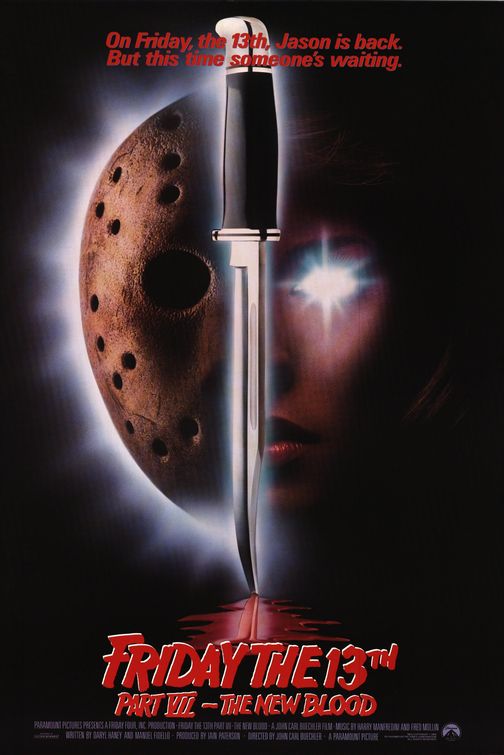 Friday the 13th Part VII: The New Blood (1988)
C’mon, did anyone really think a little thing like being stuck on the bottom of a lake was going to stop Jason? Part VII opens up with another montage sequence of scenes from the previous films, all of which basically make one point that everyone seeing the movie already knows: Jason is a bad ass. Oh, and he’s stuck at the bottom of the lake. Jason is a bad-ass stuck at the bottom of the lake.
The movie opens with a little girl who runs out into a boat on the lake and somehow kills her father. Seems she’s got some telekinetic powers, those funky things. Years later, as (wait for it) a teenager, she comes back, lamenting her father’s death, and winds up accidentally freeing Jason from his watery prison. Soon, a bunch of teenagers up there for a birthday party start getting killed.
This is actually a vast improvement over Jason Lives. They filmmakers mostly abandoned the idiotic slapstick that killed the previous movie, and Tina – while coming across as a “Carrie Lite,” does make for an interesting adversary. Terry Kieser (the “late Bernie” himself) does a suitably despicable turn as a self-important doctor hoping to study her condition, with no thought for what havoc his little experiment may cause. This is also the first appearance of Kane Hodder, who would play Jason three more times and who many fans consider the definitive performer. He’s good – big, imposing, frightening, and the makeup and costuming has improved a lot as well. Chunks of flesh have fallen off, you can see spine and ribcage, and he really looks menacing for the first time.
Is it a great movie? No. But it’s better than the series had been since its earliest installments, and a well-needed jolt of what makes the monster so much fun.
 Friday the 13th Part VIII: Jason Takes Manhattan (1989)
It’s time to travel! With the Crystal Lake region done to death, for their final Friday, Paramount Pictures put Jason out to sea and then on to the mean streets of New York City. The film begins with a pair of rambunctious teens spending the evening on a yacht on Crystal Lake. (Apparently Crystal Lake is connected to a river. This was news to me.) While they’re having their fun, their anchor drags a submerged power cable into Jason’s body, jolting him back to life. The moral of the story? Once you’ve finally got Jason dead, put whatever’s left in a rubber box, for God’s sake. Jason thanks the teens who resurrected him in his own inimitable style, and then the story takes off.
The next day we see a group of high school graduates taking a cruise for their senior trip – a cruise to New York. You know, when I think of great cruise destinations, I think: the Caribbean, Cancun, New York. But that’s where they’re going, especially our heroine du jour, Rennie, who is terrified of the water. Would that this were the only thing to be terrified about. Jason has stowed away aboard the ship, and the killing begins.
For a movie ostensibly about Jason “taking Manhattan,” it sure takes long enough to get there. The first hour of the film takes place on the ship, with Jason killing people in various clever and distinctively nautical ways. Finally, the survivors make it to New York, and Jason is hot on their heels, ready to begin the killing there. All the time, Rennie keeps having flashes of Jason attacking her even when he’s busy elsewhere.
I was actually surprised by this movie. Based solely on the title, I was braced for another Jason Lives level of camp and crap. The first hour, though, is actually pretty good. I’ve got a penchant for “claustrophobic” horror movies, where the protagonists are forced to fight for their lives in an enclosed space with little or no hope of escape, and the shipboard battles fit that bill very well. Once we make it to New York, it’s not as strong. It’s still basically the same few characters running around with Jason, occasionally drawing in a gang banger or bystander to take a hit and allow someone else to live another scene or two. The filmmakers totally squandered the potential of having a killing machine like Jason in a major metropolitan area – so much could have been done with that premise, but except for a brief chase on a subway car, it isn’t even touched on. I’m also not a fan of the new powers Jason started whipping out in this movie. Superzombie is one thing, but a psychic, teleporting superzombie? That’s a bit much. Jason works best as the unstoppable killing machine/mama’s boy. Let’s leave the psychic stuff for the Tinas of this series, shall we? They also worked in some unnecessary (and out of character) humor bits, like Jason scaring away a group of gang-bangers by taking off his mask and revealing his face, allowing them to escape. Um… since when does Jason actually care about scaring people? He just wants ‘em dead. For that matter, letting them escape is pretty preposterous too.
After this film, Paramount apparently gave up on the property, resulting in a four-year gap before the next movie, the longest at the time. Then New Line Cinema bought the license, but apparently not the trademark, because none of Jason’s subsequent appearances have appeared under the Friday the 13th moniker. In fact, the next time we saw Jason was in…
 Jason Goes to Hell: The Final Friday (1993)
Why New Line would resurrect the franchise just to (pretend to) finish it off is beyond me. Why they made their first venture into this series such a bad one is even more perplexing. The DVD I have features both the “R-rated” and “Unrated” versions of the film. I went with the unrated version for this review, assuming there’s nothing in the whopping three minutes of extra footage that would be too much for my fragile little mind.
The last time we saw Jason, he’d been wiped out by a wave of toxic waste beneath the streets of Manhattan. This time, the filmmakers (including Friday creator Sean S. Cunningham, who came back for this “final” installment) didn’t even go through the pretense of showing how this film relates to the previous one. Jason pops up at the very beginning, hale and hearty, chasing a girl in a towel through the woods. Oh, but she’s not just any girl in a towel – she’s an FBI agent. After several movies of trying to pretend Jason didn’t even exist, it seems the authorities have finally wised up. The girl is bait for a sting operation that involves lots of guns and at least one explosive charge. Jason blows up. Jason blows up good. We’ve got body parts strewn about, a head flying through the air and a still-beating heart lying on the ground. And that’s before the credits.
As the coroner examines Jason’s remains, he sees the still-beating heart and – because this is what coroners do with still-beating hearts – eats it. Then he goes on a killing spree of his own. Flash to a TV interview with a big-name bounty hunter, Creighton Duke, who claims that Jason has the power to change bodies the way normal people can change clothes, and only he knows how to defeat him. Back in Crystal Lake, he approaches a waitress at a local diner, saying that only she and her daughter can stop Jason once and for all, and if you don’t know where this is going yet, you haven’t watched enough horror movies.
What with one thing or another, we find out the waitress’s daughter, Jessica, is dating the TV host, Robert, and has a child of her own with a local boy (Steven) that she’s estranged from. The waitress is killed, Steven is thrown in jail and he meets Duke. After a nicely sadistic finger-breaking sequence, Duke explains what anyone who’s ever seen a horror flick should have been able to figure out for themselves – through some convoluted twist, the waitress was Jason’s long-lost sister, making Jessica and her child his last two blood relatives, which means they’re the only two people who can either kill him once and for all or bring him back to his own body.
Steven escapes from jail and hightails it to the Voorhees house, where he finds a book that one of the prop guys stole from the set of Army of Darkness but which otherwise serves absolutely no purpose. He also overhears Robert on the phone laughing over the fact that he swiped the waitress’s body and stowed it away here for the sake of ratings. It’s his last boast, however, as Jason’s previous host then takes his body, and continues the carnage.
Eventually, Jessica and Duke wind up at the Voorhees house, where he tosses her a switchblade which then mysteriously transforms into a… um… magic dagger. And he tells her that only she can send Jason to Hell, tonight, “for all time.” He also informs her that she can’t trust anyone, because Jason could be in anybody’s body at this point. This turns out to be true, but only because Jason has suddenly, spontaneously developed the power of speech. Sure, just because none of his other hosts could talk, why should it be a stretch that this one suddenly can?
Jason jumps into the dead waitress’s body, which then turns into his, and Duke gets killed as Jessica wastes precious seconds trying to get the dagger out from under a dresser because, apparently, she doesn’t want to bend over the extra three millimeters it would take to reach it. Steven and Jason have a big final battle scene while Jessica (again) tries to grab the dagger. She finally stabs him with it, which results in a peachy little lightshow and a bunch of hands popping up from under the ground to drag him off to hell. A couple of the hands also grab Steven and try to pull him down. Jessica winds up saving him, but she takes a really long time to decide to do it, considering that he’s the father of her child and has saved her life about a billion times during this movie.
The movie, as a whole, is full of plot holes, terribly convoluted and utterly out of synch with the rest of the franchise. It does, however, get points for the single coolest shot in the entire series at the very end. New Line took advantage of its new property to give fans something they’d been craving for a decade – as Jason’s mask lies in the dirt, one last hand pops up to drag it down with the rest of him… a hand with long, sharp knives on the fingers. That’s right, fans wanted to see Jason take on Freddy Krueger of A Nightmare on Elm Street fame, and now that New Line owned both properties, was it going to happen?
Yes. But not for another decade. At any rate, the only way this could be considered “The Final Friday” is if we assume future installments did away with the crutch of trying to place the events on Friday the 13th and decided they could happen at any old time. Still, it would take a good eight years before Jason would grace the screen again.
 Jason X (2001)
After eight years, New Line decided “to Hell with this final stuff (pun intended), let’s bring him back. But this time… let’s make it a sci-fi movie!” So in the near future, Jason has been captured (how did he get out of Hell?) and is awaiting cryogenic suspension at the Crystal Lake Research Facility. One of the bigwigs has decided he doesn’t want Jason frozen, though, he wants him “soft” so they can continue to study his amazing regenerative powers. Which may well be the stupidest decision in the history of the planet. Jason, of course, cuts loose and begins a killing spree that doesn’t end until he and Rowan (the hottest female scientist) are frozen in cryogenic sleep.
Over 400 years later, they’re found by a group of scavengers (all of whom, coincidentally, appear to be teenagers) sifting through the ruins of a dead planet Earth. They find the two frozen bodies and bring them to space, anticipating that Rowan can be revived. She’s reanimated and brought around with the help of handy nanobots, and begin to study Jason’s corpse. Unfortunately, the scientists don’t seem to comprehend that with Jason, you don’t need nanobots to wake him up, you just need him to thaw out. And yes, the killing begins anew.
Jason slaughters lots of people really good, including the ship’s pilot, which in turn causes the spaceship to crash into the Solaris station instead of docking with it, as was the plan. The entire space station blows up, pretty much ensuring that Jason breaks his record for body count with this one. As the survivors flee, the professor who saw so much profit potential in Jason utters what has to be one of the dumbest things ever said in this franchise, “Guys, it’s okay! He just wanted his machete back!” Okay, yeah, they were going for the funny there, but still.
The survivors try to escape, and one of them finds love with his android (aaaaaaaw). Then he upgrades the android to turn her into a fighting machine, giving us the closest we’ll probably ever get to a Jason Versus Ripley battle scene. She blows him all to smithereens, but happens to knock his body right into the medical hold where all those helpful little nanobots are. So while the others wait for a rescue and prepare to blow up part of the ship so the rest of it will stay in one piece long enough, the shipboard computer (showing the sort of poor judgment that has given shipboard computers a bad name since 2001) rebuilds ol’ Jason. He’s not just Superzombie anymore. Now he’s Cyber-Superzombie! Sadly, his snazzy new duds don’t make him any more agreeable, and he keeps a-comin’. A few more people die, although remarkably, none actually are killed directly by Uberjason (one blows himself up, one dies in explosive decompression and the last one rides Jason into burning up in the atmostphere). Jason falls to the surface of “Earth 2,” and whatever’s left of him just happens to touch down on the bottom of a lake… beside which we have a couple of teenagers out camping. This is supposed to be poetic, I suppose. Anyway, the few survivors seem to have a little happily ever after potential, so good for them. As far as Jason, hopefully this little glimpse of the future was the last, because it just didn’t work. If it had been done right, this movie could have been another Alien. Instead, it was another Alien: Resurrection.
 Freddy Versus Jason (2003)
If you’re wondering how Jason got out of Hell after part nine, this film would seem to be your answer. More importantly, it gave horror geeks something they’ve wanted for nearly 20 years – a face-off between the two most popular slasher film stars of all time. Ten years after the teaser at the end of Jason Goes to Hell, we open up with the story of Freddy Krueger, a child killer who was burnt alive by a mob of vengeance-seeking parents. Freddy’s demonic spirit couldn’t be quieted, though, and he gained the power to attack children and teenagers (always with the teenagers) in their dreams. Thing is, Freddy only has power over your dreams if you’re afraid of him, and the parents of his little town, Springwood, are drugging their kids to suppress their dreams and make them forget Freddy ever existed. Down in Hell, Freddy finds Jason Voorhees, and sends him back to the surface to wreak a little havoc, bring back the fear, and let him cut loose again.
Jason heads straight for the house where Freddy’s most infamous killings took place, and where there just happens to be a new teenage girl, Lori. Lori is depressed because her boyfriend, Will, up and moved away without as much as a goodbye, so her friends bring over a couple of guys to cheer her up. One of them goes upstairs for a little fun with his girlfriend, which is Jason’s cue to have a little fun of his own. The cops are called and Freddy is the immediate suspect, even if they don’t want to even say his name out loud. Freddy makes a play for one of the other teens, but he isn’t strong enough, so he give a brief soliloquy about letting Jason have some fun. After 10 movies with a bad guy who doesn’t even so much as grunt, it’s a little disconcerting to suddenly have a baddie who yammers on for hours on end. Of course, that’s one of the things that gives these two such distinct personalities.
Turns out, though, Will didn’t just run off from Lori, he was placed in a mental institution because Freddy was too strong in his mind. When he sees Lori’s house on the news as the scene of an attack, he and his friend Mark break out and run to the rescue. Back at school, the class nerd expresses his concern for Lori and a guy who apparently was cloned from Jason Mewes starts handing out flyers for a party. Will and Mark pop up with Freddy’s story on their lips and people start getting more and more terrified, which of course is just what Freddy wanted. Mark figures out that the institution was a place to quarantine everyone who had contact with Freddy, like he did when his brother, Scut Farkus, “committed suicide.” Fortunately, even after four years in a mental institution, he’s still got his van (which he apparently got when he was 14), and Will sets off to find the girls at Jason Mewes’ party, which happens to be in the middle of a cornfield.
One of Lori’s friends wanders off on her own and winds up getting drawn into Freddy’s Dreamworld boiler room, where he’s at his strongest. Before he can take her out, though, Jason kills her in the real world, denying Freddy his kill, which he doesn’t take well at all. Jason crashes the rave and some enterprising Horatio Sanz wannabe (I swear, when they decided to cobble together the two leads from previous movies, they just gave up on having any original characters in this movie) sets him on fire. In a dry cornfield. You know, it’s actually a mercy he was killed off before he graduated high school and entered the work force.
The kids escape and Freddy starts killing people himself. Meanwhile, the only cop in town whose head isn’t up his ass recognizes the similarities between the new killings and the Jason Voorhees legend. He meets up with the teenagers and they put everything together in a painful sequence of expository dialogue, culminating in them heading back to Will’s institution for more of the dream-suppressing drug. Freddy and Jason both show up to cause terror, and somehow along the way the kids decide that Jason is the lesser of two evils. They get him drugged up and haul him back to Crystal Lake, where he’ll have “home field advantage” over Freddy. While they’re doing this, Freddy and Jason face off in the Dreamworld.
The mandate must have been to have them battle on both of their home fields, because the kids manage to yank Freddy out of Dreamworld to do battle at Camp Crystal Lake, which has apparently been rebuilt and abandoned again since Jason Goes to Hell. As usual, both of them prove to be imminently distractable, which gives the remaining kids just enough time to set up a firetrap on the dock, which Jason really should have been ready for since Tommy Jarvis nailed him with the same thing in Jason Lives.
The final battle sequence is actually pretty satisfying. It’s a bit over-reliant on a highly convenient construction site there at the camp, but Freddy and Jason each get their licks in and there’s a lot of blood to go around. You’ve also got to give the producers credit for actually having the guts to show a winner. (Sorry, Freddy fans, but when one of the characters ends the movie with a head attached to his neck and the other one doesn’t, he can wink all he wants, but he’s still lost.)
So there you have it, sports fans. All 11 Jason Voorhees films, viewed and reviewed in a 48-hour stretch, because I clearly have lost my mind. What’s even crazier – I enjoyed it. Even the really bad ones. I’ve seen ‘em all now. The worst of the bunch? Easily Friday the 13th Part VI: Jason Lives. The best? I’m gonna call that a toss-up between Friday the 13th Part 3 (yeah, I know I was kind of down on it in the review, but this is the film where Jason as we know him really began to take shape) and Friday the 13th Part VII: The New Blood. The most fun? Freddy Versus Jason, because the geek in me will always give it up for a great crossover. Is this the end of Jason? Probably not – reports are that there’s a Freddy Versus Jason 2 in the works, possibly bringing in a character from a third horror franchise (God, I’d love to see Ash take on those two), and there’s supposedly a new Friday solo film in talks as well.
As for me, I think I need to cleanse myself – go watch some Looney Tunes or something to wash all the blood out of my system. But if you enjoyed reading this as much as I enjoyed whipping it up, let me know. There are plenty of other horror franchises out there. Maybe in next year’s Halloween Party, it’ll be Freddy’s turn.
[And it was. But here, just for the sake of completion, is the review I wrote of the Friday remake in 2009.]
 Friday the 13th (2009)
One of the many wonderful things about Erin is that she not only tolerates the kind of movies I watch, she makes me promise to wait for her to watch them. So today, she and I went out to catch the remake of the 80s horror staple Friday the 13th. If you may recall, a while back I actually reviewed all of the previous films in the franchise, so you can consider this a sort of addendum to that review series.
This film, like producer Michael Bay‘s remake of The Texas Chainsaw Massacre, is sort of an updating of the horror legend. The film begins some 20 years after the death of Pamela Voorhees, a mother who murdered a slew of counselors at Camp Crystal Lake whom she believed caused her son Jason’s death. (This, of course, was the plot of the first movie.) In the here and now, a group of teenagers (it’s always a group of teenagers) comes up to the lake in the hopes of finding a large crop of wild pot purported to grow here, quickly allowing the movie to cast aspersions on all three of the vices that get kids killed in these movies — sex, drugs, and alcohol. Six weeks later, the brother of one of the teens goes to the camp to search for her, at the same time as a second group of oversexed, alcoholic, pothead kids rolls up to spend a weekend away from it all.
“Away,” unfortunately for them, means “right in Jason’s backyard.”
There’s actually a lot of good in this movie. The plot isn’t just a carbon copy of any of the previous films, although the film goes out of its way to include all the tropes that made them popular. The brother, played by the kid from Supernatural whose name I can’t spell and am too lazy to look up, is a stronger male lead than most of the heroes of the franchise, and we get two fairly well-rounded female characters as well. The rest of the characters are all painful stereotypes, including the slutty blond, the jackass boyfriend and the black guy who feigns offense at unintended racial stereotypes. Seen it.
Jason himself is quite a departure from previous incarnations of the character. This is a much smarter Jason. He doesn’t just march through the film mindlessly killing everyone with whatever he has at hand. This is a Jason who thinks. Who sets traps. Who uses a light switch. He’s got a brain. As a result, he’s nearly an entirely different character.
In the end, actually, that’s the main drawback for the film. Jason is almost a different character, and the film is almost a different franchise. It’s not that it’s bad — I mean, it’s not great, but it’s at least as good as at least half of the old films. But it’s not really the same, and it’s supposed to be. It’s the Coke Zero of the franchise. You can tell it’s supposed to be the same, and it’s not bad, but it still tastes different no matter what the commercials tell you.
What I Watched In… August 2013
In the interest of full disclosure (and to generate a little content here) I thought I’d present a regular tally of what movies I managed to see in the previous month. Some of them I’ve written about, most of them I haven’t. This list includes movies I saw for the first time, movies I’ve seen a thousand times, movies I saw in the theater, movies I watched at home, direct-to-DVD, made-for-TV and anything else that qualifies as a movie. Feel free to discuss or ask about any of them!
1. Pete’s Dragon (1977), B+
2. Ernest in the Army (1998), D
3. The Artist (2011), A-
4. The Wolverine (2013), B
5. 101 Dalmatians (1961), B+
6. Puppet Master (1989), C
7. Cloud Atlas (2012), B
8. The Revenge of Dr. X (1970), F; RiffTrax Riff, B-
9. A Goofy Movie (1995), B+
10. Chicken Run (2000), A
11. Starship Troopers (1997), C; RiffTrax Riff, B+
12. Enchanted (2007), A
13. Hellbound: Hellraiser II (1988), C
14. Nightmares in Red, White and Blue: The Evolution of the American Horror Film (2009), B-
15. Kick-Ass 2 (2013), B+
16. Shaun of the Dead (2004), A
17. Hot Fuzz (2007), A-
18. The World’s End (2013), A-
19. The Adventures of Robin Hood (1938), A
20. Robin Hood (1973), B
21. Robin and Marian (1976), B
22. Robin Hood: Prince of Thieves (1991), B+
23. Robin Hood: Men in Tights (1993), C+
24. Would You Rather (2012), B
25. Masters of the Universe (1987), C
26. Gamer (2009), C
Robin Hood Week Day 5: Cary Elwes in Robin Hood-Men in Tights (1993)
 Director: Mel Brooks
Writers: J.D. Shapiro, Evan Chandler, Mel Brooks
Cast: Cary Elwes, Richard Lewis, Roger Rees, Amy Yasbeck, Mark Blankfield, Dave Chappelle, Isaac Hayes, Megan Cavanagh, Eric Allan Kramer, Matthew Porretta, Tracey Ullman, Dom DeLuise, Dick Van Patten, Mel Brooks
Plot: With King Richard away in the Crusades, his brother Prince John (Richard Lewis) and the corrupt Sheriff of Rottingham (Roger Rees) have seized power in England. Really… if you guys have been reading these articles all week this should be no surprise by now. In Mel Brooks’s parody of earlier Robin Hood films (most notably the Costner and Flynn versions), we begin in Khalil Prison in Jerusalem, where Robin of Loxley (Cary Elwes) has been taken captive. He meets a Moorish prisoner named Asneeze (Isaac Hayes), imprisoned for jaywalking. Together they free the captives and Asneeze asks Robin to look after his son Ahchoo (Dave Chapelle), an exchange student, when he returns home. Robin agrees and swims from Jerusalem back to England.
Robin finds Ahchoo and rescues him from a band of the Sheriff’s men. They return to Loxley Hall to find it repossessed by the Prince’s accountant, leaving behind only Robin’s old blind servant Blinkin (Mark Bankfield). The Sheriff of Rottingham pursues a boy who killed a deer on the King’s lands, but Robin humiliates him and drives him off. In the palace, Maid Marian (Amy Yasbeck) confides to her servant Broomhilde (Megan Cavanagh) her wish that she could find her one true love: the man with the key to her “heart.” (Also her chastity belt.)
Worried about Robin’s return to England, Prince John turns to his gnarled, witchlike servant, Latrine (Tracey Ullman), who offers to brew a potion to disable Robin. In the forest, Robin meets Little John (Eric Allan Kramer) and Will Scarlett O’Hara (Matthew Porretta), battling over the right to use the bridge over a ludicrously small creek. After besting John and saving his life… sort of… Robin invites the two of them to join his band of Merry Men. Robin barges into one of the Prince’s feasts, charming Marian and antagonizing the Prince and Sheriff before battling free.
Robin’s men stop the wandering Rabbi Tuckman (Mel Brooks), who agrees to join them – along with his stores of Sacramental Wine. As the men “bless” everything in the forest, the Sheriff turns to Don Giovanni (Dom DeLuise), a lord who suggests using an archery contest to trap Robin. Overhearing the plot, Marian and Broomhilde rush to the forest to warn him, arriving just after the show-stopping “Men in Tights” musical number. Robin professes his love to Marian and promises to avoid the contest, a promise he promptly breaks.
The disguised Robin nearly loses to one of Don Giovanni’s men before checking the script for the movie and confirming that he has another shot. With his “Patriot Arrow,” he annihilates the target. He’s captured and almost killed, but Marian promises to marry the Sheriff if he allows Robin to live. Ahchoo saves Robin just before she can say “I do,” and the Prince’s men go to battle with Robin’s. The Sheriff drags Marian away hoping to consummate the marriage, only to be stymied by Marian’s Chastity Belt. Robin and the Sheriff duel, breaking open a medallion from Robin’s father and revealing the key to Marian’s belt. The Sheriff impales himself on Robin’s sword while trying to stab him from behind, and Latrine offers to save him if he’ll marry her. He agrees, and immediately regrets it. Robin and Marian plan a wedding, but are interrupted by the return of King Richard (a cameo by Patrick Stewart), who has his brother arrested and makes Robin a knight. Tuchman finishes the marriage ceremony and Robin and Marian dance away… only to find Robin’s key doesn’t turn in the lock.
Thoughts: Just as the Kevin Costner Robin Hood hit when I was 13 and looking for adventure, this version hit when I was 15 and looking for things to be cynical about. A Mel Brooks comedy was just the thing. And like the Kevin Costner version, I still like this film despite its flaws. Unlike the Costner film, though, I find the flaws in this movie a bit harder to defend.
Brooks is credited with co-writing the screenplay with the two men credited for the story, one of whom never wrote anything else and the other of whom went on to write Battlefield Earth. When you realize just how drastically this film lacks the sharp verbal wit of Brooks’s superior films, the preceding sentence makes a lot more sense. The best Brooks movies (by which I mean Blazing Saddles and Young Frankenstein) were so great because of how sharp and clever the writing and characters were. This movie doesn’t quite rise to that level, relying more on anachronistic dated references like Ahchoo’s pump sneakers and a kid parodying Macaulay Culkin’s character in Home Alone. Anachronisms in Brooks comedies isn’t new, of course, but compare the impromptu musical numbers and wild finale of Blazing Saddles with Blinkin holding a braille Playboy magazine in this movie and tell me they belong in the same conversation. Other nuggets feel like lame Mad magazine gags (Will Scarlett O’Hara – “We’re from Georgia”), or the “Wide load” sign on the back of Loxley Hall as it’s carted away.
The best bits, in fact, are the ones that harken to Errol Flynn’s The Adventures of Robin Hood, a movie a good 75 percent of this audience never saw. Robin and Little John’s battle at the creek is great – the two of them duel over the right to cross a body of water approximately ten inches wide, their fighting staffs breaking in half over and over until they’re left swatting at each others’ fingers. The battle at the feast is set up much like the fights in Flynn’s movie, with added visual gags which work infinitely better than many of the verbal jokes in the film. The archery contest, similarly, is really funny. Brooks is no stranger to breaking the fourth wall, but having every character stop to check the script to make sure Robin was entitled to another shot… I don’t really know why, but I still chuckle at that.
A great Brooks comedy always has great performances, but this is the only one I can think of where the performances actually save the weak material. Cary Elwes is really great here, only a few years after The Princess Bride and playing a broader version of the swashbuckler from that film. While he does his share of mugging for the camera, he does it with charm and wit. His famous dig at Kevin Costner (“Unlike some other Robin Hoods, I can speak with an English accent”) is the one thing everybody remembers from this movie even 20 years later, and he sells it with real panache. Had he been born sixty years earlier, I think Elwes would have gone down as one of the all time great movie heroes. As it is, he has that one great movie, this lesser movie, and Saw. Wow, it’s depressing when you think of it that way.
Amy Yasbeck isn’t a bad Marian. While not a classic beauty, she has a sweetness to her that feels like it’s been amplified for the sake of the comedy, but remains sincere at heart. Richard Lewis and Roger Rees, similarly, work well in this film. While Lewis would never fit in to a straight version of Robin Hood, he’s perfect as this sort of weasely, incompetent Prince John. Roger Rees, probably best known for his recurring role in Cheers, is the perfect smarmy right-hand man. He’s the enforcer, with a little bit of muscle to back up the Prince’s gutless orders. At the same time, though, he’s a bumbler himself, constantly tripping over his words and never exuding any real menace.
This isn’t the best Robin Hood movie, I concede. And it’s certainly not Brooks’s best movie. But if there’s one thing I think we can all agree on, it’s this: at least it’s not Dracula: Dead and Loving It.
The first Reel to Reel study, Mutants, Monsters and Madmen, is now available as a $2.99 eBook in the Amazon Kindle store and Smashwords.com bookstore. And you can find links to all of my novels, collections, and short stories, in their assorted print, eBook and audio forms, at the Now Available page!
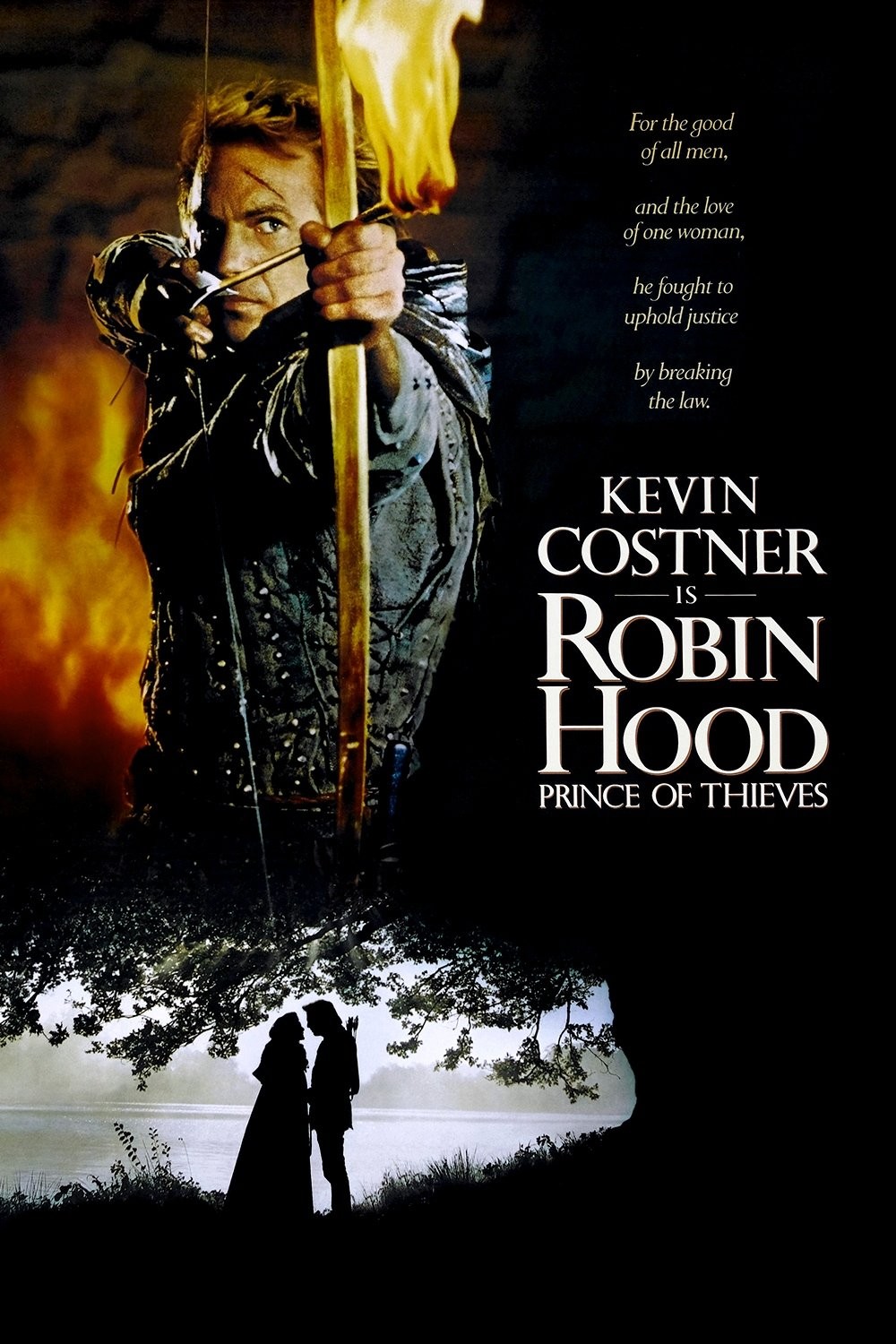
Robin Hood Week Day 4: Kevin Costner in Robin Hood-Prince of Thieves (1991)
 Director: Kevin Reynolds
Writer: Pen Densham & John Watson
Cast: Kevin Costner, Morgan Freeman, Christian Slater, Mary Elizabeth Mastrantonio, Alan Rickman, Nick Brimble, Mike McShane, Michael Wincott, Geraldine McEwan, Harold Innocent, Brian Blessed, Soo Drouet
Plot: Robin of Locksley (Kevin Costner), a nobleman who joined King Richard in the Crusades, has been captured in Jerusalem. He escapes, saving the life of a Moor named Azeem (Morgan Freeman) in the process. Azeem returns to England with Robin, having sworn a life-debt to the Christian. Robin and Azeem return to England to find Nottingham under the thumb of its cruel Sheriff (Alan Rickman). The Sheriff rules with the aid of Sir Guy of Ginsbourne (Michael Wincott), the corrupt Bishop (the ironically-named Harold Innocent), and a witch named Mortianna (Geraldine McEwan), who fears prophecy of her death at the hands of a “painted man.” Robin meets with a childhood friend, Marian (Mary Elizabeth Mastrantonio), whose brother made Robin swear to protect her before dying in the Crusades. Robin’s father is dead and his home destroyed, and he and Azeem flee into Sherwood Forest to evade the Sheriff’s men.
They encounter a band of outlaws led by Little John (Nick Brimble) and Will Scarlet (Christian Slater), who takes an immediate dislike to Robin. Robin takes the lead of the outlaws and begins training them to fight. As time passes, they begin robbing the coaches of noblemen, including that of a hard-drinking but able Friar Tuck (Mike McShane), who joins their party. Marian, realizing that Robin is fighting for the England of her absent cousin, the King, begins to quietly provide him aid.
The Sheriff hires mercenaries to help him find Robin’s woodland hideout, capturing several of his men. He “proposes” marriage to Marian, the King’s cousin, saying he will space the captured outlaws if she accepts. One of the captives, Will Scarlet, deals with the Sheriff to track down Robin. When released into the forest, though, Will tells Robin of the Sheriff’s plans despite his anger with the man. Will reveals that he is Robin’s half-brother, the son of a woman Robin’s father took up with after his mother died. Robin embraces his brother, and together, they begin to plan.
On the day of Marian’s wedding – which will coincide with the execution of the captives – Robin leads a rescue, setting them free. Azeem rallies the peasants to join them in overthrowing the Sheriff, and Nottingham erupts into war. The Sheriff rushes his “wedding” to Marian and takes her away, planning to consummate the marriage. As the Bishop tries to flee, Tuck faces him and loads him with treasure, pushing him from a window to his death. Robin saves Marian and kills the Sheriff, but Mortianna attacks him with a spear. Before she can strike her blow she is killed by Azeem, who has fulfilled his debt to Robin.
Robin and Marian marry in the forest, a wedding only briefly interrupted by the return of King Richard (Sean Connery in an awesome cameo), who blesses them and gives Robin Hood his thanks.
Thoughts: I was 13 years old the summer this movie came out, and although I know it gets a lot of grief from the Costner-haters of the world, it’s still a movie I really like. This was the first live action Robin Hood movie I ever saw, and as such it has greatly influenced my feelings about the character. Still, looking back at it 20 years later, I can see some of the cracks in the hero’s armor.
Kevin Costner, to begin with, is slightly problematic. While I don’t hate the man, and in fact find his performance to be mostly effective, the fact that he doesn’t even attempt to sound English really does stick out like a Teletubby in a Goth Club. For all the good he brings to the role – a confident air, a dedication that feels genuine – the truth is I do have to force myself to ignore his lack of an accent. There’s an irony here – most linguistic scholars believe that the modern American dialect is actually much closer to 12th-century England than the speech patterns of the modern British. One could actually make the argument that Costner technically has the most accurate speech pattern in the film. Of course, I would then tell “one” to shut up, because that doesn’t change the fact that Costner still didn’t sound like anybody else in the movie.
The rest of the cast, however, is impeccable. Morgan Freeman, who is as convincing as a Moor as Costner is as an actor being paid an enormous amount of money but still refusing to attempt an accent, steals the show as Azeem. He takes over the role of Robin’s second that is usually occupied by Little John, standing with him in the hardest moments and driving together the action when he draws his sword. His dry wit even brings a good bit of comic relief to the film. I would gladly have watched a film chronicling the further adventures of Azeem.
But the prominence of this original character doesn’t really hurt Robin’s usual Merry Men. Mike McShane’s Friar Tuck is a riot and a lot of fun to watch, and to compensate for making Little John somewhat less of a central player than he usually is, the screenwriters introduced his wife (Soo Drouet) and family, giving him much more to do and much more at stake than he usually has. Drouet herself is a very strong addition to the cast – wry and boisterous, like a saucier version of Molly Weasley. Mastrantonio’s Marian… well, she’s not bad at all, but there’s nothing particularly memorable about he. She plays the part, she does what you want her to do.
Alan Rickman, however, absolutely shines. We’re only a few years removed from Die Hard here, and he brings the same sort of nasty menace to the Sheriff of Nottingham as he did to Hans Gruber. When he threatens to cut out Robin’s heart “with a spoon” (“Because it’s dull, you twit, it’ll hurt more,”) damned if you don’t believe it. This is, without exception, my favorite rendition of the Sheriff of Nottingham of all time, the fiercest, the most frightening, and the most fun to watch.
It may be because I was just at the right age when this movie hit, but it’ll always hold a soft spot for me. I can watch it over and over even today and always enjoy it, always get swept up in the excitement, and always feel ready to cheer for England’s legendary defender.
The first Reel to Reel study, Mutants, Monsters and Madmen, is now available as a $2.99 eBook in the Amazon Kindle store and Smashwords.com bookstore. And you can find links to all of my novels, collections, and short stories, in their assorted print, eBook and audio forms, at the Now Available page!
Robin Hood Week Day 3: Sean Connery in Robin and Marian (1976)
 Director: Richard Lester
Writer: James Goldman
Cast: Sean Connery, Audrey Hepburn, Robert Shaw, Richard Harris, Nicol Williamson, Denholm Elliott, Kenneth Haigh, Ronnie Barker, Ian Holm, Veronica Quilligan, John Barrett, Esmond Knight
Plot: The aging Robin Hood (Sean Connery) has become one of King Richard’s (Richard Harris) most stalwart captains, leading Richard’s men to war in France. Robin and Little John (Nicol Williamson) lay siege to a castle, seeking a rumored treasure, but find only a single one-eyed man (Esmond Knight) guarding a few poor citizens. Richard orders Robin to storm the castle for the treasure, but Robin refuses and is arrested. The one-eyed man throws an arrow at Richard, wounding him in the neck. Richard has the castle destroyed. Dying from his wound, he summons Robin. He tries to draw his sword and slay Robin, but lacks the strength and collapses. As Robin rushes to his side, Richard pardons him before dying.
Robin and John return to England, where they’re assaulted by two old men. As they fight, they recognize Will Scarlet (Denholm Elliott) and Friar Tuck (Ronnie Barker). The friends reconnect, learning that Robin’s old adventures have become exaggerated and turned into legend, and now-King John (Ian Holm) has gone mad with power, with the people of England and even the Church turning against him. They take Robin to an Abbey where they find Marian (Audrey Hepburn), now a nun. As the Sheriff of Nottingham (Robert Shaw) arrives to arrest her for refusing the King’s order for all clergy to leave England, Robin “rescues” Marian against her will, and the Sheriff orders Robin’s arrest. In the forest, Marian abashes Robin for his part in the Crusades, and Robin confesses to the horrors he saw in war. When they return to the Abbey, they find the Sheriff has arrested all of the nuns but one.
Robin and John disguise themselves as peddlers and free the nuns, but are almost captured in the escape attempt, with Marian, Will and Tuck arriving to rescue the rescuers. Marian confesses to attempting suicide when Robin left, and the two almost kiss before Will signals them that a Sheriff’s posse approaches. After driving them off, Robin tells Marian all he wants now is a life with her in Sherwood. That night, as they relax in the woods, townspeople who saw them rescue the nuns arrive in the forest, wanting to join him to fight against King John.
King John sends out a force of 200 men to drive Robin from the forest. As they amass, Robin and his men watch, knowing they are hopelessly outnumbered. Marian tries to plead with him not to fight, but Robin insists he’s still the warrior he was in his youth. She swears to leave rather than watch him get slaughtered, and goes instead to Little John, hoping he can convince Robin not to fight. Although John agrees it is suicide, he refuses to speak against Robin, and vows to ride into battle with him.
Robin approaches the Sheriff with a proposal – a duel between the two of them. If Robin wins, the soldiers retreat; if the Sheriff wins, Robin’s men surrender. The Sheriff agrees. Both men are grievously wounded, with Robin taking a horrible slash to the side before finally killing the Sheriff. As he dies, the King’s men charge, and Little John slays their captain. John and Marian help Robin from the battlefield to the Abbey for treatment, while his men are scattered into the woods, with many captured or slain.
Lying in the Abbey, Marian gives Robin medicine and speaks of how – once well – he’ll lead his men into battle once again. When his limbs begin to go numb, he realizes Marian has poisoned him. When he asks her why, she processes her love for him – a love so deep that she cannot allow him to go on, knowing he would never be the warrior he was again. What’s more, she has taken the poison as well. Robin agrees that it’s better this way, and asks John for his bow. He fires an arrow into the air and asks they be buried together where it falls.
Thoughts: A few years before diluting Richard Donner’s Superman universe with a recut and reshot Superman II, Richard Lester put no less than James Bond and one of history’s most beautiful women in this odd rendition of the Robin Hood saga. From the beginning it’s clear this isn’t the Robin Hood most people are familiar with. This is a Robin who fought in the Crusades with Richard, something most movies don’t include. What’s more, this is a Richard who may have the name “Lionhearted,” but carries none of the patience or understanding one would expect from one of noble rank. Robin calls him a “bastard” in the opening scene, and as he’s presently ordering him to murder women and children over a non-existent treasure, it’s hard to disagree with that assessment.
Unlike the bold adventure most Robin Hood films become, Richard Lester’s version take a weird sort of anti-war stance, with Robin giving a monologue about watching King Richard order the slaughter of innocent Muslims after his single great victory of the Crusades. This isn’t the bold Robin Hood we’re used to, but a worn-down, tired man whose glory days are behind him… and what’s worse, he finds himself questioning if they were ever truly glorious to begin with.
Sean Connery is… well, he’s Sean Connery. Let’s be honest here, he’s always Sean Connery, whether he’s Sean Connery as a young Irishman, a dashing British secret agent, a Russian submarine commander or a whatever the crap he was supposed to be in Zardoz, he’s still Sean Connery. The miracle of that is that he almost always gets a role where “somebody like Sean Connery” is exactly what the movie calls for. Mid-70s Sean Connery is perfectly cast as the aging Robin Hood – still strong and undeniably charismatic, but at the same time, he’s beginning to get a little world-weary. Oh, he’ll still fight, and he’ll still kick your butt, but that doesn’t mean he isn’t getting a little bit tired of it. While Connery’s Robin is still willing to take up arms whenever necessary, it’s clear the only thing he really wants is to reclaim the love of Marian and settle down to a life he wishes he hadn’t sacrificed 20 years earlier.
Audrey Hepburn was 47 when this movie came out, and the line when she asks Robin if she’s “old and ugly” is still laughable. The woman had a grace and a poise her entire life that the greatest movie stars of all time couldn’t touch and the best of today can only dream about. Like Connery, she does a fine job of painting a woman who has grown tired with the world. She lost her dreams a long time ago, but she’s not so far gone that she can’t be convinced to take them up again. She vacillates between her heart and her vows several times, and always in an entirely convincing manner.
In this film, the villains are almost nonentities. The Sheriff and King John are the root of Robin’s problem, but he faces them almost as a matter of course, the way you face a force of nature. This could be the story of a stubborn old man intent on battling a hurricane or an earthquake for all the influence they have on the story. That’s nothing against Robert Shaw or Ian Holm, mind you, their performances are perfectly fine, but they aren’t given that much to do. Even Richard Harris as King Richard comes across as more of a personal obstacle for Robin than the ostensible villains of the piece. In truth, the real antagonist for Connery’s Robin Hood is age itself, the certainty of mortality and the inevitable approach of death.
It’s a cheerful movie, is what I’m saying.
I take that back, there is one bit that’s kind of funny… the duel between Robin and the Sheriff. If the goal of the scene was to thrill the audience, they failed, with the camera often set so far back it’s nigh impossible to tell who is who. If the goal is to depict a semi-realistic fight with very heavy broadswords and axes that look like a chore to swing around… well, Richard Lester, you succeeded, but in so doing you crafted one of the most mundane fight scenes in Sean Connery’s long and storied career. Even the sword fight in Franco Zeffirelli’s Romeo and Juliet had more excitement than this one, and that’s not intended as a compliment.
The final scene of the film is really a grand one. The revelation that Marian deliberately poisons him is baffling, but instantly understandable when she makes her declaration of love. It’s a moving scene and both Connery and Hepburn nail it. The movie isn’t a masterpiece, but the finale makes it worthwhile. It’s not a standard version of Robin Hood at all, but it’s an impressive one, and one that serves as a bittersweet conclusion to the legend.
The first Reel to Reel study, Mutants, Monsters and Madmen, is now available as a $2.99 eBook in the Amazon Kindle store and Smashwords.com bookstore. And you can find links to all of my novels, collections, and short stories, in their assorted print, eBook and audio forms, at the Now Available page!
Robin Hood Week Day 2: Brian Bedford in Robin Hood (1973)
 Director: Wolfgang Reitherman
Writer: Larry Clemmons & Ken Anderson
Cast: Brian Bedford, Monica Evans, Phil Harris, Roger Miller, Peter Ustinov, Terry-Thomas, Andy Devine, Carole Shelley, Pat Buttram, George Lindsey, Ken Curtis, Billy Whitaker
Plot: When good King Richard (a lion) left for the crusades, he left his brother Prince John as ruler of England, despite the fact that they were both voiced by Peter Ustinov. The rooster minstrel Alan-A-Dale (Roger Miller) tells us the story of the crusader who fought against John – a clever fox named Robin Hood (Brian Bedford), who defended Sherwood Forest with his friend, a bear named Little John (Phil Harris). The two outlaws disguise themselves and rob a coach carrying Prince John and his right-hand snake, Sir Hiss (Terry-Thomas).
John’s flunky, the Sheriff of Nottingham (Pat Buttram) makes the rounds to collect the exorbitant taxes from the townsfolk, snatching up every cent Robin’s friend Friar Tuck (Andy Devine) has managed to smuggle to them, even snaring a rabbit child’s birthday present of a single coin. As he leaves, Robin arrives in disguise and gives the boy a bow and arrow, along with one of his hats. The boy, Skippy (Billy Whitaker) leads his friends to play, but loses the bow in a palace courtyard. When he goes to retrieve it, he encounters Maid Marian (Monica Evans) and her friend Lady Cluck (Carole Shelley). The kids question Marian about her past relationship with Robin, and Skippy winds up playacting a “rescue” of Marian, culminating with her giving the unsuspecting boy a kiss.
Back in the forest, Robin is busy mooning over Marian himself when Friar Tuck brings him the news of an archery tournament, with the prize to include a kiss from Marian. Robin cannot help himself from entering the tournament, albeit disguised as a stork. He wins easily, but his disguise slips and he’s captured. Before the Sheriff can execute him, Little John forces the Prince to release him, and taking Marian with him, Robin and the others flee into the forest.
When Prince John learns how the people of Sherwood have begun to mock him, he triples the taxes and arrests anyone who can’t pay. The Sheriff tries to empty the church’s poorbox to line John’s coffers, sending Friar Tuck into a rage. He’s arrested and John sentences him to death in order to lure Robin Hood out of hiding. Disguising himself as one of the Sheriff’s Vulture henchmen, Robin sneaks into the palace late that night. Little John frees the Friar and the rest of their friends who have been arrested, while Robin sneaks off to steal the sacks of money in Prince John’s private quarters right under the sleeping prince’s nose. As he makes off with the last of it, Sir Hiss wakes up and alerts John (in a cartoonishly violent way). After a daring escape, Robin dives into the moat, followed by a shower of arrows, and Prince John believes him dead… but he pops up and chimes out “A pox on the phony king of England!” sending Prince John crying for his mommy.
Eventually, King Richard returns to England and pardons Robin and his men, placing John, Sir Hiss, and the Sheriff in irons, just in time for Robin and Marian’s wedding.
Thoughts: As with many people my age, this was the first version of Robin Hood I remember seeing, and in fact was the only version I was aware of for many years. In fact, even though Roger Miller’s Alan-A-Dale starts the movie by pointing out there are many versions of the Robin Hood and that this is, in fact, the version told by the animals, I remember being distinctly surprised when I got a little older and realized that Robin Hood was not, in fact, an original Disney character, and that what’s more, most versions of him were human and did not start anthropomorphic animals. Then I had to stop and look up what “anthropomorphic” meant, because I was like eight years old.
What’s more, this is the first time I watched this movie in years, and I’m catching a number of things I never would have noticed before. For example, the first scene with Robin Hood and Little John, after some cartoon antics escaping Prince John’s men, sees them engaging in a moralistic debate over the ethics of the whole “robbing the rich to give to the poor” angle. It’s a bit more thoughtful than one would expect from an early-70’s Disney movie, but it’s highly appropriate. In fact, there’s a lot of ethical moralizing in this movie. Whereas Errol Flynn (despite his loyalty) blamed Richard for leaving England in the hands of his brother to engage in the Crusades, Disney lightens it up a bit by making Richard the victim of the hypnotic Sir Hiss, who sent him off on what John calls a “silly crusade.”
The 70s were sort of a nebulous time for Disney. Walt was gone and, although it was still many years before the company’s second renaissance would begin with The Little Mermaid, it was also long before they would really hit the skids in the 80s. There’s a roughness to the quality of the films of the period, and while it now marks them indelibly as products of their time, it’s also the time in which I was introduced to Disney animation. I’ve got a soft spot for it. Even this film has a lot going for it in terms of animation and performance – the way Sir Hiss slithers his body underneath himself to simulate the elbows of a petulant teenager is a great image that gives you the perfect amount of character development. Brian Bedford and Phil Harris as Robin Hood and Little John remain the voices I hear when I think of the characters, and folk singer Roger Miller made for a fantastic bard.
Despite the animal players, the movie has lots of tiny moments that humanize the characters, such as Robin’s gift to the rabbit boy. As the kids leave, he gives the mother a sweet speech about keeping faith that Nottingham will return to glory. While Errol Flynn was loud and bombastic with his approach to rousing the townspeople, Brian Bedford’s Robin Hood is a quieter hero, one who sneaks in and out, going unnoticed until he’s discovered. Of course, once a disguise fails and he’s made, he’s just as likely to bring forth a spectacle as any other incarnation of the character. (The disguises, it’s worth pointing out, are only slightly above Bugs Bunny quality in the concealment department, but they usually work exceedingly well.)
The movie also sidesteps the usual beginning of the Robin/Marian relationship. In the Flynn movie, and in most other versions, the two are initially at odds, as he’s an outlaw and she’s a ward of the King and (technically) under the protection of the Prince. In this version, Marian loved Robin as a young girl and still does, eliminating the need for him to win her over and cutting right to the chase. I would imagine this is in deference to the cartoon nature of the film – while the scenes of Robin winning Marian over can work really well from an emotional standpoint, I can imagine in 1973 the animators thought a young audience would lose patience with such a thing.
Compared to the Errol Flynn film, the villains are far less menacing. Prince John is a spoiled mama’s boy with no air of danger about him whatsoever. Sir Hiss – a stand-in for Sir Guy of Ginsbourne – is a pompous, browbeaten serpent. The only thing about him that’s even remotely dangerous is his ability to hypnotize people, which he never even really uses to any serious effect once the story begins. (Dispatching Richard on the Crusades, the most important plot point to his hypnotism, happens before the film opens.) Only the Sheriff is an improvement in the villain department from The Adventures of Robin Hood, and that says more about the latter’s buffoonery than anything in favor of the Disney version. He’s less oafish and more dangerous than the other two, but still not the sort of villain that would give any kid trouble sleeping.
The biggest complaint I’ve got about the film is the ending. The final rescue at Prince John’s palace is fine, but Richard’s return to the throne and the arrest of the villains happens entirely off-camera. It’s not all that satisfying to cut from Robin’s escape, even as the prince pouts, to seeing them in chains with nothing in-between. Sure, these cartoons films are often short (at a crisp 83 minutes there’s little filler in this movie), but it certainly feels as though they could have given us just a bit more closure.
This isn’t the grand adventure of the Errol Flynn Robin Hood nor the attempt at an epic that the character would take later. It is, however, a grand and entertaining family version of the film with some sweet music, excellent voice performances, and mid-era Disney charm. It’s hard to say anything bad about that.
The first Reel to Reel study, Mutants, Monsters and Madmen, is now available as a $2.99 eBook in the Amazon Kindle store and Smashwords.com bookstore. And you can find links to all of my novels, collections, and short stories, in their assorted print, eBook and audio forms, at the Now Available page!
Robin Hood Week Day 1: Errol Flynn in The Adventures of Robin Hood (1938)
 Directors: Michael Curtiz & William Keighley
Writers: Norman Reilly Raine & Seton I. Miller
Cast: Errol Flynn, Olivia de Havilland, Basil Rathbone, Claude Rains, Patric Knowles, Eugene Pallette, Alan Hale, Melville Cooper, Ian Hunter, Una O’Conner
Plot: In the year 1191, King Richard the Lionheart (Ian Hunter) left England to reclaim the Holy Land in the crusades, with his bitter brother Prince John (Claude Raines) in charge. When Richard is captured in Austria John – a Norman — seizes the opportunity to increase his power over the Saxons of England, raising taxes and seizing goods and services on the populace… even enslaving people who refuse to toil for his crony, Sir Guy of Gisbourne (Basil Rathbone). The Saxon Sir Robin of Locksley (Errol Flynn) begins to resist the Norman oppression of the Saxons. As John hosts a banquet, Robin himself arrives. Robin makes it clear his intention is to rouse the people of England into revolt against John, then fights his way to freedom in front of Norman noblewoman Maid Marian (Olivia de Havilland).
Returning home, Robin and Will Scarlett (Patric Knowles) encounter a large man (Alan Hale) crossing a stream. Robin and the man battle, and Robin is knocked into the water. Laughing at the scuffle, they befriend the man – John Little – and together unite a band of free people of England who swear to fight John and defend all innocent – Norman and Saxon alike — until the return of King Richard.
As Guy leads a procession through Sherwood Forest, Robin’s men capture them all, humiliating Guy and the Sheriff of Nottinham (Melville Cooper). Robin attempts to impress Marian with their frivolity, but she remains cold. Her heart begins to change, though, when she realizes Robin and his men intend to return the goods they have stolen to King Richard and he introduces her to some of the Saxons suffering. For the first time, Robin exposes Marian to the misery John’s rule has wrought.
The Sheriff proposes a trap for Robin – an archery contest with a golden arrow presented by Marian as a prize. Robin enters in disguise and, after several rounds, wins. As Marian presents him with his prize, Sir Guy exposes him and he is captured. Robin is sentenced to death and imprisoned, and Marian rushes to his men to help plan a rescue. They disrupt his execution and flee. That night, as he comes to thank her, he overhears her professing her love for him, and he shares his own.
A bishop brings John the news that King Richard has escaped his captivity and returned to England. John sends an assassin to kill him, but Marian overhears his plan. Before she can send word to Robin, she is discovered by Sir Guy and arrested. Robin and his men capture Richard, not realizing who he is at first, and impress the King with their loyalty. They are together when they learn of Marian’s execution, which is scheduled to coincide with John’s coronation. Robin and Richard lead their men into battle. Robin kills Sir Guy and frees Marian, and the forces loyal to Richard overwhelm those of Prince John. Robin is made Baron of Locksley and given Marian’s hand in marriage. Richard banishes John and his men from England and calls for Normans and Saxons alike to share the freedoms of true Englishmen.
Thoughts: For generations this was not only the benchmark of Robin Hood movies, but the archetype against which all swashbucklers would be measured. Errol Flynn is truly magnificent in the title role, cutting a dashing figure of such strength and earnestness that one couldn’t help but want to follow him into battle.
This is, I confess, the first time I’ve ever seen this version of Robin Hood, but it’s one of those movies that’s known so well through parody and inspiration that I may as well have. Dozens of cartoons, TV shows and other films have liberally borrowed chunks of this movie wholesale. Flynn’s performance hasn’t informed too many of the modern Robin Hoods, each of whom seems to want to offer a different take on the character, but any other time a film tries to give a taste of Golden Age glory in an adventure tale, Flynn is the inspiration. You can feel pieces of his performance in Cary Elwes’s Westley from The Princess Bride, spoofed in Monty Python and the Holy Grail, and as the hero Timothy Dalton’s villain pretends to be in The Rocketeer.
Although Robin is the hero here, and a great one at that, Flynn isn’t afraid to let him feel a little humiliation. His defeat against Little John at the stream is an iconic moment, and one that’s easy for him to laugh off. His first encounter with Eugene Pallette’s Friar Tuck follows a similar pattern, but Tuck fights a bit more ferociously, and Robin comes across as a bit of a bully before he extends his hand in friendship.
Olivia de Havilland is radiant as Marian, and does a good job of selling her change of heart. In the early scenes it’s easy to feel discomfort – even disgust – during her dealings with Robin. As she starts to realize the truth about John’s rule, her emotional metamorphosis is slow, but convincing. By the time we reach the scene where Robin is sentenced to death, you can tell she’s in love with the man and trying desperately not to show it in the face of his enemies.
The villains are an odd collection. Rains’s Prince John comes across as a bit of a lightweight, but he’s at least sharp enough to have Rathbone’s Guy of Gisbourne as his enforcer. He’s not a physical threat on his own, but you can believe he would command a man of Gisbourne’s menace. The Sheriff, on the other hand, is a real goof. He’s cowardly and ineffective, with only the inspiration for the archery contest keeping him from being entirely useless. A comic relief villain isn’t necessarily a bad thing, but considering how elevated the Sheriff often is in Robin Hood lore, I was a bit surprised to see him as the clown in this early, iconic cinema version of the story.
The fight scenes are particularly impressive for the time period. Intricately choreographed, Flynn and his men put up an impressive front against the worst Prince John can send against them. Although there is a good dose of Hollywood magic to it (the swords, for instance, are not particularly convincing as weapons, although they’re handled very well), it’s the sort of thing that you forgive as a staple of the time, even as the presentation is wonderfully entertaining. The archery scene is another one of those moments that has been endlessly parodied and referenced, and it’s done fairly well. In these long-ago days, before CGI and the effort to give us an arrow’s-eye view of the winning shot, it’s presented in a very straightforward, simple style that nonetheless pleases the eye and brings a smile to a real lover of old cinema.
The final, climactic battle feels like a template for all great swordfights. Watching dozens of men fight and dozens of swords flash at once is a blast, the sort of thing every kid who’s ever picked up a branch and pretended it’s a blade dreams of. While Robin and Guy are having their own final confrontation, the directors start getting fancy: they walk off-camera and we watch as their shadows carry on the fight. Close-ups of the two of them as they grapple ratchet up the tension until Robin deals the final blow, and Guy’s plunge down the stairwell looks painful enough to be real.
One thing that rather surprised me about the film was just how much of it had the overtones of racism. Granted, the Saxons and the Normans are pretty indistinguishable to a viewer, but the oppression of the Saxons cuts a deep swath through the American heart. It’s impossible to hear the disgust John espouses without it evoking the nastier aspects of our own past. In truth, considering that this film takes place in the 12th century, it works well as a reminder that ignorance isn’t exactly a new invention. At the same time, fortunately, it does give us some hope that even 900 years ago, there were men willing to stand against it.
This movie is justifiably hailed as one of the all-time great adventure films, and it’s as fine an example of golden age cinema as I can imagine. For many, for decades, Errol Flynn was Robin Hood. And in truth, when you watch this movie, he always will be.
The first Reel to Reel study, Mutants, Monsters and Madmen, is now available as a $2.99 eBook in the Amazon Kindle store and Smashwords.com bookstore. And you can find links to all of my novels, collections, and short stories, in their assorted print, eBook and audio forms, at the Now Available page!
Next week is ROBIN HOOD WEEK
 “Icons” had to take a break in July due to another project of mine, but it’s coming back to close out the month of August as I look at one of the great folk heroes of all time and how he’s been portrayed on the silver screen.
Robin Hood is one of the world’s most indelible heroic archetypes: the dashing rogue that fights against an unjust system by robbing from the rich and giving to the poor. But is it always quite that simple? Next week we’re going to find out through five very different takes on our title character…
- Errol Flynn: The Adventures of Robin Hood (1938)
- Brian Bedford: (Disney’s) Robin Hood (1973)
- Sean Connery: Robin and Marian (1976)
- Kevin Costner: Robin Hood: Prince of Thieves (1991)
- Cary Elwes: Robin Hood: Men in Tights (1993)
Yes, there are other Robin Hoods… many, many, many other Robin Hoods. Some of them even speak with an English accent. I created this list based on the versions that are the most memorable to me. If you disagree, you Russell Crowe fans, you’re welcome to do your own write-ups.
Of course, before we can start, we need to know who our hero is, don’t we?
The Character
When good King Richard left England to go on the Third Crusade, rule of his country was left in the hands of his corrupt brother, Prince John. As John proceeded to crush the populace with unjust rule and unfair taxes, a former nobleman escaped into the eaves of Sherwood Forest. There, the outlaw who would become known as Robin Hood gathered a band of Merry Men to join him in his own Crusade — one against the Prince and his enforcer, the Sheriff of Nottingham, to preserve the England King Richard left behind.
This, of course, is a bit of an aggregate of the character. There have been stories of Robin Hood told throughout Europe for over 600 years, and as with many truly legendary characters, several of the versions have a tendency to contradict one another. But this baseline is how most people think of the hero today, and that seems as good a way as any to start. Come back Monday, friends, and we’ll start with one of the first truly great cinematic adventure films.
Gut Reactions: Kick-Ass 2 (2013)
 Director: Jeff Wadlow
Writer: Jeff Wadlow, based on the comic book series by Mark Millar & John Romita Jr.
Cast: Aaron Taylor-Johnson, Chloe Grace Mortez, Morris Chestnut, Claudia Lee, Clark Duke, Augustus Prew, Donald Faison, Steven Mackintosh, Monica Dolan, Garrett M. Brown, Lyndsy Fonseca, Christopher Mintz-Plasse, Yancy Butler, John Leguizamo, Jim Carrey, Robert Emms, Lindy Booth
Plot: It’s been two years since the events of the first Kick-Ass, and both Dave Lizewski (Aaron Taylor-Johnson) and Mindy Macready (Chloe Grace Mortez) have remained retired from action as the “real world” superheroes Kick-Ass and Hit-Girl. When Dave starts to feel restless but is unable to convince Mindy to get back into action, he finds a new team of citizens eager to fight to take back the streets. Meanwhile the former Red Mist (Christopher Mintz-Plasse) finds himself with the freedom to take action against Kick-Ass for killing his mob boss father with a plan that could plunge the entire city into all-out war.
Thoughts: As big a geek as I am, I’ve never actually read any of the comic books the two Kick-Ass movies have been based on. I’m not a fan of the writer, Mark Millar, who I feel often goes for shock value at the expense of real emotion and discards characterization at a whim. Despite this, I liked the first Kick-Ass and wasn’t surprised that I thought the sequel wasn’t bad at all.
With news stories about “real world” superheroes like Seattle’s Phoenix Jones becoming more prevalent in the news, this story hits a nice chord that examines the philosophy of a person who would choose to put on a costume and try to beat up gang bangers at night. This time around, with Nicolas Cage’s “Big Daddy” character out of the picture, the relationship between Dave and Mindy becomes the center of the film. The two of them both shift back and forth between craving the life of a hero and trying to reject it at various points. What’s more, it’s easy to understand and even sympathize with both points of view – on the one hand, it’s a remarkably dangerous and (frankly) stupid lifestyle. On the other hand, when confronted with evil, how can a decent person simply choose to do nothing?
Interestingly, the most press I’ve seen about this movie in the last few months seems to have come from the fact that Jim Carrey, who plays “Colonel Stars and Stripes,” has chosen not to promote the film. Carrey says that the events at Sandy Hook Elementary last winter (which happened after filming was complete) affected him deeply and he cannot, in good conscience, promote violence. While I don’t take issue with him choosing a pacifist lifestyle, I have to wonder if he actually paid attention to the movie while he was making it. Kick-Ass 2 in no way promotes a violent lifestyle. While there is a lot of comedy in the film, and while some of the fight scenes are somewhat exaggerated, that’s not the same thing as saying they’re glamorized. The film clearly shows the consequences of violence in general and the lifestyle that Dave has chosen in particular, and neither of these are things that any sane person would willingly accept. In this movie, as in the first one, choosing a life of violence hurts, both physically and spiritually.
Which is not to say there isn’t fun. Mintz-Plasse’s character, embarking on a quest to become the world’s first real super-villain, is pretty laughable for most of the film. Even once it gets dark, when he starts to recruit real muscle to back up his threats, he’s still a caricature of every stupid, overblown villain cliché you can imagine. He’s a point of ridicule, a pathetic character, and would be pitiable if he didn’t pull off a few legitimately evil acts in the film. (It’s also worth noting that the film scales back on the comic book, dropping the most evil act he commits as apparently being too much to put on screen. I haven’t read the comic, as I said, so I can’t judge how well it worked there, but I do think it would have been too much on the screen.)
With so many superhero movies these days, it’s nice to see one that brings the action down to a (mostly) human level, that doesn’t treat average citizens as cannon fodder, and that shows that being a hero can hurt. There are two other comics in this series (a Hit-Girl spinoff and the currently in-progress Kick-Ass 3), and I’d be anxious to see both of those make it to the screen too. If not, I may actually have to break down and read the comics to see how the saga of Dave Lizewski finally ends.
The first Reel to Reel study, Mutants, Monsters and Madmen, is now available as a $2.99 eBook in the Amazon Kindle store and Smashwords.com bookstore. And you can find links to all of my novels, collections, and short stories, in their assorted print, eBook and audio forms, at the Now Available page!
Fun with Riffing
 Once upon a time, there was a thing called the “Cable Ace Awards.” It was basically the Emmys for cable TV. They stopped giving them out about the same time HBO started winning all of the real Emmys, at which point they realized there was no longer any reason for the Ace Awards to exist, showing the sort of self-awareness the MPAA can only dream of. As far as I’m concerned, there’s only one lasting contribution the Ace Awards made to modern society: they’re responsible for my introduction to Mystery Science Theater 3000. One year, whichever network was broadcasting the awards showed a bunch of the nominated shows over a weekend, including an episode of MST3K. As my parents’ cable provider did not, at that time, carry Comedy Central, I’d never seen an episode before. I stumbled upon the image of a guy and two robots in a darkened theater cracking jokes about a terrible 50s-era monster movie, the sort that local TV channels still showed all weekend even then. I was instantly mesmerized, but it would be about two years before our local cable got Comedy Central and I was given my real entryway into becoming a hardcore MSTie for life.
MST3K went away many years ago, of course, but it has its spiritual successors, my favorite of which is RiffTrax. The RiffTrax crew consists of Michael J. Nelson, Bill Corbett, and Kevin Murphy – essentially the second cast of MST3K. They’re doing the same job as before, making fun of movies, but now they do it through video on demand you can download from their website or buy on DVD, MP3 commentary riffs for blockbuster movies that you can synch and watch on your own, and a few times a year, live riffs of movies they perform in front of an audience and broadcast to movie theaters across America. Last night, I went to the first RiffTrax Live event I’ve had the chance to attend – a Kickstarter-fueled riffing of director Paul Verhoven’s laughably bad sci-fi “satire” Starship Troopers. The riff was great, picking apart the movie mercilessly. Even several cast members, including Casper Van Dien, Clancy Brown, Jake Busey, and Neil Patrick Harris (who has joined Mike Nelson for riffs in the past) spread the word about the riffing, none of which particularly spared them from the crew’s jokes… although it should be noted that Denise Richards undoubtedly got the worst of their jabs, and she didn’t seem to have anything to do with promoting the riffing.
I’m not here to sell you on the riff, though – you can go to their website and download any of their riffs if you need convincing. What I loved about this, more than anything else, was the actual experience of watching the film. I went with my friends Kenny, Daniel and Lauren, all of whom have gone to RiffTrax Live shows before, and therefore knew a bit more about what to expect than I did. As we sat down, the screen rolled with what appeared to be the usual pre-movie spiel you get in any multiplex in America… but soon, the resounding laughter would make it clear even to the blind that this wasn’t just your ordinary stuff. Instead, it was RiffTrax-generated jokes. Anagrams that poked fun at recent summer blockbusters, “Movie Mistakes” gags that invariably turned into jokes about Casper Van Dien’s post-Troopers career, and so on. With each change of the scene there’d be quiet, then laughter.
In-between the new screens, though, the atmosphere was nothing like a usual movie theater, where disinterested strangers sit around chomping down their popcorn at best or yammering on their phone at worst. Instead, it was a sort of carnival atmosphere, full of people who came not just to watch a movie, but to have a good time. People roamed around, talking, chatting to strangers. There was a sort of unspoken promise that the general volume level would drop to read the preshow cards (even though there was no technical reason for it to do so), and a bizarre feeling of community. It was like everybody in the room was in on a joke that we knew the people wandering in and out of whatever Tyler Perry joint was soiling the adjacent theater would never understand.
Once the movie started, the conversation stopped, but not the noise. People laughed, people cheered, people applauded their favorite riffs. I don’t usually clap even in the best of movies, because it’s not like the actors can hear me. But when Mike Nelson dropped a fairly obvious gag at the expense of AT&T, it hit a sort of universal chord that made the theater almost explode with energy, and I found myself pounding my hands together along with everybody else.
Because I wasn’t just “at the movies,” like I am any other time, even when the best movies are on the screen. Years ago, the MST3K commercials included a line that was something like, “It’s like watching cheesy movies with three of your funniest friends.” Last night, I felt like I was in an entire theater full of friends who wanted to have a good time together.
They’re going to rebroadcast the Starship Troopers show on September 12, again in theaters across America. Then they’re coming back on October 24 to riff the granddaddy of the modern zombie film, Night of the Living Dead. I can’t wait to see that one too, and I intend to go to as many of these as I can from now on. In a world where even movie theaters are so often dens of misery, it’s great to know that for just a little while, you can stop in for some pure, untarnished fun.
 Reel to Reel